Multi-Site Manufacturing Operations: Managing Complexity Across Multiple Facilities
Turn this article into takeaways for your work.


Each assistant summarizes the article only for you and suggests best practices for your work.
An industrial equipment manufacturer operated five plants across three countries. Each site had evolved independently with its own systems, processes, and cultures. Corporate headquarters struggled to get consistent data. Product costs varied wildly between sites making identical products. Customer orders bounced between facilities based on whoever had capacity, creating logistics chaos. The CFO calculated that network inefficiency cost 8% of revenue annually. They had facilities but not a network.
Multiple manufacturing sites should create competitive advantage through scale, resilience, and market proximity. But many multi-site operations destroy value instead. McKinsey research on manufacturing networks notes that organizations now need networks that deliver products at the right time, quality, and cost, plus resilience to tolerate shocks and agility to respond to demanding customers. Sites duplicate efforts, compete for resources, and lack coordination. What should be a powerful network operates as disconnected facilities that happen to have the same owner. The difference between value-creating networks and value-destroying fragmentation is intentional network strategy and disciplined coordination.
Network Strategy Fundamentals
Operating multiple sites without network strategy leads to suboptimal local decisions that harm overall performance. Sites optimize for themselves, not for the network. Products get allocated to whoever has capacity rather than who can make them best. Knowledge stays trapped in individual facilities rather than flowing across the network.
Focused factories assign specific products or product families to specific sites. Each facility becomes expert at its assigned products, develops optimized processes, and builds specialized capabilities. This specialization improves efficiency and quality but reduces flexibility. If one site goes down, others can't easily absorb its volume. Focused factories work best with stable demand and diverse product requirements.
Flexible networks distribute products dynamically based on capacity, cost, and delivery requirements. Any site can make any product. When demand spikes in one region, the nearest facility produces regardless of traditional assignments. When one site is constrained, others absorb volume. This flexibility provides resilience and optimal capacity utilization. But it requires standardized processes, shared quality systems, and sophisticated planning. Flexible networks cost more to build but perform better under uncertainty.
Hybrid approaches combine focused and flexible elements. Core products get assigned to specialized facilities for efficiency. Commodity products can be made anywhere for flexibility. New products launch at lead facilities, then transfer to other sites as they mature. This balances the benefits and limitations of both pure strategies. Most large manufacturers end up with hybrid networks because pure approaches prove too rigid.
Site role definition clarifies what each facility should excel at. One site might be the innovation leader launching new products. Another focuses on high-volume, low-cost production. A third provides flexible response for custom requirements. Clear roles prevent all sites from trying to do everything and enables resource allocation aligned with strategic contributions.
Production Allocation Strategy
Deciding which facility makes which products determines network efficiency more than any other factor. Bad allocation creates excess logistics costs, suboptimal capacity utilization, and quality variations. Good allocation aligns volume with capability while minimizing total system cost.
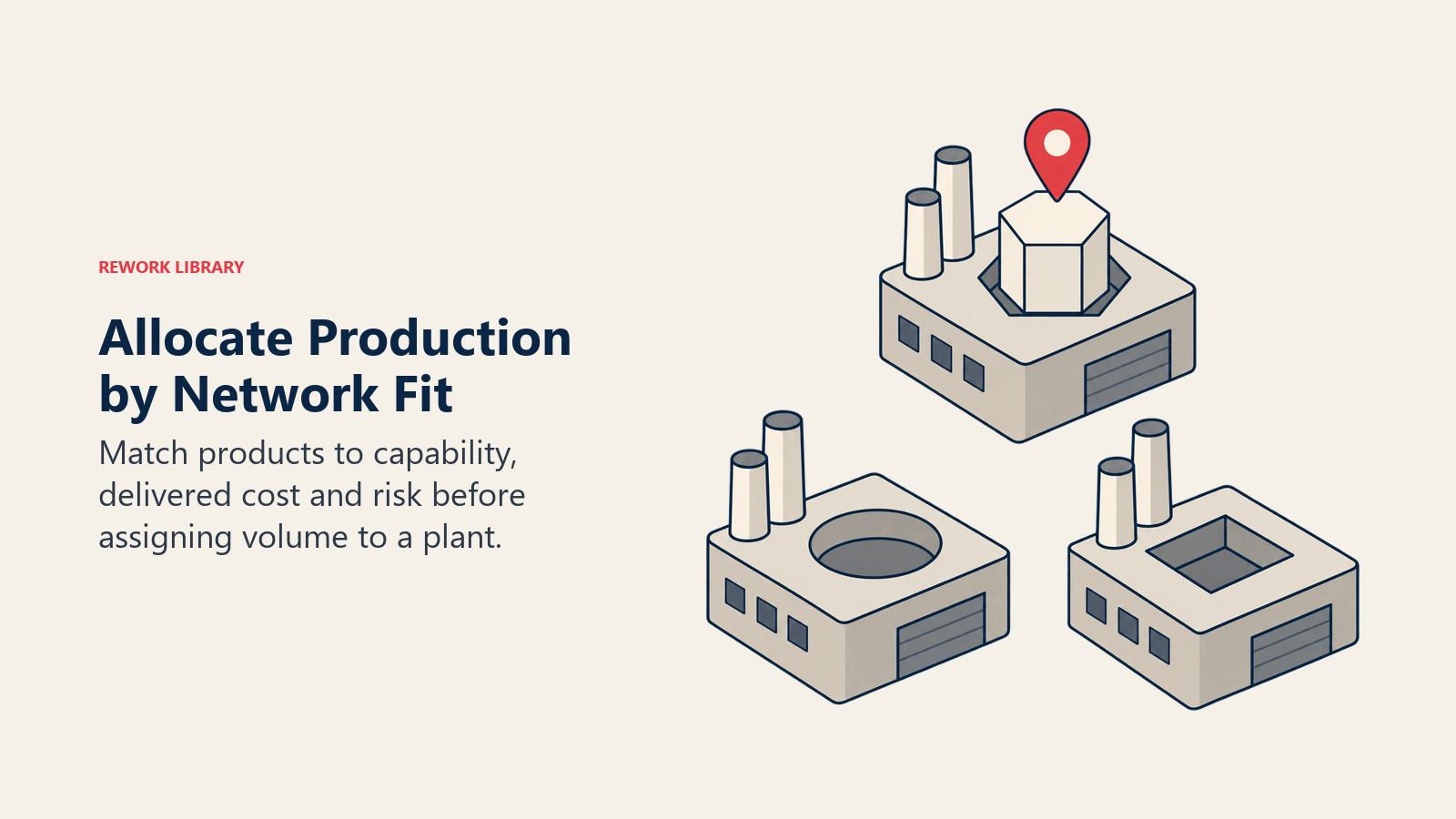
Customer proximity often drives allocation for heavy or perishable products. When freight costs are significant, serving customers from nearby facilities reduces logistics expense. Regional facilities serve regional markets. This approach increases facility count but can reduce total delivered cost. The breakeven depends on freight costs relative to production scale economies.
Cost-based allocation assigns production to lowest-cost facilities. Some sites have lower labor, energy, or regulatory costs. Products requiring manual labor go to low-labor-cost facilities. Energy-intensive products go where energy is cheap. This maximizes production efficiency but might increase logistics costs if low-cost facilities are far from customers or material sources.
Capability-based allocation matches products to facilities with appropriate technology and expertise. Complex products requiring specialized equipment or expertise get made where those capabilities exist. Simple products can be made anywhere. This prevents forcing square pegs into round holes but requires honest assessment of site capabilities and willingness to move products when capabilities don't match.
Risk mitigation through dual sourcing produces critical products at multiple sites. If one facility goes down:from fire, natural disaster, labor disputes, or equipment failures:the other maintains supply. Dual sourcing costs more than single sourcing because it reduces scale economies and requires maintaining capabilities at multiple locations. But for critical products, the cost is insurance against catastrophic supply disruptions.
Operational Coordination
Multiple independent sites operating under one company name isn't a network. True networks coordinate operations to achieve system-wide objectives that individual sites can't reach alone.
Centralized planning aggregates demand across all sites and allocates production to optimize the total network. Advanced planning systems consider capacity constraints, material availability, logistics costs, and customer commitments simultaneously. The resulting production plan balances local efficiency with network optimization. This requires sophisticated systems and organizational discipline to follow network plans rather than optimizing locally.
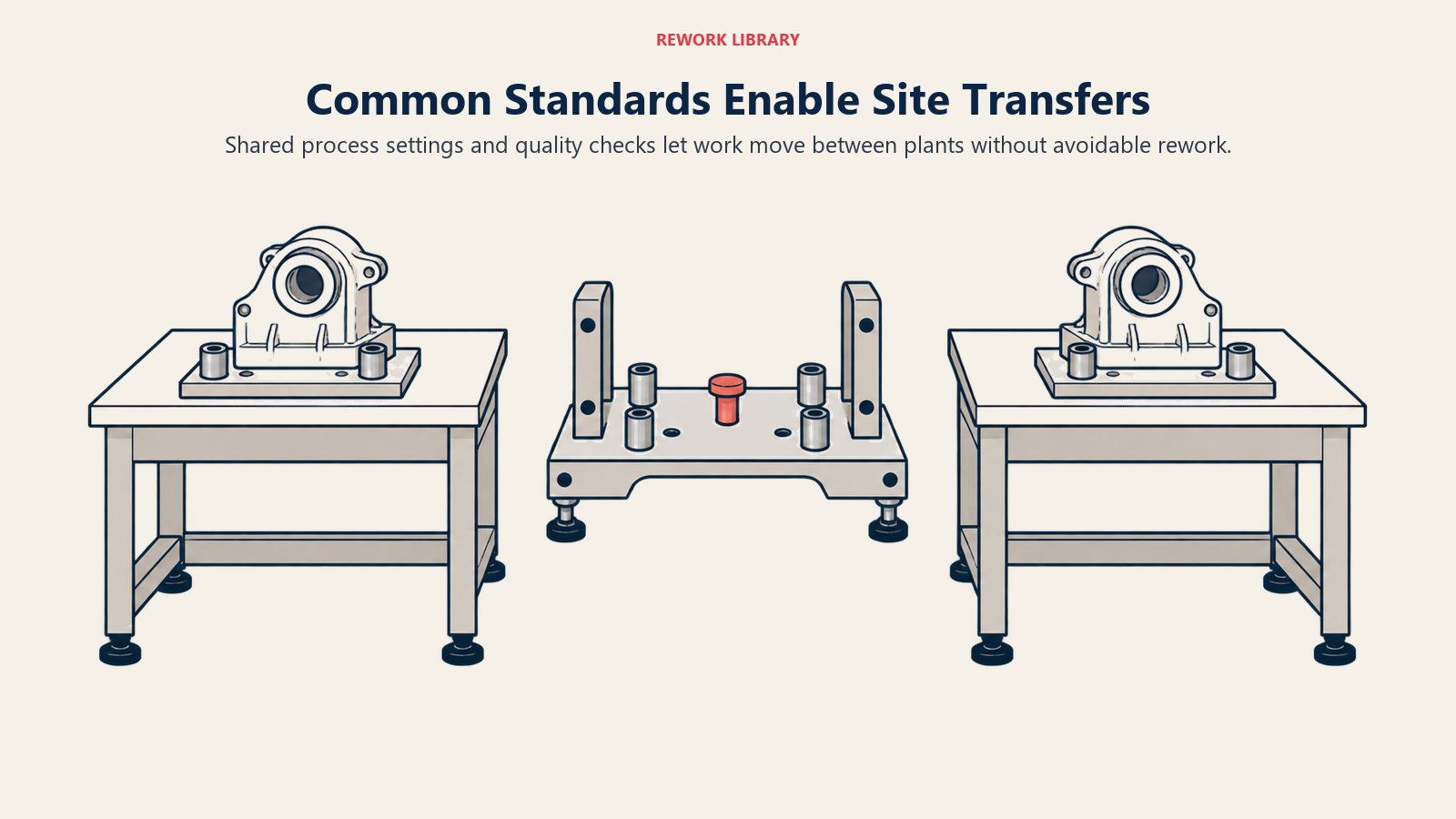
Standardized processes enable products to move between sites without rework or quality issues. When all facilities use the same process parameters, quality systems, and work instructions, products made at any site meet the same standards. Standardization costs flexibility:sites can't customize processes to local conditions:but enables the network effects that justify multiple facilities.
Knowledge sharing transfers best practices and innovation across the network. When one site discovers a process improvement, others should adopt it quickly. When one site develops expertise solving a problem, others should learn from it. This requires formal knowledge management systems, regular cross-site communication, and cultural openness to external ideas. Sites that see themselves as competing rather than collaborating hoard knowledge instead of sharing it.
Inventory management across sites determines how much working capital gets tied up and how flexibly the network responds to demand shifts. Centralized inventory visibility shows what's available where. Network inventory optimization minimizes total inventory while maintaining service levels. Inventory can shift between sites to meet demand. This beats every site maintaining safety stock for full demand variability.
Transfer pricing affects site incentives and network optimization. How do you price products moved between facilities? At cost? At market rates? Transfer prices determine site profitability metrics, which drive behavior. Bad transfer pricing creates incentives for sites to optimize locally at network expense. Good transfer pricing aligns site incentives with network objectives.
Technology Infrastructure
Multi-site operations require integrated technology that provides network visibility and enables coordinated decision-making. Disconnected systems at each site prevent network optimization.
Shared ERP systems provide single version of truth for orders, inventory, production schedules, and costs. When all sites work in one system, headquarters can see network status in real-time. Planning algorithms can optimize across sites. Reports compare site performance consistently. Implementing shared ERP is expensive and disruptive, but it's foundational for network operations.
Manufacturing execution systems (MES) track production in real-time at each site and feed data to network planning systems. This visibility enables dynamic reallocation. When one site falls behind schedule, the system identifies where to shift volume. When quality issues emerge, the system prevents shipping until resolution. MES closes the loop between planning and execution.
Collaboration platforms connect people across sites for problem-solving and knowledge sharing. Video conferencing, shared document systems, and project management tools enable distributed teams to work together. Without good collaboration tools, people default to local communication and local optimization.
Data analytics aggregate performance across sites revealing patterns invisible at individual facilities. Why does Site A have higher scrap rates than Site B making identical products? What causes downtime variations? Which sites improve fastest? Digital twins and network optimization can allow the end-to-end network to be optimized for incredibly complex planning problems. Network-level analytics drive improvement prioritization and best practice identification.
Organizational Design
Multi-site operations require organizational structures that balance local autonomy with network coordination. Too much autonomy creates disconnected sites. Too much centralization kills local initiative and responsiveness.
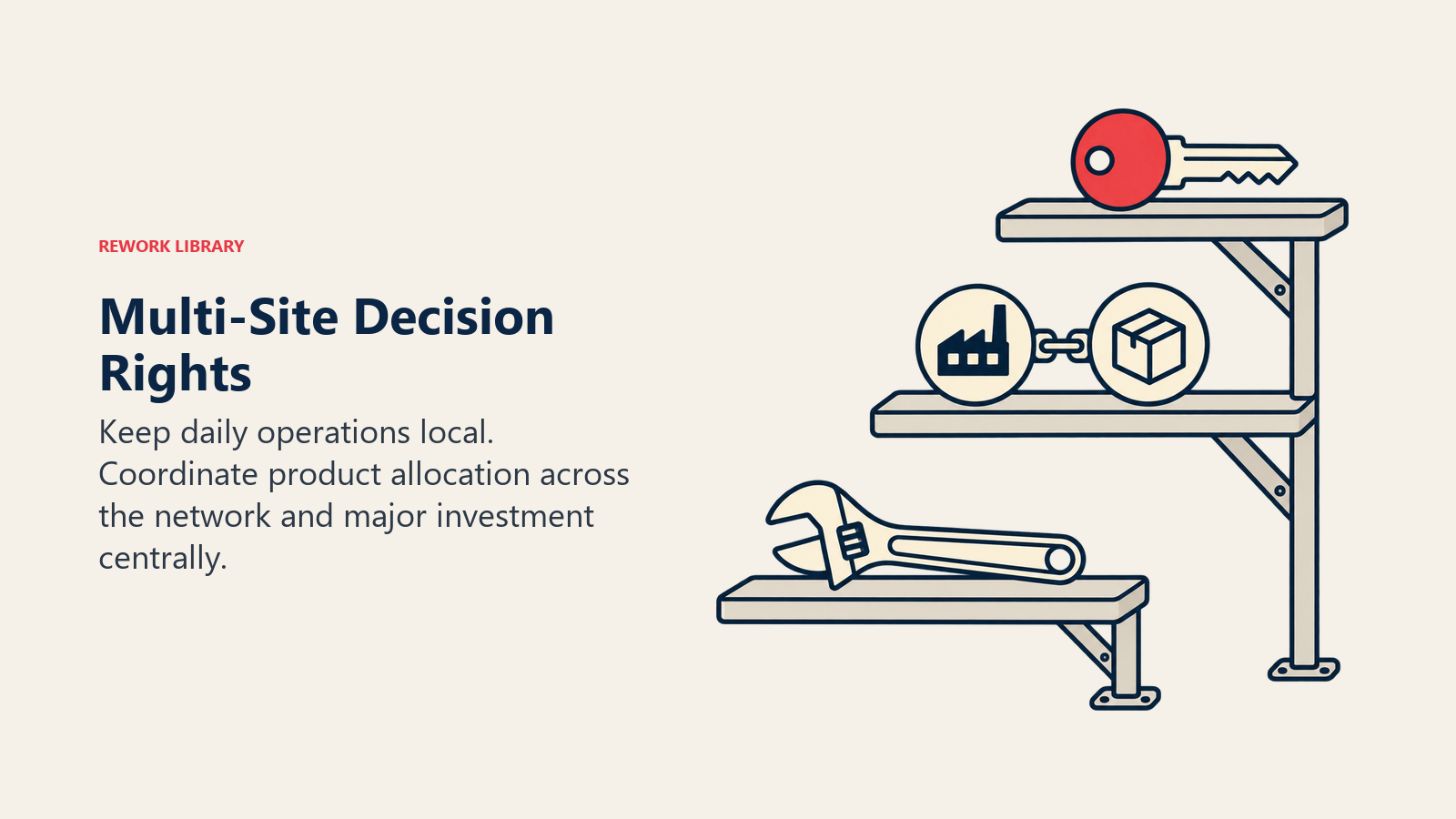
Site-level management runs day-to-day operations. Plant managers own their facilities' performance:safety, quality, cost, delivery. They manage local teams, solve local problems, and drive local improvement. Without strong site leadership, facilities underperform regardless of network strategy.
Network-level coordination functions optimize across sites. Production planning allocates volume. Supply chain management coordinates material flows. Quality systems ensure consistent standards. Engineering maintains process documentation and standardization. These functions need authority to make network decisions even when sites disagree.
Centers of excellence develop specialized capabilities that serve the entire network. One site might lead lean manufacturing. Another excels at automation. A third has deep quality expertise. Centers of excellence create knowledge and train others rather than hoarding expertise. This builds network capability faster than each site developing everything independently.
Governance models define decision rights between sites and corporate. Which decisions should sites make locally? Which require network coordination or corporate approval? Clear governance prevents constant escalation and conflict while ensuring critical decisions get made at the right level. Equipment purchases might be local. Product allocation decisions might be network. New facility investments might be corporate.
Performance Management
Measuring and managing performance across multiple sites requires metrics that balance local accountability with network optimization. Individual site metrics can drive behaviors that harm the network. Network metrics must flow down to site actions.
Site-level metrics track operational fundamentals: safety, quality, delivery, cost, productivity. These metrics make sites accountable for executing well. But site metrics alone don't ensure network optimization. A site can hit all its metrics while hurting network performance by refusing to take overflow volume or hoarding inventory.
Network-level metrics measure system performance: total network cost, aggregate customer service, overall equipment utilization, cross-site knowledge sharing. These metrics ensure someone cares about network optimization even when it conflicts with individual site metrics. Network metrics should link to executive compensation so leaders optimize for the network, not just their specific sites.
Balanced scorecards include both local and network metrics. Sites are measured on their own performance and their contribution to network objectives. This creates tension but appropriate tension. Sites should optimize locally within constraints set by network needs. The scorecard makes both objectives visible and forces balanced decisions.
Benchmarking across sites identifies performance gaps and improvement opportunities. If Site A achieves 85% OEE and Site B achieves 70% making identical products, what explains the gap? Site B should learn from Site A. According to McKinsey research, following optimization design practices can increase supply chain throughput by 10 to 15 percent with no change in assets. But be careful with benchmarks:sites often have legitimate differences in age, product mix, or market conditions. Blind benchmarking without context creates resentment rather than improvement.
Moving Forward
Multi-site manufacturing operations multiply complexity. But they should also multiply capability, resilience, and competitive advantage. The difference depends on whether you manage sites as a network or as disconnected facilities.
Start with clear network strategy. Why do you have multiple sites? What should the network enable that single sites can't? What role should each site play? These strategic questions should drive operational decisions about product allocation, process standardization, and technology investment.
Invest in integration. Shared systems, standardized processes, and collaboration tools cost money but enable network effects. Individual sites optimizing independently will never achieve network optimization. Integration is infrastructure that pays for itself through network benefits.
Build network coordination capabilities gradually. You can't go from autonomous sites to fully integrated network overnight. Pick high-value coordination opportunities like aggregate planning or knowledge sharing. Demonstrate benefits. Build trust. Expand coordination as capability builds. Forcing coordination before capability exists creates compliance without commitment.
Balance local autonomy and network coordination thoughtfully. Sites need freedom to solve local problems and respond to local conditions. But pure autonomy prevents network optimization. The right balance depends on your products, markets, and strategic priorities. Don't default to autonomy or centralization. Choose consciously based on what drives value in your business.
Remember that multi-site operations are never finished. Products change. Markets shift. Technologies advance. Networks must evolve continuously. The manufacturers who excel at multi-site operations treat network design as continuous improvement, not one-time project. Build the organizational capabilities to evolve your network as conditions change. Static networks become obsolete. Dynamic networks create sustained competitive advantage.
Learn More
