Quality Control vs Quality Assurance: Understanding the Difference and Building Both Capabilities
Turn this article into takeaways for your work.


Each assistant summarizes the article only for you and suggests best practices for your work.
A manufacturing executive once told me, "We have 50 quality control inspectors. Why do we still have quality problems?" The answer was simple but uncomfortable: they were spending millions detecting defects but almost nothing preventing them.
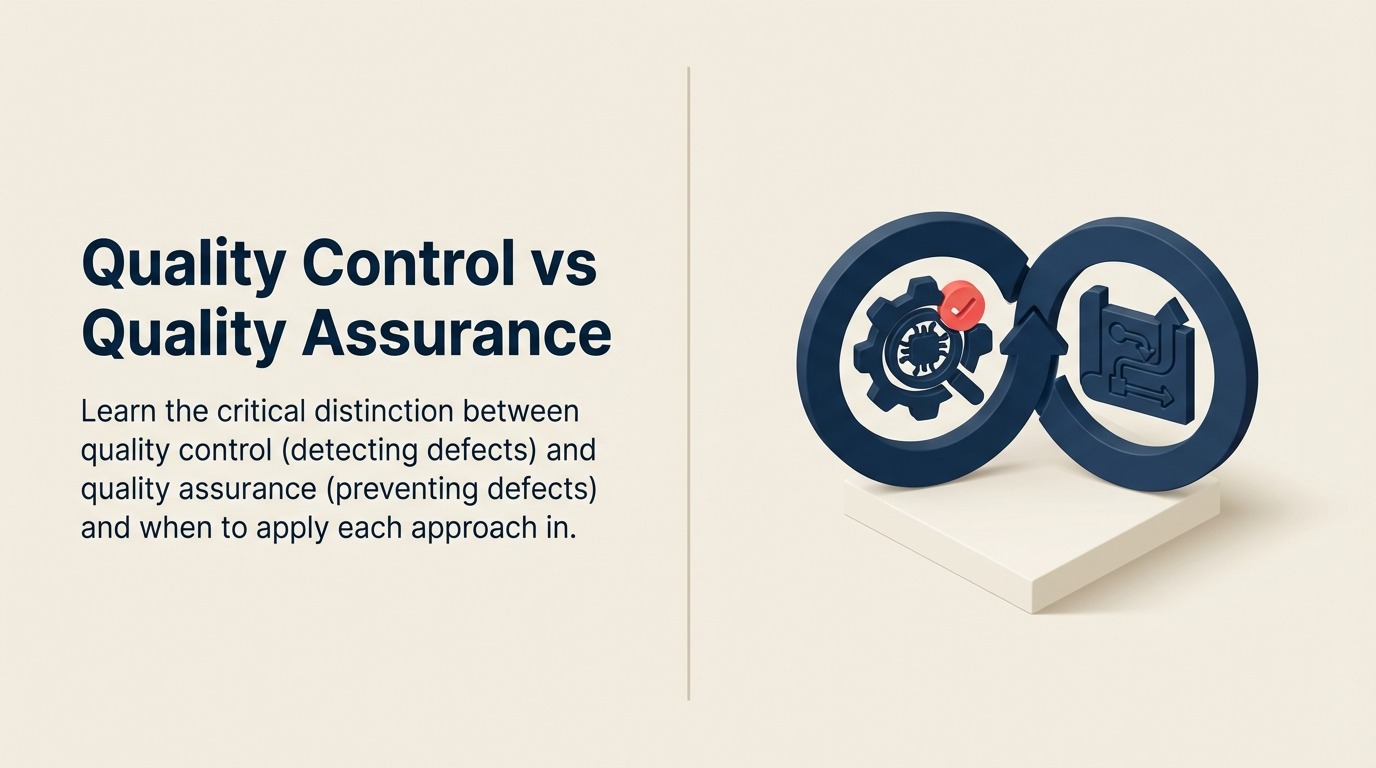
Quality Control (QC) and Quality Assurance (QA) sound similar, and many people use the terms interchangeably. But they're fundamentally different approaches that serve different purposes. Confusing them leads to wasted resources, persistent quality issues, and frustrated customers.
QC catches problems after they occur. QA prevents problems from occurring in the first place. One is defensive, the other is proactive. And world-class manufacturers excel at both.
QC vs QA Fundamentals: Two Sides of Quality Management
Quality Control focuses on product:identifying defects through inspection, testing, and measurement. According to ASQ, QC is product-oriented and focuses on defect identification. It answers the question: "Is this output acceptable?"
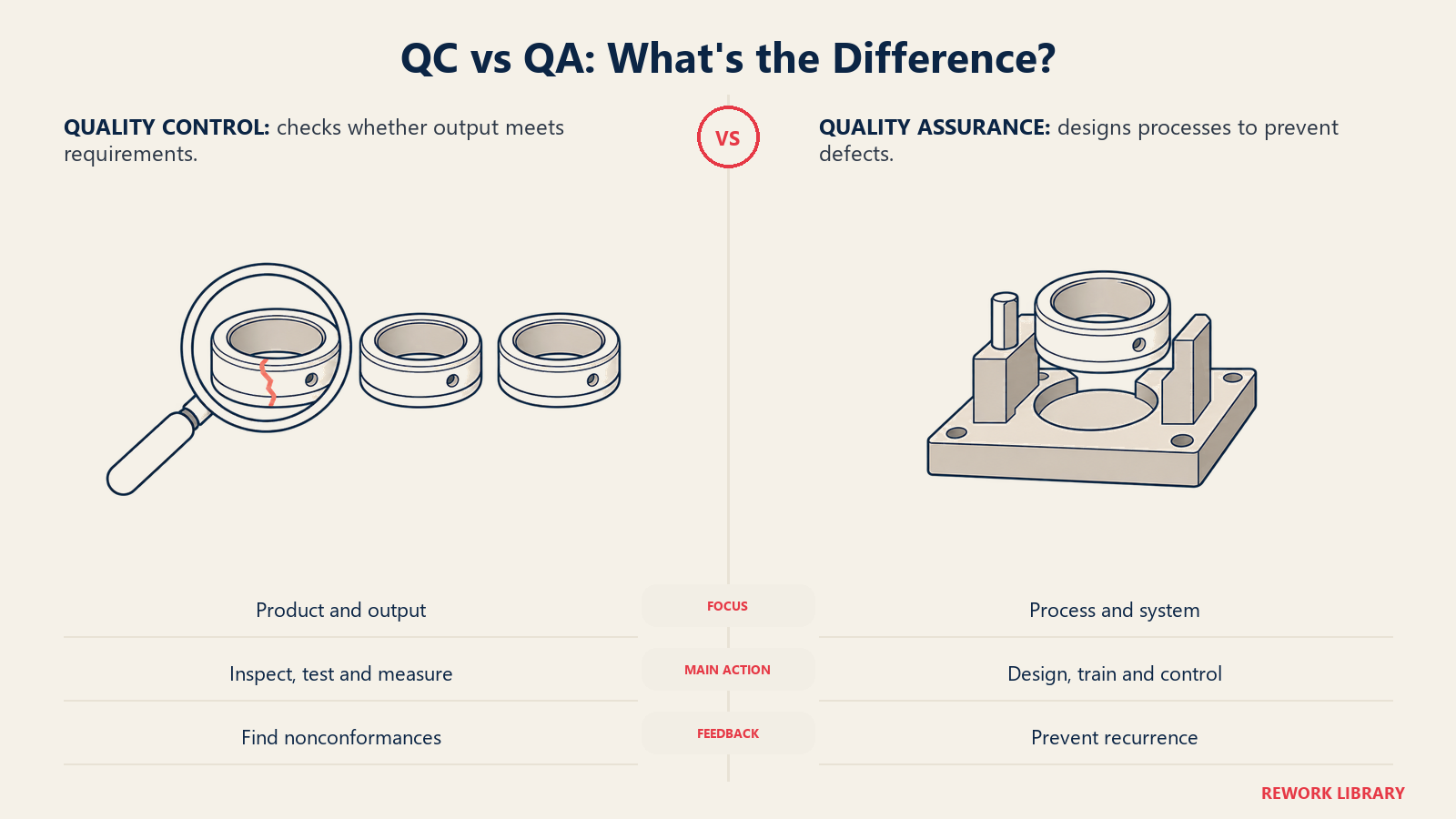
Quality Assurance focuses on process:ensuring that systems and procedures are designed and followed to produce acceptable output consistently. ASQ explains that QA is process-oriented and focuses on defect prevention, encompassing all the planned and systematic activities implemented within the quality system. It answers the question: "Are we doing things right?"
Quality Control: Detection and Correction
QC activities happen during or after production:
Inspection: Visual or dimensional checks to identify defects.
Testing: Functional or performance tests to verify product meets specifications.
Measurement: Dimensional inspection, material testing, or other objective measurements.
Sorting: Separating conforming from nonconforming products.
Disposition: Deciding what to do with defects:rework, scrap, use-as-is, or return to supplier.
QC is reactive. Problems have already occurred; QC just finds them before they reach customers. That's valuable, but it's expensive and imperfect. No inspection catches 100% of defects, and you've already incurred production costs for defective units.
Quality Assurance: Prevention and Process Design
QA activities happen before and during production to prevent defects:
Process design: Creating manufacturing processes capable of meeting specifications.
Standard work: Documenting best methods so everyone performs tasks consistently.
Training: Ensuring people have skills and knowledge to execute correctly.
Preventive maintenance: Keeping equipment in condition to produce good parts.
Supplier management: Ensuring purchased materials meet requirements.
Design reviews: Validating that product designs can be manufactured successfully.
Audits: Verifying that processes and systems function as intended.
QA is proactive. It builds quality into processes so defects don't occur. When QA works well, you need less QC because there are fewer problems to find.
Relationship Between QC and QA
QC and QA aren't alternatives:they're complementary. You need both, but in different proportions depending on your situation.
QA creates the conditions for good quality. QC verifies that those conditions are producing acceptable results.
QC provides feedback that drives QA improvements. Inspection data reveals where processes need strengthening. Without this feedback loop, QA efforts might miss critical issues.
Think of it like healthcare. QC is diagnosis:identifying when something's wrong. QA is preventive medicine:diet, exercise, vaccinations that keep you healthy. You need both, but you're better off with strong prevention that minimizes the need for diagnosis and treatment.
Complementary Roles in Quality Management
Effective quality management balances QC and QA:
Early stage/new processes: Higher QC emphasis to catch problems while QA systems are being developed and validated.
Mature processes: Higher QA emphasis with reduced QC as prevention systems demonstrate effectiveness.
High-risk products: Maintain significant QC even with strong QA, because failure consequences are too severe to rely on prevention alone.
High-volume production: Strong QA emphasis because inspection costs become prohibitive at high volumes.
A automotive Tier 1 supplier illustrates this balance. For new part launches, they use 100% inspection for the first month while operators learn the process and QA systems are validated. As First Pass Yield improves above 98%, they transition to statistical sampling. For safety-critical components, they maintain additional QC even after processes prove capable, because the consequences of failure are too severe.
Quality Control Deep Dive: Detection Mechanisms
Let me explain what good QC looks like and when it makes sense to emphasize inspection.
Inspection Strategies
Not all inspection is created equal. Choose strategies based on risk, volume, and economics:
100% Inspection: Every unit is checked. Use when failure consequences are severe, when volumes are low, or when processes are new or unstable. Expensive but provides maximum defect detection.
Statistical Sampling: Inspect a defined sample and infer population quality. Use for high-volume production of established processes. Much less expensive than 100% inspection but with some risk of accepting defective lots.
First Piece Inspection: Verify the first unit after setup before releasing the lot. Catches setup errors that would affect the entire run.
Last Piece Inspection: Verify the last unit to confirm process stability throughout the run.
Patrol Inspection: Periodic checks throughout production to detect when processes drift out of control.
The right approach depends on your specific situation. Critical aerospace components might justify 100% inspection. Consumer goods typically use sampling with appropriate risk levels.
In-Process vs Final Inspection
When you inspect matters almost as much as what you inspect.
In-process inspection checks work at intermediate stages:
Advantages:
- Catches problems before more value is added to defective work
- Provides immediate feedback for operators to adjust processes
- Reduces rework costs by preventing cascading defects
- Enables faster problem resolution
Disadvantages:
- Multiple inspection points increase total inspection labor
- May slow production flow
- Requires inspection capability at each stage
Final inspection checks completed products before shipment:
Advantages:
- Single inspection point minimizes inspection labor
- Ensures nothing ships without final verification
- Allows comprehensive functional testing
Disadvantages:
- Maximum value already added before defects are caught
- Delayed feedback makes root cause analysis harder
- Can create bottlenecks if inspection capacity is insufficient
- May encourage "inspect quality in" mentality
The best approach often combines both: in-process checks at critical operations where defects would be costly or hard to detect later, plus final inspection to verify overall product integrity.
Inspection Equipment and Measurement Systems
QC is only as good as your measurement capability. Invest in appropriate inspection equipment:
Manual inspection tools: Calipers, micrometers, gauges for dimensional checks. Lower cost but dependent on operator skill.
Automated measurement: CMMs (coordinate measuring machines), laser scanners, vision systems. Higher cost but faster, more consistent, and capable of measuring complex features.
Functional testers: Equipment that verifies product performs as intended, not just meets dimensional specifications.
Nondestructive testing: X-ray, ultrasound, magnetic particle inspection for internal defects without destroying parts.
But equipment is only part of the equation. You must also validate measurement system capability through Gage R&R studies to ensure measurement variation is small relative to product tolerances. A measurement system with poor repeatability or reproducibility can't reliably separate good parts from bad.
Nonconforming Material Handling
Finding defects is only useful if you handle them properly:
Segregation: Physically separate nonconforming product to prevent accidental use or shipment.
Identification: Clear labeling that shows quality status:hold tags, colored bins, or designated areas.
Disposition decision: Someone with authority must decide: rework, use-as-is (with customer approval if needed), scrap, or return to supplier.
Root cause analysis: Don't just sort defects:understand why they occurred and implement corrective action.
Tracking: Record nonconformance data to identify trends and prioritize improvement efforts.
Poor nonconforming material handling is how defects reach customers despite inspection. Parts get mixed back into production, hold tags fall off, or operators use questionable materials because "we need to make the schedule."
Create systems that make it difficult to accidentally use or ship nonconforming product. Physical barriers, process controls, and clear accountability matter more than relying on people to always do the right thing.
When QC is Appropriate
QC emphasis makes sense in specific situations:
New or unstable processes: When you're still learning how a process behaves, higher inspection provides safety net and learning feedback.
High-risk products: When failure causes safety issues, high warranty costs, or critical customer problems, maintain QC even with strong QA.
Supplier quality issues: When incoming material quality is unreliable, incoming inspection protects your processes from defective inputs.
Regulatory requirements: Some industries mandate inspection and testing regardless of process capability.
Low-volume, high-mix: When production volume doesn't justify extensive prevention infrastructure, QC may be more economical.
Limitations of Inspection-Based Quality
But don't fool yourself:QC alone has serious limitations:
Inspection errors: People miss defects due to fatigue, distraction, or ambiguous criteria. Even excellent inspectors miss 10-15% of defects.
Late detection: Finding defects after they occur wastes materials, labor, and capacity already invested.
Sorting inefficiency: Testing every part is expensive and time-consuming.
False confidence: Extensive inspection can create belief that quality is under control when you're just catching a symptom of poor process capability.
Quality department dependency: If QC catches all problems, production feels no urgency to prevent them.
These limitations explain why world-class manufacturers shift emphasis toward QA. Detection has its place, but prevention delivers better results at lower cost.
Quality Assurance Deep Dive: Prevention Systems
Now let me explain what comprehensive QA looks like and why it's more powerful than QC.
Process Design and FMEA
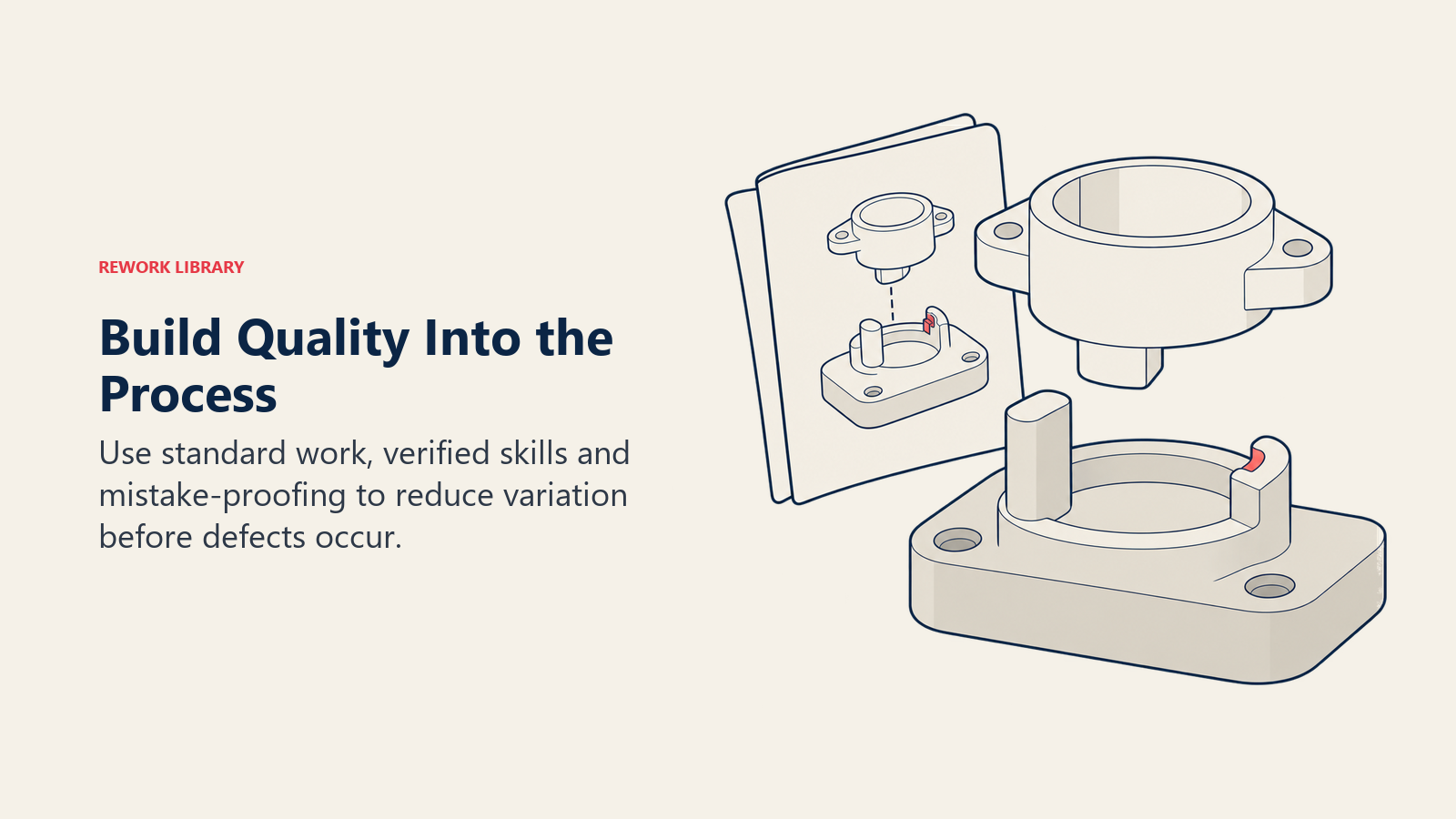
QA starts with designing processes that are inherently capable of meeting requirements.
Process FMEA (Failure Mode and Effects Analysis) systematically evaluates what could go wrong at each process step, how likely failures are, how severe the consequences, and whether you'd detect problems before they cause harm.
This analysis identifies high-risk process steps that need additional controls:
- Mistake-proofing devices to prevent errors
- In-process verification to detect problems immediately
- Special operator qualifications or training
- Tighter process parameter controls
A manufacturer of medical implants used process FMEA during new product introduction to identify 23 critical control points across their manufacturing sequence. Each received specific controls documented in their control plan:from specialized fixtures preventing incorrect loading to automated measurement systems verifying critical dimensions. This QA approach reduced launch defects 80% compared to previous products where they relied on inspection.
Standard Work and Documented Procedures
Variation in how work is performed creates variation in results. Standard work documents the current best method:
- Sequence of operations
- Key process parameters and settings
- Quality checks and specifications
- Common problems and how to avoid them
When everyone follows standard work, process capability improves and defects decrease. But standard work only helps if:
It's current: Update it as processes improve.
It's accessible: Operators can reference it at point of use.
It's visual: Photos and diagrams communicate better than text.
It's practical: If standard work doesn't match reality, people ignore it.
Standard work isn't bureaucracy:it's capturing and sharing best practices so everyone benefits from what the best operators already know.
Training and Competency Verification
People can't follow standards they don't understand or lack skills to execute.
Effective training programs include:
Initial training: New employees learn essential skills and procedures.
Role-specific training: Specialized skills for particular operations or equipment.
Refresher training: Periodic updates to maintain proficiency.
Cross-training: Broader skills that increase flexibility and understanding.
But training isn't enough:verify competency. Don't assume someone is qualified because they attended training. Test knowledge through written exams or practical demonstration. Document qualification before allowing independent work on critical operations.
An electronics manufacturer created a three-tier operator certification program. Level 1 operators work under supervision on basic operations. Level 2 perform setups and complex operations. Level 3 handle problem-solving and train others. Each level requires passing written tests and practical demonstration. This competency verification system reduced operator-related defects 70%.
Supplier Quality Management
Your internal QA efforts can be undermined by poor supplier quality. Extend QA thinking to your supply chain:
Supplier selection: Choose suppliers with demonstrated quality capability, not just lowest price.
Quality agreements: Clear specifications and expectations documented before orders.
Supplier development: Help suppliers improve their processes rather than just inspecting their output.
Performance monitoring: Regular scorecards tracking quality, delivery, and responsiveness.
Supplier audits: Periodic assessment of supplier QA systems.
The goal is reducing incoming inspection by working with suppliers whose QA systems reliably produce acceptable materials. This shift from detection (incoming inspection) to prevention (supplier QA) saves time and money for both parties.
Design Reviews and Validation
QA extends upstream into product development. Design reviews with cross-functional teams catch potential manufacturing issues before they're baked into designs:
Manufacturability review: Can we reliably produce this design?
Tolerance review: Are specifications appropriate for our process capabilities?
Risk assessment: What failure modes should we address through design changes?
Supplier input: Do our suppliers have concerns about materials or components?
Design validation confirms that products actually work as intended under real-world conditions. Don't just verify compliance with specifications:validate that specifications were correct.
Management System Audits
ISO 9001 and other QMS standards provide frameworks for QA. Internal audits verify that your quality management system functions as intended:
- Are procedures being followed?
- Do processes deliver intended results?
- Are corrective actions effective?
- Where do we have systemic issues that need attention?
Audits shouldn't be "gotcha" exercises looking for procedural violations. Good audits assess whether your QA system actually prevents defects and improves performance.
When QA is Most Effective
QA emphasis makes sense when:
Mature processes: When you understand process behavior and have stable operations, QA delivers maximum value.
Volume production: High volumes justify investment in prevention infrastructure that reduces per-unit costs.
Complex products: When products have many components or process steps, prevention is more economical than exhaustive inspection.
Continuous improvement culture: QA requires organizational discipline and commitment to systematic problem-solving.
Capable processes: When processes are capable of meeting specifications with margin, QA sustains that capability.
Building Balanced Capabilities: QC and QA Together
The goal isn't choosing between QC and QA:it's building complementary capabilities that work together.
QC Provides Feedback for QA Improvement
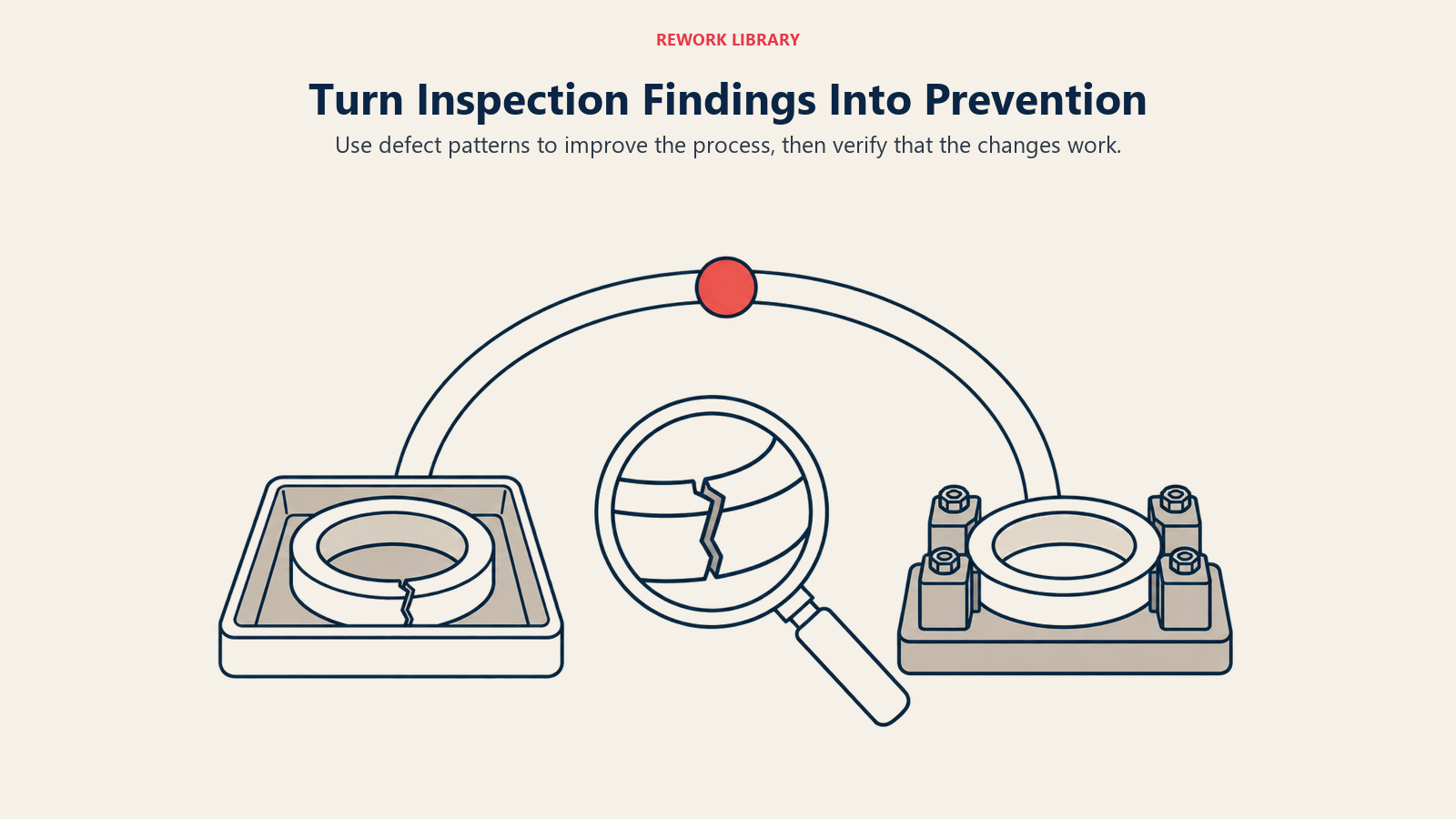
Inspection data is valuable input for QA improvement:
Defect Pareto analysis: What defects occur most frequently? These guide where to focus prevention efforts.
Process capability studies: Is the process inherently capable, or do we have fundamental capability issues?
Trend analysis: Are defects increasing, decreasing, or stable? Trends trigger investigation and improvement.
Supplier performance: Which suppliers have quality issues that need attention?
Without QC feedback, QA operates blind. You might think processes are performing well while defects slip through. Or you might over-control processes that are already capable.
The right amount of QC:enough to understand process behavior without sorting every part:provides guidance for where QA investments deliver highest return.
Using Inspection Data to Identify Process Issues
Good organizations don't just count defects:they analyze patterns:
By operation: Which process steps generate the most defects?
By shift: Do defects correlate with particular shifts, suggesting training or supervision issues?
By operator: Do certain operators have more problems, indicating training needs?
By time: When do defects occur:after maintenance, during setup, at start of shift?
By material lot: Do defects correlate with particular supplier lots or material batches?
These patterns reveal root causes that QA can address. Maybe defects spike on night shift because lighting is poor. Maybe they correlate with a particular material supplier. Maybe they occur during first hour of operation because equipment needs longer warm-up.
QC data transforms from defect counts into actionable intelligence that drives QA improvement.
Transitioning from QC to QA as Processes Mature
Smart manufacturers reduce QC as QA proves effective:
Stage 1 (New process): Heavy QC emphasis. 100% or high-frequency inspection provides safety net while learning.
Stage 2 (Improving process): QC provides data for improvement. Use inspection results to identify and eliminate defect sources.
Stage 3 (Capable process): Reduce QC as capability improves. Shift to sampling or patrol inspection.
Stage 4 (Sustained capability): Minimal QC for verification. Strong QA sustains performance with occasional confirmation that prevention systems work.
This transition isn't automatic. You must demonstrate sustained capability before reducing QC. And you maintain data collection to confirm that reduced inspection didn't create blind spots.
Right Mix by Product Lifecycle Stage
Different lifecycle stages call for different QC/QA balance:
Development and launch: Higher QC emphasis. Processes aren't fully validated, and you need feedback to understand behavior.
Production ramp: Balanced approach. QC catches issues while QA systems are implemented and validated.
Mature production: QA emphasis. Prevention systems are proven, and QC reduces to verification and feedback.
End of life: May shift back toward QC if volume doesn't justify maintaining extensive QA infrastructure.
A consumer electronics manufacturer follows this pattern. New product launches get 100% functional testing for first month. As First Pass Yield improves, they reduce to 10% sampling. For mature products in stable production, they sample 2% with heavier sampling quarterly to verify continued capability.
Organizational Structure: Roles and Responsibilities
How you organize quality functions affects whether QC and QA work together or create conflict.
QC Inspector Roles and Reporting
QC inspectors perform inspection, testing, and measurement. Key responsibilities:
- Execute inspection per documented procedures
- Accurately record results
- Identify nonconforming material and route for disposition
- Maintain inspection equipment and ensure calibration
- Communicate quality issues promptly
Inspectors typically report to quality management, not production, to maintain independence and objectivity. This prevents production pressure from compromising inspection integrity.
QA Engineer Responsibilities
QA engineers design and maintain prevention systems:
- Develop and maintain control plans
- Conduct process capability studies
- Perform FMEA and risk assessments
- Design and validate inspection procedures
- Analyze quality data to identify improvement opportunities
- Support root cause analysis and corrective action
- Audit processes and systems
- Interface with customers on quality requirements
QA roles require broader technical skills:statistics, problem-solving, process understanding, project management. They work with engineering, operations, and suppliers to prevent problems rather than just find them.
Quality Manager Oversight
Quality managers balance QC and QA resources:
- Allocate inspection resources based on risk and process capability
- Ensure QC feedback drives QA improvement
- Manage quality budget across prevention and detection activities
- Report quality performance to leadership
- Develop quality capability across the organization
- Maintain relationships with customer quality functions
The quality manager should advocate for shifting resources toward prevention while maintaining appropriate detection capability based on risk.
Independence and Objectivity
Quality functions need independence to be effective:
Organizational independence: Quality shouldn't report to production, which has competing priorities for throughput and cost.
Decision authority: Quality must have authority to stop production or hold shipments when issues warrant.
Resource independence: Adequate budget and staffing that doesn't fluctuate based on production volume or schedule pressure.
Career paths: Quality professionals need advancement opportunities that don't require moving to production roles, which can create conflicts of interest.
Independence doesn't mean isolation. Quality teams should collaborate closely with operations while maintaining ability to make objective decisions when quality and schedule conflict.
Industry Examples: QC/QA Balance by Sector
Different industries emphasize QC and QA differently based on their specific circumstances:
Automotive (Heavy QA with Verification QC)
Automotive manufacturers pioneered QA emphasis:
Strong QA: Advanced Product Quality Planning (APQP), extensive process FMEA, statistical process control, mistake-proofing throughout production.
Focused QC: Verification sampling at critical operations, final audit before shipment, but not 100% inspection because QA systems demonstrate capability.
Rationale: High volumes make prevention economical. Complex assemblies make exhaustive inspection impractical. But safety criticality requires verification that prevention works.
Ford, Toyota, and other major OEMs drove this approach through supplier quality requirements. Tier 1 and Tier 2 suppliers had to adopt similar systems to qualify.
Aerospace (Extensive QA with Critical QC)
Aerospace combines rigorous QA with extensive QC:
Comprehensive QA: Detailed process specifications, operator certifications, extensive documentation, traceability systems, regular audits.
Extensive QC: First Article Inspection, in-process inspection at critical operations, final inspection, often with customer or regulatory witness.
Rationale: Safety criticality and regulatory requirements mandate extensive verification. Lower volumes (compared to automotive) make more intensive inspection economically viable.
Consumer Goods (QA Focus with Sampling QC)
Consumer products emphasize efficiency:
Streamlined QA: Standard work, operator training, process controls focused on critical characteristics.
Sampling QC: Statistical sampling during production, final audit of packaging and labeling, but minimal 100% inspection.
Rationale: High volumes and price sensitivity make extensive inspection uneconomical. Consumer safety issues are less severe than aerospace or medical.
Medical Devices (Regulatory-Driven QA and QC)
Medical devices balance prevention with verification:
Rigorous QA: Design controls per FDA regulations, process validation, extensive documentation, supplier controls, comprehensive training.
Risk-based QC: Inspection intensity based on failure criticality. Implantable devices get more inspection than low-risk accessories.
Rationale: Regulatory requirements mandate both QA systems and verification activities. Patient safety requires highest reliability levels.
From Detection to Prevention Mindset
The ultimate goal is organizational culture that thinks prevention first, using detection as verification rather than primary quality mechanism.
This cultural shift requires:
Leadership emphasis on prevention: When leaders ask "How will we prevent this?" instead of "How will we catch this?", the message is clear.
Metrics that reward prevention: Measure and celebrate First Pass Yield improvement, not inspection efficiency.
Resources allocated to prevention: Invest in mistake-proofing, process improvement, training, and supplier development.
Problem-solving discipline: React to defects with root cause analysis and prevention, not just sorting and rework.
Time for prevention: Don't run production so lean that there's no capacity for process improvement.
Organizations that successfully make this shift report:
- Lower total quality costs despite higher prevention spending
- Reduced firefighting and crisis management
- Higher customer satisfaction
- Improved production efficiency
- Better employee morale (prevention is more satisfying than sorting defects)
A pump manufacturer made this transition over five years. They gradually reduced inspection staff from 50 to 22 people while increasing QA engineers from 3 to 8. Total quality costs dropped from 4.2% to 1.8% of sales. Customer returns decreased 75%. And manufacturing throughput increased 18% because less time was spent on rework.
That's the power of understanding and properly balancing QC and QA:not as competing approaches, but as complementary capabilities that together deliver sustainable quality performance.
Learn More
- Manufacturing Quality Management Overview: Building Defect Prevention Systems
- Defect Prevention Strategies: Building Quality at the Source
- Statistical Process Control: Monitoring and Preventing Variation
- First Pass Yield Optimization: Reducing Defects at the Source
- Six Sigma in Manufacturing: Data-Driven Quality Improvement
- ISO 9001 Implementation: Building a Quality Management System

Co-Founder, Rework.com
On this page
- QC vs QA Fundamentals: Two Sides of Quality Management
- Quality Control: Detection and Correction
- Quality Assurance: Prevention and Process Design
- Relationship Between QC and QA
- Complementary Roles in Quality Management
- Quality Control Deep Dive: Detection Mechanisms
- Inspection Strategies
- In-Process vs Final Inspection
- Inspection Equipment and Measurement Systems
- Nonconforming Material Handling
- When QC is Appropriate
- Limitations of Inspection-Based Quality
- Quality Assurance Deep Dive: Prevention Systems
- Process Design and FMEA
- Standard Work and Documented Procedures
- Training and Competency Verification
- Supplier Quality Management
- Design Reviews and Validation
- Management System Audits
- When QA is Most Effective
- Building Balanced Capabilities: QC and QA Together
- QC Provides Feedback for QA Improvement
- Using Inspection Data to Identify Process Issues
- Transitioning from QC to QA as Processes Mature
- Right Mix by Product Lifecycle Stage
- Organizational Structure: Roles and Responsibilities
- QC Inspector Roles and Reporting
- QA Engineer Responsibilities
- Quality Manager Oversight
- Independence and Objectivity
- Industry Examples: QC/QA Balance by Sector
- Automotive (Heavy QA with Verification QC)
- Aerospace (Extensive QA with Critical QC)
- Consumer Goods (QA Focus with Sampling QC)
- Medical Devices (Regulatory-Driven QA and QC)
- From Detection to Prevention Mindset
- Learn More