Digital Twin Technology: Virtual Models for Manufacturing Optimization
Turn this article into takeaways for your work.


Each assistant summarizes the article only for you and suggests best practices for your work.
An aerospace manufacturer was designing a new assembly line for a next-generation aircraft component. Traditional approaches meant building the physical line, identifying bottlenecks during ramp-up, and making costly modifications. The entire process typically took 18-24 months and millions in unplanned modifications.
Instead, they built a digital twin first, a virtual replica of the proposed line that simulated every aspect of operations. They tested different configurations, identified the optimal layout, validated cycle times, and trained operators on the virtual line before breaking ground on the physical facility.
The result: production targets achieved three months ahead of schedule, capital costs 23% below budget, and zero surprise bottlenecks during ramp-up. The digital twin didn't just save money, it compressed time-to-market at a stage where delays cascade through the entire program.
Digital Twins as Virtual Replicas
A digital twin is a virtual representation of a physical manufacturing asset, system, or process that's connected to its real-world counterpart through sensors and data exchange. It's not just a 3D model or simulation, it's a living digital replica that mirrors the current state, behavior, and performance of the physical entity.
Understanding the distinctions in digital representations clarifies what digital twins offer. Digital models are static representations. CAD drawings, process flowcharts, equipment specifications. They don't change when the physical asset changes. Digital shadows receive data from physical assets but data flows only one direction. The digital representation updates based on physical state, but the digital system doesn't control or influence the physical.
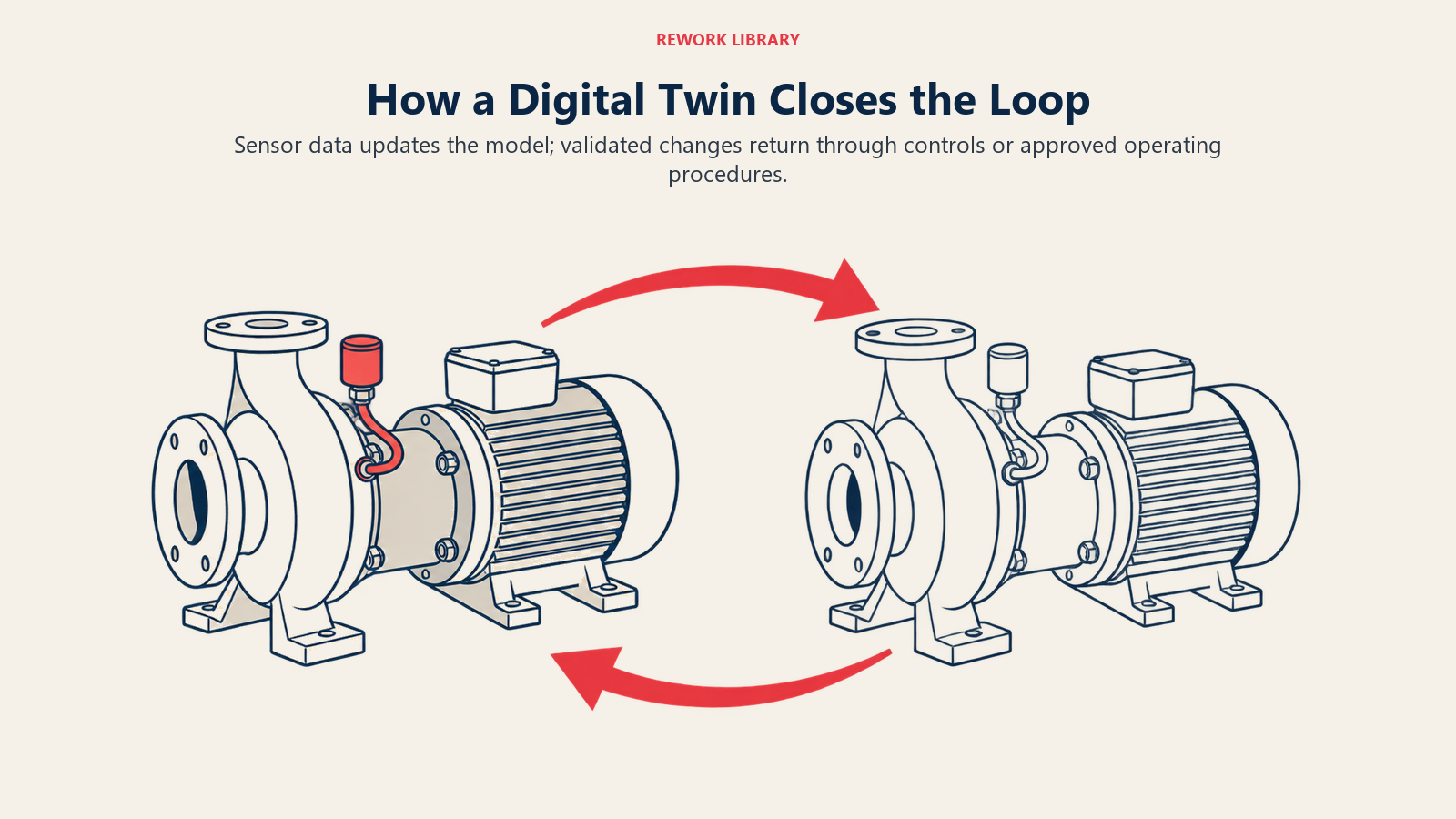
Digital twins feature bidirectional data flow. The twin receives real-time data from the physical asset and can send commands or adjustments back. This closed loop enables optimization scenarios where the twin tests changes virtually, validates results, and implements proven improvements on the physical asset.
Types of twins address different needs. Product twins represent individual products, tracking their performance through their lifecycle. Production twins model manufacturing processes, lines, or entire facilities. Performance twins focus on operational optimization, using real-time data to predict and enhance performance.
Real-time synchronization distinguishes operational twins from engineering simulations. The twin continuously updates to reflect current conditions, equipment status, material locations, production schedule, quality metrics. This real-time fidelity enables the twin to predict near-term behavior accurately and detect deviations immediately.
Simulation and "what-if" analysis capabilities let manufacturers test scenarios without touching physical assets. What if we increase line speed by 10%? What if that machine fails? What if we reroute material flow? The twin simulates outcomes, identifies potential problems, and quantifies benefits before implementation.
Manufacturing Applications
Product design and virtual prototyping enables testing and refinement before building physical prototypes. Design engineers create digital twins of new products, simulate performance under various conditions, test durability, and optimize designs. This virtual testing reduces physical prototypes, accelerates development cycles, and catches problems in the design phase where fixes cost far less.
A consumer electronics manufacturer used product twins to test thermal performance of a new device design. The twin simulated heat generation and dissipation under various usage patterns, identifying hot spots that would have caused field failures. Design modifications solved the problem before physical prototypes existed.
Production line design and optimization benefits from virtual commissioning, testing the line digitally before installation. Engineers design the layout, program PLCs and robots, validate cycle times, identify bottlenecks, and optimize throughput. When physical installation begins, 80% of the debugging is already complete.
Process parameter optimization uses the twin to find ideal operating conditions. The twin simulates thousands of parameter combinations, evaluating quality, throughput, energy consumption, and wear. This exploration would take months or years on physical equipment but runs in hours virtually.
Predictive maintenance and performance leverages real-time data flowing into equipment twins. The twin compares actual performance against expected performance under current conditions. Deviations indicate developing problems. The twin predicts remaining useful life based on actual usage patterns rather than generic schedules.
Supply chain and logistics optimization extends the twin concept beyond the factory floor. Digital twins of warehouses, distribution networks, and transportation assets enable optimization of inventory placement, routing, and logistics operations. Manufacturers can test contingency plans for disruptions before they occur.
Training and simulation provides safe, cost-effective operator training. New operators learn on the digital twin, making mistakes and learning procedures without risk to equipment or products. The twin can simulate rare scenarios and failure modes that operators need to handle but might not experience for years on actual equipment.
Digital Twin Architecture
Physical assets with sensors and controls form the foundation. Modern equipment already includes sensors for temperature, pressure, vibration, position, and speed. Additional sensors might be needed for comprehensive monitoring. Controls enable the twin to influence physical behavior when implementing optimizations.
Data acquisition and connectivity layer collects sensor data, often using industrial IoT platforms. Edge computing devices aggregate and pre-process data before transmission to cloud or on-premise systems. Industrial protocols (OPC-UA, MQTT) standardize data exchange across diverse equipment.
The digital model and simulation engine represents asset geometry, kinematics, physics, and behavior. This might be a CAD model for visualization, finite element models for stress analysis, discrete event simulation for process flow, or physics-based models for equipment behavior. The sophistication matches the application, a simple twin for monitoring might use basic models while a predictive twin requires high-fidelity simulation.
Analytics and intelligence layer processes data to generate insights. Statistical analysis detects trends and anomalies. Machine learning models predict future states and optimal actions. Optimization algorithms find best operating parameters. This intelligence transforms raw data into actionable information.
Visualization and user interface presents the twin's state and recommendations. 3D visualizations show equipment status and operational flow. Dashboards display key metrics and predictions. Alert systems notify operators of issues requiring attention. The interface design determines whether users can effectively act on the twin's insights.
Feedback loop to physical asset closes the optimization cycle. Validated improvements flow from twin to physical implementation through control systems, work instructions, or manual procedures. This is where the twin shifts from monitoring to active optimization.
Implementation Approach
Starting small reduces complexity and proves value before major investment. Component twins model individual machines or processes. These are simpler to develop, easier to validate, and deliver focused benefits. System twins representing entire production lines or facilities can follow once the organization has experience.
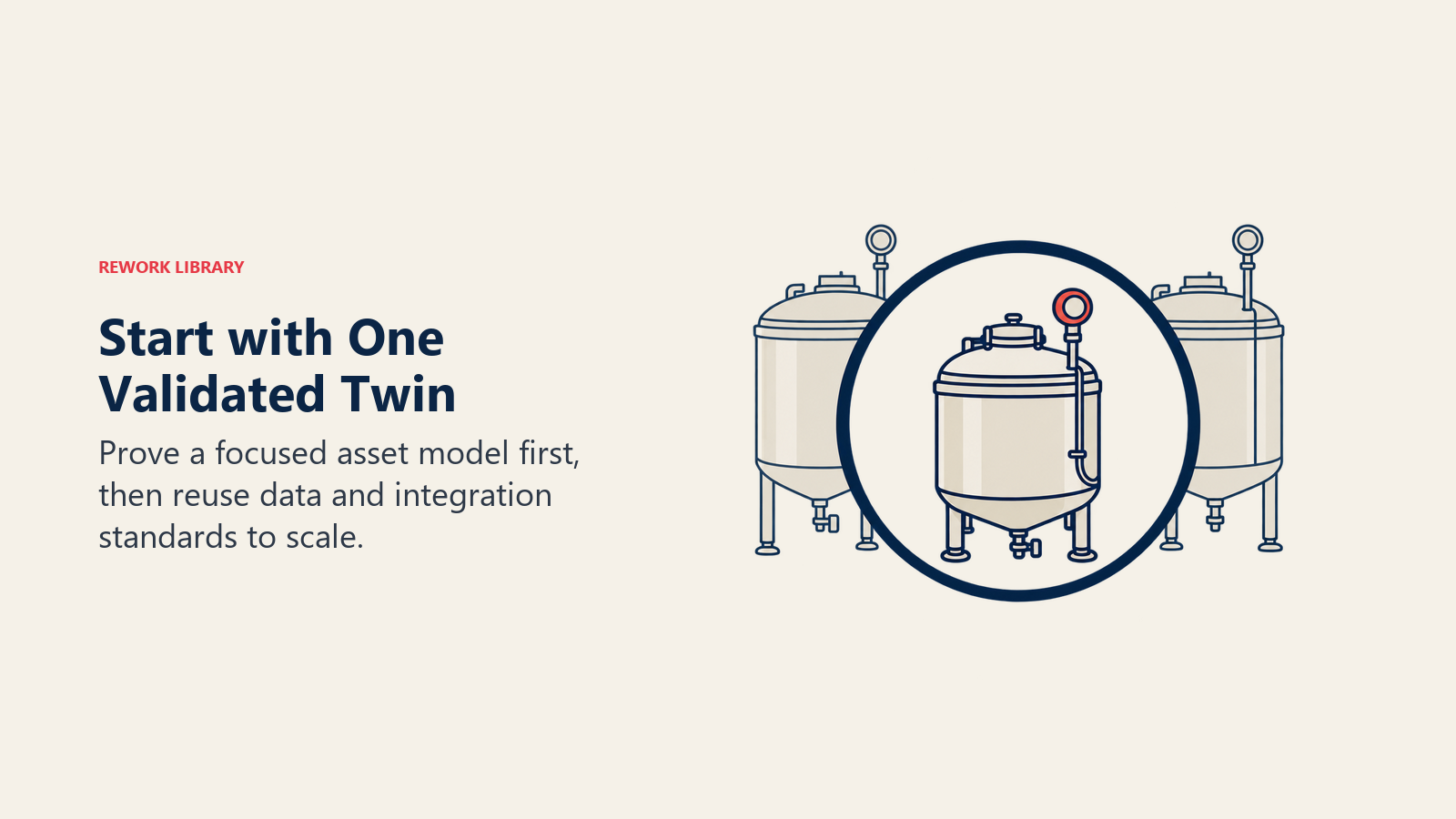
A food processing company started with a digital twin of their critical pasteurization system rather than attempting to twin the entire facility. They validated the twin's accuracy, used it to optimize temperature profiles, and achieved 8% energy savings. This success built support for expanding to additional systems.
Data requirements and IoT infrastructure must be assessed realistically. What sensors exist today? What additional instrumentation is needed? How will data reach the twin platform? What's the required update frequency? Address connectivity, bandwidth, and security requirements early to avoid deployment delays.
Modeling and simulation tools range from simple spreadsheet calculations to sophisticated multi-physics simulators. Commercial digital twin platforms provide pre-built templates for common equipment types and manufacturing processes. Custom modeling is needed for proprietary processes or novel applications.
Integration with existing systems maximizes value. CAD and PLM systems provide product geometry and engineering data. MES systems supply production schedules and actual performance data. ERP systems offer demand forecasts and material availability. The twin aggregates these disparate data sources into a unified model.
Scaling from pilot to production requires standardization. Develop reusable twin templates for common equipment types. Establish data models and integration patterns. Define governance for model updates and change control. These standards enable efficient deployment across multiple assets and facilities.
Value Realization
Reduced physical prototyping costs accumulate quickly. One aerospace manufacturer calculated savings of $2.8M annually from reduced physical testing during product development. The digital twin caught issues that would have required expensive prototype iterations and validated designs with higher confidence.
Faster time-to-market for new products comes from parallel rather than sequential development. Design, tooling, line layout, and operator training proceed simultaneously using the digital twin. Physical installation and ramp-up happen faster because problems are solved virtually first.
Optimized production efficiency results from continuous optimization enabled by the twin. A semiconductor manufacturer's fab twin identifies optimal preventive maintenance timing that balances equipment reliability with production throughput. This optimization runs continuously, adapting to changing product mix and equipment conditions.
Reduced downtime through prediction shifts maintenance from reactive to proactive. Equipment twins predict failures days or weeks in advance with enough specificity to order parts and schedule repairs during planned downtime. This eliminates the scrambling and expedited costs of emergency repairs.
Better capital investment decisions flow from testing expansions and modifications virtually before committing capital. Should we add capacity through a new line or retrofit existing equipment? The twin provides data-driven answers rather than educated guesses. A chemical plant used their twin to evaluate a $12M capacity expansion, identifying a $3M lower-cost alternative that achieved the same throughput.
Future Evolution
AI and ML integration for autonomous optimization represents the next frontier. Today's twins require human interpretation and decision-making. Future twins will automatically optimize parameters, predict and prevent problems, and adapt to changing conditions with minimal human intervention. Machine learning models trained on twin data will discover relationships and optimizations that humans miss.
Enterprise-wide connected twins create value through system-level optimization. Individual equipment twins connect into production line twins. Line twins aggregate into facility twins. Facility twins link across the supply chain. This networked twin ecosystem enables optimization that spans organizational boundaries.
Metaverse and extended reality integration will transform how humans interact with digital twins. Engineers and operators will put on AR headsets and see twin data overlaid on physical equipment. Training will happen in immersive environments where digital and physical worlds blend. Remote experts will troubleshoot equipment through twin interfaces that make distance irrelevant.
Virtual-First Manufacturing
Digital twin technology represents a fundamental shift from trial-and-error physical optimization to virtual-first development and continuous optimization. The most advanced manufacturers now default to testing changes on the twin before implementing them physically.
This virtual-first approach compresses development cycles, reduces risk, and enables continuous improvement at speeds impossible with physical-only methods. Equipment runs more reliably. Processes operate more efficiently. New products reach market faster.
But success requires more than software licenses. You need clean data flowing from physical assets, models that accurately represent reality, integration across the technology stack, and people who understand how to use twin insights for better decisions.
Start with a focused application where you can prove value. Build capability incrementally. Connect twins as you scale. The goal isn't creating perfect virtual replicas of everything, it's using digital representations to make better decisions faster.
Learn More
