Production Bottleneck Analysis: Finding and Fixing Capacity Constraints
Turn this article into takeaways for your work.


Each assistant summarizes the article only for you and suggests best practices for your work.
Your factory's throughput is only as fast as your slowest process. According to Eliyahu Goldratt's Theory of Constraints, introduced in his 1984 book "The Goal," every system has at least one constraint that limits its performance. You might have brilliant equipment, skilled workers, and excellent materials. But if one operation constrains flow, that bottleneck determines your entire system's output. Understanding and managing bottlenecks is fundamental to manufacturing growth model execution and profitability.
Most manufacturers know they have bottlenecks. But they don't systematically identify them, manage them strategically, or eliminate them permanently. They treat symptoms (expediting, overtime, adding resources everywhere) rather than addressing root causes. This reactive approach wastes resources and leaves throughput constrained.
Understanding Production Bottlenecks
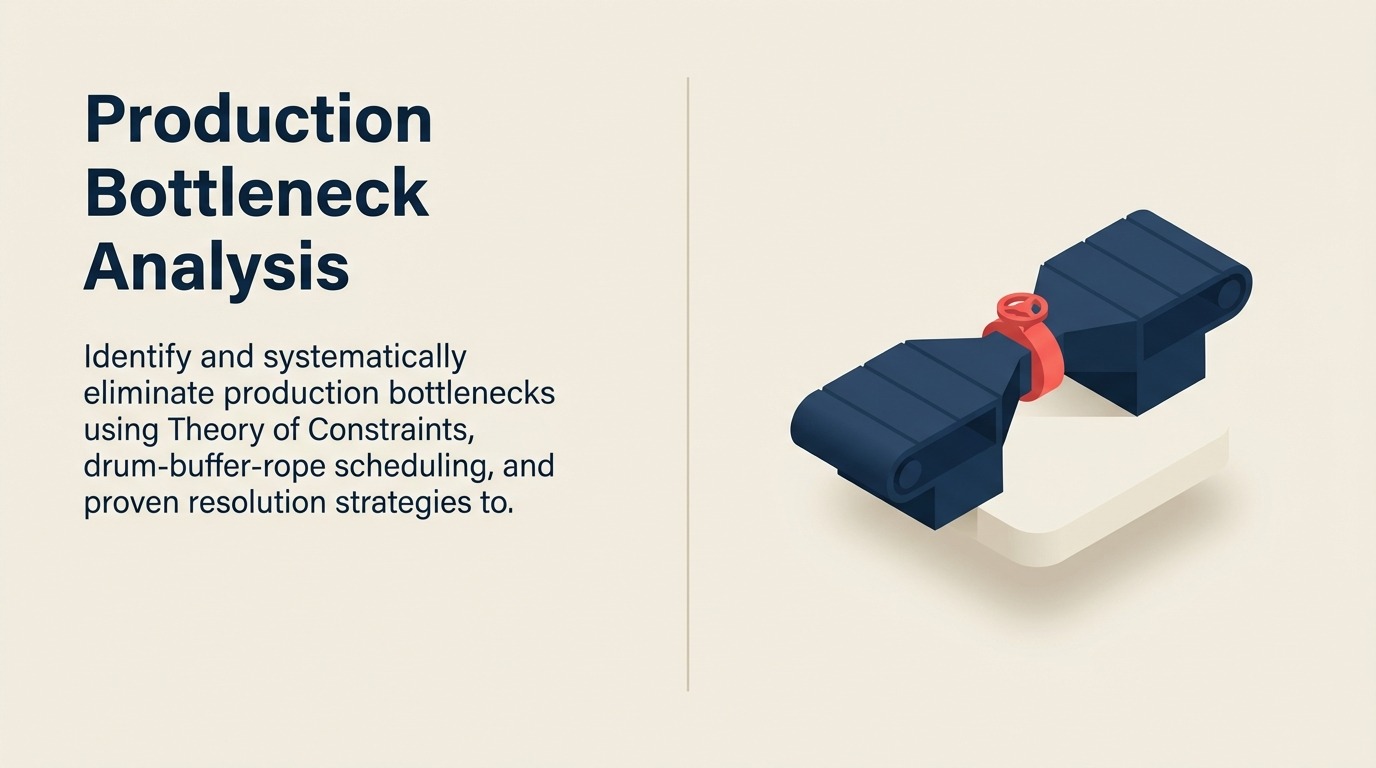
A bottleneck is any resource whose capacity is less than or equal to demand placed on it. It constrains system throughput regardless of how much capacity exists at non-bottleneck resources.
What Creates Bottlenecks
Equipment bottlenecks occur when one machine or work center has less capacity than others or than market demand. This might result from equipment limitations, high changeover times, or reliability problems creating effective capacity below nameplate capacity.
Labor bottlenecks occur when skilled worker availability constrains throughput. You might have adequate machines but insufficient operators. Or you might have adequate headcount but lacking specific skills needed for critical operations.
Material bottlenecks occur when supply constraints limit production. Supplier capacity, material availability, or logistics constraints prevent feeding downstream operations fast enough to maintain full throughput.
Policy bottlenecks are self-imposed through rules and procedures that limit flow. Large batch sizes, excessive quality checks, or approval requirements slow throughput below physical capacity. These are often the easiest to fix but hardest to recognize because they're "the way we've always done it."
Types of Constraints
Physical constraints are tangible: equipment capacity, facility space, labor availability. You can measure them in hours, square feet, or headcount. Most manufacturers focus here because physical constraints are visible.
Policy constraints are rules and procedures: batch sizes, approval processes, quality protocols, work rules. They're less visible but equally limiting. Changing policies is often cheaper and faster than changing physical constraints.
Paradigm constraints are assumptions and beliefs: "we've always done it this way," "customers won't accept that," "it can't be done." These are hardest to identify because people don't recognize their beliefs as constraints. But paradigm shifts often unlock more capacity than physical investments.
Impact on Overall Throughput
The bottleneck determines system throughput. Period. Investing in non-bottleneck resources doesn't increase throughput. It just creates more idle time at those resources and potentially more work-in-process inventory.
This is counter-intuitive. Manufacturers instinctively want to maximize efficiency everywhere. But maximizing non-bottleneck efficiency doesn't increase throughput. It increases costs through excess inventory and complexity.
An hour lost at the bottleneck is an hour lost for the entire system. An hour saved at a non-bottleneck means nothing for system throughput. This fundamental insight drives Theory of Constraints methodology.
Identification Methods: Finding Your Bottlenecks
Several approaches identify bottlenecks. Use multiple methods for validation.
Observation Techniques
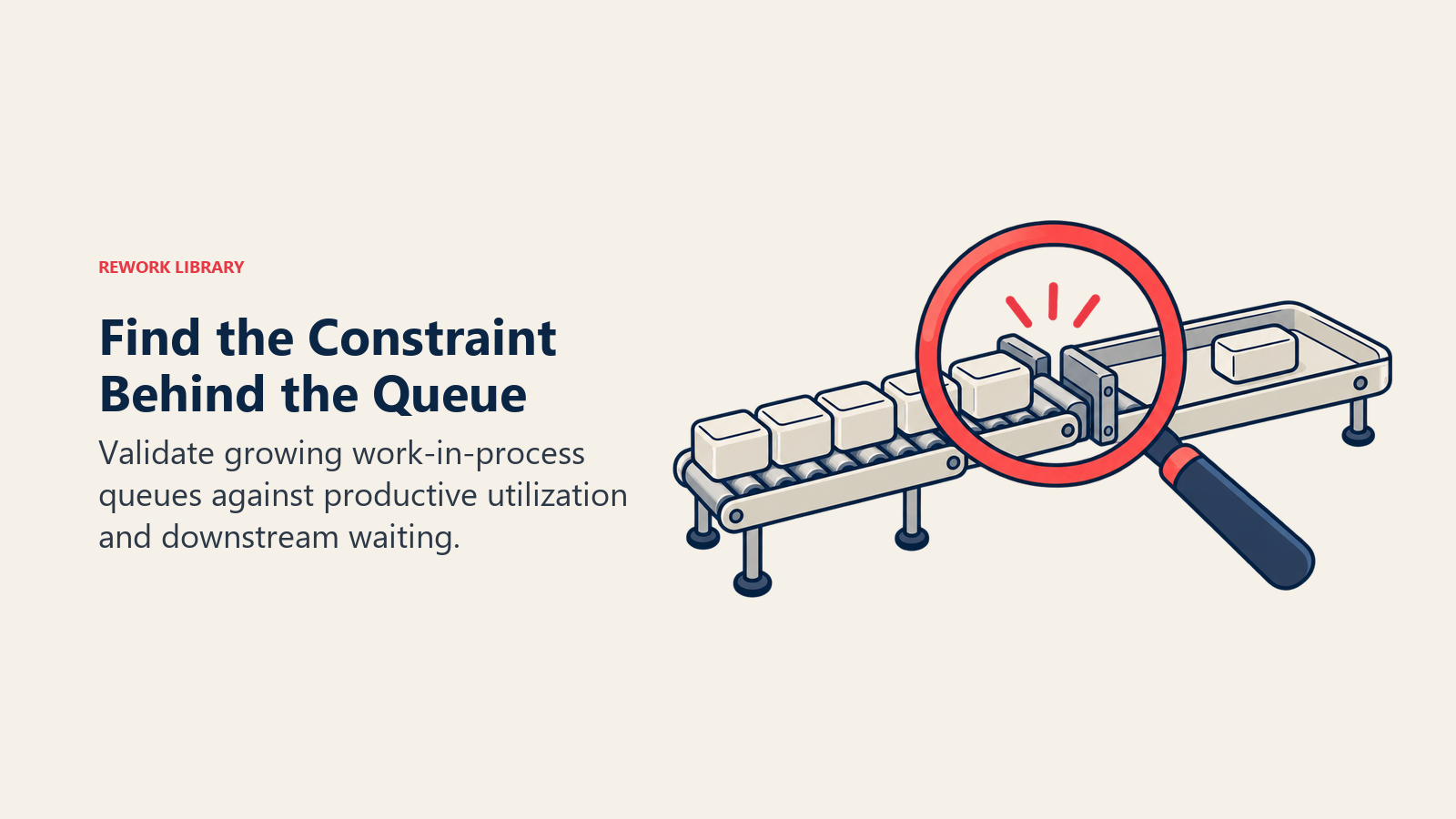
Walk the shop floor and observe where work piles up. Large queues of work-in-process indicate bottlenecks downstream. Empty work centers with idle equipment or workers indicate non-bottlenecks waiting for work from upstream bottlenecks.
Watch which operations run consistently while others start and stop. Bottlenecks run continuously because demand exceeds capacity. Non-bottlenecks run intermittently because they must wait for bottleneck output.
Listen to expeditors and production control. Which operations do they worry about most? Which operations determine whether you'll meet delivery commitments? This reveals operational knowledge of bottlenecks even if formal analysis hasn't identified them.
Data Analysis Approaches
Utilization analysis compares actual output to available capacity by resource. Resources consistently running at 90%+ utilization are bottleneck candidates. But distinguish between active utilization (productive work) and busy utilization (working on low-value activities just to stay busy).
Cycle time analysis tracks how long products spend in each operation and in queues. Operations with long queue times indicate bottlenecks. Products spending 2 hours in process but 20 hours waiting signal that operation is a constraint.
Throughput accounting tracks the rate at which the system generates money through sales. Calculate throughput (revenue minus totally variable costs) per time unit at each operation. The operation with lowest throughput per time is your constraint. Understanding manufacturing cost structure helps with accurate throughput calculations.
WIP Accumulation Signals
Work-in-process accumulates before bottlenecks because upstream operations produce faster than bottlenecks can consume. WIP maps showing inventory distribution across the factory highlight bottlenecks visually.
Monitor WIP levels daily at key operations. Rising WIP trends indicate constraint formation. Declining WIP means the constraint moved elsewhere or demand decreased below capacity. Understanding WIP patterns reveals bottleneck dynamics.
Utilization Patterns
Compare utilization across work centers. The resource with highest utilization is often the bottleneck. But verify this through observation and WIP analysis. Sometimes high utilization results from producing the wrong things rather than being a true constraint.
Calculate utilization as: (Productive Time / Available Time) × 100%. Available time should exclude planned downtime for maintenance and breaks. Productive time is actual output-generating work. Non-productive busy time shouldn't count as utilization.
Theory of Constraints: Systematic Bottleneck Management
Theory of Constraints (TOC) provides systematic methodology for identifying and managing constraints to maximize system throughput.
Five Focusing Steps
Step 1: Identify the constraint. Use methods above to find the current bottleneck. Don't assume. Measure and verify.
Step 2: Exploit the constraint. Maximize bottleneck productivity through eliminating downtime, improving quality (no time wasted on defects), optimizing product mix (prioritize high-contribution products), and reducing changeover time.
Step 3: Subordinate everything else to the constraint. Operate non-bottleneck resources at pace required to support bottleneck, not at maximum efficiency. This might mean planned idle time at non-bottlenecks. This aligns with lean manufacturing principles of flow optimization.
Step 4: Elevate the constraint. If exploitation and subordination don't provide adequate throughput, add bottleneck capacity through additional equipment, extra shifts, or process improvements.
Step 5: Return to step 1. When you elevate one constraint, a different resource becomes the new constraint. Don't let inertia become the constraint:continuously improve.
Drum-Buffer-Rope Scheduling
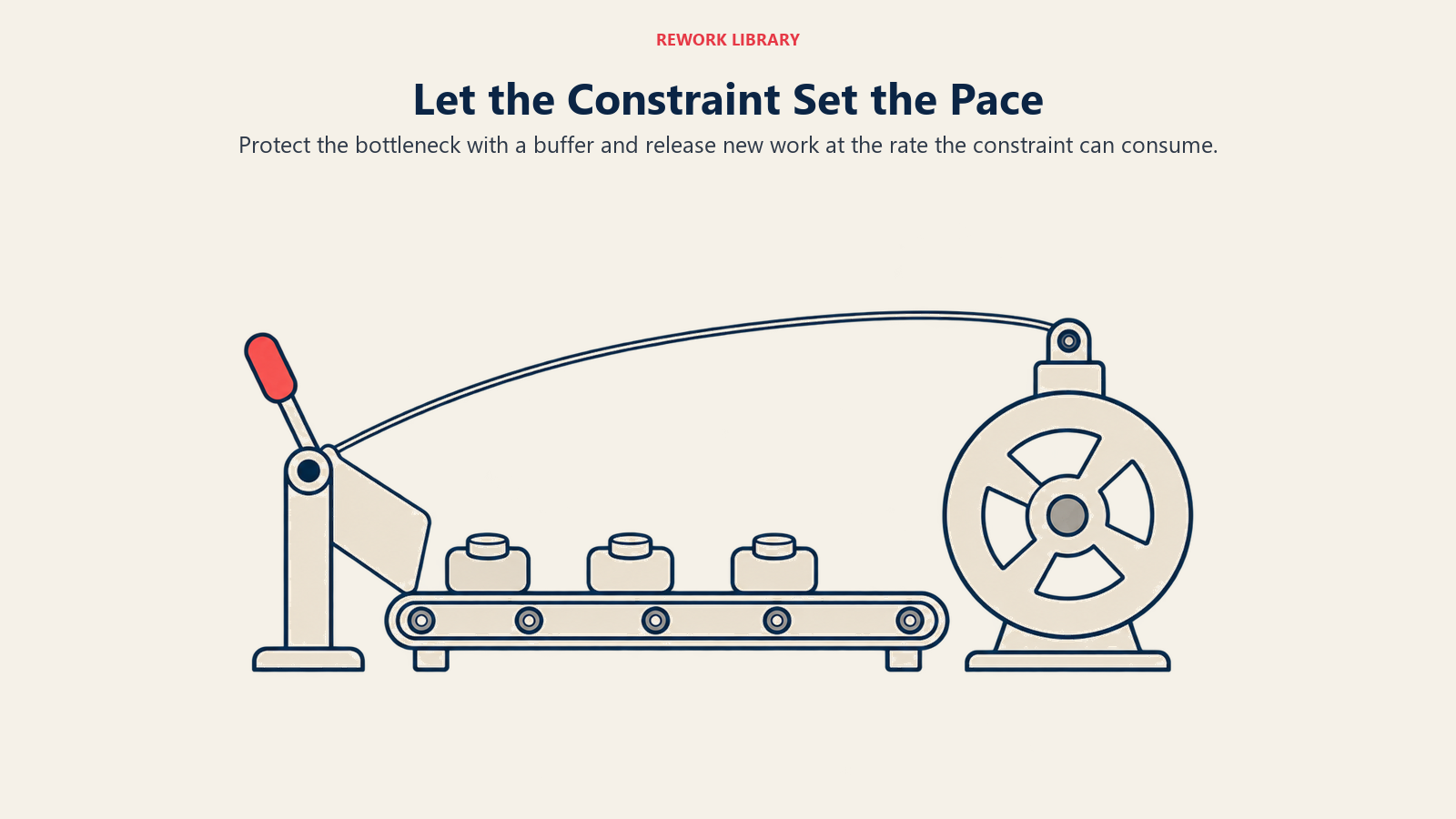
Drum-Buffer-Rope (DBR) is TOC's scheduling approach. The drum is the bottleneck schedule, which sets system pace. The buffer is protective capacity or inventory to prevent bottleneck starvation. The rope is information flow that releases work based on bottleneck consumption.
The drum schedules the bottleneck to maximize throughput. Focus planning effort here. The bottleneck schedule determines what the entire system produces, so get this right before worrying about non-bottleneck schedules.
Buffers protect the bottleneck from disruptions. Time buffers release materials to bottlenecks early enough that upstream problems don't starve them. Inventory buffers maintain WIP ahead of bottlenecks to prevent starvation from material shortages.
The rope controls work release to prevent WIP accumulation. Instead of releasing work whenever materials arrive, release based on bottleneck consumption. If the bottleneck consumes 100 units daily, release 100 units to the system daily. This limits WIP without starving the bottleneck.
Buffer Management
Buffer management monitors work flow to bottlenecks. Divide the time buffer into three zones:
Green zone (0-33%): work is on schedule. No action needed.
Yellow zone (33-66%): work is late but likely will reach bottleneck before it starves. Monitor situation.
Red zone (66-100%): work is seriously late. Bottleneck starvation risk. Expedite immediately.
Frequent red zone appearances indicate buffer is too small or upstream operations are unstable. Extend buffer time or fix upstream problems. Buffers consistently in green indicate excess buffer that can be reduced to lower WIP.
Resolution Strategies: Fixing Bottlenecks Permanently
Identifying bottlenecks is valuable only if you act to eliminate or manage them.
Quick Wins: Exploiting the Constraint
Eliminate bottleneck downtime. If a constraint runs only 6 hours per shift due to breaks, maintenance, and delays, eliminating these increases capacity 33% without investment. Stagger breaks so constraints never stop. Perform maintenance outside production hours. Deliver materials early to eliminate material wait time. Overall equipment effectiveness metrics help track uptime improvements.
Improve bottleneck quality. Every defective unit at the bottleneck wastes capacity that can't be recovered. Implement poka-yoke (error-proofing), enhance operator training, and improve preventive maintenance to maximize quality at constraints. A quality improvement from 95% to 98% yields increases effective capacity 3%.
Optimize product mix. If products consume constraint time unequally but generate different margins, prioritize high-contribution products through constraints. Calculate throughput per constraint minute for each product. Schedule highest-throughput products first.
Reduce bottleneck changeover time. Use SMED (Single-Minute Exchange of Dies) techniques to minimize changeover time. If changeovers take 4 hours and you can reduce to 1 hour, you gain 3 hours of production capacity per changeover.
Capacity Addition Strategies
Additional shifts extend capacity without equipment investment. A constraint running single shift has 200% additional capacity potential through second and third shifts. Labor and utility costs increase, but equipment depreciation doesn't.
Additional equipment directly increases constraint capacity but requires capital investment and space. Evaluate ROI carefully. Capacity additions only create value if demand can absorb increased output and bottleneck will remain the constraint after expansion.
Process improvements increase effective capacity without physical investment. Cycle time reductions, yield improvements, and automation increase throughput from existing resources. These often provide better ROI than capacity additions.
Offloading moves some work from constraints to other resources or outside suppliers. Can non-bottleneck equipment be modified to handle some constraint work? Can subcontractors handle overflow? Offloading prevents constraint investments for temporary capacity needs.
Permanent Solutions
Rebalance the production line to distribute work more evenly across operations. If one operation has 10 minutes per unit while others have 6 minutes, you've created an artificial bottleneck through poor line design. Redistribute work to equalize times.
Automate constraints to increase capacity and consistency. Manual bottlenecks are good automation candidates because high utilization enables fast ROI and automation directly increases system throughput.
Simplify products to reduce constraint time. If you can reduce constraint operation time from 10 minutes to 8 minutes through design changes, you increase constraint capacity 25%. This requires engineering collaboration but often provides high-leverage improvements.
Eliminate the constraint entirely by removing operations through design changes, process innovation, or capability development elsewhere in the system. The ultimate bottleneck solution is making it unnecessary.
Learn More
Deepen bottleneck management expertise:
- Production Planning Fundamentals explains planning around bottlenecks
- Capacity Planning Strategy guides capacity decisions at bottlenecks
- Lean Manufacturing Principles provides tools for constraint exploitation
- Manufacturing KPIs Overview covers metrics for bottleneck monitoring
- Value Stream Mapping visualizes flow and identifies constraints
- Master Production Scheduling aligns schedules with bottleneck capacity
Continuous Bottleneck Management
Bottleneck management is never finished. When you fix one bottleneck, another emerges. Market demand grows and current constraints become inadequate. Product mix changes and different operations constrain.
Build continuous bottleneck management into operations. Review utilization and WIP patterns weekly. Identify emerging constraints before they limit throughput. Exploit constraints systematically before investing in capacity. And subordinate non-bottleneck resources to constraint schedules rather than optimizing local efficiency.
This discipline transforms bottleneck management from occasional firefighting to systematic capability that maximizes throughput, optimizes investment, and builds competitive advantage through superior delivery and cost performance.
