Lean Manufacturing Principles: Eliminating Waste and Maximizing Value
Turn this article into takeaways for your work.


Each assistant summarizes the article only for you and suggests best practices for your work.
Lean manufacturing manufacturers achieve 30-50% cost reductions while improving quality and delivery. They don't work harder. They work smarter by systematically eliminating waste that consumes resources without creating value. Every process contains waste. Lean provides the mindset and tools to see it and remove it.
But lean isn't just cost reduction. It's a philosophy about creating value efficiently, respecting people, and continuously improving. Developed by Toyota's Taiichi Ohno and Eiji Toyoda between 1948 and 1975, the Toyota Production System became the foundation for modern lean manufacturing. Organizations that treat lean as a cost-cutting program miss the point and achieve temporary improvements that don't sustain. Those that embrace lean thinking transform their cultures and capabilities permanently.
Fundamental Lean Principles
Five core principles guide lean thinking and implementation. The Lean Enterprise Institute describes these principles as grounded in two main pillars: Just-in-time production and Jidoka (automation with a human touch).
Value from Customer Perspective
Value is what customers are willing to pay for. Everything else is waste. This sounds obvious but manufacturers often define value from their perspective: "we make quality products" or "we use advanced technology." But customers don't pay for quality or technology directly. They pay for products that solve problems or meet needs.
Start by understanding what customers truly value. Is it low cost? Fast delivery? Customization? Reliability? Technical performance? Different customers value different things. Segment customers and design value delivery accordingly.
Then examine every activity and ask: does this create value the customer pays for? Machining creates value by transforming materials. Material handling doesn't create value; it's necessary waste to support machining. Inspection doesn't create value; it catches problems that shouldn't exist. This distinction between value-adding and non-value-adding activities guides improvement priorities.
Value Stream Thinking
Value streams are all activities required to bring products from raw materials through delivery to customers. They cross functional boundaries, departments, and even companies. Traditional management optimizes functions. Lean optimizes value streams. Value stream mapping provides systematic methodology for visualization.
Map complete value streams, not just manufacturing steps. Include design, ordering, purchasing, production, shipping, and installation. Waste often hides in handoffs between functions. Manufacturing might be efficient while procurement delays materials for weeks.
Value stream thinking reveals that local optimization doesn't guarantee system optimization. A department achieving 95% efficiency might create waste elsewhere if it overproduces, creates defects, or delivers at wrong times. Optimize the stream, not the steps.
Flow and Pull
Make value flow continuously without interruption, waiting, or batching. Ideal flow means products move through processes without stopping:one piece at a time with zero inventory between steps. Reality rarely allows perfect flow, but the ideal guides improvement.
Create pull where continuous flow isn't possible. Pull means nothing produces until downstream customers or processes signal need. This prevents overproduction (making things before they're needed) and reduces inventory while maintaining delivery capability.
Traditional manufacturing pushes production based on forecasts and schedules. Lean pulls production based on actual consumption. Pull responds faster to demand changes and eliminates waste from producing wrong products or excessive quantities.
Perfection Through Continuous Improvement
Perfection is unattainable but pursuing it drives continuous improvement (kaizen). There's always more waste to eliminate, better ways to create value, and higher performance to achieve. Organizations that think they've "finished" lean stop improving and fall behind.
Continuous improvement isn't just managers or engineers improving processes. It's everyone identifying and eliminating waste daily. Front-line workers see problems that managers miss. Empowering them to make improvements multiplies improvement pace.
Make improvement everyone's job, not just a department's responsibility. Production supervisors improve operations. Operators improve their work areas. Engineers improve designs for manufacturability. Sales improves order processes. Continuous improvement becomes cultural, not episodic.
Respect for People
Lean respects people by not wasting their time on non-value activities, engaging their intelligence in improvement, developing their skills, and creating safe, clean work environments. Organizations that claim to be lean while treating workers poorly aren't really lean.
Respect means involving workers in improvement, listening to their ideas, acting on suggestions, and explaining when suggestions can't be implemented. It means investing in training and development. It means creating conditions where people can take pride in their work.
Many manufacturers implement lean tools while maintaining command-and-control management. This creates compliance without engagement. True lean requires cultural change where managers see their role as enabling workers to succeed rather than controlling what they do.
Seven Wastes: Identifying and Eliminating Muda
Lean identifies seven classic wastes (muda) that consume resources without creating value. Learning to see these wastes is fundamental to lean thinking.
Overproduction
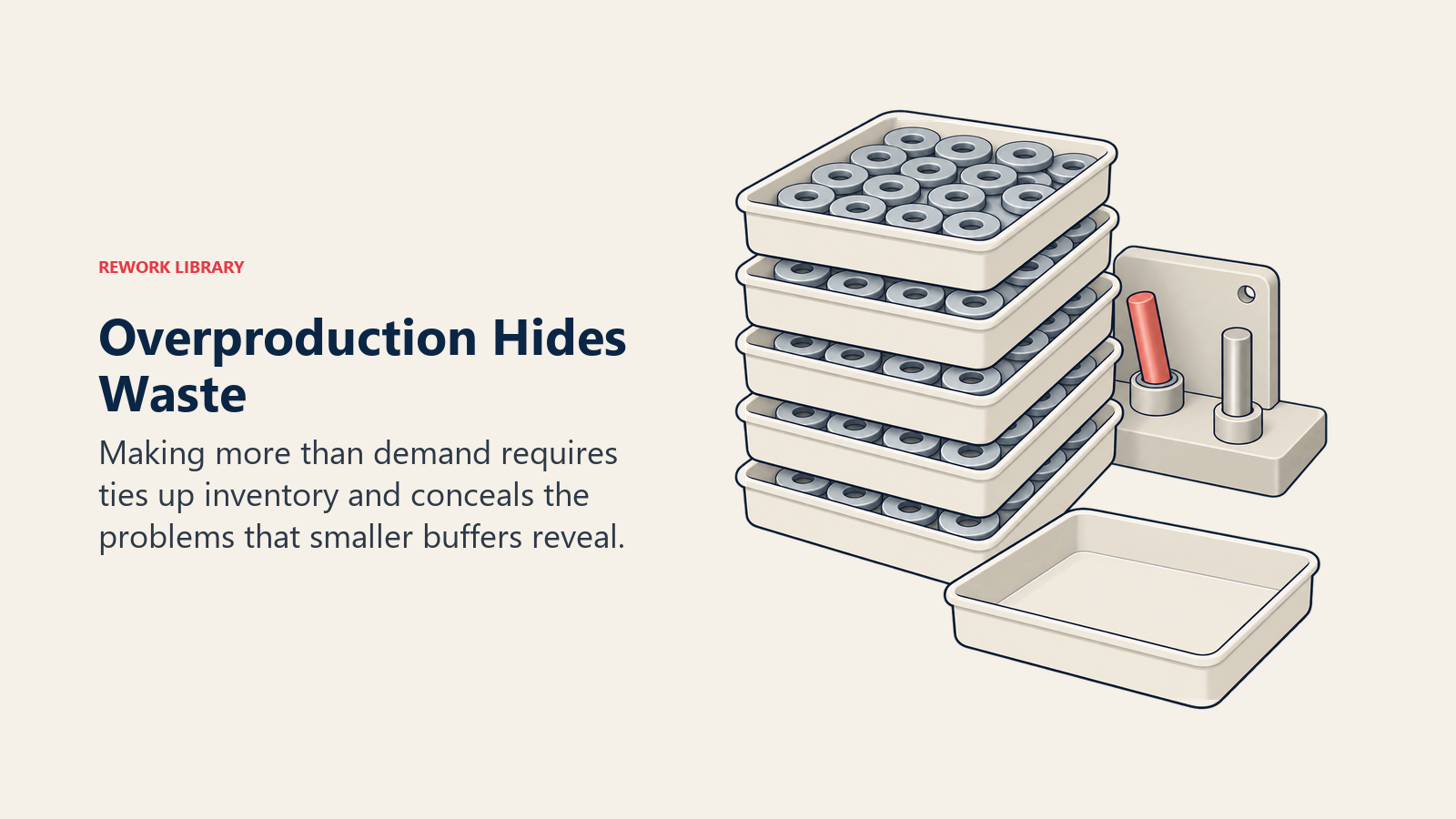
Producing more than needed or before needed is the worst waste because it creates other wastes. Overproduction creates excess inventory (waste #5), consumes capacity needed for value-adding work, and hides problems that limited production would reveal.
Manufacturers overproduce to keep workers and machines "busy," achieve "efficiency," or protect against uncertainty. But busy doesn't equal productive. Making things customers haven't ordered yet is waste, not efficiency.
Eliminate overproduction through pull systems that produce only what's needed when needed. Accept that resources might occasionally idle rather than overproduce. Lower utilization with zero overproduction beats high utilization with excess inventory. Kanban system implementation provides practical pull mechanism.
Waiting
Waiting occurs when work, information, or materials delay the next step. Workers waiting for materials, machines waiting for setup, products waiting for next operations:all represent waste. Time adds no value. Only transformation does.
Measure queue time (time work waits) separately from process time (time work is actually processed). Most manufacturing has queue-to-process ratios of 10:1 or higher. Products requiring 4 hours of processing wait 40+ hours between operations.
Reduce waiting through flow improvements, better scheduling, setup reduction, and eliminating bottlenecks. Every minute of waiting eliminated is a minute of lead time reduced without increasing cost.
Transportation
Moving materials, products, or information that doesn't directly create value is waste. Each transportation step requires time, equipment, labor, and energy. It creates opportunities for damage, loss, and error. It adds cost without adding value.
Long distances between operations, poor layout, excessive handling, and centralized storage create transportation waste. Materials moving hundreds of feet multiple times during production consume resources pointlessly.
Minimize transportation through cellular layouts that position related operations close together, point-of-use storage that keeps materials where needed, and flow designs that eliminate backtracking.
Over-processing
Over-processing means doing more work than customers value. Tighter tolerances than required, extra finishing steps, unnecessary features, redundant approvals:all represent over-processing waste.
This waste often stems from unclear specifications, risk-averse culture, or history ("we've always done it that way"). Engineers specify tight tolerances because they're worried about quality, not because customers need them. Managers require multiple approvals because they don't trust workers, not because value increases.
Eliminate over-processing by understanding what customers truly value, specifying requirements accurately, empowering workers to make decisions, and continuously questioning whether steps add value.
Inventory
Excess inventory:raw materials, work-in-process, or finished goods:ties up cash, hides problems, and risks obsolescence. Inventory is waste's symptom. It exists to buffer other wastes: overproduction, waiting, quality problems, or unreliable processes. Inventory optimization strategies balance service levels with inventory investment.
Manufacturers maintain inventory thinking it's necessary. But lean manufacturers operate with 50-80% less inventory while maintaining better delivery than traditional manufacturers. They accomplish this by eliminating root causes requiring inventory buffers.
Reduce inventory by improving flow, reducing setup times, fixing quality problems, and creating reliable processes. Don't just cut inventory targets without addressing root causes. That creates shortages without eliminating waste.
Motion
Unnecessary movement of people is motion waste. Reaching, walking, bending, searching:any movement not directly transforming products represents waste. Ergonomically poor workstations create motion waste while also risking worker injury.
Motion waste often appears trivial: a few extra steps, a slight reach. But multiply across repetitions and workers. A 5-second reach occurring 500 times per shift wastes 40+ minutes daily. Across 20 workers, that's 13+ hours daily:more than one FTE.
Eliminate motion waste through good workplace organization (5S), ergonomic design, tools and materials within easy reach, and visual management that eliminates searching for information.
Defects
Defects waste materials, labor, equipment time, and customer goodwill. Rework doubles costs. Scrap destroys value already created. Warranty returns create service costs and damage reputation.
Defects result from poor process capability, inadequate training, design problems, or quality shortcuts. Don't just inspect quality in. Build it in through poka-yoke (error-proofing), proper training, capable processes, and designs for manufacturability. Just-in-time production requires high quality because there's no buffer inventory.
Zero-defect thinking isn't unrealistic perfectionism. It's recognition that each defect represents a failure to create value efficiently. Understanding root causes and preventing defects is cheaper than detecting and correcting them.
Lean Tools and Methods: Practical Implementation
Several proven tools enable lean implementation across operations.
5S Workplace Organization
5S creates orderly, clean, standardized workplaces that support efficient operations:
Sort: Remove unnecessary items from work areas. Keep only what's needed for current work.
Set in Order: Organize remaining items for easy access. "A place for everything and everything in its place."
Shine: Clean work areas and equipment daily. Cleaning reveals problems like leaks, wear, or damage.
Standardize: Establish standards for organization and cleanliness. Visual controls show correct states.
Sustain: Maintain improvements through discipline and audit. 5S isn't a one-time event.
5S seems simple but transforms operations. Organized workplaces reduce motion waste, prevent errors, improve safety, and create pride. Disorganized workplaces waste time searching, increase defects, and signal that excellence doesn't matter.
Kaizen Events
Kaizen events are focused improvement projects lasting 3-5 days with cross-functional teams. They deliver rapid, visible improvements while teaching lean thinking and building improvement capability.
Typical kaizen: Assemble 6-8 people from operations, engineering, and support. Focus on specific process or problem. Map current state, identify waste, design improvements, implement changes, and measure results. Typical kaizen delivers 25-50% improvements in targeted metrics.
Kaizen success requires management support (remove obstacles, provide resources), appropriate scope (achievable in one week), team empowerment (authority to implement changes), and follow-through (sustain improvements after the event).
Poka-Yoke (Error-Proofing)
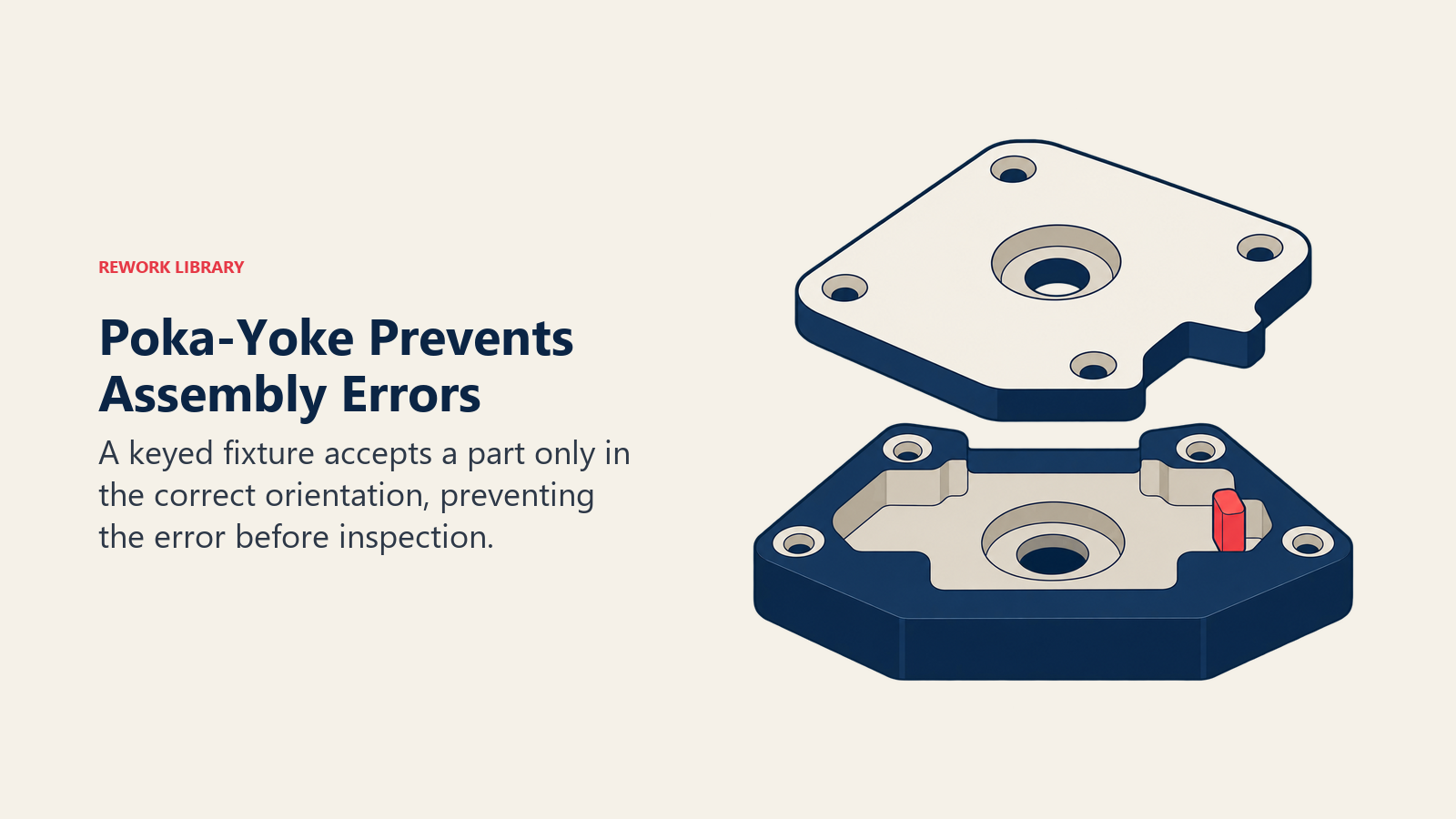
Poka-yoke devices or procedures prevent errors or make them immediately obvious. Examples: fixtures that only accept parts in correct orientation, sensors detecting missing components, software requiring approval before processing orders.
Good poka-yoke prevents errors (parts can't be assembled wrong) rather than just detecting them (inspection catches wrong assembly). Prevention is cheaper and more reliable than detection.
Implement poka-yoke wherever errors occur frequently, have serious consequences, or are easy to prevent with simple devices. Even simple poka-yoke (color coding, physical templates, checklists) dramatically reduces errors.
Standard Work
Standard work documents the current best practice for each job: sequence, timing, work-in-process, and quality checks. It creates baseline for improvement and ensures consistency across shifts and workers.
Standard work isn't restrictive policy. It's capturing what expert workers do and making it repeatable. When you discover better methods, update standards. Standards without continuous improvement become rigid barriers.
Create standard work collaboratively with operators who do the work. They know details that engineers miss. Their involvement also builds ownership and compliance.
Visual Management
Visual management makes problems, status, and standards immediately visible without asking questions or checking documents. Examples: kanban cards showing inventory status, andon lights signaling problems, shadow boards showing tool locations, performance boards displaying metrics.
Good visual management enables management by exception. Leaders can see at a glance whether everything is normal or where attention is needed. This lets them focus on exceptions rather than constantly checking routine status.
Implement visual controls progressively. Start with critical operations and simple visuals. Expand as the organization develops capability. Too many visuals create clutter that people ignore.
Implementation Roadmap: Building Lean Culture
Lean implementation is a journey, not a project. Sustainable lean requires cultural change, not just tool adoption.
Phase 1: Foundation (Months 1-6)
Build lean understanding through training. Teach principles, wastes, and basic tools to leaders and key personnel. Visit successful lean facilities to see possibilities.
Implement 5S in pilot areas. This teaches basic improvement discipline while creating visible wins. 5S seems simple but reveals whether organization can sustain improvements.
Map value streams for key product families. This reveals waste and opportunities while teaching value stream thinking. Start with one or two simple streams before tackling complex ones.
Phase 2: Expansion (Months 7-18)
Run kaizen events in multiple areas. Build internal facilitation capability by training facilitators and having them lead events. Target 1-2 events per month to build momentum without overwhelming organization.
Implement pull systems in pilot areas. Start with simple kanban for replenishment. Expand to production leveling and heijunka as understanding grows.
Develop operator-led continuous improvement through suggestion systems, problem-solving training, and team structures that engage front-line workers in improvement.
Phase 3: Integration (Months 19-36)
Expand lean across operations, then to support functions. Apply lean thinking to procurement, scheduling, engineering, and administration. Waste exists everywhere, not just production.
Integrate lean into management systems: performance metrics tracking lean indicators, meeting structures reviewing lean progress, compensation recognizing improvement contributions.
Build advanced capabilities like setup reduction, total productive maintenance, and design for manufacturing. These leverage lean foundation for deeper improvement.
Phase 4: Transformation (Year 3+)
Lean becomes "how we work" rather than a program. Continuous improvement is habitual. Visual management is standard. Pull systems are normal. Problems surface quickly and get solved systematically.
Leaders act as coaches enabling improvement rather than as controllers directing work. Workers feel empowered and engaged. Customers notice superior quality, delivery, and responsiveness.
This transformation takes years and requires sustained leadership commitment. Organizations that view lean as quick-fix cost reduction give up before reaching transformation.
Learn More
Deepen lean expertise through:
- Manufacturing Growth Model explains lean's role across growth phases
- Manufacturing Cost Structure shows cost impacts of lean
- Value Stream Mapping provides detailed mapping methodology
- Production Bottleneck Analysis complements lean with constraint thinking
- Manufacturing KPIs Overview covers lean metrics
- Production Planning Fundamentals integrates lean with planning processes
Lean as Continuous Journey
Lean isn't a destination. There's no "finished" state where you've eliminated all waste and can stop improving. Markets change, products evolve, technologies advance. Continuous improvement means continuously adapting to remain excellent.
Start lean implementation with realistic expectations. You won't transform overnight. You'll encounter resistance, make mistakes, and face setbacks. That's normal. What matters is persistent commitment to principles and willingness to learn.
Focus on principles over tools. Tools are useful but the lean thinking matters more. Organizations that implement tools without embracing principles create temporary improvements that don't sustain. Those that internalize principles adapt tools creatively and continuously improve.
And remember that lean respects people. It's not about squeezing more from workers through speedups and layoffs. It's about eliminating waste so people can focus energy on value creation instead of fighting systems, searching for materials, or fixing problems. That respect creates engagement that drives continuous improvement far beyond what management-driven programs achieve.
