Industry 4.0 Overview: The Fourth Industrial Revolution in Manufacturing
Turn this article into takeaways for your work.


Each assistant summarizes the article only for you and suggests best practices for your work.
Manufacturing has experienced three industrial revolutions. Mechanization through water and steam power defined the first. Electrification and assembly lines characterized the second. Automation through electronics and IT marked the third. Now the fourth industrial revolution, Industry 4.0, transforms manufacturing through cyber-physical systems that blur lines between digital and physical operations.
The stakes are higher than previous revolutions. Early adopters gain productivity advantages competitors struggle to match. Companies applying AI to quality control catch defects humans miss. Manufacturers using digital twins optimize processes through simulation rather than expensive trial-and-error. Factories with IoT sensors and predictive maintenance avoid unplanned downtime that cripples competitors. These aren't marginal improvements. they're step-function changes in capability and cost structure.
But digital transformation isn't merely buying technology. It requires rethinking how manufacturing operates, integrating systems previously operating independently, developing new workforce capabilities, and accepting continuous change as normal. Many manufacturers struggle with where to start, which technologies matter, and how to justify investments. Understanding Industry 4.0's components, benefits, and implementation approaches enables strategic decisions that capture opportunities while avoiding costly missteps.
Defining Industry 4.0
Industry 4.0 represents the integration of cyber-physical systems into manufacturing operations. Physical equipment and processes connect to digital systems that monitor, analyze, and optimize performance autonomously. The factory becomes a network of intelligent, connected systems rather than isolated machines requiring constant human intervention.
Key enabling technologies include Industrial Internet of Things (IIoT) connecting equipment and sensors, artificial intelligence analyzing data and making decisions, robotics providing flexible automation, cloud computing enabling scalable data processing, and big data analytics extracting insights from vast information streams. These technologies individually provide value but create transformative capabilities when integrated.
The smart factory vision illustrates Industry 4.0 potential. Equipment monitors its own condition, predicting maintenance needs before failures occur. Production systems adapt automatically to changing orders without manual reprogramming. Quality inspection happens in real-time using computer vision. Supply chains coordinate seamlessly through integrated systems. Workers receive augmented reality guidance for complex tasks. The factory essentially runs itself while continuously improving through machine learning.
Cyber-physical production systems merge digital and physical realms. Sensors capture physical conditions. temperature, vibration, position, power consumption. Digital systems process this data, identifying patterns and anomalies. Control systems adjust physical processes based on digital analysis. This closed loop enables autonomous optimization impossible with manual approaches. The physical world informs digital decisions that control physical operations in continuous cycles.
The Nine Pillars of Industry 4.0
Nine technology categories form Industry 4.0's foundation, each contributing specific capabilities while combining synergistically.
Autonomous robots extend beyond traditional industrial robots bolted in fixed positions. Collaborative robots (cobots) work safely alongside humans, adapting to changing tasks. Autonomous mobile robots transport materials without fixed paths. Advanced programming through teaching or simulation enables quick reconfiguration. These robots provide flexible automation adapting to production changes.
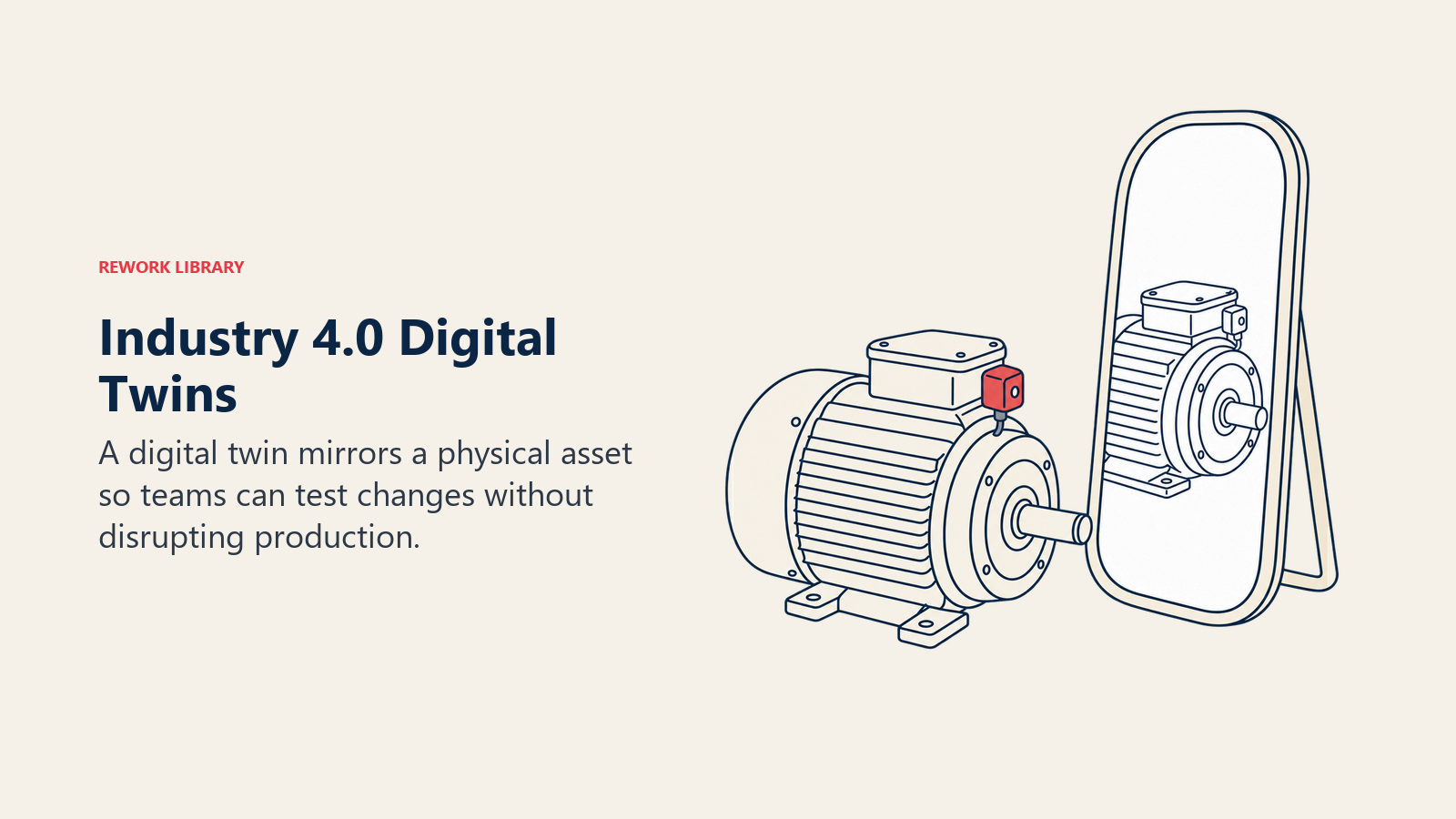
Simulation and digital twins create virtual factory replicas enabling experimentation without disrupting real operations. Digital twins mirror physical assets, using real-time data to maintain synchronization. Engineers test process changes virtually, identifying optimal parameters before implementing physically. New product designs get validated in simulation, reducing physical prototyping costs and time.
Horizontal and vertical system integration connects previously isolated systems. Vertical integration links shop floor equipment through MES to enterprise ERP systems, enabling data flow from sensors to C-suite. Horizontal integration connects companies across value chains. suppliers, manufacturers, logistics providers, customers. enabling end-to-end visibility and coordination.
Industrial Internet of Things (IIoT) instruments equipment and processes with sensors generating continuous data streams. Connected machines report status, production counts, quality metrics, energy consumption. Environmental sensors monitor conditions. Asset trackers show material locations through IoT connectivity. This real-time visibility enables rapid response and data-driven decisions.
Cybersecurity protects connected systems from threats that could shut down operations or steal intellectual property. Industry 4.0 expands attack surfaces as systems connect to networks. Security architecture must protect while allowing necessary connectivity. This includes network segmentation, access controls, intrusion detection, and security monitoring.
Cloud computing provides scalable infrastructure for data storage and processing that on-premise systems can't match economically. Cloud platforms enable analytics across multiple facilities, AI model training requiring massive compute power, and rapid deployment of new capabilities. Hybrid approaches combine on-premise processing for real-time control with cloud for heavy analytics.
Additive manufacturing (3D printing) produces complex geometries impossible with traditional manufacturing while enabling on-demand production without tooling investments. Industrial applications include rapid prototyping, custom tooling and fixtures, and direct production of low-volume parts. Distributed production through additive manufacturing reduces inventory and enables mass customization.
Augmented reality (AR) overlays digital information on physical environments. Maintenance technicians receive step-by-step AR instructions for repairs. Quality inspectors see specifications overlaid on parts. Assembly workers get AR guidance for complex configurations. AR bridges experience gaps while improving accuracy and speed.
Big data and analytics extract insights from massive datasets generated by connected systems. Predictive analytics forecast equipment failures, demand patterns, and quality issues. Optimization algorithms identify ideal process parameters. Machine learning continuously improves predictions and recommendations. Analytics turn raw data into actionable intelligence.
Business Value and Benefits
Industry 4.0 investments must deliver tangible business results justifying substantial technology spending and organizational change.
Productivity improvements through automation and optimization typically generate largest returns. Connected equipment operates at higher utilization through reduced downtime via maintenance strategies. Autonomous systems eliminate manual intervention. Optimized processes run at ideal parameters through lean manufacturing principles. Productivity gains of 10-30% aren't uncommon in successful implementations.
Quality enhancement comes from real-time monitoring and automated inspection catching defects humans miss. Computer vision inspects 100% of production at speeds impossible manually. Statistical process control responds immediately to variation. Predictive quality models identify at-risk production before defects occur. First-pass yield improvements of 5-15% directly reduce costs while improving customer satisfaction.
Flexibility and mass customization become economically viable through rapid reconfiguration. Production systems adapt to different products without extensive changeovers. Additive manufacturing produces customized items at mass-production economics. Order-of-one production serves niche markets previously uneconomical. Flexibility enables competitive differentiation and premium pricing.
Predictive maintenance reduces unplanned downtime by replacing reactive repair with scheduled interventions. Sensors monitor equipment condition. Analytics predict failures weeks before occurrence. Maintenance happens during planned windows rather than emergency situations. Unplanned downtime reductions of 30-50% are common, with corresponding cost savings from avoided emergency repairs and lost production.
Supply chain optimization improves through end-to-end visibility and coordination. Real-time demand signals trigger automatic replenishment. Inventory positions adjust dynamically to changing conditions. Logistics operations optimize based on current rather than historical information. Supply chain costs decrease while service levels improve.
Energy efficiency improves through monitoring and optimization. Energy consumption gets measured at equipment level, identifying waste. Processes optimize for energy efficiency without sacrificing production. Equipment operates during off-peak rate periods when possible. Energy cost reductions of 10-20% help both bottom lines and sustainability goals.
Implementation Roadmap
Successful Industry 4.0 transformation requires systematic approaches rather than random technology adoption.
Maturity assessment establishes current state across technology, processes, and organization. Assessment frameworks evaluate connectivity, data utilization, automation level, integration, and analytics capabilities. Understanding current maturity identifies gaps and appropriate next steps. Don't jump to advanced AI applications if basic connectivity doesn't exist.
Use case prioritization focuses efforts on highest-value opportunities. Identify specific problems or opportunities Industry 4.0 technologies could address. Evaluate based on business impact, implementation feasibility, and strategic importance. Prioritized use cases guide investment decisions and implementation sequencing.
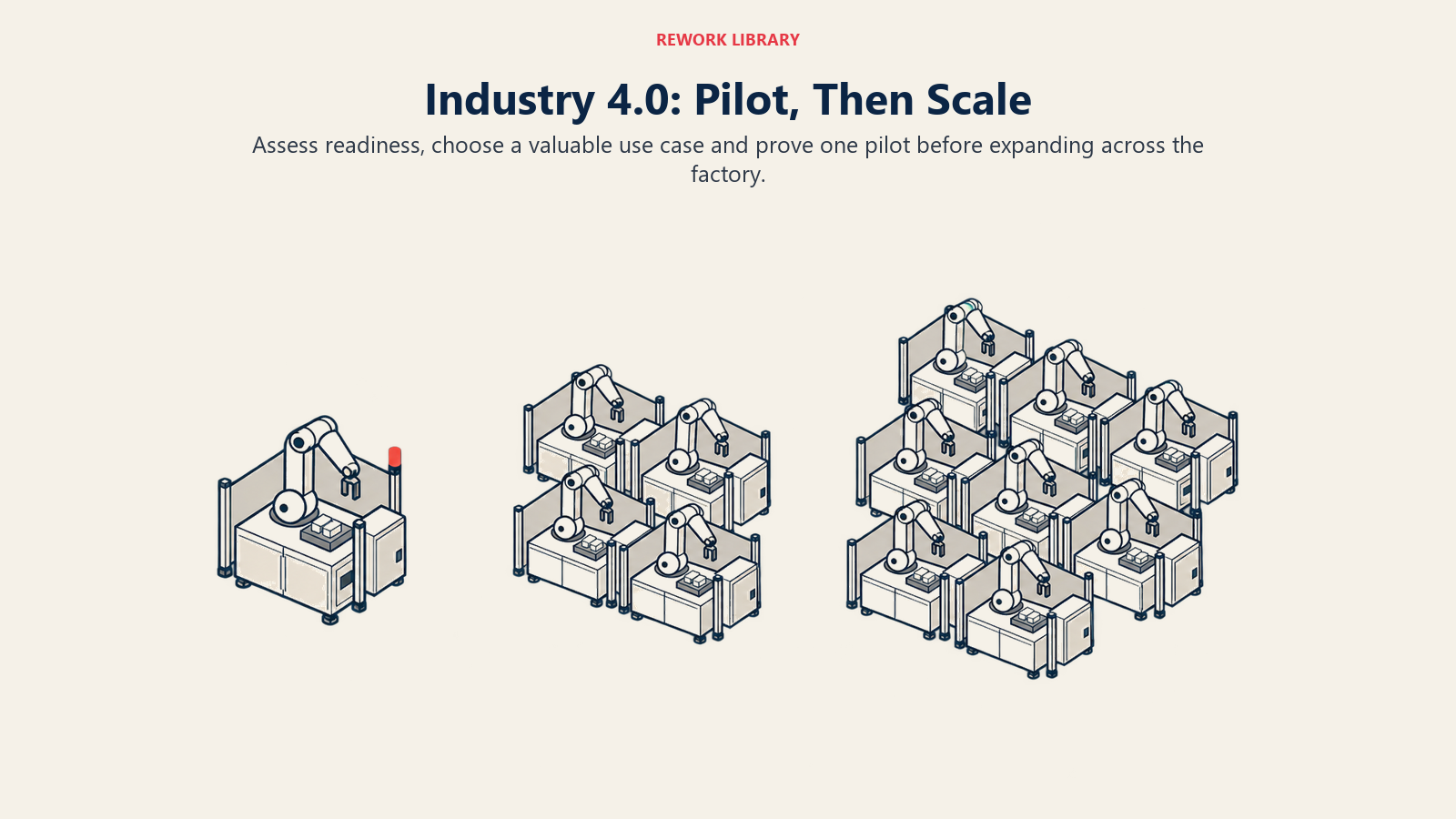
Pilot and scale methodology proves concepts before enterprise rollout. Start with limited pilots demonstrating technical feasibility and business value. A single production line, one facility, or specific process provides learning ground. Successful pilots get scaled systematically across additional scope. This approach manages risk while building organizational capability.
Quick wins build momentum and credibility for broader transformation. Target use cases delivering clear value with straightforward implementation. Predictive maintenance on critical equipment might deliver faster returns than comprehensive smart factory transformation. Early successes secure executive support and funding for subsequent phases.
Change management and skills development address organizational barriers to technology adoption. Workers need training on new systems and responsibilities. Managers need understanding of data-driven decision making. Executives need visibility into transformation progress and returns. Communication, training, and support systems enable organizational adaptation to new ways of working.
Implementation Challenges
Industry 4.0 transformation encounters predictable obstacles requiring proactive management.
Legacy system integration presents technical challenges. Old equipment lacks connectivity needed for IIoT applications. Proprietary protocols prevent communication between systems from different vendors. Data formats and definitions vary across systems. Retrofit strategies, middleware solutions, and standards adoption address these issues but require investment and expertise.
Cybersecurity risks increase as systems connect to networks. Connected equipment creates attack vectors. Data breaches could expose intellectual property or customer information. Ransomware could shut down production. Security architecture must evolve alongside connectivity, balancing protection against operational requirements.
Skills gaps limit capability to implement and operate Industry 4.0 systems. Traditional manufacturing workers need data literacy through workforce training programs. Maintenance shifts from mechanical to digital troubleshooting. Engineers need simulation and analytics capabilities. Workforce development through training, hiring, and partnerships with educational institutions builds needed competencies.
Investment justification proves challenging when returns depend on organizational change beyond technology installation. Traditional ROI calculations miss benefits like flexibility and resilience. Executives accustomed to proven technologies hesitate at emerging approaches through cost analysis frameworks. Business cases need both quantitative financial analysis and qualitative strategic benefits clearly articulated.
Strategic Imperative
Industry 4.0 isn't optional enhancement but competitive necessity. Productivity advantages compound over time. Companies falling behind struggle to catch up as leaders continuously improve through digital capabilities. The gap between leaders and laggards widens.
But success requires strategic approach rather than ad-hoc technology adoption. Clear vision of desired end state. Prioritized roadmap aligning investments with business priorities. Systematic implementation building on successes. Organizational development enabling new capabilities.
Learn More
