Manufacturing Cost Structure: Complete Guide to Production Economics
Turn this article into takeaways for your work.


Each assistant summarizes the article only for you and suggests best practices for your work.
A manufacturer might report 15% gross margins and wonder why competitors thrive at the same price points. The answer? Cost structure. Hidden costs lurk in overhead allocation, material waste, and indirect labor. Understanding your true cost structure is the difference between profitable growth and scaling toward bankruptcy.
Manufacturing cost management isn't about cutting costs blindly. It's about understanding how costs behave, where value is created, and which investments generate returns. The manufacturers who win optimize strategically, not just cut universally.
Components of Manufacturing Cost Structure
Manufacturing costs fall into three primary categories: direct materials, direct labor, and manufacturing overhead. But these simple categories mask significant complexity.
Direct Materials
Direct materials are components and raw materials that physically become part of finished products. Steel for fabrication, electronic components for assembly, chemicals for formulations. According to manufacturing cost research, direct materials typically represent 40-60% of total manufacturing costs, making them the largest cost category for most manufacturers.
Material costs vary directly with production volume. Double your output and you'll roughly double material costs. But "roughly" matters. Volume discounts, scrap rates, and procurement efficiency create non-linear relationships that manufacturers must understand and optimize.
The true cost of materials includes more than purchase price. It encompasses freight, receiving inspection, inventory carrying costs, obsolescence, and waste. A component with a $10 purchase price might carry a $12 total cost when you factor in these elements. Manufacturers who optimize only purchase price while ignoring total cost make poor decisions.
Direct Labor
Direct labor includes wages and benefits for workers who directly transform materials into finished goods. Machine operators, assemblers, welders, and production technicians. These costs typically represent 10-20% of total manufacturing costs in most industries, though labor-intensive operations run higher.
Labor costs have both variable and fixed characteristics. You can adjust labor hours through overtime, part-time workers, and shift changes. But core production workers represent relatively fixed costs because you can't easily change headcount with short-term volume fluctuations.
The hourly wage is just the visible portion of labor cost. Add payroll taxes (typically 8-10%), benefits (15-30%), and support costs (supervision, training, facilities). A worker paid $20/hour might carry a $30-35/hour fully-loaded cost.
Manufacturing Overhead
Manufacturing overhead encompasses all production costs beyond direct materials and labor. Depreciation, utilities, maintenance, quality control, production management, facilities, and factory supplies. These costs typically represent 30-40% of total manufacturing costs.
Overhead includes both variable costs (utilities, supplies, maintenance) and fixed costs (depreciation, insurance, property taxes). The mix determines how your cost structure behaves as volume changes. High fixed overhead creates leverage: margins expand dramatically with volume increases but contract painfully with volume decreases.
Many manufacturers don't truly understand their overhead. They allocate it simplistically based on direct labor hours or machine hours, masking which products and processes actually consume overhead resources. Activity-based costing reveals the truth but requires effort most manufacturers avoid.
Understanding Cost Behavior: Fixed vs. Variable
Cost behavior determines manufacturing profitability more than absolute cost levels. Two manufacturers with identical total costs can have radically different profit trajectories based on their fixed-variable mix.
Variable Costs
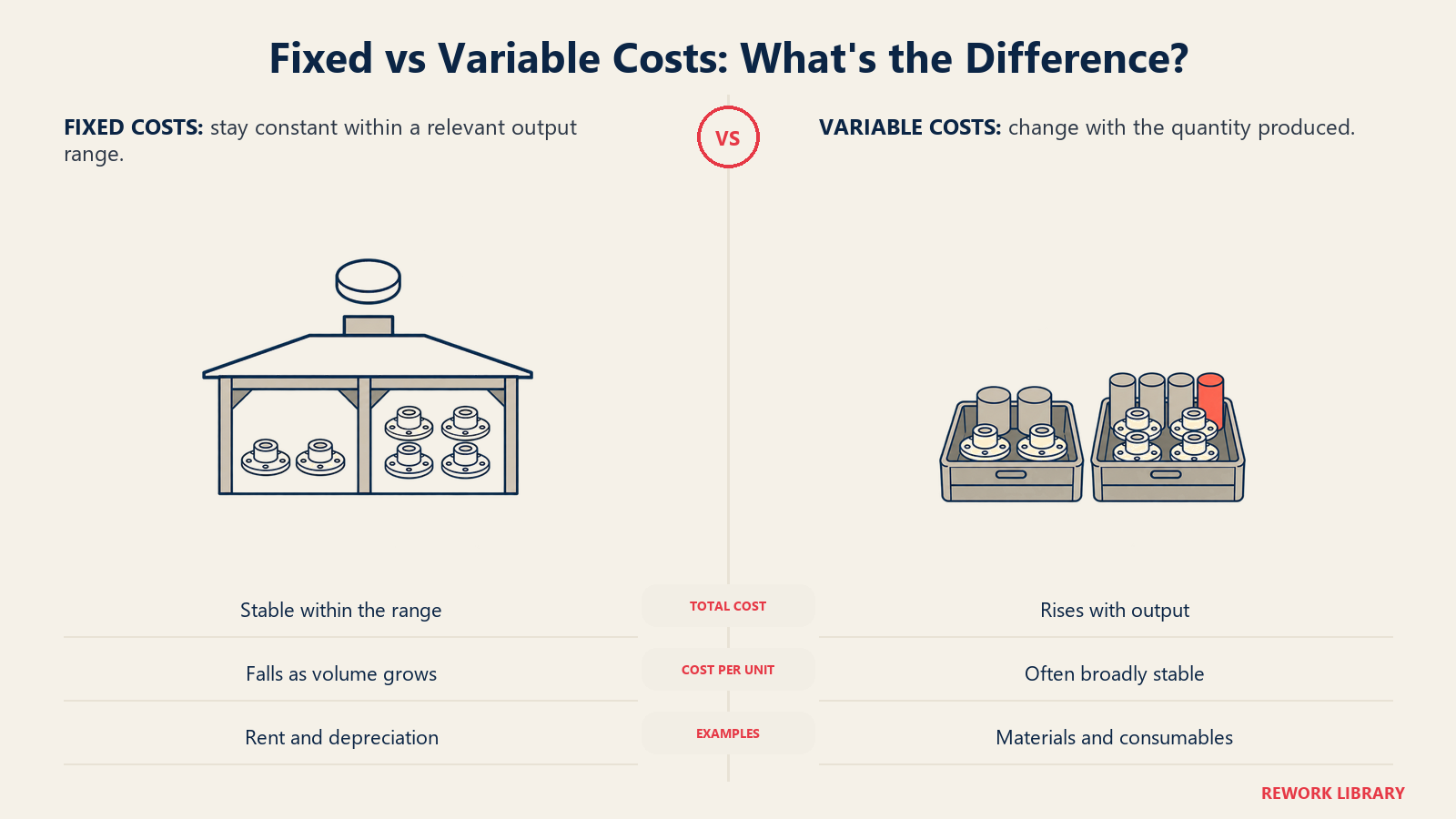
Variable costs change proportionally with production volume. If material cost per unit is $50, producing 1,000 units costs $50,000 and producing 2,000 units costs $100,000. The relationship is direct and predictable.
True variable costs are rarer than manufacturers think. Materials are genuinely variable. Some labor and overhead costs seem variable but contain fixed elements. Understanding which costs are truly variable guides decisions about pricing, capacity, and volume.
Variable costs create linear profit relationships. Each additional unit sold generates the same marginal profit. This simplifies decision-making: any price above variable cost contributes to profit in the short term. But it also means you can't achieve economies of scale through volume alone.
Fixed Costs
Fixed costs remain constant regardless of production volume within relevant ranges. Facility leases, equipment depreciation, production management salaries, insurance, and property taxes stay the same whether you produce 1,000 or 10,000 units per month.
Fixed costs create operating leverage. As volume increases, fixed costs spread over more units, reducing per-unit costs and expanding margins. A manufacturer with $500K monthly fixed costs producing 10,000 units carries $50/unit fixed cost. At 15,000 units, fixed cost per unit drops to $33, improving margins by $17 per unit even if price stays constant.
The leverage works both ways. Volume decreases concentrate fixed costs over fewer units, compressing margins quickly. This is why manufacturers with high fixed costs panic during demand downturns. They can't reduce costs fast enough to maintain profitability.
Break-Even Analysis
Break-even analysis reveals the volume needed to cover all costs. The formula is simple: Fixed Costs ÷ (Price - Variable Cost per Unit). A manufacturer with $500K monthly fixed costs, $50 variable cost per unit, and $80 selling price breaks even at 16,667 units per month.
Understanding your break-even volume guides strategic decisions. If your market can only support 15,000 units monthly, you'll never reach profitability with current cost structure. You must either reduce fixed costs, reduce variable costs, increase price, or exit the market.
Multi-product manufacturers need product-specific break-even analysis. Aggregate break-even masks which products contribute to profit and which destroy it. Product A might generate strong margins while Product B operates below break-even, but aggregate analysis makes both look acceptable.
Capacity Utilization Impact
Fixed costs create a direct relationship between capacity utilization and profitability. A plant operating at 50% capacity carries twice the per-unit fixed cost burden as one at 100% capacity. This is why underutilized capacity is so expensive.
Manufacturers facing low utilization have three options: increase volume to spread fixed costs, reduce fixed costs to match lower volume, or accept lower profitability temporarily. Each approach has limitations and risks that depend on market conditions and competitive position.
High utilization delivers profitability but creates vulnerability. Plants running at 95%+ capacity can't absorb volume spikes, respond to rush orders, or handle production problems without missing deliveries. The optimal utilization target balances profitability with flexibility, typically 80-90% for most manufacturers.
Cost Reduction Strategies: Systematic Approach
Cost reduction requires systematic analysis across materials, labor, overhead, and processes. Random cost cutting often reduces value faster than it reduces costs.
Material Optimization
Material costs offer the largest absolute savings opportunity for most manufacturers. Strategies include:
Design optimization reduces material consumption through smarter product design. Lighter weight structures, fewer components, standard parts instead of custom. Each design change that eliminates 5% of material content drops right to bottom-line profit.
Supplier negotiations use volume, competition, and relationships. Manufacturers who run quotes annually and consolidate purchases with fewer suppliers reduce costs 10-20% without changing specifications. Those who engage suppliers in value engineering projects find even larger savings.
Waste reduction attacks scrap, rework, and obsolescence. A manufacturer running 5% scrap rates wastes 5% of material spending. Reducing that to 2% through better processes, training, and quality control converts waste into profit.
Make vs. buy analysis questions whether in-house production makes economic sense. Some components cost less to buy than make once you factor in all costs. Others offer vertical integration advantages that justify production despite higher costs.
Labor Productivity
Labor productivity improves through training, process improvement, and automation. Strategies include:
Process standardization eliminates variation that slows production. When every operator has their own method, productivity varies widely. Standard work captures best practices and makes them repeatable, improving productivity 15-25%.
Training develops skills that increase speed and quality. Expert operators produce more with fewer defects than novices. Structured training programs accelerate skill development and reduce the productivity gap.
Layout optimization reduces wasted motion and material handling. Poor layouts force workers to walk, reach, and search unnecessarily. Lean layout principles can improve productivity 20-30% without changing equipment.
Automation replaces labor where economics justify investment. But automation requires volume and stability to generate returns. Manufacturers who automate low-volume, high-variation processes usually lose money.
Overhead Reduction
Overhead costs often escape scrutiny because they're less visible than materials and labor. But overhead reduction generates pure profit improvement.
Activity elimination questions whether work adds value. Many overhead activities persist because "we've always done it," not because customers value it. Eliminating non-value activities rather than just reducing their cost generates larger savings.
Shared services consolidate overhead activities across sites or divisions. Separate facilities each maintaining their own purchasing, scheduling, and quality functions carry higher overhead than those sharing centralized services.
Technology automation reduces overhead labor through better systems. Manual data entry, spreadsheet-based planning, and paper-based quality tracking consume labor that automation eliminates. The right systems reduce overhead 30-40% while improving accuracy.
Process Efficiency
Process improvement reduces costs across all categories simultaneously. Lean manufacturing principles attack waste systematically.
Cycle time reduction increases throughput per unit of capacity, spreading fixed costs over more units. It also reduces work-in-process inventory carrying costs and improves cash flow.
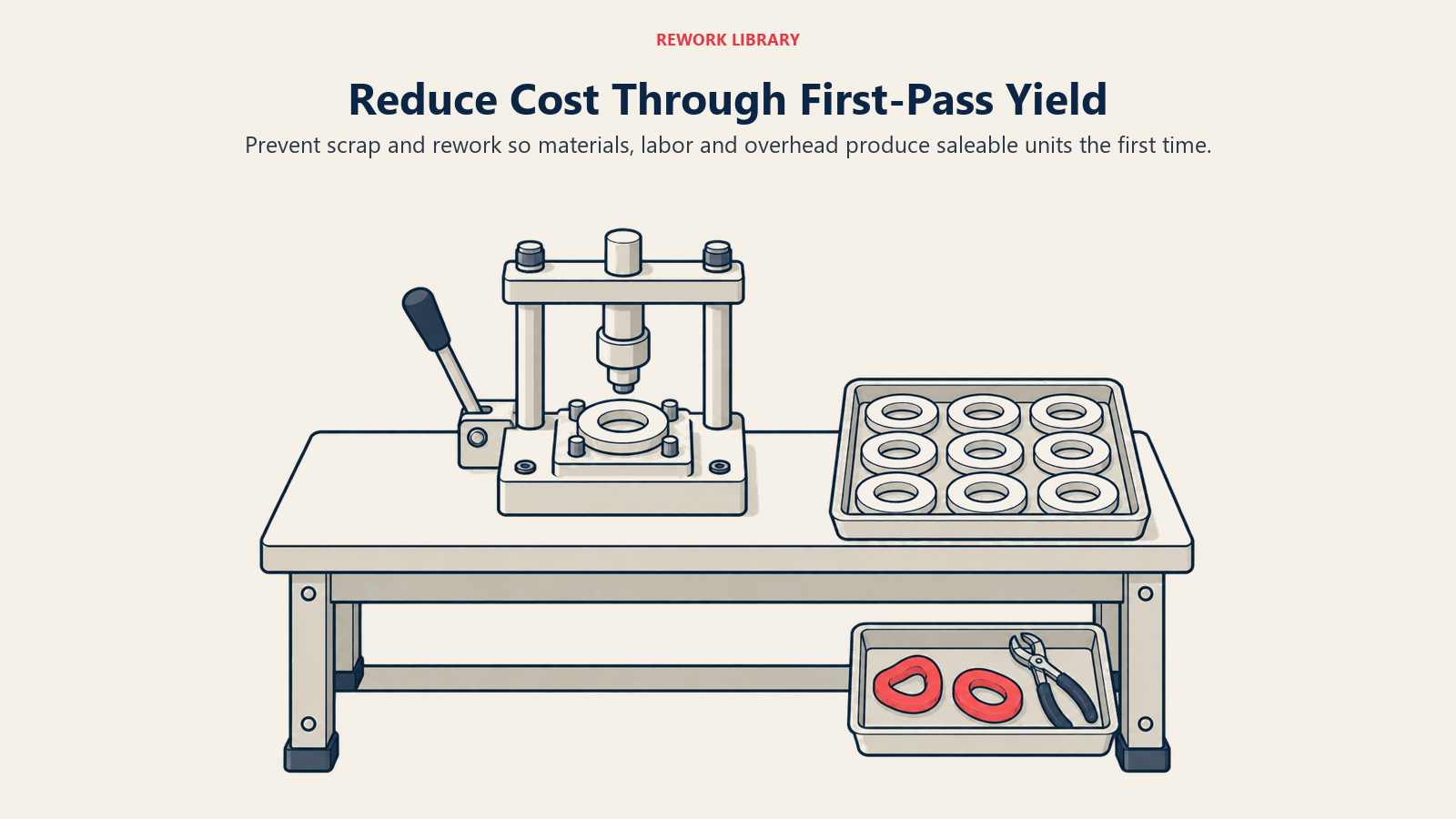
First-pass yield improvement eliminates rework and scrap. Improving yield from 90% to 95% reduces total production cost by nearly 5% because you're not wasting materials, labor, and overhead on defective units.
Setup time reduction enables smaller batches without sacrificing efficiency. This reduces inventory, improves flexibility, and allows better customer service without increasing costs.
Cost Control Framework: Tools and Methods
Effective cost control requires systems that track actual costs, compare them to standards, and trigger corrective action when variances occur.
Standard Costing Systems
Standard costing establishes what products should cost based on engineered standards for materials, labor, and overhead. Actual costs are compared to standards, with variances indicating problems requiring attention.
Material price variances show whether purchasing paid more or less than standard. Material usage variances indicate whether production consumed more or less material than standard. The distinction matters because different groups control each variance.
Labor rate variances compare actual wages to standard rates. Labor efficiency variances measure whether workers took more or less time than standard. Again, different root causes and corrective actions apply to each.
Activity-Based Costing
Activity-based costing (ABC) allocates overhead based on cost drivers that actually consume resources. Instead of spreading overhead uniformly based on labor hours, ABC identifies activities (setup, inspection, material handling) and assigns costs based on how much each product uses those activities.
ABC reveals that low-volume, high-complexity products often consume far more overhead than traditional costing suggests. This leads to better pricing decisions, product mix optimization, and process improvement priorities.
Implementing ABC requires effort to identify activities, measure cost drivers, and maintain data. Most manufacturers find that full ABC isn't worth the effort, but applying ABC principles to key overhead categories generates insights that justify the investment.
Target Costing
Target costing works backward from market price. Instead of designing products and then calculating costs, target costing starts with the price customers will pay, subtracts desired margin, and sets a cost target that design and manufacturing must achieve.
This approach forces cost consciousness into design phase, where 70-80% of costs are determined. It prevents situations where products are beautifully designed but impossible to produce profitably.
Learn More
Deepen your cost management expertise with these resources:
- Manufacturing Growth Model explains how cost structure impacts growth phases
- Manufacturing Revenue Streams shows how different revenue streams have different cost profiles
- Lean Manufacturing Principles provides tools for systematic waste elimination
- Production Bottleneck Analysis helps identify where costs concentrate
- Capacity Planning Strategy guides fixed cost investments
Building a Competitive Cost Structure
Cost structure determines manufacturing competitiveness more than any other factor. You can have superior products, excellent service, and strong customer relationships. But if your cost structure is 20% higher than competitors', you'll eventually lose.
Building competitive cost structure requires understanding every component, optimizing systematically, and managing costs continuously. It's not a one-time project. It's a permanent discipline that separates profitable manufacturers from struggling ones.
The manufacturers who win don't just cut costs. They invest strategically in areas that reduce long-term costs while improving value. They understand the difference between good costs that build capability and bad costs that just consume resources. And they build cultures where everyone understands costs and takes responsibility for managing them.
