E-commerce Business Models: Choosing the Right Path for Your Online Store
Turn this article into takeaways for your work.


Each assistant summarizes the article only for you and suggests best practices for your work.
Two online stores selling similar products to the same audience. Both drive 100,000 monthly visitors. One generates $2M in annual revenue. The other? $20M.
Same traffic. Same market. The difference? Their business model choice.
This isn't about who works harder or who has better products. The business model you choose fundamentally determines your profit potential, growth trajectory, and operational complexity. Choose wrong, and you'll fight uphill battles on margins, customer acquisition costs, and cash flow. Choose right, and the model itself becomes your competitive edge.
If you're building or scaling an e-commerce operation, understanding business model economics isn't optional. It's the strategic foundation that determines everything else, from your unit economics to your customer lifetime value.
The Six Core E-commerce Business Models
The e-commerce landscape has consolidated around six primary business models, each with distinct characteristics:
- Direct-to-Consumer (D2C) - Brand-owned stores selling directly to end customers
- Business-to-Business (B2B) - Wholesale and bulk sales to other businesses
- Business-to-Consumer (B2C) - Multi-brand retail selling to consumers
- Marketplace/Multi-Vendor - Platform connecting buyers with multiple sellers
- Subscription & Recurring Revenue - Predictable, recurring customer purchases
- Dropshipping & Fulfillment Models - Inventory-light operations with third-party logistics
These aren't mutually exclusive. The most sophisticated e-commerce operators run hybrid models, combining multiple approaches to maximize market coverage and revenue predictability.
But before you can hybrid, you need to understand the fundamentals of each model.
Direct-to-Consumer (D2C): The Brand Control Model
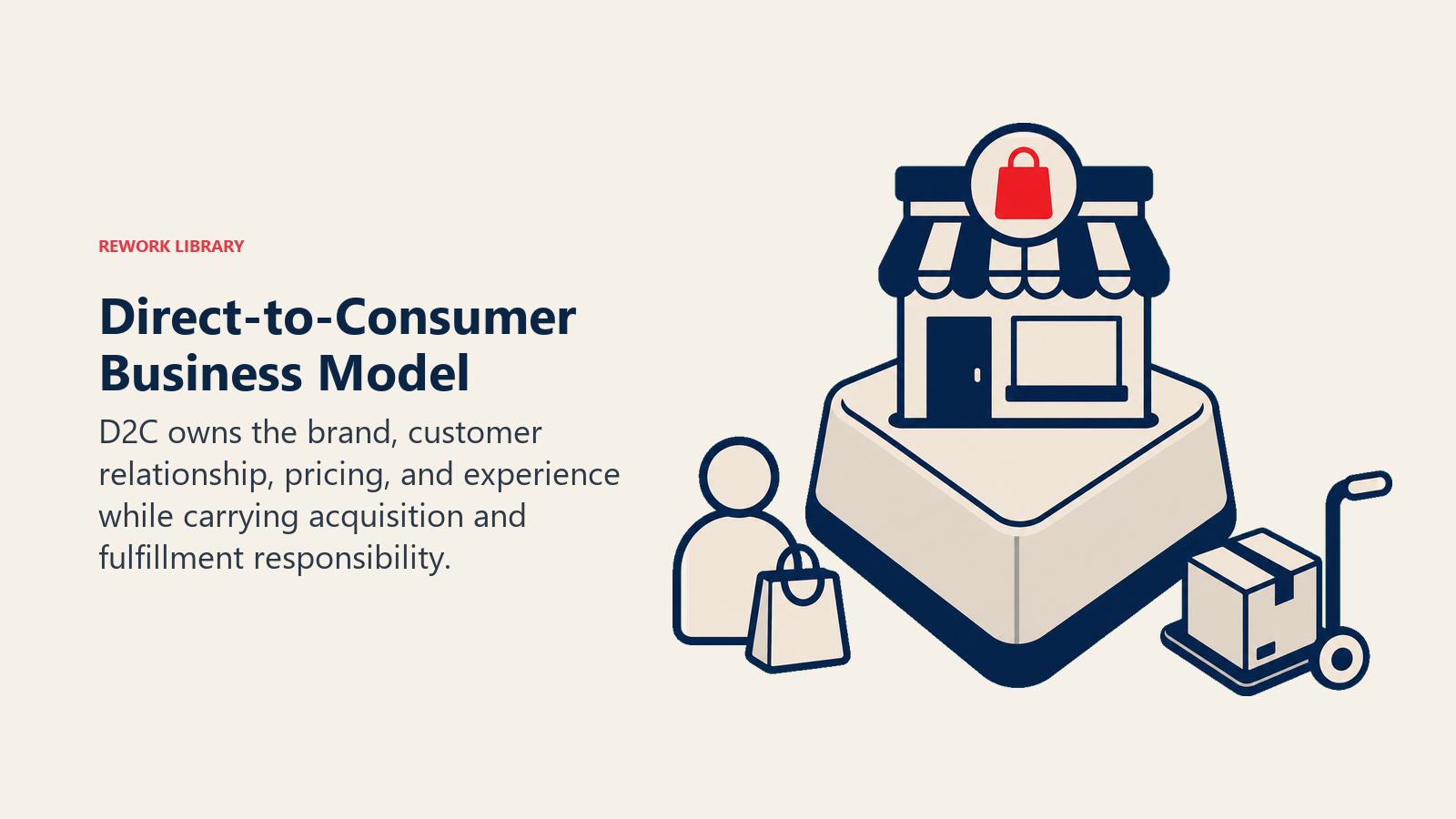
D2C turned traditional retail on its head. Instead of selling through intermediaries, brands sell directly to customers through owned channels.
How D2C Actually Works
Core mechanics:
- Brand manufactures or sources products
- Owns the entire customer relationship
- Controls pricing, messaging, and experience
- Captures full margin without retail markup
- Builds direct customer data and insights
Economics:
- Product margin: 60-80% (no retail cut)
- Customer acquisition cost: $30-150 per customer
- Average order value: $75-200
- Repeat purchase rate: 25-40%
- Break-even point: 12-18 months
The D2C Trade-off: Margins vs. CAC
The D2C promise is compelling: eliminate the middleman, capture the full margin, own the customer relationship.
The D2C reality is more complex. You keep the retail margin, but you inherit the retailer's job, customer acquisition, marketing, fulfillment, customer service.
Where D2C wins:
- Customer data ownership enables personalization
- Direct feedback loop for product development
- Brand control maintains premium positioning
- Margin capture funds growth investment
Where D2C struggles:
- Customer acquisition costs often exceed first-purchase margin
- Profitability depends on repeat purchases (understanding LTV is critical)
- Logistics and fulfillment complexity at scale
- Marketing budget requirements to break through noise
Profitability benchmarks:
- Gross margin: 60-75%
- Contribution margin (after CAC): 15-30%
- EBITDA margin at scale: 8-15%
- LTV:CAC ratio target: 3:1 minimum
Best-Suited Products for D2C
D2C economics work best when:
- High perceived value justifies premium pricing (skincare, supplements, electronics)
- Strong brand differentiation creates preference over alternatives (Warby Parker, Casper)
- Repeat purchase potential drives lifetime value (consumables, subscriptions)
- Complex buying journey benefits from education and product page optimization (mattresses, fitness equipment)
- Community or identity elements create brand loyalty (outdoor gear, lifestyle brands)
D2C struggles with:
- Commoditized products with price competition
- One-time purchases with no repeat potential
- Low-margin products that can't support CAC
- Highly seasonal items with inventory risk
Business-to-Business (B2B): The Volume Play
B2B e-commerce looks different from consumer models. Bigger baskets, longer cycles, relationship-driven.
How B2B E-commerce Operates
Core mechanics:
- Sell to businesses, not individual consumers
- Bulk ordering with volume pricing tiers
- Account-based relationships with dedicated reps
- Net payment terms (Net 30, Net 60)
- Complex approval and procurement processes
Economics:
- Average order value: $1,500-50,000+
- Order frequency: Monthly to quarterly
- Customer acquisition cost: $500-5,000 per account
- Sales cycle: 30-180 days
- Gross margin: 25-50% (lower than D2C, higher volume)
The B2B Playbook: Relationships Over Transactions
B2B isn't about optimizing landing pages or running Facebook ads. It's account-based marketing, relationship building, and long-term partnership.
What makes B2B different:
- Decision complexity: Multiple stakeholders, procurement processes, budget cycles
- Longer sales cycles: Discovery, evaluation, approval, implementation
- Higher stakes: Switching costs and operational integration create stickiness
- Relationship premium: Trust and service matter more than price alone
B2B-specific fulfillment requirements:
- Bulk packaging and shipping logistics
- Custom pricing and contract terms by account
- Integration with customer procurement systems
- White-label and private label capabilities
- Inventory management for large, irregular orders
Profitability drivers:
- Account retention rates (80-95% typical)
- Order size growth over time
- Operational efficiency on fulfillment strategy
- Cross-sell into product categories
B2B Success Metrics
Different metrics matter in B2B:
- Annual Contract Value (ACV) rather than AOV
- Logo retention rate (percentage of accounts renewed)
- Net Revenue Retention (NRR) (growth from existing accounts)
- Pipeline coverage (3-5x quota typical)
- Sales cycle velocity (time from lead to close)
Business-to-Consumer (B2C): The Retail Model
B2C is what most people think of as traditional e-commerce, online stores selling products to individual consumers.
The B2C Framework
Core mechanics:
- Multi-brand assortment and product selection
- Consumer psychology and impulse purchase optimization
- Price competition and promotional strategies
- Fast shipping and easy returns
- Mobile-first shopping experience
Economics:
- Average order value: $50-150
- Gross margin: 30-50%
- Customer acquisition cost: $15-60
- Conversion rate: 1-3%
- Repeat purchase rate: 20-35%
B2C: Scale and Unit Economics
The B2C game is volume. Thin margins, high velocity, constant traffic acquisition.
Where B2C wins:
- Broader market appeal than single-brand D2C
- Customer acquisition through product variety
- Operational leverage at scale
- Platform and marketplace integration
Where B2C struggles:
- Price competition erodes margins
- Low customer loyalty and brand switching
- High dependency on paid advertising
- Inventory risk across broad catalog
Critical success factors:
- Conversion rate optimization compounds at scale
- AOV growth through bundles and upsells
- Email marketing and retention programs
- Efficient fulfillment strategy
B2C Channel Strategy: Owned vs. Third-Party
Most B2C businesses operate across multiple channels:
Owned e-commerce (Shopify, custom):
- Full control and branding
- Customer data ownership
- Better margins (no marketplace fees)
- Requires traffic generation investment
Third-party marketplaces (Amazon, Walmart):
- Built-in traffic and discovery
- Marketplace fees (8-15% typical)
- Limited customer data access
- Price competition with other sellers
Smart B2C operators run a multi-channel marketplace strategy, balancing owned channels with marketplace presence.
Marketplace/Multi-Vendor: The Platform Model
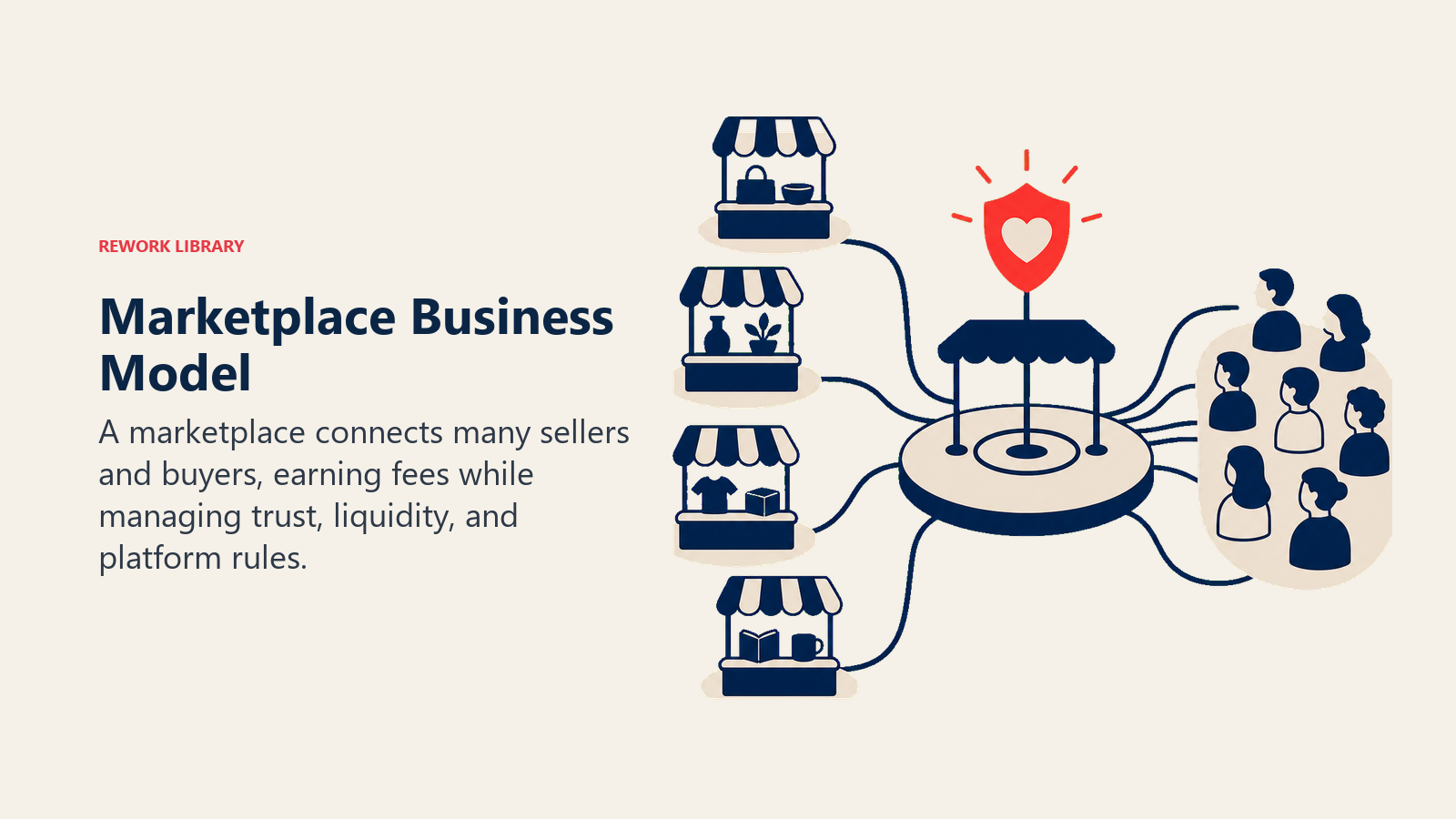
Marketplaces don't own inventory. They connect buyers with sellers and take a cut of each transaction.
How Marketplace Economics Work
Core mechanics:
- Platform facilitates transactions between buyers and sellers
- Marketplace provides discovery, trust, and payment infrastructure
- Sellers handle inventory, fulfillment (or platform provides fulfillment services)
- Revenue from commission (8-30% typical) or listing fees
Economics:
- Commission rate: 8-30% per transaction
- Seller acquisition cost: $200-2,000 per active seller
- Gross margin: 70-90% (service revenue, minimal COGS)
- Platform operating costs: 40-60% (technology, trust/safety, customer service)
- EBITDA margin at scale: 20-40%
The Marketplace Advantage: Network Effects
Marketplaces benefit from powerful network effects. More buyers attract more sellers, and more sellers attract more buyers.
Marketplace strengths:
- Capital-light (no inventory investment)
- Infinite catalog diversity from seller network
- Scalability without inventory risk
- High gross margins on service revenue
Marketplace challenges:
- Seller recruitment and retention
- Quality control across diverse sellers
- Trust and safety mechanisms
- Balancing buyer and seller interests
- Commoditization and price competition
Seller Management: The Marketplace Operations Core
Running a marketplace means managing a two-sided market:
Seller recruitment and vetting:
- Quality standards and approval processes
- Category balance and diversity
- Preventing counterfeit and policy violations
Seller support and enablement:
- Onboarding and training resources
- Performance analytics and optimization
- Payment processing and payouts
- Dispute resolution and account management
Quality control mechanisms:
- Product listing standards
- Customer review and rating systems
- Seller performance metrics (ship time, defect rate, cancellations)
- Account suspension and removal policies
Subscription & Recurring Revenue: The Predictability Model
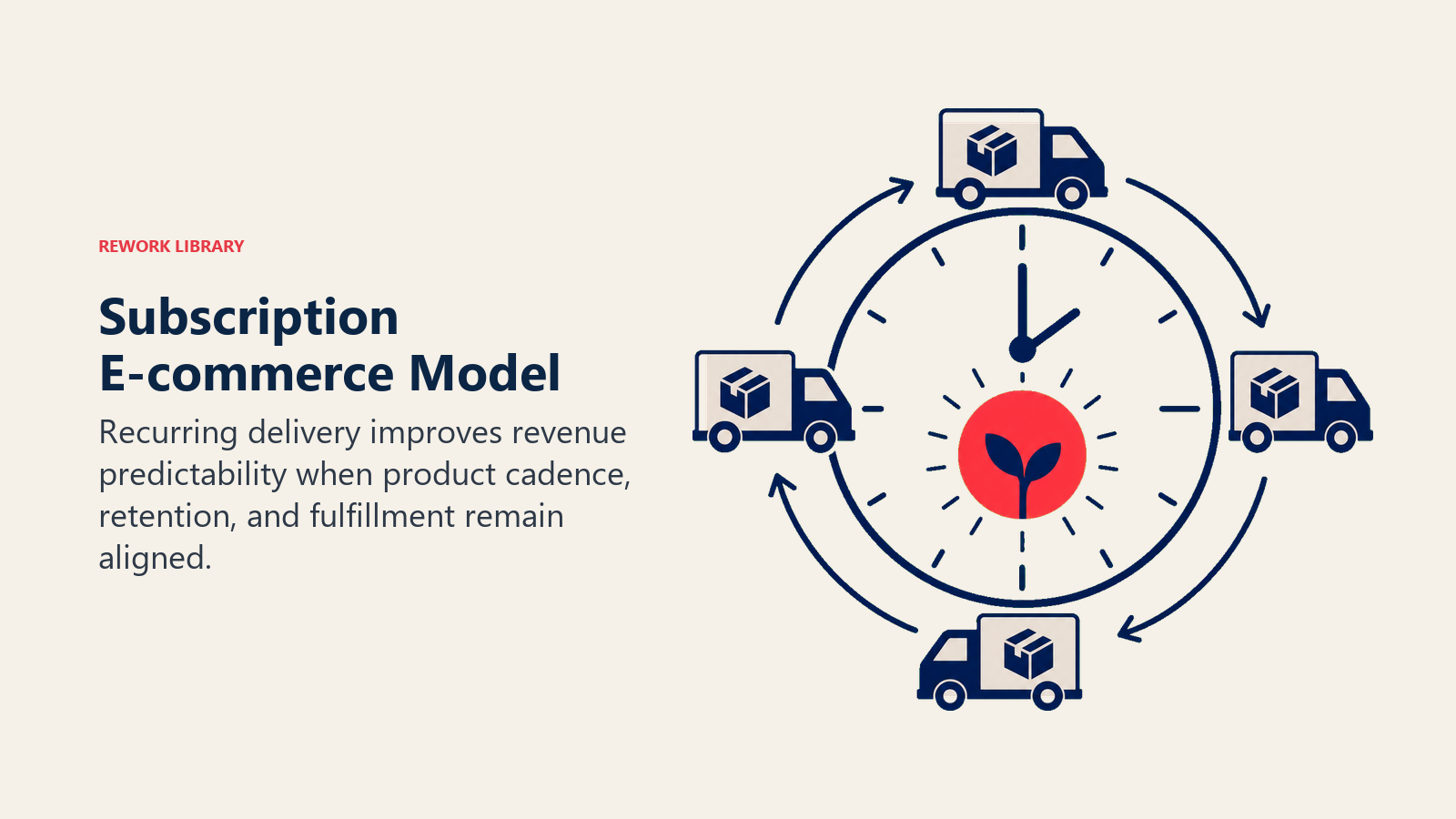
Subscription commerce transforms one-time transactions into recurring relationships. Instead of constantly hunting new customers, you build a base of predictable revenue.
How Subscription Models Work
Core mechanics:
- Customers commit to recurring purchases (weekly, monthly, quarterly)
- Automatic payment processing
- Predictable inventory planning
- Retention and churn management as core operations
Economics:
- Monthly recurring revenue (MRR) per subscriber: $20-200
- Churn rate: 5-10% monthly (good performance)
- Lifetime value: $240-2,400+ (12-24 month retention)
- CAC payback: 3-6 months
- Gross margin: 60-80%
The Subscription Value Proposition
Subscriptions work when there's a compelling reason for recurring purchase:
Consumable replenishment (best fit):
- Coffee, supplements, pet food, personal care
- Natural consumption creates need for refills
- Convenience of auto-delivery with subscribe & save programs
- Examples: Dollar Shave Club, BarkBox, HelloFresh
Curated discovery:
- Monthly product selections and surprises
- Discovery and variety seeking
- Examples: Stitch Fix, Ipsy, FabFitFun
Access and membership:
- Exclusive products or early access
- Community and identity benefits
- Examples: Nike membership programs, Amazon Prime
SaaS-enabled products:
- Software-connected physical products
- Ongoing feature updates and support
- Examples: Peloton, Ring, connected fitness
Churn Management: The Subscription Lifeline
In subscription models, churn is the enemy. A 10% monthly churn rate means you lose half your subscribers in seven months.
Retention tactics:
- Flexible pause and skip options
- Personalization and product selection
- Proactive engagement before cancellation
- Win-back campaigns for churned subscribers
- Incentives for longer-term commitments
Churn warning signs:
- Skipped shipments or paused accounts
- Declining engagement with content or community
- Support tickets about pricing or product fit
- Failed payment methods
Profitability math: If MRR = $50, churn = 8% monthly, CAC = $60:
- Average customer lifetime = 12.5 months (1 / 0.08)
- LTV = $50 × 12.5 = $625
- LTV:CAC ratio = 10.4:1 (excellent)
Lower that churn to 5% monthly:
- Average customer lifetime = 20 months
- LTV = $1,000
- LTV:CAC ratio = 16.7:1 (exceptional)
Dropshipping & Fulfillment Models: The Inventory-Light Approach
Dropshipping minimizes upfront investment by eliminating inventory ownership. You market and sell; suppliers handle fulfillment.
How Dropshipping Works
Core mechanics:
- Customer orders from your store
- Order forwarded to supplier/manufacturer
- Supplier ships directly to customer
- You capture margin difference between retail and wholesale price
Economics:
- Product margin: 15-30% (lower than owned inventory)
- No inventory investment required
- Supplier order minimums and shipping costs
- Gross margin: 25-40%
- Net margin after advertising: 5-15%
The Dropshipping Reality Check
Dropshipping gets marketed as passive income. The reality is razor-thin margins, quality control challenges, and customer service headaches.
Where dropshipping can work:
- Niche products with limited competition
- Testing product research and validation before inventory investment
- High-ticket items where margin dollars justify low margin percentage
- Products with standardized quality from reliable suppliers
Where dropshipping struggles:
- Commoditized products with price competition
- Quality inconsistency and customer service issues
- Long shipping times (especially international suppliers)
- No control over inventory availability
- Thin margins can't support sustainable CAC
Better fulfillment alternatives:
- Amazon FBA: Own inventory, outsource fulfillment
- 3PL partnerships: Centralized fulfillment with professional logistics
- Print-on-demand: Inventory-light for customizable products
Hybrid Models & Multi-Channel Strategies
The most sophisticated e-commerce operators don't pick one model, they run multiple models simultaneously to maximize market coverage and revenue diversification.
Common Hybrid Approaches
D2C + Wholesale:
- Owned store captures full margin and customer data
- Wholesale partnerships drive volume and brand exposure
- Examples: Outdoor brands selling direct and through REI
D2C + Marketplace:
- Owned Shopify store for brand experience
- Amazon and Walmart for discovery and impulse purchase
- Understanding Shopify vs marketplace trade-offs
D2C + Subscription:
- One-time purchases and subscription options
- Subscribe & save programs with discount incentives
- Examples: Supplement brands offering both models
B2B + B2C:
- Consumer direct sales alongside wholesale accounts
- Separate pricing and experience for each channel
- Examples: Food and beverage brands
Managing Channel Conflict
Running multiple models creates potential conflicts:
Pricing consistency:
- Maintain MAP (Minimum Advertised Price) policies
- Different pricing strategy for e-commerce by channel (B2B wholesale, D2C retail, marketplace)
- Avoid undercutting your own channels
Brand consistency:
- Unified messaging across channels
- Consistent customer experience standards
- Product quality and service expectations
Resource allocation:
- Dedicated teams or shared resources across models
- Investment prioritization by channel performance
- Technology integration across platforms
Financial Model Comparison: The Unit Economics Reality
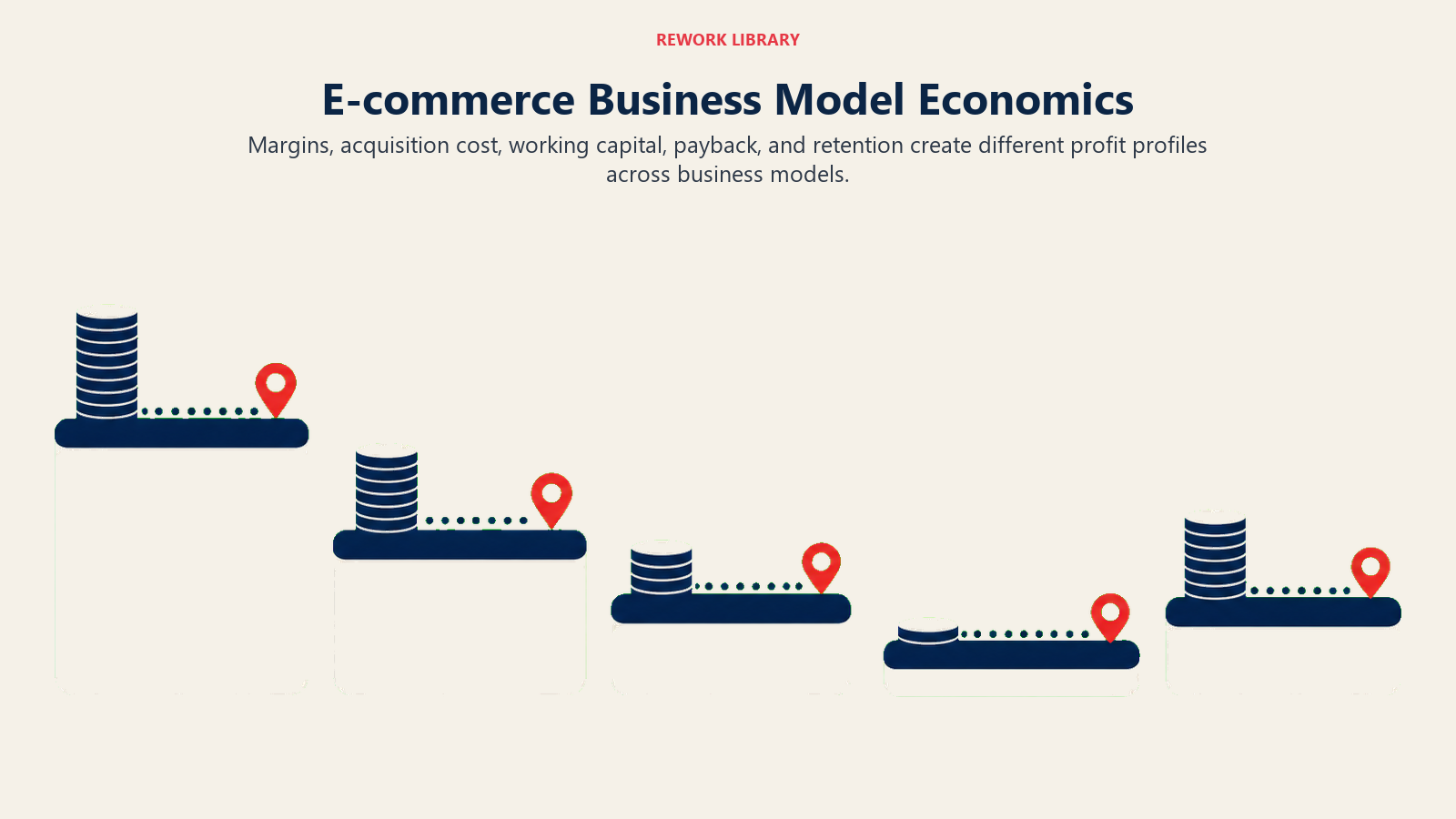
Different models have dramatically different financial profiles. Here's what the numbers actually look like:
Margin Profile by Model
Direct-to-Consumer:
- Gross margin: 60-75%
- Contribution margin (post-CAC): 15-30%
- EBITDA margin: 8-15%
- Payback period: 12-18 months
B2B E-commerce:
- Gross margin: 25-50%
- Contribution margin: 20-40%
- EBITDA margin: 15-25%
- Payback period: 6-12 months
B2C Multi-Brand Retail:
- Gross margin: 30-50%
- Contribution margin: 10-25%
- EBITDA margin: 3-10%
- Payback period: 6-12 months
Marketplace:
- Gross margin: 70-90%
- Contribution margin: 60-80%
- EBITDA margin: 20-40%
- Payback period: 3-6 months
Subscription:
- Gross margin: 60-80%
- Contribution margin: 40-60%
- EBITDA margin: 15-30%
- Payback period: 3-6 months
Dropshipping:
- Gross margin: 25-40%
- Contribution margin: 5-20%
- EBITDA margin: 2-8%
- Payback period: 3-6 months
CAC Benchmarks by Model
Customer acquisition cost varies dramatically:
- Marketplace sellers: $15-40 (leverage platform traffic)
- B2C retail: $20-60 (paid ads and e-commerce SEO strategy)
- D2C brands: $30-150 (brand building and community)
- B2B accounts: $500-5,000 (account-based sales)
- Subscription: $40-120 (higher CAC justified by LTV)
LTV expectations by model:
- One-time purchase (D2C, B2C): $100-300
- Repeat purchase business: $300-800
- Subscription models: $500-2,500+
- B2B accounts: $5,000-100,000+
Target LTV:CAC ratios:
- Minimum viable: 2:1
- Healthy business: 3:1
- Excellent performance: 5:1+
- Subscription optimal: 8:1+
Operational Complexity by Model: What It Actually Takes
Beyond financial metrics, different models demand different operational capabilities.
Inventory Requirements
D2C and B2C:
- Forecasting and planning across SKUs
- Warehouse management and storage costs
- Inventory financing and cash flow impact
- Stockouts and overstock risks
- Understanding inventory management
B2B:
- Large, irregular order patterns
- Safety stock for volume orders
- Bulk storage and handling
- Consignment and vendor-managed inventory options
Marketplace:
- No inventory ownership
- Seller inventory visibility and coordination
- Backup fulfillment for seller failures
Dropshipping:
- No owned inventory
- Supplier coordination and reliability
- Inventory visibility challenges
Technology Stack Requirements
D2C and B2C:
- E-commerce platform selection (Shopify, BigCommerce, custom)
- Marketing automation and email
- Analytics and tracking setup
- CRM and customer data platform
B2B:
- Wholesale/B2B pricing and account management
- Quote and proposal tools
- ERP integration for order processing
- Custom catalog and ordering portals
Marketplace:
- Seller onboarding and management platform
- Payment processing and split payouts
- Trust and safety monitoring tools
- Dispute resolution workflow systems
Subscription:
- Recurring billing and payment management
- Subscription churn management
- Pause, skip, and swap functionality
- Predictive analytics for retention
Customer Service and Support
D2C and B2C:
- Order tracking and shipping strategy and pricing
- Returns management and exchanges
- Product questions and recommendations
- High volume, fast response expectations
B2B:
- Account management and relationships
- Custom pricing and contract questions
- Bulk order coordination
- Net terms and payment processing
Marketplace:
- Buyer-seller dispute mediation
- Platform policy enforcement
- Seller performance coaching
- Trust and safety investigations
Subscription:
- Billing and payment issues
- Pause, skip, and cancellation management
- Product swaps and customization
- Proactive retention outreach
Team Size and Hiring Implications
Approximate team requirements at $10M annual revenue:
D2C:
- 15-25 employees
- Marketing (5-8), operations (4-6), customer service (3-5), product (2-3)
- Heavy on marketing and creative
B2B:
- 10-18 employees
- Sales (4-6), account management (2-3), operations (3-5), customer service (1-2)
- Relationship and sales-driven
Marketplace:
- 20-35 employees
- Seller operations (6-10), trust/safety (4-6), customer service (5-8), technology (5-10)
- Platform operations intensive
Subscription:
- 12-20 employees
- Retention (3-5), marketing (4-6), operations (3-5), customer service (2-4)
- Focus on retention and community
Market Positioning Framework: Selecting the Right Model
Your ideal business model depends on competitive landscape, target customer, and resource constraints.
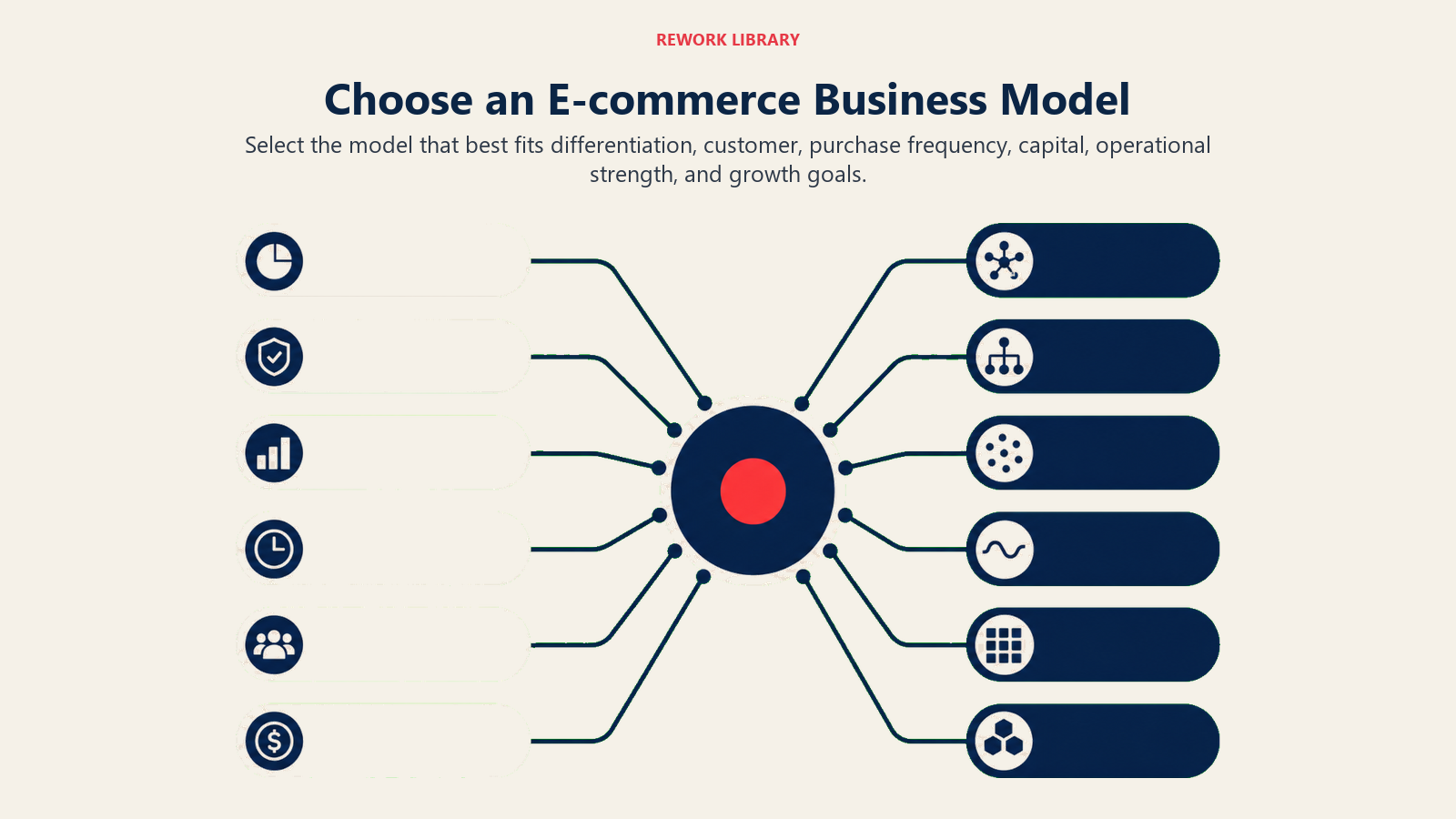
Decision Framework: Nine Critical Questions
1. What's your competitive differentiation?
- Strong brand → D2C captures brand premium
- Unique product selection → Marketplace or B2C retail
- Service and relationships → B2B
- Convenience and habit → Subscription
2. What's your target customer segment?
- Individual consumers → D2C or B2C
- Small businesses → B2B or marketplace
- Enterprises → B2B with account-based approach
3. What's your product purchase frequency?
- Consumable (monthly+) → Subscription model viable
- Occasional (quarterly-annually) → D2C or B2C
- One-time or rare → D2C with focus on LTV through expansion
4. What's your available startup capital?
- Limited capital → Dropshipping or marketplace (no inventory)
- Moderate capital → D2C with focused SKU count
- Significant capital → B2C with broad catalog or B2B with inventory
5. What's your product margin structure?
- High margin (60%+) → D2C can support CAC
- Medium margin (30-60%) → B2C or subscription
- Lower margin (20-30%) → B2B volume or marketplace
6. What's your operational expertise?
- Marketing and brand building → D2C
- Sales and relationship management → B2B
- Platform and technology → Marketplace
- Operations and logistics → B2C or subscription
7. What's your growth timeline?
- Fast growth priority → Marketplace leverage or B2C
- Sustainable profitability → D2C or subscription
- Long-term strategic accounts → B2B
8. What's your cash flow requirement?
- Need fast payback → B2C or marketplace
- Can invest long-term → D2C or subscription
- Volume with terms → B2B (manage payment terms carefully)
9. What's your long-term vision?
- Build brand equity → D2C
- Build platform value → Marketplace
- Build enterprise relationships → B2B
- Build recurring revenue base → Subscription
Model Selection Matrix
| If you have... | Consider... | Because... |
|---|---|---|
| Strong brand + high margins | D2C | Capture full value of brand premium |
| Limited capital + marketing skills | Dropshipping or marketplace seller | Minimize upfront investment |
| Industry relationships + B2B network | B2B e-commerce | Leverage existing relationships |
| Consumable product + retention focus | Subscription | Predictable revenue and LTV |
| Technology expertise + two-sided market | Marketplace | Network effects and scalability |
| Diverse product sourcing + retail ops | B2C multi-brand | Broad appeal and volume |
Strategic Sequencing: Evolution Path
Many successful e-commerce companies evolve through models:
Common progression:
- Start with marketplace presence (Amazon) to validate demand
- Launch D2C store to capture customer data and margin
- Add subscription option to build recurring revenue
- Expand to B2B wholesale for volume and stability
- Build marketplace to enable third-party sellers
Example evolution:
- Year 1: Sell on Amazon to test products and generate revenue
- Year 2: Launch Shopify D2C store, drive traffic through traffic acquisition strategy
- Year 3: Add subscription model design for consumable products
- Year 4: Open B2B wholesale channel for retail partners
- Year 5: Consider marketplace model if two-sided opportunity emerges
Conclusion: The Model Determines the Game
Your e-commerce business model isn't a detail. It's the foundation that determines your unit economics, growth trajectory, operational complexity, and competitive positioning.
Choose D2C, and you're optimizing for brand control and margin capture, accepting higher CAC and retention challenges. Pick B2B, and you're playing the volume game with relationship-driven sales and cash flow management. Launch a marketplace, and you're building network effects while managing a two-sided platform. Go subscription, and you're optimizing for predictable recurring revenue while fighting churn.
There's no universally "best" model. There's the right model for your product, market, resources, and goals.
Companies that thoughtfully select their business model based on competitive differentiation and unit economics build sustainable, profitable operations. Those that chase trends or copy competitors without understanding model implications struggle with margins, cash flow, and growth.
The e-commerce growth model you choose today determines the revenue ceiling you'll hit tomorrow.
Choose strategically. Understand the economics. Build deliberately.
Ready to optimize your e-commerce business model? Explore unit economics for e-commerce and customer lifetime value to validate your model economics.
Learn more:

On this page
- The Six Core E-commerce Business Models
- Direct-to-Consumer (D2C): The Brand Control Model
- How D2C Actually Works
- The D2C Trade-off: Margins vs. CAC
- Best-Suited Products for D2C
- Business-to-Business (B2B): The Volume Play
- How B2B E-commerce Operates
- The B2B Playbook: Relationships Over Transactions
- B2B Success Metrics
- Business-to-Consumer (B2C): The Retail Model
- The B2C Framework
- B2C: Scale and Unit Economics
- B2C Channel Strategy: Owned vs. Third-Party
- Marketplace/Multi-Vendor: The Platform Model
- How Marketplace Economics Work
- The Marketplace Advantage: Network Effects
- Seller Management: The Marketplace Operations Core
- Subscription & Recurring Revenue: The Predictability Model
- How Subscription Models Work
- The Subscription Value Proposition
- Churn Management: The Subscription Lifeline
- Dropshipping & Fulfillment Models: The Inventory-Light Approach
- How Dropshipping Works
- The Dropshipping Reality Check
- Hybrid Models & Multi-Channel Strategies
- Common Hybrid Approaches
- Managing Channel Conflict
- Financial Model Comparison: The Unit Economics Reality
- Margin Profile by Model
- CAC Benchmarks by Model
- Operational Complexity by Model: What It Actually Takes
- Inventory Requirements
- Technology Stack Requirements
- Customer Service and Support
- Team Size and Hiring Implications
- Market Positioning Framework: Selecting the Right Model
- Decision Framework: Nine Critical Questions
- Model Selection Matrix
- Strategic Sequencing: Evolution Path
- Conclusion: The Model Determines the Game