Amazon Advertising: Sponsored Products, Brands & DSP Strategy Guide
Turn this article into takeaways for your work.


Each assistant summarizes the article only for you and suggests best practices for your work.
Amazon Advertising has become the third-largest digital advertising platform globally, generating over $47 billion in annual ad revenue. For e-commerce sellers and brands, it's no longer optional, it's the primary driver of visibility, sales velocity, and market share on the world's largest marketplace.
But here's what most sellers get wrong: they treat Amazon ads like Google Ads. They're not. Amazon operates at the bottom of the funnel where purchase intent is highest, conversion rates are 3-5x higher, and the attribution model is completely different. Understanding these nuances is what separates profitable advertisers from those burning cash on inflated ACoS. Effective PPC campaign management requires a fundamentally different approach on Amazon than other platforms.
This guide covers everything from Sponsored Products fundamentals to advanced DSP strategies, with a focus on profitability, not just visibility.
Why Amazon Advertising Matters
Amazon's advertising ecosystem exists because of a fundamental marketplace dynamic: there are millions of products competing for limited screen real estate. Organic ranking alone won't cut it, especially for new products or competitive categories.
The platform offers three primary ad types, each serving different strategic purposes:
Sponsored Products (SP) - Keyword and ASIN-targeted ads that appear in search results and product detail pages. These drive 70-80% of most sellers' ad spend and are the foundation of any Amazon advertising strategy.
Sponsored Brands (SB) - Banner ads featuring your logo, custom headline, and multiple products. These appear at the top of search results and are only available to brand-registered sellers. They're ideal for brand awareness and consideration.
Amazon DSP (Demand-Side Platform) - Programmatic display and video ads that reach audiences both on and off Amazon. This is where you get into audience retargeting, competitive conquesting, and cross-channel attribution.
Each ad type has different objectives, cost structures, and optimization strategies. Most sellers start with Sponsored Products, expand to Sponsored Brands once they have consistent sales velocity, and only move to DSP when they have significant budget and sophisticated attribution needs.
The key insight: Amazon advertising isn't just about driving immediate sales. It influences organic ranking through sales velocity, helps you defend against competitors targeting your ASINs, and provides data on what keywords and audiences actually convert. This intelligence feeds back into your Amazon SEO & Ranking strategy and Product Page Optimization efforts.
Sponsored Products: The Foundation
Sponsored Products are where 90% of sellers should focus their initial efforts. They're simple to set up, easy to understand, and deliver the most direct ROI when managed correctly.
Manual vs Automatic Campaigns
When you launch a Sponsored Products campaign, you have two targeting options:
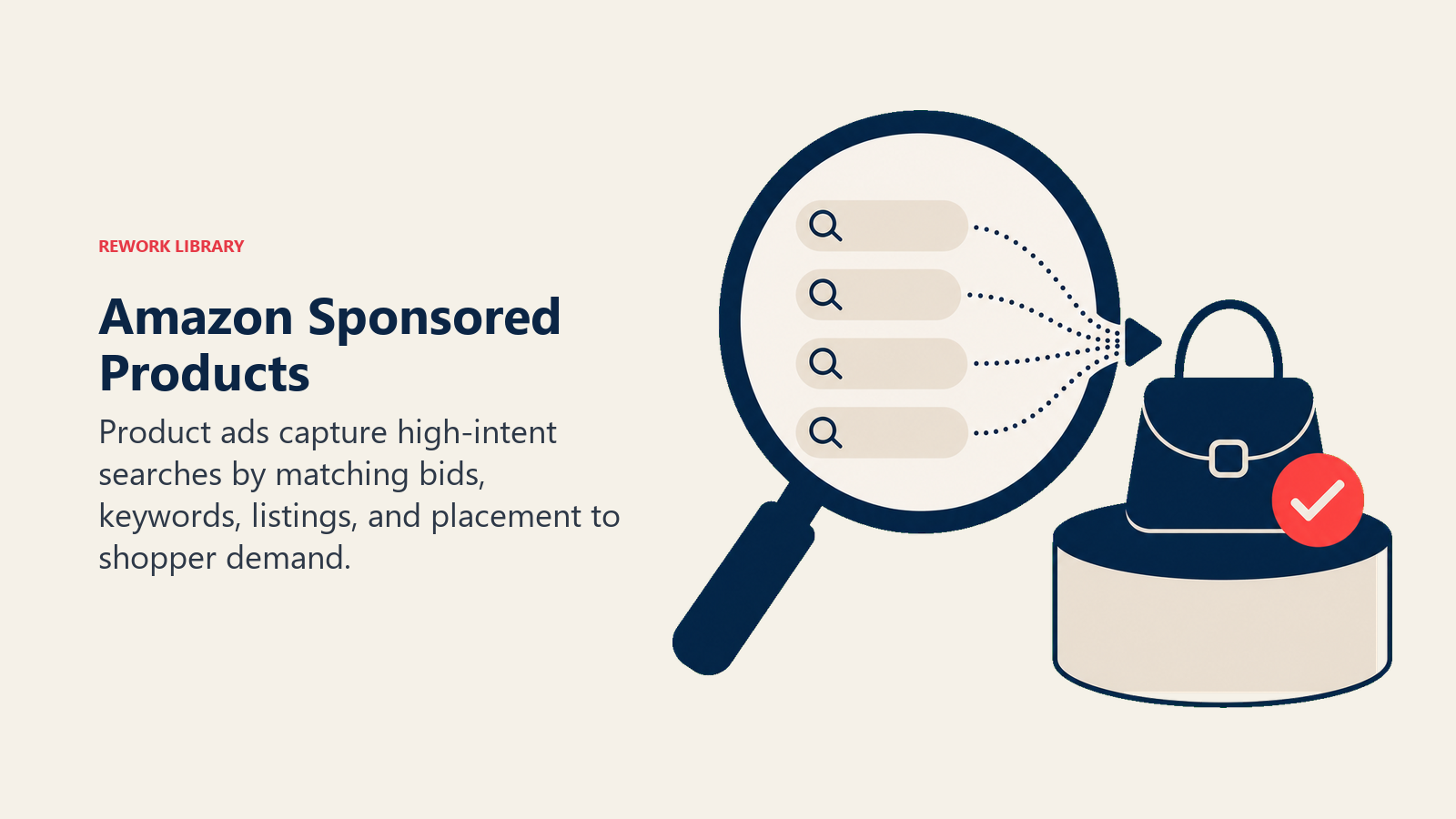
Automatic targeting lets Amazon decide which search terms and product pages to show your ads on. Amazon uses your product listing data, title, bullet points, description, backend keywords, to match you with relevant queries. This is perfect for keyword discovery and finding unexpected conversion opportunities.
Manual targeting gives you full control over which exact keywords or ASINs you bid on. This is where optimization happens. You take winners from automatic campaigns, isolate them in manual campaigns with custom bids, and systematically improve performance.
The strategic approach most successful sellers use:
- Launch automatic campaigns first to gather data
- Let them run for 2-4 weeks to accumulate meaningful search term data
- Mine the search term report for high-converting keywords
- Move winners to manual exact-match campaigns with optimized bids
- Add negative keywords to automatic campaigns to prevent wasted spend
- Keep automatic campaigns running continuously for ongoing discovery
This creates a perpetual research and optimization loop. Your automatic campaigns are your R&D budget, they're discovering new opportunities. Your manual campaigns are your profit engines, they're executing on proven winners.
Keyword Match Types and Strategy
Manual campaigns support three match types, each with different reach and relevance tradeoffs:
Broad match shows your ad for variations, synonyms, and related searches. If you bid on "yoga mat," you might show up for "exercise mat," "pilates mat," or "workout mat." This gives you maximum reach but lower relevance and higher wasted spend.
Phrase match requires your keyword to appear in the search query in the same order, but allows additional words before or after. "yoga mat" could match "thick yoga mat" or "yoga mat for hot yoga" but not "mat for yoga."
Exact match only shows your ad when someone searches for your exact keyword. This gives you maximum control and relevance but limits discovery.
The bid strategy matrix looks like this:
| Match Type | Bid Strategy | Use Case |
|---|---|---|
| Exact | Highest bid | Proven converters, high intent |
| Phrase | Medium bid | Tested keywords, expansion |
| Broad | Lowest bid | Discovery, low-risk testing |
| Automatic | Medium bid | Continuous research |
Start conservative. Launch exact match campaigns on your highest-intent keywords first. Once those are profitable, expand to phrase match. Only use broad match if you have budget to burn and want maximum discovery, and even then, monitor search terms weekly to add negatives aggressively.
ASIN Targeting: Offense and Defense
ASIN targeting is the most underutilized feature in Sponsored Products. Instead of bidding on keywords, you bid to show your ad on specific competitors' product detail pages or category pages.
There are two strategic applications:
Offensive ASIN targeting - You identify competitors with similar products but weaker conversion elements (reviews, price, images) and bid to appear on their pages. When someone is considering a competitor, your product shows up as an alternative. This is ASIN sniping, and it works best when your product has clear advantages.
Defensive ASIN targeting - You bid on your own ASINs to prevent competitors from hijacking your traffic. If you don't defend your own detail pages, your competitors will advertise there, stealing conversions you've already earned. This is especially critical for high-traffic ASINs.
The beauty of ASIN targeting is the data. You can see exactly which competitor ASINs convert well for you, which tells you where your product is genuinely competitive. This intelligence informs your Pricing Strategy for E-commerce and positioning decisions.
Sponsored Brands: Building Brand Equity
Sponsored Brands are banner ads that appear at the top of search results. They're visually prominent, support multiple products, and include your logo, making them ideal for brand building, not just performance marketing.
You need to be brand-registered to run Sponsored Brands, which requires owning a trademark. Once enrolled, you get access to three creative formats:
Product collection - Displays your logo, custom headline, and up to three products. This is the most common format and works well for showcasing a product line or complementary items.
Store spotlight - Drives traffic to your Amazon Store (your branded multi-page storefront on Amazon). Use this when you want to create a full-funnel experience and cross-sell multiple product categories.
Video ads - Short video content that appears in search results. These have higher engagement but require video production resources.
The strategic question: when should you invest in Sponsored Brands?
Don't start with Sponsored Brands if:
- You're a new seller with limited budget
- Your Sponsored Products campaigns aren't profitable yet
- You only have 1-2 products
- Your brand isn't differentiated
Do invest in Sponsored Brands when:
- You have a product line worth cross-selling
- You're competing in a branded category where awareness matters
- Your Sponsored Products are consistently profitable and you have room to expand
- You want to defend against competitors at the top of search results
- Your brand building and positioning strategy demands top-of-search visibility
Budget allocation: Most mature advertisers spend 70-80% on Sponsored Products and 20-30% on Sponsored Brands. The latter typically has higher ACoS but delivers brand halo effects that don't show up in direct attribution.
Headline copy matters enormously. This is your only chance to communicate value before someone clicks. Test benefit-driven headlines ("Leak-Proof Travel Mugs for Commuters") against product-focused ones ("Stainless Steel Insulated Tumblers"). Track click-through rates obsessively.
Amazon DSP: Advanced Audience Targeting
Amazon's Demand-Side Platform (DSP) is a programmatic advertising platform that lets you buy display, video, and audio ads both on Amazon properties and across the web. This is enterprise-grade advertising, minimum spends typically start at $50,000, and you're competing with agencies and Fortune 500 brands.
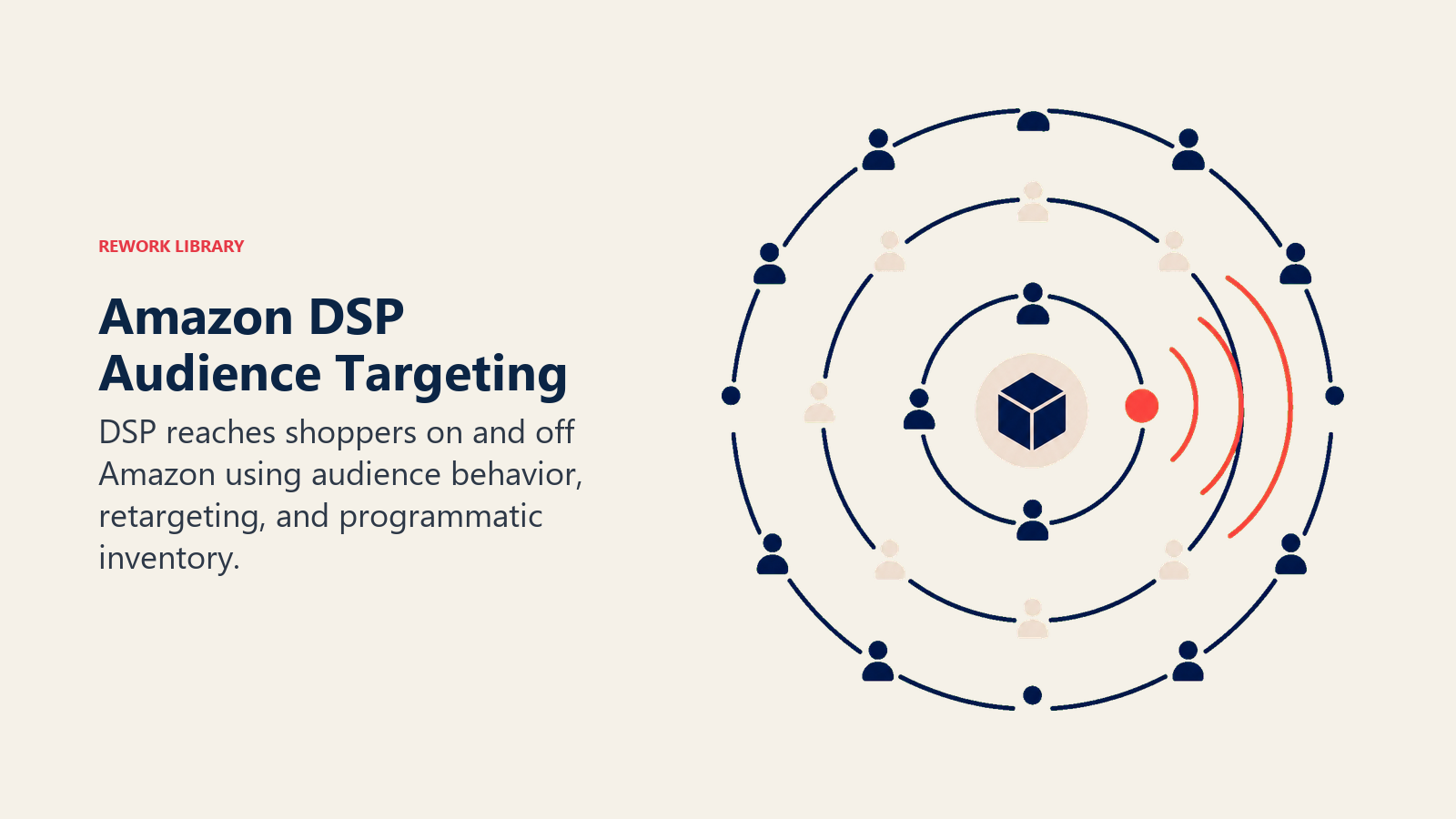
DSP gives you capabilities you can't get with Sponsored Products or Brands:
Audience targeting - You can target based on purchase behavior, browsing history, demographic data, and Amazon's first-party shopping signals. Want to reach people who recently bought yoga mats but not your brand? DSP can do that.
Retargeting - Show ads to people who viewed your products but didn't buy, or who bought and might buy again. This is classic e-commerce retargeting but with Amazon's conversion-focused data.
Competitive conquesting - Target people who viewed or purchased competitor products. This is offense at scale.
Video and display formats - Richer creative options including video pre-roll, display banners, and OTT/streaming ads.
The catch: DSP is complex, expensive, and requires sophisticated attribution modeling to assess effectiveness. Most sellers under $5M in annual revenue shouldn't touch it. Focus on mastering Sponsored Products and Brands first.
If you do use DSP, the killer application is retargeting cart abandoners and repeat purchase audiences. Amazon's data on purchase recency and frequency is unmatched. You can build segments like "purchased competitor X in last 30 days" or "viewed our product 3+ times without buying" and serve them targeted creative. This is where DSP starts to justify its cost.
ACoS Optimization Fundamentals
ACoS (Advertising Cost of Sale) is the metric every Amazon advertiser obsesses over. It's calculated as:
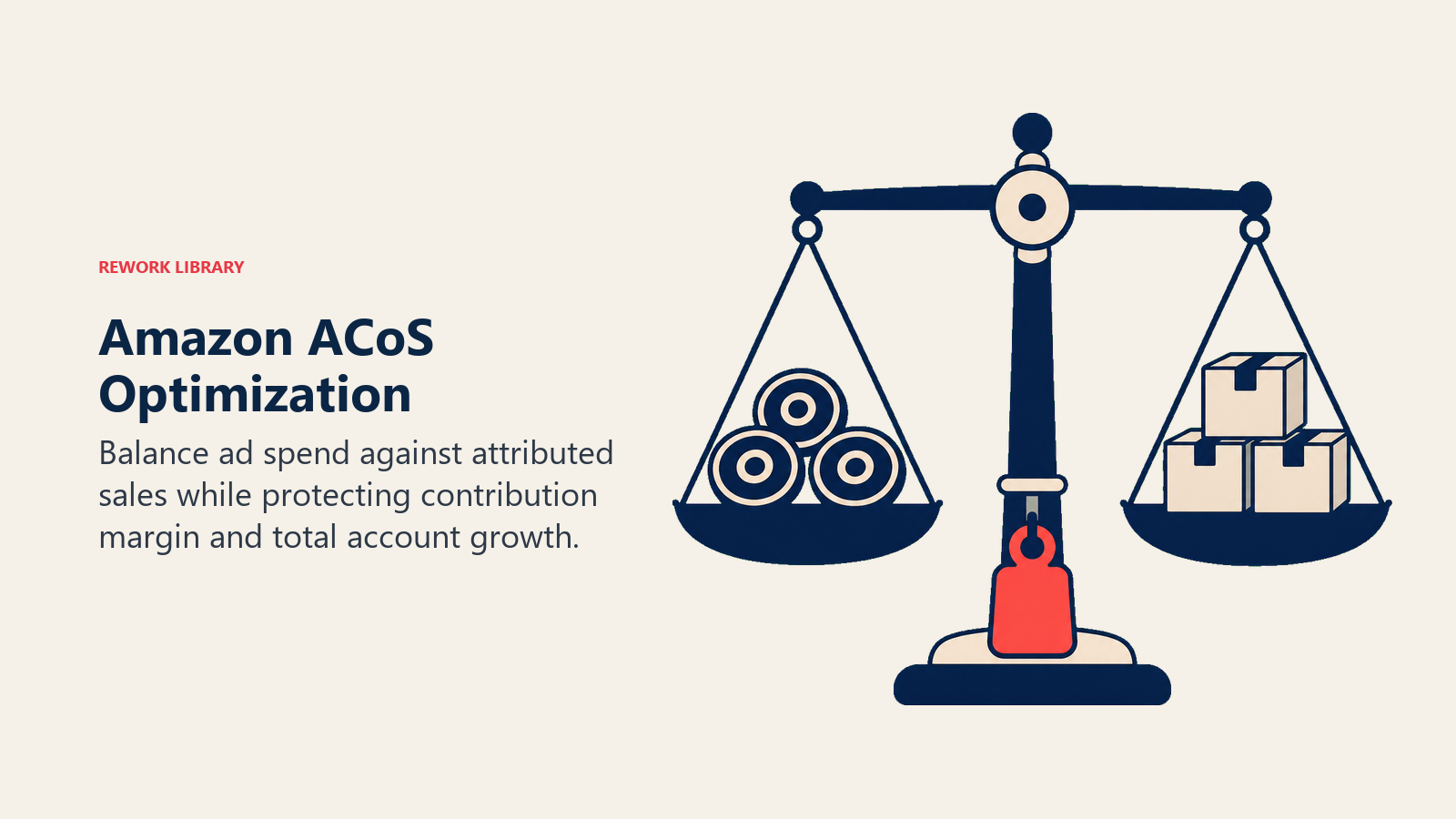
ACoS = (Ad Spend / Ad Revenue) × 100
If you spend $20 on ads and generate $100 in attributed sales, your ACoS is 20%.
But here's what matters: ACoS is meaningless without context. A 20% ACoS might be fantastic or disastrous depending on your Unit Economics for E-commerce.
The key calculation is your break-even ACoS (also called TACoS, Total Advertising Cost of Sale):
Break-Even ACoS = Profit Margin %
If your profit margin after all costs (COGS, Amazon fees, shipping, etc.) is 30%, your break-even ACoS is 30%. Any ACoS below that is profitable. Above it, you're losing money.
Most sellers confuse revenue with profit. Just because your ACoS is 25% doesn't mean you're making money. If your margin is only 20%, you're losing 5% on every sale.
The strategic framework:
Launch phase (new products): Run at higher ACoS (40-60%) to build sales velocity, reviews, and organic ranking. You're buying market position.
Growth phase (established products with reviews): Target ACoS slightly above break-even (25-35%) to balance profitability with continued growth and ranking defense.
Maturity phase (dominant products): Optimize for maximum profit with ACoS well below break-even (15-25%), or even lower if organic ranking is secure.
This isn't about hitting a single magic ACoS number. It's about intentionally choosing where on the growth-vs-profit curve you want to operate for each product.
Bidding Strategies and Tactics
Amazon offers three dynamic bidding strategies that automatically adjust your bids based on conversion likelihood:
Dynamic bids - down only - Amazon lowers your bid (up to 100%) when a click is less likely to convert. Conservative strategy that prevents overspending.
Dynamic bids - up and down - Amazon raises your bid (up to 100%) for high-conversion placements and lowers it for low-conversion ones. This is the default and works well for most sellers.
Fixed bids - Your bid never changes. You have complete control but miss optimization opportunities.
Start with "up and down" for most campaigns. It gives Amazon room to optimize while you maintain overall budget control.
Beyond the strategy setting, keyword-level bid optimization is where the real work happens:
High-performing keywords (strong conversion, acceptable ACoS) - Increase bids by 10-20% every few days until ACoS reaches your target. This maximizes impression share on proven winners.
Moderate performers (decent conversion but high ACoS) - Lower bids by 15-25% and monitor. Sometimes a small bid reduction dramatically improves ACoS without killing traffic.
Non-converters (clicks but no sales after 30+ days) - Pause or set bids very low. These are burning budget with no return.
New keywords (insufficient data) - Start with moderate bids and let them accumulate 20-30 clicks before making changes. Don't optimize prematurely.
Seasonal adjustments are critical. If you sell a gift item, bid aggressively from November through December. If you sell pool supplies, reduce bids in winter. Match your bid strategy to demand curves.
One advanced tactic: dayparting. If your Traffic Acquisition Strategy analysis shows you convert better on weekday evenings than weekend mornings, increase bids during high-conversion windows and decrease them during low-conversion times. This requires portfolio budget rules in Campaign Manager.
Campaign Structure Best Practices
How you structure your campaigns determines how efficiently you can optimize. Poor structure creates chaos; good structure enables systematic improvement.
The framework most successful sellers use:
Campaign level - Organize by product category or strategic purpose (brand defense, competitor conquest, keyword research, etc.). This lets you allocate budgets strategically.
Ad group level - Group tightly related products together. Don't mix yoga mats with yoga blocks in the same ad group, their keywords and conversion patterns are different.
Keyword/ASIN level - This is where optimization happens. Each keyword or ASIN gets its own bid and performance tracking.
A typical structure might look like:
- Campaign: Yoga Mats - Brand Defense (automatic)
- Campaign: Yoga Mats - Exact Match Winners (manual exact)
- Campaign: Yoga Mats - Phrase Match Expansion (manual phrase)
- Campaign: Yoga Mats - Competitor ASINs (manual ASIN targeting)
This separation gives you clean data and prevents high-performing keywords from being dragged down by poor performers in the same ad group.
Negative keywords are criminally underused. Every week, review your search term report and add irrelevant queries as negatives. If you sell premium yoga mats and keep showing up for "cheap yoga mat," add "cheap" as a negative keyword. This prevents wasted clicks and improves relevance.
Device bidding is another lever. If you notice mobile converts poorly (check placement reports), you can reduce mobile bids by up to 90%. Desktop and tablet can be adjusted separately. This is especially relevant for products with complex detail pages that don't render well on mobile.
Keywords vs ASINs: Performance Comparison
A strategic question: should you prioritize keyword targeting or ASIN targeting?
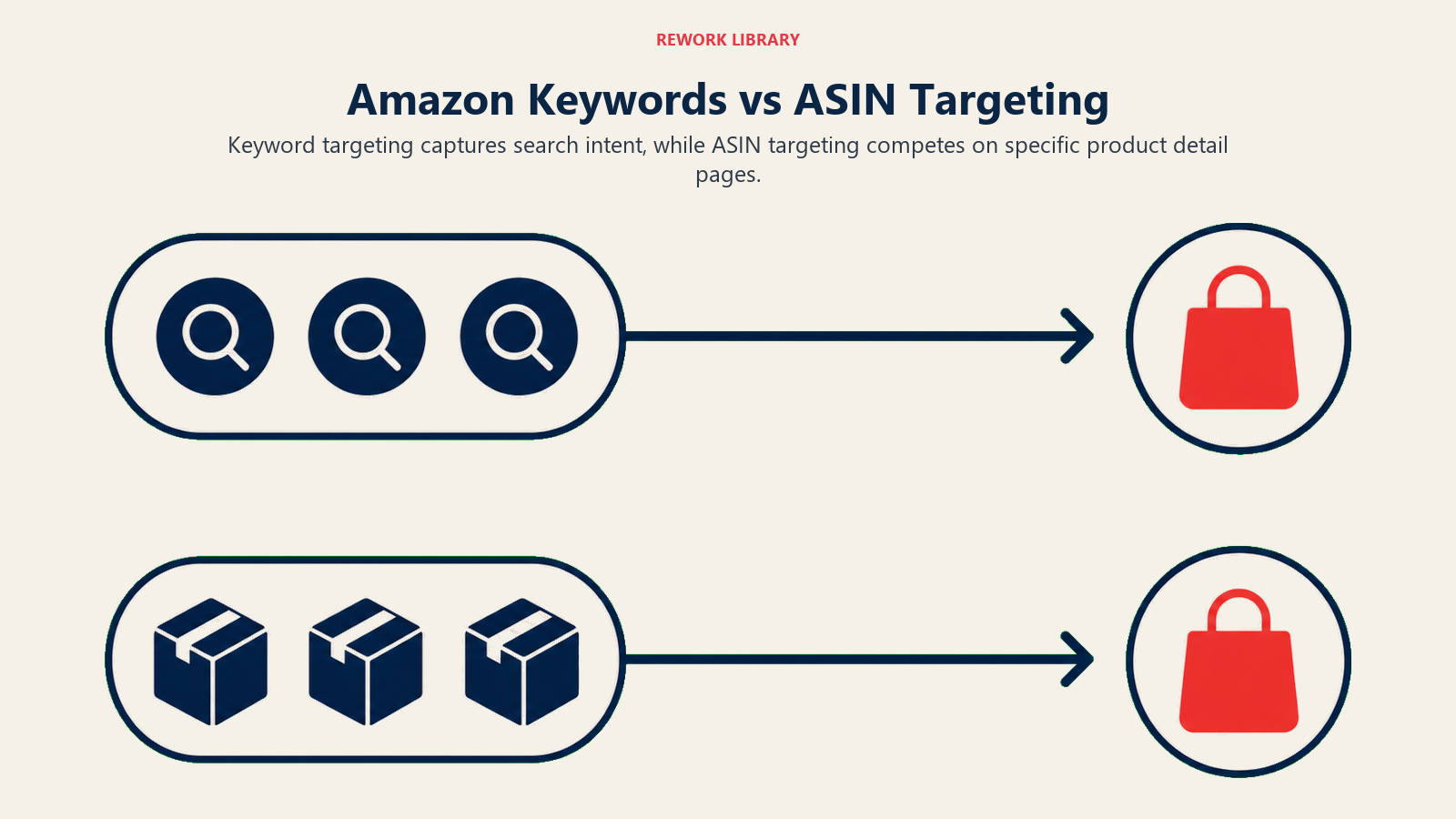
The answer depends on your product maturity and competitive positioning:
Keyword targeting wins when:
- You're launching a new product and need search visibility
- Your category has strong search volume (people actively search for your product type)
- You want to capture bottom-of-funnel intent
- Your product solves a clear problem people search for
- Your product research and validation revealed high search demand
ASIN targeting wins when:
- Your product is genuinely competitive with existing market leaders
- You want to intercept customers already considering competitors
- Search volume is low but specific products have high traffic
- You're defending your own ASINs from competitor ads
Many sellers make the mistake of focusing exclusively on keywords and ignoring ASIN opportunities. The reality: some of your best conversions will come from ASIN targeting on competitor pages where visitors are already primed to buy.
Run both simultaneously. Allocate 70-80% of budget to keyword targeting (it's more scalable) and 20-30% to ASIN targeting (it's more tactical). Compare ACoS and conversion rates by targeting type to refine the mix.
One underrated insight: ASIN targeting performance tells you where you're genuinely competitive. If you convert well on Competitor A's ASIN but terribly on Competitor B's, it means something about B's offering is stronger, better reviews, price, imagery, whatever. This intelligence should feed back into your Product Page Optimization roadmap.
Conversion Rate Optimization: The Force Multiplier
Every advertising guide focuses on bid optimization and keyword research. That's half the equation. The other half is making sure that when people click your ad, they actually convert.
Your ad performance is a direct function of your listing quality. If your main image is weak, your bullet points are confusing, or you have 3.2 stars with 20 reviews, no amount of bid optimization will save you.
The conversion multiplier hierarchy:
1. Review count and rating - This is the #1 conversion driver. A product with 500+ reviews and 4.5+ stars will dramatically outperform one with 30 reviews at 4.2 stars, even if everything else is identical. Your advertising strategy should prioritize getting to critical review thresholds (50, 100, 500 reviews). See Customer Reviews & UGC for tactical approaches.
2. Main image quality - Your main image determines click-through rate from search. It needs to be crystal clear, high resolution, properly lit, and showcase the product from the optimal angle. Test variations relentlessly.
3. Price competitiveness - If you're 20% more expensive than similar products without clear differentiation, your conversion rate will suffer. Advertising can't overcome fundamental pricing problems. Run disciplined Pricing Strategy for E-commerce experiments.
4. Bullet points and A+ content - These answer objections and communicate value. Poor copy tanks conversion. Clear, benefit-focused copy lifts it.
The feedback loop: improved conversion rates lower your ACoS (more revenue per click) and improve your ad rank (Amazon rewards high-converting ads with better placement). This creates a virtuous cycle where conversion optimization makes advertising more efficient, which drives more sales, which generates more reviews, which further improves conversion.
This is why Amazon FBA Strategy success isn't just about advertising, it's about the entire product-market-listing system working together.
Analytics and Reporting: Beyond ACoS
Most sellers look at ACoS and call it a day. That's like judging a business solely on gross margin, it's one metric in a complex system.
The full performance dashboard should include:
ACoS - Advertising efficiency, but not profitability. Directional metric only.
ROAS (Return on Ad Spend) - The inverse of ACoS, calculated as (Ad Revenue / Ad Spend). A 5:1 ROAS means you generate $5 for every $1 spent. Some sellers prefer this to ACoS because it's more intuitive.
TACoS (Total Advertising Cost of Sale) - (Total Ad Spend / Total Revenue) × 100. This includes organic sales in the denominator, showing how advertising impacts your overall business. Declining TACoS over time means advertising is building organic momentum.
Impression share - What percentage of available impressions are you capturing? Low impression share means you're losing visibility to competitors, either because your bids are too low or your budget is exhausting early.
Click-through rate (CTR) - Measures ad relevance and appeal. Low CTR means your keywords are mismatched or your main image is weak. Industry average is 0.4-0.6%; anything below 0.3% needs investigation.
Conversion rate - The percentage of clicks that result in sales. This is your listing quality scorecard. Category averages range from 10-20%; anything below 8% indicates listing problems.
Cost per click (CPC) - What you're paying per click. Track this by keyword to identify expensive terms eating your budget.
The analysis that matters: segment all these metrics by campaign type, match type, and product. Your exact-match campaigns should have higher conversion rates and lower ACoS than broad match. Your brand defense campaigns should have astronomical conversion rates. Your competitor ASIN campaigns might have higher ACoS but deliver strategic value by stealing market share.
Build weekly reports that track trends, not just snapshots. Is ACoS improving or degrading over time? Is impression share growing or shrinking? Are you gaining or losing ground? A comprehensive understanding of e-commerce metrics and KPIs ensures you're tracking the right indicators beyond just advertising performance.
Common Pitfalls and Mistakes
After working with hundreds of Amazon advertisers, the same mistakes appear repeatedly:
Mistake #1: Running broad match with no negative keywords - This is the fastest way to burn money. Broad match generates tons of irrelevant traffic. You must actively harvest negatives weekly or you'll bleed budget.
Mistake #2: Not separating automatic and manual campaigns - When you run everything in one campaign, you can't optimize effectively. You need clean data structures to identify what's working.
Mistake #3: Optimizing too quickly - Changing bids after 10 clicks is premature. You need statistical significance. Wait for 30+ clicks (or 20+ for high-priced items) before making bid adjustments.
Mistake #4: Ignoring placement performance - Amazon offers different placements: top of search, rest of search, and product pages. Each performs differently. Use placement multipliers to bid more for top-of-search (typically highest converting) and less for product pages (unless running ASIN defense).
Mistake #5: Letting budgets cap out early - If your daily budget exhausts by 2pm, you're missing evening and weekend traffic. Either increase the budget or lower bids to spread spend across the full day.
Mistake #6: Not accounting for profitability - Running campaigns at 40% ACoS when your margin is 25% means you're losing money on every sale. Know your unit economics cold.
Mistake #7: Treating ACoS as a static target - Your target ACoS should vary by product lifecycle stage, competitive intensity, and business objectives. A one-size-fits-all ACoS target is lazy.
Mistake #8: Ignoring organic rank impact - Advertising drives sales velocity, which improves organic rank. A campaign with 30% ACoS that dramatically boosts organic traffic might be more valuable than a 15% ACoS campaign with no halo effect. Track TACoS to capture this.
Mistake #9: Not testing ad copy in Sponsored Brands - Your headline is your only creative lever. Test benefit-driven vs. product-focused headlines. Test urgency vs. quality messaging. A 0.2% CTR improvement on thousands of impressions is enormous.
Mistake #10: Advertising products with bad listings - No amount of advertising will fix a 3-star product with blurry images. Fix the fundamentals first.
The Strategic Takeaway
Amazon Advertising isn't a channel you "turn on." It's a systematic discipline requiring continuous optimization, clear profitability targets, and tight integration with your broader e-commerce operations.
The path forward:
Start with Sponsored Products automatic campaigns to gather intelligence. Harvest winners into manual exact-match campaigns with optimized bids. Add negative keywords religiously. Once that's consistently profitable, expand to Sponsored Brands for share-of-voice and brand building. Only consider DSP when you're at scale and have exhausted simpler channels. Consider expanding to a multi-channel marketplace strategy once you've mastered Amazon advertising fundamentals.
Optimize for profitability, not vanity metrics. A 60% ACoS at launch is fine if it's building momentum. A 30% ACoS at maturity might be leaving money on the table. Match your strategy to your business stage and Unit Economics for E-commerce.
And remember: advertising is an amplifier. If your product, pricing, and listing are weak, advertising will efficiently prove that. Fix the fundamentals, then advertise aggressively.
The sellers who win on Amazon treat advertising as a competitive moat, they outbid, outoptimize, and outconvert their competitors through systematic discipline. The losers treat it as a cost center and wonder why they're bleeding cash.
Which one will you be?
Learn More
Deepen your Amazon advertising expertise with these related resources:
- Amazon FBA Strategy - Build a complete fulfillment and logistics foundation that complements your advertising efforts
- Amazon SEO & Ranking - Understand how advertising sales velocity impacts organic search positioning
- Pricing Strategy & Optimization - Develop competitive pricing that maximizes ad conversion rates and profitability
- Customer Reviews & UGC - Generate social proof that dramatically improves ad-to-sale conversion rates

On this page
- Why Amazon Advertising Matters
- Sponsored Products: The Foundation
- Manual vs Automatic Campaigns
- Keyword Match Types and Strategy
- ASIN Targeting: Offense and Defense
- Sponsored Brands: Building Brand Equity
- Amazon DSP: Advanced Audience Targeting
- ACoS Optimization Fundamentals
- Bidding Strategies and Tactics
- Campaign Structure Best Practices
- Keywords vs ASINs: Performance Comparison
- Conversion Rate Optimization: The Force Multiplier
- Analytics and Reporting: Beyond ACoS
- Common Pitfalls and Mistakes
- The Strategic Takeaway
- Learn More