Upsell & Cross-Sell: Strategic Techniques to Increase Average Order Value
Turn this article into takeaways for your work.


Each assistant summarizes the article only for you and suggests best practices for your work.
Upselling and cross-selling are among the highest-leverage ecommerce growth levers because they raise revenue from traffic you already have. McKinsey research shows they can increase sales by 20% and profits by 30%, and Amazon credits up to 35% of revenue to its recommendation engine. This guide covers the buyer psychology, the timing and placement that convert, and the recommendation tactics that lift average order value 10 to 25%.
The difference between a $50 order and a $75 order often comes down to one thing: suggesting the right additional product at the right time. Upselling and cross-selling aren't pushy sales tactics. When done right, they're value-adding experiences that help customers find what they actually need.
Research from McKinsey shows that cross-selling and upselling can increase sales by 20% and profits by 30%. Amazon attributes up to 35% of its revenue to its recommendation engine. Yet many e-commerce businesses struggle to implement these strategies, either coming across as too aggressive or missing opportunities entirely.
This guide breaks down the psychology, tactics, and implementation strategies for increasing average order value through strategic upselling and cross-selling.
Upsell vs Cross-Sell: Understanding the Fundamentals
The distinction between upselling and cross-selling is simple but critical to getting your strategy right.
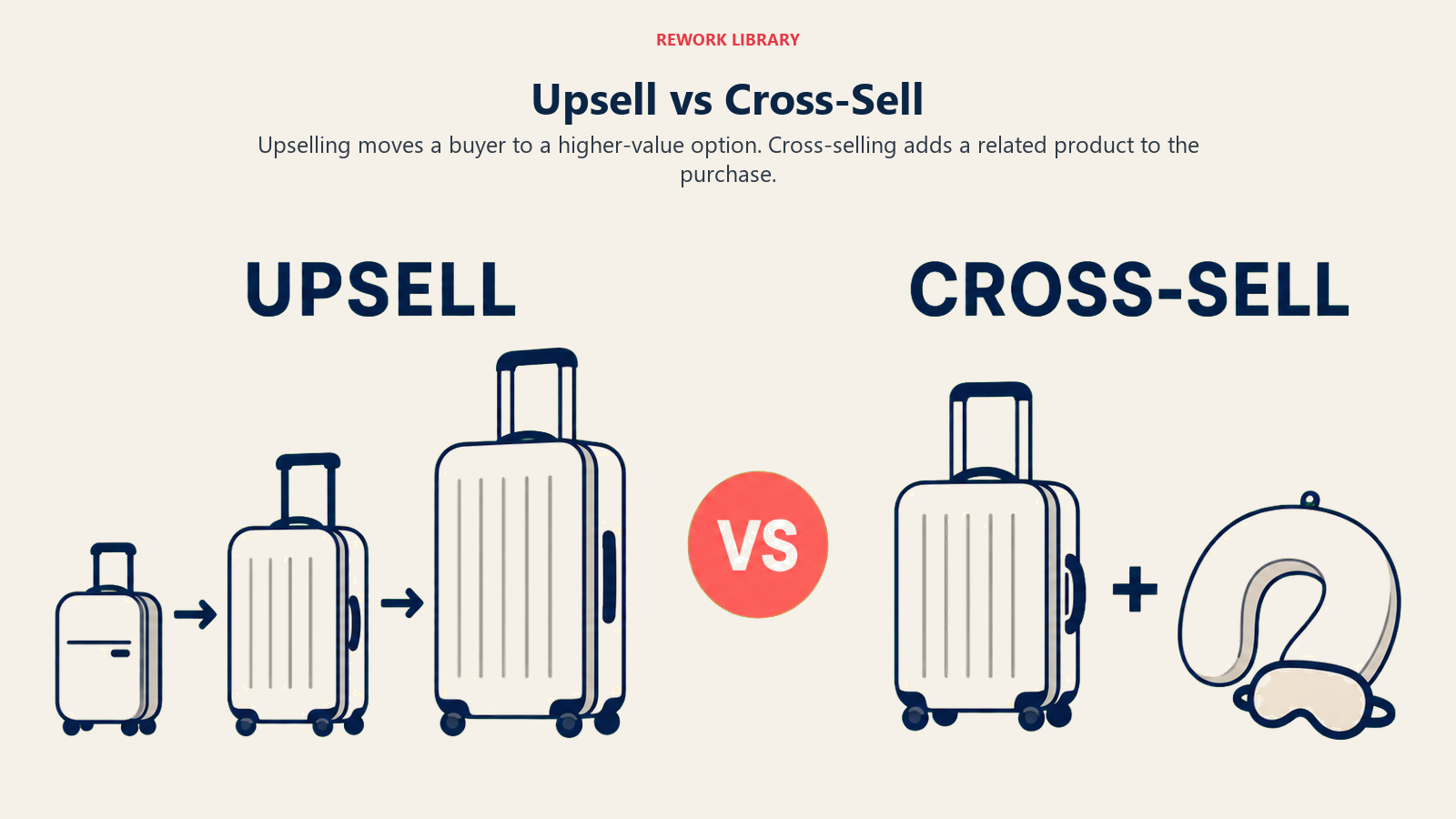
Upselling encourages customers to purchase a higher-end version of the product they're considering. You're moving them up the value ladder:
- Suggesting a laptop with 16GB RAM instead of 8GB
- Offering an annual subscription instead of monthly
- Recommending the premium coffee beans over the standard blend
Cross-selling suggests complementary products that enhance or complete the original purchase:
- A laptop case and mouse with that laptop
- Coffee filters and a grinder with those coffee beans
- A phone case and screen protector with a new phone
When to use each:
Use upselling when:
- The customer shows price flexibility indicators (browsing premium options, abandoned high-value carts)
- Feature differences are clear and valuable
- The upgrade cost is proportional (typically 20-40% more)
- You have clear tier differentiation
Use cross-selling when:
- Products naturally complement each other
- The customer is already committed to a purchase
- Combined value is obvious (protection, convenience, completion)
- The additional purchase is relatively low commitment
The best strategies use both, but never at the same time. Presenting too many options creates decision paralysis and kills conversion rates.
Customer Psychology Behind Upselling
Understanding why customers say yes to upsells reveals how to present them more effectively.
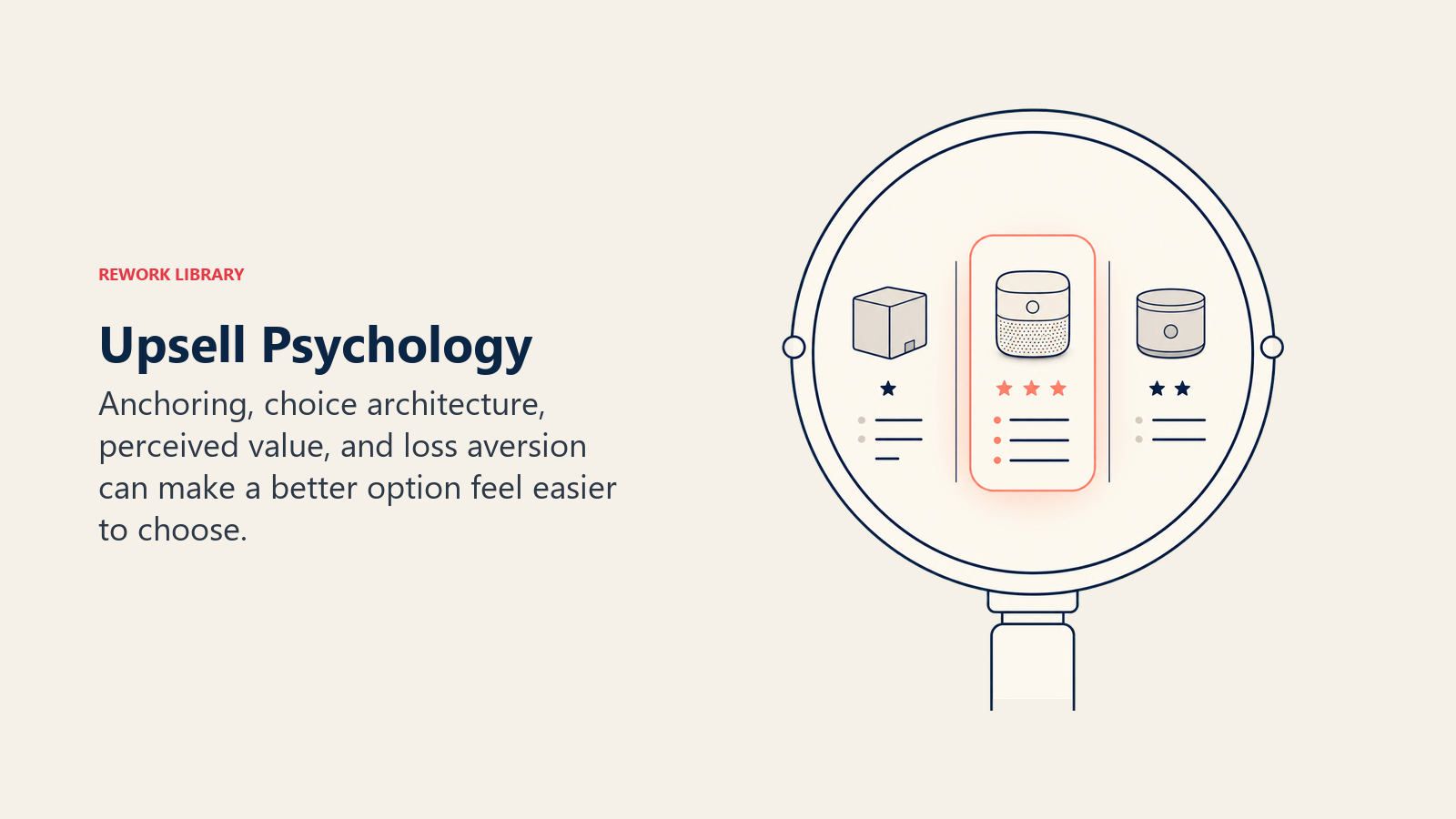
Price Anchoring
Once a customer commits to spending $500 on a product, an additional $100 for a meaningful upgrade feels proportionally smaller. The initial commitment anchors their spending threshold.
This is why upsells work better after the customer has selected their base product. The percentage increase feels manageable compared to the absolute dollar amount.
Example: A $150 upgrade on a $1,000 laptop (15% increase) converts better than presenting that $1,150 laptop from scratch. The customer has already justified the $1,000 expense.
Perceived Value Gaps
Customers are most receptive to upsells when the perceived value gap between options is clear and significant:
- Bad upsell: 128GB storage → 256GB storage for $50 more (incremental improvement)
- Good upsell: 128GB storage → 512GB storage + 2-year warranty for $80 more (comprehensive upgrade)
The value perception must justify the price jump. Bundle additional features or benefits with the upsell to create a compelling value proposition. For more on effective bundling strategy, see our comprehensive guide.
Fear of Missing Out (FOMO)
Customers worry about regretting a smaller purchase. Frame your upsells around avoiding future regret:
- "90% of customers who bought X wish they'd upgraded to Y"
- "One-time upgrade opportunity (not available after purchase)"
- "Most popular choice among professionals in your field"
This works particularly well for products with long replacement cycles. Nobody wants to live with buyer's remorse for three years.
Commitment Consistency
Once customers have decided to buy from you, they're psychologically inclined to continue that commitment. This is why post-purchase upsells often convert at 10-30%, because the decision to trust your brand has been made.
Product Positioning for Effective Upsells
The way you position products determines upsell success before a customer ever clicks.
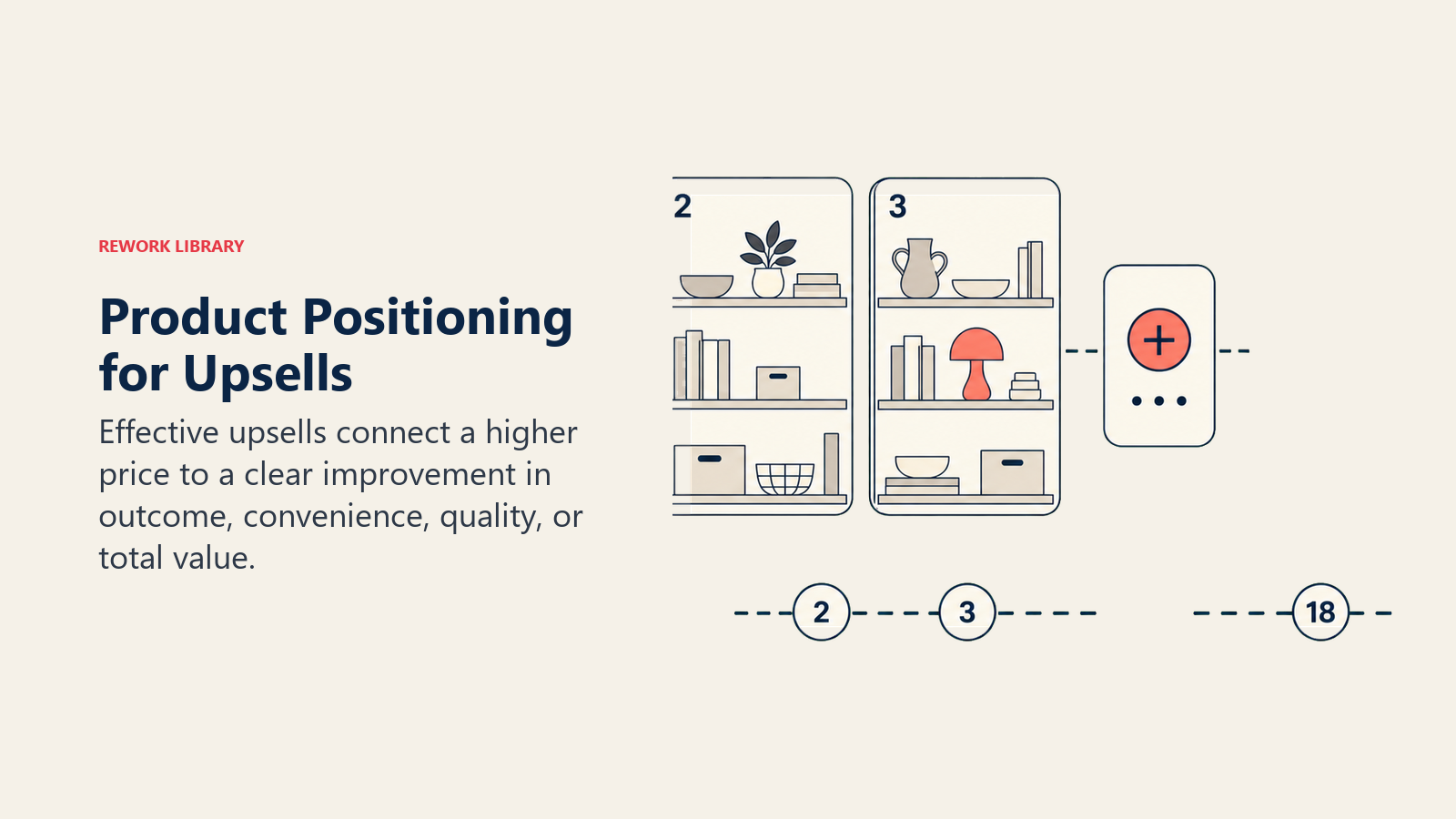
Create Clear Upgrade Paths
Customers need to understand what they gain by spending more:
| Tier | Features | Price | Best For |
|---|---|---|---|
| Basic | Core features | $29/mo | Individuals, basic needs |
| Pro | Core + automation, integrations | $79/mo | Growing teams |
| Enterprise | Everything + custom, dedicated support | $199/mo | Large organizations |
Notice each tier has a clear "best for" designation. Customers self-select based on identity, not just features.
Feature Positioning That Drives Upgrades
Position premium features around outcomes, not specifications:
- Specification-focused: "Enterprise includes 99.99% uptime"
- Outcome-focused: "Enterprise eliminates downtime that costs your business money"
The outcome frame creates urgency and justifies the investment.
The "Most Popular" Strategy
Highlighting your middle-tier option as "most popular" serves two purposes:
- Social proof drives conversions
- Sets the middle tier as the default, making premium seem like a modest upgrade
Spotify, Netflix, and most SaaS companies use this approach. The basic tier exists mainly to make the middle tier look valuable.
Good-Better-Best Pricing
Presenting three options consistently outperforms two:
- Two options: 50/50 split
- Three options: 20/60/20 split (middle option dominates)
The presence of a premium option makes the middle option feel reasonable, while the basic option prevents feeling trapped.
Timing and Placement: When to Present Upsells and Cross-Sells
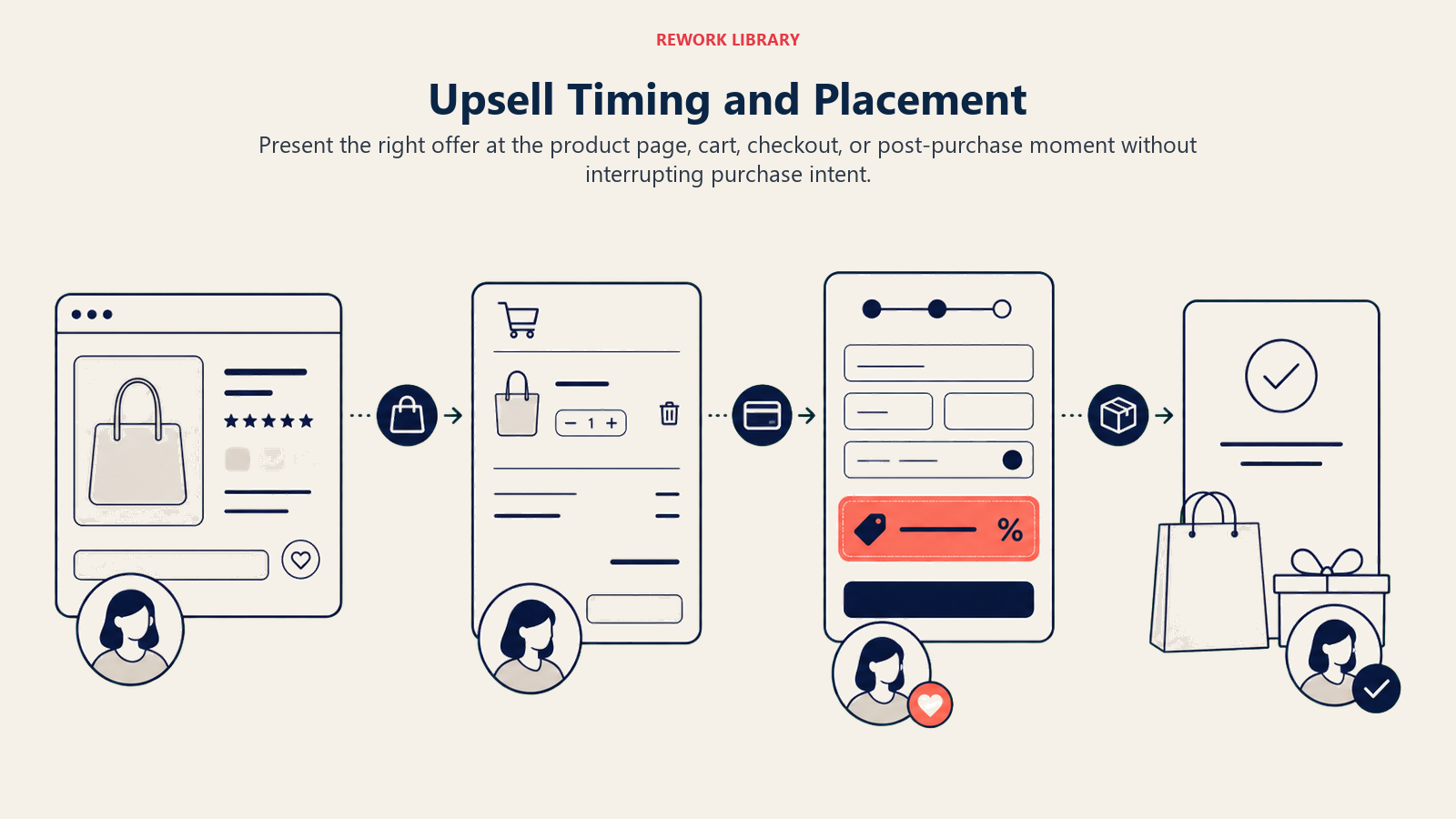
Where and when you present additional offers dramatically impacts acceptance rates.
Pre-Purchase Upsells
On product pages: Present tier comparisons and feature upgrades before the "Add to Cart" button. Conversion rate typically 8-15% for well-positioned offers.
Best practices:
- Show immediately below product description
- Use comparison tables for complex products
- Include customer reviews mentioning upgrades
- Keep CTAs distinct (don't hijack the primary purchase)
For a deeper dive into maximizing conversions at this critical stage, explore our guide on product page optimization.
During product configuration: For customizable products, suggest upgrades as customers select options. "Customers who choose this option usually add X."
In-Cart Upsells
Motivation: The customer is committed but hasn't paid yet. They're evaluating their cart and remain open to optimization.
Effective in-cart tactics:
- "Complete your order" suggestions (cases, accessories, warranties)
- Tier upgrade reminders ("Upgrade to Pro for $X more")
- Bundle offers that increase cart value
- Free shipping thresholds that encourage adding items
Convert rate: 3-5% for relevant suggestions. Learn more about reducing drop-offs with our cart abandonment recovery strategies.
Checkout Page Cross-Sells
This is your last chance before payment. Keep it minimal:
- One-click add-ons only (no navigation away)
- Low-commitment items ($5-$20)
- Highly relevant accessories
- Clear value propositions
Amazon's "frequently bought together" section at checkout exemplifies this, minimal friction, high relevance.
Warning: Overcomplicated checkout upsells increase abandonment. Test carefully. Your primary goal is completing the initial transaction.
Post-Purchase Upsells
The confirmation page or email is psychologically powerful. The customer just bought, they trust you, and they're in a positive state.
Post-purchase upsells work for:
- Service add-ons (warranties, installation, premium support)
- Complementary products they didn't see
- Subscription upgrades
- Replenishment scheduling
These convert at 10-30% because there's no cart abandonment risk, the main purchase is complete.
Recommendation Engines: The Technology Behind Smart Suggestions
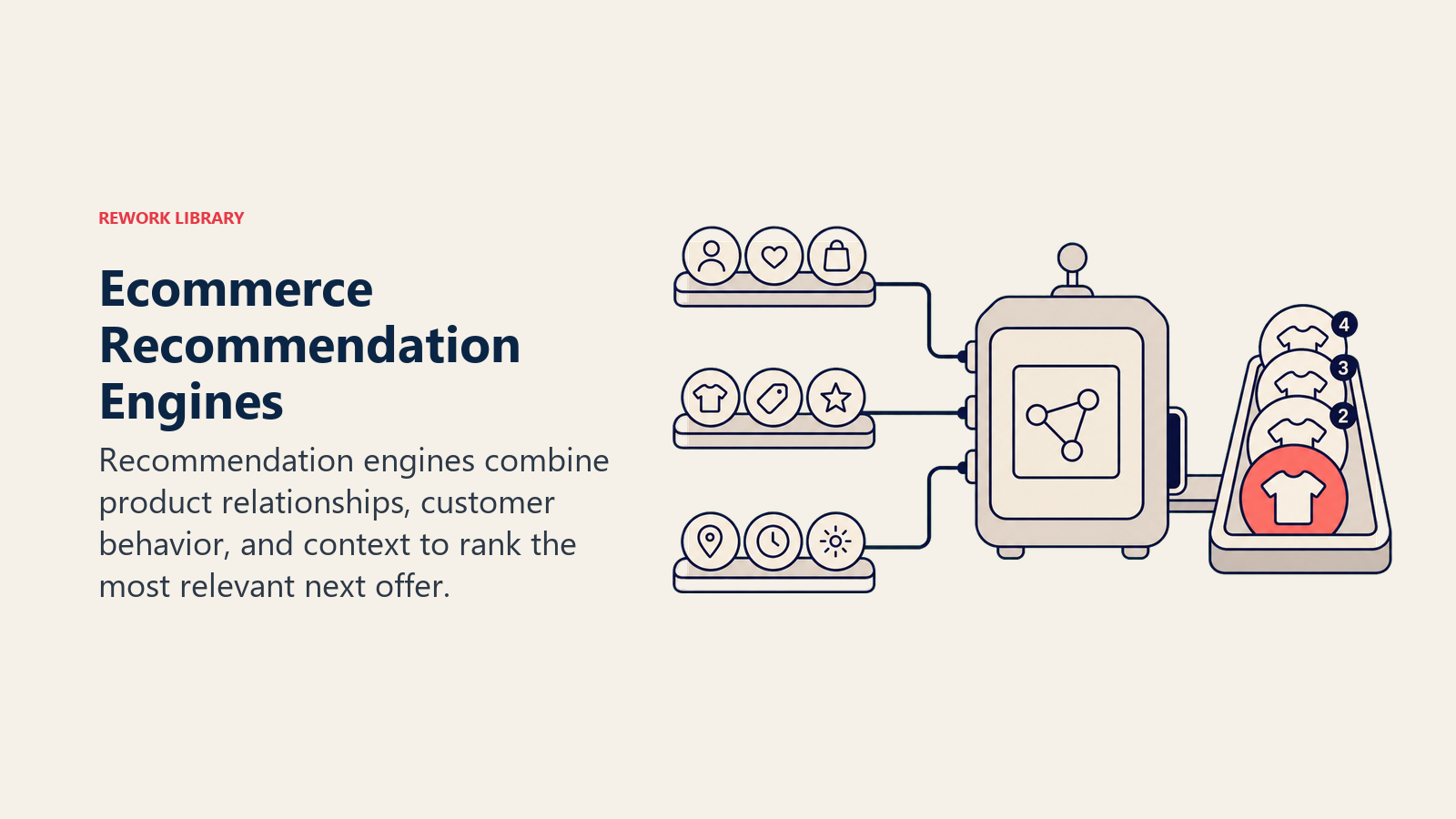
Manual curation doesn't scale. E-commerce businesses that excel at cross-selling use algorithmic recommendations.
Collaborative Filtering
Concept: Recommend products based on what similar customers bought.
"Customers who bought X also bought Y" works because purchasing patterns reveal relationships that aren't obvious from product descriptions alone.
Implementation tiers:
- Basic: "Frequently bought together" based on order history
- Intermediate: User-based collaborative filtering (similar customer profiles)
- Advanced: Item-based collaborative filtering (similar product relationships)
Shopify, WooCommerce, and BigCommerce offer plugins for basic collaborative filtering. For advanced implementations, consider platforms like Dynamic Yield or product recommendations and personalization specialized services.
Content-Based Filtering
Recommend products with similar attributes to what the customer is viewing:
- Same category
- Same brand
- Similar price range
- Matching specifications
This works well for new products without purchase history and for customers with limited browsing data.
Hybrid Approaches
Combine collaborative and content-based filtering:
- Use collaborative filtering when sufficient data exists
- Fall back to content-based for new products or customers
- Apply business rules (margin, inventory, strategic priorities)
AI and Machine Learning
Advanced implementations use neural networks to:
- Predict purchase probability for each product
- Optimize timing and placement dynamically
- Personalize based on browsing behavior, not just purchases
- A/B test variations automatically
These systems learn continuously and improve over time. Companies like Netflix and Amazon invest heavily here because the ROI is substantial.
Data-Driven Cross-Sell Selection
Not all cross-sells are created equal. Use data to identify high-performing combinations.
Analyzing Purchase Combinations
Query your order database:
Which products are most frequently purchased together?
What's the time gap between related purchases?
Which combinations have the highest combined margin?
Look for:
- Attachment rate: % of product A buyers who also buy product B
- Lift: How much more likely is product B to sell alongside product A vs. alone
- Revenue impact: Total additional revenue generated by the combination
Customer Segmentation
Different customer segments respond to different cross-sells:
- First-time buyers: Lower-priced, lower-risk add-ons
- Repeat customers: Premium accessories, upgrades
- High-value customers: Complete solutions, professional services
Segment your recommendations to match customer profiles and purchase history.
Inventory and Margin Considerations
Pure algorithmic recommendations might suggest low-margin or out-of-stock products. Apply business logic:
- Prioritize higher-margin items when relevance is equal
- Exclude low-inventory items from aggressive promotion
- Feature strategic products (new launches, overstocked items)
The algorithm provides relevance; your business rules optimize profitability.
A/B Testing Your Upsell and Cross-Sell Strategies
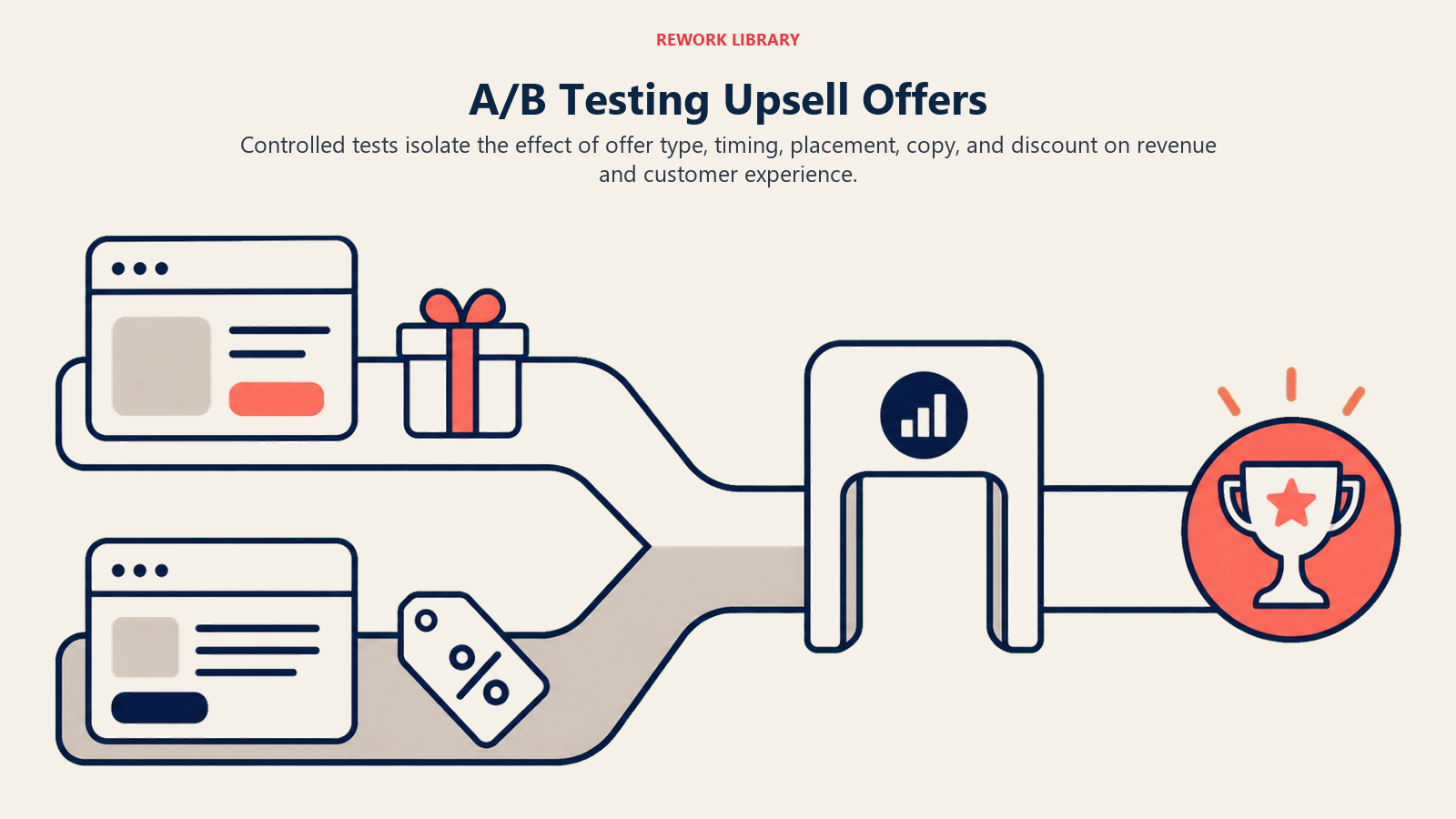
Assumptions about what works often prove wrong. Test systematically.
What to Test
Placement:
- Product page vs. cart vs. checkout vs. post-purchase
- Above fold vs. below product description
- Sidebar vs. inline vs. modal
Presentation:
- Format: Comparison tables vs. cards vs. lists
- Number of recommendations: 1 vs. 3 vs. 6 options
- Visual emphasis: Highlighted "most popular" vs. equal treatment
Copy and Messaging:
- Benefit-focused vs. feature-focused
- Social proof ("Best seller") vs. scarcity ("Limited time")
- Question format ("Need protection?") vs. statement ("Complete your order")
Pricing Display:
- Show discount percentage vs. absolute savings
- Monthly vs. annual pricing emphasis
- Bundle pricing vs. individual prices
Testing Methodology
Control for variables: Test one element at a time. Changing placement and copy simultaneously makes it impossible to know what drove results.
Measure the right metrics:
- Primary: Upsell acceptance rate, incremental AOV
- Secondary: Overall conversion rate (ensure upsells don't hurt main purchases)
- Tertiary: Return rates (ensure upsells provide actual value)
Sample size requirements: For 95% confidence, you typically need 350-400 conversions per variant. This means testing upsells (lower conversion rates) requires more time than testing primary CTAs.
Winner validation: Run winning variants for at least two full business cycles. Weekly seasonality and promotions can create false positives.
Implementation Across Different Sales Channels
Your upsell strategy should adapt to the channel context.
On-Site E-commerce
Full control over experience. Implement:
- Dynamic product recommendations on PDPs
- Smart cart upsells based on cart contents
- Progressive checkout offers
- Post-purchase confirmation page offers
Technical implementation: Most platforms (Shopify, WooCommerce, Magento) offer apps for this. Custom implementations give more control but require development resources.
Amazon and Marketplace Platforms
Limited ability to cross-sell (Amazon controls recommendations). Focus on:
- Product bundling (selling pre-packaged sets)
- Amazon's "Frequently Bought Together" optimization
- Sponsored product ads for complementary items
- A+ Content highlighting use cases that require accessories
Email Marketing
Post-purchase email sequences provide excellent cross-sell opportunities:
- Day 1: Order confirmation with complementary product suggestions
- Day 7: "Complete your setup" accessories email
- Day 30: Replenishment or upgrade opportunities
Personalize based on actual purchase, not generic campaigns. Our guides on email marketing for e-commerce and post-purchase email sequences provide detailed implementation strategies.
Subscription Businesses
Upselling happens over time:
- Feature limitations that demonstrate premium value
- Usage-based triggers ("You're approaching your limit")
- Anniversary offers ("Upgrade and save on your renewal")
- In-app upsells at point of friction
The subscription model enables ongoing relationship optimization. For more on this, see Customer Lifetime Value (LTV).
Discounting Strategy for Upsells and Cross-Sells
Should you discount upsells? The answer depends on your positioning.
When to Discount
Bundle discounts: "Buy together and save 15%" works because the customer sees clear value in the combination while you increase total cart value.
First-time customer incentives: Aggressive first-purchase upsells with discounts can increase LTV by establishing broader product usage early.
Strategic inventory moves: Discount cross-sells on overstock or seasonal items to move inventory while increasing AOV.
When to Avoid Discounting
Premium positioning: If your brand is premium, constant upsell discounts train customers to wait for deals and undermine pricing integrity.
High-value B2B: Enterprise customers evaluate based on value and ROI, not discounts. Discounting can signal desperation or reduce perceived quality.
Post-purchase upsells: These already convert well without discounts. Customers just made a full-price purchase; they're not in discount-seeking mode.
The Free Shipping Threshold Strategy
Instead of discounting, use free shipping thresholds to encourage higher-order values:
"Add $15 more for free shipping" effectively creates an upsell opportunity without devaluing your products.
This works because:
- Customers hate paying for shipping
- The threshold feels like earning a benefit, not buying more
- It applies to any combination of products
For comprehensive strategies, see AOV Optimization Strategy.
Measuring ROI and Performance Metrics
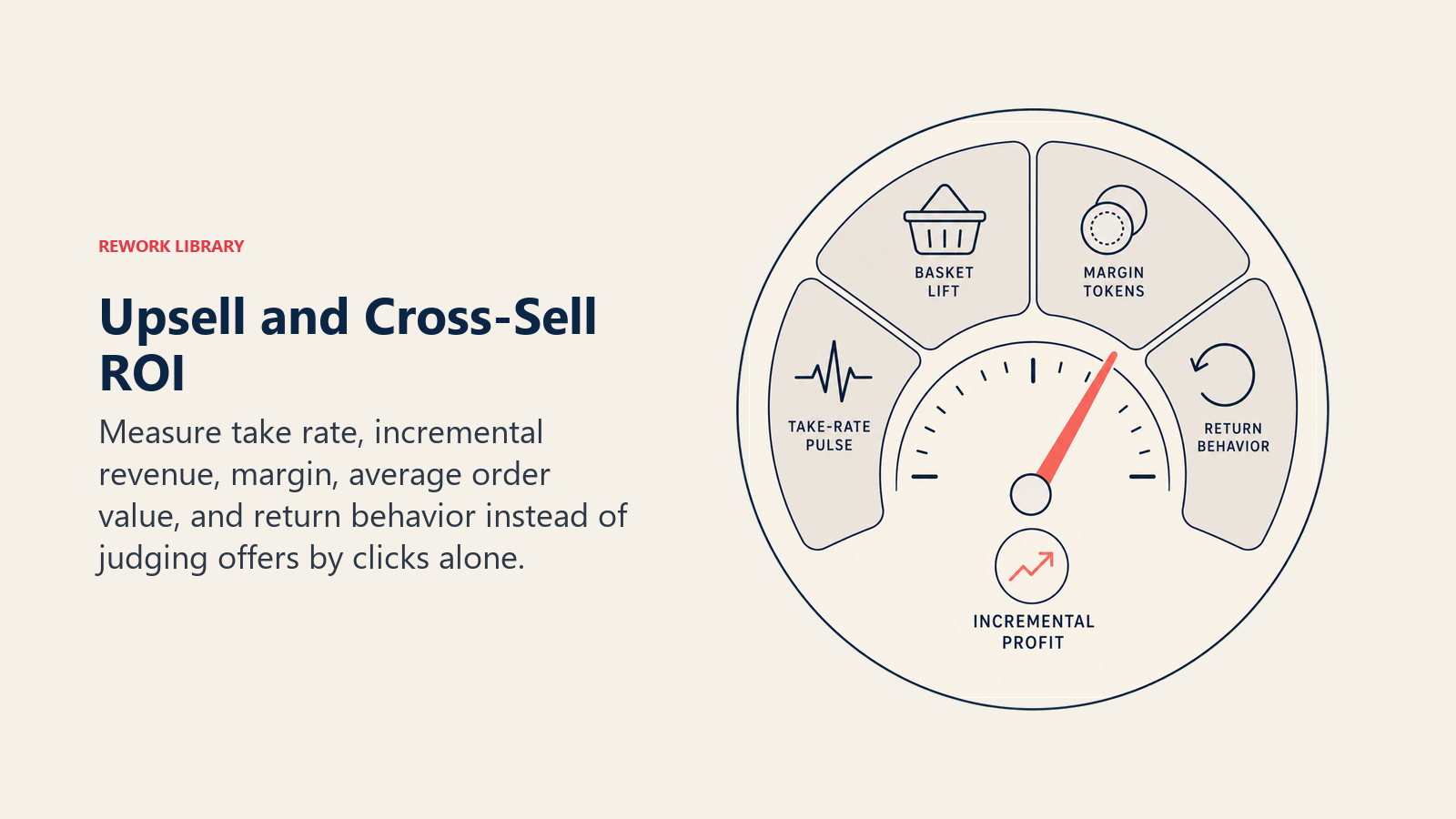
Track these metrics to evaluate your upsell and cross-sell program effectiveness.
Primary Metrics
Upsell/Cross-Sell Conversion Rate:
(Orders with upsell/cross-sell) ÷ (Total orders) × 100
Benchmark: 15-30% for mature programs.
Average Order Value (AOV) Lift:
(AOV with upsell program) - (AOV baseline)
Benchmark: 10-25% lift is achievable.
Revenue from Upsells/Cross-Sells:
Total incremental revenue attributable to these offers
This is your gross impact. Track it monthly and by channel.
Secondary Metrics
Acceptance Rate by Offer Type: Track which specific upsells and cross-sells convert best. Double down on winners.
Attachment Rate:
(Units of product B sold with product A) ÷ (Units of product A sold) × 100
Reveals which product combinations naturally fit together.
Impact on Customer Lifetime Value: Do customers who accept upsells have higher LTV? This validates that you're not just front-loading value but building stronger customer relationships. For comprehensive LTV analysis, see our guide on customer lifetime value.
Cautionary Metrics
Return Rate on Upsold Products: If significantly higher than baseline, you're overselling products customers don't actually want.
Cart Abandonment Rate: If upsell implementation increases abandonment, you've added friction that offsets value.
Overall Conversion Rate: Monitor your primary conversion rate. Upsells that reduce overall conversions aren't worth it, you've optimized the wrong thing.
Common Pitfalls and Customer Experience Considerations
Aggressive upselling damages customer relationships and long-term revenue.
Pitfall #1: Interrupting the Purchase Flow
Modal pop-ups that interrupt checkout increase abandonment. If a customer has to close something to continue purchasing, you've added friction.
Solution: Keep upsells inline and optional. Never require interaction to proceed.
Pitfall #2: Irrelevant Recommendations
Suggesting printer ink to someone buying a couch erodes trust in your recommendations. If algorithms fail, customers ignore future suggestions.
Solution: Set relevance thresholds. Better to show no recommendation than a bad one.
Pitfall #3: Overselling Value
If you upsell a premium product that doesn't deliver proportional value, you create disappointed customers and returns.
Solution: Ensure genuine value differentiation. Premium tiers should be objectively better in ways customers care about. Learn more about effective pricing strategy and optimization approaches.
Pitfall #4: Too Many Options
Presenting 10 cross-sell options overwhelms customers and reduces conversion on all of them.
Solution: Limit to 3-4 highly relevant suggestions. Curate ruthlessly.
Pitfall #5: Neglecting Mobile Experience
Upsell modules designed for desktop often break on mobile, where 60-70% of traffic occurs.
Solution: Mobile-first design for all upsell implementations. Test exhaustively on devices.
Maintaining Customer-Centricity
The best upsells feel helpful, not pushy:
- Frame upsells as solving problems or enhancing the purchase
- Use customer language, not sales language
- Make it genuinely easy to decline
- Honor customer preferences (don't repeatedly offer what they've declined)
Your goal is increasing value for both parties. When done well, upselling improves customer satisfaction because people get more of what they actually need. Building trust through customer reviews and user-generated content can further validate your recommendations.
Integration with Broader Retention and Growth Strategy
Upselling and cross-selling aren't isolated tactics, they connect to your entire customer value strategy.
Product-Led Growth
Use your product to reveal upgrade opportunities organically:
- Feature limits that demonstrate value before restricting
- Usage notifications that prompt upgrades at natural points
- Comparison tools within the product
This creates upsells that feel like natural progression, not sales tactics.
Lifecycle Positioning
Match offers to customer lifecycle stage:
- New customers: Low-friction cross-sells that enhance first purchase
- Engaged customers: Feature upgrades based on demonstrated usage
- At-risk customers: Value-focused offers that re-engage
- Champions: Premium or exclusive offerings
For lifecycle strategies, see Conversion Rate Optimization (CRO).
Creating Upgrade Paths
Your product line should naturally ladder up:
- Entry products that demonstrate your value
- Mid-tier products that serve committed customers
- Premium products for sophisticated needs
If gaps exist in this ladder, customers have nowhere to expand to as their needs grow.
Optimizing Every Touchpoint
Upselling and cross-selling extend beyond the purchase page:
- Product page optimization that highlights tiers
- Checkout flow optimization that includes strategic offers
- Post-purchase sequences that deepen engagement
- Replenishment campaigns for consumables
Each touchpoint is an opportunity to increase customer value while delivering better outcomes. Tracking these improvements requires understanding key e-commerce metrics and KPIs across the customer journey.
Taking Action: Your Upsell Implementation Roadmap
Ready to implement or improve your upsell and cross-sell strategy? Here's where to start.
Phase 1: Foundation (Weeks 1-4)
- Audit current state: What upsells and cross-sells exist? Where are they? What are they converting at?
- Analyze purchase data: Which products are bought together? What's the purchase sequence?
- Identify quick wins: Low-hanging fruit like obvious accessories or bundles
- Implement basic recommendations: "Frequently bought together" on top products
Phase 2: Optimization (Weeks 5-12)
- Deploy recommendation engine: Implement or upgrade to algorithmic recommendations
- Test placement: Product page vs. cart vs. checkout positioning
- Segment offers: Different recommendations for different customer types
- Refine messaging: Test benefit-focused vs. feature-focused copy
Phase 3: Advanced Implementation (Months 4-6)
- Dynamic personalization: Real-time recommendations based on browsing behavior
- Post-purchase programs: Systematic upsell sequences after initial purchase
- Lifecycle optimization: Upgrade paths tied to customer maturity
- Cross-channel consistency: Coordinated upselling across web, email, and other channels
Phase 4: Continuous Improvement (Ongoing)
- Monthly performance reviews: Track all key metrics
- Quarterly strategy updates: Adjust based on seasonal patterns and new products
- Regular A/B testing: Continuous optimization of offers and presentation
- Customer feedback integration: Ensure upsells remain valuable, not annoying
Conclusion: Upselling as Value Creation
The best upselling doesn't feel like selling at all. It feels like helpful guidance toward the right solution.
When you frame upsells and cross-sells as helping customers get more value from their purchase, avoid the aggressive pitfalls, and use data to make relevant suggestions, you create a win-win: customers get better outcomes, and your business captures more of the value you deliver.
Start with one high-traffic product. Identify the most natural upsell or cross-sell. Implement it cleanly with clear value messaging. Measure the impact. Then expand systematically.
Your average order value is one of the highest-leverage metrics in e-commerce. Small improvements compound dramatically when applied across thousands of orders. The strategies in this guide give you the framework to capture that leverage while building stronger customer relationships.
The opportunity is sitting in your existing traffic. The question is whether you'll help customers find what they actually need.
Frequently Asked Questions about Ecommerce Growth
How much can upselling and cross-selling lift ecommerce growth?
McKinsey research puts the potential at a 20% sales increase and 30% profit increase, and Amazon attributes up to 35% of its revenue to recommendations. In practice, a mature upsell and cross-sell program lifts average order value by 10 to 25%, with upsell conversion rates of 15 to 30% on existing traffic, so it grows revenue without new acquisition spend.
What is the difference between upselling and cross-selling?
Upselling moves a customer to a higher-end version of the product they are already considering, such as a laptop with more storage or an annual plan instead of monthly. Cross-selling suggests complementary products that complete the purchase, like a case and mouse with that laptop. The best programs use both, but never at the same moment, since too many options create decision paralysis.
When is the best time to present an upsell or cross-sell?
Timing changes acceptance dramatically. Product-page upsells convert at 8 to 15%, in-cart upsells at 3 to 5%, and post-purchase upsells at 10 to 30% because there is no cart abandonment risk once the main order is complete. Keep checkout upsells minimal and one-click, since overcomplicated checkout offers increase abandonment.
Do upsells and cross-sells need to be discounted?
Not usually. Post-purchase upsells already convert well at full price because the customer just chose to trust you. Bundle discounts and free shipping thresholds work when you want to nudge cart value, but constant upsell discounts on a premium brand train customers to wait for deals and erode pricing integrity.
Related Resources
Deepen your understanding of revenue optimization strategies with these complementary guides:
- AOV Optimization Strategy - Comprehensive approaches to increasing average order value across all customer touchpoints
- Product Bundling - Strategic bundling techniques that create compelling package offers
- Post-Purchase Upsells - Converting customers after the initial transaction with high-converting offers
- Conversion Rate Optimization - Systematic approaches to improving conversion rates throughout the customer journey

On this page
- Upsell vs Cross-Sell: Understanding the Fundamentals
- Customer Psychology Behind Upselling
- Price Anchoring
- Perceived Value Gaps
- Fear of Missing Out (FOMO)
- Commitment Consistency
- Product Positioning for Effective Upsells
- Create Clear Upgrade Paths
- Feature Positioning That Drives Upgrades
- The "Most Popular" Strategy
- Good-Better-Best Pricing
- Timing and Placement: When to Present Upsells and Cross-Sells
- Pre-Purchase Upsells
- In-Cart Upsells
- Checkout Page Cross-Sells
- Post-Purchase Upsells
- Recommendation Engines: The Technology Behind Smart Suggestions
- Collaborative Filtering
- Content-Based Filtering
- Hybrid Approaches
- AI and Machine Learning
- Data-Driven Cross-Sell Selection
- Analyzing Purchase Combinations
- Customer Segmentation
- Inventory and Margin Considerations
- A/B Testing Your Upsell and Cross-Sell Strategies
- What to Test
- Testing Methodology
- Implementation Across Different Sales Channels
- On-Site E-commerce
- Amazon and Marketplace Platforms
- Email Marketing
- Subscription Businesses
- Discounting Strategy for Upsells and Cross-Sells
- When to Discount
- When to Avoid Discounting
- The Free Shipping Threshold Strategy
- Measuring ROI and Performance Metrics
- Primary Metrics
- Secondary Metrics
- Cautionary Metrics
- Common Pitfalls and Customer Experience Considerations
- Pitfall #1: Interrupting the Purchase Flow
- Pitfall #2: Irrelevant Recommendations
- Pitfall #3: Overselling Value
- Pitfall #4: Too Many Options
- Pitfall #5: Neglecting Mobile Experience
- Maintaining Customer-Centricity
- Integration with Broader Retention and Growth Strategy
- Product-Led Growth
- Lifecycle Positioning
- Creating Upgrade Paths
- Optimizing Every Touchpoint
- Taking Action: Your Upsell Implementation Roadmap
- Phase 1: Foundation (Weeks 1-4)
- Phase 2: Optimization (Weeks 5-12)
- Phase 3: Advanced Implementation (Months 4-6)
- Phase 4: Continuous Improvement (Ongoing)
- Conclusion: Upselling as Value Creation
- Related Resources