Multi-Channel Marketplace Strategy: Selection, Inventory & Operations
 Selling on a single marketplace is like putting all your eggs in one basket. One algorithm change, one policy violation, one account suspension and your entire business can disappear overnight. Multi-channel marketplace strategy isn't just about growth, it's about survival.
Turn this article into takeaways for your work.


Each assistant summarizes the article only for you and suggests best practices for your work.
But here's the catch: managing inventory across multiple marketplaces while maintaining profitability and sanity requires systems, discipline, and a clear framework. Let's break down how to build a sustainable multi-channel operation.
Multi-Channel vs Single-Channel: The Trade-Off
Channel expansion changes both growth potential and operating complexity, so compare the risk reduction against the work each new marketplace adds. Single-channel benefits:
- Simpler operations and inventory management
- Concentrated marketing efforts and optimization
- Deeper platform expertise
- Lower overhead and fewer systems needed Multi-channel benefits:
- Revenue diversification and risk mitigation
- Access to different customer demographics
- Reduced dependency on one platform's algorithm
- Competitive advantage through channel-specific offers
- Better negotiating position with suppliers (higher volume) The reality: most successful e-commerce brands eventually go multi-channel. The question isn't if, but when and how.
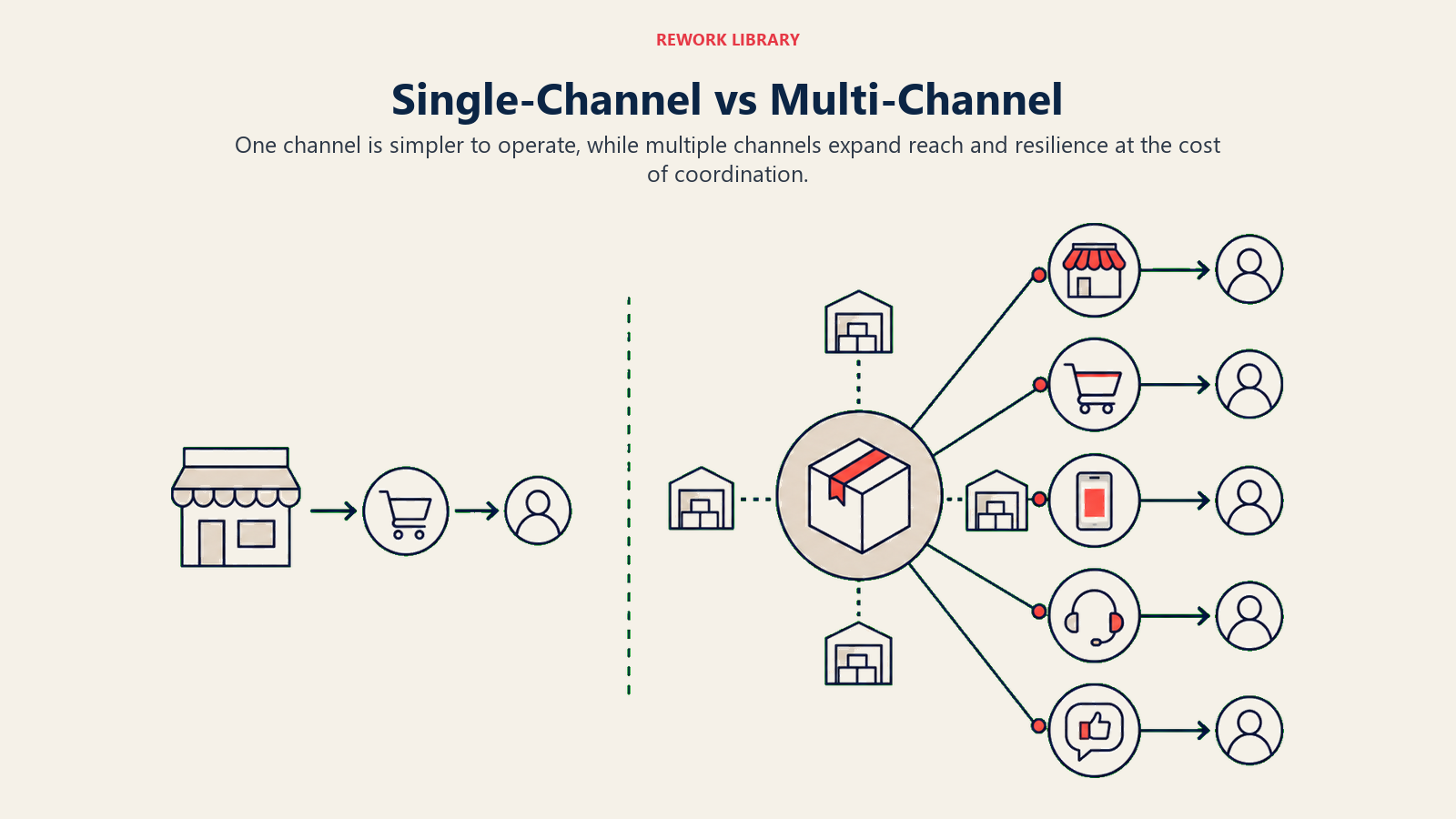
Concentration risk is real. Amazon sellers have woken up to suspended accounts with six figures trapped in inventory. Etsy sellers have seen traffic plummet after algorithm updates. The platform owns the customer relationship, not you.
Start with one channel to prove product-market fit and build systems. Then expand methodically.
Marketplace Selection Framework
Not all marketplaces are worth your time. Evaluate opportunities using these criteria:
Market Size & Traffic
Look at actual monthly visitors and active buyers, not just registered users. Amazon has 200+ million Prime members in the US alone. Walmart.com gets 100+ million monthly visitors. Etsy has 90+ million active buyers globally. Smaller niche marketplaces might have lower traffic but higher intent for specific categories (Reverb for musical instruments, Poshmark for fashion resale).
Fee Structure & Profitability
Calculate your effective fee rate including:
- Referral/commission fees (8-15% typically)
- Payment processing (2-3%)
- Fulfillment fees if using platform warehousing
- Subscription or monthly fees
- Advertising costs to remain competitive
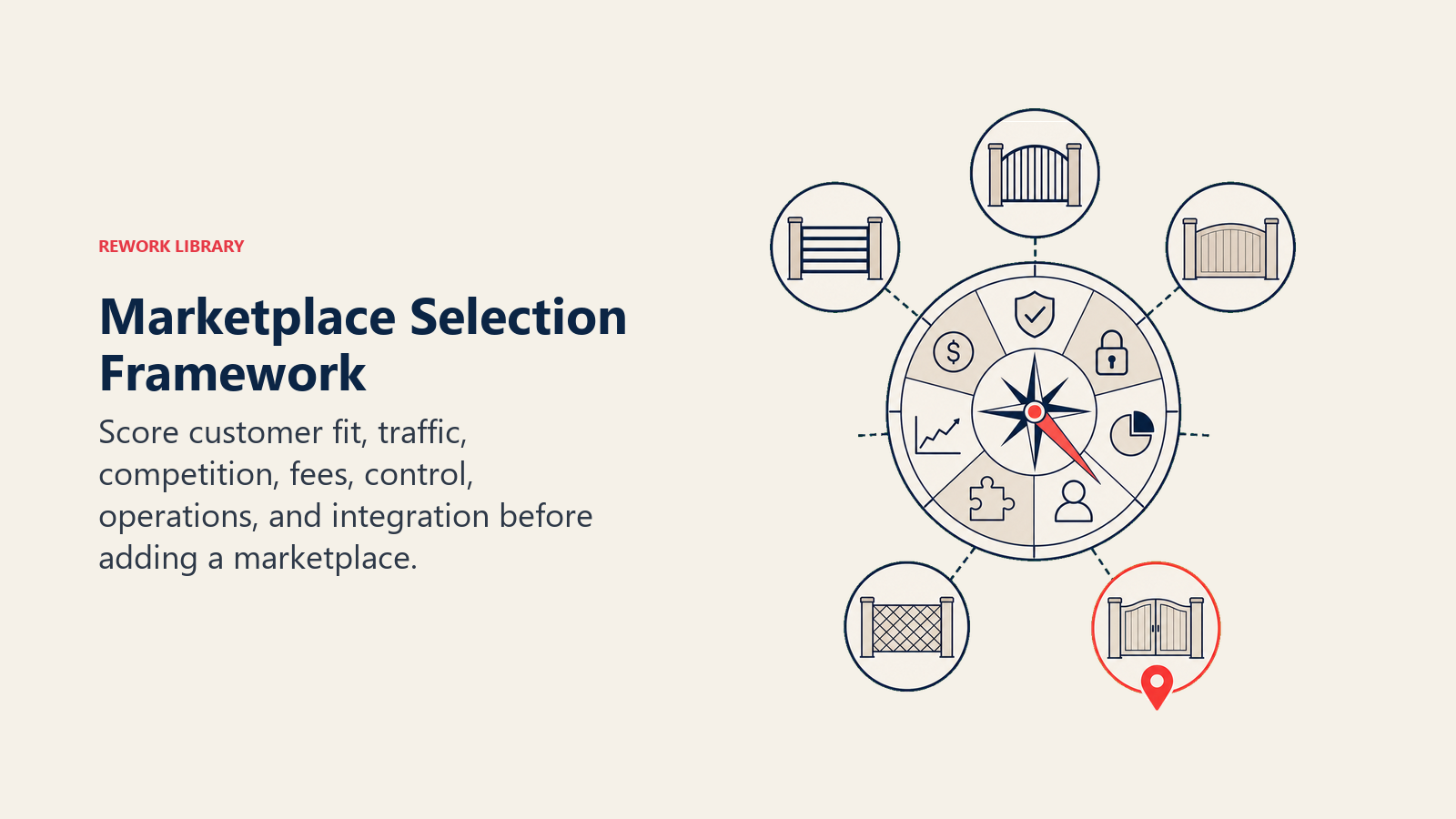
A marketplace with 8% fees but high organic reach might be more profitable than one with 5% fees where you need heavy ad spend.
Customer Demographics & Fit
Different marketplaces attract different buyers:
- Amazon: Convenience-focused, Prime members, broad demographics
- Walmart: Value-conscious, middle America, families
- Etsy: Handmade/unique seekers, gift buyers, creative community
- eBay: Deal hunters, collectors, auction-style buyers
- Target Plus: Quality-conscious, millennial parents, design-focused
Your brand building and positioning strategy should match the platform's core audience.
Competition Intensity
High competition means higher advertising costs and lower organic visibility. Check:
- Number of similar products in search results
- Saturation of your category
- Average review counts on competitors (indicates maturity)
- Advertising bid costs (if available)
Sometimes being a bigger fish in a smaller pond (niche marketplace) beats fighting Amazon giants.
Integration Complexity
Consider technical requirements:
- API availability for inventory sync
- Compatibility with your current systems
- Onboarding and approval process complexity
- Time to first sale
- Platform-specific requirements (UPC codes, brand registry, etc.)
Amazon as Core Channel
For most product-based e-commerce businesses, Amazon should be your primary or secondary channel. The numbers don't lie:
Why Amazon dominates:
- 50%+ of all US e-commerce sales
- Product searches start on Amazon, not Google
- Prime membership drives purchase frequency
- FBA provides 2-day shipping credibility
- Reviews and ratings build trust faster
The Amazon trade-off: You give up margin (15-20% in fees plus FBA costs) for volume, trust, and logistics infrastructure. For many products, that's worth it, which is why developing a comprehensive Amazon marketplace strategy is essential for success.
Critical FBA considerations:
- Requires 3-4 months of inventory sent to fulfillment centers
- Cash flow intensive (inventory + fees tied up)
- Long-term storage fees penalize slow movers
- Returns processed by Amazon (less control)
- Account health metrics can suspend your business instantly
Master Amazon fundamentals before expanding to other channels. Amazon's algorithm rewards relevance, conversion rate, and seller performance. Get those fundamentals right first.
Secondary Marketplace Opportunities
Once Amazon is generating consistent revenue, expand strategically:
Walmart Marketplace
The second-largest e-commerce player in the US with significant growth trajectory.
Advantages:
- Lower competition than Amazon (for now)
- Strong brand recognition and trust
- Walmart Fulfillment Services (WFS) similar to FBA
- No monthly subscription fee
- Growing online grocery integration
Challenges:
- Application and approval process (not automatic)
- Stricter quality and performance standards
- Smaller seller ecosystem (less resources/tools)
- WFS not as developed as FBA
eBay
Often overlooked but still drives $85+ billion in gross merchandise volume.
Best for:
- Liquidating excess inventory or returns
- Products with collectible/unique angles
- International sales (strong global presence)
- Auction-style pricing for limited items
Not ideal for:
- Commodity products with thin margins
- Sellers wanting predictable fixed pricing
- Products requiring heavy brand storytelling
Etsy
The handmade and unique goods marketplace with a passionate community.
Ideal for:
- Handmade, vintage, or customizable products
- Craft supplies and creative tools
- Products with story-driven branding
- Gift-focused items
Requirements:
- Products must fit handmade/vintage criteria
- Strong photography and listing optimization essential
- Community engagement expected (responding to convos)
International Marketplaces
Consider expansion once domestic channels are stable:
- Amazon EU (UK, Germany, France, Italy, Spain)
- Alibaba/Tmall (China market entry)
- Rakuten (Japan)
- MercadoLibre (Latin America)
International expansion adds complexity: VAT/taxes, customs, language, returns logistics, payment processing. Start with English-speaking markets first.
Marketplace Comparison Matrix
Here's how major marketplaces stack up across key factors:
| Marketplace | Monthly Traffic | Referral Fee | Fulfillment Options | Approval Required | Best For |
|---|---|---|---|---|---|
| Amazon | 200M+ (US) | 8-15% | FBA, FBM | Open (most categories) | Volume, convenience buyers |
| Walmart | 100M+ (US) | 6-15% | WFS, Seller Fulfilled | Yes (application) | Value-conscious families |
| eBay | 80M+ (US) | 10-15% | Managed Delivery, self-ship | Open | Liquidation, collectibles |
| Etsy | 90M+ (global) | 6.5% + $0.20/listing | Self-fulfillment only | Open (handmade/vintage) | Handmade, unique, gifts |
| Target Plus | 50M+ (US) | Negotiable | Target fulfillment required | Yes (invitation) | Design-forward, quality goods |
Inventory Management Across Channels
This is where most multi-channel sellers fail. Overselling creates cancellations and account penalties. Underselling leaves money on the table.
Centralized Inventory System
You need a single source of truth for inventory counts. Options: Spreadsheet approach (not recommended beyond 2 channels): Manual tracking with daily updates. Error-prone and doesn't scale. Inventory management software:
- SellerCloud, ChannelAdvisor, Sellbrite - Enterprise solutions with channel integration
- Cin7, Skubana, Linnworks - Mid-market inventory and order management
- InventoryLab, RestockPro - Amazon-focused with limited multi-channel features
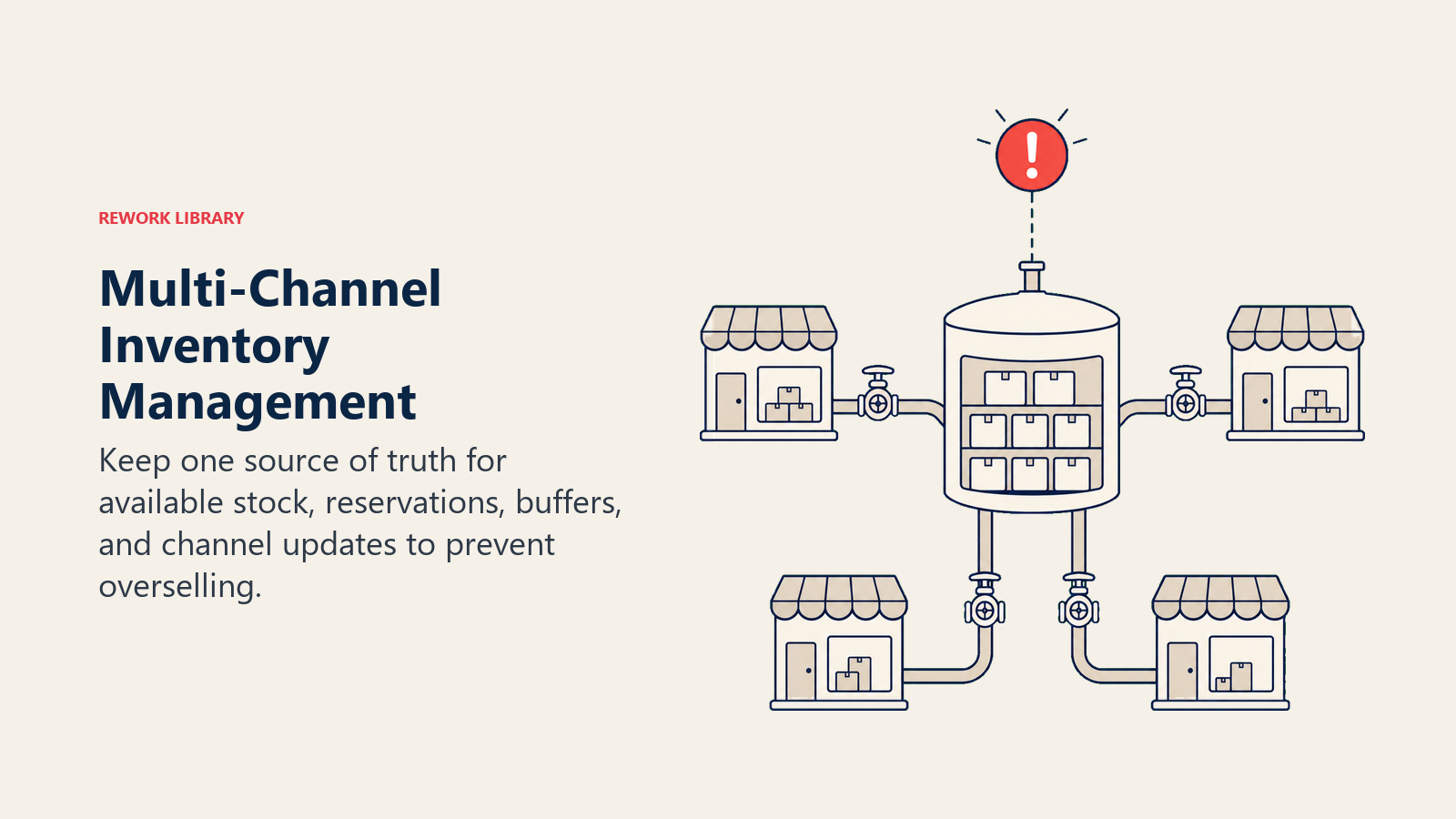
Choose software that integrates natively with your marketplaces and your warehouse/3PL.
Real-Time Inventory Sync
Your system should automatically:
- Update inventory counts when orders come through any channel
- Push updated quantities to all connected marketplaces
- Reserve inventory for pending/processing orders
- Track inventory by location (FBA warehouses, your warehouse, in-transit)
Sync frequency matters. Real-time is ideal but may not be supported by all marketplaces. Aim for 15-minute intervals minimum.
Buffer Stock Strategy
Never list your full inventory across all channels. Use buffer rules:
Conservative approach (recommended for beginners):
- List 70% of available inventory on each marketplace
- Reserve 30% as buffer for oversell protection
- Results in some underselling but prevents account penalties
Intelligent allocation:
- Allocate more inventory to faster-moving channels
- Use predictive analytics to forecast demand by channel
- Adjust allocations based on historical sell-through rates
Example allocation for 100 units:
- Amazon FBA: 50 units (fastest mover)
- Walmart: 30 units
- eBay: 15 units
- Reserve: 5 units (safety buffer)
Managing FBA + Self-Fulfilled Inventory
If you use Amazon FBA but self-fulfill other channels:
Two-inventory system:
- FBA inventory: Sent to Amazon, only available on Amazon
- On-hand inventory: In your warehouse, available for other channels
This prevents cross-contamination but increases total inventory needs. You're essentially duplicating safety stock.
Alternative: FBA Multi-Channel Fulfillment: Amazon can ship orders from other marketplaces using your FBA inventory (for a fee). Provides consistency but adds cost and removes branding from packages.
Inventory Sync Flowchart
Here's how real-time inventory sync should flow:
Order Placed on Channel A
    ↓
Order imported to central system
    ↓
Inventory quantity decreases by order amount
    ↓
Updated inventory count pushed to all channels
    ↓
Channel B, C, D receive updated quantity
    ↓
Listings auto-adjust available inventory
    ↓
[If inventory drops to threshold]
    ↓
Automatic reorder notification sent
Failure points to monitor:
- API connection failures (marketplace downtime)
- Sync delays causing temporary oversells
- Manual adjustments not propagating
- Returns not adding inventory back automatically
Pricing Strategy for Multi-Channel
Pricing across channels requires balancing profitability with competitiveness.
Base Cost Formula
Start with your true landed cost per unit:
Landed cost = Product cost + Shipping to warehouse + Duties/taxes + Receiving fees
Then calculate marketplace-specific pricing:
Channel A price = (Landed cost / (1 - Target margin %)) / (1 - Channel fee %)
This ensures you hit your target margin after marketplace fees.
Fee-Adjusted Pricing
Different marketplaces have different fees, so your price should vary:
Example for a product with $10 landed cost, targeting 40% margin:
- Amazon (15% referral + $4 FBA): $28.57 listing price
- Walmart (12% referral + $3 WFS): $26.44 listing price
- Etsy (6.5% referral + 3% payment): $21.05 listing price
Wait, doesn't this create price discrepancies customers can see?
Price Parity vs Price Optimization
Price parity approach: Keep the same price across all channels. Simpler to manage, prevents customer confusion, but sacrifices margin on lower-fee platforms.
Optimized pricing approach: Adjust prices by channel to maintain consistent margins. More profitable but risks customer comparison shopping.
Middle ground: Keep prices similar (within $1-2) but not identical. Use different value props:
- Amazon: "Fast Prime shipping included"
- Etsy: "Handcrafted with custom options"
- Your website: "Free shipping + bonus gift"
The perceived value justifies small price differences. Understanding pricing strategy and optimization helps maintain competitive positioning while protecting your margins.
Operations & Fulfillment Complexity
Multi-channel selling multiplies operational overhead.
Fulfillment Model Decision
Option 1: FBA for Amazon + Self-fulfill others
- Simplest starting point
- Get FBA benefits on largest channel
- Maintain control and branding on smaller channels
- Requires warehouse/space for non-Amazon inventory Option 2: 3PL for all channels Send all inventory to a third-party logistics provider who:
- Receives and stores inventory
- Picks, packs, and ships orders from all channels
- Integrates with your inventory system
- Provides you with one point of contact Cost-effective once you exceed 500+ orders/month across channels. Your fulfillment strategy selection becomes critical as order volume increases across multiple marketplaces.
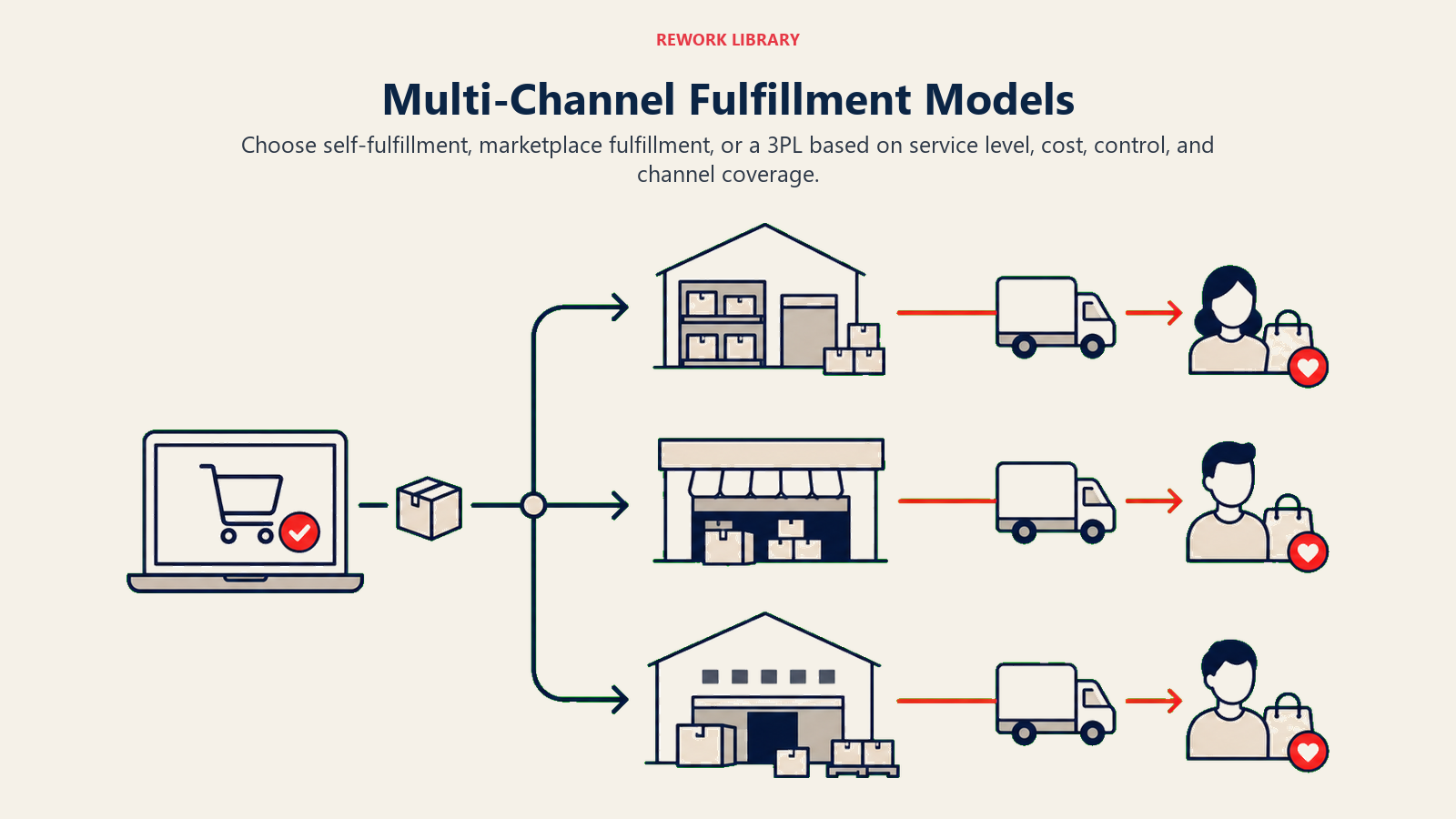
Option 3: FBA Multi-Channel Fulfillment Use Amazon's warehouses to fulfill all channels. Higher fees but simplifies inventory storage.
Returns Management
Each marketplace has different return policies and processes:
- Amazon FBA: Amazon handles returns, refunds, restocking
- Walmart WFS: Walmart processes returns
- Self-fulfilled: You create return labels, receive items, inspect, restock
Unified returns process:
- Create standard return procedures regardless of channel
- Use return management software (ReturnLogic, Loop Returns)
- Track return rates by channel and product
- Build return costs into your margin calculations (typically 5-10%)
Customer Service Complexity
You'll receive customer messages through:
- Amazon Buyer-Seller messaging
- Walmart Seller Center
- Etsy Conversations
- eBay Messages
- Email (your website)
Solution: Customer service aggregation tools Software like eDesk, Zendesk, or Gorgias can aggregate messages from all channels into one inbox with unified workflows.
Channel Conflict Management
More channels means more potential conflicts.
Brand Consistency Issues
Customers finding your product at different prices or with different branding on multiple marketplaces creates confusion.
Maintain consistency:
- Use similar product titles and descriptions
- Consistent photography across channels
- Aligned brand voice and messaging
- Clear differentiation when applicable (bundle differences, etc.)
Price Wars Between Channels
If you're the only seller of your brand, you control this. But resellers or grey market sellers can create price wars.
Brand protection strategies:
- Register trademarks and use brand registry programs (Amazon Brand Registry)
- Issue cease and desist to unauthorized sellers
- Implement MAP (Minimum Advertised Price) policies for wholesale accounts
- Use product variations or bundles unique to each channel
Account Suspension Risk
One suspended account shouldn't kill your entire business, but account health issues on one marketplace can indicate problems elsewhere.
Prevention:
- Monitor account health metrics weekly across all platforms
- Maintain inventory to prevent out-of-stock cancellations
- Ship on time (or use FBA/WFS)
- Respond to customer messages within 24 hours
- Keep defect rates below 1%
Diversification benefit: If Amazon suspends you, you still have revenue from Walmart, eBay, Etsy while you appeal.
Technology & Systems Integration
Multi-channel requires investment in systems.
Inventory Management Software
Essential features:
- Real-time sync with all marketplaces
- Centralized order management
- Automatic inventory updates
- Low stock alerts and reorder points
- Reporting and analytics
Popular solutions:
- SellerCloud (enterprise, $500+/month)
- Sellbrite (mid-market, $30-300/month)
- ChannelAdvisor (enterprise, custom pricing)
- Ecomdash (small-mid market, $50-200/month)
Order Aggregation
Import orders from all channels into one system to:
- Print shipping labels in batch
- Track shipments uniformly
- Update tracking numbers back to marketplaces
- Manage customer communications
Most inventory software includes this. Standalone options: ShipStation, ShipWorks, Ordoro.
Listing Management & Sync
Create product listings once, distribute to multiple channels:
- Push product data (title, description, images) to all channels
- Update pricing globally or by channel
- Manage variations and options
- Bulk editing capabilities
Template-based approach: Create listing templates with channel-specific customizations (Amazon bullet points vs Etsy tags).
Accounting Integration
Connect your marketplace and inventory software to QuickBooks, Xero, or similar:
- Automatic sales recording by channel
- COGS tracking tied to inventory movements
- Fee reconciliation
- Profitability reporting by marketplace
Accurate accounting is essential for understanding which channels actually make money.
Analytics & Performance Tracking
You can't optimize what you don't measure.
Channel-Level Profitability
Track these metrics for each marketplace:
Revenue metrics:
- Gross sales
- Net sales (after returns/refunds)
- Average order value
- Units sold
Cost metrics:
- Total marketplace fees
- Shipping/fulfillment costs
- Advertising spend
- Return costs
- Payment processing fees
Profitability:
- Gross margin by channel
- Net margin by channel
- ROI (return on inventory investment)
- ROAS (return on ad spend)
Understanding unit economics for e-commerce is essential for calculating true profitability by channel.
Comparative Performance Analysis
Which channel drives the best outcomes?
Volume leader: Highest revenue and units sold (usually Amazon) Margin leader: Best net profitability per unit (often your own website or Etsy) Efficiency leader: Lowest operational overhead and highest automation
Example monthly snapshot:
- Amazon: $50k revenue, 15% net margin = $7,500 profit
- Walmart: $15k revenue, 18% net margin = $2,700 profit
- Etsy: $8k revenue, 25% net margin = $2,000 profit
Amazon drives most profit in absolute terms, but Etsy has the best margins. Different strategic value.
CAC by Channel
Customer acquisition cost varies significantly:
Amazon: Organic ranking vs PPC campaigns (Sponsored Products can be $1-5+ per click) Walmart: Less competitive PPC, lower CAC typically Etsy: Etsy Ads often cheaper but lower volume
Track CAC alongside customer lifetime value. A channel with high CAC but high repeat purchase rates may still be profitable long-term.
Inventory Turn Rate
How quickly does inventory sell through on each channel?
Inventory turn rate = COGS / Average inventory value
Faster turns mean less capital tied up and better cash flow. If Amazon turns inventory 12x/year but Etsy only 4x/year, allocate more inventory to Amazon.
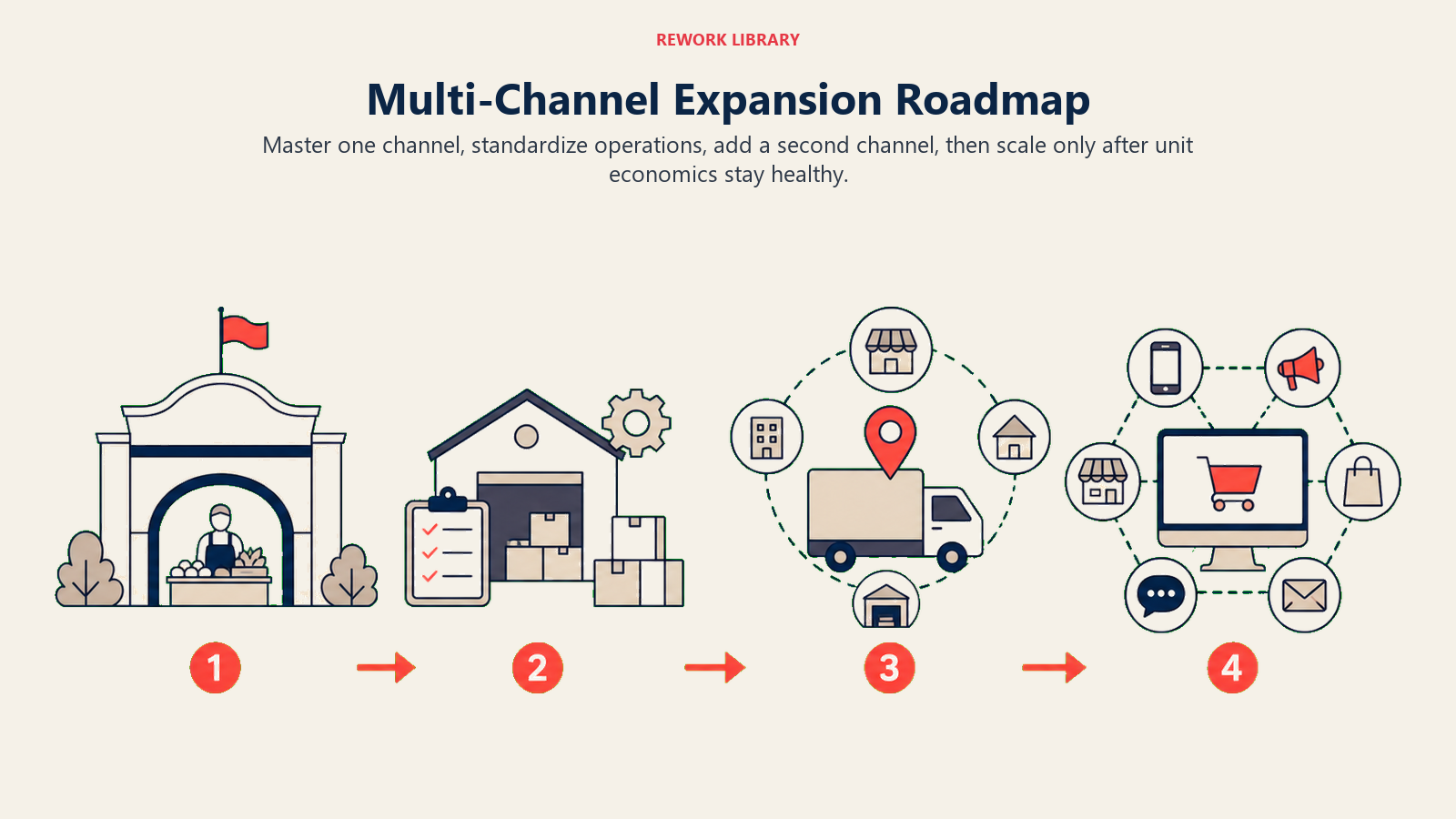
Expansion Roadmap
Scale methodically, not recklessly.
Phase 1: Single Channel Mastery (Months 1-6)
- Choose one marketplace (usually Amazon)
- Achieve consistent $10k+/month revenue
- Build inventory and operations systems
- Reach profitability
- Establish reliable supply chain Don't expand until: You can manage current operations in <10 hours/week and have 3+ months of cash flow cushion.
Phase 2: Secondary Channel Addition (Months 6-12)
- Add one complementary marketplace (Walmart or Etsy typically)
- Implement inventory sync software
- Test with limited SKU set (3-5 products)
- Validate profitability before expanding catalog
- Refine operational workflows
Success criteria: New channel reaches 20%+ of primary channel revenue within 3 months.
Phase 3: Multi-Channel Optimization (Months 12-18)
- Add 1-2 additional channels (eBay, niche marketplaces)
- Fully automate inventory sync and order management
- Implement 3PL if order volume justifies
- Establish channel-specific marketing strategies
- Build cross-channel analytics dashboard
Phase 4: International Expansion (Months 18+)
- Launch on Amazon EU or other international marketplaces
- Navigate VAT, customs, international logistics
- Adapt products and messaging for local markets
- Partner with international 3PLs or use Amazon Global Logistics
Resource Requirements by Phase
Phase 1: Solopreneur or 1 VA (5-10 hrs/week) Phase 2: Part-time ops manager + VA (15-20 hrs/week) Phase 3: Full-time ops manager + customer service rep + VA Phase 4: Dedicated team: ops, marketing, CS, international specialist
Technology investment:
- Phase 1: $0-100/month (basic tools)
- Phase 2: $200-500/month (inventory software)
- Phase 3: $500-1,000/month (full suite + 3PL)
- Phase 4: $1,000-3,000/month (international logistics + advanced analytics)
Final Thoughts
Multi-channel marketplace strategy isn't about being everywhere at once. It's about strategic diversification that builds resilience while maintaining operational sanity.
Start with one channel. Master it completely. Build systems that can scale. Then expand methodically.
The brands that win long-term don't rely on one platform's algorithm or policy. They own relationships, control inventory, and optimize for profit across channels, not just revenue.
Your marketplace mix should evolve with your business. What works at $50k/month looks different from $500k/month. Stay flexible, keep measuring, and always prioritize margin over vanity metrics.
Multi-channel selling is complex. But concentration risk is existential. Choose your hard.
Learn More
Deepen your e-commerce expertise with these related resources:
- E-commerce Metrics & KPIs - Track the right performance indicators across all channels
- Traffic Acquisition Strategy - Drive qualified visitors to each marketplace presence
- E-commerce Platform Selection - Choose the right tech stack to support multi-channel operations
- Social Commerce Strategy - Expand beyond traditional marketplaces into social selling channels

On this page
- Multi-Channel vs Single-Channel: The Trade-Off
- Marketplace Selection Framework
- Market Size & Traffic
- Fee Structure & Profitability
- Customer Demographics & Fit
- Competition Intensity
- Integration Complexity
- Amazon as Core Channel
- Secondary Marketplace Opportunities
- Walmart Marketplace
- eBay
- Etsy
- International Marketplaces
- Marketplace Comparison Matrix
- Inventory Management Across Channels
- Centralized Inventory System
- Real-Time Inventory Sync
- Buffer Stock Strategy
- Managing FBA + Self-Fulfilled Inventory
- Inventory Sync Flowchart
- Pricing Strategy for Multi-Channel
- Base Cost Formula
- Fee-Adjusted Pricing
- Price Parity vs Price Optimization
- Operations & Fulfillment Complexity
- Fulfillment Model Decision
- Returns Management
- Customer Service Complexity
- Channel Conflict Management
- Brand Consistency Issues
- Price Wars Between Channels
- Account Suspension Risk
- Technology & Systems Integration
- Inventory Management Software
- Order Aggregation
- Listing Management & Sync
- Accounting Integration
- Analytics & Performance Tracking
- Channel-Level Profitability
- Comparative Performance Analysis
- CAC by Channel
- Inventory Turn Rate
- Expansion Roadmap
- Phase 1: Single Channel Mastery (Months 1-6)
- Phase 2: Secondary Channel Addition (Months 6-12)
- Phase 3: Multi-Channel Optimization (Months 12-18)
- Phase 4: International Expansion (Months 18+)
- Resource Requirements by Phase
- Final Thoughts
- Learn More