Walmart Marketplace: Seller Requirements, Listing Optimization & Competitive Positioning
Turn this article into takeaways for your work.


Each assistant summarizes the article only for you and suggests best practices for your work.
Walmart Marketplace isn't Amazon's little brother anymore. With $82 billion in marketplace GMV and 150 million monthly visitors, it's the second-largest e-commerce platform in the United States. More importantly, it's attracting a distinct customer base that prioritizes value, everyday essentials, and the trust of the Walmart brand.
If you're running a CPG brand, selling consumables, or targeting middle America, Walmart Marketplace might actually convert better than Amazon. Lower seller saturation means better visibility. Advertising costs less. And customers behave differently than Prime members. But getting approved and succeeding on Walmart requires understanding its unique requirements and optimization strategies.
Here's everything you need to know about launching and scaling on Walmart Marketplace in 2026.
Walmart Marketplace Overview: The $82B Opportunity
Walmart Marketplace is one of the fastest paths to ecommerce growth right now because it pairs an $82 billion GMV platform with far lighter seller competition than Amazon. Lower referral fees, cheaper advertising, and a value-focused customer base mean CPG and everyday-essentials brands often convert better here, especially as a second channel layered onto an existing Amazon business.
Walmart's marketplace launched in 2009 but only became a serious Amazon competitor around 2019 when they streamlined seller onboarding and introduced Walmart Fulfillment Services (WFS). Today, the platform represents a distinct strategic opportunity:
Customer Demographics: Walmart's online shoppers skew older (35-54 years), more suburban/rural, and more value-conscious than Amazon's base. Average household income ranges from $50K-$100K. These customers prioritize price, trust established brands, and make larger basket purchases of everyday items.
Strategic Advantages: Lower competition gives your products better visibility. In categories like grocery, household essentials, and baby products, you'll face 70-80% fewer competing listings than Amazon. Lower referral fees (6-15% vs Amazon's 8-17%) improve unit economics. Walmart's aggressive push into e-commerce means continuing investment in seller tools, advertising capabilities, and fulfillment infrastructure.
Platform Maturity: While Walmart's seller tools still lag behind Amazon's sophistication, the gap is closing rapidly. Walmart Connect (their advertising platform) now offers sponsored products, display ads, and search brand amplifier campaigns. Analytics have improved significantly, and WFS has expanded to multiple fulfillment centers nationwide.
The bottom line: If you're already selling on Amazon, adding Walmart can increase your total e-commerce revenue by 15-30% with relatively minimal incremental effort once systems are in place. If you're just starting out, Walmart offers a less cutthroat environment to establish your brand before tackling Amazon's hypercompetitive ecosystem.
Seller Requirements & Account Setup
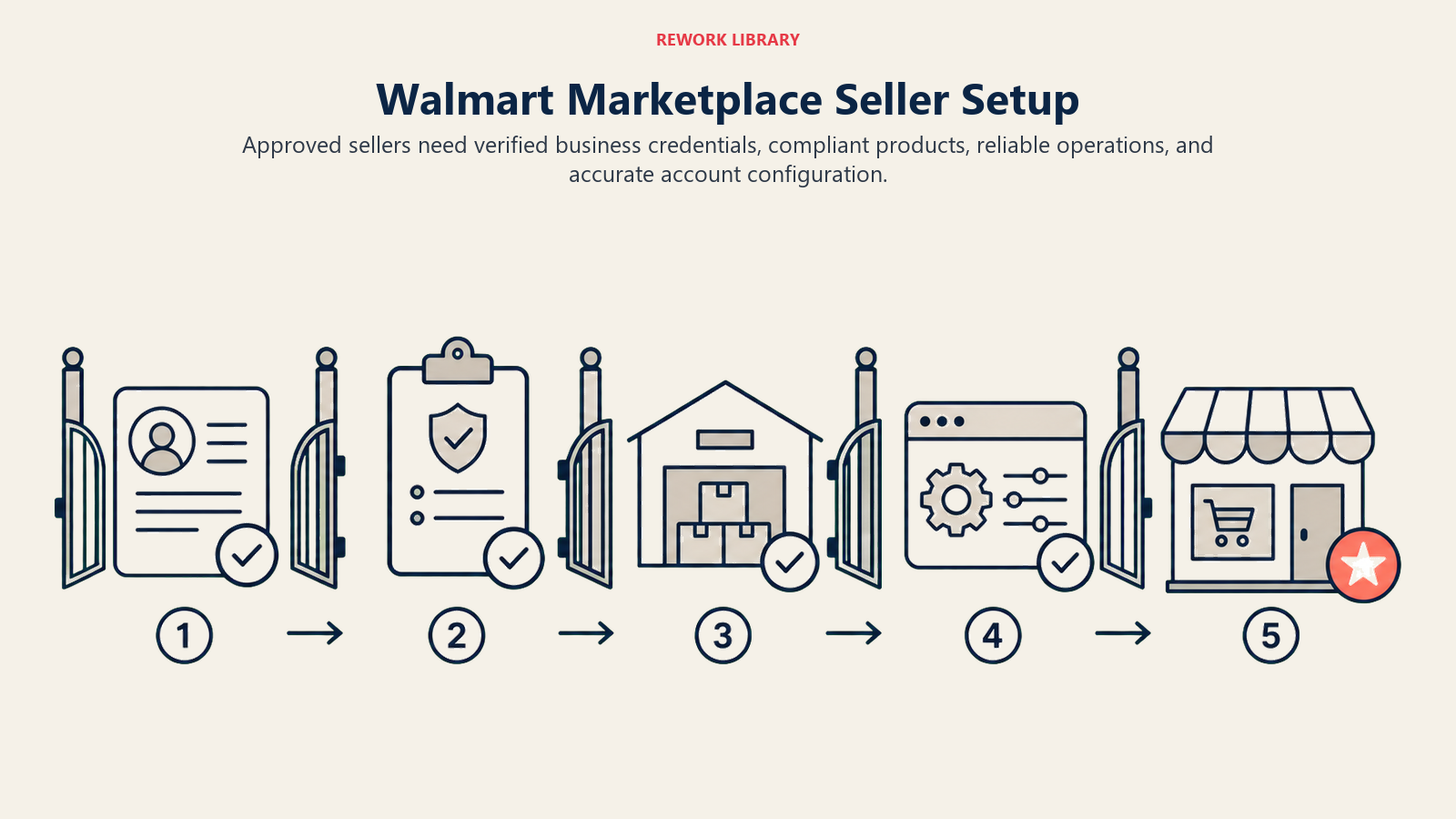
Walmart's application process is notoriously selective compared to Amazon's relatively open marketplace. They approve only 2-3 out of every 10 applicants. Here's what you need to qualify:
Basic Eligibility Requirements:
- US-based business with valid EIN or SSN
- US bank account for payment processing
- W9 or W8 tax documentation
- Product liability insurance (typically $1M minimum, Walmart as additional insured)
- Verifiable return address in the United States
- Minimum business history (usually 6-12 months of verifiable sales)
- Integration capability with their API or marketplace management platform
Application Red Flags: Walmart rejects sellers with poor Amazon metrics, new businesses without track record, resellers without authorized brand relationships, sellers in restricted categories, and anyone with intellectual property complaints or account suspensions on other platforms. They're building a curated marketplace, not an open bazaar.
Seller Account Tiers: Walmart operates with implicit seller tiers based on performance and integration level:
| Tier | Requirements | Benefits | Typical GMV |
|---|---|---|---|
| Basic Seller | Approved application, self-fulfillment | Standard placement, basic reporting | <$500K/year |
| Pro Seller | WFS enrolled, 90+ day track record, >95% on-time delivery | Priority placement, enhanced visibility | $500K-$5M/year |
| Strategic Partner | High volume, brand registry, vendor relationship potential | Merchandising support, dedicated account manager | $5M+/year |
| Walmart Vendor | Invitation only, 1P relationship | Direct PO fulfillment, national distribution potential | $10M+/year |
Application Process: Submit your application at marketplace.walmart.com with business documentation, product catalog (minimum 20-50 SKUs recommended), and brand authorization letters if applicable. Expect 2-4 weeks for review. If rejected, you can reapply after 90 days with improved documentation or track record.
Once approved, you'll complete tax forms, payment setup, shipping configuration, and product uploads. Most sellers use integration platforms like ChannelAdvisor, Seller Active, or Zentail rather than Walmart's native Seller Center for bulk operations and multi-channel management.
Product Listing Optimization
Walmart's algorithm (called "Pangea") prioritizes different ranking factors than Amazon's A9. While both consider sales velocity and conversion rate, Walmart places heavier weight on price competitiveness, shipping speed, and seller performance metrics. Listing optimization follows different best practices:
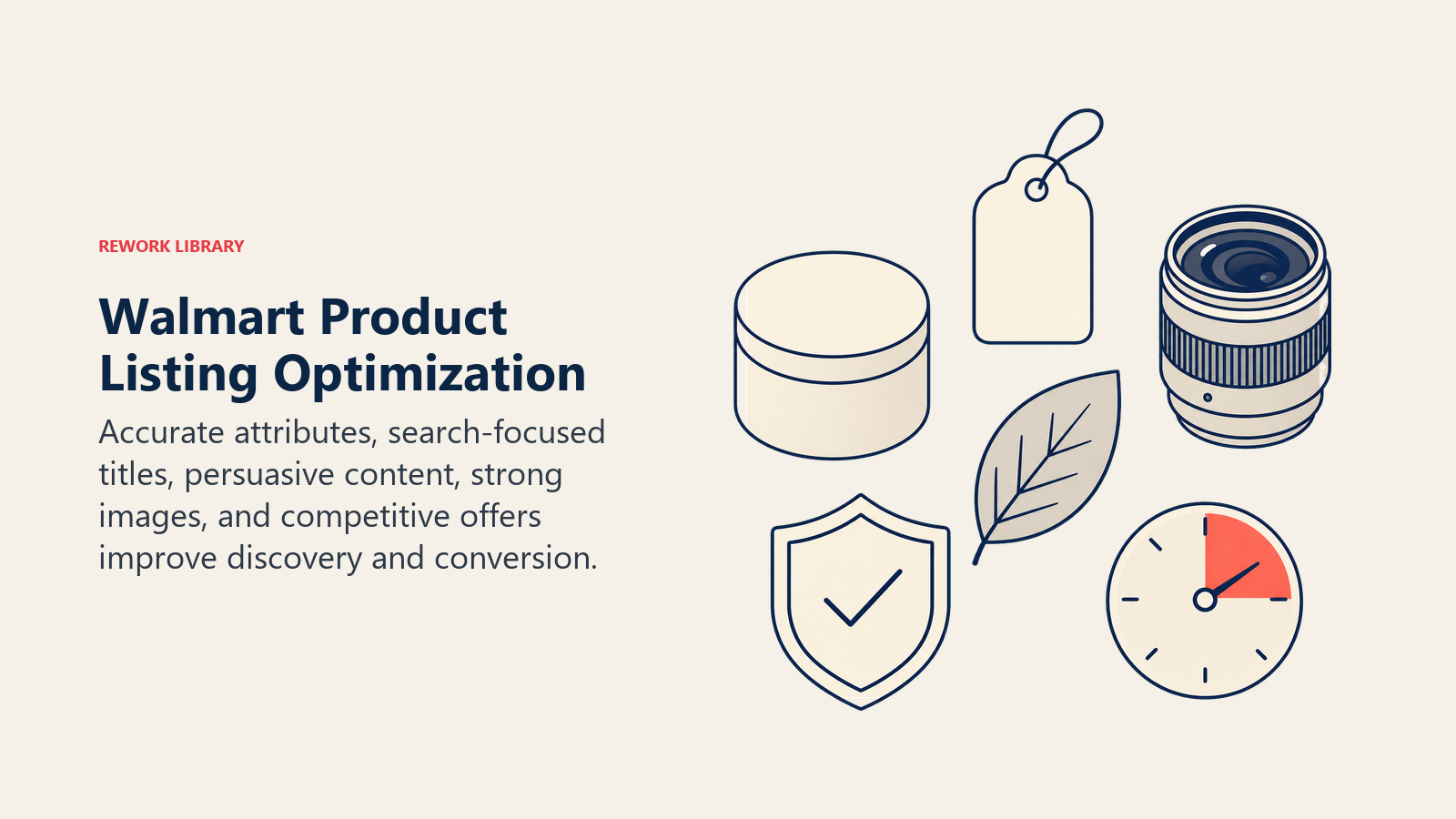
Product Attributes & Item Spec 5.0: Walmart uses a highly structured data model called Item Spec 5.0 that requires specific attributes for each category. Unlike Amazon's relatively forgiving listing creation, Walmart's system will reject listings with incomplete or incorrectly formatted attributes. Key requirements:
- Primary Product Identifiers: Valid UPC/GTIN required for all products (no exceptions, no GTIN exemptions like Amazon)
- Category-Specific Attributes: Each category has mandatory attributes (e.g., apparel requires size type, size chart, color map, material composition)
- Shelf Description: Separate from main description, focused on in-store equivalent copy
- Enhanced Content: Rich media modules similar to Amazon A+ but with different dimensions and requirements
Title Optimization: Walmart titles follow a more constrained format than Amazon. Maximum 75 characters (strictly enforced), no promotional language, no special characters, and brand name should be first. The optimal structure: [Brand] [Product Type] [Key Variant] [Size/Quantity] [Top Feature]
Example: "Bounty Paper Towels Quick-Size 16 Family Rolls White" instead of Amazon-style "Bounty Quick-Size Paper Towels, White, 16 Family Mega Rolls = 40 Regular Rolls"
Image Specifications: Pure white background (RGB 255, 255, 255) required for primary image. Product must fill 85-90% of frame. Minimum 2000px on longest side, maximum 10,000px. No watermarks, props, or text overlays on primary image. Secondary images can show lifestyle, usage, or dimensions but must maintain professional quality.
Pricing Strategy: Walmart actively monitors pricing across channels and will suppress listings that aren't price competitive. If your product is available for less on Amazon, your Walmart listing may lose Buy Box or visibility. Consider your pricing strategy for e-commerce carefully, factoring in Walmart's lower referral fees when setting your prices. Price parity isn't required, but you need to be within 5-10% of your Amazon price or risk suppression.
Product Description: Unlike Amazon's bullet points, Walmart uses a single long-form description with embedded formatting. Focus on value proposition, practical benefits, and specifications. Walmart customers respond better to straightforward benefits rather than marketing fluff. Keep descriptions between 500-1000 words with clear hierarchy using HTML formatting.
Fulfillment Options & Logistics
Walmart offers multiple fulfillment pathways, each with distinct economics and positioning:
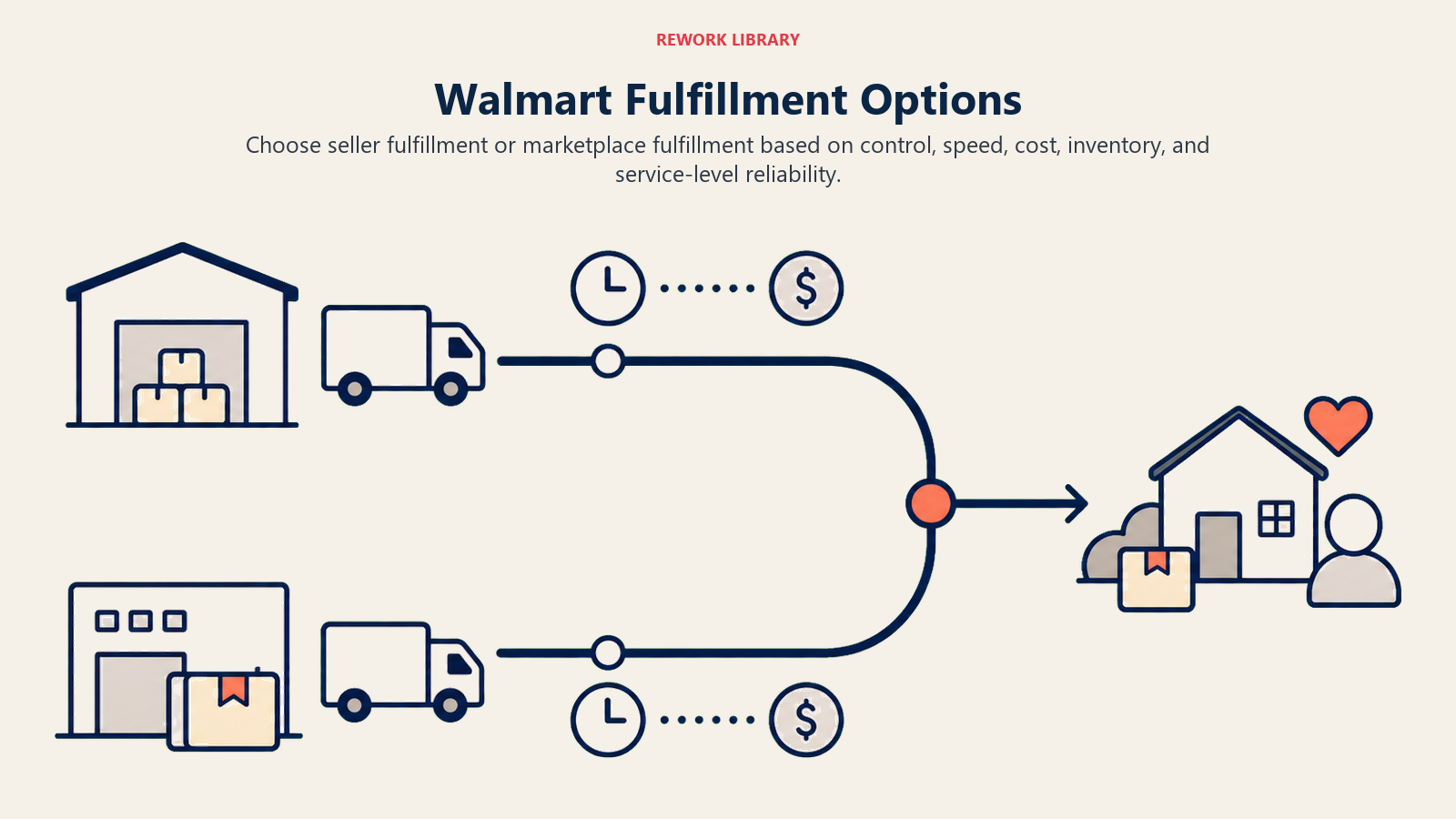
Self-Fulfilled Delivery: You handle all storage, packing, and shipping. Walmart requires 1-2 day handling time and strongly prefers 2-day delivery. Without fast shipping, your products will rank lower and lose Buy Box. Best for oversized items, custom products, or very low velocity SKUs where WFS economics don't work.
Walmart Fulfillment Services (WFS): Walmart's FBA equivalent. You send inventory to WFS fulfillment centers, they pick, pack, ship, and handle customer service. Benefits include "Fulfilled by Walmart" badge (similar to Prime), Two-Day Delivery tag, higher search ranking, and eligibility for Walmart+ members' free shipping.
WFS economics (approximate):
- Storage: $0.48-$0.75/cubic foot/month (seasonal pricing)
- Fulfillment: $3.75-$8.50 depending on size tier
- Returns processing: $2.00-$5.00 per unit
Compared to Amazon FBA strategy, WFS typically costs 10-15% less for storage but has fewer fulfillment centers, meaning potential shipping delays to some regions. WFS is expanding rapidly, with 40+ fulfillment centers planned by end of 2026.
Deliverr/Flexport Integration: Third-party fulfillment platforms that integrate with Walmart to provide the "Fast Tag" designation without using WFS. Useful for multi-channel sellers who want one fulfillment provider for all marketplaces. Costs vary by provider and volume.
Fulfillment Strategy Decision Matrix: Use WFS for fast-moving consumables and items under 5 lbs where the velocity justifies the fees. Self-fulfill for oversized, high-value, or slow-moving products. Consider Deliverr/Flexport if you're already using them for Amazon and other channels. Calculate your unit economics for e-commerce across all channels to determine the optimal fulfillment mix.
Competitive Positioning vs Amazon
Understanding how Walmart differs from Amazon helps you optimize your multi-channel marketplace strategy:
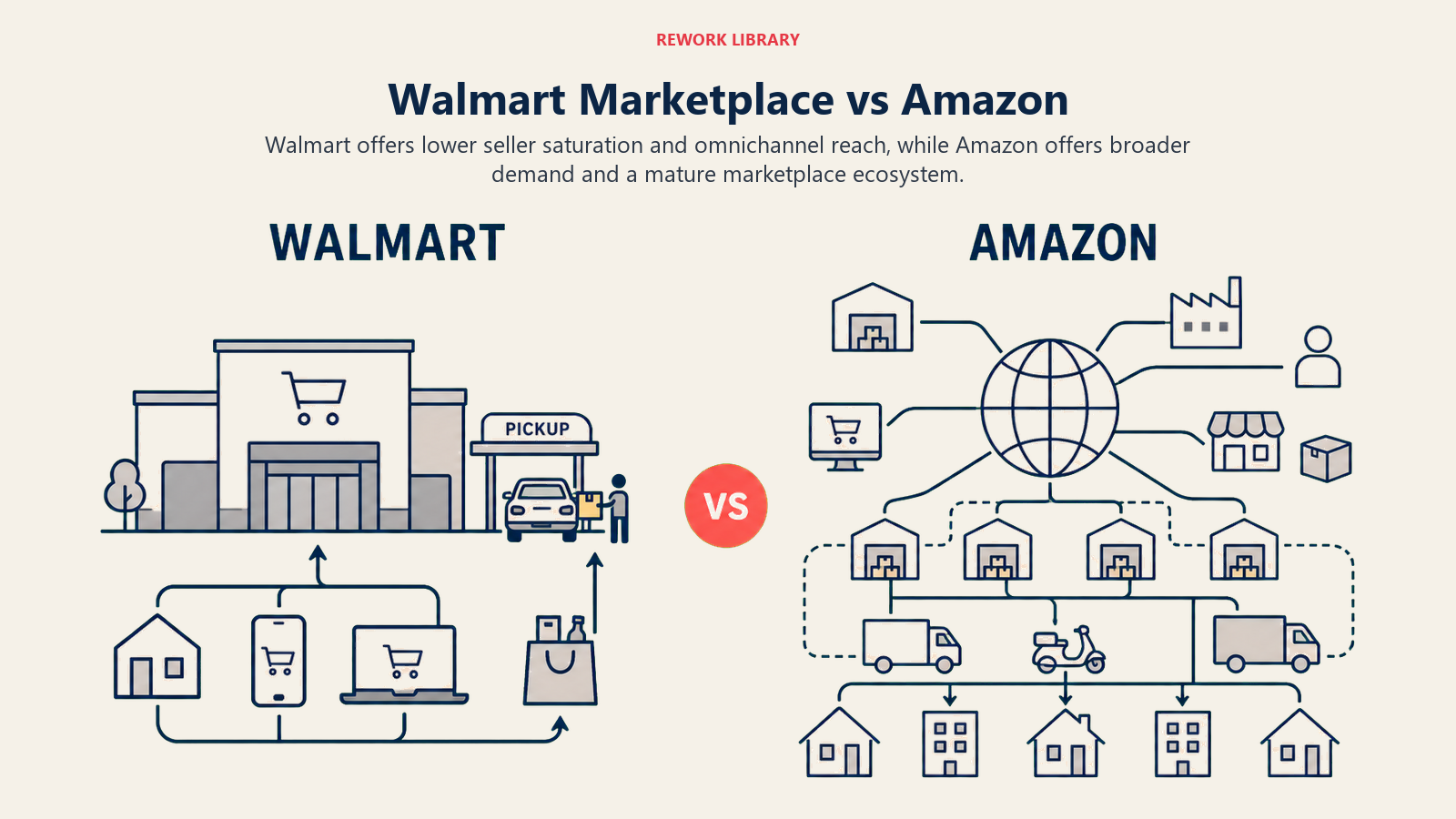
Market Share & Traffic: Amazon captures 38-40% of US e-commerce; Walmart claims 6-7%. Amazon has 200+ million Prime members; Walmart+ has 30+ million members. But Walmart's traffic is growing faster (22% YoY vs Amazon's 13% in recent years), and their customers exhibit higher basket sizes for certain categories.
Referral Fee Comparison:
- Electronics: Amazon 8% / Walmart 8%
- Home & Garden: Amazon 15% / Walmart 15%
- Clothing: Amazon 17% / Walmart 15%
- Grocery: Amazon 8-15% / Walmart 8%
- Health & Personal Care: Amazon 8-15% / Walmart 8-15%
Walmart generally charges 1-3% lower fees, which improves margins but not dramatically. The real economic difference comes from lower advertising costs and less promotional intensity required to maintain velocity.
Buyer Behavior Differences: Amazon customers expect fast delivery, comprehensive reviews, and are willing to pay premium prices for convenience. Walmart customers prioritize value, trust the Walmart brand for quality assurance, and make larger basket purchases. Conversion rates on Walmart average 2-3% higher for consumables and everyday essentials because customers aren't comparison shopping as intensely.
Advertising Economics: Walmart Connect's average CPC ranges from $0.30-$0.80, compared to Amazon's $0.80-$2.50+ in competitive categories. ACOS (advertising cost of sales) typically runs 8-15% on Walmart vs 15-30% on Amazon for similar products. Lower advertising costs mean you can be profitable at lower price points and maintain market share without constant promotional activity.
Search Algorithm Differences: Amazon's A9 heavily weights sales velocity and conversion history, creating momentum-based ranking where established listings dominate. Walmart's Pangea places more emphasis on recent performance, price competitiveness, and seller metrics, meaning newer listings can gain visibility faster with good fundamentals. This makes Walmart more accessible for new products and brands.
Marketing & Promotion Strategies
Walmart Connect, the platform's advertising system, launched in 2019 and has evolved rapidly. While less sophisticated than Amazon Advertising, it offers strong ROI for sellers who understand its mechanics:
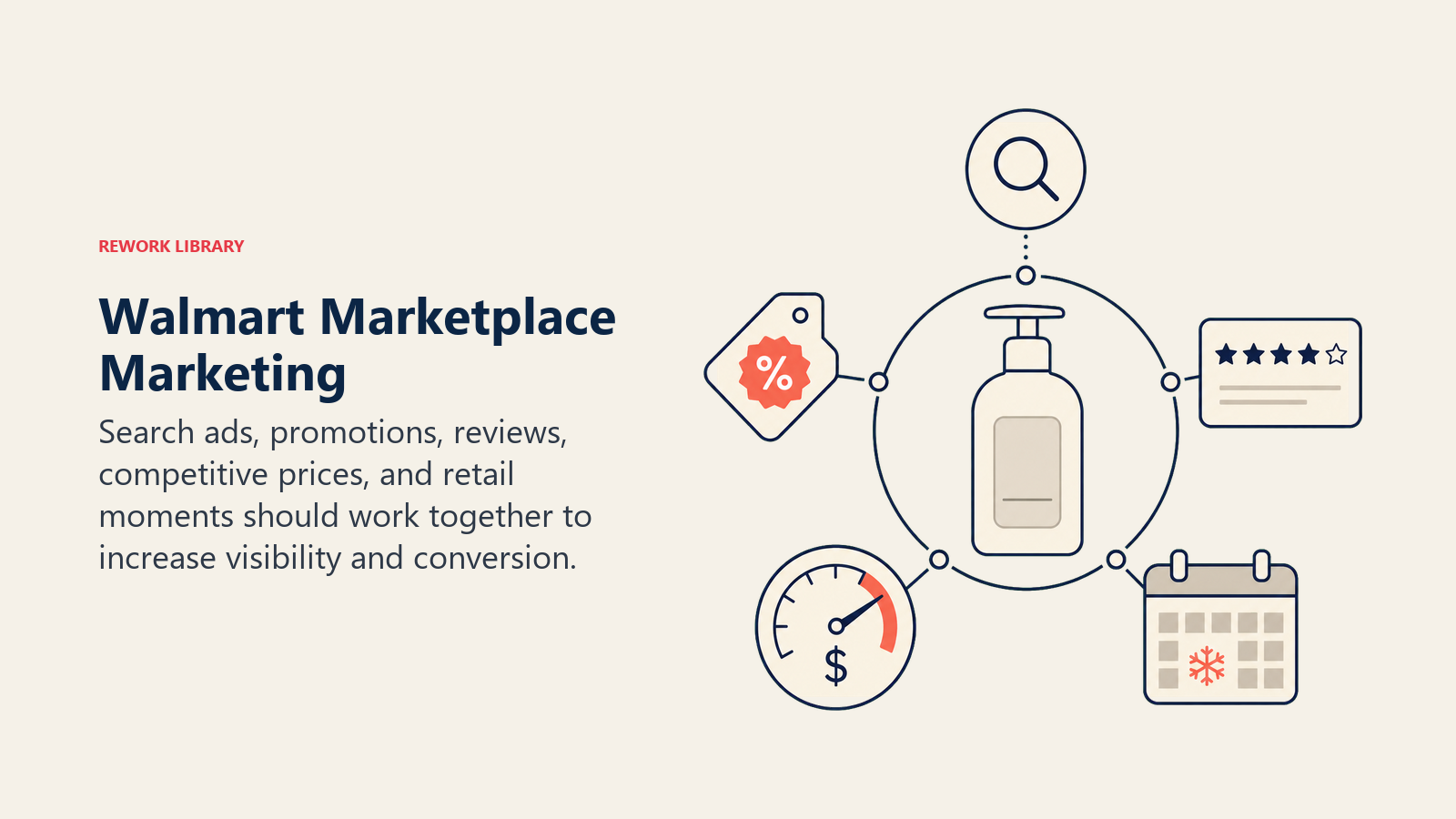
Sponsored Products: Keyword-targeted ads that appear in search results and product pages. Similar to Amazon Sponsored Products. Recommended starting bid: $0.35-$0.50 for most categories. Focus on high-intent keywords with commercial modifiers ("buy", "best", "online") since Walmart shoppers are further along the purchase journey than casual browsers.
Campaign Structure Best Practices: Create separate campaigns for brand terms (defensive), competitor terms (conquest), and generic category terms (growth). Use exact match for high-volume terms, phrase match for exploration. Start with automatic campaigns to identify converting keywords, then move winners to manual campaigns with higher bids.
Display Advertising: Banner placements across Walmart's site and app. Useful for brand awareness and retargeting. Minimum monthly spend around $1,000 makes this viable only for brands doing $100K+/month on the platform. Display works best for seasonal promotions and new product launches.
Search Brand Amplifier: Premium placement for brand-owned search terms. Expensive ($10K+ monthly minimum) but effective for established brands protecting their trademark terms and showcasing full product line.
Rollback Pricing Events: Walmart's promotional mechanism for temporary price reductions. Unlike Amazon Lightning Deals, Rollbacks don't require deep discounts or inventory commitments. A 5-10% reduction for 30 days qualifies. Rollbacks get special badges and merchandising, often driving 3-4x normal velocity. Best used quarterly for inventory clearance or seasonal pushes.
Promotional Best Practices: Stack promotions during Walmart's tentpole events (Deals for Days in summer, Black Friday, Post-Holiday clearance). Budget 10-15% of projected sales for advertising and promotions. Unlike Amazon, you don't need continuous promotion to maintain rank - periodic strategic pushes work better on Walmart's platform.
Performance Metrics & Analytics
Walmart's Seller Center provides basic analytics, but serious sellers need third-party tools for actionable insights. Key metrics to monitor:
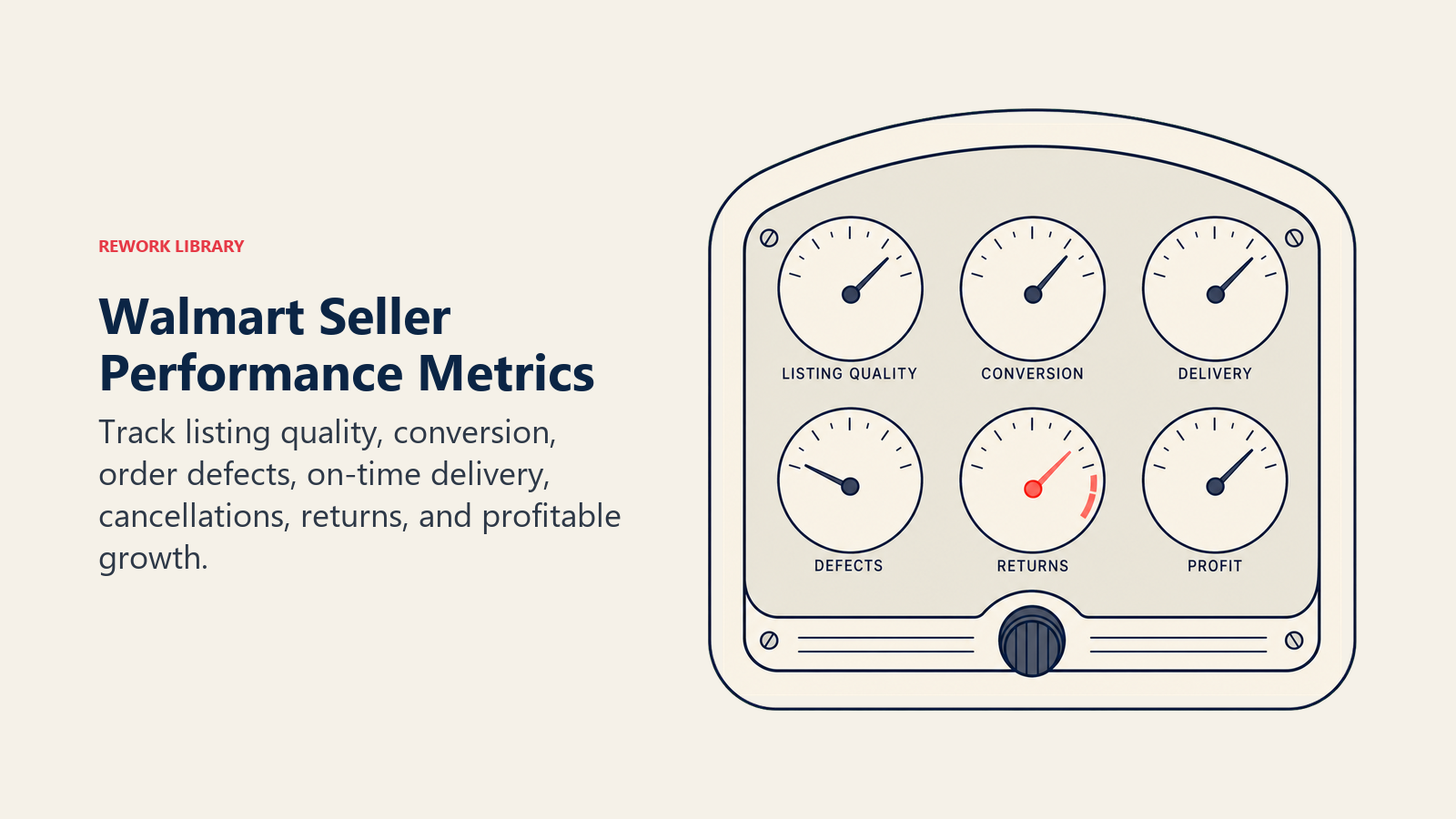
Order Defect Rate (ODR): Percentage of orders with defects (cancellations, returns, negative feedback). Target: <2%. Above 5% triggers account review. This is Walmart's equivalent to Amazon's ODR and carries similar weight.
On-Time Delivery Rate: Percentage of orders delivered by promised date. Target: >95%. Below 90% results in search suppression and potential Buy Box loss. For self-fulfilled orders, this is your most critical metric.
Valid Tracking Rate: Orders with working tracking information. Target: >95%. Missing or invalid tracking severely impacts ranking and can result in payment holds.
Return Rate: Percentage of orders returned. Category-dependent (apparel 15-25% is normal, electronics <5% expected). High return rates indicate listing accuracy issues, quality problems, or poor product-market fit.
Item Listing Quality: Walmart scores your listings based on attribute completeness, image quality, and content accuracy. Score shown per item (0-100 scale). Items below 70 get suppressed. Maintain 85+ for optimal visibility.
Sales Velocity & Inventory Performance: Units sold per day (item-level), sell-through rate, and inventory coverage. Walmart doesn't publish these metrics prominently, but they drive algorithm decisions. Maintain 30-60 days of inventory coverage for WFS items, 60-90 days for self-fulfilled products.
Analytics Deep Dive: Export order reports weekly to track trending. Monitor category share of voice for your key search terms. Compare conversion rates across traffic sources (organic search, paid ads, browse) to optimize spend allocation. Integrate with your overall inventory management systems to maintain stock levels that support velocity without overinvestment.
Seller Compliance & Risk Management
Walmart's seller policies are stricter than Amazon's in some areas, more lenient in others. Understanding the red lines prevents account suspensions:
Prohibited & Restricted Items: Walmart prohibits dietary supplements (unless pre-approved vendor), used/refurbished items in most categories, alcohol, tobacco, weapons, and some chemicals. Restricted categories like baby products, groceries, and health items require additional documentation and approval. Always check the current prohibited items list before uploading new SKUs.
Intellectual Property Protection: Walmart has streamlined IP complaint processes, making it easier for brands to remove counterfeit listings but also easier to get suspended for alleged violations. If you're selling branded products, maintain clear documentation of authorized dealer agreements. If you're building your own brand, register trademarks and monitor for infringement.
Account Health Dashboard: Similar to Amazon's Account Health, this shows your standing across key metrics. Yellow warnings indicate areas needing attention; red alerts mean imminent suspension risk. Check weekly and address issues immediately. Walmart's support is less responsive than Amazon's, so proactive monitoring prevents problems.
Common Suspension Triggers: Repeated copyright/trademark complaints, ODR above 5%, multiple customer complaints about product authenticity, pricing violations (pricing an item at $1 to clear inventory), prohibited product uploads, and invalid tax documentation. Most suspensions can be appealed, but the reinstatement process takes 2-4 weeks.
Risk Management Best Practices: Maintain product liability insurance with $2M coverage (even though $1M is minimum). Document all supplier relationships. Keep detailed records of product sourcing. Monitor your metrics daily. Have an appeal template prepared with documentation proving compliance. Consider working with a Walmart marketplace consultant if your account generates $500K+ annually - the cost is worth avoiding suspension.
Product Categories & Restrictions
Not all categories perform equally on Walmart, and some require special approval:
Best-Performing Categories: Grocery & household essentials, baby products, health & personal care, pet supplies, home improvement, and seasonal items. These align with Walmart's core competency and customer expectations. If your products fit these categories, Walmart should be a priority channel.
Competitive but Viable: Electronics, toys, sporting goods, and home decor. More competition but still strong demand. Focus on value positioning and fast shipping to win.
Challenging Categories: Fashion apparel, jewelry, luxury goods, and niche hobbyist products. Walmart's customer base doesn't naturally gravitate toward these categories online. Can work with strong brand recognition and strategic advertising, but expect lower conversion rates.
Gated Categories Requiring Approval: Medical devices, baby food/formula, cosmetics, automotive parts, and groceries. Application process requires certificates of analysis, safety testing documentation, and sometimes facility inspections. Budget 60-90 days for approval in gated categories.
UPC & GTIN Compliance: Unlike Amazon, Walmart offers no GTIN exemption process. Every product must have a valid UPC from GS1 (the official UPC issuer). Third-party UPC resellers are not accepted - Walmart verifies through GS1's database. Budget $250+ for official UPC codes if you don't already have them. This requirement alone disqualifies many small sellers but ensures product authenticity.
Multi-Channel Strategy Integration
Most successful sellers treat Walmart as part of a broader multi-channel marketplace strategy rather than a standalone channel:
Inventory Allocation: If using separate fulfillment for each channel, maintain at least 30 days coverage on Walmart to avoid out-of-stock suppression. If using shared fulfillment (Deliverr/Flexport), implement channel-based allocation rules to prevent one marketplace from monopolizing inventory.
Pricing Parity Considerations: Walmart monitors your pricing on Amazon and will suppress listings if they're significantly cheaper elsewhere. Strategy: Price the same on both platforms, but account for different fee structures in your promotion strategies. Alternatively, use bundling or exclusive SKUs to avoid direct price comparison.
Product Selection: Launch your best-selling Amazon products on Walmart first to establish velocity and credibility. Then expand to products that fit Walmart's demographic profile. Not every SKU needs to be on every channel - focus on products where Walmart's customer base aligns with your positioning.
Operational Integration: Use multi-channel management software (ChannelAdvisor, Sellbrite, Zentail) to sync inventory, pricing, and orders. Implement unified reporting to track profitability by channel and product. Maintain separate advertising strategies for each platform - what works on Amazon rarely works unchanged on Walmart.
Brand Positioning: Use Walmart to reach a different customer segment without diluting your Amazon positioning. For premium brands, this means value-focused bundles or larger pack sizes on Walmart while maintaining premium single units on Amazon. For mass market brands, Walmart becomes your primary channel with Amazon for niche variations.
Growth & Scaling Roadmap
Strategic approach to scaling your Walmart presence:
Phase 1 - Foundation (Months 1-3): Launch 20-50 core SKUs. Use self-fulfillment or Deliverr to minimize risk. Run small test campaigns ($500-1,000/month) to identify converting keywords. Focus on achieving 95%+ performance metrics. Goal: $10K-25K/month revenue, establish account health.
Phase 2 - Optimization (Months 4-6): Expand to 50-100 SKUs based on early winners. Transition fast-moving items to WFS for velocity boost. Increase ad spend to $2K-5K/month focused on proven keywords. Implement promotional calendar with quarterly Rollbacks. Goal: $25K-75K/month revenue, improve ranking for core terms.
Phase 3 - Scaling (Months 7-12): Full catalog upload of viable products. Heavy WFS adoption for items meeting velocity thresholds. Increase ad spend to 10-12% of revenue. Launch display campaigns for brand awareness. Apply for gated categories if applicable. Goal: $75K-250K/month revenue, establish brand presence.
Phase 4 - Maturity (Year 2+): Optimize product page optimization based on conversion data. Explore vendor program for high-volume items. Implement sophisticated inventory planning and fulfillment strategy. Consider category expansion into adjacent products. Goal: $250K+/month revenue, transition best products to vendor relationship.
Vendor Program Transition: Once you're generating $3-5M+ annually on Walmart Marketplace, you may receive vendor program invitations. Vendor relationships involve Walmart buying your inventory directly (1P model) instead of marketplace selling (3P model). This provides larger volumes and access to physical stores, but lower margins and loss of direct customer relationship. Evaluate based on your business model and growth stage.
Advanced Topics
WFS Deep Dive: Enrollment requires minimum performance standards (95% on-time rate, <2% ODR, 60+ days history). Inbound shipping to WFS follows specific requirements: palletized freight for bulk, SPD (small parcel delivery) for small quantities, detailed ASNs (advanced shipping notices), and proper labeling. WFS reimbursement policies for lost/damaged inventory are less generous than FBA - document everything.
Walmart Brand Central: Brand registry equivalent that provides enhanced product pages, rich media capabilities, and brand analytics. Requires trademark registration. Benefits include better content control, protection against counterfeit sellers, and merchandising support from Walmart's category teams. Apply once you're generating $100K+/month.
Walmart Seller Plus: Premium support tier for high-volume sellers. Includes dedicated account manager, priority support, and access to beta features. Typically invitation-only for sellers doing $5M+ annually. Benefits often justify the additional fees through improved problem resolution speed and strategic guidance.
International Expansion: Walmart operates marketplaces in Canada and Mexico with similar infrastructure. Once established in the US, international expansion requires separate applications, compliance with local regulations, and localized product catalogs. Canadian marketplace is most accessible for US sellers, requiring minimal additional documentation.
Walmart Marketplace represents a genuine growth channel for e-commerce brands willing to adapt to its unique ecosystem. The platform rewards operational excellence, competitive pricing, and customer-focused selling over marketing gimmicks and review manipulation. For brands selling consumables, household essentials, or value-oriented products, Walmart can generate 20-30% of your Amazon revenue with less competitive intensity and better unit economics.
Success on Walmart requires treating it as a distinct channel with different customers, algorithms, and best practices rather than simply copying your Amazon strategy. Invest in proper listing optimization, maintain excellent seller metrics, and align your product selection with Walmart's core customer base. The platform is still evolving rapidly, meaning early movers who establish strong positioning now will benefit as Walmart continues investing in e-commerce infrastructure and marketing.
Start with your proven bestsellers, establish operational excellence, then scale systematically. Combined with your Amazon SEO & ranking strategy, Walmart becomes a powerful second pillar for sustainable multi-channel growth.
Frequently Asked Questions
Is Walmart Marketplace good for ecommerce growth?
Yes, especially for CPG, consumables, and value-oriented brands. Walmart's traffic is growing faster than Amazon's, seller competition is lighter, and both referral fees and advertising costs run lower. Many existing Amazon sellers add 15-30% in total ecommerce revenue by listing on Walmart with minimal incremental effort once systems are in place.
How hard is it to get approved as a Walmart seller?
Walmart is selective and approves roughly 2-3 of every 10 applicants. You need a US-based business with a valid EIN, a US bank account, product liability insurance, and usually 6-12 months of verifiable sales history. Sellers with poor metrics on other platforms or in restricted categories are commonly rejected.
What does Walmart Marketplace cost to sell on?
There is no monthly subscription fee. Walmart charges referral fees of roughly 6-15% depending on category, generally 1-3% lower than Amazon. If you use Walmart Fulfillment Services, expect storage around $0.48-$0.75 per cubic foot per month and fulfillment of about $3.75-$8.50 per unit by size tier.
Is Walmart Marketplace better than Amazon for sellers?
Neither is strictly better. Amazon has far larger traffic and a deeper toolset, while Walmart offers lighter competition, cheaper ads, and a value-focused audience. Most successful sellers treat Walmart as part of a multi-channel marketplace strategy rather than choosing one over the other.
How long does it take to grow on Walmart Marketplace?
A typical ramp runs over a year. Months 1-3 focus on launching 20-50 SKUs and hitting strong performance metrics, months 4-6 shift winners to WFS and scale ads, and months 7-12 push toward a full catalog and $75K-250K per month. From year two, top sellers may transition to Walmart's vendor program.

On this page
- Walmart Marketplace Overview: The $82B Opportunity
- Seller Requirements & Account Setup
- Product Listing Optimization
- Fulfillment Options & Logistics
- Competitive Positioning vs Amazon
- Marketing & Promotion Strategies
- Performance Metrics & Analytics
- Seller Compliance & Risk Management
- Product Categories & Restrictions
- Multi-Channel Strategy Integration
- Growth & Scaling Roadmap
- Advanced Topics
- Frequently Asked Questions