Product Launch Strategy: Maximizing Impact, Reviews, and First-Month Revenue
Turn this article into takeaways for your work.


Each assistant summarizes the article only for you and suggests best practices for your work.
You've invested months developing the perfect product. Now comes the critical moment that determines whether it becomes a revenue driver or sits in your warehouse collecting dust.
The difference between a successful launch and a missed opportunity isn't luck. It's systematic planning, coordinated execution, and momentum building that starts 90 days before launch day. Before you begin, make sure you've completed thorough product research and validation to confirm market demand.
Here's how to orchestrate product launches that generate early reviews, drive first-month revenue, and set your product up for sustained growth.
Pre-Launch Foundation (90 Days Before)
The groundwork you lay three months out determines your launch trajectory. This isn't about creating hype, it's about building infrastructure.
Competitive Intelligence Gathering
Start by understanding the landscape your product enters. Analyze competitor pricing, positioning, reviews, and marketing approaches. Identify gaps in their offerings that your product fills. Document their launch patterns, promotional strategies, and customer pain points mentioned in reviews.
This research shapes every decision from pricing strategy to messaging. If competitors launched at premium prices and faced backlash, you know to position differently. If review complaints center on specific features, your messaging emphasizes how you've solved those issues.
Inventory and Supply Chain Validation
Nothing kills launch momentum faster than stockouts. Run your demand forecasts through pessimistic, realistic, and optimistic scenarios. Add 30% buffer to your realistic forecast, successful launches often exceed expectations.
Coordinate with suppliers on lead times, quality control checkpoints, and contingency plans. Establish backup suppliers for critical components. Document your entire supply chain so any team member can identify bottlenecks quickly.
Implement inventory tracking systems that provide real-time visibility. You need to know exactly how many units you have, where they're located, and when replenishment arrives.
Channel Readiness Assessment
Audit every sales channel where you'll launch. Your website needs page templates, checkout flows, and integration testing completed. Marketplaces require approval processes, listing optimization, and compliance verification.
Create standardized product information packages: high-resolution images from multiple angles, detailed specifications, benefit-focused descriptions, and comparison charts. This content library feeds every channel consistently.
Test payment processing, shipping integrations, and customer service workflows. Run through complete purchase simulations to identify friction points before real customers encounter them.
Building Anticipation (60-30 Days)
The pre-launch phase generates qualified demand through targeted audience building and strategic teasers.
Email List Segmentation and Warmup
Segment your email list into distinct groups: existing customers who've purchased similar products, engaged subscribers who've shown interest in this category, and VIP customers who deserve early access.
Begin the anticipation sequence 60 days out with educational content about the problem your product solves. At 45 days, introduce subtle product hints without full reveals. At 30 days, show sneak peeks to build intrigue. For comprehensive email sequencing strategies, explore our guide on email marketing for e-commerce.
The goal isn't aggressive selling. You're warming up your audience so they're receptive when launch arrives. Share development stories, behind-the-scenes content, and the "why" behind product decisions.
Early Access and VIP Programs
Create tiered early access that rewards your best customers and generates social proof. Offer VIP customers first access 24-48 hours before general launch. Give engaged email subscribers special launch-day pricing.
Structure early access to generate reviews before the wide launch. Ship sample products to a select group of customers 2-3 weeks early in exchange for honest reviews on launch day. This seeds your product page with social proof when most customers arrive.
We'll expand on the review generation process in detail later.
Influencer and Partnership Outreach
Identify influencers whose audiences align with your target customers. Look beyond follower counts to engagement rates, audience demographics, and content quality. Micro-influencers (10K-100K followers) often deliver better ROI than mega-influencers.
Reach out 60 days before launch with personalized pitches explaining why your product fits their audience. Offer exclusive early access, special discount codes for their followers, or affiliate partnerships with competitive commission structures.
Ship products 30 days before launch so influencers have time to create content. Provide content briefs suggesting key features to highlight, but give creative freedom for authentic presentations.
For strategies on scaling influencer partnerships, review our guide on Influencer Marketing.
Marketing Campaign Architecture
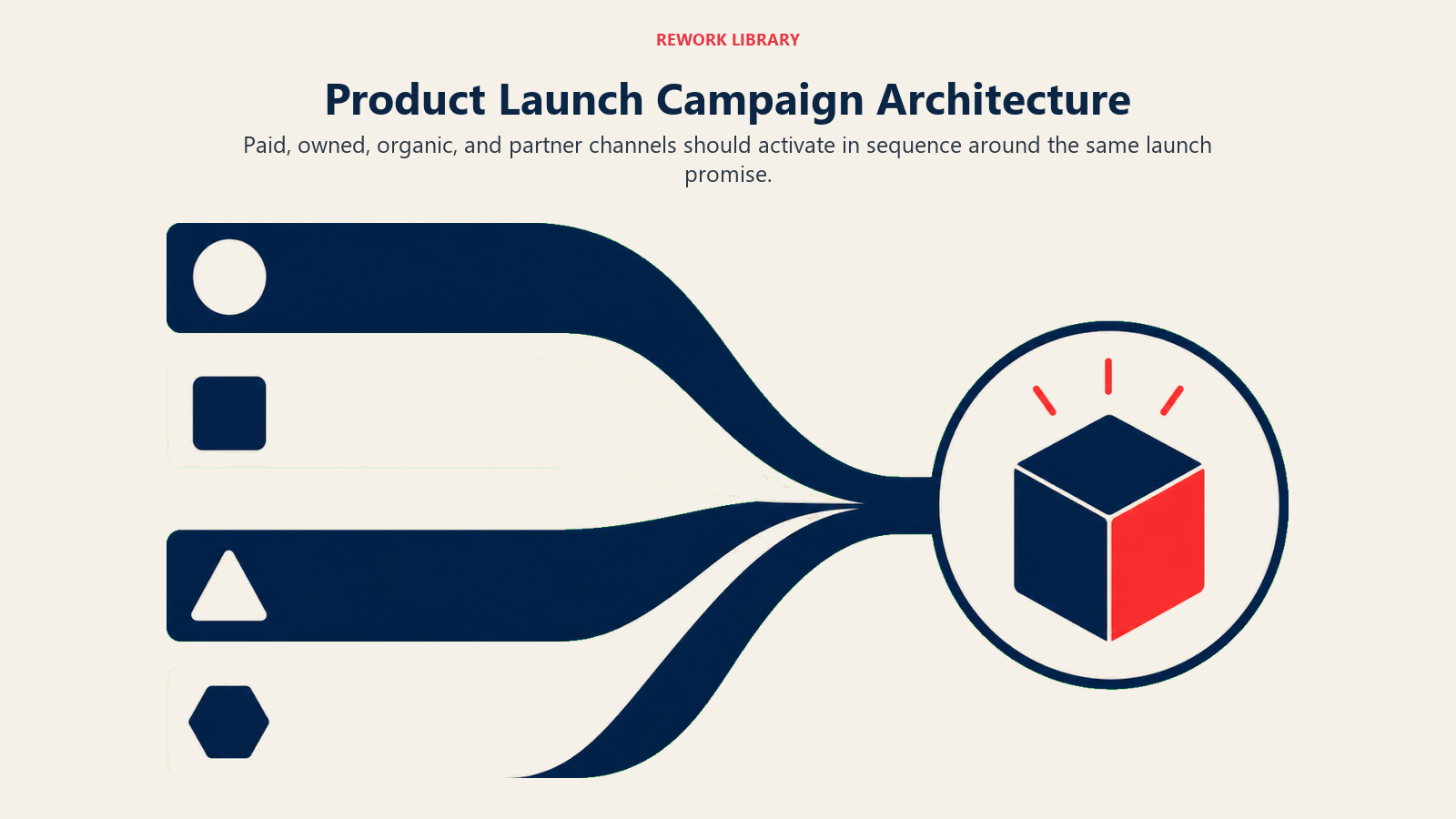
A successful launch requires synchronized execution across paid, organic, and owned channels. Each channel serves specific functions in the customer journey.
Paid Advertising Strategy
Structure your paid campaigns in phases that match the customer awareness journey. Start with broad awareness campaigns targeting cold audiences interested in your product category. Use engaging creative that introduces the problem and hints at your solution.
Layer in consideration campaigns targeting people who've engaged with your awareness content. These ads highlight specific benefits, features, and differentiators. Include early reviews and testimonials as social proof.
Design conversion campaigns with urgency elements, launch-day pricing, limited quantities, or exclusive bundles. Use dynamic product ads for people who've visited your product page.
Allocate 40% of your paid budget to awareness, 30% to consideration, and 30% to conversion. Adjust based on performance, but maintain presence across all stages. For a complete overview of channel strategy, review our guide on traffic acquisition strategy.
Organic and Content Marketing
Publish content addressing questions your target customers search for. Create comparison guides, buying guides, and problem-solution articles that naturally lead to your product.
Optimize product pages for search engines with detailed descriptions, schema markup, and internal linking. Include FAQ sections answering common questions you've gathered from competitor reviews and customer research.
Build backlinks through product reviews, partnership content, and PR outreach. Reach out to industry publications with product announcements that emphasize newsworthiness, unique features, sustainability innovations, or problem-solving approaches.
Owned Channel Activation
Your email list becomes your most valuable asset during launches. Structure a launch sequence that builds anticipation, rewards loyalty, and creates urgency.
Days 7-5 before launch: Build excitement with product reveals, feature spotlights, and countdown timers.
Days 4-2 before launch: Offer VIP early access to top customers. Create exclusivity with "preview hours" before public launch.
Launch day: Send multiple emails to different segments. Morning announcement to engaged subscribers, midday reminder to people who opened but didn't click, evening last-chance message emphasizing limited availability.
Days 1-7 post-launch: Share launch updates, early reviews, social proof, and urgency messages about inventory levels.
Launch Day Operations
Launch day requires real-time coordination across your entire team. Create a launch command center, physical or virtual, where key stakeholders monitor performance and respond to issues.
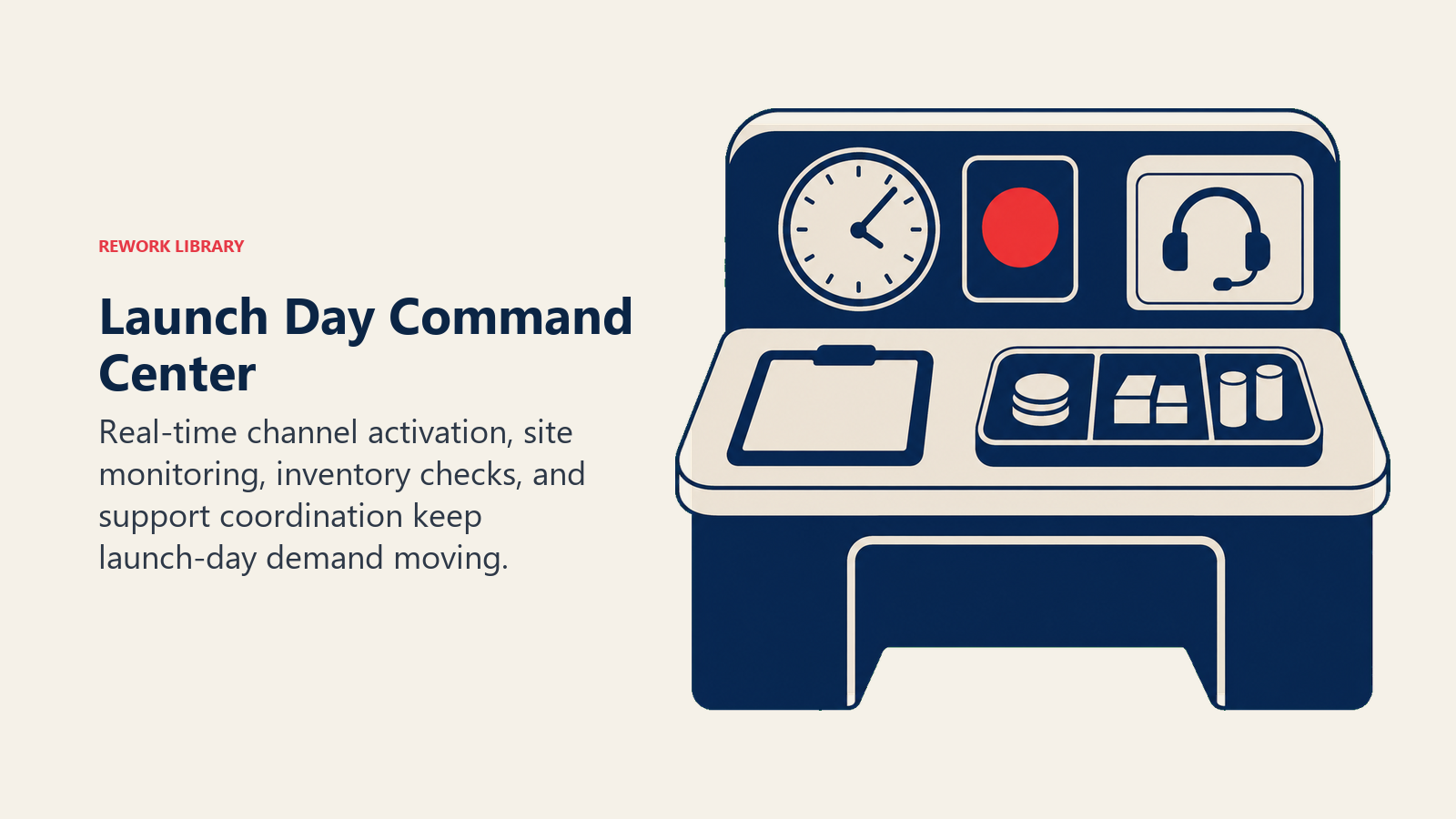
Coordinated Channel Activation
Schedule content to go live simultaneously across all channels. Product pages go live at midnight. Email sequences trigger at 6 AM when open rates peak. Paid ads activate at 8 AM targeting morning browsers. Social posts publish throughout the day maintaining visibility.
Monitor each channel for technical issues. Check product page load times, payment processing, and mobile experience. Verify pricing displays correctly across all platforms. Test checkout flows to confirm smooth transactions.
Have customer service teams briefed on product details, common questions, and escalation procedures. Provide them with quick-reference guides and FAQs so they can respond confidently to inquiries.
Real-Time Performance Monitoring
Track key metrics hourly on launch day: website traffic, product page views, add-to-cart rate, checkout conversion rate, and completed orders. Compare actual performance against projections to identify underperforming areas.
Set up automated alerts for critical thresholds. If conversion rates drop below benchmarks, investigate immediately. If traffic sources underperform, reallocate budget to better-performing channels.
Monitor social media mentions and customer feedback. Address negative comments quickly and amplify positive reactions. User-generated content created on launch day becomes valuable social proof for retargeting campaigns.
Early Review Generation Strategy
Reviews in the first week dramatically impact long-term product success. Search algorithms, customer trust, and conversion rates all improve with early review volume.
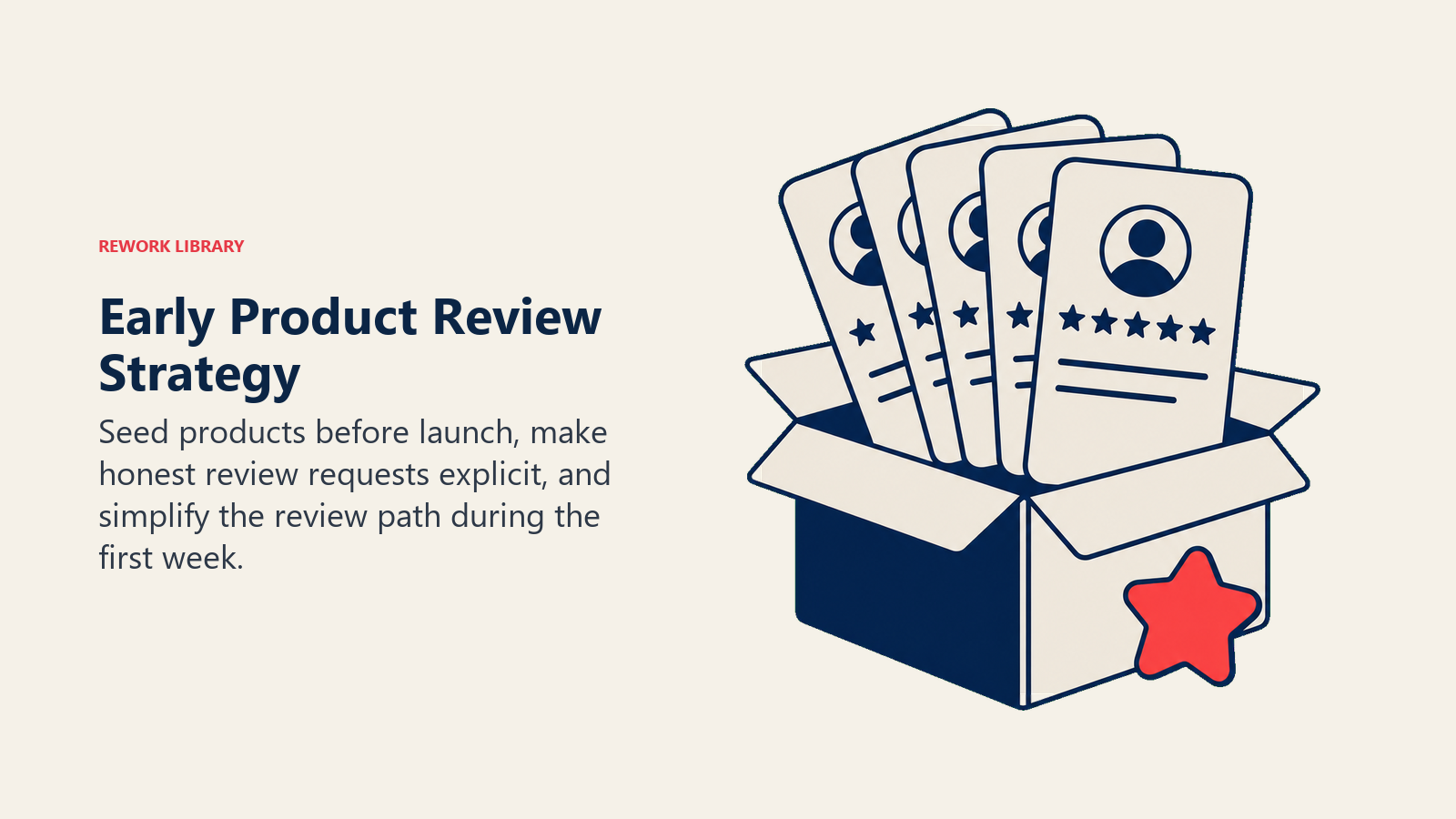
Pre-Launch Review Seeding
Send products to 20-50 customers 2-3 weeks before launch. Select diverse customer profiles to generate varied perspectives. Include loyal customers who've left reviews before, but also new customers representing your target audience.
Make the request explicit: "We're sending you early access in exchange for an honest review on launch day." Provide simple review instructions and direct links to review pages.
Follow up one week before launch confirming they've received the product and reminding them of the review commitment. Send a final reminder on launch day with easy review submission links.
Post-Purchase Review Campaigns
Set up automated email sequences that request reviews at optimal times. For physical products, wait until customers have received and used the product, typically 7-14 days post-delivery.
Structure review requests in three touches:
Touch 1 (Day 7): Ask about their experience, provide helpful tips for using the product, and softly mention that reviews help other customers.
Touch 2 (Day 14): Direct review request with simple one-click review links. Emphasize that honest feedback (positive or negative) helps improve the product.
Touch 3 (Day 21): Final reminder offering incentive for review completion, discount on future purchase, entry into prize drawing, or loyalty points.
Include review prompts across multiple touchpoints: packaging inserts with QR codes, thank-you page after purchase, and customer account dashboards.
For comprehensive approaches to building review volume, see our guide on Customer Reviews and UGC.
Incentivizing Authentic Feedback
Offer incentives for reviews, but structure them carefully to maintain authenticity. Don't reward only positive reviews, reward all honest reviews.
Acceptable incentive structures:
- Loyalty points for any review (positive or negative)
- Entry into monthly prize drawing for reviewers
- Small discount on next purchase for leaving feedback
- Early access to future products for active reviewers
Avoid incentives that compromise authenticity:
- Higher rewards for positive reviews
- Compensation contingent on star rating
- Requiring review approval before incentive delivery
Momentum Building Strategies (Days 7-30)
The first week's performance provides data for optimizing the remaining three weeks. Use early insights to double down on what's working and fix what isn't.
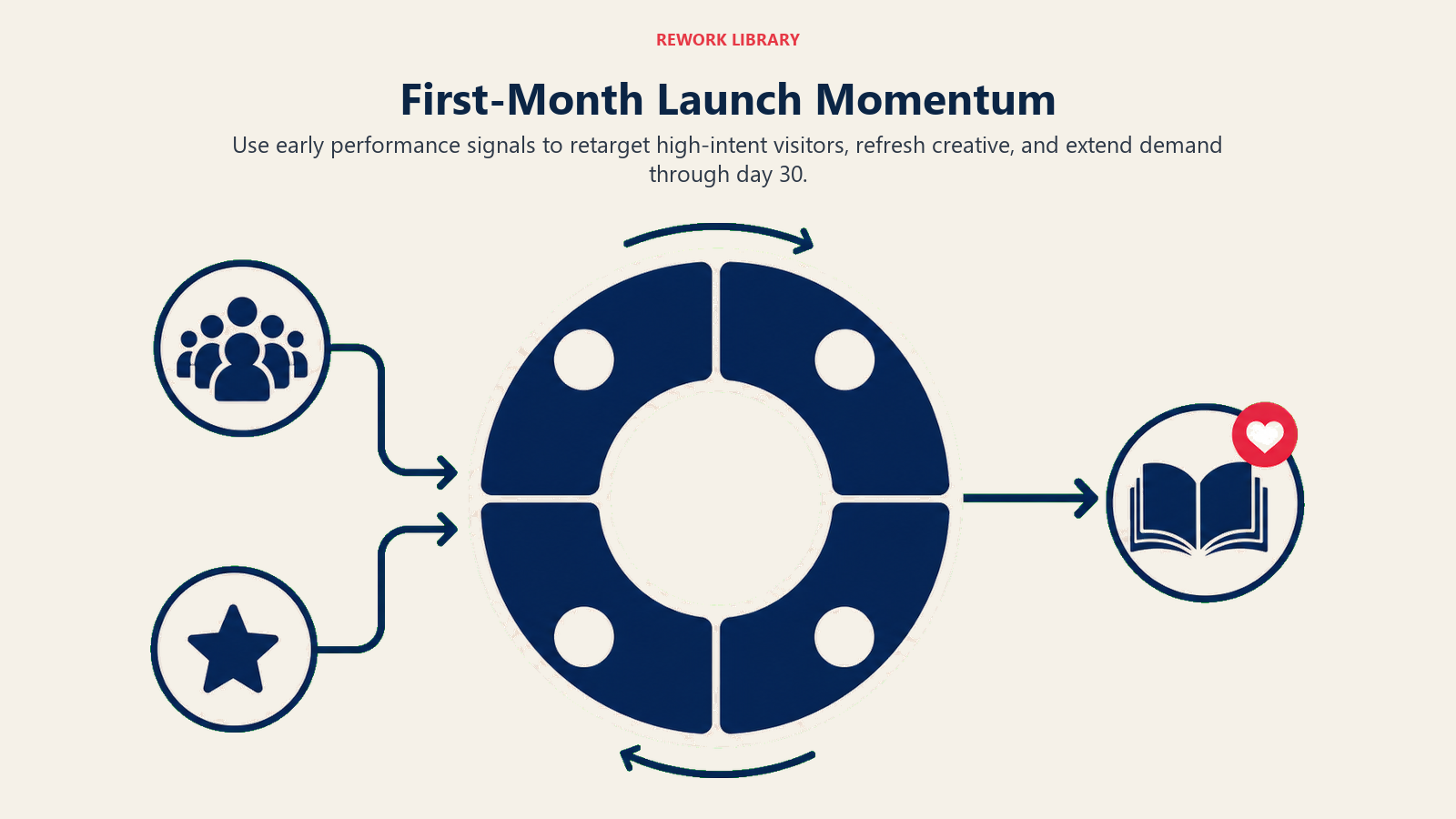
Retargeting and Win-Back Campaigns
Create custom audiences for different engagement levels: product page viewers who didn't add to cart, cart abandoners, and people who purchased competing products.
Design retargeting creative that addresses objections. For viewers who didn't add to cart, emphasize key differentiators and social proof. For cart abandoners, offer time-limited incentives and address common abandonment reasons.
Use dynamic product ads showing the exact product people viewed along with complementary items. Include real customer reviews in ad creative to build trust.
Implement email win-back sequences for people who engaged but didn't purchase. Segment by behavior and personalize messaging based on which features they viewed or which comparisons they researched.
Flash Sales and Urgency Creation
Launch mini-campaigns creating urgency without devaluing your product. Use legitimate scarcity, limited inventory alerts, bundle offers available for 48 hours, or bonus gifts with purchase while supplies last.
Structure flash sales strategically. Week two might feature bundle deals pairing your new product with complementary items. Week three could highlight user-generated content with special pricing for featured combinations.
Always tie urgency to legitimate constraints. Customers see through artificial scarcity, but they respond to real inventory limitations, time-bound bonuses, or exclusive access windows.
User-Generated Content Amplification
Monitor social media for customers posting about your product. Request permission to share their content across your channels. Offer small incentives (store credit, feature in newsletter) for high-quality content.
Create hashtag campaigns encouraging customers to share photos, videos, or reviews. Feature the best submissions on product pages, social media, and email campaigns.
User-generated content serves double duty, it's authentic social proof and it's free marketing content. The customer who posted organically becomes an advocate sharing with their network.
Conversion Rate Optimization During Launch
Launch weeks provide concentrated traffic perfect for optimization testing. High volume enables faster statistical significance for experiments.
Real-Time Optimization Opportunities
Monitor product page performance hourly. Check which sections get the most engagement, where users scroll, and which images they click. Use heatmapping tools to identify attention patterns.
Test different elements in quick succession:
- Hero images: lifestyle vs. product-focused
- Headline messaging: benefit-driven vs. feature-focused
- Call-to-action copy: "Buy Now" vs. "Add to Cart" vs. "Get Yours Today"
- Price presentation: standard vs. savings-focused vs. value-comparison
- Review placement: above vs. below fold
Implement changes that show immediate improvement. Document all tests for future launches.
A/B Testing Strategy
Run structured A/B tests on high-impact elements. Test one variable at a time to isolate what drives performance changes.
Priority testing areas:
- Product page layout and information hierarchy
- Checkout flow and form fields
- Shipping and return policy presentation
- Trust signals and guarantee placement
- Bundle and upsell positioning
Let tests run until reaching 95% statistical confidence. Don't stop tests early based on initial trends, launch traffic can be volatile and early patterns don't always hold.
For systematic approaches to testing and optimization, see our comprehensive guide on Conversion Rate Optimization.
Performance Measurement and Analytics
Track metrics daily during the launch period, then weekly through month one. Create dashboards showing real-time performance against goals.
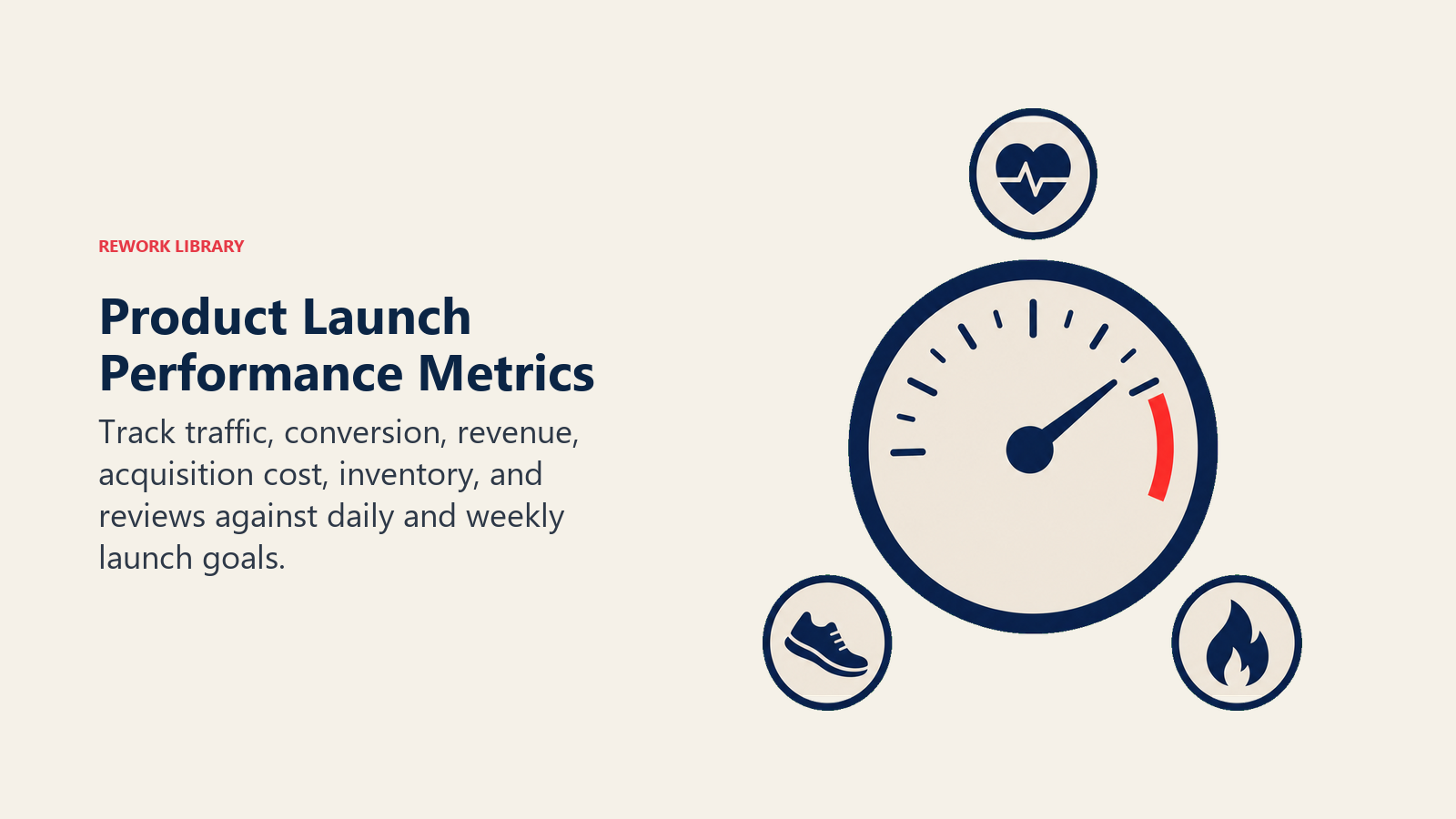
Essential Launch Metrics
Monitor these KPIs throughout the launch period:
Traffic metrics: Unique visitors, traffic sources, bounce rate, average session duration, pages per session.
Conversion metrics: Product page conversion rate, add-to-cart rate, checkout initiation rate, checkout completion rate.
Revenue metrics: Total revenue, average order value, revenue by traffic source, revenue by customer segment.
Customer acquisition: Cost per acquisition by channel, customer lifetime value for launch customers, payback period.
Product performance: Units sold, inventory levels, stockout occurrences, return rate, review volume and rating.
For comprehensive tracking frameworks, see our guide on e-commerce metrics and KPIs.
Attribution and Source Analysis
Understand which channels drive the best customers. Track not just first-touch attribution but full customer journey.
Launch customers often touch multiple channels before purchasing. The awareness ad on Instagram, the retargeting ad on Facebook, the email reminder, and the direct visit all play roles. Use multi-touch attribution models that credit each touchpoint appropriately.
Analyze cohorts by acquisition source. Do email customers have higher lifetime value than paid search customers? Do influencer referrals convert better than display ads? This insight shapes future launch budget allocation.
Logistics and Fulfillment Coordination
Backend operations make or break customer experience during high-volume launch periods. Prepare logistics infrastructure to handle success.
Inventory Allocation Strategy
Distribute inventory strategically across warehouses and fulfillment centers. Place stock close to high-demand markets to minimize shipping times.
Implement inventory reservations in your system preventing overselling. When customers add items to cart, temporarily reserve that inventory. Release reservations if carts abandon after set time periods.
Create inventory buffers for customer service issues, returns, and replacements. Don't sell 100% of inventory, keep 5-10% reserved for problem resolution.
Monitor inventory levels in real-time. Set up alerts when stock reaches critical thresholds. Have clear communication protocols for how marketing adjusts when inventory runs low.
Delivery Excellence
Launch customers form first impressions based on the entire experience including shipping and unboxing. Invest in packaging that creates positive moments.
Offer expedited shipping options even at cost to you. Customers who pay for fast shipping expect premium experiences. Meet or exceed promised delivery dates, early delivery delights customers.
Include surprise elements in packaging: handwritten thank-you notes, small bonus items, or exclusive launch-customer gifts. These touches generate social media posts and repeat purchases.
Provide proactive shipping updates. Send tracking information immediately after shipment with expected delivery dates. Send reminder notifications the day before delivery.
Post-Launch Momentum Extension
Success doesn't end at day 30. The best launches create sustained momentum extending months beyond the initial campaign.
Sustained Marketing Pressure
Don't drop marketing intensity after week four. Many brands pull back too quickly, killing momentum before reaching critical mass.
Transition from launch campaigns to evergreen product promotion. Continue paid advertising but shift messaging from "new product" to "customer favorite" as reviews accumulate.
Refresh creative regularly incorporating new reviews, user-generated content, and updated social proof. Monthly creative updates prevent ad fatigue while leveraging growing product credibility.
Product Line Extension Planning
Successful launches create opportunities for line extensions. Analyze which features customers most value, which complaints appear in reviews, and which questions dominate customer service inquiries.
Plan complementary products addressing unmet needs identified during launch. If customers love your product but request different colors, plan color extensions. If reviews mention wishing for additional features, plan enhanced versions.
Launch adjacent products that pair naturally with your successful product. Consider developing a hero product strategy that positions your successful launch as the cornerstone of your product line. Create bundles, kits, or collections that increase average order value and provide cross-selling opportunities.
Customer Feedback Integration
Treat launch customers as product development partners. Survey them about their experience, desired improvements, and other products they'd purchase.
Respond personally to negative reviews addressing concerns and offering solutions. Public responses demonstrate customer care to all potential buyers reading reviews.
Incorporate feedback into product iterations, marketing messaging, and customer education. When you address common concerns proactively, future customers have smoother experiences.
Pre-Launch Checklist
Use this checklist to ensure readiness across all launch dimensions:
90 Days Before Launch:
- Competitive analysis complete with pricing, positioning, and gap analysis
- Demand forecasts created with pessimistic, realistic, optimistic scenarios
- Inventory ordered with 30% buffer above realistic forecast
- Supply chain contingency plans documented
- Product pages designed and coded
- Payment processing tested
- Shipping integrations verified
- Customer service team briefed and trained
60 Days Before Launch:
- Email list segmented by customer type and engagement level
- Anticipation email sequence created and scheduled
- VIP early access program structured
- Early review program participants selected
- Sample products shipped for pre-launch reviews
- Influencer partnerships negotiated
- Products shipped to influencer partners
- Content briefs provided to influencers
30 Days Before Launch:
- Paid advertising campaigns built and reviewed
- Ad creative developed and tested
- Organic content published and optimized
- Launch day coordination plan finalized
- Real-time monitoring dashboard created
- Review request automation configured
- Retargeting audiences built
- Flash sale plans scheduled
Launch Week:
- Final inventory counts confirmed
- All channel content scheduled
- Customer service team on standby
- Monitoring dashboards active
- Hour-by-hour schedule distributed to team
- Crisis communication protocols ready
- Social media monitoring activated
Launch Timeline Visualization
Here's how a complete 120-day launch timeline flows:
Days -90 to -60 (Foundation Phase): Research, planning, and infrastructure building. Finalize product, confirm inventory, prepare channels.
Days -60 to -30 (Anticipation Phase): Audience warming, early access setup, influencer coordination, review program launch.
Days -30 to -7 (Campaign Buildup): Paid ads launch to awareness audiences, content publishing intensifies, email sequences begin.
Days -7 to 0 (Final Countdown): Daily email sequences, VIP early access, final testing, team coordination.
Day 0 (Launch Day): Coordinated activation across all channels, real-time monitoring, rapid response to issues.
Days 1-7 (Critical Week): Performance monitoring, quick optimization, review generation, momentum assessment.
Days 8-30 (Momentum Building): Retargeting campaigns, flash sales, UGC amplification, sustained marketing pressure.
Days 31-90 (Momentum Extension): Transition to evergreen promotion, product line planning, feedback integration, sustained growth.
Moving Forward
Product launches aren't events, they're orchestrated campaigns spanning months of preparation, weeks of intensive execution, and ongoing momentum building.
The brands that consistently win in e-commerce don't just have great products. They have systematic launch processes generating reviews, building demand, and maximizing first-month revenue.
Start planning your next launch 90 days out. Build the infrastructure during pre-launch. Execute with intensity on launch day. And maintain momentum through month one and beyond.
Your next product launch can be your strongest revenue quarter of the year. The question isn't whether you have a great product, it's whether you'll execute the launch strategy that great product deserves.

Sales Operations Practice Lead
On this page
- Pre-Launch Foundation (90 Days Before)
- Building Anticipation (60-30 Days)
- Marketing Campaign Architecture
- Launch Day Operations
- Early Review Generation Strategy
- Momentum Building Strategies (Days 7-30)
- Conversion Rate Optimization During Launch
- Performance Measurement and Analytics
- Logistics and Fulfillment Coordination
- Post-Launch Momentum Extension
- Pre-Launch Checklist
- Launch Timeline Visualization
- Moving Forward