Holiday & Seasonal Promotions: Maximizing Revenue During Peak Shopping Periods
Turn this article into takeaways for your work.


Each assistant summarizes the article only for you and suggests best practices for your work.
Holiday and seasonal shopping periods represent the biggest revenue opportunities in e-commerce. For many retailers, the final quarter alone accounts for 30-40% of annual sales, with Black Friday through Cyber Monday generating 15-20% of total revenue in just five days.
This concentration of consumer demand creates unique challenges: you need to forecast months in advance, coordinate with suppliers facing universal pressure, manage intense promotional activity, and execute flawlessly across all channels while competitors fight for the same customers with aggressive discounting.
Success requires strategic planning that starts 6-12 months before peak periods, coordinated execution across merchandising, marketing, operations, and customer service, and the discipline to analyze results and adjust your approach year over year.
The Holiday & Seasonal Opportunity
Consumer shopping behavior shifts dramatically during holiday periods. Customers who typically research for weeks make impulse purchases. Shoppers who avoid full-price products buy premium items as gifts. New customers discover your brand through gift guides and social recommendations. Revenue Potential
Most e-commerce categories experience 2-5x normal daily revenue during peak periods. Gift-focused categories like jewelry, beauty, and home goods see even higher multipliers. A business generating $50,000 daily might reach $200,000-250,000 on Black Friday alone.
This concentration creates operational challenges but also financial opportunity. Higher order values, increased purchase frequency, and greater receptivity to full-priced products offset promotional discounts when you execute well.
Customer Acquisition Efficiency
Holiday shopping brings elevated organic traffic from people actively searching for gifts and deals. Your Traffic Acquisition Strategy becomes more efficient as customers display stronger purchase intent and require less persuasion.
Customer acquisition costs typically drop 20-40% during peak periods while conversion rates increase. A customer costing $45 to acquire in August might cost $28 during November, with higher average order values offsetting promotional discounts.
Competitive Intensity
Every competitor recognizes the same opportunity. Email inboxes overflow with promotions. Paid advertising costs increase 30-60% as brands compete for attention. Consumers face overwhelming choice and decision fatigue.
Your promotional strategy must balance being competitive enough to win consideration while maintaining sufficient margin to remain profitable. This requires understanding your market positioning and making deliberate choices about where you compete aggressively versus where you protect margins.
Long-Term Customer Value
Holiday shoppers include gift purchasers who may never return and bargain hunters chasing discounts, but they also include new customers who become loyal repeat purchasers. Post-holiday customer retention typically ranges from 15-35% depending on product category and onboarding strategy.
A strong holiday season provides the customer base for growth throughout the following year. Businesses that acquire 10,000 new customers during the holidays might retain 2,500-3,500 who generate $500,000-1,000,000 in customer lifetime value over the next 2-3 years.
Building Your Holiday Calendar
Strategic holiday planning requires a comprehensive calendar that extends beyond major retail events to include seasonal transitions, cultural celebrations, and category-specific occasions. Major Retail Holidays
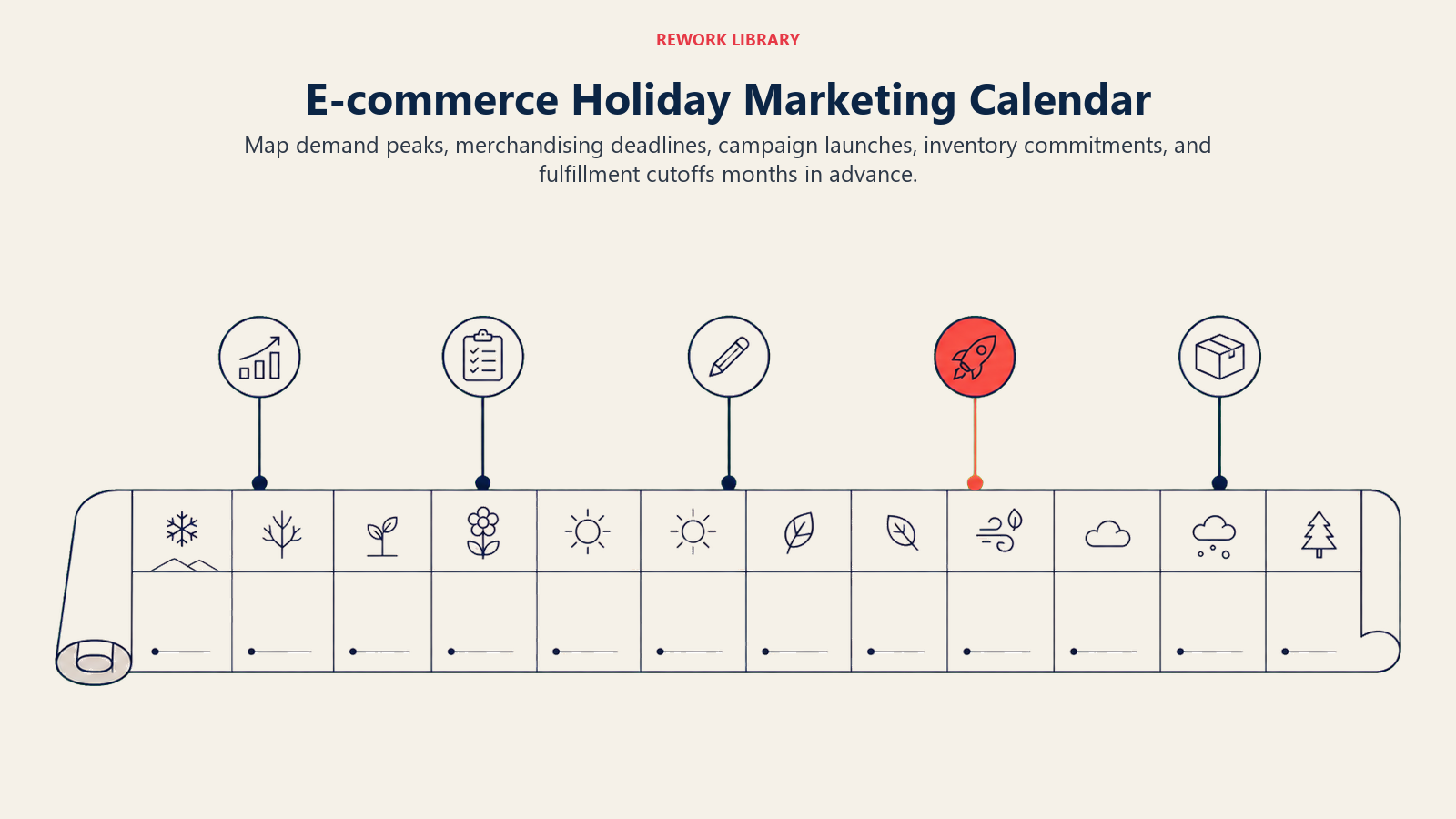
Core holiday periods drive the majority of seasonal revenue:
- Black Friday/Cyber Monday (late November): The highest-volume shopping weekend, accounting for 15-20% of Q4 revenue for most retailers
- Holiday Shopping Season (December 1-23): Extended gift purchasing with distinct early-bird and last-minute waves
- Valentine's Day (February 14): Major gifting holiday for jewelry, flowers, confections, and experiences
- Mother's Day & Father's Day (May/June): Category-specific opportunities for apparel, home goods, and personal care
- Back-to-School (July-August): Significant for apparel, electronics, and organizational products
Each holiday requires distinct promotional approaches. Black Friday emphasizes urgency and deep discounts. December shopping focuses on gift discovery and convenience. Valentine's Day highlights curation and personal expression.
Shopping Events
Manufactured shopping events create promotional opportunities beyond traditional holidays:
- Amazon Prime Day (mid-July): Elevates consumer deal expectations across all retailers
- Singles Day (November 11): Growing international shopping event
- Small Business Saturday: Opportunity for differentiation against major retailers
- Green Monday/Free Shipping Day: Last-minute shipping deadline promotions
Your calendar should acknowledge these events even if you don't participate directly, as they influence consumer expectations and competitive promotional intensity.
Cultural Celebrations
Expanding beyond mainstream holidays captures diverse customer segments:
- Lunar New Year: Significant for Asian-American communities and international markets
- Ramadan/Eid: Major gifting and celebration period for Muslim customers
- Diwali: Indian celebration with gift-giving traditions
- Quinceañera/Sweet 16: Category-specific for formal wear and celebrations
Cultural celebrations provide differentiation opportunities with less competitive intensity while serving specific communities authentically.
Personal Occasions
Year-round gifting occasions create consistent promotional opportunities:
- Birthdays: Largest personal celebration category
- Weddings & Anniversaries: High-value gift opportunities
- Graduations: Seasonal concentration in May-June
- New Babies: Ongoing throughout the year with spring/summer concentration
Your Seasonal Product Planning should include product assortments and marketing campaigns targeting these occasions even during off-peak periods.
Black Friday & Cyber Monday Strategy
BFCM represents the single most important promotional period for most e-commerce businesses, requiring dedicated planning and execution months in advance. Planning Timeline Start BFCM planning 6-12 months before the event:
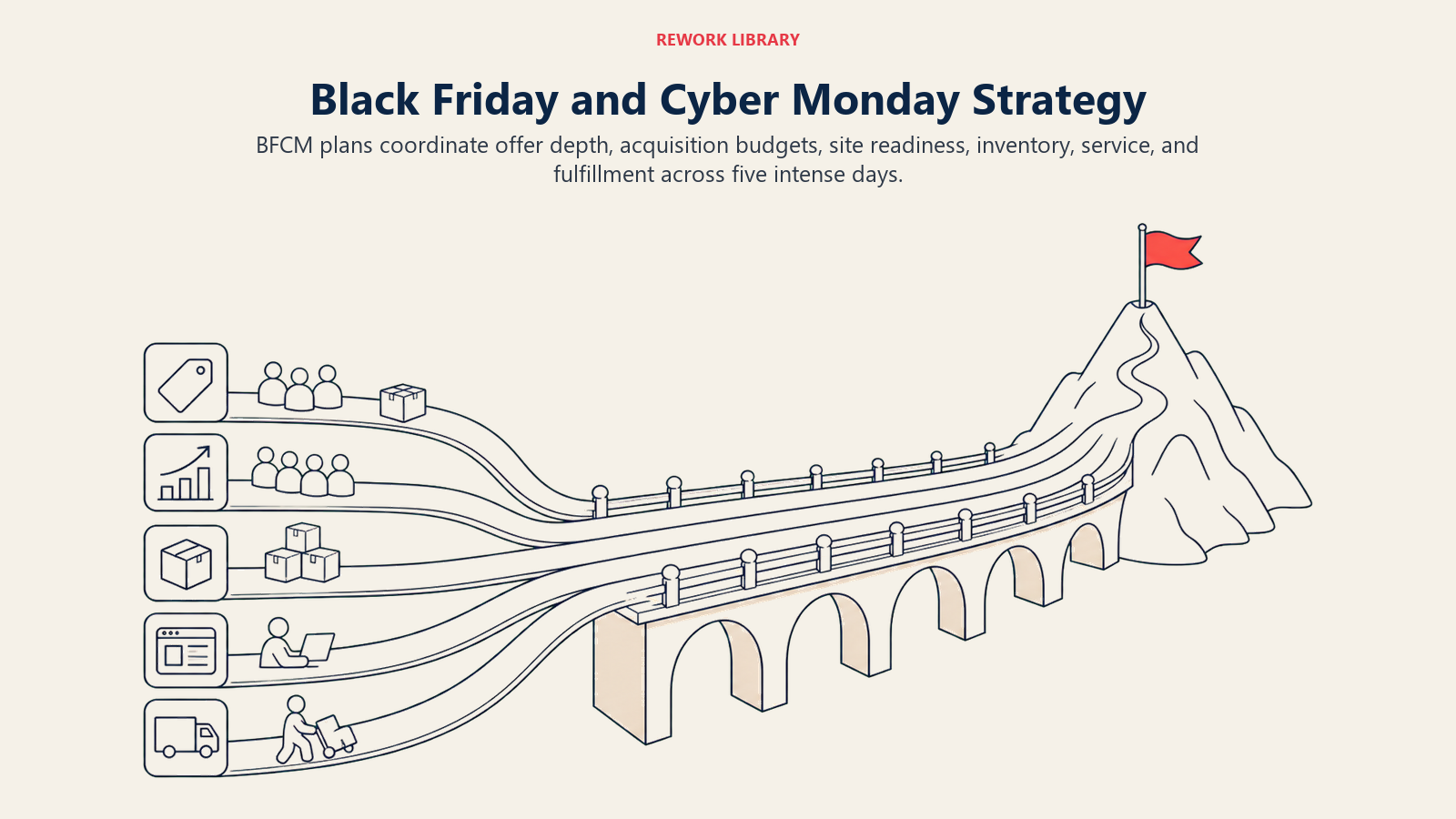
- January-March: Analyze previous year's performance, establish revenue goals, begin product development
- April-June: Finalize product assortment, negotiate supplier terms, plan promotional strategy
- July-September: Create marketing assets, establish inventory positions, brief customer service team
- October: Finalize promotional details, launch early awareness campaigns, complete inventory receipts
- November 1-20: Ramp up marketing intensity, execute early bird promotions, prepare fulfillment operations
This extended timeline allows coordination with suppliers who face the same pressure across their customer base, production of marketing materials when creative resources aren't overwhelmed, and inventory receipt before carrier capacity constraints emerge.
Promotional Strategy
Your BFCM promotion must balance competitive positioning, margin protection, and operational capacity:
Most successful retailers offer 20-40% off sitewide or 30-50% off on select products, often with tiered discounting that increases perceived value. A "30% off $100, 35% off $150, 40% off $200" structure encourages larger basket sizes while maintaining better margins on smaller orders.
Consider staggering your best offers rather than leading with maximum discounts. Many retailers run progressive promotions: "25% off Preview Access" (Wednesday before), "30% off Early Bird" (Thanksgiving), "35% off Black Friday," and "40% off Cyber Monday." This structure creates multiple purchase opportunities and urgency without training customers to wait for the deepest discount, similar to effective flash sale strategies.
Your Discount Strategy should account for product margins, competitive positioning, and inventory depth. High-margin products can sustain deeper discounts. Fast-moving items might see lower discounts to protect margins while slower products receive aggressive markdowns.
Email Campaign Structure
BFCM email campaigns typically include 8-12 messages over five days:
- Pre-Launch Teasers (2-3 emails): Build anticipation, preview products, offer early access to VIP customers
- Launch Announcements (2-3 emails): Announce promotion, highlight best-sellers, showcase gift ideas
- Mid-Event Reminders (2-3 emails): Create urgency, feature specific categories, address objections
- Final Hours (2-3 emails): Maximum urgency, last-chance messaging, inventory scarcity
Segment your campaigns based on customer history and behavior. VIP customers receive early access. Previous holiday purchasers see gift-focused messaging. Cart abandoners receive recovery campaigns. Your Email Marketing for E-commerce approach should adapt to seasonal intensity.
Traffic Forecasting
Accurate traffic forecasting prevents site crashes while optimizing hosting costs. Expect 3-5x normal daily traffic on Black Friday and 2-3x on Cyber Monday, with concentration during specific hours.
Traffic typically peaks 9-11am and 7-9pm in your primary time zone. Mobile traffic dominates, often representing 70-80% of sessions. Your site infrastructure must handle sustained traffic at these peaks, not just average daily volumes.
Load test your site at 150-200% of expected peak traffic. A site that handles 5,000 concurrent users during normal periods should be tested at 25,000-30,000 concurrent users for Black Friday preparedness.
Inventory Allocation
BFCM inventory strategy balances capturing demand against post-holiday excess. Most successful retailers allocate 40-60% of Q4 inventory to the BFCM period, reserving remaining inventory for December gifting and post-holiday sales.
Calculate promotional inventory based on last year's units sold, expected traffic increase, anticipated conversion lift from promotional intensity, and available supplier capacity. If you sold 1,000 units last year with 50,000 visitors, expect to sell 1,800-2,200 units this year with 150,000 visitors at similar conversion rates.
Your Inventory Management system should track daily sales velocity and alert you when products risk selling out before the event ends or when excess inventory requires additional promotion.
Gift Guide & Gift Season Marketing
Gift guides transform product discovery into curated recommendations while reducing decision fatigue for shoppers unfamiliar with your brand or category. Gift Guide Creation
Effective gift guides balance aspiration with accessibility. Each guide should include 8-15 products spanning multiple price points, featuring clear photography, concise descriptions, and direct purchase links.
Create guides based on recipient relationships ("Gifts for Her," "Gifts for Him," "Gifts for Parents"), price points ("Under $50," "$50-100," "Luxury Gifts"), interests ("For the Home Chef," "For Travelers," "For Wellness Enthusiasts"), and occasions ("Stocking Stuffers," "Secret Santa," "Corporate Gifts").
Each product should include why it makes a great gift, not just product features. Instead of "Italian leather wallet with RFID protection," write "A timeless everyday essential that gets better with age, perfect for the minimalist who appreciates craftsmanship."
Segmentation Strategy
Different customer segments require distinct gift guide approaches:
- Self-purchasers: Emphasize "treat yourself" messaging and personal benefit
- Gift givers: Focus on recipient reactions and how gifts make them look thoughtful
- Corporate buyers: Highlight bulk ordering, customization, and professional presentation
- Last-minute shoppers: Feature digital gift cards, fast shipping, and gift receipts
Your content strategy should address each segment with dedicated guides, landing pages, and marketing campaigns throughout the gift-giving season.
Marketing Channels
Gift guides require multi-channel promotion to reach diverse audiences:
Email campaigns feature weekly gift guide themes throughout November and December, with increasing frequency as shipping deadlines approach. Send dedicated campaigns for each major guide with secondary placement in regular promotional emails.
Social media showcases individual products from guides with lifestyle photography and gift-giving scenarios. Create Instagram Stories highlights for each guide. Share gift ideas as scrollable carousels on Instagram and Facebook.
Paid advertising promotes top-performing guides to cold traffic. Gift guides convert 30-50% better than product pages for new visitors because they reduce choice paralysis and position products in gift-giving context.
Content partnerships with bloggers and influencers extend reach beyond your owned channels. Provide curated selections for their audiences with custom discount codes to track performance.
Bundle Creation
Pre-curated product bundles simplify gift purchases while increasing average order values. Bundles should offer perceived value through complementary products that customers might not discover independently.
A skincare brand might bundle cleanser, serum, and moisturizer at $120 (20% off individual prices). A coffee company could combine beans, brewing equipment, and accessories at $85 (25% off individual prices).
Your Product Bundling strategy should create bundles specifically for gifting, with attractive packaging and gift messaging options. Limited-edition seasonal bundles create urgency while testing product combinations that might become permanent offerings.
User-Generated Content
Customer photos and reviews add authenticity to gift recommendations. Encourage gift recipients to share purchases through post-purchase email campaigns, social media hashtags, and photo submission incentives.
Feature customer photos in gift guides, social media, and email campaigns. UGC converts 3-5x better than brand photography because it demonstrates real-world use and social proof.
Create a branded hashtag for gift sharing (#GiftedByBrand) and feature the best submissions in your marketing. Offer small incentives (10-15% off next purchase) to encourage participation.
Promotional Calendar & Timing
Strategic timing determines whether promotions feel like valuable opportunities or desperate discounting. Your calendar should create urgency without training customers to wait for better deals.
Early Bird Scheduling
Launch holiday promotions before competitive intensity peaks. Early access creates exclusivity for loyal customers while securing revenue before promotional fatigue sets in.
Most successful retailers begin holiday promotions in mid-November, 7-10 days before Black Friday. This timing captures early shoppers without extending the promotional period so long that urgency dissipates.
Offer VIP early access 24-48 hours before public launch. Email your best customers with exclusive early access codes. This approach rewards loyalty while generating revenue and reducing strain on peak-day infrastructure.
Promotional Intensity Curves
Holiday promotional intensity should build gradually, peak during major shopping days, and extend into last-minute gifting without appearing desperate:
- November 1-15: Regular promotional cadence with holiday gift guide introduction
- November 16-22: Increased email frequency, early bird promotions, preview access
- November 23-27: Maximum intensity for BFCM with multiple daily emails and aggressive promotion
- November 28-December 15: Sustained promotion emphasizing gift discovery and convenience
- December 16-23: Last-minute urgency focusing on shipping deadlines and gift cards
Promotional intensity should match customer receptivity. Aggressive email frequency during BFCM (2-3 daily emails) would feel overwhelming in October but meets expectations during peak shopping days.
Email Frequency
Holiday email frequency increases dramatically compared to regular promotional cadence:
- Normal periods: 2-4 emails per week
- Early holiday (November 1-15): 3-5 emails per week
- BFCM weekend: 8-12 emails over 5 days
- December gifting season: 4-6 emails per week
- Last-minute rush (December 16-23): Daily or multiple daily emails
Monitor unsubscribe rates and engagement metrics. Expect unsubscribe rates to increase 20-30% during peak periods, this represents subscribers who were never engaged rather than damage to your core audience.
Paid Ad Budget Allocation
Concentrate paid advertising spend during high-intent periods when conversion rates justify increased costs. Most retailers allocate 40-50% of Q4 paid ad budget to the BFCM period despite representing only 20-25% of shopping days.
Increase daily ad spend 3-5x during BFCM compared to normal periods. If you typically spend $2,000 daily, plan for $6,000-10,000 daily during Black Friday through Cyber Monday.
Budget flexibility allows you to capitalize on strong performance. Reserve 10-15% of your total budget for opportunistic spending if ROAS exceeds targets.
Discount & Promotion Strategy
Holiday discount strategy must balance competitive positioning, margin protection, and perceived value creation without training customers to expect permanent discounting. Percentage vs Fixed Dollar Different discount structures appeal to different customer psychologies and optimize for different business objectives:
Percentage discounts feel more valuable on higher-priced items and create consistent margin impact. "25% off" generates excitement for $200 products ($50 savings) while protecting margins on lower-priced items.
Fixed dollar discounts work better for lower-priced products and create concrete value perception. "$20 off $100" feels more valuable than "20% off" even though they're equivalent.
Test both approaches with your audience. Many brands find percentage discounts perform better in premium categories while fixed dollar discounts work for value-oriented products.
Your Pricing Strategy for E-commerce should establish promotional frameworks that maintain profitability while meeting competitive expectations.
Tiered Discounting
Tiered discount structures increase average order values by incentivizing customers to reach higher thresholds:
- 20% off orders $100+
- 25% off orders $150+
- 30% off orders $200+
This structure encourages customers to add products to reach the next tier. Someone with $140 in their cart sees that $10 more in products saves them $14 (moving from 20% to 25% off).
Calculate tiers based on your current average order value and typical product prices. Set the first tier just below your normal AOV, the middle tier at 25-30% above AOV, and the top tier at 50-60% above AOV.
Free Shipping Thresholds
Free shipping significantly impacts conversion rates while creating opportunities to increase order values. Most e-commerce businesses offer free shipping at $50-75 for domestic orders.
Holiday promotions often reduce or eliminate shipping thresholds. "Free shipping on all orders" removes friction for gift purchases where recipients have different addresses. However, this impacts margins by 8-15% depending on average order weight and shipping destinations.
Alternative approaches protect margins while reducing friction: "Free shipping on orders $50+" maintains thresholds while feeling generous. "Free 2-day shipping" adds value through speed rather than cost elimination.
BOGO and Gift with Purchase
Buy-one-get-one promotions and gift-with-purchase offers create perceived value while moving inventory and introducing customers to new products:
BOGO works well for replenishable products where customers might purchase multiple units anyway. "Buy 2, get 1 free" effectively offers 33% off while encouraging larger purchases.
Gift with purchase introduces customers to new products while creating excitement. "Free travel-size moisturizer with any $75 purchase" costs you $8-12 in product cost while adding $25-30 in perceived value.
Both strategies work better than equivalent percentage discounts for certain products because they feel like bonuses rather than discounts, protecting brand perception.
Stacking Rules
Clear promotional stacking rules prevent margin erosion while maintaining customer trust. Define whether customers can combine multiple promotions: sitewide discounts with product-specific offers, promotional codes with sale items, loyalty rewards with holiday promotions.
Most retailers limit stacking to protect margins: "One promotional code per order" or "Discount codes cannot be applied to sale items." However, allowing limited stacking can increase conversion: "Combine sitewide discount with loyalty rewards."
Make stacking rules clear in promotional terms and at checkout. Surprise restrictions damage trust and increase cart abandonment.
Inventory Forecasting & Allocation
Holiday inventory management requires balancing the risk of stockouts against post-holiday excess while accounting for extended supplier lead times and universal demand pressure. Historical Analysis Begin forecasting with historical performance, adjusting for growth, competitive changes, and promotional intensity:
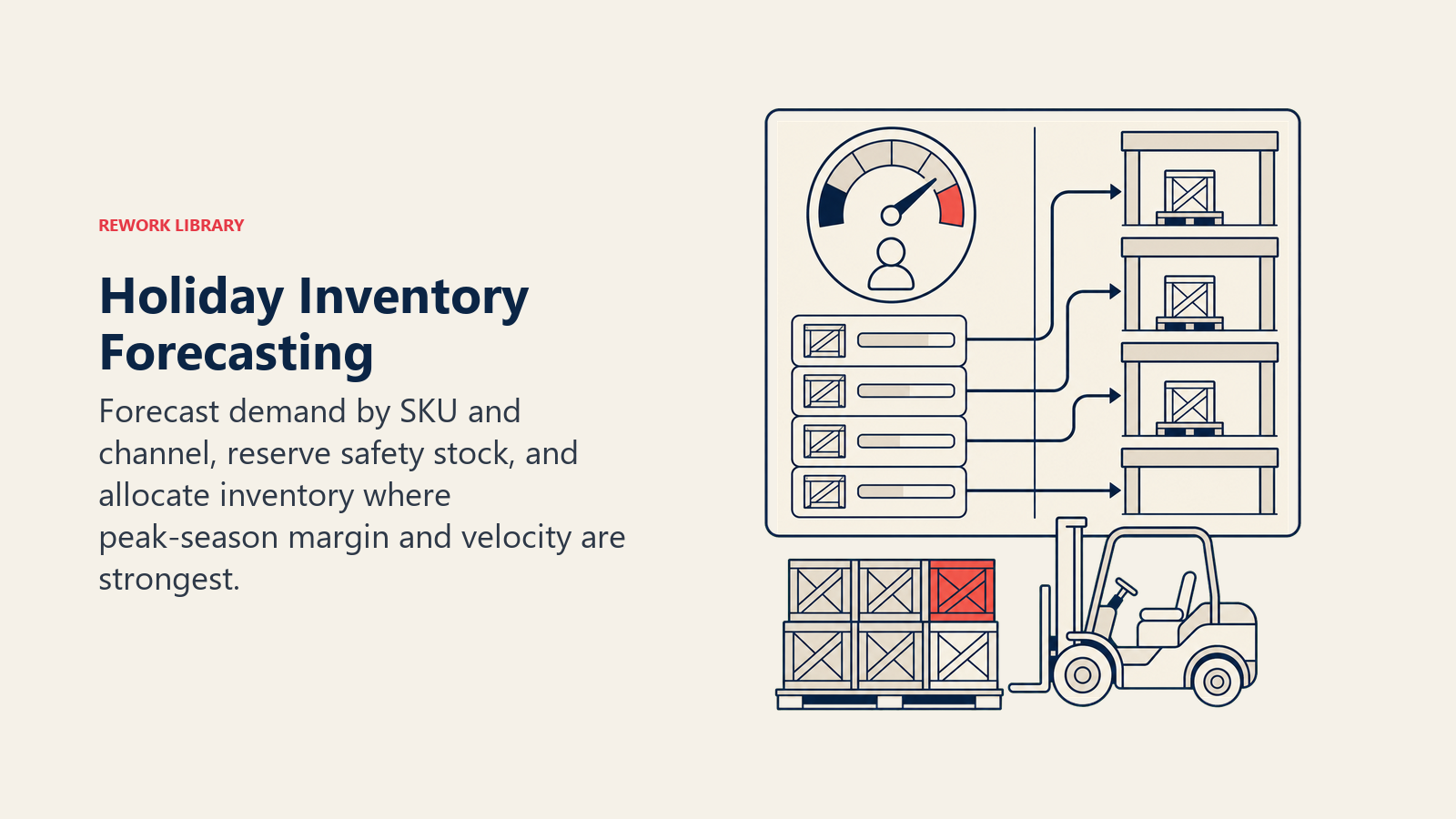
Start with last year's units sold by product during the holiday period. Apply expected traffic growth (30-50% for most growing brands). Adjust for promotional changes, deeper discounts increase conversion rates by 15-25%.
If you sold 500 units of a product last holiday with 25% off and plan 35% off this year with 40% more traffic, forecast 500 × 1.4 (traffic) × 1.2 (conversion lift) = 840 units.
Demand Multipliers
Different product categories experience varying demand multipliers during holiday periods:
- Gift-focused products (jewelry, premium home goods): 4-6x normal demand
- Personal-use products (basics, consumables): 2-3x normal demand
- High-consideration items (furniture, major electronics): 1.5-2x normal demand
Apply category-specific multipliers to your base forecasts rather than universal assumptions.
Supplier Coordination
Communicate holiday needs with suppliers 4-6 months in advance. Suppliers face competing demands from all customers and prioritize those who commit early with deposits or purchase orders.
Negotiate extended payment terms or early-pay discounts to secure inventory positions. Many suppliers offer 2-3% discounts for payment at order rather than at delivery, which can offset the cost of carrying inventory early.
Plan for 15-20% longer lead times during peak production periods (August-October for winter holidays). A supplier with normal 45-day lead times might require 60 days during peak season.
Safety Stock
Maintain 15-25% safety stock beyond forecasted demand for best-selling products to capture upside while avoiding stockouts. Running out of best-sellers during peak periods costs more than carrying modest excess inventory.
If you forecast selling 1,000 units during the holiday period, purchase 1,150-1,250 units. The downside of 150-250 excess units typically represents 2-3 months of normal sales that clear naturally or through post-holiday promotions.
Balance safety stock against storage costs and cash flow constraints. Focus safety stock on highest-margin products where stockouts represent the greatest opportunity cost.
Excess Inventory Clearance
Plan post-holiday clearance before purchasing inventory. Excess holiday inventory clears through January sales, Valentine's gift promotions, or off-season wholesale channels.
Budget for 15-25% of holiday inventory to remain after the season. Build clearance costs into your financial planning rather than treating excess as unexpected losses.
Some retailers deliberately over-order with clearance plans: purchase at 60% of retail, sell 75% at 30% off (49% margin), clear 25% at 50% off (17% margin), achieving blended 42% margins across all units.
Gift Wrapping & Premium Services
Holiday gift services differentiate your brand while increasing average order values and customer satisfaction. These services justify premium pricing and reduce returns from gift recipients. Gift Wrapping Options
Offer gift wrapping at $5-12 per item depending on your price points and brand positioning. Simple tissue and ribbon costs $0.75-1.50 per package while premium box presentations cost $2-4.
Create tiered wrapping options: basic gift wrapping ($5), premium gift boxes ($10), luxury presentation ($15-20). This structure allows customers to choose based on gift importance while encouraging upgrades.
Clearly photograph each wrapping option so customers understand what they're purchasing. Show wrapped products from multiple angles. Specify what's included (box, ribbon, gift message card).
Personalization
Gift personalization services command significant premiums while creating products that can't be returned or price-compared:
- Monogramming: $10-25 depending on placement and complexity
- Custom engraving: $15-35 for jewelry and accessories
- Gift messages: Often free, sometimes $3-5 for premium cards
- Custom packaging: $10-20 for branded boxes with personal notes
Personalization increases perceived value while protecting margins. A $75 wallet becomes a $95 personalized gift that customers perceive as worth $150+.
Partner with local or on-demand personalization services if you don't have in-house capabilities. Many fulfillment centers offer monogramming and engraving services for $2-5 per item wholesale.
Gift Cards
Digital and physical gift cards solve last-minute shopping needs while generating cash flow without inventory costs. Gift cards typically represent 8-12% of holiday revenue for retailers with breakage rates (unredeemed cards) of 5-15%.
Offer gift cards in standard denominations ($25, $50, $100, $150) with custom amount options. Include digital delivery for instant gratification and physical cards for traditional gift-giving.
Promote gift cards heavily during the final shipping week: "Ordering deadline passed? Send a digital gift card, delivered instantly." This messaging captures revenue that would otherwise go to competitors or big-box retailers.
Luxury Unboxing Experience
Premium packaging creates emotional impact that justifies higher prices while generating social sharing. Brands like Glossier and Away have built loyalty partially through distinctive unboxing experiences.
Elements of luxury unboxing include branded boxes with magnetic closures ($2-4 per unit), tissue paper and ribbon ($0.50-1.00), product protection and presentation ($0.75-1.50), branded thank-you notes ($0.25-0.50), and small bonus samples or gifts ($1-3).
Total cost of $5-10 per package justifies $15-25 gift service charges while creating memorable experiences that recipients share on social media.
Third-Party Fulfillment
Consider specialized gift fulfillment services during peak periods to maintain service quality while scaling beyond internal capacity. Services like ShipBob, Deliverr, and Whiplash offer temporary capacity with gift wrapping capabilities.
Expect to pay $3-6 per unit in fulfillment fees plus $1-3 for gift services. This premium over internal fulfillment (typically $2-3 per unit) pays for itself through maintained service levels and captured upside revenue.
Acquisition Campaign Timing
Holiday periods offer the year's best customer acquisition opportunities due to elevated intent and reduced acquisition costs, but campaign timing determines which customers you attract and at what cost.
Paid Search Budget
Search volume increases 40-60% during holiday periods while competition drives CPCs up 30-50%. The net effect is 10-20% lower customer acquisition costs due to higher conversion rates from elevated intent.
Increase search ad budgets 2-3x during November-December compared to baseline periods. If you normally spend $15,000 monthly on search, plan for $30,000-45,000 during Q4.
Expand keyword targeting to include gift-focused queries: "gifts for [demographic]," "best [product category] gifts," "[brand/category] gift guide." These queries convert 20-30% better than product-focused searches due to gift-giving urgency.
Social Advertising
Social platforms compete for holiday ad budgets, driving CPMs up 40-70% during peak periods. However, creative fatigue decreases as consumers expect promotional content and engage more readily with gift ideas.
Refresh ad creative weekly during November-December compared to monthly refresh during other periods. Consumers see 3-5x more ads during holidays, causing faster creative fatigue.
Test gift-focused creative angles: products styled as gifts, lifestyle shots showing gift-giving moments, testimonials from gift recipients, and gift guide compilations. These angles outperform product-focused creative during holiday periods by 30-50%.
Your Cart Abandonment Recovery campaigns become especially valuable during holidays as customers comparison shop and experience decision paralysis. Abandoned cart sequences should emphasize scarcity ("Only 3 left in stock") and urgency ("Order by Dec 20 for Christmas delivery").
Influencer Partnerships
Commission influencer content 6-8 weeks before major holidays to allow production and approval time. Most established influencers book holiday campaigns by September, requiring early outreach.
Negotiate flat fees plus commission structures for holiday campaigns rather than commission-only deals. Influencers can choose from many offers during peak periods and prioritize guaranteed compensation.
Provide influencers with multiple products to create authentic gift guides rather than single-product promotions. A beauty brand might send 6-8 products and request "holiday favorites" content featuring 3-4 items, creating genuine recommendations.
Retargeting Strategy
Holiday retargeting windows should shorten to match compressed decision timelines. Reduce retargeting windows from 30-60 days to 7-14 days to focus on high-intent recent visitors.
Increase frequency caps to accommodate elevated research behavior. Consumers visit multiple sites before purchasing gifts. A frequency cap of 3 impressions per day might expand to 5-7 during holidays.
Segment retargeting by browsing behavior: gift guide visitors see curated collections, cart abandoners receive discount incentives, product page viewers see customer reviews and social proof.
New Customer Offers
First-purchase discounts acquire new customers who may become long-term buyers. However, holiday promotions often already include aggressive sitewide discounts, making additional first-purchase offers redundant.
Instead of percentage discounts, offer new customer benefits that create loyalty: free shipping on first order, extended return windows (90 days instead of 30), or free gift wrapping. These benefits cost less than additional discounting while creating positive first impressions.
Promote new customer offers through social ads and partnerships targeting cold audiences rather than on-site where existing customers might see them.
Email & SMS Marketing
Holiday communication strategies require dramatically increased frequency while maintaining relevance and value to prevent list fatigue and unsubscribes. Holiday Email Calendar Structure your holiday email calendar around key shopping moments:
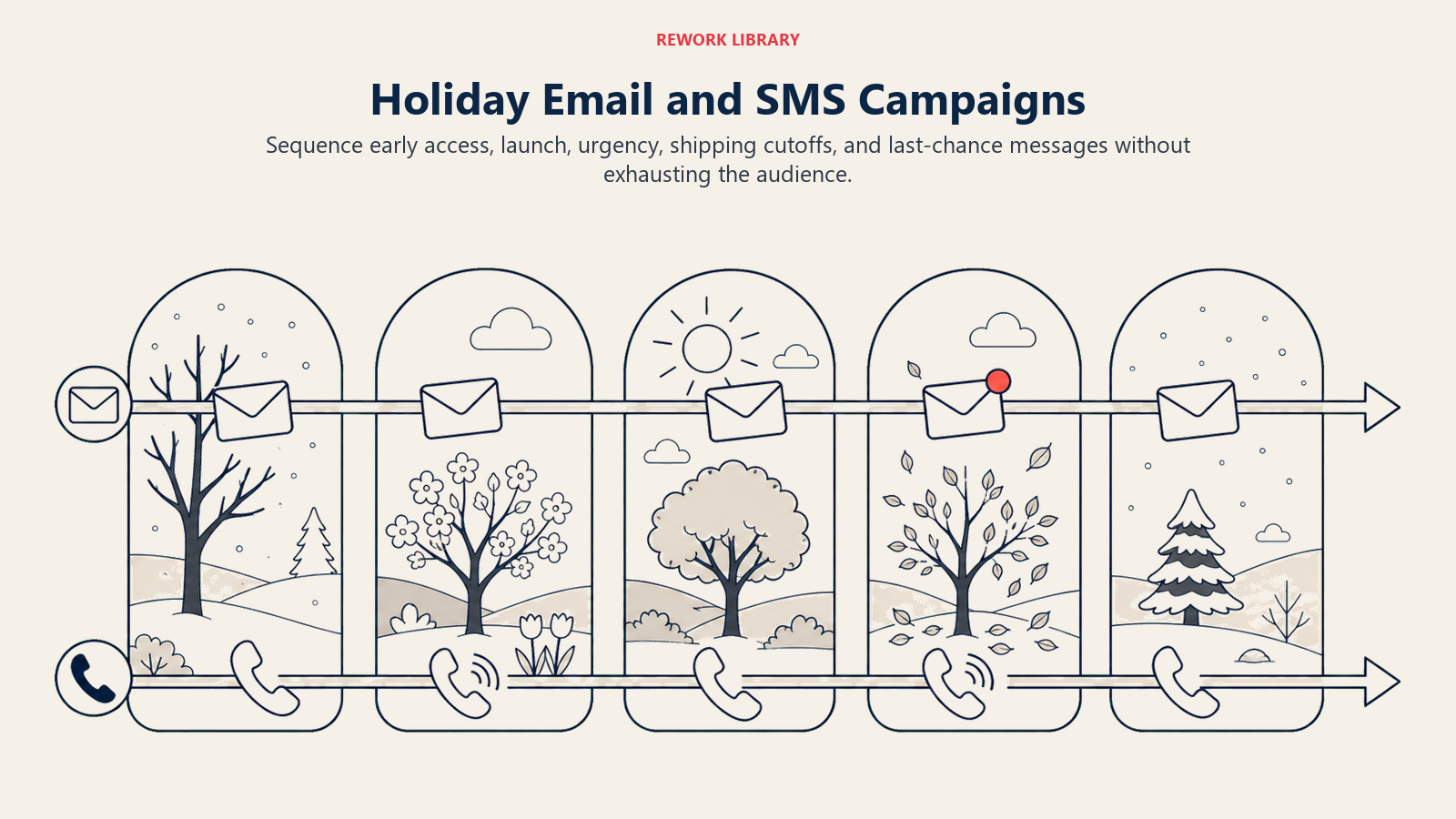
November 1-15: Weekly emails introducing holiday collections, gift guides, and upcoming promotions. Focus on inspiration and education rather than aggressive selling.
November 16-22: 2-3 emails weekly building anticipation for Black Friday, offering early access to VIP customers, and showcasing best-selling gift ideas.
November 23-27: Daily or multiple daily emails with promotional announcements, urgency messaging, and category-specific gift ideas. This represents peak email volume.
November 28-December 15: 4-6 emails weekly balancing promotional intensity with gift inspiration, shipping deadline reminders, and holiday content.
December 16-20: Daily emails emphasizing shipping deadlines, gift card solutions, and last-minute gift ideas.
December 21-24: Multiple daily emails for true last-minute shoppers focusing exclusively on digital gift cards and e-gift options.
Customer Segmentation
Different customer segments require distinct email approaches during holidays, and effective customer segmentation becomes critical for maximizing holiday revenue:
VIP customers (top 10-20% by lifetime value) receive early access to promotions, exclusive offers, and white-glove service messaging. Offer these customers concierge services, extended return windows, or bonus gifts with purchase.
Holiday 2024 purchasers already understand your products as gifts. Target them with "Give [Brand] again this year" messaging and direct gift recommendations based on past purchases.
Engaged subscribers who haven't purchased need conversion-focused messaging with strong offers and social proof. Emphasize reviews, bestsellers, and risk-reduction (easy returns, satisfaction guarantees).
At-risk subscribers (low engagement) should receive reduced email frequency focused only on major promotions (Black Friday, Cyber Monday) to avoid pushing them to unsubscribe.
SMS Alert Strategy
SMS provides immediate attention for time-sensitive promotions but requires careful frequency management to avoid opt-outs. Most brands send 4-8 SMS messages during Q4 compared to 2-4 monthly during other periods. A comprehensive SMS marketing strategy helps balance urgency with subscriber retention.
Reserve SMS for high-value moments: early access announcements, flash sales, shipping deadline reminders, and last-minute gift solutions. Each message should provide clear value that justifies the interruption.
Effective holiday SMS examples:
- "VIP Early Access: 30% off starts NOW for you (public launch tomorrow) → [link]"
- "⚠️ Last day for Christmas delivery! Order by 3pm EST → [link]"
- "Cyber Monday: Extra 40% off ends tonight. Shop → [link]"
- "Can't decide? Digital gift cards delivered instantly → [link]"
Countdown Campaigns
Countdown sequences create urgency through time-based scarcity. These work especially well for shipping deadlines, promotional end dates, and inventory scarcity.
Create countdown email series for major promotions:
- 72 hours before: Introduction with full details
- 48 hours before: Social proof and bestsellers
- 24 hours before: "Tomorrow's your last chance"
- 12 hours before: "Final hours" with urgency emphasis
- 2 hours before: "Last call" to committed subscribers
Each email should provide distinct value beyond repeating "time is running out." Share different products, customer stories, use cases, or testimonials to maintain interest.
Post-Holiday Win-Back
January win-back campaigns target holiday purchasers who might not return organically. These campaigns generate 15-25% of holiday customer lifetime value within 60 days.
Send a welcome series to holiday gift purchasers in early January: thank them for their gift purchase, invite them to shop for themselves, offer a first-order discount (if they were gift recipients shopping with someone else's account), and showcase new products or collections.
Target holiday discount shoppers with value-focused messaging that maintains the relationship: exclusive sale access, loyalty program enrollment, or product education that demonstrates value beyond promotional pricing.
Customer Service & Fulfillment
Holiday operational excellence determines whether increased demand becomes profitable growth or operational chaos that damages your brand.
Seasonal Staffing
Customer service volume increases 3-5x during holiday periods while complexity grows due to gift-related questions, shipping anxiety, and new customers unfamiliar with your products.
Hire seasonal customer service representatives 4-6 weeks before peak demand (mid-October for November-December holidays). This timing allows training and system familiarization before volume spikes.
Cross-train existing team members from other departments to provide customer service backup during peak periods. Marketing and operations staff who understand your products can handle tier-1 inquiries during overflow periods.
Extended Service Hours
Offer extended customer service hours during peak shopping days: 7am-11pm or even 24-hour coverage during Black Friday through Cyber Monday when purchase activity continues overnight.
Communicate extended hours prominently on your website and in email campaigns. "Questions? We're here 7am-11pm every day through December 23" reduces anxiety and prevents cart abandonment from unresolved questions.
Shipping Deadline Communication
Clearly communicate shipping deadlines and options to set appropriate expectations and prevent post-deadline disappointment:
Create a shipping deadline table showing cutoffs for each service level (ground, 2-day, overnight) to reach customers by Christmas or other major holidays. Update this throughout December as deadlines pass.
Email shipping deadline reminders: 1 week before ground shipping cutoff, 3 days before ground cutoff, final ground shipping day, 2-day shipping cutoff, overnight shipping cutoff, and "too late for shipping, send gift cards" after all deadlines pass.
Returns Policies
Extended return windows reduce purchase anxiety for gift-givers uncertain about sizes, preferences, or duplicates. Most retailers extend return windows to 60-90 days for purchases made November-December.
Clearly communicate holiday return policies: "All November-December purchases can be returned until January 31" gives gift recipients weeks after the holidays to process returns without pressure.
Provide gift receipts (either physical or email) that show items but not prices. This allows returns and exchanges without revealing purchase amounts.
Some retailers offer returnless refunds for low-value items during peak periods to reduce processing costs and improve customer experience. A returnless refund on a $15 item costs less than the reverse shipping and processing labor.
International Shipping
International orders require 2-3 weeks longer for delivery and involve customs, duties, and higher costs that surprise customers unfamiliar with cross-border shopping.
Clearly communicate international shipping timelines: "International orders ship via [carrier] and typically arrive in 12-21 business days. Custom delays may extend delivery."
Offer DDP (Delivered Duty Paid) shipping where you collect duties at checkout rather than forcing recipients to pay customs charges on delivery. This costs 3-5% more in fees but dramatically reduces delivery issues and customer service contacts.
Consider partnerships with international fulfillment centers in major markets (Canada, UK, EU, Australia) to offer faster delivery and local returns. Third-party services like Global-E, Borderfree, and Flow handle localization, customs, and logistics.
Post-Holiday Analytics & Optimization
The holiday season provides the richest data set of the year for understanding customer behavior, channel performance, and operational capacity. Comprehensive analysis informs next year's strategy. Campaign Performance Analysis Evaluate each campaign and channel against revenue, profit, and customer acquisition goals:
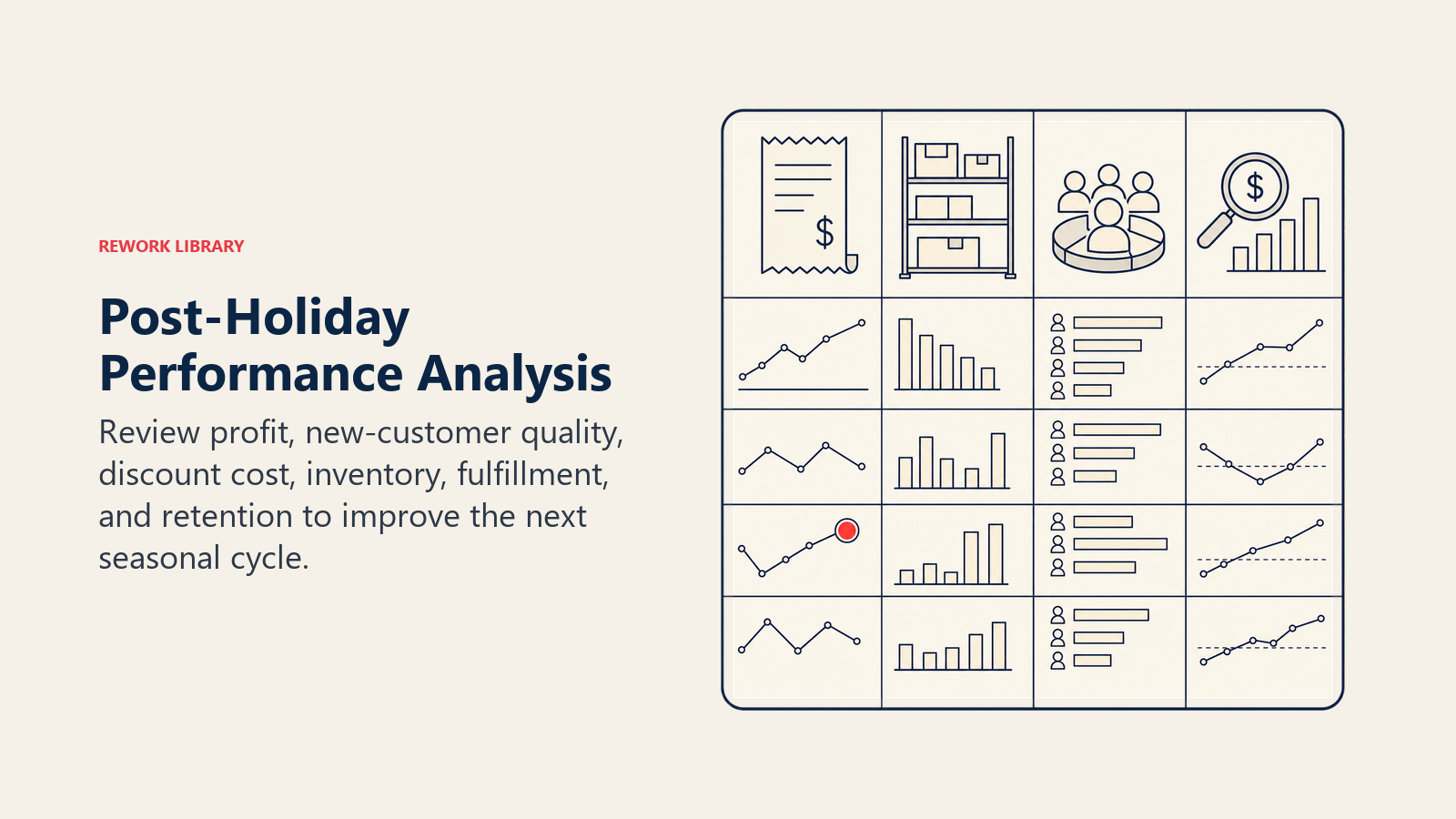
Email performance: Analyze open rates, click rates, and revenue per email by campaign type (promotional vs. gift guide vs. educational). Identify which subject lines, send times, and content structures drove highest engagement.
Most retailers find gift guide emails generate 30-40% higher open rates but 20-30% lower conversion than promotional emails, making them valuable for engagement but secondary to direct promotional campaigns for revenue.
Paid advertising: Calculate ROAS (return on ad spend) and CAC (customer acquisition cost) by channel, campaign, and audience segment. Determine which channels and audiences delivered profitable customer acquisition.
Expect blended ROAS of 3-5x during holiday periods compared to 2-3x during normal periods. CAC should be 20-40% lower despite increased competition due to higher intent and conversion rates.
Organic and direct traffic: Measure year-over-year growth in organic search traffic and direct traffic, indicating brand strength and SEO performance. Strong brands see 40-60% YoY organic growth during early-stage growth.
CAC by Channel
Calculate fully-loaded customer acquisition costs by channel, including ad spend, creative production, agency fees, and attribution discounts. Understanding these e-commerce metrics and KPIs is essential for holiday profitability:
Typical holiday CAC by channel:
- Paid search: $25-45 (lower due to high intent)
- Paid social: $35-60 (higher due to competition)
- Display/retargeting: $30-50 (varies by sophistication)
- Influencer: $40-80 (depends on commission structure)
- Affiliate: $35-55 (commission-based)
Compare these costs against customer lifetime value by acquisition cohort. Holiday customers typically have 20-30% lower LTV than customers acquired during other periods due to gift purchasers and discount shoppers with lower retention.
Target holiday CAC of 15-25% of first-year customer value (not lifetime value) to ensure profitable acquisition even with lower retention rates.
Inventory Turnover
Analyze inventory performance to identify winners and losers for next year's planning:
Stockouts: Identify products that sold out during peak periods, representing missed revenue. Calculate opportunity cost: if a product generating $50 profit per unit sold out with 5 days remaining in the promotional period and was selling 100 units daily at that point, you missed $25,000 in profit.
Excess inventory: Calculate carrying costs for remaining inventory including storage fees, capital costs, and clearance discounts needed to move product. A product purchased at $30 wholesale that requires 50% off clearance ($45 retail → $22.50 sale price) loses $7.50 per unit.
Turnover rates: Compare inventory turnover (units sold ÷ units purchased) by product and category. Strong performers achieve 90-100% turnover, while products below 70% turnover should be reconsidered or ordered more conservatively.
Planning Adjustments
Use holiday performance data to adjust your approach for next year:
Inventory planning: Increase purchase quantities for products that sold out, decrease for products with excess inventory. Many retailers use a simple formula: Next year's quantity = This year's quantity × (This year's sales ÷ This year's inventory) × Expected growth rate.
If you purchased 1,000 units this year, sold 900, and expect 20% growth: 1,000 × (900 ÷ 1,000) × 1.2 = 1,080 units.
Promotional strategy: Evaluate whether deeper discounts drove proportional revenue increases. If 35% off generated 40% more revenue than 25% off, the incremental discount was profitable. If 35% off generated only 15% more revenue, protect margins with smaller discounts.
Channel allocation: Shift budget toward highest-performing channels while testing new channels at 10-15% of budget to discover new opportunities.
Operational capacity: Assess whether customer service, fulfillment, and technology infrastructure met demand. Identify breaking points where additional investment would capture upside or prevent service failures.
Calendar timing: Evaluate whether promotional timing matched customer behavior. If early promotions underperformed while later periods exceeded expectations, shift timing forward or backward accordingly.
Holiday and seasonal promotions represent concentrated opportunities to capture significant revenue, acquire new customers, and strengthen relationships with existing customers. Success requires starting planning 6-12 months in advance, coordinating across all business functions, executing with precision during compressed shopping periods, and analyzing results to inform continuous improvement.
The retailers that win holiday seasons consistently are those who treat it as a year-round discipline rather than a fourth-quarter scramble, who balance aggressive competitive positioning with margin protection, and who create gift-giving experiences that exceed customer expectations while remaining operationally feasible at scale.
Related Resources
Enhance your holiday promotional strategy with these complementary guides:
- Flash Sale Strategy - Create urgency-driven promotions beyond major holiday events
- Pricing Strategy & Optimization - Balance promotional discounting with year-round profitability
- Customer Segmentation - Target different shopper types with personalized holiday campaigns
- E-commerce Metrics & KPIs - Track and measure holiday performance effectively

On this page
- The Holiday & Seasonal Opportunity
- Building Your Holiday Calendar
- Black Friday & Cyber Monday Strategy
- Gift Guide & Gift Season Marketing
- Promotional Calendar & Timing
- Discount & Promotion Strategy
- Inventory Forecasting & Allocation
- Gift Wrapping & Premium Services
- Acquisition Campaign Timing
- Email & SMS Marketing
- Customer Service & Fulfillment
- Post-Holiday Analytics & Optimization
- Related Resources