Shipping Strategy & Pricing: Mastering Carrier Selection, Speed Options, and Cost Optimization
Turn this article into takeaways for your work.


Each assistant summarizes the article only for you and suggests best practices for your work.
Shipping represents 15-30% of total fulfillment expenses for most e-commerce businesses, yet many operators treat it as a fixed cost rather than a strategic lever. Here's the reality: shipping strategy directly impacts your unit economics, customer acquisition efficiency, and competitive positioning. A customer who abandons cart over $8.99 shipping might happily pay $120 for a product with "free" delivery. Another accepts 7-day standard shipping for commodity products but demands next-day for urgent needs.
The shipping paradox is simple. Customers want fast, free delivery while carriers continuously raise rates. Your job isn't to absorb all costs or pass them through completely. It's to build a shipping strategy that optimizes for profitability while meeting customer expectations in your category. That means understanding true carrier economics, structuring speed tiers psychologically, and positioning shipping as a value driver rather than a transaction tax.
This framework covers carrier selection, pricing strategy, cost optimization techniques, and the operational integration required to turn shipping from a margin killer into a competitive advantage.
Shipping Cost Fundamentals
Before selecting carriers or setting prices, understand what you're actually paying for. Shipping costs break into several components that interact in non-obvious ways. Dimensional weight (DIM weight) is the primary cost driver for lightweight, bulky products. Carriers calculate DIM weight by dividing package volume (length × width × height) by a divisor (typically 139 for domestic, 166 for international). If DIM weight exceeds actual weight, you pay for DIM weight. A 2-pound pillow in a 20×16×12 box ships at 27.7 pounds DIM weight, not 2 pounds.
Zone distance determines base rates. Carriers divide geography into zones (typically 2-8) based on distance from origin. Shipping from California to Nevada costs less than California to New York because it crosses fewer zones. This makes warehouse location a strategic decision, not just an operational one.
Handling fees add up quickly, fuel surcharges (7-12% of base rate), residential delivery fees ($4-5 per package), address correction fees ($15-20), oversized fees ($30-90), and signature requirements ($5-7). A $7.50 base rate becomes $12+ after fees.
The gap between actual cost and customer perception creates opportunity. Customers perceive $4.99 shipping as "reasonable" even when your cost is $8.50. They perceive $0 shipping as "free" even when you've built $8.50 into product pricing. Understanding this perception gap lets you structure pricing strategically.
Fixed costs include carrier contract minimums, packaging materials, warehouse labor, and shipping software. Variable costs include per-package carrier fees, materials, and handling. Most businesses focus only on variable carrier costs while fixed costs silently erode margins. Track total cost per shipment, not just carrier invoices.
Carrier Selection Framework
Selecting the right carrier mix requires evaluating cost, reliability, speed, geographic coverage, and service quality. No single carrier wins across all dimensions. USPS offers the lowest rates for lightweight packages (under 1 pound) and certain zones. Priority Mail includes free packaging and tracking. First Class Package Service costs $4-5 for items under 16 ounces. USPS delivers to PO boxes (UPS/FedEx don't) and offers flat-rate boxes that ignore weight up to 70 pounds. The drawbacks? Inconsistent delivery times, limited tracking visibility, and challenging customer service. Best for: low-value items, lightweight products, PO box delivery, Alaska/Hawaii. UPS provides reliable service with excellent tracking, ground economy rates competitive with USPS Priority, and strong commercial discounts at volume. UPS Ground delivers business addresses faster than residential (businesses first on routes). UPS SurePost combines UPS pickup with USPS final delivery for cost savings. The drawbacks? Higher residential surcharges and minimum package charges. Best for: business-to-business, products over 1 pound, regions where UPS Ground is faster than USPS.
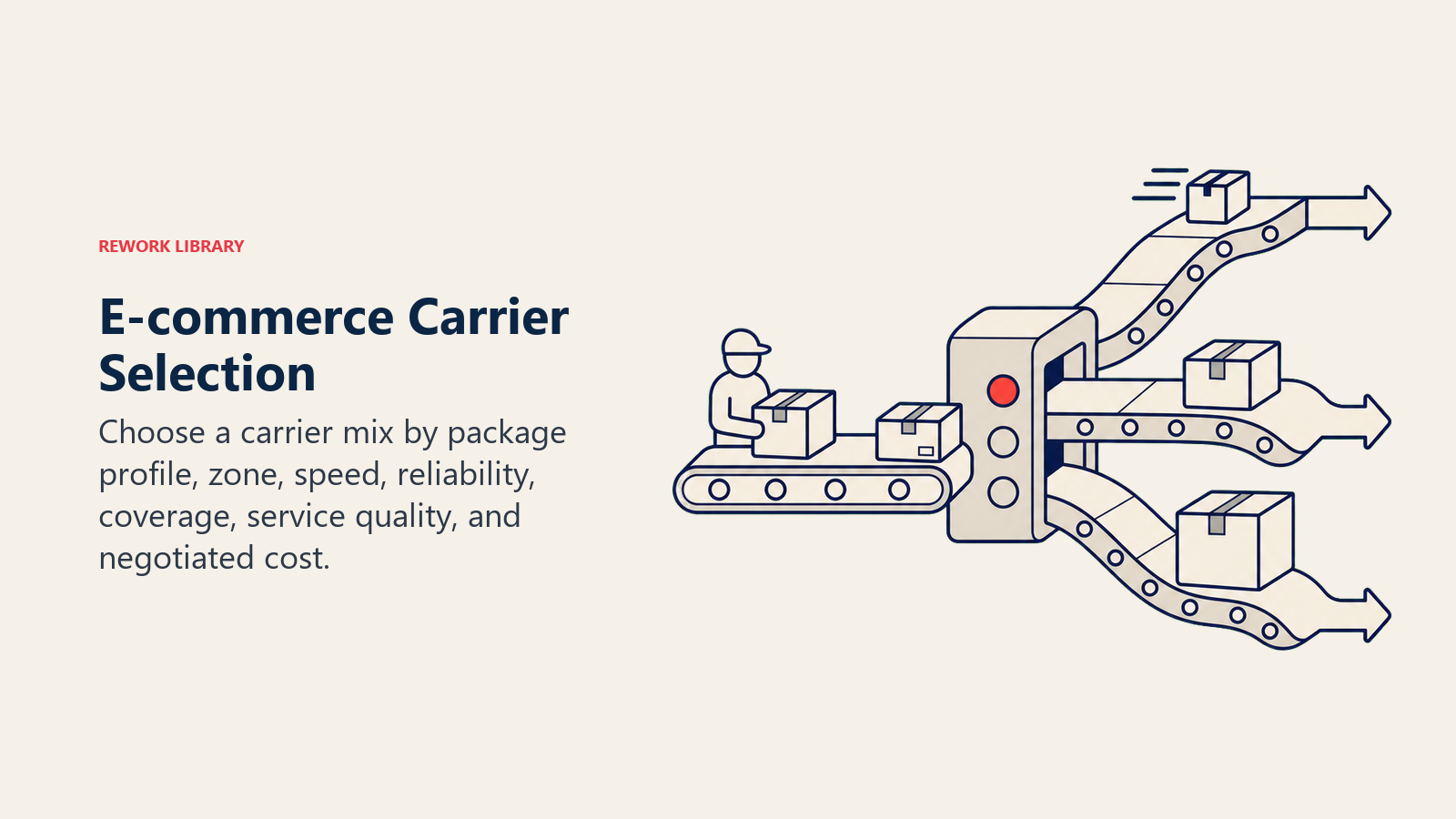
FedEx excels at express services and commercial delivery. FedEx Ground rivals UPS for reliability. FedEx Home Delivery offers evening and weekend service. SmartPost (like SurePost) combines FedEx pickup with USPS delivery. The drawbacks? Similar pricing to UPS, residential surcharges. Best for: express shipping, business delivery, time-sensitive products.
Regional carriers like OnTrac, LSO, and Lone Star Delivery offer 20-40% savings in their coverage areas with delivery speeds matching or beating nationals. They focus on specific regions (OnTrac covers Western U.S.) and provide personalized service. The drawbacks? Limited coverage areas and brand recognition. Best for: high-volume shippers in carrier regions.
Build a multi-carrier strategy. Use USPS for lightweight domestic, UPS/FedEx Ground for standard commercial, regional carriers where available, and express services for premium tiers. Most modern fulfillment strategies incorporate 2-3 carriers to optimize cost and service.
Evaluate carriers on:
- Rate structure: Base rates, surcharges, dimensional divisors
- Service quality: On-time delivery percentage, damage rates, claims process
- Volume discounts: Tiered pricing incentives, contractual minimums
- Coverage: Geographic zones, international capabilities, PO box delivery
- Integration: API quality, shipping software compatibility, tracking visibility
Request rate quotes at multiple volume tiers. A carrier's list rates mean nothing, negotiated rates reflect reality. Most carriers offer 30-60% discounts off published rates for businesses shipping 100+ packages monthly.
Shipping Speed Tiers & Customer Expectations
Speed tiers segment customers by urgency and willingness to pay. The psychology of speed matters as much as the economics. Standard shipping (5-7 business days) should be your baseline, the speed most customers accept for most purchases. Price standard shipping at or near cost, or offer free shipping above a threshold. Standard becomes the default option, the one customers choose when they're not in a rush. For most e-commerce categories, 60-75% of customers choose standard shipping when presented with tiered options.
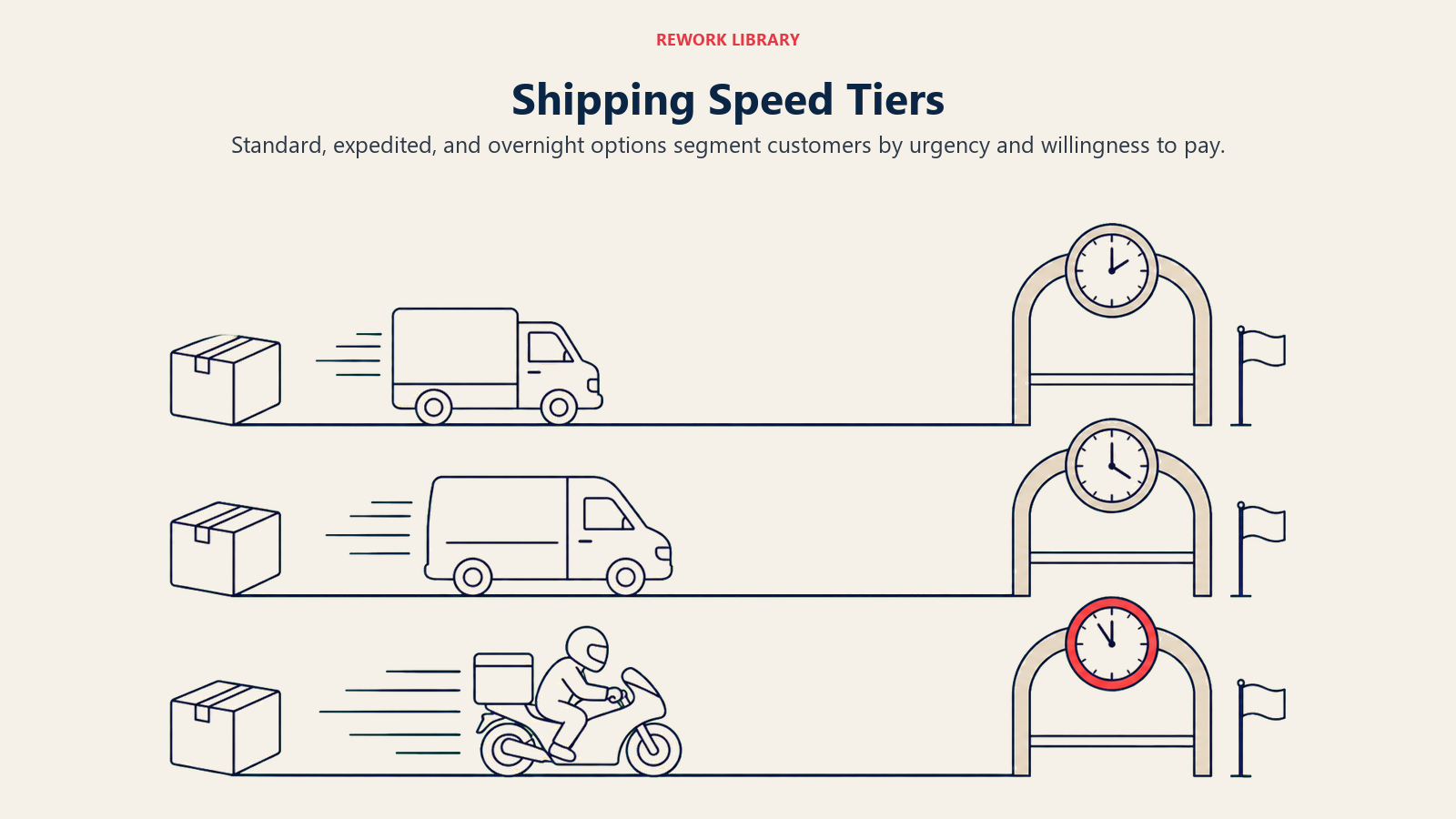
Expedited shipping (2-3 business days) creates a middle tier for customers who want products faster but won't pay next-day premiums. This tier typically costs 40-60% more than standard. Price it at 150-200% of your cost to maintain margin. About 20-30% of customers choose expedited when it's positioned as "get it by [specific date]" rather than "2-3 day shipping."
Next-day/overnight shipping serves urgent needs and premium customers. This tier costs 3-5× standard shipping. Price it at 200-300% of cost. Only 5-10% of customers choose next-day for typical products, but certain categories (replacement parts, event-related products, gifts) see 15-25% adoption.
Customer expectations vary dramatically by category. Apparel shoppers accept 5-7 day standard. Electronics buyers expect 2-3 days as standard. Replacement parts require next-day options. Benchmark your category, not all e-commerce.
Segment analysis reveals which customers pay for speed. New customers often choose faster shipping (unfamiliar with your reliability). Repeat customers trust your delivery promises and choose standard. High-AOV orders correlate with faster shipping selection. Gift purchases skew toward expedited/next-day.
The key insight: speed tiers create customer segmentation. Price-sensitive customers self-select into standard. Time-sensitive customers pay premium rates. This natural segmentation improves both customer lifetime value and operational efficiency.
Free Shipping Economics & Threshold Strategy
Free shipping isn't free, it's absorbed, subsidized, or built into product pricing. The question is whether free shipping improves overall profitability through higher conversion, larger orders, or customer retention. Calculate the financial impact before implementing free shipping:
- Current average shipping cost per order: $7.50
- Current average order value (AOV): $65
- Current conversion rate: 2.5%
- Gross margin: 45% If you absorb shipping costs completely, your gross margin drops from 45% to 33.5% ($7.50 / $65 = 11.5 percentage points). That's sustainable only if free shipping increases conversion or AOV enough to offset lost margin.
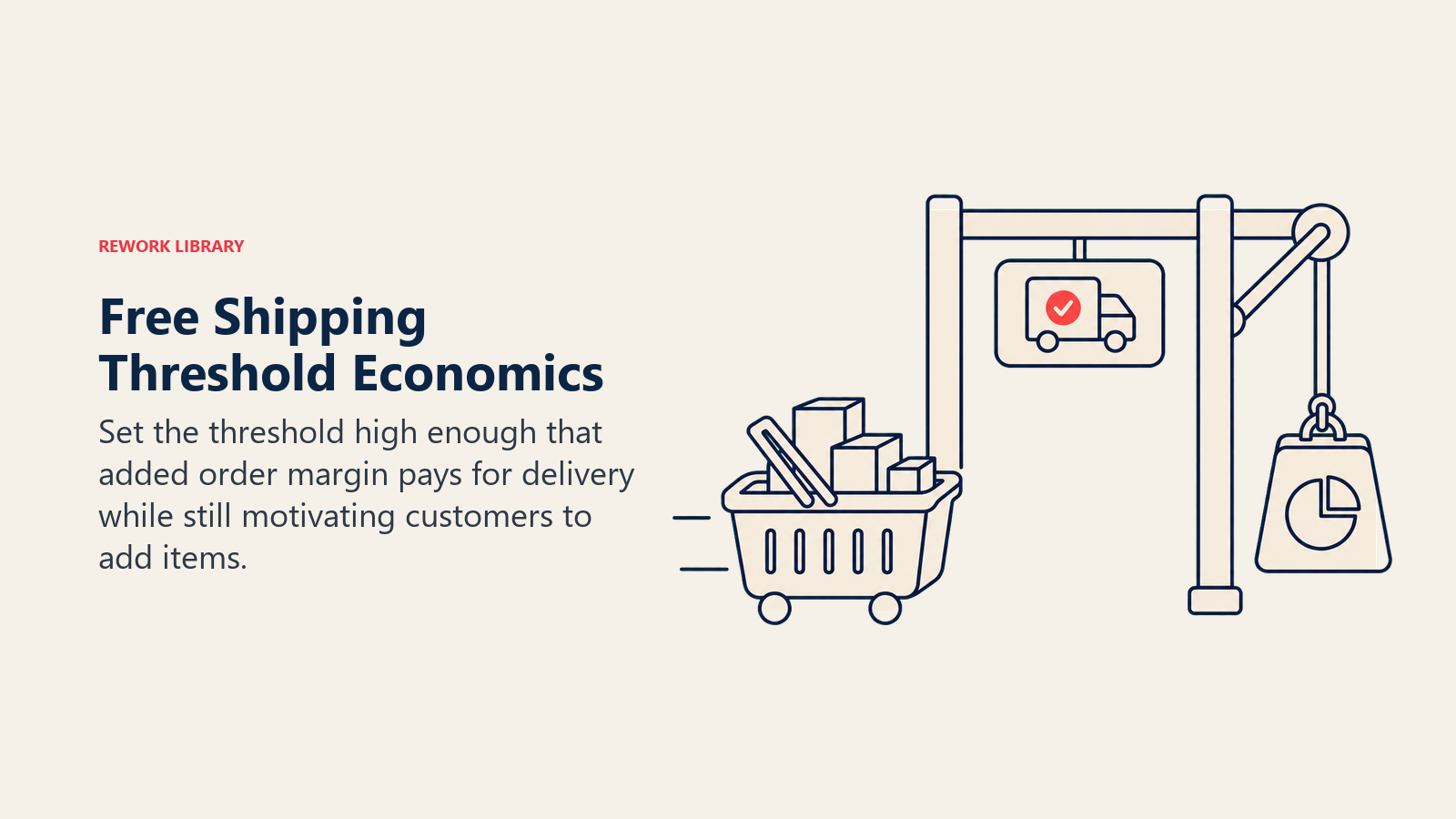
The math: You need AOV to increase by 25% (from $65 to $81.25) just to maintain the same gross profit dollars per order. Or conversion must increase by 34% (from 2.5% to 3.35%) to maintain total gross profit.
Threshold-based free shipping solves this by conditioning free shipping on minimum order values. The threshold should exceed your current AOV by 20-40% to encourage basket building while remaining achievable.
Example threshold calculation:
- Current AOV: $65
- Target threshold: $85 (30% increase)
- Average shipping cost: $7.50
- Expected behavior: 40% of customers add products to reach threshold
Result: Of customers who would have bought at $65, 40% now buy at $85 (adding $20 in products). Your gross margin on that $20 is $9 (45%). After absorbing $7.50 shipping, you net $1.50 more per order. The other 60% still pay shipping.
This strategy works because the psychology of "free" motivates basket building. Customers who see "Add $18 to qualify for free shipping" often add products they were considering anyway. This increases AOV while making shipping feel like a reward, not a penalty.
Weight limitations matter. If shipping costs scale with order size (heavier products, multiple items), unlimited free shipping above a threshold destroys margins. Set weight caps (e.g. "free shipping on orders $75+ up to 10 pounds") or exclude heavy items.
Geographic strategies help control costs. Offer free shipping only in low-cost zones, or set higher thresholds for expensive zones (West Coast customers need $100 vs $75 for East Coast). This feels less fair but preserves economics.
Free shipping should improve contribution margin, not destroy it. Model the scenarios before committing. For more on threshold strategy, see Free Shipping Thresholds.
Dynamic Shipping Pricing Models
Static shipping rates (one price for all customers, all destinations) leave money on the table. Dynamic pricing aligns charges with actual costs and customer willingness to pay.
Cost-plus pricing charges customers your actual carrier cost plus a fixed markup ($3-5) or percentage (20-30%). This ensures profitability on every shipment but can feel expensive in low-cost zones. Implementation requires real-time rate calculations from carrier APIs.
Flat-rate pricing charges one price regardless of destination. Simple for customers, simple to communicate. Works when your product/packaging is consistent and your customer base is geographically distributed. Set the flat rate at your 60th-70th percentile cost (not average) to avoid subsidizing expensive shipments.
Zone-based pricing varies rates by destination zone. Transparent and fair, closer customers pay less. Requires more complex pricing logic and customer communication but significantly improves margin in low-cost zones.
Weight-tiered pricing charges based on order weight brackets (0-2 lbs, 2-5 lbs, 5-10 lbs, etc.). Common in industries with variable product weights. Requires accurate product weights in your system.
Conditional pricing adjusts shipping rates based on:
- Order value: Free shipping over $X, discount shipping over $Y
- Customer segment: Free shipping for VIP/repeat customers, new customers pay full rate
- Product mix: Discounted shipping for certain products/categories
- Membership: Free shipping for subscription members, prime-style programs
- Promotional periods: Free shipping weekends, seasonal campaigns
The optimal model depends on your product characteristics, customer base, and competitive positioning. Test different approaches in different customer segments to find what maximizes contribution margin.
Real-time carrier rate calculation provides the most accuracy but adds technical complexity. For businesses shipping 1,000+ orders monthly, the margin improvement justifies the investment. Use platforms like ShipStation, Shippo, or EasyPost to access multi-carrier rates via API.
Packaging & Dimensional Weight Optimization
Packaging directly impacts shipping costs through dimensional weight calculations. The difference between a 12×10×8 box and a 14×12×10 box is $2-4 per shipment. Calculate DIM weight: (Length × Width × Height) / 139 (domestic) or 166 (international) Example:
- Option A: 14×12×10 box = 1,680 cubic inches / 139 = 12.1 lbs DIM weight
- Option B: 12×10×8 box = 960 cubic inches / 139 = 6.9 lbs DIM weight
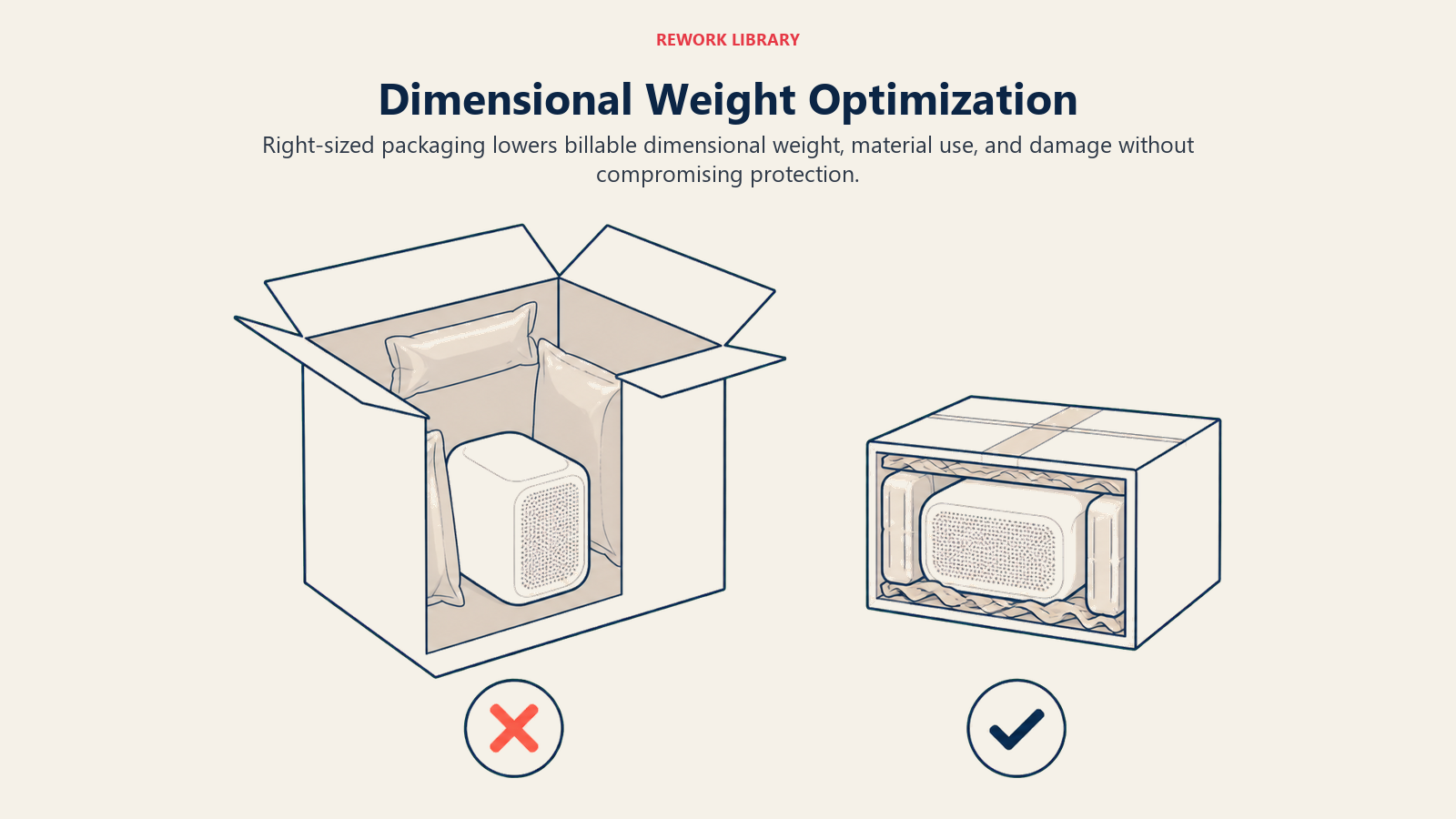
If actual product weight is 3 lbs, Option A ships at 12.1 lbs, Option B at 6.9 lbs. The rate difference is typically $3-5 per package. At 1,000 shipments monthly, right-sizing saves $3,000-5,000 annually.
Right-sizing strategies:
- Measure your 10 most-shipped products and create custom box sizes
- Use poly mailers for soft goods (apparel, textiles)
- Implement variable-size boxes (3-4 standard sizes covering 80%+ of orders)
- Avoid "one size fits all" packaging
Materials cost vs savings: Smaller boxes cost less in materials but require more SKUs. A custom box that saves $2 per shipment pays for itself immediately even if it costs $0.50 more than a standard box.
Branded packaging improves unboxing experience but often increases dimensional weight. Test whether branded packaging improves repeat purchase rates enough to justify higher shipping costs. For premium brands, the answer is usually yes. For commodity products, probably no.
Void fill (air pillows, packing paper, bubble wrap) protects products but adds weight and volume. Use minimal fill that prevents damage. Overfilled boxes increase DIM weight and waste materials.
Run a packaging audit quarterly:
- Identify your top 20% of products by shipment volume
- Measure actual package dimensions currently used
- Test smaller packaging alternatives
- Calculate DIM weight differences
- Model annual savings at volume
Most businesses discover 15-25% of shipments use oversized packaging. Fixing these outliers generates immediate margin improvement.
Speed Tier Positioning & Pricing Strategy
How you present shipping options at checkout affects both selection rates and customer satisfaction. Small changes in positioning drive meaningful revenue and margin differences. Presenting options: List shipping tiers from fastest to slowest (psychological anchoring) or slowest to fastest (budget positioning). Testing shows fastest-first increases expedited selection by 8-12% because customers see next-day first and mentally anchor there. Slowest-first increases standard selection.
Pricing gaps matter. If standard is $4.99, expedited at $7.99 feels minimal ($3 for faster delivery). Expedited at $12.99 feels expensive. The sweet spot for expedited pricing is 150-200% of standard. Test gaps to find where incremental revenue maximizes.
Default tier selection: Pre-selecting standard shipping is standard practice. Pre-selecting expedited (common in premium brands) increases expedited adoption by 15-20% because many customers don't change defaults. Use this carefully, it can feel manipulative if not aligned with brand positioning.
Delivery date display converts better than delivery speed. "Get it by Thursday, Jan 18" outperforms "2-3 day shipping" because it's concrete. Customers can visualize having the product. Calculate delivery dates based on current day/time and carrier transit times.
Promoting paid shipping: Paradoxically, some customers prefer to pay for shipping over "free" shipping built into product prices. Transparent pricing builds trust. Consider offering both: higher product prices with free shipping AND lower product prices with paid shipping. Let customers choose.
Upselling at checkout: When customers select standard shipping, show a message: "Get it 4 days faster for just $5 more." This works best when the date difference is meaningful (before a weekend, before an event) and the price difference is modest.
Guarantees: "Delivered by [date] or your shipping fee refunded" increases expedited selection. The actual refund rate is typically 1-2% (carriers are reliable) but the guarantee provides psychological safety.
The goal is making shipping decisions feel easy and fair. Confusion at checkout drives abandonment. Clarity drives completion. Apply checkout flow optimization principles to test your shipping options with real users and watch where they hesitate.
Cost Optimization Techniques
Reducing shipping costs without degrading service requires systematic optimization across operations. Negotiating volume discounts: Carriers offer tiered discounts based on monthly shipment volume. The jump from 500 to 1,000 packages monthly typically unlocks 5-10% additional discounts. Request rate reviews quarterly. Show competitive quotes to negotiate better rates. Many businesses accept initial rates without negotiation and overpay by 20-30%.
Regional carrier partnerships: If 40% of your volume ships to Texas and you're based in Texas, a regional carrier covering that area can reduce costs by 25-35% compared to national carriers. The complexity of multi-carrier routing is worth it at scale.
Consolidation and batch shipping: Consolidate multiple items from one order into a single package rather than shipping separately. Schedule carrier pickups at optimal times to qualify for volume pricing. Batch small orders when customers accept longer delivery windows.
Timing shipments strategically: Ship early in the week (Monday/Tuesday) so packages arrive before weekends. Use Saturday delivery only when customers pay for it. Avoid Friday shipments that sit in warehouses over weekends.
Analytics and auditing tools: Use shipping auditing software (like 71lbs, Shipware, AuditShipment) to identify billing errors, duplicate charges, and late deliveries eligible for refunds. Carriers make mistakes on 5-10% of invoices. Recovery saves $5,000-15,000 annually for businesses shipping 1,000+ packages monthly.
Dimensional weight optimization: Already covered in packaging, but worth repeating, this is the highest-impact optimization for most businesses.
Label cost reduction: Use thermal label printers (not laser/inkjet) to eliminate per-label costs. Buy labels in bulk. Use 4×6 labels (not 8.5×11) to reduce waste.
Insurance optimization: Carrier insurance is expensive ($1-3 per $100 insured). For low-value orders, self-insure by absorbing occasional losses. For high-value orders, use third-party insurance (like Shipsurance) at 40-50% lower rates.
Returns shipping: Don't offer free return shipping unless required by category norms. When you do, use prepaid labels only when customers initiate returns (not included in packages). This reduces fraudulent returns and unnecessary shipping costs.
Build a cost optimization checklist and review quarterly. Small improvements compound. A 5% reduction in shipping costs flows directly to bottom line.
Integration with Business Operations
Shipping strategy connects to nearly every operational decision. Treating it as isolated from inventory, warehousing, and returns creates inefficiencies.
Inventory location alignment: Stock fast-moving products in multiple warehouses to reduce shipping zones. If 40% of customers are in California and your warehouse is in Ohio, every shipment crosses 5-7 zones. Adding a California warehouse drops those to 1-2 zones, reducing costs by 30-40%. The inventory and warehousing costs must justify the shipping savings, but for high-volume SKUs, the math works. See 3PL Partner Selection for warehouse network strategies.
Warehouse placement decisions: Choose warehouse locations based on customer density, not just costs. Being near major carrier hubs (Memphis for FedEx, Louisville for UPS) speeds transit times and reduces costs. Proximity to ports benefits international shipments.
Return shipping strategy: Returns increase shipping costs by 15-30% in categories with high return rates (apparel, shoes). Strategies:
- Charge return shipping fees ($6-8 flat rate)
- Offer free returns only for exchanges, not refunds
- Provide return labels on request, not in every package
- Partner with local drop-off services (Happy Returns, ReturnBear) to consolidate returns
- Use slower return shipping (USPS Ground) since customers aren't waiting for returns
International shipping: Duty and tax handling affects customer experience and your costs. Delivered Duty Paid (DDP) means you handle customs and taxes, simpler for customers but increases your costs and complexity. Delivered Duty Unpaid (DDU) means customers pay at delivery, cheaper for you but risks refusal and returns. Most businesses start DDU and move to DDP for key markets as volume grows. See International Shipping for detailed frameworks.
Seasonal adjustments: Shipping costs and carrier capacity fluctuate seasonally. Peak season (October-December) brings surcharges of $3-5 per package and slower delivery times. Strategies:
- Stock up on inventory to ship earlier
- Set customer expectations with longer delivery estimates
- Increase shipping prices during peak periods
- Offer slower shipping tiers only during peak capacity constraints
Subscription and membership programs: Amazon Prime normalized free fast shipping, creating customer expectations. Consider membership programs where customers pay annual fees for free expedited shipping. This works when:
- Customer repeat purchase rate is high (3+ orders per year)
- Membership fee covers incremental shipping costs
- Psychological commitment increases purchase frequency
The membership fee ($49-99 annually) generates profit while building loyalty. Model your repeat customer cohort to see if this math works.
Competitive Benchmarking & Customer Communication
Your shipping strategy doesn't exist in a vacuum. Customers compare your shipping costs, speeds, and policies to alternatives.
Analyzing competitor strategies: Mystery shop 5-10 direct competitors quarterly. Document:
- Shipping speeds offered (standard, expedited, overnight)
- Shipping prices at different order values
- Free shipping thresholds
- Delivery time estimates
- Packaging quality
- Tracking visibility and communication
Identify patterns. If all competitors offer free shipping at $75, your $100 threshold disadvantages you. If competitors charge $8.99 for standard, your $4.99 creates competitive advantage.
Category expectations: Shipping norms vary dramatically. Electronics customers expect 2-3 day standard. Furniture customers accept 2-3 weeks. Apparel shoppers tolerate 5-7 days. Align your strategy with category expectations, not generic e-commerce averages.
Transparent cost communication: Hiding shipping costs until checkout drives abandonment and increases cart abandonment recovery efforts needed later. Display estimated shipping early in the shopping experience. Show delivery date ranges on product pages. If you offer free shipping, promote it prominently.
Delivery estimates: Under-promise and over-deliver. If your actual delivery time is 3-5 days, tell customers 5-7 days. Early arrivals delight. Late arrivals disappoint. Buffer estimates by 1-2 days for customer satisfaction.
Peak season management: Communicate extended delivery times before peak season. Send proactive emails to customers who order during high-volume periods: "Orders placed Dec 15-20 may take an extra 2-3 days." This sets expectations and reduces support contacts.
Tracking and notifications: Proactive shipping notifications reduce "where is my order" support tickets by 40-60%. Send:
- Order confirmation with expected delivery date
- Shipping confirmation with tracking number
- In-transit updates (optional, depends on brand style)
- Delivery confirmation
Most shipping platforms (ShipStation, Shopify, etc.) automate this. Enable these features, they're free margin protection.
Service recovery: When shipments run late or get lost, communicate proactively. Don't wait for customers to contact you. Monitor tracking and reach out when delays occur: "We see your order is delayed. Here's what we're doing..." This transforms negative experiences into loyalty moments.
Analytics, Testing & Continuous Improvement
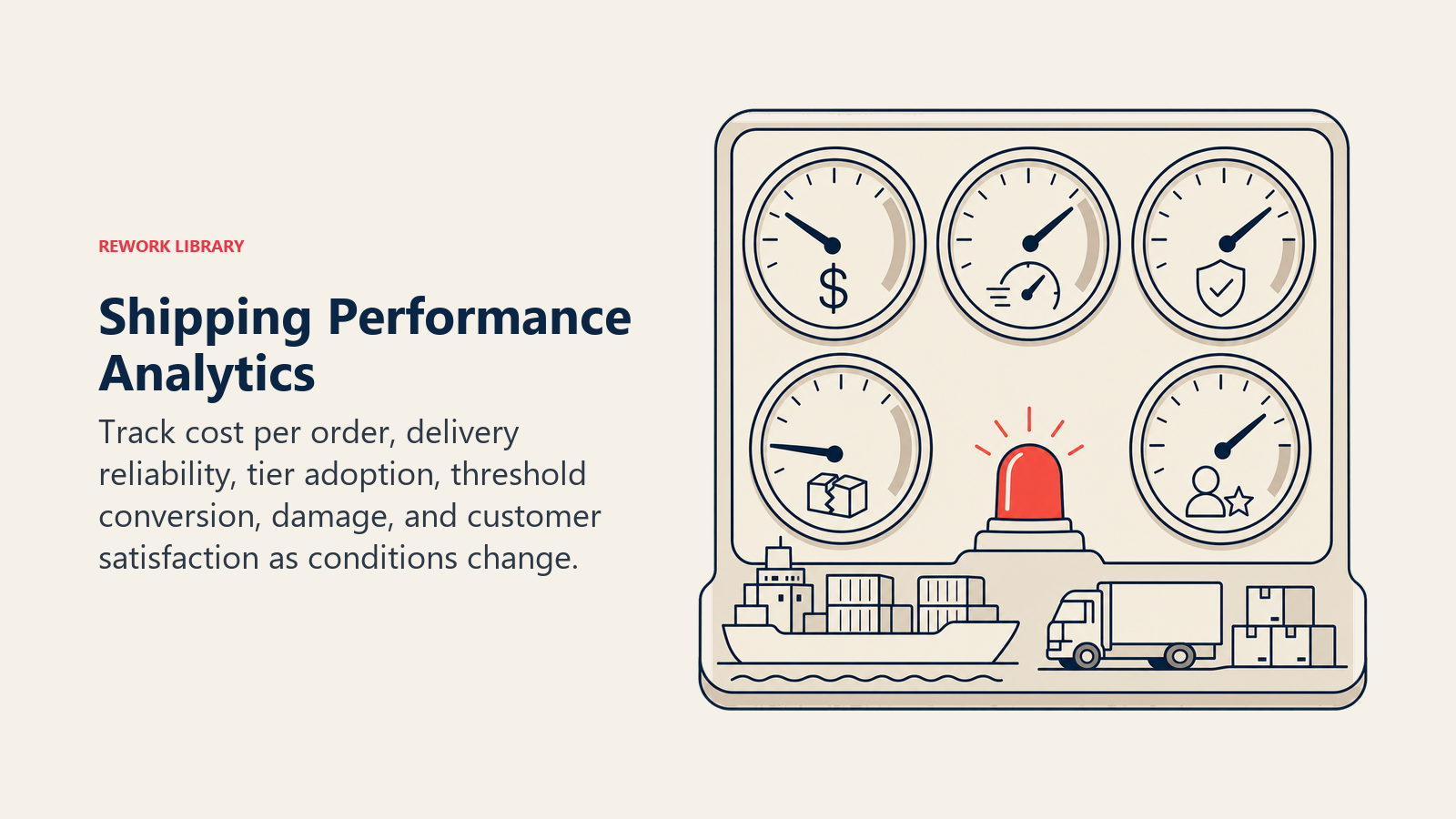
Shipping strategy requires ongoing measurement and optimization. What worked last quarter may not work next quarter as costs, volumes, and customer behaviors shift. Key metrics to track:
- Average cost per order: Total shipping spend / orders shipped
- Cost as percentage of revenue: Shipping costs / total revenue (target: 5-10% for most categories)
- Speed tier adoption rates: % selecting standard, expedited, overnight
- Free shipping threshold conversion: % of customers reaching threshold vs not
- Average dimensional weight: Tracking whether packaging optimization is working
- Late delivery rate: % of shipments missing carrier estimates
- Shipping-related support tickets: Volume of customer inquiries about shipping
- Cart abandonment at shipping: % of customers who reach checkout but abandon at shipping selection Monitor these monthly. Sudden changes signal issues. Gradual trends reveal opportunities.
A/B testing opportunities:
- Free shipping thresholds ($75 vs $85 vs $100)
- Tier pricing gaps ($4.99 standard + $9.99 expedited vs $4.99 + $12.99)
- Checkout presentation (fastest-first vs slowest-first)
- Delivery date display vs transit time display
- Default tier selection (standard vs expedited)
- Shipping discount promotions ($5 off shipping vs free shipping)
Run tests for 2-4 weeks to gather sufficient data. Measure impact on:
- Overall conversion rate
- Average order value
- Average shipping revenue per order
- Contribution margin per order (after shipping costs)
The goal isn't maximizing any single metric, it's maximizing contribution margin. A test that increases conversion by 5% but decreases margin by 15% fails.
High-cost zone identification: Analyze shipping costs by destination zone. If Zone 8 shipments cost $15 vs $6 for Zone 2, consider:
- Higher shipping charges for distant zones
- Longer delivery estimates to use cheaper carriers
- Adding warehouse locations in high-cost zones if volume justifies
- Excluding those zones from free shipping offers
Carrier performance monitoring: Track on-time delivery rates, damage rates, and claim resolution times by carrier. Switch carriers when performance degrades. Carriers know you're monitoring and often improve service when challenged with data.
Seasonal pattern analysis: Shipping costs and customer preferences shift seasonally. Q4 costs increase 20-40% while expedited selection rises. Summer sees more leisurely shopping with standard shipping dominating. Adjust thresholds and pricing by season.
Continuous improvement cadence:
- Weekly: Monitor high-level metrics for anomalies
- Monthly: Review detailed analytics and carrier performance
- Quarterly: Benchmark competitors, test pricing changes, audit packaging
- Annually: Renegotiate carrier contracts, evaluate warehouse network, model major strategic shifts
Shipping strategy is never "done." Customer expectations evolve, carrier rates change, and your business scales. The companies that win treat shipping as a dynamic competitive lever, not a static operational cost.
Your shipping strategy should drive profitability while meeting customer expectations. When your E-commerce Metrics & KPIs show shipping costs creeping above 10% of revenue or customer satisfaction declining, it's time to revisit your carrier mix, pricing structure, and operational integration. The frameworks in this guide provide the foundation. Your execution determines whether shipping becomes a competitive advantage or a margin drain.

On this page
- Shipping Cost Fundamentals
- Carrier Selection Framework
- Shipping Speed Tiers & Customer Expectations
- Free Shipping Economics & Threshold Strategy
- Dynamic Shipping Pricing Models
- Packaging & Dimensional Weight Optimization
- Speed Tier Positioning & Pricing Strategy
- Cost Optimization Techniques
- Integration with Business Operations
- Competitive Benchmarking & Customer Communication
- Analytics, Testing & Continuous Improvement