Discount Strategy: The Playbook for Profitable Promotions in E-commerce
Turn this article into takeaways for your work.


Each assistant summarizes the article only for you and suggests best practices for your work.
A discount strategy is the deliberate plan for when, how, and to whom you offer promotions so they drive ecommerce growth instead of eroding profit. The strongest strategies target specific outcomes (new customer acquisition, AOV lift, inventory clearance), protect contribution margin with break-even math, and segment offers so you never discount buyers who would have paid full price. Discounts are a tactic, not a business model.
Here's the uncomfortable truth about e-commerce discounts: you probably need them, but they can destroy your business if you get them wrong. Every discount you offer is a direct hit to your margin. Yet without them, you're leaving money on the table and losing customers to competitors who are willing to play the promotional game.
The difference between successful brands and those trapped in a race to the bottom isn't whether they discount. It's how strategically they use promotions to drive growth while protecting their economics.
This guide shows you how to build a discount framework that works. One that acquires customers profitably, moves inventory efficiently, and maintains brand value over time.
Why Discounts Matter in E-commerce
Discounts are one of the most powerful levers in your e-commerce toolkit. When you use them right, they accelerate business outcomes that would otherwise take months to achieve organically. Conversion rate impact: A well-timed discount can increase conversion rates by 20-50%. For a store converting at 2%, a targeted promotion raising that to 2.8% represents a 40% increase in revenue from the same traffic. The math is simple. Discounts reduce purchase friction for customers on the fence.
Average order value (AOV) manipulation: Volume discounts and thresholds push customers to add more items. Offer $15 off orders over $75, and customers at $60 will find that extra $15 in products. Your margin takes a hit on the discount, but the incremental $15 in products often more than compensates. Learn more about strategic AOV Optimization Strategy.
Customer acquisition economics: New customer acquisition is expensive. A strategic first-purchase discount can make your customer acquisition cost (CAC) work when the full-price math doesn't. If your Customer Lifetime Value (LTV) is $180 and your CAC is $60, offering a $20 discount on first orders still leaves you with healthy unit economics.
Inventory management: Seasonal products, overstocked items, and slow-moving SKUs tie up capital. Strategic discounting turns that inventory into cash, freeing up capital for better-performing products. A 30% discount that moves stagnant inventory is better than holding it for months.
Competitive positioning: In crowded categories, discounts give you a tactical edge. If three competitors offer similar products at similar prices, your promotion can tip the decision in your favor. The key is ensuring you're not always the cheapest, just cheaper when it strategically matters.
The challenge is deploying discounts intentionally, not reflexively. Too many e-commerce brands treat discounts as a panic button rather than a strategic tool.
Types of Discounts: Understanding Your Options
Different discount structures serve different strategic purposes. Choosing the right type matters as much as the discount amount itself. Percentage-based discounts: "20% off" is the most common structure. It's easy to understand and scales naturally with order size. The downside? Higher-priced items take a bigger absolute hit to margin. A 20% discount on a $30 product costs you $6, but on a $300 product, it's $60. Use percentage discounts when you want broad appeal and simplicity, but watch the margin impact on premium products. Dollar-amount discounts: "$15 off orders over $50" gives you better margin control. You know exactly what the promotion costs per order. Dollar discounts work particularly well for AOV manipulation, customers clearly see they need to hit a threshold. The tradeoff is that the perceived value decreases as order size increases. $15 off feels great on a $50 order (30% savings) but less impressive on $150 (10% savings).
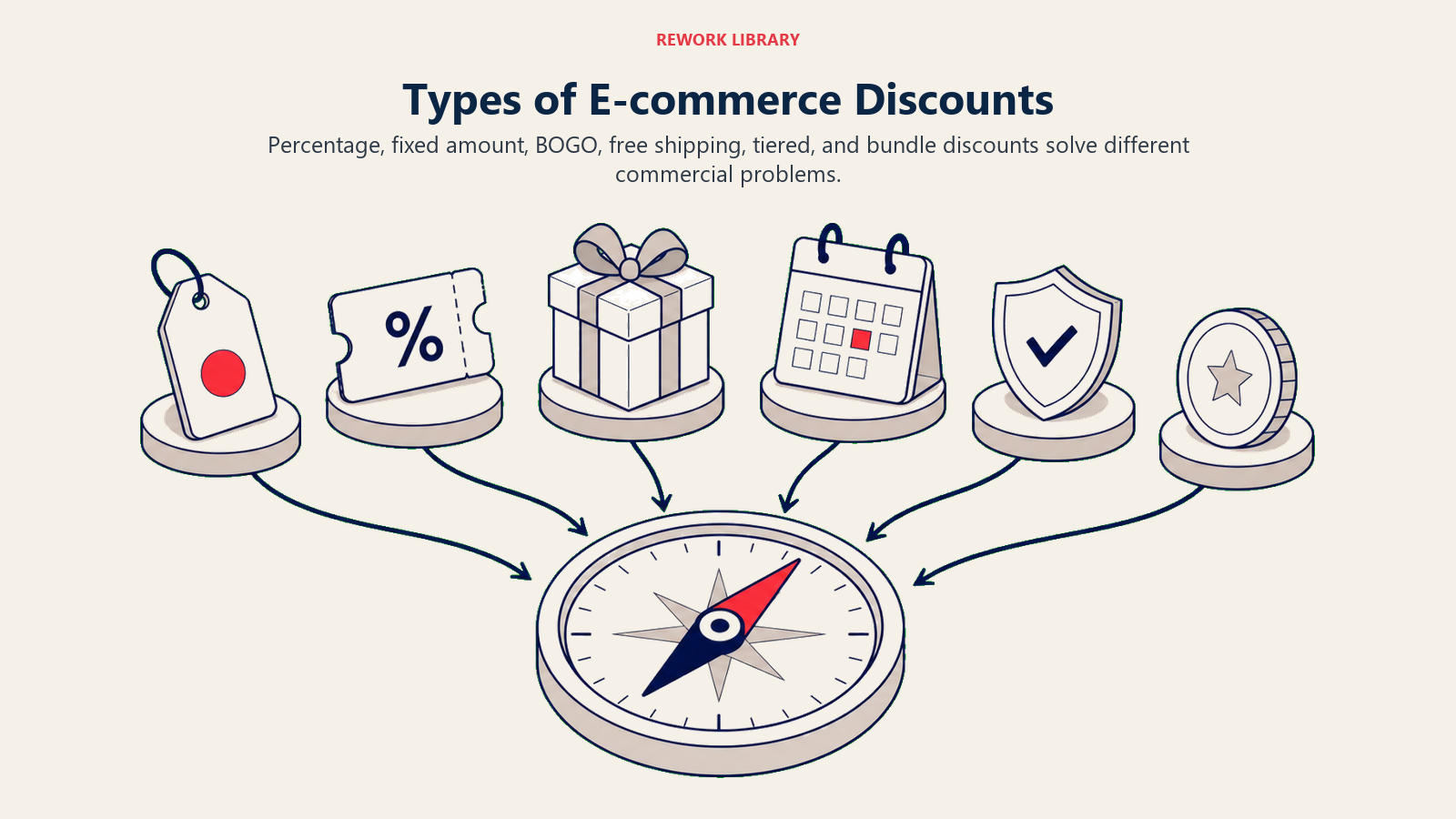
Dollar-amount discounts: "$15 off orders over $50" gives you better margin control. You know exactly what the promotion costs per order. Dollar discounts work particularly well for AOV manipulation, since customers clearly see they need to hit a threshold. The tradeoff is that the perceived value decreases as order size increases. $15 off feels great on a $50 order (30% savings) but less impressive on $150 (10% savings).
Buy One, Get One (BOGO): BOGO offers move volume fast and feel generous. The actual cost depends on your margin structure. If your product costs $10 to produce and sells for $40, a BOGO effectively sells two units for $40 ($20 each), not $20 total. Your margin shrinks but doesn't disappear. BOGO works best for products with high margins or when moving inventory quickly is the priority. For more on bundling approaches, see Product Bundling.
Free shipping: Often more effective than direct discounts. If your standard shipping is $8, offering free shipping on orders over $60 accomplishes two things: it removes a psychological barrier (shipping fees are universally hated) and creates a minimum order threshold. The cost to you is predictable and often lower than equivalent percentage discounts.
Volume and tiered discounts: "Buy 3, save 15%" or "Spend $100, get 20% off" encourage larger purchases. These work exceptionally well for consumable products or when targeting wholesale/bulk buyers. The margin hit is offset by increased volume and reduced per-order fulfillment costs.
Time-limited flash sales: Creating urgency drives immediate action. Flash Sales & Limited Offers work because they trigger FOMO (fear of missing out). The key is making them genuinely limited. If you run "24-hour flash sales" every week, they lose urgency. Use flash sales to spike revenue during slow periods or move specific inventory quickly.
The right discount type depends on your goal: new customer acquisition, AOV increase, inventory clearance, or competitive response. Most successful brands use different discount types for different strategic purposes rather than defaulting to one approach.
The Margin Protection Framework
Every discount decision should start with one question: can we afford this? Too many brands promote first and calculate the damage later. Understanding contribution margin: Your contribution margin is what's left after subtracting the variable costs of selling a product: cost of goods sold (COGS), payment processing fees, shipping, and any per-order costs. If you sell a product for $50, and it costs $20 to manufacture, $3 for payment processing, and $5 to ship, your contribution margin is $22 (44%). Every discount comes directly out of this contribution margin. A 20% discount ($10) on that $50 product drops your contribution margin from $22 to $12, a 45% reduction in profit. This is why understanding your true margins before discounting is critical.
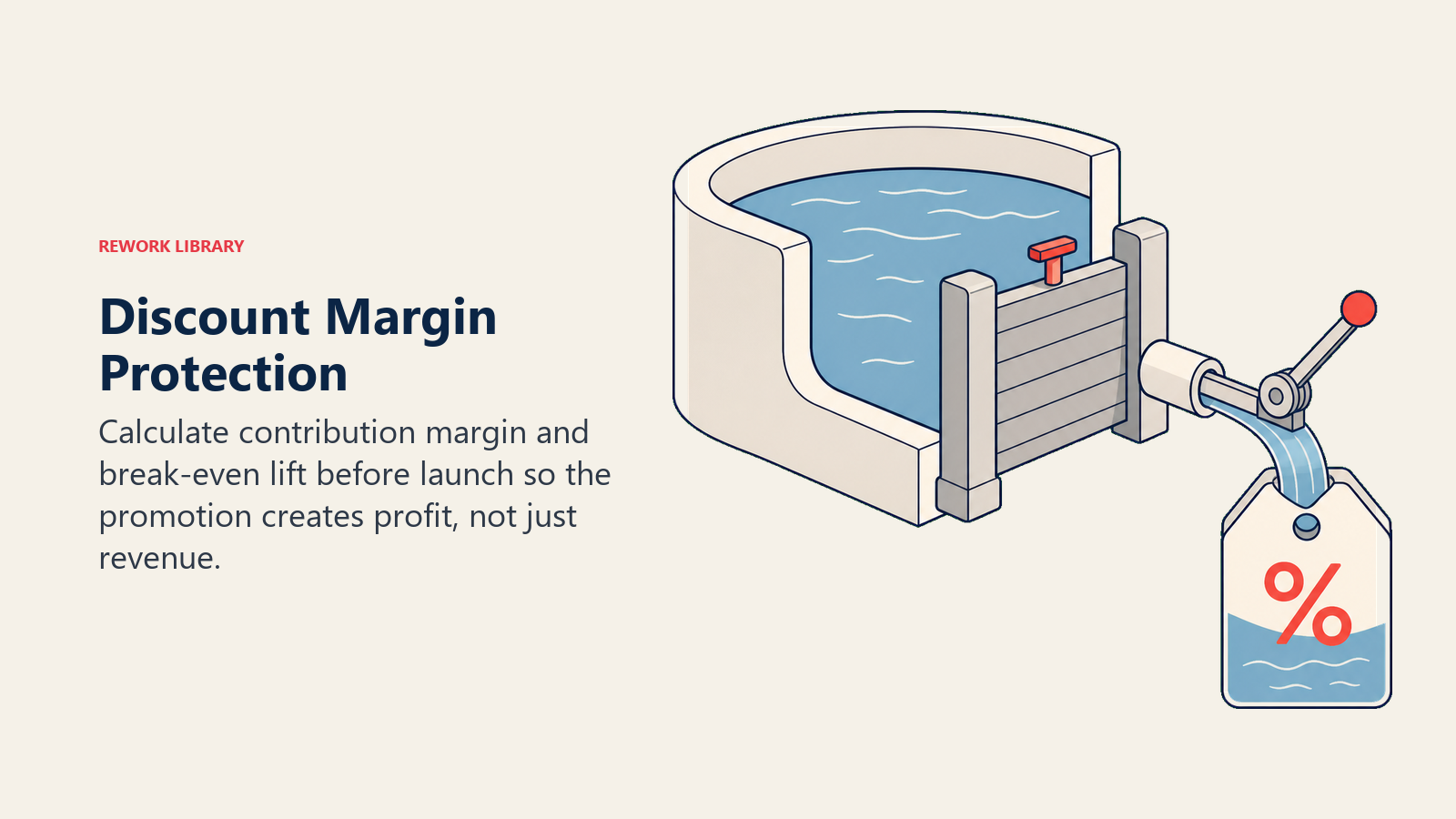
Every discount comes directly out of this contribution margin. A 20% discount ($10) on that $50 product drops your contribution margin from $22 to $12, a 45% reduction in profit. This is why understanding your true margins before discounting is critical.
Calculating break-even thresholds: For any promotion, calculate how much additional volume you need to maintain the same absolute profit. If your normal contribution margin is $22 per order and a promotion drops it to $12, you need 83% more orders to generate the same total profit. Can your promotion realistically deliver that lift? If not, you're intentionally accepting lower profit for other strategic reasons (customer acquisition, inventory clearance, market share).
Product margin segmentation: Not all products can afford the same discount. Segment your catalog by margin profile:
- High-margin products (50%+ contribution margin): Can sustain deeper discounts without destroying profitability. These are your promotional workhorses.
- Medium-margin products (30-50%): Require more careful discounting. Consider tiered offers or free shipping instead of straight percentage discounts.
- Low-margin products (below 30%): Should rarely be discounted directly. Bundle them with high-margin products or use them as loss leaders only when strategically justified.
Build a simple margin calculator that shows the impact of various discount levels on each product category. Before launching any promotion, run the numbers. A 5-minute calculation can prevent a month of unprofitable sales.
Protecting your baseline: The most dangerous discounts are those that cannibalize full-price sales. If 60% of people using your promotion would have bought at full price anyway, you're just giving away margin. This is why targeted discounting (new customers only, cart abandonment recovery, specific segments) beats broad site-wide sales.
Your overall pricing strategy and optimization should build in room for strategic discounts. If your margins are already razor-thin at full price, you have no promotional flexibility. Price products with enough margin to support occasional promotions without bleeding money.
Customer Segmentation Approach
The most profitable discount strategies don't treat all customers the same. Segment your audience and tailor promotions accordingly.
New customer acquisition: First-time buyers need different incentives than repeat customers. A 15-20% first-purchase discount reduces the risk of trying a new brand. The key is ensuring this discount is truly for new customers. Verify email addresses haven't been used before, and consider requiring account creation to prevent abuse.
Calculate your acceptable CAC and work backward. If you can spend $40 to acquire a customer with an LTV of $180, and your organic conversion rate is 1.5% with a $50 AOV, offering a $15 discount might push conversion to 3%, making your effective CAC $32.50 instead of $50. The discount pays for itself in lower acquisition costs.
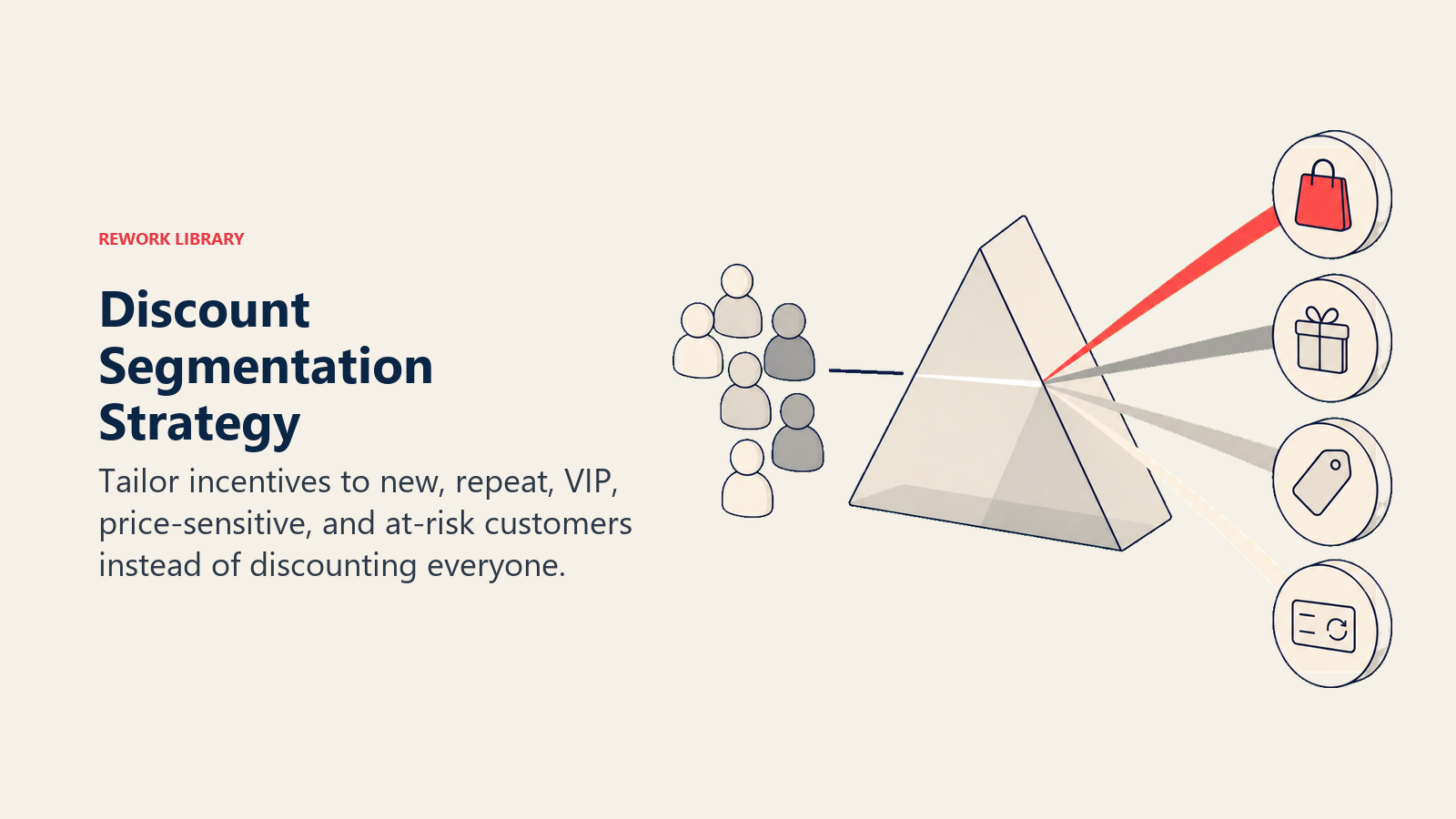
VIP and repeat customer protection: Your best customers are the ones who buy repeatedly at full price. Don't train them to wait for discounts. Create a separate rewards structure through loyalty programs, early access to new products, exclusive items, or VIP-only sales. When you do offer them promotions, make them feel special: "As a valued customer, here's 20% off, this week only."
The worst outcome is conditioning loyal customers to only buy during sales. If someone has purchased from you five times at full price, they don't need a discount to buy again.
Price-sensitive segments: Some customers will only buy on sale, and that's fine, but identify them and manage expectations. Create a "deals list" or "sale notification" segment so price-sensitive shoppers can self-select. This keeps discount promotions from diluting your brand to full-price customers while still capturing sales from the value-conscious segment.
Cart abandonment recovery: Abandoned carts represent immediate opportunities. A targeted 10-15% discount sent 2-4 hours after abandonment recovers conversions that would otherwise be lost. The margin hit is acceptable because these are incremental sales, and the alternative is $0. Track recovery rates to optimize timing and discount levels through cart abandonment recovery strategies.
Geographic and channel segmentation: Different markets and channels may justify different discounting approaches. First-time Instagram shoppers might need more incentive than Google search traffic with high purchase intent. International customers might respond better to free shipping than percentage discounts. Test and segment by customer source.
The goal is to give the right discount to the right person at the right time, not blast everyone with the same offer regardless of their purchase likelihood or history. Effective customer segmentation makes this targeting possible.
Strategic Discount Deployment
Random discounting is just margin erosion. Strategic discounting drives specific business outcomes at specific times.
Seasonal promotions and calendar planning: Build an annual promotional calendar aligned with your business cycle and customer expectations. Black Friday, Cyber Monday, and end-of-year holidays are unavoidable in most categories, so plan for them. But also identify your unique seasonal opportunities: back-to-school if you sell supplies, summer sales for winter inventory clearance, new year promotions for resolution-related products. Develop a comprehensive seasonal and promotional strategy that maps your entire year.
The key is spacing promotions to maintain scarcity. If you discount every month, customers learn to wait. A well-spaced calendar might look like: major promotion quarterly (25% off), mid-level promotions monthly (15% off or free shipping), and flash sales as needed for inventory management.
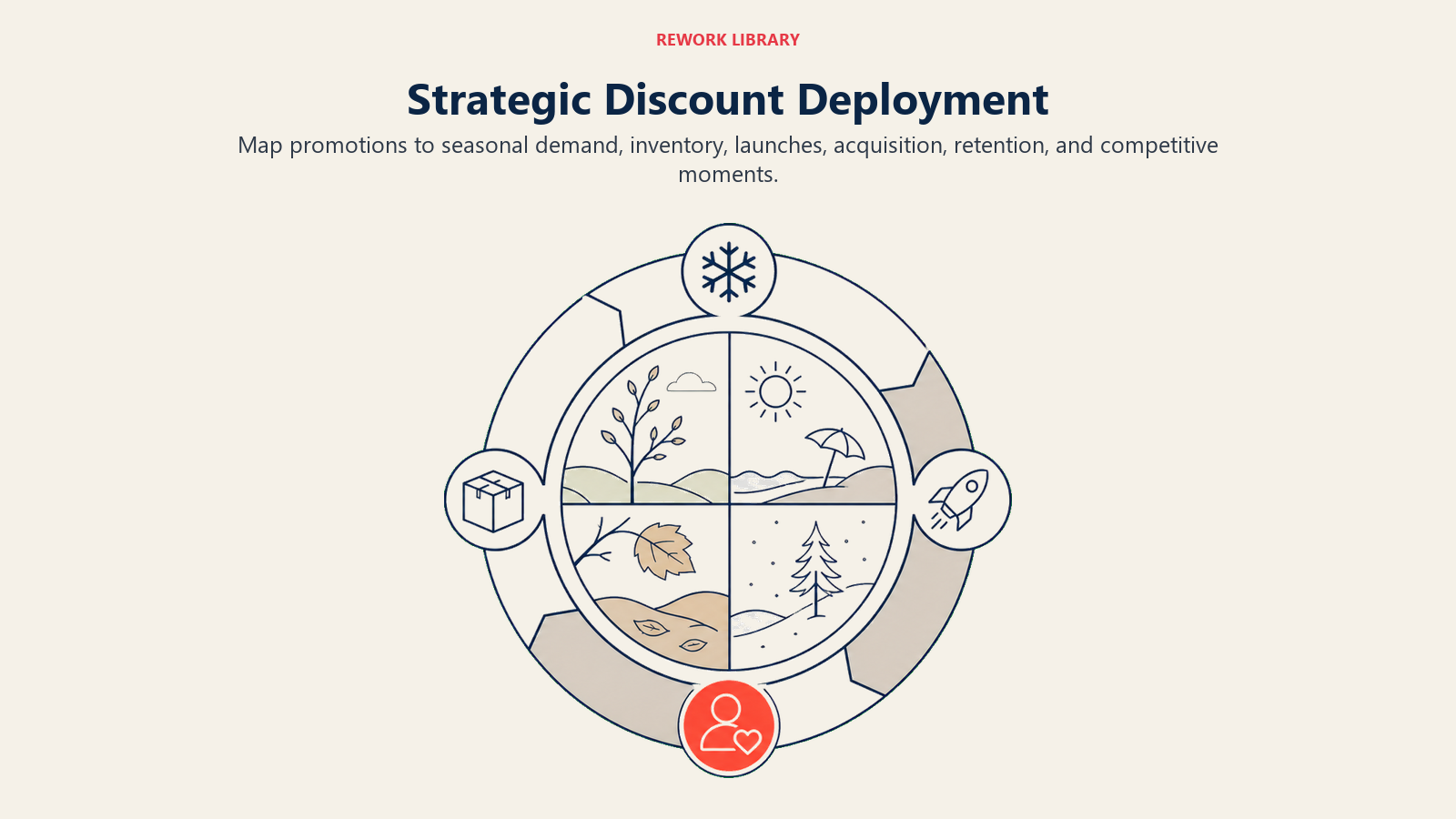
Inventory management discounts: Slow-moving inventory is dead capital. Identify products that haven't moved in 60-90 days and discount aggressively to clear them. A 40% discount that moves stagnant inventory is better than holding it for another quarter. Use email segmentation to promote clearance items to price-sensitive customers without broadcasting markdowns site-wide.
Run monthly inventory reports and create automatic discount triggers: 60 days = 20% off, 90 days = 30% off, 120 days = 40% off. This systematic approach prevents inventory from becoming a long-term burden.
New product launches: Strategic discounting can accelerate initial traction for new products. Offer early-bird pricing or bundle new products with established bestsellers at a slight discount. This generates reviews, social proof, and initial momentum. Once you have 20-30 reviews, phase out the launch discount and let the product sell on its own merits.
Competitive positioning: Monitor competitor promotions and respond tactically. If a major competitor runs a 25% off sale during a key shopping period, you may need to match or counter. But don't reflexively match every competitor discount. Choose your battles based on strategic importance and margin impact.
Testing and optimization: Treat promotions as experiments. A/B test discount levels (15% vs. 20%), structures (percentage vs. dollar amount), and messaging. Small changes can have big impacts. One e-commerce brand found that "$15 off orders over $60" outperformed "20% off" even though the percentage discount had a higher average value, because the dollar amount created a clearer threshold to hit. The more sophisticated your testing infrastructure, the more you can optimize promotional ROI.
Customer Training and Expectation Management
How you deploy discounts shapes how customers perceive your brand and when they choose to buy. Manage this carefully. Shaping customer perception: Frequent, predictable discounts train customers to wait for sales. If you offer 20% off every month, customers learn that full price is for suckers. The solution is making promotions genuinely intermittent and unpredictable. Yes, you'll run seasonal sales, but mix up the timing, structure, and eligibility for other promotions.
Brands like Apple rarely discount, which maintains perceived value. When they do offer promotions (education discounts, trade-ins), it feels strategic, not desperate. You don't need Apple's pricing power, but the principle applies: discounts should feel like opportunities, not expectations.
Creating scarcity and urgency: Make promotions time-bound and genuinely limited. "24-hour flash sale" works better than "sale continues..." for weeks. Countdown timers, limited inventory indicators, and clear end dates create urgency. But never fake scarcity, because customers can tell, and it destroys trust.
Communicating value, not just discounts: Frame promotions around value, not desperation. "Spring Refresh Sale: 20% off new arrivals" sounds better than "Everything Must Go!" The first suggests a curated selection and seasonal relevance; the second screams cash flow problems.
When announcing promotions, lead with the benefit: "Save on your favorite products," not "We're slashing prices because we need to move inventory." Positioning matters.
Frequency and timing: The right promotional cadence depends on your industry, average purchase frequency, and competition. For high-frequency purchases (skincare, supplements), monthly promotions might work. For infrequent purchases (furniture, electronics), quarterly may be enough.
Watch your baseline conversion rate. If full-price conversions drop significantly outside promotional periods, you're training customers to wait for sales. Pull back on promotional frequency and focus on value communication.
Measurement and Analytics
You can't optimize what you don't measure. Build a measurement framework that tells you which promotions work and which destroy value.
Incremental revenue attribution: The most important question: how much revenue would you have generated without the promotion? If you typically sell $50,000 per week and a promotion week generates $75,000, the incremental revenue is $25,000, not $75,000. Did the promotion cost more than $25,000 in margin? Then it lost money.
This is hard to measure perfectly, but you can approximate by comparing promoted weeks to non-promoted weeks, accounting for seasonality. The goal is understanding true lift, not just gross revenue.
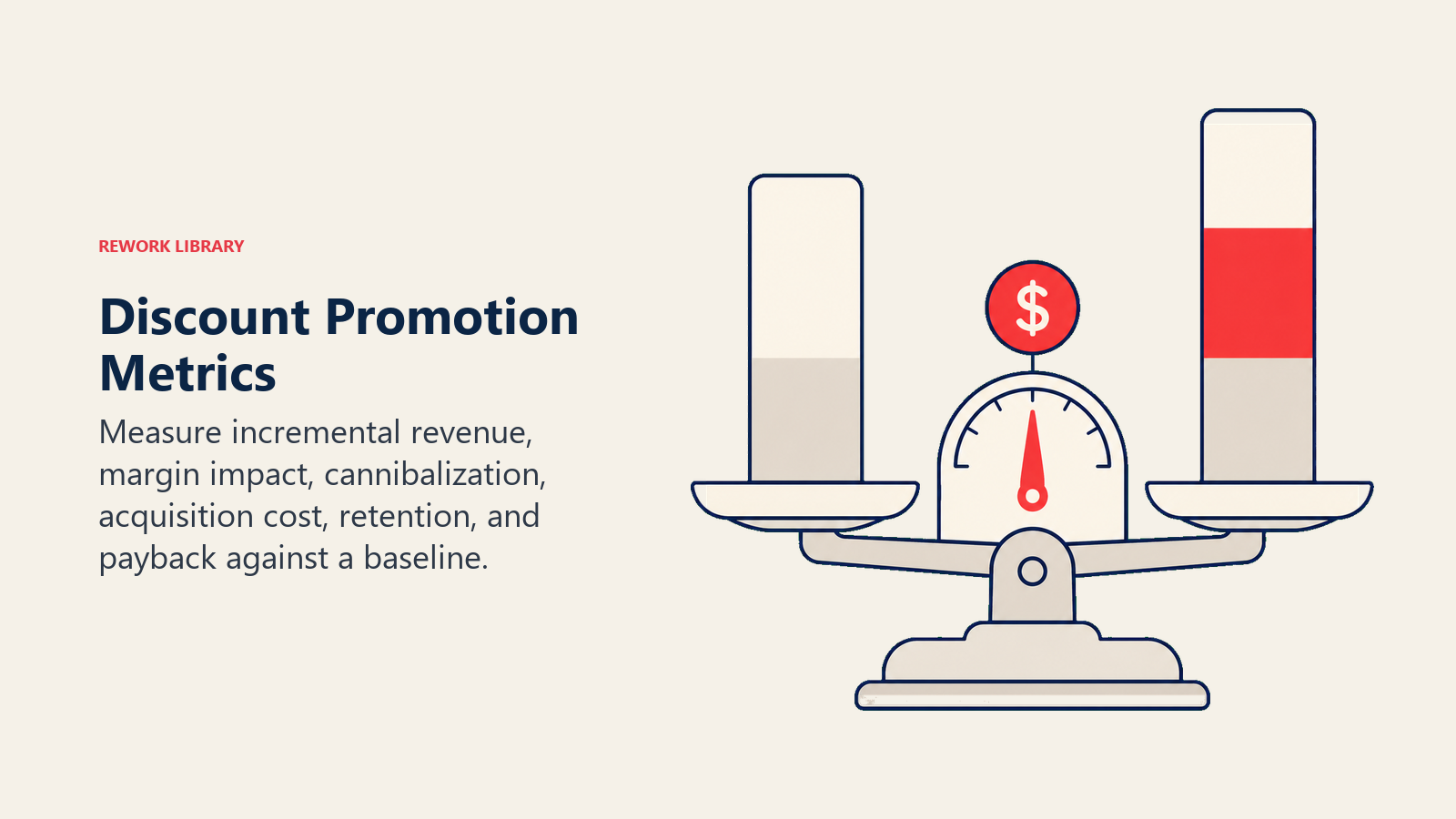
Margin impact analysis: Track promotion costs as a percentage of revenue. If a promotion generates $100,000 in revenue but costs $35,000 in discounts, that's a 35% promotional cost. Compare this to your typical contribution margin to see if the promotion was profitable.
Break this down by product category and discount type. You might find that 15% percentage discounts on high-margin products are profitable, while 20% discounts on low-margin products destroy value.
CAC by promotional channel: Track acquisition costs separately for promotional and non-promotional customers. If your average CAC is $40 and a promotion increases it to $55 but also increases first-order value from $60 to $80, the promotion improved your immediate payback period. Understanding unit economics for e-commerce helps you evaluate whether promotional economics make sense.
Repeat purchase behavior: The real test of a promotion is whether customers come back. Track repeat purchase rates for customers acquired through promotions versus full price. If promotional customers have a 15% repeat rate compared to 35% for full-price customers, your promotions are attracting deal-seekers, not brand loyalists.
Calculate customer lifetime value by acquisition channel. This tells you which promotions attract valuable customers versus one-time bargain hunters.
Cannibalization analysis: Measure how many promotional sales would have happened anyway. If you offer a site-wide sale and 70% of orders use the code, but your typical conversion rate suggests 60% would have bought regardless, you gave away margin on most sales.
Better targeting (new customers only, cart abandonment, lapsed customers) reduces cannibalization. Track code usage rates and conversion lift to optimize targeting.
Set up dashboard reports that show:
- Revenue lift (vs. baseline)
- Margin impact (total discount cost)
- Customer acquisition cost
- Repeat purchase rate by cohort
- Cannibalization estimate
Review these e-commerce metrics and KPIs after every major promotion and use them to inform future decisions.
Technology and Implementation
Running promotions smoothly requires the right technical infrastructure. Here's what you need.
Discount code management: Your e-commerce platform should support multiple code types: percentage, dollar amount, free shipping, and conditional rules. Create unique codes for different channels (INSTA15, EMAIL20) to track attribution. Set expiration dates and usage limits automatically.
Generate single-use codes for VIP customers or influencer partnerships to prevent sharing. Track code performance in real-time to see which channels drive the most conversions.
Conditional discount rules: Advanced platforms allow sophisticated rules: "15% off if cart total > $75 and customer is first-time buyer." This targeting reduces cannibalization. Build rules that stack discounts appropriately, or prevent stacking to protect margins.
Some platforms support automatic discounts that apply at checkout without codes, reducing friction. Test whether auto-apply discounts or code-required promotions perform better for your audience.
A/B testing frameworks: Run experiments on discount levels, messaging, and timing. Show half your email list 15% off, half 20% off, and measure conversion rates and profitability. Test discount presentation: "Save $15" versus "Get 20% off" to see which resonates better.
Your testing platform should integrate with your analytics to connect promotion exposure to purchases and margin impact. Small test-based improvements compound over time.
Dynamic discount optimization: More sophisticated brands use AI-powered tools that adjust discount offers based on customer behavior, predicted conversion likelihood, and inventory levels. If a customer has viewed a product three times and added it to cart twice, a 10% offer might close the sale. Someone visiting for the first time might need 20%.
These tools require significant traffic volume to work effectively but can meaningfully improve promotional ROI at scale.
Integration with email and SMS: Your discount system should feed directly into email and SMS campaigns. Segment customers by behavior (cart abandoners, lapsed customers, VIPs) and send targeted offers automatically. Track which segments respond to which discount levels.
Personalized discount codes (unique to each recipient) increase perceived value and prevent sharing. "Here's your exclusive code: JOHN15" feels more special than a generic site-wide offer.
Common Discount Mistakes to Avoid
Even experienced e-commerce operators make costly promotional errors. Here's what to watch for. Discounting too frequently: The fastest way to destroy brand value is constant promotions. If customers know there's always a sale coming, they'll never pay full price. Pull back on frequency and make promotions genuinely special. Scarcity creates value.
Site-wide discounts without segmentation: Blasting 25% off to everyone, including customers who would have paid full price, is pure margin destruction. Target new customers, cart abandoners, or price-sensitive segments. Protect your core buyers from discounts they don't need.
Ignoring margin math: Offering 30% off a product with 35% margins leaves you with 5% contribution margin, barely enough to cover fixed costs. Run the numbers before promoting. Some products simply can't afford deep discounts.
No clear strategy or measurement: Running promotions without tracking incremental lift, repeat rates, or margin impact is guesswork. Build measurement into every campaign so you can optimize future efforts.
Training customers to expect discounts: Once customers learn to wait for sales, it's hard to break the pattern. Avoid setting expectations with regular, predictable promotions. Mix timing and structure to keep customers guessing.
Forgetting competitive implications: If you constantly undercut competitors on price, you'll start a race to the bottom that no one wins. Compete on value, selection, and experience, and use promotions tactically, not as your core positioning.
Neglecting full-price value communication: If your only message is "buy now, it's on sale," customers forget why they should care about your brand. Balance promotional messaging with content that builds brand value, showcases product benefits, and creates emotional connection.
Building Your Discount Roadmap
Strategic discounting requires planning, not panic. Here's how to build an annual promotional roadmap.
Quarterly planning sessions: Review last quarter's promotional performance and plan the next quarter. Identify seasonal opportunities, inventory concerns, and competitive dynamics. Set revenue and margin goals for each promotion.
Annual promotional calendar: Map major promotions to the calendar: Black Friday/Cyber Monday (November), end-of-year (December), New Year (January), spring sales (March/April), summer clearance (July), back-to-school if relevant (August). Space out promotions to maintain scarcity.
Include flexibility for tactical promotions, inventory clearance, competitive response, slow weeks. But keep these limited to maintain the integrity of your planned calendar.
Budget allocation by category: Assign promotional budgets by product category based on margin capacity. High-margin categories can sustain deeper, more frequent discounts. Low-margin categories get lighter, more targeted promotions.
Track spending throughout the year to ensure you're not over-discounting and destroying annual profitability.
Category-specific strategies: Different product categories need different approaches. Fashion and apparel require seasonal clearance. Electronics benefit from holiday promotions. Consumables work well with subscription discounts and volume pricing.
Build promotional playbooks for each major category that define appropriate discount levels, timing, and targeting.
Testing and optimization schedule: Dedicate 10-20% of your promotional activity to testing. Try new discount structures, messaging, and segments. Document what works and incorporate learnings into future campaigns.
Quarterly reviews should assess which promotions drove profitable growth and which destroyed value. Double down on winners, eliminate losers.
Conclusion: Discounts as a Tactical Tool, Not a Business Model
Discounts are powerful when used strategically. They can acquire customers, move inventory, and drive short-term revenue spikes. But they're a tactic, not a strategy.
The brands that win long-term are those that build value beyond price, quality products, excellent experience, strong brand identity. Discounts support these goals tactically but never replace them.
Your discount framework should answer three questions:
- What business outcome are we trying to achieve?
- Can we afford this promotion while maintaining healthy margins?
- How will we measure success and learn for next time?
If you can answer those questions clearly for every promotion, you're using discounts strategically. If you're offering discounts because it's been a few weeks since the last sale, or because competitors are promoting, or because traffic is slow, you're being reactive, not strategic.
Build a promotion calendar, protect your margins, segment your customers, and measure ruthlessly. Use discounts to accelerate growth, not substitute for it.
The best discount strategy is one where promotions feel rare and special to customers, profitable to you, and aligned with clear business goals. That's how you use discounts to grow without destroying the value you've built.
Frequently Asked Questions about Discount Strategy for Ecommerce Growth
What is a good discount strategy for ecommerce growth?
A good strategy ties every promotion to a specific goal, protects contribution margin with break-even math, and targets the right segment (new customers, cart abandoners, slow inventory) so you avoid discounting full-price buyers. Use a planned calendar rather than reactive sales.
Percentage or dollar-amount discount, which is better?
Percentage discounts ("20% off") are simple and scale with order size but hit premium items harder. Dollar discounts ("$15 off orders over $50") give cleaner margin control and create a clear threshold for AOV lift. Many brands find a dollar amount converts better even when its average value is lower.
How much can I discount without losing money?
Calculate your contribution margin first, then how much extra volume the discount needs to break even. A 20% cut on a 44% margin product can drop profit per order by roughly 45%, so high-margin products absorb deep discounts while sub-30% margin items rarely should be discounted directly.
Do frequent discounts hurt my brand?
Yes. Predictable, frequent sales train customers to wait and treat full price as a penalty. Keep promotions intermittent and varied in timing and structure so they feel like opportunities, not expectations.
How do I measure if a promotion actually worked?
Track incremental revenue against your baseline, total discount cost as a percent of revenue, CAC by promotional channel, repeat purchase rate by cohort, and a cannibalization estimate. If most code users would have bought anyway, you gave away margin.
Related Resources
Deepen your promotional strategy with these complementary guides:
- Flash Sales & Limited Offers - Create urgency-driven promotions that spike revenue without training customers to wait for discounts.
- AOV Optimization Strategy - Learn how to increase order values through bundling, thresholds, and upsells that work alongside discount strategies.
- Seasonal & Promotional Strategy - Build an annual promotional calendar that balances revenue goals with margin protection.
- Unit Economics for E-commerce - Master the financial fundamentals that determine which discounts you can afford and which will destroy profitability.

On this page
- Why Discounts Matter in E-commerce
- Types of Discounts: Understanding Your Options
- The Margin Protection Framework
- Customer Segmentation Approach
- Strategic Discount Deployment
- Customer Training and Expectation Management
- Measurement and Analytics
- Technology and Implementation
- Common Discount Mistakes to Avoid
- Building Your Discount Roadmap
- Conclusion: Discounts as a Tactical Tool, Not a Business Model
- Related Resources