Hero Product Strategy: Identifying and Scaling Your Revenue Engine

Turn this article into takeaways for your work.


Each assistant summarizes the article only for you and suggests best practices for your work.
Here's the uncomfortable truth about e-commerce: most brands don't have a product portfolio problem. They have a focus problem.
The data tells a clear story. Across thousands of e-commerce businesses, one product consistently drives 40-60% of total revenue. Another 2-3 products account for an additional 25-30%. The remaining 70-80% of your catalog? They're collectively responsible for less than 20% of revenue.
This isn't a bug. It's a feature of successful e-commerce.
The brands that scale profitably understand this concentration and lean into it. They identify their hero product early, allocate resources accordingly, and build their entire growth strategy around making that one product unstoppable. The brands that struggle spread resources evenly across their catalog, treating every product like it deserves equal attention.
Let's talk about how to identify your hero product, scale it intelligently, and build a portfolio strategy that actually drives growth. This starts with thorough product research and validation to understand which products have true hero potential.
What Makes a Hero Product
A hero product isn't just your best-seller. It's the product that fundamentally defines your brand's growth trajectory. Revenue concentration is the obvious indicator. If one product drives 40-60% of your revenue, you've found your hero. But revenue alone doesn't tell the complete story.
Customer acquisition cost efficiency matters more than volume. Your hero product should have the lowest CAC in your portfolio, often 30-50% lower than other products. This isn't because it's cheaper to market. It's because it converts better, resonates more deeply, and attracts customers who are ready to buy. Effective conversion rate optimization ensures your hero product maintains this advantage.
Brand association is the ultimate test. When someone thinks of your brand, they should immediately think of your hero product. Allbirds has Wool Runners. Away has their carry-on suitcase. Dollar Shave Club had their 5-blade razor. The hero product IS the brand in most customers' minds.
Repeat purchase patterns reveal product strength. Hero products typically drive 2-3x higher repeat purchase rates than other items in your catalog. Customers buy it once, love it, and either buy it again or bring friends.
Look at your portfolio through this lens. If you can't immediately identify your hero product, you probably don't have one, and that's your first strategic problem to solve.
Identifying Hero Product Candidates
Most brands already have hero product data, they just haven't organized it properly. Start with sales velocity analysis over the past 12 months. Don't just look at total revenue. Examine revenue per SKU, units sold, and revenue growth rate. The hero product candidate should rank in the top 3 for all three metrics. Compare CAC across products using your attribution data. Calculate the fully-loaded customer acquisition cost for first-time buyers of each product. Include paid advertising, influencer marketing, content marketing, and any product-specific campaigns. Your hero product should have the most efficient CAC ratio.
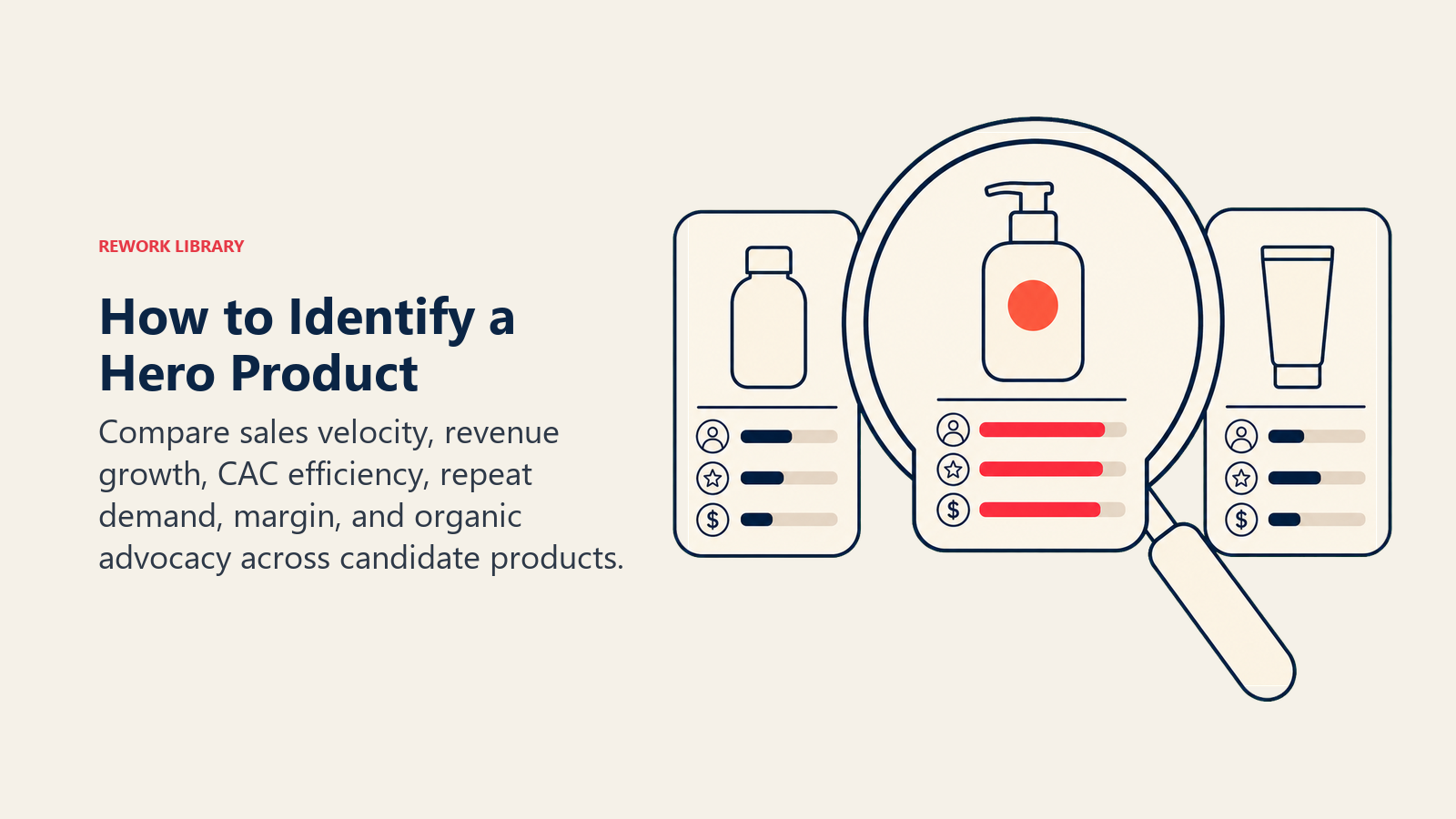
Analyze repeat purchase rates by initial product. What product do customers buy first? What do they buy again? The hero product typically scores highest on both metrics. This creates a compounding effect where new customers become repeat customers, reducing your blended CAC over time.
Review customer feedback and rating patterns. Hero products typically have 4.5+ star ratings with high review volume. More importantly, the reviews should mention specific outcomes and benefits, not just generic praise. "This changed my morning routine" beats "Good product" every time. Learn how to leverage customer reviews and user-generated content to amplify your hero product's credibility.
Examine organic search and social mention volume. Tools like Google Trends, SEMrush, and social listening platforms reveal which products generate organic interest. Hero products get talked about without prompting because they solve real problems in memorable ways.
Here's a simple scoring framework:
Hero Product Identification Checklist:
- Revenue contribution: 40%+ of total revenue (25 points)
- CAC efficiency: 30%+ lower than portfolio average (20 points)
- Repeat purchase rate: 2x+ portfolio average (15 points)
- Customer rating: 4.5+ stars with 100+ reviews (15 points)
- Organic search volume: Top 3 in brand + product searches (15 points)
- Growth trajectory: 20%+ YoY growth (10 points)
Total score of 70+ indicates a true hero product candidate. 50-69 suggests a strong supporting product. Below 50 means the product needs repositioning or retirement.
Run this analysis quarterly. Hero products can shift as markets evolve and customer preferences change. For deeper insights on tracking performance, see our guide on e-commerce metrics and KPIs.
Portfolio Positioning Strategy
Once you've identified your hero product, the next question is: how does everything else fit? Your hero product should be the center of your portfolio architecture. Everything else exists to either feed customers toward the hero product or extend the relationship after the hero purchase. Gateway products introduce customers to your brand at lower price points. These products should have CAC similar to your hero but lower average order values. They're not about immediate profitability - they're about customer acquisition. Think of them as paid marketing that happens to generate some revenue.
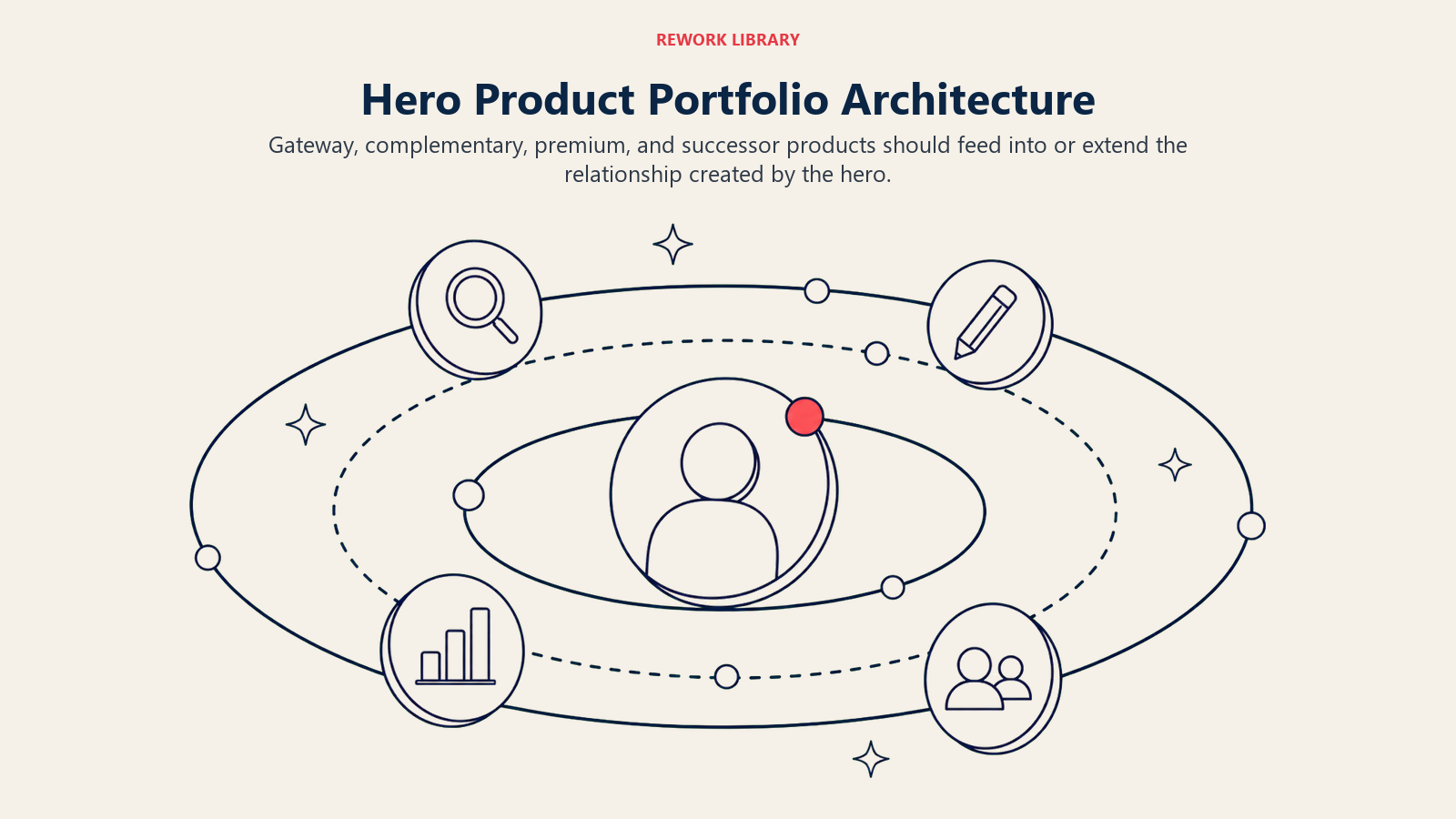
Example: A skincare brand with an $85 hero serum might offer a $25 cleanser as a gateway product. Lower margin, but it gets customers into the ecosystem.
Premium products extend customer lifetime value for your most engaged customers. These sit above your hero in price and sophistication. They typically have lower conversion rates but much higher margins. You're not marketing these broadly - you're offering them to existing customers who've already purchased your hero product multiple times. Understanding how to maximize customer lifetime value is critical for this tier.
Complementary products enhance the hero product experience. These are natural add-ons that improve results or extend usage. Think accessories, refills, or related items that customers logically purchase together. Strategic upselling and cross-selling around your hero product can significantly boost average order value.
Portfolio matrix framework:
| Product Type | Price vs. Hero | CAC Investment | Marketing Focus | % of SKUs |
|---|---|---|---|---|
| Hero | Baseline | 60-70% of budget | Broad acquisition | 1-2 SKUs |
| Gateway | 30-50% lower | 15-20% of budget | Top-of-funnel | 2-3 SKUs |
| Premium | 40-100% higher | 5-10% of budget | Existing customers | 1-2 SKUs |
| Complementary | Varies | 10-15% of budget | Post-purchase | 3-5 SKUs |
Total portfolio should be 7-12 SKUs for most brands under $10M in revenue. More than that and you're diluting focus. Fewer than that and you're limiting customer lifetime value.
The key insight: every product should have a clear strategic role relative to your hero product. If you can't articulate that role in one sentence, the product shouldn't be in your catalog.
Resource Allocation Framework
Most brands get hero product strategy wrong here: they identify the hero, then continue spreading resources evenly across the portfolio. Marketing budget should concentrate on the hero product. Allocate 60-70% of your total marketing spend to hero product acquisition and scaling. This feels uncomfortable at first, until you realize this product drives 40-60% of revenue at the best unit economics. Paid advertising budget allocation:
- Hero product: 65% (acquisition campaigns, retargeting, brand campaigns)
- Gateway products: 20% (top-of-funnel, testing channels)
- Premium products: 5% (existing customer retargeting only)
- Complementary products: 10% (post-purchase, cross-sell campaigns)
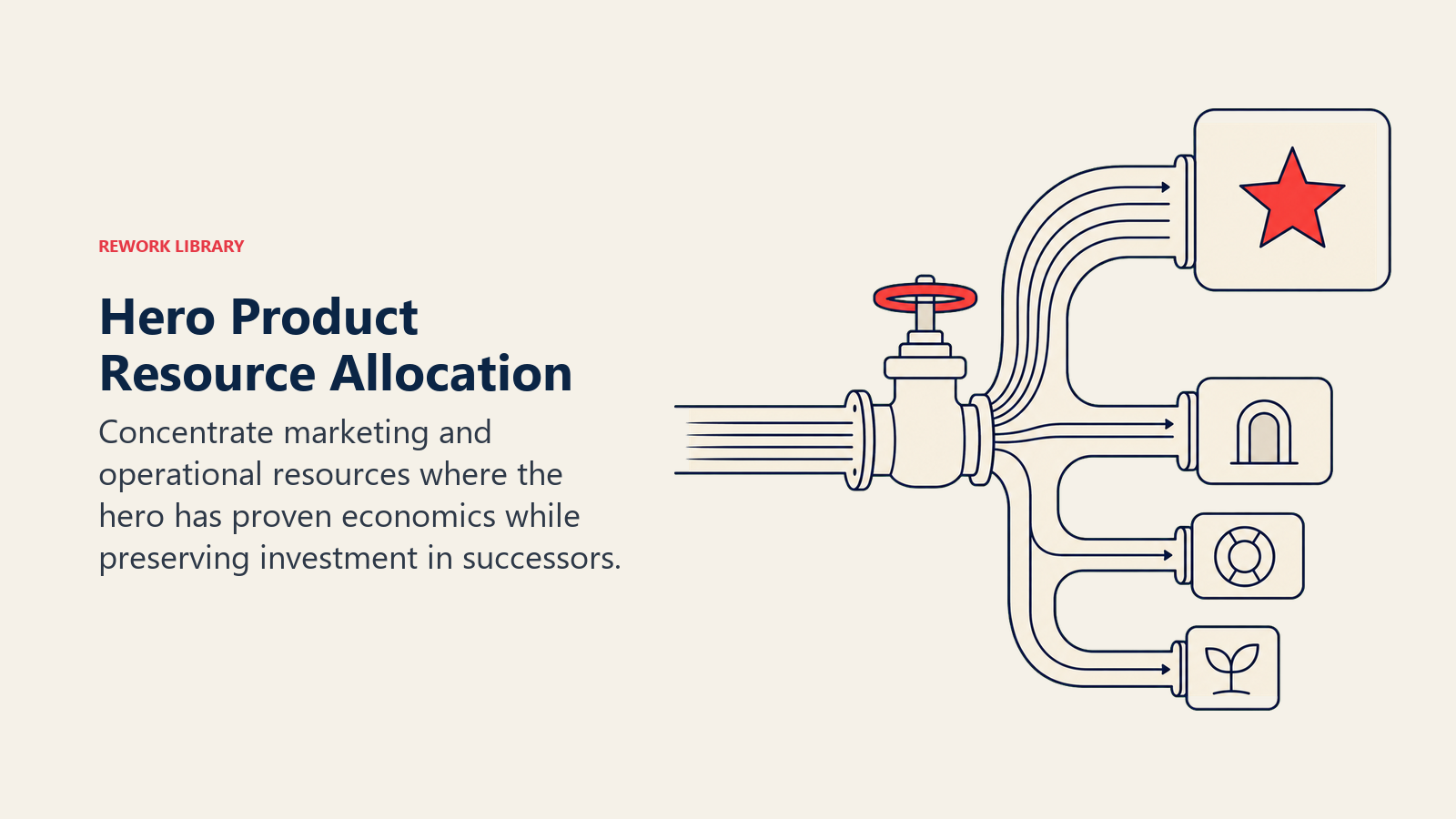
Content marketing should be hero-product-centric. 70% of your blog content, video content, and social media should directly or indirectly drive awareness and consideration for your hero product. The remaining 30% can address broader category education or other products.
See our Traffic Acquisition Strategy guide for detailed channel allocation frameworks.
Product development resources follow a different pattern. While marketing focuses heavily on the hero, product development should be split:
- 40% improving and iterating the hero product
- 30% developing the next potential hero
- 30% enhancing complementary products
This prevents over-reliance while maintaining the hero's market position.
Inventory investment should reflect revenue concentration. Your hero product should represent 50-60% of total inventory value. This ensures you never run out of stock on your revenue engine while maintaining healthy cash flow. More on this in our Inventory Management guide.
The math is simple: if your hero product drives 50% of revenue at better margins and lower CAC than anything else, investing 60-70% of marketing budget there isn't aggressive. It's optimal.
Hero Product Marketing Focus
Marketing a hero product requires different tactics than marketing a portfolio.
Paid advertising should use hero-first creative strategies. Every new channel you test should start with hero product campaigns. Every audience you target should see hero product creative first. Only after you've saturated hero product opportunities should you test other products.
Facebook/Instagram approach: 70% of creative variations should feature the hero product. The other 30% can test gateway or complementary products, but always with the goal of eventually moving customers to the hero.
SEO strategy should prioritize hero product keywords. Your hero product should rank #1 for its primary category keywords. Invest in comprehensive content clusters around:
- Product category keywords ("best [product type]")
- Problem-solution keywords ("how to solve [problem]")
- Comparison keywords ("hero product vs. competitor")
- Review and recommendation keywords
Strong product page optimization ensures that once visitors land on your hero product, they convert at the highest possible rate.
Influencer partnerships should center on hero product storytelling. Don't send influencers a variety pack hoping something resonates. Send them your hero product with clear messaging about what makes it different. Great influencer content emerges from authentic product experiences, not product variety.
Email marketing should feature the hero prominently. Welcome series? Hero product should be the featured product in at least 60% of emails. Browse abandonment? Hero product should be the default recovery offer. Win-back campaigns? Lead with your hero.
Retention marketing uses the hero as an anchor. Customers who've purchased your hero product should receive different email cadences than those who haven't. Hero product purchasers get content about maximizing results, complementary products, and premium upgrades. Non-hero purchasers get content designed to move them toward a hero purchase.
The framework: every marketing channel should ask "how does this support hero product growth?" before asking "what products should we feature?"
Scaling Without Commoditization
The biggest risk of hero product strategy is turning your differentiated product into a commodity through aggressive scaling. Maintain premium positioning even as you scale. Don't discount your hero product to drive volume. Ever. The moment you train customers to wait for sales, you've destroyed the product's premium positioning. This requires disciplined brand building and positioning to maintain perceived value at scale. Avoid channel proliferation that erodes brand value. Just because you can sell your hero product on Amazon, Walmart, and 12 other marketplaces doesn't mean you should. Each additional channel dilutes your brand control and makes it harder to maintain premium pricing. Choose 2-3 channels maximum and own them.
Resist the urge to create too many variations. Brands often respond to scaling pressure by launching color variations, size variations, and special editions. This fragments your hero product's identity. Stick to 2-3 core variations maximum. Apple doesn't launch 47 iPhone colors. You shouldn't either.
Invest in product quality improvements as you scale. As revenue grows, reinvest 10-15% of hero product gross profit into product improvements. Better materials, better manufacturing, better packaging. This prevents quality erosion as you increase production volume and maintains the premium positioning that made the product a hero in the first place.
Use scarcity strategically, not desperately. Limited editions and seasonal releases work when they're planned, not when you run out of inventory and pretend it was intentional. If you're going to use scarcity as a positioning tool, build it into your Product Launch Strategy from the beginning.
The goal is sustainable scaling where the hero product maintains its premium positioning and brand association even as revenue grows 2-5x.
Inventory and Supply Chain Optimization
Your hero product should never go out of stock. Period.
Safety stock levels should be 2-3x higher for hero products than for other items in your portfolio. Yes, this ties up more cash. But the cost of stockouts on your hero product, lost revenue, lost customers, lost momentum, far exceeds the cost of carrying extra inventory.
Forecast accuracy requirements are higher. Non-hero products can tolerate ±20% forecast variance. Hero products should be within ±10%. This requires more sophisticated demand planning, better data analysis, and closer supplier relationships.
Supplier relationships for hero products should be tier-one priority. Multiple backup suppliers, priority manufacturing slots, and premium payment terms all make sense for your hero product. For other products? Standard terms and single sourcing work fine.
Lead time buffers should be built into hero product reordering. If your standard lead time is 60 days, reorder at 90 days for hero products. This buffer absorbs shipping delays, manufacturing issues, and demand spikes without creating stockouts.
Demand sensing should be real-time for hero products. Weekly sales reviews aren't enough. Daily monitoring of sales velocity, traffic patterns, and conversion rates helps you spot demand shifts before they create inventory problems.
Hero Product Inventory Formula:
- Average monthly sales × 3 months (safety stock)
- Plus: forecasted growth for next 90 days
- Plus: 20% buffer for demand volatility
- Equals: minimum inventory level
Reorder when inventory drops to this level, not below it.
The cash flow concern is real, but remember: your hero product has the best margins and the fastest inventory turns. It's not tying up cash. It's generating cash faster than any other investment you can make.
Performance Metrics and Tracking
You need different metrics for hero products than for the rest of your portfolio.
Revenue contribution should stay within 40-60% of total revenue. If it drops below 40%, your hero product is losing market position. If it rises above 60%, you're over-reliant on a single product and vulnerable to market shifts.
CAC efficiency should be tracked separately. Your hero product CAC should be 30-50% lower than portfolio average CAC. If this gap narrows, it's an early warning signal that the product is losing its conversion advantage.
Hero Product Dashboard Metrics:
- Daily sales velocity (units and revenue)
- 7-day moving average conversion rate
- CAC by channel (paid social, paid search, organic, etc.)
- Repeat purchase rate for hero product buyers
- Average time between first and second purchase
- Inventory days on hand
- Review rating and review volume (weekly)
- Organic search ranking for top 5 keywords
Monthly analysis should include:
- Revenue concentration percentage
- CAC efficiency vs. portfolio average
- Contribution margin by product
- Customer cohort analysis (hero buyers vs. non-hero buyers)
- Lifetime value comparison (hero buyers vs. others)
Quarterly strategic reviews should ask:
- Is our hero product still the right hero?
- Are we investing enough in hero product marketing?
- What threats could displace our hero product?
- What's our succession plan if market dynamics shift?
Track these metrics in a dedicated dashboard. Your hero product deserves its own analytics infrastructure, not just a filter in Google Analytics.
Common Pitfalls
Even brands that understand hero product strategy make predictable mistakes.
Over-reliance on a single product creates vulnerability. If your hero drives 70%+ of revenue, you're one competitor away from a crisis. Maintain the 40-60% range by developing strong supporting products and potential successor heroes.
Neglecting product innovation because "it's working." The market that made your current hero product successful will eventually shift. Invest 30% of product development resources in the next generation even while the current hero is growing.
Expanding the product line before establishing the hero. Brands under $5M in revenue often launch new products hoping to find their hero instead of doubling down on hero product candidates. Focus creates heroes. Variety creates mediocrity.
Discounting the hero product during slow periods. This trains customers to wait for sales and permanently damages pricing power. If growth slows, invest in better marketing, not worse pricing. See our AOV Optimization Strategy for alternative approaches.
Ignoring early warning signs of hero product decline. Rising CAC, falling conversion rates, declining review ratings, and increasing return rates all signal problems. Address them immediately, not after revenue drops 20%.
Failing to build supporting products around the hero. Your hero product should be the center of a constellation of complementary products that increase customer lifetime value. Standalone heroes are harder to defend and monetize. Check our Product Line Expansion guide for frameworks.
Copying hero product strategies from other brands without understanding your unique position. What works for a $50M brand might not work for a $2M brand. Your hero product strategy should reflect your stage, resources, and market position.
The common thread? Hero product strategy requires ongoing attention and strategic thinking, not set-it-and-forget-it execution.
Portfolio Balance and Succession Planning
The final piece: preparing for what comes after your current hero. Develop potential hero successors while the current hero is still growing. Start investing in next-generation products when your current hero hits 40-50% revenue concentration, not when it starts declining. Product lifecycle for hero products typically follows this pattern:
- Year 1-2: Growth phase (0% to 40% revenue concentration)
- Year 3-4: Peak phase (40-60% revenue concentration)
- Year 5-6: Mature phase (steady revenue, margins compressing)
- Year 7+: Decline phase (market saturation, new competitors)
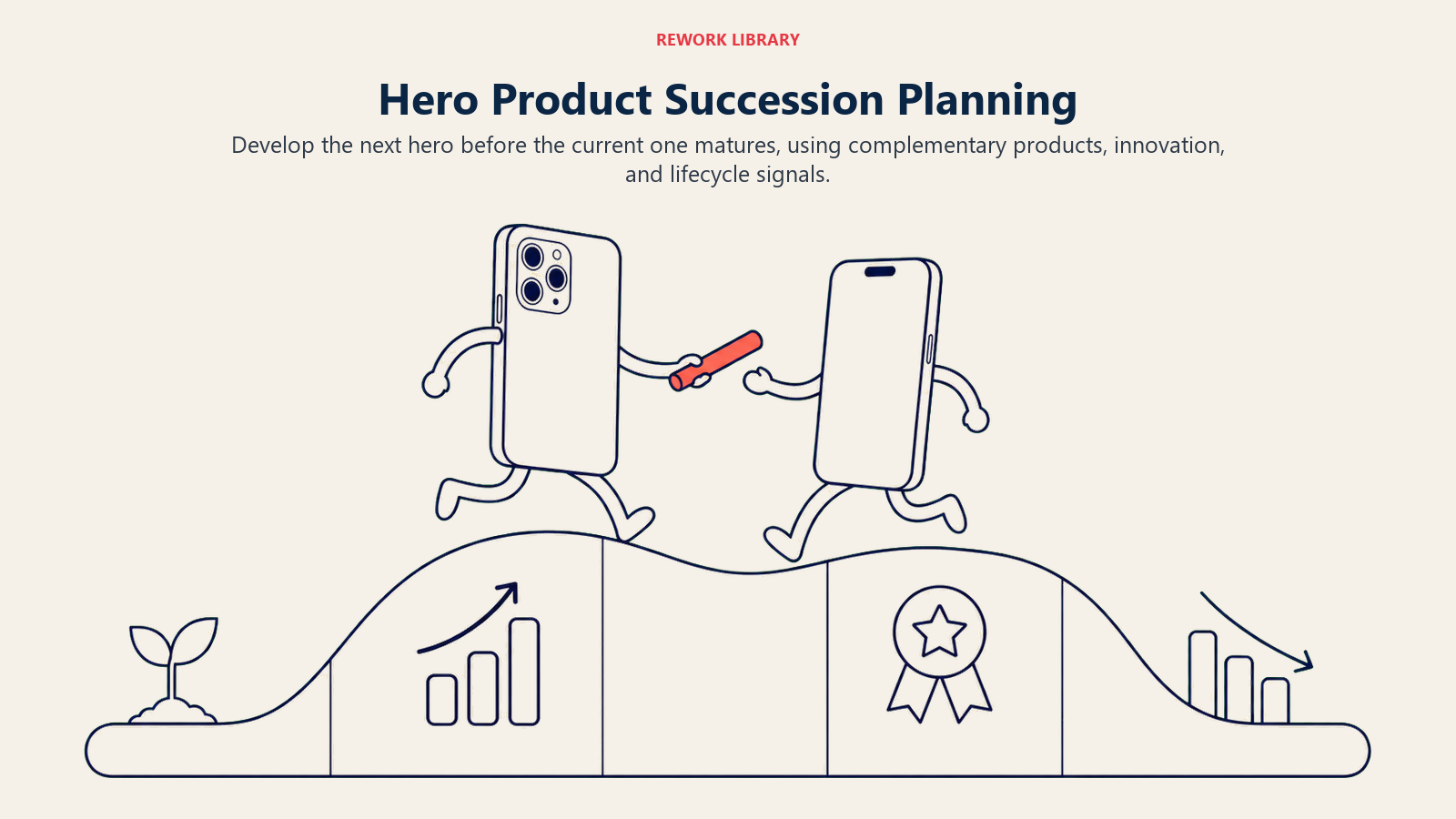
Succession candidates should emerge from complementary products. The next hero often starts as a premium or complementary product that shows unusual growth characteristics. Watch for products with:
- CAC efficiency approaching hero product levels
- Higher-than-expected repeat purchase rates
- Strong organic word-of-mouth and review volume
- Customer requests for expanded availability or variations
Portfolio evolution framework:
- Maintain 1 established hero (40-60% of revenue)
- Develop 1-2 potential successors (10-15% of revenue each)
- Support with 3-4 gateway products (5-10% of revenue each)
- Extend with 2-3 premium products (3-5% of revenue each)
Transition planning should be gradual, not abrupt. As your successor hero grows from 10% to 20% to 30% of revenue, the original hero should gracefully decline from 60% to 50% to 40%. This maintains portfolio stability while allowing new products to emerge.
Investment reallocation should follow growth signals. When a potential successor shows hero-product characteristics (CAC efficiency, repeat rates, organic interest), start shifting marketing budget allocation. Move from 65/35 (hero/other) to 50/35/15 (hero/successor/other) over 2-3 quarters.
The brands that scale sustainably have a pipeline of potential hero products in development at all times. They're not reactive to market shifts. They're proactively creating the next wave of hero products before the current wave peaks.
Building Your Hero Product Strategy
Start with brutal honesty about your current portfolio. Run the hero product identification analysis. Calculate the numbers. Most brands already have a hero product, they just haven't acknowledged it and adjusted their strategy accordingly.
If you don't have a clear hero, that's your strategic priority. Identify the top 2-3 candidates and run focused campaigns to determine which product has true hero potential. Give it 90 days and real budget. The data will tell you which product can carry your growth.
Once you've identified your hero, reallocate resources accordingly. This feels risky because you're concentrating investment, but it's actually less risky than spreading resources thin across products that will never drive meaningful growth.
Build your portfolio around the hero. Every product should have a clear strategic role: gateway, premium, or complementary. If it doesn't fit one of these categories, remove it.
Track hero product metrics obsessively. This is your revenue engine. You should know its performance better than any other aspect of your business.
And start developing the next hero before you need it. The most successful e-commerce brands have a steady cadence of hero product evolution, not desperate pivots when the market shifts.
Your hero product is the 80 in the 80/20 rule of e-commerce. Everything else is supporting cast. Build your strategy accordingly.
Related Resources
To build a comprehensive hero product strategy, explore these complementary guides:
- Product Research & Validation - Validate hero product candidates before committing resources
- Product Page Optimization - Maximize conversion rates on your hero product pages
- Traffic Acquisition Strategy - Drive qualified traffic to your hero product
- Product Line Expansion - Develop supporting products around your hero product

On this page
- What Makes a Hero Product
- Identifying Hero Product Candidates
- Portfolio Positioning Strategy
- Resource Allocation Framework
- Hero Product Marketing Focus
- Scaling Without Commoditization
- Inventory and Supply Chain Optimization
- Performance Metrics and Tracking
- Common Pitfalls
- Portfolio Balance and Succession Planning
- Building Your Hero Product Strategy
- Related Resources