Conversion Rate Optimization (CRO): Systematic Framework for E-commerce Conversion Growth
Turn this article into takeaways for your work.


Each assistant summarizes the article only for you and suggests best practices for your work.
Most e-commerce sites convert at 2-3%. That means 97-98% of your traffic leaves without buying. You're spending money on ads, SEO, and content to drive traffic, but most of it evaporates before checkout.
This isn't a traffic problem. It's a conversion problem.
Conversion Rate Optimization (CRO) is the systematic practice of increasing the percentage of visitors who complete desired actions on your site - making a purchase, adding items to cart, or signing up for your email list. Here's what separates real CRO from random website tweaks: it's continuous and data-driven. You're testing based on methodology, not guesswork.
The difference between a site converting at 2% versus 4% is huge. With the same traffic and average order value, you've just doubled your revenue. And you did it without spending an extra dollar on customer acquisition.
What CRO Actually Means for E-commerce
CRO isn't about making your site "prettier" or following the latest design trends. It's about understanding exactly where visitors drop off in your funnel, hypothesizing why, testing solutions, and implementing what works.
Think of your e-commerce site as a series of decision points. Every page, every button, every product description is a moment where a visitor decides to move forward or leave. CRO is the practice of systematically reducing friction at each of these points.
A true CRO program has three core components:
Data collection and analysis: You need to know what's happening on your site. Where are visitors entering? Where are they leaving? What paths do buyers take versus non-buyers? Without proper analytics tracking setup, you're flying blind.
Hypothesis-driven testing: This isn't about testing random ideas because they sound good. You develop hypotheses based on data, visitor behavior, and known friction points. Then you test those hypotheses methodically using an A/B testing framework.
Continuous improvement culture: CRO isn't a one-time project. The best e-commerce teams treat it as an ongoing operational discipline. They have testing roadmaps, regular review cycles, and a culture that expects constant iteration.
Why CRO Delivers Better ROI Than More Traffic
Here's a truth that changes how you think about growth: improving conversion is almost always cheaper and more profitable than buying more traffic.
Let's say you're spending $50,000 per month on paid ads, driving 25,000 visitors at a $2 cost per click. At a 2% conversion rate, you get 500 customers. To double your revenue, you could:
- Double your ad spend to $100,000/month to get 1,000 customers
- Or improve your conversion rate to 4% and get 1,000 customers with the same $50,000 spend
The economics are simple. When you improve conversion, every dollar you spend on acquisition becomes more valuable. Your customer acquisition cost drops. Your return on ad spend increases. You're getting more output from the same input.
Plus, traffic costs keep rising. Competition for ads increases. SEO becomes more competitive. But your ability to improve your site's conversion potential is entirely within your control.
The CRO Testing Framework
Effective CRO operates on a structured testing methodology. You're not randomly changing elements hoping for improvement. You're following a scientific approach that produces reliable, repeatable results.
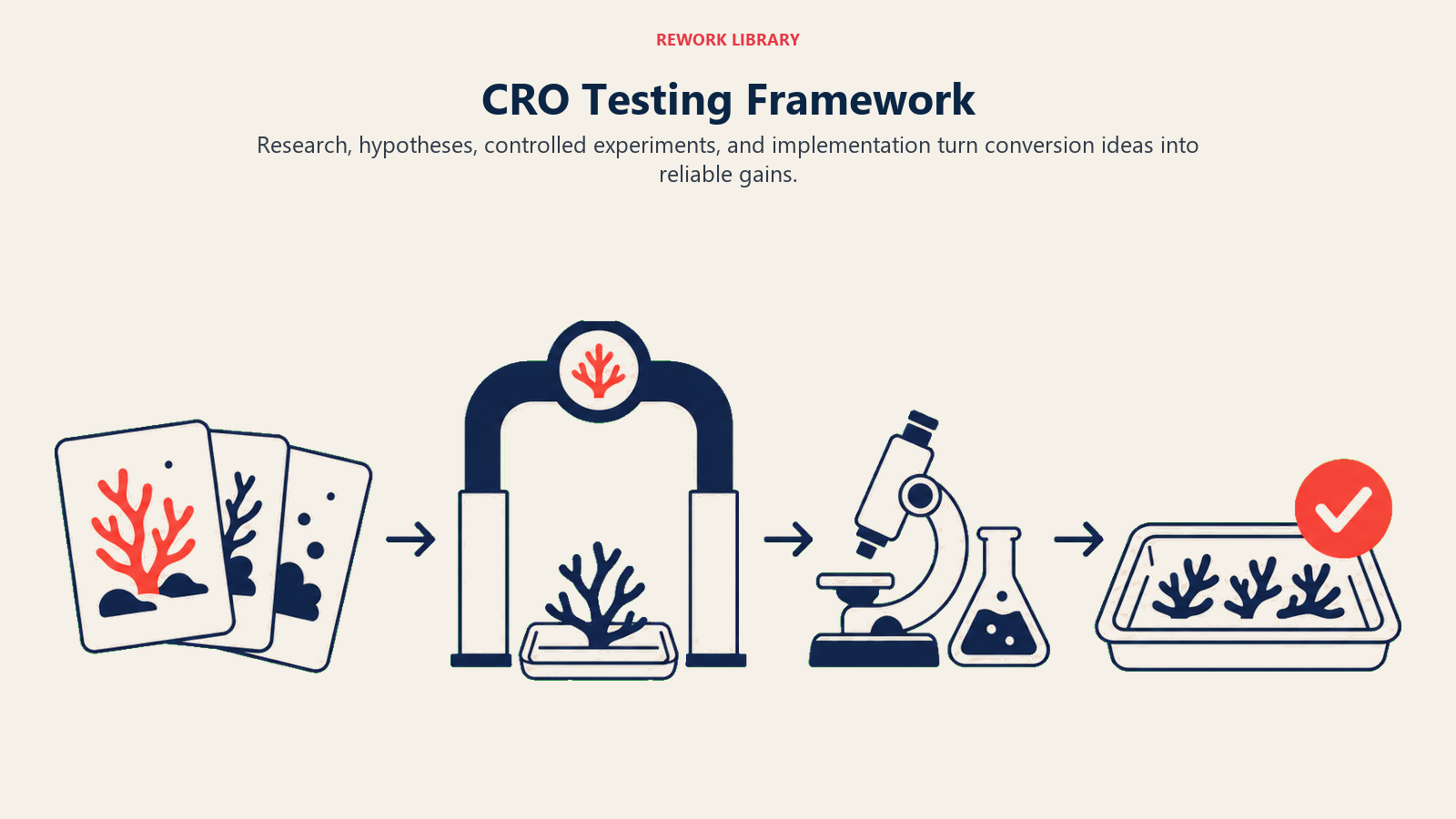
Step 1: Research and data gathering
Before you test anything, you need to understand what's actually happening. This means:
- Analyzing your conversion funnel to identify drop-off points
- Reviewing session recordings to see how visitors interact with key pages
- Collecting customer feedback about their experience
- Examining heat maps to understand what captures attention
This research phase tells you where you have problems and gives you clues about why visitors aren't converting.
Step 2: Hypothesis formation
Based on your research, you develop testable hypotheses. A good hypothesis follows this format: "We believe that [specific change] will [increase/decrease specific metric] because [reason based on data or user behavior]."
For example: "We believe that adding trust badges to the checkout page will increase completed purchases by 15% because exit surveys indicate visitors are concerned about payment security."
Step 3: Test design
Now you decide how to test your hypothesis. For most e-commerce CRO, you'll use either:
A/B testing: You test one variant against your control. Half your traffic sees version A, half sees version B. This is the cleanest way to isolate the impact of a single change.
Multivariate testing: You test multiple elements simultaneously to understand which combinations perform best. This requires significantly more traffic but can accelerate learning.
Step 4: Statistical validation
This is where many teams fail. They run tests for a few days, see positive results, and declare victory. But you need statistical significance before making changes permanent.
Statistical significance means you're confident the results aren't due to chance. Most testing platforms calculate this automatically, but you need to reach at least 95% confidence before trusting your results. This usually requires thousands of visitors per variation.
Step 5: Implementation and monitoring
When a test wins, you implement it permanently and monitor long-term performance. Sometimes "winning" variations lose their advantage over time as novelty wears off or as seasonal factors change.
Key Conversion Metrics and KPIs
You can't improve what you don't measure. But not all metrics matter equally for conversion optimization. Understanding e-commerce metrics and KPIs helps you focus on what drives results.
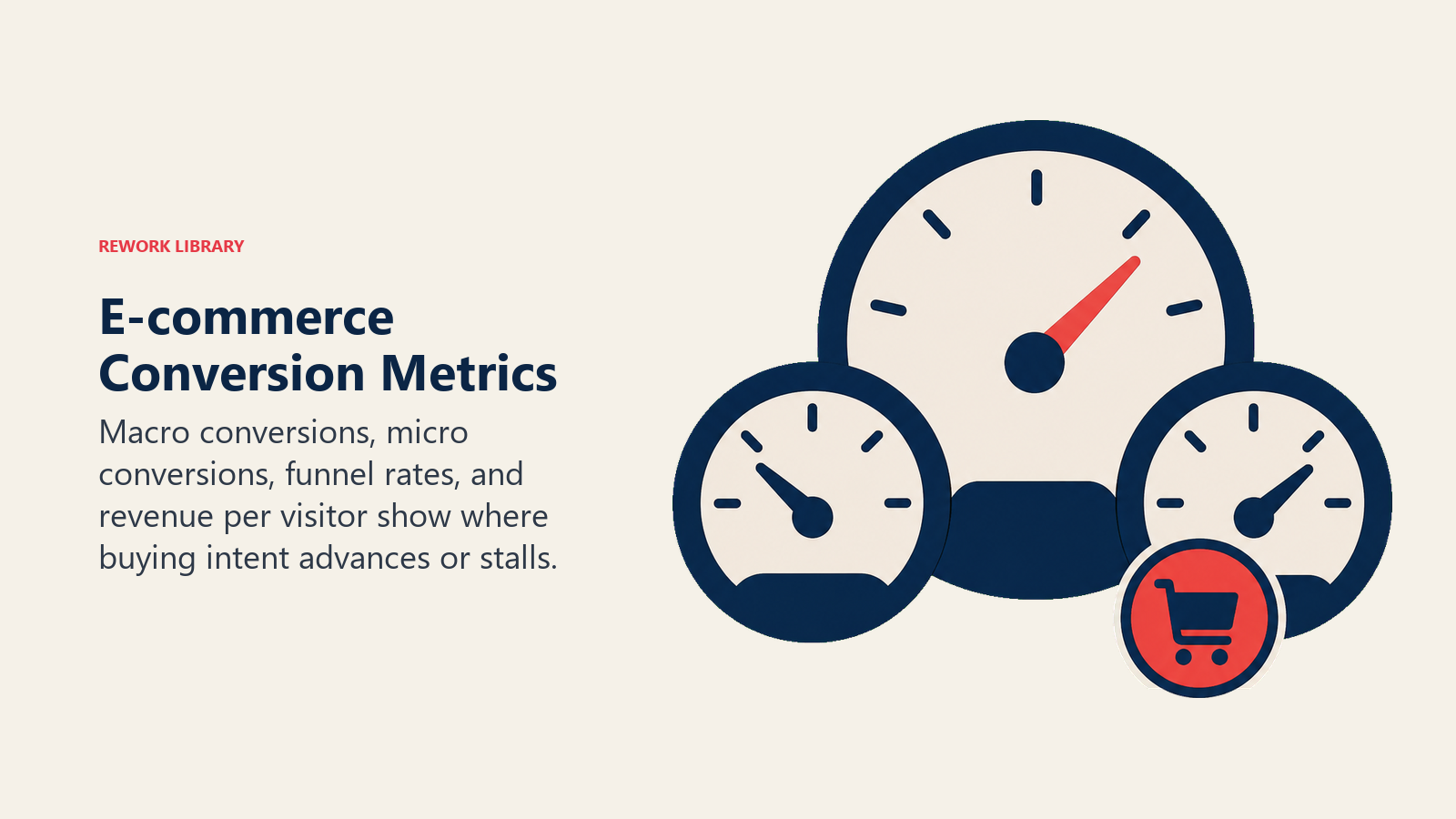
Overall conversion rate is your primary metric. It's calculated as: (Total purchases ÷ Total visitors) × 100. If 50 out of 2,000 visitors buy, your conversion rate is 2.5%.
But overall conversion rate hides important details. You also need to track:
Micro-conversions: These are smaller actions that lead to purchases. Add-to-cart rate, email signup rate, product page views per session. These metrics help you understand the path to purchase.
Macro-conversions: Your ultimate goal, completed purchases. But also consider other high-value actions like account creation or starting a subscription.
Funnel conversion rates: What percentage of visitors who view a product add it to cart? What percentage of cart additions reach checkout? What percentage of checkout starts result in completed orders? Each of these stages reveals different optimization opportunities.
Segmented conversion analysis: Your overall rate masks important variations. Look at conversion by:
- Traffic source (organic search typically converts differently than social traffic)
- Device type (mobile versus desktop performance)
- New versus returning visitors
- Geography (regional differences in behavior)
- Product category
These segments reveal where your biggest opportunities lie.
Optimizing Each Funnel Stage
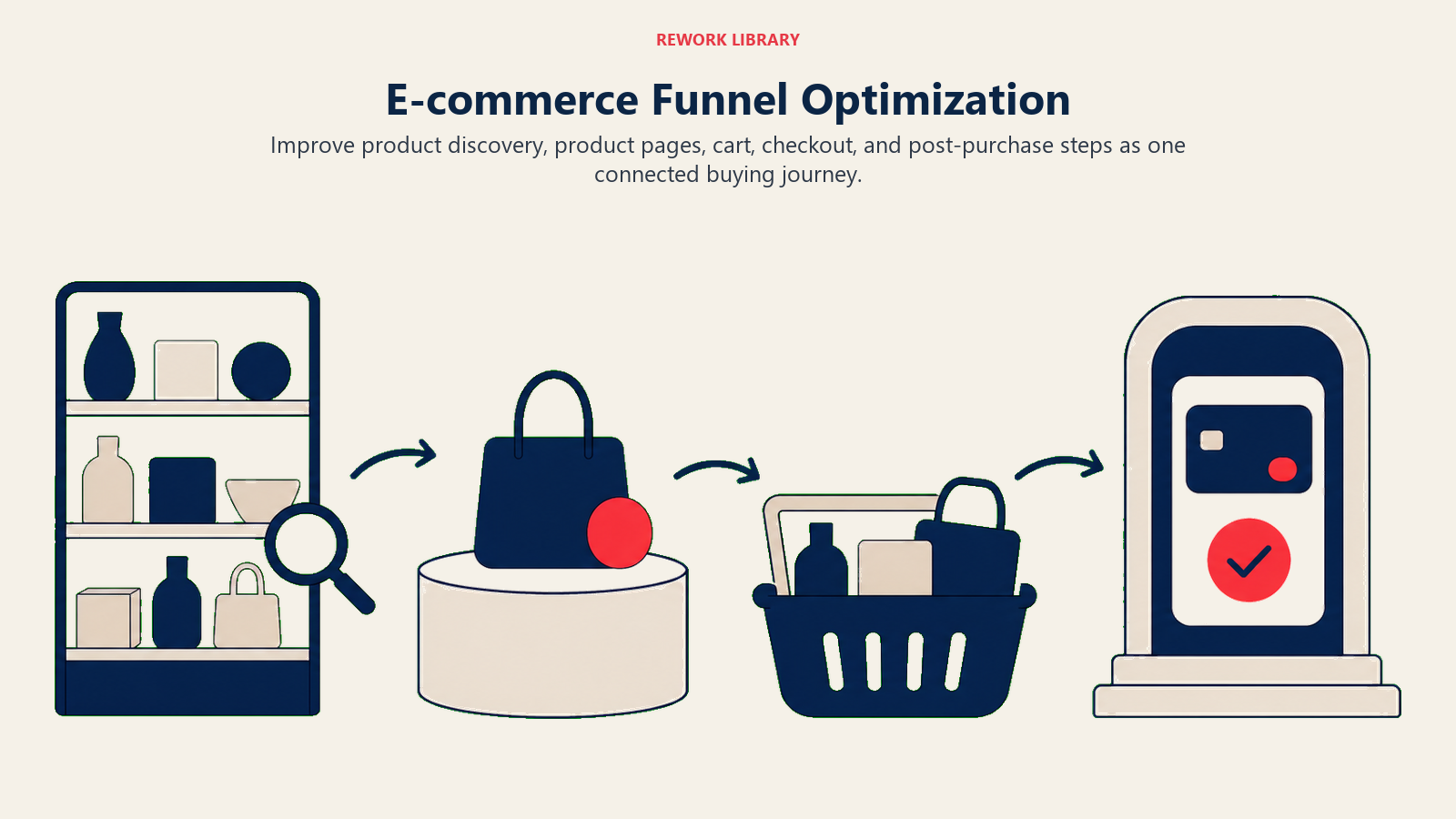
Every e-commerce funnel has predictable stages where visitors make decisions. Your job is to optimize each stage systematically.
Product Page Optimization
Your product page is where interest becomes intent. Visitors have found what they're looking for - now convince them it's worth buying.
Critical elements include:
- High-quality product images from multiple angles
- Video demonstrations when relevant
- Clear, benefit-focused product descriptions
- Prominent display of price and availability
- Visible add-to-cart button above the fold
- Customer reviews and ratings
- Complete product specifications
- Size guides and comparison tools
Small changes here compound. A 5% improvement in add-to-cart rate across all product pages transforms your overall conversion performance.
Checkout Flow Optimization
Your checkout flow is where intent becomes revenue. Every additional click, every unnecessary form field, every moment of confusion increases abandonment.
Focus on:
- Reducing the number of checkout steps (one-page checkout often converts better)
- Making guest checkout prominently available
- Clearly displaying shipping costs early
- Offering multiple payment options
- Auto-filling fields when possible
- Showing progress indicators
- Displaying trust signals (security badges, money-back guarantees)
The checkout is where small friction points cause big losses. A confusing shipping calculator or unclear return policy can kill conversions at the final moment.
Cart Abandonment Recovery
Even with an optimized checkout, 60-70% of carts will be abandoned. Cart abandonment recovery strategies capture revenue that would otherwise be lost.
The most effective approaches:
- Abandoned cart email sequences sent 1 hour, 24 hours, and 72 hours after abandonment
- Exit-intent popups offering help or incentives when visitors move to close the tab
- Retargeting ads showing the specific products left in cart
- SMS reminders for customers who've opted in
You're not just recovering individual sales. You're collecting data on why people abandon and what brings them back.
Post-Transaction Optimization
The conversion doesn't end at purchase. Post-transaction screens are high-attention moments when customers are engaged and in a buying mindset. This is a prime opportunity to increase average order value.
Use this moment for:
- Upsell and cross-sell offers ("Customers who bought this also bought...")
- Email subscription signup if they didn't already subscribe
- Social media follows
- Referral program enrollment
- Product recommendations for their next purchase
These micro-conversions improve customer lifetime value and create ongoing touchpoints.
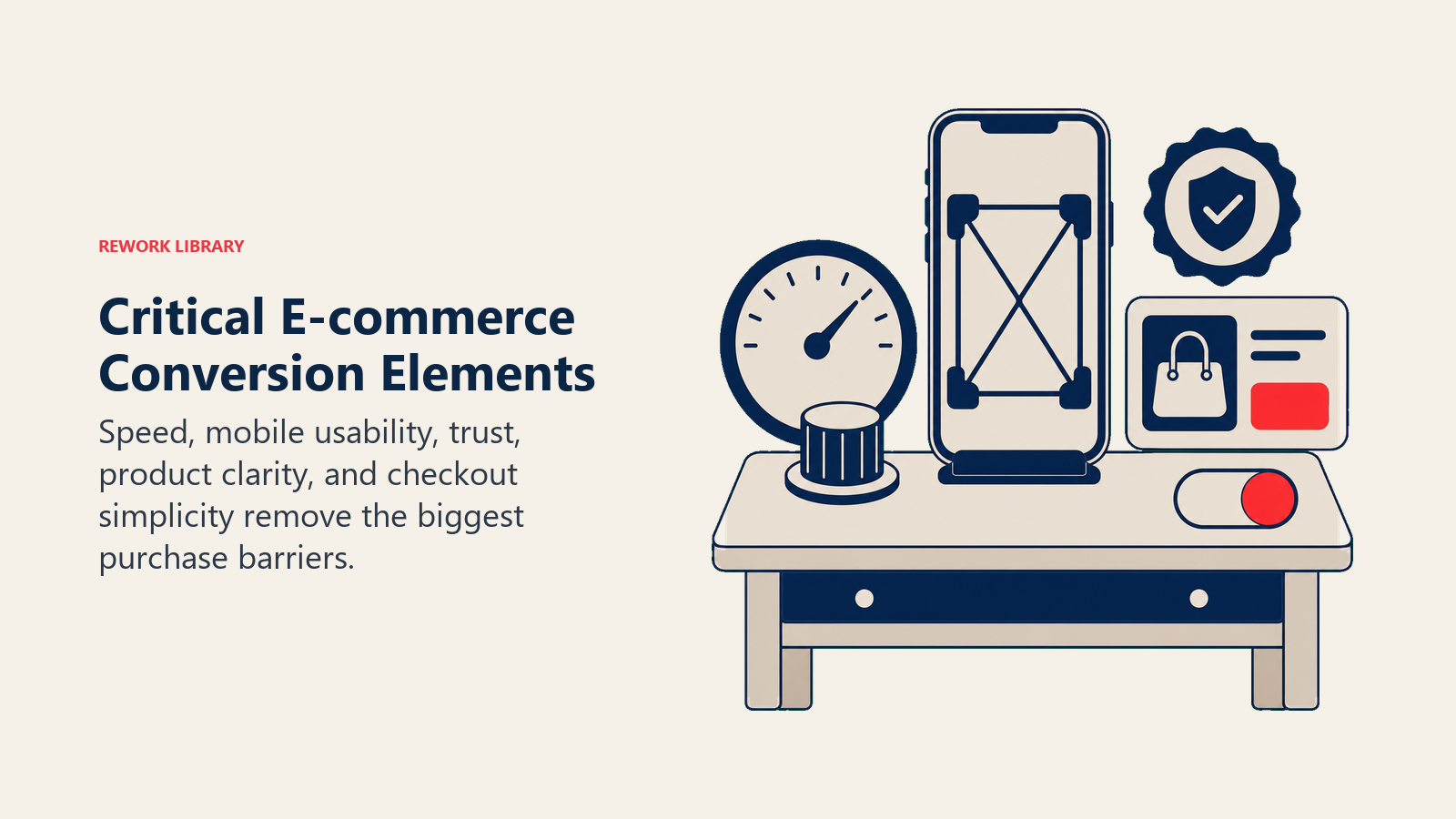
Critical Conversion Elements
Beyond funnel stages, certain site elements have outsized impact on conversion rates across your entire experience.
Site Speed and Performance
Site speed directly impacts conversion. Research shows that:
- A 1-second delay in page load time can reduce conversions by 7%
- 40% of visitors abandon sites that take more than 3 seconds to load
- Mobile users are even less patient than desktop users
Speed optimization isn't just technical, it's a conversion strategy. Compress images, minimize code, use content delivery networks, and monitor load times religiously.
Mobile Commerce Optimization
Mobile traffic now accounts for 50-70% of e-commerce visits at most stores. But mobile conversion rates typically lag desktop by 1-2 percentage points.
Mobile commerce optimization requires thinking beyond responsive design. You need:
- Larger tap targets for buttons and links
- Simplified navigation designed for small screens
- Streamlined forms with mobile-friendly inputs
- One-click payment options like Apple Pay and Google Pay
- Fast image loading without sacrificing quality
Don't just make your desktop experience fit on mobile. Design specifically for mobile behavior.
Trust Signals and Social Proof
Visitors don't know your brand. They're entering payment information on your site. They need reasons to trust you.
Trust signals and social proof reduce perceived risk:
- Customer reviews and ratings on product pages
- Trust badges (SSL certificates, payment security, money-back guarantees)
- Media mentions and certifications
- Social media proof (follower counts, user-generated content)
- Clear return policies and customer service contact information
Trust isn't built through claims ("We're the most trusted!"). It's built through evidence.
Product Photography and Video
Visual presentation directly impacts perceived value and purchase confidence. Product photography and video serve different functions:
Photography shows details and allows inspection from multiple angles. Include:
- High-resolution images that can be zoomed
- Multiple views (front, back, sides, detail shots)
- Lifestyle images showing the product in use
- Scale references so size is clear
Video demonstrates functionality and builds emotional connection:
- Product demos showing how it works
- Unboxing videos setting expectations
- Customer testimonial videos
- 360-degree views for complex products
Product Descriptions
Your product description isn't just information. It's sales copy. Effective product description writing focuses on benefits over features and addresses objections proactively.
Instead of: "100% organic cotton, machine washable" Write: "Stay comfortable all day in breathable organic cotton that gets softer with every wash"
Good descriptions answer the questions visitors have before they ask them.
Customer Reviews and UGC
Customer reviews and user-generated content serve as third-party validation that you can't provide yourself. Products with reviews convert 3-4x better than products without them.
Actively collect reviews through post-purchase emails, incentive programs, and simple request processes. Display them prominently on product pages, and respond to both positive and negative feedback.
Testing Prioritization Framework
You have limited resources. You can't test everything. So how do you decide what to test first?
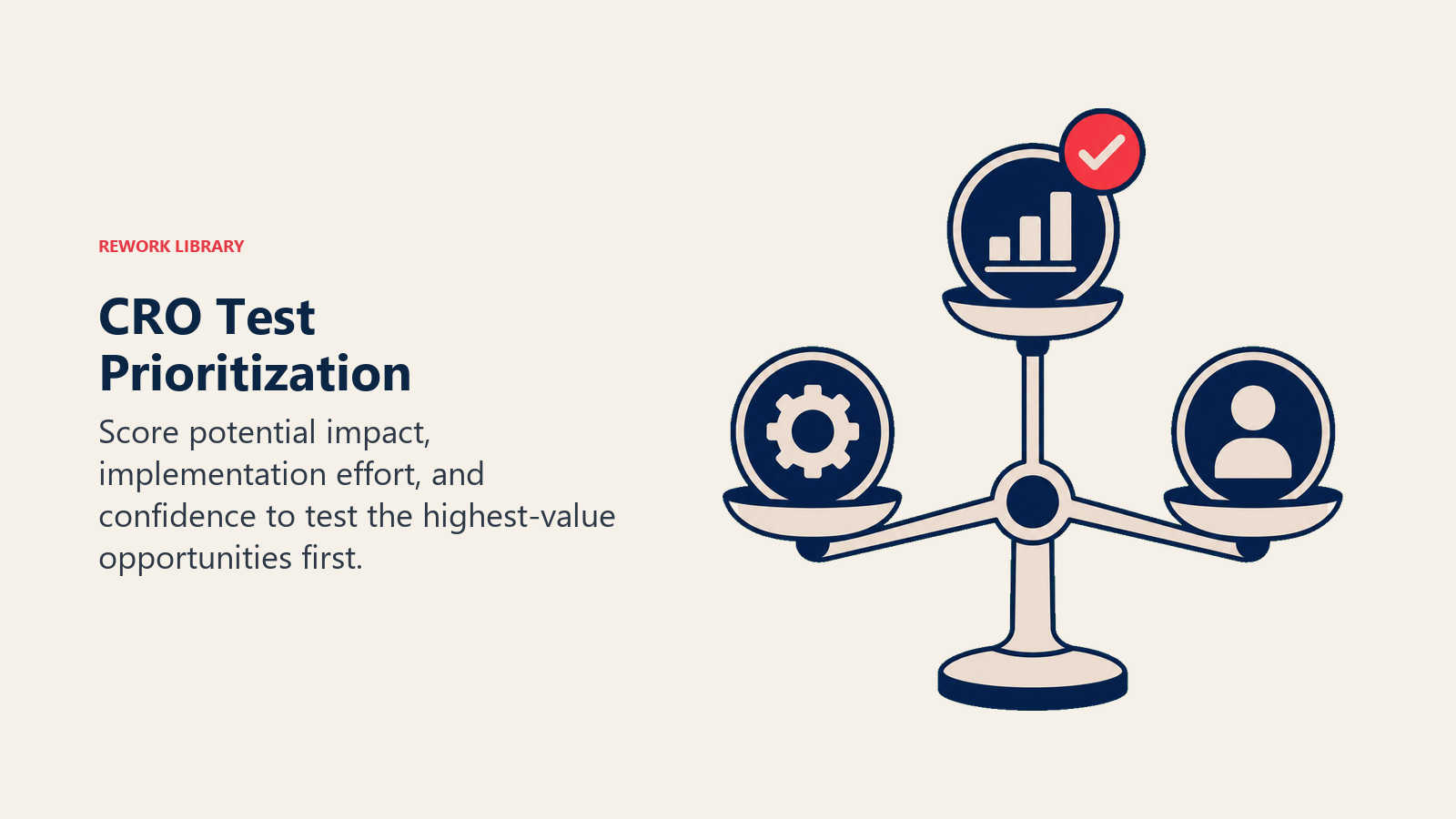
Use a prioritization framework that considers three factors:
Potential impact: What's the possible revenue improvement if this test wins? High-traffic pages with low conversion rates offer bigger opportunities than low-traffic pages with high conversion rates.
Implementation effort: How complex is the test to design and launch? Quick wins build momentum. Massive redesigns carry more risk.
Confidence level: How certain are you this change will improve conversion? Tests based on strong data and user research deserve priority over random ideas.
A simple scoring system helps:
- Rate each factor from 1-10
- Multiply the scores (Impact × Confidence ÷ Effort)
- Prioritize tests with the highest scores
This ensures you're working on changes that matter, not just changes that are easy.
Segmentation and Personalization
Not all visitors behave the same way. Your conversion optimization should account for different visitor segments with different needs.
First-time visitors need orientation and trust-building. They don't know your brand. They're evaluating whether you're credible. Show social proof prominently, make your value proposition clear, and reduce perceived risk.
Returning customers already trust you. They need efficiency and convenience. Show them what's new, make reordering simple, and reward their loyalty.
Device-specific optimization recognizes that mobile and desktop users have different contexts and patience levels. Mobile users want speed and simplicity. Desktop users can handle more complexity.
Traffic source segmentation acknowledges that visitors from organic search behave differently than those from paid ads or social media. Search visitors often have higher intent. Social visitors may need more education.
Personalization doesn't require complex AI. Simple segmentation based on observable behavior creates meaningful lift.
Common Conversion Barriers and Solutions
Most conversion problems fall into predictable categories. Once you recognize the barrier, the solution becomes clearer.
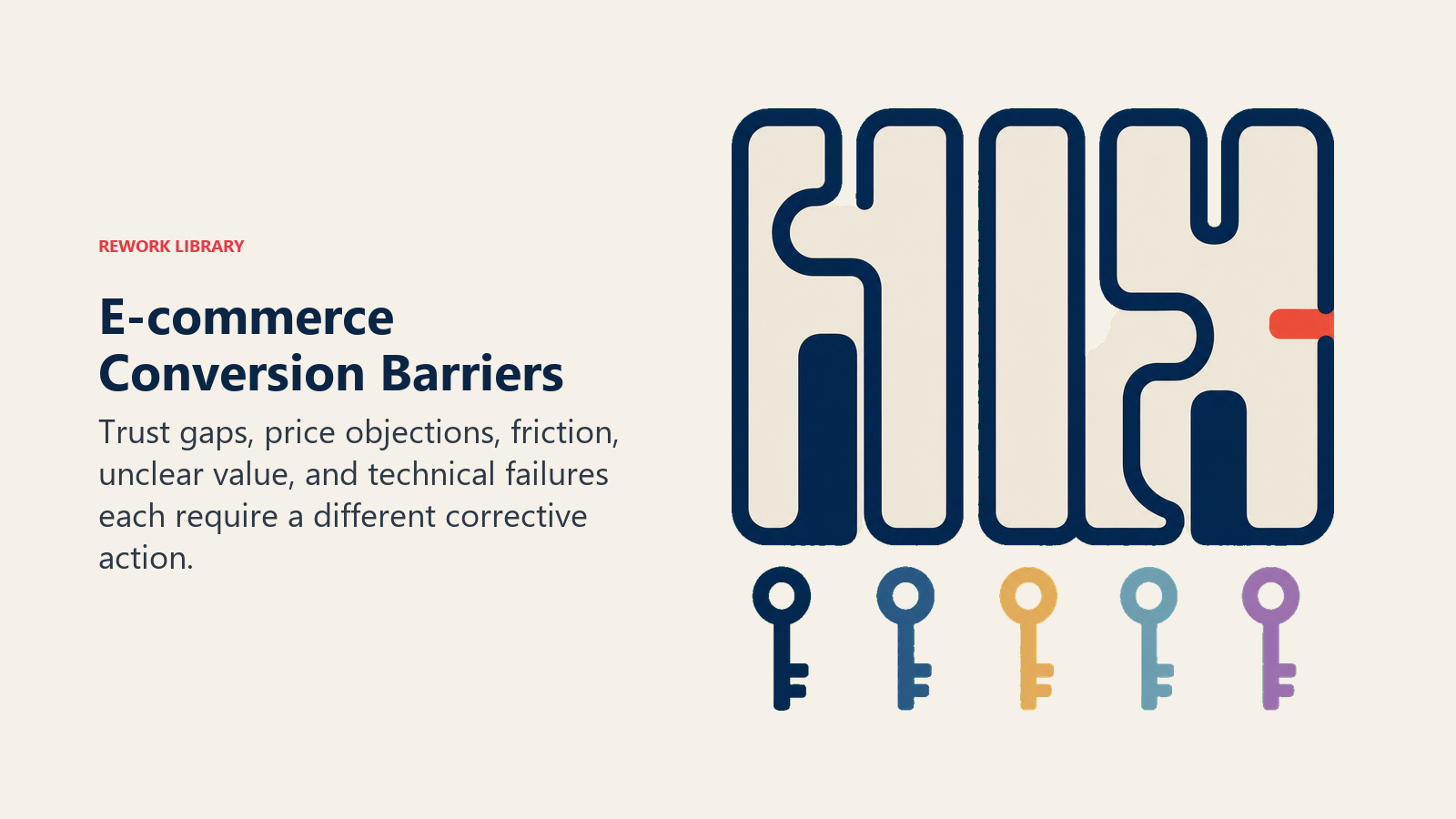
Barrier: Trust and credibility concerns Visitors don't know if you're legitimate. They're worried about fraud or poor quality.
Solution: Display trust badges, customer reviews, clear return policies, and professional design. Make contact information prominent. Show real humans behind your brand.
Barrier: Price objections Visitors think your product costs too much for the value received.
Solution: Emphasize value over price. Use comparison charts. Offer payment plans. Bundle products to increase perceived value. Add free shipping thresholds. Understanding unit economics for e-commerce helps you determine sustainable pricing strategies.
Barrier: Unclear product benefits Visitors don't understand what problem your product solves or why it's better than alternatives.
Solution: Lead with benefits, not features. Use customer testimonials explaining the transformation. Include before/after demonstrations.
Barrier: Checkout friction The purchase process is too complicated, requires too much information, or lacks preferred payment options.
Solution: Streamline to the minimum viable checkout. Offer guest checkout. Accept multiple payment methods. Save customer information for faster future purchases.
Barrier: Return and satisfaction concerns Visitors worry they won't be able to return the product if it doesn't work out.
Solution: Offer hassle-free returns with clear policies. Provide money-back guarantees. Show customer service availability. Include product guarantees.
Measurement and Analytics Discipline
Effective CRO requires rigorous data practices. You need to know what's happening at every stage of your funnel.
Start with proper analytics and tracking setup. Implement:
- E-commerce tracking in Google Analytics (or your analytics platform)
- Event tracking for micro-conversions (add-to-cart, wishlist adds, video views)
- Funnel visualization to see drop-off points
- Enhanced e-commerce tracking for product performance data
Beyond analytics, use:
- Heat mapping tools to see what gets attention
- Session recording to watch how real users navigate
- Form analytics to identify where users abandon forms
- Surveys to collect qualitative feedback
Create dashboards that you review weekly. Track:
- Overall conversion rate trends
- Segment-specific performance
- Funnel stage conversion rates
- Active test performance
- Revenue impact of completed optimizations
The discipline of regular review keeps conversion optimization top of mind and ensures you catch problems early.
Building an Optimization Roadmap
Random, ad-hoc testing rarely produces breakthrough results. You need a structured roadmap.
Your roadmap should include:
Quarterly themes: Focus each quarter on a specific area (product pages Q1, checkout Q2, mobile experience Q3, personalization Q4).
Monthly test calendar: Plan 2-4 tests per month based on your traffic volume. Don't run too many tests simultaneously, you'll dilute traffic and extend time to significance.
Backlog of ideas: Maintain a prioritized list of test ideas that come from data analysis, customer feedback, and team input.
Success criteria: Define what winning looks like before launching each test. What lift would make this change worth implementing?
Review cadence: Schedule regular review sessions to analyze test results, share learnings, and adjust the roadmap.
A/B Testing Best Practices
Successful A/B testing follows specific principles:
Test one variable at a time when possible. If you change the headline, button color, and layout simultaneously, you won't know which change drove results.
Run tests to statistical significance, typically 95% confidence or higher. Don't call tests early even if you're seeing positive trends.
Account for time-based variations. Run tests for at least one full week to capture weekend versus weekday behavior. Consider monthly cycles and seasonal factors.
Monitor for segment effects. Sometimes a change improves conversion for one segment while hurting another. Check mobile versus desktop, new versus returning, and traffic source performance.
Document everything. Keep detailed records of what you tested, why, what happened, and what you learned. This knowledge compounds over time.
CRO Maturity Stages
E-commerce companies typically evolve through predictable stages of CRO sophistication:
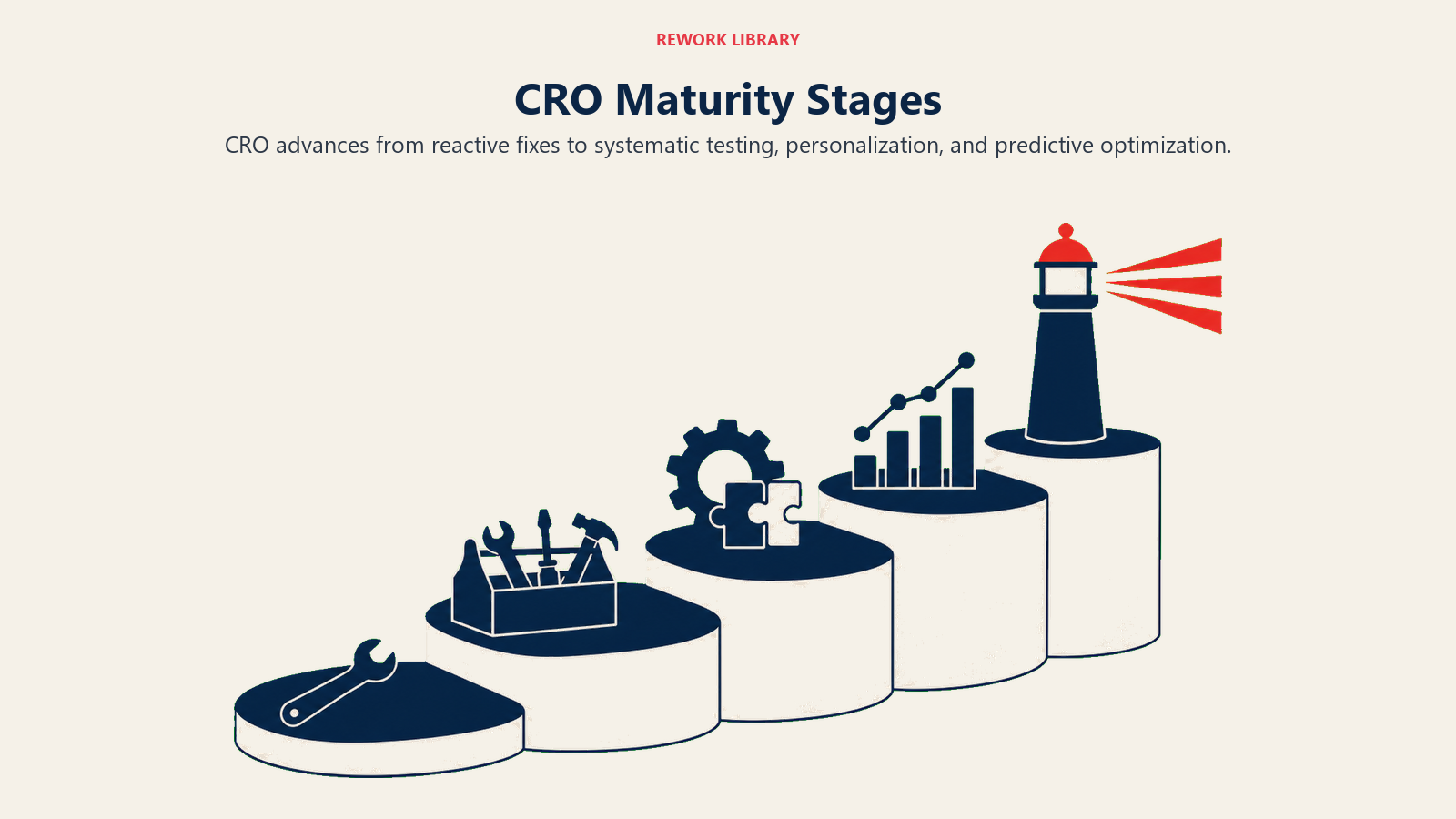
Stage 1: Reactive optimization You make changes when something obviously breaks or when someone has a strong opinion about what should change. There's no systematic approach.
Stage 2: Basic testing You've implemented testing tools and run occasional A/B tests. But testing is ad-hoc, driven by whoever has time or interest.
Stage 3: Systematic testing program You have a dedicated testing roadmap, regular review cadence, and prioritization framework. Testing is an ongoing discipline.
Stage 4: Advanced personalization You're testing different experiences for different segments. You've implemented personalization engines, dynamic content, and behavioral triggers.
Stage 5: Predictive optimization You're using machine learning to automatically optimize experiences, predict customer behavior, and personalize in real-time without manual testing. This often involves a customer data platform to unify all customer information.
Most e-commerce businesses operate at Stage 1 or 2. The jump to Stage 3, systematic testing, is where meaningful results start to compound.
Making CRO a Continuous Practice
The companies that win with CRO don't run a test, declare victory, and move on. They build conversion optimization into their operational culture.
This means:
- Dedicating resources (even if it's just a few hours per week initially)
- Creating accountability for conversion metrics
- Celebrating wins and learning from losses
- Building a knowledge base of what works for your audience
- Training team members on testing methodology
- Questioning assumptions regularly
Your conversion rate six months from now should be measurably better than today. And six months after that, it should be better still. That's the power of treating CRO as a discipline rather than a project.
The gap between the average e-commerce site (2-3% conversion) and the best (8-10%+) isn't about having a better product or spending more on ads. It's about systematically removing friction, testing relentlessly, and continuously improving the path from visitor to customer.
Every visitor represents someone who was interested enough to click. Your job is making sure fewer of them leave without buying.
Related Resources
Learn specific conversion optimization tactics:
- Product Page Optimization - Optimize the most critical page in your funnel
- Checkout Flow Optimization - Reduce friction at the final conversion moment
- Site Speed and Performance - Technical optimizations that directly impact conversion rates
- Mobile Commerce Optimization - Convert the growing mobile shopping audience

On this page
- What CRO Actually Means for E-commerce
- Why CRO Delivers Better ROI Than More Traffic
- The CRO Testing Framework
- Key Conversion Metrics and KPIs
- Optimizing Each Funnel Stage
- Product Page Optimization
- Checkout Flow Optimization
- Cart Abandonment Recovery
- Post-Transaction Optimization
- Critical Conversion Elements
- Site Speed and Performance
- Mobile Commerce Optimization
- Trust Signals and Social Proof
- Product Photography and Video
- Product Descriptions
- Customer Reviews and UGC
- Testing Prioritization Framework
- Segmentation and Personalization
- Common Conversion Barriers and Solutions
- Measurement and Analytics Discipline
- Building an Optimization Roadmap
- A/B Testing Best Practices
- CRO Maturity Stages
- Making CRO a Continuous Practice
- Related Resources