Affiliate Marketing Program: Building a High-Performance Channel
Turn this article into takeaways for your work.


Each assistant summarizes the article only for you and suggests best practices for your work.
Most e-commerce brands treat affiliate marketing as a set-it-and-forget-it traffic channel. They sign up for a network, offer a standard commission, and hope affiliates magically start sending buyers. Then they wonder why their program attracts only coupon sites and generates minimal revenue.
Here's the reality: successful affiliate programs don't run themselves. They require deliberate program design, strategic partner recruitment, ongoing relationship management, and constant vigilance against fraud. The brands that crack this formula unlock a performance-based channel that scales revenue without upfront ad spend. The ones that don't? They end up paying commissions for sales that would have happened anyway.
This guide covers everything from program architecture to fraud prevention. We'll focus on building an affiliate channel that actually moves your business forward, not just generating vanity metrics.
Why affiliate marketing matters for e-commerce
Affiliate marketing flips the traditional advertising model. Instead of paying upfront for impressions or clicks that might convert, you pay commissions only when affiliates drive actual sales. This performance-based structure makes it one of the most capital-efficient growth channels available. The economics are compelling. While you're paying $30-50 CPMs on Facebook or burning cash on traffic acquisition campaigns that might not pay off, affiliates work on commission. They invest their own resources, content creation, audience building, advertising spend, and only get paid when they deliver results. This shifts acquisition risk from you to your partners.
But the real value isn't just lower customer acquisition costs. A well-run affiliate program gives you access to audiences you couldn't reach otherwise. That niche blogger with 50,000 loyal readers in your exact target market? That YouTube channel reviewing products in your category? That email newsletter your ideal customers actually read? Those aren't channels you can buy through traditional advertising. Affiliates open doors.
The challenge is that affiliate marketing also attracts low-quality partners looking to game the system. Cookie stuffers, incentivized traffic brokers, and coupon sites that add zero incremental value but claim credit for sales. Your program design determines whether you build a channel of strategic partners or a commission-paying fraud magnet.
Affiliate marketing vs influencer marketing: understanding the difference
These terms get used interchangeably, but they're different models with different economics and different outcomes. Affiliate marketing is performance-based. Affiliates promote your products and earn commissions on sales they drive. The relationship is transactional, they send traffic, you pay for conversions. Affiliates typically use trackable links, cookies for attribution, and standardized commission structures. Think bloggers writing product roundups, review sites comparing options, or deal aggregators promoting offers. Influencer marketing is usually fee-based. You pay influencers upfront (or via product gifting) for content creation and distribution to their audience. You're buying access to their following and their endorsement, not paying for specific sales outcomes. The relationship is more partnership than transaction. Results are measured in reach, engagement, and brand lift, sales are a bonus.
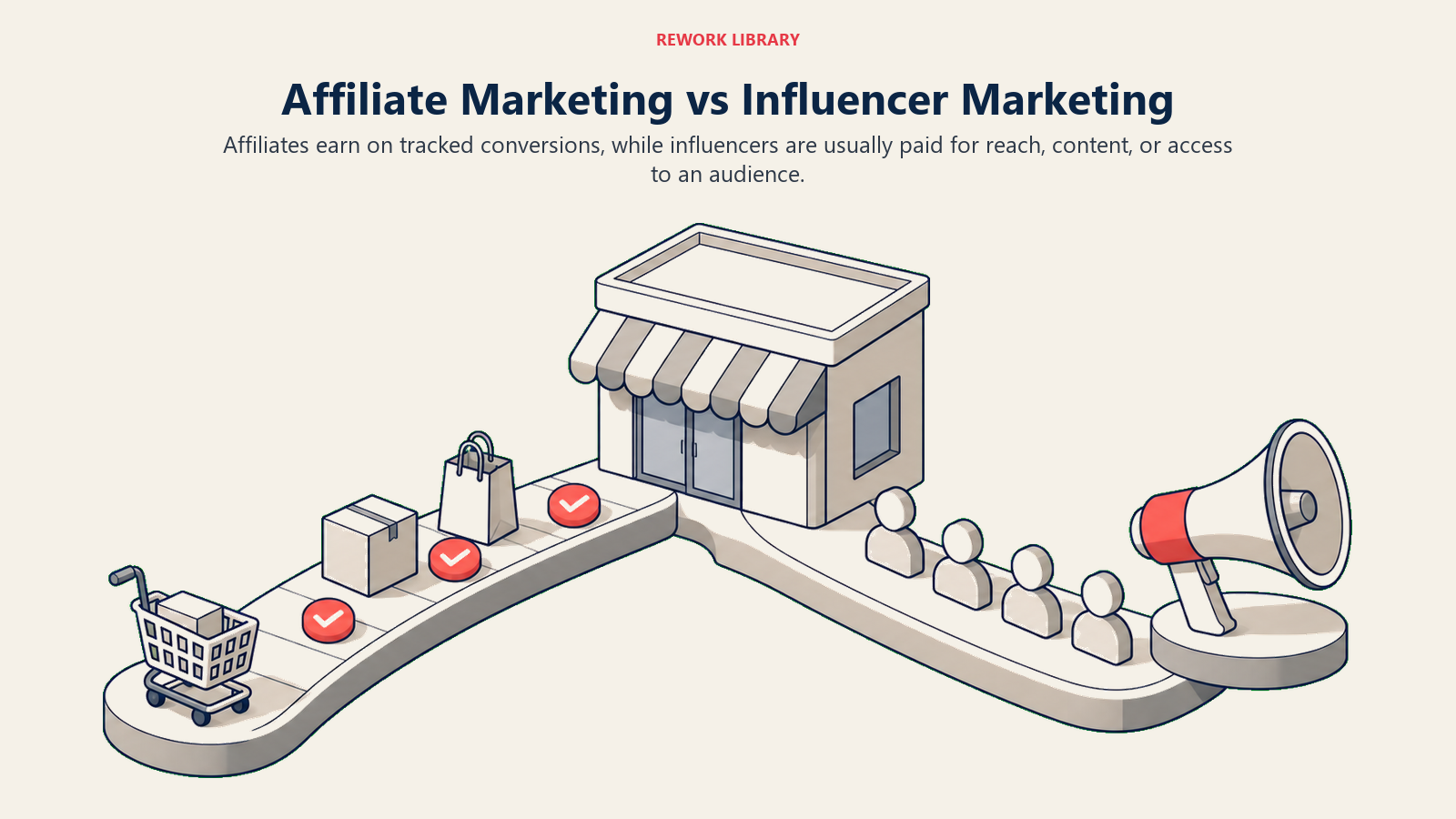
Some programs blend both models by offering influencers hybrid deals: a flat fee plus performance commissions. This can work when you want guaranteed content creation but also want to align incentives on driving sales. Learn more about this approach in our guide to influencer marketing.
For e-commerce brands, affiliate programs make sense when you need scalable, performance-driven traffic. Influencer partnerships work better for product launches, brand awareness campaigns, or when you're targeting specific audience segments where authentic creator endorsement matters more than pure conversion efficiency.
In-house program vs affiliate networks: choosing your approach
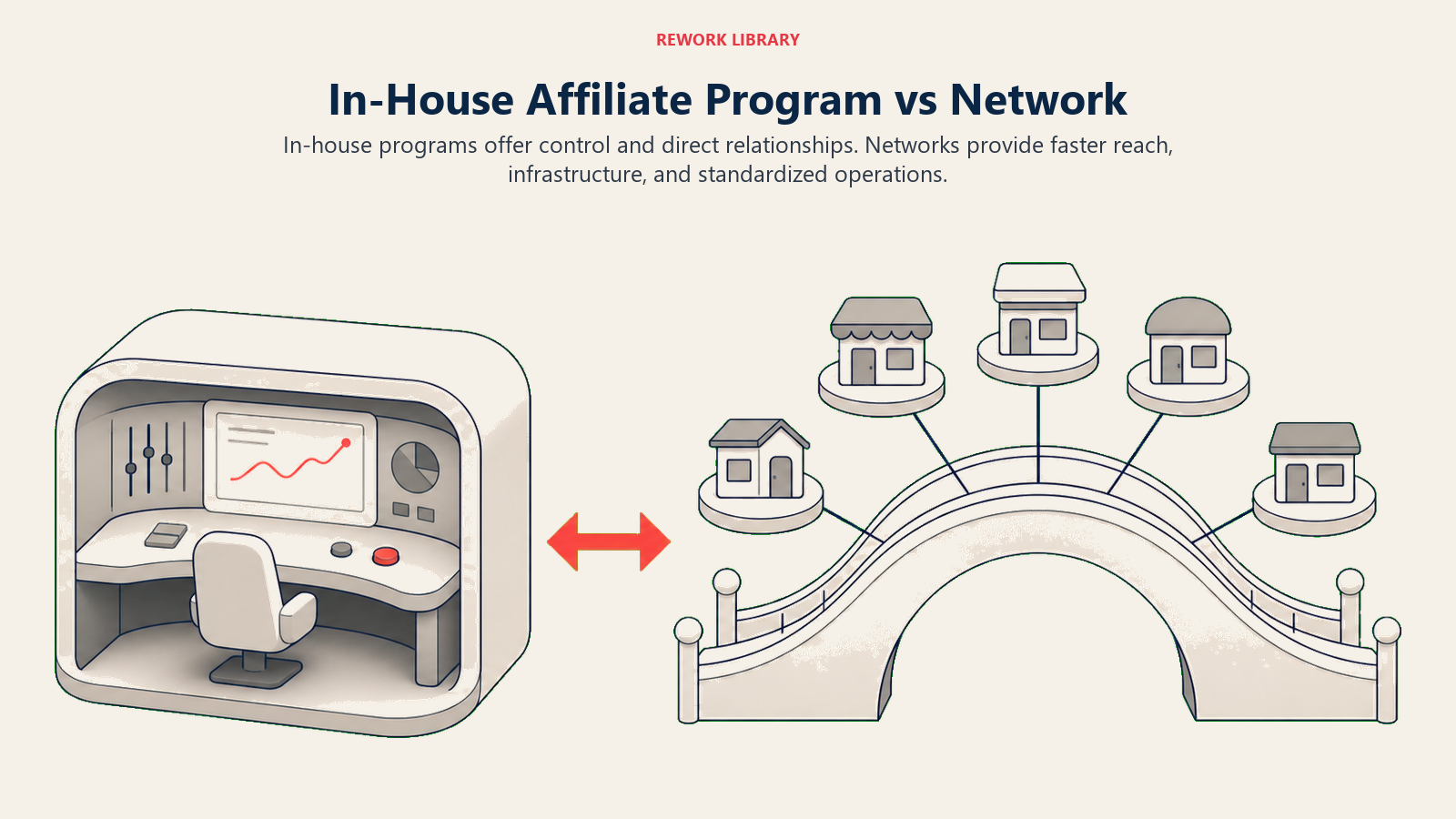
You have two main paths for running an affiliate program: build it yourself or join an established network. Each has trade-offs.
Affiliate networks
Networks like ShareASale, CJ Affiliate (Commission Junction), Rakuten Advertising, and Impact connect brands with thousands of affiliates already on their platforms. You set up your program, set commission rates, and affiliates apply to join.
Advantages:
- Instant access to established affiliates already looking for programs to join
- Platform handles tracking, reporting, and commission payments
- Built-in fraud prevention and compliance tools
- Easier to launch, you're plugging into existing infrastructure
Disadvantages:
- Network fees on top of commissions (usually 20-30% of commissions paid, plus monthly platform fees)
- Less control over affiliate relationships and communication
- Competing with hundreds of other brands for affiliate attention
- Generic program listings that don't differentiate your offer
Networks work best when you're just starting, don't have resources to build infrastructure, or want to test affiliate marketing before committing to a full program.
In-house programs
In-house programs use affiliate tracking software (like Refersion, Tapfiliate, or Post Affiliate Pro) that you host and manage yourself. You recruit affiliates directly, set your own terms, and own the entire relationship.
Advantages:
- Lower costs, just software fees, no network commissions
- Complete control over program structure and terms
- Direct relationships with affiliates
- Ability to customize everything from commission rules to creative assets
- Your affiliate data stays with you if you change platforms
Disadvantages:
- You handle all recruitment, vetting, and relationship management
- Smaller initial affiliate pool, you're building from scratch
- More technical setup and ongoing management
- You're responsible for fraud detection and prevention
In-house programs make sense when you have the resources to actively recruit and manage affiliates, want maximum control and customization, or are scaling beyond what networks efficiently provide.
The hybrid approach
Many successful programs start with a network to get quick momentum, then layer in direct partnerships with strategic affiliates. You might use ShareASale for broad affiliate recruitment while separately managing relationships with your top 10 partners who drive most of your affiliate revenue.
This gives you network scale plus high-touch relationship management where it matters most. Just make sure your tracking can handle both channels without attribution conflicts.
Commission structures: designing incentives that work
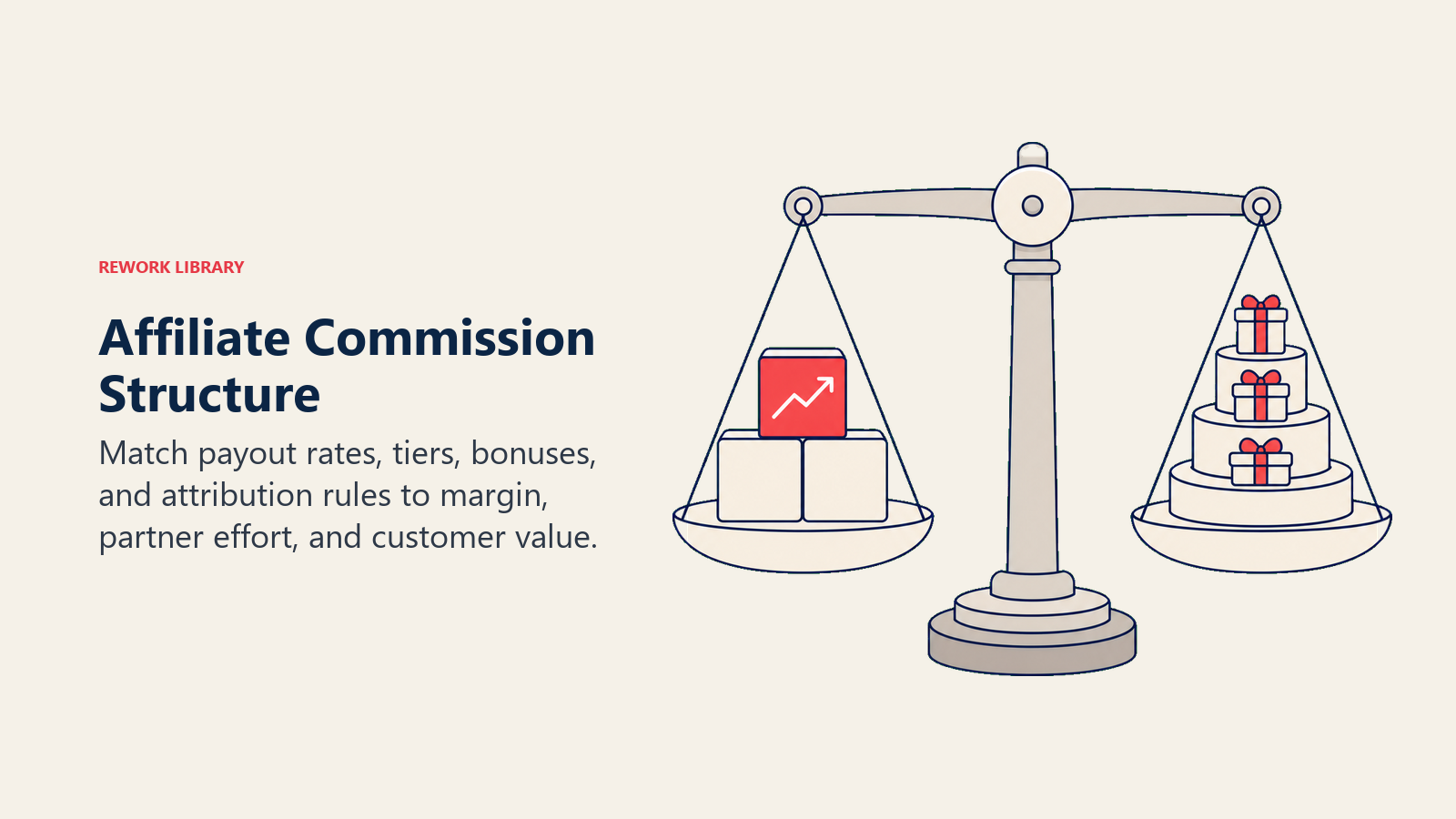
Your commission structure determines what type of affiliates you attract and how hard they work to promote your products. Get this wrong and you'll either lose money on unprofitable partnerships or fail to motivate affiliates to prioritize your program.
Flat commission model
The simplest approach: pay a fixed percentage on all sales. If you set 10% commission, every affiliate earns 10% regardless of performance, product sold, or customer type.
Example: An affiliate drives a $100 sale, they earn $10. A $500 sale pays $50.
This works when you want simplicity and predictable unit economics. Most programs start here because it's easy to explain and manage. The downside is it doesn't reward top performers or incentivize affiliates to focus on higher-value products or customer segments.
Typical flat commission rates by category:
- Fashion/apparel: 5-15%
- Beauty/cosmetics: 10-20%
- Electronics: 2-5%
- Home goods: 5-10%
- Digital products: 15-30%
- Supplements/health: 15-25%
Your rate should balance competitiveness (what other programs in your space offer) with your unit economics (what you can afford while maintaining positive contribution margin).
Tiered commission model
Tiered structures increase commission rates as affiliates hit performance thresholds. This rewards your best partners while keeping costs reasonable for small contributors.
Example tiered structure:
- $0-$2,000/month in sales: 8% commission
- $2,001-$5,000/month: 10% commission
- $5,001-$10,000/month: 12% commission
- $10,000+/month: 15% commission
Tiers can be based on monthly sales volume, number of conversions, or total commissions earned. The key is making the next tier achievable, if the jump from 8% to 10% requires doubling sales, affiliates might not see it as worth the effort.
Tiered models work best when you have a mix of affiliate types and want to motivate growth. Your hobbyist blogger might drive $500/month at 8%, but your professional content site seeing 10% at the next tier will push to hit that threshold.
Performance bonuses
Beyond tiered rates, you can add performance bonuses for specific achievements:
- New customer bonuses: Extra $5-10 commission for first-time customers (to encourage customer acquisition vs. coupon code redemption)
- Volume bonuses: One-time $500 bonus for hitting $10,000 in monthly sales
- Product-specific bonuses: 20% commission on new product launches for the first 30 days
- Seasonal bonuses: Double commissions during Black Friday/Cyber Monday
Bonuses let you focus affiliate effort on specific goals without permanently changing your commission structure. They're particularly useful for product launches or seasonal campaigns where you need concentrated promotion. Consider aligning these with your broader discount strategy to maintain pricing consistency.
Hybrid structures
Some programs combine different models for different partner types:
Content partners (bloggers, review sites): 10% flat commission Loyalty/cashback partners: 3% commission (lower because they're mostly capturing existing intent) Coupon sites: 5% commission (even lower, since they rarely drive incremental sales) Strategic partners: 15% + performance bonuses (for hand-picked partners you want to prioritize)
This approach acknowledges that different affiliate types deliver different value. A detailed product review from a trusted blogger drives more incremental sales than a generic coupon listing, so you compensate accordingly.
Cookie duration and attribution windows
Commission structure isn't just about rates, attribution windows matter just as much. The cookie duration determines how long after clicking an affiliate link a customer can purchase and still credit the affiliate.
Standard cookie durations:
- 24 hours: Very short, used mainly for daily deal sites
- 7 days: Common for impulse purchases and low-consideration products
- 30 days: Industry standard for most e-commerce
- 60-90 days: Higher-consideration products, longer sales cycles
- Lifetime: Rare, but used for subscription products or high-LTV customer bases
Longer cookies attract better affiliates because they get credit for sales even when customers take time to decide. But they also increase the chance of attribution conflicts (multiple affiliates claiming credit for the same sale).
Most programs use 30-day cookies with last-click attribution, whoever refers the customer last before purchase gets the commission. This is simple but can undervalue early-stage content that introduces customers to your brand.
Setting up your affiliate program infrastructure
Once you've designed your commission structure, you need the technical infrastructure to track clicks, attribute sales, and pay commissions.
Platform selection
Your affiliate platform handles link tracking, conversion attribution, commission calculation, reporting, and payments. Key features to evaluate:
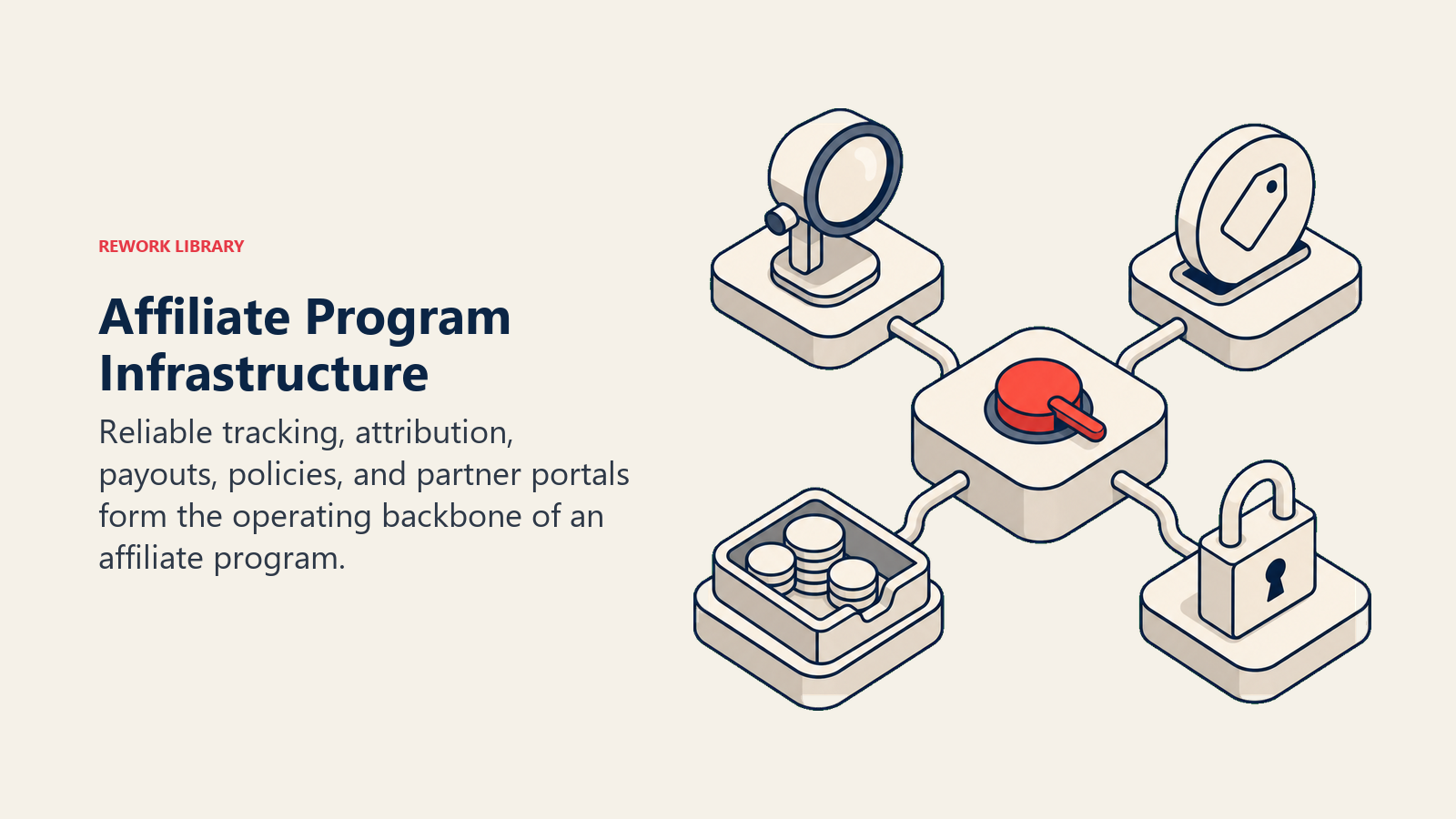
Tracking reliability: Does it accurately attribute sales across devices and browsers? Can it handle coupon codes and offline conversions?
Integration capabilities: Native integrations with your e-commerce platform (Shopify, WooCommerce, BigCommerce), analytics tools, and payment processors make setup easier.
Reporting depth: Can affiliates see real-time performance? Can you segment reporting by product, traffic source, or affiliate tier?
Commission flexibility: Does the platform support your commission structure (tiers, bonuses, product-specific rates)?
Fraud detection: Built-in tools for identifying suspicious traffic patterns, duplicate conversions, or affiliate policy violations.
Payment automation: Automated commission calculations and payouts save hours of manual work each month.
Popular platforms:
- Refersion: Strong Shopify integration, unlimited affiliates, good for scaling programs
- Tapfiliate: Flexible commission rules, white-label affiliate portal, solid fraud prevention
- Impact: Enterprise-grade platform with advanced tracking and partnership automation
- Post Affiliate Pro: Self-hosted option, maximum customization, steeper learning curve
- ShareASale/CJ Affiliate: Full-service networks with built-in affiliate pools
For most e-commerce brands starting out, Refersion or Tapfiliate offer the right balance of features, ease of use, and cost. Enterprise brands with complex needs might justify Impact or building custom solutions.
Integration and tracking setup
Your affiliate platform needs to track when visitors click affiliate links and attribute any resulting purchases back to the correct affiliate. This requires:
Conversion tracking pixel/script: JavaScript code added to your order confirmation page that fires when someone completes a purchase. This tells the platform which affiliate drove the sale and calculates commission owed.
Coupon code tracking: If affiliates use custom promo codes, your platform needs to attribute sales using those codes even without click tracking. Ensure this integrates with your analytics tracking setup for accurate attribution.
Cross-device tracking: Customers might click an affiliate link on mobile but purchase later on desktop. Better platforms handle this through fingerprinting or probabilistic matching.
Subdomain or custom domain: Most platforms let you host your affiliate portal on a branded subdomain (affiliates.yourstore.com) instead of generic platform URLs. This looks more professional and increases trust.
Test your tracking thoroughly before launching. Make test purchases through affiliate links, apply promo codes, and verify that conversions show up correctly in the platform with accurate commission calculations. Attribution bugs cost you money, either through unpaid affiliates who stop promoting you or overpayments for conversions that shouldn't have been credited.
Creating your affiliate portal and resources
Your affiliate portal is where partners go to get links, check performance, and access promotional materials. A well-designed portal makes it easy for affiliates to promote your products effectively.
Essential portal elements:
Dashboard: Real-time stats showing clicks, conversions, earnings, and top-performing content. Affiliates should see exactly how their promotion is performing without waiting for monthly reports.
Link generator: Tool to create trackable affiliate links for any product or page on your site. The easier you make it to get links, the more affiliates will promote you.
Creative assets:
- Banner ads in standard sizes (728x90, 300x250, 160x600)
- Product images with transparent backgrounds
- Logo files in multiple formats
- Social media graphics optimized for different platforms
- Email templates affiliates can customize
Product feed: Data feed with all your products, prices, images, and descriptions that affiliates can use to automate content creation or build comparison tools.
Program terms and guidelines:
- Commission rates and payment terms
- Prohibited promotional methods (trademark bidding, cookie stuffing, incentivized traffic)
- Brand guidelines (how they can use your name, logo, and images)
- Content requirements (disclosure language, claims they can/can't make)
- Cookie duration and attribution rules
Communication center: Updates on new products, seasonal promotions, commission changes, or performance contests. Regular communication keeps affiliates engaged and informed.
Educational resources:
- Product guides explaining features and benefits
- Best-performing promotional angles (what messaging converts)
- Seasonal campaign calendars (when to promote what)
- Case studies from top-performing affiliates
The more you invest in your affiliate portal, the easier you make it for partners to succeed, which directly translates to more revenue for your program.
Affiliate recruitment strategy: finding and activating quality partners
Having a great commission structure and polished portal means nothing if you don't have affiliates actively promoting your products. Recruitment is where most programs fail, they build the infrastructure, then wait for affiliates to magically discover them.
Identifying your ideal affiliate types
Not all affiliates are created equal. Different partner types deliver different value and require different management approaches.
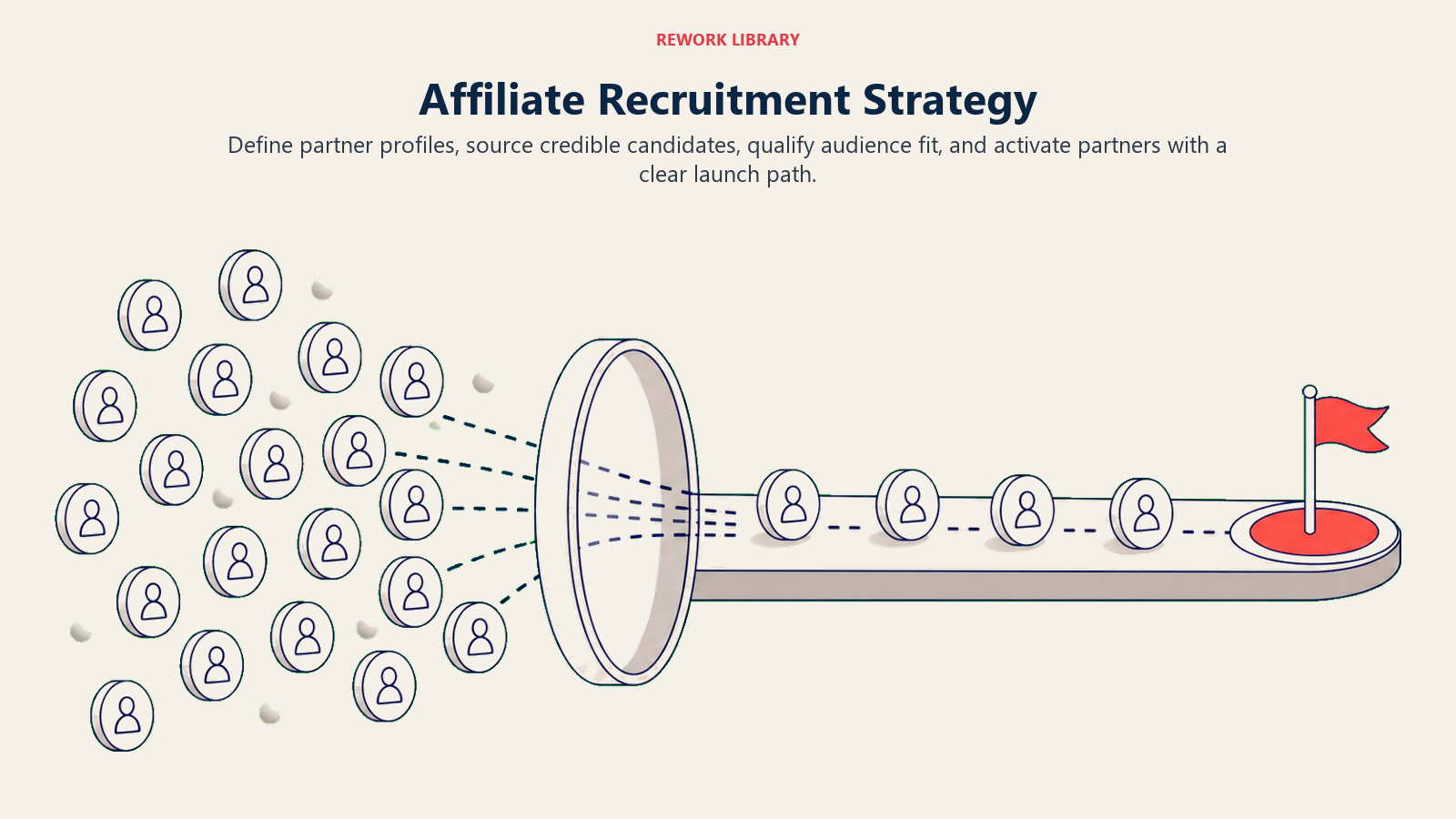
Content publishers (blogs, review sites, niche media): Create detailed product reviews, comparison articles, buying guides, and recommendation lists. They drive high-intent traffic from organic search and loyal readers. These are often your most valuable partners because they build trust with their audience over time.
YouTube creators: Video reviews, unboxings, tutorials, and comparison content. Visual formats work especially well for products where seeing them in action matters. YouTube traffic tends to convert well when creators authentically recommend products.
Email list owners: Newsletter publishers with engaged subscribers in your target market. They can drive concentrated bursts of traffic during promotional periods. Quality varies widely, some lists are hyper-engaged, others are bought or incentivized. Consider how this complements your own email marketing for e-commerce strategy.
Coupon and deal sites: Aggregate discounts and promo codes. They capture existing purchase intent but rarely drive incremental sales. Useful for volume, but manage carefully to avoid paying commissions on sales that would have happened anyway.
Loyalty and cashback programs: Rakuten, TopCashback, Honey. They offer shoppers cashback for purchases through their platforms. Similar to coupon sites, mostly capturing existing demand rather than creating new demand.
Comparison shopping engines: Sites that let shoppers compare products across retailers. Can drive high-intent traffic but often require product feeds and may charge per-click fees in addition to commissions.
Social media influencers: Instagram, TikTok, Pinterest creators who share affiliate links with their followers. Authenticity matters here, forced product placements backfire. Work best when your products naturally fit their content.
Start by identifying which types align with your customer acquisition strategy. A luxury skincare brand might prioritize beauty bloggers and YouTube creators. A budget home goods retailer might focus on deal sites and cashback platforms. Most successful programs eventually include a mix, but you should have a primary focus based on where your ideal customers discover products.
Direct outreach and recruitment
The most effective affiliate recruitment is proactive outreach to your ideal partners. Waiting for them to find you means you're competing with every other program in your category.
Research and prospect list building:
- Google search for "[your category] + reviews" or "best [product type]"
- Look at who's ranking for product comparison keywords
- Check YouTube for creators reviewing products like yours
- Browse relevant subreddits, forums, and communities
- Use tools like BuzzSumo or Ahrefs to find popular content in your niche
Build a spreadsheet of potential partners with their site/channel URL, traffic estimates, audience quality signals, and contact information.
Outreach email template:
Subject: Partnership opportunity - [Your Brand] affiliate program
Hi [Name],
I found your [article/video] on [topic] and was impressed by [specific detail showing you actually read/watched their content].
We're looking for partners to join our affiliate program for [Your Brand]. We make [brief product description] and think your audience would genuinely benefit from [specific reason].
Our program offers:
- [Commission rate]% commission on all sales
- -day cookie duration
- Performance bonuses for [specific incentive]
- Dedicated affiliate support
Would you be interested in partnering with us? I can send you some sample products to review if that helps you decide.
Best, [Your Name]
The key is personalization. Generic affiliate recruitment emails get ignored. Show you understand their content and explain why your products fit their audience.
Affiliate recruitment through networks
If you're on a network like ShareASale or CJ, you're automatically visible to thousands of affiliates searching for programs to join. But being visible doesn't mean being chosen, you're competing with hundreds of other brands.
To stand out:
- Competitive commission rates: Research what similar programs offer and match or beat it
- Detailed program description: Explain what makes your products unique and why affiliates should promote you
- High-quality promotional materials: Professional banners and creative assets signal you're serious
- Strong product feed: Complete, accurate data makes it easy for affiliates to feature your products
- Responsive support: Reply quickly to affiliate applications and questions
Many affiliates on networks use automated tools to find high-paying programs with good conversion rates. Your program needs competitive economics and proven performance to attract them.
Building affiliate tiers for differentiated management
Not all affiliates deserve the same level of attention. Segment your partners into tiers based on performance so you can focus resources on high-impact relationships.
Tier 1 - Strategic partners (top 10% of revenue):
- Custom commission deals
- Dedicated account management
- Early access to new products
- Co-marketing opportunities
- Direct communication channel
Tier 2 - Growing partners (next 30%):
- Regular performance check-ins
- Seasonal campaign briefings
- Standard creative assets
- Monthly newsletter updates
Tier 3 - Active partners (remaining affiliates driving sales):
- Self-service portal access
- Automated commission payments
- Access to standard resources
- Quarterly updates
Tier 4 - Inactive partners (applied but not promoting):
- Onboarding email sequence
- Automated reminder campaigns
- Periodic reactivation offers
This tiered approach lets you pour energy into relationships that matter while maintaining baseline support for everyone else. Your top 20% of affiliates will likely drive 80% of your affiliate revenue, treat them accordingly.
Fraud prevention and quality control
Affiliate fraud is rampant. If you're not actively preventing it, you're paying for it. Common fraud patterns include cookie stuffing, click fraud, incentivized traffic, fake leads, and commission theft.
Understanding affiliate fraud types
Cookie stuffing: Dropping affiliate cookies on users' browsers without them actually clicking an affiliate link. When that user later visits your site directly and makes a purchase, the affiliate claims credit. This is pure theft, you're paying commissions for sales you would have gotten anyway.
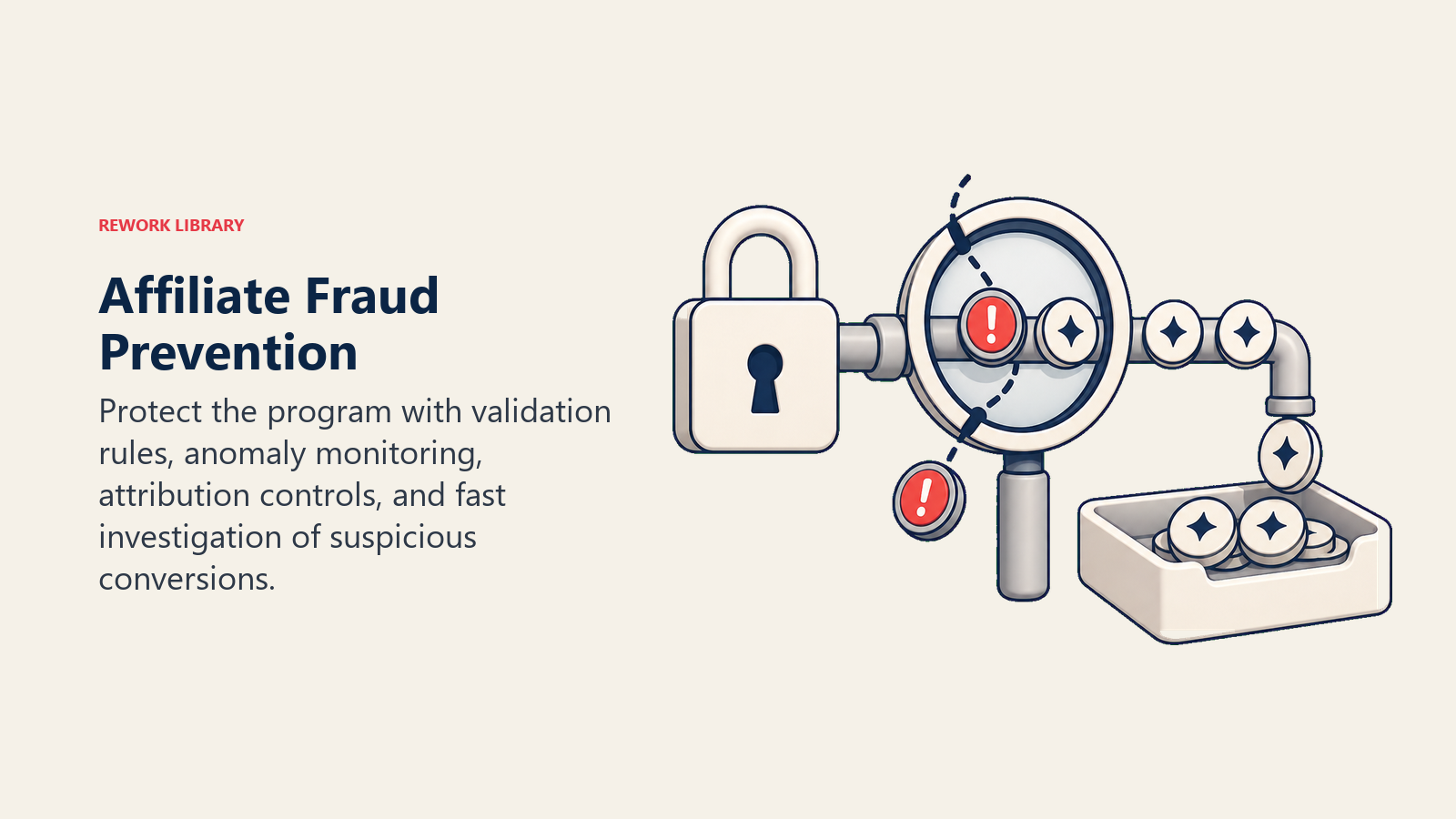
Click fraud: Generating fake clicks through bots or click farms to inflate metrics and potentially trigger per-click bonuses. Doesn't usually result in conversions but wastes your time and skews reporting.
Incentivized traffic: Paying people to click affiliate links or make purchases (then return products) just to generate commissions. The "sales" look real but aren't actual customers.
Fake leads: Submitting fake form fills or sign-ups (for programs that pay per lead) using generated or purchased data. Clogs your system with worthless contacts.
Trademark bidding: Bidding on your brand name in paid search and inserting affiliate links between the ad and your site. You're paying for traffic you would have gotten organically, plus paying the affiliate commission.
Duplicate accounts: Creating multiple affiliate accounts to abuse new affiliate bonuses or bypass account limits.
Red flags and detection methods
Monitor these signals to identify potential fraud:
Conversion rate spikes: If an affiliate suddenly jumps from 2% conversion rate to 15%, investigate. Real traffic patterns are relatively stable.
High click volume with low/no conversions: Suggests bot traffic or click fraud. Legitimate affiliates drive clicks that convert.
Suspicious traffic sources: Check referring URLs in your analytics. Traffic from random domains, URL shorteners, or sketchy redirect chains is suspect.
Too-perfect metrics: An affiliate with exactly 100 clicks and exactly 10 conversions every day might be faking data or manipulating systems.
Short time-to-purchase: If most sales happen within seconds of the affiliate click, the affiliate might be cookie stuffing users who were already on their way to your site.
High return rates: Affiliates driving sales that get returned or charged back at abnormally high rates might be using incentivized traffic or fake purchases.
Generic/international traffic to niche products: A parenting blog sending traffic to industrial B2B products doesn't make sense. Geography mismatches are also suspicious.
Use your affiliate platform's built-in fraud tools plus analytics from Google Analytics or Shopify to cross-reference traffic patterns. Most platforms let you see the referring URL for each click and conversion, review this data regularly for your top-earning affiliates.
Fraud prevention policies
Prevention starts with clear policies in your affiliate agreement:
Prohibited methods:
- Trademark bidding (PPC ads on your brand name)
- Cookie stuffing and forced-click mechanisms
- Incentivized traffic (paying users to click/purchase)
- Misleading claims or false advertising
- Email spam or unsolicited communications using your brand
- Misleading domains (typosquatting your brand)
Required disclosures: Affiliates must clearly disclose their affiliate relationship in compliance with FTC guidelines.
Traffic quality standards: Specify minimum conversion rate expectations and traffic source requirements.
Review process: Reserve the right to review affiliate promotional methods before and after approval.
Penalties: Define consequences for violations (commission forfeiture, account termination, potential legal action).
Make affiliates agree to these terms on signup. This gives you legal standing to refuse commission payments for fraudulent activity.
Managing problematic affiliates
When you detect fraud or policy violations:
- Pause commissions: Put the affiliate's pending commissions on hold while investigating
- Request explanation: Give them a chance to explain the traffic pattern or address the concern
- Review historical data: Check whether past performance also shows suspicious patterns
- Make a decision:
- Minor violation: Warning and monitoring
- Clear fraud: Terminate account, forfeit commissions, potentially pursue legal action
- Gray area: Request changes to promotional methods and monitor closely
Document everything. You'll need records if affiliates dispute commission holds or account terminations.
Affiliate support and enablement
The best affiliates are those who understand your products, know what works, and have the resources they need to create effective promotions. Your job is making them successful.
Onboarding new affiliates
First impressions matter. When a new affiliate joins your program, send a comprehensive welcome email:
Welcome email contents:
- Thank them for joining and express enthusiasm for the partnership
- Explain how to access the affiliate portal and generate links
- Link to your best-selling products or current promotions
- Share your top-performing promotional angles (what messaging converts)
- Provide any seasonal calendar or upcoming campaign plans
- Explain commission structure and payment schedule
- Offer to answer questions or provide support
Follow up one week later if they haven't posted any content. Many affiliates join programs with good intentions but never actually promote. A gentle nudge can activate dormant partners.
Providing product samples and experiences
Especially for content creators and reviewers, firsthand product experience dramatically improves promotion quality. An affiliate who's actually used your product can:
- Create authentic, detailed reviews instead of generic descriptions
- Share genuine opinions that build trust with their audience
- Produce better photos and videos
- Answer audience questions from experience
Develop a product seeding program for qualified affiliates:
- Review sites and bloggers: Send products they're likely to review
- YouTube creators: Provide unboxing or tutorial opportunities
- Instagram/TikTok creators: Visual products work great for social content
Not every affiliate needs free products, many prefer to purchase (and get commissions). But strategic product seeding can unlock much better content from key partners.
Regular communication and updates
Stay top-of-mind with consistent communication:
Monthly affiliate newsletter:
- New product launches and their best features
- Upcoming promotions and special offers
- Top-performing content examples from other affiliates
- Commission updates or bonus opportunities
- Seasonal trends and merchandising suggestions
Promotional campaign briefings: When running major sales (Black Friday, holiday campaigns, new product launches), give affiliates advance notice with:
- Campaign dates and discount details
- Suggested promotional angles
- Creative assets and copy templates
- Recommended products to feature
Performance updates: Quarterly or semi-annual emails to each affiliate showing:
- Their total sales and commissions
- How they rank among all affiliates
- Opportunities to increase performance (tier upgrades, product categories they haven't promoted)
Regular touchpoints keep your program active in affiliates' minds when they're deciding what to promote next.
Performance coaching
Your top affiliates are often open to feedback on improving their performance. If you notice:
- Low conversion rates despite good traffic (might suggest messaging misalignment)
- Heavy focus on low-margin products (could promote higher-value items)
- Outdated content or broken links (needs refresh)
- Seasonal opportunities they're missing
Reach out with specific, helpful suggestions. Frame it as partnership: "I noticed your review of [product] is driving great traffic but converting lower than similar content. Would you like some data on what product features resonate best with our customers?"
Most affiliates appreciate insights that help them earn more commissions. Avoid being pushy or demanding, you're offering help, not criticism.
Monitoring and optimization: making your program more effective
An affiliate program isn't set-it-and-forget-it. Continuous monitoring and optimization separate growing programs from stagnant ones.
Key metrics to track
Program-level metrics:
- Total affiliate sales: Revenue driven by all affiliates
- Active affiliates: Number actually driving traffic and sales
- Affiliate-attributed revenue %: Share of total revenue coming from affiliates
- Average order value (AOV): Affiliate-driven purchases vs. overall AOV
- Return on ad spend (ROAS): Revenue / total program costs (commissions + platform fees + management time)
- Incremental revenue %: Estimated portion of affiliate sales that wouldn't have happened otherwise
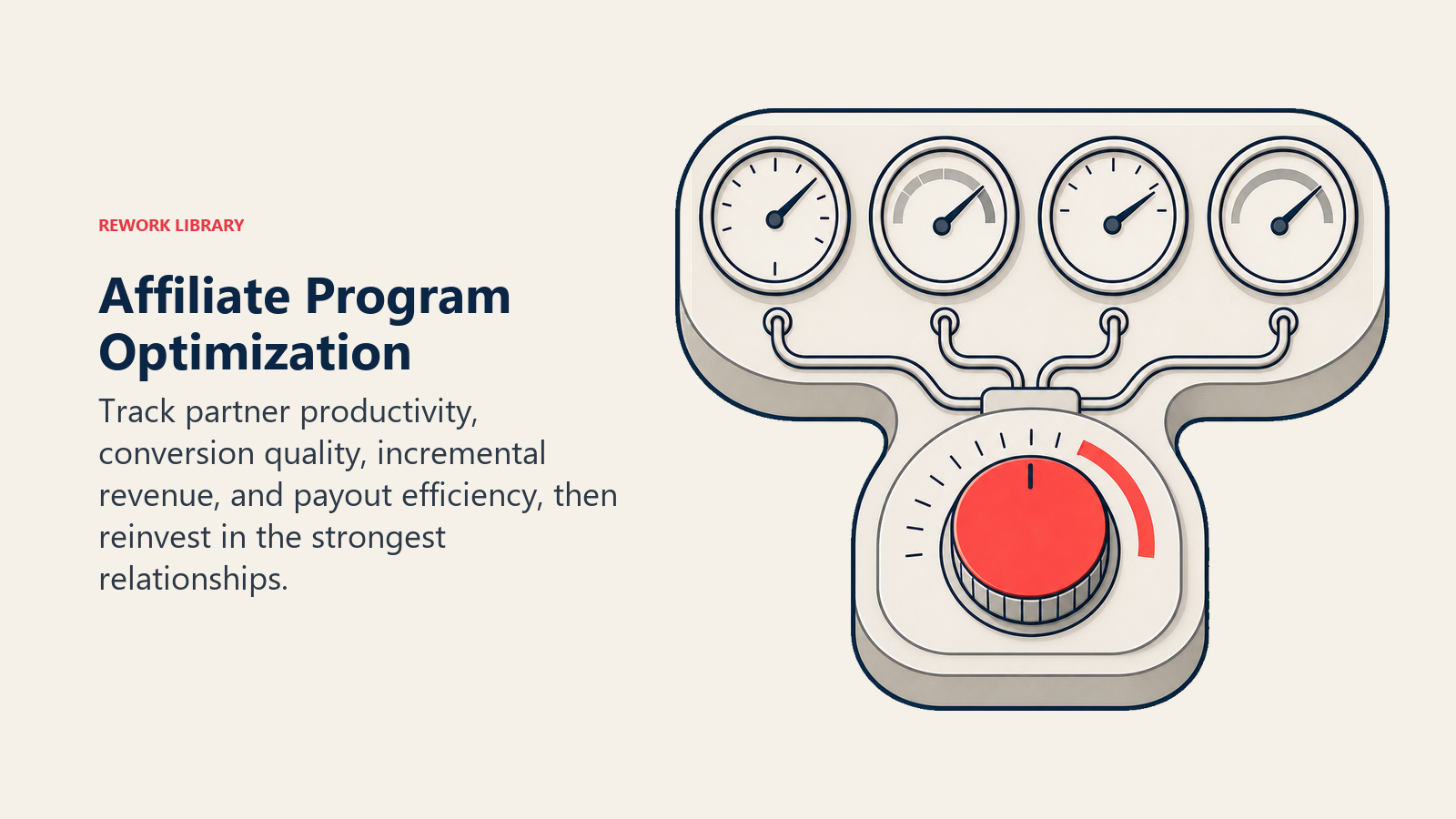
For a comprehensive view of program performance, track these alongside your broader e-commerce metrics and KPIs.
Affiliate-level metrics:
- Clicks: Total affiliate link clicks
- Conversions: Sales attributed to the affiliate
- Conversion rate: Conversions / clicks
- Average commission per conversion: How much you pay per sale
- Revenue per click (RPC): Total revenue / total clicks
- New vs. returning customers: Are they bringing you new buyers or just claiming credit for repeat customers?
Understanding customer lifetime value for affiliate-driven customers helps determine your true program ROI.
Content-level metrics:
- Top-performing content types: Reviews vs. comparisons vs. tutorials
- Best-converting traffic sources: Organic search vs. social vs. email
- Product performance: Which products get promoted most and convert best
Track these in your affiliate platform dashboard and supplement with Google Analytics data to see the full customer journey.
Identifying and scaling what works
Look for patterns in your top performers:
- What affiliate types drive the best results?
- What promotional methods convert highest?
- What products get featured most and perform best?
- What content formats (video, written reviews, comparisons) work?
- What traffic sources (organic, paid, social, email) convert best?
Once you identify what's working, double down:
- Recruit more affiliates like your top performers: If food bloggers crush it, find more food bloggers
- Promote winning products: Feature your best-converting products more prominently in affiliate materials
- Share successful content examples: Show other affiliates what's working
- Adjust commissions to incentivize desired behavior: Bonus new product categories you want more coverage on
Apply conversion rate optimization principles to your affiliate landing pages to maximize the value of affiliate-driven traffic.
Data should drive your recruitment focus, product promotion strategy, and resource allocation.
A/B testing with affiliates
Test different program elements to optimize performance:
Commission rates: Try increasing rates for a segment of new recruits and compare activation rates and revenue per affiliate
Creative assets: Provide multiple banner options and see which drive more clicks
Product recommendations: Feature different products in affiliate newsletters and track which generate more content
Promotional periods: Test sending sale previews 1 week vs. 2 weeks in advance to see what generates more affiliate participation
Onboarding sequences: Try different welcome email flows and measure affiliate activation rates
Track results rigorously. Small improvements in conversion rates or affiliate activation compound across your entire program.
Common pitfalls and how to avoid them
Over-reliance on coupon sites
Coupon and deal sites are the fast food of affiliate marketing, convenient and high-volume, but questionable value. They intercept customers already on their way to purchase and insert affiliate links (plus discount codes) to claim commissions.
The problem: you're paying commissions on sales that would have happened anyway. Worse, you're training customers to always search for coupon codes before purchasing, which conditions them to wait for deals.
Solution: Limit coupon affiliate participation or pay them lower commissions. Some programs ban them entirely. If you do allow them, ensure your codes are restricted (new customers only, specific product categories) so you're not just giving away margin. Integrate this thinking with your overall pricing strategy for e-commerce.
Inadequate fraud controls
If you're not actively monitoring for fraud, assume you have it. Many programs lose 10-20% of affiliate commissions to various fraud schemes.
Solution: Implement the detection methods outlined earlier. Review top-earning affiliates monthly. Use traffic analysis tools. Don't just look at revenue, examine traffic quality, conversion patterns, and customer retention.
Weak commission structures
Offering 5% commission when competitors offer 15% means you won't attract quality affiliates. They'll join, realize your program isn't worth their effort, and focus elsewhere.
Solution: Research competitive programs. Survey affiliates who join but don't promote you. You might not need the highest commissions, but you need competitive economics plus good products and support.
Poor affiliate support
Affiliates who feel ignored stop promoting you. If they can't get questions answered, access to product information, or help troubleshooting tracking issues, they'll focus on programs that treat them better.
Solution: Assign someone to manage affiliate relationships. Respond to emails within 24 hours. Proactively share updates and resources. Treat your top affiliates like valued partners, not anonymous traffic sources.
Ignoring program data
Running your program on autopilot means you're probably overpaying for low-quality traffic while underinvesting in high-performers.
Solution: Monthly program reviews. Analyze top performers, identify bottom performers, review fraud indicators, examine product mix, and assess overall program ROI. Use data to make deliberate decisions about commission changes, recruitment priorities, and resource allocation.
Scaling your affiliate program
Once your program is running smoothly, focus shifts to deliberate growth.
Recruiting at scale
Early-stage recruitment is manual and high-touch. At scale, you need systematic approaches:
Affiliate recruitment campaigns: Run outreach campaigns targeting specific affiliate types. Build lists of 100-500 prospects, develop personalized email templates, and track response rates.
Affiliate recruitment landing pages: Create dedicated pages explaining your program benefits, commission structure, and signup process. Drive affiliates here through:
- Blog posts about affiliate marketing in your niche
- Guest posts on affiliate marketing forums/sites
- Paid ads targeting "affiliate programs in [category]" searches
- Social media outreach to creators
Referral bonuses: Pay existing affiliates to recruit new ones. Offer $50-100 bonuses for referred affiliates who hit minimum performance thresholds.
Industry events: Attend affiliate marketing conferences and category-specific events where potential partners gather. Affiliate Summit and similar events connect you with professional affiliates.
Affiliate managers/agencies: Hire dedicated program managers or outsource to agencies specializing in affiliate recruitment and management. This makes sense when you're doing $100k+/month in affiliate revenue and need expertise you don't have in-house.
International expansion
Most affiliate programs start domestic but international affiliates can unlock growth:
Multi-currency support: Pay commissions in affiliates' local currencies to make your program attractive globally.
Localized creative assets: Provide product images, copy, and banners in multiple languages.
Regional affiliate managers: Time zones and language barriers make international support challenging. Consider hiring regional managers or partnering with international networks.
Compliance with local regulations: Different countries have different disclosure requirements, data privacy laws, and advertising regulations. Ensure your program terms and affiliate content comply.
Seasonal campaign planning
E-commerce is seasonal. Plan affiliate campaigns around key dates:
Q4 holiday campaigns: Black Friday, Cyber Monday, Christmas. Give affiliates 4-6 weeks advance notice, provide campaign calendars, and consider bonus commissions for this critical period.
Category-specific seasons:
- Back-to-school (late summer)
- Valentine's Day (January-February)
- Spring cleaning (March-April)
- Summer travel (May-June)
- Fitness (January new year's resolution period)
Coordinate with your broader marketing calendar so affiliates align with email campaigns, paid ads, and on-site promotions.
New product launches: Turn affiliates into launch partners. Provide early access, sample products, and launch-specific promotional materials. Consider higher commissions for the first 30-60 days.
Program management best practices
Running a successful affiliate program long-term requires consistent management practices:
Regular performance reviews: Monthly deep-dives into program performance, top/bottom performers, fraud indicators, and optimization opportunities.
Affiliate segmentation and tiering: Continuously update your affiliate tiers based on performance. Promote growing partners, identify declining ones, and adjust support accordingly.
Contract and compliance management: Ensure affiliate agreements are current, affiliates are complying with FTC disclosure rules, and you have documentation for any commission disputes.
Competitive intelligence: Monitor what other programs in your space offer. Commission rates, promotional approaches, and affiliate support levels evolve, stay competitive.
Product and messaging alignment: Keep affiliates informed about product updates, new positioning, or messaging changes. Outdated affiliate content hurts both of you.
Payment reliability: Pay commissions on time, every time. Late payments destroy affiliate trust and motivation faster than anything else.
Technology maintenance: Keep tracking scripts updated, monitor for broken links or redirect issues, and ensure your platform integrates properly with your e-commerce stack.
From setup to scale: your affiliate program roadmap
Affiliate marketing done right is one of the highest-leverage channels available to e-commerce brands. You're not just buying traffic, you're building an army of partners motivated to sell your products because their success depends on yours.
The brands that succeed treat affiliate marketing as a strategic channel requiring thoughtful program design, active recruitment, ongoing relationship management, and constant optimization. They invest in their partners, provide resources that make promotion easy, and maintain the discipline to prevent fraud while rewarding performance.
Start with solid program fundamentals: clear commission structures, reliable tracking, and quality creative assets. Recruit deliberately, focusing on partners whose audiences align with your customers. Support your affiliates with regular communication and helpful resources. Monitor performance ruthlessly, scaling what works and cutting what doesn't.
Your affiliate program won't build itself, but when you build it right, you unlock a performance-based growth channel that scales revenue without scaling upfront ad spend, and that's worth the effort.
Learn More
Ready to strengthen your affiliate program and overall growth strategy? These resources will help:
- Product Page Optimization - Maximize conversions from affiliate-driven traffic with optimized product pages
- Customer Data Platform - Track and analyze customer journeys from affiliate touchpoints through purchase and beyond
For broader context on building sustainable traffic channels, see Traffic Acquisition Strategy. Learn how affiliate programs compare to other paid channels in Google Shopping Ads, or explore partnership-based alternatives in Influencer Marketing. To optimize for repeat purchases from affiliate-driven customers, see Retargeting & Remarketing. Track program performance using E-commerce Metrics & KPIs, and evaluate long-term affiliate-driven customer value through Customer Lifetime Value (LTV). Ensure your program economics work by understanding Unit Economics for E-commerce.

On this page
- Why affiliate marketing matters for e-commerce
- Affiliate marketing vs influencer marketing: understanding the difference
- In-house program vs affiliate networks: choosing your approach
- Affiliate networks
- In-house programs
- The hybrid approach
- Commission structures: designing incentives that work
- Flat commission model
- Tiered commission model
- Performance bonuses
- Hybrid structures
- Cookie duration and attribution windows
- Setting up your affiliate program infrastructure
- Platform selection
- Integration and tracking setup
- Creating your affiliate portal and resources
- Affiliate recruitment strategy: finding and activating quality partners
- Identifying your ideal affiliate types
- Direct outreach and recruitment
- Affiliate recruitment through networks
- Building affiliate tiers for differentiated management
- Fraud prevention and quality control
- Understanding affiliate fraud types
- Red flags and detection methods
- Fraud prevention policies
- Managing problematic affiliates
- Affiliate support and enablement
- Onboarding new affiliates
- Providing product samples and experiences
- Regular communication and updates
- Performance coaching
- Monitoring and optimization: making your program more effective
- Key metrics to track
- Identifying and scaling what works
- A/B testing with affiliates
- Common pitfalls and how to avoid them
- Over-reliance on coupon sites
- Inadequate fraud controls
- Weak commission structures
- Poor affiliate support
- Ignoring program data
- Scaling your affiliate program
- Recruiting at scale
- International expansion
- Seasonal campaign planning
- Program management best practices
- From setup to scale: your affiliate program roadmap
- Learn More