Repeat Purchase Strategy: Building Systems for Customer Loyalty and Recurring Revenue
Turn this article into takeaways for your work.


Each assistant summarizes the article only for you and suggests best practices for your work.
Getting a first-time customer to buy is expensive. Getting them to buy again is where profit happens.
Most e-commerce brands spend 80% of their marketing budget acquiring new customers, then wonder why they're not profitable. The numbers are clear: acquiring a new customer costs 5-7x more than retaining an existing one, and repeat customers spend 3x more per order than first-time buyers. Understanding your unit economics for e-commerce helps clarify why retention is critical.
Without a systematic repeat purchase strategy, only 10-15% of first-time customers will naturally come back. With the right systems in place, you can push that to 40-50% or higher.
This isn't about hoping customers remember you. It's about building automated systems that bring them back at the right time.
Why Repeat Customers Matter
The economics of repeat purchases are compelling:
Repeat customers are more profitable. They already know your brand, trust your products, and have lower service costs. Their orders typically have 20-30% higher average order values and require minimal marketing spend to generate.
The 80/20 rule applies. For mature e-commerce brands, 80% of future revenue comes from the top 20% of existing customers. Your repeat purchase rate directly determines your Customer Lifetime Value (LTV) and whether your customer acquisition costs are sustainable.
Without strategy, most customers never return. The natural repeat purchase rate without intervention is 10-15%. People forget about you, get distracted, or simply don't think to reorder. They're not choosing competitors. They're just not choosing at all.
Repeat purchases compound. A customer who makes a second purchase is 3x more likely to make a third. A customer who makes a third purchase is 5x more likely to make a fourth. The hardest conversion is getting them to come back the first time.
The goal isn't just to sell more to existing customers. It's to build systematic retention that makes your customer acquisition math work.
Repeat Purchase Fundamentals
Before building retention systems, understand your baseline:
Natural repurchase cycles vary by product. Coffee might repurchase every 30 days. Skincare every 60-90 days. Furniture might be years. Your repeat purchase strategy must align with your product's natural consumption rate.
Different products have different retention patterns. Consumables have predictable cycles. Fashion has seasonal patterns. Electronics have upgrade cycles. Understanding your category's natural rhythm is essential for timing your outreach.
Benchmark your current performance. Calculate your repeat purchase rate: (Number of customers who purchased more than once / Total number of customers) x 100. Industry benchmarks vary, but 20-30% is typical for consumables, 10-20% for fashion, and 5-10% for durables.
Track time-to-second-purchase. The median days between first and second purchase tells you when to intervene. If most second purchases happen within 45 days, but you're waiting 90 days to reach out, you're too late.
Start by measuring where you are, then build systems to improve it.
Retention Frameworks
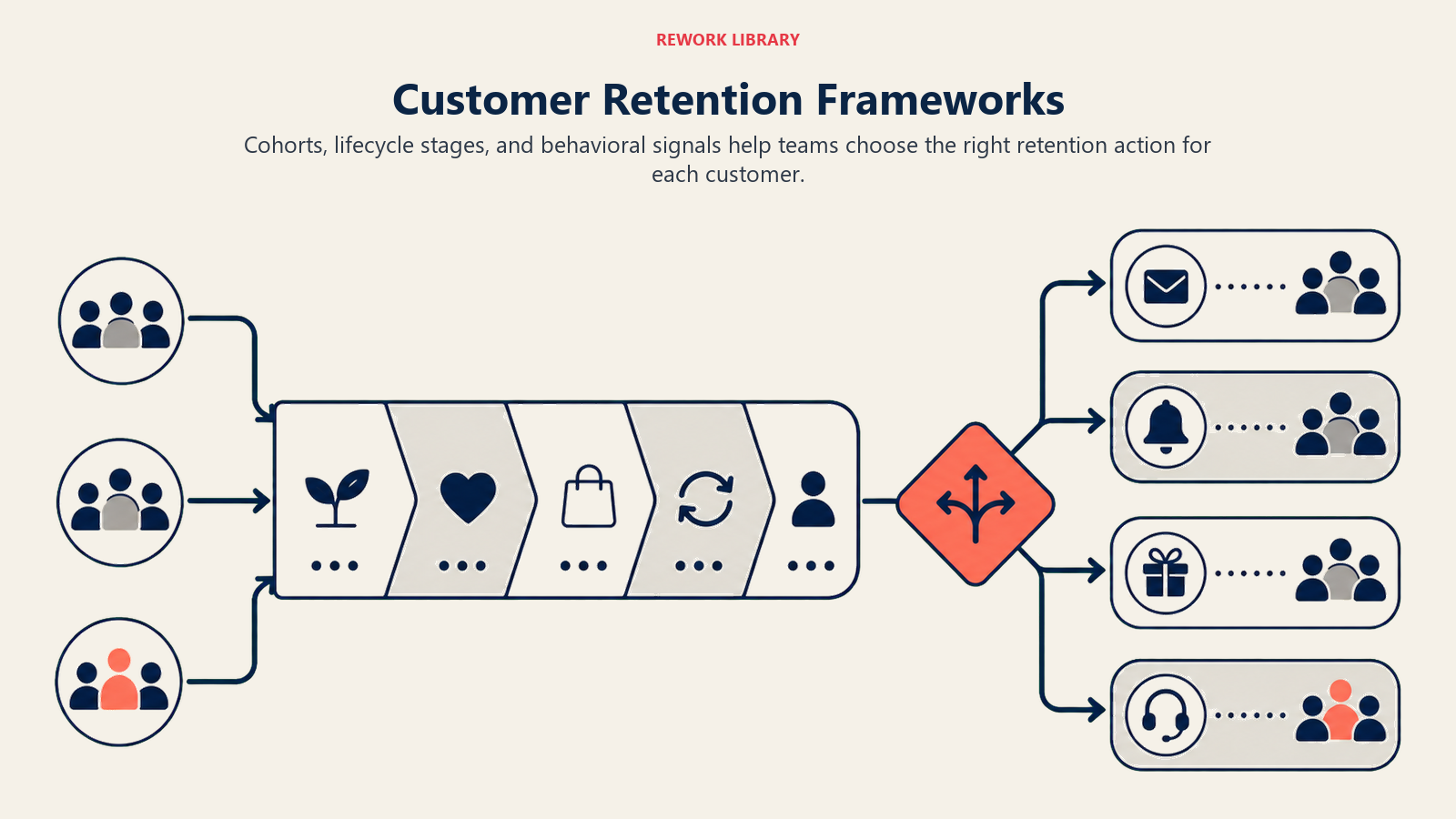
Effective repeat purchase strategies are built on understanding customer behavior patterns.
RFM Analysis
RFM (Recency, Frequency, Monetary) segmentation helps you identify who to target and when:
| Segment | Recency | Frequency | Monetary | Action |
|---|---|---|---|---|
| Champions | Purchased recently | Buys frequently | Spends the most | Reward, engage, ask for reviews |
| Loyal Customers | Purchased recently | Buys frequently | Spends good amount | Upsell, cross-sell, loyalty programs |
| Potential Loyalists | Purchased recently | Average frequency | Spends good amount | Nurture, offer Subscribe & Save Programs |
| At Risk | Haven't purchased recently | Used to buy frequently | Spent good amount | Win-back campaigns, special offers |
| Need Attention | Purchased a while ago | Few purchases | Low spending | Reactivation emails, product education |
| Lost Customers | Haven't purchased in long time | Low frequency | Low spending | Aggressive discounts or move to low-touch nurture |
This segmentation lets you send the right message to the right customer at the right time instead of treating all customers the same. For deeper insights into segmentation strategies, see our guide on customer segmentation.
Cohort Tracking
Track repeat purchase rates by acquisition cohort (month they first purchased). This reveals:
- Whether retention is improving or declining over time
- Which acquisition channels bring higher-quality customers
- Seasonal patterns in repeat behavior
- The impact of retention initiatives
A cohort that shows 15% repeat rate at 30 days, 28% at 60 days, and 35% at 90 days tells you when the natural windows are for intervention.
Purchase Cycle Mapping
For each product category, map the expected repurchase cycle:
- Calculate average days between purchases for repeat customers
- Identify the standard deviation to understand variance
- Set trigger points at 75%, 100%, and 125% of the average cycle
- Build automated sequences around these milestones
A coffee brand might see an average 28-day cycle with ±5 days variance. They'd trigger a reminder at day 21 (75%), a stronger nudge at day 28 (100%), and a discount offer at day 35 (125%).
Automated Reorder Reminder Systems
Manual outreach doesn't scale. Automated systems ensure no customer falls through the cracks.
Email Triggers
Set up behavior-based email triggers tied to purchase cycles:
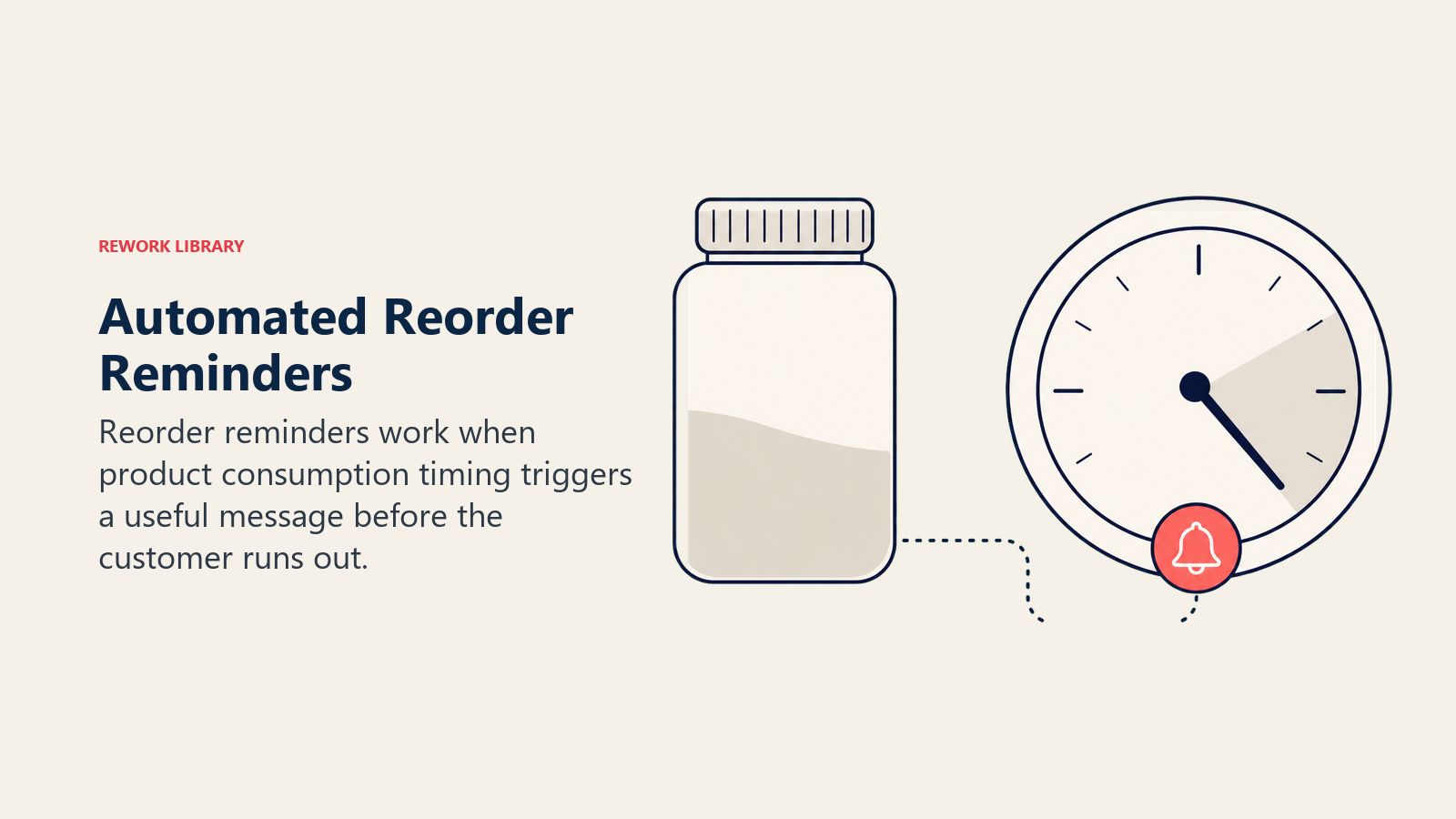
Predictive reorder reminders send when a customer should be running low based on their last purchase and your product's consumption rate. "Your coffee supply should be running low, ready to reorder?"
Usage-based triggers for products with known depletion rates. If someone bought a 30-day supply, trigger a reminder at day 25.
Browse-but-didn't-buy sequences for returning customers who viewed products but didn't purchase. They're showing intent, so give them a reason to buy.
Cross-sell triggers based on previous purchases. Someone who bought a camera should get lens and accessory recommendations.
For detailed implementation, see our guide on Email Marketing for E-commerce.
SMS Timing
SMS has 98% open rates but must be used strategically:
- Day before expected reorder: "Running low on [product]? Tap to reorder in 10 seconds."
- Out-of-stock alerts: "Your favorite item is back in stock, grab it before it sells out again."
- Flash sales for past purchasers: "24-hour sale on items you've purchased before."
SMS should complement email, not replace it. Use it for time-sensitive, high-intent moments. Learn more in our SMS Marketing Strategy guide.
Push Notification Alerts
For brands with mobile apps, push notifications enable real-time engagement:
- Reorder reminders based on purchase history
- Personalized product drops aligned with past preferences
- Abandoned cart recovery for returning customers
- Exclusive app-only deals for repeat buyers
Push notifications have 3-7x higher click-through rates than email when used appropriately.
Loyalty Program Integration
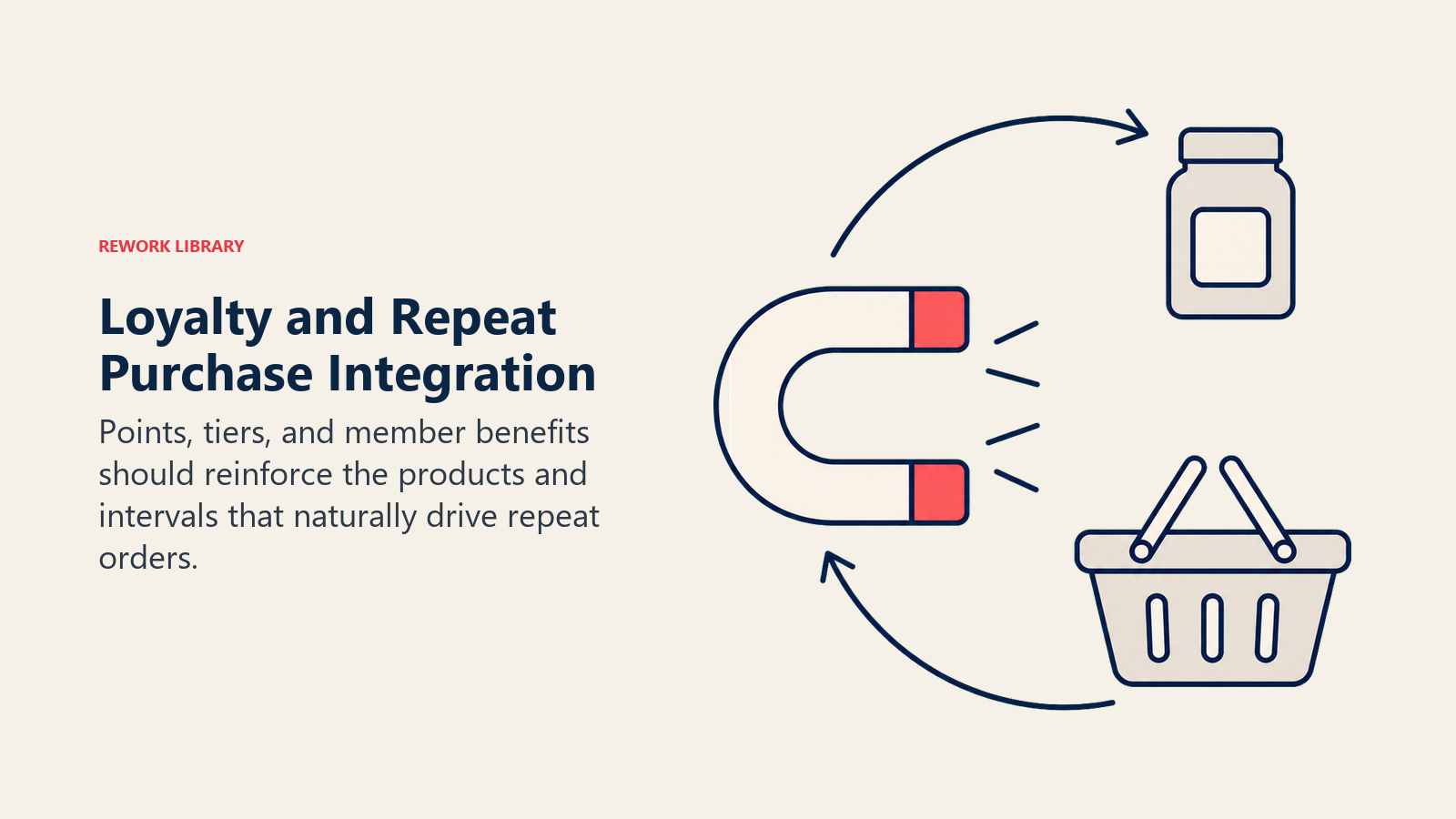
Loyalty programs transform one-time buyers into repeat customers by creating ongoing reasons to return.
Points Systems
The simplest loyalty structure: earn points per dollar spent, redeem for discounts or free products.
Earning acceleration: Reward repeat purchases with higher point multipliers. First purchase earns 1x points, second purchase 1.5x, third purchase 2x.
Points expiration: Create urgency with expiration dates. "You have 500 points expiring in 30 days, use them or lose them."
Engagement rewards: Award points for reviews, referrals, social shares, and birthday purchases to drive behavior beyond buying. Consider implementing a referral program design to amplify word-of-mouth growth.
Tiered Programs
Status-based tiers incentivize customers to reach the next level:
- Bronze tier: Standard benefits for all customers
- Silver tier: Reached after 2-3 purchases, unlocks free shipping
- Gold tier: Reached after 5+ purchases, unlocks early access and exclusive products
- Platinum tier: VIP customers with dedicated support and special pricing
The key is making the next tier feel achievable while offering genuinely valuable benefits.
Exclusive Benefits
Non-monetary benefits often drive more loyalty than discounts:
- Early access to new products or sales
- Free shipping with no minimum
- Priority customer service
- Members-only products
- Birthday and anniversary gifts
These benefits increase perceived value without eroding margins like constant discounting does.
Post-Purchase Email Sequences
The post-purchase window is critical for driving repeat purchases. Most brands send an order confirmation and nothing else, which leaves money on the table.
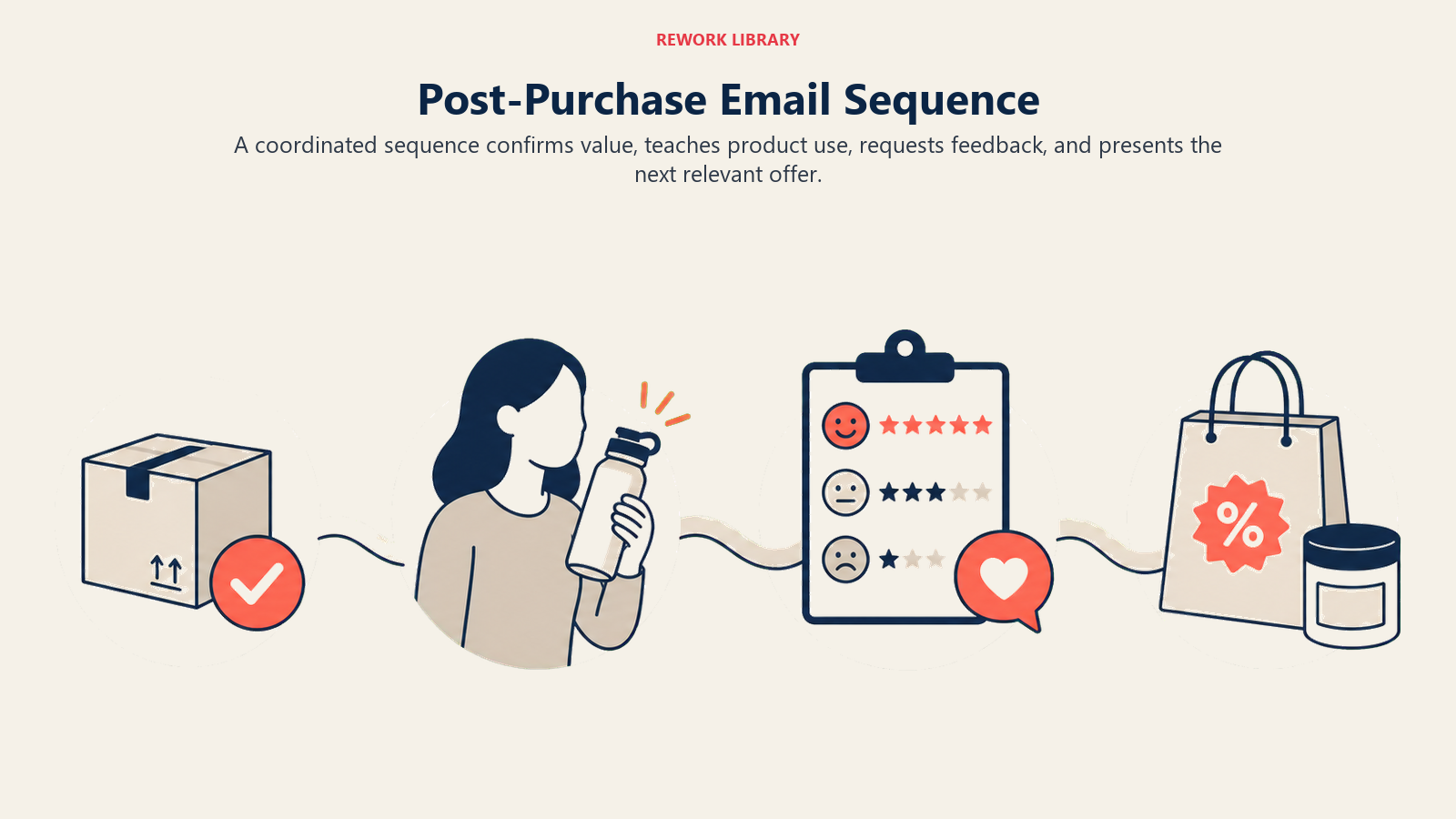
A strategic post-purchase email sequence keeps your brand top-of-mind and guides customers toward their next purchase:
Email Sequence Timeline
Day 1-3: Delivery Confirmation & Product Education
- Shipping and tracking information
- How to get the most from their purchase
- Usage tips and best practices
- Video tutorials if applicable
Day 7: Check-In & Cross-Sell
- "How's [product] working for you?"
- Request review or feedback through a customer feedback loop
- Suggest complementary products
- Highlight other items in your catalog
Day 14: Value Reinforcement
- Customer success stories with the product
- Advanced usage tips
- Community content or user-generated content
- Soft introduction to subscription options
Day 30: Replenishment or Expansion
- Reorder reminder for consumables
- "You might also like..." recommendations
- Loyalty program invitation if not enrolled
- Exclusive offer for second purchase
Day 45-60: Win-Back or Loyalty Activation
- Stronger incentive to return (limited-time discount)
- Showcase new arrivals since their purchase
- Referral program invitation
- Survey to understand barriers to repeat purchase
This cadence keeps you present without being intrusive, and each email serves a specific purpose in the customer journey.
Subscribe & Reorder Programs
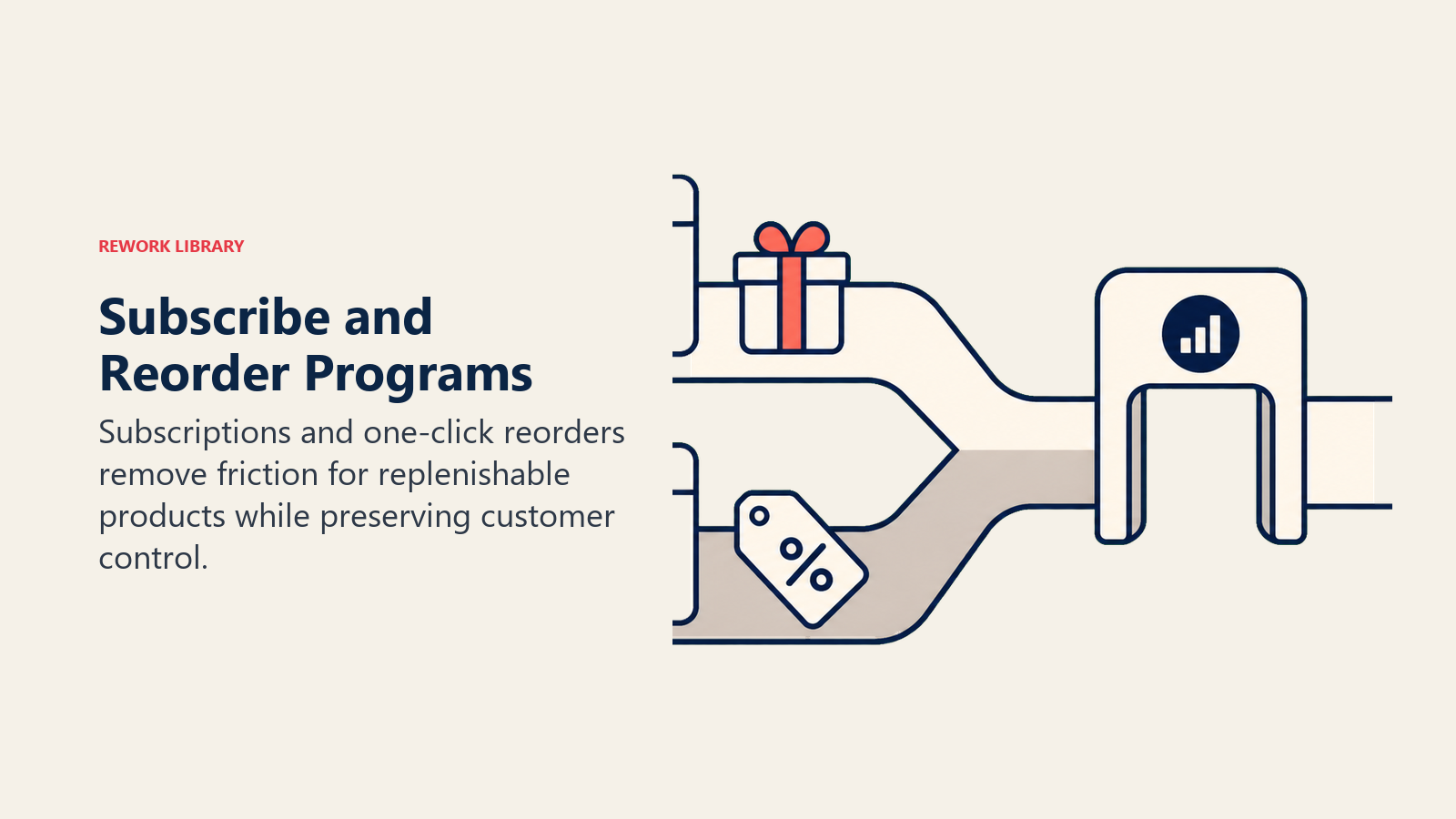
Subscription models convert one-time purchases into predictable recurring revenue. Learn more about building a comprehensive subscription commerce strategy.
Subscription Benefits
Offer compelling reasons to subscribe:
- 10-15% discount on recurring orders
- Free shipping on all subscription deliveries
- Never run out with automatic replenishment
- Flexible scheduling to match consumption rate
- Easy cancellation to reduce risk
The subscription value proposition must be clear: save money, save time, never run out.
Flexible Frequency
Let customers choose their delivery schedule:
- Weekly, bi-weekly, monthly options
- Easy schedule adjustments online
- Skip or pause deliveries as needed
- Change products between deliveries
Flexibility reduces churn by letting customers adapt the subscription to their needs.
Churn Mitigation
Even with flexibility, subscribers will try to cancel. Build retention flows:
Save offers: When they try to cancel, offer a one-time discount to stay Pause option: Suggest pausing instead of canceling Frequency adjustment: "Would a different schedule work better?" Product swap: "Want to try a different product instead?"
Every saved subscription extends Customer Lifetime Value (LTV) significantly.
Personalization for Repeat Success
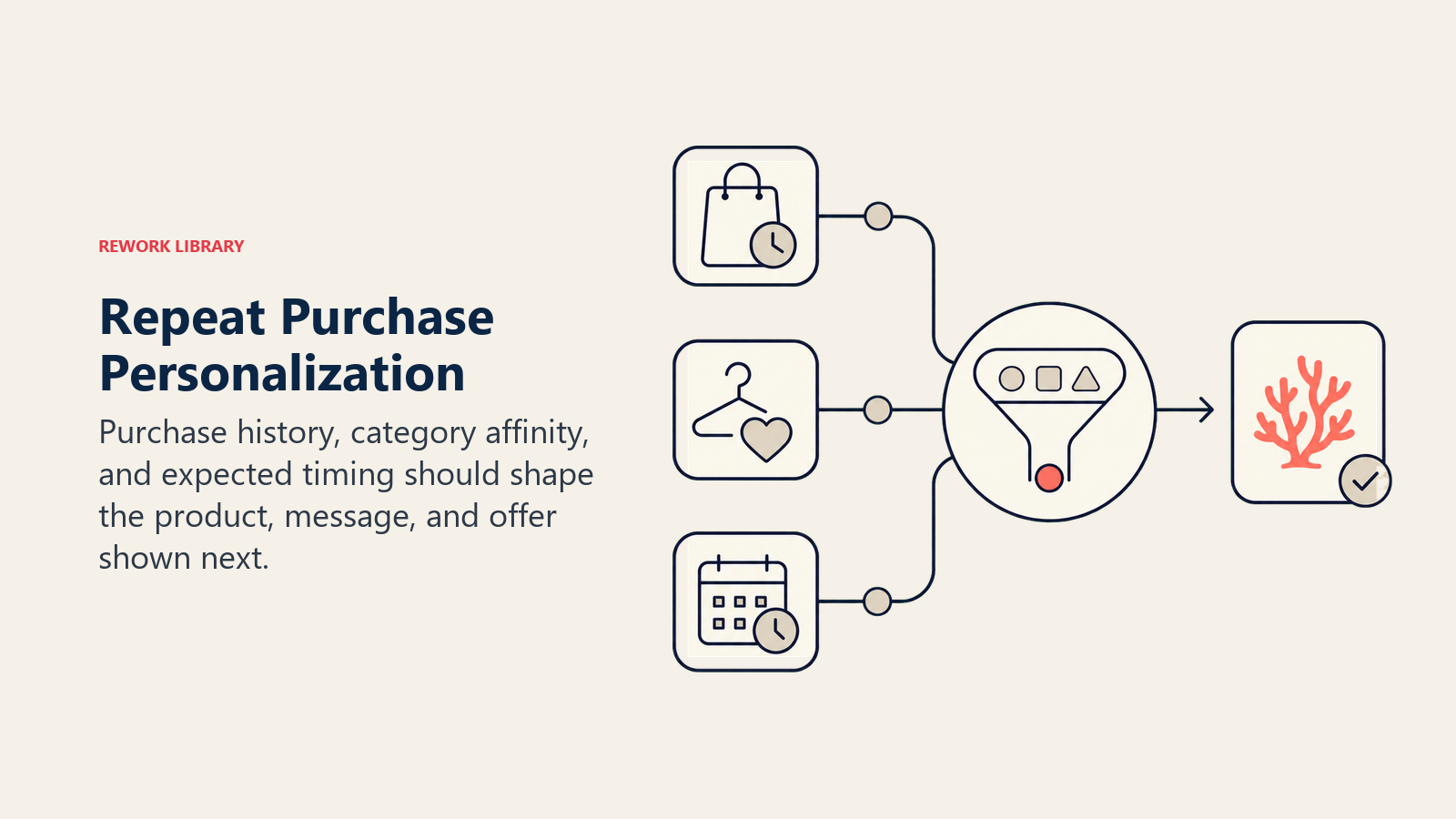
Generic messages don't drive repeat purchases. Personalization based on actual behavior does.
Purchase History Personalization
Use what customers have already bought to inform what you show them:
Replenishment recommendations: Products they've purchased before with one-click reorder Variant exploration: If they bought vanilla protein, show chocolate and strawberry Size optimization: Suggest larger sizes for products they reorder frequently Bundle creation: Package their frequent purchases together at a discount
The best product recommendations come from actual purchase data, not just browsing behavior.
Behavioral Triggers
Set up automated responses to customer actions:
- Price drop alerts on previously viewed or purchased items
- Back-in-stock notifications for items they wanted but were unavailable
- Restock reminders for seasonal products they bought last year
- Review requests for products they've had time to evaluate
These triggers feel helpful, not pushy, because they're based on demonstrated interest.
Dynamic Content Blocks
Personalize email and site content based on customer segment:
- Show different homepage banners to new vs. repeat customers
- Feature different products in emails based on purchase history
- Adjust messaging for VIP customers vs. at-risk customers
- Customize offers based on customer lifetime value
Personalization at scale requires good data infrastructure but dramatically improves engagement.
Cross-Category Repeat Purchases
Don't just get customers to rebuy what they've already purchased. Expand their relationship with your brand.
Upsell Complementary Products
Map your product catalog to identify natural complements:
- Coffee grinder for coffee bean buyers
- Skincare routine completion (cleanser + toner + moisturizer)
- Accessory packages for electronics
- Seasonal product extensions
The key is suggesting items that genuinely enhance their original purchase, not random products.
Basket Expansion Strategies
Encourage customers to add more categories to their repeat orders:
"Complete your routine" bundles: Show what other customers with similar purchases also bought "Try something new" sections: Introduce new product lines to existing customers Cross-category discounts: "Spend $50 across 2 categories, get 15% off" Sample programs: Include free samples of other products in shipments
Each new category a customer purchases from increases their likelihood of repeat purchases and overall lifetime value.
Category Migration
Move customers up the value chain over time:
- Entry-level product → premium version
- Single item → multi-item bundle
- Standard subscription → VIP tier
- Product only → product + services
This migration happens naturally when you provide excellent experiences and clearly communicate the benefits of higher tiers.
Measurement & Optimization
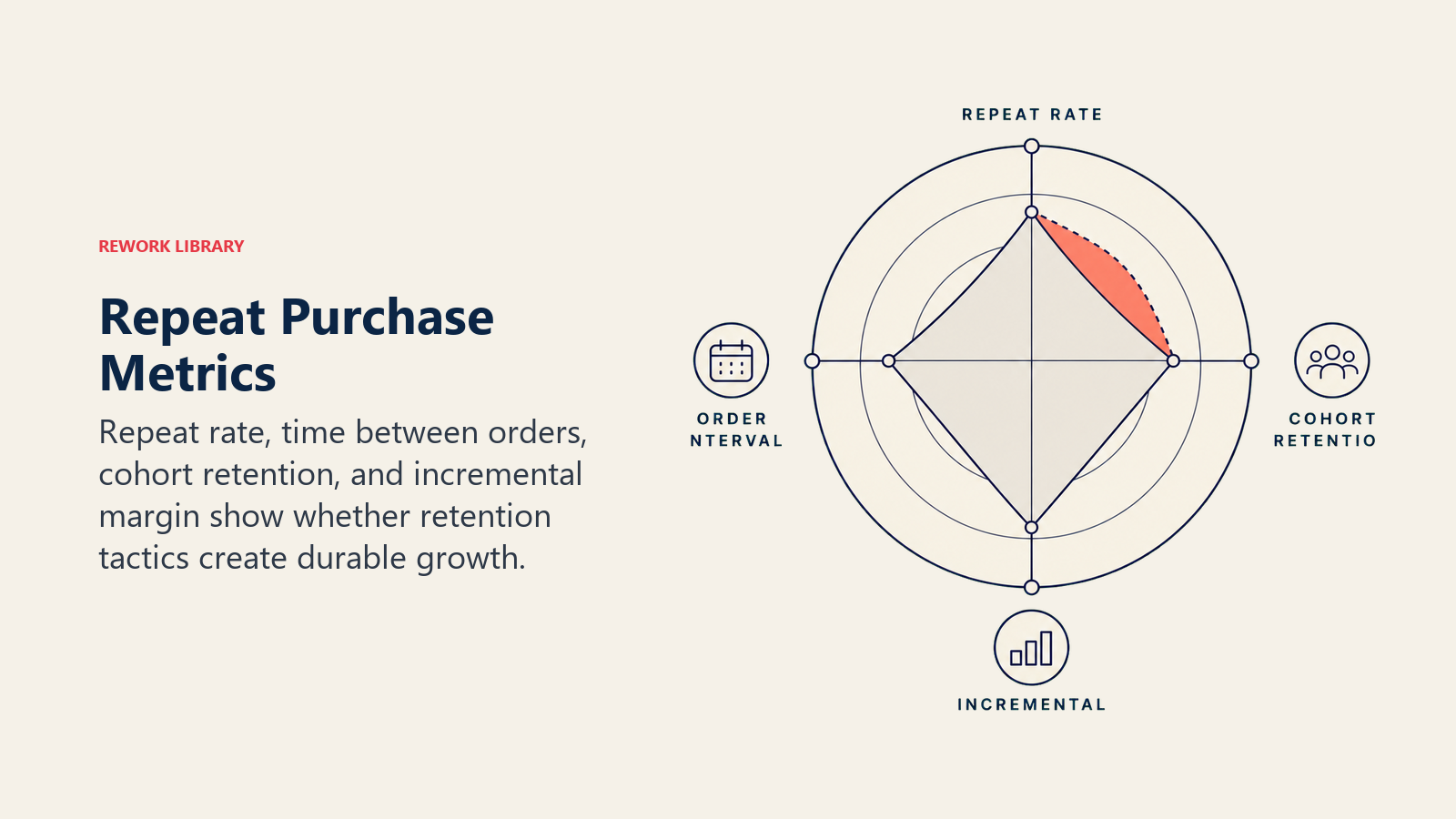
You can't improve what you don't measure. Track these key e-commerce metrics and KPIs:
Core Repeat Purchase Metrics
Repeat Purchase Rate (RPR): Percentage of customers who make more than one purchase
- Target: 30-40% for consumables, 15-25% for fashion, 10-15% for durables
Time to Second Purchase: Median days from first to second purchase
- Benchmark against your product's natural consumption cycle
Purchase Frequency: Average number of orders per customer per year
- Target increases over time as retention improves
Cohort Retention Curves: Percentage of each monthly cohort making 2nd, 3rd, 4th+ purchases
- Look for improving curves month over month
Cohort Analysis Benchmarks
Track each acquisition cohort's performance over time:
- 30-day repeat rate: What % made a second purchase within 30 days?
- 90-day repeat rate: What % made a second purchase within 90 days?
- 12-month retention: What % are still active customers after one year?
Compare cohorts to identify whether your retention initiatives are working.
Email & SMS Metrics
For repeat purchase campaigns, track:
Open rates: 25-35% for email, 95%+ for SMS Click-through rates: 3-5% for email, 15-25% for SMS Conversion rates: 2-5% for email, 10-20% for SMS Revenue per recipient: Direct revenue attributed to each campaign
Test subject lines, timing, offers, and messaging to optimize these metrics continuously.
Technology Stack for Automation
Manual repeat purchase programs don't scale. You need the right tools:
Email Service Provider (ESP)
Choose an ESP with strong automation and segmentation:
- Klaviyo: Best for e-commerce, deep Shopify integration
- Drip: Strong automation workflows and behavioral tracking
- Omnisend: Multi-channel campaigns (email + SMS + push)
- ActiveCampaign: Robust automation at mid-market price
Key features needed: behavioral triggers, segmentation, product recommendations, revenue tracking.
SMS Platform
Dedicated SMS platforms offer better deliverability than email providers:
- Postscript: E-commerce focused, strong compliance tools
- Attentive: Enterprise-grade with advanced segmentation
- SMSBump: Affordable option for smaller brands
Ensure your SMS provider integrates with your ESP for coordinated campaigns.
Loyalty & Subscription Systems
Loyalty platforms:
- Smile.io: Simple points and referral programs
- LoyaltyLion: Advanced tiering and engagement rewards
- Yotpo: Loyalty + reviews + UGC in one platform
Subscription platforms:
- Recharge: Industry standard for Shopify subscriptions
- Bold Subscriptions: Flexible subscription rules
- Skio: Modern UX with strong retention features
The right technology stack automates the heavy lifting while you focus on strategy and optimization.
Common Pitfalls & Best Practices
Avoid these mistakes that sabotage repeat purchase programs:
Pitfall 1: Over-Messaging
Sending too many emails or texts burns out your list. Establish frequency caps and let customers control their preferences.
Best practice: Implement a preference center where customers choose what communications they receive and how often.
Pitfall 2: Ignoring Product-Market Fit
If your product doesn't solve a real problem or quality is poor, no retention strategy will work. Fix the fundamentals first.
Best practice: Use feedback from repeat customers to improve product quality and expand your line with items they actually want.
Pitfall 3: Treating All Customers the Same
Your VIP customer who's made 10 purchases shouldn't get the same message as someone who bought once 18 months ago.
Best practice: Build distinct workflows for different customer segments based on RFM analysis.
Pitfall 4: Discount Dependency
Training customers to only buy when there's a discount erodes margins and devalues your brand.
Best practice: Use discounts strategically for reactivation, but build loyalty through value, convenience, and exclusive benefits.
Pitfall 5: Missing the Timing Window
Reaching out too early (before they need to reorder) or too late (after they've bought from a competitor) both fail.
Best practice: Map purchase cycles by product and trigger reminders at the optimal moment based on actual consumption rates.
Building Trust for Long-Term Retention
The foundation of repeat purchases is trust:
- Consistent quality: Every order should meet or exceed expectations
- Reliable delivery: Ship on time, every time
- Responsive support: Resolve issues quickly and generously
- Transparent communication: No hidden fees, no bait-and-switch
You can have the perfect automated system, but if customers don't trust your brand, they won't come back. Strong brand building and positioning creates the foundation for lasting customer relationships.
Start Building Your Repeat Purchase Engine
Repeat purchases aren't optional. They're the difference between profitable growth and burning cash on acquisition.
Start with these three steps:
- Calculate your current repeat purchase rate and time-to-second-purchase by product category
- Build a 60-day post-purchase email sequence that educates, engages, and encourages reordering
- Implement RFM segmentation and create distinct messaging for Champions, Loyal Customers, and At-Risk segments
The brands that win in e-commerce aren't those that acquire the most customers. They're the ones that keep them coming back.
Your repeat purchase strategy determines whether customer acquisition is an investment or an expense.
Learn More
Deepen your understanding of customer retention with these related resources:
Core Strategy:
- Customer Lifetime Value - Calculate and optimize your customer value metrics
- Unit Economics for E-commerce - Understand the math behind retention economics
- E-commerce Metrics & KPIs - Track the metrics that matter for retention
Retention Programs:
- Loyalty Programs - Design programs that reward repeat purchases
- Subscription Commerce Strategy - Build predictable recurring revenue
- Referral Program Design - Turn customers into advocates
Communication & Engagement:
- Email Marketing for E-commerce - Master retention email strategies
- Post-Purchase Email Sequences - Guide customers to their next purchase
- Customer Segmentation - Send the right message to the right customer
- Customer Feedback Loop - Use feedback to improve retention
- Customer Reviews & UGC - Leverage social proof for trust
Recovery & Optimization:
- Win-Back Campaigns - Re-engage dormant customers
- Brand Building & Positioning - Create lasting customer relationships

On this page
- Why Repeat Customers Matter
- Repeat Purchase Fundamentals
- Retention Frameworks
- RFM Analysis
- Cohort Tracking
- Purchase Cycle Mapping
- Automated Reorder Reminder Systems
- Email Triggers
- SMS Timing
- Push Notification Alerts
- Loyalty Program Integration
- Points Systems
- Tiered Programs
- Exclusive Benefits
- Post-Purchase Email Sequences
- Email Sequence Timeline
- Subscribe & Reorder Programs
- Subscription Benefits
- Flexible Frequency
- Churn Mitigation
- Personalization for Repeat Success
- Purchase History Personalization
- Behavioral Triggers
- Dynamic Content Blocks
- Cross-Category Repeat Purchases
- Upsell Complementary Products
- Basket Expansion Strategies
- Category Migration
- Measurement & Optimization
- Core Repeat Purchase Metrics
- Cohort Analysis Benchmarks
- Email & SMS Metrics
- Technology Stack for Automation
- Email Service Provider (ESP)
- SMS Platform
- Loyalty & Subscription Systems
- Common Pitfalls & Best Practices
- Pitfall 1: Over-Messaging
- Pitfall 2: Ignoring Product-Market Fit
- Pitfall 3: Treating All Customers the Same
- Pitfall 4: Discount Dependency
- Pitfall 5: Missing the Timing Window
- Building Trust for Long-Term Retention
- Start Building Your Repeat Purchase Engine
- Learn More