3PL Partner Selection: Evaluating, Negotiating, and Scaling with the Right Logistics Provider
Turn this article into takeaways for your work.


Each assistant summarizes the article only for you and suggests best practices for your work.
Choosing the wrong 3PL partner costs e-commerce businesses 15-25% of their total logistics spend in inefficiencies, penalties, and lost sales. Poor selection leads to inventory misplacement, delayed shipments, damaged products, and customers who never return. The right 3PL becomes a strategic growth enabler. The wrong one? It caps your growth and erodes margins while you're locked into multi-year contracts.
This guide walks through a systematic framework for evaluating, negotiating with, and managing third-party logistics providers. You'll learn how to assess capabilities, structure SLAs, model true costs, negotiate favorable terms, and scale operations without switching providers every 18 months.
3PL Partnership Overview: Strategic Role and Provider Types
A 3PL (third-party logistics provider) manages warehousing, fulfillment, shipping, and often returns processing for e-commerce companies. Unlike simple warehouses, 3PLs integrate technology, handle inventory management, pick and pack orders, coordinate carriers, and provide visibility into operations. Provider Categories:
Asset-Based 3PLs own warehouses, trucks, and equipment. They offer stability and control but less flexibility. Best for high-volume, predictable businesses needing dedicated space. Examples: XPO Logistics, Geodis.
Asset-Light 3PLs work with partner networks and third-party facilities. They provide flexibility and faster geographic expansion but may offer less control. Best for growing businesses with fluctuating volumes. Examples: ShipBob, ShipMonk.
Specialized 3PLs focus on specific verticals (beauty, supplements, apparel) or capabilities (cold chain, hazmat, oversized items). They understand industry compliance and handling requirements. Best when products need specialized care.
Tech-Enabled 3PLs stand out through software platforms, real-time inventory visibility, and advanced analytics. They integrate seamlessly with e-commerce platforms and provide superior transparency. Best for omnichannel brands needing tight integration.
Build vs. Outsource Decision Framework:
Run your own warehouse when:
- Order volume exceeds 5,000+ monthly shipments consistently
- Margins support warehouse labor, rent, and technology investments
- Products require highly specialized handling unavailable from 3PLs
- You have logistics expertise and capital for infrastructure
Partner with a 3PL when:
- You're under 5,000 monthly shipments and growing
- Capital would be better spent on product development and marketing
- You need geographic coverage without facility investments
- Seasonal fluctuations make fixed costs risky
- You'd rather focus on core competencies, not logistics operations
Most e-commerce businesses benefit from 3PL partnerships until they reach $20-50M in annual revenue. Even then, hybrid models (own warehouse + 3PL for overflow/regions) often optimize costs better than going fully in-house.
Assessment Phase: Defining Your Requirements
Before contacting 3PLs, document exactly what you need. Vague requirements lead to mismatched providers and scope creep during negotiations. Logistics Capability Audit:
Map your current fulfillment operations:
- Order volume (current and 12-month projection)
- SKU count and inventory turnover rates
- Average order composition (units per order, weight, dimensions)
- Special handling needs (temperature control, fragile items, kitting)
- Returns volume and complexity
- Geographic distribution of customers
- Channel breakdown (DTC, wholesale, marketplaces)
Forecasting Fulfillment Needs:
Project 12-24 months ahead across dimensions:
- Monthly order volume growth curve
- SKU expansion plans
- Seasonal peaks (quantify peak:average ratios)
- Geographic expansion (new markets, international)
- New product categories requiring different handling
- Channel diversification (adding retail, subscription)
Example projection:
- Current: 3,000 orders/month, 150 SKUs, 95% DTC
- 12 months: 8,000 orders/month, 300 SKUs, 80% DTC + 20% wholesale
- Peak months: 15,000 orders (holiday season)
- International: 15% of volume by month 18
Technology and Integration Requirements:
List systems your 3PL must connect with:
- E-commerce platform (Shopify, BigCommerce, WooCommerce)
- Order management system (if separate from e-commerce platform)
- Inventory management software
- Accounting system (QuickBooks, NetSuite)
- Customer service platform (Zendesk, Gorgias)
- Shipping software (ShipStation, ShipBob)
Define required integrations:
- Real-time inventory syncing (critical threshold)
- Automatic order transmission
- Tracking number pushback
- Returns processing and restocking
- Reporting and analytics data feeds
Special Handling and Service Requirements:
Document non-standard needs:
- Temperature-controlled storage (supplements, beauty, food)
- Kitting and assembly (subscription boxes, bundling)
- Gift wrapping and customization
- Insert inclusion (samples, marketing materials)
- Serialized inventory tracking (electronics, high-value items)
- Compliance requirements (FDA, EPA, hazmat)
Service Level Expectations:
Define minimum acceptable performance:
- Order accuracy target (99%+)
- Same-day shipping cutoff time (orders by 2pm ship same day)
- Average shipping speed to major markets
- Peak season performance (Black Friday, holiday)
- Returns processing turnaround
- Inventory accuracy standards
This requirements document becomes your RFP (request for proposal) foundation and ensures you're comparing providers on equal footing.
Evaluation Criteria: Technical Capabilities
Assess 3PL capabilities across operational dimensions that directly impact your customer experience and unit economics. Network Coverage and Geographic Footprint:
Analyze where providers have facilities relative to your customer base:
- Map customer concentration by region
- Calculate weighted distance from facilities to customers
- Model shipping zones and transit times
- Identify coverage gaps requiring multi-facility strategies
Example: If 60% of customers are in California, Texas, and Florida, a 3PL with facilities in LA, Dallas, and Orlando enables 1-2 day ground shipping for most orders. A single Midwest facility forces expensive 3+ day shipping or costly 2-day air upgrades, significantly impacting your shipping strategy and pricing.
Warehouse Capacity and Automation:
Evaluate physical capabilities:
- Total warehouse square footage available to you
- Pallet positions and shelf space allocation
- Climate-controlled zones (if needed)
- Automation level (conveyor systems, sortation, robotics)
- Expansion capacity within existing facilities
- Geographic expansion options
Higher automation correlates with lower per-unit costs at scale but may include higher minimum volume requirements. Manual operations offer flexibility for low volumes and specialized handling.
Technology Infrastructure:
Assess the 3PL's warehouse management system (WMS):
- Real-time inventory visibility
- Order routing logic and rules engine
- Integration capabilities (APIs, EDI, flat files)
- Reporting and analytics dashboards
- Mobile app access for live status
- Historical data retention and access
Request demonstrations showing:
- How you'd view current inventory levels by SKU
- Order status tracking from receipt to shipment
- Exception handling when items are out of stock
- Reporting customization options
Handling Capabilities:
Verify the 3PL can execute your specific operations:
- Receiving processes (same-day processing, inspection standards)
- Storage methods (shelf, pallet, bin locations)
- Picking accuracy and verification (barcode scanning, batch picking)
- Packing standards (box sizing, damage prevention)
- Kitting and assembly capabilities
- Quality control checkpoints
Request to observe these processes during site visits. Watch how they handle products similar to yours.
Returns Processing:
Returns impact profitability significantly. Evaluate:
- Returns intake and inspection speed
- Restocking procedures and timelines
- Disposition options (resale, liquidation, disposal)
- Customer refund triggering (automatic vs. manual)
- Returns data tracking and reporting
The best 3PLs inspect and restock returns within 24-48 hours, minimizing inventory unavailability. Poor returns processing creates "phantom inventory" (shows available but actually in returns queue) that causes overselling.
Multi-Channel Support:
If you sell across channels, verify capabilities:
- Marketplace fulfillment (Amazon FBM, Walmart WFS)
- Wholesale/B2B order handling (case packs, EDI, advanced shipping notices)
- Retail store replenishment
- Subscription box fulfillment
- Custom projects (pop-up shops, trade shows)
Your multi-channel marketplace strategy requires 3PLs that can adapt to different platform requirements and fulfillment standards.
Channel diversity requires flexible operations. Ensure the 3PL can handle different shipping requirements, packaging standards, and compliance needs per channel.
Financial Evaluation: Pricing Models and Cost Analysis
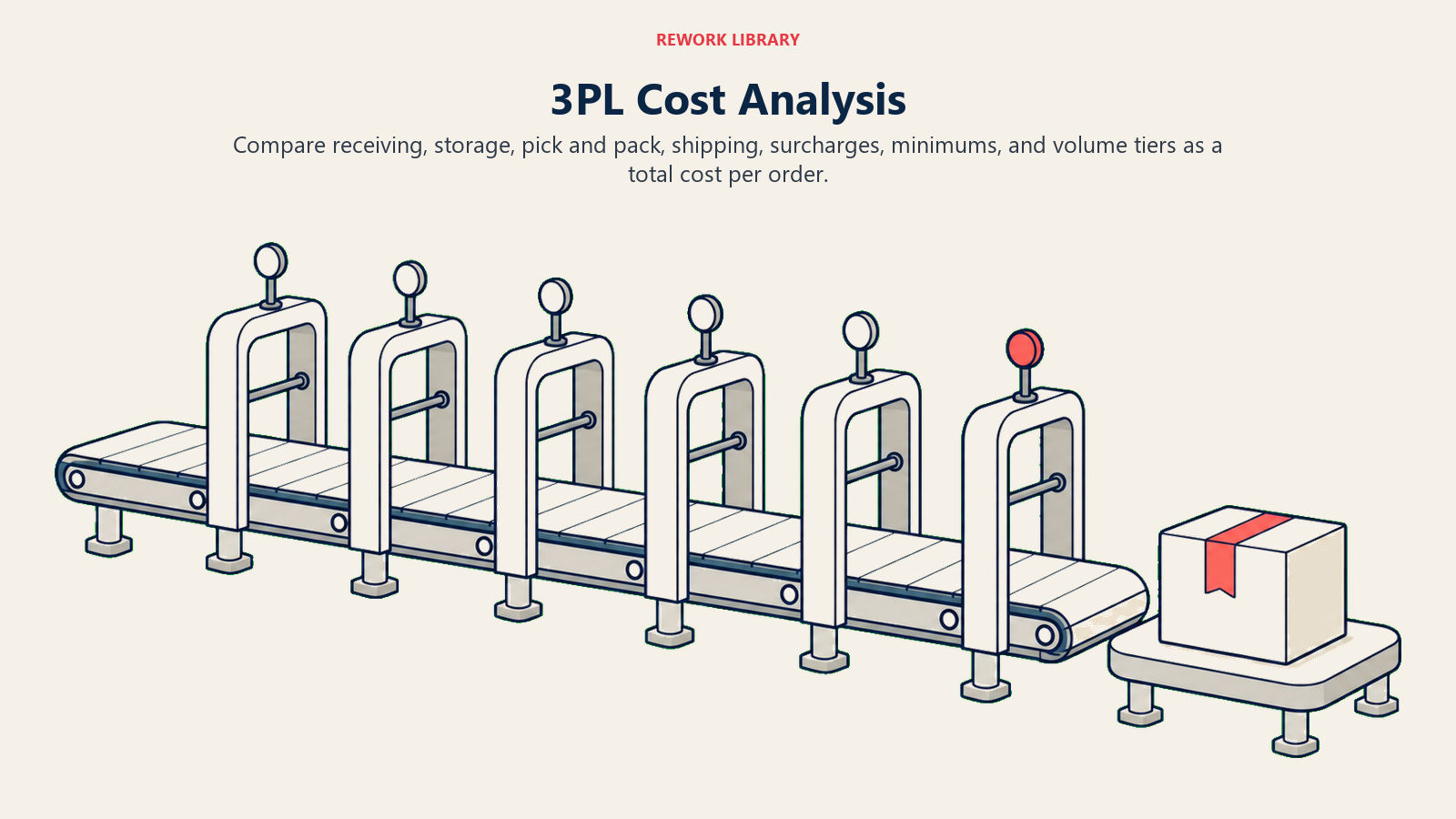
3PL pricing seems straightforward until you calculate total costs. Hidden fees, volume tiers, and surcharges significantly impact your margins and overall profitability. Common Pricing Structures: Receiving Fees:
- Per pallet received: $5-15
- Per carton received: $0.50-2.00
- Per unit received (for pre-counted shipments): $0.10-0.30
- Some 3PLs bundle receiving into storage or picking fees
Storage Fees:
- Per pallet per month: $15-40
- Per shelf/bin location per month: $3-8
- Per cubic foot per month: $0.40-1.20
- First month often included in receiving fee
Storage pricing favors efficient inventory turnover. High-turnover inventory (ships within 30 days of receipt) costs less than slow-moving stock sitting for months.
Picking and Packing:
- Base pick fee per order: $1.50-4.00
- Per additional item: $0.30-0.80
- Per SKU (some models): $0.40-1.00
- Packing materials: $0.50-2.50 per order
- Kitting/assembly: Custom pricing per complexity
Example order cost calculation:
- 3-item order, 2 unique SKUs
- Base pick: $2.50
- Additional items: 2 x $0.50 = $1.00
- Packing materials: $1.20
- Total: $4.70
Shipping Costs:
- Carrier rates (passed through at 3PL's negotiated rates)
- Shipping markup: 5-15% over carrier cost (or included in other fees)
- Dimensional weight calculations
- Surcharges for oversized, residential, remote areas
Reputable 3PLs pass through actual carrier costs with transparent markup. Avoid providers unwilling to show carrier invoices.
Additional Fees:
- Returns processing: $2-5 per return
- Re-packaging/restocking: $1-3 per unit
- Special projects (kitting, inserts): Custom pricing
- Technology/integration fee: $100-500/month (sometimes waived)
- Account management: $200-1,000/month
- Inventory reconciliation: Quarterly fees or included
Cost Modeling Across Volumes:
Build a cost model comparing 3PL pricing at different volume levels:
Scenario: 5,000 orders/month, 250 SKUs, 2.2 units/order average
Provider A (Asset-Light):
- Storage: 100 pallets x $25 = $2,500
- Picking/packing: 5,000 orders x $5.20 avg = $26,000
- Shipping (avg $7/order w/ markup): $35,000
- Monthly total: $63,500 ($12.70/order)
Provider B (Asset-Based):
- Storage: 100 pallets x $18 = $1,800
- Picking/packing: 5,000 orders x $6.00 avg = $30,000
- Shipping (avg $6.50/order, lower markup): $32,500
- Technology fee: $300
- Monthly total: $64,600 ($12.92/order)
At this volume, costs appear similar. Now model at 15,000 orders/month (triple volume):
Provider A:
- Storage: 250 pallets x $25 = $6,250
- Picking/packing: 15,000 x $4.80 (volume tier) = $72,000
- Shipping: $105,000
- Monthly total: $183,250 ($12.22/order - decreases with volume)
Provider B:
- Storage: 250 pallets x $18 = $4,500
- Picking/packing: 15,000 x $5.50 (volume tier) = $82,500
- Shipping: $97,500
- Technology fee: $300
- Monthly total: $184,800 ($12.32/order)
Volume tiers and shipping efficiency impact total costs differently. Model your projected volumes to understand long-term economics.
True Cost of Ownership:
Beyond monthly fees, factor in:
- Onboarding costs (integration development, inventory transfer)
- Minimum volume commitments (paying for 1,000 orders even if you ship 600)
- Overages and exceptions (rush orders, special handling)
- Inventory transfer costs if switching providers
- Technology investments (WMS access, API development)
- Account management time (communication, issue resolution)
Calculate total first-year cost including setup. A 3PL with lower monthly fees but $15,000 in onboarding costs may be more expensive than a competitor with higher monthly fees but minimal setup costs. Understanding these costs is essential for accurate unit economics for e-commerce calculations.
Negotiation Leverage Points:
Use these factors to negotiate better pricing:
- Volume commitments (guarantee minimums for lower rates)
- Contract length (multi-year deals often reduce rates 10-15%)
- Prepayment (quarterly or annual pre-pay for discounts)
- Seasonal volume (commit to peak volumes for capacity allocation)
- Growth trajectory (share projections showing rapid scaling)
- Competitive bids (leverage multiple quotes)
Request tiered pricing that decreases as volumes increase. Lock in rate protection (no increases for 12-24 months) in contracts.
Operational Fit and Service Level Agreements (SLAs)
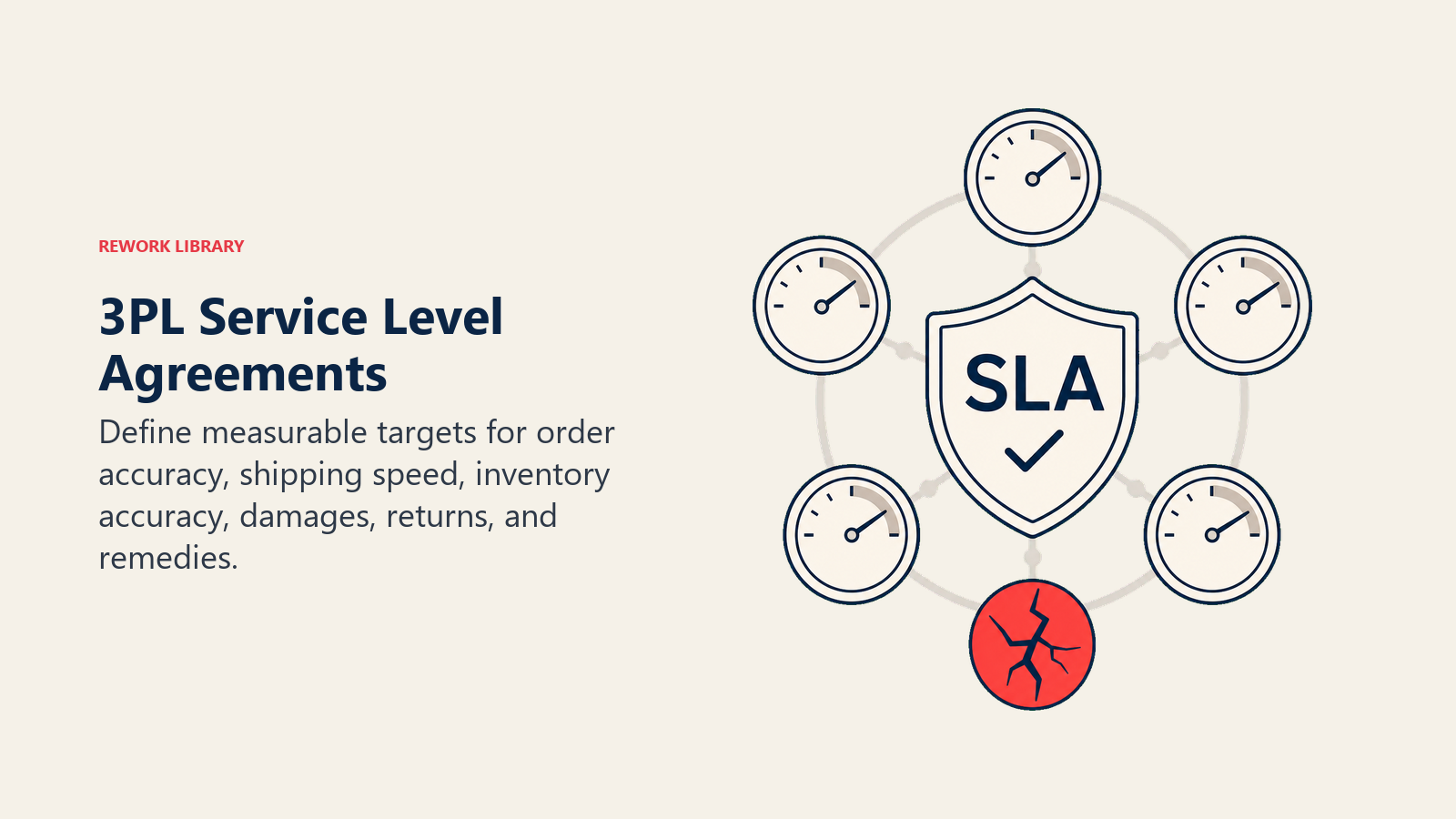
SLAs define performance expectations and consequences for failures. Well-structured SLAs align 3PL incentives with your customer experience goals and provide remedies when performance slips. Critical SLA Metrics: Order Accuracy:
- Target: 99.5%+ orders shipped with correct items and quantities
- Measurement: (Correct orders / Total orders) x 100
- Exclusions: Customer errors in order placement
- Consequence: Credit for mis-shipped order costs (fulfillment fee + shipping)
Shipping Speed:
- Target: 95%+ of orders ship same day if received by 2pm cutoff
- Measurement: Orders shipped same day / Orders received by cutoff
- Exclusions: Out-of-stock items, carrier delays, force majeure
- Consequence: Shipping upgrade credits to meet customer promises
Inventory Accuracy:
- Target: 99%+ inventory count accuracy
- Measurement: (Accurate counts / Total SKUs counted) during cycle counts
- Frequency: Monthly or quarterly physical counts
- Consequence: Credits for stockouts caused by count errors
Damage Rate:
- Target: <0.5% of units damaged during warehousing or packing
- Measurement: Damaged units / Total units handled
- Exclusions: Damage from carrier mishandling, pre-existing damage
- Consequence: Replacement cost credit or reimbursement
Returns Processing Speed:
- Target: 80%+ of returns inspected and restocked within 48 hours
- Measurement: Returns processed within SLA / Total returns received
- Exclusions: Items requiring manufacturer inspection
- Consequence: Credits for lost sales due to delayed restocking
Realistic Performance Targets:
Avoid SLAs that sound good but are unrealistic:
- 100% accuracy: No operation achieves perfection. 99.5% is world-class.
- Same-day shipping for orders received after 5pm: Physically impossible without night shifts
- Zero damage: Some breakage occurs even with excellent handling
- Instant inventory updates: System syncs take 5-15 minutes
Set targets slightly above your current performance (if self-fulfilling) or industry benchmarks. Review actual performance quarterly and adjust targets based on data.
Penalties and Incentives:
Structure SLAs with consequences:
Credit Structure:
- Miss order accuracy SLA: Credit 10% of monthly fulfillment fees
- Miss shipping speed SLA: Credit shipping upgrade costs
- Inventory accuracy below target: Credit stockout impact (estimated lost sales)
- Consistent underperformance (3+ months): Right to terminate without penalty
Incentive Structure:
- Exceed accuracy target (99.8%+): Performance bonus or fee reduction
- Handle peak volumes without additional surcharges: Extended contract or rate lock
- Implement process improvements reducing costs: Share savings 50/50
Exception Handling:
Define how to handle situations outside normal operations:
- Stock discrepancies discovered during fulfillment
- Customer complaints about order quality
- Carrier pickup failures or delays
- Inventory damage discovered during cycle counts
- System integration failures preventing order flow
Establish communication protocols:
- Critical issues (system outages): Immediate phone call
- Order exceptions (out of stock): Email within 1 hour
- Inventory issues: Daily summary report
- Performance reviews: Monthly scorecards
Performance Review Cadence:
Schedule regular reviews of SLA performance:
- Weekly: Quick status check, exception review
- Monthly: Full scorecard review, trend analysis
- Quarterly: Strategic review, SLA adjustment discussions
- Annually: Contract performance evaluation, renegotiation
Monthly scorecards should show:
- Each SLA metric performance vs. target
- Trend lines (improving, stable, declining)
- Root cause analysis for misses
- Corrective actions implemented
- Credits applied or earned
Treating SLA reviews as partnership discussions (not confrontations) builds collaborative relationships focused on continuous improvement.
Integration and Technology Assessment
Seamless technology integration determines whether your 3PL partnership feels invisible (good) or requires constant manual intervention (disaster). Evaluate integration capabilities thoroughly before signing contracts. API Requirements and Capabilities:
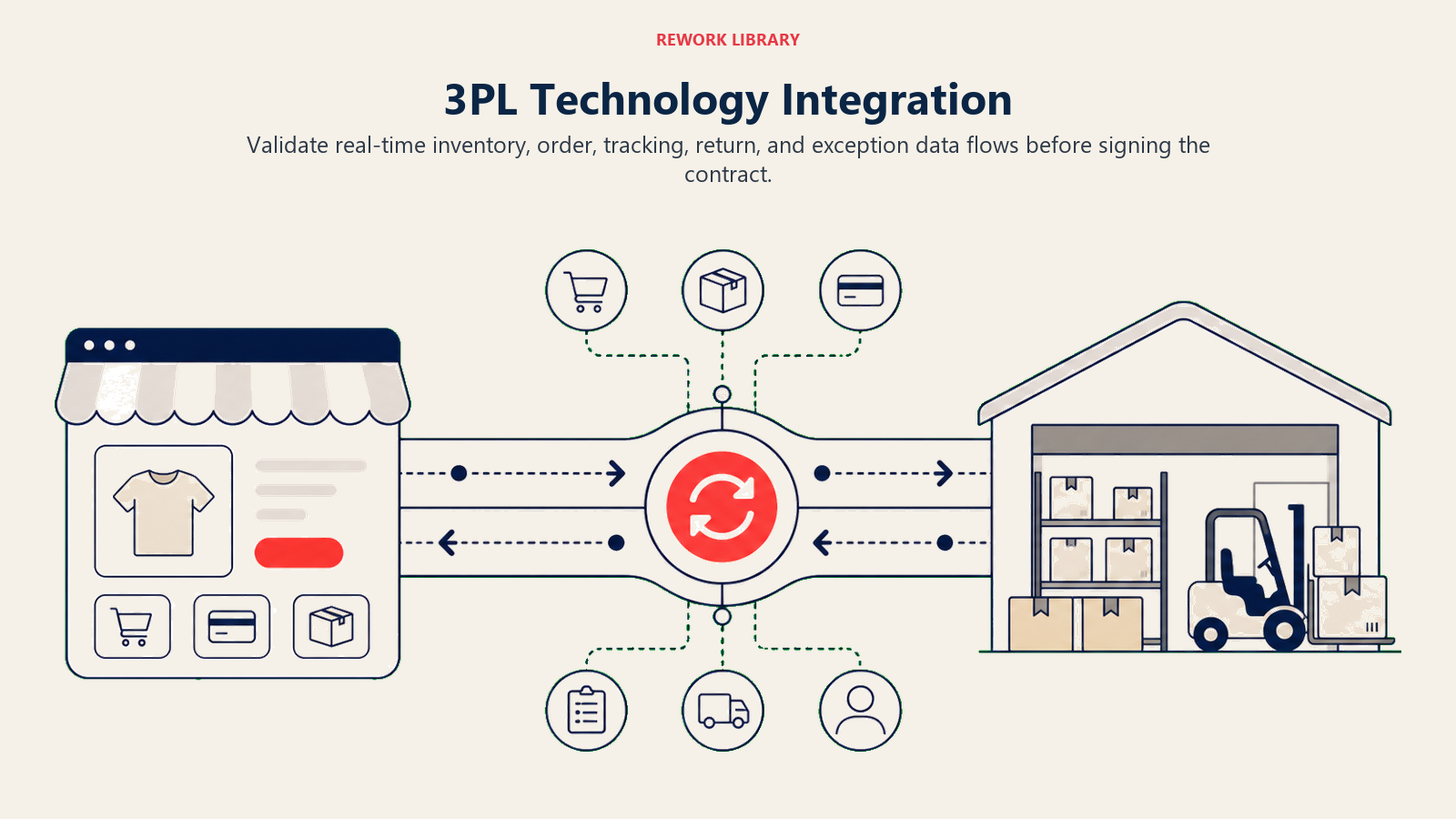
Modern 3PLs offer RESTful APIs enabling real-time data exchange. Assess:
Inventory Synchronization:
- Real-time inventory updates (pushed every 5-15 minutes)
- Stock level webhooks (notifications when inventory crosses thresholds)
- Batch inventory uploads (for initial setup or corrections)
- Reserved inventory handling (pending orders not yet shipped)
Order Management:
- Automatic order transmission from your e-commerce platform
- Order status updates (received, picking, packed, shipped)
- Tracking number pushback to your system
- Order modification capabilities (cancel, change address)
Returns Processing:
- Return notification when customer initiates return
- RMA (return merchandise authorization) creation
- Inspection results and disposition decisions
- Restocking confirmation
Reporting Data Access:
- API endpoints for pulling performance reports
- Historical data access (12+ months)
- Custom report generation
- Data export formats (JSON, CSV, XML)
Request API documentation during evaluation. Look for:
- Comprehensive endpoint coverage (all operations available via API)
- Webhook support (event-driven updates, not just polling)
- Rate limits (ensure limits accommodate your volume)
- Authentication methods (OAuth 2.0, API keys)
- Sandbox environment for testing before production
Inventory Visibility and Accuracy:
Your team and customers need real-time inventory visibility. Evaluate:
For Your Team:
- Dashboard showing current stock levels by SKU and location
- Aging reports (how long inventory has been in warehouse)
- Receiving status (inbound shipments and processing timeline)
- Reserved vs. available inventory distinction
- Low stock alerts and reorder recommendations
For Customers:
- Accurate "in stock" status on product pages
- Estimated delivery dates based on current inventory location
- Backorder visibility and expected restock dates
Test inventory accuracy by:
- Shipping a sample inventory batch
- Verifying counts match between your system and 3PL WMS
- Placing test orders and confirming immediate inventory decrements
- Simulating returns and verifying restocking speed
Phantom inventory (shows available but isn't) causes overselling and customer disappointment. Ensure inventory updates happen in near real-time.
Order Management System (OMS) Compatibility:
If you use an OMS separate from your e-commerce platform, verify compatibility:
- Pre-built integrations (no custom development needed)
- Order routing logic (which orders go to which 3PL if using multiple)
- Split shipment handling (partial inventory fulfillment)
- Cancellation and modification workflows
Popular OMS platforms (ShipStation, Skubana, Cin7) have integrations with major 3PLs. Verify the integration supports all features you need, not just basic order transmission.
Returns Integration and Management:
Returns processing must be as seamless as forward fulfillment. Assess:
- Return portal for customers to initiate returns
- Automatic RMA generation and label creation
- Integration with your helpdesk (Zendesk, Gorgias) for support visibility
- Inspection workflow (saleable, damaged, defective categories)
- Restocking automation (approved returns automatically added back to inventory)
- Refund triggering (notification to your system to process customer refund)
Test the returns flow end-to-end:
- Customer initiates return through your system
- RMA created in 3PL system
- Physical return arrives at warehouse
- Inspection completed and disposition determined
- Inventory restocked (if applicable)
- Your system receives update to trigger refund
Slow returns processing creates negative customer experiences and ties up capital in unavailable inventory.
Reporting Dashboards and Analytics:
Data visibility enables informed decision-making. Evaluate reporting capabilities:
Operational Reports:
- Daily shipment summary (orders shipped, carriers used, costs)
- Inventory levels and movements
- Receiving log (inbound shipments processed)
- Returns processed and dispositions
Performance Reports:
- SLA compliance scorecards
- Order accuracy rates
- Shipping speed metrics
- Damage and returns analysis
Financial Reports:
- Detailed billing breakdowns (storage, picking, packing, shipping)
- Cost per order trends
- Storage utilization and costs
- Forecasted billing based on current inventory
Request sample reports during evaluation. Look for:
- Customization options (filter by date range, SKU, channel)
- Export capabilities (Excel, CSV, PDF)
- Automated delivery (scheduled email reports)
- Historical data access for trend analysis
Redundancy and Disaster Recovery:
Technology failures happen. Assess the 3PL's backup plans:
- System uptime SLA (99.9%+ availability)
- Backup WMS in case primary system fails
- Manual fallback processes (paper picking lists if systems down)
- Data backup frequency and retention (daily backups, 30+ day retention)
- Disaster recovery testing (quarterly drills)
Ask about the last major system outage:
- What happened and how long did it last?
- How were orders fulfilled during the outage?
- What changes were implemented to prevent recurrence?
3PLs with robust redundancy plans minimize the impact of inevitable technology hiccups on your operations.
Due Diligence and Risk Assessment
Financial stability, operational track record, and compliance capabilities separate reliable 3PLs from risky partners. Thorough due diligence prevents painful surprises six months into your contract. Financial Health Evaluation: Assess the 3PL's financial stability:
- Years in business (5+ years preferred for stability)
- Revenue growth trajectory (growing, stable, declining)
- Funding status (self-funded, VC-backed, private equity-owned)
- Customer retention rate (90%+ indicates satisfaction)
- Expansion activities (new warehouses, acquisitions)
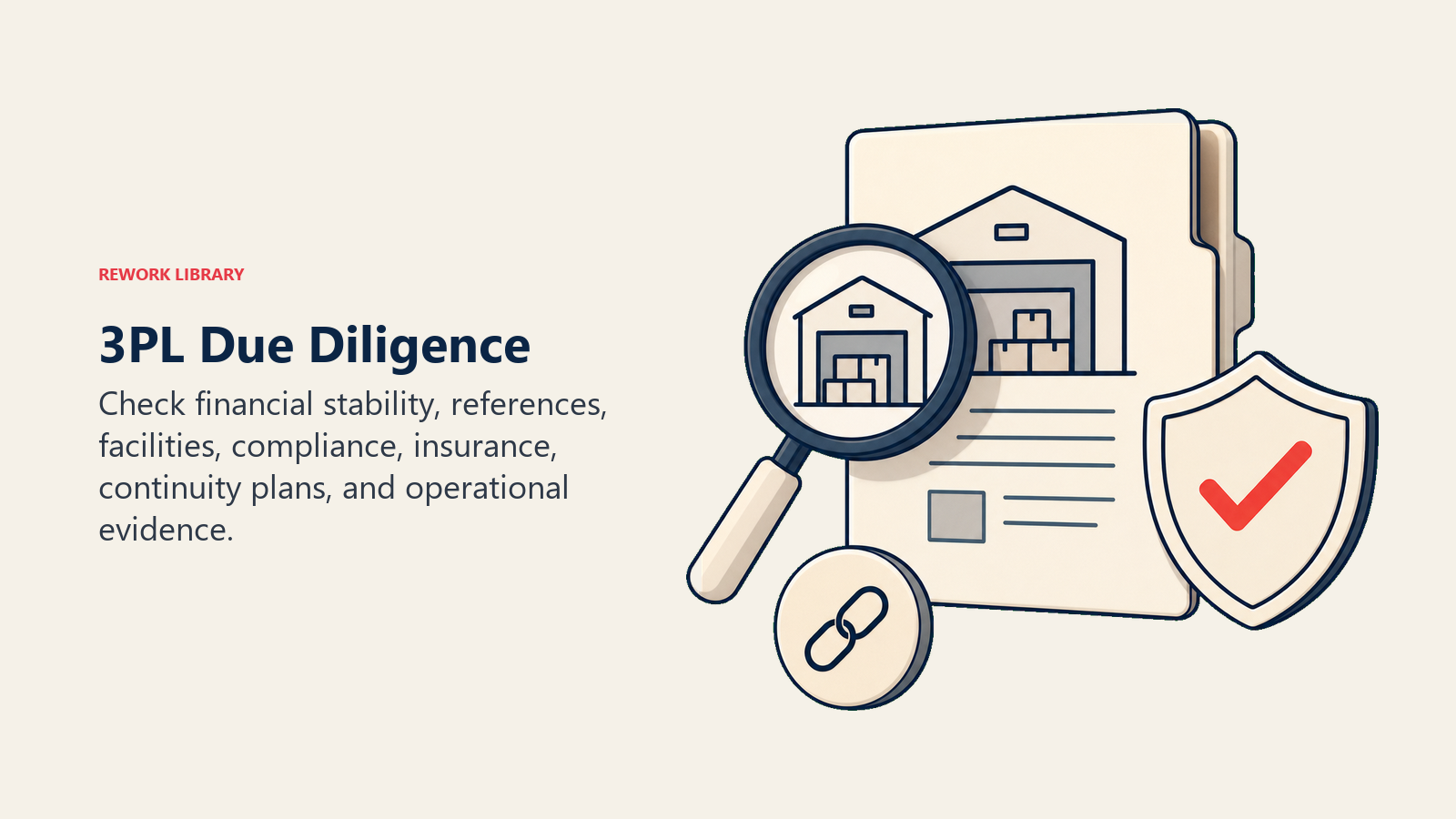
Request financial references or research public filings if available. VC-backed 3PLs may prioritize growth over profitability, creating operational risk if funding dries up. Private equity-owned providers may face pressure to cut costs impacting service quality.
References and Case Studies:
Speak with current clients, particularly those in similar industries or volume ranges:
Questions for References:
- How long have you worked with this 3PL?
- What made you choose them initially?
- How has performance been relative to SLAs?
- How responsive is account management to issues?
- Have you experienced any major problems? How were they handled?
- How has the partnership handled your growth?
- What's one thing you wish you knew before signing with them?
- Would you recommend them to a peer?
Request at least 3 references, ideally including one that has been with the 3PL for 2+ years (longevity indicator) and one with similar product types (handling expertise).
Site Visits and Operational Inspections:
Schedule site visits to primary fulfillment centers. Observe:
Facility Conditions:
- Cleanliness and organization (disorganized warehouses lose inventory)
- Climate control (if required for your products)
- Security measures (cameras, access controls, inventory audit processes)
- Safety protocols (proper equipment, trained staff, low accident rates)
Operational Processes:
- Receiving workflow (how inbound shipments are processed)
- Storage methods (bin locations, pallet organization)
- Picking operations (accuracy checks, batch vs. individual picking)
- Packing stations (quality control, material efficiency)
- Shipping staging (carrier organization, end-of-day processing)
Technology in Action:
- WMS usage (barcode scanning, mobile devices)
- Automation level (conveyors, sortation systems)
- Error detection (weight verification, photo documentation)
- Real-time dashboards (management visibility into operations)
Staff Observations:
- Training level (can staff explain their processes?)
- Turnover indicators (experienced team or constant new faces?)
- Communication (how do floor staff and management interact?)
- Morale (engaged employees or disgruntled workers?)
High employee turnover (common in warehouse work) impacts consistency. Look for retention programs, training investments, and positive work culture.
Contingency Planning:
Evaluate the 3PL's business continuity plans:
- Backup facilities if primary warehouse becomes unavailable
- Multi-carrier relationships (not dependent on single carrier)
- Emergency communication protocols
- Inventory insurance and liability coverage
- Force majeure provisions (natural disasters, pandemics)
Ask about COVID-19 impact:
- Did operations continue during lockdowns?
- What safety measures were implemented?
- How was staff availability managed?
- Were SLAs maintained or adjusted?
3PLs that successfully navigated pandemic disruptions demonstrated resilience valuable for future uncertainties.
Compliance and Certifications:
Verify regulatory compliance relevant to your products:
- FDA registration (food, supplements, cosmetics)
- cGMP certification (supplements manufacturing practices)
- Hazmat handling certifications (for regulated substances)
- USDA compliance (organic products)
- International shipping expertise (customs, documentation)
Request copies of certifications and licenses. Non-compliance puts your business at legal risk if products are stored or shipped improperly.
Insurance Coverage:
Confirm adequate insurance protection:
- General liability insurance (minimum $2M)
- Cargo insurance (covers inventory while in their custody)
- Errors and omissions insurance (covers fulfillment mistakes)
- Cyber liability insurance (data breach protection)
Request certificates of insurance naming your company as additionally insured. This provides direct recourse if claims arise.
Risk Flags to Watch For:
Warning signs indicating potential problems:
- Unwilling to provide references or allow site visits
- Aggressive growth without infrastructure investments
- High customer turnover or negative online reviews
- Vague answers about technology capabilities
- Resistance to SLAs or performance guarantees
- Lack of compliance certifications for your product category
- Minimal insurance coverage or unwillingness to share certificates
- Contractual terms heavily favoring the 3PL (one-sided agreements)
One or two yellow flags warrant deeper investigation. Multiple red flags suggest looking elsewhere.
Negotiation Strategy and Contract Terms
Negotiating favorable 3PL contracts requires preparation, leverage, and understanding which terms truly matter. Everything is negotiable before you sign. After signing, you have minimal leverage. Competitive Bidding Process:
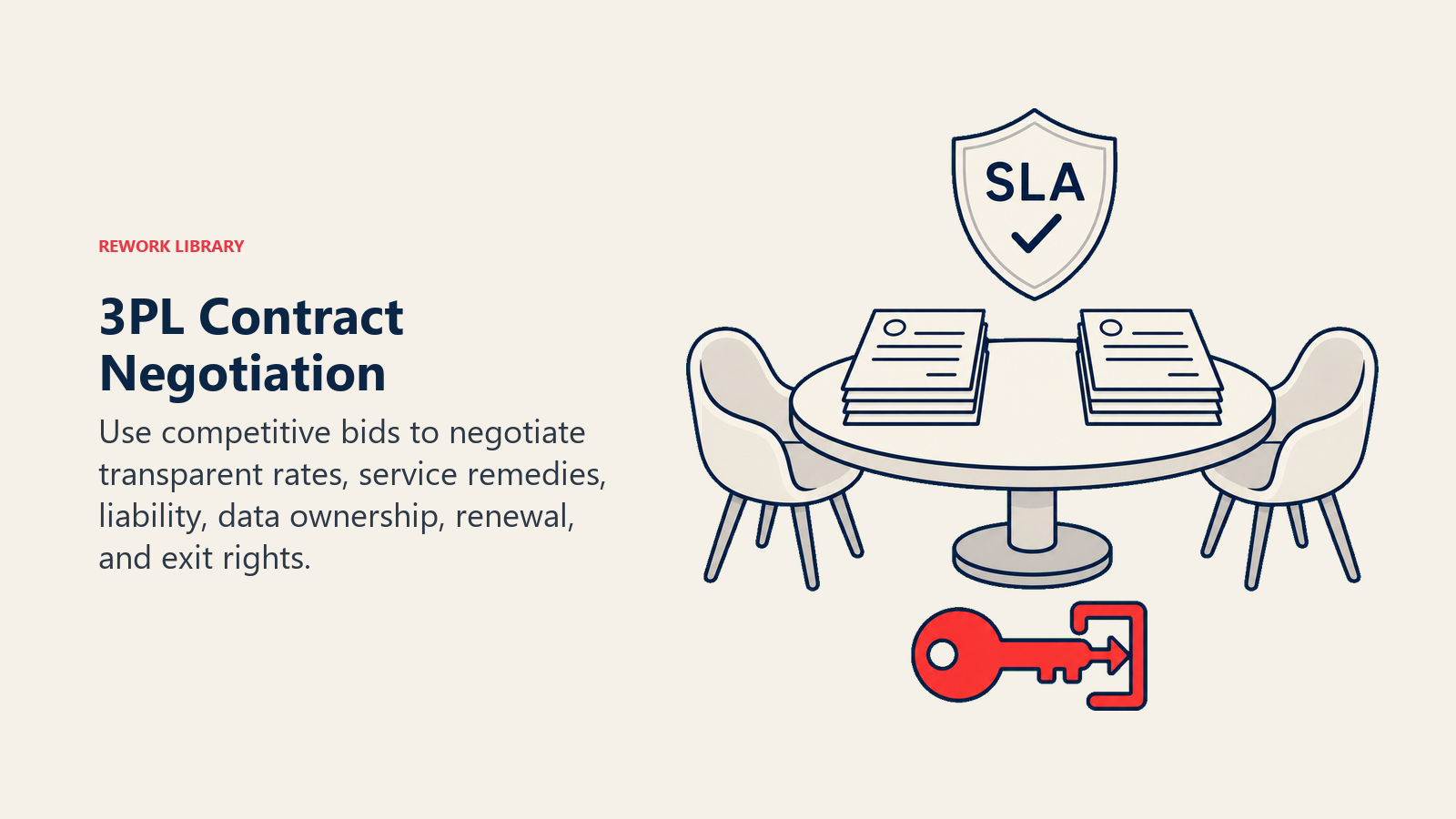
Maximize negotiating leverage through structured RFP processes:
Phase 1: Initial RFP (4-6 providers)
- Send standardized RFP with requirements and volume projections
- Request detailed pricing across volume tiers
- Ask for sample SLAs and contract terms
- Set response deadline (2-3 weeks)
Phase 2: Evaluation and Shortlist (2-3 providers)
- Score responses against evaluation criteria
- Conduct initial phone interviews
- Request references
- Shortlist top 2-3 candidates
Phase 3: Deep Dive (2-3 providers)
- Schedule site visits
- Request detailed proposals with customized SLAs
- Conduct technical integration assessments
- Check references thoroughly
Phase 4: Negotiation (Top 1-2 providers)
- Share volume commitments for best pricing
- Negotiate SLA terms and remedies
- Refine contract terms
- Request final and best offers
Running a competitive process takes 6-8 weeks but can reduce costs 15-25% compared to single-provider negotiations.
Leverage Points for Better Terms:
Use these factors to negotiate improvements:
Volume Commitments:
- Guarantee minimum monthly volumes for reduced per-unit rates
- Offer exclusive fulfillment (all volume goes to one 3PL)
- Commit to seasonal peaks for capacity allocation
Contract Length:
- Multi-year deals (2-3 years) often reduce rates 10-15%
- Include volume-based escalations (rates decrease as you grow)
- Request rate protection (no increases for contract term)
Payment Terms:
- Offer prepayment (quarterly or annual) for discounts
- Agree to faster payment (net 15 vs. net 30) for rate reductions
- Commit to auto-pay to reduce their AR management
Strategic Partnership Positioning:
- Highlight growth trajectory (they're investing in a growing account)
- Offer case study participation (marketing value to them)
- Commit to joint process improvements (reduces their costs)
Competitive Pressure:
- Share (non-confidential) competitor pricing ranges
- Use "we're evaluating multiple providers" language
- Set decision timelines creating urgency
Contract Structure and Critical Terms:
Pricing Terms:
- Detailed fee schedule for all services
- Volume tier breakpoints and associated rates
- Surcharge definitions (peak season, oversized items, special handling)
- Annual rate increase caps (3-5% maximum, tied to CPI)
- Pass-through shipping costs (actual carrier rates + defined markup percentage)
- Technology fees (monthly platform access, integration costs)
Minimum Volume Requirements:
- Monthly minimum orders or revenue
- Consequences for missing minimums (pay difference or terminate)
- Ramp periods (reduced minimums during first 3-6 months)
- Seasonal adjustments (lower minimums in slow months)
Service Level Agreements:
- Specific SLA metrics and targets
- Measurement methodology and reporting frequency
- Penalty structure for SLA misses
- Credit application process
- SLA review and adjustment provisions
Term and Termination:
- Initial contract term (12-36 months typical)
- Auto-renewal provisions (watch for automatic multi-year renewals)
- Termination notice period (60-90 days typical)
- Termination for cause (SLA failures, breach)
- Termination for convenience (your right to exit without cause)
- Exit fees (inventory transfer costs, early termination penalties)
Exit Clauses and Transition Rights:
Negotiate favorable exit terms before signing:
For Cause Termination (no penalty):
- Consistent SLA failures (missing targets 3+ consecutive months)
- Material breach (failure to meet contract obligations)
- Financial instability (bankruptcy, acquisition, major operational changes)
- Force majeure lasting 30+ days
For Convenience Termination:
- Your right to terminate with 60-90 days notice
- Early termination fees (negotiate caps or elimination)
- Transition assistance requirements (inventory transfer, data export)
Transition Provisions:
- 3PL must provide full inventory counts upon notice
- Inventory transfer within 30 days of termination date
- Data export in standard formats (CSV, XML)
- Cooperation with incoming 3PL for smooth transition
- No hostage-taking (inventory held for unpaid fees only)
Liability and Insurance:
- Liability caps for losses (avoid broad limitations)
- Insurance requirements (coverage amounts, certificates)
- Indemnification provisions (protection for their errors)
- Limitation of consequential damages (negotiate reasonable caps)
Dispute Resolution:
- Escalation procedures (account manager → director → VP)
- Mediation before litigation
- Arbitration provisions (if preferred over court)
- Governing law and jurisdiction
Data and IP Ownership:
- Your data remains your property
- Right to access and export data at any time
- Confidentiality obligations (your business information)
- Use of your trademarks (permission required)
Red Flag Contract Terms:
Watch for and negotiate out of:
- Automatic multi-year renewals without notice
- Termination only for cause (no convenience exit)
- Broad liability limitations (zero accountability)
- Unrealistic SLAs with no remedies
- Vague pricing (discretionary surcharges)
- Exclusive arbitration in provider's jurisdiction
- Data ownership claims (your data is theirs)
- Non-compete provisions (restricting your 3PL choices)
Every unfavorable term is negotiable. "Standard contract" doesn't mean non-negotiable. Everything signed by both parties becomes binding, so read carefully and consult legal counsel for significant commitments.
Scaling and Growth Management
Your 3PL partnership must accommodate growth without frequent provider switches. Plan for scale from the start and manage capacity proactively. Capacity Planning and Forecasting:
Share detailed growth projections with your 3PL:
Monthly Volume Forecasts:
- Order volume projections (12-24 months ahead)
- SKU count expansion plans
- Inventory level requirements
- Peak season multipliers
Geographic Expansion Plans:
- New markets or regions
- International shipping needs
- Multi-warehouse distribution strategies
Product Mix Changes:
- New product categories
- Special handling requirements
- SKU proliferation impact on storage
Quarterly forecast reviews ensure your 3PL allocates sufficient warehouse space, staff, and technology resources. Surprises (doubling volume with 30 days notice) strain relationships and create service failures.
Volume Tier Optimization:
3PL pricing typically decreases with volume. Optimize costs:
Understanding Tier Breakpoints:
- Many 3PLs offer tiered pricing (e.g., <5K orders, 5-10K, 10-20K, 20K+)
- Rates decrease 10-20% at each tier
- Calculate your current tier and proximity to next breakpoint
Timing Volume Increases:
- If averaging 4,800 orders/month (just below 5K tier), push marketing to cross threshold
- Temporarily concentrating orders (promotion timing) can trigger better tier pricing
- Negotiate tier adjustments as you consistently exceed breakpoints
Peak Season Handling:
Holiday peaks strain 3PL capacity. Plan proactively:
Capacity Reservations (6+ months ahead):
- Share peak volume projections
- Request capacity commitments (guaranteed space and labor)
- Negotiate peak pricing (flat rates vs. surcharges)
Inventory Positioning:
- Build inventory early (August-September for holiday season)
- Pre-position bestsellers in optimal locations
- Reduce SKU complexity during peaks (pause slow-movers)
Contingency Plans:
- Backup carriers for capacity crunches
- Overflow agreements (partner 3PLs for excess volume)
- Communication plans for customers if delays occur
3PLs prioritize capacity for clients who plan ahead and commit to volumes. Last-minute requests get lowest priority or declined entirely.
Adding Services and Capabilities:
As you grow, leverage your 3PL for expanded services:
Value-Added Services:
- Kitting and bundling (subscription boxes, gift sets)
- Custom packaging (branded boxes, tissue paper)
- Returns processing and refurbishment
- Quality inspections (pre-fulfillment checks)
Channel Expansion:
- B2B fulfillment (wholesale, retail replenishment)
- International shipping (customs, documentation)
- Subscription management (recurring shipments)
- Drop-shipping (direct from suppliers)
Technology Enhancements:
- Advanced reporting and analytics
- Demand forecasting tools
- Inventory optimization software
- Multi-channel inventory allocation
Discuss roadmap plans during quarterly business reviews. Many capabilities require setup time (new processes, technology integration, staff training) taking 30-90 days to implement.
Cost Optimization at Scale:
Larger volumes create negotiating opportunities:
Annual Contract Reviews:
- Renegotiate rates based on increased volumes
- Request tiered pricing reflecting actual performance
- Benchmark against current market rates
- Negotiate multi-year deals locking in favorable terms
Process Improvements:
- Standardize packaging (reduces packing time and costs)
- Optimize inventory turnover (reduces storage costs)
- Improve forecasting accuracy (reduces stockouts and rush shipments)
- Consolidate SKUs (reduces complexity costs)
Shipping Optimization:
- Zone skipping (3PL consolidates shipments to regional carriers)
- Multi-warehouse strategies (stock closer to customers)
- Carrier diversification (optimize for speed vs. cost per lane)
- Packaging efficiency (smaller boxes reduce dimensional weight charges)
Track all-in fulfillment costs per order monthly. Costs should decrease as volumes increase. If costs remain flat or increase, investigate root causes and address with your 3PL.
Multi-Provider Strategies:
At higher volumes (10K+ orders/month), consider multi-3PL approaches:
Geographic Distribution:
- East Coast 3PL for eastern customers
- West Coast 3PL for western customers
- Reduces shipping zones and transit times
- Enables 1-2 day ground shipping to most US customers
Channel-Specific 3PLs:
- DTC fulfillment provider
- B2B/wholesale provider
- International fulfillment partner
- Each optimized for specific channel requirements
Risk Diversification:
- Primary 3PL for 70% of volume
- Secondary 3PL for 30% (backup capacity, competitive pressure)
- Ability to shift volumes based on performance
Multi-3PL strategies add complexity (inventory allocation, system integrations, management overhead) but provide flexibility and reduce single-provider dependence. Best suited for $5M+ annual revenue businesses with volumes justifying the complexity.
Relationship Management and Optimization
Treating your 3PL as a strategic partner (not a vendor) improves performance, reduces costs, and creates competitive advantages.
Communication Protocols and Cadence:
Establish regular touchpoints:
Daily:
- Exception reports (out of stock, shipping delays)
- Critical issue notifications (system outages)
- Operational status during peak periods
Weekly:
- Quick sync calls (15-30 minutes)
- Open issue review and resolution
- Upcoming week planning (promotions, inventory arrivals)
Monthly:
- SLA scorecard review
- Billing reconciliation and cost analysis
- Process improvement discussions
- Forecast updates
Quarterly:
- Strategic business reviews
- Growth planning and capacity discussions
- Technology roadmap alignment
- Contract term reviews and adjustments
Annually:
- Performance evaluation and benchmarking
- Contract renewal or renegotiation
- Strategic partnership planning
Consistent communication prevents small issues from becoming major problems and builds collaborative relationships.
Account Management and Point of Contact:
Clarify roles and escalation paths:
Day-to-Day Operations:
- Primary contact: Operations manager
- Response time: Same business day for routine questions
- Handles: Order status, inventory questions, routine requests
Service Issues:
- Escalation contact: Account manager
- Response time: Within 2 hours for SLA-impacting issues
- Handles: Performance problems, billing disputes, service failures
Strategic Planning:
- Executive contact: Director or VP level
- Quarterly business reviews
- Handles: Capacity planning, contract negotiations, partnership strategy
Emergency Situations:
- 24/7 contact: On-call manager (phone/text)
- Response time: Immediate
- Handles: System outages, facility emergencies, critical customer issues
Request contact information and communication preferences (email, phone, text, Slack) for each role. Test emergency contacts before you need them.
Continuous Improvement and Process Optimization:
Partner on ongoing enhancements:
Root Cause Analysis:
- When errors occur, conduct joint RCA sessions
- Identify systemic issues (not just individual mistakes)
- Implement corrective actions preventing recurrence
- Track effectiveness of improvements
Process Efficiency Projects:
- Packaging optimization (reducing materials costs)
- Picking route optimization (faster fulfillment)
- Inventory placement strategies (high-volume SKUs in prime locations)
- Returns processing improvements (faster restocking)
Technology Upgrades:
- Integration enhancements (new features, faster syncs)
- Reporting improvements (custom dashboards)
- Automation opportunities (auto-reordering, smart routing)
- Mobile app capabilities (customer tracking visibility)
Shared Cost Savings:
- Negotiate agreements where process improvements reducing costs benefit both parties
- Example: Packaging optimization saving $0.30/order → split savings 50/50
- Aligns incentives for continuous improvement
Performance Benchmarking:
Regularly compare performance against industry standards and competitors. Track these alongside your broader e-commerce metrics and KPIs:
Industry Benchmarks:
- Order accuracy: 99.5%+ (world-class)
- Same-day shipping: 95%+ (by cutoff time)
- Inventory accuracy: 99%+ (cycle counts)
- Damage rate: <0.5%
Competitive Intelligence:
- Network with peers using other 3PLs
- Compare pricing structures and SLA performance
- Identify capabilities your 3PL lacks
- Use benchmarking data in annual renegotiations
Internal Tracking:
- Monitor trends over time (improving, stable, declining)
- Correlate performance with volume changes
- Identify seasonal patterns
- Forecast future performance based on growth
Monthly scorecards showing performance vs. benchmarks create accountability and identify improvement opportunities.
Renegotiation Opportunities:
Contracts shouldn't be set-and-forget. Revisit terms as circumstances change:
Triggers for Renegotiation:
- Significant volume increases (50%+ growth)
- Contract nearing renewal (6 months ahead)
- Consistent SLA performance (earning better terms)
- Adding new services or capabilities
- Competitive offers from other providers
- Market rate changes (economic conditions, fuel costs)
Renegotiation Strategies:
- Present volume growth data (you're more valuable now)
- Share competitive intelligence (market rates have decreased)
- Propose multi-year extensions for rate improvements
- Offer increased volume commitments for better pricing
- Request value-adds (free technology access, account management)
What to Renegotiate:
- Per-unit fulfillment rates (picking, packing)
- Storage fees (particularly if high-turnover inventory)
- Volume tier breakpoints (lower thresholds)
- Technology fees (waive or reduce)
- Peak season surcharges (flat-rate vs. percentage)
- Contract minimums (reduce or eliminate)
Annual renegotiations based on performance and growth can reduce costs 10-15% without switching providers.
Contingency Planning and Provider Transitions
Even excellent 3PL relationships sometimes end. Plan for transitions before you need them. Monitoring 3PL Health and Stability:
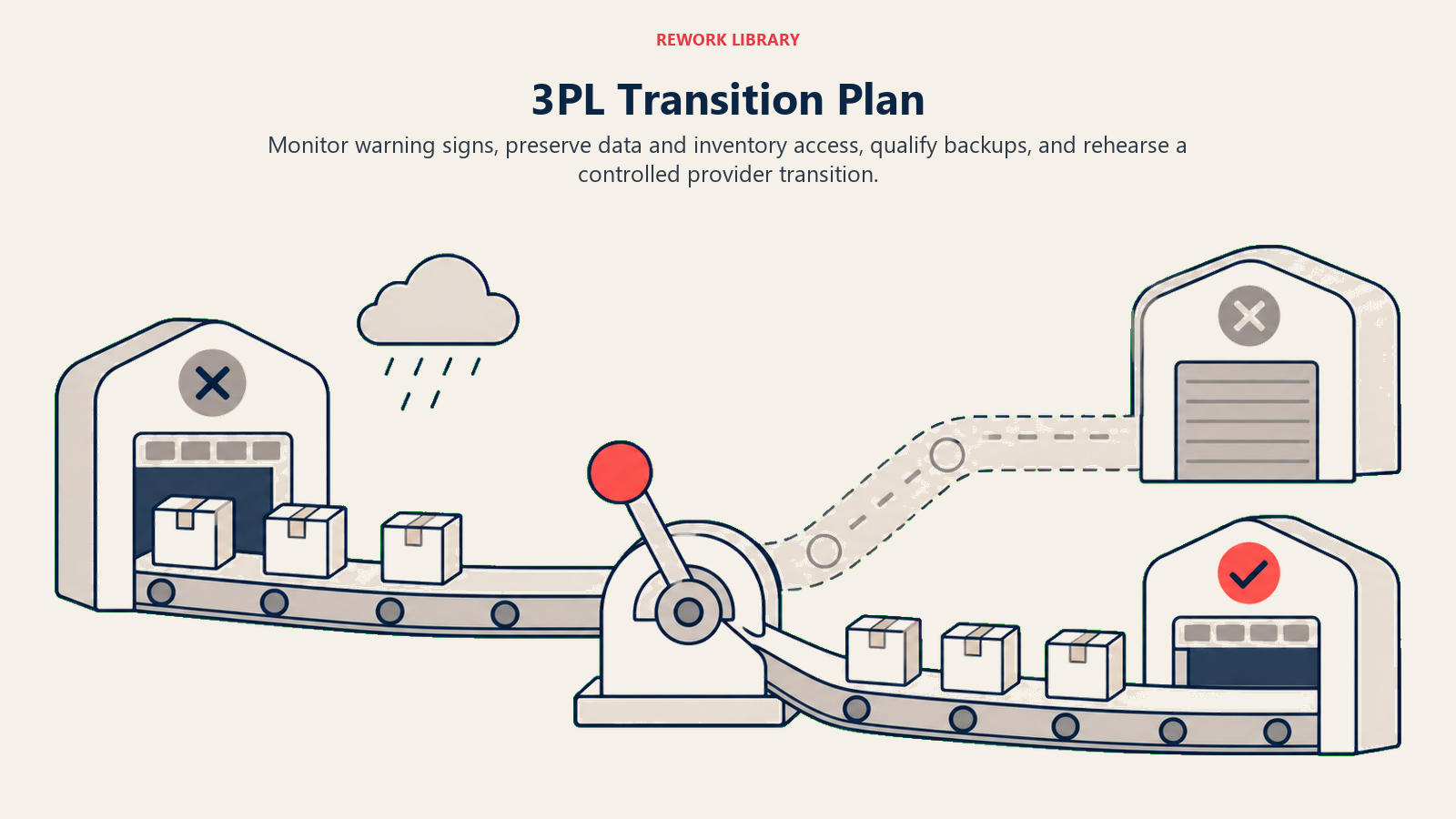
Watch for warning signs of deteriorating service or financial trouble:
Service Quality Indicators:
- SLA performance declining for 2+ consecutive months
- Increased error rates or customer complaints
- Slower response times from account management
- Unfulfilled promises or missed commitments
- Technology issues becoming more frequent
Financial Health Indicators:
- Delayed invoicing or billing errors increasing
- Requests for prepayment or shortened payment terms
- Staff turnover (especially senior leadership)
- Facility maintenance declining
- Rumors of financial distress or acquisition
Operational Red Flags:
- Warehouse space overcrowding
- Inventory misplacement increasing
- Picking/packing speed slowing
- Carrier relationships deteriorating
- Peak season failures
Communication Breakdown:
- Account manager changes frequently
- Difficulty reaching decision-makers
- Defensive responses to performance feedback
- Lack of transparency on issues
Early detection enables proactive conversations or planned transitions rather than emergency switches.
When to Change Providers:
Consider switching when:
Service Failures:
- Consistent SLA misses despite corrective action plans
- Unwillingness to address performance issues
- Customer satisfaction declining due to fulfillment problems
- Financial impact (lost sales, refunds) exceeding switch costs
Growth Limitations:
- Inadequate capacity for your projected volumes
- Geographic coverage gaps limiting expansion plans
- Technology limitations preventing needed integrations
- Inability to support new channels or services like Amazon FBA strategy
Financial Reasons:
- Costs significantly above market rates (15%+ premium)
- Hidden fees or unexpected surcharges
- Refused to renegotiate despite volume growth
- Better total cost of ownership available elsewhere, impacting customer lifetime value
Strategic Misalignment:
- 3PL pursuing different market segments
- Acquisition or ownership changes altering priorities
- Your business model evolves beyond their capabilities
- Partnership culture deteriorated
When NOT to Switch:
Avoid provider changes for wrong reasons:
- Minor cost differences (5-10% savings don't justify transition risks)
- Grass-is-greener syndrome (all 3PLs have occasional issues)
- Single incidents (isolated problems corrected don't warrant switching)
- Unrealistic expectations (no 3PL achieves perfection)
Switching costs (integration development, inventory transfer, team training, service disruptions) typically equal 3-6 months of fulfillment fees. Ensure the benefits clearly outweigh transition costs and risks.
Transition Planning and Execution:
When changing providers, plan methodically:
90 Days Before Transition:
- Select new 3PL and negotiate contract
- Notify current 3PL per contract terms (60-90 days notice)
- Develop detailed transition project plan
- Assign transition team (your staff + both 3PLs)
- Communicate plans internally (customer service, marketing, ops)
60 Days Before:
- Complete technical integration development
- Test integrations in sandbox environment
- Coordinate inventory transfer logistics
- Plan transition inventory counts (reconciliation)
- Prepare customer communication (if needed)
30 Days Before:
- Conduct final inventory cycle count
- Ship transition inventory to new 3PL
- Complete integration testing
- Train team on new systems/processes
- Establish communication protocols with new 3PL
Transition Week:
- Dual-run period (both 3PLs operational for 3-7 days)
- New orders to new 3PL
- Old orders complete at old 3PL
- Monitor both operations closely
- Address issues immediately
30 Days After:
- Complete final inventory reconciliation
- Resolve outstanding credits/invoices with old 3PL
- Conduct post-transition review with new 3PL
- Document lessons learned
- Optimize processes based on initial performance
Dual-Running and Risk Mitigation:
Minimize transition risks through parallel operations:
Inventory Splitting:
- Transfer 50% of inventory to new 3PL
- Route 50% of orders to each provider
- Maintain backup capacity at both facilities
- Shift percentages as new 3PL proves capabilities
Channel-Based Transitions:
- Start with lowest-risk channel (B2B or low-volume)
- Prove new 3PL performance before shifting DTC volume
- Gradually increase percentage over 30-60 days
Geographic Transitions:
- Start with single region
- Expand to additional regions as performance validates
- Maintain old 3PL for other regions during transition
Dual-running adds costs (two 3PLs simultaneously) but significantly reduces risks of major service disruptions during transitions.
Data Migration and Historical Records:
Ensure continuity of information:
Data to Extract:
- 12+ months order history
- Inventory transaction records (receipts, adjustments, shipments)
- SLA performance reports
- Billing history
- Returns processing data
Formats and Accessibility:
- CSV or Excel exports (standard formats)
- API data pulls (if available)
- Historical reporting access (6-12 months post-termination)
New 3PL Setup:
- Import starting inventory levels
- Configure product master data (dimensions, weights, SKUs)
- Set up location preferences and picking rules
- Establish baseline reporting
Customer Communication:
Decide whether customers need notification:
No Communication Needed:
- Seamless transitions (no service changes)
- Improved service (faster shipping, better tracking)
- No customer-facing changes
Communication Recommended:
- Tracking number format changes
- Return address changes
- Packaging appearance differences
- Potential brief shipping delays during transition
If communicating:
- Emphasize improvements ("faster shipping", "enhanced tracking")
- Set realistic expectations for transition period
- Provide updated return addresses and instructions
- Monitor customer service tickets for transition-related issues
Reducing Single-Provider Concentration Risk:
Avoid complete dependence on one 3PL:
Diversification Strategies:
- Multi-warehouse approach (2-3 providers across regions)
- Primary + backup provider relationship (90/10 split)
- Channel-specific providers (DTC vs. B2B vs. international)
- Maintain in-house capabilities for critical products or customers
Inventory Distribution:
- Never hold 100% of inventory at single location
- Split high-value or critical SKUs across facilities
- Maintain safety stock at backup locations
- Plan for rapid reallocation if primary facility fails
Contract Protections:
- Avoid exclusive agreements (maintain right to use other 3PLs)
- Reasonable termination clauses (60-90 days, not 12+ months)
- Data portability provisions (easy export and migration)
- Performance guarantees with exit rights
Large e-commerce businesses ($10M+ revenue) should operate with 2+ 3PLs to reduce single points of failure and maintain competitive pressure.
Selecting and managing 3PL partnerships is ongoing strategic work, not a one-time decision. The providers you choose directly impact customer experience, operating margins, and growth capacity. Use this framework to evaluate capabilities comprehensively, negotiate favorable terms, structure SLAs that drive performance, integrate systems seamlessly, and build partnerships that scale with your business.
Your fulfillment strategy determines customer satisfaction and profitability. Choose 3PL partners carefully, manage relationships proactively, and maintain flexibility to adapt as your business evolves. The right 3PL becomes invisible to customers while enabling you to focus on growth rather than logistics operations.
Connect your 3PL selection to broader operational excellence through inventory optimization, returns efficiency, shipping refinement, and performance tracking. When logistics, fulfillment, and customer experience align, your 3PL partnership transforms from operational necessity to competitive advantage.
Learn More
Strengthen your e-commerce fulfillment and logistics capabilities with these related resources:
- Fulfillment Strategy - Build a comprehensive fulfillment approach that aligns with your 3PL partnership
- Inventory Management - Optimize inventory levels and turnover across your 3PL facilities
- Returns Management - Design efficient returns processes that integrate with your 3PL operations
- Shipping Strategy & Pricing - Develop shipping strategies that leverage your 3PL's carrier relationships

On this page
- 3PL Partnership Overview: Strategic Role and Provider Types
- Assessment Phase: Defining Your Requirements
- Evaluation Criteria: Technical Capabilities
- Financial Evaluation: Pricing Models and Cost Analysis
- Operational Fit and Service Level Agreements (SLAs)
- Integration and Technology Assessment
- Due Diligence and Risk Assessment
- Negotiation Strategy and Contract Terms
- Scaling and Growth Management
- Relationship Management and Optimization
- Contingency Planning and Provider Transitions
- Learn More