Cart Abandonment Recovery: Systematic Email, SMS, and Retargeting Strategies to Recapture Lost Revenue
Turn this article into takeaways for your work.


Each assistant summarizes the article only for you and suggests best practices for your work.
Cart abandonment recovery is one of the fastest ecommerce growth levers because it converts buyers who already chose products and started checkout. A coordinated email, SMS, and retargeting sequence typically recaptures 10% to 30% of abandoned carts and adds 5% to 15% to total revenue, with almost no new acquisition cost.
The economics of cart abandonment recovery are compelling. With average cart abandonment rates around 70% across e-commerce, the majority of potential sales slip away at the final stage. But unlike lost traffic or unconverted browsers, cart abandoners are high-intent customers who've actively selected products and initiated checkout. They've demonstrated buying intent. They just didn't complete the transaction.
This creates an extraordinary recovery opportunity. Systematic cart abandonment recovery programs consistently recapture 10-30% of abandoned carts, adding 5-15% to total revenue without any acquisition costs. These aren't new customers requiring expensive marketing. They're customers who already wanted to buy but hit friction, got distracted, or hesitated.
Yet most e-commerce stores approach cart recovery reactively and incompletely. They might send a single reminder email, or maybe two, then give up. They rarely integrate SMS follow-up, paid retargeting, or sophisticated incentive strategies. They treat cart abandonment as an occasional recovery tactic instead of a systematic revenue operation.
The opportunity lies in the gap between basic implementation and comprehensive multi-channel recovery frameworks that address different abandonment triggers through coordinated email sequences, SMS messaging, exit-intent tactics, retargeting campaigns, and dynamic discount strategies. When integrated with broader conversion rate optimization efforts, cart recovery becomes a predictable revenue driver.
Understanding Cart Abandonment as Systematic Revenue Operation
Cart abandonment recovery represents a distinct revenue channel with specific characteristics that differentiate it from new customer acquisition.
Types of cart abandonment fall into two categories that require different recovery approaches. Session drop-off occurs when customers abandon during active browsing sessions, they add items to cart, then navigate away, close the browser, or get distracted before completing checkout. These abandonments happen within minutes or hours.
Post-session recovery addresses carts abandoned in previous sessions. The customer may have intended to purchase later, wanted to save items for consideration, or encountered checkout friction that caused immediate abandonment. These carts remain dormant until recovery messaging re-engages the customer.
The distinction matters because recovery timing and messaging differ significantly. Session drop-off responds to immediate interventions like exit-intent popups or very rapid email follow-up. Post-session recovery requires longer sequences and different value propositions.
Revenue impact quantification demonstrates the business value of systematic recovery programs. A store with $100,000 monthly revenue and 70% cart abandonment effectively has $233,000 in potential revenue ($100,000 actual + $166,000 abandoned). Recovering just 15% of abandoned carts adds $25,000 monthly revenue, a 25% increase without additional acquisition spending.
The unit economics are extraordinary: cart recovery costs (email platform fees, SMS costs, potential discount incentives) are minimal compared to customer acquisition costs. Recovering a $75 abandoned cart might cost $2 in messaging fees plus $7.50 in discount incentives (10% offer), a $9.50 cost to capture $75 revenue versus $30-50 typical customer acquisition costs.
Recovery strategy prioritization focuses effort on the highest-value opportunities. Not all abandoned carts deserve equal recovery investment. Prioritize based on cart value (high-value abandonment justifies more aggressive recovery), customer segment (previous customers versus first-time visitors), product category (high-margin products support larger incentives), and abandonment timing (recent abandonment converts better than old carts).
Multi-channel integration approach coordinates email, SMS, paid retargeting, and on-site tactics into cohesive recovery sequences instead of scattered independent efforts. Effective integration ensures consistent messaging across channels, strategic escalation from lower-cost to higher-cost tactics, and coordinated timing that avoids overwhelming customers with simultaneous recovery messages.
Why Cart Abandonment Recovery Matters
The strategic importance of cart recovery extends beyond immediate revenue recapture to long-term business fundamentals.
Average 70% cart abandonment rate means that even well-optimized stores lose the majority of initiated purchases. While checkout optimization reduces this rate, some abandonment is inevitable due to comparison shopping, price sensitivity, timing mismatches, and legitimate purchase reconsideration.
Accepting this reality shifts focus from preventing all abandonment (impossible) to systematically recovering the recoverable portion. This dual approach, minimize abandonment through friction reduction while maximizing recovery of remaining abandonment, delivers optimal results.
Direct revenue recovery without acquisition costs represents pure margin expansion. These customers already found your products, already added items to cart, already invested time in the purchase process. Recovery doesn't require advertising spend, SEO investment, or content marketing efforts. The marginal cost to attempt recovery (email send cost) is near zero, making even low recovery rates profitable.
Improved unit economics through existing customer engagement benefits from the fundamental truth that engaging existing customers costs less than acquiring new ones. Cart abandoners exist in your database, have demonstrated interest, and require only reactivation rather than full acquisition funnel progression.
This dramatically improves CAC (Customer Acquisition Cost) ratios when recovered customers are properly attributed. A recovered abandoned cart effectively acquired a customer at email sending cost rather than full acquisition cost, improving overall unit economics and contributing positively to customer lifetime value metrics.
Customer behavior insights from abandonment patterns provide valuable data about friction points, price sensitivity, and purchase decision factors. Analyzing abandonment triggers reveals: which products see highest abandonment (indicating potential pricing, description, or shipping cost issues), at what checkout steps abandonment spikes (revealing friction points), what time delays correlate with abandonment (suggesting optimal recovery timing), and which customer segments abandon most frequently (enabling targeted optimization).
These insights inform both recovery strategy and broader conversion optimization efforts, creating compound value beyond immediate revenue recovery.
Understanding Cart Abandonment Triggers
Effective recovery requires understanding why customers abandon, enabling targeted messaging that addresses specific concerns. Unexpected costs trigger immediate abandonment when shipping fees, taxes, or other charges appear at checkout. Customers make buying decisions based on product prices, then encounter total costs significantly higher than anticipated. The perception of hidden fees creates instant distrust and frequently triggers abandonment. Recovery approach: Acknowledge the concern directly in recovery messaging. "We noticed you didn't complete your order, if shipping costs were a concern, here's a free shipping offer to complete your purchase." This demonstrates understanding while providing solution. Consider reviewing your shipping strategy and pricing to minimize sticker shock. Checkout friction and complexity exhausts customers through excessive form fields, unclear processes, technical errors, or confusing navigation. The effort required to complete checkout exceeds the purchase motivation, leading to abandonment.
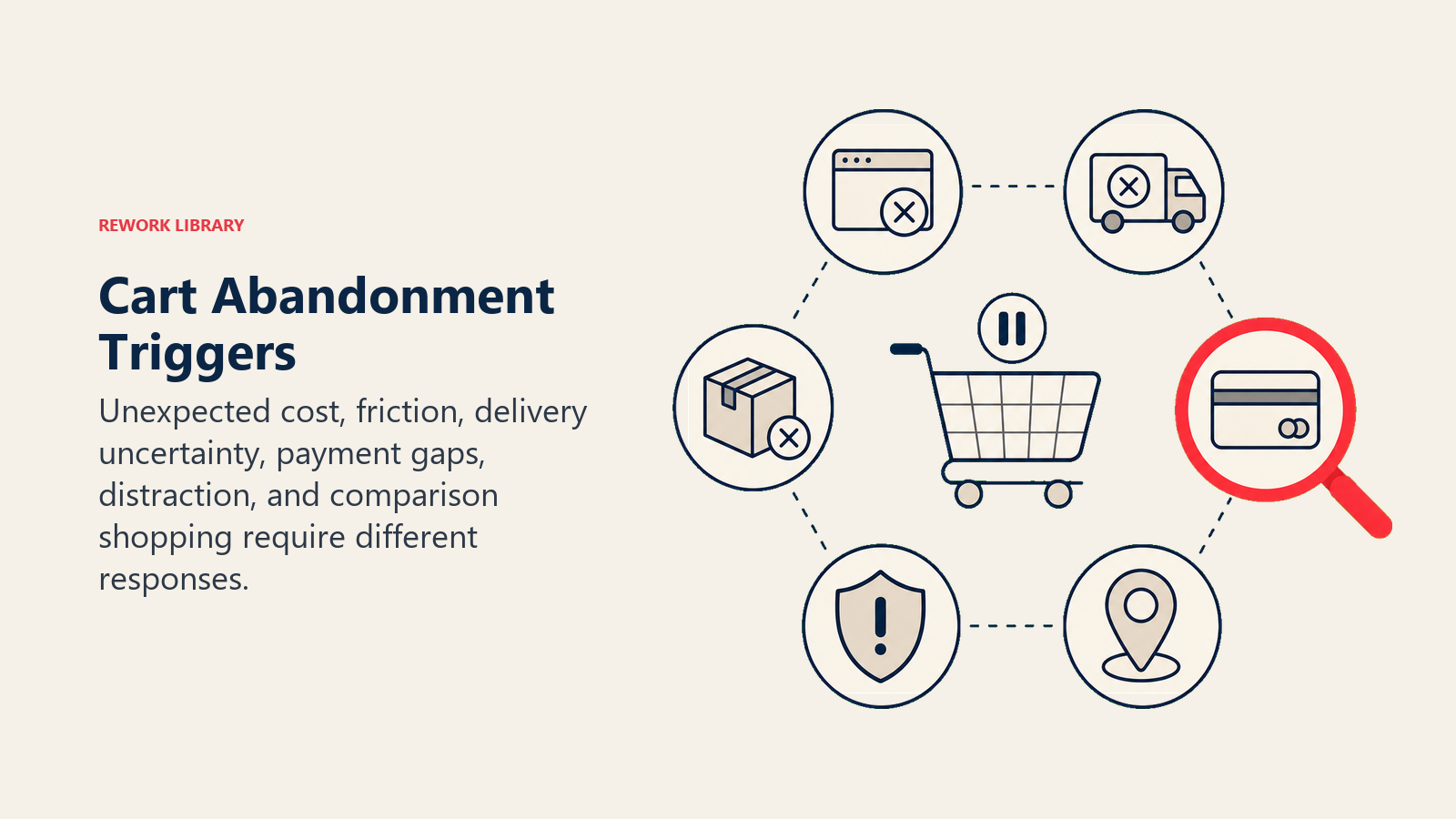
Recovery approach: Emphasize simplified completion in recovery messages. "Your items are still waiting, complete your order in under 60 seconds with our streamlined checkout." Consider providing direct checkout links that bypass cart review.
Payment method limitations prevent completion when customers can't use preferred payment types. Inability to pay with PayPal, lack of Buy Now Pay Later options, or limited credit card acceptance all trigger abandonment.
Recovery approach: If you've added payment methods since abandonment, highlight this in recovery: "Now accepting Apple Pay and Klarna for easier checkout." If payment limitations persist, emphasize security and accepted methods to set clear expectations. Optimizing your payment processing strategy can prevent these abandonments.
Security and trust concerns escalate during checkout when customers prepare to share financial information. Missing security indicators, unfamiliar payment processors, or concerns about data privacy can trigger abandonment.
Recovery approach: Emphasize security in recovery messaging: "Your information is fully encrypted and secure. We never share customer data." Include security badges in recovery emails to reinforce trust. Building strong trust signals and social proof throughout your site reduces these concerns.
Price sensitivity and comparison shopping reflect intentional abandonment by customers checking prices across multiple retailers before deciding where to buy. These customers may intend to purchase but want to ensure they're getting the best price.
Recovery approach: Provide price confidence through messaging like "We'll match any competitor's price, just reach out before purchasing elsewhere" or offer limited-time discounts that create urgency: "Complete your order in the next 24 hours for 10% off."
Unplanned purchase decisions occur when customers add items to cart impulsively but haven't fully committed to buying. The cart serves as a wishlist or placeholder rather than immediate purchase intent.
Recovery approach: Use softer messaging focused on product benefits rather than aggressive discounting. "Still thinking about [product name]? Here's why customers love it" with social proof and reviews often works better than immediate discounts for this segment.
Email Sequence Strategy
Email represents the foundational cart recovery channel due to low cost, high reach, and flexibility for detailed messaging. A well-structured email marketing approach for e-commerce forms the backbone of effective cart recovery. First email timing and content (0-1 hours) capitalizes on immediate session context while cart contents remain top-of-mind. Send this email within 30-60 minutes of abandonment for maximum relevance. Content focus: Simple reminder with cart contents display, clear "complete your order" call-to-action, minimal friction to return to checkout. Avoid discounts in first emails, many customers abandoned due to distraction or timing rather than price concerns. Offering immediate discounts trains customers to abandon for discounts. Subject line approaches: "You left something behind," "Your cart is waiting," or "Did something go wrong with your order?" These create curiosity without pressure.
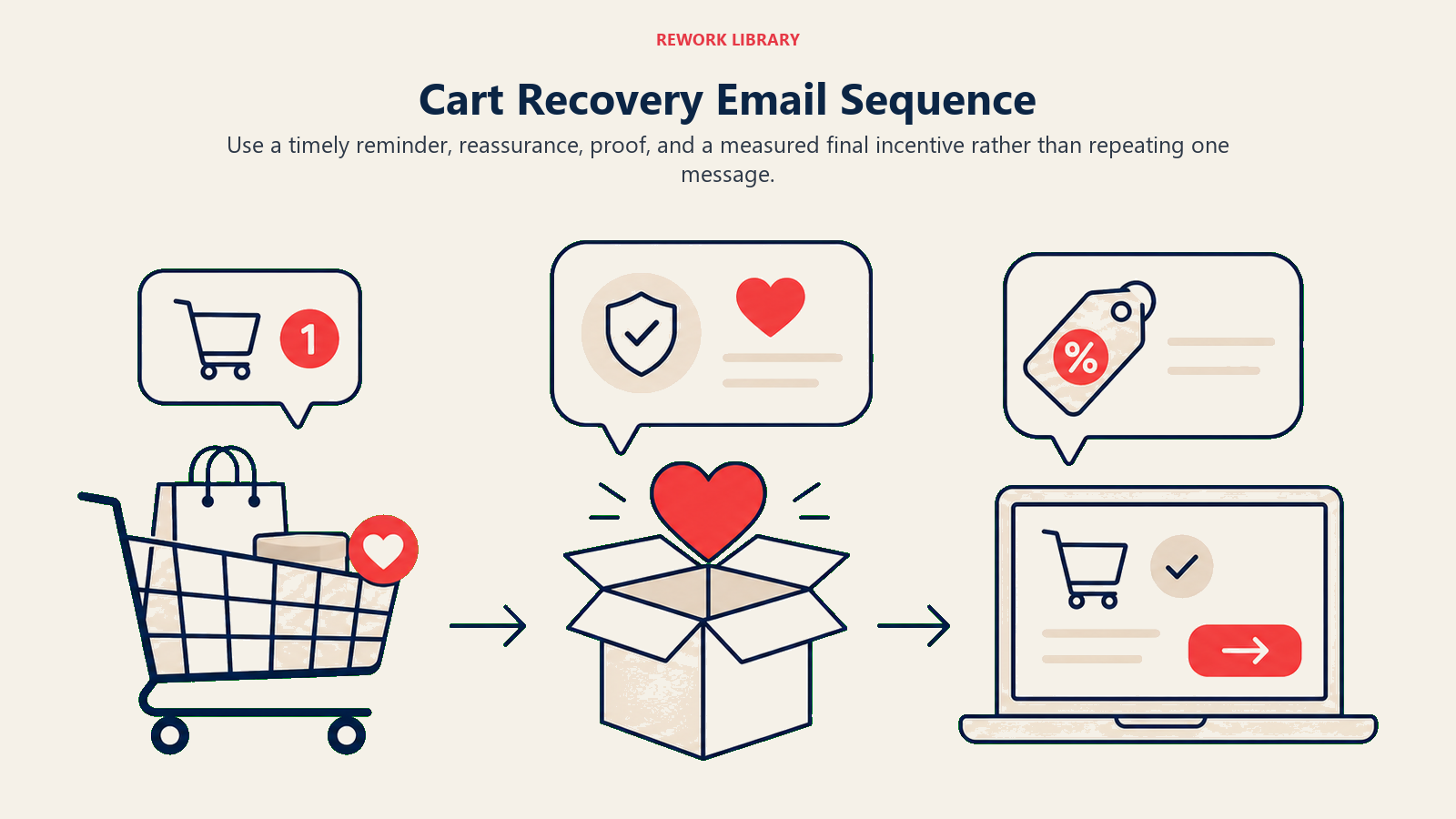
Second email timing and content (24 hours) addresses customers who didn't respond to immediate reminder, suggesting deeper hesitation requiring different messaging.
Content focus: Shift from simple reminder to value reinforcement. Highlight product benefits, include customer reviews and social proof, address common objections (free returns, money-back guarantees, customer support availability). Maintain direct checkout links for easy completion.
Subject line approaches: "Still interested in [product name]?", "Is this a good fit for you?", or "Customers love [product category]." Focus on helpfulness rather than urgency.
Third email timing and content (72 hours) represents the final standard recovery attempt, justifying incentive offers or alternative product suggestions for customers who haven't responded to value-based messaging.
Content focus: Introduce limited-time incentive (percentage discount, free shipping, small gift with purchase) with clear expiration creating urgency. Alternatively, suggest similar products at different price points if price sensitivity caused abandonment.
Subject line approaches: "Last chance for [product name]," "Special offer inside, just for you," or "Here's 10% off to complete your order." Create urgency and emphasize exclusive nature of offer.
Segmentation by cart value and product category enables targeted recovery approaches. High-value carts (over $200) justify more aggressive recovery including larger discounts and personalized outreach. Low-value carts (under $30) may not justify discount offers at all.
Product category segmentation addresses different purchase decision factors. Fashion items might emphasize style and fit information. Electronics might focus on specifications and comparisons. Consumables might highlight convenience and subscription options.
Personalization opportunities extend beyond basic name insertion to include: displaying actual cart contents with product images, referencing specific products by name in subject lines and content, showing related products based on cart items, highlighting reviews specific to abandoned products, and adjusting messaging based on customer status (new versus returning).
Frequency optimization balances recovery opportunity against list fatigue and unsubscribe risk. Three-email sequences (1 hour, 24 hours, 72 hours) represent standard best practice. Some stores extend to four or five emails, but diminishing returns and increasing annoyance typically make longer sequences counterproductive.
Testing determines optimal frequency for your specific audience. Monitor unsubscribe rates, spam complaints, and incremental conversion rates for each additional email. If email three drives 5% of total recoveries but increases unsubscribes by 10%, it may not be worthwhile.
Exit-Intent and On-Site Recovery
On-site recovery tactics attempt to prevent abandonment before customers leave, creating the first recovery touchpoint. Exit-intent popup triggers and messaging detect when customers are about to leave (mouse movement toward browser close button or URL bar on desktop, back-button gesture on mobile) and display targeted messaging. Effective exit-intent popups include: clear headline addressing abandonment ("Wait! Before you go..."), specific offer or value proposition, simple completion path, easy dismissal option for customers who genuinely want to leave. Avoid aggressive popups that frustrate users: Don't trigger on every page, don't make popups difficult to close, don't use popups that obscure critical content, don't trigger multiple popups in single sessions.
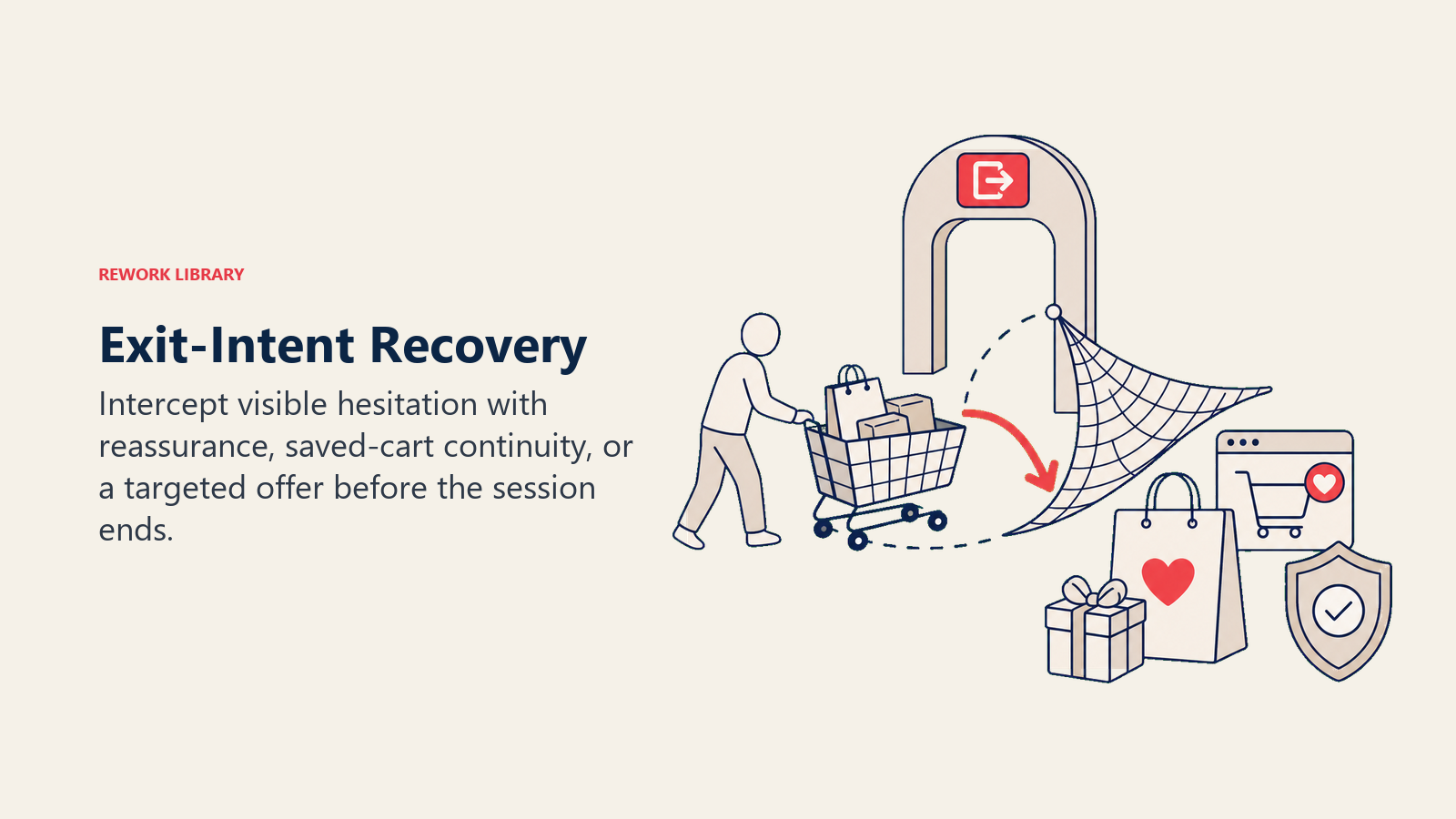
On-cart incentive strategies display offers directly on cart pages before customers enter checkout, addressing price concerns proactively.
Incentive approaches: Free shipping thresholds ("Add $15 more for free shipping"), percentage discounts for cart completion within timeframe ("10% off if you checkout in the next hour"), bundling suggestions ("Customers who bought these items also added..."), or urgency messaging ("Low stock, 2 items remaining").
Urgency messaging creates psychological pressure to complete purchase through scarcity or time-limited offers. "Only 3 left in stock," "Sale ends in 4 hours," "This cart will expire in 24 hours", these messages drive action through FOMO (fear of missing out).
Critical consideration: Only use urgency messaging for genuine scarcity or limited offers. Fake urgency ("Only 2 left!") that persists for weeks damages trust and credibility.
Progressive disclosure of incentives reserves stronger offers for later recovery attempts rather than leading with best offers immediately. This prevents training customers to abandon for discounts while ensuring serious consideration customers receive compelling offers.
Progression example: Exit-intent shows free shipping offer, first email provides product value reminder with no discount, second email offers 10% off, third email offers 15% off with urgency. This escalation reserves highest-cost incentives for customers requiring most persuasion.
Mobile versus desktop optimization addresses different user behaviors and technical capabilities across devices. Desktop exit-intent works reliably, while mobile exit-intent is less precise due to different browsing patterns.
Mobile optimization priorities: Simplified popup designs for small screens, touch-friendly interaction (large close buttons, clear CTAs), faster load times (mobile users on slower connections), and reduced form friction (one-click offers rather than multi-field submissions). Comprehensive mobile commerce optimization ensures recovery tactics work seamlessly across all devices.
SMS Recovery Tactics
SMS provides high-visibility recovery channel with open rates exceeding 90%, far above email's 20-30% typical rates. Effective SMS marketing strategy extends beyond cart recovery to build comprehensive customer engagement. SMS as follow-up channel after email positions text messaging as escalation for non-responders rather than first recovery attempt. This reserves SMS (which costs more than email and has stricter consent requirements) for customers who didn't respond to email recovery. Sequencing example: Email at 1 hour and 24 hours, SMS at 48 hours if no response. This uses SMS strategically for customers requiring multiple touches rather than wasting SMS sends on customers who would have converted from email alone. Message timing and frequency limits require more conservative approach than email due to SMS's intrusive nature. Limit to 1-2 SMS recovery messages per abandoned cart. Space messages at least 24 hours apart. Avoid sending outside business hours (respect "quiet hours" of 9 PM - 9 AM unless customer preferences indicate otherwise).
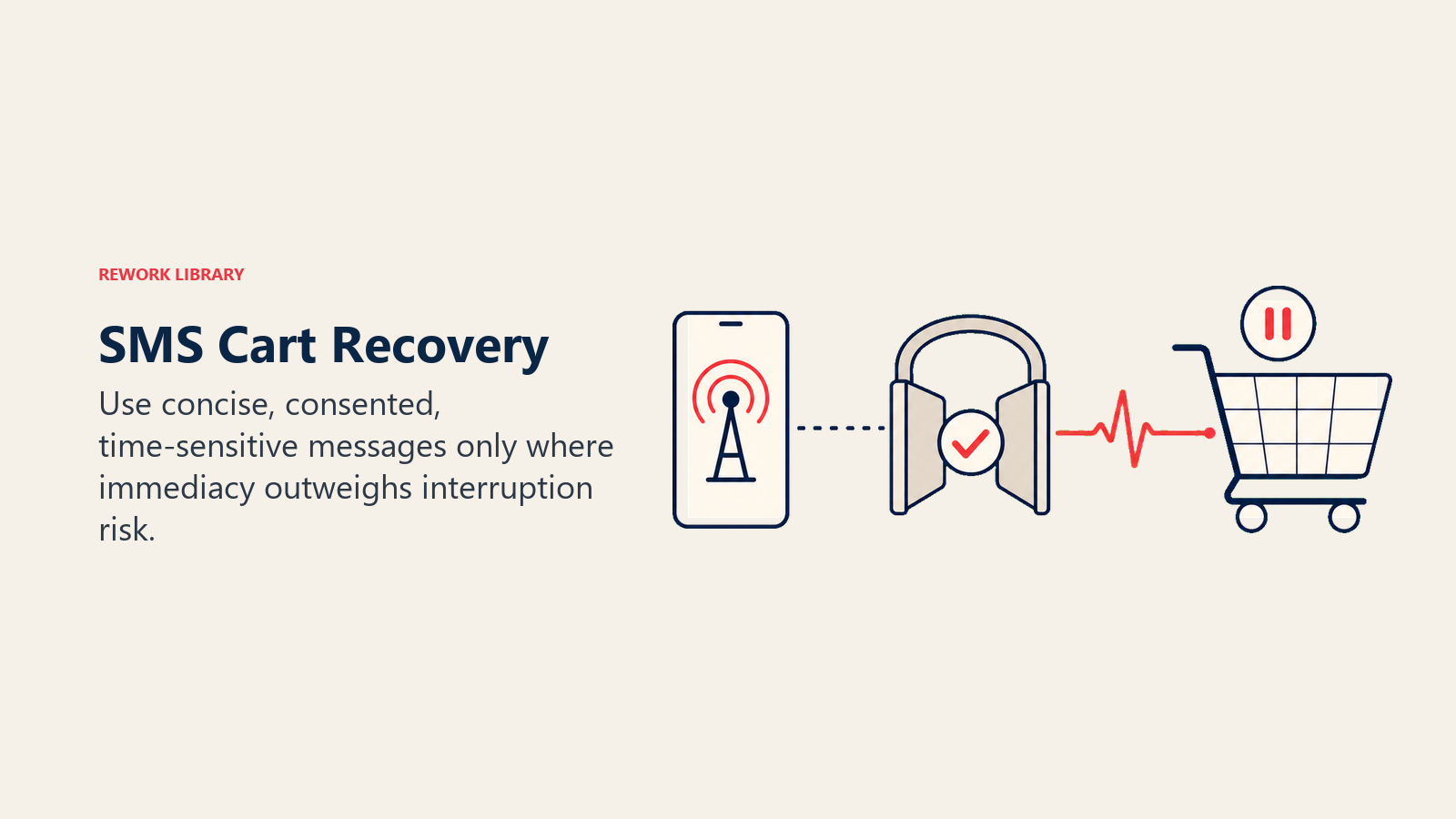
Compliance with SMS regulations presents strict requirements exceeding email marketing regulations. Required elements: Explicit opt-in consent for marketing messages (pre-checked boxes don't qualify), clear identification of sender, opt-out instructions in every message, honoring opt-outs immediately, maintaining consent records.
TCPA (Telephone Consumer Protection Act) violations carry significant penalties ($500-$1,500 per violation), making compliance critical. Use reputable SMS platforms (Attentive, Postscript, Klaviyo SMS) that handle compliance requirements.
Shortened URL tracking and link optimization addresses SMS character limits and readability. Use URL shorteners that provide click tracking while keeping messages concise. Ensure shortened URLs direct to checkout completion, not generic cart pages requiring navigation.
Example: "Your cart is waiting! Complete checkout here: [short.link/abc123]. Reply STOP to opt out." This provides clear path to completion while maintaining required compliance elements.
Exclusive SMS-only offers create incentive for SMS opt-in and provide rationale for SMS messages beyond simple email duplication. "Exclusive SMS offer: 15% off your cart with code SMS15" differentiates SMS value and rewards customers who provided phone numbers.
This exclusivity can be genuine (don't offer same discount via email) or timing-based (offer same discount via SMS first, email later). Either approach creates SMS-specific value.
Retargeting and Paid Advertising Recovery
Paid retargeting extends recovery beyond owned channels (email, SMS) to reach abandoners through display advertising across the web and social platforms. Strategic retargeting and remarketing campaigns create multiple touchpoints to bring customers back. Display retargeting campaigns show ads to cart abandoners as they browse other websites, keeping products top-of-mind and providing easy return path to checkout. Setup requirements: Install retargeting pixels (Google Ads Remarketing Tag, Facebook Pixel) on cart and checkout pages, create cart abandoner audience segments, develop creative showing abandoned products or category, set appropriate frequency caps to avoid ad fatigue. Dynamic product retargeting displays ads featuring the specific products customers abandoned rather than generic brand advertising. This personalization dramatically improves relevance and click-through rates.
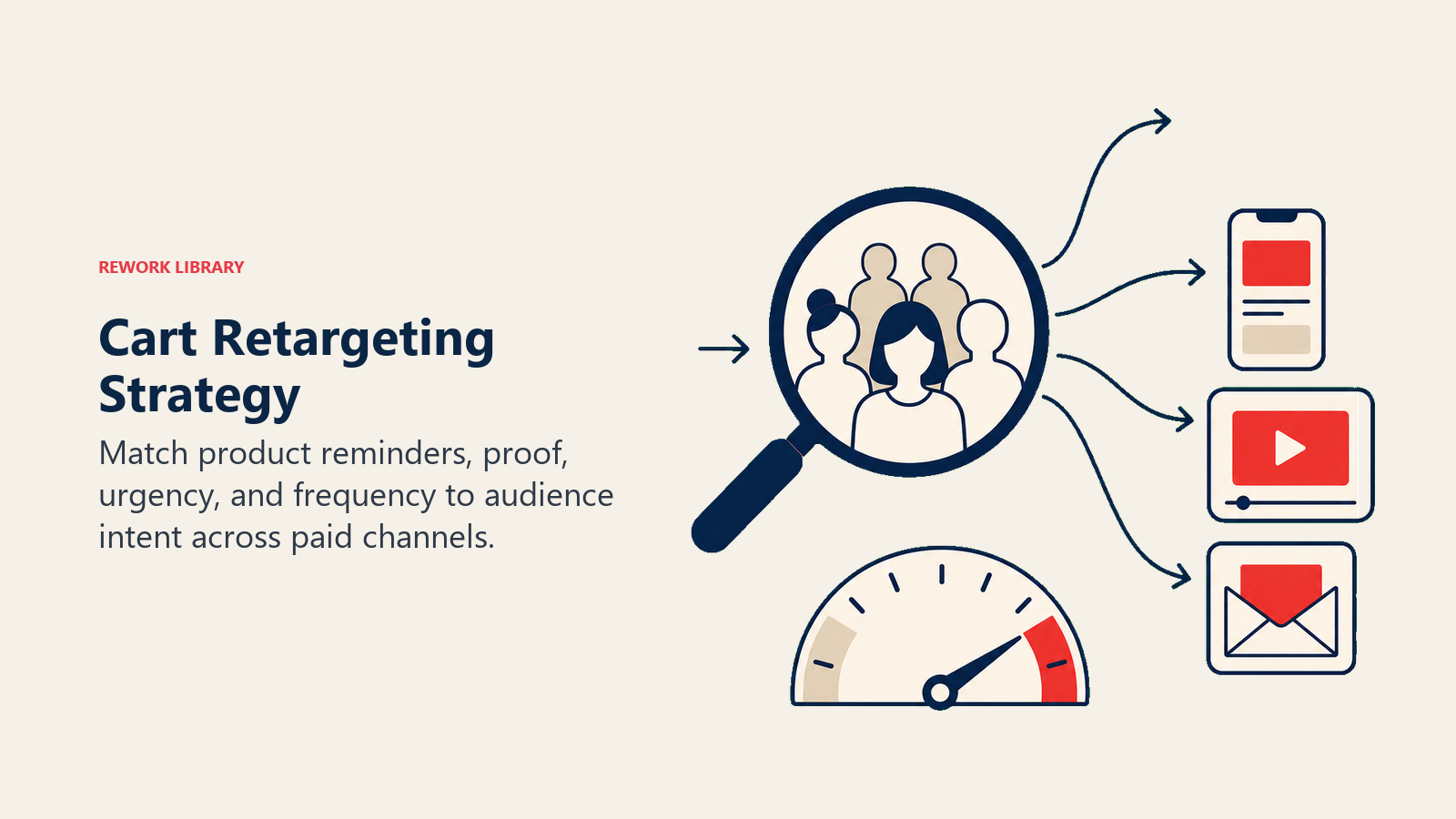
Implementation: Use dynamic remarketing templates that automatically populate with abandoned products from product feed, show product images and names from actual cart, include pricing and "complete your order" calls-to-action.
Platform-specific strategies optimize for different retargeting channels' strengths and user behaviors.
Google Display Network: Broad reach across millions of websites, works well for consideration-stage messaging and brand awareness, relatively low costs per impression.
Facebook and Instagram: High engagement, sophisticated audience targeting, effective for lifestyle and visual products, higher costs but better conversion rates.
TikTok: Emerging platform for younger audiences, native video format requirements, works well for trendy products and impulse purchases.
Frequency capping and creative rotation prevents ad fatigue from seeing identical ads repeatedly. Set frequency caps limiting ad displays (typical limit: 3-5 impressions per person per day). Rotate creative variations to maintain freshness.
Creative testing: Develop multiple ad variations with different images, copy, and offers. Test which combinations drive highest recovery rates and ROAS (return on ad spend).
Budget allocation between channels optimizes spend across email (lowest cost), SMS (medium cost), and paid retargeting (highest cost).
Strategic allocation: Use email for all abandoners (low cost justifies broad reach), SMS for high-value carts or email non-responders (higher cost requires selectivity), paid retargeting for highest-value carts where potential recovery revenue justifies advertising costs.
Example allocation for $500 cart recovery budget: $50 email platform costs (unlimited sends), $150 SMS (high-value cart recovery), $300 paid retargeting (top 20% cart values). Adjust based on channel performance and cart value distribution.
Measurement and Analytics
Systematic measurement enables continuous recovery optimization and ROI quantification. Tracking the right e-commerce metrics and KPIs ensures data-driven decision making for recovery efforts.
Recovery rate by channel tracks what percentage of abandoned carts each channel successfully recovers. Calculate: (Recovered carts / Total abandoned carts) × 100 for each channel and overall.
Benchmark targets: Overall recovery rate 10-30%, email recovery rate 5-15%, SMS recovery rate 3-8%, retargeting recovery rate 2-5%. These benchmarks vary significantly by industry, product price point, and abandonment rate.
Revenue recovered versus incentive cost analysis measures true profitability of recovery programs. Track: Total revenue recovered, minus discount incentives provided, minus channel costs (email platform fees, SMS costs, retargeting ad spend).
This net revenue recovered figure determines actual program value. A program recovering $10,000 cart value but providing $4,000 in discounts and costing $1,000 in channel expenses nets $5,000-50% of gross recovery.
Attribution modeling across multi-touch recovery addresses the challenge of multiple channels touching the same customer. Did the email recover the cart, or did the email plus SMS plus retargeting ad collectively drive recovery?
Attribution approaches: Last-touch (credit to final channel before conversion), first-touch (credit to initial recovery attempt), linear (equal credit to all touches), time-decay (more credit to recent touches), data-driven (algorithmic weight based on actual impact).
Cohort analysis for repeat abandoners segments customers by abandonment frequency, revealing whether cart abandonment represents one-time occurrence or pattern behavior.
One-time abandoners (abandoned once, never again) represent best recovery targets, they likely abandoned due to temporary friction. Repeat abandoners may be using carts as wishlists or systematically waiting for discount offers, requiring different strategies.
ROI measurement by channel calculates return on investment for each recovery channel: (Revenue recovered - Channel costs) / Channel costs × 100.
Example: Email channel recovers $15,000 cart value, provides $2,000 in discounts, costs $200 in platform fees. Net recovery: $12,800. ROI: ($12,800 / $200) × 100 = 6,400%. This extraordinary ROI demonstrates why cart recovery deserves systematic investment.
Segmentation and Personalization
Tailored recovery approaches based on customer characteristics and cart attributes dramatically improve recovery rates.
First-time cart abandoners versus repeat customers require different messaging. First-time visitors may have trust concerns requiring security emphasis and guarantee highlighting. Repeat customers abandoned despite previous positive experiences, suggesting different triggers like price sensitivity or timing issues.
Segment by cart value enables appropriate incentive investment. High-value carts ($200+) justify personalized outreach, phone calls from sales team, generous discount offers. Low-value carts ($25-) may not justify any discount, relying on reminder messaging alone.
Tiered strategy example: Under $50 carts receive email sequence with no discounts, $50-$150 carts receive email plus 10% discount in final email, $150+ carts receive email, SMS, retargeting, and 15% discount with free shipping.
Product category-specific messaging addresses different purchase decision factors. Fashion abandonment might emphasize free returns and size guides. Electronics might focus on specifications and expert reviews. Consumables might highlight subscription convenience and auto-replenishment options.
Previous purchase behavior personalization leverages customer history. Customers with previous purchases receive "welcome back" messaging and loyalty recognition. Customers who've abandoned multiple times might receive stronger initial offers. Customers who've never purchased despite multiple abandons might receive different value propositions or alternative product suggestions.
Geographic and device-specific optimization adapts messaging to context. Mobile abandoners might receive mobile-optimized checkout links and mobile wallet payment emphasis. Customers in high-shipping-cost regions might receive free shipping offers as primary incentive.
Building Your Cart Abandonment Recovery Strategy
Cart abandonment recovery represents one of the highest-ROI e-commerce optimizations available. Start with fundamentals: implement basic email recovery sequence (1 hour, 24 hours, 72 hours), ensure cart data capture, create abandoned cart audience segments.
Advance systematically: Add SMS recovery for high-value carts, implement exit-intent popups, create retargeting campaigns for top cart value segments. Test incentive strategies, measure channel performance, optimize based on data.
The stores that excel at cart recovery don't just send reminder emails, they build comprehensive multi-channel frameworks that address different abandonment triggers through coordinated email sequences, SMS follow-up, retargeting campaigns, and strategic incentive escalation. This systematic approach transforms cart abandonment from lost opportunity into predictable revenue stream.
Learn More
Enhance your cart recovery strategy with these related resources:
- Marketing Automation - Automate your cart recovery sequences and multi-channel campaigns for scalable growth
- Checkout Flow Optimization - Reduce abandonment at the source by streamlining your checkout process
- Email Marketing for E-commerce - Master email strategies beyond cart recovery for comprehensive customer engagement
- Conversion Rate Optimization - Implement systematic testing frameworks to improve every step of the customer journey

On this page
- Understanding Cart Abandonment as Systematic Revenue Operation
- Why Cart Abandonment Recovery Matters
- Understanding Cart Abandonment Triggers
- Email Sequence Strategy
- Exit-Intent and On-Site Recovery
- SMS Recovery Tactics
- Retargeting and Paid Advertising Recovery
- Measurement and Analytics
- Segmentation and Personalization
- Building Your Cart Abandonment Recovery Strategy
- Learn More