Volume Discounts: Strategic Tiered Pricing to Increase Average Order Value
Turn this article into takeaways for your work.


Each assistant summarizes the article only for you and suggests best practices for your work.
Volume discounts are one of the most direct ecommerce growth levers for raising average order value, typically lifting AOV 15-25% when the tiers are built on real unit economics. They work because buying more of what a customer already wants becomes a rational choice, so done right they increase both revenue and total profit dollars rather than just margin percentage.
Volume discounts represent the most direct, friction-free path to driving average order value increases. Unlike upsell and cross-sell strategies that require customers to add different products, or product bundling approaches that demand careful curation, volume discounts work with the natural buying behavior already happening in your store.
The math is compelling: a well-designed volume discount structure typically drives 15-25% AOV increases while actually improving customer satisfaction. When customers see they can save 10-15% by buying three items instead of one, the decision becomes rational rather than emotional. You're not convincing them to want something new. You're making it financially smart to buy more of what they already want.
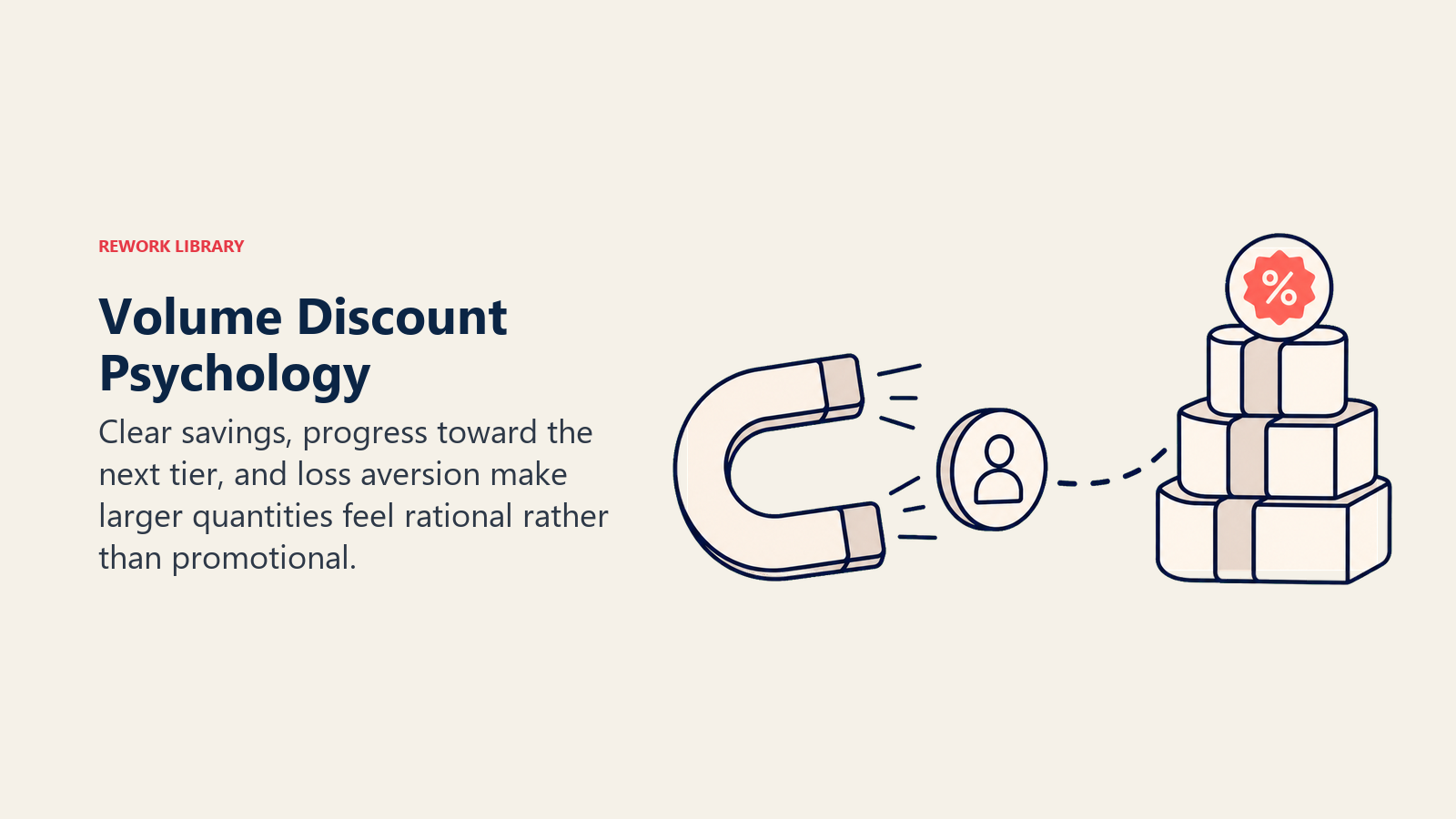
The psychology is equally powerful. Volume discounts tap into loss aversion: customers feel like they're losing money by NOT taking advantage of the deal. This inverts the typical e-commerce friction where customers resist spending more. Instead, they actively seek ways to qualify for the next discount tier.
But here's what separates successful volume discount strategies from margin-destroying mistakes: understanding the economics beneath the psychological incentive. Done right, volume discounts increase both revenue and profit. Done wrong, they train customers to wait for deals while eroding your margins to unsustainable levels.
This guide walks through the framework for implementing volume discounts that drive meaningful AOV growth while protecting and even enhancing profitability.
Volume Discount Economics: The Margin Protection Framework
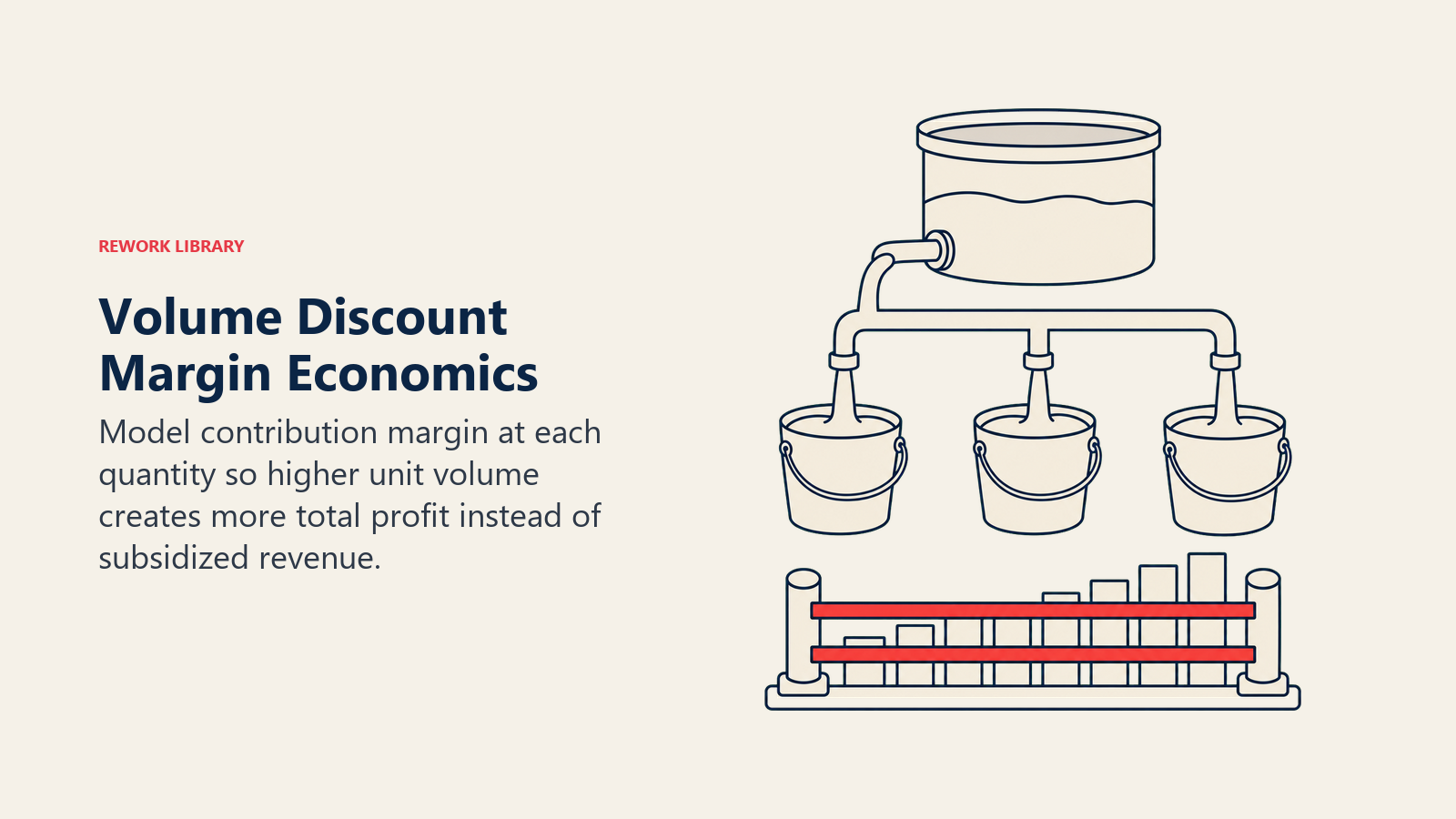
Before setting any discount tiers, you need to understand your unit economics at a granular level. Volume discounts only work when the math works, and the math only works when you know your numbers. Start with your contribution margin per unit, not your gross margin. Contribution margin accounts for variable costs that scale with volume: product cost, payment processing fees, packaging, and fulfillment. For most e-commerce businesses, this lands between 35-60% depending on product category and fulfillment model. Here's the critical calculation: at what volume does the reduced per-unit margin still generate higher total contribution dollars than a single-unit sale?
Let's work through a real example:
- Product retail price: $50
- Product COGS: $20
- Fulfillment cost per unit: $5
- Payment processing (3%): $1.50
- Contribution margin per unit: $23.50 (47%)
If you offer a "Buy 3, Save 15%" promotion, each unit now generates $42.50 in revenue. Your new contribution margin per unit is $16 ($42.50 - $20 - $5 - $1.28), or 37.6%.
Three units at the discounted price generate $48 in total contribution margin versus $23.50 for a single unit. That's a 104% increase in contribution dollars, even though your margin percentage decreased by 9.4 points.
This is why volume discounts work: the increase in units sold more than compensates for the per-unit margin reduction, assuming your discount tiers are properly structured.
The break-even formula is straightforward: Minimum quantity needed = 1 / (1 - (discount % / margin %))
For our example with 47% margin and 15% discount: Minimum quantity = 1 / (1 - (0.15 / 0.47)) = 1.47 units
This means selling 2+ units at 15% off generates higher contribution dollars than a single unit at full price. The third unit is pure incremental profit.
Tiered Pricing Architecture: Designing Your Discount Structure
The difference between two-tier and multi-tier structures is significant, and your choice depends on your product characteristics and customer buying patterns. Two-tier structures work best for:
- Products with higher price points ($75+)
- Categories where customers typically buy 1-2 units
- New volume discount implementations
- Businesses testing the strategy for the first time A typical two-tier structure might be:
- 1 unit: Regular price
- 3+ units: 15% off
Multi-tier structures work best for:
- Lower price point products ($15-50)
- Consumable or replenishable items
- Established volume discount programs
- Products with strong repeat purchase behavior
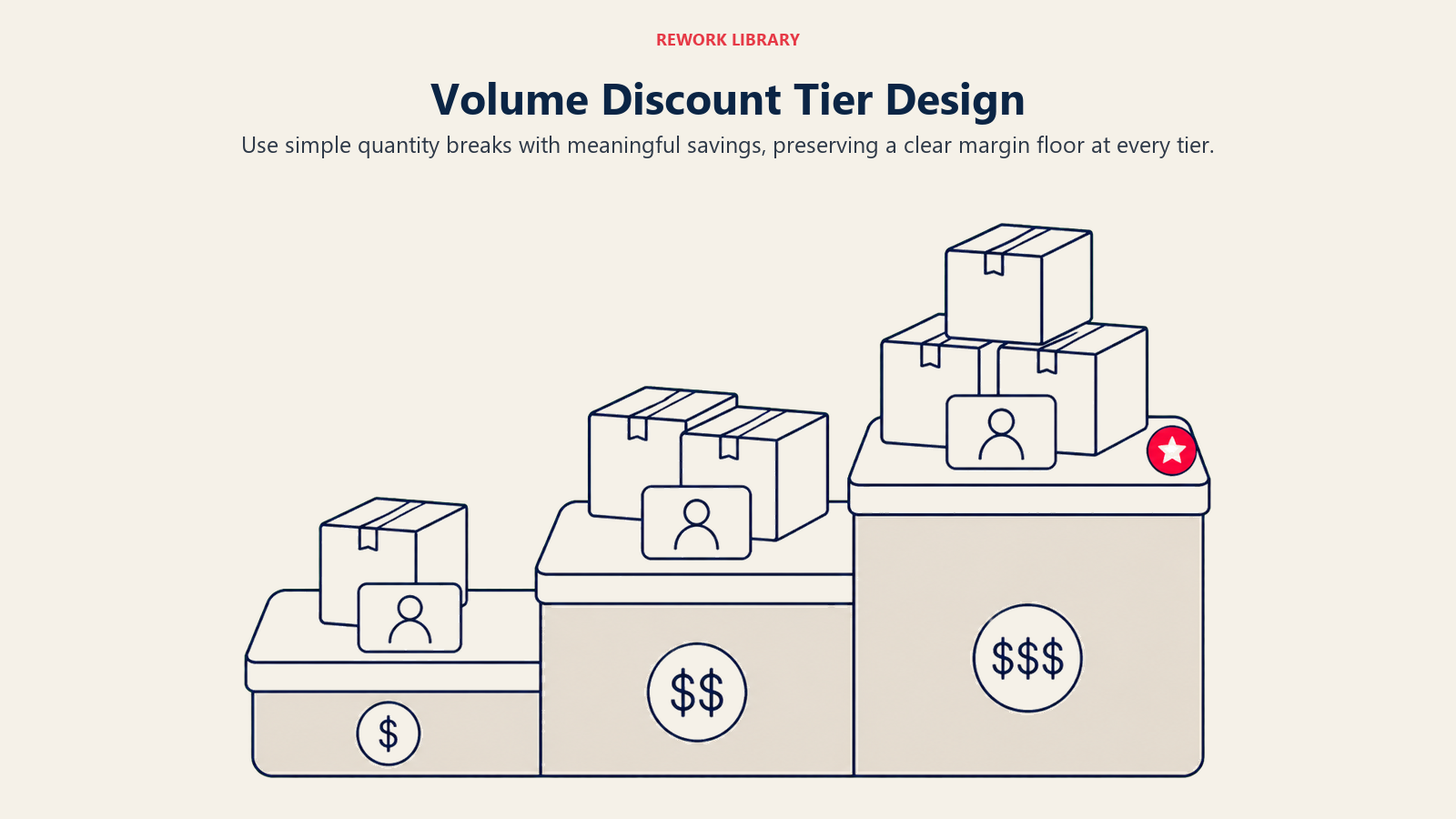
A typical multi-tier structure might be:
- 1 unit: Regular price
- 2 units: 10% off
- 3 units: 15% off
- 5+ units: 20% off
The key decision point is your quantity breaks. These should be set based on actual customer behavior data, not arbitrary numbers. Pull your order data and look at quantity distribution:
| Quantity Ordered | % of Orders | Cumulative % |
|---|---|---|
| 1 unit | 68% | 68% |
| 2 units | 18% | 86% |
| 3 units | 8% | 94% |
| 4 units | 3% | 97% |
| 5+ units | 3% | 100% |
In this example, setting your first tier at 2 units captures 32% of existing orders (everyone already buying 2+), while setting it at 3 units captures only 14%. The 2-unit tier provides more immediate revenue impact, while the 3-unit tier provides more incremental behavior change.
The strategic answer is often both: start with a 2-unit tier at 10% off to capture quick wins, then add a 3-unit tier at 15% off to drive incremental purchasing.
Psychological Pricing Principles: Making Savings Visible
Volume discounts only drive behavior when customers can clearly see and calculate the value proposition. This requires intentional pricing presentation and savings messaging. The reference price is critical. Customers need to see:
- The original per-unit price
- The discounted per-unit price
- The total savings amount
- The percentage saved Weak presentation: "Buy 3 for $127.50"
Strong presentation: "Buy 3, Save 15%
- Regular price: $50 each ($150 total)
- Volume price: $42.50 each ($127.50 total)
- You save: $22.50"
The savings narrative matters more than the discount percentage for most customers. "$22.50 in savings" creates a more tangible mental anchor than "15% off."
Real-time savings calculators dramatically improve conversion on volume discount offers. As customers adjust quantity in the cart, they should see:
- Total savings amount update
- Progress toward the next discount tier
- How many more units needed to unlock additional savings
For example: "Add 1 more item to save an additional $7.50 (20% off total order)"
This creates what behavioral economists call "goal gradient effect": the closer customers get to a reward, the more motivated they become to reach it.
Color coding and visual indicators reinforce the psychological impact:
- Green highlighting for current savings
- Progress bars showing tier achievement
- Badges or icons indicating "Best Value" tiers
The presentation should answer the customer's immediate question: "How much will I actually save by buying more right now?"
Margin Protection Strategies: Safeguarding Profitability
The biggest risk with volume discounts is conditioning customers to never pay full price. Several strategies prevent this margin erosion. Time-limited volume offers create urgency while preserving the full-price baseline. Run volume discounts for 2-3 weeks per quarter rather than permanently. This maintains the promotional excitement while ensuring most revenue still comes at full margin. Category-specific discounting protects your overall margin structure. Apply volume discounts to:
- Products with higher base margins (50%+)
- Consumable or replenishable items
- Overstocked inventory
- Products in the growth phase of their lifecycle
Avoid volume discounts on:
- New product launches
- Premium or luxury items
- Products already at competitive price points
- Items with margins below 40%
Minimum quantity thresholds ensure you're rewarding meaningful volume increases. A "buy 2, get 10% off" offer on a $200 product drives different behavior than the same offer on a $15 product. Higher price points justify lower quantity thresholds.
Dynamic discount tiers based on product performance allow you to optimize margins across your catalog. High-velocity products might only need a 10% discount at 3 units, while slower-moving items could offer 20% to drive volume.
The contribution margin waterfall helps you track margin health:
| Metric | Full Price | 2-Unit Tier (10% off) | 3-Unit Tier (15% off) |
|---|---|---|---|
| Revenue per unit | $50.00 | $45.00 | $42.50 |
| COGS per unit | $20.00 | $20.00 | $20.00 |
| Fulfillment per unit | $5.00 | $5.00 | $5.00 |
| Processing per unit | $1.50 | $1.35 | $1.28 |
| Contribution per unit | $23.50 | $18.65 | $16.22 |
| Contribution margin % | 47.0% | 41.4% | 38.2% |
| Total contribution | $23.50 | $37.30 | $48.66 |
This waterfall makes the trade-off explicit: you're sacrificing per-unit margin to gain total contribution dollars through increased volume.
Presentation and Messaging: Converting Awareness to Action
Where and how you present volume discounts significantly impacts their effectiveness. Most e-commerce stores under-communicate these offers, leaving revenue on the table. Product page presentation should be prominent but not overwhelming:
- Include a volume pricing table above the fold
- Show savings calculations dynamically as quantity changes
- Add a "Best Value" badge on the optimal tier
- Include brief copy explaining the offer
Cart page reminders catch customers before checkout:
- "Add 1 more to save $7.50"
- Progress indicators showing tier proximity
- Quick-add buttons for additional units
- Comparison table showing full price vs. volume price
Category page callouts drive discovery:
- Icon or badge indicating "Volume Discounts Available"
- Filter option to show volume discount products
- Sort option for "Best Value" (highest savings per dollar spent)
Email and marketing integration amplifies reach:
- Abandoned cart emails highlighting volume savings
- Post-purchase emails suggesting reorder at volume prices
- Newsletter features on highest-value volume offers
- Retargeting ads emphasizing savings amounts
The messaging framework should follow this hierarchy:
- Lead with the savings amount in dollars
- Support with the percentage saved
- Include social proof ("Most popular" or "Best value")
- Add urgency if time-limited ("Ends Sunday")
Example product page copy: "Save $22.50 when you buy 3 (15% off) Most customers choose this option Free shipping on orders over $100"
This combines financial incentive, social proof, and additional value (free shipping) in a clear, scannable format.
Implementation Across Product Categories
Volume discount strategies should vary by product category because customer buying behavior varies significantly.
Consumables and replenishables (supplements, skincare, pet food):
- Use aggressive multi-tier structures (up to 25% off)
- Emphasize subscription options alongside volume discounts
- Calculate savings over time: "Save $45 every 3 months"
- Link to usage patterns: "3-month supply"
Apparel and accessories:
- Focus on multi-pack options (3-pack t-shirts, 5-pack socks)
- Use moderate discounts (10-15% off)
- Emphasize color/style variety within the volume offer
- Create gift-ready packaging for volume purchases
Electronics and tech accessories:
- Target business buyers and bulk purchasers
- Offer graduated discounts at higher thresholds (5, 10, 25 units)
- Provide volume quote requests for larger quantities
- Include business invoicing and PO options
Home goods and kitchenware:
- Combine volume discounts with gift-giving occasions
- Seasonal promotions (holiday entertaining, back-to-school)
- Moderate discounts (12-18% off)
- Emphasize "stock up and save" messaging
B2B and wholesale:
- Deep discount tiers (up to 40% off at high volumes)
- MOQ (minimum order quantity) requirements
- Net payment terms as additional incentive
- Account-based pricing rather than public tiers
The category-specific approach ensures your volume discounts align with natural purchasing patterns rather than fighting against them.
Volume Discounts and Inventory Management
Volume discount strategies have significant implications for inventory planning and cash flow management. Done wrong, they create inventory problems that offset the revenue benefits. The inventory velocity equation changes when you implement volume discounts. If 30% of customers shift from buying 1 unit to buying 3 units, your inventory turns accelerate by roughly 70% for those SKUs. This requires:
Increased stock levels for volume discount products:
- Add 40-60% buffer stock for products with active volume offers
- Prioritize reorder points based on volume discount performance
- Monitor daily sales velocity for early stockout warnings
Cash flow planning for inventory investment:
- Volume discounts drive faster inventory depletion
- Faster depletion requires more frequent reorders
- Calculate working capital needs 60-90 days in advance
SKU rationalization to focus inventory investment:
- Limit volume discounts to top 20% of products by revenue
- Discontinue volume offers on slow-moving items
- Use volume discounts to clear excess inventory strategically
Supplier negotiations to protect margins:
- Request volume price breaks from suppliers based on increased velocity
- Negotiate extended payment terms for faster-moving SKUs
- Consider drop-shipping for volume orders above certain thresholds
The relationship between volume discounts and inventory health is direct: successful volume discount programs require proactive inventory management, not reactive responses to stockouts.
Integration with Other AOV Tactics
Volume discounts work best as part of a comprehensive AOV optimization strategy, not as a standalone tactic. The key is strategic layering without creating customer confusion or decision paralysis. Volume discounts + free shipping thresholds: Set your free shipping threshold slightly above your average volume discount order value. For example:
- 3-unit volume discount: ~$127 order value
- Free shipping threshold: $150
- Gap encourages addition of a small complementary item
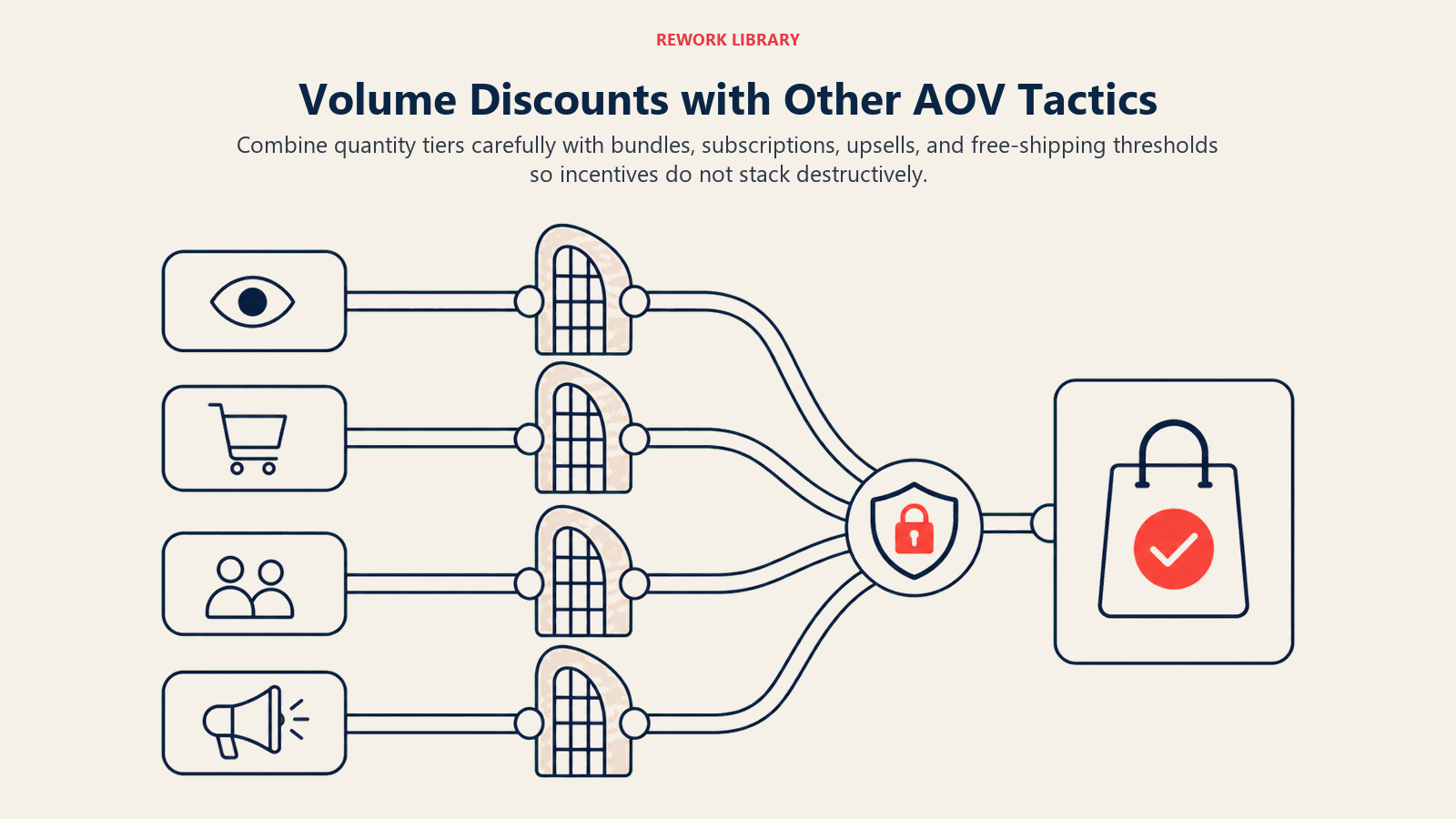
Volume discounts + product recommendations: Recommend complementary products that help customers reach the next volume tier:
- "Add 1 more [Product X] to unlock 15% off your entire order"
- Show products at similar price points to minimize decision friction
- Prioritize recommendations that increase margin dollars, not just revenue
Volume discounts + post-purchase upsells: Offer one-click post-purchase additions at volume pricing:
- "Add 2 more to your order at your volume discount price"
- Time-limited (60 seconds) to create urgency
- No re-entry of payment information required
Volume discounts vs. bundling: The strategic question: when do you use product bundling versus volume discounts?
Use bundling when:
- You want to introduce customers to new products
- You're pairing complementary items
- You want to create a gift-ready option
Use volume discounts when:
- Customers already know what they want
- Products are consumable or replenishable
- Simplicity is more important than curation
The most sophisticated approach combines both: offer volume discounts on individual products while also offering curated bundles at similar discount levels. Let customer preference determine which they choose.
Data Analysis and Testing Framework
Effective volume discount strategies require continuous analysis and optimization. Set up tracking for these key metrics: Pre-implementation baseline:
- Average order value (overall and by product)
- Average units per transaction
- Gross margin percentage
- Customer acquisition cost
Post-implementation performance:
- AOV lift by customer segment
- Units per transaction by discount tier
- Revenue per session
- Contribution margin by tier
- Discount tier utilization rate
Advanced metrics:
- Incremental revenue (volume orders vs. predicted single-unit orders)
- Cannibalization rate (full-price orders shifting to discounted)
- Customer lifetime value by first order type (volume vs. single)
- Repeat purchase rate by discount tier usage
The testing framework should follow this sequence:
Phase 1: Limited SKU test (weeks 1-4)
- Select 10-15 products with strong baseline sales
- Implement two-tier volume discounts (10% at 2 units, 15% at 3 units)
- Measure tier utilization and AOV impact
- Calculate incremental contribution margin
Phase 2: Category expansion (weeks 5-8)
- Expand to full category based on Phase 1 results
- Add multi-tier structure if data supports it
- Test messaging variations (savings amount vs. percentage)
- Analyze customer segment performance
Phase 3: Optimization (weeks 9-12)
- Adjust discount percentages based on margin analysis
- Modify quantity thresholds based on utilization data
- Test presentation variations (calculator, progress bars, etc.)
- Implement automated recommendations to reach tiers
Phase 4: Full deployment (week 13+)
- Roll out to all appropriate product categories
- Establish ongoing monitoring cadence
- Create margin protection guardrails
- Plan seasonal promotions and variations
A/B testing should focus on these high-impact elements:
- Discount percentage by tier (10% vs. 12% vs. 15%)
- Quantity thresholds (2 units vs. 3 units for first tier)
- Messaging approach (percentage vs. dollar savings)
- Visual presentation (table vs. calculator vs. progress bar)
Customer Communication Strategy
Clear communication prevents confusion and maximizes volume discount adoption. Your communication plan should cover multiple touchpoints.
Site-wide announcements for new volume discount programs:
- Banner notification on homepage
- FAQ section explaining how volume discounts work
- Help center articles with examples
- Video tutorial showing the calculation
Transactional communications reinforcing value:
- Order confirmation emails highlighting total savings
- Shipping notifications mentioning volume discount usage
- Post-purchase surveys asking about volume discount experience
- Thank you page emphasizing savings achieved
Re-engagement campaigns for previous customers:
- Email series highlighting new volume discount options
- Personalized recommendations based on past purchases
- "Buy again and save" messaging with specific calculations
- Loyalty program integration showing volume savings
Customer service training to handle common questions:
- How do volume discounts combine with other promotions?
- Can I mix products to reach quantity thresholds?
- What happens if I return one item from a volume order?
- How do volume discounts work with subscriptions?
The communication framework should emphasize transparency and simplicity. Customers should never have to guess whether they're getting the best price or how to qualify for savings.
Measuring Success and ROI
Volume discount programs should be evaluated on total business impact, not just AOV increases. Here's the comprehensive scorecard: Primary metrics:
- Average order value (target: +15-25%)
- Units per transaction (target: +30-50%)
- Total revenue (target: +10-18%)
- Gross profit dollars (target: +8-15%)
Secondary metrics:
- Contribution margin percentage (acceptable: -3 to -8 points)
- Customer acquisition efficiency (CAC with higher AOV)
- Inventory turnover rate for volume discount SKUs
- Discount tier utilization rates
Diagnostic metrics:
- Cannibalization rate (percent of volume discount users who would have bought at full price)
- Incremental unit sales (units sold above baseline)
- Average discount per order (weighted across all orders)
- Return rate by discount tier
The ROI calculation should account for both revenue and margin impacts:
Example ROI Analysis:
Baseline (pre-volume discounts):
- 1,000 orders per month
- $75 average order value
- $75,000 monthly revenue
- 45% gross margin
- $33,750 gross profit
With volume discounts:
- 1,000 orders per month (same order count)
- $89 average order value (+18.7%)
- $89,000 monthly revenue
- 41% gross margin (-4 points)
- $36,490 gross profit (+8.1%)
This scenario represents a successful implementation: revenue increases by 18.7%, gross profit increases by 8.1%, despite a 4-point margin percentage decrease.
The key question: would investing the same marketing dollars in customer acquisition have generated better returns? If CAC is $45 and average customer LTV is $220, acquiring 61 new customers ($2,740 in CAC) would generate $13,420 in lifetime value. The volume discount strategy generated $2,740 in incremental monthly profit with no additional CAC investment, making it equivalent to acquiring those customers but with immediate payback.
Making Volume Discounts Work for Your Business
Volume discounts succeed when they align with natural customer behavior rather than trying to force new behaviors. The implementation framework is straightforward: understand your unit economics, design tiers around actual purchase patterns, present savings clearly, and measure constantly.
Start with a limited test on your best-performing products. Use conservative discount percentages (10-15%) until you understand customer response and margin impact. Expand methodically based on data, not assumptions.
The businesses that get the most value from volume discounts treat them as a core pricing strategy element, not a promotional gimmick. They integrate volume pricing into their product positioning, inventory planning, and customer communication from day one.
When done right, volume discounts create a virtuous cycle: higher order values improve customer acquisition efficiency, which funds growth, which drives economies of scale, which allows for better supplier terms, which protects margins, which funds more aggressive volume discounts. The cycle compounds over time, creating a sustainable competitive advantage that's difficult for competitors to replicate.
The question isn't whether volume discounts can drive AOV growth - the data proves they can. The question is whether you'll implement them strategically or haphazardly. Strategic implementation protects margins while driving growth. Haphazard implementation erodes margins while training customers to never pay full price.
The choice, and the results, are yours.
Frequently Asked Questions
How much do volume discounts increase average order value? A well-structured program typically lifts AOV 15-25% and units per transaction 30-50%. The gain comes from customers buying more to qualify for a tier, which more than offsets the lower per-unit margin when tiers are set on real contribution-margin math.
Do volume discounts hurt profit margins? They lower margin percentage but usually raise total profit dollars. In a typical example, three units at 15% off generate about $48 in contribution versus $23.50 for a single unit, a 104% increase in profit dollars despite a roughly 9-point drop in margin percentage.
How do you set volume discount tiers? Base quantity breaks on actual order data, not round numbers. Pull your quantity distribution, then set the first tier where it captures meaningful existing demand. A common starting structure is 10% off at 2 units and 15% off at 3 units, with a 20% tier at 5 or more for replenishable products.
When should you avoid volume discounts? Skip them on new product launches, premium or luxury items, products already at competitive price points, and anything with margins below 40%. Time-limited offers and category-specific discounting protect your full-price baseline so customers do not learn to wait for deals.
How do volume discounts compare to product bundling? Use volume discounts when customers already know what they want and the product is consumable or replenishable. Use product bundling when you want to introduce new products or pair complementary items. The strongest AOV optimization strategy often offers both and lets customer preference decide.

On this page
- Volume Discount Economics: The Margin Protection Framework
- Tiered Pricing Architecture: Designing Your Discount Structure
- Psychological Pricing Principles: Making Savings Visible
- Margin Protection Strategies: Safeguarding Profitability
- Presentation and Messaging: Converting Awareness to Action
- Implementation Across Product Categories
- Volume Discounts and Inventory Management
- Integration with Other AOV Tactics
- Data Analysis and Testing Framework
- Customer Communication Strategy
- Measuring Success and ROI
- Making Volume Discounts Work for Your Business
- Frequently Asked Questions