Post-Purchase Upsells: Maximizing Revenue After the First Sale
Turn this article into takeaways for your work.


Each assistant summarizes the article only for you and suggests best practices for your work.
Post-purchase upsells are offers shown right after checkout, on the thank you page or in follow-up emails, while the buyer's card is still on file. They convert at 5 to 35 percent versus 0.5 to 2 percent for pre-checkout offers because payment friction is gone, and done well they lift average order value by 15 to 35 percent with no extra ad spend.
Here's what most e-commerce stores miss: The moment right after someone buys from you is your single highest-converting opportunity to increase order value. Not the product page. Not the cart. The thank you page.
While your competitors waste this moment with a boring "order confirmed" message, you could be capturing 2-10x higher conversion rates on strategically placed upsell offers. The buyer is already committed, their card is already charged, and they're in a positive emotional state. This is your moment.
Post-purchase upsells aren't just an add-on strategy. They're a core component of modern e-commerce growth. Done right, they can increase average order value by 15-35% without spending a single dollar on additional traffic. Done poorly, they'll frustrate customers and damage lifetime value. As part of a comprehensive upselling and cross-selling strategy, post-purchase offers represent one of the highest-converting opportunities available.
This guide shows you how to implement post-purchase upsells that feel helpful rather than pushy, convert at industry-leading rates, and create a better customer experience in the process.
Post-Purchase Upsell Fundamentals
Post-purchase upsells work because of a simple psychological principle: commitment and consistency. Once someone commits to buying from you, they're in a different mental state than a browser who hasn't purchased yet. Why timing matters:
The post-purchase window has unique characteristics that make it ideal for upsells:
- Payment friction is eliminated - The customer has already entered their payment information and completed checkout flow optimization
- Buyer's remorse hasn't set in - They're still in the positive emotional state from making a purchase decision
- Trust is established - They've crossed the threshold from prospect to customer
- Attention is focused - They're actively engaged with your brand rather than browsing passively
The conversion rate advantage:
Industry data consistently shows post-purchase upsells converting at dramatically higher rates:
- Pre-checkout upsells: 0.5-2% conversion rate
- Cart upsells: 1-3% conversion rate
- Post-purchase upsells: 5-20% conversion rate
- Post-purchase one-click upsells: 10-35% conversion rate
That's not a typo. Well-executed post-purchase offers can convert at 10x the rate of pre-purchase offers because they remove the primary friction point: payment authorization.
Thank You Page Optimization
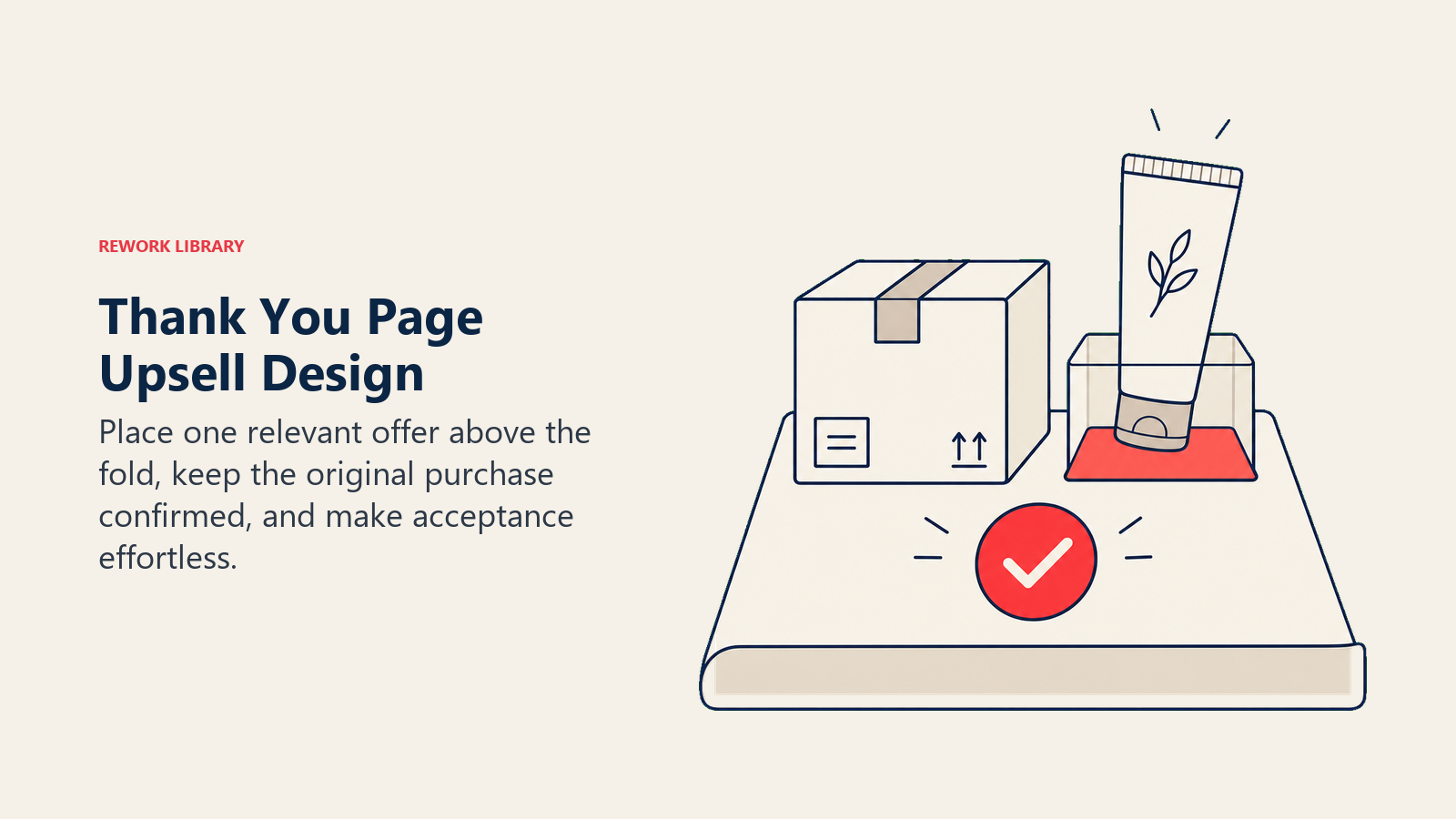
Your thank you page is prime real estate that most stores completely waste. Here's how to transform it into a revenue-generating asset. One-click upsell placement: The thank you page upsell should appear immediately after order confirmation details, positioned above the fold on desktop and mobile. The offer should be:
- Visually distinct - Use different background colors or borders to separate it from order confirmation
- Clear and simple - Single product or tightly related bundle
- Time-limited - "One-time offer available for 10 minutes" creates urgency
- One-click enabled - No re-entering payment information
Effective thank you page structure:
- Order confirmation (order number, email confirmation message)
- Primary upsell offer (hero position)
- Order details (items purchased, shipping info)
- Secondary offer or social proof
- Next steps (tracking info, customer service)
Design principles that convert:
Your thank you page upsell should feel like a helpful suggestion, not a hard sell. Use language like:
- "Customers who bought [product] also grabbed..."
- "Complete your [category] setup with..."
- "Add this before we ship your order"
- "One-time offer: Get [product] at [discount]"
The visual design should maintain your brand aesthetic while clearly differentiating the upsell from order confirmation details. Use buttons with action-oriented text: "Add to My Order" rather than generic "Buy Now."
Post-Purchase Email Sequences
Email provides multiple touchpoints to present upsells without interrupting the thank you page experience. Strategic timing is everything. For a complete guide on implementing effective post-purchase email sequences, see our dedicated resource. 0-2 hour window (Order confirmation email): Your order confirmation email should include a subtle upsell opportunity positioned after all critical order information:
- Primary content: Order details, shipping timeline, tracking
- Secondary content: "You might also like..." with 2-3 complementary products
- Conversion rate: 3-8% (lower than thank you page but higher volume since everyone receives it)
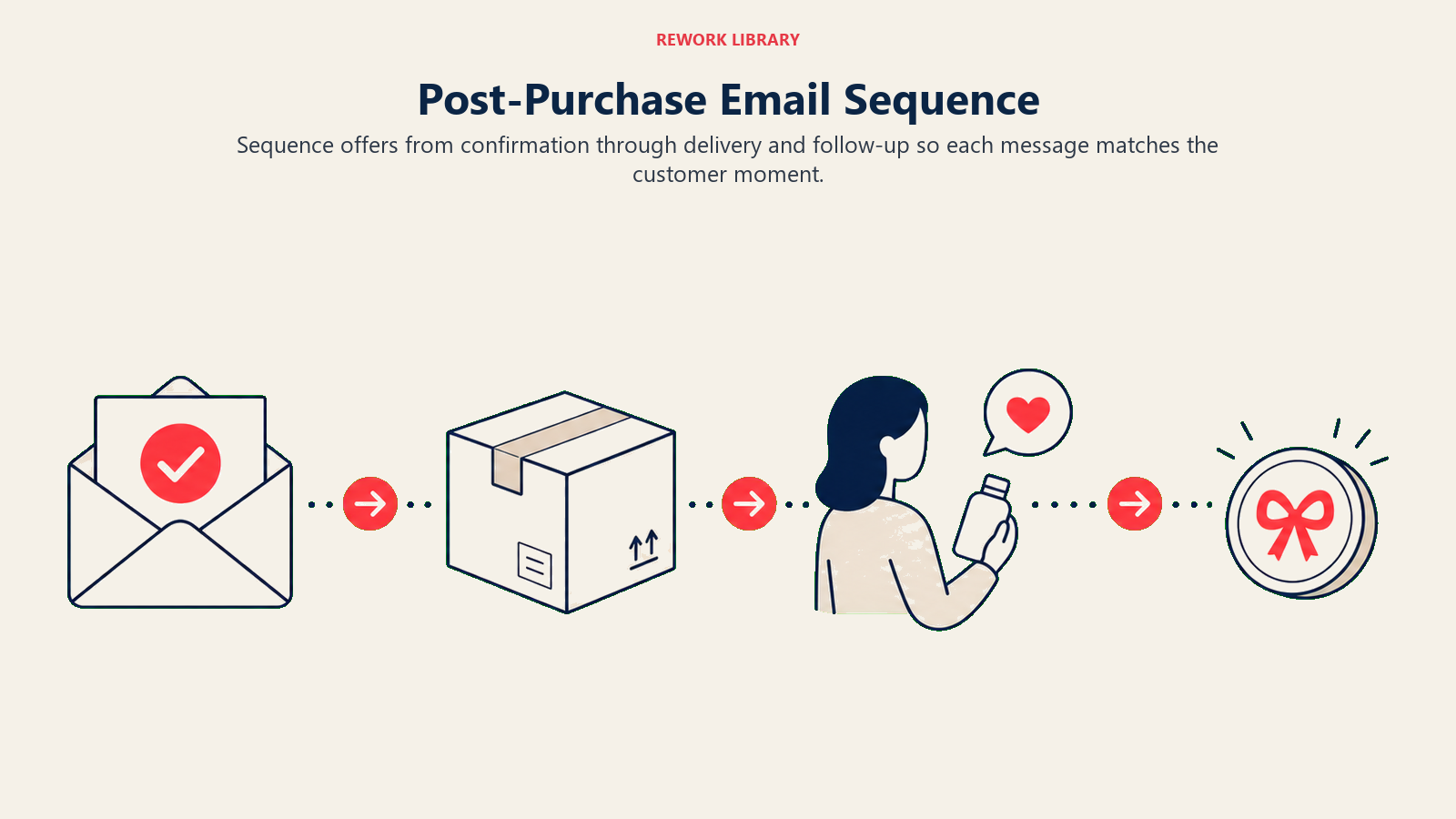
Day 1-2 (Order shipped email):
The shipping confirmation email provides another high-engagement touchpoint:
- "While you wait for [product] to arrive, customers also grabbed..."
- Focus on products that complement what they ordered
- Include a small first-time customer discount (5-10%) to drive urgency
- Conversion rate: 2-5%
Day 7-14 (Post-delivery follow-up):
Once the product has arrived and been used, you can present more strategic upsells:
- "How to get the most from your [product]" with accessory suggestions
- Replenishment offers for consumable products
- Upgrade paths for entry-level purchases
- Conversion rate: 1-4%
The key is matching offer timing to product experience. Don't try to upsell a phone case before the phone arrives. Don't wait three months to suggest consumable refills.
Product Selection for Upsells
Not all products make good post-purchase upsells. Strategic selection determines whether your offers feel helpful or annoying. Complementary products: These complete or enhance the primary purchase:
- Phone + phone case
- Camera + memory card
- Skincare product + application tool
- Supplement + pill organizer
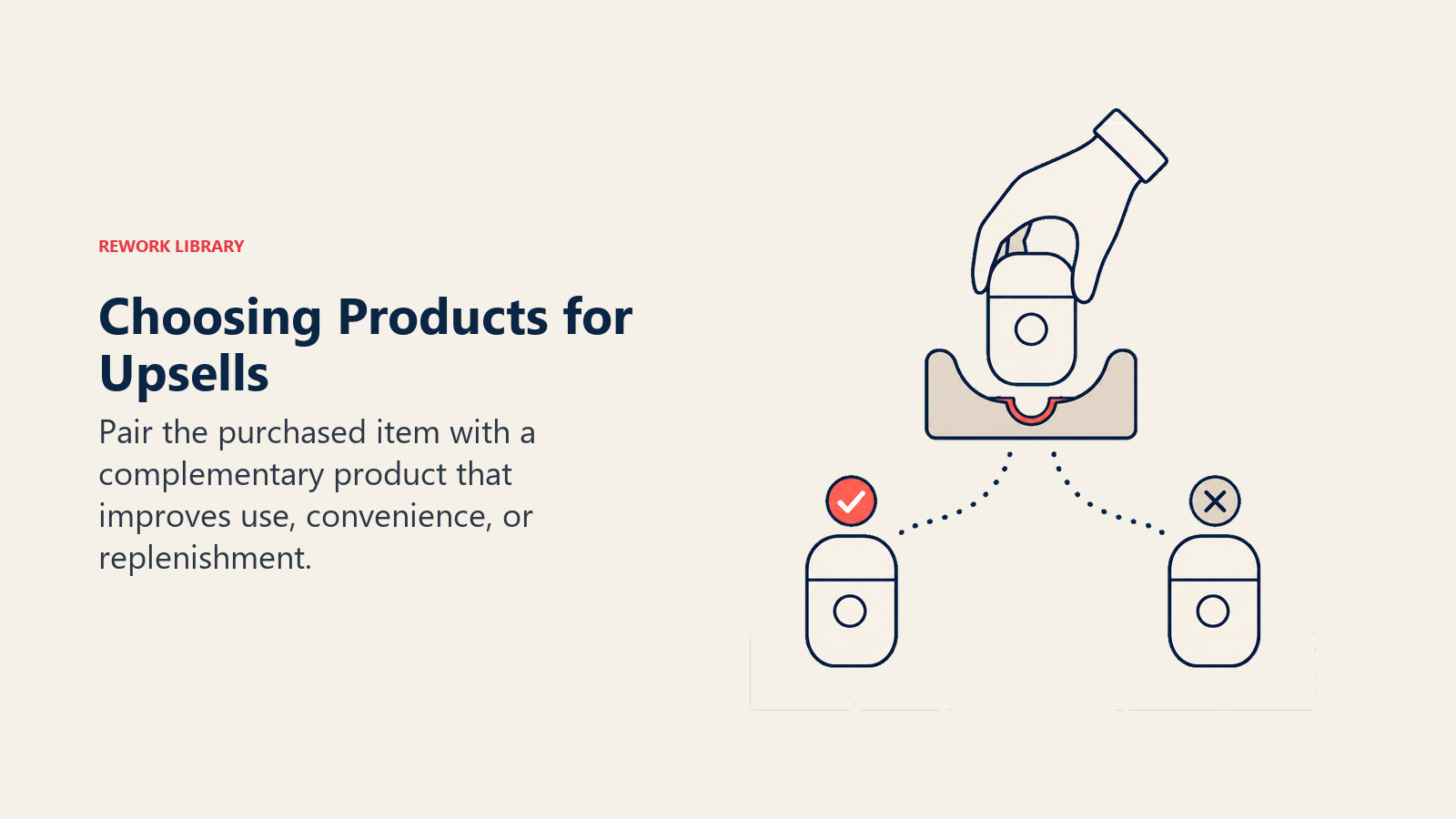
Complementary upsells work best on the thank you page because they're immediately relevant and clearly useful. Effective product recommendations and personalization can significantly improve the relevance of these suggestions.
Supplementary products:
These extend the value of the primary purchase:
- One product + two more of the same (buy 1, add 2 more at discount)
- Product + refill/replacement
- Basic version + premium upgrade
- Single item + full set
Supplementary upsells work better in email sequences when you can explain the additional value more thoroughly. Consider incorporating bundling strategies to create compelling multi-product offers.
Price point considerations:
Your upsell price should generally follow these guidelines:
- Thank you page upsells: 20-50% of original order value
- Email upsells: 30-100% of original order value
- Discount depth: 10-25% off regular price
- Free shipping threshold: Include if close to qualifying amount
A $100 order shouldn't see a $500 upsell on the thank you page. That breaks the psychological momentum. But a $20-40 complementary product at 15% off? That's an easy yes.
One-Click Upsell Mechanics
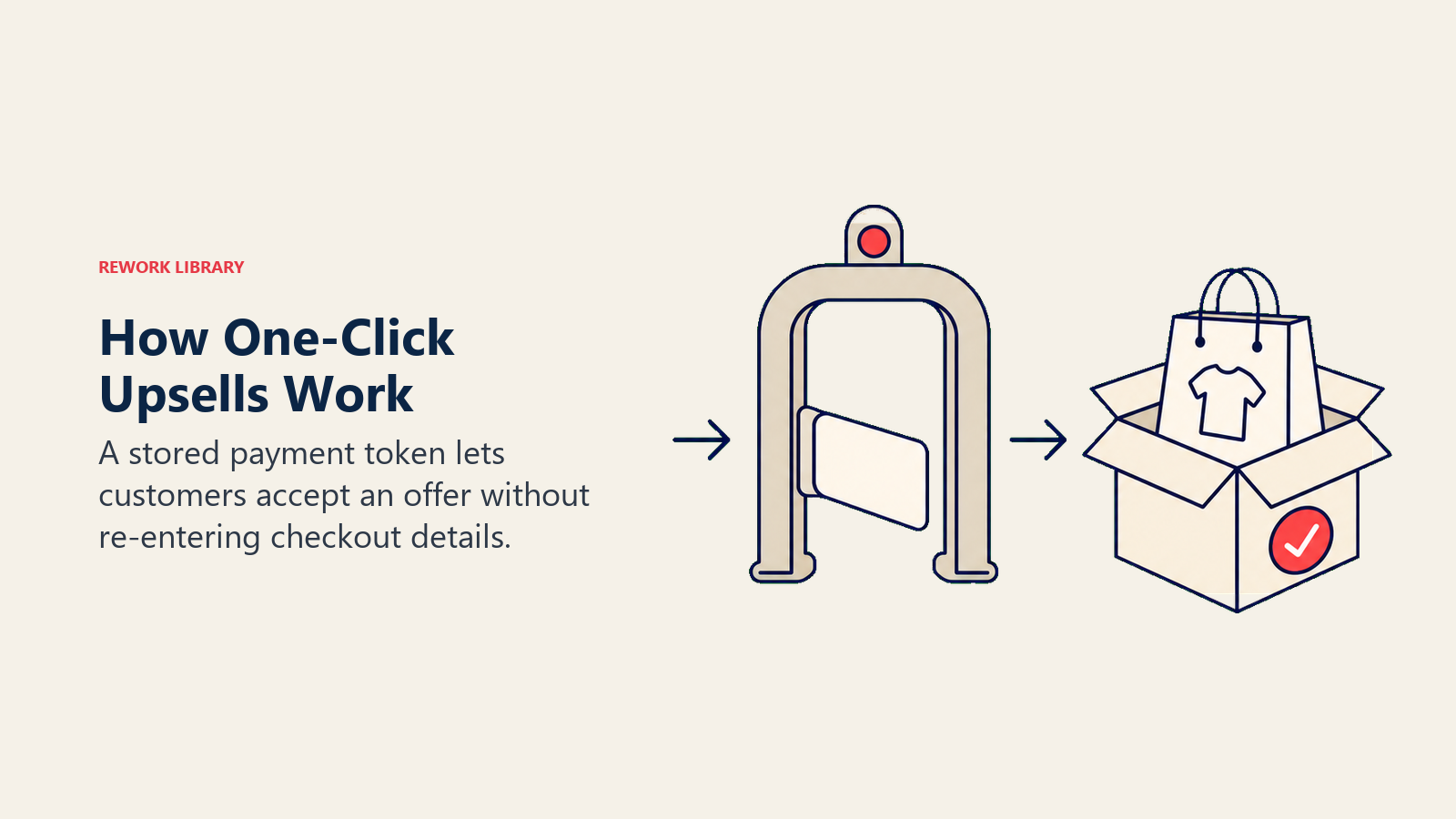
The technical implementation of one-click upsells is what enables their high conversion rates. Here's how they work and what you need to know. Payment tokenization: One-click upsells use the payment token from the original purchase to process the upsell without requiring re-authorization. This only works if:
- Your payment processor supports tokenization
- You present the upsell within the same session
- The customer hasn't closed the browser/app
- You clearly disclose the additional charge
Platform options:
Most major e-commerce platforms support post-purchase upsells either natively or through apps:
- Shopify: Native post-purchase upsells or apps like ReConvert, Zipify
- WooCommerce: Plugins like CartFlows, OneClickUpsell
- BigCommerce: Apps like Bold Upsell, Shogun
- Custom builds: Stripe, PayPal, and other processors support tokenization APIs
Customer experience requirements:
For one-click upsells to maintain trust:
- Clearly display the upsell price
- Show updated order total
- Confirm the additional charge
- Provide instant decline option ("No thanks")
- Send updated order confirmation email
- Never make the "No" button hard to find
The goal is convenience, not deception. Customers should feel like you're making it easy to add something useful, not tricking them into extra purchases.
Mobile-Specific Upsell Strategies
With 60-75% of e-commerce traffic coming from mobile, your post-purchase upsells must be mobile-optimized. Mobile thank you page design:
- Single upsell product (avoid choice paralysis on small screens)
- Large, thumb-friendly buttons
- Minimal scrolling required
- Image-heavy with minimal text
- Clear pricing and "No thanks" option
Mobile email considerations:
- Preview text that includes upsell value proposition
- Single column layout
- Large product images
- One primary CTA per email
- Fast-loading pages when clicked
App-specific opportunities:
If you have a mobile app, post-purchase upsells can be even more effective:
- Push notifications 1-2 hours after purchase
- In-app exclusive offers
- One-tap upsells (already authenticated)
- Saved payment methods enable true one-click
Mobile upsells should be simpler and more visually driven than desktop versions. Don't try to cram three product options into a thank you page that someone is viewing on their phone while walking to their car.
Upsell Performance Metrics
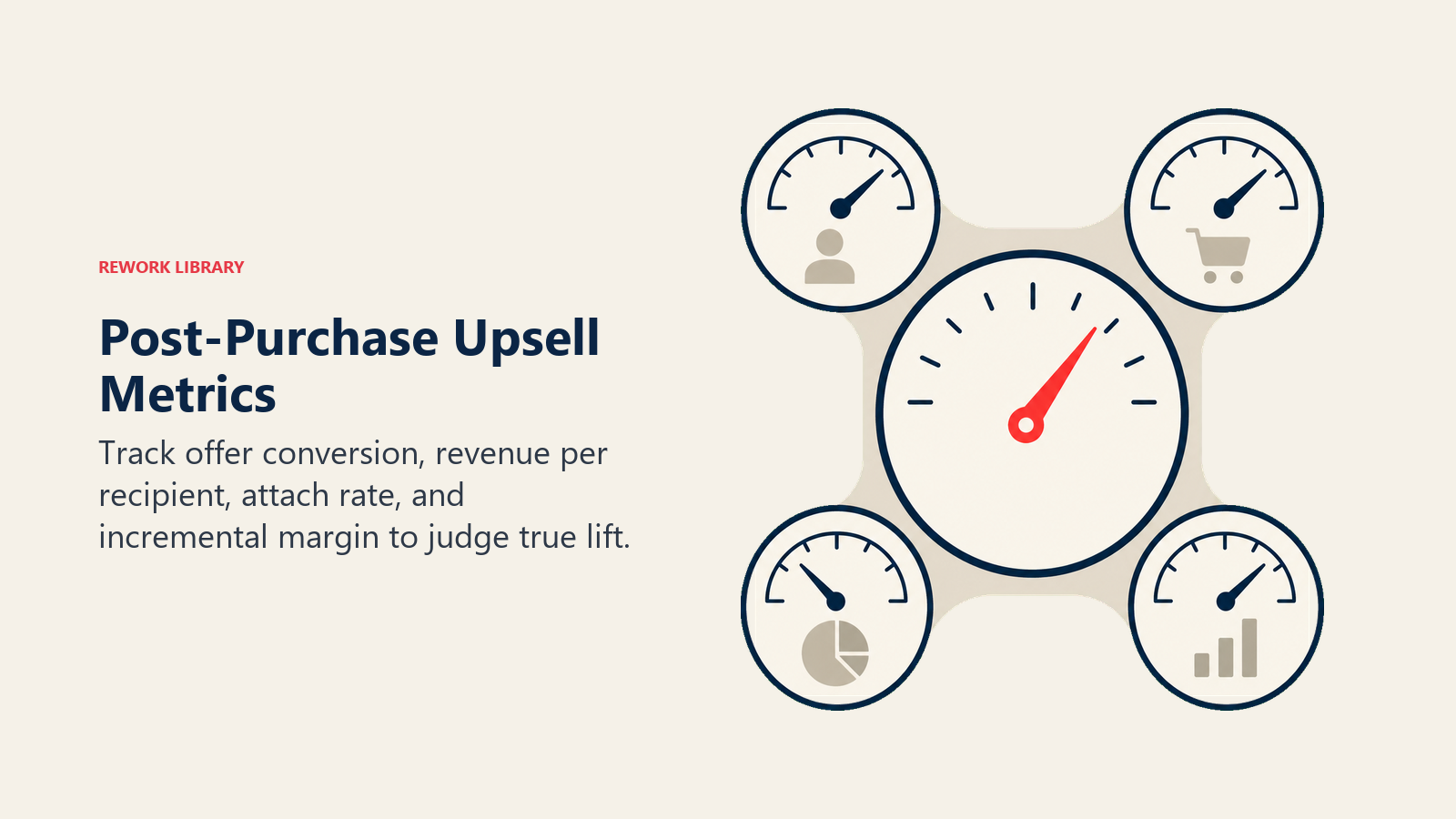
You can't optimize what you don't measure. Here are the key metrics for tracking post-purchase upsell performance. Core metrics:
- Upsell conversion rate - Percentage of customers who accept post-purchase offers
- Revenue per recipient (RPR) - Total upsell revenue divided by total orders
- Average upsell value - Average dollar amount when upsell is accepted
- Upsell attach rate - Percentage of total orders that include an upsell Revenue attribution:
Track upsell revenue separately from initial order revenue to understand true impact:
- Initial order AOV: $85
- Post-purchase upsell RPR: $12
- Effective AOV: $97 (+14% from upsells)
This lets you calculate the true value of your post-purchase strategy and compare it to other AOV Optimization Strategy initiatives.
A/B testing framework:
Test one variable at a time:
- Product selection - Which products convert best as upsells
- Discount depth - 10% vs 15% vs 20% off
- Urgency messaging - Time-limited vs quantity-limited vs no urgency
- Visual design - Layout, colors, image sizes
- Placement timing - Immediate vs 2-hour delay vs next-day email
Run tests for at least 500 conversions per variant to reach statistical significance. A 2% difference in conversion rate might not seem like much, but on 10,000 monthly orders, that's 200 additional upsells.
Common Mistakes
Even experienced e-commerce operators make these post-purchase upsell errors.
Mistake 1: Aggressive or pushy offers
Making the "No thanks" button tiny or hiding it damages trust more than the extra 2-3% conversion rate helps. Customers remember feeling tricked, and it impacts repeat purchase rates.
Mistake 2: Poor product matching
Showing completely unrelated products ("You bought vitamins, want to add a yoga mat?") makes your upsells feel like random advertising rather than helpful suggestions. Match intent, not just category.
Mistake 3: Too many options
Presenting 5-6 different upsell products creates decision paralysis. Stick to 1-2 offers maximum, especially on mobile.
Mistake 4: Ignoring mobile experience
If your thank you page upsell looks great on desktop but requires pinch-zooming on mobile, you're missing 60%+ of opportunities.
Mistake 5: No urgency mechanism
Without time limitation or scarcity, customers think "I'll come back and buy that later" (and never do). Add legitimate urgency: "Add to your order before it ships" or "10-minute exclusive offer."
Mistake 6: Overcomplicating the tech
Don't build a complex multi-step upsell funnel before you've validated that simple one-click offers work. Start simple, test, iterate.
Integration with Marketing Stack
Post-purchase upsells work best when integrated with your broader marketing technology. Customer Data Platform (CDP) integration: Feed upsell acceptance data into your CDP to:
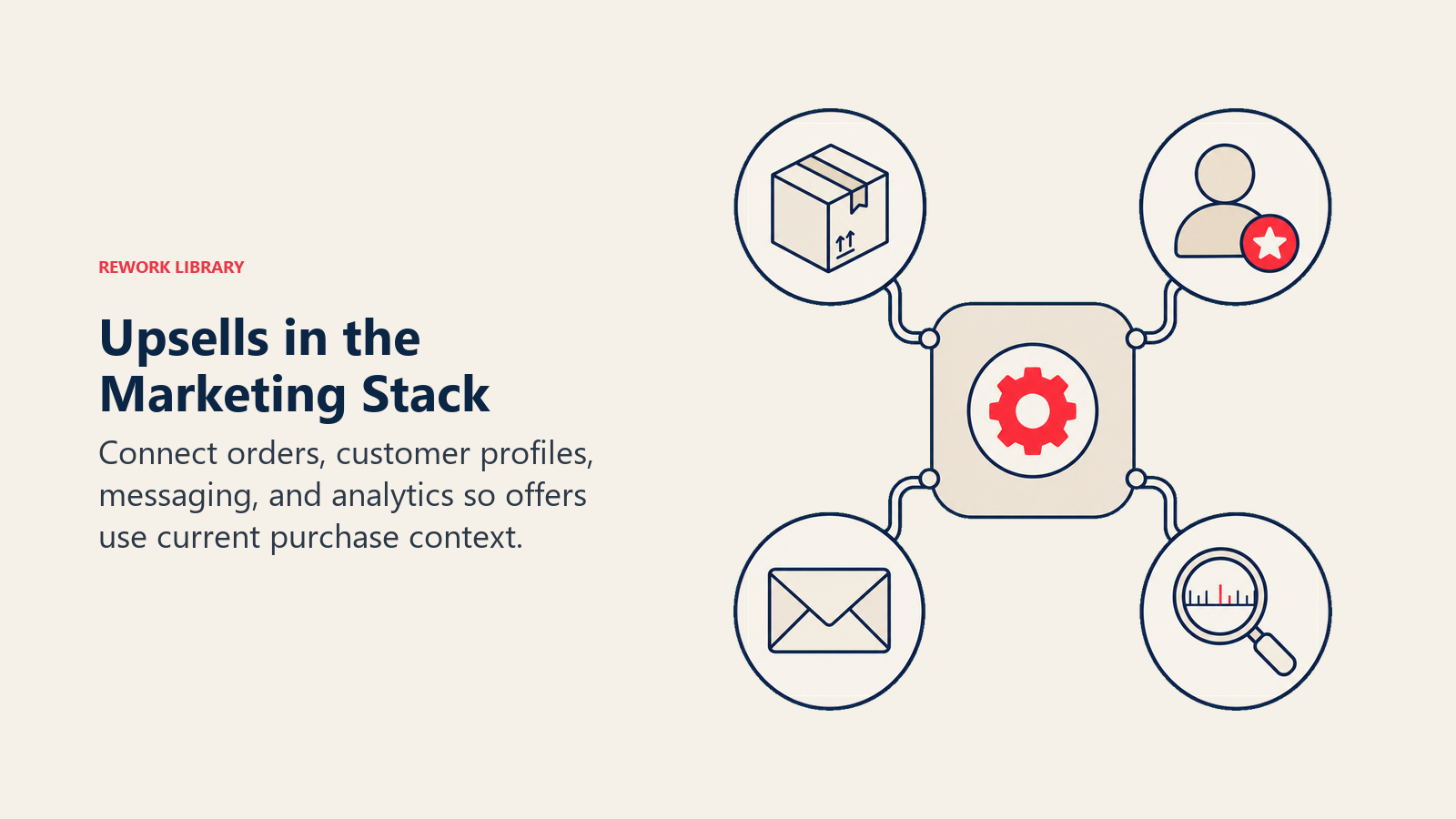
- Segment customers by upsell behavior
- Identify high-value customers early
- Personalize future upsell offers
- Build lookalike audiences
Effective customer segmentation enables you to tailor upsell offers based on purchase behavior, preferences, and value tier.
Email platform synchronization:
Your email platform should know:
- Which customers accepted thank you page upsells (skip redundant email offers)
- Which products were purchased (for complementary suggestions)
- Purchase timing (for replenishment offers)
- Customer lifetime value tier (for VIP offers)
Integrating upsell data with your email marketing for e-commerce platform ensures coordinated messaging across all touchpoints.
Analytics and attribution:
Connect post-purchase upsell data to Google Analytics, Segment, or your analytics platform to:
- Track upsell revenue in your revenue reports
- Attribute revenue to specific offers
- Calculate true customer acquisition cost (CAC) including upsell value
- Measure impact on customer lifetime value (CLV)
Shopify-specific integrations:
If you're on Shopify, post-purchase upsells can integrate with:
- Klaviyo for email follow-ups
- Gorgias for customer service context
- Recharge for subscription upsells
- Loyalty programs for points earning
The goal is creating a seamless experience where upsell data flows through your entire marketing stack, enabling increasingly personalized and effective offers over time.
Advanced Strategies
Once you've mastered basic post-purchase upsells, these advanced tactics can increase performance further. Dynamic offer selection:
Use machine learning or rule-based logic to show different upsells based on:
- Cart contents (product affinity analysis)
- Customer segment (new vs returning, VIP vs standard)
- Time of day (impulse vs considered purchases)
- Device type (mobile vs desktop)
- Geographic location (shipping cost considerations)
VIP customer upsells:
High-value customers should see different offers:
- Higher-priced products (they've demonstrated higher willingness to pay)
- Exclusive or limited edition items
- Early access to new products
- Bundled VIP services (priority support, free returns)
Subscription conversion upsells:
For consumable products, the thank you page is perfect for subscription offers:
- "Never run out: Subscribe and save 15%"
- "Deliver every 30 days, cancel anytime"
- "First subscription order ships free"
Converting one-time buyers to subscribers dramatically increases lifetime value, making this one of the highest-ROI upsell strategies.
Sequential upsells:
Some platforms allow multiple sequential upsells:
- Customer completes checkout
- Thank you page shows Offer A (30% accept)
- Those who decline see Offer B at lower price point (15% accept)
- Those who accept Offer A see complementary Offer C (10% accept)
This can work well but requires careful testing to ensure you're not annoying customers who just want to complete their purchase.
Downsell strategy:
If someone declines your primary upsell, offer a lower-priced alternative:
- Primary: "Add three more for $50"
- Downsell: "Add one more for $20"
This gives price-sensitive customers an easier entry point while still capturing incremental revenue.
Implementation Roadmap
Here's a phased approach to implementing post-purchase upsells without overwhelming your team. Phase 1: Thank you page foundation (Week 1-2)
- Set up basic thank you page upsell (single product, manual selection)
- Implement one-click purchase capability
- Add simple "Accept" and "Decline" options
- Install analytics tracking
- Test on 10% of traffic Phase 2: Product selection optimization (Week 3-4)
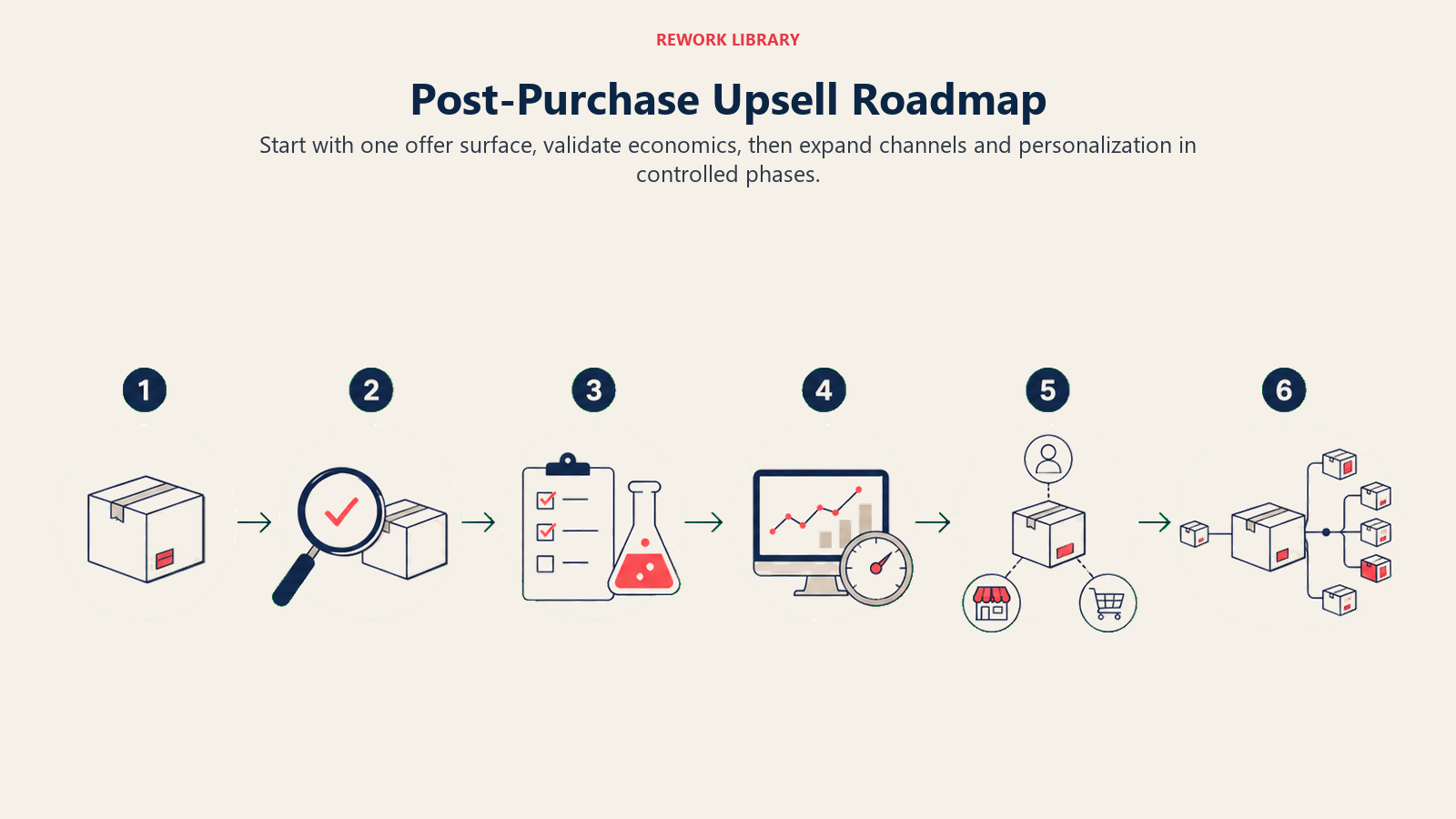
- Analyze which products perform best as upsells
- Create product pairing rules (if bought X, offer Y)
- A/B test 2-3 different products per primary purchase
- Optimize pricing and discount depth
- Scale to 50% of traffic
Phase 3: Email sequence activation (Week 5-6)
- Add subtle upsell to order confirmation email
- Create shipping confirmation upsell email
- Develop post-delivery follow-up sequence
- Integrate with email platform for segmentation
- Test timing and frequency
Phase 4: Mobile optimization (Week 7-8)
- Audit mobile thank you page experience
- Optimize button sizes and layout
- Test mobile-specific offers
- Implement mobile app upsells if applicable
- Compare mobile vs desktop performance
Phase 5: Advanced personalization (Week 9-12)
- Implement dynamic product selection
- Create customer segment-specific offers
- Add urgency timers and countdown
- Test sequential upsell flows
- Build automated optimization rules
Phase 6: Continuous optimization (Ongoing)
- Weekly review of upsell metrics
- Monthly A/B test schedule
- Quarterly product performance analysis
- Integration with broader upselling and cross-selling initiatives
- Regular customer feedback collection
Measuring Success
After implementing post-purchase upsells, track these success indicators. For comprehensive tracking guidance, reference our e-commerce metrics and KPIs resource.
Short-term metrics (Week 1-4):
- Upsell conversion rate above 8%
- Revenue per recipient above $5-10
- No increase in refund rate
- No decrease in customer satisfaction scores
Medium-term metrics (Month 2-3):
- Overall AOV increase of 10-15%
- Incremental revenue attribution to upsells
- Improved email engagement (if using email upsells)
- Positive customer feedback
Long-term metrics (Month 4+):
- No negative impact on repeat purchase rate
- Increased customer lifetime value
- Higher profit margins (upsells typically have better margins)
- Reduced customer acquisition cost (CAC) when factoring in upsell value
If you're seeing 5-10%+ conversion rates on thank you page upsells and 2-5% on email upsells, you're performing in line with industry benchmarks. Above those numbers means you've found product-market fit for your upsell strategy.
Making It Work for Your Store
Post-purchase upsells aren't a one-size-fits-all tactic. They need to be adapted to your specific products, customers, and brand.
Start with your thank you page. That's the highest-converting opportunity and the easiest to implement. Pick one complementary product that makes obvious sense with your best-selling item. Price it at 20-30% of the average order value and offer a modest discount (10-15% off).
Test that for two weeks. If it converts above 5%, you've validated the strategy. Then expand to more products, add email sequences, and optimize from there.
The brands seeing the biggest wins from post-purchase upsells aren't the ones with the most sophisticated technology. They're the ones who understand their customers well enough to suggest the right product at the right time with the right messaging.
Combine this strategy with related tactics from our guides on bundling strategy, email marketing for e-commerce, and product recommendations and personalization to create a comprehensive revenue optimization system.
Your thank you page isn't just a confirmation screen. It's a revenue opportunity that most of your competitors are completely ignoring. Make the most of it.
Frequently Asked Questions about Post-Purchase Upsells
What is a post-purchase upsell?
A post-purchase upsell is an offer presented immediately after a customer completes checkout, on the thank you page or in follow-up emails, often as a one-click add-on that uses the payment details already on file. Because the purchase decision and payment are already done, these offers feel like a helpful add rather than a new buying decision.
How much do post-purchase upsells convert compared to regular offers?
Pre-checkout upsells typically convert at 0.5 to 2 percent and cart upsells at 1 to 3 percent, while post-purchase upsells convert at 5 to 20 percent and one-click versions at 10 to 35 percent. The jump comes from removing payment friction at the exact moment the buyer is most committed.
Do post-purchase upsells hurt the customer experience?
Not when they're relevant and easy to decline. Match the offer to what the customer just bought, show one or two options at most, display the price and updated total clearly, and keep the "No thanks" button obvious. Aggressive or hidden-decline tactics damage trust and repeat purchase rates more than the extra conversions are worth.
What products work best as post-purchase upsells?
Complementary products that complete the primary purchase (a case for a phone, a memory card for a camera) work best on the thank you page because the relevance is obvious. Supplementary offers like refills, bundles, or premium upgrades work better in email sequences where you can explain the added value. Subscriptions are strong for consumable goods.
How do one-click upsells work technically?
One-click upsells reuse the payment token from the original order to charge the add-on without re-entering card details. This requires a processor that supports tokenization, the offer to appear within the same session, and clear disclosure of the extra charge. Most platforms like Shopify, WooCommerce, and BigCommerce support it natively or through apps.

On this page
- Post-Purchase Upsell Fundamentals
- Thank You Page Optimization
- Post-Purchase Email Sequences
- Product Selection for Upsells
- One-Click Upsell Mechanics
- Mobile-Specific Upsell Strategies
- Upsell Performance Metrics
- Common Mistakes
- Integration with Marketing Stack
- Advanced Strategies
- Implementation Roadmap
- Measuring Success
- Making It Work for Your Store