Post-Purchase Email Sequences: Building Customer Relationships After the Sale
Turn this article into takeaways for your work.


Each assistant summarizes the article only for you and suggests best practices for your work.
For ecommerce growth, post-purchase email sequences are the highest-leverage retention channel you have: automated flows that confirm orders, onboard buyers, request reviews, trigger replenishment, and cross-sell at the right moment. They matter because 72 percent of customers expect immediate confirmation, repeat buyers spend 67 percent more than first-timers, and most brands leave that revenue on the table.
The sale isn't the finish line. It's the starting line. While most e-commerce brands obsess over acquisition, the real money lives in what happens after someone buys. The numbers tell the story: 72% of customers expect an immediate order confirmation, 58% want product recommendations within days, and repeat customers spend 67% more than first-time buyers. Yet most brands send a basic confirmation email and ghost their customers until the next promotional blast.
Post-purchase email sequences are your secret weapon for turning one-time buyers into loyal customers. When done right, they confirm orders, set delivery expectations, teach customers how to use products, collect reviews, drive repeat purchases, and build relationships that last years. This is where customer lifetime value gets built, one strategic email at a time.
The Post-Purchase Email Journey
Your post-purchase sequence starts the moment someone completes checkout and continues for weeks or months, depending on your product cycle. The goal isn't just to confirm the order. It's to guide customers through a journey that builds trust, delivers value, and creates opportunities for repeat business.
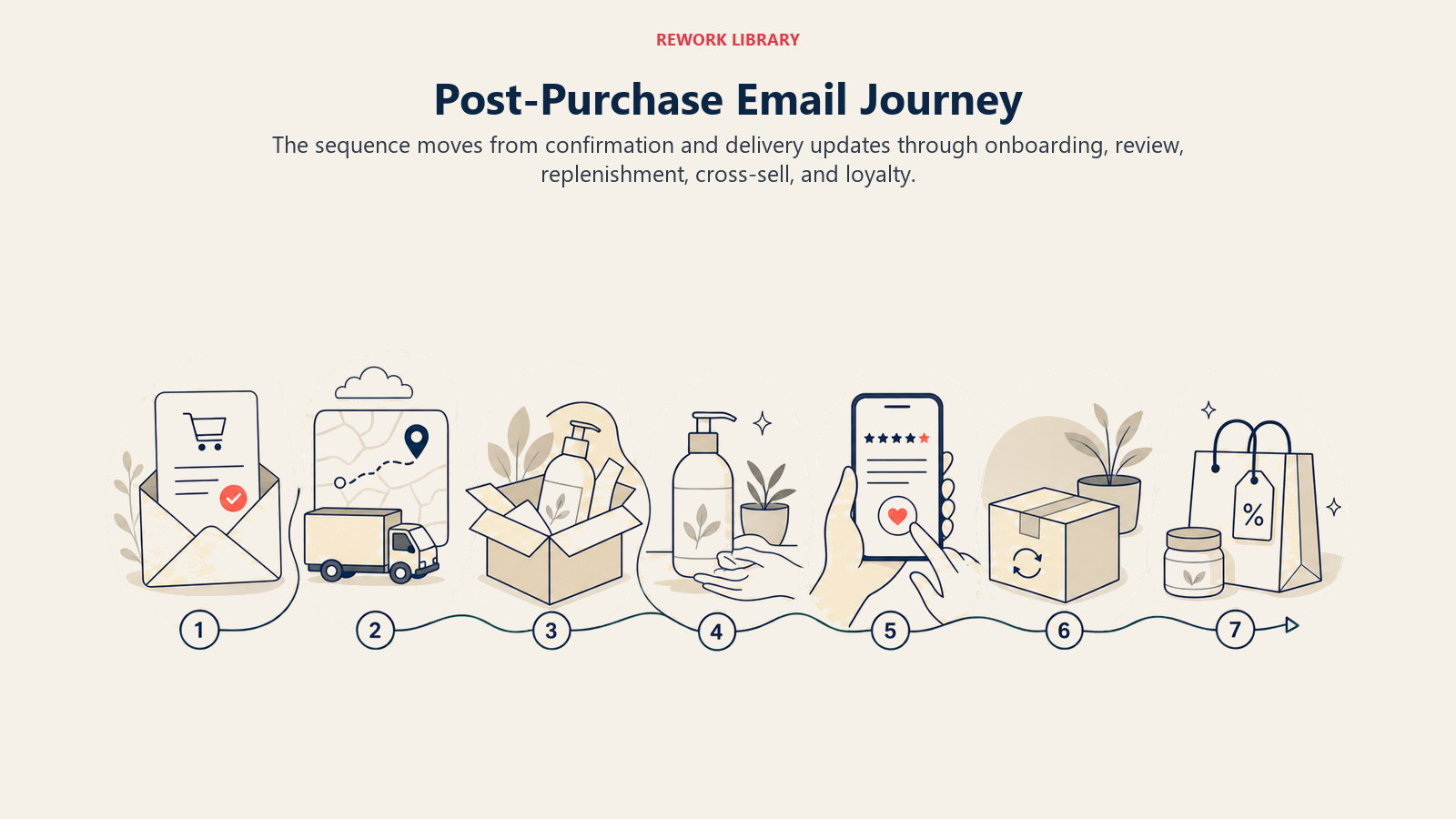
The typical post-purchase journey includes:
Immediate (0-24 hours): Order confirmation, shipping notification, delivery expectations
Early days (1-7 days): Product education, setup guides, first-use tips
First experience (7-14 days): Review requests, feedback collection, satisfaction checks
Ongoing relationship (14-90 days): Recommendations, replenishment reminders, loyalty invitations
Long-term (90+ days): Re-engagement, seasonal promotions, win-back campaigns
Each stage has specific objectives and success metrics. Order confirmations should have 90%+ open rates and provide tracking information. Educational emails should drive product usage and reduce returns. Review requests should achieve 15-25% response rates. Replenishment campaigns should convert at 8-12% for consumable products.
The key is understanding that different customers need different sequences. First-time buyers need more education and reassurance. Repeat customers skip the basics and want recommendations. High-value customers deserve VIP treatment. Segment your sequences using customer segmentation strategies accordingly.
Order Confirmation Email Strategy
Your order confirmation email is the most opened email you'll ever send, typically 80-90% open rates. It's also a critical moment of customer anxiety: Did my payment go through? When will it arrive? Did I make the right decision? Your job is to answer these questions instantly while setting the stage for the relationship ahead.
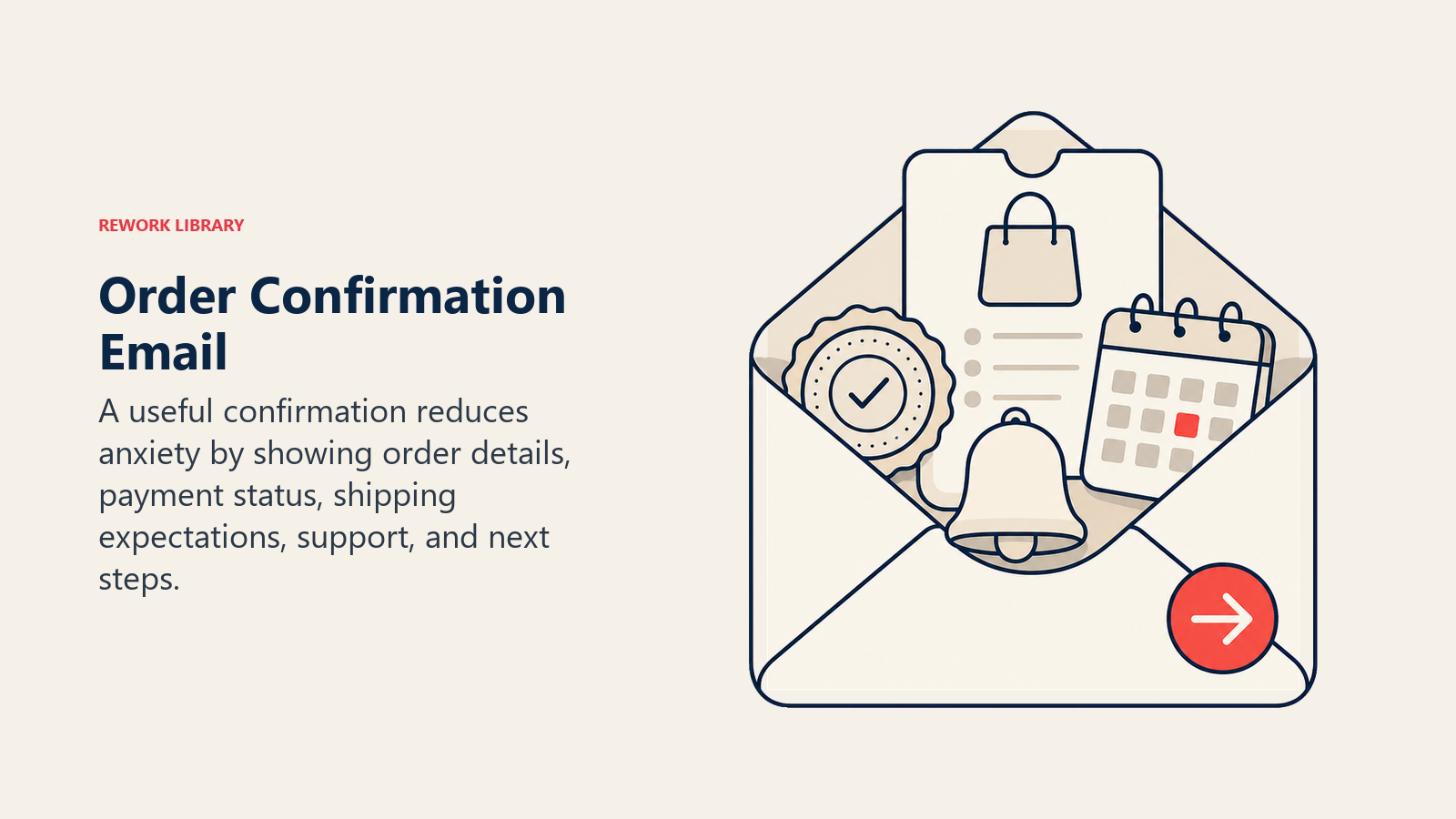
The essential elements of an order confirmation:
Clear subject line: "Order #12345 confirmed - arrives Tuesday" beats generic "Thank you for your order"
Order summary with images: Product photos, quantities, sizes, colors, a visual confirmation of what they bought
Pricing transparency: Subtotal, shipping, taxes, discounts, total, with no surprises
Shipping details: Estimated delivery date, shipping method, tracking number (when available)
Next steps: When to expect shipping notification, how to track, customer service contact
Cross-sell opportunity: 1-2 relevant complementary products (subtle, not pushy) using upselling and cross-selling techniques
Here's what a strong order confirmation structure looks like:
Subject: Order #12345 confirmed - arrives Tuesday, June 10

Hero: "Thanks for your order, Sarah!"

Order summary:
[Product image] Wireless Headphones - Black
Quantity: 1 | $149.99

[Product image] Protective Case
Quantity: 1 | $24.99

Subtotal: $174.98
Shipping: $5.99
Tax: $14.52
Total: $195.49

Shipping to:
Sarah Johnson
123 Main St
Portland, OR 97201

Estimated delivery: Tuesday, June 10
Tracking: [Track your order]

What's next:
✓ Order confirmed
→ Preparing for shipment (1-2 business days)
→ Shipped (you'll get tracking)
→ Delivered

Need help? [Contact support]

[Optional] Customers who bought this also loved:
[Product 1] [Product 2]
The transactional nature of confirmation emails gives them inbox priority and high engagement. Use this attention wisely. Include branding elements that reinforce your identity, but keep the focus on order details. Add one subtle cross-sell opportunity at the bottom, not multiple promotional blocks that distract from the core message.
Many brands also use confirmation emails to set expectations about the overall experience: "Here's what to expect over the next week" or "Your headphones ship tomorrow, then we'll send setup tips." This primes customers for your ongoing sequence and reduces surprise when educational emails arrive.
Welcome & Onboarding Sequences
For first-time buyers, the post-purchase period is critical for establishing your brand relationship. They don't know you yet, don't trust you completely, and might have buyer's remorse. Your welcome sequence turns strangers into customers who feel confident about their purchase and excited to buy again.
A first-time buyer welcome sequence typically includes:
Email 1 (Day 0 - immediate): Order confirmation with delivery expectations
Email 2 (Day 1-2): Welcome to the family - brand story, what makes you different, social proof
Email 3 (Day 3-5): Product preparation - how to get ready for arrival, what to expect
Email 4 (Day 7-10): First use guide - setup instructions, tips for success, video tutorials
Email 5 (Day 14): Review request - ask for feedback now that they've used it
Email 6 (Day 21-30): Next purchase incentive - recommend complementary products
Each email serves a specific purpose in the customer journey. The welcome email builds emotional connection: "Welcome to the [Brand] family! We're thrilled you chose us. Here's why 50,000+ customers love our products..." Social proof, founder story, mission statement, make them feel good about their decision.
The product preparation email reduces friction: "Your headphones arrive Tuesday! Here's what to do: Charge them overnight, download our app, create your profile. We'll send a setup video tomorrow." This prevents the frustration of receiving a product and not knowing what to do with it.
The first use guide provides maximum value: "Getting started with your headphones - [Video tutorial link]. Quick tips: Enable noise canceling for flights, use ambient mode for walking, customize EQ in the app." Include visual guides, video links, FAQs, and support contact. The goal is successful first use, which drives retention and reduces returns.
For complex products (software, fitness equipment, skincare routines), extend this sequence with progressive tutorials: Week 1 basics, Week 2 intermediate features, Week 3 advanced techniques. Each email delivers one actionable tip that helps customers get more value from their purchase.
Review Request Sequences
Customer reviews and user-generated content drive conversion, build trust, and provide valuable feedback, but only if you actually get them. The typical e-commerce store gets reviews from less than 5% of customers. Strategic review request sequences can push that to 15-25% or higher.
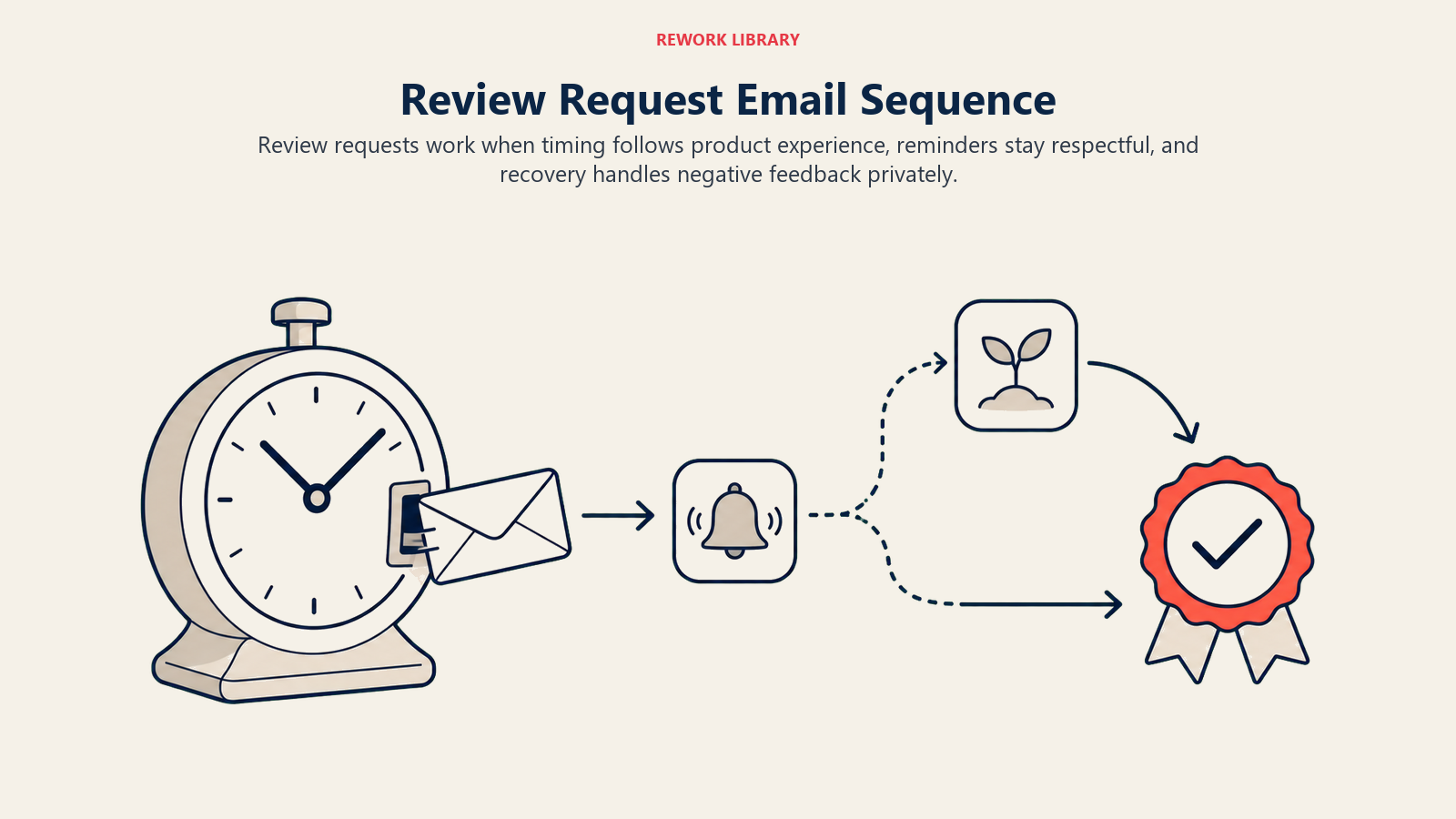
The timing of review requests is critical. Too early (before they've used it) and they have nothing to say. Too late (after they've forgotten about it) and they won't respond. The sweet spot depends on your product:
Fast-consumption products: 3-5 days (snacks, supplements, books)
Standard products: 7-14 days (clothing, accessories, home goods)
Complex products: 14-21 days (electronics, fitness equipment, software)
Long-cycle products: 30-60 days (furniture, appliances, subscription boxes)
A multi-touch review sequence works better than a single request:
Touch 1 (optimal timing): Direct ask with incentive - "Share your experience, get 10% off next purchase"
Touch 2 (+3 days): Simplified ask - "Quick favor: Rate your purchase in 30 seconds"
Touch 3 (+7 days): Last chance - "Final reminder: Your opinion matters"
The first email should make leaving a review as frictionless as possible. Include direct links to review pages, show star ratings they can click, pre-populate product information. The easier you make it, the more reviews you get.
Here's an effective review request structure:
Subject: How are you liking your headphones?

Hi Sarah,

You've had your wireless headphones for about two weeks now.
How's the experience been?

[5 stars ⭐⭐⭐⭐⭐] [4 stars ⭐⭐⭐⭐] [3 stars ⭐⭐⭐] [2 stars ⭐⭐] [1 star ⭐]
(Click to leave a quick review)

Your feedback helps other shoppers make confident decisions
and helps us improve our products.

As a thank you, we'll send you a 10% discount code after
you submit your review.

[Write a detailed review] (2 minutes)

Thanks for being part of our community!
Incentives increase review rates significantly. Offer a discount, loyalty points, entry into a giveaway, or exclusive content. Just make sure your review platform allows incentivized reviews (most do if you disclose it).
For high-value products or luxury brands, consider a two-step approach: First request feedback via email or survey ("How was your experience? What do you love? What could we improve?"), then invite satisfied customers to leave a public review. This filters for positive experiences while still collecting useful feedback from everyone.
Replenishment & Reorder Campaigns
For consumable products like supplements, skincare, pet food, cleaning supplies, and coffee, replenishment emails are gold. They remind customers to reorder exactly when they're running low, creating convenient recurring revenue without requiring subscriptions.
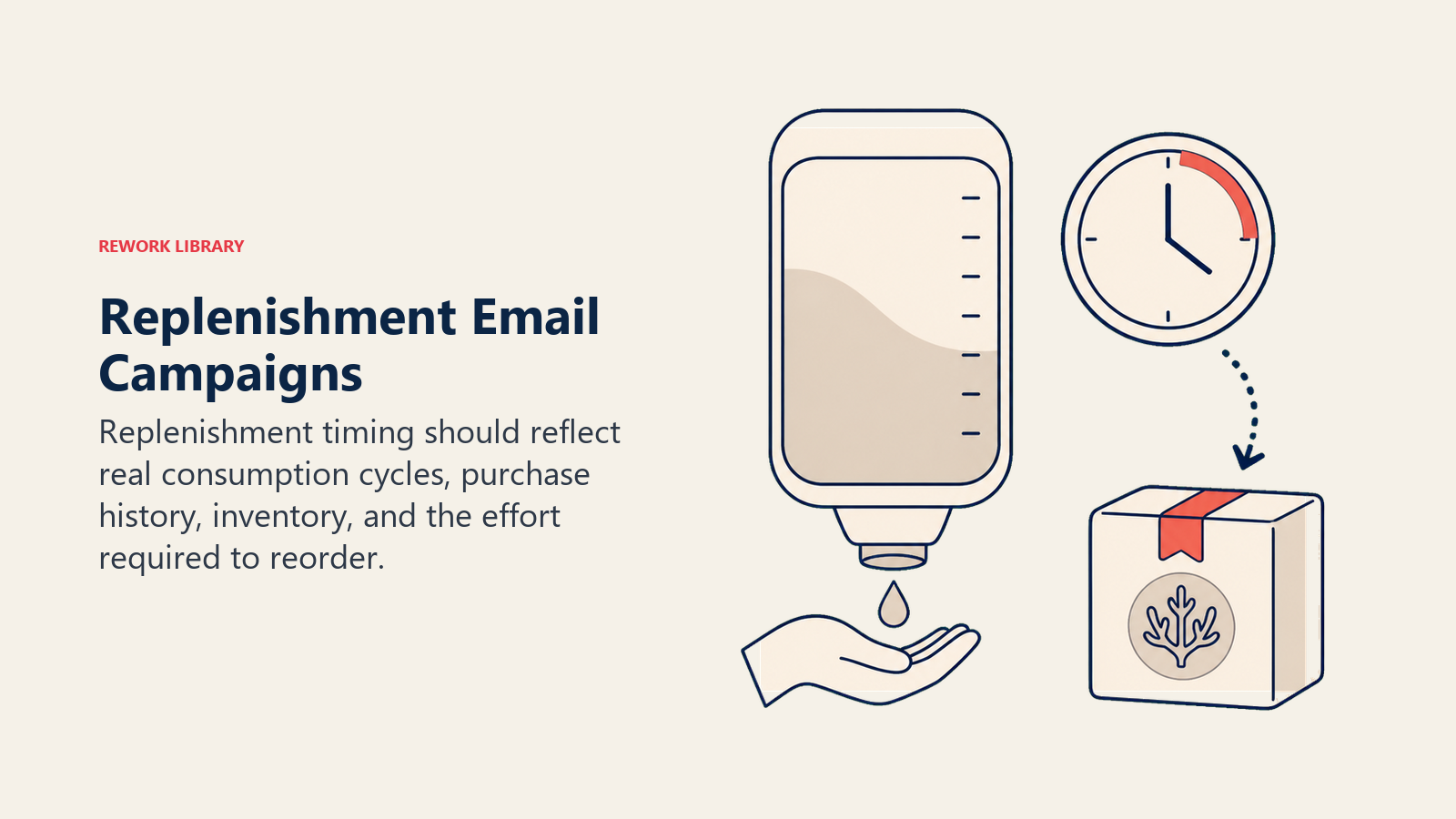
The key is identifying your replenishment interval. Analyze purchase data to find the average time between first and second orders:
30-day cycle: Vitamins, protein powder, coffee
60-day cycle: Skincare, cleaning products, pet treats
90-day cycle: Shampoo, razors, air filters
Send your replenishment reminder 5-7 days before they typically run out:
Subject: Running low on coffee? Time to restock!

Hi Sarah,

You ordered our Colombian Roast about 3 weeks ago.
If you've been enjoying it daily, you're probably running low.

[Reorder Colombian Roast] (Same as last time)

Want to try something new?
• Ethiopian Blend (customers who bought Colombian also love this)
• Dark Roast Sampler (try 3 new flavors)

[Subscribe & save 15%] - Never run out again

Questions? Reply to this email.
Make reordering effortless. Include a one-click reorder button that uses saved payment and shipping information. Show their previous order details. Offer a "same as last time" option alongside recommendations to try new products.
Predictive triggers work even better than calendar-based sequences. If someone buys 1lb of coffee, remind them in 3 weeks. If they buy 5lbs, remind them in 10 weeks. If they've ordered three times at consistent intervals, send reminders matched to their personal cycle.
The ultimate version is subscribe-and-save: "Never run out - subscribe for 15% off and free shipping. Pause, skip, or cancel anytime." This converts one-time buyers into predictable recurring revenue. Learn more in our guide on Subscription Onboarding.
For non-consumable products, replenishment sequences become seasonal reminders: "Ready for summer? Your sunglasses from last year were a hit" or milestone-based: "Your running shoes are 6 months old - time for a fresh pair?"
Cross-Sell & Upsell Sequences
Every purchase creates natural opportunities for related products. Someone who bought a camera needs memory cards, a bag, and lenses. Someone who bought yoga pants might want a mat, blocks, and tops. Strategic cross-sell sequences drive 25-40% additional revenue from existing customers.
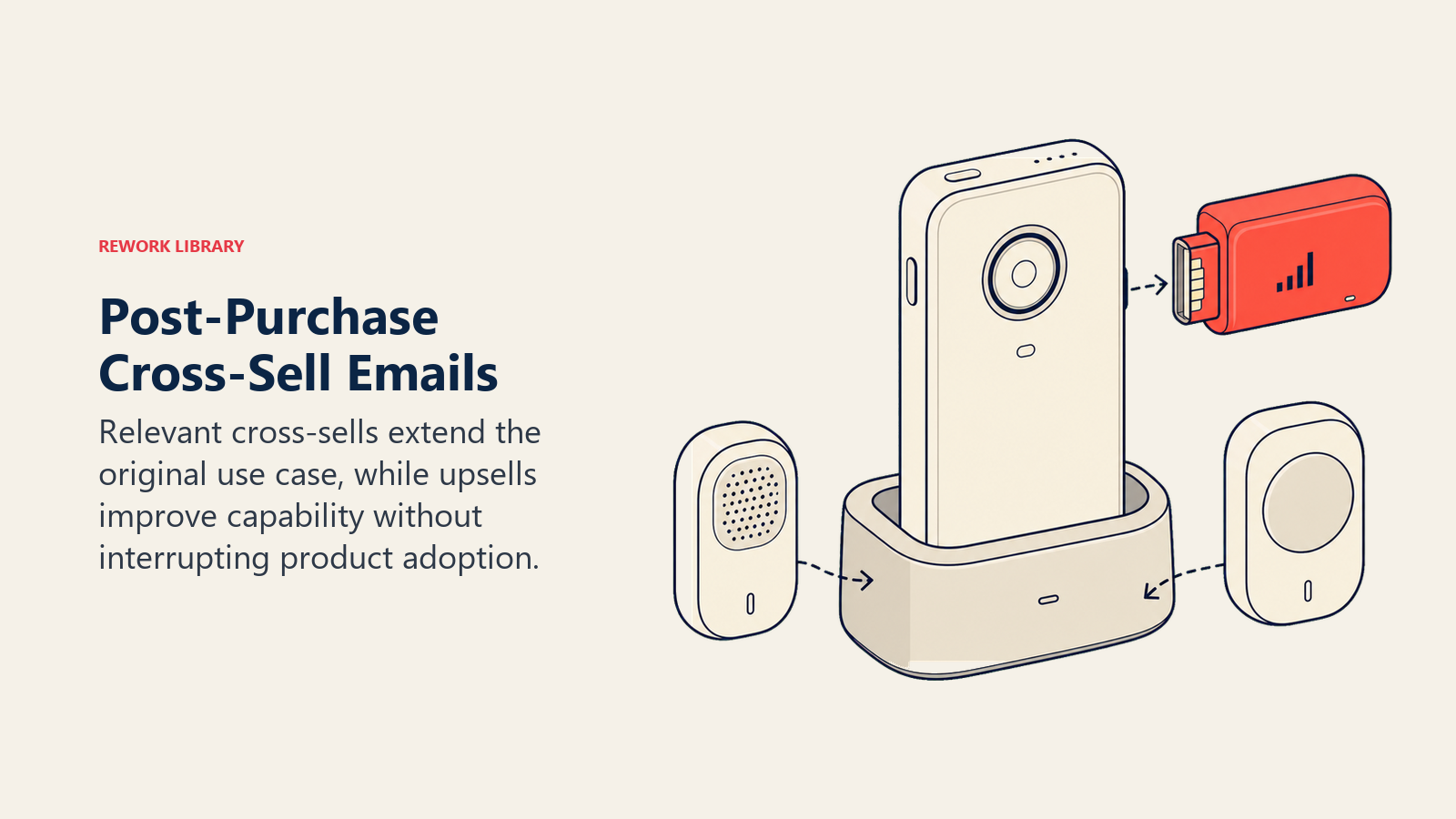
The key is relevance and timing. Show products that genuinely complement what they bought, and present them when they're most receptive, typically 7-14 days after the initial purchase, once they've experienced the product and feel good about it.
A cross-sell sequence structure:
Email 1 (Day 7): Essential accessories - "Complete your setup"
Email 2 (Day 14): Enhanced experience - "Take it to the next level"
Email 3 (Day 21): Related products - "Customers also loved these"
The first email focuses on necessary accessories: "You got headphones, but do you have a case to protect them? Customers who bought your model also grab these essentials..." This is practical value, not aggressive selling.
The second email introduces premium upgrades: "Loving your headphones? Upgrade to the Pro model for 50% off. Or add our premium cable for studio-quality sound." This works well for customers showing high engagement (opened previous emails, visited product pages).
The third email widens the aperture: "Based on your headphone purchase, you might also like: Bluetooth speakers, Smart watch, Laptop stand." These are related but not directly connected, so you're building a broader relationship.
Personalization multiplies effectiveness. Use purchase history to inform recommendations:
- Price tier matching: If they bought a $500 product, recommend $200-800 products, not $50 items
- Category affinity: Multiple athletic purchases suggest sports enthusiasts
- Brand preference: Repeat brand buyers want more from the same brand
Dynamic product recommendations driven by machine learning perform best, but even simple "customers who bought X also bought Y" logic works well. See our guide on product recommendations and personalization for advanced strategies.
Bundle offers perform exceptionally well in cross-sell sequences: "Get the complete kit: Headphones + Case + Premium Cable for $199 (save $45)." Bundling increases average order value while simplifying decision-making.
Customer Feedback & Loyalty Integration
Post-purchase sequences aren't just about driving sales. They're about building relationships. Customer feedback surveys and loyalty program enrollment create engagement touchpoints that strengthen your brand connection.
A feedback sequence typically runs 14-30 days post-purchase:
Subject: Quick question about your recent order

Hi Sarah,

How would you rate your recent experience with us?

[😊 Great] [😐 Okay] [☹️ Not great]

(Click to tell us more - takes 1 minute)

We read every response and use your feedback to improve
our products and service.

Thanks for helping us get better!
This simple Net Promoter Score (NPS) approach segments customers into promoters (9-10), passives (7-8), and detractors (0-6). Follow up based on their response:
- Promoters: Invite to loyalty program, ask for referrals, request detailed review
- Passives: Ask what would make them promoters, offer personalized recommendations
- Detractors: Immediate customer service outreach, solve their problem, prevent churn
Loyalty program enrollment works best 14-21 days after purchase, once customers have experienced your product and feel positive:
Subject: Welcome to VIP rewards, Sarah 🎁

You've joined thousands of customers who earn points on
every purchase.

Your current status:
Points: 150 (from your recent order)
Next reward: 50 points away from $10 off

Ways to earn more:
• Make a purchase (1 point per $1)
• Leave a review (+50 points)
• Refer a friend (+100 points)
• Follow us on Instagram (+25 points)

[Explore rewards] [Refer a friend]
Gamification elements like points, tiers, badges, and milestones increase engagement. Show progress toward next reward, highlight exclusive benefits, create urgency with limited-time bonus points. Learn more in our loyalty programs guide.
Combine feedback and loyalty in a single sequence: "Rate your experience and earn 50 bonus points." This increases survey response while driving loyalty enrollment.
Technical Implementation & Automation
Effective post-purchase sequences require robust marketing automation infrastructure. Manual emails don't scale, and timing precision matters, since a review request sent 14 days after purchase hits different than one sent 20 days later.
Most e-commerce platforms integrate with email service providers (ESPs) that handle automation:
Shopify: Klaviyo, Mailchimp, Omnisend, ActiveCampaign
WooCommerce: Mailchimp, Drip, ConvertKit, ActiveCampaign
BigCommerce: Klaviyo, Mailchimp, Omnisend
Magento: Dotdigital, Mailchimp, Klaviyo
Your ESP should connect directly to your e-commerce platform to trigger emails based on order events:
Trigger: Order placed → Send order confirmation
Trigger: Order shipped → Send shipping notification with tracking
Trigger: Estimated delivery date → Send "your order arrived?" check-in
Trigger: 7 days after delivery → Send review request
Trigger: 30 days after purchase → Send replenishment reminder
Advanced automation includes conditional logic:
- If first-time buyer → Send welcome sequence
- If repeat buyer → Skip welcome, send loyalty upsell
- If high-value order (>$200) → Send VIP thank you
- If purchased consumable → Send replenishment sequence
- If purchased gift → Skip review request, send gift guide
Segmentation makes generic sequences personal:
By product category: Electronics buyers get setup guides, clothing buyers get style tips
By purchase frequency: First-time buyers get education, repeat customers get rewards
By engagement level: High-openers get more emails, low-engagers get reduced frequency
By lifecycle stage: New customers get onboarding, loyal customers get VIP treatment
Use dynamic content blocks to personalize within sequences. Show product-specific tutorials, location-based shipping estimates, behavior-triggered recommendations. The same email template adapts to each customer's context.
Set up proper tracking to measure sequence performance. Tag emails with UTM parameters, track revenue attribution, monitor unsubscribe rates. If your replenishment sequence shows 30% unsubscribe rate, something's wrong, so adjust frequency or value proposition.
Performance Metrics & Analytics
Post-purchase sequences should be judged on business outcomes, not just email metrics. Yes, open rates matter, but revenue per recipient matters more.
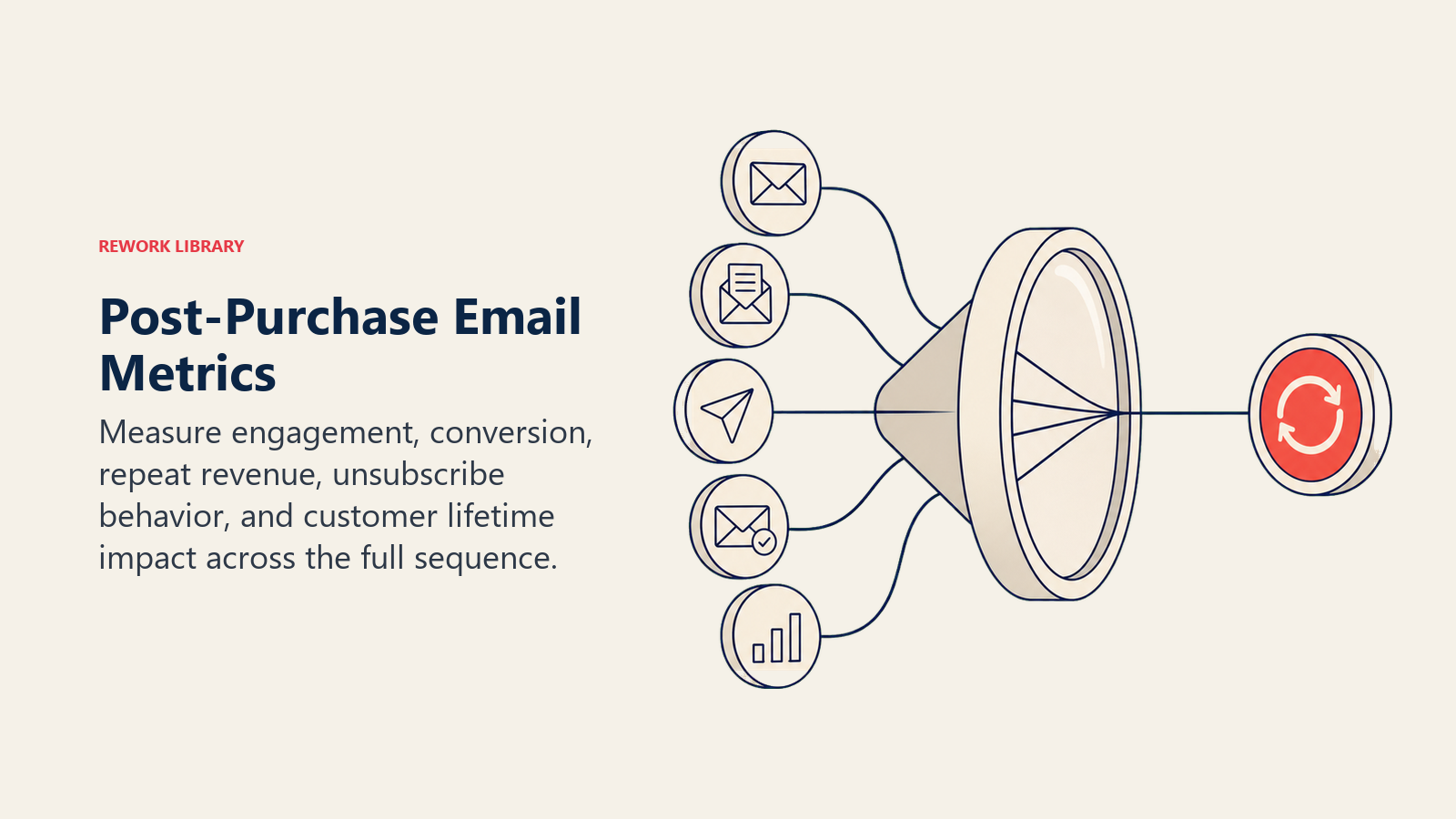
Key metrics to track:
Email performance:
- Open rate: 40-60% for post-purchase emails (higher than promotional)
- Click-through rate: 5-15% depending on email type
- Unsubscribe rate: <0.5% (if higher, you're over-mailing or providing low value)
Business impact:
- Revenue per recipient: Total revenue / total recipients
- Conversion rate: Purchases / emails sent
- Average order value: For cross-sell/upsell sequences
- Customer lifetime value: Impact over 6-12 months
Sequence-specific:
- Review collection rate: Reviews submitted / review requests sent (target 15-25%)
- Replenishment conversion: Reorders / replenishment emails (target 8-12%)
- Loyalty enrollment: Signups / invitations sent (target 20-35%)
Benchmark your sequences against these targets:
Order confirmation: 80%+ open rate, 10-15% click rate, 2-5% purchase rate
Welcome sequence: 50-60% open rate, 8-12% click rate, 15-25% multi-purchase rate within 90 days
Review requests: 40-50% open rate, 15-25% review submission rate
Replenishment: 45-55% open rate, 8-12% reorder rate
Cross-sell: 40-50% open rate, 6-10% click rate, 3-6% purchase rate
Track cohort performance over time using e-commerce metrics and KPIs. Compare customers who went through your post-purchase sequence vs. those who didn't (or who went through before you optimized it). You should see measurably higher repeat purchase rates, higher LTV, and better retention.
A/B test critical elements:
- Subject lines: Personalized vs. generic, benefit-focused vs. curiosity-driven
- Send timing: Day 7 vs. Day 10 for review requests
- Incentive types: Discount vs. points vs. free shipping
- Email length: Short and focused vs. comprehensive guides
- Call-to-action: Single CTA vs. multiple options
Even small improvements compound. A 2% increase in review request conversion means 2% more reviews, which drives higher conversion rates, which increases revenue significantly over time.
Design Best Practices & Mobile Optimization
Over 60% of emails are opened on mobile devices, yet many e-commerce brands send desktop-first emails that look terrible on phones. Your post-purchase sequences must be mobile-optimized from day one.
Mobile design principles:
Single column layouts: Stacking elements vertically works everywhere
Large touch targets: Buttons at least 44x44px, plenty of spacing
Scannable hierarchy: Clear headlines, short paragraphs, bulleted lists
Optimized images: Fast loading, properly sized, alt text for accessibility
Readable text: Minimum 14px font size, high contrast, short line length
Template structure for mobile:
[Logo - centered, 150-200px wide]

[Headline - 24-28px, bold, 1-2 lines max]

[Subheadline - 16-18px, 1-2 lines, explain the value]

[Visual element - product image or illustration]

[Body copy - 14-16px, 2-4 short paragraphs, scannable]

[Primary CTA - Full-width button, contrasting color]

[Supporting elements - Small text links, social proof]

[Footer - Unsubscribe, contact, legal]
Use responsive email templates that adapt to screen size. Test on actual devices (iPhone, Android, iPad, desktop clients). Use email preview tools like Litmus or Email on Acid to catch rendering issues.
Visual hierarchy guides attention to what matters most. In a review request email, the star rating should be the most prominent element. In a cross-sell email, product images and pricing need immediate visibility.
Brand consistency builds recognition. Use your brand colors, fonts, logo placement, and voice consistently across all post-purchase emails. Customers should instantly recognize your emails in their inbox.
Include accessibility features: Alt text for images, semantic HTML, sufficient color contrast, clear link text (avoid "click here"). This helps customers with disabilities and improves deliverability.
Advanced Strategies & Personalization
Basic post-purchase sequences work, but advanced personalization creates exceptional customer experiences that drive loyalty and revenue.
Dynamic content personalization: Show different content blocks based on customer attributes. First-time buyers see educational content, VIP customers see exclusive offers, local customers see regional promotions.
Behavioral triggered sequences: If someone clicks the replenishment email but doesn't buy, send a follow-up with a discount. If they browse recommended products but don't purchase, send a reminder email similar to cart abandonment recovery campaigns.
Predictive analytics: Use machine learning to predict churn risk, optimal send times, product affinity, and lifetime value. Send retention campaigns to at-risk customers before they churn.
Multi-channel orchestration: Coordinate email with SMS, push notifications, and retargeting ads. Send review request via email, follow up via SMS if no response, show social proof ads featuring reviews.
Win-back automation: Identify customers who haven't purchased in 60/90/120 days and trigger re-engagement sequences: "We miss you" emails, special comeback offers, feedback requests to understand why they left.
Anniversary campaigns: Celebrate one year since first purchase, birthdays, subscription anniversaries. These emotional touchpoints strengthen brand relationships.
Surprise and delight: Randomly send unexpected bonuses like free shipping on next order, a surprise upgrade, or exclusive early access. These create memorable experiences that drive word-of-mouth.
The most sophisticated brands use customer data platforms (CDPs) to unify data across touchpoints and deliver truly personalized experiences. But even simple segmentation and dynamic content deliver significant improvements over one-size-fits-all sequences.
Building the Complete System
Your post-purchase email strategy should work as an integrated system, not disconnected campaigns. Map the complete customer journey from order confirmation through loyalty:
Days 0-7: Confirm order, build excitement, prepare for arrival, deliver educational content
Days 7-30: Enable successful first use, collect reviews, introduce complementary products
Days 30-90: Drive repeat purchase through replenishment or recommendations, enroll in loyalty
Days 90+: Maintain engagement through exclusive content, seasonal promotions, community building
Each sequence supports the others. Review requests drive social proof that improves conversion. Cross-sell sequences increase average order value. Replenishment campaigns create predictable revenue through customer retention strategies. Loyalty programs reduce acquisition costs. Together, they transform your customer economics.
The real power of post-purchase email sequences is compound growth. Every improvement to retention and repeat purchase rate creates exponential returns. A customer who buys once is worth X. A customer who buys twice is worth 3X. A customer who buys quarterly for years is worth 50X. Your post-purchase sequences determine which outcome you get.
Start with the fundamentals: solid order confirmations, strategic review requests, basic replenishment reminders. Then layer in personalization and automation sophistication. Test relentlessly, measure everything, optimize continuously.
Frequently Asked Questions about Post-Purchase Email Sequences
What is a post-purchase email sequence?
A post-purchase email sequence is an automated series of emails triggered after a customer buys, starting with an order confirmation and continuing through onboarding, review requests, replenishment reminders, and cross-sell offers. The goal is to turn a single transaction into a relationship that drives repeat purchases and higher lifetime value.
How many emails should a post-purchase sequence include?
A typical first-time-buyer sequence runs five to six emails over 30 days: order confirmation (day 0), welcome and brand story (day 1 to 2), product preparation (day 3 to 5), first-use guide (day 7 to 10), review request (day 14), and a next-purchase incentive (day 21 to 30). Consumable products add replenishment emails timed to the reorder cycle.
When should you send a review request after purchase?
Timing depends on the product. Send 3 to 5 days out for fast-consumption items, 7 to 14 days for standard products, 14 to 21 days for complex electronics or software, and 30 to 60 days for long-cycle goods like furniture. A multi-touch sequence (initial ask, a +3 day reminder, a +7 day last chance) lifts review rates from under 5 percent to 15 to 25 percent.
What open and conversion rates should post-purchase emails hit?
Order confirmations should see 80 percent or higher open rates, welcome sequences 50 to 60 percent, review requests 40 to 50 percent with 15 to 25 percent submission, and replenishment emails 45 to 55 percent open with 8 to 12 percent reorder. Judge sequences on revenue per recipient, not opens alone.
Learn More
For more strategies to maximize customer value after the sale, explore these related resources:
- Email Marketing for E-commerce - Comprehensive email strategy beyond post-purchase sequences
- Customer Retention Strategies - Build long-term customer relationships that drive repeat revenue
- Marketing Automation - Technical implementation of automated email workflows
- Loyalty Programs - Design reward systems that keep customers coming back
The sale is just the beginning. What you do after determines everything that follows.

On this page
- The Post-Purchase Email Journey
- Order Confirmation Email Strategy
- Welcome & Onboarding Sequences
- Review Request Sequences
- Replenishment & Reorder Campaigns
- Cross-Sell & Upsell Sequences
- Customer Feedback & Loyalty Integration
- Technical Implementation & Automation
- Performance Metrics & Analytics
- Design Best Practices & Mobile Optimization
- Advanced Strategies & Personalization
- Building the Complete System
- Learn More