Product Research & Validation: Market Discovery Before Launch
Turn this article into takeaways for your work.


Each assistant summarizes the article only for you and suggests best practices for your work.
Here's a painful truth about e-commerce: 72% of new products fail within their first year. Not because they're terrible products, but because nobody validated whether customers actually wanted them before committing tens of thousands of dollars to inventory, marketing, and operations.
I've watched brands invest $50,000 into inventory for products that sold maybe 30 units total. I've seen entrepreneurs mortgage their homes for "revolutionary" products that already had three better competitors on Amazon. Most of these failures were completely preventable with just 2-3 weeks of systematic research and validation.
The good news? Brands that invest in proper product research and validation reduce their launch failure rate by 60-75%. They don't just avoid disasters. They uncover opportunities their competitors miss entirely.
Here's how to validate product demand before you risk serious capital.
Why Product Research Actually Matters
Product research isn't about being cautious or slow. It's about being smart with your capital and time.
The real benefits:
Risk reduction: Validating demand before production cuts your failure rate by 60-75%. You're testing assumptions with hundreds or thousands of dollars instead of betting tens of thousands on hope.
Customer insight: Research reveals the actual pain points customers experience, not what you think they need. This shapes everything from product features to marketing messaging to pricing strategy.
Cost savings: Finding out a product won't work costs $2,000-5,000 in research. Finding out after production costs $30,000-100,000 in dead inventory.
Competitive advantage: Thorough research uncovers underserved niches, feature gaps, and positioning angles your competitors haven't discovered yet.
Faster iteration: When you validate incrementally, you learn faster and pivot cheaper than brands that go all-in on their first guess.
The brands crushing it in e-commerce aren't the ones with the best instincts, they're the ones with the best research processes.
Market Research Framework
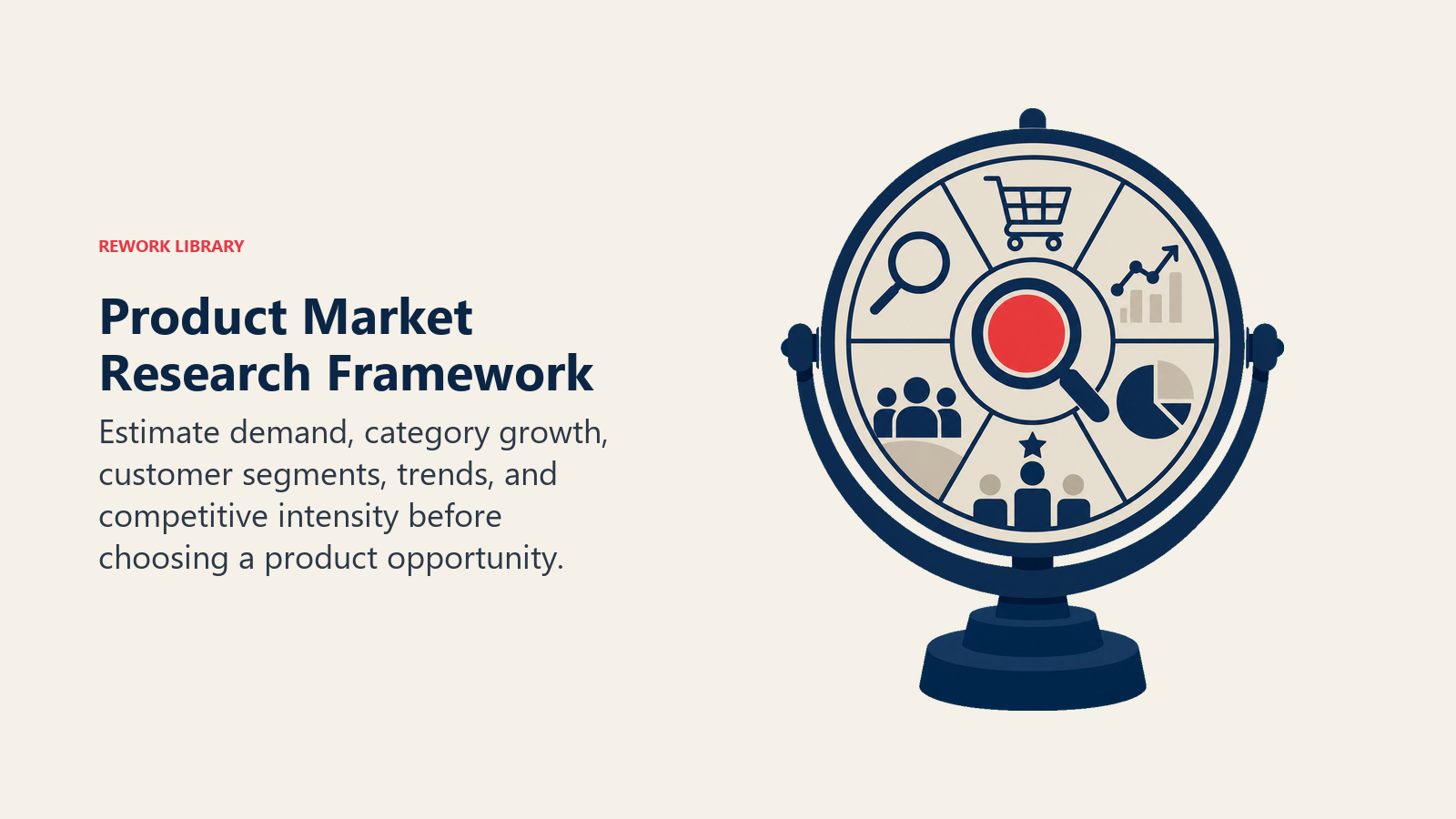
Effective product research starts with understanding the market landscape. Here's the framework that actually works:
Demand Estimation
Start by estimating actual market demand, not just market size:
Search volume analysis: Use tools like Google Keyword Planner, Ahrefs, or SEMrush to find monthly search volume for your product category and variations. Look for 10,000+ monthly searches for viable products.
Marketplace demand: Check Amazon Best Sellers Rank (BSR) for similar products. Products with BSR under 50,000 in their category typically sell 100+ units monthly. Under 10,000 means serious volume. Learn more about leveraging Amazon FBA strategy for marketplace validation.
Trend analysis: Google Trends shows whether demand is growing, stable, or declining. You want upward or stable trends over 2-3 years, not temporary spikes.
Social signals: Check hashtag volume on Instagram and TikTok. Products with 100,000+ posts in their category show real consumer interest.
TAM/SAM/SOM Analysis
Size your market realistically:
Total Addressable Market (TAM): The total market demand for your product category. Example: The US organic skincare market is $2.3 billion annually.
Serviceable Addressable Market (SAM): The portion you can actually reach with your business model. Example: Online organic face serums for women 25-45 = $180 million.
Serviceable Obtainable Market (SOM): What you can realistically capture in year one. Example: 0.05% market share = $90,000 in revenue.
If your SOM doesn't support profitable unit economics, you need a different product or positioning.
Competitive Landscape Mapping
Understand who you're competing against:
Direct competitors: Products that solve the exact same problem the same way. List 5-10 major players with their pricing, positioning, and estimated revenue.
Indirect competitors: Different products that solve the same customer problem. A meal kit competes with restaurants, not just other meal kits.
Market saturation: If you find 50+ similar products on Amazon all with weak reviews and low sales, that's a saturated market with weak demand. But if you find 5-10 products all thriving with strong reviews, that's validated demand with room for differentiation.
Price positioning: Map competitors by price and quality. Look for white space where customer demand exists but no strong competitor serves that segment. Develop your approach with our pricing strategy optimization guide.
Demand Validation Methods
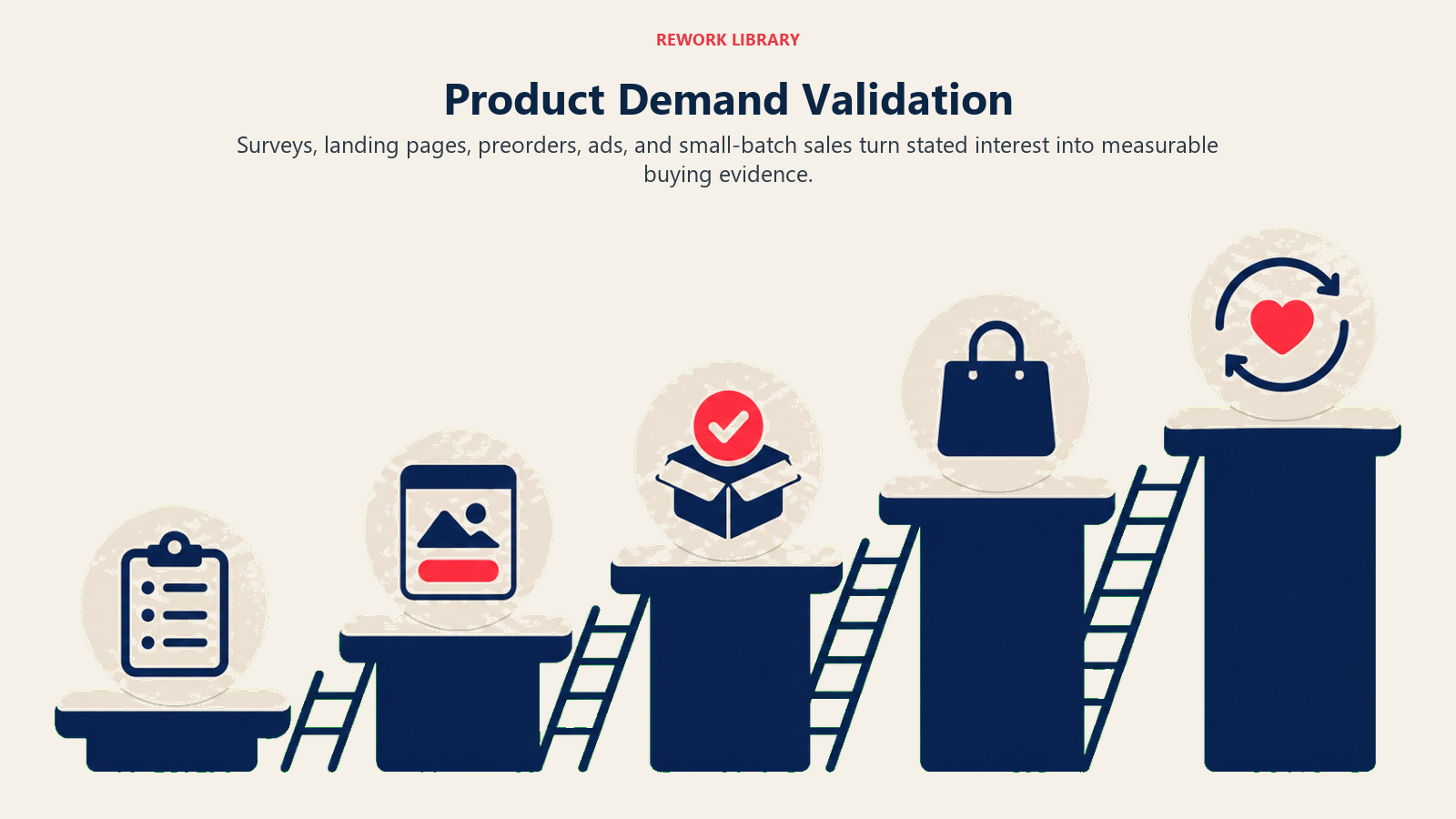
Research gives you hypotheses. Validation gives you proof. Here are the methods that actually work:
Surveys & Market Research
Surveys are cheap validation, but only if you do them right:
Target audience: Survey people who actually buy products in your category, not just anyone who'll answer. Use Facebook Ads or Google Surveys to target your demographic.
Sample size: Get at least 200-300 responses for statistically meaningful results. Fewer responses work for niche B2B products.
Question framework:
- "How do you currently solve [problem]?" (reveals current solutions)
- "What frustrates you about [current solution]?" (uncovers pain points)
- "Would you pay $X for a product that [benefit]?" (tests price sensitivity)
- "How often do you buy [product category]?" (estimates purchase frequency)
Validation threshold: If less than 40% say they'd "definitely" or "probably" buy at your target price, you have a demand problem.
Waitlists & Landing Pages
Build a simple landing page describing your product and collect emails from interested buyers:
Setup: Create a one-page site with compelling copy, product images (mockups are fine), and an email signup form. Tools like Carrd, Webflow, or Unbounce work perfectly.
Traffic: Drive 500-1,000 visitors using Facebook/Instagram Ads, Google Ads, or Reddit targeting your audience. Budget $200-500 for this test.
Conversion benchmark: If 15-25% of visitors sign up for your waitlist, you have strong demand. Under 5% means weak interest or poor messaging.
Email validation: Email your waitlist offering early access or pre-orders. If 20%+ actually buy, you've validated real demand, not just curiosity.
Crowdfunding Campaigns
Kickstarter and Indiegogo aren't just for raising funds, they're validation engines:
Campaign setup: Create a professional campaign with video, detailed product specs, and compelling story. Set your funding goal at your minimum viable production quantity.
Success threshold: Reaching 30% of your goal in the first 48 hours predicts campaign success. Hitting your goal validates demand. Exceeding 200%+ means you've hit product-market fit.
Customer feedback: Read every comment and message. Backers tell you exactly what features matter, what concerns they have, and what price feels right.
Post-campaign learning: Whether you fund or not, you've validated (or invalidated) demand with real purchase intent, not just survey responses.
Pre-Orders & Limited Drops
The ultimate validation: getting customers to pay before you manufacture:
Pre-order setup: List your product as available for pre-order with a 4-8 week ship time. Be transparent about the timeline.
Limited drop testing: Produce 50-100 units and sell them as a limited edition. This tests demand without committing to massive inventory.
Validation metrics: If you sell through 50-100 units in 2-4 weeks with minimal marketing, scale up. If it takes 8+ weeks, you have a demand or positioning problem.
Ad Testing & Traffic Validation
Run small ad campaigns to test interest before building inventory:
Facebook/Instagram ads: Create 3-5 ad variations showcasing your product. Drive traffic to a landing page with email signup or pre-order option.
Cost per acquisition: If you're getting email signups for under $5 or pre-orders for under $30, you have viable traffic acquisition economics.
Engagement signals: High click-through rates (1.5%+) and low cost-per-click (under $1.50) suggest strong product-market fit.
Google Shopping ads: If you can get clicks at $0.50-1.00 CPC, your product has search demand.
Competitor Analysis Essentials
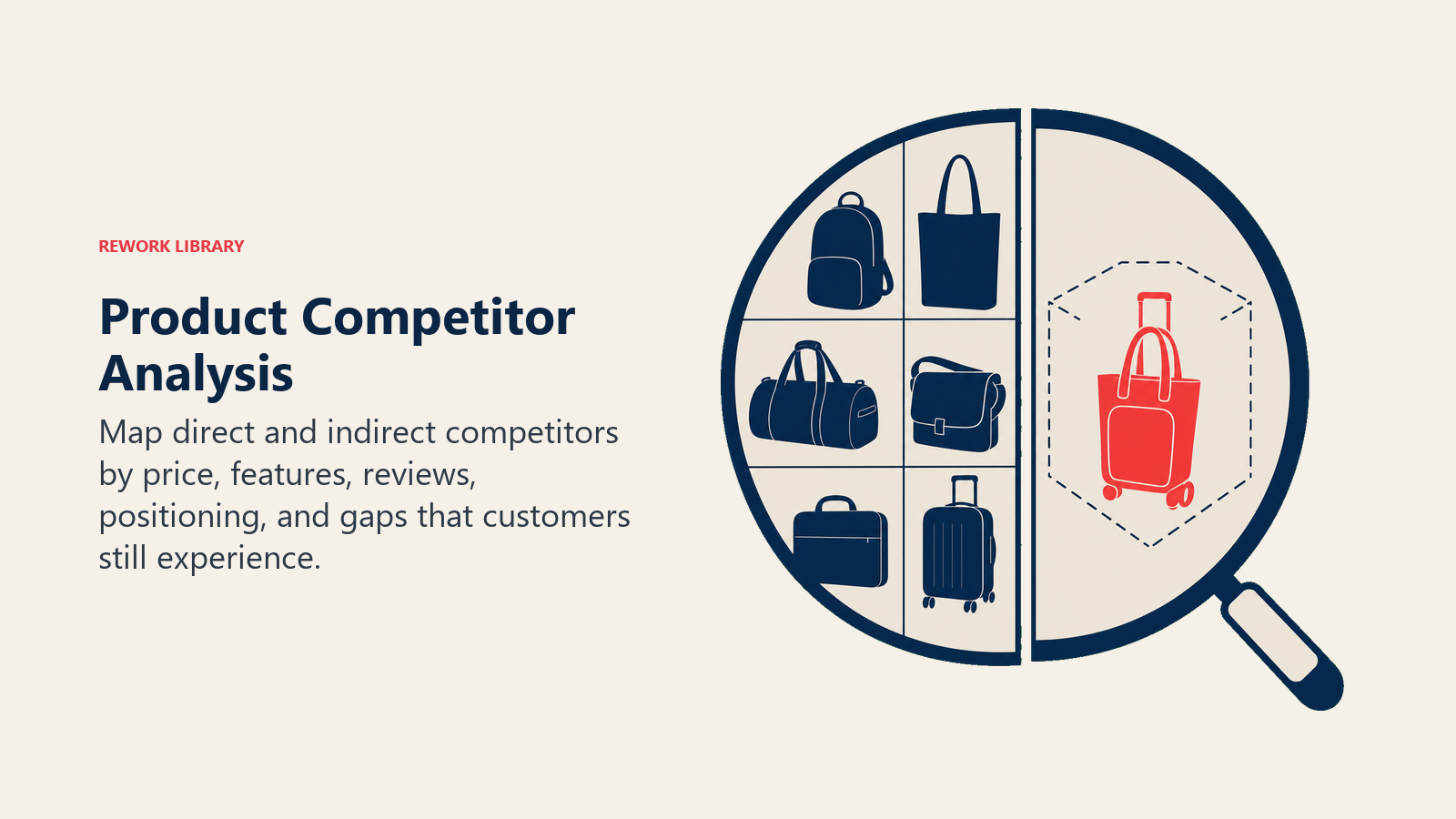
Understanding your competition reveals gaps you can exploit:
Direct vs. Indirect Competitors
Direct competitors: List every brand selling the same product type. Analyze their:
- Pricing strategy and promotions
- Product features and quality
- Review volume and ratings (4.5+ stars means they're doing something right)
- Marketing channels and messaging
- Estimated revenue (use tools like JungleScout for Amazon sellers)
Indirect competitors: Identify different products solving the same customer problem. A standing desk competes with exercise balls and ergonomic chairs, not just other standing desks.
Feature Mapping & Gap Analysis
Create a spreadsheet comparing your product concept to top competitors:
Features matrix: List key features down the left column, competitors across the top. Mark which features each offers.
Gap identification: Look for features customers request in reviews but no competitor offers. These are your differentiation opportunities.
Over-served segments: Find features every competitor includes but reviews suggest customers don't value. You can simplify and reduce costs here.
Under-served segments: Identify customer segments (price points, use cases, demographics) where no strong competitor exists.
Review Mining for Insights
Competitor reviews are free market research:
What to look for:
- 3-star reviews reveal product weaknesses you can solve
- 1-star reviews show deal-breaker flaws to avoid
- 5-star reviews highlight must-have features and emotional benefits
- Question sections reveal confusion about features, sizing, usage
Process: Read 100+ reviews for your top 3-5 competitors. Use tools like ReviewMeta or FeedbackWhiz to automate analysis for Amazon products.
Validation: If 40%+ of reviews mention the same complaint, and you can solve it, you've found your differentiation angle.
Customer Interview & Discovery
Surveys and data give you breadcrumbs. Conversations give you the full story.
Interview Methodology
Who to interview: 15-25 people who:
- Currently buy products in your category (not people who might someday)
- Represent your target demographic
- Have purchased similar products in the last 6 months
Where to find them: Facebook groups, Reddit communities, customer lists from complementary products, Upwork for paid interviews ($25-50 per 30-minute call).
Interview structure:
- Current behavior: "Walk me through the last time you bought [product category]."
- Pain points: "What's frustrating about the options available?"
- Decision factors: "What made you choose that specific product?"
- Ideal solution: "If you could design the perfect version, what would it include?"
- Price sensitivity: "What would you expect to pay for that?"
Recording & synthesis: Record calls (with permission), transcribe key quotes, and look for patterns across 15+ interviews.
Synthesizing Feedback
After 15-25 interviews:
Pattern recognition: What pain points did 60%+ of interviewees mention? Those are your core problems to solve.
Feature prioritization: What features did customers describe without prompting? Those are must-haves. What did they mention only when asked? Those are nice-to-haves.
Messaging insights: How do customers describe the problem in their own words? Use their language in your marketing.
Segmentation: Do different customer types have different needs? You might need multiple products or positioning strategies.
MVP Testing Strategies
Don't build the full product until you've validated with a minimum viable version:
Feature Prioritization
Use the MoSCoW method:
Must-have: Core features required for the product to function and solve the primary problem. These are non-negotiable.
Should-have: Important features that significantly improve the experience but aren't essential for launch.
Could-have: Nice-to-have features that provide marginal value. Save these for version 2.
Won't-have: Features customers request but don't align with your positioning or economics.
Your MVP should only include must-haves and 1-2 critical should-haves.
Prototype Testing
Test before production:
Physical products: Create 3D-printed prototypes, hand-made samples, or mockups. Get them in customers' hands for feedback on design, sizing, functionality.
Digital mockups: For apparel or designed products, create photorealistic mockups and test them via landing pages or social ads.
Beta programs: Produce 25-50 units and give them to customers for 30-60 days in exchange for detailed feedback.
Feedback collection: Use surveys, one-on-one calls, and usage tracking (if digital). Focus on what customers do, not just what they say. Establish a systematic customer feedback loop for ongoing insights.
Iteration Cycles
Plan for 2-4 iteration cycles:
Cycle 1: Test core concept with mockups or prototypes. Validate that customers want this product category at your target price.
Cycle 2: Test first physical samples with beta users. Refine features, quality, sizing, packaging based on usage.
Cycle 3: Test production-quality samples with 25-50 early customers. Validate that your manufacturing quality meets expectations.
Cycle 4: Soft launch with 100-250 units to test full customer experience including shipping, support, and post-purchase satisfaction.
Each cycle should cost $500-3,000, much cheaper than discovering problems after ordering 5,000 units.
Data Sources & Tools
Use these resources to accelerate your research:
Market Research Tools
Google Trends: Free trend analysis showing demand patterns over time. Compare multiple product variations to see which has stronger interest.
Keyword research: Ahrefs ($99/month), SEMrush ($119/month), or free Google Keyword Planner for search volume data.
Jungle Scout ($29+/month): Amazon product research showing estimated sales, revenue, and competition level.
SimilarWeb (free & paid): Traffic analysis for competitor websites.
Marketplace Research
Amazon: Search your product category and analyze:
- Best Sellers Rank for top products
- Review count and ratings
- Price distribution
- Feature variations in listings
Etsy: Great for handmade and unique product research. Shows what customers will pay for quality and customization.
eBay sold listings: Shows real transaction prices for established product categories.
AliExpress/Alibaba: Research what's already being manufactured and at what costs. Identify suppliers and MOQs. Plan your full product sourcing strategy after validation.
Social Listening Tools
BuzzSumo ($99+/month): Content and influencer research showing what resonates in your category.
Mention ($29+/month): Track brand mentions and conversations about your product category.
Native platform search: Use Instagram, TikTok, and Reddit search to find authentic customer conversations, complaints, and desires.
Industry Databases
IBISWorld: Industry research reports with market size, growth, and trend data.
Statista: Statistics and market data across thousands of categories.
Trade associations: Industry-specific associations often publish free market research and trend reports.
Iterative Validation Cycles
Product validation isn't one-and-done, it's a continuous learning process:
Hypothesis-Driven Testing
Frame each test as a hypothesis:
Demand hypothesis: "We believe that [customer segment] will pay [$X] for [product] because [reason]."
Feature hypothesis: "We believe that [feature] will increase purchase intent by [Y%] for [customer segment]."
Positioning hypothesis: "We believe that positioning this as [angle] will resonate more than [current angle] with [audience]."
Test design: Define how you'll test (survey, landing page, prototype, etc.), what success looks like (conversion rate, signup rate, feedback), and timeline.
Learn and iterate: If validated, scale up. If invalidated, pivot your hypothesis and test again.
Learning from Failures
Failed tests aren't failures, they're cheap learning:
Low survey interest: Your positioning might be off, or the market doesn't care about your differentiation. Try different messaging or features.
Low landing page conversions: Test different value propositions, pricing, images, or social proof. Run A/B tests systematically.
Poor prototype feedback: Customers tell you what's wrong. Listen and iterate. Sometimes the core concept is solid but execution needs work.
No pre-order traction: This is the hardest signal, demand might not exist at your price point or positioning. Consider pivoting to a different product or market segment.
The brands that win aren't the ones who nail it first try, they're the ones who learn fastest from each test.
Go/No-Go Decision Framework
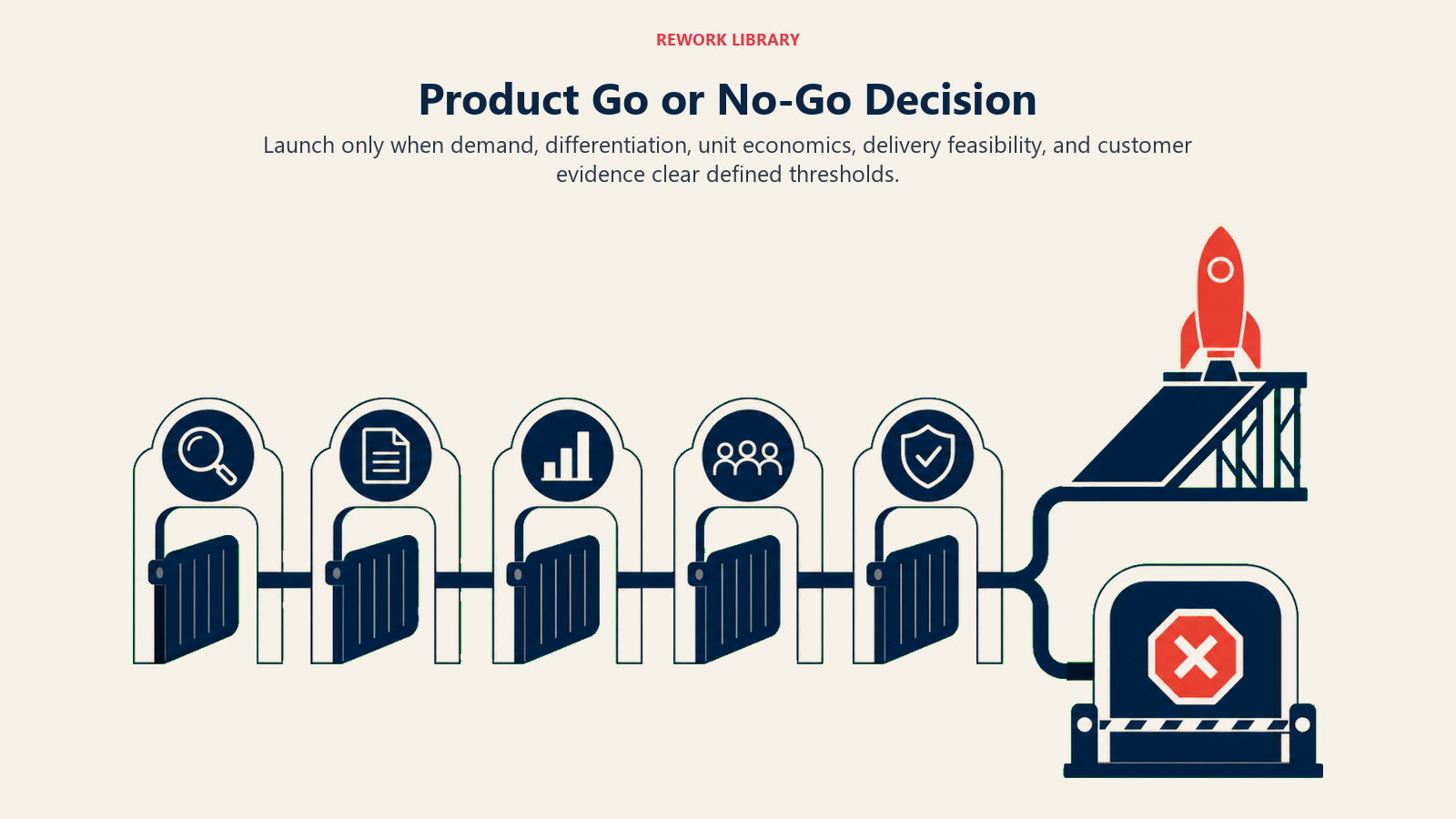
After validation, use this framework to decide whether to launch:
Key Validation Metrics
You need green lights on at least 4 of these 5:
1. Demand validation:
- Waitlist conversion: 15%+ signup rate, 20%+ email-to-purchase
- Pre-orders: Sold 50+ units in 4 weeks
- Survey intent: 40%+ would "definitely" or "probably" buy
2. Competition validation:
- Identified clear differentiation from top 3 competitors
- Found underserved segment or feature gap
- Can match or beat competitor quality at similar/better price
3. Economic validation:
- Unit economics show 40%+ gross margins
- Customer acquisition cost under 30% of customer lifetime value
- Can reach profitability within 12 months at reasonable scale
4. Customer feedback validation:
- 80%+ of beta testers would recommend
- Prototype NPS score of 40+
- Less than 20% requested major changes
5. Market size validation:
- SOM supports $100,000+ annual revenue
- Market growing or stable, not declining
- Can build sustainable competitive advantage
Risk Assessment Matrix
Evaluate risk levels:
High risk, proceed with caution:
- Weak demand signals (under 40% purchase intent)
- Saturated market with 20+ strong competitors
- Tight margins (under 35% gross margin)
- High MOQs requiring $20,000+ investment
- Unproven manufacturing or supply chain
Medium risk, validate further:
- Moderate demand (40-60% purchase intent)
- 5-10 competitors with mixed success
- Decent margins (35-45%)
- Some customer feedback concerns
- Seasonal or trend-dependent demand
Low risk, good to launch:
- Strong demand (60%+ purchase intent)
- Clear differentiation from 3-5 competitors
- Healthy margins (45%+)
- Enthusiastic customer feedback
- Proven supply chain with reasonable MOQs
Pivot vs. Persist Decision
Pivot if:
- Multiple validation tests fail despite messaging/pricing iterations
- Customer interviews reveal you're solving the wrong problem
- Market research shows declining demand or overcrowding
- Economics don't work even with optimization
Persist if:
- Core demand signals are positive but execution needs refinement
- Customer feedback is constructive, not fundamental rejection
- One or two metrics are weak but fixable
- You're learning and improving with each iteration
Kill it if:
- No validation method shows positive signals
- Customers consistently say "nice but wouldn't buy"
- Market too small or shrinking too fast
- Economics fundamentally broken (can't achieve 30%+ margins)
The hardest decision is killing a product you're excited about. But killing it after $5,000 in research beats losing $50,000 in inventory.
Scaling After Validation
Once validated, here's how to scale intelligently:
From Testing to Production
Conservative first order: Even after validation, order 2-3x your test volume, not 10x. If you sold 100 units in testing, order 200-300 for launch.
Inventory planning: Use your validation data to forecast demand. Apply the conversion rates from landing pages to your traffic projections. See inventory management for detailed planning.
Supply chain setup: Negotiate payment terms, production timelines, and quality controls with manufacturers before placing large orders.
Quality assurance: Order and inspect production samples before approving bulk manufacturing. Small quality issues scale into major problems.
Launch Strategy Integration
Connect your validation insights to your product launch strategy:
Messaging: Use the exact language customers used in interviews and surveys. They told you what resonates.
Feature emphasis: Highlight the features that tested best and solve the pain points you validated.
Pricing strategy: Launch at the price point that tested best. You can always adjust, but start validated.
Marketing channels: Focus on the channels that drove your best validation metrics (email, social ads, influencers, etc.).
Continuous Validation
Validation doesn't stop at launch:
Monitor metrics: Track conversion rates, return rates, review ratings, and customer feedback daily in the first month. Set up comprehensive e-commerce metrics and KPIs tracking.
Customer surveys: Email customers 30 days post-purchase asking for detailed feedback.
Review analysis: Read every review in your first 100 sales. Look for patterns in complaints or praise.
Iterate quickly: Fix issues immediately. If sizing is off, update listings and samples. If messaging misses the mark, test new copy.
Product expansion: Use customer feedback to guide your product line expansion strategy.
Optimization Cycles
Plan for ongoing optimization:
Month 1-3: Focus on conversion rate optimization, improving product pages, checkout, and messaging.
Month 4-6: Optimize acquisition, scaling proven channels and testing new ones.
Month 7-12: Refine product, address common feedback, improve quality, add requested features in version 2.
The brands that dominate their categories don't just validate once, they continuously learn from every customer interaction.
Common Pitfalls to Avoid
Watch out for these validation mistakes:
Confirmation Bias
The trap: You want your product to succeed, so you unconsciously interpret data to support launching.
How it shows up:
- Focusing on the 30% who liked your product, ignoring the 70% who didn't
- Dismissing negative feedback as "they're not our target customer"
- Cherry-picking survey responses that support your hypothesis
How to avoid it: Set validation criteria before testing. If less than 40% show purchase intent, you fail the test, no exceptions, no excuses.
Insufficient Sample Sizes
The trap: Making decisions based on 10 survey responses or 3 customer interviews.
Minimum thresholds:
- Surveys: 200+ responses
- Customer interviews: 15+ conversations
- Landing page tests: 500+ visitors
- Pre-orders: 50+ units sold
Why it matters: Small samples create false signals. Ten enthusiastic friends don't predict market demand.
Ignoring Negative Feedback
The trap: Discounting criticism as "haters" or "people who don't get it."
Reality check: If multiple customers raise the same concern, it's real. If 40% of feedback is negative on a specific feature, fix it or remove it.
Healthy approach: Negative feedback is the most valuable. It prevents expensive mistakes and reveals what competitors aren't solving.
Skipping Economic Validation
The trap: Validating demand without validating that you can make money.
What to check:
- Can you manufacture at a cost that allows 40%+ gross margins?
- Can you acquire customers at a cost under 30% of lifetime value?
- Can you handle returns, support, and overhead while staying profitable?
Reality: Demand without economics is a hobby, not a business.
Testing the Wrong Audience
The trap: Surveying or showing prototypes to people who would never buy.
Wrong audiences:
- Your friends and family (they're biased)
- General population surveys (too broad)
- People outside your demographic or psychographic target
Right approach: Only validate with people who currently buy products in your category and match your target customer profile.
Your Next Steps
Product validation isn't about being perfect, it's about being smart with your resources. Here's how to start:
Week 1: Market research and competitive analysis. Size your opportunity and understand the landscape.
Week 2-3: Customer interviews and surveys. Talk to 15-25 target customers and survey 200+ people.
Week 4-5: Create landing page and run traffic test. Measure signup rates and pre-order conversion.
Week 6-8: Prototype testing with 25-50 beta customers. Refine based on actual usage feedback.
Week 9: Go/no-go decision using the validation framework. Proceed only with strong signals.
Week 10+: First production order and soft launch if validated. Otherwise, pivot and test a new hypothesis.
The difference between successful e-commerce brands and failed ones isn't luck or timing, it's systematic validation before investment. The brands that make it don't bet on hope. They validate with data, iterate with feedback, and scale with confidence.
Stop guessing what customers want. Start proving it before you commit serious capital.
Want to nail your launch after validation? Check out our guide on product launch strategy.
Need to understand if your economics work? See unit economics for e-commerce.
Ready to identify your winning product? Learn about the hero product strategy.

On this page
- Why Product Research Actually Matters
- Market Research Framework
- Demand Estimation
- TAM/SAM/SOM Analysis
- Competitive Landscape Mapping
- Demand Validation Methods
- Surveys & Market Research
- Waitlists & Landing Pages
- Crowdfunding Campaigns
- Pre-Orders & Limited Drops
- Ad Testing & Traffic Validation
- Competitor Analysis Essentials
- Direct vs. Indirect Competitors
- Feature Mapping & Gap Analysis
- Review Mining for Insights
- Customer Interview & Discovery
- Interview Methodology
- Synthesizing Feedback
- MVP Testing Strategies
- Feature Prioritization
- Prototype Testing
- Iteration Cycles
- Data Sources & Tools
- Market Research Tools
- Marketplace Research
- Social Listening Tools
- Industry Databases
- Iterative Validation Cycles
- Hypothesis-Driven Testing
- Learning from Failures
- Go/No-Go Decision Framework
- Key Validation Metrics
- Risk Assessment Matrix
- Pivot vs. Persist Decision
- Scaling After Validation
- From Testing to Production
- Launch Strategy Integration
- Continuous Validation
- Optimization Cycles
- Common Pitfalls to Avoid
- Confirmation Bias
- Insufficient Sample Sizes
- Ignoring Negative Feedback
- Skipping Economic Validation
- Testing the Wrong Audience
- Your Next Steps