E-commerce SEO Strategy: Technical Optimization, Content, and Link Building for Online Retail
 43% of e-commerce traffic comes from organic Google search. That's not branded searches from people who already know you. That's discovery traffic from people searching for products you sell.
Turn this article into takeaways for your work.


Each assistant summarizes the article only for you and suggests best practices for your work.
And most e-commerce companies are terrible at SEO. They treat it like a technical checklist you complete once, or they chase ranking for vanity keywords that don't drive revenue. Meanwhile, competitors who actually understand SEO are capturing thousands of high-intent buyers every month through effective traffic acquisition strategy.
If you're a growth leader at an e-commerce company, SEO isn't optional anymore. It's the most sustainable acquisition channel you have. Unlike paid advertising, organic rankings compound over time. That product page you optimize today generates sales for years.
Why SEO Matters More for E-commerce Than Other Industries
E-commerce has a unique advantage in SEO that most retailers don't leverage: product-intent searches have commercial value built in. When someone searches "project management software," they're researching. They might buy in six months. When someone searches "Nike Air Max 270 men's size 11 black," they're ready to buy right now. That's bottom-funnel traffic at scale.
The economics make it even more compelling. A typical e-commerce site might pay $2-8 per click on Google Shopping for high-intent keywords. Rank organically for those same terms, and your acquisition cost drops to essentially zero after the upfront SEO investment.
Let's look at the unit economics. If you're spending $50,000/month on Google Ads at 2% conversion rate and $100 average order value, you're generating $100,000 in revenue at 50% advertising cost. Now layer in organic SEO that drives an additional 20% of that traffic at zero marginal cost. Your blended CAC drops from $50 to $40, immediately improving unit economics.
But most companies mess this up: they think SEO is about ranking #1 for their category. That's not the game. The game is ranking for hundreds or thousands of long-tail product searches that collectively drive more revenue than any single keyword.
Technical SEO Foundation: The Stuff That Breaks Everything
Before you even think about content or links, you need technical infrastructure that doesn't sabotage your rankings. E-commerce sites have unique technical challenges that SaaS or content sites don't face.
Site Structure and URL Architecture
Your URL structure needs to be logical for both users and crawlers. The problem is that e-commerce sites often have complex category hierarchies with multiple navigation paths to the same product. A product might live under:
/mens-shoes/running/nike-air-max-270//nike/shoes/running/air-max-270//sale/mens-running-shoes/air-max-270/
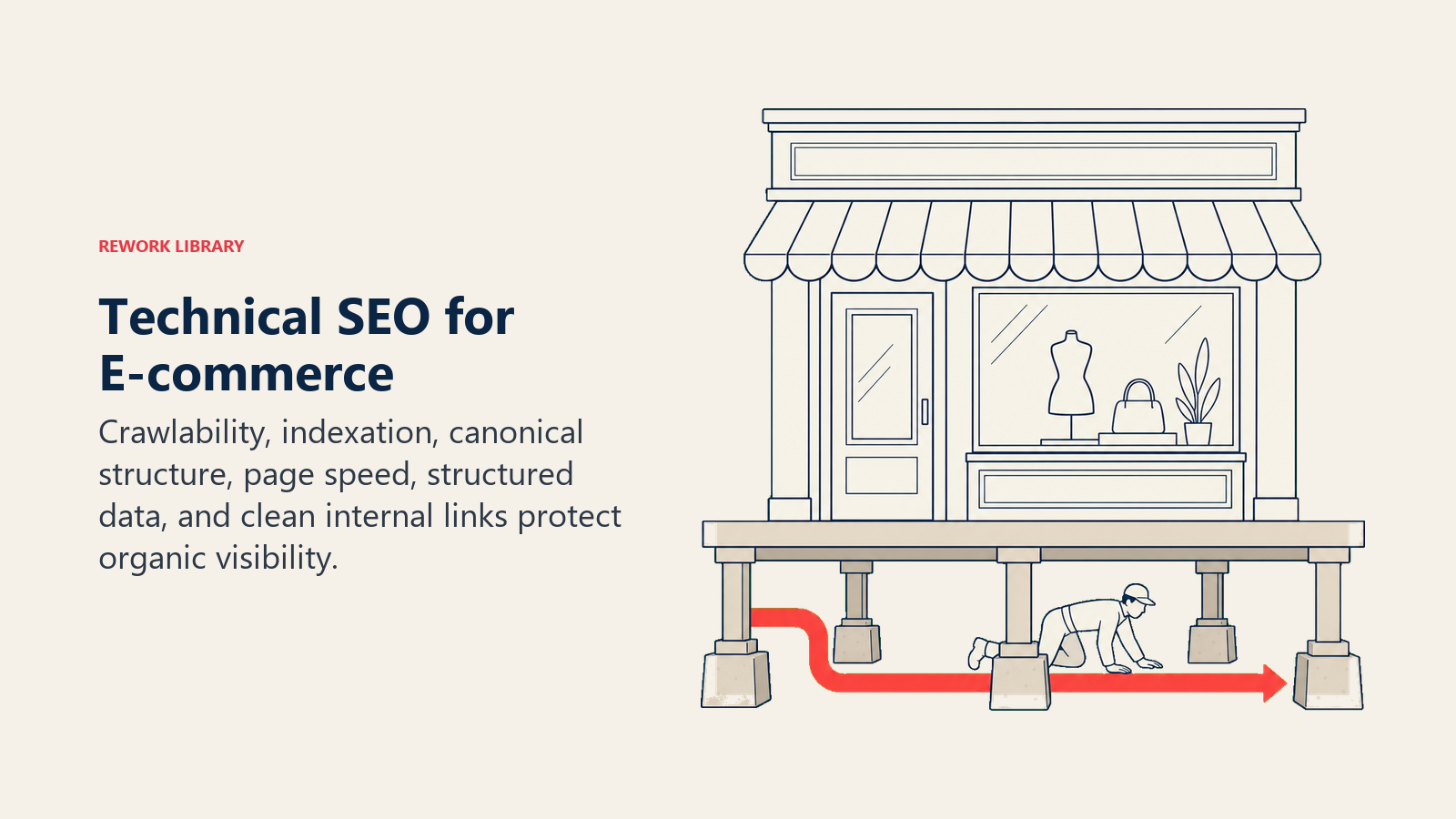
Google sees these as three different pages with duplicate content. That's a problem.
The solution: pick one canonical URL structure and stick with it. Use canonical tags to tell Google which version is the "real" one. For most sites, a category-first structure makes sense: /category/subcategory/product-name/.
Keep URLs clean and descriptive. /products/12847345 tells nobody anything. /mens-running-shoes/nike-air-max-270-black/ is instantly clear.
Site Speed and Core Web Vitals
Google explicitly uses page speed as a ranking factor, but more importantly, speed directly impacts conversion. Amazon found that every 100ms of latency costs them 1% in sales.
Core Web Vitals measure three things:
- Largest Contentful Paint (LCP): How quickly the main content loads (target: under 2.5 seconds)
- First Input Delay (FID): How quickly the page responds to user interactions (target: under 100ms)
- Cumulative Layout Shift (CLS): How much the page jumps around while loading (target: under 0.1)
E-commerce sites struggle with these metrics because of heavy product images, multiple tracking scripts, and complex JavaScript frameworks. That's why site speed optimization is critical.
Common fixes that actually move the needle:
- Use modern image formats (WebP) with lazy loading
- Minimize JavaScript execution time
- Leverage browser caching aggressively
- Use a CDN for static assets
- Optimize for mobile-first indexing since 60%+ of e-commerce traffic is mobile
Don't just run PageSpeed Insights once and call it done. Monitor real user metrics monthly and fix regressions immediately.
Mobile-First Indexing
Google crawls and indexes your mobile site, not your desktop site. If your mobile experience is broken, your rankings suffer regardless of how good your desktop site is.
This matters enormously for e-commerce. Mobile users behave differently, they want fast load times, easy navigation, and simple checkout flows optimized through mobile commerce optimization.
Common mobile SEO mistakes:
- Hidden content in accordions that users (and crawlers) never expand
- Tiny product images that require zooming
- Forms that are impossible to fill out on small screens
- Interstitials that block content
- Different content on mobile vs desktop (Google hates this)
Test everything on actual devices, not just Chrome DevTools. Your iPhone experience might be perfect while Android users see a broken mess.
Schema Markup and Structured Data
Schema markup tells search engines exactly what's on your page in a format they can understand. For e-commerce, this is gold because it enables rich snippets that increase click-through rates.
Product schema lets you show:
- Star ratings
- Price
- Availability (in stock/out of stock)
- Brand
These rich results take up more space in search results and signal trust. A listing with 4.5 stars and "In stock" gets clicked more than a plain blue link.
Beyond products, implement schema for:
- Organization markup (logo, social profiles, contact info)
- Breadcrumb markup (shows navigation path in results)
- Review markup (aggregate ratings)
- FAQ markup (expands your result with questions)
Use Google's Rich Results Test to validate your markup. If it's not working, you're not getting the benefit.
Product and Category Page SEO: Where Revenue Happens
This is where e-commerce SEO diverges completely from other industries. Your product and category pages ARE your money pages. Blog content supports them, but these pages drive sales.
Category Page Optimization
Category pages are your biggest SEO opportunity. Each one can rank for dozens of related keywords and capture significant search volume. The anatomy of an optimized category page:
- Descriptive title tag: "Men's Running Shoes - Nike, Adidas, Brooks | Free Shipping"
- Clear H1 that matches search intent: "Men's Running Shoes"
- Unique category description (200-300 words minimum) explaining what's in the category and why someone should buy from you
- Faceted navigation that lets users filter by brand, size, color, price
- Product grid with clear images, pricing, and CTAs through effective product page optimization
- SEO-friendly pagination or infinite scroll implementation
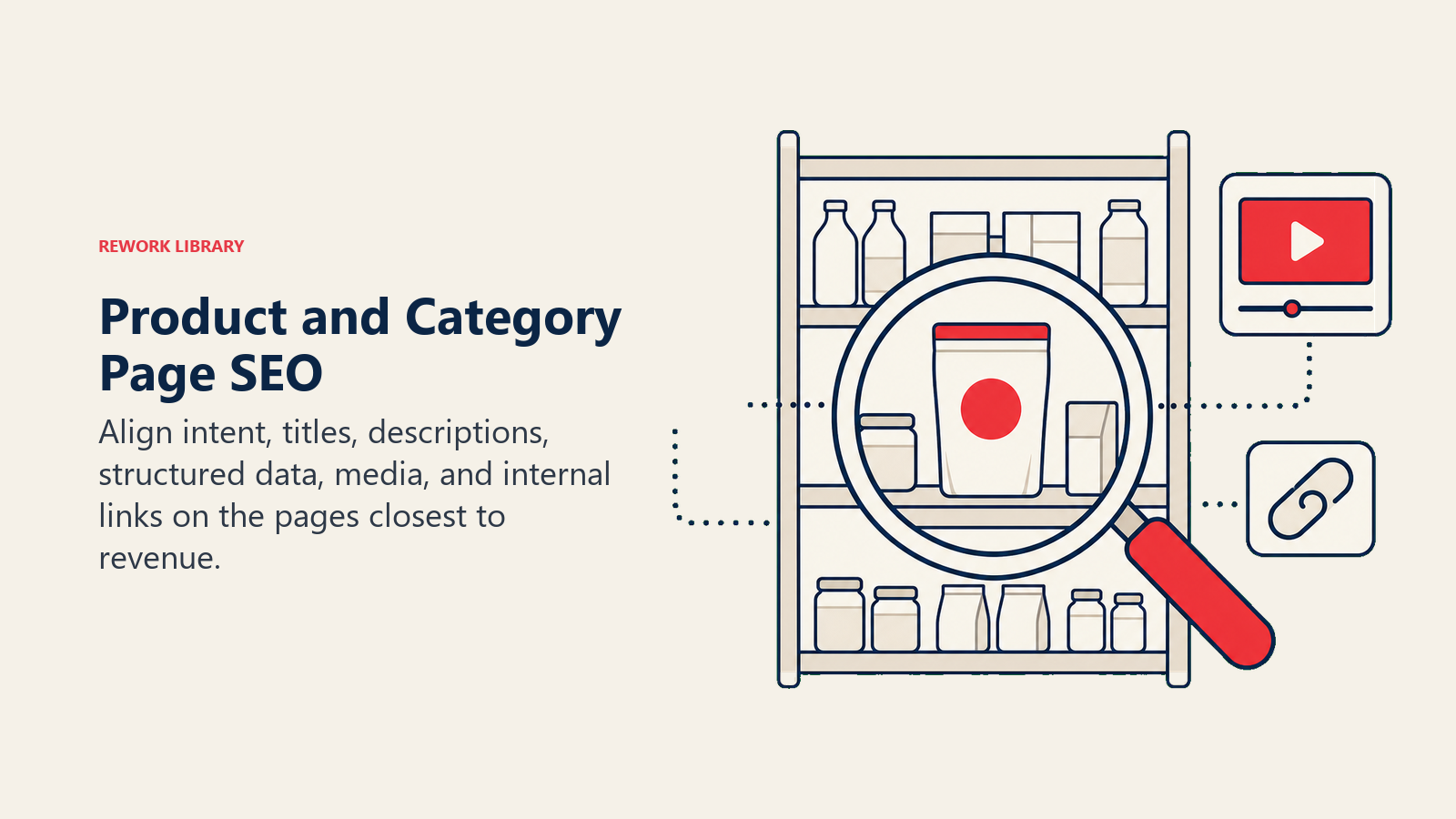
The biggest mistake? Thin content. A category page with just a heading and product grid has nothing for Google to rank. Add context, answer common questions, and differentiate yourself.
Learn more about advanced category page optimization techniques that balance user experience with SEO requirements.
Product Page SEO Best Practices
Individual product pages face a different challenge: how do you create unique, rankable content for products that might have hundreds of similar variants?
Key elements of optimized product pages:
- Unique product descriptions (never copy manufacturer descriptions, everyone else does)
- High-quality images with descriptive alt text through product photography and video
- Customer reviews through customer reviews and user-generated content that's unique and constantly updated
- Detailed specifications in structured tables
- Related products with internal linking
- FAQ sections answering common questions about the product
The product title is critical. Don't just use "Air Max 270" when people search for "Nike Air Max 270 men's running shoes black size 11." Include the important modifiers that people actually search for.
Product descriptions should be genuinely helpful. Instead of "premium quality materials and excellent craftsmanship," explain exactly what the product does, who it's for, and how it compares to alternatives. Learn effective product description writing techniques that rank and convert.
Dive deeper into product page SEO for specific optimization tactics that increase both rankings and conversions.
Handling Faceted Navigation and Filters
Facets are essential for user experience but create SEO nightmares. When users filter a category by brand, color, and size, does that create a new URL? Should Google index it?
Most of the time: no. Filtered URLs should use parameters or hash fragments that don't create indexable pages. Use canonical tags pointing back to the main category page.
Exception: high-value filter combinations that people actually search for. "Red Nike running shoes size 10" might deserve its own indexable page if there's search volume.
The general rule: be aggressive with noindex and canonical tags. It's better to rank well for 100 important pages than to rank poorly for 10,000 filtered variations.
Duplicate Content Management
E-commerce sites generate duplicate content at scale:
- Same product in multiple categories
- Manufacturer descriptions used by 50 competitors
- Similar products with nearly identical specs
- Out-of-stock pages that still exist
Your duplicate content strategy:
- Canonical tags for products in multiple categories
- 301 redirects for discontinued products (send to similar products or relevant category)
- Noindex tags for out-of-stock pages if you don't restock
- Unique content for every important page (hire writers if needed)
Google's gotten much better at understanding that e-commerce sites have structural duplication. They won't penalize you for having the same product in two categories IF you properly use canonicals.
Content Strategy for E-commerce: Beyond the Product Catalog
Product and category pages are necessary but not sufficient. You need content that captures buyers earlier in their journey and builds topical authority.
Buying Guides and Comparison Content
This is the highest-ROI content for e-commerce. Someone searching "best running shoes for flat feet" is 2-3 weeks away from a purchase and actively researching. Create comprehensive buying guides that:
- Answer the specific question in the search query
- Compare multiple products objectively (including competitors)
- Link to specific products in your catalog
- Update annually to stay current
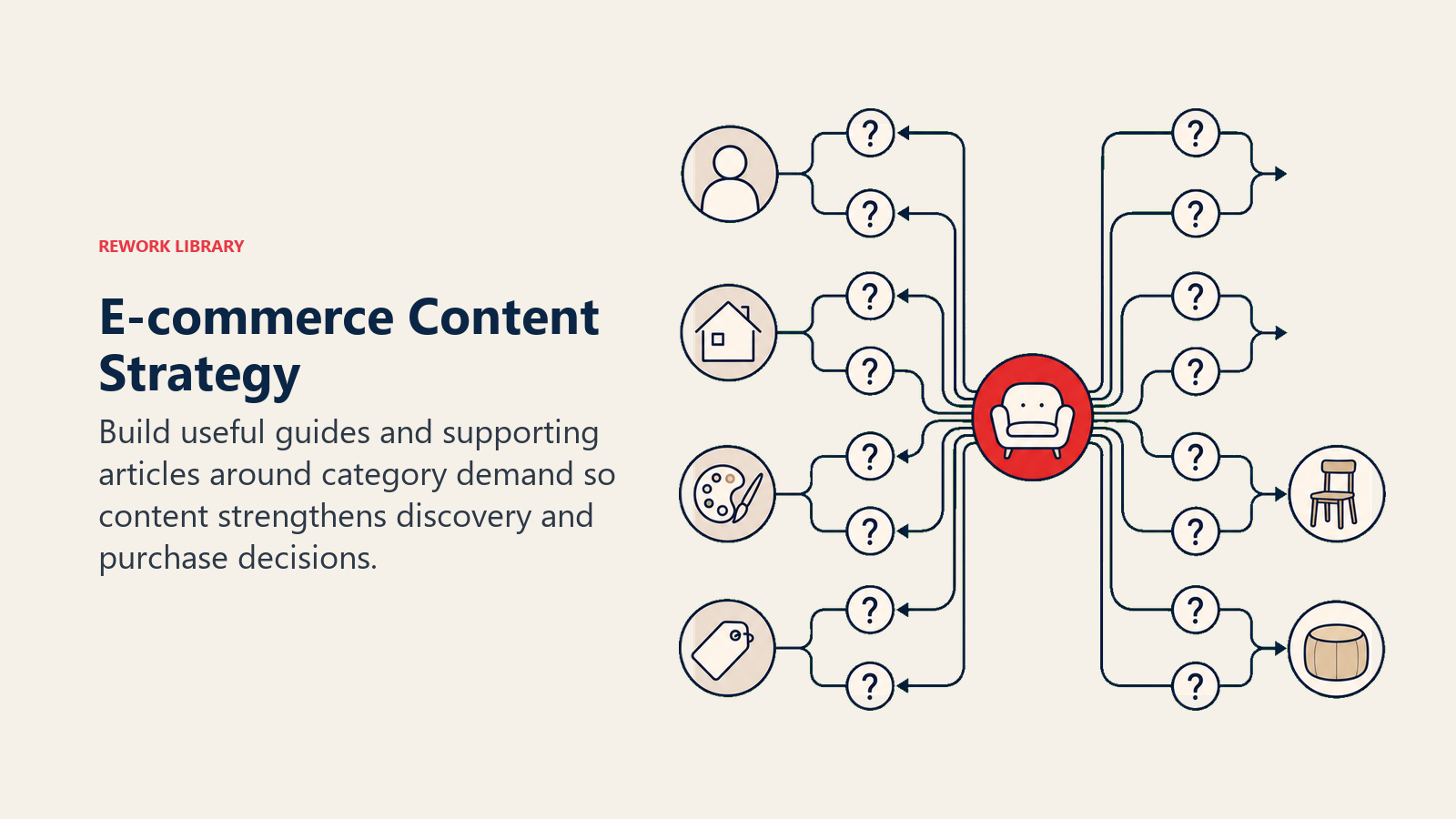
Don't make these glorified product ads. Genuinely help people make informed decisions. If your guide is actually useful, people will bookmark it, link to it, and come back when ready to buy.
Common guide formats:
- "Best [product category] for [use case]"
- "[Product] vs [Product]: Which Should You Buy?"
- "How to Choose [Product]: Complete Buying Guide"
- "[Number] [Products] for [Specific Need]"
Example: A running shoe retailer might create "Best Running Shoes for Flat Feet (2025 Guide)" comparing 10-15 options with pros, cons, and direct purchase links.
Keyword Research for Product-Focused Queries
E-commerce keyword research is different. You're not just looking for volume, you're looking for commercial intent and alignment with your catalog.
Start with seed keywords from your categories. If you sell "men's running shoes," expand into:
- Brand + product ("Nike Pegasus 40")
- Problem/solution ("running shoes for plantar fasciitis")
- Comparison ("Nike vs Adidas running shoes")
- Feature-specific ("cushioned running shoes")
- Price-based ("best running shoes under $100")
Use tools like Ahrefs, SEMrush, or Google's Keyword Planner to find variations and volume. But don't ignore low-volume keywords. A keyword with 50 searches/month and high purchase intent beats a keyword with 5,000 searches and zero intent.
Look at what's already ranking. If all the top results are buying guides, that's what Google wants to see. If they're all product pages, guide content won't rank there.
FAQ Optimization and Featured Snippets
FAQs serve two purposes: they answer customer questions (reducing support load) and they capture featured snippet rankings.
Featured snippets are the "position zero" results that appear above organic listings. They're especially common for question-based searches.
To optimize for snippets:
- Use clear question headings ("What's the difference between..." or "How do you...")
- Provide concise answers (40-60 words typically get pulled)
- Use structured formatting (lists, tables, or short paragraphs)
- Answer the question directly without fluff
Add FAQ schema markup so Google understands the structure. This can result in accordion-style expansions directly in search results, increasing your visibility.
Topic Clusters and Internal Linking
Topic clusters organize your content around core themes with a pillar page linking to supporting content.
For a running shoe retailer:
- Pillar page: "Complete Guide to Running Shoes"
- Cluster content: "How to Choose Running Shoes," "Running Shoe Types Explained," "How Often to Replace Running Shoes," "Running Shoe Sizing Guide"
Each cluster article links back to the pillar and to related cluster content. This creates topical authority, Google sees you as comprehensive on the subject.
Your internal linking strategy should:
- Use descriptive anchor text (not "click here")
- Link from high-authority pages to important commercial pages
- Create clear paths from content to products
- Distribute PageRank throughout your site
Don't just link randomly. Every link should serve user intent and SEO goals.
Link Building for E-commerce: Authority Signals That Matter
Backlinks remain one of Google's top ranking factors. But getting quality links to commercial pages is hard, nobody naturally links to product pages.
Competitor Backlink Analysis
Start by understanding who's linking to your competitors and why. Use Ahrefs or SEMrush to analyze competitor backlink profiles. Look for patterns:
- Industry directories they're listed in
- Publications that covered them
- Partnerships or collaborations
- Resources people link to (guides, tools, data)
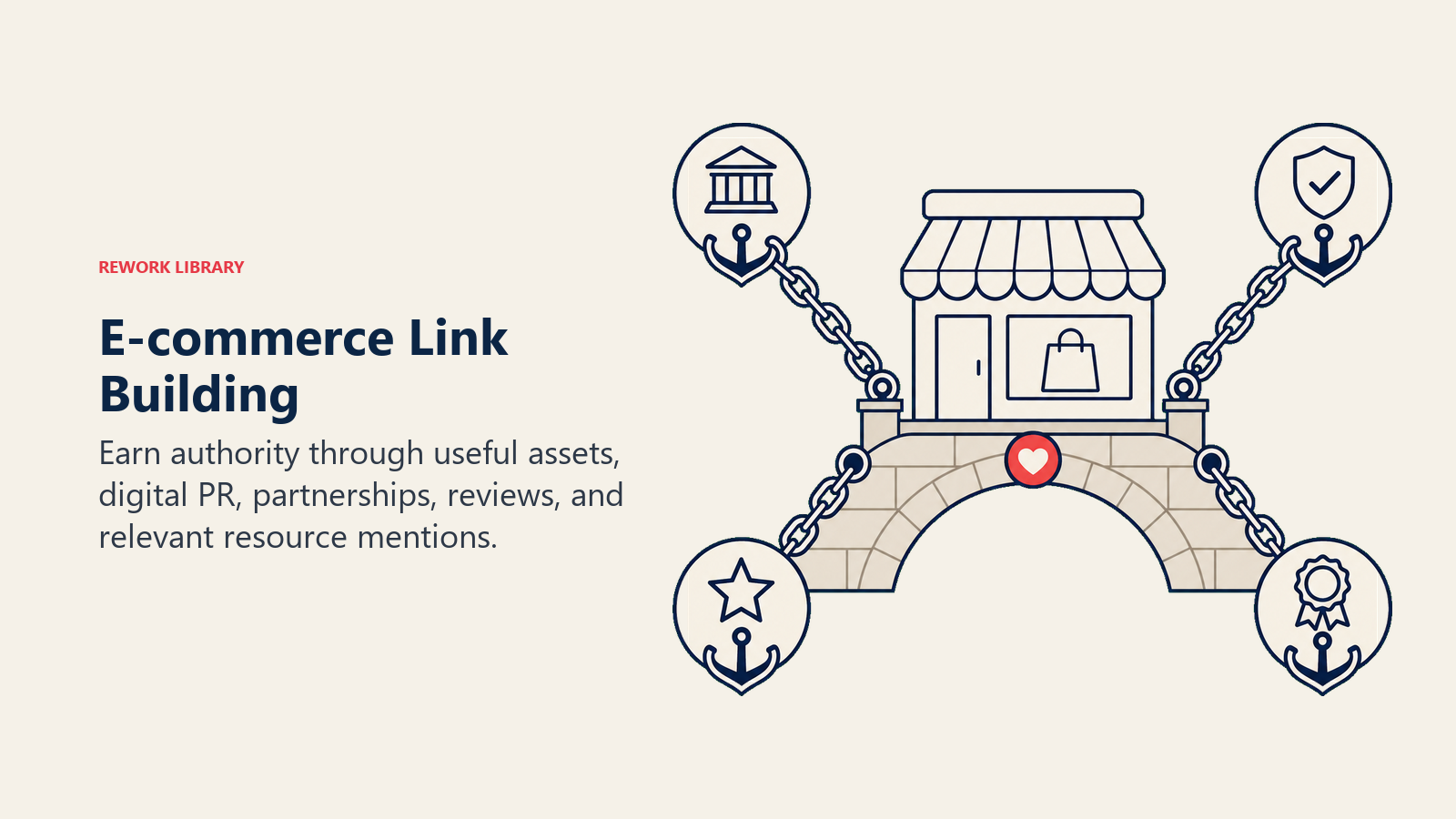
You can often replicate these links. If a competitor is in an industry directory, get your site listed there too. If a publication wrote about them, pitch a similar story angle.
Pay attention to the context of links. A link from a product review is more valuable than a link from a random blog comment.
PR and Digital Outreach
Traditional PR drives links. When publications write about your company, product launch, or unique data, they link to your site.
What gets covered:
- Original research: Survey your customers and publish insights
- Trend analysis: Be the expert source on industry trends
- Product innovation: Launch genuinely new products worth writing about
- Founder stories: Unique backstories that resonate
Build relationships with journalists and bloggers in your niche. Tools like HARO (Help A Reporter Out) connect you with journalists looking for expert sources.
The pitch matters. "We have a new product" isn't interesting. "We surveyed 1,000 runners and found 67% are wearing the wrong shoe size" is interesting.
Marketplace and Directory Listings
Not sexy, but effective. Getting listed in relevant directories and marketplaces provides:
- Direct referral traffic
- Link equity
- Business validation signals
Focus on industry-specific directories, not generic "submit to 1,000 directories" services. A link from a running specialty site is worth more than 100 links from random directories.
Examples:
- Industry associations
- Local business directories
- Product review platforms
- Comparison sites
- Niche marketplaces
Some require payment, which is fine if the directory has genuine value and traffic. What you're avoiding is spammy, low-quality link farms.
Building Authority Through Content Partnerships
The most sustainable link building is creating resources so good that people want to link to them.
Linkable asset ideas:
- Industry reports: Publish annual data and insights
- Interactive tools: Calculators, comparison tools, size charts
- Ultimate guides: Be the definitive resource on a topic
- Infographics: Visualize complex data in shareable formats
Promote these assets through outreach. Find articles that could benefit from linking to your resource and suggest it. The key is genuine value, you're helping them improve their content, not just begging for links.
Traffic Optimization: Technical Factors That Impact Rankings
Beyond content and links, structural factors determine how effectively Google crawls and understands your site.
Internal Linking Architecture
Every page should be reachable in 3 clicks from your homepage. Use breadcrumbs, category navigation, footer links, and contextual links to ensure no page is orphaned.
Priority pages (high-revenue categories, top-selling products) should receive more internal links from authoritative pages. This concentrates PageRank where it matters.
Your navigation should balance user needs with SEO. Too many top-level categories dilute authority. Too few creates deep hierarchies where important pages are buried.
XML Sitemaps and Robots.txt
Your XML sitemap tells Google which pages matter and how often they change. E-commerce sites need separate sitemaps for:
- Product pages
- Category pages
- Content/blog
- Static pages
Update sitemaps daily or weekly as products change. Include priority and last-modified dates to help Google prioritize crawling.
Robots.txt controls what Google can access. Common directives for e-commerce:
- Block admin areas and customer accounts
- Block search result pages (unless you want them indexed)
- Block checkout pages
- Allow all product and category pages
Test your robots.txt carefully. Accidentally blocking important pages is a common mistake that tanks rankings overnight.
Breadcrumb Implementation
Breadcrumbs show navigation paths: Home > Men's Shoes > Running Shoes > Nike Air Max 270
They serve three purposes:
- User experience: Easy navigation back up the hierarchy
- Internal linking: Automatic links to parent categories
- Rich snippets: Google displays breadcrumbs in search results
Implement breadcrumb schema markup so Google understands the structure. This can replace your URL in search results with a more descriptive path.
Pagination and Infinite Scroll
How you handle long product lists affects SEO. Traditional pagination (page 1, 2, 3...) works but dilutes authority across pages. Google might only crawl page 1.
Solutions:
- Load more button with paginated URLs as a fallback
- Infinite scroll with proper history state management
- View all option for critical categories
- Rel="next" and rel="prev" tags to indicate sequence
Test thoroughly in Google Search Console. If pages aren't being indexed or products aren't appearing in search, your pagination implementation is broken.
Measuring SEO Success: Metrics That Actually Matter
SEO without measurement is guesswork. But not all metrics are equally important.
Google Search Console Mastery
Search Console is your most important SEO tool. It shows:
- Performance: Which queries you rank for, impressions, clicks, CTR, position
- Coverage: Which pages are indexed vs. excluded and why
- Core Web Vitals: Real user experience data
- Mobile usability: Issues affecting mobile rankings Check Search Console weekly. Look for:
- Queries where you rank #4-10 (opportunity to improve to page 1)
- Pages with high impressions but low clicks (optimize titles/descriptions)
- Coverage errors (pages that should be indexed but aren't)
- Performance trends over time
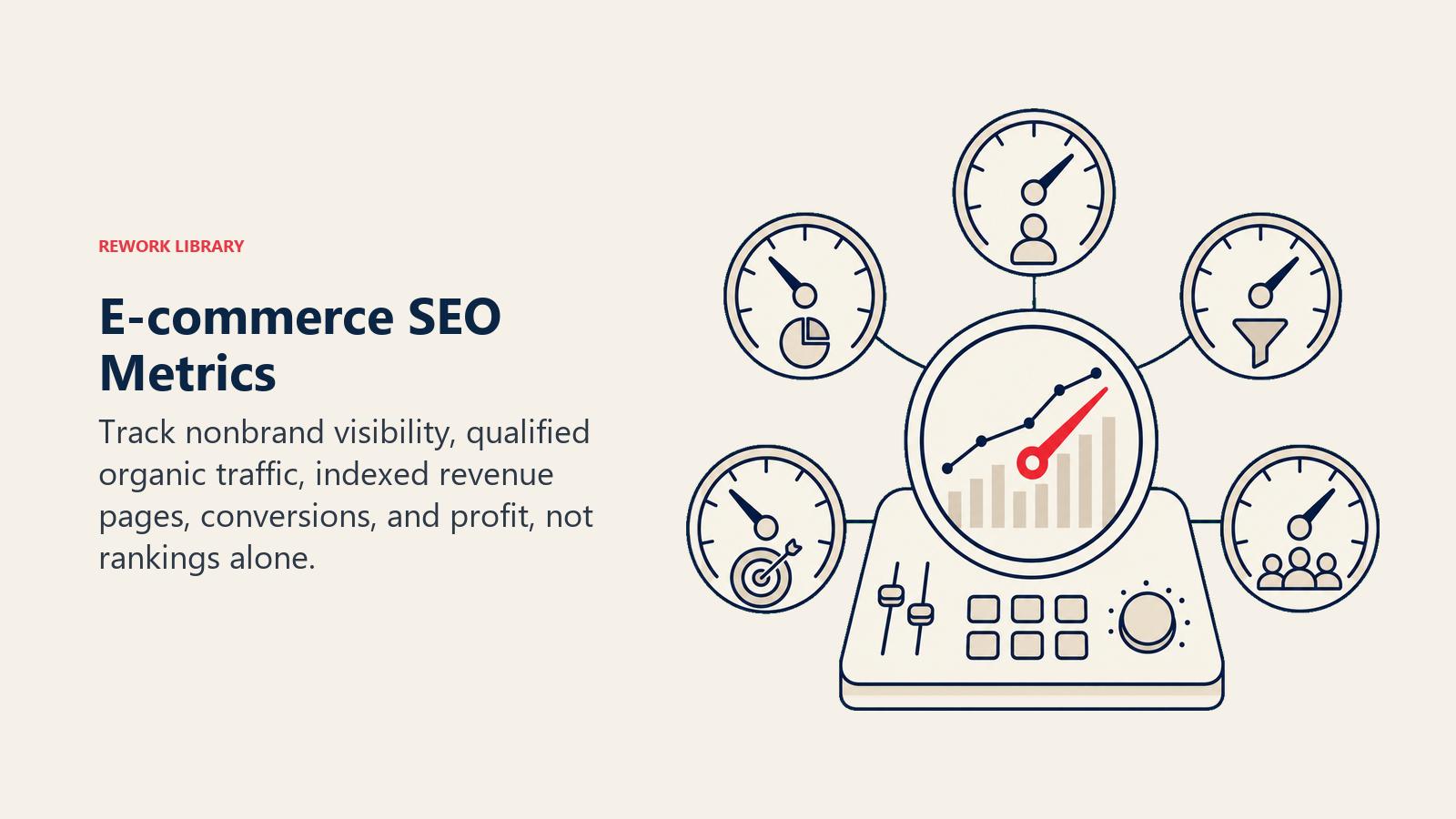
Don't obsess over individual keyword rankings. Focus on aggregate organic traffic and revenue.
Organic Traffic and Attribution
Track organic traffic in Google Analytics, but segment by landing page type:
- Category pages
- Product pages
- Content/guides
- Brand terms vs. non-brand
Organic traffic growth means nothing if it's all brand searches or low-intent informational queries. You want product-focused traffic that converts. Proper analytics and tracking setup ensures you're measuring what matters.
Set up proper attribution tracking. How much revenue comes from organic? What's the conversion rate? What's the customer lifetime value of organic customers?
Use UTM parameters for any links you control (emails, social) so organic traffic isn't inflated by other channels.
Conversion Tracking from Organic
SEO drives traffic, but revenue drives business. Track:
- Organic conversion rate vs. other channels
- Revenue per organic visitor
- Organic CAC (amortize SEO investment over acquired customers)
- Product page conversion rates for top organic landing pages
If organic traffic is growing but conversion rate is dropping, you're attracting the wrong visitors. Refine your keyword targeting and content. Monitor critical e-commerce metrics and KPIs to identify performance gaps quickly.
Compare organic to paid acquisition performance. If paid converts at 3% and organic at 1.5%, understand why. Is organic targeting broader keywords? Are product pages not optimized for conversion?
This is where conversion rate optimization becomes critical, SEO gets people to your site, but CRO turns them into customers.
ROI Calculation and Benchmarking
Calculate organic SEO ROI:
ROI = (Organic Revenue - SEO Investment) / SEO Investment
SEO investment includes:
- Content creation costs
- Technical development
- Tools and software
- Agency fees or internal salary cost
Good e-commerce SEO typically shows 300-500% ROI within 12-18 months. Early months are negative as you invest, but returns compound over time.
Benchmark against competitors using tools like SEMrush or Ahrefs. Track their:
- Estimated organic traffic
- Number of ranking keywords
- Content publication frequency
- Backlink acquisition rate
If a competitor is publishing 20 guides/month while you publish 2, that explains why they're outranking you.
Common E-commerce SEO Mistakes That Kill Rankings
Let's talk about what NOT to do. These mistakes are surprisingly common and surprisingly destructive.
Thin Content on Category Pages
A category page with just a title and products gives Google nothing to rank. Every major category needs at least 200-300 words of unique, helpful content explaining what's in the category and why someone should care.
Poor Pagination Handling
Implementing "page 2, 3, 4..." without proper canonical tags spreads authority thin. Google sees each paginated page as separate and ranks none of them well.
Noindex on Important Pages
Someone adds noindex to filter pages, accidentally catches category pages too, and suddenly nothing ranks. Always audit which pages have noindex tags using Screaming Frog or similar tools.
Keyword Stuffing
Trying to rank for "red running shoes" by repeating it 47 times on the page hasn't worked since 2010. Google's algorithms are sophisticated enough to understand context and synonyms. Write naturally.
Ignoring Mobile Experience
If your mobile site is slow, hard to navigate, or has content hidden behind accordions, you won't rank well. Test on real devices regularly.
No Content Strategy
Relying solely on product and category pages limits your rankings to product searches. You miss out on all the informational and research queries that precede purchases.
Copying Manufacturer Descriptions
If you and 50 competitors use the same product description, Google has to pick one to rank. It probably won't be yours. Write unique descriptions for every important product.
Timeline and Resources: Building SEO Momentum
SEO is not a quick win. Set realistic expectations with your team and leadership.
Realistic Timeline
Months 1-3: Foundation building
- Technical audit and fixes
- Keyword research and strategy
- Initial content creation
- Site structure improvements
You'll see minimal results. Rankings might even temporarily drop as you make changes.
Months 4-6: Early signals
- Some content starts ranking
- Technical improvements stabilize
- Link building shows initial traction
- Small traffic increases
Months 7-12: Momentum builds
- Multiple pages ranking on page 1
- Content library generating consistent traffic
- Link velocity increasing
- Clear ROI emerging
12+ months: Compounding returns
- Established authority in key topics
- Significant organic revenue contribution
- Lower blended CAC
- Sustainable competitive advantage
Don't expect instant results. If someone promises page 1 rankings in 30 days, they're using black-hat tactics that will eventually get you penalized.
Team Structure
Effective e-commerce SEO requires:
- SEO strategist: Owns the roadmap, does keyword research, tracks performance
- Content creators: Writers for guides, product descriptions, category content
- Technical developer: Implements schema, fixes speed issues, handles complex technical work
- Link builder: Outreach, partnerships, PR
Small teams wear multiple hats. One person might do strategy and content. As you scale, specialize.
The most important element: executive buy-in. If leadership sees SEO as optional or expects instant results, you'll struggle to get resources and patience needed for success. Understanding the complete e-commerce growth model helps secure that buy-in.
Tools and Technology
Your SEO stack should include:
- Ahrefs or SEMrush: Keyword research, competitor analysis, backlink monitoring
- Google Search Console: Performance tracking, indexation issues
- Google Analytics: Traffic and conversion analysis
- Screaming Frog: Technical audits and crawling
- PageSpeed Insights: Performance monitoring
- Schema validator: Structured data testing
Budget $500-2,000/month for tools depending on site size. Don't cheap out, good tools pay for themselves quickly.
SEO Roadmap: 90-Day, 6-Month, and 12-Month Planning
Break your SEO initiative into phases with clear milestones.
90-Day Quick Wins
Focus on high-impact, relatively easy improvements:
- Fix critical technical issues (broken links, slow pages, indexation problems)
- Optimize top 10-20 product and category pages
- Create 10-15 buying guides targeting bottom-funnel keywords
- Implement schema markup site-wide
- Claim directory listings in major industry directories
- Set up A/B testing framework to validate optimization decisions
Goal: Establish foundation and see first ranking improvements.
6-Month Strategic Build
Expand into comprehensive SEO:
- Build out complete content library (50+ articles)
- Optimize all major categories and top 100 products
- Establish link building partnerships and PR outreach
- Implement advanced internal linking strategy
- Develop topic clusters around key themes
- Expand presence to marketplaces with Amazon SEO and ranking strategies
Goal: Achieve page 1 rankings for 50+ commercial keywords.
12-Month Market Leadership
Solidify position as category leader:
- Publish original research and industry reports
- Expand into adjacent categories and keywords
- Build authoritative resource center
- Establish consistent PR presence
- Achieve 30-40% of revenue from organic traffic
- Optimize unit economics for e-commerce by reducing blended CAC
Goal: Become the go-to organic result for most important product searches in your niche.
Track progress against these goals quarterly. Adjust based on what's working and what isn't.
Conclusion: SEO as Sustainable Acquisition Moat
E-commerce SEO is not a project, it's a practice. Companies that treat it as a one-time initiative fail. Those that commit to ongoing optimization, content creation, and technical excellence build defensible moats.
The math is compelling. Traffic acquisition strategy must balance multiple channels, but organic SEO offers the best long-term ROI. Every dollar invested in SEO continues paying dividends for years.
Start with the foundation: fix technical issues through site speed optimization and proper mobile commerce implementation. Then systematically optimize your product and category pages. Layer in content that captures buyers early in their journey. Build authority through links and PR.
Most importantly: measure what matters. Use analytics and tracking to understand which efforts drive revenue, not just rankings. Combine SEO traffic with strong conversion rate optimization to maximize the value of every visitor.
Your competitors are investing in SEO. The question is whether you'll match them, or leave organic search dominance to someone else.
Learn More
Ready to build your complete acquisition strategy? These resources will help you drive sustainable traffic growth:
- Traffic Acquisition Strategy - Balance SEO with other channels for optimal customer acquisition
- Product Page SEO - Deep dive into optimizing individual product pages for rankings and conversions
- Category Page Optimization - Master the pages that drive the most organic revenue
- Site Speed & Performance - Technical optimization that impacts both rankings and conversions
- Mobile Commerce Optimization - Ensure your mobile experience supports SEO goals
- Analytics & Tracking Setup - Measure SEO performance and ROI accurately
- Conversion Rate Optimization - Turn your SEO traffic into revenue

On this page
- Why SEO Matters More for E-commerce Than Other Industries
- Technical SEO Foundation: The Stuff That Breaks Everything
- Site Structure and URL Architecture
- Site Speed and Core Web Vitals
- Mobile-First Indexing
- Schema Markup and Structured Data
- Product and Category Page SEO: Where Revenue Happens
- Category Page Optimization
- Product Page SEO Best Practices
- Handling Faceted Navigation and Filters
- Duplicate Content Management
- Content Strategy for E-commerce: Beyond the Product Catalog
- Buying Guides and Comparison Content
- Keyword Research for Product-Focused Queries
- FAQ Optimization and Featured Snippets
- Topic Clusters and Internal Linking
- Link Building for E-commerce: Authority Signals That Matter
- Competitor Backlink Analysis
- PR and Digital Outreach
- Marketplace and Directory Listings
- Building Authority Through Content Partnerships
- Traffic Optimization: Technical Factors That Impact Rankings
- Internal Linking Architecture
- XML Sitemaps and Robots.txt
- Breadcrumb Implementation
- Pagination and Infinite Scroll
- Measuring SEO Success: Metrics That Actually Matter
- Google Search Console Mastery
- Organic Traffic and Attribution
- Conversion Tracking from Organic
- ROI Calculation and Benchmarking
- Common E-commerce SEO Mistakes That Kill Rankings
- Thin Content on Category Pages
- Poor Pagination Handling
- Noindex on Important Pages
- Keyword Stuffing
- Ignoring Mobile Experience
- No Content Strategy
- Copying Manufacturer Descriptions
- Timeline and Resources: Building SEO Momentum
- Realistic Timeline
- Team Structure
- Tools and Technology
- SEO Roadmap: 90-Day, 6-Month, and 12-Month Planning
- 90-Day Quick Wins
- 6-Month Strategic Build
- 12-Month Market Leadership
- Conclusion: SEO as Sustainable Acquisition Moat
- Learn More