Customer Data Platform: Unifying Customer Data for E-commerce Growth
 Your customer data lives in seventeen different systems. Your marketing team sees one version of a customer, your support team sees another, and your analytics team is building yet another view from scratch. Meanwhile, 87% of that data sits unused in disconnected silos.
Turn this article into takeaways for your work.


Each assistant summarizes the article only for you and suggests best practices for your work.
The cost isn't just inefficiency. You're losing revenue because you can't personalize at scale, segment accurately, or predict which customers are about to churn. Your competitors with unified data are running circles around you, sending the right message to the right customer at exactly the right moment.
Customer Data Platforms emerged to solve this specific problem: creating a single, persistent, real-time customer profile from fragmented data sources. They aren't CRMs. They aren't data warehouses. They're the unification layer that makes everything else work.
What Is a Customer Data Platform?
A Customer Data Platform collects data from every customer touchpoint, resolves identities to create unified profiles, and activates that data across your entire marketing and analytics stack in real-time. Four capabilities define a true CDP:
Real-Time Data Integration: Ingests behavioral, transactional, and demographic data from websites, apps, email platforms, CRM systems, and customer service tools as events happen. Not batch processes. Not daily syncs. Real time.
Identity Resolution: Matches anonymous visitors with known customers across devices and channels. It recognizes that customer@email.com on desktop, user_12345 in your app, and the person who called support yesterday are the same person.
Unified Customer Profiles: Creates persistent records that combine every interaction, purchase, support ticket, email click, and behavioral signal into one continuously updated view. These profiles power everything else.
Activation Infrastructure: Pushes unified data back to your tools. Sends segments to your email platform, behavioral triggers to your automation system, audiences to advertising platforms, and enriched profiles to your CRM.
The distinction matters because many tools claim to be CDPs but only solve part of the problem. A marketing automation platform with some data collection isn't a CDP. A data warehouse with customer tables isn't a CDP. The combination of collection, unification, and activation separates real CDPs from marketing databases.
Why E-commerce Needs CDPs
E-commerce businesses generate massive amounts of customer data. Without unification, that data actively works against you. Segmentation at Scale: Merchants using CDPs report 40% higher average order values from segmented campaigns compared to generic ones. The difference is targeting precision. Through advanced customer segmentation, instead of "customers who bought in the last 90 days," you can target "customers who bought category X twice, browsed category Y three times, opened your last two emails, but haven't purchased in 45 days."
Email Performance: When your email platform receives unified customer profiles instead of isolated email engagement data, performance jumps. Merchants see 35% higher open rates and 50% higher conversion rates from campaigns built on CDP segments versus basic list segmentation.
Activation Speed: Building a segment in Google Analytics, exporting a CSV, importing to Klaviyo, and launching a campaign takes hours or days. With a CDP, you define the segment once and activate it everywhere instantly. Companies cut segment-to-campaign time by 50-70%.
Predictive Accuracy: Customer Lifetime Value (LTV) predictions based on unified behavioral data are 3x more accurate than models built on purchase history alone. Churn prediction accuracy increases from 45-55% to 75-85%.
Cross-Channel Consistency: A customer browses product A on mobile, abandons cart on desktop, and receives an email featuring product B because your systems don't talk. CDPs eliminate these disconnects. The same customer profile drives recommendations, email content, and site personalization.
The return shows up in revenue numbers. Merchants implementing CDPs typically see 15-25% increases in repeat purchase rates within six months and 20-35% improvements in marketing efficiency as they shift spend from broad campaigns to targeted segments.
CDP vs CRM vs Data Warehouse
These three systems get confused constantly. They're complementary but fundamentally different. CRM Systems manage relationships and workflows. Salesforce tracks deals, contact history, and sales pipelines. It's your system of record for customer accounts, but it doesn't collect behavioral data, resolve anonymous identities, or activate segments across marketing tools. CRMs consume data from CDPs.
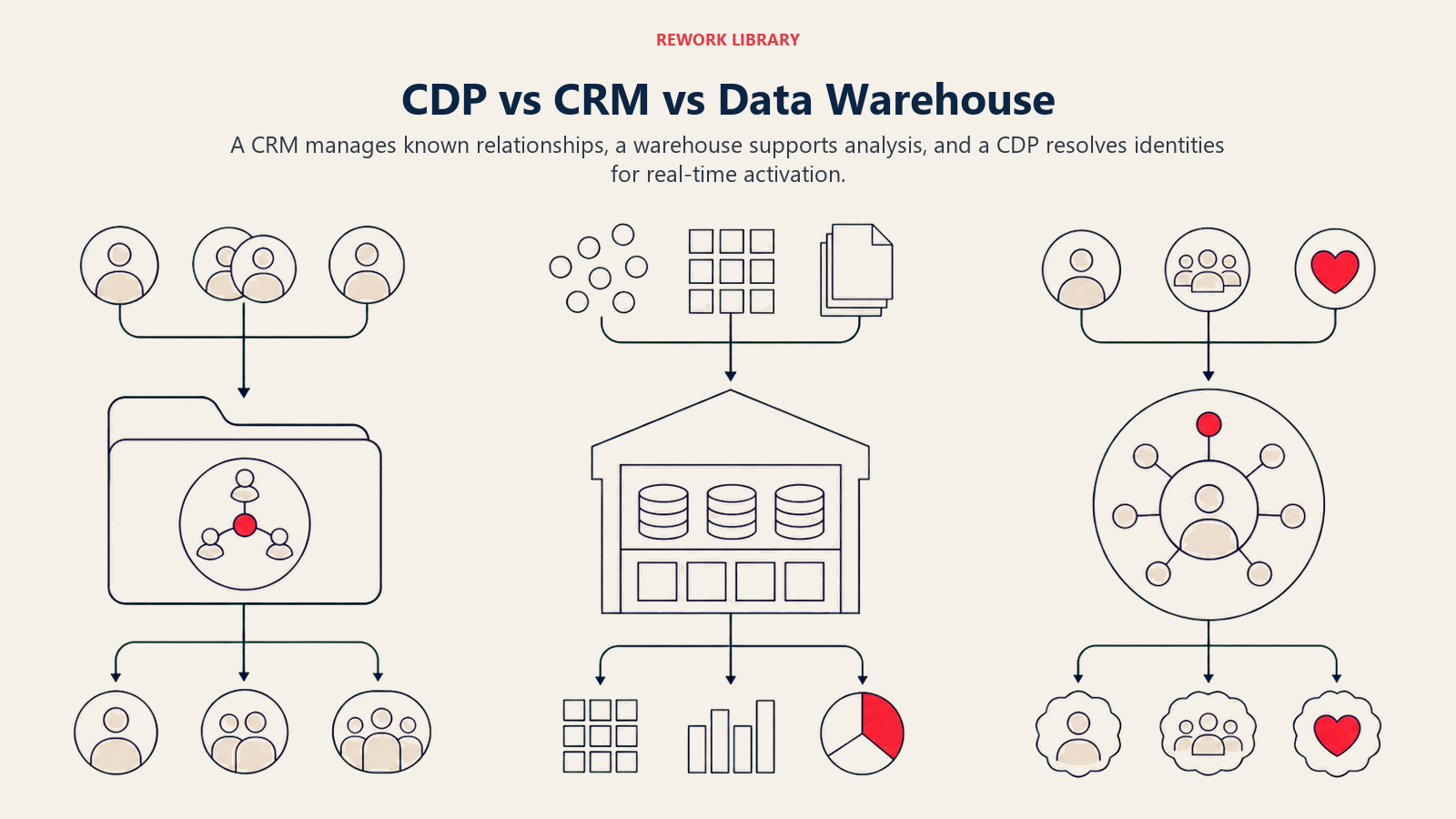
Data Warehouses store everything. Snowflake, BigQuery, and Redshift are built for analytics queries across massive datasets. They're excellent for BI reporting and data science, but they don't offer identity resolution engines, real-time activation, or marketer-friendly interfaces. Data warehouses work alongside CDPs by providing deep analytical capabilities.
CDPs sit between data sources and activation tools. They're built specifically to collect, unify, and activate customer data in real time. The interface is designed for marketers and growth teams, not SQL analysts.
Integration Pattern: Data flows from sources into the CDP for unification. The CDP sends unified profiles to your CRM for account enrichment, activates segments to marketing tools for campaigns, and exports historical data to your warehouse for deep analysis.
When to Use Each:
- Use a CDP when you need real-time personalization, segmentation, and cross-channel activation
- Use a CRM when you need sales workflows, account management, and relationship tracking
- Use a data warehouse when you need complex analytics, custom data science models, and historical reporting
Cost and Complexity: CDPs typically cost $12,000-$120,000 annually depending on data volume. CRMs range from $1,200-$50,000. Data warehouses charge based on compute and storage. Most growing e-commerce businesses need all three at some point. But CDPs deliver immediate marketing ROI that warehouses and CRMs don't.
Core CDP Capabilities
Understanding what CDPs actually do helps you evaluate vendors and plan implementations. Data Collection and Unification: CDPs ingest data through pre-built connectors, APIs, SDKs, and webhooks. They normalize data formats, map fields across sources, and maintain event streams. The engineering effort drops dramatically compared to building custom pipelines.
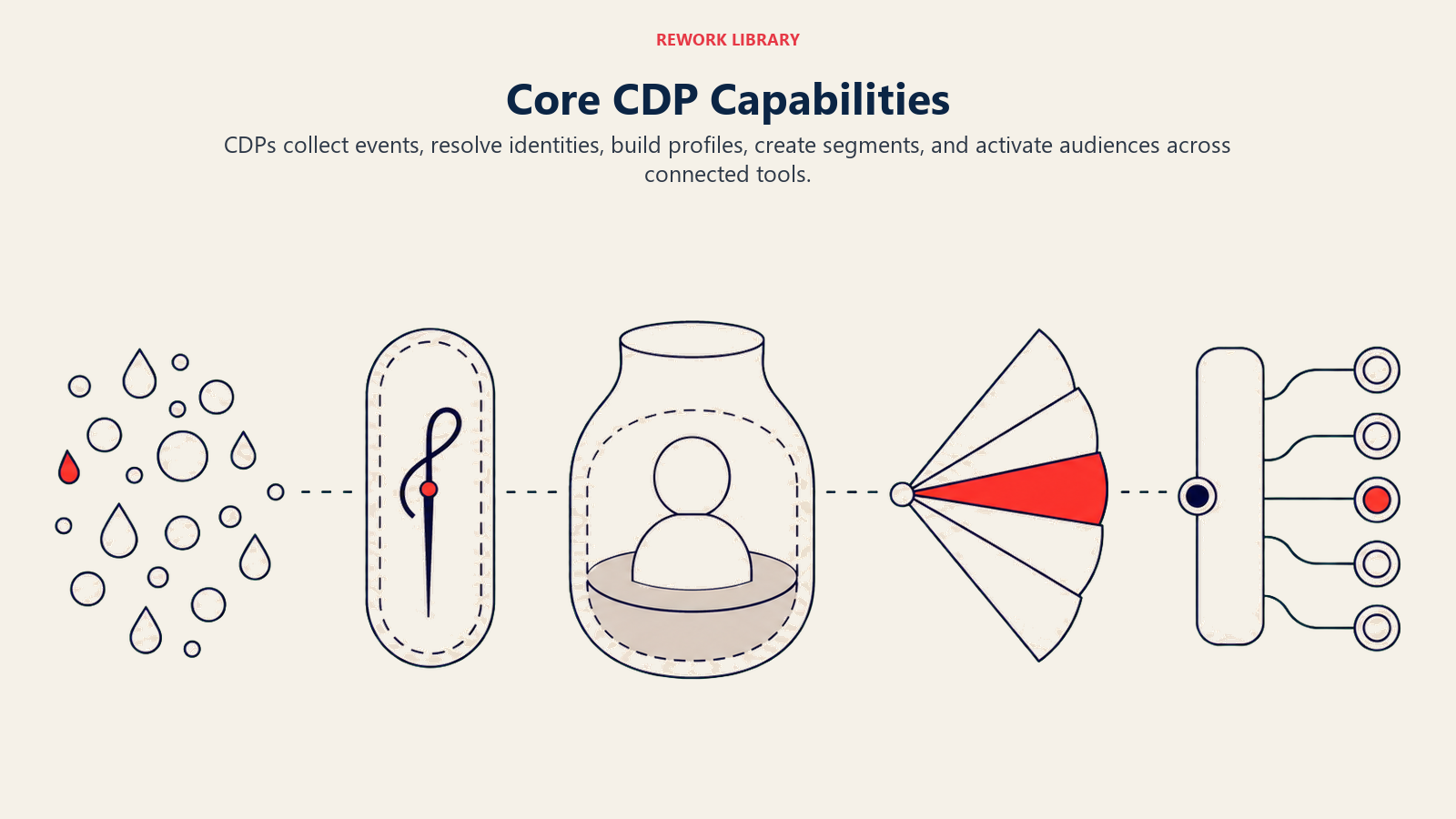
Identity Resolution: This is the hardest technical problem CDPs solve. A visitor browses anonymously, then logs in. Later they buy from a different device. Identity resolution stitches these interactions together using email addresses, customer IDs, device fingerprints, and probabilistic matching.
Three resolution methods:
Deterministic matching uses exact identifiers like email addresses and customer IDs. High accuracy but only works for known customers.
Probabilistic matching uses behavioral signals, IP addresses, device characteristics, and timing patterns to identify likely matches. Lower accuracy but captures anonymous behavior.
Graph-based resolution builds relationship networks. If Device A and Device B share an IP address and similar browsing patterns, they're probably the same person.
Segmentation Engines: CDPs offer visual segment builders that let marketers create audiences without SQL. "Customers who purchased more than three times in the last six months AND browsed category X in the last seven days BUT haven't opened an email in 14 days" becomes point-and-click instead of custom queries.
Real-time segment membership updates as customer behavior changes. Someone joins the "abandoned cart" segment the moment they exit without purchasing, triggering immediate email sequences.
Activation and Destinations: CDPs maintain pre-built integrations with hundreds of marketing tools. Define a segment once and push it to Klaviyo, Google Ads, Facebook, Braze, and your CRM simultaneously. When segment membership changes, updates sync automatically.
Privacy and Governance: GDPR, CCPA, and other privacy regulations require consent tracking, data deletion capabilities, and audit trails. CDPs centralize these controls. When a customer requests data deletion, one action removes their data from the CDP and sends deletion requests to all connected systems.
Customer Data Sources
CDPs get more powerful as you connect more sources. Start with the highest-impact data. Website and App Behavior: Page views, product views, add-to-cart events, search queries, video plays, and time on site. This behavioral data powers product recommendations and personalization. Install the CDP's JavaScript SDK or use pre-built integrations with your e-commerce platform.
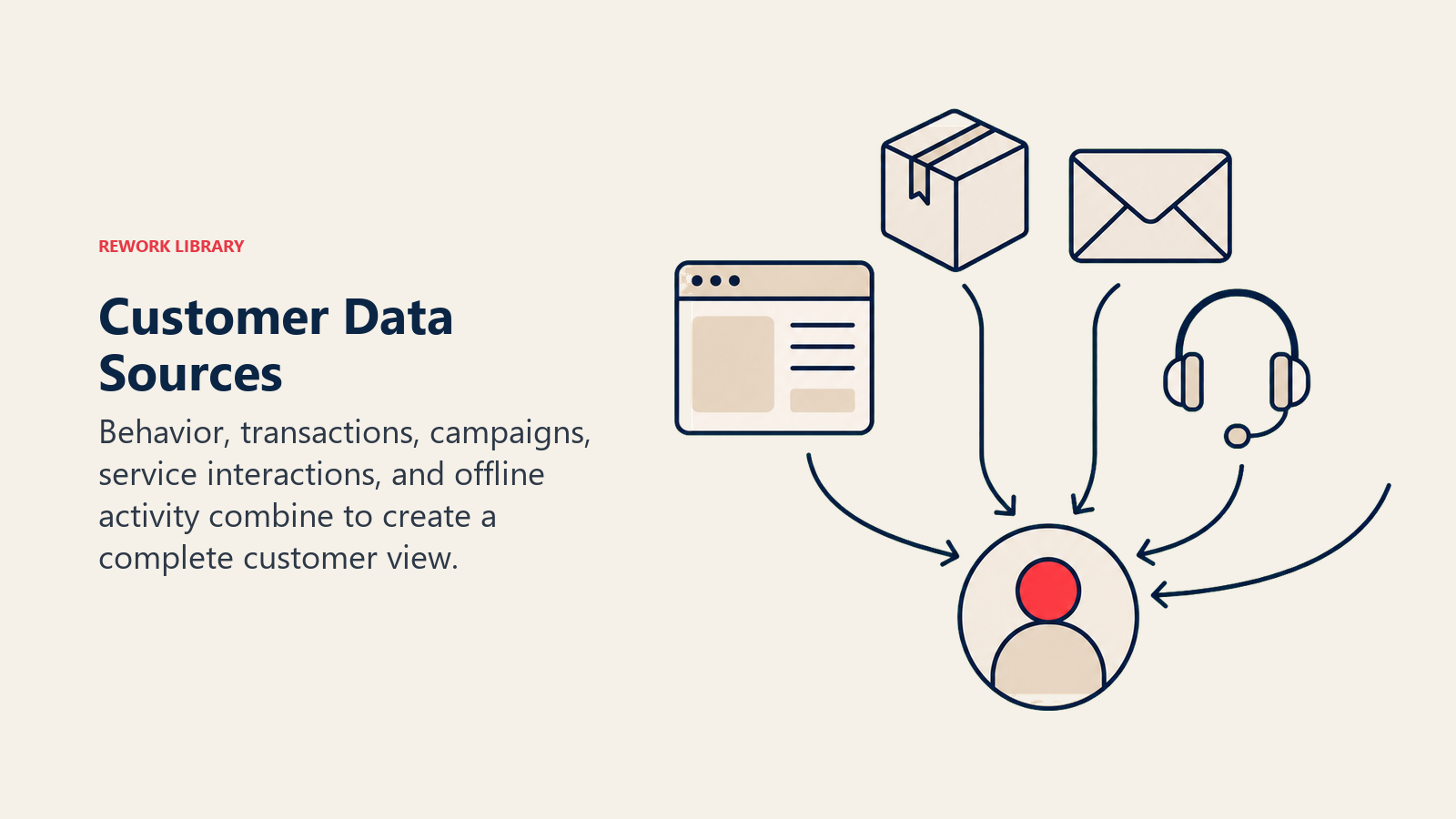
CRM and Transaction Data: Purchase history, order values, product SKUs, refund events, lifetime spend, and account information. This is your system of record for actual revenue. Sync bidirectionally so your CRM receives enriched behavioral data while your CDP gets transaction records.
Email and Marketing Platforms: Opens, clicks, unsubscribes, campaign engagement, and preference changes. When your Email Marketing for E-commerce platform connects to your CDP, you can segment on email engagement combined with behavioral and transaction data for much more precise targeting.
Customer Service Interactions: Support tickets, chat transcripts, call recordings, satisfaction scores, and resolution times. Customers who contact support have different needs and risk profiles. This data improves churn prediction and triggers proactive customer retention strategies.
Third-Party and External Data: Enrichment services provide demographic data, firmographic information for B2B, social media profiles, and intent signals. Weather APIs trigger product recommendations. Inventory systems prevent promoting out-of-stock items.
Offline Data: If you have retail locations, POS systems should feed into your CDP. In-store purchases, loyalty card scans, and store visits create a complete picture of omnichannel behavior.
The key is connecting sources progressively. Don't try to integrate everything at once. Start with your three highest-volume, highest-value sources and expand from there.
Segmentation Strategies
Unified data enables sophisticated segmentation. These approaches deliver the highest returns. RFM Segmentation (Recency, Frequency, Monetary): Classic but powerful. Divide customers into groups based on when they last purchased, how often they purchase, and how much they spend. Your "Champions" segment (recent, frequent, high-spending) gets VIP treatment. Your "At Risk" segment (used to purchase frequently but hasn't recently) triggers win-back campaigns.
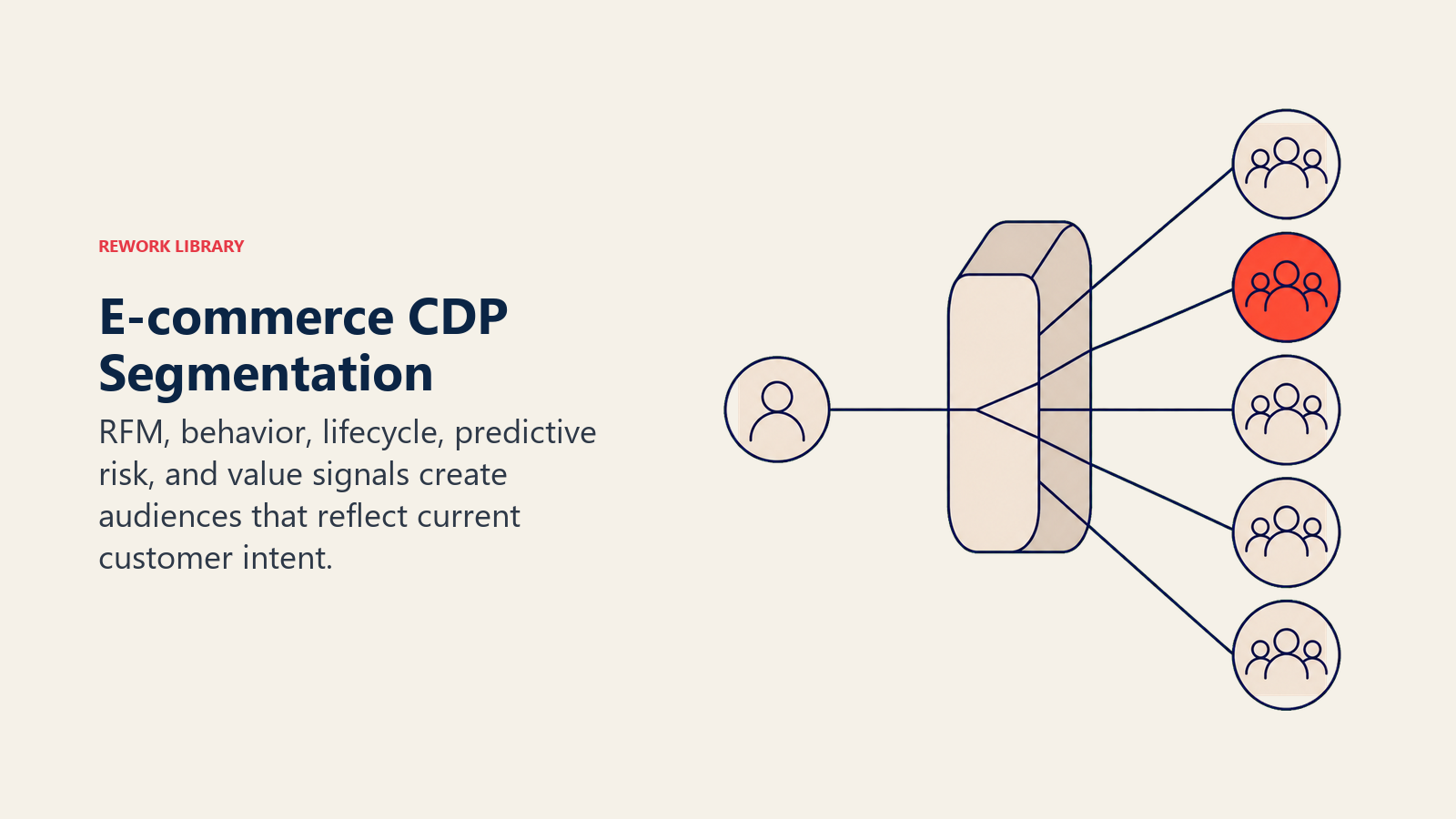
Build RFM segments in your CDP with these definitions:
- Recency: 0-30 days (5 points), 31-60 days (4 points), 61-90 days (3 points), 91-180 days (2 points), 180+ days (1 point)
- Frequency: 5+ purchases (5 points), 3-4 purchases (4 points), 2 purchases (3 points), 1 purchase (2 points)
- Monetary: Top 20% spend (5 points), 20-40% (4 points), 40-60% (3 points), 60-80% (2 points), bottom 20% (1 point)
Behavioral Segmentation: Group customers by actions, not just demographics. High-intent browsers, comparison shoppers, impulse buyers, and research-oriented customers all respond to different messaging. Someone who views 20 products but never adds to cart needs different treatment than someone who adds but abandons.
Predictive Scoring and Propensity Models: Modern CDPs include built-in machine learning for predicting next purchase likelihood, churn risk, and product affinity. These scores become segmentation criteria. Target "high churn risk + high lifetime value" customers with aggressive retention offers. Send "high next-purchase likelihood" customers gentle reminders instead of discounts.
Lifecycle Stage Segmentation: New customers, active customers, VIP customers, at-risk customers, and churned customers need completely different strategies. Accurate lifecycle segmentation relies on understanding patterns in customer behavior. New customers get education and category expansion campaigns. And at-risk customers get win-back offers.
Channel Preference Segmentation: Some customers open every email. Others never do but respond to SMS. Identify preferred channels from engagement history and adjust your communication strategy accordingly. This dramatically improves overall response rates while reducing unsubscribe rates.
Product Category Affinity: Customers who repeatedly purchase from specific categories become cross-sell targets for complementary products. Someone who buys running shoes every six months should see running apparel recommendations, not basketball gear.
Effective segmentation combines multiple criteria. "High lifetime value customers who purchased from category X in the last 90 days and opened our last email but haven't purchased in 30 days" is far more actionable than "customers who purchased recently."
Personalization Use Cases
Unified customer profiles make personalization practical at scale. These use cases deliver measurable results. Dynamic Product Recommendations: Real-time customer profiles from your CDP let you show different products to different visitors. Someone browsing running shoes sees running apparel. Someone who bought running shoes last month sees complementary accessories. Someone who bought running shoes six months ago sees new shoe releases.
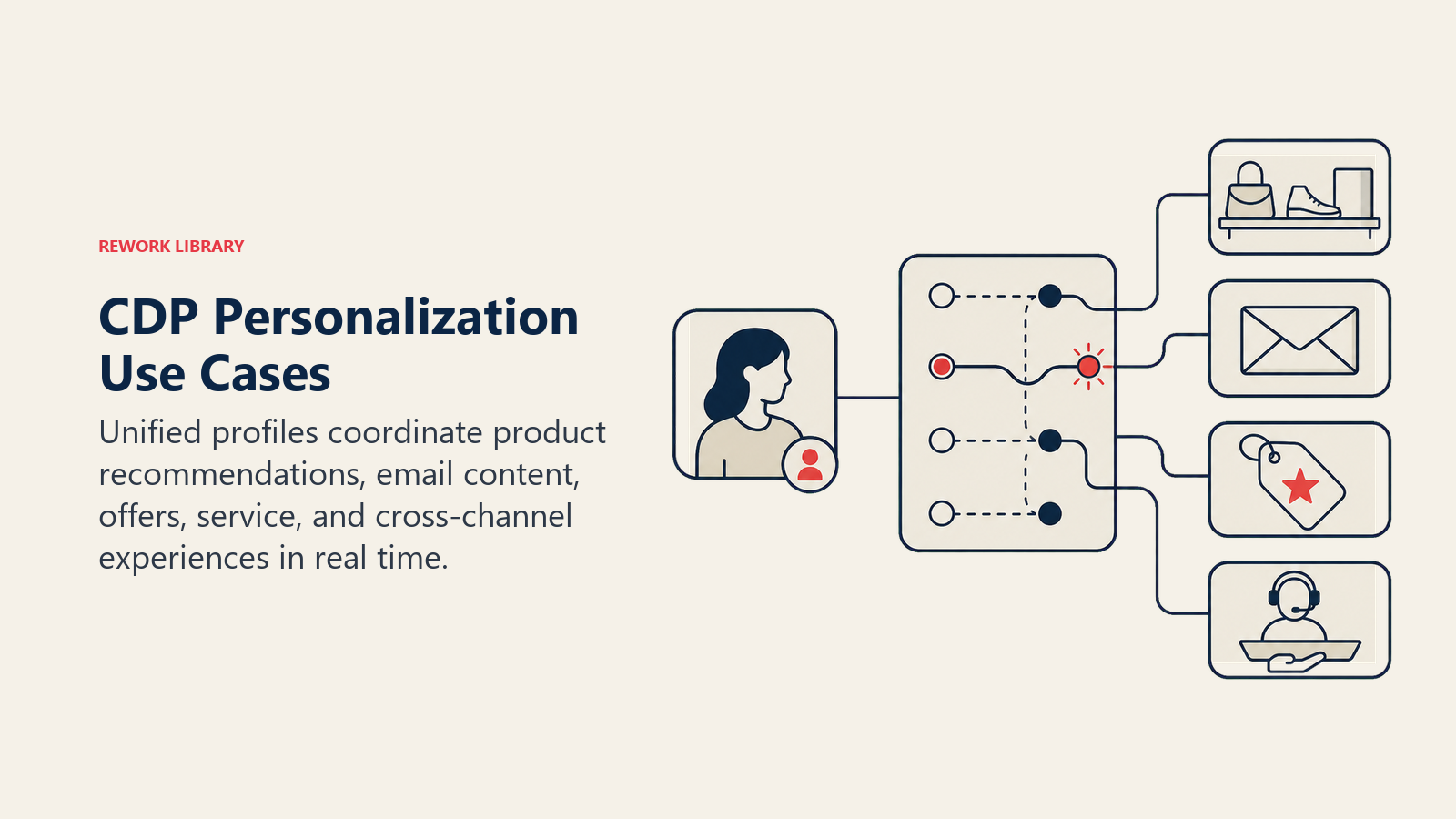
Personalized Email Campaigns: Instead of sending the same newsletter to 100,000 subscribers, send 10,000 variations based on browsing history, purchase history, engagement patterns, and predicted interests. Dynamic content blocks pull from customer profiles to show relevant products, offers, and content.
One merchant increased email revenue per recipient by 127% by implementing profile-based personalization. The technical implementation took three days once their CDP was connected to their email platform.
Segment-Based Promotions: Don't offer 20% off to customers who consistently buy at full price. Save discounts for price-sensitive segments and at-risk customers. Your CDP identifies these segments and triggers appropriate offers through your marketing automation platform.
Custom Website Experiences: Show different homepage banners, navigation elements, and product collections based on customer profiles. First-time visitors see category education and bestsellers. Returning customers see new arrivals in their favorite categories. VIP customers see early access to sales. This personalized approach significantly improves conversion rate optimization efforts.
Predictive Churn Prevention: When a customer's behavior matches churn patterns (reduced engagement, longer time since purchase, fewer category views), automatically trigger retention sequences. Send a "we miss you" email. Follow up with a personalized offer. Escalate to phone outreach for high-value customers.
Cross-Sell and Upsell Timing: Don't bombard new customers with upsell attempts. Wait until they've received their first order, used the product, and shown engagement signals. Then introduce complementary products or premium versions based on usage patterns and satisfaction indicators.
Abandoned Cart Recovery: Basic abandoned cart emails are table stakes. Advanced implementations use CDP data to personalize recovery timing, discount depth, and product recommendations based on customer history. First-time abandoners get more aggressive discounts than serial abandoners.
The pattern is consistent: take a generic marketing tactic, add customer profile data, and performance improves by 30-100%. The technical barrier isn't the tactic itself but having unified customer data accessible in real time.
Popular CDP Platforms
The CDP market has consolidated around several proven platforms. Choose based on your technical capabilities, data volume, and integration requirements. Segment: The most popular CDP for growth-stage companies. Developer-friendly with excellent documentation, 300+ pre-built integrations, and straightforward pricing based on Monthly Tracked Users (MTUs). Starts around $120/month, scales to $100,000+ for large enterprises.
Best for: Companies with technical resources who want flexibility and developer control.
mParticle: Similar to Segment but with stronger mobile app support and more sophisticated identity resolution. Pricing is less transparent (quote-based) but typically higher than Segment.
Best for: Mobile-first businesses and companies needing advanced cross-device tracking.
Treasure Data: Enterprise-focused CDP with built-in data warehouse capabilities. More expensive but offers powerful analytics features and white-glove implementation support.
Best for: Large enterprises with complex requirements and significant budgets ($200,000+).
Lytics: Marketing-focused with strong predictive capabilities and an emphasis on first-party data. Easier for non-technical marketers but less flexible than developer-oriented platforms.
Best for: Marketing teams who need predictive insights without heavy technical involvement.
Self-Hosted vs SaaS: Open-source options like RudderStack offer CDP functionality you host yourself. This gives you maximum control and no data leaves your infrastructure, but requires engineering resources for setup and maintenance. Only consider self-hosted if you have data engineers on staff and specific data residency requirements.
Evaluation Criteria:
Integration Breadth: Does the CDP connect to your existing stack without custom development? Check for pre-built integrations with your e-commerce platform, email platform, advertising channels, and analytics tools.
Identity Resolution Capabilities: How sophisticated is cross-device and cross-channel matching? Request specifics on deterministic vs probabilistic methods and accuracy rates.
Ease of Use: Can your marketing team build segments without involving engineers every time? Request a demo focused on the segment builder interface.
Real-Time Performance: What's the latency between event collection and segment activation? Some CDPs have 15-minute delays. Others activate in seconds.
Privacy and Compliance: How does the platform handle GDPR requests, consent management, and data retention policies?
Pricing Structure: MTU-based pricing penalizes growth. Event-based pricing becomes expensive at scale. Understand the pricing model and projected costs at 2x and 5x your current volume.
Implementation Timeline and Cost: Plan for 6-12 weeks from vendor selection to full deployment. Costs include platform fees ($12,000-$120,000 annually), implementation time (40-200 hours of internal resources), and potentially consulting fees ($15,000-$50,000) if you lack technical expertise.
CDP Implementation Roadmap
Successful CDP implementations follow a structured approach. Rushing leads to partial adoption and poor ROI. Phase 1: Data Audit and Source Mapping (2-3 weeks)
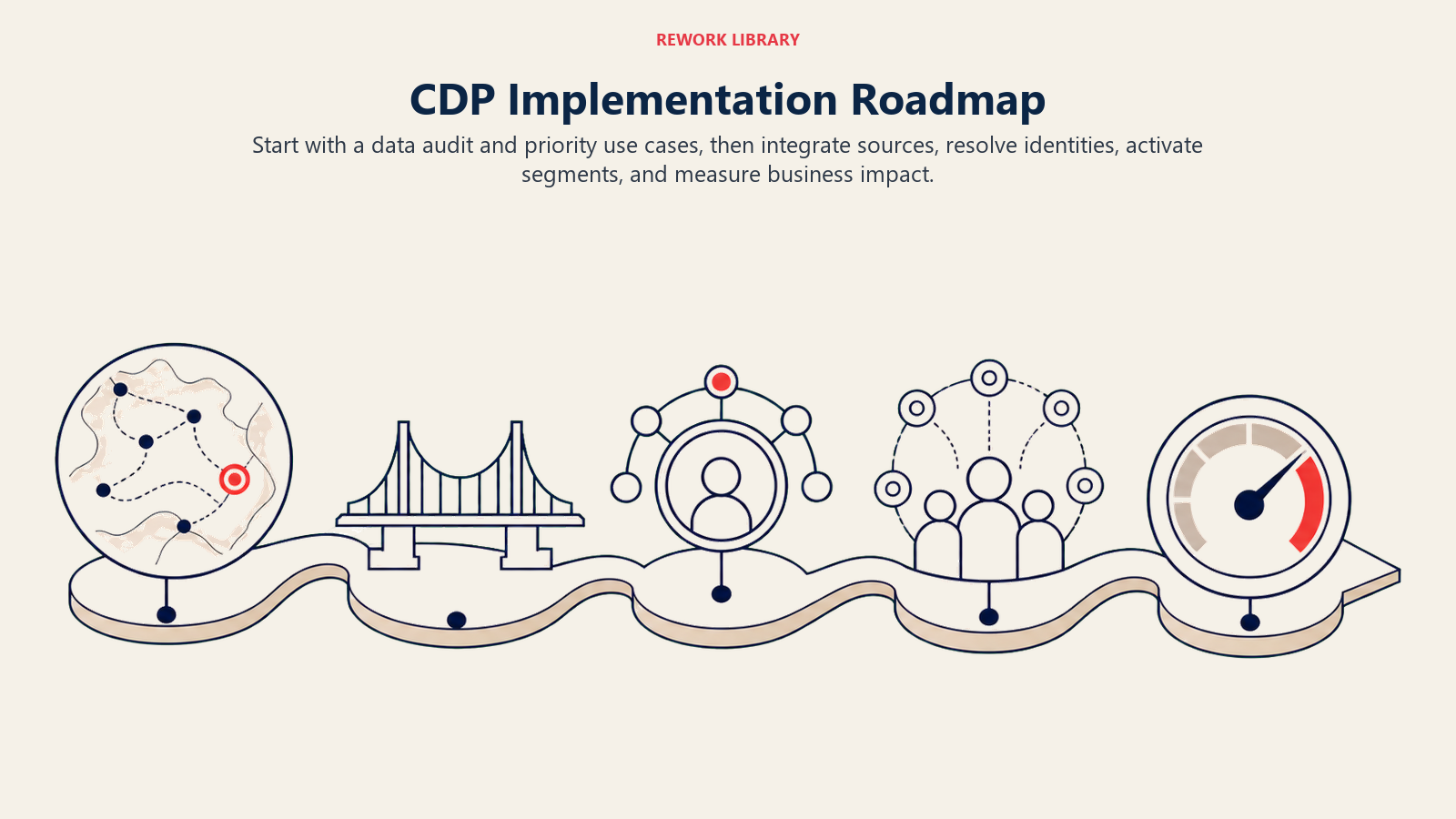
Document every system that touches customer data. For each system, identify:
- What customer data it contains
- How customers are identified (email, customer ID, device ID)
- Update frequency (real-time, hourly, daily)
- Data quality issues
- Privacy and compliance considerations
Create a prioritization matrix based on data completeness, business impact, and integration difficulty. Your first three integrations should be high-impact and moderate difficulty. Get early wins with visible results before tackling complex integrations.
Phase 2: Technical Integration Planning (2-3 weeks)
Work with your CDP vendor to design the integration architecture. Key decisions:
Server-side vs client-side tracking: Client-side JavaScript is easier to implement but affected by ad blockers and browser restrictions. Server-side tracking is more reliable but requires backend changes.
Event naming conventions: Establish standards before collecting data. Inconsistent event names create massive cleanup work later.
Identity resolution strategy: Define how you'll connect anonymous visitors to known customers. Where do users log in? What identifiers are available?
Data flow diagrams: Map exactly how data moves from sources through the CDP to destinations. This becomes your implementation guide.
Phase 3: Governance and Compliance Setup (1-2 weeks)
Before collecting data, establish governance policies:
Data retention: How long do you keep customer data? Different data types may have different retention requirements.
Consent management: How do you capture and respect customer preferences? Your CDP should integrate with your consent management platform.
Access controls: Who can view customer profiles? Create segments? Export data? Define roles and permissions.
Privacy processes: Document how you'll handle data subject requests, deletions, and compliance audits.
Phase 4: Implementation and Testing (3-4 weeks)
Install tracking code, connect integrations, and validate data flow:
Start with one source: Implement your website tracking first. Verify events are flowing correctly before adding more sources.
Build test segments: Create simple segments and verify the correct customers are included. Check segment counts against expected numbers.
Test activation: Send test segments to one destination platform and confirm they appear correctly.
Validate identity resolution: Track a test customer across multiple devices and verify the CDP successfully matches their profile.
Phase 5: Segmentation Strategy (2 weeks)
With data flowing, build your core segments:
Lifecycle segments: New, active, at-risk, churned RFM segments: Champions, loyal customers, potential loyalists, at-risk Behavioral segments: Browser types, category affinities, engagement levels Predictive segments: High churn risk, high next-purchase likelihood
Connect these segments to your email platform, advertising platforms, and analytics tracking setup before launching campaigns.
Phase 6: Measurement Framework (1 week)
Define how you'll measure CDP impact:
Baseline metrics: Document current email performance, campaign efficiency, repeat purchase rates, and segment activation time Success metrics: Set targets for improvement in each area based on key e-commerce metrics and KPIs Attribution approach: How will you isolate CDP impact from other initiatives? Consider using attribution modeling to understand channel contributions Reporting cadence: Weekly reviews during the first quarter, monthly thereafter
Ongoing Optimization: CDPs need continuous refinement. Plan for monthly segment reviews, quarterly integration additions, and annual strategy reassessments.
Common Pitfalls
Most CDP failures stem from these preventable mistakes. Over-Collecting Data Without Use Cases: Teams install tracking for every possible event "just in case." This creates massive volumes of unused data, increases costs, and makes it harder to find useful signals. Only track data you'll actually use for segmentation or activation.
Ignoring Privacy Regulations: GDPR fines start at €10 million or 2% of annual revenue. CCPA violations cost $2,500-$7,500 per incident. Your CDP makes compliance easier but doesn't automatically ensure compliance. Work with legal to establish proper consent, retention, and deletion processes.
Treating the CDP as Magic: A CDP is infrastructure. It creates possibilities but doesn't automatically improve results. You still need to build smart segments, create relevant content, and test campaigns. The CDP makes these activities more effective but doesn't replace strategic thinking.
Lack of Organizational Alignment: Marketing wants the CDP for segmentation. Product wants it for analytics. Engineering sees it as technical debt. Without executive sponsorship and cross-functional buy-in, CDP initiatives stall. Establish a CDP working group with representatives from marketing, product, engineering, and analytics.
Insufficient Technical Resources: CDPs reduce technical burden but still require ongoing maintenance. Event tracking breaks when you redesign pages. Integrations need updates when platforms change. Budget 10-20 hours per month for CDP maintenance.
Poor Data Quality: "Garbage in, garbage out" applies to CDPs. If your source systems have duplicate records, incorrect customer IDs, or inconsistent data formats, your unified profiles will be flawed. Fix data quality issues before implementing a CDP, not after.
Premature Scaling: Don't connect 25 data sources in month one. Start with your three highest-impact integrations, prove value, then expand. Trying to do everything at once leads to nothing working well.
What's Next for CDPs
The CDP category continues to evolve rapidly. These trends will shape the next five years. AI Integration: CDPs are adding built-in machine learning for automatic segment creation, next-best-action recommendations, and predictive modeling. Instead of manually building "customers likely to churn," the CDP will identify patterns and create segments automatically. Expect AI-powered personalization engines that continuously optimize recommendations without human intervention.
Real-Time Decisioning: Current CDPs excel at segment activation but lack sophisticated decision engines. Next-generation platforms will include real-time decisioning capabilities that evaluate multiple signals and select optimal actions in milliseconds. "Should we show this visitor a discount or a product recommendation?" becomes an automated decision based on predicted conversion lift.
First-Party Data Strategies: As third-party cookies disappear and privacy regulations tighten, CDPs become even more critical. Companies that own rich first-party customer data and activate it effectively will dominate their categories. And CDPs are evolving to help businesses collect more first-party data through preference centers, progressive profiling, and value exchanges.
Composable CDP Architectures: Some companies are building "composable CDPs" using modern data stacks. They use data warehouses (Snowflake) for storage, reverse ETL tools (Census, Hightouch) for activation, and identity resolution services (Rudderstack) for matching. This approach offers more flexibility but needs more engineering resources.
Tighter Platform Integration: Expect e-commerce platforms like Shopify and BigCommerce to offer native CDP capabilities or extremely tight integrations with major CDP vendors. The line between e-commerce platform and CDP will blur as platforms add unified customer profile features.
Predictive Lifetime Value at Scale: Current LTV models need data science teams. Future CDPs will calculate and continuously update predictive LTV for every customer automatically, making it a standard segmentation dimension rather than a specialized analysis.
The central insight remains unchanged: companies that unify their customer data and activate it intelligently will consistently outperform competitors operating with fragmented data. CDPs have moved from nice-to-have to competitive necessity for any e-commerce business targeting growth beyond $10M in revenue.
Start with clear use cases, implement progressively, measure rigorously, and expand based on proven results. Your customer data is sitting there waiting to drive growth. The question is whether you'll unify it before your competitors do.
Learn More
Maximize the value of your unified customer data with these related resources:
- Customer Segmentation - Build sophisticated audience segments using your unified customer profiles
- Customer Lifetime Value - Calculate and predict LTV with comprehensive behavioral and transaction data
- Product Recommendations & Personalization - Deploy recommendation engines powered by unified customer profiles
- Email Marketing for E-commerce - Create highly targeted email campaigns using CDP segments