Product Description Writing: Conversion-Focused Copy That Sells
Turn this article into takeaways for your work.


Each assistant summarizes the article only for you and suggests best practices for your work.
Most product descriptions fail before they even have a chance. They're copied from the manufacturer's spec sheet, crammed with technical jargon nobody cares about, and written like they're meant for a robot instead of a human being. Then store owners wonder why their conversion rates stay stuck at 1-2% while their competitors convert at 5-6%.
Product descriptions aren't just words on a page. They're your silent salesperson, working 24/7 to convince visitors to click "Add to Cart." A well-written description does three things at once: it helps people find you in search engines, it answers the exact questions holding them back from buying, and it creates enough emotional connection that they choose you over the dozen other stores selling the same thing.
The difference between a product that sits unsold and one that flies off the digital shelf often comes down to 200-300 words of well-crafted copy.
Why Product Description Writing Matters More Than Ever
E-commerce has fundamentally changed how people buy. Nobody walks into a store, picks up a product, examines it, and asks questions anymore. They read. They scroll. They compare. Your product description is the entire buying experience compressed into text, images, and a few strategic elements. The numbers tell the story. Stores with unique, well-written product descriptions see conversion rates 2-3x higher than those using manufacturer copy. Why? Because unique copy ranks in search engines (manufacturer descriptions appear on hundreds of sites, so Google ignores them), it answers customer-specific questions, and it speaks to buying motivations instead of listing features.
Consider two descriptions for the same standing desk:
Generic version: "Adjustable height desk with electric motor. Programmable memory settings. Steel frame. 48-inch desktop."
Conversion-focused version: "Back pain from sitting all day? This electric standing desk adjusts from sitting to standing in 10 seconds with a tap. Set your perfect heights in memory (sitting at 29", standing at 42") and never fiddle with manual adjustments again. The steel frame holds steady even when you're typing at full standing height - no wobble, no shake."
The second version doesn't just describe the desk. It identifies the problem (back pain, slow manual adjustments, wobbly desks), positions the product as the solution, and paints a picture of what using it feels like. That's what converts.
Understanding how product descriptions fit into your overall product page optimization strategy ensures you're not just writing good copy - you're writing copy that works within a conversion-focused page structure. Combined with strong product photography and video, your descriptions become exponentially more effective at driving conversions.
The Psychology of Product Description Writing
Before we get into formulas and techniques, you need to understand what's happening in a potential customer's mind when they land on your product page. They're not just gathering information. They're running through a mental checklist: Will this solve my problem? They have a specific need or desire. Your description needs to confirm this product addresses it. Can I trust this? They don't know you. They've been burned before by cheap products or misleading descriptions. You need to overcome skepticism. What if I'm wrong? They're worried about making a bad decision. You need to reduce the perceived risk.
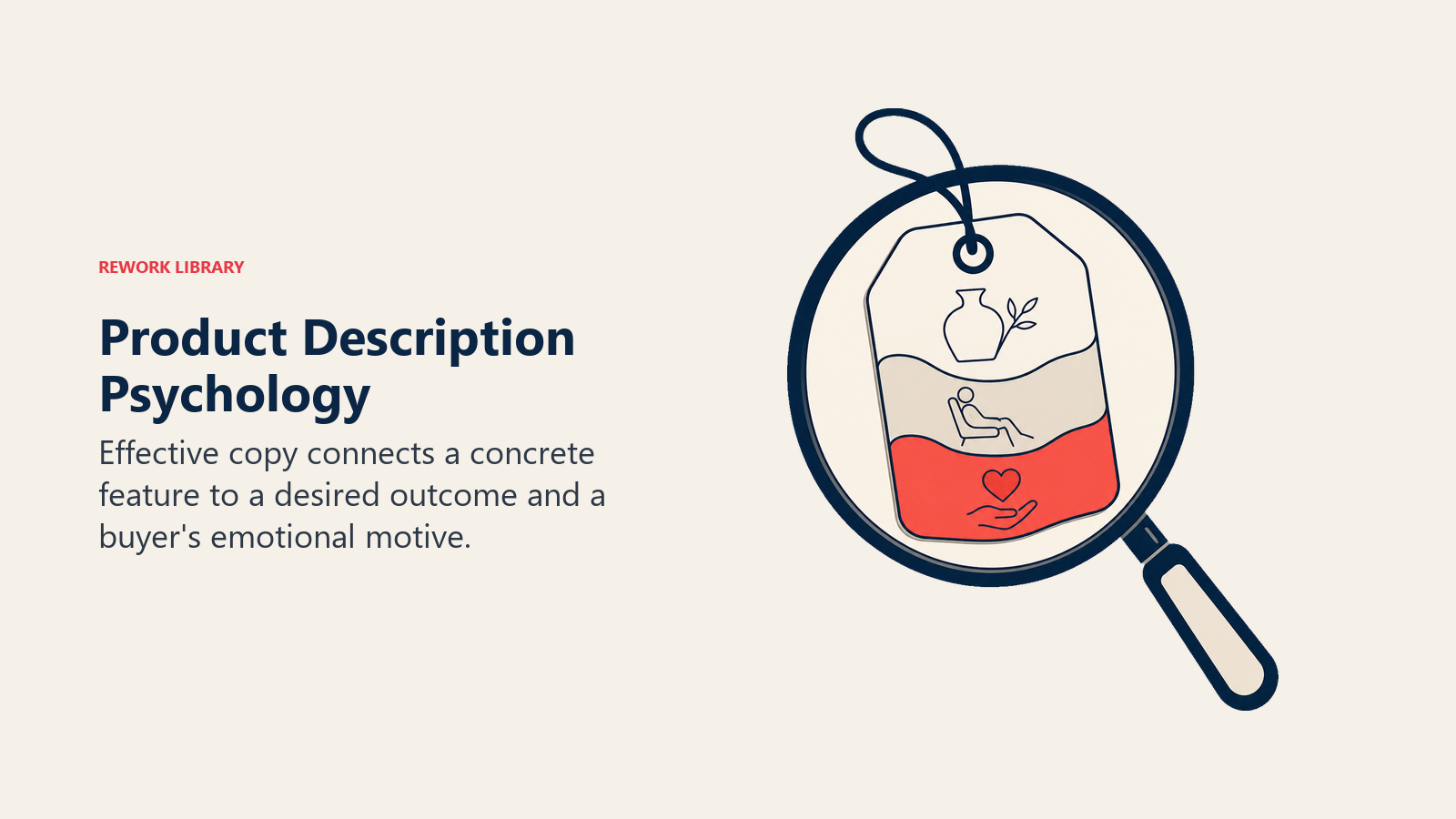
Why should I buy from you? They can probably find this product elsewhere. You need to differentiate.
Why should I buy it now? They're busy. They'll bookmark and forget unless you give them a reason to act today.
Every good product description addresses these questions, often without explicitly stating them. When you write with this mental model in mind, your copy stops being a list of features and becomes a persuasive conversation.
The Feature-Benefit Translation
This is where most product descriptions fall apart. They list features (what the product is) without translating them into benefits (what the product does for the customer).
Feature: "400-thread-count Egyptian cotton sheets" Benefit: "Hotel-quality sheets that feel softer and stay cooler than standard cotton, so you sleep better"
Feature: "Lithium-ion battery with 10-hour runtime" Benefit: "Use your wireless headphones all day without charging - from your morning commute to your evening workout"
Feature: "Stainless steel construction" Benefit: "Won't rust, warp, or scratch even after years of daily use"
The formula is simple: every feature should answer "so what?" If you can't explain why a feature matters to the customer's life, it's either not worth mentioning or you haven't thought deeply enough about your customer.
The Product Description Formula That Works
There's no single template that works for every product, but there's a structure that consistently outperforms generic descriptions across industries and price points.
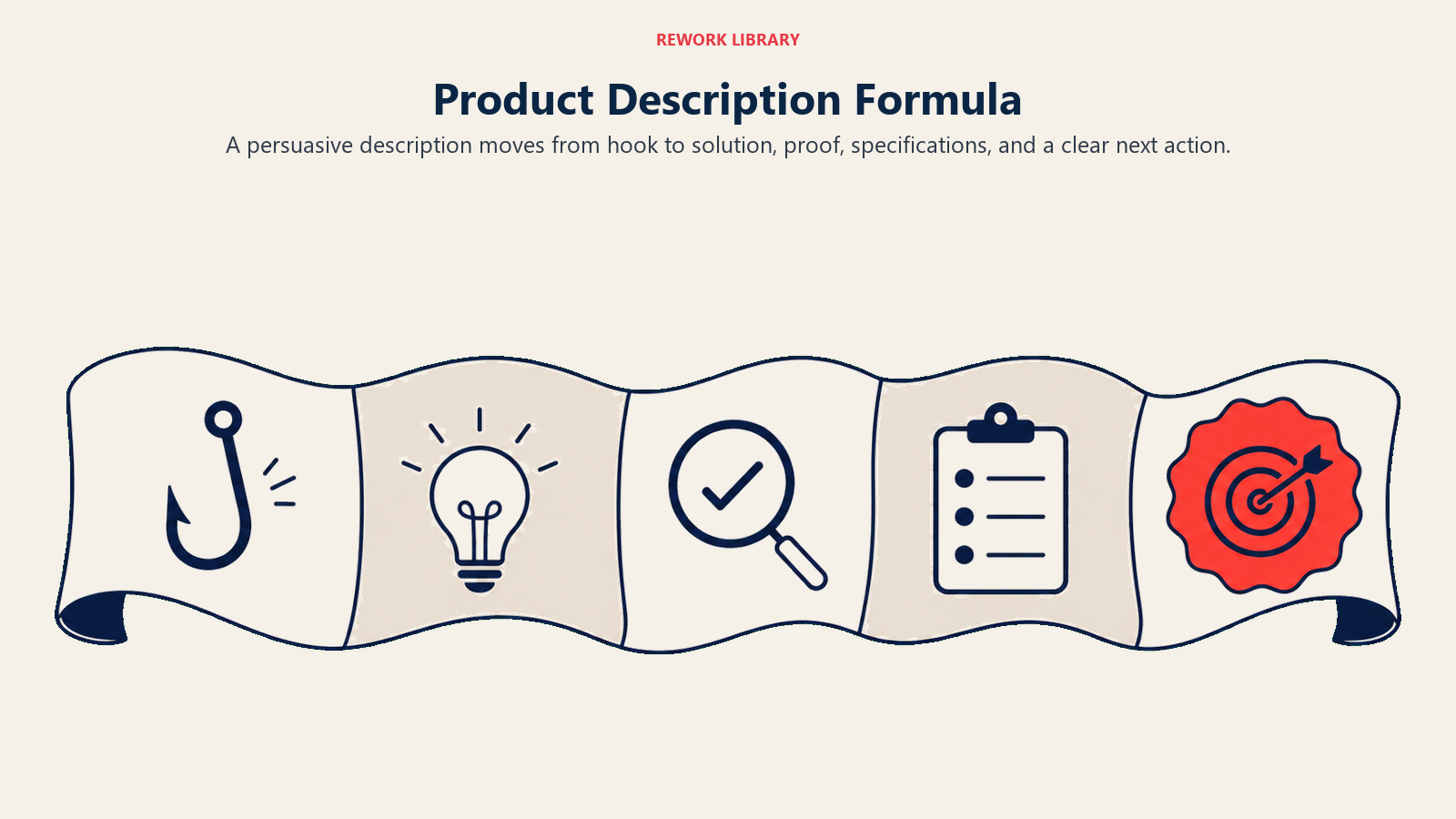
Opening: Hook + Problem Identification (2-3 sentences)
Start with a question, pain point, or desire your target customer immediately recognizes. This creates the "that's me" moment that makes them keep reading.
"Tired of tangled cables on your desk? Wireless charging should be simple - drop your phone, watch, and earbuds in one spot and walk away. This 3-in-1 charging station finally makes that possible."
You've identified the problem (cable clutter), acknowledged what should be true but isn't (charging should be simple), and positioned your product as the solution. In three sentences.
Body: Solutions + Specific Details (4-6 sentences)
This is where you translate features into benefits while providing just enough technical detail to satisfy logical buyers. Mix practical benefits with emotional outcomes.
"Charge your iPhone, Apple Watch, and AirPods simultaneously without fumbling with three separate cables. The built-in alignment guides ensure your phone charges properly every time - no more waking up to a dead phone because it was sitting 2mm off-center. Fast charging delivers 15W to your phone, so you get a 50% charge in 30 minutes instead of waiting two hours. The soft silicone base protects your devices and won't scratch your nightstand. And because it folds flat, it fits in your bag when you travel."
Notice how each sentence delivers a complete thought - no "moreover" or "additionally" needed. Each benefit flows naturally into the next.
Details: Specifications + Technical Info (Bulleted list)
After the narrative copy, provide scannable technical specifications for people who need specific details before buying. This satisfies the logical, detail-oriented buyers without cluttering your main copy.
Technical Specifications:
- Power output: 15W (phone), 5W (watch), 5W (earbuds)
- Compatible devices: iPhone 12 and newer, Apple Watch Series 3+, AirPods with wireless case
- Cable: USB-C, 5ft braided cable included
- Dimensions: 7" x 3" x 0.5" (folded)
- Safety: Over-temperature protection, foreign object detection, UL certified
Closing: Trust + Call-to-Action (1-2 sentences)
End with a trust signal (warranty, return policy, social proof) and a clear next step.
"Backed by a 2-year warranty and over 5,000 5-star reviews. Order today and never deal with charging cable clutter again."
Writing for Different Product Categories
The formula adapts based on what you're selling. Here's how to adjust your approach for common product types.
Fashion & Apparel
Fashion buying is emotional and aspirational. Describe how wearing the item makes someone feel, not just what it looks like.
Focus on:
- Fit and feel (how it wears, not just measurements)
- Styling versatility (what to pair it with)
- Quality indicators (fabric weight, construction details)
- Lifestyle context (where they'll wear it)
Example opening: "The blazer that takes you from client meetings to dinner without looking overdressed for either. This slim-fit design gives you structure without feeling stiff, made from stretch fabric that moves with you instead of restricting you."
Electronics & Tech
Tech buyers want proof the product solves their specific use case. Be precise about capabilities and limitations.
Focus on:
- Real-world performance (not just specs)
- Compatibility and integration
- Setup and learning curve
- Support and updates
- Concrete use cases
Example opening: "Video calls with 10+ people turn into a laggy, pixelated mess on standard webcams. This 1080p camera with dual microphones delivers clear video and audio even when your bandwidth isn't perfect, so your remote team actually hears what you're saying."
Home & Furniture
Home goods buying combines practical needs (will it fit, is it durable) with emotional desires (will I love it, will guests notice it).
Focus on:
- Dimensions and space context
- Durability and maintenance
- Assembly and setup
- Material quality and feel
- Style and design rationale
Example opening: "Small apartments need furniture that does more than one job. This coffee table lifts up to dining height in seconds, revealing hidden storage underneath - perfect for storing blankets, remotes, and the random clutter that usually ends up on top of coffee tables."
Beauty & Personal Care
Beauty and wellness products sell transformation. People aren't buying shampoo - they're buying better hair.
Focus on:
- Problem it solves (specific hair/skin issues)
- How it works (ingredients and mechanism)
- Expected results and timeline
- Usage instructions
- Sensory details (smell, texture, feel)
Example opening: "Frizzy hair in humid weather makes every styled look fall flat by lunchtime. This anti-humidity serum creates an invisible barrier that locks out moisture while keeping your hair soft and moveable - not stiff or greasy like most anti-frizz products."
Sports & Fitness
Fitness buyers want performance improvements and injury prevention. Connect features to performance outcomes.
Focus on:
- Performance benefits (speed, strength, endurance)
- Comfort during use
- Durability under stress
- Technical advantages
- Skill level appropriateness
Example opening: "Running in shoes designed for walking gives you shin splints and knee pain. These lightweight running shoes have responsive cushioning that absorbs impact on heel strike while propelling you forward on toe-off - the difference between grinding through miles and feeling energized."
SEO Optimization Without Killing Readability
Product descriptions need to rank in search engines, but keyword-stuffed copy that reads like a robot wrote it won't convert even if it ranks. The goal is to write naturally while strategically including search terms. This is a crucial component of your broader e-commerce SEO strategy that helps your products get discovered by the right buyers.
Keyword Research for Product Descriptions
Before writing, identify what people actually search for. Don't guess. Use real data.
Primary keyword: The main product type (e.g., "wireless charging station") Secondary keywords: Specific features or variations (e.g., "3-in-1 charging station," "fast wireless charger for iPhone") Long-tail keywords: Specific questions or use cases (e.g., "charging station for nightstand," "travel wireless charger")
Use tools like Google Keyword Planner, Ahrefs, or SEMrush to find search volume and competition. Prioritize keywords with commercial intent (people ready to buy) over informational queries.
Natural Keyword Integration
Once you have your keywords, work them into your copy naturally. Here's how:
Title and first paragraph: Include your primary keyword in both. "This 3-in-1 wireless charging station charges your phone, watch, and earbuds simultaneously."
Subheadings: Use secondary keywords in H2 and H3 tags. "Fast Wireless Charging for iPhone 14 and 15"
Body copy: Sprinkle variations throughout, but never force it. If a keyword doesn't fit naturally, skip it.
Alt text for images: Describe what's in the image while including relevant keywords. "Wireless charging station with iPhone, Apple Watch, and AirPods"
For more advanced SEO techniques specific to product pages, explore our comprehensive guide on product page SEO which covers technical optimization, schema markup, and ranking strategies.
What Not to Do
Don't write like this: "Looking for wireless charging stations? Our wireless charging station is the best wireless charging station because this wireless charging station has features other wireless charging stations don't have."
That's keyword stuffing, and Google penalizes it. More importantly, humans stop reading immediately.
Instead: "This charging station solves the biggest frustration with wireless charging - aligning your phone perfectly so it actually charges. The built-in guides mean you drop your phone and it works every time."
The keywords are there (charging station, wireless charging, phone), but they're serving the sentence instead of dominating it.
Advanced Copywriting Techniques
Once you've mastered the basics, these advanced techniques separate good product descriptions from exceptional ones.
Sensory Language
Help readers imagine using the product by engaging multiple senses.
Weak: "Soft leather chair" Strong: "Sink into butter-soft leather that molds to your back, with cushioning that supports without feeling stiff"
Weak: "Fresh coffee beans" Strong: "Open the bag and the rich aroma of chocolate and caramel hits immediately - these beans smell like the best coffee shop in your city"
Specificity Over Vagueness
Specific details are more believable and memorable than vague claims.
Vague: "Long battery life" Specific: "10 hours of continuous use - enough for a full workday plus your evening commute"
Vague: "Durable construction" Specific: "Drop-tested from 6 feet onto concrete without damage. The reinforced corners take the impact so your phone doesn't."
Preemptive Objection Handling
Address common concerns before they become reasons not to buy. This technique pairs especially well with a clear returns management process that gives customers confidence to purchase.
If your product is more expensive than competitors: "Yes, it costs more than budget options. It also lasts 5x longer, so you actually spend less over time - plus you're not dealing with replacements every few months."
If setup might be complicated: "No technical expertise required. Plug it in, download the app, and you're running in under 5 minutes. Video setup guide included."
If sizing is uncertain: "Not sure about fit? Order your normal size - these run true to size. Free returns if it's not perfect."
Creating Urgency Without Being Pushy
Legitimate urgency converts better than fake scarcity.
Fake: "Only 3 left!" (when you have 500 in stock) Real: "Summer sale ends Sunday - save 20% this week only"
Fake: "Everyone is buying this!" Real: "Our best seller for outdoor furniture - we restock this piece three times more often than any other product"
Fake: "Don't miss out!" Real: "Order by 2pm for same-day shipping"
Common Product Description Mistakes to Avoid
Even experienced copywriters fall into these traps. Here's what to watch for.
Copying Manufacturer Descriptions
This is the biggest mistake and the easiest to fix. Manufacturer copy is written for B2B buyers (retailers), not end customers. It's generic by necessity. Your description should be written specifically for your target customer.
Plus, hundreds of other stores are using the same manufacturer copy. Google sees duplicate content and doesn't rank any version well. Unique descriptions give you an SEO advantage while also connecting better with your specific audience.
Writing About the Company Instead of the Product
"At [Company Name], we believe in quality and customer service. We've been in business for 20 years providing excellent products..."
Nobody cares. They care whether this specific product solves their problem. Save company info for your About page.
Using Jargon Without Explanation
Technical terms are fine if your audience knows them. But if you're selling to general consumers, explain or skip the jargon.
"This monitor has a 144Hz refresh rate" means nothing to most buyers.
"This monitor refreshes the image 144 times per second instead of the standard 60, so fast-moving video games look smooth instead of stuttery" explains what that spec actually does.
Listing Features Without Context
"300-watt motor, 2-liter capacity, 6 speed settings, pulse function, dishwasher-safe parts"
Those are features. Now translate them:
"The 300-watt motor powers through frozen fruit without straining (cheaper blenders burn out). The 2-liter pitcher makes enough smoothie for the whole family in one batch. Six speeds give you control - blend gently for chunky salsas or liquify for perfectly smooth hummus. Pop the parts in the dishwasher when you're done."
Ignoring the Mobile Experience
Over 60% of e-commerce traffic comes from mobile devices. Long paragraphs are exhausting on small screens.
Write in shorter paragraphs (2-4 sentences max). Use bullet points. Add white space. Make it scannable.
Writing for Everyone (Which Means No One)
"Perfect for anyone who needs a [product]" is weak positioning. Speak directly to your primary customer segment.
"Perfect for remote workers who need to focus in noisy home environments" is stronger than "perfect for anyone who works from home."
Optimization and Testing
Writing great product descriptions isn't a one-and-done task. Top-performing stores continually test and refine.
What to Test
Description length: Try short (100-150 words) vs. medium (200-300 words) vs. long (400-500+ words). Some products convert better with minimal copy; others need comprehensive detail.
Opening hooks: Test question-based openings vs. statement-based vs. benefit-led. Small changes here can significantly impact whether people keep reading.
Format: Test paragraph-heavy descriptions vs. bullet-point-heavy vs. mixed. Different audiences prefer different formats.
Tone: Test friendly and casual vs. professional and detailed. B2B products often need different tone than consumer products.
Call-to-action language: "Add to Cart" vs. "Get Yours Now" vs. "Order Today" - these small variations can move conversion rates.
Testing Method
Don't test everything at once. Change one element on a subset of similar products, run the test for at least two weeks (to account for weekly traffic patterns), and compare conversion rates.
If you have high-traffic products, A/B test directly using a structured A/B testing framework. If you have lower traffic, test sequentially (new version vs. old version for equivalent time periods).
Track not just conversion rate but also average order value, return rates, and support questions. Sometimes a description that converts better creates more returns (because it over-promises) or more support tickets (because it under-explains).
Scaling Product Description Writing
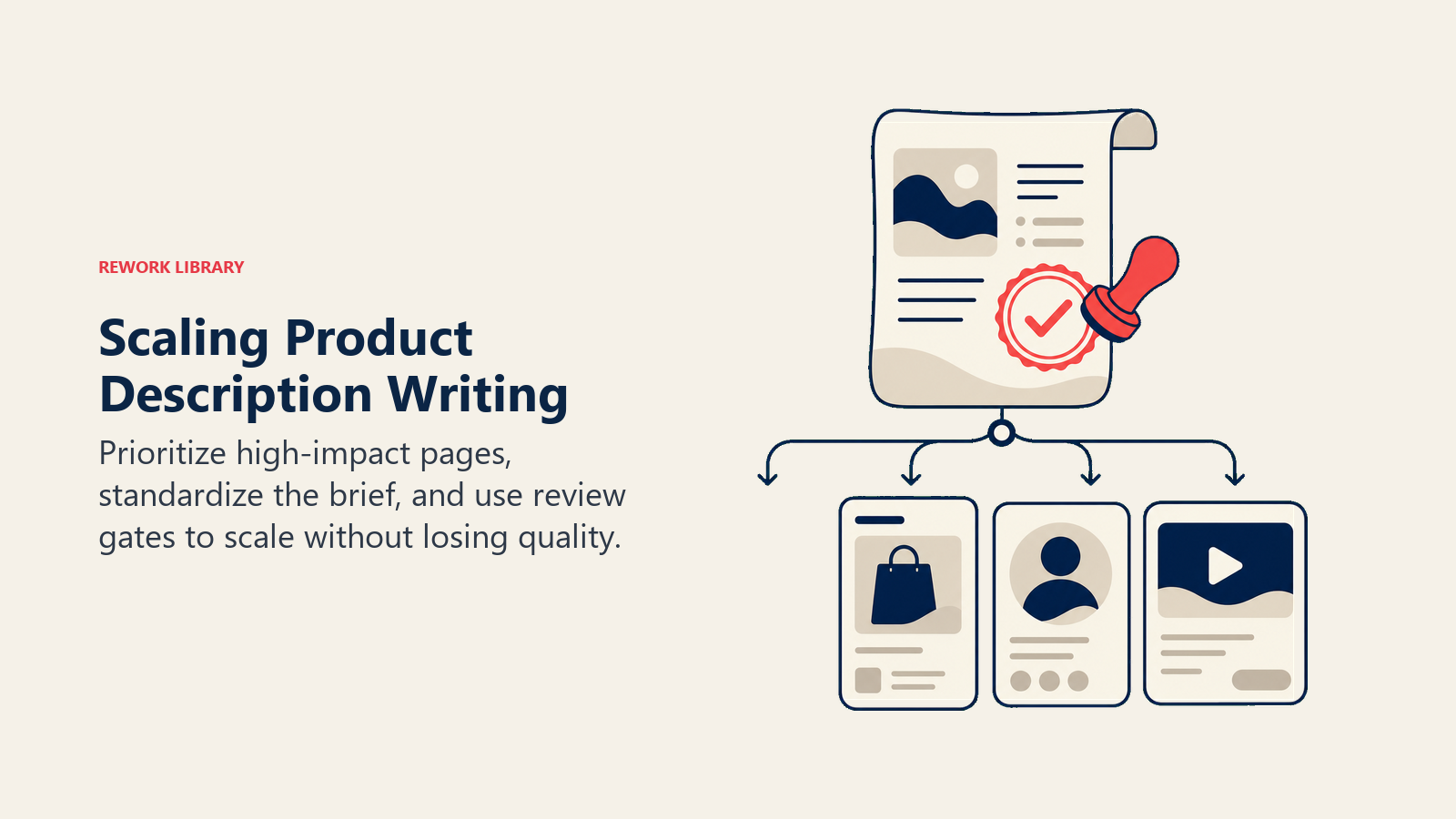
Writing unique, high-quality descriptions for thousands of products seems impossible. Here's how to approach it strategically.
Prioritization Framework
Not every product needs a fully custom description on day one. Prioritize based on:
- High-traffic products: Products that get the most visits first
- High-margin products: Products with the best profit margins second
- Products with poor conversion: Products with traffic but low conversion third
- New launches: New products as they launch
- Everything else: Fill in over time
Template-Based Approach for Scale
For large catalogs with similar products (e.g., 500 t-shirts in different colors), create a flexible template.
Template structure: [Hook about problem] This [product type] solves [problem] with [main differentiator]. [3-4 sentences about benefits] [Specific details about this variant: color, size, material specifics]. [Trust signal + CTA]
Example for black t-shirt: "Cheap t-shirts shrink, fade, and lose shape after a few washes. This premium cotton tee maintains its fit and color even after dozens of wash cycles. Pre-shrunk fabric means you order your size and it stays your size. Double-stitched hems prevent unraveling. The soft, breathable cotton keeps you comfortable whether you're running errands or meeting friends. This black colorway works with everything in your wardrobe - dress it up with a blazer or keep it casual with jeans. Over 2,000 five-star reviews. Order your true size today."
Change the color-specific sentence and you've got 10 variations ready.
Working With Writers
If you're hiring writers (freelancers or in-house), provide:
Product details: Specs, features, key benefits, manufacturer info Customer research: Common questions, pain points, buying motivations Competitor examples: Links to 3-4 competitor product pages Target audience: Who buys this and why Tone guidance: Examples of descriptions that match your brand voice SEO keywords: Primary and secondary keywords to include
A detailed brief produces better first drafts, saving revision rounds.
Product Description Writing for Commerce Platforms
Different e-commerce platforms have different technical requirements and limitations. Here's how to adapt.
Shopify
Shopify allows HTML in product descriptions, so you can add custom formatting, embedded videos, and styled elements. The description field has no character limit, but extremely long descriptions may impact page load speed.
Best practice: Keep core description under 500 words, use collapsible sections for extensive technical specs, embed size charts and care instructions as images.
WooCommerce
WooCommerce (WordPress) gives full control over description layout. You can use short description (excerpt that appears above the fold) and long description (below the fold).
Best practice: Put key benefits and conversion elements in the short description, detailed specs and FAQs in the long description.
BigCommerce
BigCommerce has separate fields for description, warranty info, and meta descriptions. Take advantage of the structured data to organize information logically.
Best practice: Main description focuses on benefits, warranty section covers guarantees and return policy, meta description optimized for search.
Amazon
Amazon has strict formatting rules - no HTML, limited use of characters, specific section requirements. You also need to compete with dozens or hundreds of other sellers for the same product.
Best practice: Use all available characters in bullet points, front-load key benefits, include size/fit information prominently, optimize for Amazon's search algorithm (A9) with relevant keywords. For detailed strategies on ranking higher in Amazon search results, review our guide on Amazon SEO and ranking.
Custom Platforms
If you're using custom-built commerce software like quotation management systems that generate online product pages, you have flexibility in structure but need to ensure your copy integrates properly with dynamic pricing, discount calculations, and product configurations.
Best practice: Separate static description content from dynamic elements (pricing, availability), ensure descriptions are clear about what's included in the base price vs. customizable options.
Combining Descriptions With Other Page Elements
A product description doesn't exist in isolation. It works together with other page elements to convert visitors.
Descriptions + Images
Your description should reference what's visible in product photos. If your main image shows the product in use, your opening line might be: "See how this wireless charger fits perfectly on a nightstand? That's intentional design."
If you have multiple product images showing different angles or features, call them out: "Check the gallery to see the hidden storage compartment underneath."
Descriptions + Reviews
Customer reviews provide social proof and answer real questions. Reference reviews in your description to preemptively address concerns: "Over 1,000 reviewers mention how easy this is to assemble - no tools required, 10 minutes from box to done." Building a robust system for collecting and displaying customer reviews and user-generated content amplifies the effectiveness of your product descriptions significantly.
Descriptions + Video
If you have product videos, the description can reference what's shown: "Watch the video to see how the convertible laptop mode works - it flips completely flat without any manual adjustments."
Video can also handle what's difficult to convey in text. Unboxing, assembly, size comparison, and performance demonstrations work better on video, leaving your description to focus on benefits and emotional connection.
Descriptions + Specifications
Technical specifications should complement, not duplicate, your main description. Main copy covers benefits and use cases, specs table provides detailed measurements and compatibility info for detail-oriented buyers.
Integrate your product information properly within your overall conversion rate optimization strategy. Descriptions are one element of high-converting product pages that work together with images, reviews, and other page elements to guide visitors toward purchase.
Maintaining Description Quality Over Time
Product descriptions need updates as products change, customer feedback emerges, and search behavior evolves.
Regular Audit Schedule
Quarterly: Review top 20 products for accuracy, update any changed features or specs Bi-annually: Refresh descriptions for seasonal products (update winter descriptions before winter season) Annually: Complete audit of all products, rewrite underperforming descriptions
Using Customer Feedback
Customer service questions reveal gaps in your descriptions. If 50 people ask "Does this work with my iPhone 13?" your description should explicitly answer that.
Reviews highlight what matters most to buyers. If 100 reviews mention "easy to clean," add that benefit to your description prominently.
Adapting to Search Trends
Search behavior changes. New models release, new terminology emerges, people search differently. Consider implementing a personalization engine that can dynamically adjust product presentation based on customer segments while maintaining your core description quality.
Check your search query data quarterly. If people are finding your product pages using terms you didn't optimize for, update descriptions to include those terms naturally.
The Business Impact of Great Product Descriptions
Let's bring this back to what actually matters - results. What happens when you invest in quality product descriptions? Higher conversion rates: Well-written descriptions convert 2-3x better than generic copy, meaning the same traffic generates significantly more revenue.
Better SEO performance: Unique, keyword-optimized descriptions rank higher in search results, driving more organic traffic without additional ad spend.
Lower return rates: Accurate, detailed descriptions set proper expectations, reducing "not what I expected" returns.
Fewer support tickets: Comprehensive descriptions answer common questions upfront, reducing pre-purchase support volume.
Higher average order value: Descriptions that effectively communicate value justify premium pricing and reduce discount dependence.
A store with 100 products, 10,000 monthly visitors, and a 2% conversion rate generates 200 sales monthly. Improve conversion to 4% through better descriptions (a realistic improvement), and you've doubled sales to 400 monthly with the same traffic.
Over a year, that's 2,400 additional sales. At an average order value of $75, that's $180,000 in additional revenue from copy improvements. Even at a 30% margin, that's $54,000 additional profit from better descriptions.
Getting Started: Your First 10 Product Descriptions
If you're starting from scratch or doing a complete overhaul, here's the practical approach:
Week 1: Choose your top 10 products by traffic volume. Write new descriptions using the framework in this guide. Publish and track baseline metrics (traffic, conversion rate, revenue).
Week 2-4: Let the data accumulate. You need at least two weeks of data to see meaningful patterns.
Week 5: Analyze results. Which descriptions performed best? What elements worked? Identify patterns.
Week 6-8: Write your next 20 products using insights from the first 10. Refine your approach based on what's working.
Ongoing: Add 10-20 new descriptions per week until your entire catalog is covered. Then move to the maintenance and optimization phase.
Start with products where the impact is immediate - high traffic, high margin, currently poor conversion. That's where improved descriptions pay back fastest.
Product descriptions are one of the highest-leverage improvements in e-commerce. The words you write work continuously, converting traffic while you sleep. Invest in getting them right.
Learn More: Related E-commerce Growth Resources
Enhance your product page performance with these complementary strategies:
- Product Page Optimization - Complete framework for building high-converting product pages beyond just descriptions
- Product Photography and Video - Visual content strategies that work alongside great copy
- Customer Reviews and UGC - Leverage social proof to reinforce your product descriptions
- Conversion Rate Optimization - Systematic approach to improving your entire conversion funnel

On this page
- Why Product Description Writing Matters More Than Ever
- The Psychology of Product Description Writing
- The Feature-Benefit Translation
- The Product Description Formula That Works
- Opening: Hook + Problem Identification (2-3 sentences)
- Body: Solutions + Specific Details (4-6 sentences)
- Details: Specifications + Technical Info (Bulleted list)
- Closing: Trust + Call-to-Action (1-2 sentences)
- Writing for Different Product Categories
- Fashion & Apparel
- Electronics & Tech
- Home & Furniture
- Beauty & Personal Care
- Sports & Fitness
- SEO Optimization Without Killing Readability
- Keyword Research for Product Descriptions
- Natural Keyword Integration
- What Not to Do
- Advanced Copywriting Techniques
- Sensory Language
- Specificity Over Vagueness
- Preemptive Objection Handling
- Creating Urgency Without Being Pushy
- Common Product Description Mistakes to Avoid
- Copying Manufacturer Descriptions
- Writing About the Company Instead of the Product
- Using Jargon Without Explanation
- Listing Features Without Context
- Ignoring the Mobile Experience
- Writing for Everyone (Which Means No One)
- Optimization and Testing
- What to Test
- Testing Method
- Scaling Product Description Writing
- Prioritization Framework
- Template-Based Approach for Scale
- Working With Writers
- Product Description Writing for Commerce Platforms
- Shopify
- WooCommerce
- BigCommerce
- Amazon
- Custom Platforms
- Combining Descriptions With Other Page Elements
- Descriptions + Images
- Descriptions + Reviews
- Descriptions + Video
- Descriptions + Specifications
- Maintaining Description Quality Over Time
- Regular Audit Schedule
- Using Customer Feedback
- Adapting to Search Trends
- The Business Impact of Great Product Descriptions
- Getting Started: Your First 10 Product Descriptions
- Learn More: Related E-commerce Growth Resources