Dropshipping Model: Low-Risk Entry Strategy for E-commerce Growth
Turn this article into takeaways for your work.


Each assistant summarizes the article only for you and suggests best practices for your work.
Dropshipping supports early ecommerce growth as a low-capital way to validate demand, not as a long-term business model. You list products you do not own, forward orders to suppliers who ship directly, and keep the margin, which removes inventory risk but also removes control over quality and delivery. The smart play is to test products with $700-3,000 in startup cost, then graduate proven winners to inventory-based fulfillment once volume and repeat rates justify it.
You can start an e-commerce business tomorrow with almost no capital. List products you don't own, sell them at a markup, forward orders to suppliers who ship directly to customers. Keep the difference. That's dropshipping, and it sounds perfect until you realize why 80% of dropshippers fail within their first year.
The model works, but there's a harsh trade-off: zero inventory risk means zero control over the customer experience. When your supplier ships late, sends defective products, or runs out of stock without warning, your brand takes the hit. You're building a business where you control marketing and pricing but not the core product delivery that determines whether customers come back.
Most dropshippers operate on 10-25% gross margins while competing against sellers using identical suppliers. Customer acquisition costs eat most profits. Chargebacks from shipping delays destroy what's left. The math works only if you find the right niche, select reliable suppliers, and know exactly when to graduate to inventory-based fulfillment.
Dropshipping isn't a long-term business model for most sellers, it's a validation tool. Use it to test products without financial risk, then transition to holding inventory once you've proven demand. This guide shows you the mechanics, economics, risks, and strategic timing for making dropshipping work as part of your broader e-commerce business models strategy.
Dropshipping Mechanics & Economics Foundation
The workflow is simple: customer places order → you forward it to supplier → supplier ships directly → you keep the margin. You never touch inventory. Your supplier handles warehousing, picking, packing, shipping. Capital requirements are minimal. You need:
- E-commerce platform subscription ($30-300/month)
- Domain and basic branding ($50-200)
- Sample products for quality verification ($100-500)
- Initial marketing budget ($500-2,000)
Total startup cost: $700-3,000 compared to $10,000-50,000 for inventory-based businesses.
Unit economics look deceptively simple:
- Product cost from supplier: $15
- Shipping cost: $5
- Selling price: $40
- Gross margin: $20 (50%)
But the real calculation includes platform fees (2-3%), payment processing (2.9% + $0.30), returns (5-15%), and chargebacks (1-3%). Your actual margin drops to $12-15 per unit before marketing costs. Understanding unit economics for e-commerce is critical for long-term viability.
Compare this to inventory-based fulfillment where you buy products at $10 instead of $15 because of bulk pricing, but you need $5,000 upfront to order 500 units. You get higher margin per sale, but massive upfront risk.
The fundamental trade-off: dropshipping exchanges margin compression for capital preservation. You pay premium per-unit costs to avoid inventory risk. This works when testing products or serving low-volume niches. It breaks down when scaling because your cost structure can't compete with sellers who buy bulk.
Supplier dependency is total. They control inventory availability, shipping speed, product quality, and packaging. You're building a business on infrastructure you don't own. When suppliers raise prices, experience stockouts, or deliver poor quality, you absorb the consequences with zero leverage.
Supplier Selection & Relationship Management
Your supplier determines whether your dropshipping business succeeds or fails. Most new dropshippers choose suppliers based on product catalog size. Wrong criteria. Focus on reliability metrics instead. Evaluation criteria that matter:
- Order accuracy rate: Should exceed 98%. One wrong item per 50 orders.
- Average fulfillment time: Order to shipment in 1-2 business days maximum.
- Stock accuracy: Inventory system sync within 15 minutes of actual stock levels.
- Return/defect rate: Under 2% for quality issues.
- Communication responsiveness: Reply within 24 hours to urgent issues.
Test reliability before committing. Place 10-20 test orders to different addresses. Track:
- Actual delivery time vs promised timeline
- Packaging quality and branding flexibility
- Product condition on arrival
- Tracking number accuracy and updates
- How they handle out-of-stock scenarios
Red flags during vetting:
- No minimum order requirements (signals they work with everyone)
- Generic product photos (means they're middlemen, not manufacturers)
- Reluctance to provide references or case studies
- No formal return/defect policies
- Inconsistent pricing between catalog versions
Payment terms reveal supplier quality. Reputable suppliers offer:
- Net-7 to Net-15 terms after establishing relationship
- Volume-based pricing tiers with clear thresholds
- Transparent fee structure (no hidden charges)
- Formal agreements outlining responsibilities
Start with transactional relationships but build toward partnerships. After proving consistent volume (50-100 orders/month), negotiate:
- Faster fulfillment priority
- Custom packaging with your branding
- Better pricing tiers
- Direct line to operations manager
- Inventory reservation for peak seasons
Supply chain diversification protects against single-supplier dependency. Identify 2-3 backup suppliers for best-selling products. Test them quarterly with small orders. When your primary supplier has stockouts or quality issues, you can pivot immediately instead of losing sales.
Document everything: pricing agreements, fulfillment SLAs, quality standards, communication protocols. Dropshipping relationships fail because expectations weren't formalized. Get it in writing.
Margin Analysis & Profitability Framework
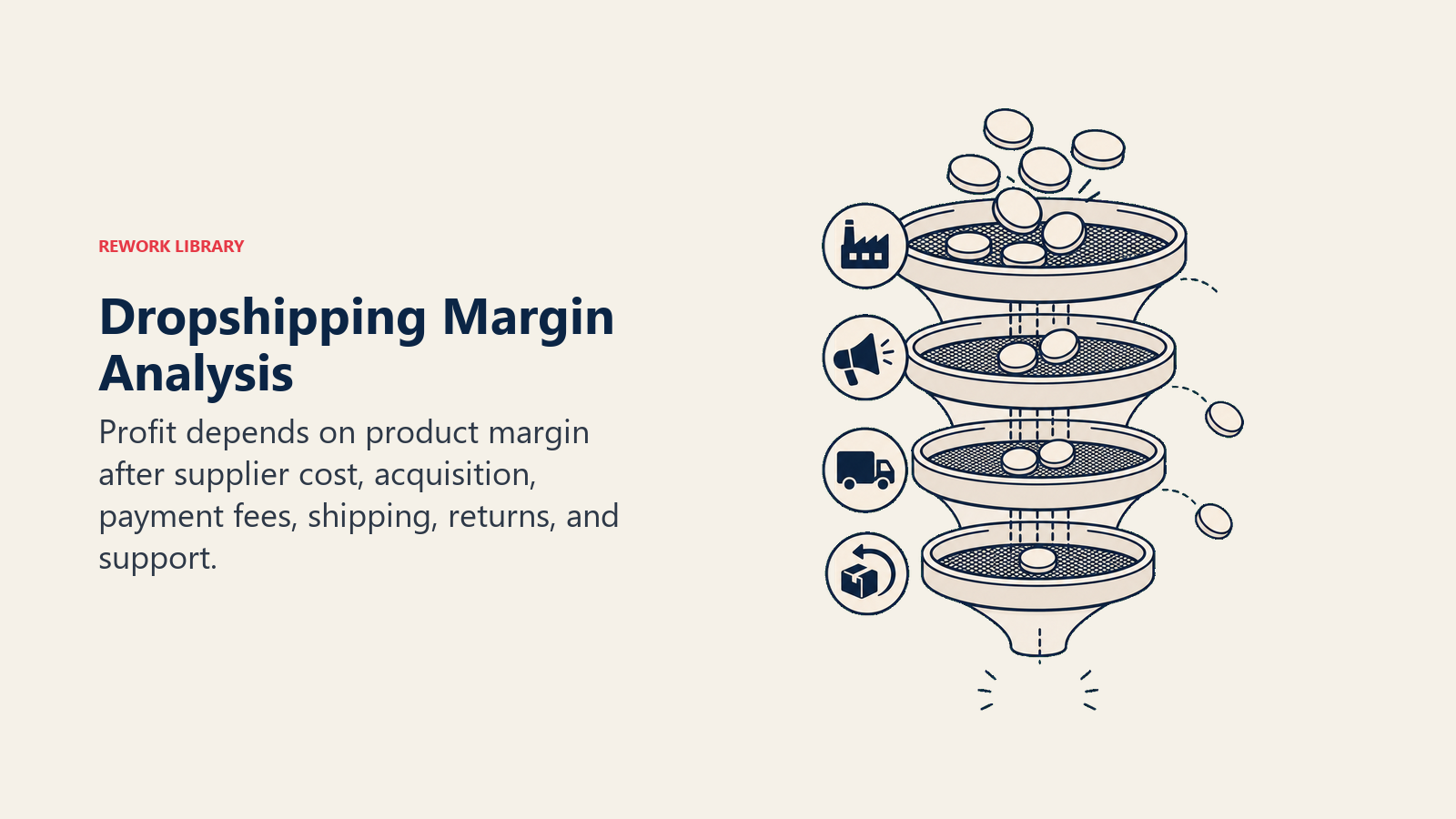
Dropshipping margin math looks simple until you account for all costs. Break down every component: Product costs:
- Base product from supplier: $15.00
- Supplier packaging/handling: $1.50
- Supplier margin built into their pricing: $3.00-5.00
Platform costs:
- Shopify subscription: $0.50 per order (assuming 100 orders/month on $79 plan)
- Transaction fees: 2% of sale price = $0.80
- Payment processing: 2.9% + $0.30 = $1.46
Logistics costs:
- Domestic shipping: $5.00-8.00
- International shipping: $12.00-25.00
- Returns shipping: $4.00 (allocated across all orders at 10% return rate = $0.40/order)
Developing a solid shipping strategy & pricing approach helps optimize these costs.
Risk costs:
- Chargebacks: 2% of orders = $0.80
- Damaged/lost packages: 1% = $0.40
- Customer service time: $1.00/order
Total cost on $40 sale: $29.36-32.36 Net margin: $7.64-10.64 (19-27%)
Before marketing. Customer acquisition cost determines profitability. If your CAC is $15 and margin is $10, you lose money on first purchase. You need 60% of customers to buy again just to break even. This is where tracking customer lifetime value becomes essential.
Typical margin profiles by niche:
- General consumer products: 10-15% (high competition)
- Specialty/hobby items: 20-30% (targeted audience)
- Custom/personalized products: 35-50% (low competition)
- Tech accessories: 15-25% (moderate competition)
Minimum order value becomes critical. You can't profitably dropship $20 items if CAC is $12. Your AOV (average order value) needs to be 3-4x your CAC for sustainable economics.
Example calculation for sustainability:
- Target CAC: $12
- Minimum AOV: $48 (4x CAC)
- Net margin at 25%: $12
- First purchase: Break-even
- Repeat purchase at 40% rate: ($12 × 0.4) = $4.80 profit per customer
This requires either upselling (increasing AOV to $60-80) or achieving 60-70% repeat rates. Most dropshippers struggle with both because they lack inventory control and branding differentiation.
Scaling challenges emerge around 500-1,000 orders/month. Your per-unit costs stay fixed while inventory-based competitors reduce theirs through bulk purchasing. You're stuck paying $15/unit while they're paying $10. They can afford to price at $35 and still profit while you need $40 minimum.
Break-even analysis reveals the crossover point:
- Dropshipping: $15 product cost + $5 shipping = $20 COGS, $40 sale = 50% margin
- Inventory model: $10 product (bulk) + $4 shipping (negotiated rates) = $14 COGS, $35 sale = 60% margin
At 1,000 units/month, inventory model generates $21,000 margin versus $20,000 for dropshipping, despite lower prices. The gap widens as volume increases.
Quality Control & Supplier Management
You don't control product quality, but you're responsible when customers receive defective items. This asymmetry kills dropshipping businesses that don't implement quality oversight systems. Sample receiving and inspection protocol: Order samples of every product before listing. Inspect for:
- Physical defects (scratches, misalignment, poor materials)
- Functionality (if applicable)
- Packaging quality (does it protect product in transit?)
- Branding accuracy (labels, inserts match your specifications)
- Actual dimensions versus supplier specifications
Document findings with photos. Create quality baseline. When customer complaints arise, you know whether it's supplier inconsistency or unrealistic expectations.
Ongoing quality auditing:
Don't assume quality stays consistent. Random audit process:
- Monthly: Order 2-3 products as if you're a customer
- Ship to your address or trusted friend's address
- Inspect everything, photograph unboxing
- Compare to baseline quality standards
- Track trends in packaging degradation or product changes
Suppliers cut corners over time, especially if they think you're not paying attention. Regular audits signal you're monitoring quality.
Handling defective units and warranties:
Establish clear policies before problems occur:
Return window: 30 days for defects (separate from change-of-mind returns) Defect definition: Product doesn't match listing, arrives damaged, or fails within warranty period Photo evidence requirement: Customer provides photos showing defect Supplier responsibility threshold: Defects above 2% trigger supplier investigation Resolution timeline: Replacement shipped within 5 business days, refund within 3 days if no replacement
When customers report defects:
- Collect evidence (photos, description, order number)
- Verify defect against baseline quality
- Contact supplier with evidence within 24 hours
- Request immediate replacement shipment
- Process customer refund/replacement same day (don't wait for supplier)
- Track supplier's resolution and credit to your account
You eat the cost upfront, then recover from supplier. This protects customer experience while holding supplier accountable.
Documentation and escalation:
Maintain defect log:
- Date of complaint
- Product SKU
- Issue description
- Photo evidence
- Customer resolution (replacement/refund)
- Supplier response
- Final cost allocation
When defect rate exceeds 2% for any product:
- Immediate escalation to supplier operations manager
- Temporary delisting until issue resolved
- Root cause analysis required from supplier
- Enhanced inspection for 100 units after resolution
SLAs and financial penalties:
Formalize performance standards in supplier agreements:
- Order accuracy: 98% minimum
- Fulfillment time: 2 business days maximum
- Defect rate: Under 2%
- Stock accuracy: 95% minimum
Penalties for violations:
- Credits for misshipped orders (full refund + shipping)
- Expedited shipping at supplier cost for delays they caused
- Full refund for defective products
- Right to terminate for consistent SLA misses (3+ months below standards)
Most dropshippers don't negotiate these terms. They accept whatever supplier provides. That's why customer experience suffers and reviews tank.
Customer Experience Risks & Mitigation
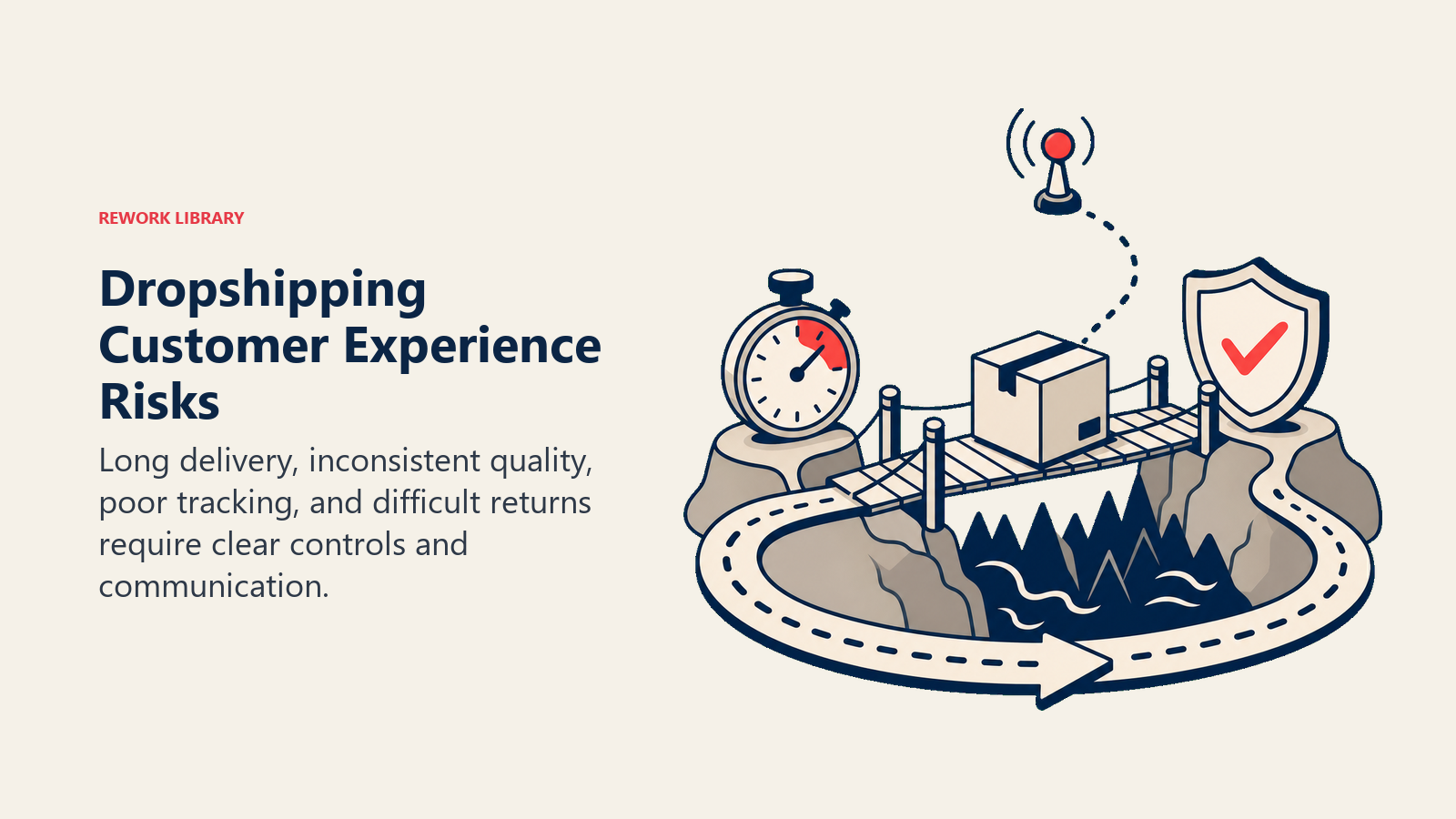
Dropshipping creates customer experience problems you can't directly control. You can only mitigate and communicate around them. Shipping delay reality: Suppliers promise "1-2 business days to ship" but reality differs:
- 30% ship same day
- 50% ship within 2 days
- 15% take 3-4 days
- 5% experience delays beyond 5 days
Total delivery time = supplier processing + carrier transit. If supplier takes 3 days and shipping takes 7 days, customer waits 10 days. For products marketed as "fast shipping," this kills trust.
Expectation setting strategies:
Be realistic about timelines. Don't promise 3-5 days if your supplier averages 2 days to ship and carrier takes 7-10 days. Promise 10-12 days, then delight customers by delivering in 8.
Product page transparency:
- "Ships within 2-3 business days"
- "Delivery: 7-12 business days via standard shipping"
- "Expedited shipping available: 4-6 business days"
Order confirmation email:
- "Your order is being prepared by our fulfillment partner"
- "Expected ship date: [Date + 2 days]"
- "Estimated delivery: [Date + 10 days]"
Tracking notification:
- Send immediately when supplier provides tracking
- Include delivery estimate based on carrier's data
- Link to tracking page
Proactive communication for delays:
Monitor orders without tracking updates 3 days after purchase. Contact supplier to confirm status. If delayed:
Email customer immediately: "We're following up on your order #12345. Our fulfillment partner experienced a slight delay, and your order will ship within the next 24 hours. We've applied a 10% credit to your account for the inconvenience. Tracking will be sent tomorrow."
Small gesture ($4-5 credit) prevents refund requests ($40 loss) and negative reviews (ongoing damage).
Return process complexity:
Returns in dropshipping are messy. Customer returns to supplier's address, not yours. You coordinate:
- Customer requests return → you approve within 24 hours
- You request RMA from supplier → supplier provides return address
- You send return label and instructions to customer
- Customer ships to supplier
- Supplier receives and inspects
- Supplier confirms condition and credits your account
- You refund customer
This takes 10-15 days minimum. Problems occur at every step: supplier delays RMA approval, customer doesn't ship, product arrives damaged from customer mishandling, supplier disputes condition.
Return policy that protects margins:
- 30-day return window (standard expectation)
- Customer pays return shipping for change-of-mind returns
- Free returns for defective/wrong items (you eat cost, recover from supplier)
- 15% restocking fee for opened non-defective items
- Clear photos required before return approval for damage claims
Reputation management:
One-star reviews from shipping delays compound. Customer doesn't care that supplier caused the delay, your brand gets blamed.
Review recovery protocol:
- Monitor reviews daily (set up alerts)
- Respond within 24 hours to negative reviews
- Acknowledge issue, explain resolution, offer compensation
- Follow up privately with customer to turn experience around
- Request review update after resolution
Example response: "We're sorry your order took longer than expected. This doesn't meet our standards. We've refunded your shipping cost and added a 20% discount code for your next order. Your feedback helps us hold our partners accountable."
40% of customers update negative reviews after proper resolution. That's the difference between 3.2 stars (death) and 4.4 stars (viable).
Operational Complexity of Dropshipping
Dropshipping looks simple until you're managing 20+ products across 3 suppliers with 50 daily orders. Operational complexity scales non-linearly.
Order routing logic:
Multiple suppliers mean routing decisions:
- Which supplier has lowest cost for this item?
- Which has fastest shipping to customer's location?
- Which has item in stock right now?
- Should you split shipment across suppliers or delay until one has everything?
Manual routing breaks at 10 orders/day. You need automated systems checking inventory, comparing costs, and routing to optimal supplier.
Inventory synchronization challenges:
Supplier shows 47 units in stock. You list product as available. Customer orders. Supplier actually has 3 units. Your order for 5 units gets partially fulfilled. Customer gets shipment notification for incomplete order.
Proper inventory management systems prevent these costly overselling situations.
Inventory sync needs to update every 15 minutes minimum:
- API integration pulling real-time stock levels
- Automatic delisting when stock falls below threshold (5 units)
- Buffer quantities to prevent overselling (show available only when supplier has 10+)
- Backorder notification systems when stock depletes
Out-of-stock handling protocols:
Despite sync efforts, stockouts happen. Process:
- Automated notification when order placed for out-of-stock item
- Immediate customer email: "We're confirming availability of [product] and will update you within 24 hours"
- Contact supplier for restock date
- If restocking within 5 days: offer to wait or switch to similar product
- If restocking beyond 5 days: offer alternative product or full refund
- Process resolution within 48 hours maximum
The longer you wait, the higher the chargeback risk. Chargebacks cost $40 in fees plus the sale amount. Better to refund proactively.
Technology requirements for scale:
At 100+ orders/month, you need:
- E-commerce platform with multi-supplier support (Shopify, WooCommerce)
- Order routing automation (ShipStation, Ordoro, or custom integration)
- Inventory sync middleware (Syncee, Oberlo for Shopify, custom APIs)
- Supplier communication tools (shared dashboards, EDI for larger suppliers)
- Customer service platform (Zendesk, Gorgias) with order data integration
- Analytics dashboard tracking margin by product, supplier performance, CAC by channel
Choosing the right e-commerce platform selection is foundational for scaling operations efficiently.
Split shipment communication:
Customer orders 3 items. Two come from Supplier A, one from Supplier B. Different tracking numbers, different delivery dates. Confusion and complaints follow unless you communicate clearly:
Order confirmation: "Your order contains items from multiple locations and will arrive in 2 shipments. You'll receive tracking for each shipment as they're processed."
When first shipment tracks: "Part of your order has shipped! Tracking: [link]. Your remaining item will ship within 2 business days."
When second shipment tracks: "The rest of your order is on the way! Tracking: [link]."
Reverse logistics complexity:
Returns go back to supplier addresses. If customer ordered from 2 suppliers and wants to return items from both, they need:
- Two different return labels
- Two different return addresses
- Clear instructions on which items go where
Single mistake means returned product goes to wrong supplier, credit gets delayed, customer gets frustrated, and you mediate for weeks.
Simplification strategy: limit product catalog to 1-2 primary suppliers for core SKUs. Use additional suppliers only for specialty items. Reduces operational overhead by 60%.
Dropshipping vs 3PL vs In-House Fulfillment
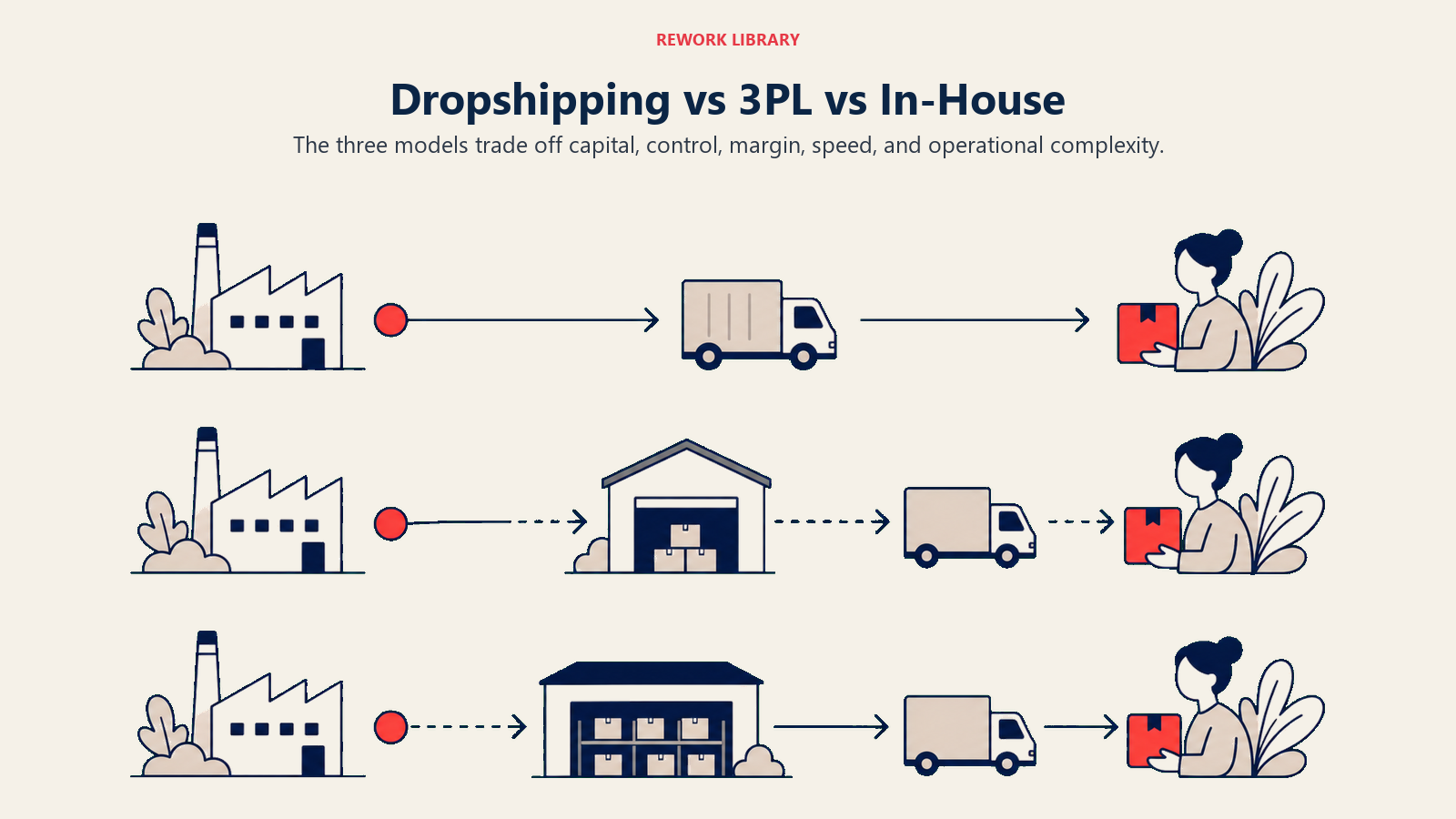
Understanding when to use each model determines long-term viability. Each has distinct economics and scaling characteristics. Capital intensity comparison:
| Model | Startup Capital | Monthly Fixed Costs | Variable Cost per Unit |
|---|---|---|---|
| Dropshipping | $700-3,000 | $100-500 | $20-30 |
| 3PL | $5,000-15,000 | $500-2,000 | $12-18 |
| In-house | $15,000-75,000 | $3,000-10,000 | $8-12 |
Dropshipping wins on capital efficiency. Loses on unit economics at scale.
Control differences:
Dropshipping: Zero control over inventory, packaging, shipping speed, or quality. You control marketing, pricing, and customer communication. That's it.
3PL (Third-Party Logistics): You own inventory (control over quality, quantities ordered). A 3PL partner selection process helps identify providers who handle storage and fulfillment (control over speed, packaging, shipping carriers). Middle ground between dropshipping and full control.
In-house: Complete control over every element. Also complete responsibility for space, labor, shipping negotiations, inventory management, and all operational overhead.
Speed and reliability trade-offs:
Dropshipping depends entirely on supplier speed. Best case: 1-2 day fulfillment. Average case: 3-5 days. Worst case: 7-10 days when supplier is backed up.
3PL typically ships same-day or next-day because inventory is already received and stored. Fulfillment centers are optimized for speed. Average delivery time improves by 30-40%.
In-house can ship same-day if you have systems and labor. But you're responsible when things break down, sick staff, equipment failures, carrier delays all land on you.
Scalability assessment:
Dropshipping scales well from 0-500 orders/month. Beyond that, margin compression from per-unit costs makes growth unprofitable unless you're in high-margin niches.
3PL scales efficiently from 500-10,000 orders/month. Fixed costs (receiving, storage) spread across more units. Variable costs (picking, packing) stay relatively constant.
In-house scales beyond 10,000 orders/month when you can negotiate bulk shipping rates, optimize warehouse layout, and hire dedicated staff. Below that threshold, fixed costs kill profitability.
Transition strategies:
Most successful e-commerce businesses start with dropshipping, validate product-market fit, then graduate to inventory-based fulfillment.
Transition trigger points:
- Selling 200+ units/month of specific products (proven demand)
- Gross margin below 25% due to supplier pricing (need bulk pricing)
- Customer complaints about shipping speed exceed 10% (need faster fulfillment)
- Repeat purchase rate above 30% (predictable reorder volumes)
Graduation playbook:
Phase 1: Identify top 20% of products by volume (likely 80% of revenue)
Phase 2: Calculate inventory investment required:
- 60-90 days of inventory for core products
- Bulk pricing from existing supplier or new manufacturer
- Example: Selling 200 units/month at $15 dropship cost
- 90-day inventory: 600 units
- Bulk cost: $10/unit
- Investment: $6,000
- Monthly savings: $1,000 in margin improvement
Phase 3: Source 3PL partner or warehouse space
- Compare 3PL costs to in-house for your volume
- Under 1,000 units/month: 3PL almost always cheaper
- Above 5,000 units/month: in-house becomes competitive
Phase 4: Transition gradually
- Order first inventory batch for top 3 SKUs
- Keep dropshipping for remaining catalog
- Test fulfillment operations before going all-in
- Expand inventory to more SKUs as cash flow improves
Phase 5: Optimize hybrid model
- Continue dropshipping for new/test products
- Hold inventory for proven winners
- Maintain supplier relationships for overflow during peak seasons
You don't need to abandon dropshipping completely. Use it strategically for product testing while building inventory-based operations for core catalog. Understanding different fulfillment strategy options helps you choose the right approach for each product.
Niche Selection & Product Viability
Product selection determines whether dropshipping economics work. Generic products with 100 suppliers competing on price fail. Specialized products with limited competition succeed.
High-margin niche characteristics:
- Passionate, engaged audience (hobbyists spend more)
- Products with perceived value beyond commodity pricing
- Limited supplier options (harder for competitors to replicate)
- Consumable or repeat-purchase potential
- Difficult to find in retail stores
Examples that work:
- Custom pet accessories (personalization prevents commodity pricing)
- Specialty fitness equipment for specific sports
- Hobby supplies for niche crafts (resin art, miniature painting)
- Sustainable/eco-friendly alternatives to common products
- Products targeting specific professional needs
Custom and personalized products advantage:
Personalization creates margin protection. Competitors can't replicate your exact offerings. Customers expect higher prices because items are unique.
T-shirt dropshipping fails (commodity). Custom-printed pet portraits succeed (personalization). Same fulfillment model, completely different economics.
Personalized products typically command 40-60% margins versus 15-25% for generic items. The customization work limits competition and justifies premium pricing.
Seasonal products strategy:
Seasonal items create timing advantages. Order samples in off-season, test marketing, then scale when season hits. Lower competition during testing phase, higher demand during peak.
Risks:
- Supplier stockouts during peak season
- Cash flow gaps between seasons
- Customer acquisition costs spike when everyone advertises simultaneously
Mitigation:
- Work with suppliers to reserve inventory before peak season
- Build email list during off-season for lower CAC
- Test products with small budgets before committing heavily
Avoiding price competition death spirals:
Generic products available from 50 suppliers attract sellers who compete purely on price. Race to bottom:
- Seller A prices at $40
- Seller B undercuts at $38
- Seller C goes to $35
- Everyone's margin compresses to $5-7 per unit
- CAC stays at $12-15
- Nobody profits
Exit this game by finding products with limited supplier options. If only 3-5 suppliers carry the product, price competition reduces. If you're the only seller with that specific variant, you set market price.
Competitive saturation assessment:
Before adding products, check saturation:
- Google Shopping search: How many sellers listing identical product?
- Amazon search: How many results for exact product?
- AliExpress: How many orders show on supplier listing? (High orders = many dropshippers)
- Facebook Ad Library: How many advertisers promoting this product?
Saturation indicators:
- 10+ sellers on Google Shopping: Saturated
- 100+ reviews on Amazon for same product: Saturated
- Supplier shows 10,000+ orders: Saturated
- 20+ active Facebook advertisers: Saturated
Find products with 1-5 sellers maximum. Early-mover advantage still exists if you identify products before saturation.
Testing before inventory investment:
Dropshipping's primary value: product validation without inventory risk. Use this strategically:
Test protocol:
- Add 10-15 products to store in new niche
- Run small marketing tests ($500-1,000 total budget)
- Track which products generate orders
- Calculate actual CAC and conversion rates
- Identify 2-3 winners with sustainable economics
- Order inventory for winners
- Continue dropshipping for remaining catalog
This product research & validation approach minimizes risk while gathering real market data.
Validation criteria before inventory investment:
- 50+ units sold through dropshipping
- CAC below 50% of AOV
- Repeat purchase rate above 20%
- Profit margin above $15/unit after all costs
- Supplier reliability confirmed through 50+ orders
This approach minimizes risk while maximizing learning. You invest in inventory only after proving demand.
Marketing & Customer Acquisition with Dropshipping
Dropshipping margins require disciplined customer acquisition. You can't afford $20 CAC on $10 margin. Marketing efficiency determines viability.
Minimum CAC thresholds by margin:
| Gross Margin | Maximum CAC | Required AOV | LTV Needed |
|---|---|---|---|
| $10 | $5 | $40 | $25 |
| $15 | $7 | $60 | $40 |
| $20 | $10 | $80 | $50 |
| $30 | $15 | $120 | $75 |
Calculation assumes 40% repeat purchase rate and 2.5x LTV to CAC ratio for sustainability.
Most dropshippers ignore these thresholds. They spend $15 acquiring customers with $12 margin, hoping repeat purchases save them. 70% never buy again in commodity niches.
Organic traffic advantages:
Organic channels (SEO, content, social media) reduce CAC to near-zero after initial investment. Dropshipping businesses that survive long-term rely on organic traffic for 60-80% of customers.
SEO strategy for dropshippers:
- Target long-tail keywords with buyer intent ("best [product] for [specific use case]")
- Create comparison content ranking against competitors
- Build resource content around product usage and selection
- Focus on niches where product research drives purchases
Example: "best ergonomic mouse for small hands" (buyer intent, specific need) versus "buy mouse online" (generic, high competition).
Content investment required: 20-40 articles targeting specific buyer queries. Takes 3-6 months to generate meaningful traffic. But CAC drops from $12 to $2 once traffic builds.
Paid advertising sustainability:
Paid ads work for dropshipping only with specific conditions:
- AOV exceeds $60 (covers ad costs and provides profit margin)
- Products have visual appeal (images drive clicks)
- Clear differentiation from alternatives (reduces comparison shopping)
- Proven conversion rates above 2% (tested through organic traffic first)
Facebook/Instagram ads typically cost $8-15 per acquisition for e-commerce. Google Shopping costs $5-12 depending on competition. If your margin is $15, you're profitable but not scaling efficiently.
Test small ($500 budgets), measure actual CAC and conversion rates, then decide whether to scale. Most dropshippers scale too quickly based on initial results that don't hold as ad frequency increases.
Influencer approaches for margin efficiency:
Influencer marketing works well for dropshipping because:
- Per-post costs are predictable ($100-500 for micro-influencers)
- Affiliate structures align incentives (influencer earns on conversions)
- Audience trust transfers to products
- CAC can drop to $5-8 with right influencer fit
Finding effective influencers:
- Engagement rate above 3% (likes + comments / followers)
- Audience demographics match your target customer
- Previous brand partnerships show successful product promotions
- Follower counts between 10,000-100,000 (micro-influencers convert better than mega-influencers)
Test with 3-5 influencers at $200-300 each. Track conversions using unique discount codes. Scale with influencers who deliver CAC below your threshold.
Brand loyalty building without inventory control:
Dropshipping makes brand loyalty difficult because you don't control product quality or fulfillment experience. Customers remember late shipments and defective products, not your marketing.
Loyalty strategies that work:
- Exceptional customer service (respond within 2 hours, resolve issues proactively)
- Over-communication about order status (more updates than necessary)
- Surprise credits and discounts after service failures
- Email content providing value beyond selling (product usage tips, related content)
- Community building around product usage (Facebook groups, forums)
You're compensating for lack of product control with relationship control. 30% of customers will return if you nail communication and service, even when fulfillment isn't perfect.
Technology Stack & Automation
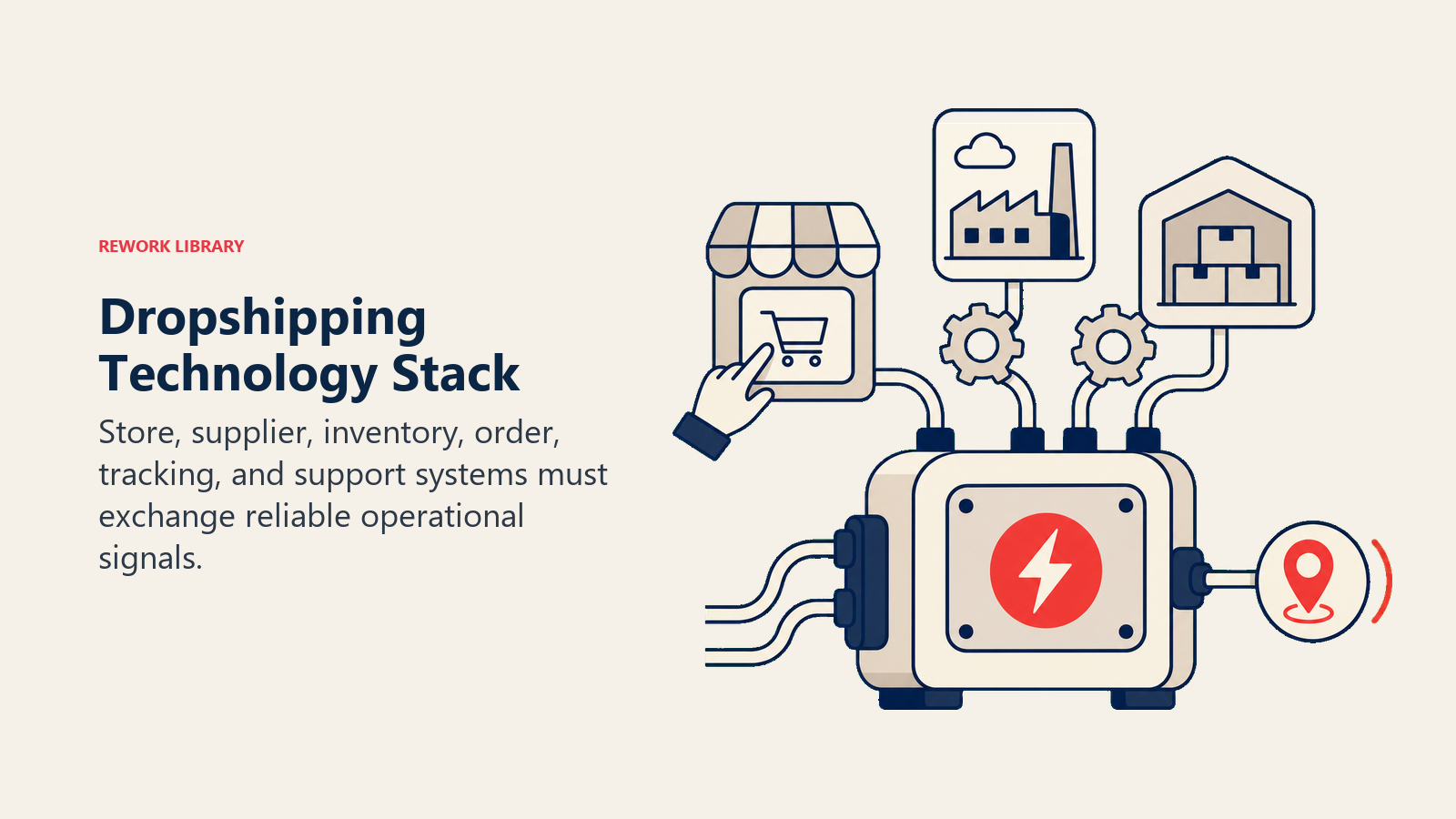
Manual order processing fails beyond 20 orders/day. Technology requirements scale with volume. Platform options analysis: Shopify: Best for beginners and scaling to 1,000+ orders/month
- Pros: Extensive app ecosystem, easy supplier integrations, built-in payment processing
- Cons: Monthly fees ($29-299), transaction fees if not using Shopify Payments
- Best for: General dropshipping, multiple suppliers, rapid scaling
WooCommerce: Best for WordPress users and custom requirements
- Pros: No monthly platform fees, complete customization, ownership of data
- Cons: Requires technical setup, hosting costs, plugin management, steeper learning curve
- Best for: Content-driven stores, businesses needing custom functionality
BigCommerce: Best for high-volume and B2B dropshipping
- Pros: No transaction fees, built-in B2B features, advanced SEO tools
- Cons: Higher base cost, smaller app ecosystem than Shopify
- Best for: Scaling beyond 1,000 orders/month, wholesale operations
Supplier integration approaches:
API integrations (best for large suppliers):
- Real-time inventory sync every 15 minutes
- Automated order forwarding
- Tracking number updates pushed automatically
- Requires technical setup or middleware platforms
EDI (Electronic Data Interchange) (enterprise suppliers):
- Standardized data format for B2B communication
- Requires EDI software or 3PL that handles EDI
- Common in fashion, consumer goods wholesale
- Higher setup cost but most reliable at scale
CSV/spreadsheet uploads (small suppliers):
- Manual export from your platform
- Email to supplier or upload to their portal
- Supplier processes and updates tracking via email
- Fails beyond 50 orders/day (too much manual work)
Automation platforms connecting platform to suppliers:
Syncee (multi-supplier aggregator):
- Connects to 500+ suppliers across categories
- Automated inventory sync and order routing
- $35-250/month depending on features
- Good for testing multiple suppliers quickly
Oberlo (Shopify-specific, AliExpress focus):
- One-click product imports from AliExpress
- Automated fulfillment
- $0-80/month
- Limited to AliExpress suppliers (quality control issues)
ShipStation (order management and shipping):
- Connects multiple sales channels and suppliers
- Automated rule-based order routing
- Branded tracking pages
- $9-159/month based on shipments
Inventory management requirements:
Track at product level:
- Current stock quantity from each supplier
- Historical stockout frequency (identifies unreliable suppliers)
- Restock dates when out of stock
- Lead time from order to delivery (by supplier and product)
- Return rates by product (quality signal)
Buffer stock settings:
- Show "in stock" only when supplier has 10+ units (prevents overselling)
- Auto-delist products when stock falls below 5 units
- Notify when stock drops to threshold levels
- Restock alerts sent to you when supplier replenishes
Accounting integration essentials:
Separate dropshipping finances from personal accounts. Track:
- Revenue by product and supplier
- COGS including all fees (product, shipping, platform, processing)
- Net margin by product (identifies unprofitable SKUs)
- Accounts payable to suppliers
- Accounts receivable from customers (chargebacks, refunds)
QuickBooks or Xero integration:
- Automatic order sync from e-commerce platform
- Expense categorization by supplier
- Profit and loss by product line
- Tax calculation and remittance tracking
Financial visibility reveals which products actually profit versus which look good but lose money after all costs.
Analytics dashboards for decision-making:
Critical metrics to monitor:
- Gross margin by product: Identifies which SKUs drive profitability
- CAC by marketing channel: Shows which acquisition sources are sustainable
- Repeat purchase rate: Indicates product-market fit and customer satisfaction
- Supplier performance scores: Tracks fulfillment speed, defect rates, stock accuracy
- Lifetime value by cohort: Shows whether customers acquired in specific periods return
Dashboard tools:
- Google Analytics: Traffic sources, conversion rates, customer behavior (free)
- Shopify Analytics: Built-in sales reporting (included with subscription)
- Triple Whale or Northbeam: Advanced attribution and LTV tracking ($50-500/month)
Weekly review cycle:
- Monday: Review weekend orders, check supplier performance
- Wednesday: Analyze CAC by channel, pause underperforming campaigns
- Friday: Review week's margin by product, identify SKUs to optimize or remove
Data drives decisions when you track consistently. Most dropshippers operate blind, then wonder why they're not profitable. Monitoring e-commerce metrics & KPIs ensures you catch problems before they become critical.
Exit Strategies & Evolution Beyond Dropshipping
Dropshipping isn't a destination. It's a stepping stone to sustainable e-commerce operations. Plan your evolution from day one. Transition trigger analysis:
Move to inventory-based fulfillment when:
- Volume threshold: Selling 200+ units/month of core products (proven demand)
- Margin compression: Gross margins below 25% due to supplier pricing (need bulk discounts)
- Quality control: Defect rates above 3% (need direct manufacturer relationships)
- Speed requirements: Customer complaints about delivery time exceed 10%
- Competitive pressure: Competitors with inventory can undercut your pricing by 15%+
Don't transition too early. Inventory investment before validating demand kills cash flow. But waiting too long allows competitors to capture market share with better pricing and faster delivery.
Building supplier relationships for transition:
Start relationship development 6 months before inventory transition:
Communicate volume trajectory: "We're currently ordering 150 units/month and projecting 300/month by Q3. We're considering inventory investment and want to understand bulk pricing."
Request manufacturer introductions: Your dropship supplier likely sources from manufacturers. Ask for direct introductions to reduce supply chain layers.
Negotiate minimum order quantities: Manufacturers often require 500-1,000 unit minimums. Negotiate based on your proven demand: "We've ordered 800 units through our current supplier over 6 months. We're ready to commit to 500-unit orders if pricing makes sense."
Test samples from multiple manufacturers: Even if transitioning from existing supplier, test 2-3 alternatives. Pricing and quality vary significantly.
Capital requirements for graduation:
Calculate inventory investment needed:
Example scenario:
- Top 5 products generate 80% of revenue (focus here first)
- Average monthly volume per product: 100 units
- 60-day inventory target: 200 units per product
- Bulk cost per unit: $9 (versus $15 dropship cost)
- Total investment: 1,000 units × $9 = $9,000
Add additional costs:
- 3PL onboarding and first month: $500
- Shipping to 3PL warehouse: $300
- Sample orders for quality verification: $200
- Total capital needed: $10,000
Funding options:
- Reinvest profits: Safest approach if you have 3-6 months to accumulate cash
- Small business loan: $10,000-50,000 at 7-12% interest, requires proven revenue
- Inventory financing: Some platforms offer financing specifically for inventory purchases
- Personal savings: Fastest but highest personal risk
Most successful transitions use profits from dropshipping to fund inventory gradually. Start with top 1-2 products, then expand as cash flow permits.
Private label development path:
Next evolution beyond buying generic inventory: creating your own branded products.
Timeline:
- Months 0-6: Dropship to validate product-market fit
- Months 6-12: Transition to inventory with manufacturer's products
- Months 12-24: Develop custom branding, packaging, minor product modifications
- Months 24+: Full private label with unique product formulations or designs
Private label advantages:
- Complete pricing control (no competitors selling identical products)
- Brand loyalty increases (customers buy from you specifically, not any seller)
- Higher margins (30-50% versus 20-30% for generic inventory)
- Amazon and other marketplaces can't undercut you easily
Private label requirements:
- Minimum order quantities increase to 1,000-5,000 units ($20,000-100,000 investment)
- Custom packaging design and tooling costs ($2,000-10,000)
- Trademark registration for brand protection ($500-2,000)
- Extended lead times (3-6 months from order to delivery for first production run)
Start with simple branding (custom packaging for existing products) before full private label development.
Scaling playbook from dropshipping to inventory to private label:
Phase 1: Dropshipping validation (Months 1-6)
- Goal: Identify 3-5 winning products
- Metric: 100+ units sold per product
- Action: Test 20-30 products, eliminate non-performers weekly
- Product Research & Validation framework applies here
Phase 2: Hybrid inventory introduction (Months 6-12)
- Goal: Order inventory for top 3 products
- Metric: 30% margin improvement on inventory products
- Action: Source manufacturer, order 500-1,000 units, establish 3PL relationship
- See Inventory Management strategies
Phase 3: Inventory expansion (Months 12-18)
- Goal: Move 80% of revenue to inventory-based fulfillment
- Metric: Overall margin increase to 35-40%
- Action: Add inventory for products 4-10, maintain dropshipping for new tests
- Implement Fulfillment Strategy optimization
Phase 4: Private label development (Months 18-24)
- Goal: Launch 2-3 custom branded products
- Metric: 45-50% margins on private label items
- Action: Work with manufacturer on custom formulations, packaging, branding
- Reference E-commerce Business Models for scaling
Success metrics at each phase:
| Phase | Monthly Revenue | Gross Margin | CAC | Repeat Rate |
|---|---|---|---|---|
| Dropship | $10,000-30,000 | 20-25% | $10-15 | 20-30% |
| Hybrid | $30,000-75,000 | 28-35% | $8-12 | 30-40% |
| Inventory | $75,000-200,000 | 35-45% | $6-10 | 40-50% |
| Private Label | $200,000+ | 45-60% | $5-8 | 50-60%+ |
Each phase builds on the previous. Rushing to private label without validating through dropshipping and inventory phases leads to $50,000+ losses from unsold inventory.
Dropshipping gives you permission to learn without catastrophic financial risk. Use it strategically, transition methodically, and build toward sustainable inventory-based operations that create real business value.
The goal isn't to become a career dropshipper, it's to use dropshipping as the foundation for building an e-commerce business with genuine competitive advantages through inventory control, supplier relationships, and eventually brand differentiation.
Where Dropshipping Fits in Your Ecommerce Growth Stage
Dropshipping is the right tool at one specific stage of ecommerce growth and the wrong tool at others. Use this snapshot to decide whether to start, continue, or graduate.
| Growth stage | Monthly volume | Best fulfillment model | What to do next |
|---|---|---|---|
| Validation | 0-200 units | Dropshipping | Test 20-30 products, keep winners |
| Early scale | 200-500 units | Hybrid (dropship + inventory) | Buy inventory for top 3 SKUs |
| Growth | 500-5,000 units | 3PL with owned inventory | Move 80% of revenue off dropshipping |
| Scale | 5,000+ units | In-house or private label | Build brand and margin control |
The pattern is consistent: dropshipping earns its place during validation, then margin compression and shipping-speed complaints signal the move to inventory. If gross margin slips below 25% or delivery complaints pass 10% of orders, that stage has ended, regardless of how comfortable the low-capital model feels.
Dropshipping and Ecommerce Growth FAQs
Is dropshipping good for ecommerce growth?
It is excellent for the validation stage and weak for scaling. With $700-3,000 in startup cost you can test demand without inventory risk, but per-unit costs stay high, so margins compress as volume grows. Treat it as a way to find winning products, then graduate them to inventory.
Why do most dropshipping businesses fail?
Roughly 80% fail within the first year because they compete on commodity products using identical suppliers, run 10-25% gross margins, and let customer acquisition cost exceed margin. Shipping delays and chargebacks erode what little profit remains.
What margin can I realistically expect from dropshipping?
After platform fees, payment processing, returns, and chargebacks, a typical $40 order nets 19-27% margin before marketing. Generic products land at 10-15%, while custom or personalized products can reach 35-50% because competition is limited.
When should I switch from dropshipping to holding inventory?
Graduate when you sell 200+ units a month of a product, gross margin drops below 25% from supplier pricing, delivery complaints exceed 10% of orders, or repeat purchase rate passes 30%. Those signals mean demand is proven and speed now matters more than capital preservation.
How much capital do I need to graduate from dropshipping?
Plan for around $10,000 to move your top SKUs to inventory: roughly $9,000 for 60-90 days of bulk stock plus about $1,000 for 3PL onboarding, inbound shipping, and quality samples. Most sellers fund this from dropshipping profits.
Learn More
Ready to optimize your e-commerce operations? These related resources will help you build a more efficient and profitable business:
- Fulfillment Strategy - Compare fulfillment models and choose the optimal approach for your business stage
- Inventory Management - Master inventory planning, forecasting, and optimization techniques
- 3PL Partner Selection - Find and evaluate third-party logistics providers for scalable fulfillment
- Shipping Strategy & Pricing - Optimize shipping costs and delivery speed while maintaining profitability

On this page
- Dropshipping Mechanics & Economics Foundation
- Supplier Selection & Relationship Management
- Margin Analysis & Profitability Framework
- Quality Control & Supplier Management
- Customer Experience Risks & Mitigation
- Operational Complexity of Dropshipping
- Dropshipping vs 3PL vs In-House Fulfillment
- Niche Selection & Product Viability
- Marketing & Customer Acquisition with Dropshipping
- Technology Stack & Automation
- Exit Strategies & Evolution Beyond Dropshipping
- Where Dropshipping Fits in Your Ecommerce Growth Stage
- Learn More