Product Recommendations: AI-Powered Personalization for Higher AOV
Turn this article into takeaways for your work.


Each assistant summarizes the article only for you and suggests best practices for your work.
Product recommendations are one of the most reliable e-commerce growth levers available: done well, they lift average order value 15 to 20 percent and can drive 10 to 25 percent of total revenue. Amazon credits 35 percent of its sales to recommendations. The edge comes from matching the right algorithm to the right placement at the right moment.
Here's what most e-commerce retailers are missing: while you're obsessing over ad spend and checkout optimization, your biggest AOV opportunity is sitting right there on your product pages.
Product recommendations drive 15-20% AOV lifts for retailers who implement them strategically. Amazon attributes 35% of their revenue to recommendation engines. Netflix saves $1 billion annually through personalization that keeps subscribers engaged.
Yet most online stores still show "random" related products or generic "best sellers" that convert at barely 2-3%. The difference between amateur recommendations and sophisticated personalization isn't just technology. It's understanding how to match the right algorithm with the right placement at the right moment in the customer journey.
Effective recommendations work in tandem with broader conversion rate optimization efforts to maximize revenue per visitor.
Let's break down how recommendation engines work, which approaches deliver results, and how to implement them without a data science team.
Understanding Recommendation Engines
A product recommendation engine is a system that predicts and displays products a customer is likely to purchase based on behavioral data, purchase history, and product relationships. Core purpose: Surface relevant products at moments when customers are already engaged, increasing both conversion rates and average order values without adding friction.
The key insight: Customers don't know your full catalog. Even engaged shoppers typically view 5-10 products per session. Recommendations expose them to products they'd love but never discovered organically.
Types of Recommendation Systems
Not all recommendations are created equal. Understanding the core types helps you choose the right approach for different scenarios:
| Recommendation Type | How It Works | Best For | AOV Impact |
|---|---|---|---|
| Collaborative Filtering | "Customers who bought X also bought Y" | Established products with purchase history | 12-18% lift |
| Content-Based | Similar products based on attributes | New products, specific preferences | 8-12% lift |
| Hybrid Systems | Combination of multiple algorithms | Mature e-commerce operations | 15-25% lift |
| Behavioral | Based on browsing and engagement patterns | First-time visitors, session data | 10-15% lift |
| Context-Aware | Considers time, device, location | Seasonal products, mobile optimization | 8-14% lift |
The most effective implementations use hybrid approaches that combine multiple signals rather than relying on a single algorithm.
Recommendation Algorithms Explained
Understanding the math behind recommendations helps you make better strategic decisions about which approaches to prioritize.
Collaborative Filtering
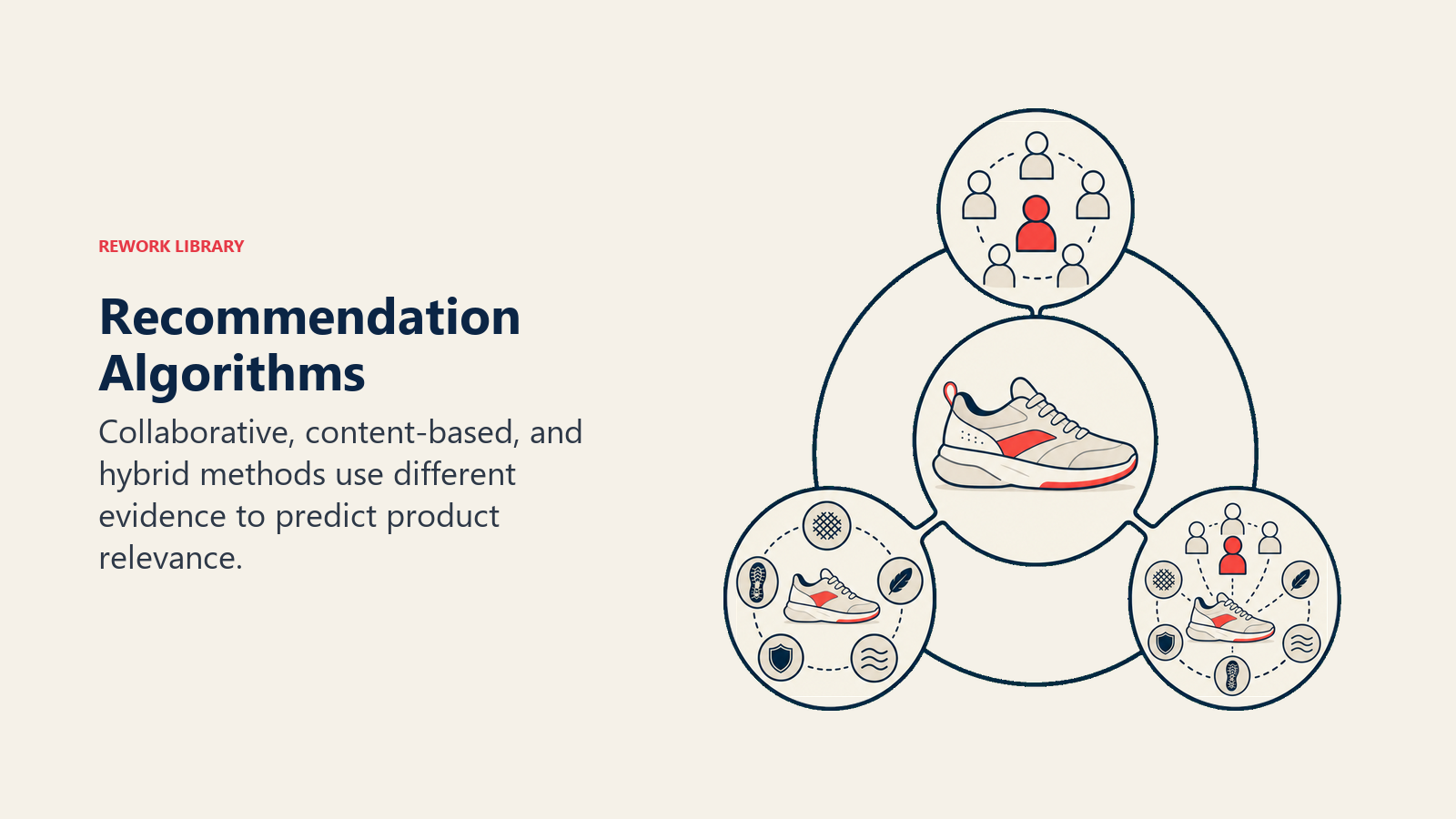
How it works: Finds patterns across customer behavior. If customers A, B, and C all bought products 1 and 2, and customer D bought product 1, the algorithm predicts D will like product 2.
Two main approaches:
User-based: "People similar to you bought..."
- Compares customer purchase patterns
- Requires significant user data
- Works well for repeat customers
Item-based: "People who bought this also bought..."
- Compares product co-purchase patterns
- More stable than user-based
- Amazon's original approach
Strengths: Discovers unexpected relationships. Doesn't need product attribute data. Improves with scale.
Limitations: Cold start problem for new products. Requires purchase volume. Can create filter bubbles.
Content-Based Filtering
How it works: Recommends products with similar attributes to items the customer viewed or purchased.
If a customer bought a red Nike running shoe (size 10, $120 price point), recommend other red athletic shoes, Nike products, or running shoes in that price range.
Key components:
- Product attributes (category, brand, color, size, price)
- Customer preference profile
- Similarity scoring algorithms
- Weighted attribute importance
Strengths: Works immediately for new products. Explains why recommendations make sense. No data from other users needed.
Limitations: Limited discovery beyond existing preferences. Requires detailed product attributes. Can feel too obvious.
Hybrid Approaches
The most sophisticated systems combine multiple algorithms:
Netflix-style hybrid:
- Collaborative filtering for "Others also watched"
- Content-based for genre/actor matching
- Behavioral signals for trending content
- Context-awareness for time/device
E-commerce hybrid:
- Item-based collaborative for cross-sells
- Content-based for similar product suggestions
- Behavioral tracking for personalized homepages
- Popularity weighting for new products
The key is weighting different algorithms based on available data and the specific recommendation context.
Key Recommendation Types for E-Commerce
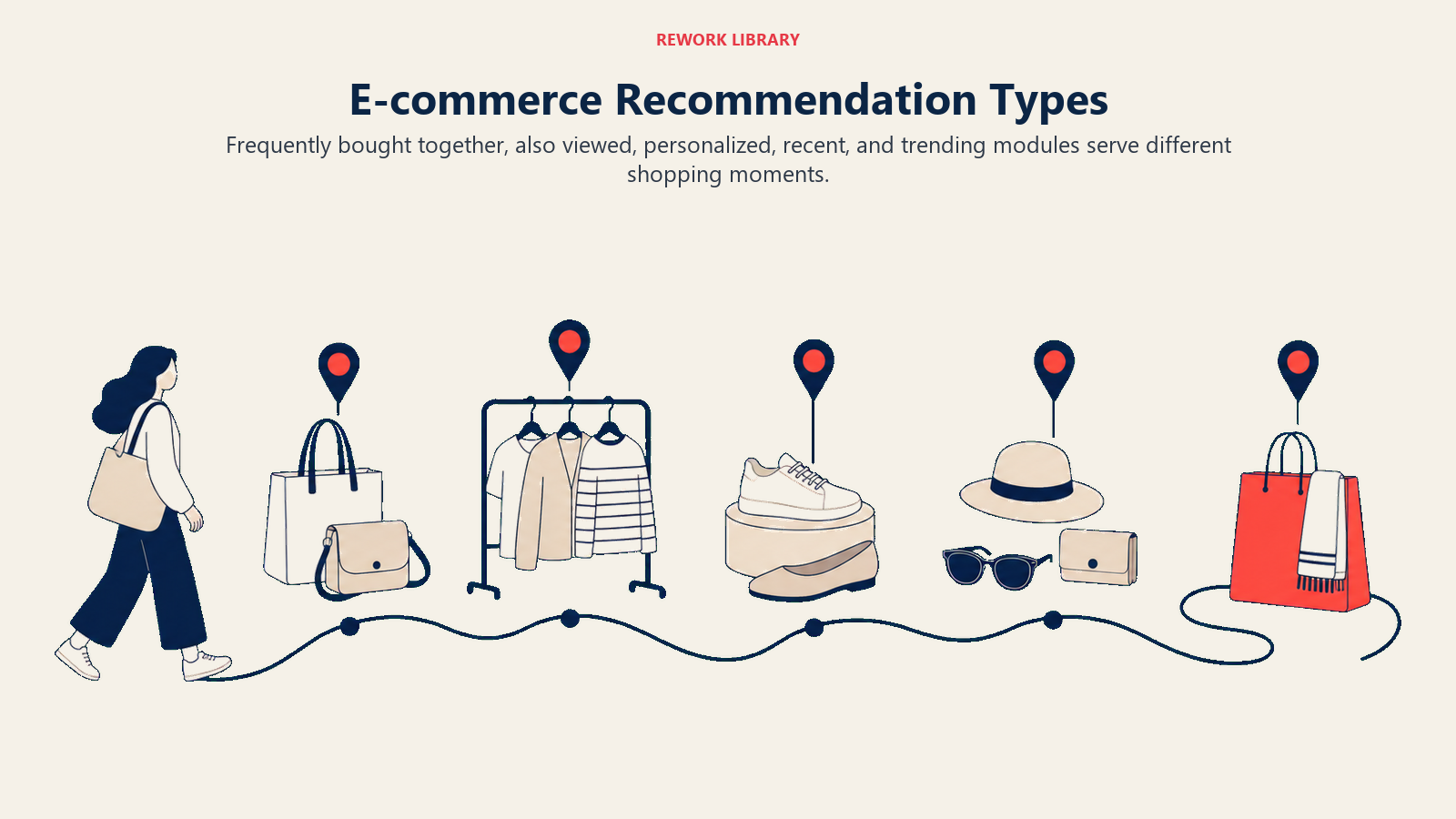
Different recommendation types serve different purposes in the customer journey. Here's how to deploy each strategically.
Frequently Bought Together
What it is: Products commonly purchased in the same transaction.
Best placement: Product detail pages, cart page.
Algorithm: Item-based collaborative filtering on transactional data.
Example: Camera + memory card + camera bag (Amazon's classic approach)
Implementation tip: Require minimum support threshold (e.g. co-purchased at least 50 times) to ensure statistical significance.
Expected impact: 15-25% of customers add at least one recommended item.
Customers Also Viewed
What it is: Products viewed in the same session by other customers.
Best placement: Product detail pages, below the fold.
Algorithm: Session-based collaborative filtering.
Example: "Other customers looking at this laptop also viewed these accessories"
Why it works: Lower commitment than purchase data, so more examples and faster learning.
Expected impact: 8-12% click-through rate to recommended products.
Personalized for You
What it is: Products selected specifically based on individual browsing and purchase history.
Best placement: Homepage, email campaigns, post-login experience.
Algorithm: Hybrid approach combining collaborative filtering, content-based matching, and behavioral signals. Integrating recommendations into your email marketing for e-commerce campaigns can significantly boost engagement rates.
Example: "Based on your recent searches for wireless headphones..."
Privacy consideration: Requires explicit consent for behavioral tracking in many jurisdictions.
Expected impact: 2-3x higher engagement than generic recommendations.
Recently Viewed
What it is: Products the customer previously viewed in current or past sessions.
Best placement: Homepage, account dashboard.
Algorithm: Simple session/cookie tracking.
Why it matters: 25-30% of customers revisit products before purchasing, so make it easy.
Expected impact: 12-18% of returning customers engage with recently viewed items.
Trending Products
What it is: Products with unusual spikes in views or purchases.
Best placement: Homepage, category pages, new visitor experience.
Algorithm: Time-weighted popularity scoring.
Use case: Solves cold-start problem for new visitors with no behavioral data.
Expected impact: 6-10% engagement from first-time visitors.
Strategic Placement Opportunities
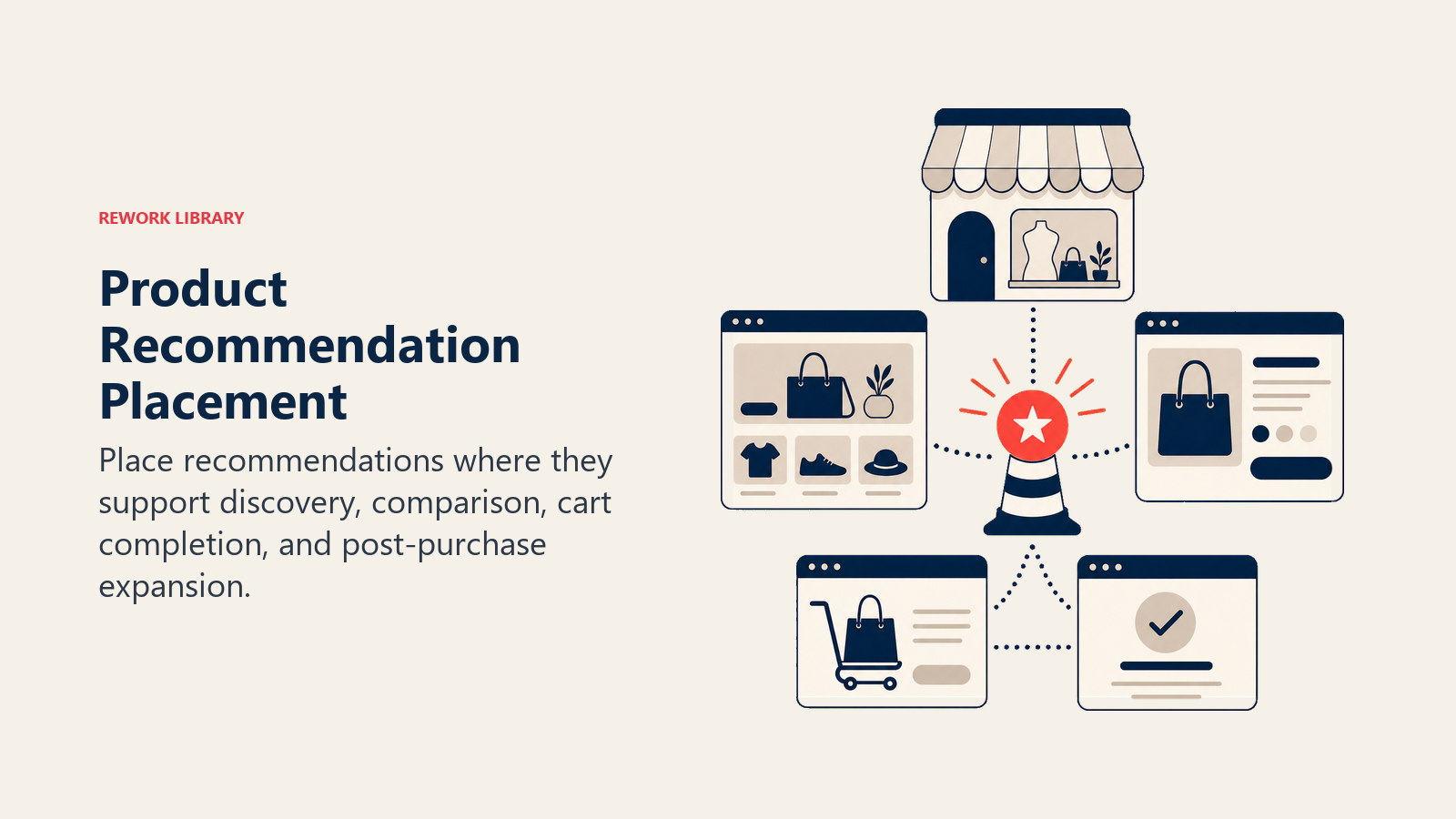
Where you show recommendations matters as much as what you recommend. Here's the strategic framework for placement decisions.
Product Detail Pages
Primary placement: Below product description, above reviews.
Recommendation types:
- Frequently bought together (highest priority)
- Similar products (alternative options)
- Complete the look (fashion/home decor)
Recommendations should complement your overall product page optimization strategy, not distract from the primary purchase decision.
Design considerations:
- Clear visual separation from main product
- "Add all to cart" functionality for bundles
- Lazy loading for performance
Conversion impact: 15-20% of product page visitors engage with recommendations.
Shopping Cart
Primary placement: Cart sidebar or below cart items.
Recommendation types:
- Complementary products based on cart contents
- "You might have forgotten" (batteries, accessories)
- Threshold incentives ("Add $15 for free shipping")
Strategic purpose: Last opportunity to increase AOV before checkout.
Implementation tip: Show 3-5 recommendations maximum, don't overwhelm.
Conversion impact: 8-12% cart addition rate from recommendations.
Learn more about optimizing the complete cart experience in our upselling and cross-selling guide.
Post-Purchase
Primary placement: Order confirmation page, confirmation email.
Recommendation types:
- Complementary products for items just purchased
- Replenishment recommendations (consumables)
- Next logical purchase in product journey
Why it works: Customer is in buying mode, purchase friction is lowest.
Expected impact: 5-8% make additional purchases (higher AOV than initial order).
Explore advanced post-purchase strategies in our Post-Purchase Upsells guide.
Homepage & Category Pages
Primary placement: Personalized sections in main content area.
Recommendation types:
- Personalized for you (returning visitors)
- Trending products (new visitors)
- Recently viewed (returning visitors)
- Category-specific top picks
Strategic purpose: Reduce time to first product click, surface high-margin items.
Expected impact: 10-15% higher session engagement, 12% lower bounce rate.
AI/ML Approaches for Recommendations
Modern recommendation engines increasingly leverage machine learning. Here's what you need to know.
When Machine Learning Makes Sense
Use ML when you have:
- 10,000+ monthly transactions
- 1,000+ SKUs
- Complex product catalogs
- Significant behavioral data
Stick with rule-based systems when you have:
- Limited transaction history
- Small catalogs (under 500 SKUs)
- Seasonal or highly variable demand
- Budget constraints
Neural Network Approaches
Deep learning for recommendations:
Neural Collaborative Filtering: Replaces matrix factorization with neural networks, capturing non-linear relationships.
Recurrent Neural Networks (RNN): Predicts next product based on sequence of actions in session.
Attention Mechanisms: Weights which past behaviors are most relevant for current recommendation.
When it's worth the complexity: Large catalogs (10,000+ SKUs), rich behavioral data, dedicated ML resources.
When it's overkill: Small catalogs, limited data, resource constraints.
Solving the Cold Start Problem
The challenge: New products have no purchase history. New customers have no behavioral data.
Solutions:
| Approach | How It Works | When to Use |
|---|---|---|
| Content-based fallback | Use product attributes for new items | Always, foundational approach |
| Popularity weighting | Show trending products to new users | First-time visitor experience |
| Demographic targeting | Match new users to similar cohorts | When you capture demographic data |
| Exploration bonus | Artificially boost new products | Product launches, inventory clearing |
| Active learning | Strategically show new items to gather data | When rapid learning is priority |
Best practice: Hybrid approach that combines multiple cold-start strategies.
Personalization Strategy
Effective recommendations require segmentation strategies that match different customer contexts.
Segmentation Framework
Segment by customer lifecycle stage:
Building a solid customer segmentation strategy helps your recommendations align with where each visitor is in their journey.
First-time visitors:
- Show trending products
- Highlight best sellers
- Use category-based recommendations
- Minimize personalization (no data yet)
Browsing returners:
- Recently viewed products
- Similar items to browsing history
- Abandoned browse recovery
Previous purchasers:
- Based on purchase history
- Replenishment recommendations
- Complementary product suggestions
- "Complete the set" opportunities
VIP customers:
- Premium/exclusive products
- Early access to new arrivals
- High-margin recommendations
Understanding customer lifetime value helps you identify which customers warrant premium recommendation strategies.
Behavioral Signals to Track
Explicit signals (direct customer actions):
- Products viewed
- Items added to cart
- Purchases completed
- Wishlist additions
- Product ratings/reviews
Implicit signals (inferred intent):
- Time spent on product pages
- Scroll depth on product descriptions
- Filter selections
- Search queries
- Email engagement
Weighting signals: Recent behavior typically weighted 3-5x higher than older actions.
Real-Time vs Batch Processing
Real-time recommendations:
- Update as customer browses
- Reflect current session behavior
- Higher infrastructure cost
- Better for high-intent moments (PDP, cart)
Batch processing:
- Update daily or weekly
- More cost-effective
- Sufficient for email, homepage
- Easier to implement
Hybrid approach: Real-time for cart/PDP, batch for email/homepage.
Learn more about building comprehensive personalization in our Personalization Engine guide.
Implementing Recommendations
You don't need a data science team to implement effective recommendations. Here's your decision framework.
Build vs Buy Decision Matrix
| Factor | Build In-House | Use Platform/SaaS |
|---|---|---|
| Technical resources | 2+ developers, data scientist | Limited technical team |
| Catalog size | Unique requirements, 10,000+ SKUs | Standard e-commerce, any size |
| Timeline | 6-12 months acceptable | Need results in 30-60 days |
| Budget | $150K+ annual investment | $500-5,000/month |
| Customization needs | Highly specific algorithms | Standard recommendation types work |
| Data infrastructure | Strong data warehouse, ML ops | Limited data infrastructure |
Reality: 95% of e-commerce businesses should use existing platforms rather than building custom engines.
Recommended Platforms
Enterprise solutions (large catalogs, complex needs):
- Dynamic Yield: Advanced personalization, A/B testing, optimization
- Nosto: AI-powered, visual merchandising integration
- Algolia Recommend: Search-integrated recommendations
- Bloomreach: Commerce experience cloud, full-stack
Mid-market solutions ($5M-50M revenue):
- LimeSpot: Shopify-focused, visual merchandising
- Clerk.io: Easy implementation, good analytics
- Recommendify: Affordable, solid core features
- Rebuy: Shopify Plus, cart/checkout focus
Small business (under $5M revenue):
- Wiser: Simple setup, affordable
- Personalize: Basic recommendations, good for starting
- Bold Upsell: Shopify apps, specific use cases
- Native platform features: Shopify, BigCommerce built-in options
Integration Checklist
Before implementing any recommendation engine:
Data requirements:
- Product catalog feed (SKU, title, price, attributes, images)
- Category taxonomy structure
- Inventory levels (real-time sync)
- Historical transaction data (minimum 6-12 months)
- Customer behavioral data permissions
Proper analytics and tracking setup is essential before implementing any recommendation engine to ensure accurate attribution.
Technical requirements:
- JavaScript integration capability
- API access for server-side recommendations
- Cookie consent implementation
- Page load performance budget
- Mobile responsiveness testing
Design requirements:
- Recommendation widget designs
- Responsive layouts for different placements
- Loading states and fallbacks
- A/B test variations
Business requirements:
- Merchandising rules (never recommend competitors)
- Margin-based product weighting
- Seasonal override capabilities
- Manual curation options
Measuring Recommendation Effectiveness
Vanity metrics won't tell you if recommendations are actually driving revenue. Focus on these instead.
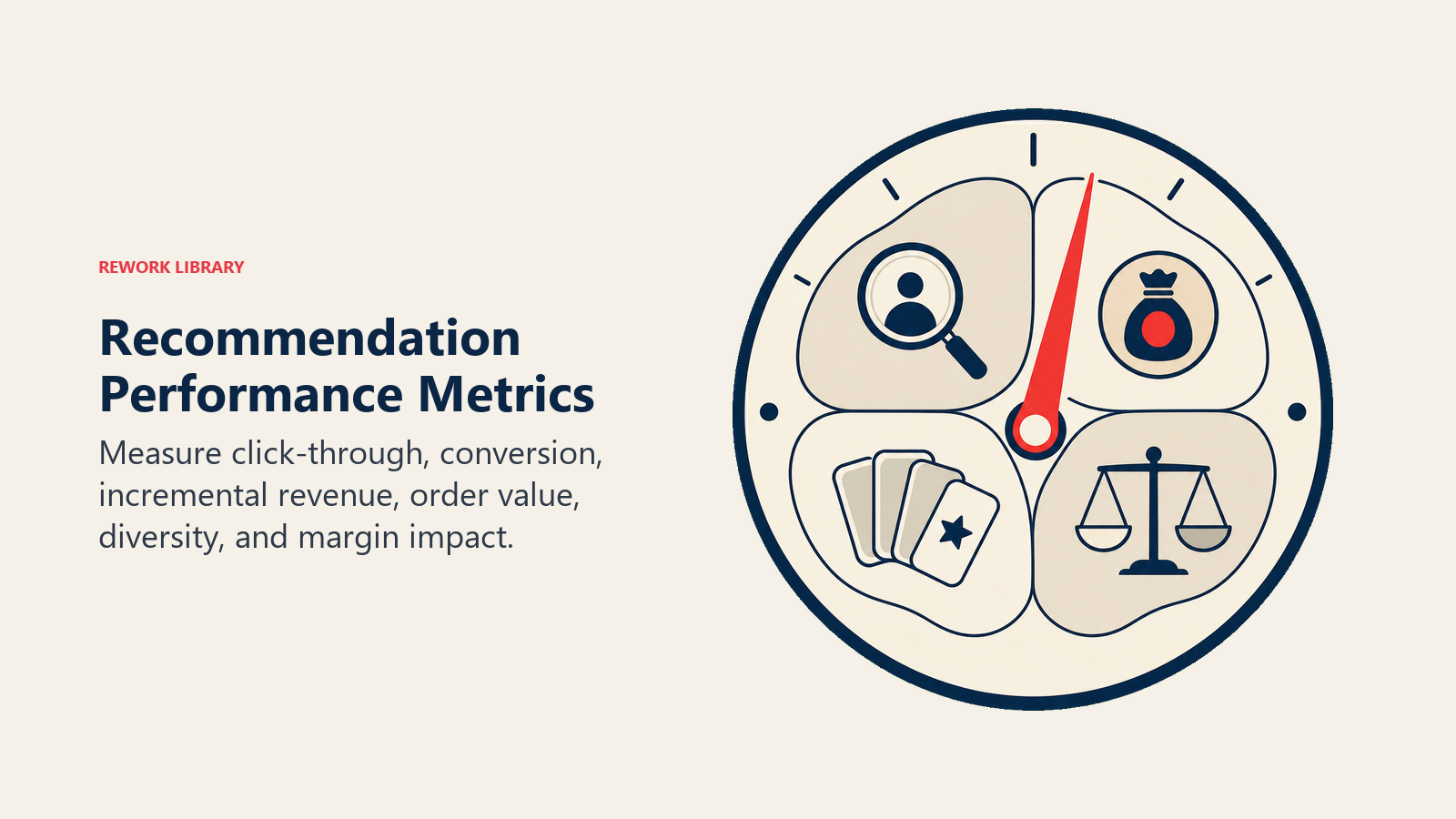
Key Metrics Framework
Track recommendation performance alongside your core e-commerce metrics and KPIs to understand true business impact.
| Metric | What It Measures | Target Benchmark |
|---|---|---|
| Recommendation CTR | % clicking recommended products | 8-15% |
| Add-to-cart rate | % adding recommendations to cart | 5-10% |
| Revenue per visitor | Impact on overall AOV | 10-18% lift |
| Recommendation revenue % | % of total revenue from recommendations | 10-25% |
| Engagement rate | Interaction with recommendation widgets | 12-20% |
| Conversion rate lift | Impact on overall site conversion | 5-12% lift |
Attribution Methodology
First-touch attribution: Customer clicked recommendation, then purchased.
- Pros: Easy to track, clear causation
- Cons: Ignores multi-touch journeys
Last-touch attribution: Recommendation was last interaction before purchase.
- Pros: Credits final conversion driver
- Cons: Ignores earlier influence
Multi-touch attribution: Distributes credit across touchpoints.
- Pros: More accurate picture
- Cons: Complex to implement
Recommendation: Start with first-touch, evolve to multi-touch as you mature.
A/B Testing Framework
What to test:
- Algorithm comparison: Collaborative filtering vs content-based vs hybrid
- Placement testing: Above fold vs below product description
- Quantity testing: 3 vs 6 vs 9 recommendations
- Design variations: Carousel vs grid vs list
- Messaging: "You might also like" vs "Complete your purchase"
Testing structure:
- Control group: No recommendations or current approach
- Test group: New recommendation strategy
- Minimum sample: 1,000 visitors per variation
- Runtime: Until statistical significance (typically 2-4 weeks)
Success criteria: 95% statistical confidence, minimum 10% improvement in target metric.
Reporting Dashboard Essentials
Daily metrics:
- Recommendation impressions
- Click-through rate
- Revenue attributed to recommendations
Weekly metrics:
- Algorithm performance comparison
- Placement effectiveness
- Product-level recommendation performance
Monthly metrics:
- AOV impact
- Conversion rate lift
- Customer segment performance
- ROI calculation
Integrate these metrics into your broader AOV Optimization Strategy reporting.
Best Practices & Common Pitfalls
Learn from others' mistakes and optimize from the start.
Diversity vs Relevance Balance
The problem: Too much personalization creates filter bubbles. Customers only see products similar to past behavior, limiting discovery and reducing potential AOV.
The solution:
- 70-80% highly relevant recommendations
- 20-30% exploratory recommendations (different category, price point, style)
- Occasional "wildcard" suggestions for serendipitous discovery
Implementation: Diversity parameter in algorithm configuration.
Product Margin Considerations
Smart merchandising: Not all recommendations drive equal profit.
Margin-weighted recommendations:
- Boost high-margin products in recommendation scoring
- Prioritize products with better unit economics
- Balance relevance with profitability
Example: Two products with equal relevance scores, recommend the one with 40% margin over 15% margin.
Caveat: Don't sacrifice relevance so much that CTR drops. Test weighting carefully.
Privacy & Data Ethics
GDPR/CCPA compliance:
- Explicit consent for behavioral tracking
- Clear privacy policy explaining recommendation data use
- Easy opt-out mechanisms
- Data deletion capabilities
Ethical considerations:
- Don't exploit vulnerable customers (excessive upselling to price-insensitive segments)
- Transparent recommendation logic when requested
- Avoid discriminatory patterns (price-based customer treatment)
Best practice: Privacy-first personalization, focused on session-based recommendations when consent isn't clear.
Learn more about managing customer data responsibly in our Customer Data Platform guide.
Common Implementation Mistakes
Mistake 1: Too many recommendations
- Showing 15+ products overwhelms customers
- Fix: 3-6 recommendations per placement
Mistake 2: Ignoring mobile experience
- Recommendations push content too far down
- Fix: Fewer recommendations on mobile, prioritized placement
Mistake 3: Static recommendations
- Same products regardless of inventory
- Fix: Real-time inventory integration
Mistake 4: No manual override
- Algorithm shows competing brands
- Fix: Merchandising rules for exclusions
Mistake 5: Forgetting fallbacks
- New products show no recommendations
- Fix: Fallback to trending/best-selling when insufficient data
Real-World Case Studies
Case Study 1: Fashion Retailer AOV Lift
Company: Mid-size online fashion retailer ($25M annual revenue)
Challenge: Low AOV ($65), customers buying single items per order.
Implementation:
- "Complete the outfit" recommendations on product pages
- Cart-based complementary suggestions
- Post-purchase accessory recommendations
Approach: Hybrid collaborative + content-based filtering focused on style matching.
Results:
- 18% increase in AOV (from $65 to $77)
- 23% of orders now include recommended items
- 12% improvement in overall conversion rate
- $2.8M incremental annual revenue
Key insight: Fashion recommendations worked best when explaining the connection ("Completes this look") rather than generic "You might also like."
Case Study 2: Consumer Electronics
Company: Online electronics retailer ($50M annual revenue)
Challenge: Customers didn't know what accessories they needed for complex products.
Implementation:
- "Essential accessories" section on every product page
- Smart bundling ("Frequently bought together" with one-click add)
- Setup guides with recommended additions
Approach: Rule-based content filtering for technical compatibility + collaborative filtering for popular combinations.
Results:
- 31% of product page visitors added at least one recommendation
- $8M incremental revenue in first year
- 42% attach rate on certain product categories
- Reduced return rate (customers bought complete solutions)
Key insight: Technical products benefit from educational recommendation framing ("You'll need this to make it work") over pure personalization.
Case Study 3: Home Goods Marketplace
Company: Home decor marketplace ($15M GMV)
Challenge: Large catalog (25,000+ products), low repeat purchase rate.
Implementation:
- Visual similarity recommendations (ML-based image matching)
- Room-based collections ("Others furnishing living rooms viewed")
- Price-point matching
Approach: Neural network visual similarity + collaborative filtering + price segmentation.
Results:
- 26% increase in session depth
- 14% AOV improvement
- 19% reduction in bounce rate from product pages
- 8% overall revenue lift
Key insight: Visual similarity recommendations outperformed traditional collaborative filtering for aspirational purchases where customers browsed more than bought.
Future of Recommendations
The recommendation landscape is evolving rapidly. Here's what's coming.
Generative AI Integration
Text-to-product search: "Show me a modern coffee table under $500 that fits a minimalist aesthetic."
Visual search evolution: Photo-based recommendation ("Find products that match this Instagram image").
Conversational recommendations: AI assistants that ask questions to refine suggestions.
Timeline: Mainstream adoption 2026-2026.
Context-Aware Recommendations
Advanced signals:
- Weather-based product suggestions
- Local event-triggered recommendations
- Social media trend integration
- Predictive life event recommendations
Example: Recommend patio furniture when weather forecast shows warm weekend ahead in customer's location.
Privacy-First Personalization
Federated learning: ML models that learn on-device without sending data to servers.
Contextual recommendations: Based on current session only, no cross-session tracking.
Customer control: Granular permission settings for recommendation data usage.
Trend: Apple's privacy features are pushing industry toward less invasive personalization.
Augmented Reality Integration
Virtual try-on recommendations: "You liked that sofa, here are coordinating chairs that also fit your room dimensions."
Spatial recommendations: Products that fit photographed spaces.
Timeline: Niche adoption 2026, broader rollout 2026-2027.
Conclusion: Your Recommendation Roadmap
Product recommendations aren't optional anymore. They're table stakes for competitive e-commerce. The retailers winning in 2026 aren't necessarily using the most sophisticated AI. They're strategically placing the right recommendations at the right moments with clear value propositions.
Start here:
- Month 1: Implement "Frequently bought together" on top 100 product pages
- Month 2: Add cart-based recommendations with one-click adding
- Month 3: Deploy personalized homepage for returning customers
- Month 4: Launch post-purchase recommendation email sequence
- Month 5: A/B test algorithm variations, optimize based on data
- Month 6: Expand to advanced personalization and ML approaches
Expected cumulative impact: 15-20% AOV lift, 10-15% revenue increase, improved customer experience.
The opportunity is clear. The technology is accessible. The only question is whether you'll implement recommendations before or after your competitors do.
The future of e-commerce is personalized. Your recommendation engine is how you get there.
Learn More
Complement your product recommendation strategy with these related resources:
- AOV Optimization Strategy - Complete framework for maximizing average order values across all touchpoints
- Customer Data Platform - Build the data foundation needed for advanced personalization and recommendations
- Conversion Rate Optimization - Optimize the broader conversion funnel to maximize recommendation effectiveness
- Product Page Optimization - Create product pages that convert and showcase recommendations effectively

On this page
- Understanding Recommendation Engines
- Types of Recommendation Systems
- Recommendation Algorithms Explained
- Collaborative Filtering
- Content-Based Filtering
- Hybrid Approaches
- Key Recommendation Types for E-Commerce
- Frequently Bought Together
- Customers Also Viewed
- Personalized for You
- Recently Viewed
- Trending Products
- Strategic Placement Opportunities
- Product Detail Pages
- Shopping Cart
- Post-Purchase
- Homepage & Category Pages
- AI/ML Approaches for Recommendations
- When Machine Learning Makes Sense
- Neural Network Approaches
- Solving the Cold Start Problem
- Personalization Strategy
- Segmentation Framework
- Behavioral Signals to Track
- Real-Time vs Batch Processing
- Implementing Recommendations
- Build vs Buy Decision Matrix
- Recommended Platforms
- Integration Checklist
- Measuring Recommendation Effectiveness
- Key Metrics Framework
- Attribution Methodology
- A/B Testing Framework
- Reporting Dashboard Essentials
- Best Practices & Common Pitfalls
- Diversity vs Relevance Balance
- Product Margin Considerations
- Privacy & Data Ethics
- Common Implementation Mistakes
- Real-World Case Studies
- Case Study 1: Fashion Retailer AOV Lift
- Case Study 2: Consumer Electronics
- Case Study 3: Home Goods Marketplace
- Future of Recommendations
- Generative AI Integration
- Context-Aware Recommendations
- Privacy-First Personalization
- Augmented Reality Integration
- Conclusion: Your Recommendation Roadmap
- Learn More