Traffic Acquisition Strategy: Channel Mix, Attribution & Customer Acquisition Cost
Turn this article into takeaways for your work.


Each assistant summarizes the article only for you and suggests best practices for your work.
You can't scale e-commerce on a single traffic source. Not sustainably, not profitably, and not when algorithms change, ad costs spike, or competitors outbid you.
Brands that grow consistently understand something fundamental: traffic acquisition means building a diversified channel mix where you know exactly what each source costs, which ones deliver quality customers, and how they work together to drive revenue.
This isn't about throwing money at ads and hoping for the best. It's about understanding your unit economics, tracking attribution across touchpoints, and optimizing for customer acquisition cost (CAC) that makes your e-commerce growth model work.
Let's break down how to build a traffic acquisition strategy that scales profitably.
Traffic acquisition is the practice of attracting visitors to your store across multiple channels, then measuring what each one actually costs and earns. The goal is not raw traffic, it's profitable traffic: customers whose lifetime value clears their customer acquisition cost (CAC). You do that by diversifying channels, tracking multi-touch attribution, and aiming for an LTV:CAC ratio of at least 3:1.
Why Traffic Acquisition Matters: The Foundation of Sustainable Growth
Traffic is the top of your funnel. Without it, nothing else matters. Your conversion rate optimization doesn't matter if nobody visits your site. Your email automation is useless if you have no subscribers. Your product is irrelevant if customers can't find you.
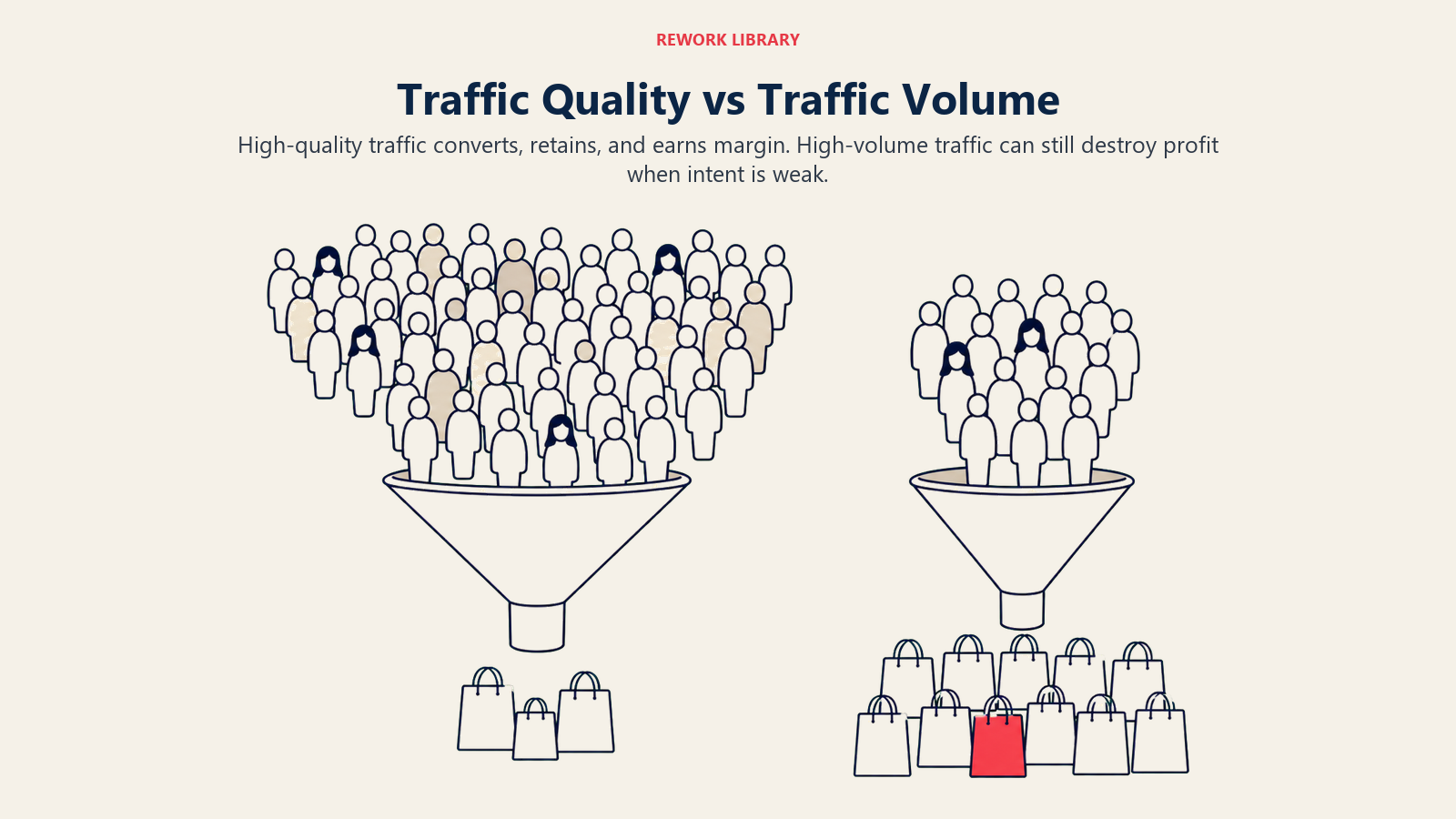
But here's where most e-commerce brands get it wrong: they confuse traffic volume with traffic quality. Getting 100,000 visitors sounds impressive until you realize they have a 0.1% conversion rate and 95% bounce rate. Meanwhile, 10,000 visitors from a different source convert at 3% and actually buy.
The goal isn't maximum traffic. It's profitable traffic that converts into customers with a lifetime value that justifies the acquisition cost.
The Traffic Acquisition Funnel: How Channels Drive Action
Before diving into specific channels, understand how traffic moves through your funnel and where different sources play different roles.
Awareness phase: reaching new audiences
This is where most people first discover your brand. They weren't looking for you specifically - they were scrolling social media, reading content, watching videos, or searching for solutions to problems.
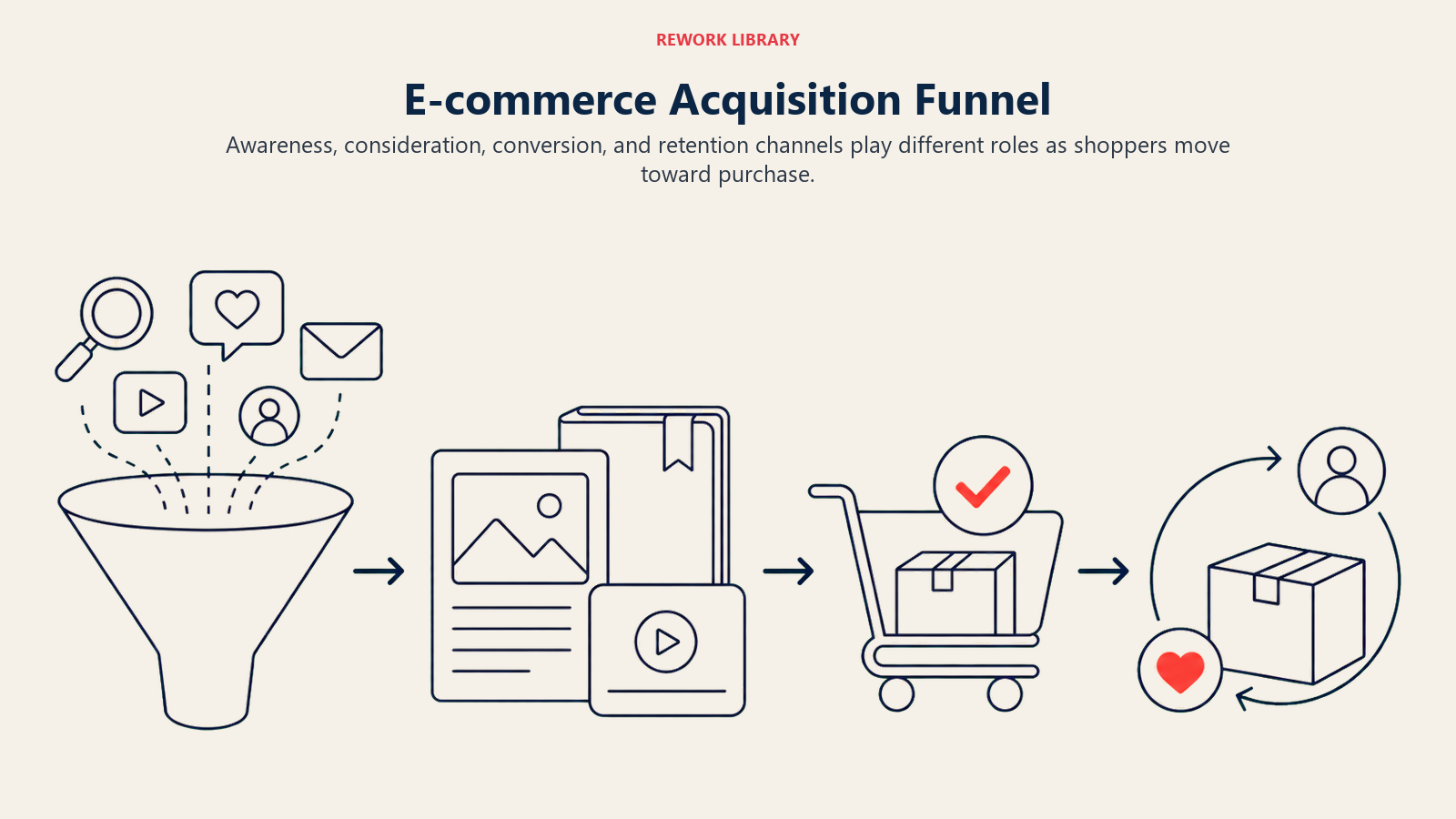
Awareness channels introduce your brand to cold audiences. The goal here isn't immediate conversion. It's getting on their radar, building recognition, and creating enough interest that they remember you when they're ready to buy.
Primary awareness channels:
- Paid social (Facebook, Instagram, TikTok)
- Display advertising
- YouTube ads
- Content marketing and SEO
- Influencer partnerships
- Podcast sponsorships
Awareness traffic typically has lower immediate conversion rates but plays a critical role in your overall attribution model. Someone who sees your Instagram ad today might Google your brand next week and buy.
Consideration phase: engaging interested prospects
Now they know you exist. They're evaluating options, comparing alternatives, reading reviews, and deciding whether your product solves their problem.
Consideration channels target people who've shown interest but haven't purchased. They're warm - not cold, not hot. They need more information, social proof, and reasons to choose you over competitors.
Primary consideration channels:
- Retargeting campaigns
- Email marketing
- Affiliate content (reviews, comparisons)
- Organic search (research-intent keywords)
- YouTube product reviews
This is where content quality matters. Product pages need detailed information. Reviews need to be visible. Your value proposition needs to be clear. Conversion rate optimization becomes critical at this stage.
Conversion phase: capturing ready-to-buy traffic
These are high-intent visitors ready to purchase. They're searching for your brand specifically, clicking on shopping ads, or responding to promotional emails.
Conversion channels target people at the bottom of the funnel with strong buying intent. Your job is to make the purchase frictionless and give them confidence to complete the transaction.
Primary conversion channels:
- Branded search (Google Ads)
- Google Shopping ads
- Affiliate links from deal sites
- Promotional emails
- Cart abandonment recovery campaigns
These channels typically have the highest immediate ROI but the smallest audience. You can't build your entire strategy on bottom-of-funnel traffic because you'll eventually exhaust the demand.
Post-purchase integration: retention and expansion
Once someone buys, they become a new acquisition channel through referrals, repeat purchases, and word-of-mouth. Understanding how to measure customer lifetime value helps you invest appropriately in retention.
Post-purchase traffic sources include:
- Email campaigns to existing customers
- Referral programs
- Loyalty programs that drive repeat purchases
- SMS marketing to past purchasers
These are your lowest CAC channels because you're marketing to people who already trust you and have purchased before.
Core Traffic Channels: What Works for E-commerce
Every e-commerce brand needs to understand these core acquisition channels and where they fit in your strategy.
Organic Search (SEO): long-term value, lowest CAC
SEO is the foundation of sustainable e-commerce traffic. When done right, it delivers consistent visitors with high purchase intent at near-zero marginal cost.
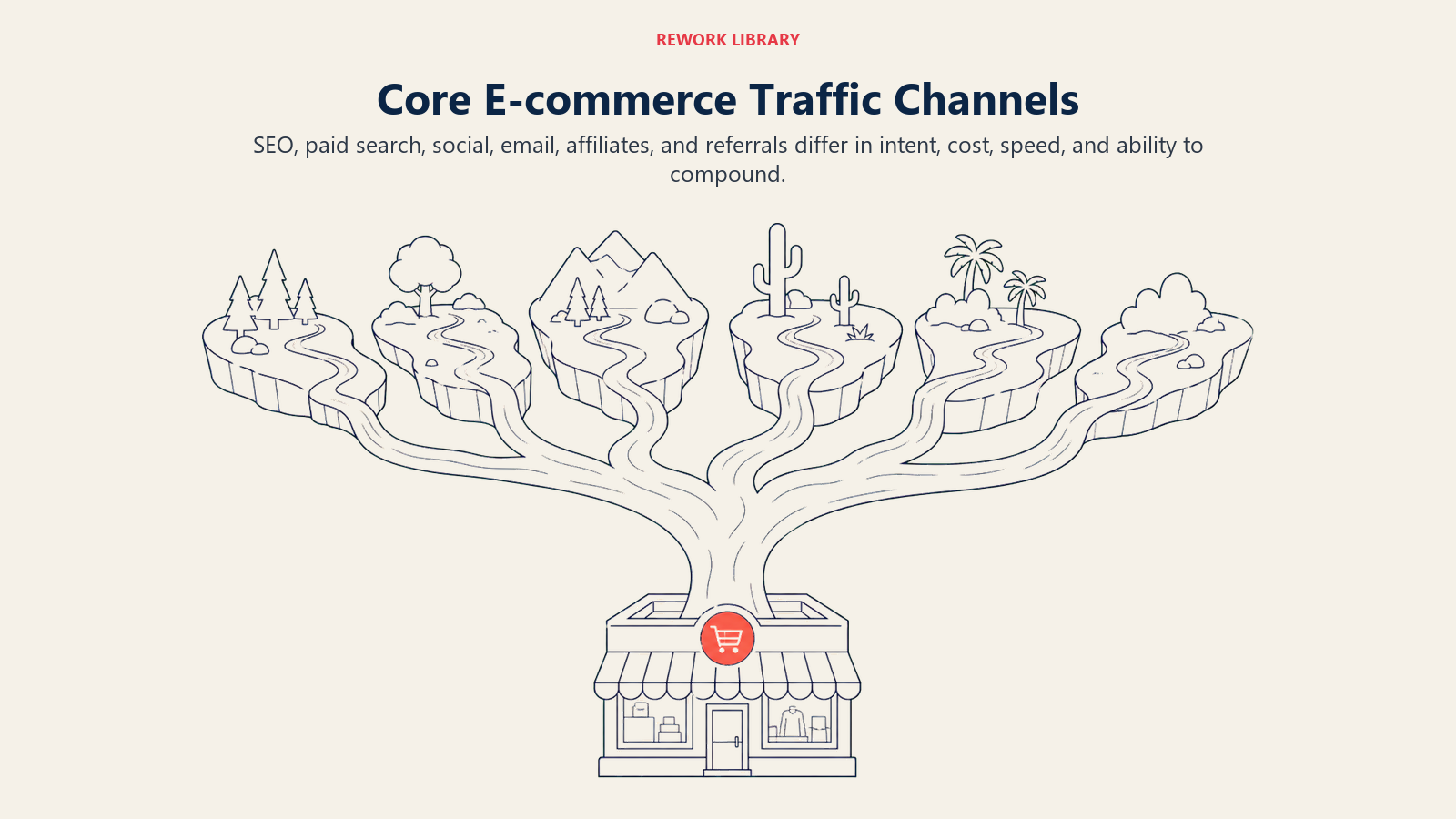
The economics are compelling: once you rank for valuable keywords, you get ongoing traffic without paying for each click. Your cost per acquisition drops over time while competitors paying for ads see theirs stay flat or increase.
But SEO is slow. It takes months to see results. You need technical infrastructure, quality content, and backlinks, especially for product page SEO and category page optimization. This requires ongoing investment before it pays off.
Best for: Brands with 6-12 month time horizons, informational products, categories with strong search demand
Typical metrics:
- CAC: $10-$30 (blended over time)
- Time to results: 3-12 months
- Conversion rate: 2-4%
When to prioritize: You have product-market fit, decent margins, and can invest in content creation before seeing returns.
Paid Search (Google Ads): immediate intent capture
Google Ads captures demand that already exists. When someone searches "buy running shoes online" or "best skincare for acne," they're signaling purchase intent.
This is bottom-of-funnel traffic. People are actively looking for what you sell. Your job is to show up, convince them to click, and convert them before competitors do.
The downside is cost. You're competing with every other advertiser in your category. Popular keywords can cost $5-20+ per click depending on competition. And if your product page doesn't convert, you're burning money.
Best for: High-margin products, competitive categories, capturing branded and high-intent searches
Typical metrics:
- CAC: $40-$120
- Time to results: Days
- Conversion rate: 3-8%
Understanding your e-commerce metrics and KPIs is essential for measuring paid search performance effectively.
When to prioritize: You need immediate sales, have competitive margins, and can afford the click costs in your category.
Paid Social (Facebook, Instagram, TikTok): audience targeting and scale
Social ads let you target specific demographics, interests, and behaviors to reach people who fit your ideal customer profile. You're interrupting their feed with your product, so creative and targeting quality matter enormously.
Facebook and Instagram ads work well for visual products, impulse purchases, and DTC brands. Understanding TikTok commerce strategy has become essential as the platform emerges as a powerful channel for younger demographics and trend-driven products.
The challenge is platform dependency. Algorithm changes can tank performance overnight. iOS privacy changes killed much of Facebook's targeting precision. You're renting attention on someone else's platform.
Best for: Visual products, impulse buys, lifestyle brands, audience targeting
Typical metrics:
- CAC: $25-$80
- Time to results: Days to weeks
- Conversion rate: 1-3%
When to prioritize: Your product photographs well, your target audience is active on social platforms, and you can create engaging creative.
Affiliate & Partnerships: performance-based acquisition
Affiliates promote your products and earn commission on sales they generate. You only pay for results, which makes this an attractive low-risk channel when structured properly through an affiliate marketing program.
Deal sites, coupon sites, review blogs, and influencer marketing partnerships all fall under this umbrella. The best affiliates already have audiences looking for products like yours.
The tradeoff is margin erosion. Commission rates typically range from 5-20% depending on industry. And some affiliates attract discount-seeking customers who won't return at full price.
Best for: Products with healthy margins, categories with active affiliate ecosystems, brands needing volume
Typical metrics:
- CAC: $30-$60 (including commission)
- Time to results: Weeks to months
- Conversion rate: 2-5%
When to prioritize: You have enough margin to afford commissions and want to expand reach without upfront ad spend.
Email & Owned Channels: direct audience access
Email marketing to subscribers you've already captured is one of your highest-ROI channels. You control the channel, don't pay per send, and reach people who opted in through email marketing for e-commerce campaigns.
The key is building your list through lead magnets, content upgrades, and on-site capture. Then nurturing that list with valuable content, not just promotional blasts.
SMS marketing has emerged as a powerful supplement to email, especially for time-sensitive promotions and cart recovery.
Best for: Building repeat purchase rates, launching new products, promotional campaigns
Typical metrics:
- CAC: $5-$20 (to existing subscribers)
- Time to results: Immediate
- Conversion rate: 5-15%
When to prioritize: You have an existing audience, products suited for repeat purchase, or launch cadence that benefits from owned distribution.
Display & Retargeting: continuous visibility
Display ads and retargeting keep your brand in front of people as they browse the web. Someone visits your site, doesn't buy, then sees your ad on news sites, blogs, and apps over the next few days through retargeting and remarketing campaigns.
Retargeting typically converts 2-3x better than cold traffic because you're reaching people who already showed interest. It's a critical component of a multi-touch attribution strategy.
Standard display advertising to cold audiences usually underperforms on direct ROI but can support brand awareness and consideration when used strategically.
Best for: Supporting consideration phase, recovering abandoned carts, upselling past customers
Typical metrics:
- CAC: $35-$70
- Time to results: Immediate
- Conversion rate: 1-4%
When to prioritize: You have sufficient site traffic to build retargeting audiences and want to increase conversion from warm traffic.
Channel Selection Framework: Matching Audience Behavior to Channels
Not every channel works for every business. The right mix depends on your product, audience, margins, and resources.
Start with customer research
Where do your best customers discover products? Ask them. Run surveys. Check analytics to see which channels drive the highest LTV customers.
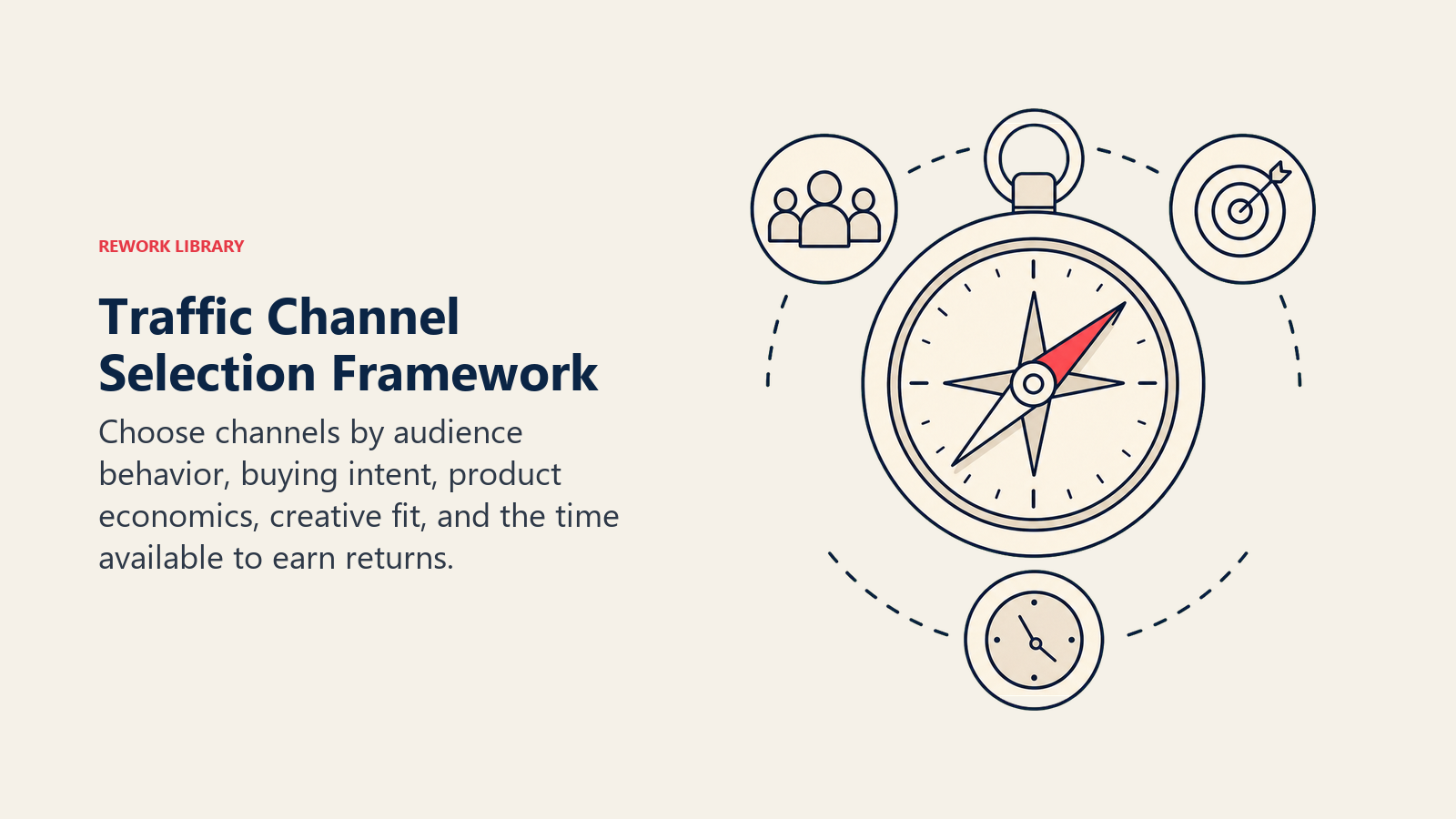
If your customers are active on Instagram and discover products through influencers, that's where you should focus. If they Google product categories and read comparison reviews, SEO and affiliates matter more.
Don't guess. Use data to guide channel prioritization.
Match channel to product characteristics
Visual, lifestyle products: Paid social (Instagram, Pinterest, TikTok) Technical, research-heavy products: SEO, affiliates, YouTube Impulse purchases under $50: Paid social, display, retargeting Considered purchases over $200: SEO, paid search, email nurture Trending, viral products: TikTok, influencers, social ads Evergreen, utilitarian products: SEO, Google Shopping, Amazon
Your product characteristics dictate which channels will be most effective and cost-efficient.
Consider your resources and constraints
Different channels require different resources:
SEO requires: Content creation, technical development, link building, time Paid search requires: Ad budget, campaign management, conversion optimization Paid social requires: Creative production, audience testing, budget Affiliates require: Recruitment, relationship management, commission budget Email requires: List building, segmentation, content creation
Be honest about what you can execute well. It's better to dominate one or two channels than to be mediocre across five. Some brands even explore multi-channel marketplace strategies to expand reach beyond owned channels.
Build for your growth stage
Pre-launch: Focus on audience building (content, email capture, social following) Early stage: Paid search and social to validate product-market fit and generate revenue Growth stage: Diversify across 3-5 channels to reduce dependency Mature stage: Optimize existing channels and test new emerging platforms
Your stage determines how aggressive vs. conservative your channel strategy should be.
Attribution Models: Understanding Multi-Touch Customer Journeys
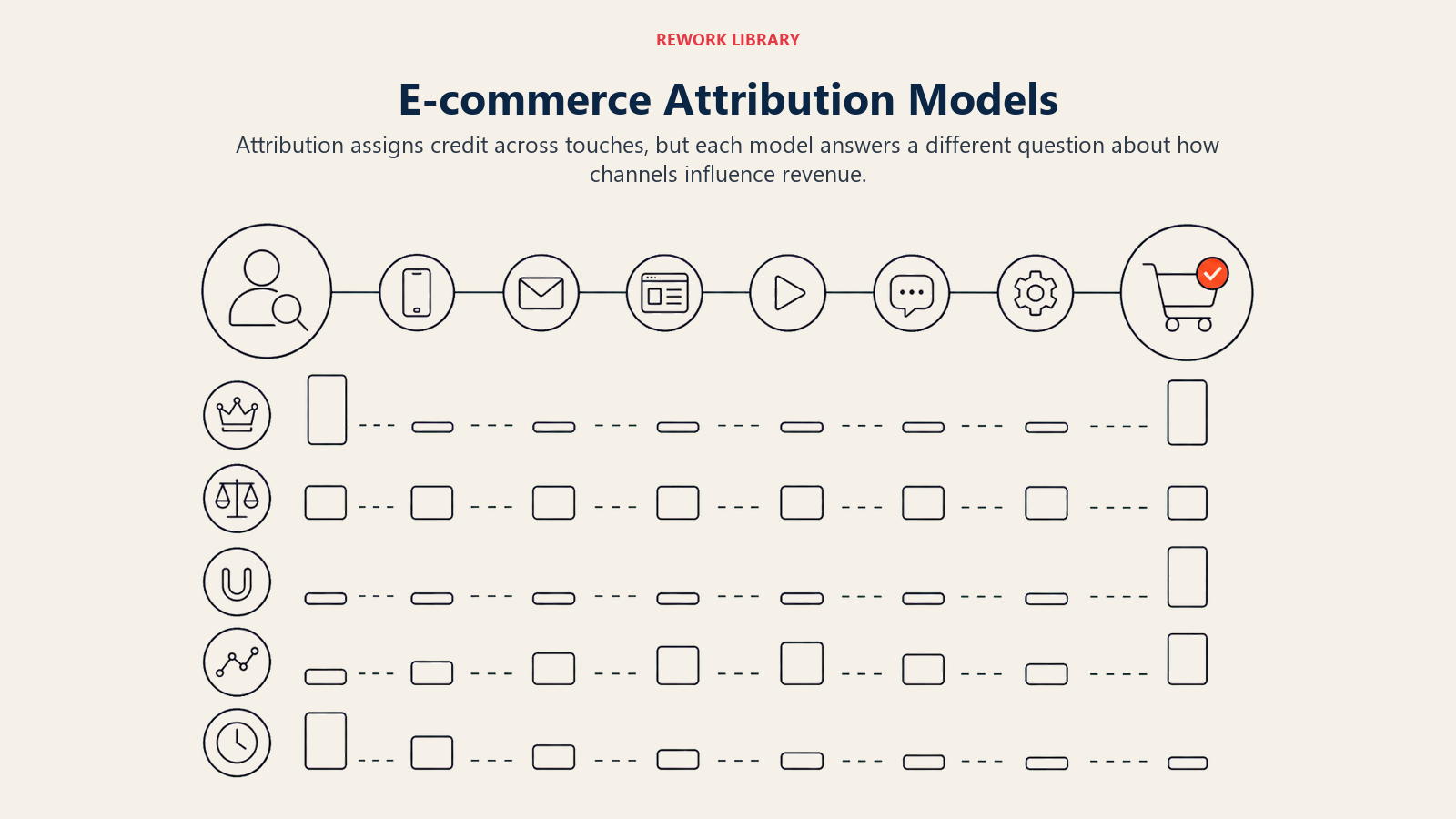
The average e-commerce customer interacts with your brand 6-8 times before purchasing. They see an Instagram ad, visit your site, leave, see a retargeting ad, Google your brand, read reviews, come back, and finally buy. Which channel gets credit for that sale? All of them? Just the last one? The first one? This is attribution, and getting it wrong leads to terrible budget allocation decisions.
First-click attribution: crediting discovery
First-click gives all credit to the first touchpoint. If someone discovers you through an Instagram ad, Instagram gets full credit even if they bought three weeks later through Google search.
Pros: Recognizes the value of awareness and discovery channels Cons: Ignores everything that happened between discovery and purchase
Best for: Understanding which channels introduce new customers to your brand
Last-click attribution: crediting conversion
Last-click gives all credit to the final touchpoint before purchase. If someone clicked on a Google search ad and bought, Google gets full credit even if they'd been seeing your Facebook ads for weeks.
Pros: Simple to track, clearly shows which channels close sales Cons: Completely ignores the customer journey and awareness touchpoints
Best for: Understanding which channels capture ready-to-buy demand
Most analytics platforms default to last-click, which systematically undervalues awareness channels and overvalues bottom-of-funnel channels.
Multi-touch attribution: spreading credit
Multi-touch models spread credit across all touchpoints in the customer journey. There are several variations:
Linear: Equal credit to every touchpoint Time-decay: More credit to recent touchpoints Position-based: More credit to first and last, less to middle Data-driven: Algorithmically assigns credit based on actual conversion patterns
Pros: Recognizes the full customer journey Cons: More complex to implement and understand
Best for: Mature businesses with sophisticated analytics and multiple touchpoints
Choosing your attribution model
If you're just starting out, use last-click to understand what's directly driving sales. But recognize its limitations.
As you mature, move to multi-touch (even a simple linear model) to better understand how channels work together. This prevents you from killing awareness channels that seem to have "bad" direct ROI but actually drive discovery that converts later through other channels.
The attribution window problem
How long after someone's first interaction should you credit a channel? 7 days? 30 days? 90 days?
Shorter windows favor quick-conversion channels. Longer windows credit awareness channels but risk attributing purchases that would have happened anyway.
Most e-commerce brands use 7-30 day attribution windows. High-ticket or considered purchases may justify 60-90 days. Test what makes sense for your purchase cycle.
Customer Acquisition Cost (CAC): The Metric That Matters Most
Customer acquisition cost is your total marketing and sales spend divided by the number of new customers acquired. It's the foundational metric for understanding whether your traffic strategy is profitable.
How to calculate CAC properly
The basic formula looks simple:
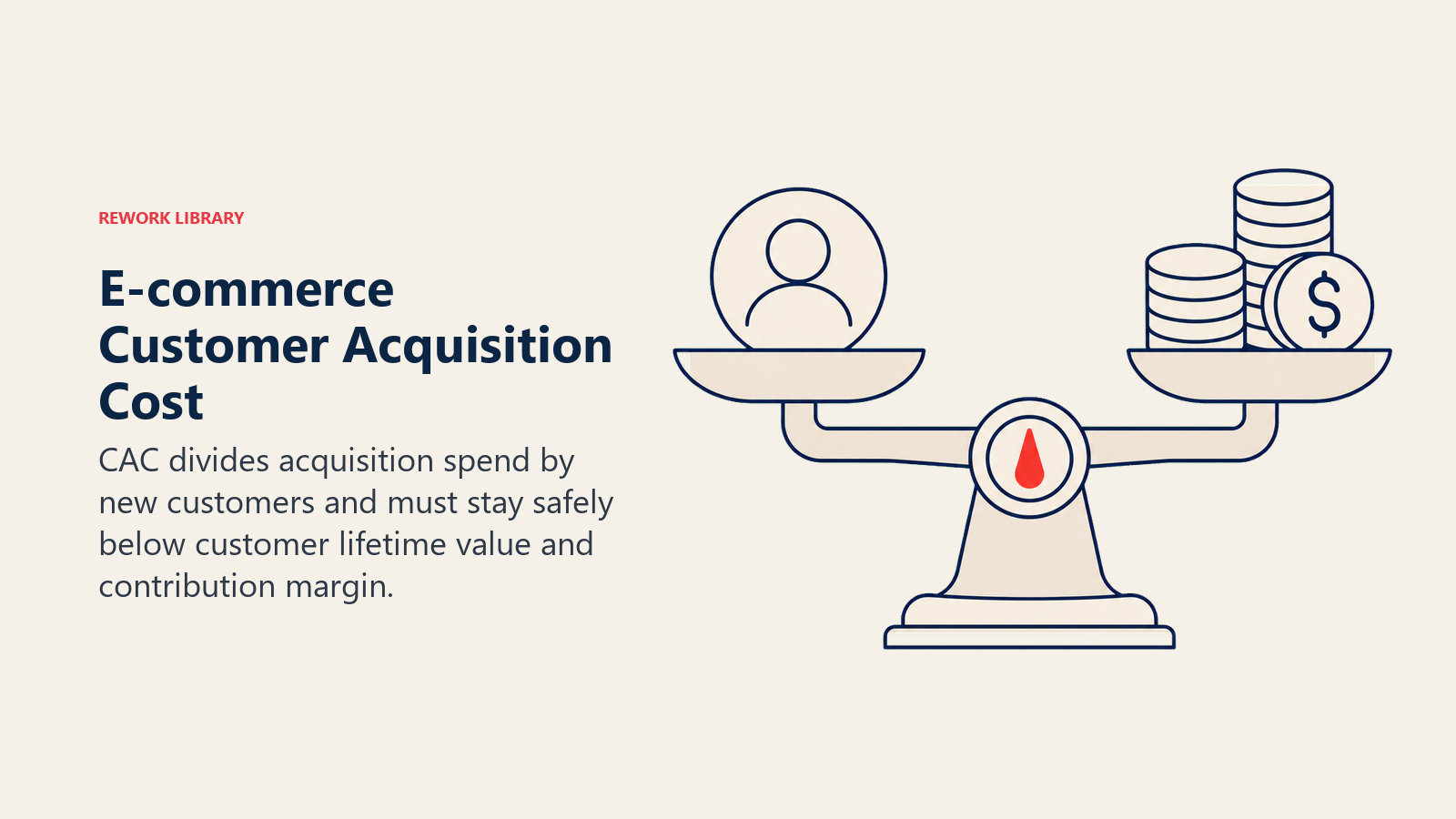
CAC = Total acquisition costs ÷ New customers acquired
But what counts as "acquisition costs"? Be comprehensive:
Include:
- All ad spend (search, social, display, affiliate commissions)
- Creative production costs (photography, video, design)
- Agency or freelancer fees
- Marketing software and tools (analytics, email, CRM)
- Content creation costs (if driving acquisition)
- Team salaries allocated to acquisition activities
Exclude:
- Retention marketing (email to existing customers)
- Product development costs
- General overhead
Calculate by channel: Don't just track blended CAC. Calculate it separately for each channel so you know which ones are efficient and which are expensive.
Channel CAC = Channel costs ÷ Customers from that channel
This reveals where to allocate more budget and where to cut back.
CAC in context: the LTV:CAC ratio
CAC is meaningless without understanding customer lifetime value. A $100 CAC is great if your LTV is $500. It's terrible if your LTV is $120.
The fundamental equation for sustainable growth:
LTV:CAC ratio ≥ 3:1
If customers are worth at least 3x what you pay to acquire them, you have a healthy business model. Lower than 3:1 and your margins are too thin. Higher than 5:1 and you're probably under-investing in growth.
Learn more about measuring and optimizing customer lifetime value for e-commerce.
CAC payback period: how fast you recover costs
Even if your LTV:CAC ratio is healthy, you need to know how quickly you recoup acquisition costs.
Payback period = CAC ÷ Average monthly revenue per customer
If your CAC is $60 and customers spend $30/month on average, your payback period is 2 months.
Shorter payback periods mean you can reinvest revenue into more acquisition faster. Longer payback periods require more capital to fund growth while waiting for returns.
Most healthy e-commerce brands target payback periods under 12 months. Subscription businesses can sometimes justify longer periods given recurring revenue predictability.
Optimizing CAC by channel
Once you know CAC by channel, optimization becomes straightforward:
Double down on channels with:
- CAC below your target threshold
- Strong LTV:CAC ratios
- Reasonable payback periods
- Room to scale (audience size, budget efficiency)
Optimize or cut channels with:
- CAC above profitable thresholds
- Declining efficiency as you scale
- Poor LTV (customers who don't return)
- Maxed out potential
Run the numbers monthly. Channel efficiency changes as competition increases, algorithms shift, and audience fatigue sets in.
Traffic Quality vs. Volume: Metrics Beyond Clicks
More traffic isn't always better. Quality matters as much as quantity. Here's how to measure whether traffic is actually valuable.
Bounce rate by source
Bounce rate shows the percentage of visitors who leave without interacting with your site. High bounce rates signal low relevance - people clicked but didn't find what they expected.
Good benchmarks:
- Organic search: 40-60%
- Paid search: 35-55%
- Paid social: 50-70%
- Display ads: 60-80%
If a channel has significantly higher bounce rates than others, something's wrong with targeting, ad messaging, or landing page relevance.
Time on site and pages per session
Engaged visitors spend more time browsing and visit multiple pages. This correlates strongly with purchase intent and conversion.
Quality indicators:
- 2+ minutes on site
- 3+ pages per session
- Visits to product pages and category pages
Channels driving high time-on-site and multiple page views are delivering interested, engaged traffic worth investing in.
Conversion rate by source
The ultimate quality metric: what percentage of traffic from each source actually buys?
Track conversion rate by channel and compare:
| Channel | Visitors | Conversion Rate | Customers |
|---|---|---|---|
| Organic Search | 10,000 | 3.2% | 320 |
| Paid Search | 5,000 | 2.8% | 140 |
| Paid Social | 8,000 | 1.5% | 120 |
| Display Ads | 15,000 | 0.8% | 120 |
Display ads drove the most traffic but had the worst conversion rate. Organic search had fewer visitors but converted at 4x the rate of display.
This analysis reveals where to focus optimization efforts and budget allocation.
Revenue per visitor by source
Conversion rate only tells part of the story. Some channels might convert at similar rates but drive very different order values.
Revenue per visitor = Total revenue from source ÷ Total visitors from source
A channel with 2% conversion rate and $100 average order value ($2 revenue per visitor) is more valuable than a channel with 2.5% conversion and $60 AOV ($1.50 revenue per visitor). Implementing AOV optimization strategies can significantly improve channel economics.
This metric accounts for both conversion rate and order value, giving you a complete picture of channel value.
Return customer rate by source
Some channels attract one-time buyers. Others bring customers who return and purchase repeatedly.
Track what percentage of first-time customers from each channel make a second purchase within 90-180 days. Channels with high return rates deliver more valuable customers even if initial CAC is higher.
This ties directly back to customer lifetime value - channels that drive repeat purchasers justify higher acquisition costs.
Building Your Channel Mix: Diversification Strategy
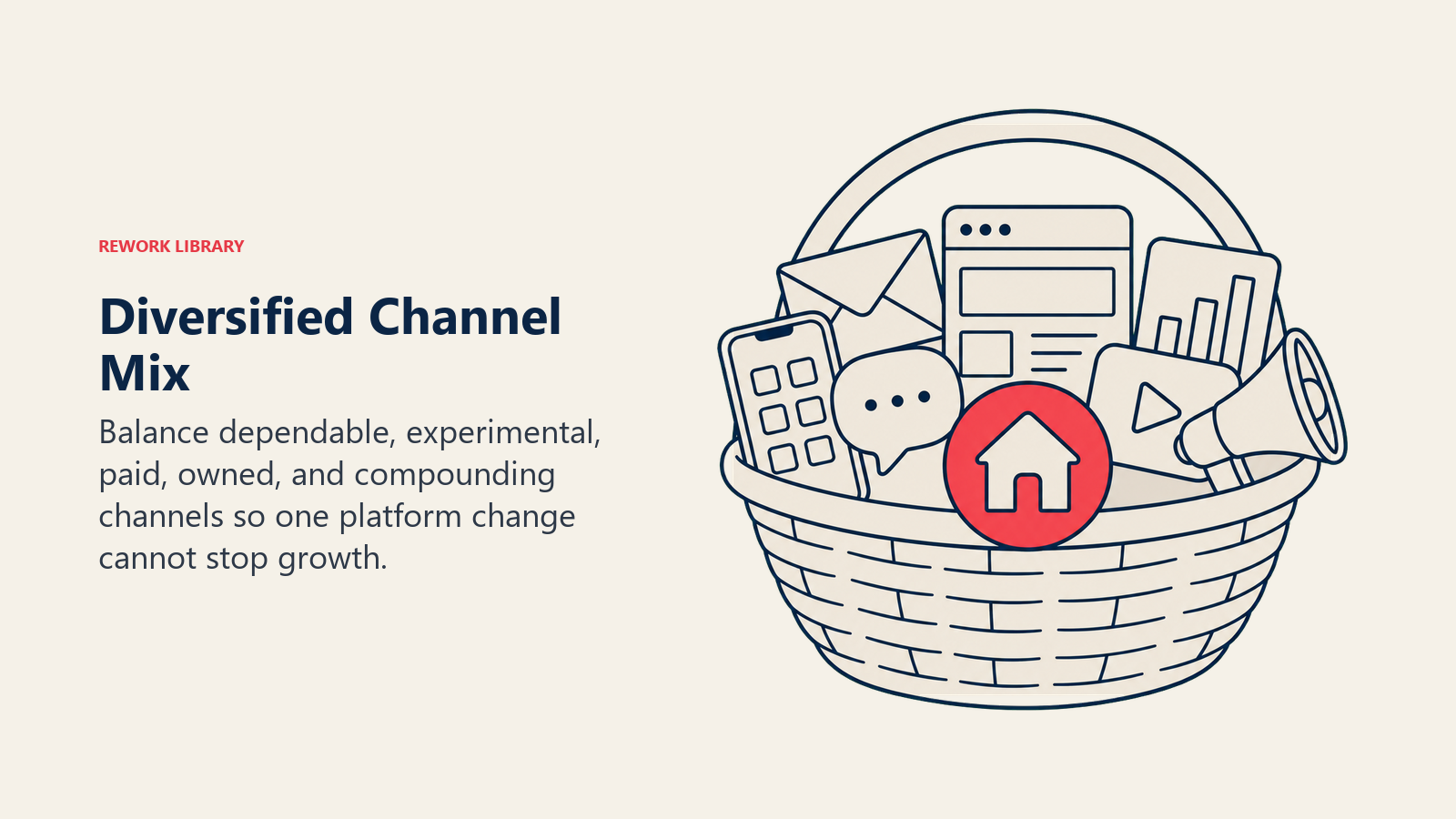
Smart e-commerce brands don't rely on a single channel. They build diversified traffic strategies that reduce risk and create multiple paths to growth.
The 60-30-10 budget allocation rule
Here's a practical framework for allocating traffic acquisition budget:
60% - Proven performers The majority of budget goes to channels you know work. These have proven ROI, acceptable CAC, and room to scale.
For most e-commerce brands, this is usually:
- Paid search (brand + high-intent keywords)
- Paid social (retargeting + proven audiences)
- Google Shopping
- Top-performing affiliate partnerships
You've tested these. You know the economics. You can scale them confidently.
30% - Growth opportunities About a third of budget goes to channels showing promise but not yet optimized. These might be:
- Expanding to new social platforms
- Testing influencer partnerships
- Scaling SEO efforts
- Developing new affiliate relationships
- Testing YouTube or podcast advertising
These channels need investment and optimization before they move into your core 60%. Some will scale. Others won't.
10% - Experiments Reserve 10% for trying completely new things. Test emerging platforms, unconventional partnerships, new targeting strategies, or creative approaches.
Most experiments fail. That's fine. You're looking for the 1-2 that work well enough to graduate into your 30% tier, then eventually your 60%.
This framework prevents over-concentration in one channel while maintaining focus on what drives results.
Geographic and seasonal diversification
Different channels perform differently by geography and season. Build this into your strategy:
Geographic: Paid search might dominate in urban markets while affiliates work better in suburban/rural areas. Test channel mix by region.
Seasonal: Social ads might spike around holidays for gift products while SEO maintains steady year-round traffic. Plan budget shifts around seasonality.
Understanding these patterns lets you optimize spend timing and prevent over-reliance on channels that only work during specific periods.
Balancing brand and performance
Every traffic strategy needs both brand-building and performance marketing:
Performance marketing: Direct response advertising optimized for immediate ROI (paid search, retargeting, affiliate)
Brand marketing: Awareness and consideration advertising that builds long-term value (content, social, display, influencers)
Pure performance marketing maximizes short-term ROI but doesn't build lasting brand equity. Pure brand marketing builds awareness but struggles to prove ROI.
The best strategies blend both: use performance marketing to drive immediate revenue while investing in brand channels that expand your addressable market over time.
Testing & Experimentation: Finding Your Optimal Mix
Your optimal channel mix is unique to your business. The only way to find it is through systematic testing.
Start with a hypothesis
Don't test randomly. Start with a clear hypothesis based on customer research and competitive analysis:
"We believe TikTok ads will drive lower CAC than Instagram for our Gen Z audience because our product is trend-driven and performs well in short-form video."
This gives you clear success criteria and prevents endless testing without learning.
Test with meaningful budgets
Testing with $100 budgets tells you nothing. You need enough spend to gather statistically significant data.
Minimum test budget: $1,000-$2,500 per channel Minimum test duration: 30 days Minimum sample size: 100+ clicks to landing page
Anything less and you're making decisions based on noise, not signal.
Control variables
When testing new channels, control other variables:
- Use the same landing pages
- Target similar audiences
- Test during comparable time periods
- Use consistent creative quality
If you change multiple variables at once, you won't know which caused results.
Measure the right metrics
Define success metrics before testing:
Awareness channels: CTR, CPM, engagement rate, audience growth Consideration channels: Time on site, pages per session, bounce rate, email capture rate Conversion channels: Conversion rate, CAC, ROAS, AOV
Don't judge awareness channels by immediate conversion rate or conversion channels by brand lift. Match metrics to channel objectives.
Give tests time to mature
Algorithms need time to optimize. Audiences need time to respond. Allow at least 30 days before making major decisions about new channels.
Some patterns only emerge after initial testing:
- Retargeting audiences build over time
- SEO takes months to show results
- Affiliate programs require relationship development
Be patient with tests that have long feedback loops.
Common Pitfalls: What Kills Traffic Strategies
Here's where most e-commerce brands go wrong with traffic acquisition.
Over-reliance on one channel
If 70%+ of your traffic comes from one source, you're vulnerable. Algorithm changes, policy updates, competitive pressure, or cost increases can devastate your business overnight.
iOS 14 killed Facebook ROI for countless DTC brands overnight. Google algorithm updates have wiped out organic traffic for thousands of e-commerce sites.
Diversify before you're forced to. When your main channel is still working is the best time to develop alternatives.
Ignoring attribution and multi-touch
If you only look at last-click attribution, you'll systematically undervalue awareness channels and make bad budget decisions.
You'll cut Facebook ads that "don't convert" while not realizing they drive brand searches that convert through Google. You'll kill content marketing that generates discovery while over-investing in branded search that only captures existing demand.
Implement at least basic multi-touch attribution to understand how channels work together.
Chasing vanity metrics
Traffic volume, impressions, and clicks are vanity metrics if they don't correlate with revenue.
100,000 visitors at 0.5% conversion rate generates fewer sales than 10,000 visitors at 3% conversion rate. Focus on quality and conversion, not just traffic volume.
Not tracking CAC by cohort
Blended CAC hides problems. You need to track CAC by:
- Acquisition channel
- Customer cohort (month acquired)
- Geographic market
- Product category
This reveals which channels drive profitable customers vs. which ones burn cash for low-value purchasers.
Stopping what works to test what's new
Shiny object syndrome kills growth. Don't kill proven channels to test new ones. Add new tests while maintaining investment in what works.
Budget for experimentation separately from core performance channels. This lets you explore without risking existing revenue.
Not aligning traffic to funnel stage
Sending cold Instagram traffic directly to product pages without education or social proof results in terrible conversion rates.
Match traffic to appropriate funnel stages:
- Cold traffic → Educational content, quizzes, value demonstrations
- Warm traffic → Product pages, comparison content, social proof
- Hot traffic → Product pages, promotional offers, cart recovery
Conversion rate optimization starts with sending the right traffic to the right experience.
Traffic Channel Comparison Matrix
Here's how major e-commerce channels compare across key dimensions:
| Channel | Speed to Results | Volume Potential | Quality Potential | Typical CAC | Typical CR | Best For |
|---|---|---|---|---|---|---|
| Organic Search (SEO) | Slow (3-12 months) | High | High | $10-$30 | 2-4% | Long-term growth, lower CAC |
| Paid Search (Google) | Fast (days) | High | High | $40-$120 | 3-8% | Intent capture, immediate sales |
| Paid Social (Meta) | Fast (days) | High | Medium | $25-$80 | 1-3% | Visual products, audience targeting |
| Google Shopping | Fast (days) | Medium-High | High | $35-$90 | 2-5% | Product comparison, price-conscious |
| Display & Retargeting | Fast (days) | Medium | Medium | $35-$70 | 1-4% | Awareness, cart recovery |
| Affiliates | Medium (weeks) | Medium | Medium | $30-$60 | 2-5% | Performance-based, low risk |
| Email (owned list) | Immediate | Low-Medium | High | $5-$20 | 5-15% | Repeat purchase, launches |
| Influencers | Medium (weeks) | Low-High | Medium | $20-$100 | 1-4% | Trust-building, niche audiences |
Use this as a starting framework, but build your own comparison based on actual performance data for your business.
Analytics & Tracking Setup: Measuring What Matters
You can't optimize what you don't measure. Proper tracking is the foundation of smart traffic strategy.
Essential tracking infrastructure
Google Analytics 4: Core traffic analytics, conversion tracking, channel attribution Tag Manager: Centralized tag management for pixels and tracking codes Platform pixels: Facebook Pixel, Google Ads tag, TikTok Pixel for retargeting and conversion tracking UTM parameters: Consistent tagging for campaign tracking across channels Server-side tracking: More reliable tracking as browser-based tracking becomes less reliable
Set these up correctly before spending significant money on traffic acquisition. Bad data leads to bad decisions.
For comprehensive tracking implementation, see Analytics & Tracking Setup for E-commerce.
Key metrics dashboard
Build a dashboard tracking these metrics by channel:
Traffic metrics:
- Sessions
- Users
- Bounce rate
- Pages per session
- Time on site
Conversion metrics:
- Conversion rate
- Transactions
- Revenue
- Average order value
Efficiency metrics:
- Cost per click (CPC)
- Cost per acquisition (CAC)
- Return on ad spend (ROAS)
- Revenue per visitor
Update daily. Review weekly. Make decisions monthly.
Attribution reporting
Set up attribution reports showing:
- First-click attribution (what drives discovery)
- Last-click attribution (what drives conversion)
- Multi-touch attribution (how channels work together)
- Time to conversion by channel
- Customer journey path analysis
This reveals which channels deserve credit and how they interact.
Moving Forward: Building Your Traffic Strategy
You don't need to implement every channel on day one. Build systematically: Month 1-2: Foundation
- Set up tracking and analytics properly
- Calculate current CAC and LTV by channel
- Identify your top 2-3 performing channels
- Establish baseline performance metrics
Month 3-4: Optimization
- Double down on proven channels
- Run A/B tests on creative and targeting
- Optimize landing pages for top traffic sources
- Implement retargeting campaigns
Month 5-6: Expansion
- Test 1-2 new channels with experimental budget
- Expand to additional platforms within working channels
- Develop content strategy for SEO if not already prioritized
- Build affiliate and partnership pipeline
Month 7-12: Diversification
- Graduate successful experiments to core budget
- Build multi-channel attribution models
- Optimize budget allocation based on CAC and LTV data
- Develop seasonal and promotional playbooks
The brands that win long-term don't find one magic channel. They build diversified, measurable, optimizable traffic engines that consistently deliver profitable customer acquisition.
Your traffic strategy is the foundation of your e-commerce growth model. Get it right, and everything else becomes easier. Get it wrong, and nothing else matters.
Frequently Asked Questions
What is traffic acquisition in e-commerce? Traffic acquisition is the process of attracting visitors to your store through channels like organic search, paid search, paid social, affiliates, email, and retargeting. The aim is profitable traffic, meaning customers whose lifetime value exceeds the cost of acquiring them, not just the highest possible visitor count.
What are the main traffic acquisition channels? The core channels are organic search (SEO), paid search (Google Ads), paid social (Meta, TikTok), Google Shopping, affiliates and partnerships, email and owned channels, and display and retargeting. Each one fits a different funnel stage and carries a different CAC, so most brands blend several rather than relying on one.
How do you measure traffic acquisition cost? Use customer acquisition cost: total acquisition spend divided by new customers acquired, calculated per channel, not just blended. Then compare it against customer lifetime value. A healthy business keeps an LTV:CAC ratio of at least 3:1 and a payback period under 12 months.
Which attribution model should I use for acquisition? If you're early, start with last-click to see what directly drives sales, while understanding it undervalues awareness channels. As you mature, move to a multi-touch model (even simple linear) so discovery channels get fair credit for purchases that close later through other channels.
How should I split my acquisition budget across channels? A practical starting point is the 60-30-10 rule: 60% to proven performers, 30% to growth opportunities you're still optimizing, and 10% to experiments on new platforms. This avoids over-reliance on a single channel while keeping a steady pipeline of new winners.
Learn More
Deepen your understanding of traffic acquisition and optimization:
Channel-Specific Strategies
- E-commerce SEO Strategy - Build organic search traffic that converts
- Google Shopping Ads for E-commerce - Optimize product feeds and shopping campaigns
- Facebook & Instagram Ads Strategy - Master social advertising for DTC brands
- Conversion Rate Optimization (CRO) - Turn more traffic into customers
- Product Page Optimization - Maximize conversions from traffic you acquire
Foundational Metrics
- E-commerce Growth Model Overview - Understand the complete growth framework
- Unit Economics for E-commerce - Master per-customer profitability
- Customer Lifetime Value (LTV) - Measure and optimize long-term customer value
- Analytics & Tracking Setup - Implement proper measurement infrastructure

Sales Operations Practice Lead
On this page
- Why Traffic Acquisition Matters: The Foundation of Sustainable Growth
- The Traffic Acquisition Funnel: How Channels Drive Action
- Awareness phase: reaching new audiences
- Consideration phase: engaging interested prospects
- Conversion phase: capturing ready-to-buy traffic
- Post-purchase integration: retention and expansion
- Core Traffic Channels: What Works for E-commerce
- Organic Search (SEO): long-term value, lowest CAC
- Paid Search (Google Ads): immediate intent capture
- Paid Social (Facebook, Instagram, TikTok): audience targeting and scale
- Affiliate & Partnerships: performance-based acquisition
- Email & Owned Channels: direct audience access
- Display & Retargeting: continuous visibility
- Channel Selection Framework: Matching Audience Behavior to Channels
- Start with customer research
- Match channel to product characteristics
- Consider your resources and constraints
- Build for your growth stage
- Attribution Models: Understanding Multi-Touch Customer Journeys
- First-click attribution: crediting discovery
- Last-click attribution: crediting conversion
- Multi-touch attribution: spreading credit
- Choosing your attribution model
- The attribution window problem
- Customer Acquisition Cost (CAC): The Metric That Matters Most
- How to calculate CAC properly
- CAC in context: the LTV:CAC ratio
- CAC payback period: how fast you recover costs
- Optimizing CAC by channel
- Traffic Quality vs. Volume: Metrics Beyond Clicks
- Bounce rate by source
- Time on site and pages per session
- Conversion rate by source
- Revenue per visitor by source
- Return customer rate by source
- Building Your Channel Mix: Diversification Strategy
- The 60-30-10 budget allocation rule
- Geographic and seasonal diversification
- Balancing brand and performance
- Testing & Experimentation: Finding Your Optimal Mix
- Start with a hypothesis
- Test with meaningful budgets
- Control variables
- Measure the right metrics
- Give tests time to mature
- Common Pitfalls: What Kills Traffic Strategies
- Over-reliance on one channel
- Ignoring attribution and multi-touch
- Chasing vanity metrics
- Not tracking CAC by cohort
- Stopping what works to test what's new
- Not aligning traffic to funnel stage
- Traffic Channel Comparison Matrix
- Analytics & Tracking Setup: Measuring What Matters
- Essential tracking infrastructure
- Key metrics dashboard
- Attribution reporting
- Moving Forward: Building Your Traffic Strategy
- Frequently Asked Questions
- Learn More
- Channel-Specific Strategies
- Foundational Metrics