Personalization Engine: Using AI to Deliver Individual Customer Experiences
Turn this article into takeaways for your work.


Each assistant summarizes the article only for you and suggests best practices for your work.
A personalization engine transforms your e-commerce site from a one-size-fits-all catalog into an individual shopping experience for each visitor. When a customer sees products they actually want, content that speaks to their needs, and offers timed to their buying journey, conversion rates jump 10-30%, average order values increase 15-25%, and lifetime value can double.
Most stores still show the same homepage to everyone. A returning customer who just bought running shoes sees the exact same featured products as a first-time visitor browsing casual wear. That's leaving money on the table. Modern personalization engines use AI and machine learning to analyze behavior patterns, predict preferences, and deliver individualized experiences in real-time across every touchpoint.
What is a Personalization Engine?
A personalization engine is a system that uses data, algorithms, and machine learning to automatically customize what each visitor sees on your site. Instead of manually creating segments or rules, the engine learns from millions of interactions to predict what each individual customer wants to see next.
The business impact is measurable. Netflix reports that its recommendation engine saves $1 billion annually in customer retention. Amazon attributes 35% of its revenue to personalized recommendations. For mid-sized e-commerce stores, implementing proper personalization typically increases conversion rates by 8-20% within the first six months.
Here's the difference between static recommendations and true personalization:
Static recommendations show the same "top sellers" or "trending products" to everyone. A rules-based approach might show "customers who bought X also bought Y" based on aggregate data. These work, but they're not optimized for individual preferences.
True personalization creates a unique experience for each visitor. The engine considers browsing history, purchase behavior, time on site, device type, referral source, seasonal patterns, and hundreds of other signals to predict what this specific person wants to see right now. The recommendations adapt in real-time as the customer interacts with your site.
Why personalization drives revenue: customers find what they want faster (reducing bounce rates), they discover products they didn't know you carried (increasing cart size), and they feel understood (building loyalty). A visitor who sees relevant products within 10 seconds is 3x more likely to convert than someone who has to search or browse manually.
The technology has matured to where personalization isn't exclusive to enterprise retailers anymore. Modern platforms offer affordable options for stores doing $1M+ in annual revenue, with ROI that typically justifies the investment within 3-6 months.
Key Types of Personalization
Personalization extends far beyond product recommendations. Here are the high-impact areas to prioritize:
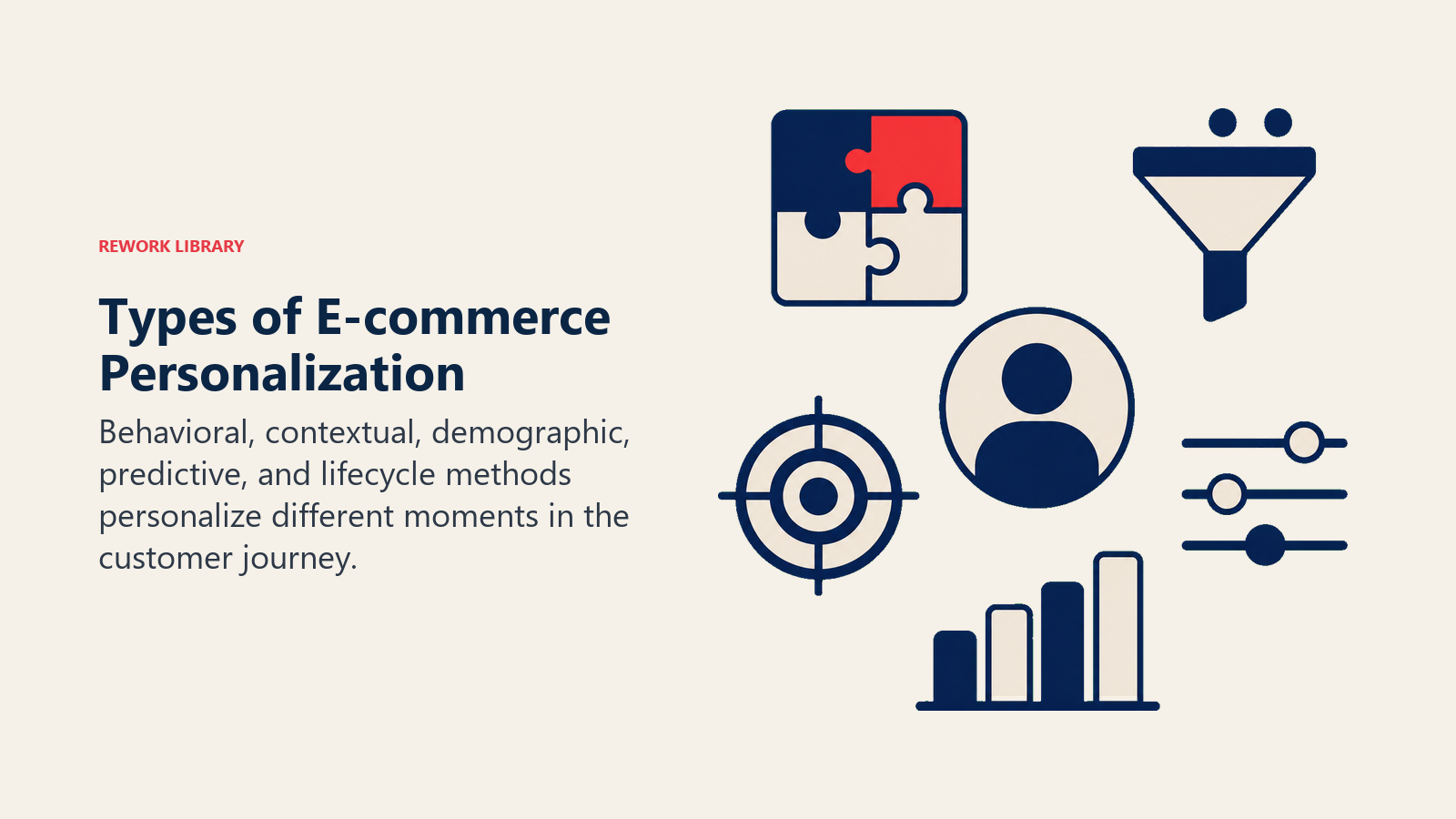
Product Recommendations remain the foundation. Product recommendations can appear on homepages, product pages, cart pages, and checkout. The engine uses collaborative filtering (people similar to you bought these) or content-based filtering (products similar to what you viewed). Advanced implementations combine both approaches. A fashion retailer might show "Complete the look" recommendations on product pages (content-based) and "Customers like you also loved" on the homepage (collaborative).
Dynamic Pricing adjusts prices based on demand, inventory levels, competitor pricing, and customer willingness to pay. Dynamic pricing can increase margins by 5-10% when implemented correctly. The engine might offer a small discount to a price-sensitive customer who's visited five times without buying, while showing full price to a first-time visitor from a high-income demographic.
Email Content Personalization goes beyond using the customer's first name. The engine determines which products to feature, what messaging to use, and when to send based on individual behavior patterns. A customer who browses on weekday evenings gets emails Tuesday at 6 PM featuring products in categories they've shown interest in. Marketing automation platforms integrate with personalization engines to execute these strategies at scale.
Homepage and Landing Page Customization shows different hero images, featured categories, and promotional banners based on visitor attributes. A returning customer who always buys men's athletic wear sees sports equipment and activewear front and center. A first-time visitor from a mobile device sees your mobile app download banner and best-selling starter products.
Search Results Personalization reorders search results based on individual preferences. Two customers searching for "running shoes" see different products ranked first based on their price sensitivity, preferred brands, and past purchases. This can increase search conversion rates by 15-30%.
Journey Stage Personalization adapts the entire experience based on where the customer is in their buying journey. First-time visitors see trust signals and category education. Repeat browsers see specific products they've viewed with urgency messaging. Recent purchasers see complementary products and loyalty program promotions. This approach, combined with proper conversion rate optimization, creates a seamless path to purchase.
The most effective strategies layer multiple personalization types. A visitor who abandons cart gets a personalized email (email content), sees the abandoned products on their next visit (homepage), and receives a small discount code (dynamic pricing), all triggered automatically by the personalization engine.
AI/ML Technologies Behind Personalization
Understanding the core technologies helps you evaluate platforms and set realistic expectations for what personalization can achieve.
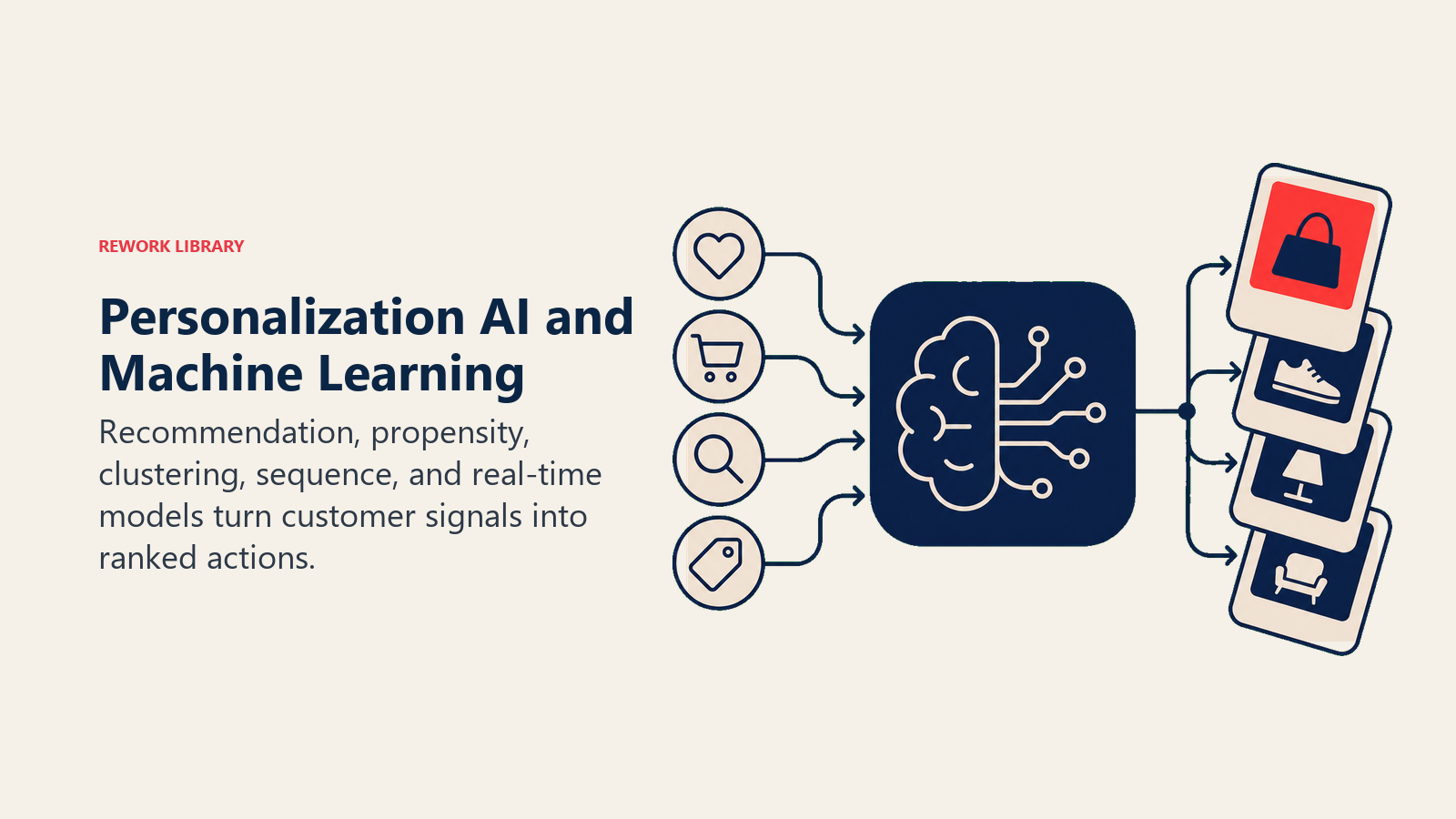
Collaborative Filtering is the "customers like you" approach. The algorithm identifies users with similar behavior patterns and recommends items that similar users liked. If users A and B both bought products 1, 2, and 3, and user A also bought product 4, the engine recommends product 4 to user B. This works really well for mature catalogs with significant transaction history. The limitation: it struggles with new products (cold start problem) and can create filter bubbles where customers only see similar items.
Content-Based Filtering analyzes product attributes to find similar items. If a customer views a red cotton t-shirt, the engine recommends other red clothing, cotton items, or t-shirts. This approach requires well-structured product data with consistent attributes (color, material, style, size, brand). Content-based filtering excels at handling new products but may miss unexpected preferences that collaborative filtering catches.
Neural Networks and Deep Learning power modern personalization engines. These models can process hundreds of signals simultaneously, browsing history, time of day, device type, weather in the customer's location, current inventory levels, seasonal trends, and find complex patterns that simpler algorithms miss. A deep learning model might discover that customers who browse on mobile devices during lunch hours respond better to quick-shipping products, while evening desktop browsers prioritize price.
Real-Time Scoring calculates personalization recommendations on the fly as customers interact with your site. Every click, scroll, and hover provides new data that updates the customer's preference profile. Modern engines can recalculate recommendations in under 100 milliseconds, ensuring the experience stays relevant as the customer's intent becomes clearer during the session.
Contextual Bandits are a machine learning technique that balances exploration and exploitation. The engine shows recommendations it's confident about (exploitation) while occasionally testing new suggestions (exploration) to discover emerging preferences. This prevents the filter bubble problem and keeps recommendations fresh. If a customer always buys athletic wear, the engine might occasionally suggest a casual jacket to test if preferences have expanded.
Natural Language Processing analyzes product descriptions, reviews, and customer service interactions to understand sentiment and context. An NLP engine can determine that customers who mention "birthday gift" in chat conversations respond well to gift packaging suggestions, or that reviewers who praise "comfortable fit" are likely to buy similar styles.
The best platforms combine all these approaches into ensemble models that outperform any single technique. The key is having clean data and sufficient volume, most algorithms need at least 10,000 monthly sessions and 500 monthly transactions to generate reliable predictions.
Data Infrastructure Requirements
Your personalization engine is only as good as the data feeding it. Here's what you need in place:
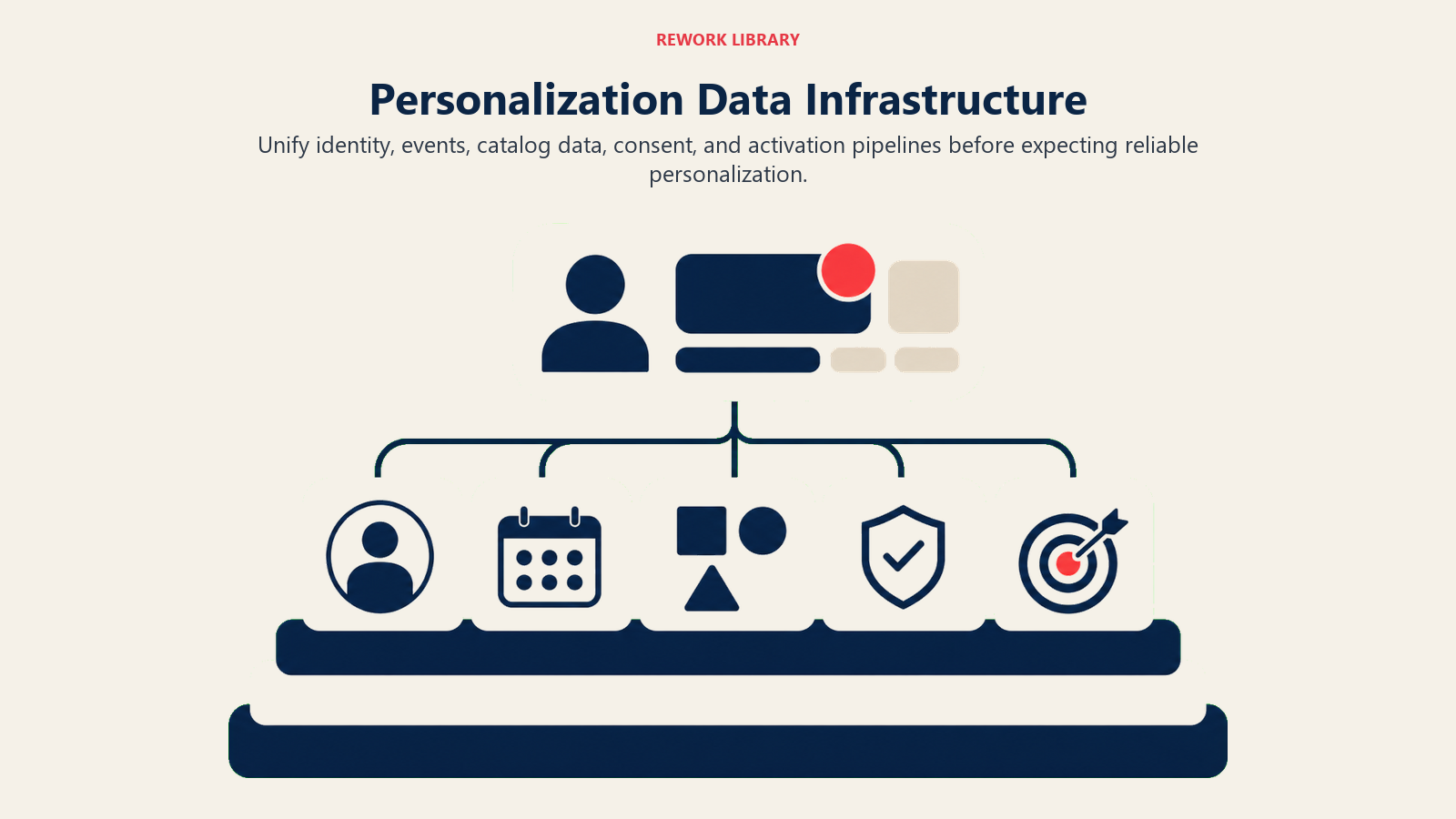
First-Party Data Collection starts with comprehensive tracking. Every product view, add-to-cart, purchase, email open, and site interaction should be captured. This goes beyond basic analytics and tracking setup, you need behavioral event streaming that records actions in real-time. Implement tracking for scroll depth, time on page, hover events, filter selections, and search queries. The richer your data, the better your personalization works.
Real-Time Data Pipelines move data from collection points to your personalization engine with minimal latency. A customer adding a product to cart should trigger updated recommendations within seconds, not hours. Modern architectures use event streaming platforms (Kafka, AWS Kinesis) to process millions of events daily. For smaller operations, webhooks and API integrations can achieve similar results at lower complexity.
Customer Data Platform (CDP) Integration unifies customer data from all sources into single profiles. Your customer data platform combines website behavior, email engagement, purchase history, customer service interactions, and offline data into one view. The personalization engine pulls from this unified profile to make decisions. Without CDP integration, you're personalizing based on incomplete information.
Data Quality and Hygiene determine accuracy. Duplicate customer records, incorrect product categorization, and missing attributes degrade personalization quality. Implement data validation rules: product catalogs should have consistent attribute schemas, customer emails should be verified, and behavioral events should include required fields. Run weekly data quality audits to catch issues before they corrupt your models.
Privacy-Compliant Storage protects customer data while enabling personalization. Use encryption for personally identifiable information, implement data retention policies that auto-delete old behavioral data, and maintain audit logs of data access. Your infrastructure should support right-to-deletion requests (GDPR) and opt-out preferences (CCPA) without breaking personalization for other users.
System Integration Architecture connects your personalization engine to existing systems. At minimum, you need bidirectional integration with your e-commerce platform, email service provider, CDP, and analytics tools. API-first platforms make this easier, but expect 40-80 hours of development time for initial integrations. Plan for additional integration as you add channels (mobile app, social commerce, in-store).
The technical work isn't trivial. Budget $15,000-$50,000 for initial infrastructure setup if building custom solutions, or $5,000-$15,000 for SaaS platform integrations. The ongoing cost of maintaining data quality and pipeline reliability runs $2,000-$10,000 monthly depending on scale.
Implementation Roadmap
Successful personalization happens in phases. Trying to do everything at once leads to long timelines, budget overruns, and underwhelming results. Here's a proven roadmap:
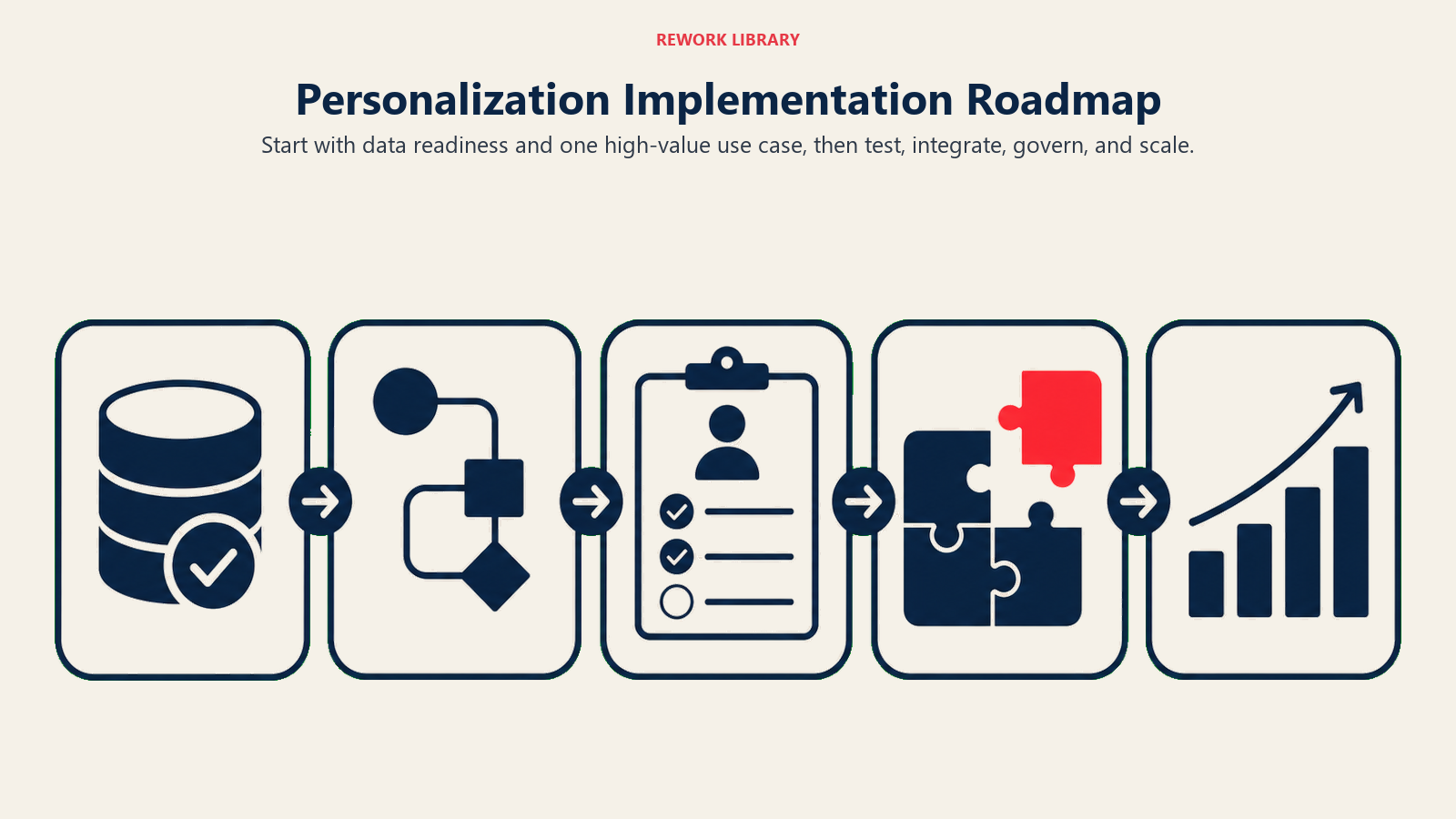
Phase 1: Foundation (Months 1-2)
Set up your customer data platform, implement comprehensive tracking, and establish baseline segmentation. This phase focuses on data collection without personalization. Costs: $10,000-$30,000 for CDP and tracking implementation. Deliverable: Clean, unified customer data flowing in real-time.
Phase 2: Rules-Based Personalization (Months 3-4)
Create manual rules for obvious personalization wins. Show different homepage banners by traffic source. Display category-specific navigation based on browsing history. Send abandoned cart emails with products the customer actually viewed. These rules don't require machine learning, just logic and data. Costs: $5,000-$15,000 for rule engine setup and QA. Expected lift: 3-8% conversion rate improvement.
Phase 3: Algorithmic Recommendations (Months 5-7)
Implement your first AI-driven personalization: product recommendations on homepage, product pages, and cart. Start with collaborative filtering since it's easier to implement and explains why recommendations were made. Run A/B tests comparing algorithmic recommendations against rules-based suggestions. Costs: $20,000-$60,000 for platform fees and integration. Expected lift: additional 5-12% conversion improvement over Phase 2.
Phase 4: Advanced Predictive Personalization (Months 8-12)
Add journey stage personalization, dynamic pricing, and predictive send time optimization for emails. Implement deep learning models that consider hundreds of signals. Personalize search results and introduce contextual bandits for exploration. Costs: $15,000-$40,000 for advanced features and optimization. Expected lift: additional 3-8% improvement.
Budget Considerations:
- Small stores ($1M-$5M annual revenue): $30,000-$80,000 first year, then $2,000-$5,000 monthly
- Mid-market ($5M-$25M revenue): $60,000-$150,000 first year, then $5,000-$15,000 monthly
- Enterprise ($25M+ revenue): $150,000-$500,000 first year, then $15,000-$50,000 monthly
Timeline Expectations:
You'll see measurable results after Phase 2 (month 4), but full ROI typically arrives 8-12 months post-launch. The first 90 days are data collection and foundation building, don't expect revenue lift during this period. Plan for a 12-18 month commitment to reach mature personalization capabilities.
The biggest mistake is moving too fast. Skipping Phase 1 foundation work means your Phase 3 algorithms train on dirty data, producing poor recommendations that actually hurt conversion. Take time to validate data quality before advancing phases.
Personalization Engine Platforms & Tools
You face a classic build versus buy decision. Here's how to evaluate your options:
Build vs Buy Framework:
Build custom if you have:
- Unique data sources that standard platforms can't integrate
- Engineering team with ML expertise (at least two dedicated engineers)
- Complex business rules that off-the-shelf solutions can't handle
- Annual revenue over $50M to justify the investment
- 18+ month timeline before needing results
Buy a platform if you:
- Want results within 6 months
- Lack dedicated ML engineering resources
- Need proven algorithms without experimentation
- Have standard e-commerce data sources
- Prefer predictable costs over build risk
Most mid-market retailers should buy. The total cost of building custom personalization, including engineering salaries, infrastructure, ongoing maintenance, and opportunity cost of delayed launch, exceeds $300,000 in year one. Platforms cost $20,000-$100,000 annually with much faster time to value.
Popular Enterprise Solutions:
Dynamic Yield (Adobe owned) offers comprehensive personalization across web, mobile, and email. Strong testing capabilities and enterprise-grade security. Expect $50,000-$200,000 annually depending on traffic. Best for retailers with complex needs and large engineering teams who can leverage the full platform.
Nosto specializes in product recommendations and content personalization for e-commerce. Easy to implement, strong Shopify and Magento integrations, fast time to value. Pricing starts around $20,000 annually for mid-market stores. Best for retailers prioritizing product recommendations over broader personalization.
Kameleoon excels at A/B testing and personalization combined. Strong for teams that want to test every personalization strategy before full rollout. Pricing around $30,000-$100,000 annually. Best for data-driven teams who won't implement features without proven lift.
Bloomreach (formerly Exponea) combines CDP and personalization in one platform. Strong email personalization and predictive analytics. $40,000-$150,000 annually. Best for retailers consolidating tech stack.
Monetate focuses on testing and optimization with personalization features. Strong for fashion and apparel retailers. $35,000-$120,000 annually.
Open-Source Options:
Apache Mahout provides collaborative filtering algorithms but requires serious development work to productionize. Free software, expensive engineering time.
TensorFlow Recommenders offers Google's recommendation system framework. Extremely powerful but assumes ML engineering expertise. Best for large retailers building custom solutions.
Feature Comparison Priorities:
- Real-time decisioning - Can it update recommendations within 100ms of user actions?
- Testing framework - Built-in A/B testing or requires separate tool?
- Cross-channel - Personalizes web, mobile app, email, or just web?
- Cold start handling - How does it personalize for new visitors and products?
- Explainability - Can you see why specific recommendations were made?
- Integration ecosystem - Pre-built connectors for your e-commerce platform, ESP, CDP?
Integration Capabilities:
Every platform claims "easy integration," but reality varies. Ask vendors:
- How many hours does typical integration take? (Honest answer: 80-200 hours)
- Do you provide implementation services or just documentation?
- How long until the algorithm has enough data to outperform rules-based recommendations? (Usually 30-60 days)
- What's your average time from contract signing to live personalization? (Typically 8-16 weeks)
Request case studies from retailers in your vertical with similar traffic volumes. A solution working well for a $100M electronics retailer may not suit a $5M fashion boutique.
Testing & Optimization Framework
Personalization requires continuous testing to prove value and improve performance. The challenge: traditional A/B testing frameworks don't always fit personalized experiences.
A/B Testing Personalized Experiences:
Set up a control group seeing non-personalized experiences (20% of traffic) versus personalized experiences (80% of traffic). Run the test for at least two full business cycles (2-4 weeks for most retailers) to account for day-of-week and weekly variations. Track conversion rate, average order value, and revenue per visitor as primary metrics.
Here's the tricky part: your personalization engine is learning and improving during the test, so the treatment group performance improves over time. This is real lift, not noise, but it violates A/B testing's assumption of consistent treatment. Document the learning curve and plan to retest after the algorithm stabilizes (typically 60-90 days post-launch).
Multivariate Testing:
Test multiple personalization strategies simultaneously. You might test:
- Collaborative filtering vs content-based filtering for product recommendations
- Homepage personalization vs standard homepage with personalized product pages
- Aggressive discounting vs full-price recommendations
Multivariate testing requires significantly more traffic (10x minimum) to achieve statistical significance. Only feasible for stores with 100,000+ monthly sessions. Smaller retailers should test sequentially.
Statistical Significance Standards:
Aim for 95% confidence and minimum 10% lift to declare a winner. Personalization tests often show smaller per-session lifts (3-8%) but compound over time as the algorithm learns. A 5% lift in conversion rate might not seem significant, but applied to $10M annual revenue, that's $500,000 additional revenue.
Don't call tests early. Personalization performance fluctuates as algorithms adjust to new data patterns. A test showing 8% lift after one week might settle to 4% lift after four weeks, still valuable, but half what you initially saw.
Holdout Group Challenges:
Maintaining a permanent control group (10-20% of traffic) provides ongoing measurement of personalization's total impact. The ethical challenge: you're knowingly giving some customers a worse experience to measure lift. The business challenge: if personalization drives 15% more revenue, the holdout group represents real opportunity cost.
Most retailers run holdout groups for 90-180 days post-launch to prove value, then release 100% of traffic to personalized experiences. Re-implement holdout groups quarterly or after major algorithm updates to verify continued performance.
Measuring Lift and ROI:
Calculate personalization ROI with this framework:
Incremental Revenue = (Personalized group revenue per visitor - Control group revenue per visitor) × Total annual visitors × % of visitors receiving personalization
Total Cost = Platform fees + Integration costs + Ongoing optimization labor
ROI = (Incremental Revenue - Total Cost) / Total Cost
Example: A retailer with 500,000 monthly visitors sees 8% higher revenue per visitor in the personalized group ($4.50 vs $4.17). Annual incremental revenue: ($4.50 - $4.17) × 6,000,000 = $1,980,000. If total costs are $75,000 annually, ROI is 2,540%, $26.40 returned for every dollar invested.
Feedback Loops:
Create weekly dashboards monitoring recommendation click-through rates, conversion rate by recommendation type, and revenue attributed to personalized elements. When performance declines, investigate immediately:
- Did product catalog structure change?
- Has traffic composition shifted?
- Did a competitor launch similar features?
- Is the algorithm overfitting to recent patterns?
The best personalization teams review performance metrics weekly and run optimization experiments monthly. Personalization isn't ever "done", it's an ongoing optimization program.
Privacy, Compliance & Ethics
Effective personalization depends on customer data, but privacy regulations and ethical considerations create boundaries you must respect.
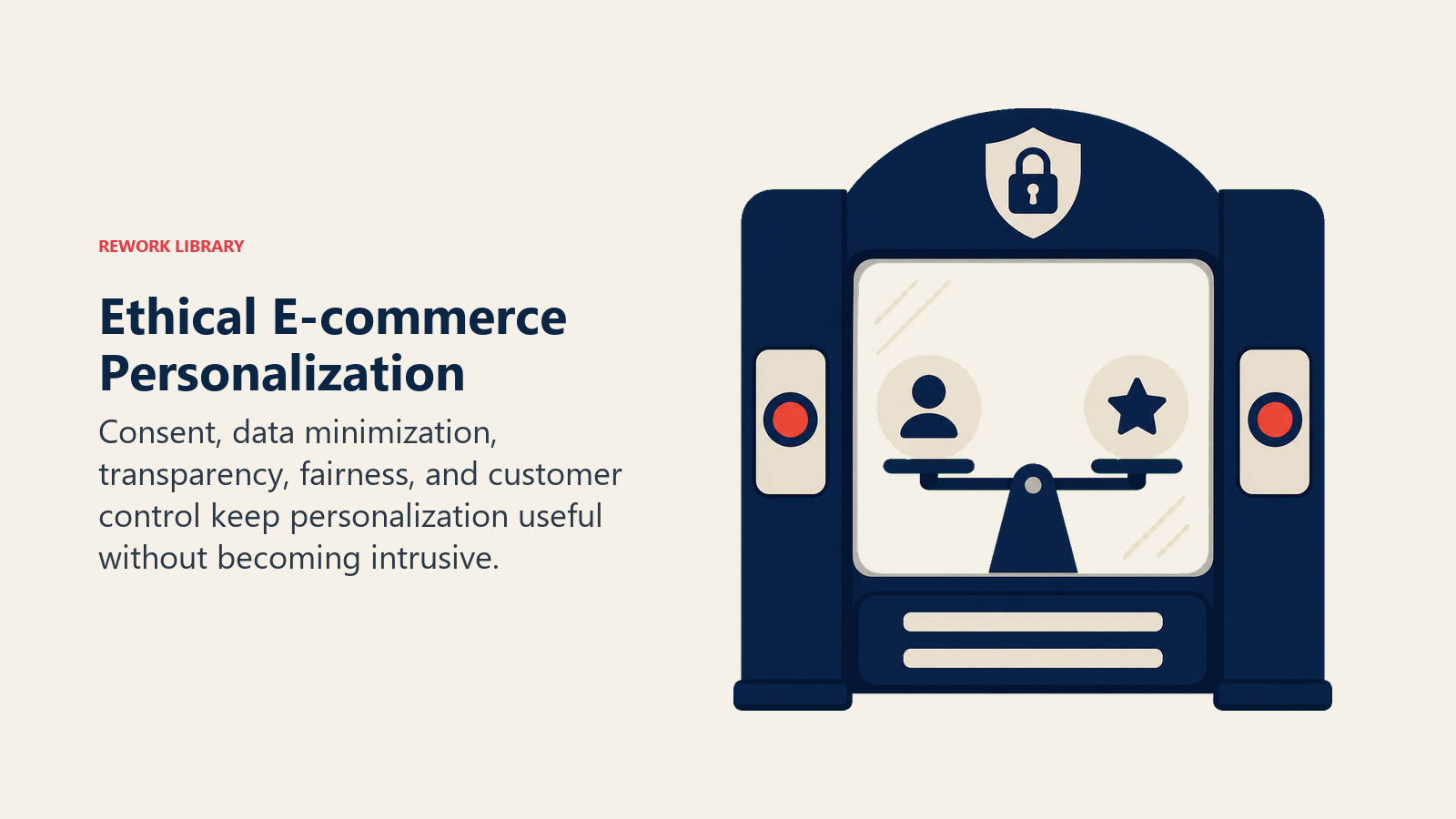
GDPR and CCPA Considerations:
Both regulations give customers rights over their data: access, deletion, and opt-out of certain uses. Your personalization engine must support:
- Right to deletion: When a customer requests data deletion, purge their behavioral history and retrain models without their data
- Opt-out of selling: Don't share customer data with third-party personalization vendors who resell data
- Transparency: Explain what data you collect and how it's used for personalization
- Consent management: Obtain explicit consent for behavioral tracking in GDPR jurisdictions
Technical side: maintain user IDs in a deletion queue that purges data across all systems within 30 days of request. Use anonymized IDs for model training so individual records can be removed without full model retraining.
Consent Management:
Implement a consent management platform that handles regional variations in privacy law. Visitors from California see CCPA-compliant opt-out options. EU visitors see GDPR cookie consent banners requiring explicit opt-in before behavioral tracking begins.
The personalization challenge: if 30% of visitors decline tracking consent, your engine has less data and worse performance for that segment. Some retailers offer value exchange: "Allow personalization for 10% off your first order." Others accept reduced personalization quality as the cost of compliance.
Transparent Personalization:
Tell customers you're personalizing their experience and give them control. Add a preference center where customers can:
- View what data you've collected about them
- See how their profile influences recommendations
- Adjust preferences (show me more of X, less of Y)
- Opt out of personalization entirely
Transparent personalization actually improves performance. Customers who understand why they're seeing specific recommendations trust the system more and engage at higher rates.
Data Minimization:
Collect only data necessary for personalization. Do you really need geolocation tracking, or is city-level information sufficient? Does your recommendation engine improve with device fingerprinting, or does browser type provide enough signal?
Minimizing data collection reduces compliance risk, lowers storage costs, and builds customer trust. Audit your data collection quarterly and eliminate signals that don't materially improve personalization accuracy.
User Control and Preference Centers:
Create a preference center with explicit controls:
- Categories of interest (show me outdoor gear, not electronics)
- Price range preferences
- Brand preferences and exclusions
- Email frequency and content preferences
- Complete opt-out option
When customers explicitly state preferences, incorporate that data into your personalization models with higher weight than inferred behavior. A customer who says "I only want eco-friendly products" should never see non-sustainable items, regardless of what collaborative filtering suggests.
Ethical AI Principles:
Avoid personalization strategies that manipulate or exploit:
- Price discrimination: Don't charge higher prices to customers who appear less price-sensitive unless there's legitimate cost justification (expedited shipping, premium service)
- Addictive patterns: Don't personalize to maximize time on site if your products aren't genuinely useful to the customer
- Filter bubbles: Occasionally show products outside the customer's typical preferences to avoid narrowing their options
- Vulnerable populations: Disable aggressive personalization for customers showing signs of compulsive buying
Build ethics reviews into your optimization process. Before launching new personalization strategies, ask: "Would we want customers to know we're doing this?" If the answer's no, don't do it.
Privacy-first personalization is becoming a competitive advantage. Customers increasingly choose retailers who respect their data. Building trust through transparent, ethical personalization creates long-term customer relationships that drive higher lifetime value than aggressive manipulation tactics ever could.
Performance Metrics & KPIs
Measuring personalization's impact requires both high-level business metrics and granular performance indicators. Here's what to track:
Conversion Rate by Segment:
Track conversion rates separately for:
- Personalized vs control group (the primary test)
- New vs returning visitors
- Different traffic sources (organic, paid, email, social)
- Device types (mobile, desktop, tablet)
- Product categories
You'll often find personalization performs differently across segments. A fashion retailer discovered their personalization engine drove 18% conversion lift for returning visitors but only 4% for new visitors, leading them to implement different strategies for each segment.
Calculate statistical significance for each segment separately. Don't assume overall lift applies equally across all visitor types.
Average Order Value (AOV) Impact:
Personalization often increases AOV through better upsell and cross-sell recommendations. Track:
- AOV for personalized product recommendations vs manual merchandising
- Attachment rate (% of orders including recommended products)
- Revenue per recommendation impression
A home goods retailer found personalized cross-sells increased AOV by $23 (from $87 to $110), a 26% improvement. The catch: the lift only appeared for orders including 3+ items, personalization helped customers build complete solutions rather than buying single items.
Customer Lifetime Value (CLV) Lift:
Personalization's biggest impact often shows up in repeat purchase behavior. Track cohorts of customers who first purchased before vs after personalization launch:
- Repeat purchase rate within 90 days
- Time to second purchase
- Total purchases in first year
- Retention rate at 6 and 12 months
One electronics retailer saw 31% higher CLV for customers whose first purchase included personalized recommendations, even though first-order value was identical. The personalization engine introduced customers to products they continued buying, creating habit patterns.
Expect 6-12 months of data before CLV patterns become clear. Don't make decisions based on 30-day cohorts.
Return Visitor Rate:
Personalization should bring customers back more frequently. Track:
- Days between first and second visit
- Average sessions per customer per month
- Percentage of traffic from returning visitors
Effective personalization creates a "your store" feeling that encourages returns. If return visitor rate isn't increasing, your personalization may not be differentiated enough from the generic experience.
Click-Through on Recommendations:
Monitor engagement metrics for personalized elements:
- Click-through rate on homepage recommendations
- Product recommendation clicks on product pages
- Email click rate for personalized content vs generic
- Add-to-cart rate for recommended products
Industry benchmarks: 3-8% CTR on homepage recommendations, 5-12% on product page recommendations, 15-25% for cart page recommendations. If you're underperforming these numbers, investigate whether recommendations are actually personalized or just showing generic best-sellers.
Revenue Attribution Models:
Determine how much revenue to credit to personalization. Options:
Last-touch attribution: Credit personalization with the sale if the customer clicked a personalized recommendation before purchasing. Simple but overcredits personalization.
First-touch: Credit personalization if the customer's first interaction included personalized elements. Undercredits by ignoring mid-funnel influence.
Multi-touch: Distribute credit across all touchpoints including personalization. Most accurate but complex to implement.
Most retailers use last-touch for simplicity, then apply a discount factor (60-80%) assuming personalization isn't entirely responsible for the sale.
Dashboard Structure:
Create three monitoring tiers:
Executive Dashboard (monthly review):
- Total revenue lift from personalization
- ROI calculation
- Conversion rate change
- AOV and CLV trends
Marketing Dashboard (weekly review):
- Conversion rate by segment
- Recommendation CTR by placement
- Email personalization performance
- Top-performing recommendation strategies
Technical Dashboard (daily monitoring):
- Algorithm prediction accuracy
- API response times
- Data pipeline health
- Model training status and errors
The key is connecting technical performance to business outcomes. If API response times spike, does conversion rate drop? If prediction accuracy improves, does CTR increase? Build these correlations into your monitoring so you catch problems before they impact revenue.
Common Pitfalls & Solutions
Even well-planned personalization implementations hit predictable obstacles. Here's how to avoid or address them:
Cold Start Problem:
New visitors and new products lack behavioral data, so personalization engines struggle to make relevant recommendations.
Solutions:
- Use content-based filtering for new products (recommend based on attributes)
- Show trending products to new visitors until they generate 3+ behavioral signals
- Leverage demographic data when available (age, location) for initial personalization
- Implement contextual bandits that explore aggressively with new users
- Ask explicit preferences: "What brings you here today?" with category options
A furniture retailer solved cold start by showing a style quiz to new visitors. Three questions (modern vs traditional, budget range, room type) provided enough signal for relevant initial recommendations. 68% of new visitors completed the quiz, giving the personalization engine a head start.
Over-Personalization and Choice Paralysis:
Showing too many personalized recommendations or constantly changing what's displayed can overwhelm customers and hurt conversion.
Solutions:
- Limit recommendations to 4-8 items per section
- Keep navigation and category pages consistent, personalize but don't completely reorganize
- Maintain some consistent elements (logo, main nav, footer) as anchors
- A/B test recommendation quantity (4 vs 6 vs 8 items)
- Show "more like this" options rather than completely unrelated products
The sweet spot's usually 4-6 personalized recommendations per page section. More than that and engagement drops as customers get decision fatigue.
Filter Bubbles:
Algorithms that only recommend similar products to past purchases narrow customer choices and limit basket growth.
Solutions:
- Reserve 20-30% of recommendation slots for exploration (new categories, trending items)
- Use contextual bandits that balance exploitation and exploration
- Periodically inject "because you might also like" sections with non-obvious suggestions
- Track category diversity in customer purchases over time
- Reward the algorithm for introducing customers to new categories
An apparel retailer discovered customers who were introduced to a second category (workwear buyer discovers weekend casual) had 2.3x higher lifetime value. They modified their algorithm to boost recommendations from adjacent categories, increasing cross-category purchases by 34%.
Technical Debt:
Personalization systems accumulate complexity quickly. Custom integrations, one-off rules, and experimental features create maintenance burdens.
Solutions:
- Document every custom rule and integration thoroughly
- Archive or remove experiments after 90 days
- Conduct quarterly technical debt reviews
- Maintain staging environments that mirror production
- Plan 20% of engineering time for refactoring and cleanup
- Use feature flags to enable/disable functionality without code changes
Schedule dedicated sprints every 6 months to clean up technical debt before it becomes unmanageable.
Poor Data Quality:
Garbage in, garbage out. Incorrect product categories, duplicate customer records, and tracking errors corrupt personalization models.
Solutions:
- Implement automated data validation at collection points
- Run weekly data quality reports (missing attributes, duplicate records, anomalous values)
- Create alerts for sudden changes in data patterns
- Maintain product data governance with required attributes
- Audit tracking implementation quarterly
- Use schema validation for all data pipelines
One retailer discovered 23% of their product catalog had incorrect category assignments, causing their recommendation engine to suggest irrelevant products. After a two-week data cleanup project, recommendation CTR jumped 41%.
Privacy Compliance Mistakes:
Failing to handle data deletion requests, sharing data inappropriately, or lacking consent management creates legal liability.
Solutions:
- Conduct annual privacy audits with legal review
- Implement automated deletion workflows
- Test data deletion requests quarterly
- Maintain consent records with timestamps
- Use privacy-by-design principles for new features
- Train team on privacy requirements
Set up quarterly privacy reviews with legal counsel to ensure your personalization practices stay compliant as regulations evolve.
Ignoring Mobile Experience:
Personalization that works on desktop often fails on mobile due to screen size, slower connections, and different user behavior.
Solutions:
- Test personalization on actual mobile devices, not just emulators
- Reduce recommendation quantities on mobile (4 instead of 6)
- Prioritize load speed over recommendation complexity
- Use mobile-specific recommendation strategies (location-aware, quick add-to-cart)
- Track mobile vs desktop performance separately
A beauty retailer found their elaborate personalized homepage destroyed mobile load times. They created a mobile-specific version with fewer, larger recommendation blocks that loaded 2.3 seconds faster and increased mobile conversion by 19%.
Future Trends & Innovations
Personalization technology evolves rapidly. Here's what's emerging:
Real-Time Intent Detection:
Next-generation engines detect purchase intent within seconds of arrival. Advanced models analyze:
- Mouse movement patterns (purposeful vs browsing)
- Scroll velocity and depth
- Search query specificity
- Time on product pages
- Price filter selections
When the engine detects high purchase intent, it adapts immediately, showing urgency messaging, highlighting fast shipping, or surfacing customer reviews. Low-intent visitors see educational content and discovery recommendations.
Early implementations show 8-15% conversion lift by matching the experience to real-time intent signals. This'll likely become standard within 2-3 years.
Cross-Device Personalization:
Customers research on mobile, compare on tablet, and purchase on desktop. Future personalization engines maintain context across device switches:
- Product views on mobile app appear in desktop recommendations
- Abandoned cart on tablet triggers mobile push notification
- Email clicked on smartphone continues the journey on any device
- Store visit influences online recommendations
Implementation requires deterministic ID matching (login) or probabilistic matching (device fingerprinting, IP patterns). Privacy regulations make this more challenging, but customers who log in create opportunities for seamless cross-device experiences.
Predictive Churn Prevention:
Machine learning models predict which customers are about to stop buying, triggering retention campaigns before churn happens. The engine analyzes:
- Time since last purchase vs typical purchase frequency
- Email engagement decline
- Website visit frequency reduction
- Category interest shifts
When churn risk exceeds thresholds, personalization shifts from acquisition to retention, showing loyalty rewards, exclusive offers, or new arrivals in favorite categories. A subscription retailer using predictive churn prevention reduced cancellations by 23% through personalized retention campaigns.
Generative AI for Content:
Large language models create personalized product descriptions, email content, and category pages for individual customers. Instead of one product description for everyone, the system generates descriptions emphasizing different benefits based on customer preferences.
A technical customer sees specification details and performance metrics. A style-focused customer sees aesthetic descriptions and outfit suggestions. Both see the same product with personalized framing that resonates with their priorities.
Early tests show 12-18% higher conversion when product descriptions match customer preferences, but implementation requires careful quality control to avoid hallucinations or inappropriate content.
Voice and Conversational Commerce:
Personalization extends to voice shopping through smart speakers and conversational AI. The engine knows your preferred brands, typical purchase sizes, and reorder patterns:
"Order more coffee" → System knows you buy Ethiopian medium roast, 2lb bags, delivered monthly "Find a gift for my wife" → Remembers her past purchases and suggests relevant options "When's my order arriving?" → Checks your recent purchase and provides tracking
Conversational commerce is growing 30% annually. Personalization engines that extend to voice channels will capture this growth.
Privacy-Preserving Personalization:
Federated learning and differential privacy techniques enable personalization without centralized data collection. Models train on-device, sharing only aggregated insights rather than individual behavioral data.
Apple's on-device ML and Google's Privacy Sandbox demonstrate early implementations. Expect privacy-first personalization to become competitive differentiator as consumers demand better data protection.
Augmented Reality Integration:
Personalization engines select which products to show in AR try-on experiences. A customer with history of buying minimalist jewelry sees different AR product suggestions than someone who buys bold statement pieces.
AR personalization is nascent but growing rapidly in furniture, fashion, and beauty categories. Retailers with AR capabilities should integrate personalization engines to maximize engagement.
The common thread across all these innovations: more thoughtful use of data to create genuinely individual experiences while respecting privacy boundaries. The retailers who master this balance will dominate their categories.
ROI & Business Case
Building the financial justification for personalization investment requires realistic projections and clear measurement frameworks.
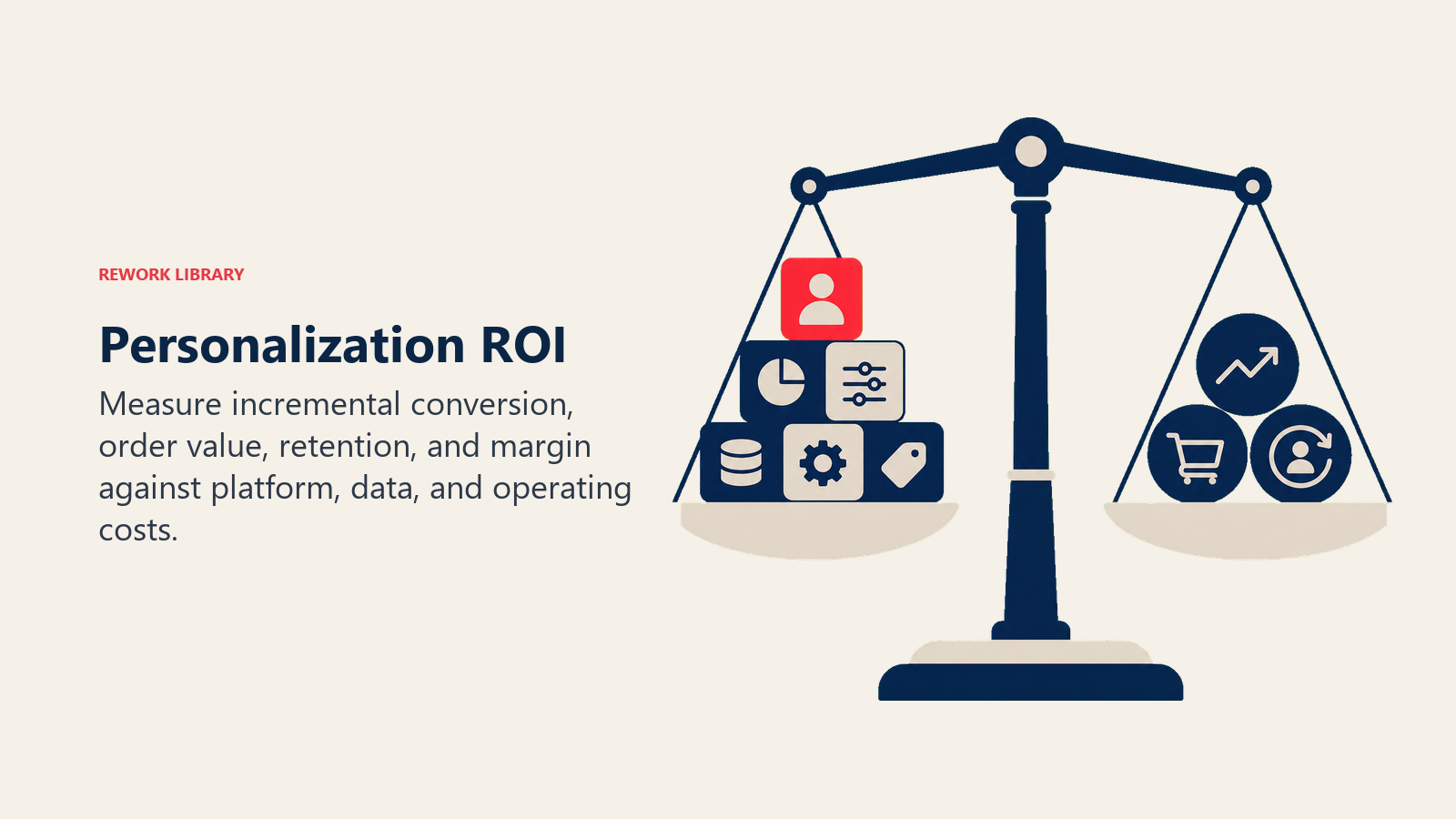
Typical Uplift Benchmarks:
Industry data shows personalization's impact varies by implementation quality and business context:
Conservative scenario (basic implementation, limited optimization):
- Conversion rate: +5-8%
- Average order value: +3-6%
- Customer lifetime value: +8-12%
- Email click-through rate: +15-25%
Moderate scenario (solid implementation, ongoing optimization):
- Conversion rate: +10-15%
- Average order value: +8-12%
- Customer lifetime value: +18-25%
- Email click-through rate: +30-45%
Best-case scenario (advanced implementation, dedicated optimization team):
- Conversion rate: +15-25%
- Average order value: +15-22%
- Customer lifetime value: +30-50%
- Email click-through rate: +50-80%
Use conservative projections for business cases. Under-promise and over-deliver beats missing optimistic targets.
Cost-Benefit Analysis Framework:
Calculate total costs:
Year 1:
- Platform fees: $20,000-$100,000
- Implementation labor: $15,000-$60,000
- Integration development: $10,000-$40,000
- Data infrastructure: $5,000-$25,000
- Training and change management: $5,000-$15,000
- Total: $55,000-$240,000
Year 2+:
- Platform fees: $20,000-$100,000
- Ongoing optimization: $15,000-$50,000
- Data infrastructure maintenance: $5,000-$15,000
- Total: $40,000-$165,000
Calculate incremental revenue using conservative uplift estimates:
Example: $10M annual revenue retailer
- Current conversion rate: 2.5%
- Projected lift: 10% (conservative)
- New conversion rate: 2.75%
- Annual visitors: 400,000
- Current revenue per visitor: $25 ($10M / 400,000)
- Incremental revenue: 400,000 × $25 × 10% = $1,000,000
Year 1 ROI: ($1,000,000 - $100,000) / $100,000 = 900%
Even with conservative 5% lift, the ROI is typically 300-500% in year one for mid-market retailers.
Quick Wins vs Long-Term Plays:
Structure your implementation to deliver fast ROI that funds continued investment:
Quick wins (months 1-4, minimal algorithmic complexity):
- Abandoned cart email personalization
- Homepage banner personalization by traffic source
- Category-specific navigation for returning visitors
- Post-purchase cross-sell recommendations
Expected impact: 3-6% conversion lift, $150,000-$300,000 incremental revenue for $5M retailer
Medium-term plays (months 5-9, moderate ML requirements):
- Algorithmic product recommendations
- Personalized search results
- Email send time optimization
- Dynamic homepage layouts
Expected impact: additional 5-9% lift, $250,000-$450,000 incremental revenue
Long-term plays (months 10-18, advanced AI):
- Predictive pricing optimization
- Cross-channel journey personalization
- Churn prediction and prevention
- Generative content personalization
Expected impact: additional 3-7% lift, $150,000-$350,000 incremental revenue
Payback Period Calculation:
Most retailers achieve payback within 4-8 months when implementing proven platforms with realistic timelines.
Month 1-3: Data collection, no revenue impact, costs accumulating Month 4-6: Quick wins deployed, 3-6% lift begins Month 6-7: Cumulative incremental revenue exceeds cumulative costs (payback achieved) Month 8-12: Continued optimization, compounding returns
Retailers who struggle with payback typically:
- Underinvest in data infrastructure (garbage in, garbage out)
- Skip quick wins and only focus on complex algorithmic personalization
- Fail to staff ongoing optimization (set-and-forget doesn't work)
- Choose platforms mismatched to their technical capabilities
Scaling Profitably:
Once personalization proves ROI, scale across channels and customer segments:
Phase 1: Web personalization for desktop traffic Phase 2: Mobile web and app personalization Phase 3: Email and SMS personalization Phase 4: Paid advertising audience personalization Phase 5: In-store and omnichannel personalization
Each expansion requires additional investment but builds on existing infrastructure and learnings. Retailers who successfully scale personalization across channels often see total revenue lifts of 25-40% compared to generic experiences, the compounding effect of personalization everywhere.
The business case is clear: personalization engines deliver measurable ROI when implemented thoughtfully with realistic expectations and ongoing optimization. Start with quick wins, prove value, then scale systematically across channels and segments. The retailers dominating their categories in 2026 are the ones who started building personalization capabilities in 2023-2024. Your competitors are already implementing these strategies, the question isn't whether to invest in personalization, but how quickly you can deploy it profitably.
Conclusion
Personalization engines transform generic e-commerce sites into individual shopping experiences that customers prefer, return to, and spend more with. The technology has matured to where mid-market retailers can implement AI-driven personalization profitably, typically seeing 10-20% conversion rate improvements and 15-30% average order value increases within the first year.
Success requires strong data foundations, realistic implementation timelines, ongoing optimization, and respect for customer privacy. Start with quick wins like abandoned cart personalization and basic product recommendations, prove ROI, then systematically expand to more advanced strategies.
The retailers winning in modern e-commerce don't show the same homepage to everyone, they create millions of unique experiences, each optimized for an individual customer. Build your personalization engine thoughtfully, measure rigorously, and you'll create sustainable competitive advantage that compounds over time.

On this page
- What is a Personalization Engine?
- Key Types of Personalization
- AI/ML Technologies Behind Personalization
- Data Infrastructure Requirements
- Implementation Roadmap
- Personalization Engine Platforms & Tools
- Testing & Optimization Framework
- Privacy, Compliance & Ethics
- Performance Metrics & KPIs
- Common Pitfalls & Solutions
- Future Trends & Innovations
- ROI & Business Case
- Conclusion