Private Label vs Reselling: Choosing the Right Product Strategy for Your E-commerce Business
Turn this article into takeaways for your work.


Each assistant summarizes the article only for you and suggests best practices for your work.
Your product strategy isn't just about what you sell. It's about how you compete, how defensible your business becomes, and whether you're building an asset or running a trading operation.
The choice between private label and reselling determines your margin structure, competitive moat, capital requirements, and exit potential. One path gives you brand equity and pricing power. The other offers speed to market and lower risk.
Neither is inherently better. But one's likely better for your capital position, risk tolerance, and long-term vision.
Defining the Models
Private Label means you source generic or custom-manufactured products and sell them under your own brand. You control the branding, packaging, positioning, and often influence product specifications. You're not manufacturing from scratch, but you're not selling someone else's brand either.
Reselling means you buy branded products from manufacturers, wholesalers, or distributors and resell them at a markup. You're leveraging existing brand recognition and demand. You're a channel, not a brand owner. The fundamental difference is ownership of the brand equity. In private label, every sale builds your brand. In reselling, every sale builds the manufacturer's brand while you capture a distribution margin.
This is the classic build vs. buy philosophy applied to e-commerce. Building (private label) takes longer and costs more upfront, but creates an asset. Buying (reselling) gets you to market faster with less capital, but leaves you with limited differentiation.
Business Model Comparison
Let's examine the core economics that drive profitability in each model.
Revenue Structures
Private Label:
- You set retail prices based on perceived value
- Margins typically range from 40-70% depending on category
- Pricing power increases as brand recognition grows
- Price competition is indirect (your brand vs. others)
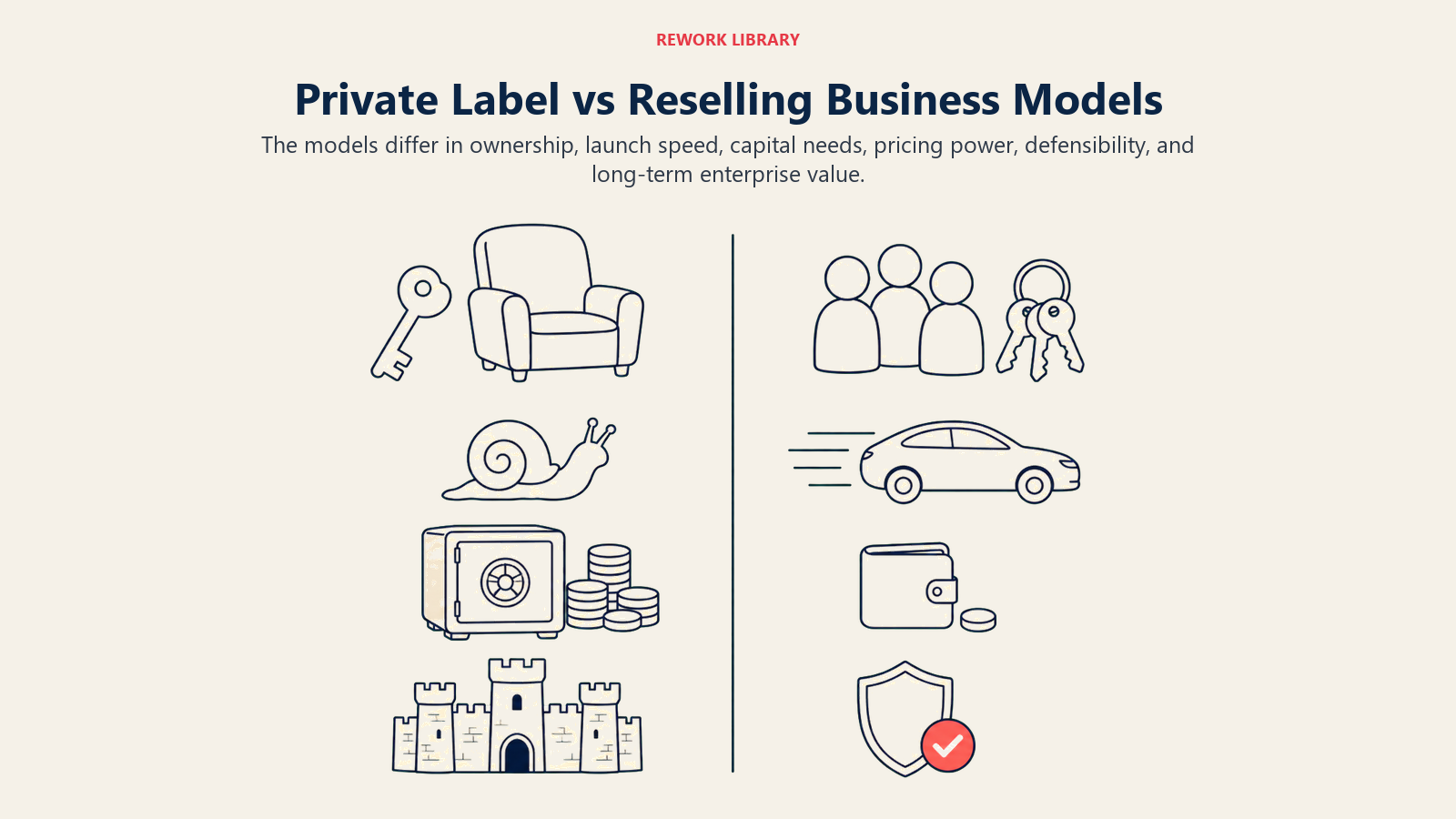
Reselling:
- Retail prices constrained by MAP (Minimum Advertised Price) policies
- Margins typically range from 15-30% after fees and shipping
- Limited pricing flexibility due to brand guidelines
- Price competition is direct (same product, multiple sellers)
Understanding unit economics for e-commerce is critical for evaluating which model generates sustainable profit in your category.
Unit Economics Example
Let's compare selling a yoga mat:
Private Label Yoga Mat:
- Manufacturing cost: $8
- Shipping/logistics: $2
- Total COGS: $10
- Retail price: $35
- Gross margin: $25 (71%)
- Marketing cost per sale: $12
- Net margin: $13 (37%)
Reselling Branded Yoga Mat:
- Wholesale cost: $18
- Shipping/logistics: $2
- Total COGS: $20
- Retail price: $30 (MAP-constrained)
- Gross margin: $10 (33%)
- Marketing cost per sale: $8
- Net margin: $2 (7%)
The private label model generates 6x the net profit per unit, but requires more upfront investment in branding, product development, and inventory risk.
Sourcing Strategy Comparison
How you source products fundamentally differs between models, requiring distinct approaches to product research and validation.
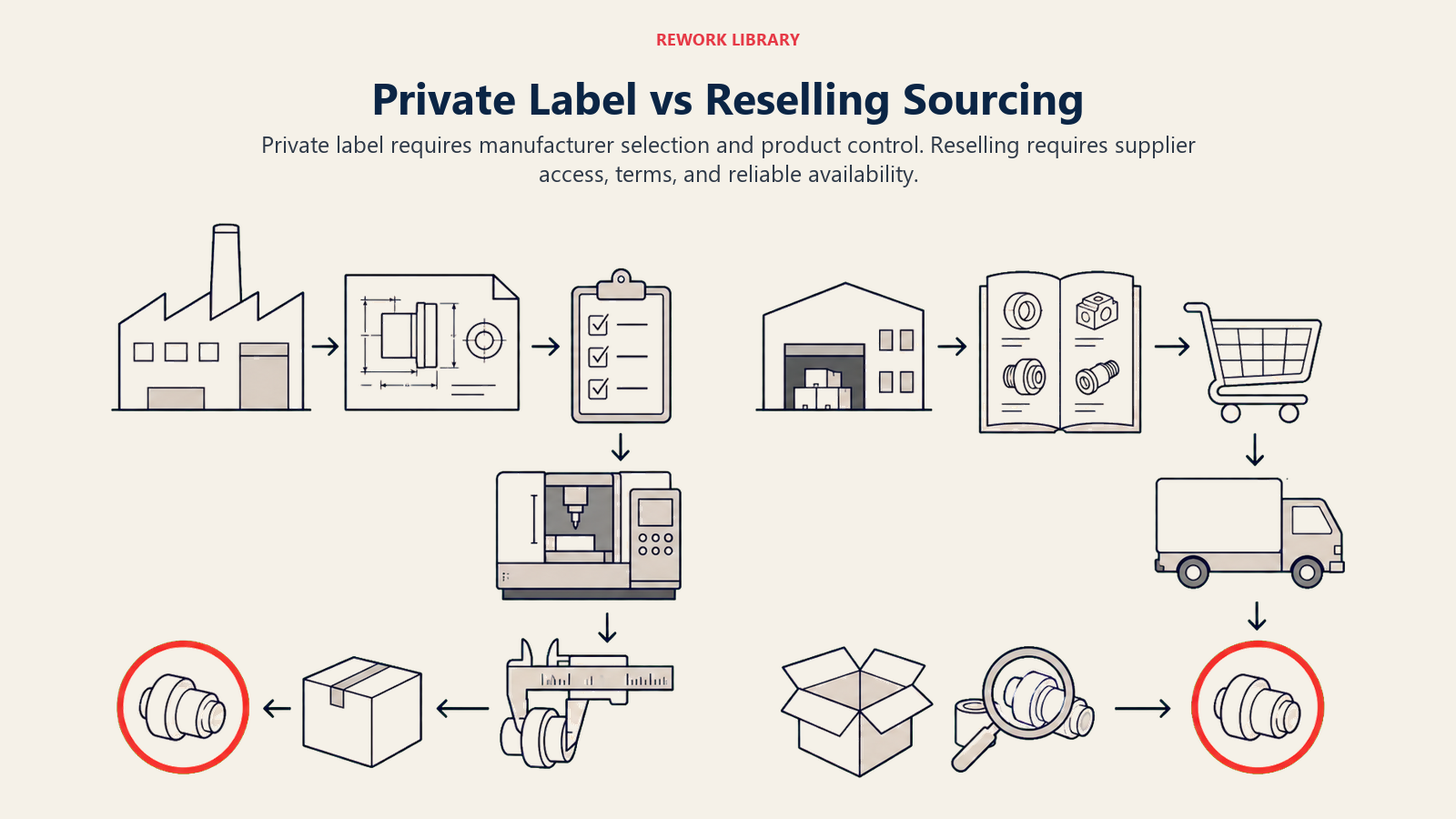
Private Label Sourcing
Manufacturer Relationships: You work directly with factories (often overseas) to produce products. This requires:
- MOQ (Minimum Order Quantities) typically 500-5,000 units
- Quality control processes and inspections
- Product specification documentation
- Longer lead times (60-120 days initial orders)
- Payment terms often 30-50% deposit, balance before shipping
Customization Levels:
- White Label: Buy existing products, add your logo/packaging
- Custom Formulation: Modify ingredients, materials, or features
- Custom Design: Create unique product specifications from scratch
The more customization, the higher the MOQ and development costs, but the stronger your competitive differentiation.
Reselling Sourcing
Wholesale Relationships: You buy from authorized distributors or directly from brands:
- Lower MOQs (sometimes as low as one unit)
- Faster turnaround (1-7 days for domestic)
- No product development required
- Authorized dealer requirements and agreements
- Credit terms possible after establishing relationship
Sourcing Channels:
- Direct from Manufacturer: Best margins, but requires larger orders
- Authorized Distributors: Smaller orders, slightly lower margins
- Wholesale Marketplaces: Easy access, but highest competition
The key constraint? Getting authorized. Many premium brands restrict online selling or require brick-and-mortar locations.
Brand Building & Competitive Advantage
This is where the models diverge most.
Private Label Brand Building
You own the brand equity. Every marketing dollar, every review, every customer interaction builds an asset you control. This creates:
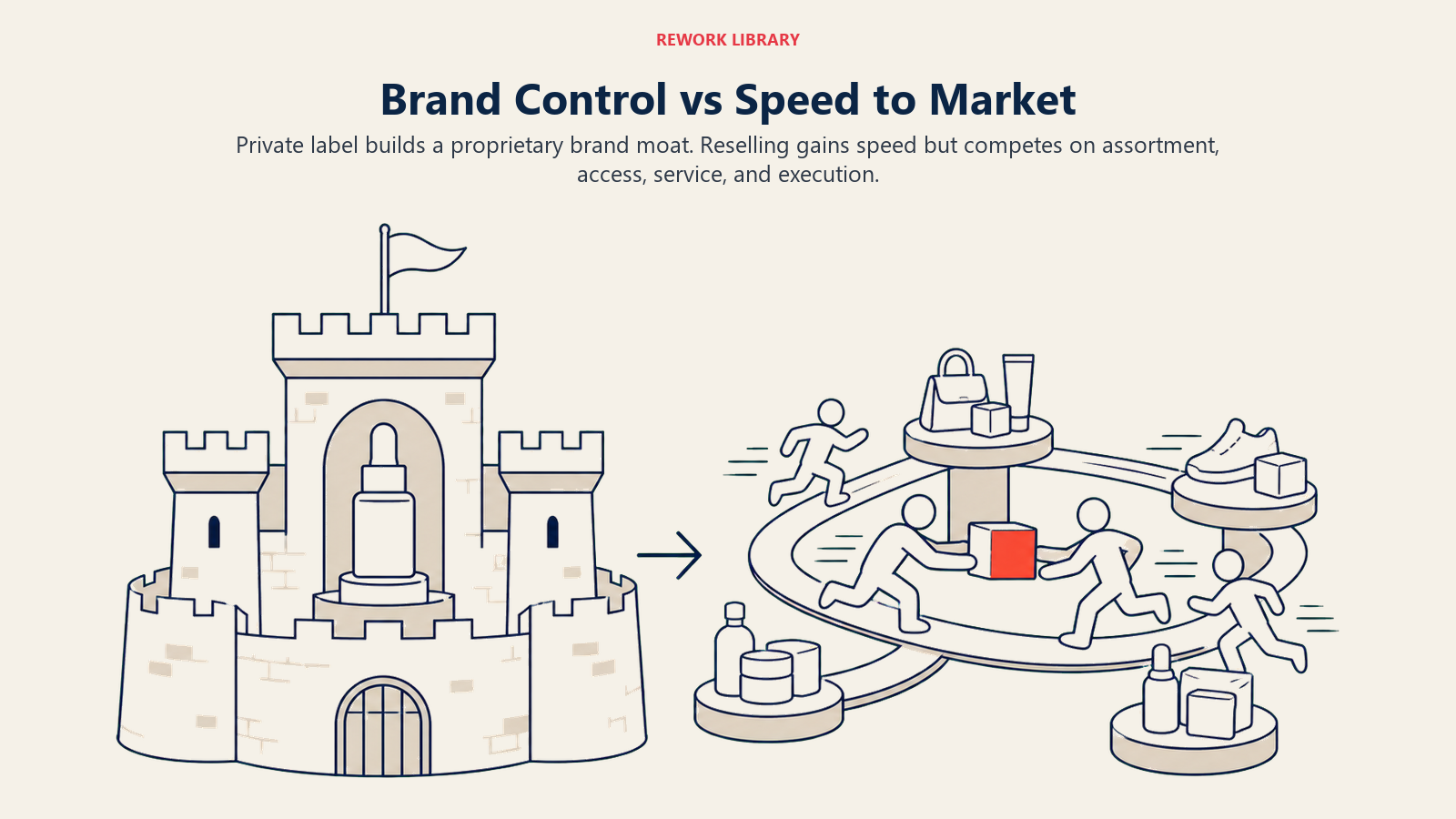
Competitive Moats:
- Brand recognition and loyalty
- Proprietary product features or formulations
- Customer relationships and data ownership
- Potential trademark and design patent protection
Differentiation Opportunities:
- Unique positioning and messaging
- Product bundles and variations
- Customer experience and packaging
- Community building and leveraging customer reviews and UGC
The product launch strategy for private label focuses on creating brand awareness from zero, which requires sustained investment.
Reselling Competitive Advantage
You're competing primarily on distribution efficiency and service. Differentiation comes from:
Operational Excellence:
- Faster shipping and fulfillment
- Better customer service
- Bundle deals and promotions (within brand guidelines)
- Multi-channel presence and convenience
Access and Availability:
- Carrying hard-to-find products
- Maintaining inventory when competitors stock out
- Exclusive distribution agreements
- Geographic or demographic specialization
Your competitive advantage is operational, not brand-based. This makes it easier to replicate by well-capitalized competitors. Pricing strategy and optimization becomes critical to maintain competitiveness.
Operational Complexity & Scalability
Day-to-day operations look very different.
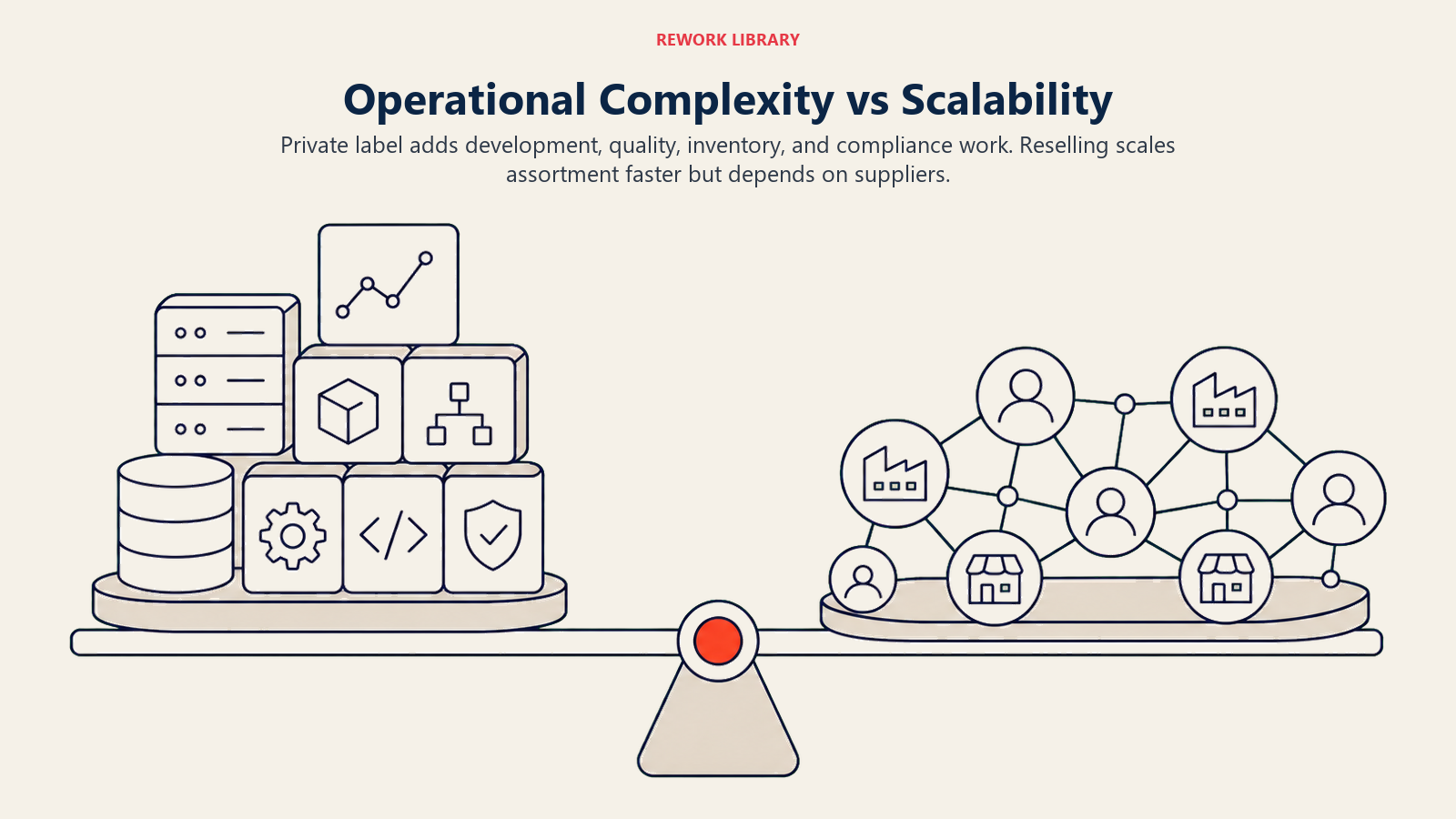
Private Label Operations
Higher Complexity:
- Product development and testing cycles
- Quality control and supplier management
- Inventory planning with longer lead times
- Custom packaging and labeling coordination
- Potential regulatory compliance (FDA, FCC, etc.)
Team Requirements:
- Product manager or developer
- Quality assurance role
- Supplier relationship manager
- Graphic designer for packaging/branding
Scalability Factors: Working capital becomes the limiting factor. You need to fund 90-120 days of inventory in advance, which grows linearly with sales.
However, unit economics improve with scale as you negotiate better manufacturing costs and shipping rates.
Reselling Operations
Lower Complexity:
- Established products with proven demand
- Supplier relationships already established
- Shorter inventory cycles
- No packaging or branding requirements
- Fewer regulatory hurdles
Team Requirements:
- Inventory manager
- Customer service rep
- Listing optimization specialist
Scalability Factors: Distribution efficiency becomes the limiting factor. As you scale, you compete more directly with larger resellers and wholesale clubs with better cost structures.
Unit economics may actually worsen with scale as you face increased price competition and race-to-bottom dynamics.
Inventory planning differs significantly between models.
Financial Model & Profitability Analysis
Let's model the financial reality of each approach.
Capital Investment Requirements
Private Label Initial Investment (Example):
- Product development and samples: $2,000-5,000
- Initial inventory (1,000 units at $10): $10,000
- Packaging design and setup: $1,500-3,000
- Photography and content: $1,000-2,000
- Total initial investment: $15,000-20,000
Reselling Initial Investment (Example):
- Initial inventory (100 units at $20): $2,000
- Business licenses and accounts: $500
- Photography (if needed): $500
- Total initial investment: $3,000-5,000
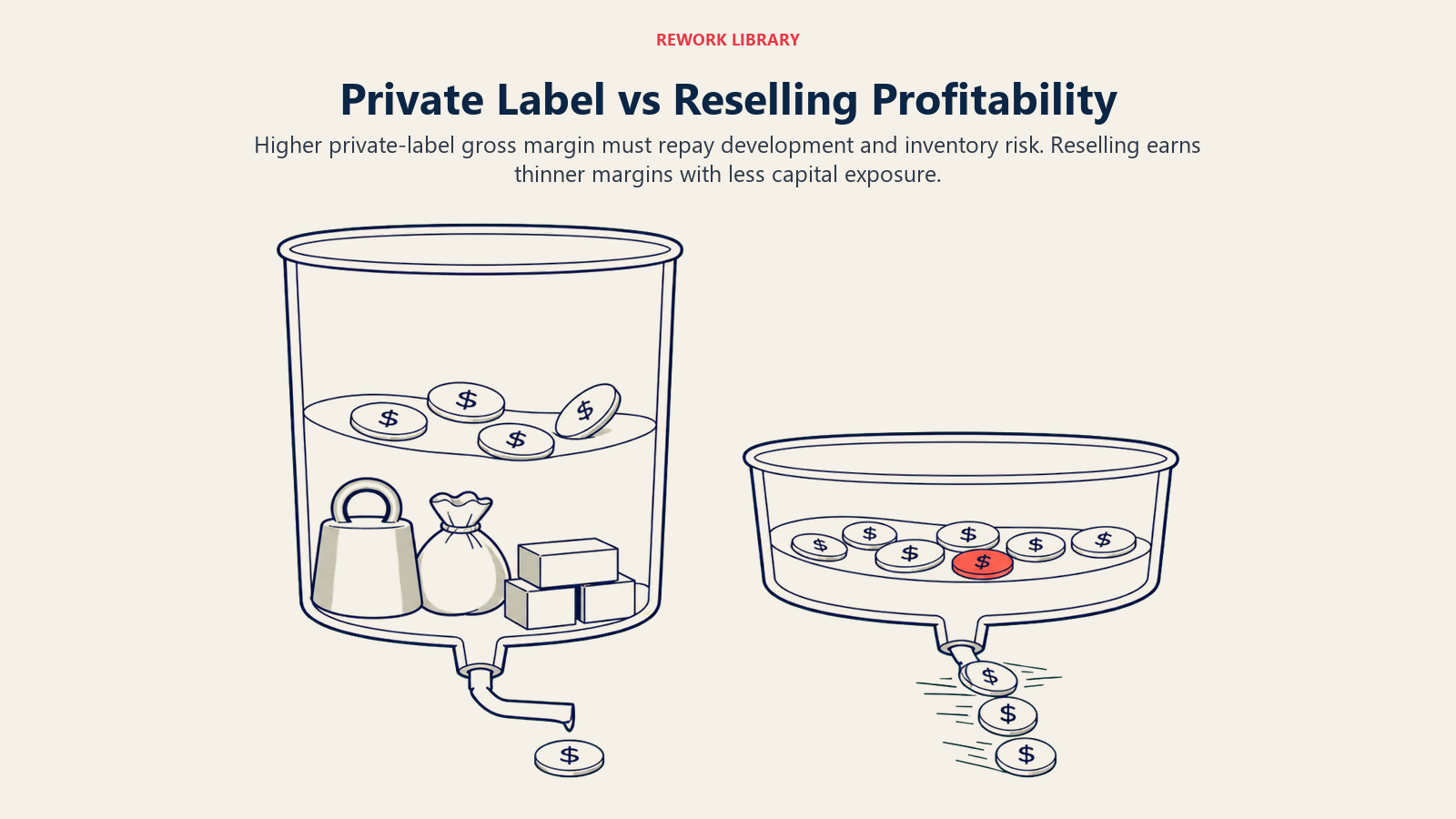
The private label model requires 3-5x more capital to launch, but generates 3-6x higher margins.
Break-Even Analysis
Private Label:
- Fixed costs: $15,000
- Net profit per unit: $13
- Break-even volume: 1,154 units
- Timeline: 4-8 months typically
Reselling:
- Fixed costs: $3,000
- Net profit per unit: $2
- Break-even volume: 1,500 units
- Timeline: 2-6 months typically
Private label requires fewer unit sales to break even, but takes longer due to product development and brand building cycles.
Cash Flow Dynamics
Private Label Cash Flow Challenge: You pay for inventory 60-90 days before selling it. Then you wait 14-30 days for marketplace payouts. Your cash is tied up for 90-120 days.
This creates a cash conversion cycle that requires working capital or credit lines to sustain growth.
Reselling Cash Flow Challenge: Faster inventory turns (30-45 days) mean less cash tied up, but lower margins mean you need higher velocity to generate equivalent profit.
Your cash conversion cycle is 45-60 days, which is more manageable but still requires careful planning.
Strategic pricing helps optimize cash flow in both models.
Competitive Landscape & Market Positioning
Market dynamics heavily influence which model works better.
Private Label Competitive Dynamics
Barriers to Entry:
- Capital requirements (medium-high)
- Product development expertise
- Brand building and marketing skills
- Supplier relationship development
Market Saturation Risk: Medium. Categories can become crowded with similar private label products, but strong branding creates differentiation.
Defensibility: High. Once you establish brand recognition, product reviews, and customer loyalty, competitors can't easily replicate your position.
Reselling Competitive Dynamics
Barriers to Entry:
- Capital requirements (low-medium)
- Authorized dealer status
- Access to wholesale accounts
Market Saturation Risk: High. Popular products often have dozens or hundreds of resellers competing on the same listings.
Defensibility: Low. Competitors can easily add the same products to their catalog. Your only defense is operational excellence and distribution agreements.
Multi-channel distribution becomes critical for resellers.
Risk Assessment & Mitigation
Every model carries specific risks.
Private Label Risks
Product-Market Fit Risk: You're betting on a product design and positioning without proven demand. Mitigation:
- Pre-launch market research and surveys
- Small initial production runs
- Test marketing before full inventory commitment
Inventory Risk: You own the inventory. If it doesn't sell, you're stuck with it. Mitigation:
- Conservative initial orders
- Proven demand validation
- Diversified product portfolio
Quality Control Risk: Manufacturing defects or quality issues damage your brand. Mitigation:
- Third-party inspections
- Sample testing before full production
- Quality guarantees in supplier contracts
Reselling Risks
MAP Violation and Account Suspension: Violating brand pricing policies can get you banned. Mitigation:
- Strict adherence to MAP policies
- Automated repricing rules with floors
- Regular policy monitoring
Supplier Relationship Risk: Losing authorized dealer status kills your business. Mitigation:
- Diversified brand portfolio
- Multiple supplier relationships
- Compliance with all dealer agreements
Price Erosion Risk: Race to bottom pricing destroys margins. Mitigation:
- Focus on service differentiation
- Bundle strategies
- Niche market positioning
Growth & Expansion Trajectories
How each model scales over time.
Private Label Growth Path
Year 1: Launch 1-3 core products, establish brand presence Year 2: Expand to 5-10 SKUs, build product line depth Year 3: Launch complementary categories, increase brand breadth Year 4+: Consider Amazon Brand Registry, expand to retail, potential acquisition target
Private label businesses build equity value. They're acquisition targets for larger brands or aggregators willing to pay 3-5x annual profit multiples. Customer lifetime value becomes a critical metric for valuation.
Reselling Growth Path
Year 1: Establish 10-20 product relationships, optimize operations Year 2: Expand to 50-100 SKUs, improve supplier terms Year 3: Add exclusive distribution agreements, expand channels Year 4+: Transition to hybrid model or consolidate around exclusive partnerships
Pure reselling businesses are harder to sell. There's limited defensibility. Exit multiples are typically 1-2x annual profit.
Hybrid Models
Many successful e-commerce businesses use both strategies:
- Start with reselling to generate cash flow and learn the market
- Use profits to fund private label product development
- Maintain reselling for stable revenue while building private label brands
- Eventually transition majority of revenue to private label
This approach mitigates risk while building toward a more valuable business asset.
Market Selection & Category Analysis
Not all categories are equally suited to each model.
Best Categories for Private Label
Ideal Characteristics:
- Commoditized products where brand creates differentiation
- High search volume, low brand loyalty
- Margins support 50%+ gross profit
- Consumable or repeat purchase products
- Examples: supplements, cosmetics, fitness equipment, pet supplies, home organization
Avoid:
- Categories with strong incumbent brands (electronics, appliances)
- Regulated products requiring certifications (medical devices)
- Fashion and trend-dependent products (high inventory risk)
Best Categories for Reselling
Ideal Characteristics:
- Strong brand recognition and existing demand
- High ASP (Average Selling Price) products
- Stable, predictable demand
- Categories where service differentiation matters
- Examples: power tools, sporting goods, musical instruments, office equipment
Avoid:
- Highly commoditized products with extreme price competition
- Low ASP items where margins don't support operations
- Categories with restrictive MAP policies and limited resellers
Amazon FBA strategy considerations differ between private label (brand registry, A+ content) and reselling (competing on existing listings).
Decision Framework
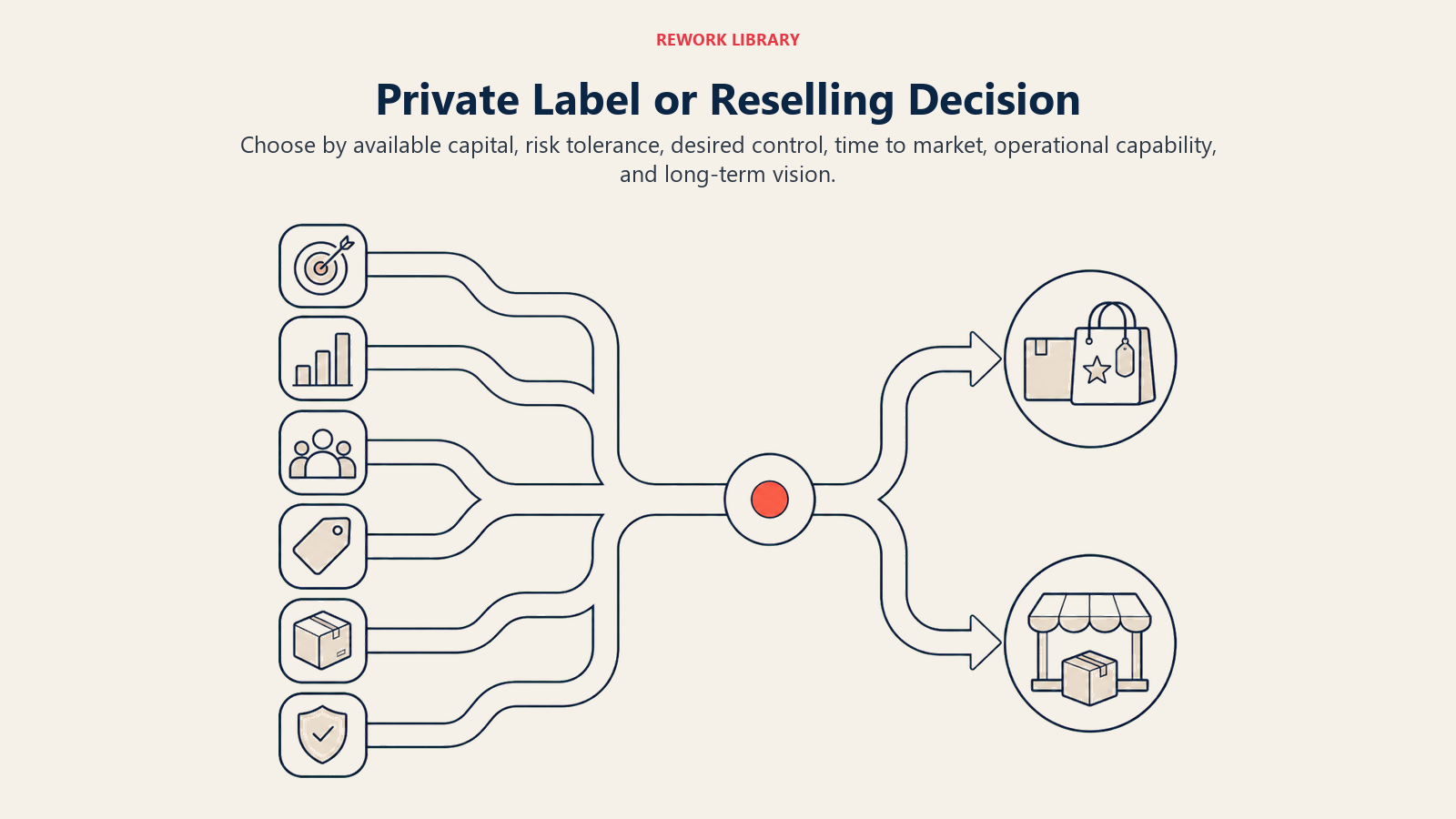
Use this evaluation matrix to determine which model fits your situation.
Business Model Comparison Matrix
When evaluating these models, track the right e-commerce metrics and KPIs for your chosen approach:
| Factor | Private Label | Reselling | Weight |
|---|---|---|---|
| Initial Capital | $15k-50k | $3k-15k | High |
| Time to First Sale | 60-120 days | 7-30 days | Medium |
| Gross Margin | 40-70% | 15-30% | High |
| Competitive Moat | Strong | Weak | High |
| Operational Complexity | High | Medium | Medium |
| Scalability | High | Medium | High |
| Exit Valuation | 3-5x profit | 1-2x profit | Medium |
| Inventory Risk | High | Medium | High |
| Brand Control | Complete | None | Medium |
| Market Entry Speed | Slow | Fast | Medium |
Decision Checklist
Choose Private Label if:
- You have $15k+ to invest and can wait 6-12 months for ROI
- You want to build a sellable asset with equity value
- You have or can develop product development and branding skills
- You're committed to a specific niche or category long-term
- You want maximum control over pricing and positioning
- You can handle 90-120 day cash conversion cycles
Choose Reselling if:
- You have limited capital ($3k-10k) and need faster ROI
- You want to test e-commerce with lower risk
- You have strong operational and customer service skills
- You want flexibility to pivot categories quickly
- You can secure authorized dealer relationships or exclusive agreements
- You're comfortable with operational competition and thinner margins
Consider a Hybrid Approach if:
- You want to minimize risk while building for the long term
- You have moderate capital ($10k-25k)
- You're willing to manage higher operational complexity
- You want stable cash flow (reselling) while building equity (private label)
The Strategic Reality
Private label and reselling aren't just different tactics. They're different businesses with different economics, competitive dynamics, and value creation models.
Private label is a branding business that happens to sell products. You're investing in awareness, trust, and customer relationships. The products are the vehicle, not the destination.
Reselling is a distribution business that leverages other people's brands. You're investing in operational efficiency, supplier relationships, and customer service. You're competing on execution, not differentiation.
Most successful e-commerce businesses eventually incorporate both strategies, using reselling for stability and private label for growth and equity value.
The question isn't which is better. It's which aligns with your capital, skills, risk tolerance, and timeline.
Choose the model that matches where you are today, but build toward the business model you want tomorrow.
Learn More
Ready to dive deeper into e-commerce strategy? Explore these related resources:
- Product Research & Validation - Validate product ideas before committing capital to inventory
- Brand Building & Positioning - Create compelling brand identity for private label products
- Unit Economics for E-commerce - Master the financial metrics that drive profitability
- Product Page Optimization - Convert visitors into customers with optimized listings

On this page
- Defining the Models
- Business Model Comparison
- Revenue Structures
- Unit Economics Example
- Sourcing Strategy Comparison
- Private Label Sourcing
- Reselling Sourcing
- Brand Building & Competitive Advantage
- Private Label Brand Building
- Reselling Competitive Advantage
- Operational Complexity & Scalability
- Private Label Operations
- Reselling Operations
- Financial Model & Profitability Analysis
- Capital Investment Requirements
- Break-Even Analysis
- Cash Flow Dynamics
- Competitive Landscape & Market Positioning
- Private Label Competitive Dynamics
- Reselling Competitive Dynamics
- Risk Assessment & Mitigation
- Private Label Risks
- Reselling Risks
- Growth & Expansion Trajectories
- Private Label Growth Path
- Reselling Growth Path
- Hybrid Models
- Market Selection & Category Analysis
- Best Categories for Private Label
- Best Categories for Reselling
- Decision Framework
- Business Model Comparison Matrix
- Decision Checklist
- The Strategic Reality
- Learn More