Amazon SEO & Ranking: Master the A9 Algorithm to Dominate Search Results
 Amazon SEO is the practice of optimizing product listings to rank higher in Amazon search and improve your Amazon ranking. Amazon's A9 algorithm scores products on relevance, performance, and customer satisfaction, then ranks the listings most likely to convert a search into a sale. Strong keywords, conversion rate, reviews, and sales velocity drive top positions.
Turn this article into takeaways for your work.


Each assistant summarizes the article only for you and suggests best practices for your work.
When your product appears on page one of Amazon search results, sales happen. When it doesn't, you're invisible. Understanding how Amazon's search algorithm works isn't optional anymore. It's the difference between thriving and barely surviving on the world's largest marketplace.
Amazon SEO is fundamentally different from traditional search engine optimization. While Google wants to show you the most relevant content, Amazon wants to show you the products most likely to generate a sale. This distinction changes everything about how you approach optimization.
Why Amazon SEO Differs from Google SEO
The core philosophy behind Amazon's A9 algorithm is simple: maximize revenue per search. Amazon doesn't care about traffic, bounce rates, or time on page. They care about conversion. Every ranking signal feeds into one question: which product is most likely to convert this search into a sale? This sales-first approach means that behavioral signals matter more than keyword matching. A product with perfect keyword optimization but poor conversion rates will lose to a product with decent keywords and strong sales performance every single time.
Google rewards content that answers questions and keeps users engaged. Amazon rewards products that people actually buy. Understanding this fundamental difference is the foundation of effective Amazon SEO strategy.
Understanding Amazon's A9 Algorithm
Amazon's A9 algorithm evaluates products across three primary dimensions: relevance, performance, and customer satisfaction. Each dimension contains multiple ranking factors that work together to determine your product's visibility. Relevance factors determine whether your product should appear for a given search term. These include title keywords, bullet point keywords, backend search terms, product description, and category selection. Amazon's algorithm looks for semantic matches, not just exact keyword matches, so related terms and synonyms contribute to relevance.
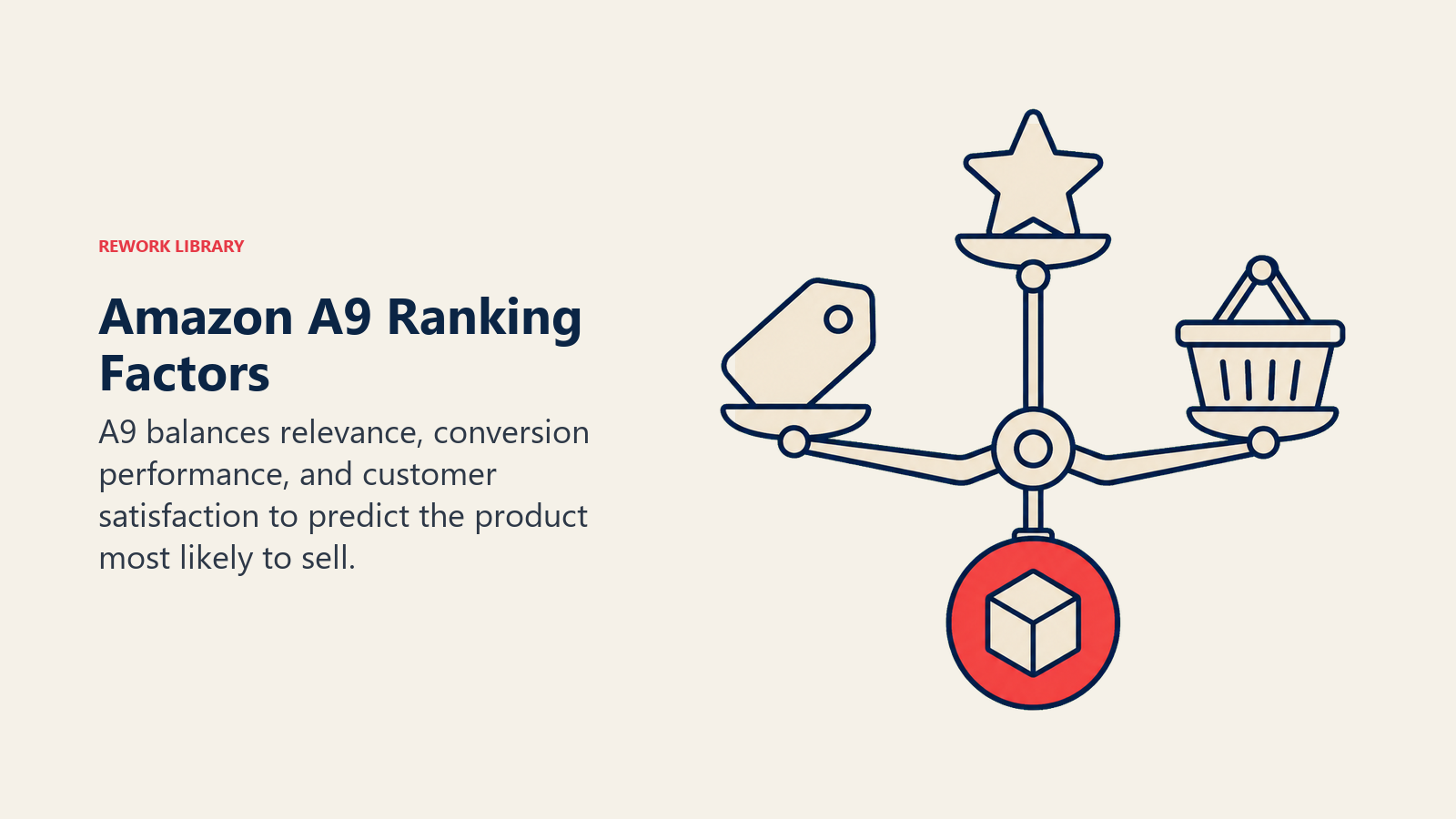
Performance factors measure how well your product converts searchers into buyers. Conversion rate is the king of performance metrics, but click-through rate, price point, availability, and fulfillment method all play significant roles. Products that consistently convert well earn higher visibility.
Customer satisfaction factors reflect the post-purchase experience. Review ratings, review velocity, return rates, and seller feedback all impact rankings. Amazon actively promotes products that generate satisfied customers because repeat buyers drive long-term marketplace value.
Here's how Amazon A9 differs from Google's algorithm:
| Factor | Amazon A9 | Google SEO |
|---|---|---|
| Primary Goal | Maximize sales conversion | Provide relevant information |
| Key Metric | Conversion rate | User engagement/relevance |
| Content Focus | Product attributes & benefits | Comprehensive content |
| Backlinks | Not a factor | Critical ranking signal |
| Social Signals | Minimal impact | Moderate impact |
| Purchase Behavior | Directly impacts rankings | Not applicable |
| Price | Significant ranking factor | Not a factor |
| Review Quality | Major ranking factor | Minor factor |
| Sales Velocity | Core ranking driver | Not applicable |
Understanding these differences helps you prioritize optimization efforts effectively. While Google SEO requires months of content development and link building, Amazon SEO delivers faster results when you focus on conversion optimization and sales momentum.
Keyword Research for Amazon
Amazon keyword research starts with understanding search intent. Shoppers on Amazon are almost always in buying mode. They're searching for products to purchase, not information to consume. This high-intent mindset means you should prioritize keywords that indicate purchase readiness. Start with Amazon's own search suggest feature. Type your base keyword into the search bar and note the auto-complete suggestions. These represent real searches with sufficient volume to warrant suggestion. They're pure gold for understanding what actual buyers are searching for.

Use tools like Helium 10, Jungle Scout, or Cerebro to expand your keyword research. These tools pull search volume data, competitive metrics, and trending keywords specific to Amazon's marketplace. Focus on keywords with high search volume, moderate competition, and strong relevance to your product. Our Product Research & Validation guide offers comprehensive methods for validating product-market fit.
Don't neglect long-tail keywords. While "yoga mat" might have massive volume, "extra thick yoga mat for hardwood floors" has clearer purchase intent and less competition. Long-tail keywords also help you capture specific customer needs that broader terms miss.
Analyze your competitors' listings using reverse ASIN lookup tools. These tools reveal which keywords are driving traffic to competing products, giving you insights into optimization opportunities you might have missed.
Consider seasonal keywords and trending terms relevant to your product category. Amazon's search trends shift with seasons, holidays, and emerging consumer interests. Products optimized for timely keywords can capture significant short-term visibility boosts.
Document your keywords in a spreadsheet with columns for search volume, relevance score, competition level, and intended placement (title, bullets, backend). This organization helps you strategically deploy keywords where they'll have maximum impact.
Listing Optimization Fundamentals
Your product title is the most critical element for Amazon SEO. It should include your primary keyword, key product attributes, and important differentiators, all while remaining readable and appealing to human shoppers. Follow Amazon's character limits (200 characters for most categories) and style guidelines for your category. Structure titles using this proven formula: Brand + Key Feature + Product Type + Specific Attributes + Size/Quantity + Color/Style. These principles align with broader Product Page SEO best practices across platforms.

For example: "AquaLife Insulated Water Bottle - 32oz Double Wall Stainless Steel - Keeps Cold 24hrs Hot 12hrs - BPA Free Sports Bottle - Sky Blue"
Bullet points are your opportunity to highlight benefits, features, and secondary keywords. Amazon displays 5-6 bullet points depending on the category. Use all available bullets and frontload the most important information. Many shoppers only read the first few bullets before making decisions.
Structure each bullet to lead with a benefit or key feature in capital letters, followed by supporting details. Include relevant keywords naturally, but prioritize readability over keyword density. Bullets that sound like keyword soup hurt conversions, which ultimately damages rankings.
The product description field offers additional space for keywords and persuasive copy. While less prominent than bullets, descriptions influence both search rankings and conversion rates. Write clear, benefit-focused descriptions that incorporate secondary and long-tail keywords naturally.
Backend search terms are hidden keywords invisible to shoppers but indexed by Amazon's algorithm. Use this space for synonyms, alternate spellings, related terms, and keywords you couldn't fit naturally into visible content. Follow Amazon's guidelines: no punctuation, no repeated keywords, no competitor brand names, no inappropriate terms.
Optimize your product images alongside your text elements. High-quality images don't directly impact keyword rankings, but they dramatically affect click-through and conversion rates, both critical ranking factors. Include multiple angles, lifestyle shots, infographics highlighting features, and scale comparisons.
Critical Conversion Factors
Click-through rate (CTR) measures how often searchers click on your listing when it appears in search results. Higher CTR signals relevance and appeal, boosting your rankings. Improve CTR through compelling main images, competitive pricing, Prime badges, and strong review ratings visible in search results. Your main image is the single biggest CTR driver. It should showcase your product against a pure white background, fill at least 85% of the image frame, and clearly communicate what you're selling at a glance. Test different image angles and product arrangements to identify the highest-converting presentation.
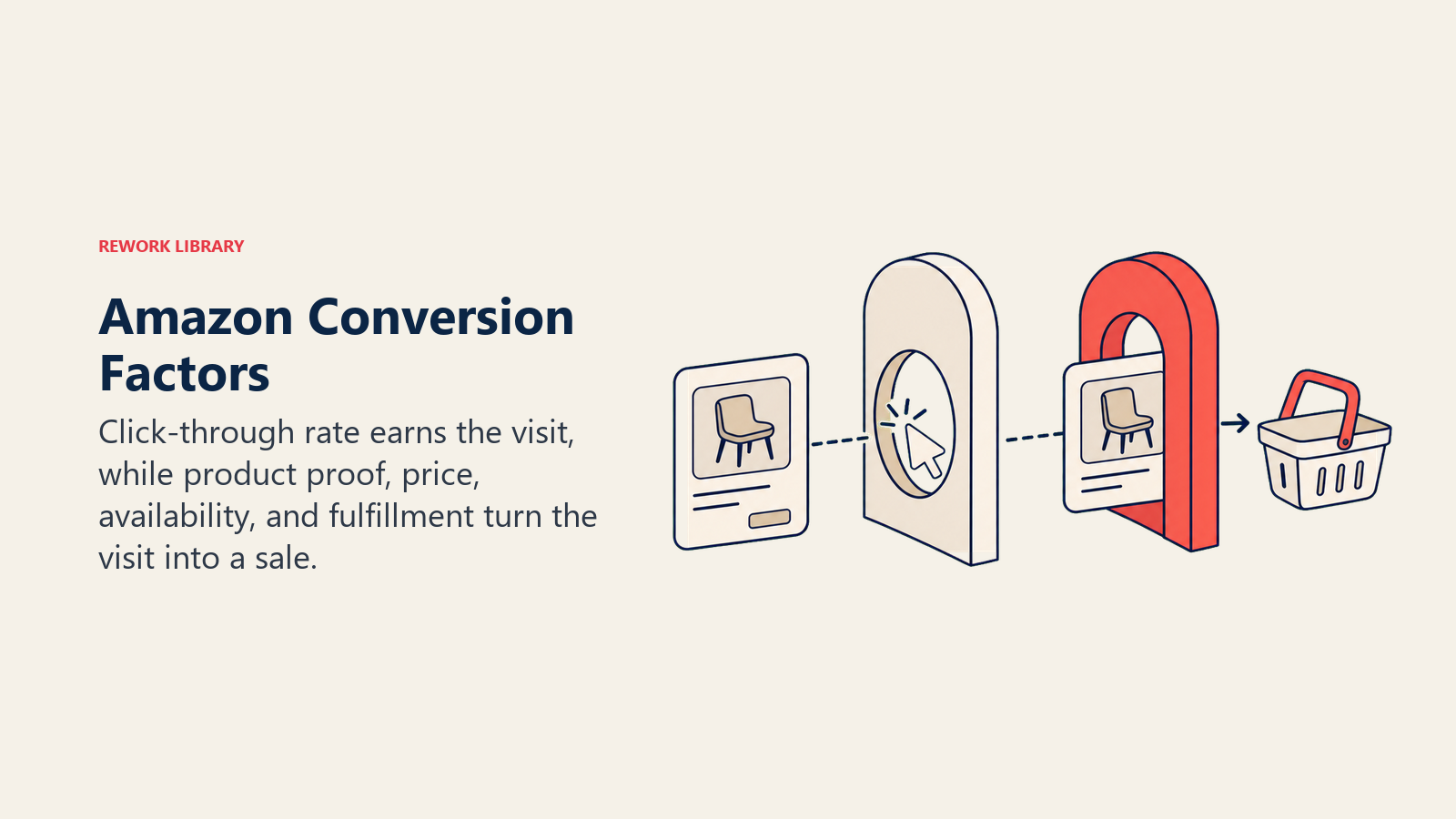
Conversion rate is the ultimate ranking factor. It directly measures how often your listing turns visitors into buyers. Amazon rewards high-converting listings with better visibility because they generate more revenue per impression.
Optimize conversion rate through persuasive copy, high-quality images, competitive pricing, strong social proof, clear product benefits, and comprehensive Q&A responses. Every element of your listing either increases or decreases conversion likelihood. Our Conversion Rate Optimization guide provides detailed tactics for improving listing performance.
Price competitiveness matters significantly. Amazon's algorithm considers your price relative to similar products. Being the cheapest isn't necessary, but being reasonably priced within your competitive set is essential. Significant price premiums require strong differentiation through enhanced content, better reviews, or unique features. Learn advanced techniques in our Pricing Strategy & Optimization guide.
Stock availability directly impacts rankings. Products that frequently go out of stock lose search visibility because Amazon won't show products they can't sell. Maintain adequate inventory levels and use Amazon's restock alerts to prevent stockouts. If you must go out of stock temporarily, consider temporarily pausing advertising to preserve organic ranking momentum. Our Inventory Management guide covers strategies for maintaining optimal stock levels.
Fulfillment method affects rankings, with FBA (Fulfillment by Amazon) products generally outranking merchant-fulfilled products. Prime eligibility, faster shipping, and Amazon's trusted fulfillment create better customer experiences that translate to higher conversion rates. Learn more in our Amazon FBA Strategy guide.
Review and Rating Strategy
Amazon reviews serve as social proof that directly influences both conversion rates and search rankings. Products with more reviews and higher average ratings typically outrank similar products with fewer or lower-rated reviews. Focus on review quantity first, then rating quality. A product with 500 reviews at 4.3 stars often outperforms a product with 50 reviews at 4.8 stars. Volume matters because it indicates sustained sales success and provides Amazon's algorithm with more data points.

Review velocity, the rate at which you accumulate new reviews, signals strong sales momentum. Products gaining reviews consistently indicate healthy sales performance, which Amazon rewards with better visibility.
Use Amazon's "Request a Review" button to systematically solicit feedback from buyers. This compliant, automated approach helps you build reviews without violating Amazon's terms of service. Many sellers also use third-party tools that automate review requests while staying within Amazon's guidelines.
Monitor reviews actively and respond to negative reviews professionally and constructively. While you can't change negative reviews, thoughtful responses demonstrate customer service commitment and can mitigate damage. They also provide an opportunity to address legitimate product issues.
Early reviews are critical for new product launches. Consider using Amazon's Early Reviewer Program or Amazon Vine program to generate initial reviews that help new products gain traction. These programs provide discounted or free products to verified reviewers in exchange for honest feedback.
Never purchase fake reviews, incentivize positive reviews, or manipulate the review system. Amazon actively detects and punishes review manipulation with listing suspensions, account bans, and legal action. The short-term gains aren't worth the long-term risks.
Address common customer concerns proactively in your listing. If reviews mention sizing issues, add detailed sizing information to your bullets and description. If packaging complaints appear, improve your packaging. Use review insights to continuously improve both your product and listing optimization. Our Customer Reviews & UGC guide offers deeper strategies.
Enhanced Content & A+ Pages
Enhanced Brand Content (EBC) for vendors and A+ Content for sellers provide additional space to showcase your product through rich media, comparison charts, lifestyle images, and detailed descriptions. While these enhanced sections don't directly impact keyword rankings, they significantly improve conversion rates, which does impact rankings. Use A+ Content to tell your brand story, highlight unique selling propositions, demonstrate product uses, compare product variants, address common objections, and provide detailed specifications. The expanded visual and textual space helps differentiate your product from competitors using basic listings.
Include comparison charts that help shoppers choose between your product variants or understand why your product outperforms alternatives. These charts reduce decision fatigue and increase conversion rates by simplifying the selection process.
Lifestyle images within A+ Content show your product in real-world contexts. These images help shoppers visualize ownership and usage, creating emotional connections that drive purchase decisions. Include diverse usage scenarios that appeal to different customer segments.
EBC and A+ Content particularly benefit complex products that require more explanation than bullets and descriptions can provide. Technical products, products with multiple features, and products competing in crowded categories all benefit significantly from enhanced content.
Test different A+ Content layouts to identify which formats drive the highest conversion rates. Amazon provides analytics showing how A+ Content affects your conversion performance, allowing you-based optimization.
Sales Velocity & Demand Signals
Sales velocity, the rate at which you generate sales, is arguably Amazon's most important ranking factor. Products selling consistently and quickly signal strong demand, which Amazon rewards with increased visibility to capitalize on that demand. Recent sales performance matters more than historical performance. A product that sold 100 units yesterday outranks a product that sold 100 units last week, all else being equal. This recency bias means maintaining consistent sales momentum is critical for sustaining rankings.
Amazon tracks sales velocity across different time horizons: daily, weekly, and monthly. Sudden drops in sales velocity trigger ranking decreases as Amazon interprets slowing sales as declining relevance or competitiveness.
Seasonal products face unique velocity challenges. When out of season, these products naturally experience sales slowdowns that damage rankings. Counter this by running moderate PPC campaigns during off-seasons to maintain minimal sales velocity, preventing your rankings from collapsing completely.
New product launches require deliberate velocity-building strategies. Without existing sales history, new products struggle to gain initial visibility. Consider launch promotions, aggressive early PPC campaigns, or temporary price reductions to generate the sales momentum needed to trigger Amazon's visibility algorithms.
External traffic from social media, email marketing, influencer promotions, or your own website can supplement Amazon's internal traffic and boost sales velocity. Amazon rewards external traffic that converts because it represents incremental sales Amazon didn't have to generate through its own marketing efforts.
Lightning Deals, Best Deals, and Coupons temporarily boost sales velocity, which can improve organic rankings even after the promotion ends. The visibility spike generates sales momentum and reviews that sustain improved rankings post-promotion.
Advertising Integration with Organic Ranking
Amazon's advertising products, particularly Sponsored Products, directly influence organic search rankings. The relationship works in both directions: advertising data informs organic algorithms, and organic performance affects advertising efficiency. Sponsored Products campaigns generate sales that contribute to overall sales velocity. These advertising-driven sales signal demand just like organic sales, helping boost organic rankings over time. This creates a virtuous cycle where advertising investment improves organic visibility.

Amazon's algorithm uses advertising performance data to validate keyword relevance. If your Sponsored Products ads for specific keywords drive strong conversion rates, Amazon interprets this as evidence that your product genuinely matches those search terms, strengthening organic relevance signals.
Use advertising campaigns for keyword research and validation. Advertise against keywords you want to rank for organically and analyze which keywords drive the strongest conversion rates. These high-converting keywords deserve priority placement in your title, bullets, and backend terms.
Aggressive advertising during product launches accelerates the sales velocity needed to gain organic traction. While advertising costs reduce initial profitability, the organic ranking improvements can deliver long-term returns that justify short-term advertising investments.
Balance advertising spend with organic performance. Products with strong organic rankings can reduce advertising intensity, improving overall profitability. Products struggling organically may require sustained advertising support to maintain visibility and sales volume. Learn more in our Amazon Advertising guide.
Competitive Analysis & Benchmarking
Understanding how your competitors rank and why reveals optimization opportunities and strategic gaps in your approach. Systematic competitive analysis should inform your ongoing optimization efforts. Identify your top 10 competitors for your primary keywords. Analyze their titles, bullets, descriptions, backend terms, pricing, image quality, review ratings, review counts, and sales estimates. Document what they're doing well and where they're vulnerable.
Reverse ASIN tools reveal which keywords drive traffic to competitor listings. This intelligence shows you optimization opportunities you might have missed and helps you understand the competitive keyword landscape.
Monitor competitor ranking positions for your target keywords over time. Sudden ranking improvements suggest optimization changes, promotional activities, or external traffic campaigns worth investigating. Sudden drops indicate vulnerabilities you can exploit.
Track competitor review accumulation rates. Competitors rapidly gaining reviews are experiencing strong sales momentum that will translate to ranking improvements. Understanding their tactics helps you defend your market position.
Analyze competitor A+ Content, product bundles, and variation offerings. These elements contribute to conversion rate differences that affect rankings. Identify gaps in your own content strategy by comparing your listing comprehensiveness to top competitors.
Use competitor intelligence to differentiate rather than imitate. If every competitor emphasizes the same features, highlighting different benefits can help you capture underserved customer segments and reduce direct ranking competition.
Common Ranking Mistakes to Avoid
Keyword stuffing, cramming excessive keywords into titles, bullets, or backend terms, hurts more than it helps. Amazon's algorithm detects unnatural keyword density, and shoppers find stuffed content off-putting, reducing conversion rates. Focus on natural, benefit-focused copy that includes keywords organically. Inconsistent information across listing elements confuses both Amazon's algorithm and shoppers. Your title, bullets, description, and images should present a cohesive, consistent story about what you're selling and why it's valuable.
Neglecting mobile optimization is a critical mistake given that the majority of Amazon shoppers now use mobile devices. Bullets should frontload key information, images should be clear at small sizes, and titles should communicate value within the first 60-80 characters visible on mobile screens.
Ignoring negative reviews or failing to address legitimate product issues damages both rankings and brand reputation. Use review feedback as product development insights and update listings to proactively address common concerns.
Letting listings stagnate is dangerous in Amazon's dynamic marketplace. Competitors continuously optimize, algorithms evolve, and customer preferences shift. Quarterly listing reviews should be standard practice, with continuous testing of titles, images, and copy elements.
Focusing solely on keywords while neglecting conversion optimization creates a fundamental mismatch. Rankings without conversions are worthless, and Amazon's algorithm will eventually demote listings that attract clicks but don't generate sales.
Violating Amazon's terms of service through review manipulation, competitor sabotage, or prohibited claims invites account suspension and permanent bans. The short-term advantages are never worth the long-term consequences.
Monitoring, Testing & Continuous Improvement
Implement systematic tracking of your key performance metrics: organic rank positions for target keywords, conversion rates, CTR, units sold, review ratings, and review velocity. Weekly monitoring reveals trends and issues requiring attention. Our E-commerce Metrics & KPIs guide provides frameworks for comprehensive performance tracking. Use Amazon's Brand Analytics (available to brand-registered sellers) to access search term data, competitive intelligence, and shopping behavior insights. This proprietary data provides visibility into how customers discover and evaluate your products.
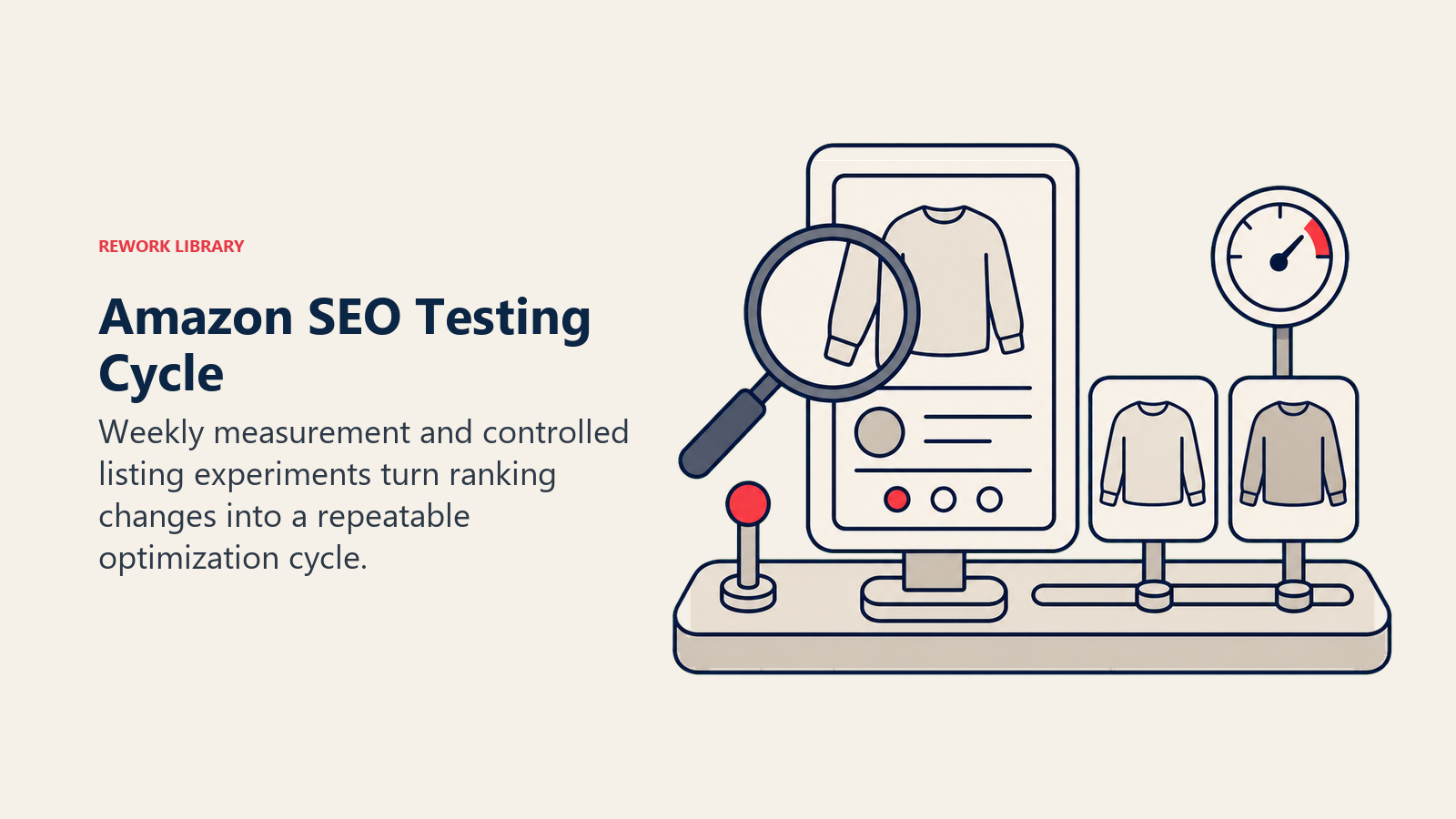
A/B test individual listing elements systematically. Amazon's Manage Your Experiments tool allows you to test different main images, titles, and A+ Content variations with scientific rigor. Small improvements compound over time into significant performance advantages.
Test one element at a time to clearly understand what drives performance changes. Testing multiple changes simultaneously makes it impossible to attribute results to specific optimizations.
Monitor your Search Query Performance report to identify which keywords drive impressions, clicks, and conversions. This data reveals optimization opportunities and shows which keywords deserve increased focus in your listing content.
Track your keyword rankings using third-party tools like Helium 10's Keyword Tracker or Jungle Scout's Rank Tracker. Daily rank tracking reveals ranking trends, competitive shifts, and the impact of your optimization efforts.
Analyze your advertising campaign data for organic optimization insights. Keywords that convert well in PPC campaigns but don't rank organically represent clear optimization opportunities. Strengthen these keywords in your organic listing content.
Review your listing quarterly at minimum, more frequently for competitive categories or new products. Each review should assess keyword relevance, competitive positioning, conversion performance, and emerging customer needs revealed through reviews and Q&A.
Document your optimization hypotheses, changes, and results in a testing log. This institutional knowledge prevents repeated mistakes and helps you identify which tactics consistently drive improvements for your specific products and categories.
Your Amazon SEO Optimization Checklist
Use this checklist to audit your current listings and guide optimization efforts:
Keyword Research
- Primary keyword identified with high search volume
- 10-20 secondary keywords documented
- Long-tail keyword variations listed
- Competitor keywords analyzed
- Seasonal keywords identified
- Backend search terms maximized
Title Optimization
- Primary keyword included in first 80 characters
- Key product attributes listed
- Brand name included
- Size/quantity specified
- Style/color mentioned
- Within character limits for category
- Readable and appealing to humans
Bullet Points
- All 5-6 bullets utilized
- Benefits frontloaded in each bullet
- Secondary keywords naturally included
- Key features highlighted
- Common objections addressed
- Formatting consistent and readable
Images
- Main image meets Amazon requirements
- 7+ high-quality images uploaded
- Lifestyle images included
- Infographic images show features
- Scale/size comparison provided
- All angles shown
- Images optimized for mobile viewing
Enhanced Content
- A+ Content or EBC created
- Brand story communicated
- Comparison chart included
- Lifestyle images showcase usage
- Unique selling points highlighted
- Product variations explained
Conversion Optimization
- Competitive pricing validated
- Prime eligible (FBA)
- Adequate inventory maintained
- Review count above 50
- Average rating 4.0+
- Q&A section populated
- Negative reviews addressed
Performance Monitoring
- Keyword rankings tracked weekly
- Conversion rate monitored
- Click-through rate analyzed
- Sales velocity tracked
- Review velocity monitored
- Competitive positions benchmarked
Testing & Improvement
- A/B test schedule established
- Quarterly listing review scheduled
- Optimization log maintained
- Results measured and documented
Connecting Amazon SEO to Broader Strategy
Amazon SEO doesn't exist in isolation. Your optimization efforts should connect to your broader e-commerce and marketplace strategy for maximum effectiveness.
Strong Amazon SEO creates data insights applicable to other marketplaces. Keywords that perform well on Amazon often perform well on Walmart, eBay, and other platforms. Conversion optimization tactics translate across platforms. Our Multi-Channel Marketplace Strategy guide explores cross-platform optimization.
Amazon SEO principles apply to your own e-commerce site with modifications. While the specific algorithms differ, the focus on conversion optimization, clear product presentation, and customer satisfaction drives success across all channels.
Product page optimization fundamentals, like clear images, benefit-focused copy, social proof, and reduced friction, matter everywhere you sell. Master these on Amazon, then deploy them across all sales channels.
Start Optimizing Today
Amazon SEO rewards systematic, data-driven optimization efforts. You don't need to implement every strategy simultaneously. Start with the fundamentals and gradually expand your sophistication.
Begin with thorough keyword research to ensure you understand what your target customers are actually searching for. Optimize your title, bullets, and backend terms based on this research. Improve your main image and product images to drive higher CTR and conversion rates.
Implement systematic review collection to build social proof. Monitor your key metrics weekly to catch issues early. Test continuously to identify what resonates with your specific audience.
Remember that Amazon SEO is ultimately about matching buyer intent with compelling products. The algorithm rewards products that satisfy customer needs and generate sales. Focus on genuine value creation, optimize relentlessly, and your rankings will follow.
Your products deserve to be found by customers actively searching for what you sell. Master Amazon SEO, dominate your category's search results, and watch your sales velocity accelerate.
Related Resources
Expand your Amazon marketplace expertise with these complementary guides:
- Amazon Advertising - Learn how to use Sponsored Products, Brands, and Display ads to accelerate organic ranking growth
- Amazon FBA Strategy - Master fulfillment strategies that improve conversion rates and customer satisfaction
- Customer Reviews & UGC - Build social proof systems that drive conversions and rankings
- Multi-Channel Marketplace Strategy - Apply Amazon optimization tactics across Walmart, eBay, and other platforms

On this page
- Why Amazon SEO Differs from Google SEO
- Understanding Amazon's A9 Algorithm
- Keyword Research for Amazon
- Listing Optimization Fundamentals
- Critical Conversion Factors
- Review and Rating Strategy
- Enhanced Content & A+ Pages
- Sales Velocity & Demand Signals
- Advertising Integration with Organic Ranking
- Competitive Analysis & Benchmarking
- Common Ranking Mistakes to Avoid
- Monitoring, Testing & Continuous Improvement
- Your Amazon SEO Optimization Checklist
- Connecting Amazon SEO to Broader Strategy
- Start Optimizing Today
- Related Resources