AOV Optimization Strategy: Proven Techniques to Increase Average Order Value
Turn this article into takeaways for your work.


Each assistant summarizes the article only for you and suggests best practices for your work.
Average Order Value optimization is the most direct path to revenue growth in e-commerce. Acquiring new customers costs money. Improving conversion rates has limits. But increasing what each customer spends per transaction? That compounds across every sale you make.
Here's what matters: a 10% increase in AOV with the same traffic and conversion rate means 10% more revenue. Do this consistently, and you've transformed your business economics without spending more on acquisition.
This guide covers the framework for increasing Average Order Value through proven techniques that work across industries and product categories.
AOV optimization is the practice of raising the average amount each customer spends per order using bundling, upsells, cross-sells, free-shipping thresholds, volume discounts, and pricing psychology. It's the most efficient path to revenue growth because every gain compounds across all your existing traffic, with no added acquisition cost, and a layered approach typically lifts AOV 25 to 40% within six months.
Understanding Average Order Value (AOV)
Average Order Value measures the average amount spent each time a customer places an order. The calculation is simple:
AOV = Total Revenue / Number of Orders
If you generated $50,000 in revenue from 1,000 orders last month, your AOV is $50.
Why AOV Matters More Than You Think
AOV directly impacts your unit economics for e-commerce. Here's why it's critical:
Acquisition Efficiency: If your Customer Acquisition Cost (CAC) is $30 and your AOV is $40, you have $10 margin per order. Increase AOV to $60, and you've tripled your margin without changing acquisition costs.
Lifetime Value: Higher AOV typically correlates with higher customer lifetime value. Customers who spend more initially tend to come back and spend more over time.
Operational Leverage: Many fulfillment costs are fixed per order. A $100 order costs almost the same to ship as a $50 order, which makes higher AOV orders way more profitable.
AOV Benchmarks by Industry
Understanding where you stand helps set realistic targets:
| Industry | Average AOV | Top Quartile AOV |
|---|---|---|
| Fashion & Apparel | $85-$120 | $150-$200 |
| Home & Garden | $95-$140 | $180-$250 |
| Electronics | $180-$280 | $350-$500 |
| Beauty & Cosmetics | $55-$85 | $120-$150 |
| Food & Beverage | $45-$75 | $95-$130 |
| Sports & Outdoors | $100-$145 | $190-$270 |
These benchmarks vary significantly by business model (DTC vs marketplace), product price points, and customer segments. Use them as directional guidance, not absolute targets.
The AOV Optimization Framework
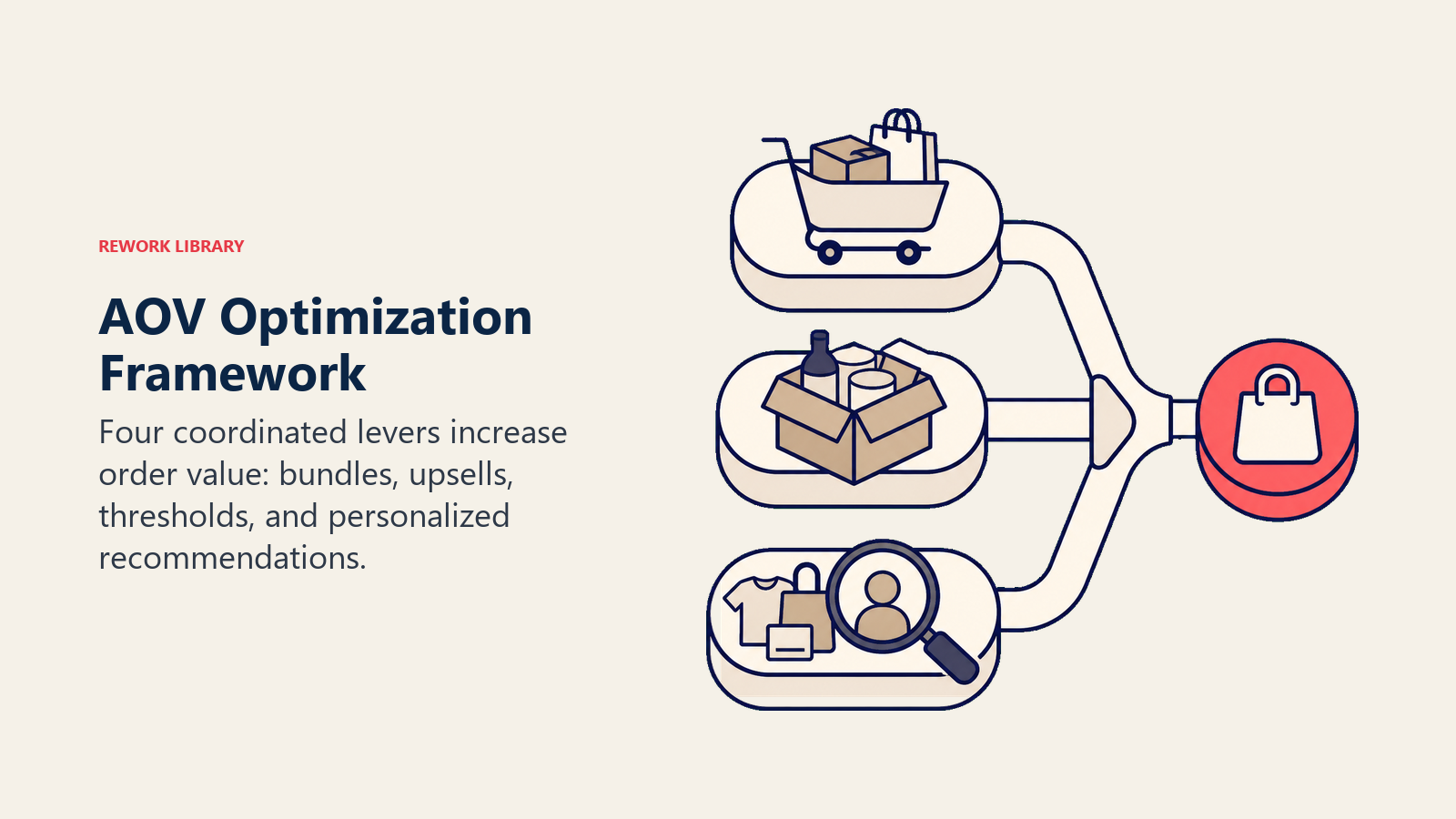
Increasing AOV requires a systematic approach across multiple levers. The most effective strategies combine several techniques that work together:
Core AOV Levers
- Product Bundling: Grouping complementary products at a discount
- Upselling: Moving customers to premium versions or larger quantities
- Cross-selling: Adding complementary products to existing cart items
- Threshold Incentives: Free shipping or gifts at specific spend levels
- Volume Discounts: Price breaks that encourage larger purchases
- Pricing Psychology: Strategic pricing that influences perceived value
- Post-Purchase Expansion: Adding items after initial checkout
Mastering upselling and cross-selling techniques forms the foundation of any successful AOV strategy.
The Layered Approach
The best AOV strategies layer multiple techniques:
- Pre-Cart: Product page optimization with bundles and cross-sells
- In-Cart: Threshold progress bars, suggested additions
- Checkout: Last-chance upsells and order bumps
- Post-Purchase: One-click additions before fulfillment
Each layer captures different customer segments and purchase motivations without overwhelming any single touchpoint.
Product Bundling as an AOV Driver
Developing a strong bundling strategy is one of the highest-impact AOV techniques. Bundles increase average order value by 30-50% when executed well.
Bundle Types That Drive AOV
1. Curated Product Sets Pre-selected combinations that solve complete problems. A skincare brand might bundle cleanser, toner, and moisturizer as a "Complete Routine" at 15% off individual prices.
2. Build-Your-Own Bundles Let customers create custom combinations with bundle pricing. "Pick 3 items, save 20%" gives customers control while increasing cart size.
3. Subscription Bundles Recurring bundles that increase initial AOV and create ongoing revenue. A coffee brand might offer "Monthly Discovery Box" with 3 varieties.
Bundle Pricing Strategy
The discount needs to be meaningful enough to drive adoption but not so steep that it erodes margin:
- 15-20% discount: Sweet spot for most categories
- 25-30% discount: For higher-margin products or clearance combinations
- 10-15% discount: Premium products or low-margin categories
The key is ensuring bundle margins remain healthy while the discount feels substantial to customers.
Upsell & Cross-Sell Mechanics
Effective upsell and cross-sell techniques capture additional revenue at the point of highest purchase intent.
Strategic Upsell Positioning
Product Page Upsells Present premium alternatives or larger sizes immediately. "Most customers choose the XL size" with a single-click upgrade option.
Cart Page Upsells "Frequently bought together" modules based on actual purchase data. Show 2-3 highly relevant items with one-click add functionality.
Checkout Upsells Minimal friction additions like warranties, gift wrapping, or rush shipping. Keep these simple and quick to add.
Cross-Sell Best Practices
Effective cross-selling requires relevance and restraint:
- Limit options: Show 2-4 items maximum to avoid choice paralysis
- Use real data: Base recommendations on actual purchase patterns
- Price appropriately: Cross-sell items should be 20-40% of main product price
- Explain the connection: "Complete your setup" or "You might also need"
Free Shipping Threshold Strategy
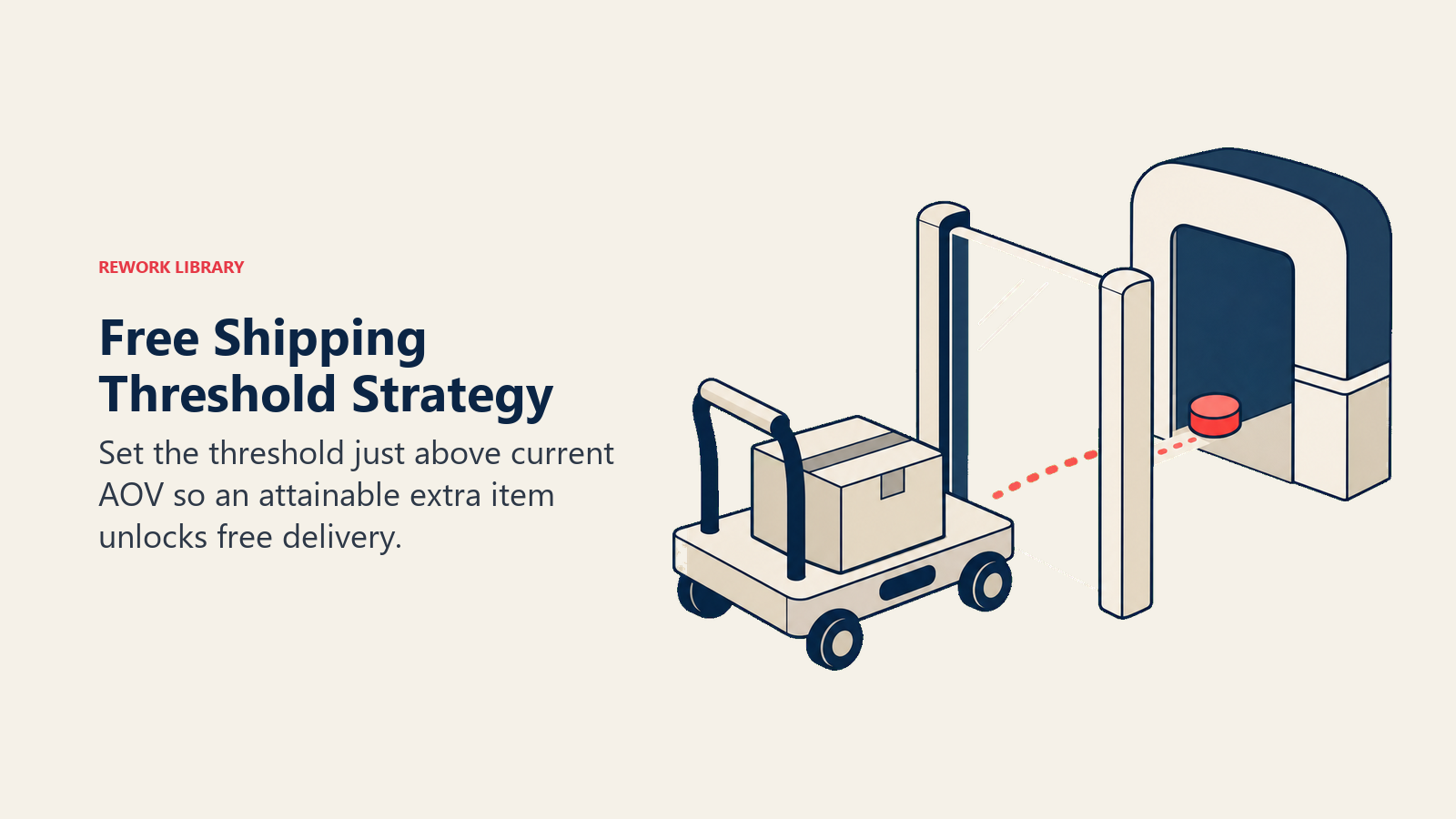
An effective shipping strategy and pricing approach is a powerful AOV driver when set strategically. Free shipping thresholds work because customers hate paying for shipping more than they dislike adding items to hit the threshold.
Setting Your Threshold
Your threshold should sit 20-30% above your current AOV. If your AOV is $50, set the threshold at $65-$75.
This ensures:
- A meaningful percentage of customers are close enough to bridge the gap
- The increase is large enough to impact AOV
- Margin on additional items exceeds shipping cost subsidy
Communicating the Threshold
Make progress visible and motivating:
Cart Messaging Examples:
- "Add $23 more for free shipping"
- "You're 85% to free shipping"
- "Only 1 more item for free shipping"
Progressive indicators (progress bars) increase conversion by 15-20% compared to static messages.
Threshold Product Strategy
Stock "threshold bridgers" - lower-priced items ($15-$30) that help customers reach free shipping. These should be:
- High-margin to absorb shipping cost
- Complementary to main products
- Useful standalone items customers actually want
Volume Discounts & Tiered Pricing
Volume discounts encourage larger purchases by reducing per-unit costs at higher quantities.
Tiered Discount Structures
Quantity-Based Tiers:
- Buy 1: $20 each
- Buy 3: $18 each (10% off)
- Buy 5: $16 each (20% off)
Spend-Based Tiers:
- Spend $50-$99: 10% off
- Spend $100-$199: 15% off
- Spend $200+: 20% off
Making Tiers Work
The psychology matters as much as the math:
- Show savings clearly: "$60 total (save $12)" not just "10% off"
- Highlight the middle tier: Most customers choose the middle option when presented with three
- Use anchoring: Show highest tier first to make others feel more accessible
- Auto-apply: Don't make customers enter codes; apply discounts automatically
Pricing Psychology & AOV Optimization
Strategic pricing strategy and optimization influences perceived value and purchase behavior in ways that directly impact AOV.

Psychological Pricing Techniques
Charm Pricing ($X.99) Still effective for lower-priced items under $100. Items at $49.99 convert better than $50.00 despite minimal difference.
Prestige Pricing (Round Numbers) For premium products over $100, round numbers ($500 vs $499.99) signal quality and luxury.
Price Anchoring
Show original price crossed out next to sale price. "$89 $129" makes the offer feel more valuable.
Decoy Pricing Offer three options where the middle is most attractive:
- Small: $39
- Medium: $59 (most popular)
- Large: $69
The large option makes medium feel like the smart choice, increasing AOV compared to offering just small and medium.
Good-Better-Best Strategy
Structure product offerings in three tiers:
- Good: Entry-level option (15-20% of sales)
- Better: Mid-tier with best value (60-65% of sales)
- Best: Premium option (15-20% of sales)
The middle option should be your AOV target. Price it to maximize margin while the premium tier makes it feel like a smart compromise.
Product Recommendations & AI Personalization
Product recommendations powered by behavioral data and AI increase AOV by surfacing relevant additions customers actually want.
Recommendation Types That Drive AOV
Collaborative Filtering "Customers who bought X also bought Y" - the Amazon model. Works well with sufficient purchase data.
Content-Based Filtering Recommendations based on product attributes. "Similar style items" or "Same category picks."
Behavioral Triggers Based on browsing history and session behavior. "You viewed these items earlier."
Implementation Best Practices
Placement Matters:
- Product pages: Below the fold after main content
- Cart page: Above checkout button
- Checkout: Minimal friction additions only
- Post-purchase: During order confirmation
Personalization Levels: Start with basic collaborative filtering and evolve to AI-driven personalization as you collect more data. Even simple "frequently bought together" increases AOV by 10-15%.
Testing Recommendations: Run continuous tests on:
- Number of recommendations shown (2 vs 4 vs 6)
- Recommendation algorithms
- Visual presentation (carousel vs grid)
- Copy and positioning
Post-Purchase & Order Expansion
Post-purchase upsells capture additional revenue after the initial commitment without risking cart abandonment.
Post-Purchase Upsell Windows
Immediate Post-Checkout Thank you page offers with one-click add to existing order. "Add to your order" with no re-entry of payment information.
Pre-Fulfillment Window Email 2-4 hours after purchase: "Still time to add to your order before it ships." Works especially well for same-day fulfillment operations.
What to Offer Post-Purchase
- Complementary products: Items that enhance the initial purchase
- Consumables: Refill items or accessories that deplete
- Gift additions: "Add a gift for someone else at 15% off"
- Subscription upgrades: Convert one-time purchase to subscription
Keep post-purchase offers simple and highly relevant. The conversion bar is lower here, but so is customer tolerance for irrelevant suggestions.
Checkout & Cart Optimization for AOV
Effective checkout flow optimization focuses on reducing friction for higher-value purchases while strategically presenting final opportunities to increase order value.
Cart Page Elements That Increase AOV
Trust Signals for Larger Purchases Display security badges, return policies, and warranties prominently. These matter more as cart value increases.
Threshold Progress Indicators Visual progress bars showing distance to free shipping, discount tiers, or gift thresholds.
Save for Later Let customers move items to a wishlist rather than removing them. This preserves the relationship and enables remarketing.
Checkout Optimization
Express Checkout Options Shop Pay, Apple Pay, and Google Pay reduce friction for high-intent customers willing to spend more.
Order Bumps Small add-ons at checkout ($5-$15 items) that require only a checkbox to include. These work for accessories, warranties, or gift options.
Payment Plan Options Affirm, Afterpay, or Klarna for higher-ticket items. "4 payments of $37.50" makes $150 purchases more accessible, increasing AOV by 30-50% for stores that implement them.
Analytics & Performance Measurement
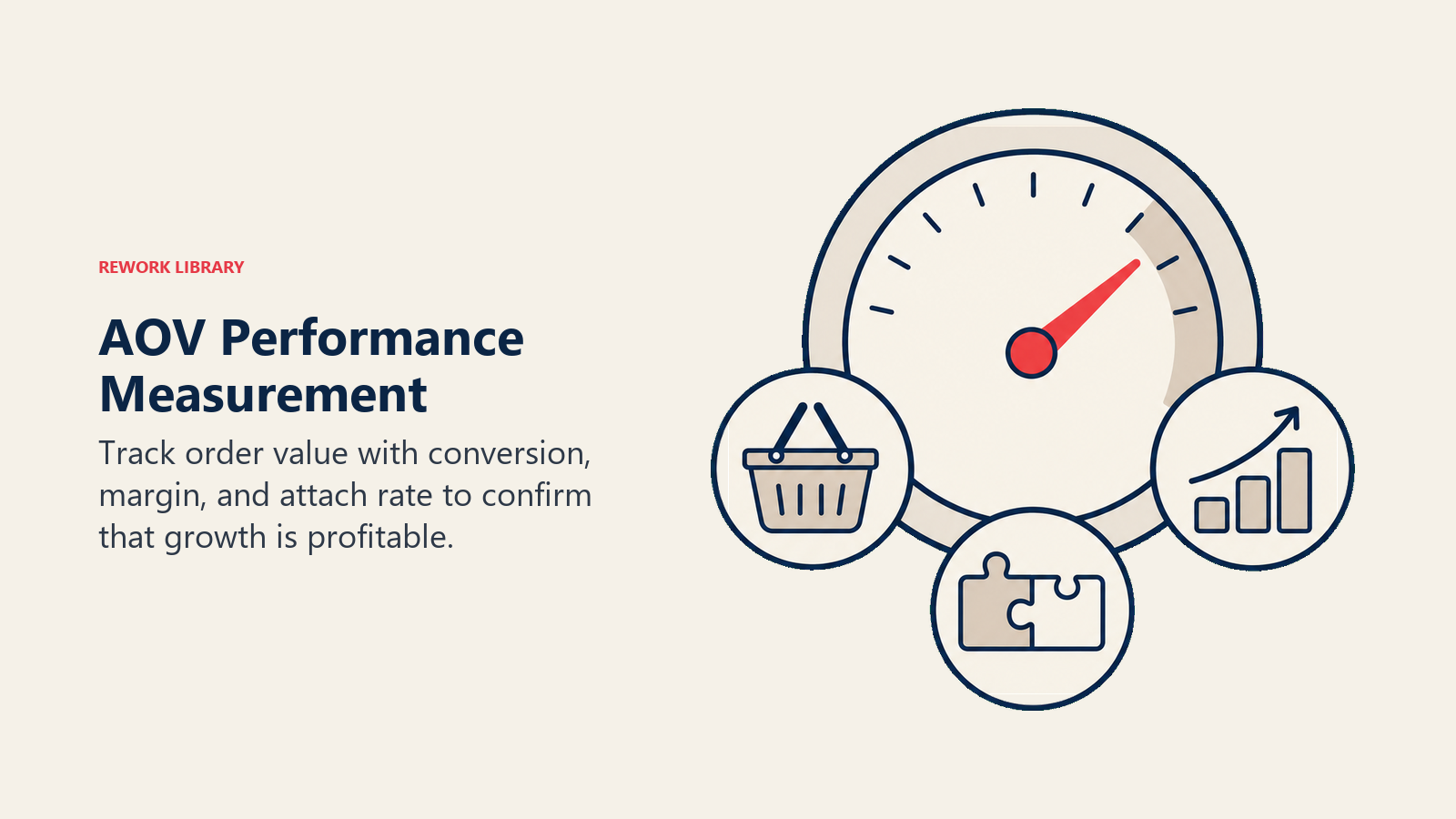
Track AOV alongside related e-commerce metrics and KPIs to understand the full picture:
Core AOV Metrics
Overall AOV Trends Track weekly and monthly to identify patterns and seasonal variations.
AOV by Channel Email, organic, paid, social - each typically has different AOV profiles. Optimize strategies by channel.
AOV by Customer Segment New vs returning, geographic location, device type. These insights inform personalization strategies.
AOV by Product Category Identify high-value categories to promote and low-value categories needing bundling strategies.
AOV Impact Metrics
Don't optimize AOV in isolation:
- Conversion Rate: Ensure conversion rate optimization tactics don't tank from aggressive upselling
- Cart Abandonment: Monitor whether upsells increase abandonment
- Customer Lifetime Value: Higher AOV should correlate with higher CLV
- Profit Margin: Track margin per order, not just revenue
Testing Framework
Run structured experiments:
- Isolate variables: Test one AOV tactic at a time
- Segment appropriately: Some tactics work for new customers, others for returning
- Run for statistical significance: Minimum 2-4 weeks depending on traffic
- Consider secondary metrics: Revenue per visitor, profit per order
Implementation Roadmap & Scaling
Start with high-impact, low-complexity tactics and build from there.
Phase 1: Foundation (Weeks 1-4)
Quick Wins:
- Implement free shipping threshold 25% above current AOV
- Add "frequently bought together" to product pages
- Create 3-5 product bundles for best-sellers
- Set up cart progress indicators
Expected Impact: 8-12% AOV increase
Phase 2: Optimization (Months 2-3)
Intermediate Tactics:
- Launch volume discount tiers
- Implement post-purchase upsells
- Add checkout order bumps
- Set up automated product recommendations
Expected Impact: Additional 10-15% AOV increase
Phase 3: Advanced Personalization (Months 4-6)
Sophisticated Approaches:
- AI-powered personalization engine
- Dynamic pricing and offers by segment
- Advanced bundle optimization
- Integrated subscription upsells
Expected Impact: Additional 8-12% AOV increase
Scaling Considerations
As you scale AOV strategies:
Maintain Margin Discipline Track profit per order alongside AOV. A 20% AOV increase that reduces margin by 30% isn't success.
Balance Acquisition and AOV Don't let AOV tactics increase entry barriers for new customers. Consider different strategies for new vs returning customers.
Keep Testing AOV optimization is never "done." Customer behavior evolves, competitive dynamics shift, and new tactics emerge. Maintain a continuous testing calendar.
Integrate Across Channels Extend AOV strategies beyond your website to email, SMS, and marketplace channels where applicable.
The Path Forward
AOV optimization is the most efficient path to revenue growth because it compounds across every transaction. A systematic approach combining multiple techniques (bundling, upsells, threshold incentives, and smart pricing) consistently increases average order value by 25-40% within six months.
Start with your highest-traffic pages and biggest bottlenecks. Implement foundational tactics quickly, then build toward more sophisticated personalization as you collect data and learn what resonates with your customers.
The stores that win with AOV optimization don't rely on a single tactic. They layer multiple strategies that work together, creating a buying experience that naturally encourages customers to purchase more while feeling like they're getting better value.
Your customers are already buying. The question is whether you're making it easy for them to buy more.
Frequently Asked Questions
What is AOV optimization?
AOV optimization is the practice of increasing the average amount customers spend per order. It combines tactics like bundling, upselling, cross-selling, free-shipping thresholds, volume discounts, and pricing psychology to raise revenue per transaction without spending more on acquisition.
How do you calculate average order value?
Average order value equals total revenue divided by number of orders. If you generated $50,000 from 1,000 orders last month, your AOV is $50. Track it weekly and monthly, and segment it by channel, customer type, and product category to find where the upside is.
What is the fastest way to increase AOV?
The quickest wins are a free-shipping threshold set 20 to 30% above current AOV, a "frequently bought together" module on product pages, and 3 to 5 curated bundles for best-sellers. Together these foundational tactics typically deliver an 8 to 12% AOV increase in the first month.
How much can AOV optimization increase revenue?
A systematic, layered approach combining bundling, upsells, threshold incentives, and smart pricing usually raises average order value 25 to 40% within six months. Because the lift applies to every order, even a 10% AOV increase at the same traffic means 10% more revenue.
Learn More
Maximize your e-commerce revenue by exploring these related strategies:
- Cart Abandonment Recovery - Recover lost revenue from abandoned carts and re-engage potential customers
- Loyalty Programs - Build customer retention programs that increase lifetime value and repeat purchase frequency

On this page
- Understanding Average Order Value (AOV)
- Why AOV Matters More Than You Think
- AOV Benchmarks by Industry
- The AOV Optimization Framework
- Core AOV Levers
- The Layered Approach
- Product Bundling as an AOV Driver
- Bundle Types That Drive AOV
- Bundle Pricing Strategy
- Upsell & Cross-Sell Mechanics
- Strategic Upsell Positioning
- Cross-Sell Best Practices
- Free Shipping Threshold Strategy
- Setting Your Threshold
- Communicating the Threshold
- Threshold Product Strategy
- Volume Discounts & Tiered Pricing
- Tiered Discount Structures
- Making Tiers Work
- Pricing Psychology & AOV Optimization
- Psychological Pricing Techniques
- Good-Better-Best Strategy
- Product Recommendations & AI Personalization
- Recommendation Types That Drive AOV
- Implementation Best Practices
- Post-Purchase & Order Expansion
- Post-Purchase Upsell Windows
- What to Offer Post-Purchase
- Checkout & Cart Optimization for AOV
- Cart Page Elements That Increase AOV
- Checkout Optimization
- Analytics & Performance Measurement
- Core AOV Metrics
- AOV Impact Metrics
- Testing Framework
- Implementation Roadmap & Scaling
- Phase 1: Foundation (Weeks 1-4)
- Phase 2: Optimization (Months 2-3)
- Phase 3: Advanced Personalization (Months 4-6)
- Scaling Considerations
- The Path Forward
- Frequently Asked Questions
- Learn More