Customer Feedback Loop: Building a Systematic Approach to Closing the Loop
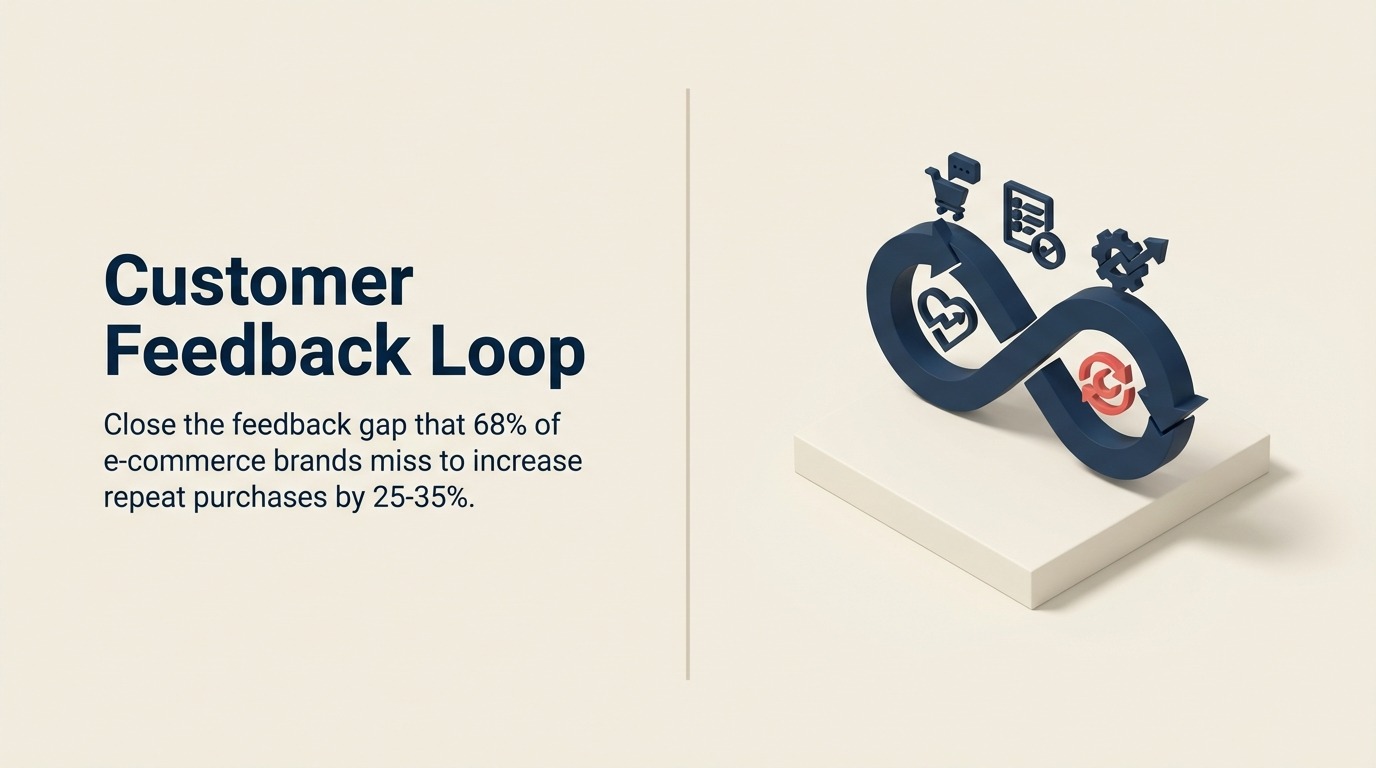 Here's a sobering reality: 68% of e-commerce brands collect customer feedback. But only 12% actually act on it and close the loop with their customers.
Turn this article into takeaways for your work.


Each assistant summarizes the article only for you and suggests best practices for your work.
That's not just a missed opportunity. It's leaving serious revenue on the table. Brands that implement systematic feedback loops see 25-35% increases in repeat purchase rates and 30-40% improvements in Customer Lifetime Value (LTV).
The difference between collecting feedback and building a feedback loop? One is passive listening. The other is an operational system that turns customer insights into retention gold.
What Is a Customer Feedback Loop?
A customer feedback loop is a closed-loop operational system that:
- Collects feedback across multiple touchpoints
- Analyzes patterns and sentiment to extract insights
- Takes action on meaningful feedback through product, service, or experience improvements
- Communicates back to customers about how their input drove change
The "closed-loop" part is critical. It's not enough to collect and act, you must close the circle by letting customers know their voice mattered.
This builds trust, loyalty, and turns customers into vocal advocates who feel invested in your brand's evolution.
Why Feedback Loops Matter for Retention
When customers see their feedback translate into tangible changes, several powerful dynamics kick in: Psychological ownership: Customers who contribute to improvements feel partial ownership of your brand's direction. That emotional investment translates directly into loyalty.
Trust amplification: Responding to feedback, especially negative feedback, demonstrates you're not just selling products; you're building relationships.
Churn prevention: According to research from Customer Contact Council, customers whose complaints are resolved quickly and communicated clearly are actually more loyal than customers who never had issues. This proactive approach to churn prevention strategies transforms potential losses into retention wins.
The retention math works out like this:
- 25-35% increase in repeat purchase rates when customers see their feedback acted upon
- 30-40% improvement in Customer Lifetime Value
- 2-3x higher referral rates from customers who contribute to product improvements
- 40-50% reduction in customer service inquiries when common feedback is systematically addressed
These improvements directly impact your customer retention strategies and bottom-line profitability.
But here's where most brands fail: they treat feedback as a one-way street rather than a conversation.
Feedback Collection Methods
An effective feedback loop draws from multiple sources to build a complete picture of customer sentiment.
Post-Purchase Surveys
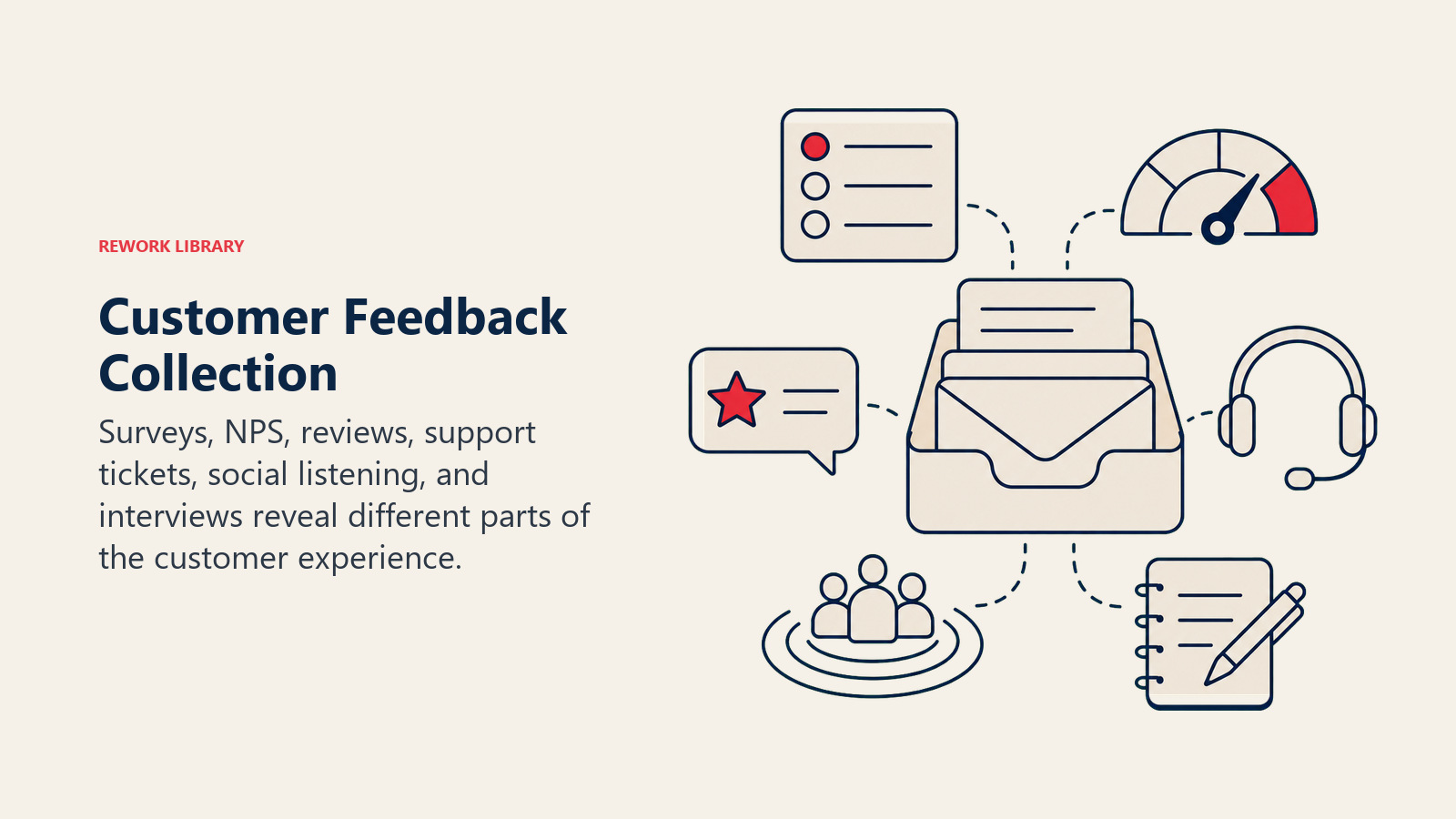
Timing is everything. Send your first feedback request 7-14 days after delivery, long enough for customers to use the product, but soon enough that the experience is fresh.
Keep surveys short (3-5 questions max) and focus on:
- Product satisfaction
- Delivery experience
- One open-ended "what could we improve?" question
Pro tip: Include a follow-up question asking if they'd be willing to elaborate. This identifies your most engaged customers for deeper conversations.
Net Promoter Score (NPS)
NPS measures customer loyalty through one simple question: "How likely are you to recommend us to a friend or colleague?" (0-10 scale)
- Promoters (9-10): Your brand advocates
- Passives (7-8): Satisfied but unenthusiastic
- Detractors (0-6): At-risk customers
The follow-up question, "What's the main reason for your score?", is where the gold is buried. More on NPS implementation below.
Customer Reviews
Reviews are unsolicited feedback goldmines. The key is treating them as a feedback channel, not just social proof.
Develop a systematic approach to:
- Weekly review analysis for pattern identification
- Categorization by product, service, shipping, packaging
- Response protocols for both positive and negative reviews
Learn more about leveraging reviews in Customer Reviews & UGC.
Support Ticket Analysis
Your customer service interactions contain invaluable insights about product issues, unclear policies, and friction points.
Tag every support ticket by category and review monthly for patterns. If you're getting 15 tickets/week about sizing, that's a feedback signal demanding action.
Social Media Listening
Customers often share unfiltered opinions on social platforms before they'd fill out a formal survey.
Monitor:
- Direct mentions and tags
- Brand hashtags
- Comments on posts
- DMs and private messages
Use social listening tools to track sentiment trends over time.
On-Site Behavior Analytics
Sometimes feedback is behavioral rather than verbal. High cart abandonment on mobile? That's feedback. Lots of returns for a specific product? That's feedback.
Combine quantitative behavioral data with qualitative surveys to understand the "why" behind the "what." These insights often reveal opportunities for conversion rate optimization and user experience improvements.
Building a Feedback Aggregation System
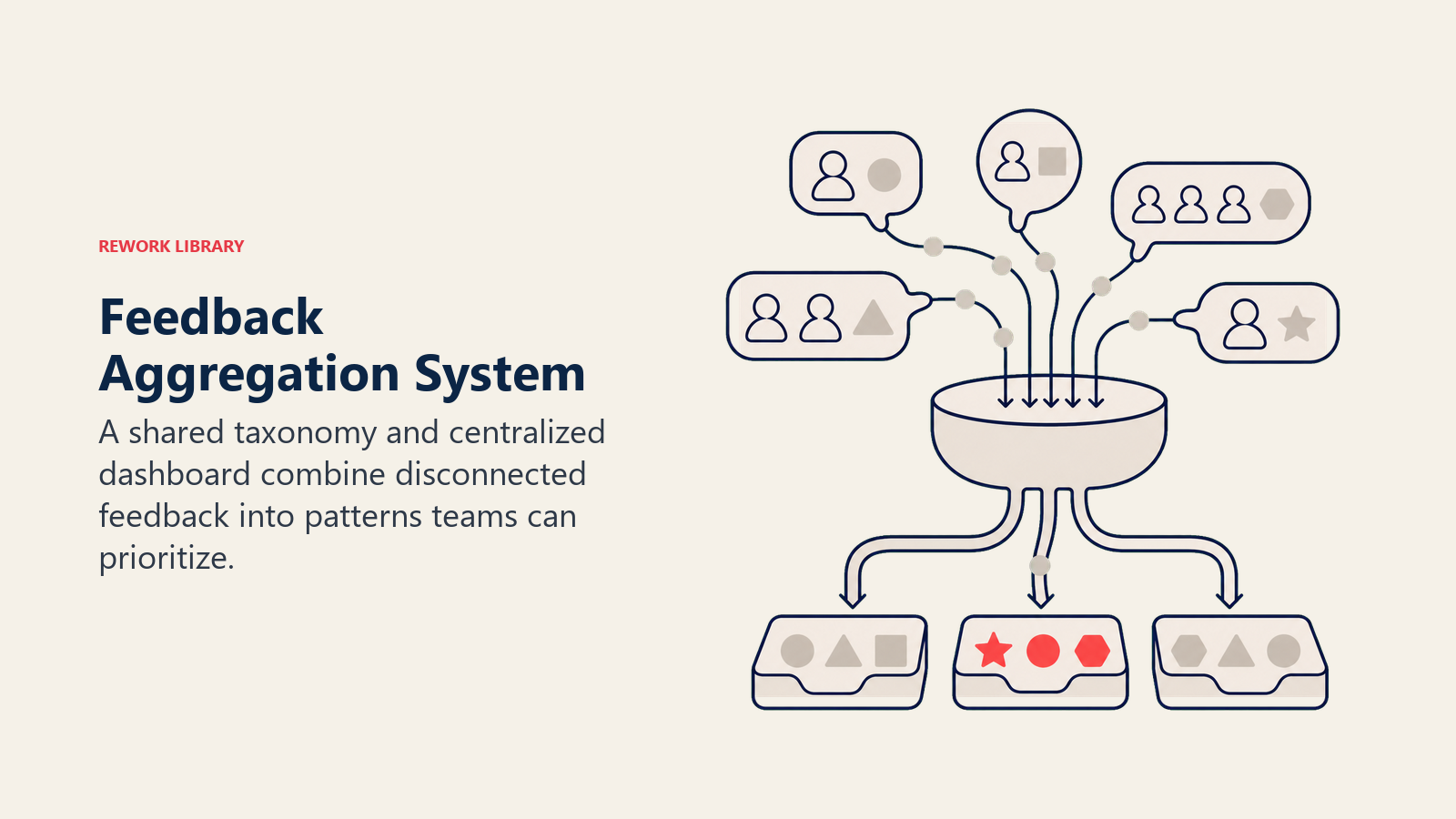
Here's where most brands hit a wall: they're drowning in disconnected feedback spread across platforms. You need a centralized feedback dashboard that aggregates:
- Survey responses
- Review content
- Support tickets
- Social mentions
- NPS scores
Tagging and Categorization
Create a consistent taxonomy for categorizing feedback:
Product-related:
- Quality issues
- Feature requests
- Sizing/fit problems
- Missing features
Experience-related:
- Shipping speed/issues
- Packaging concerns
- Website usability
- Customer service quality
Communication-related:
- Unclear policies
- Email frequency
- Marketing tone
Tag everything. This enables you to identify patterns that might not be obvious from individual pieces of feedback.
Sentiment Analysis
For brands processing hundreds of feedback entries monthly, sentiment analysis tools can automatically categorize feedback as positive, negative, or neutral.
But don't rely solely on automation, manual review of a sample ensures you're not missing nuance or context.
Creating Feedback Reports
Build a monthly feedback summary that includes:
- Total feedback volume by channel
- Top 10 themes (positive and negative)
- Sentiment trends month-over-month
- Priority items requiring action
- Progress on previous action items
Distribute this report to every department: product, marketing, customer service, operations, and leadership.
Translating Feedback into Action
Collecting and analyzing feedback is pointless without systematic action. Here's how to ensure feedback drives change:
Prioritization Framework
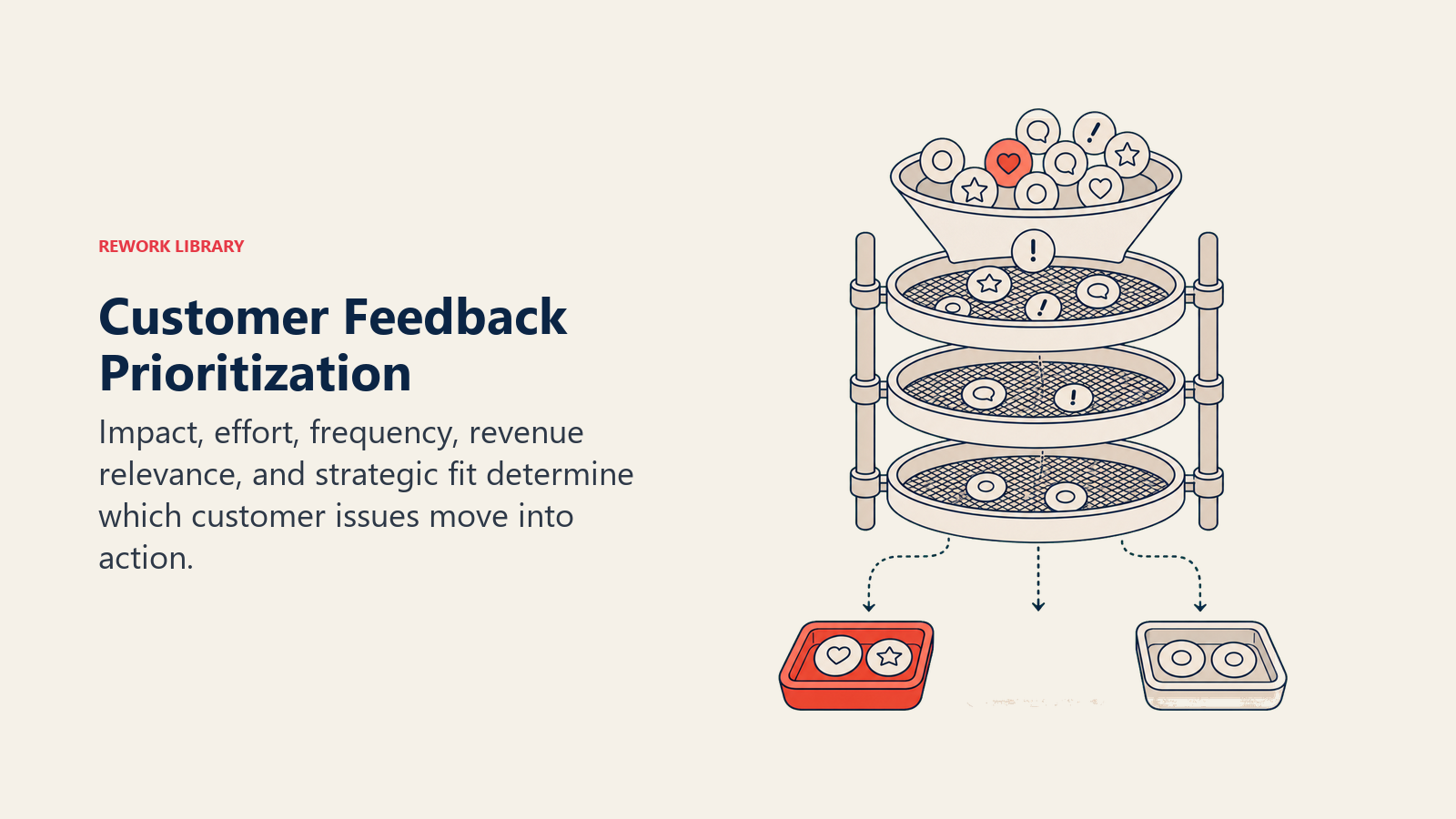
Not all feedback deserves equal attention. Use this framework:
Impact vs. Effort Matrix:
- High impact, low effort: Do immediately
- High impact, high effort: Roadmap for next quarter
- Low impact, low effort: Quick wins when bandwidth allows
- Low impact, high effort: Deprioritize or ignore
Frequency weighting: If 50 customers mention the same issue, that's more urgent than 5 customers mentioning separate concerns.
Revenue correlation: Does this feedback come from your highest-value customer segments? Use customer segmentation to prioritize feedback from your most valuable cohorts.
Product Team Collaboration
Feedback should directly inform your product roadmap. Create a formal process:
- Monthly feedback reviews with product, marketing, and customer service
- Feedback-driven feature requests added to product backlog
- Customer advisory board (10-15 engaged customers) for major decisions
- Beta testing programs that loop customers into development
When customers see their suggestions materialize into real features, they become lifetime advocates.
Process and Policy Changes
Not all feedback requires product changes, sometimes it reveals process or policy issues:
- Confusing return policy? Rewrite it and optimize your returns management process.
- Too many emails? Adjust frequency and segmentation.
- Slow shipping? Evaluate fulfillment partners.
These operational changes often deliver faster ROI than product updates.
Closing the Loop with Customers
This is where the magic happens, and where 88% of brands fail.
Individual Recognition
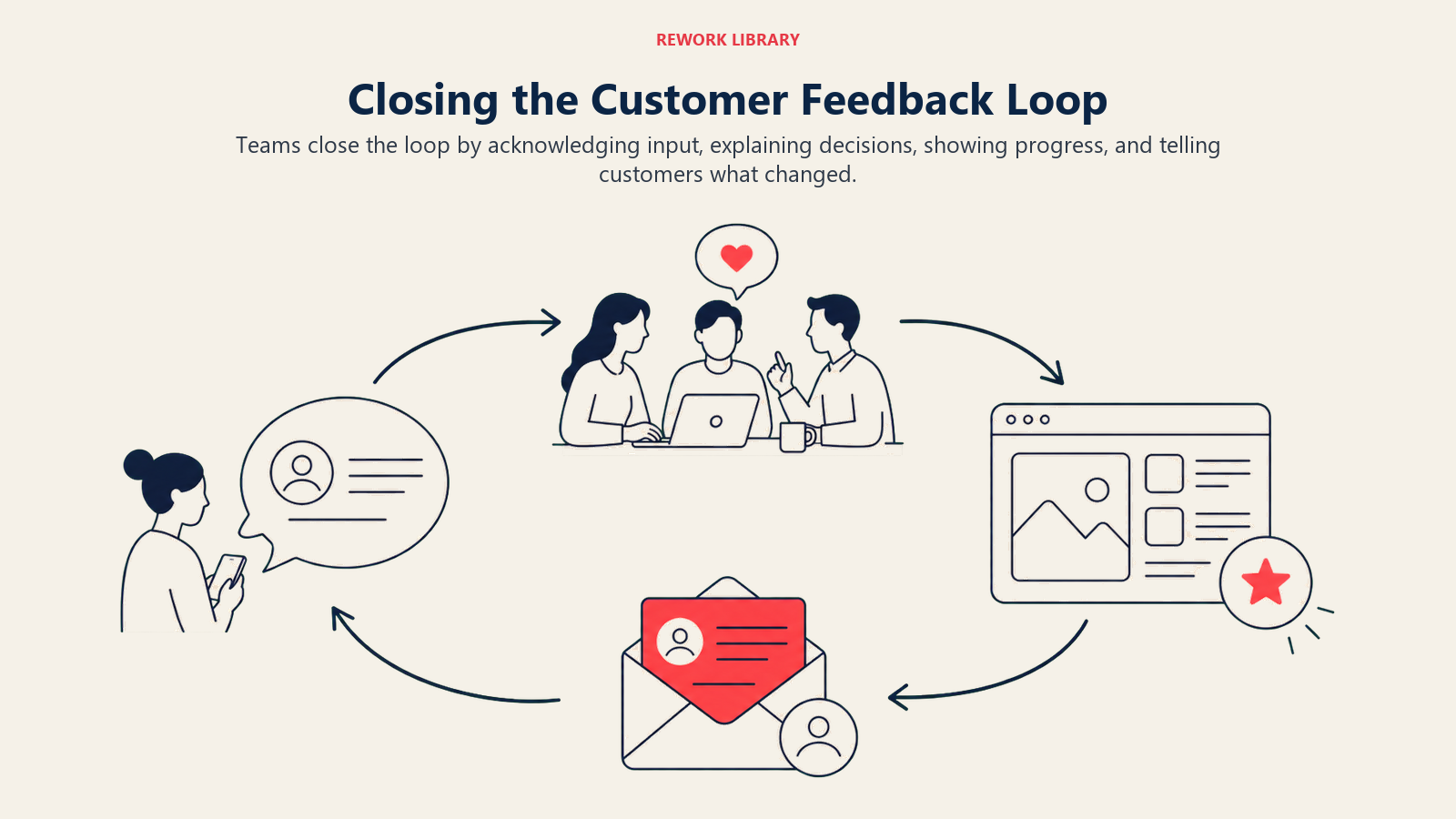
When a customer provides valuable feedback that leads to change:
- Email them personally (from a real person, not "support@")
- Explain what changed as a result of their input
- Offer a thank-you gesture: discount code, early access, or small gift
- Invite them to continue participating: join your advisory board or beta program
This transforms a transaction into a relationship.
Progress Updates
For feedback that requires longer-term solutions, keep customers in the loop:
"Thanks for suggesting we add size guides to product pages. We're working on this and expect to launch in Q2. We'll let you know when it's live."
Even if you can't implement a suggestion, explain why:
"We've explored adding overnight shipping, but the cost would require raising prices by 15%. Based on customer surveys, most prefer the current pricing model. We're continuing to optimize standard shipping speed instead."
Transparency builds trust, even when you can't deliver what customers want.
Public Spotlighting
Feature customer-driven improvements publicly:
- "You asked, we delivered" email campaigns highlighting feedback-driven changes
- Social media posts crediting customers (with permission) for suggestions
- Blog posts explaining how customer feedback shaped product evolution
- Update sections on your website showing recent improvements
This demonstrates to your entire customer base that you're listening and acting.
Learn how to integrate this into your Email Marketing for E-commerce strategy.
NPS Program Deep Dive
Net Promoter Score deserves special attention as one of the most powerful feedback and retention tools available.
Survey Setup and Timing
Frequency: Survey customers 30-45 days after their first purchase, then quarterly for repeat customers.
Survey structure:
- "How likely are you to recommend [Brand] to a friend?" (0-10)
- "What's the primary reason for your score?"
- "What's one thing we could do to improve your experience?"
Keep it to three questions max. More reduces completion rates.
Promoter Follow-Up (9-10 scores)
Promoters are your growth engine. Follow up within 24 hours:
Request a review: "We're so glad you love our products! Would you mind sharing your experience in a quick review?"
Referral program invitation: Turn enthusiasm into acquisition by inviting them to your referral program.
Testimonial request: Ask permission to feature their feedback on your website or social media.
Community engagement: Invite them to join your customer community, beta programs, or advisory board.
This approach integrates NPS with Loyalty Programs for compounding effect.
Detractor Recovery (0-6 scores)
Detractors represent both a risk and an opportunity. 70% of complaining customers will do business with you again if you resolve their issue.
Immediate escalation protocol:
- Flag detractor responses to customer service within 1 hour
- Reach out within 4 business hours with personalized outreach
- Address the specific issue mentioned in their NPS response
- Offer a resolution (refund, replacement, discount on next order)
- Follow up 2 weeks later to confirm satisfaction
Track conversion of detractors to passives or promoters. This metric reveals the effectiveness of your recovery process.
Passive Engagement (7-8 scores)
Passives are satisfied but not enthusiastic, ripe for conversion to promoters:
- Identify friction points: Their feedback often reveals small improvements that would elevate their experience
- Personalized recommendations: Show them products or features they haven't tried
- VIP treatment: Small gestures (early access, surprise discounts) can tip them to promoter status
NPS Trend Tracking
Your absolute NPS score matters less than trends over time:
- Track NPS monthly/quarterly
- Segment by customer cohort (first-time vs. repeat, product category, acquisition channel)
- Identify which initiatives moved the needle
- Set quarterly NPS improvement goals
Review Generation and Management
Reviews are both feedback and Trust Signals & Social Proof. A systematic approach maximizes both benefits.
Automated Review Request Timing
Send review requests 7-14 days post-delivery, depending on your product:
- Consumables: 7-10 days (long enough to try)
- Electronics/tools: 14-21 days (long enough to set up and use)
- Apparel: 7-10 days (quick to evaluate fit/quality)
Integrate review requests into Post-Purchase Email Sequences.
Incentivizing Reviews (The Right Way)
Do: Offer entry into a monthly giveaway for anyone who leaves a review (positive or negative).
Don't: Offer rewards only for positive reviews, this violates most platform policies and destroys credibility.
Consider: Small point bonuses in loyalty programs for verified reviews.
Responding to Reviews
Create protocols for timely responses:
Positive reviews (4-5 stars):
- Thank the customer by name
- Highlight specific praise they mentioned
- Invite them to share on social or join your community
Negative reviews (1-3 stars):
- Respond within 24 hours
- Acknowledge the issue without making excuses
- Offer a resolution publicly and follow up privately
- Update the response once resolved to show closure
Pro tip: 45% of customers who leave negative reviews will update them to positive after a satisfactory resolution. Include a gentle ask: "If we've addressed your concerns, we'd appreciate if you'd consider updating your review."
Review Analysis for Product Development
Mine reviews quarterly for:
- Common quality complaints (manufacturing issues)
- Unmet expectations (description vs. reality gaps on product pages)
- Unexpected use cases (innovation opportunities)
- Accessory or complementary product suggestions
This feeds directly into your product research and validation process and product roadmap.
Operationalizing Feedback Loops
Systems fail without clear ownership and processes. Here's how to make feedback loops part of your operational DNA:
Assign Ownership
Designate a "Voice of Customer" owner (often sits in marketing or operations) responsible for:
- Aggregating feedback from all channels
- Producing monthly feedback reports
- Facilitating cross-functional feedback meetings
- Tracking action items to completion
- Closing the loop with customers
For smaller teams, this might be 10-20% of someone's role. For larger operations, it's a full-time position.
Monthly Feedback Cycles
Establish a recurring monthly process:
Week 1: Compile feedback from all sources, categorize, and analyze sentiment.
Week 2: Present findings to cross-functional team (product, marketing, CS, ops).
Week 3: Prioritize action items, assign owners, and set deadlines.
Week 4: Update customers on progress from previous month's feedback.
This rhythm ensures feedback drives continuous improvement rather than sporadic reactions.
Cross-Departmental Feedback Meetings
Monthly 90-minute meetings with representatives from:
- Product/merchandising
- Marketing
- Customer service
- Operations/fulfillment
- Leadership
Agenda:
- Review top 10 feedback themes (30 min)
- Discuss prioritization and action items (40 min)
- Update on previous action items (20 min)
This keeps feedback front-of-mind across the organization.
Integration with OKRs and KPIs
Tie feedback metrics to company objectives and track them alongside your e-commerce metrics and KPIs:
- Product team: "Reduce 'quality concern' feedback by 30% this quarter"
- Marketing: "Increase NPS from 45 to 55 by year-end"
- Customer service: "Achieve 90% detractor response rate within 4 hours"
- Operations: "Decrease 'shipping delay' complaints by 50%"
When feedback metrics are tied to performance, they get prioritized.
Tools and Technology Stack
The right tools make feedback loops scalable. Here's a recommended stack:
Feedback Collection Platforms
Delighted or AskNicely: Purpose-built for NPS surveys with automation and tracking.
Typeform or SurveyMonkey: Flexible survey tools for post-purchase feedback.
Yotpo or Stamped.io: Review collection and management with e-commerce integrations.
Gorgias or Zendesk: Support ticket systems with tagging and reporting capabilities.
Sentiment Analysis and Aggregation
MonkeyLearn or Lexalytics: AI-powered sentiment analysis for large feedback volumes.
Thematic or Luminoso: Advanced text analytics for pattern identification.
Zapier or Integromat: Connect feedback sources into centralized dashboards.
Customer Data Platforms
Segment or mParticle: Aggregate feedback with customer profiles for segmented analysis.
Klaviyo or Customer.io: Email platforms with built-in NPS and survey capabilities.
Feedback Management and Workflow
Productboard or Canny: Turn feedback into product roadmaps with voting and prioritization.
Airtable or Notion: Build custom feedback tracking dashboards with workflow automation.
Slack integrations: Real-time detractor alerts to your team for immediate response.
Analytics and Reporting
Looker or Tableau: Build comprehensive feedback dashboards combining multiple data sources.
Google Data Studio: Free option for creating visual feedback trend reports.
The key is integration, your tools should talk to each other, creating a unified view of customer sentiment across touchpoints.
Feedback Loop Maturity Model
Most e-commerce brands progress through distinct stages in feedback sophistication:
Stage 1: Reactive Collection (0-6 months)
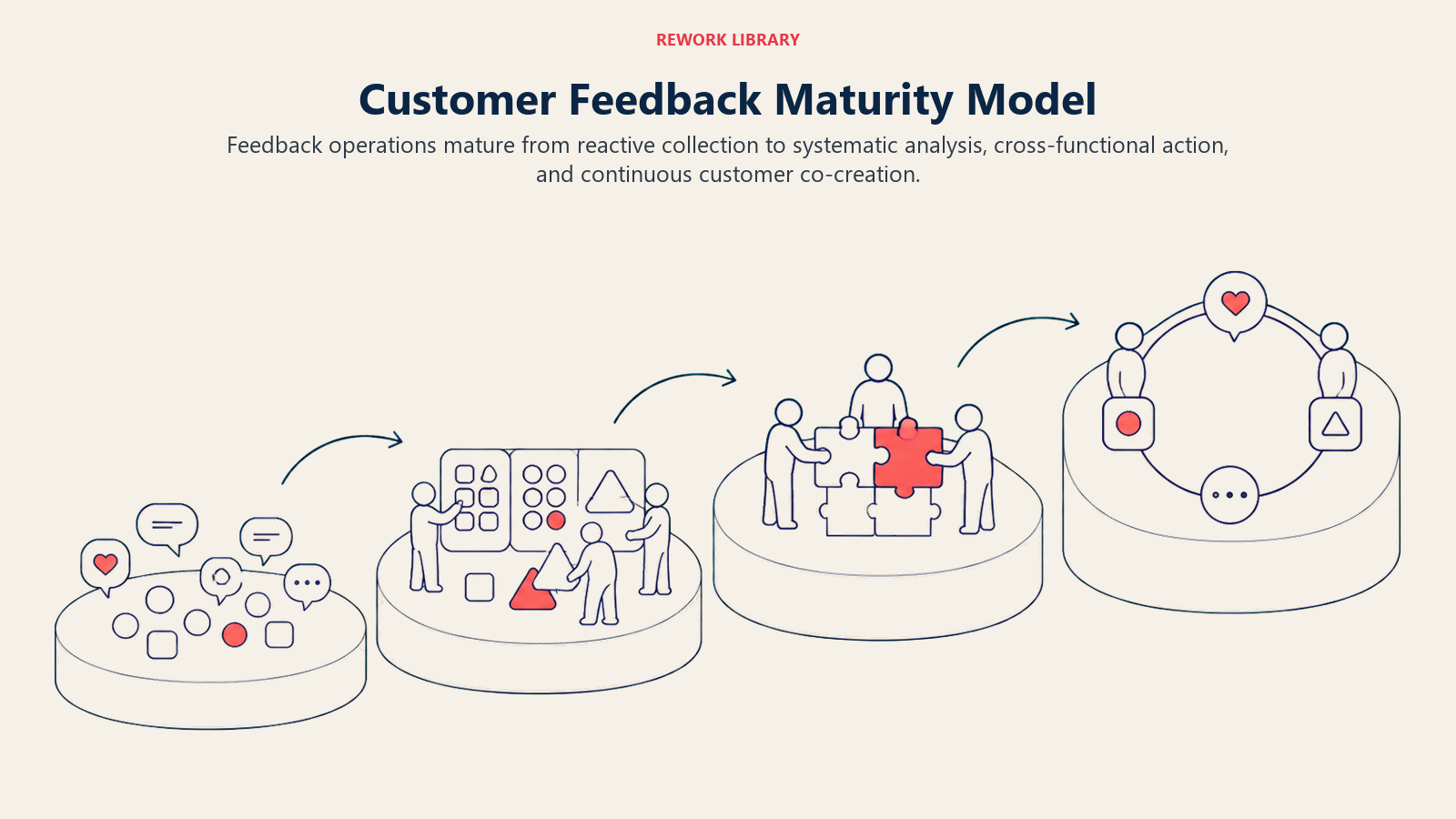
You're collecting feedback sporadically, primarily through reviews and support tickets. No systematic analysis or follow-up.
Action items:
- Implement post-purchase surveys
- Set up basic NPS program
- Create feedback tagging taxonomy
Stage 2: Systematic Analysis (6-12 months)
You're collecting feedback across multiple channels and aggregating it monthly. Basic prioritization and action planning exists.
Action items:
- Establish monthly feedback review meetings
- Assign feedback ownership
- Build centralized dashboard
- Start closing loop with high-value customers
Stage 3: Closed-Loop Operations (12-18 months)
Feedback directly informs product roadmap and operational changes. You're consistently closing the loop with customers and seeing measurable retention impact.
Action items:
- Develop customer advisory board
- Public "You asked, we delivered" campaigns
- Segment feedback by customer cohort
- Tie feedback metrics to team OKRs
Stage 4: Proactive Insight Mining (18+ months)
You're not just reacting to feedback, you're proactively mining it for innovation opportunities. Customers view your brand as co-created with them.
Action items:
- Predictive analytics to anticipate feedback trends
- Community-driven feature voting
- Beta testing programs with customer cohorts
- Feedback-driven personalization at scale
Most successful DTC brands operate at Stage 3-4, making customer feedback a competitive moat that larger competitors can't easily replicate, a key element of effective brand building and positioning.
Closing the Loop on Feedback Loops
Here's the bottom line: Customer feedback isn't just data, it's the voice of your future revenue.
Every piece of feedback represents a customer taking time to help you improve. When you honor that investment by actually improving and letting them know, you transform transactions into relationships.
The brands winning retention and loyalty wars aren't necessarily the ones with perfect products. They're the ones who listen, act, and close the loop, turning customers into co-creators and advocates.
Start small: implement NPS this month, build a basic aggregation system, and close the loop with your top 10 customers who've provided valuable feedback. The retention impact will be immediate and measurable.
Your customers are already telling you how to earn their loyalty. The question is: are you listening?
Related Resources:

On this page
- What Is a Customer Feedback Loop?
- Why Feedback Loops Matter for Retention
- Feedback Collection Methods
- Post-Purchase Surveys
- Net Promoter Score (NPS)
- Customer Reviews
- Support Ticket Analysis
- Social Media Listening
- On-Site Behavior Analytics
- Building a Feedback Aggregation System
- Tagging and Categorization
- Sentiment Analysis
- Creating Feedback Reports
- Translating Feedback into Action
- Prioritization Framework
- Product Team Collaboration
- Process and Policy Changes
- Closing the Loop with Customers
- Individual Recognition
- Progress Updates
- Public Spotlighting
- NPS Program Deep Dive
- Survey Setup and Timing
- Promoter Follow-Up (9-10 scores)
- Detractor Recovery (0-6 scores)
- Passive Engagement (7-8 scores)
- NPS Trend Tracking
- Review Generation and Management
- Automated Review Request Timing
- Incentivizing Reviews (The Right Way)
- Responding to Reviews
- Review Analysis for Product Development
- Operationalizing Feedback Loops
- Assign Ownership
- Monthly Feedback Cycles
- Cross-Departmental Feedback Meetings
- Integration with OKRs and KPIs
- Tools and Technology Stack
- Feedback Collection Platforms
- Sentiment Analysis and Aggregation
- Customer Data Platforms
- Feedback Management and Workflow
- Analytics and Reporting
- Feedback Loop Maturity Model
- Stage 1: Reactive Collection (0-6 months)
- Stage 2: Systematic Analysis (6-12 months)
- Stage 3: Closed-Loop Operations (12-18 months)
- Stage 4: Proactive Insight Mining (18+ months)
- Closing the Loop on Feedback Loops