Product Line Expansion: Strategic Growth Through New Product Categories
Turn this article into takeaways for your work.


Each assistant summarizes the article only for you and suggests best practices for your work.
You've optimized your hero products, nailed your conversion rate optimization, and maximized your existing catalog. Revenue is growing, but you've hit a ceiling. Your customers are asking for more, but you're not sure which direction to expand. This is the strategic challenge of product line expansion: the right move can double your business, and the wrong one can dilute everything you've built.
Product line expansion isn't just about adding more SKUs. It's about strategically extending your brand into new categories, price points, or customer segments while maintaining operational excellence and brand integrity. The difference between successful expansion and costly mistakes comes down to understanding cannibalization risk, resource requirements, and market validation before you commit.
Why Product Line Expansion Matters Now
After you've maximized your existing products through hero product strategy and AOV optimization, expansion becomes your primary growth lever. Why it's the natural next step:
Market saturation signals: When your existing products show diminishing returns on marketing spend, slower growth rates, or plateauing conversion rates, expansion opens new revenue streams. You've captured your addressable market. Now you need to expand that market.
Customer lifetime value multiplication: Expanding into complementary categories increases purchase frequency and customer LTV. A customer who buys one category from you might shop once a year. A customer who buys across three categories? They might shop quarterly. That's 4x more revenue from the same acquisition cost.
Competitive defensibility: A broader product portfolio makes you harder to compete against. Single-product brands are vulnerable to competitors who can undercut on price. Multi-category brands build ecosystems that create switching costs and moats.
Operational leverage: Your existing infrastructure (customer base, supply chain relationships, marketing channels, brand recognition) creates asymmetric advantages for launching new products. You're not starting from zero.
The key is knowing when you're ready. Expand too early, before you've mastered your core, and you spread resources too thin. Expand too late, and competitors fill the white space around you.
Strategic Expansion Fundamentals
Product line expansion comes in three fundamental types, each with different risk profiles and resource requirements:
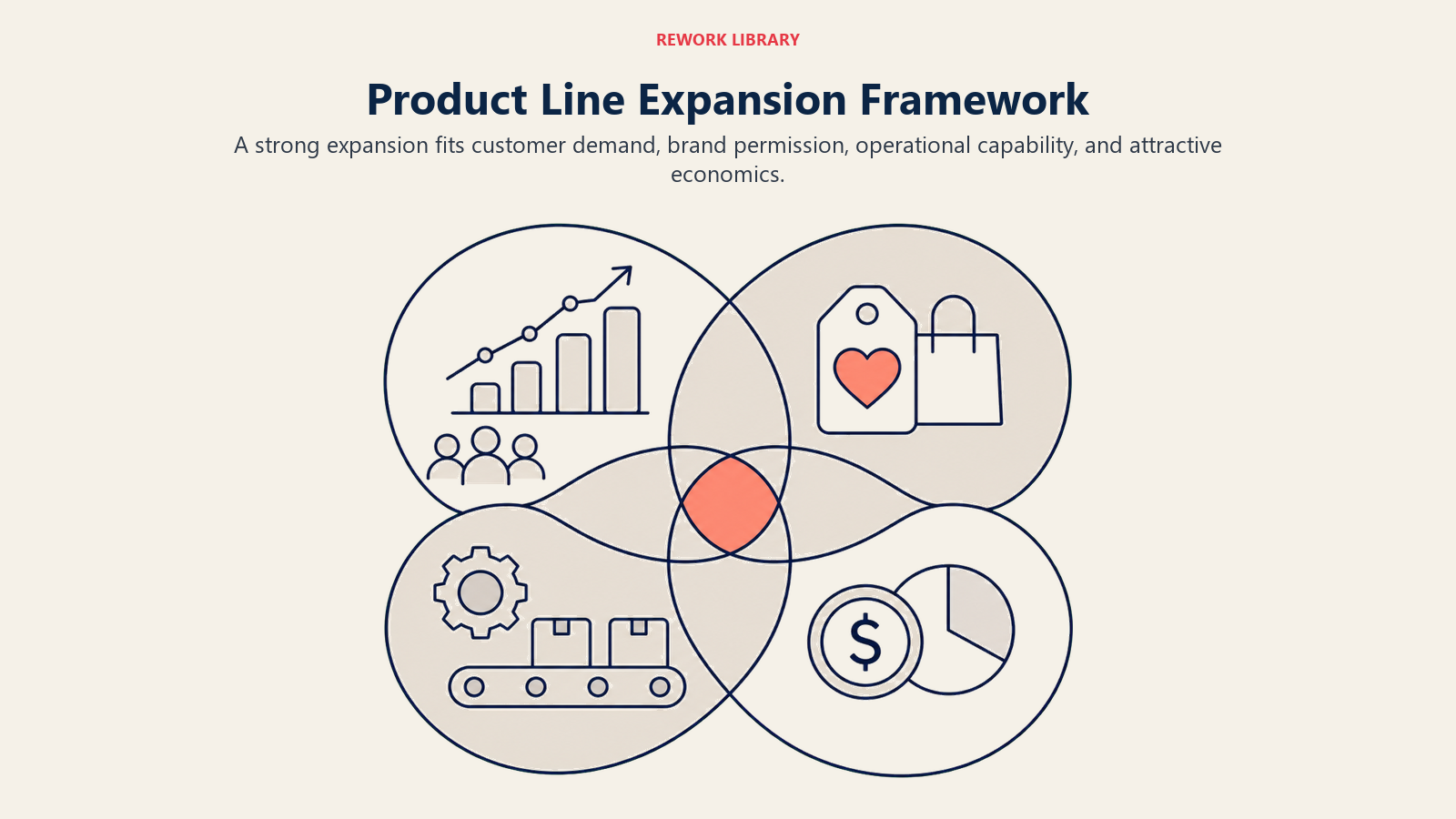
Vertical Expansion (Same Category, Different Price Points)
Vertical expansion means offering premium and budget versions of your existing products. You're serving the same customer need at different price points.
Upward expansion: Adding premium or luxury versions targets customers willing to pay more for enhanced features, materials, or exclusivity. A skincare brand might add a prestige line with rare ingredients. A furniture brand might introduce handcrafted limited editions.
Downward expansion: Adding value or entry-level versions captures price-sensitive customers. This is tricky, you risk cannibalizing your core products or diluting your brand. But done right, it defends against budget competitors and creates an upgrade path.
Risk profile: Medium cannibalization risk, low operational complexity. You're using existing expertise and supply chains - just adjusting specifications and positioning.
Horizontal Expansion (New Categories, Same Customer)
Horizontal expansion means selling different product categories to your existing customer base. You're solving adjacent problems for the same people.
Example: A yoga apparel brand expanding into yoga mats, blocks, and meditation cushions. A coffee roaster adding brewing equipment and accessories. A pet food brand launching toys and grooming products.
Strategic advantage: You already understand these customers intimately. You know their values, shopping behaviors, and pain points. The acquisition cost is often zero - they're already in your database.
Risk profile: Low cannibalization risk (different categories), medium operational complexity (new supply chains and expertise required).
Concentric Expansion (Adjacent Markets)
Concentric expansion targets new customer segments with related products. You're leveraging brand expertise into new markets.
Example: An athletic apparel brand targeting yoga practitioners, then expanding to outdoor enthusiasts, then to athleisure. A B2B software company expanding from enterprise to mid-market.
Strategic advantage: You can apply proven brand positioning and operational capabilities to new segments. Your core competencies transfer even as the customer changes.
Risk profile: Low cannibalization risk, high operational complexity (new customers require different marketing, messaging, and potentially channels).
Most successful expansions combine these approaches strategically. You might horizontally expand into a new category while simultaneously offering vertical tiers within that category.
Market Research and Validation
Before you commit resources to expansion, validate demand systematically through product research and validation. This isn't about hunches. It's about data-driven confidence.
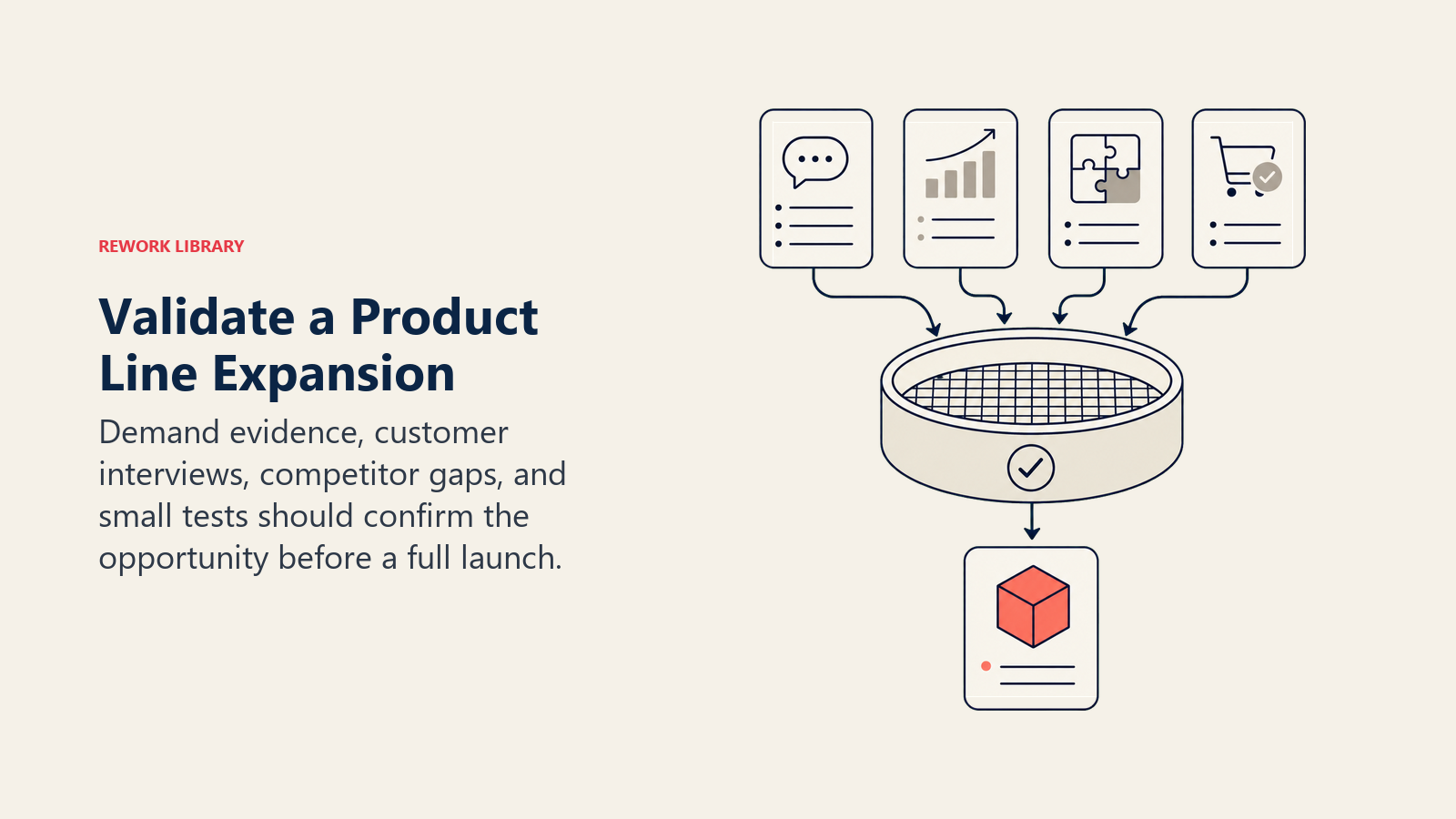
Customer Signal Analysis
Your existing customers are broadcasting expansion opportunities if you're listening:
Support and feedback analysis: Review every customer service interaction, product review, and feedback form for requests, complaints about missing products, or mentions of competitors they're buying from. These are direct signals of unmet needs. Implementing a customer feedback loop helps systematically capture and analyze these insights.
Purchase pattern analysis: Look for customers who buy certain products together frequently, even if those products aren't officially bundled. These natural combinations suggest strong demand for complementary items. Use your e-commerce metrics to identify these patterns.
Cart abandonment research: Sometimes customers add products to cart then abandon because they can't find a complementary item they need. Survey these customers about what prevented the purchase.
Email and survey validation: Send targeted surveys to customer segments asking about specific expansion ideas. Don't ask "would you buy X?" - everyone says yes to hypotheticals. Ask "what's preventing you from solving [problem] today?" and "where do you currently buy [category]?"
Competitive Gap Assessment
Map the competitive landscape to find white space and validate demand:
Category saturation analysis: How many competitors are in the category you're considering? Too few might mean no market. Too many means you need a strong differentiation angle. The sweet spot is enough competition to validate demand but gaps in positioning, price points, or features.
Competitor product line mapping: Create a matrix of competitor products by price point and features. Where are the gaps? Are competitors avoiding certain combinations for good reason (no demand, operational complexity) or is there genuine opportunity?
Market size estimation: Use tools like Google Trends, keyword research, marketplace data, and industry reports to estimate total addressable market. A category might seem attractive but if the total market is $10M and you'd need $2M to break even, the math doesn't work.
Validation Testing Methods
Before full launch, test demand with minimal risk:
Pre-order campaigns: Create product pages for expansion items and measure conversion rates on pre-orders. This validates willingness to buy, not just interest. Set clear expectations about delivery timelines.
Small batch limited releases: Manufacture minimal viable quantity and release to a customer segment. Measure sell-through rate, return rate, and customer feedback. This is especially valuable for physical products where returns indicate product-market fit issues.
Marketplace testing: Before building inventory, test on Amazon, eBay, or other marketplaces where you can list products without holding inventory (using dropshipping or made-to-order). Measure click-through rates and conversion rates against benchmarks.
Landing page validation: Create high-quality landing pages for expansion products and drive paid traffic. Measure email capture rates and pre-order conversion rates. This tests positioning and demand before manufacturing.
The validation phase should cost less than 5% of your full expansion budget. If you can't validate demand at this level, you're not ready to commit.
Cannibalization Risk Assessment
Cannibalization (when new products steal sales from existing products) is the silent killer of product line expansion. You need to quantify this risk before expanding.
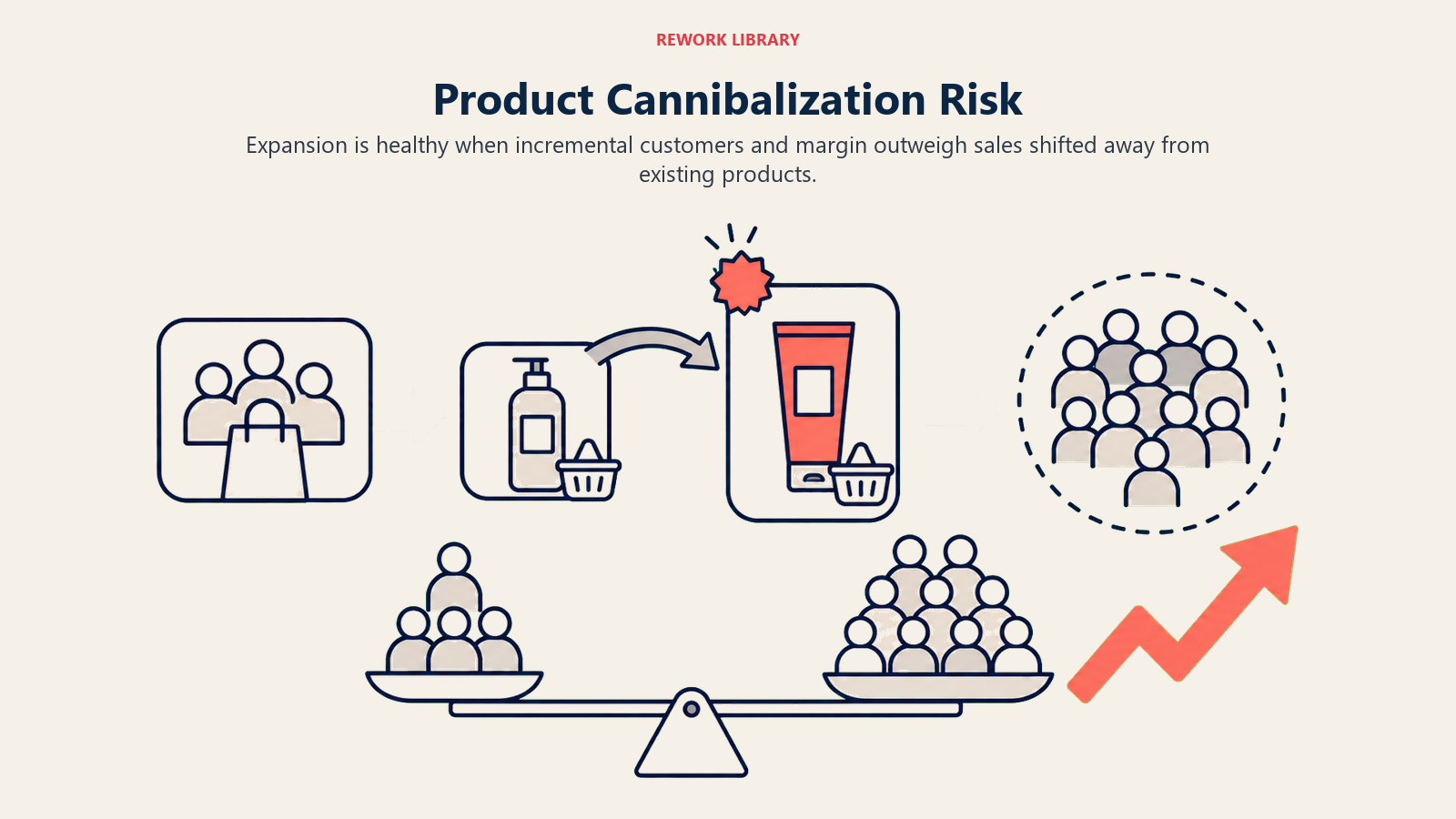
Identifying Cannibalization Threats
Not all cannibalization is bad. Some is inevitable and strategic. The key is understanding the types:
Positive cannibalization: When a new higher-margin product cannibalizes a lower-margin product, you win. If your premium version steals sales from your standard version but has 2x the margin, overall profitability increases. This is vertical expansion done right.
Neutral cannibalization: When a new product splits sales from an existing product but both have similar margins and the combined sales exceed the original product's sales. You're growing the category even if the original product shrinks.
Negative cannibalization: When a new product steals sales from a higher-margin product, or when the combined sales are less than the original product's trajectory. This destroys value.
Cannibalization Calculation Methodology
Here's how to quantify cannibalization risk before launch:
Step 1 - Baseline projection: Establish what your existing product sales would be without the new product. Use historical growth rates, seasonality adjustments, and market trends.
Step 2 - Overlap analysis: Identify the percentage of target customers for the new product who currently buy your existing products. This is your maximum cannibalization exposure.
Example:
- Existing Product A: $500K annual revenue, 30% gross margin
- New Product B targets same need, different price point
- Customer overlap: 60% of Product B's target customers currently buy Product A
- Product B revenue projection: $300K annual revenue, 35% gross margin
Step 3 - Cannibalization rate estimation: Based on price differential, feature differences, and positioning, estimate what percentage of overlapping customers will switch from the existing product to the new product.
Conservative cannibalization estimate: 40% of overlap
- Cannibalized revenue: $500K × 60% overlap × 40% switch rate = $120K
- Lost gross profit: $120K × 30% margin = $36K
Step 4 - Net value calculation: Calculate total portfolio impact.
New product contribution:
- New customer revenue: $300K × 40% (non-overlap) = $120K
- Switched customer revenue: $300K × 60% (overlap) = $180K
- Total gross profit from new product: $300K × 35% = $105K

Existing product impact:
- Lost revenue: $120K
- Lost gross profit: $36K

Net portfolio impact:
- Gross profit from new product: $105K
- Lost gross profit from existing product: -$36K
- Net increase in gross profit: $69K (+19%)
Acceptable cannibalization threshold: If net portfolio gross profit increases, cannibalization is acceptable. If it decreases, you need stronger differentiation, different pricing, or to reconsider the expansion.
Cannibalization Mitigation Strategies
When analysis shows risky cannibalization, these tactics reduce overlap:
Clear positioning differentiation: Position products for different use cases, occasions, or customer segments. Don't compete on the same benefit. A "professional" line versus a "home use" line solves the same problem differently.
Price gap management: Maintain meaningful price separation between tiers through pricing strategy and optimization. Less than 25% difference creates confusion and comparison shopping. More than 100% creates different perceived categories.
Feature bundling: Add complementary features to premium tiers that appeal to different needs rather than just "better" versions of the same features. This creates true segmentation.
Channel separation: Sell different product tiers through different channels. Wholesale versus DTC. Amazon versus your website. This reduces direct comparison and serves different customer shopping behaviors.
Adjacent Products and Upsell Strategy
The most profitable expansion often comes from adjacent products that increase AOV and encourage cross-selling.
Product Ecosystem Design
Think of your product line as an ecosystem where products work better together than separately:
Core + accessories model: A core product that requires or is enhanced by accessories. Coffee machine + beans + filters. Camera + lenses + bag. The core product has modest margins but high repeat purchase on accessories.
Complete solution bundles: Products that together solve an entire need. Don't just sell yoga pants, sell the complete yoga practice with mat, blocks, and meditation cushion. Each item has standalone value but bundled value is higher.
Progression pathways: Create natural upgrade paths as customers' needs evolve. Beginner equipment → intermediate → professional. This increases LTV as customers grow with you rather than churning to competitors. Strategic upselling and cross-selling tactics make these progression pathways seamless.
Consumable + durable pairing: Durable goods with ongoing consumable purchases create recurring revenue. Water filter (durable) + replacement filters (consumable). Razor handle + blades. This model builds predictable revenue and customer lock-in.
Strategic Bundling and Cross-Sell
How you present product combinations drives attachment rate:
Launch bundles: When introducing new categories, offer bundled discounts that combine new products with proven sellers. This reduces perceived risk of trying something new and increases initial basket size.
Smart product page recommendations: On each product page, recommend genuinely complementary items with specific use-case language. "Customers who practice hot yoga also need..." is better than "Customers also bought..."
Post-purchase cross-sell sequences: After purchase, email campaigns that introduce adjacent categories with educational content. Don't just push products, explain how they solve related problems the customer likely has.
Subscription bundle optimization: For businesses with subscription models, create tiered bundles that include products from multiple categories. This increases perceived value and reduces churn.
Resource Requirements and Implementation
Product line expansion requires significant investment across multiple dimensions. Underestimating these requirements is a common failure mode.
Capital Investment Planning
Breaking down the financial commitment:
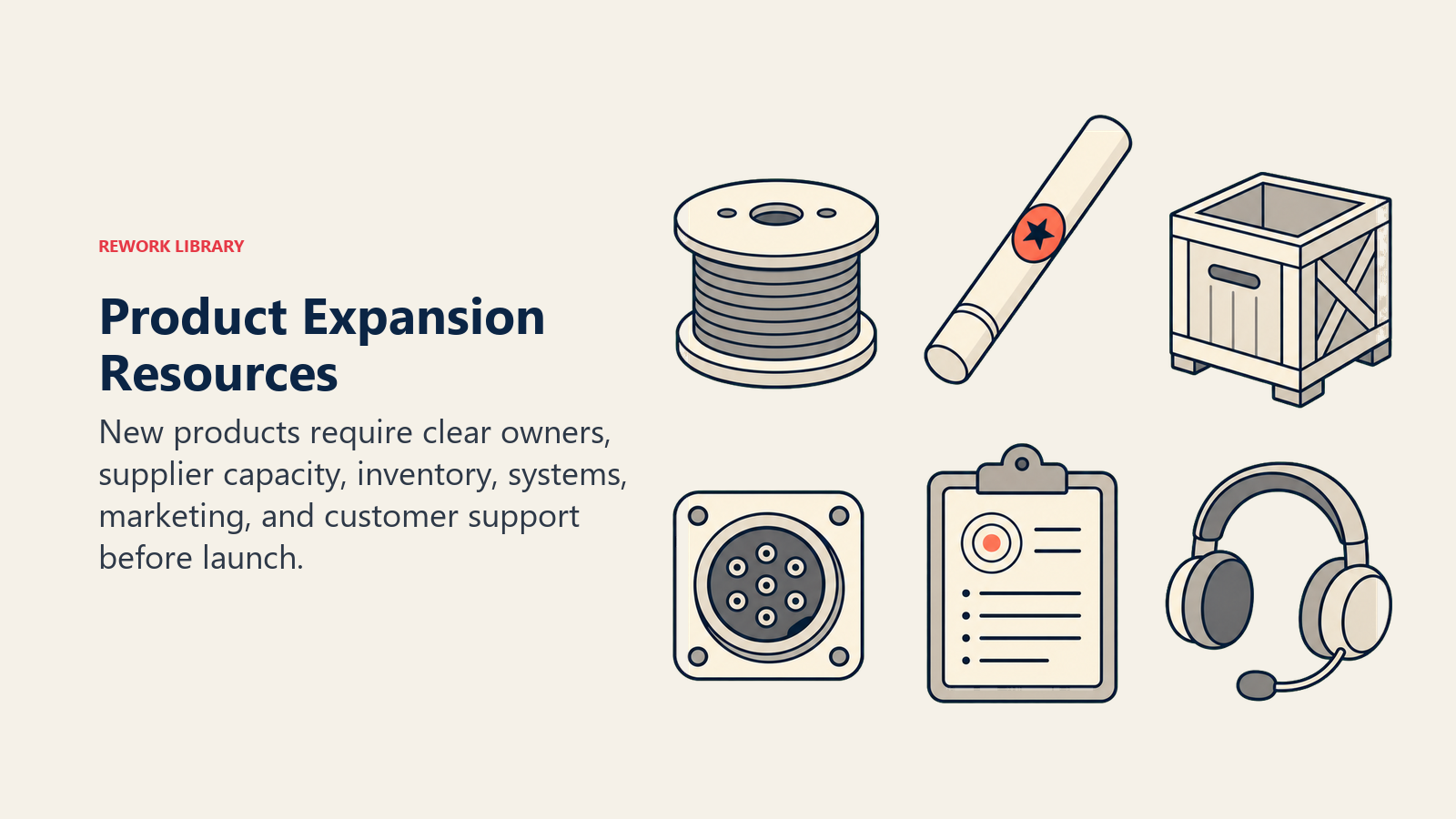
Inventory investment: For physical products, calculate total inventory cost including minimum order quantities (often higher than you want), shipping, duties, storage. Add 30% buffer for slower-than-projected sales. This capital is locked up until products sell.
Development costs: For custom or private label products, factor in design, prototyping, testing, revisions, and initial production runs. Budget 2-3x your initial estimate, first production runs always reveal issues.
Marketing investment: New categories require education and awareness building. Budget for product photography, content creation, launch campaigns, and potentially higher CAC during the learning phase. Expect 3-6 months before marketing efficiency matches existing products.
Technology and tools: New categories may require category-specific features (size charts, customization tools, subscription management) or integrations. Budget for development or platform upgrades.
Working capital buffer: Maintain 6 months of operating expenses for the new line. Expansion creates cash flow strain as you invest before revenue materializes.
Supply Chain Expansion
New products often mean new suppliers, processes, and complexity:
Supplier relationship development: Building reliable supplier relationships takes time. Don't assume your existing suppliers can handle new categories. Vet new suppliers thoroughly, request samples, check references, visit facilities if possible.
Quality control processes: Each new category needs its own QC protocols. What constitutes acceptable quality for apparel differs from electronics or food. Develop inspection checklists and thresholds before the first shipment arrives.
Fulfillment complexity: Different product categories have different storage, handling, and shipping requirements. Fragile items, temperature-sensitive products, hazmat regulations, each adds operational complexity and cost.
Inventory management systems: Your existing inventory management processes may not accommodate multiple categories well. You may need enhanced forecasting, separate reorder points, or category-specific analytics.
Team Capability Assessment
Honest evaluation of whether your team can execute:
Product expertise gap: Do you have team members who understand the new category intimately? If you're a fashion brand expanding into beauty, you need beauty industry expertise. Hiring one senior person with category expertise prevents costly mistakes.
Operational capacity: Can your existing team handle additional SKU complexity without burning out? Expansion typically requires 30-50% more operational work before you can hire to support it. If your team's already maxed out, expansion will break things.
Cross-functional coordination: Expansion requires tighter coordination between product, marketing, operations, and customer service. If these functions don't communicate well now, expansion will expose and amplify those gaps.
Launch Strategy for New Product Lines
How you launch expansion products dramatically impacts success rates.
Phased Rollout Approach
Don't launch everything everywhere all at once:
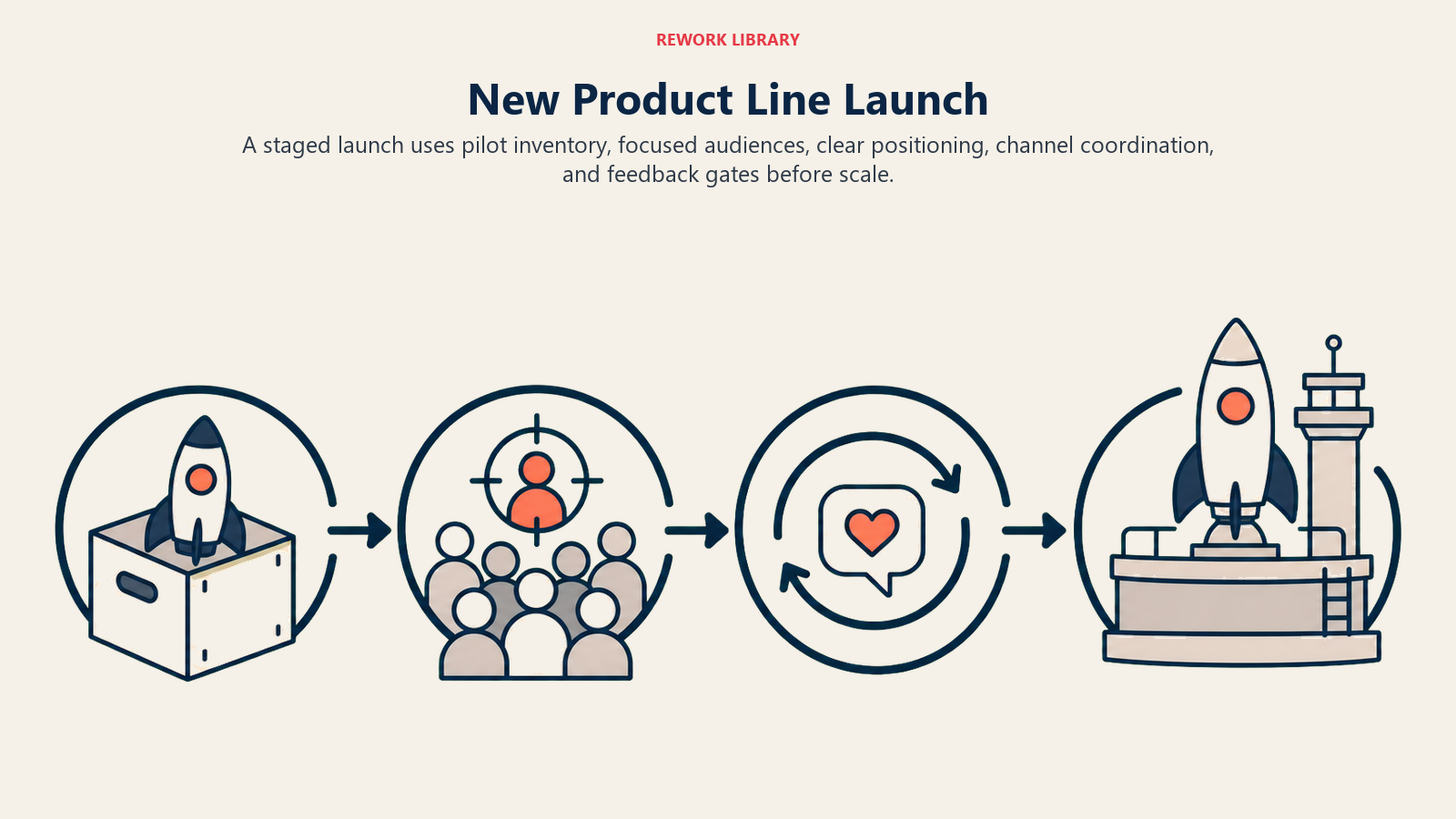
Phase 1 - Soft launch to existing customers: Release to your email list or VIP customers first. This generates initial revenue, feedback, and social proof before broader launch. Existing customers are most forgiving and provide highest-quality feedback.
Phase 2 - Limited channel expansion: Add products to your primary sales channel (website or marketplace) but not all channels. Measure performance and iterate before expanding distribution.
Phase 3 - Full channel rollout: Once product-market fit is validated and operations are smooth, expand to all channels, wholesale partners, and marketing tactics.
Phase 4 - Scale and optimize: Increase inventory, expand marketing budget, optimize conversion funnel, and refine positioning based on accumulated data.
This phased approach limits downside risk while allowing you to learn and adapt. It's especially critical for categories where you're less experienced.
Testing Framework
Validate key assumptions at each phase:
Conversion rate benchmarking: New categories often have different conversion rates than existing products. Set expectations based on industry benchmarks, not your existing products. Track new versus returning customer conversion separately, they behave differently.
Return rate monitoring: High return rates signal product quality issues, sizing problems, or expectation mismatches. Set category-specific return rate thresholds and investigate when exceeded.
Customer acquisition cost by category: Track CAC separately for new categories. Expect higher CAC initially as you learn messaging and targeting. Set a maximum CAC threshold based on LTV projections, if you can't acquire profitably within 6 months, reconsider.
Repeat purchase tracking: For categories that should drive repeat purchase, measure time-to-second-purchase and repeat rate. This validates whether the category increases customer lifetime value as projected.
Inventory Planning for New Products
Inventory planning for untested products is part art, part science:
Conservative initial orders: Order the minimum viable quantity that allows for meaningful testing while avoiding excess inventory risk. Better to sell out quickly (creating urgency and scarcity) than to have months of dead inventory.
Rapid reorder capability: Negotiate with suppliers for faster reorder terms on successful products. If something takes off, you want to capitalize quickly without waiting 90 days for the next production run.
SKU rationalization timeline: Commit to a review timeline where you'll cut underperforming SKUs. Don't let attachment to products override data. If a product hasn't gained traction in 6 months, discount heavily and exit.
Measuring Expansion Success
Define success metrics before launch, not after:
Portfolio-Level Metrics
Look at overall business health, not just new product performance:
Total revenue growth: Obviously expansion should increase total revenue, but by how much? Set a target that accounts for investment and cannibalization. If expansion required $100K investment, you need more than $100K incremental revenue to break even.
Gross margin percentage: Does the overall product mix improve or worsen gross margin? If new products have lower margins than existing products, revenue growth might not translate to profit growth.
Customer lifetime value by cohort: Track LTV for customers who buy across multiple categories versus single-category buyers. Multi-category buyers should have significantly higher LTV, if not, your expansion isn't creating the ecosystem effect.
Working capital efficiency: Measure inventory turns and days sales outstanding across the portfolio. Expansion often worsens working capital efficiency initially, that's acceptable if the trend improves over time.
Category-Specific Metrics
Each new category needs its own analytics:
Attach rate: What percentage of customers buying existing products also buy new category products? This measures how well you're cross-selling.
Solo purchase rate: What percentage of new category purchases are the only item in the order? High solo purchase rates suggest you're attracting new customers, not just selling more to existing customers.
Category contribution margin: Revenue minus all direct costs (COGS, shipping, category-specific marketing, returns). This shows true profitability, not just top-line growth.
Market share in category: If possible, estimate your market share in the new category. Are you gaining share, maintaining, or losing? This indicates long-term viability.
Customer Behavior Metrics
How expansion affects customer relationships:
Purchase frequency increase: Measure purchase frequency for customers before and after purchasing from new categories. Successful expansion should increase frequency.
Average order value impact: Track AOV for orders containing new category products versus orders without. Strategic bundling should lift AOV.
Customer retention and churn: Does expanding into new categories improve retention? Customers buying across categories should have lower churn rates.
Review these metrics monthly for the first six months, then quarterly. Set clear thresholds for success and failure, if metrics don't hit targets by X date, you'll exit the category.
Common Expansion Mistakes
Learning from others' expensive mistakes:
Over-Expansion and Dilution
Mistake: Adding too many SKUs too quickly because you're excited or competitors are doing it. This spreads resources impossibly thin and creates operational chaos.
Reality check: Can you articulate a clear, compelling strategy for each new category? Can you commit adequate resources to make each successful? If either answer is no, you're over-expanding.
Remedy: Follow the "rule of three", expand into maximum three new categories per year. Master each before adding more. Quality over quantity.
Underestimating Operational Complexity
Mistake: Assuming new products will "just work" with existing operations. Different categories have different handling requirements, customer service questions, return reasons, and supply chain challenges.
Reality check: Each new category typically requires 30% more operational capacity than projected. If you're already running lean, expansion will break processes.
Remedy: Build operational slack before expanding. Hire ahead of the growth curve. Document processes for existing products so you can template for new ones.
Ignoring Brand Coherence
Mistake: Expanding into categories just because they're profitable, without considering brand fit. A luxury skincare brand launching budget hair accessories destroys brand equity.
Reality check: Does this product make sense coming from your brand? Would customers expect it? Does it strengthen or weaken your brand building and positioning?
Remedy: Create a "brand coherence test" with specific criteria (customer overlap, brand value alignment, quality standards, price point consistency). New products must pass this test to qualify.
Inadequate Market Validation
Mistake: Committing to large inventory orders based on gut feel or surface-level research. This leads to expensive dead inventory.
Reality check: Did you validate demand through pre-orders, marketplace testing, or small batch releases? Do you have data showing customers will buy at your target price point?
Remedy: Spend 5% of expansion budget on validation before committing the remaining 95%. Test everything, don't trust assumptions.
Weak Differentiation
Mistake: Launching "me too" products that don't meaningfully differentiate from competitors. Without differentiation, you compete purely on price, which destroys margins.
Reality check: What's the compelling reason customers should buy your version instead of competitors? If the answer is "lower price," you've already lost.
Remedy: Find a differentiation angle before developing the product. It might be quality, features, sustainability, design, or brand trust. But it must be meaningful and defensible.
Technology and Systems Considerations
Your e-commerce platform and tech stack must support expansion:
Platform Capability Assessment
Product information management: Can your platform handle the complexity of multiple categories with different attributes? Apparel needs size charts. Electronics need specifications. Food needs ingredients and allergens. Generic PIMs break down.
Inventory management integration: Does your system track inventory by category, location, and status? Can you set category-specific reorder points and forecasting rules? Basic inventory systems designed for single categories struggle with complexity.
Checkout and payment flexibility: Different categories might require different payment options (subscriptions, installments, split payments) or checkout flows (customization, personalization). Ensure your platform supports this.
Reporting and analytics: Can you segment reporting by category, measure cross-category purchase patterns, and track category-specific metrics? You need visibility into how categories perform individually and together.
If your current platform can't support these needs, factor in migration costs or platform upgrades to your expansion budget. Trying to expand on inadequate technology guarantees operational headaches.
Fulfillment Technology
Multi-location inventory: As you expand categories, you may need multiple warehouses or drop-ship relationships. Your system must route orders to optimal locations and provide unified tracking.
Packaging automation: Different products need different packaging. Automation and clear guidelines prevent fulfillment errors and reduce costs at scale.
Returns processing: Category-specific return rules, restocking procedures, and quality inspection processes need to be codified in your fulfillment system. Manual processes don't scale.
Marketing Technology
Segmentation and personalization: Show customers products relevant to their interests and purchase history. This requires tagging customers by category interest and dynamic content display.
Email automation by category: Set up automated flows for each category, welcome series, educational content, replenishment reminders. Category-specific automation drives engagement and repeat purchase.
Attribution and analytics: Track which marketing channels and campaigns drive sales for each category. CAC and ROAS vary dramatically by category. You need this visibility to allocate budget effectively.
Portfolio Management and Optimization
Expansion doesn't stop at launch. Ongoing portfolio management determines long-term success:
Product Lifecycle Management
Introduction phase (Months 1-6): Focus on awareness, education, and validation. Metrics: trial rate, initial purchase, return rate. Investment: High marketing spend, low profit expectation.
Growth phase (Months 6-18): Scale what works, optimize conversion, expand distribution. Metrics: Revenue growth rate, market share, customer acquisition cost. Investment: Moderate marketing spend, improving profitability.
Maturity phase (18+ months): Maximize profitability and efficiency. Metrics: Gross margin, inventory turns, repeat purchase rate. Investment: Lower marketing spend, focus on retention.
Decline phase (variable): Recognize when products are declining and manage exit. Metrics: Declining sales, increasing returns, margin pressure. Investment: Minimal, liquidate inventory.
Track where each product sits in this lifecycle and manage accordingly. Don't throw growth-phase resources at declining products.
SKU Rationalization
The 80/20 rule applies: Typically 20% of SKUs drive 80% of revenue. Regularly analyze SKU performance and prune underperformers.
Rationalization criteria:
- Revenue contribution: Less than 2% of category revenue after 12 months
- Profitability: Negative gross margin after all allocated costs
- Inventory turns: Fewer than 2 turns per year
- Strategic fit: No longer aligns with brand direction
Exit strategy: Don't just discontinue products, have a plan. Discount remaining inventory, bundle with strong sellers, donate for tax benefits, or liquidate through outlet channels.
Timing: Review quarterly. Be ruthless but not reactive, one bad quarter doesn't mean a product should die. But consistent underperformance does.
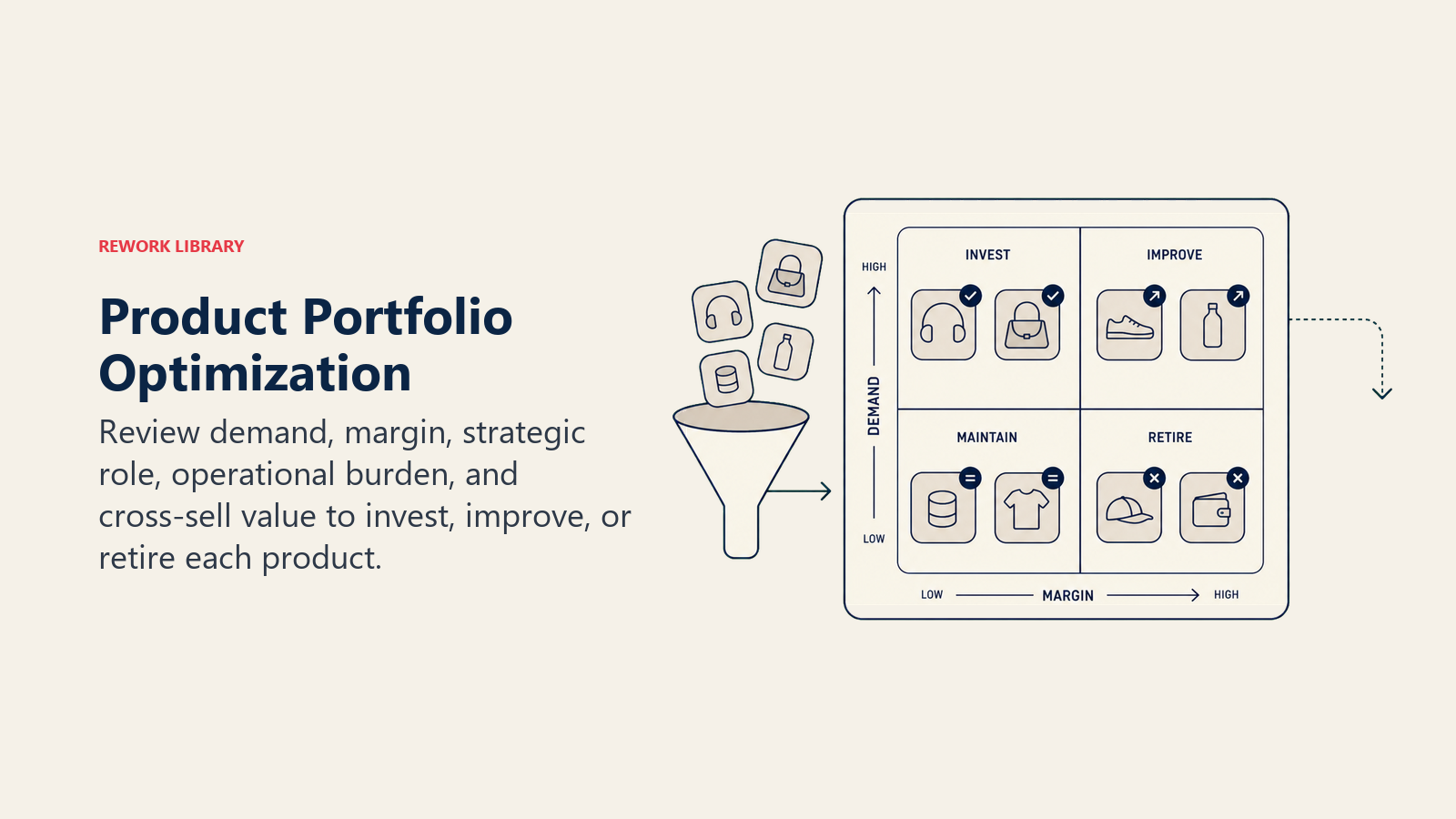
Portfolio Optimization
Look at the portfolio as a whole:
Margin mix optimization: Balance high-margin products with lower-margin traffic drivers. Not every product needs to be highly profitable if it brings customers who buy profitable products.
Seasonal balance: Diversify into categories with different seasonal patterns to smooth cash flow and reduce inventory risk.
Customer value distribution: Ensure you have products that serve entry-level customers, core customers, and premium customers. Gaps in this distribution leave money on the table or create vulnerability to competitors.
Cross-category bundling: Continuously test and optimize bundles that combine products across categories. These often have the highest AOV and customer satisfaction.
Moving Forward with Expansion
Product line expansion done right is the primary growth engine after you've optimized your core business. Here's the framework:
- Validate market demand through customer signals, competitive analysis, and low-risk testing
- Quantify cannibalization risk and ensure expansion creates net value
- Design product ecosystems that increase customer lifetime value through complementary products
- Plan for realistic resource requirements across capital, operations, and team capabilities
- Launch in phases, testing assumptions before scaling
- Measure success at portfolio level, not just product level
- Actively manage the portfolio, pruning underperformers and optimizing the mix
The brands that successfully expand treat it as a strategic capability, not a one-time project. They build systems for validation, manage risk deliberately, and maintain focus on what matters: creating more value for customers while improving unit economics for e-commerce.
Start with one category. Master it completely. Then expand again. Compounding strategic wins beats scattered activity every time.
Your next expansion opportunity is probably already visible in your customer data: support requests for products you don't sell, cart combinations that suggest natural bundles, or customer segments shopping across multiple categories at competitors. The question isn't whether to expand. It's whether you'll do it strategically or reactively.
Learn More
Ready to strengthen your product expansion strategy? These related resources will help you build a comprehensive approach:
- Hero Product Strategy - Master your core products before expanding into new categories
- Product Research & Validation - Systematic approaches to validating new product ideas before launch
- Customer Lifetime Value - Calculate and optimize the LTV impact of multi-category purchasing
- Inventory Management - Scale your inventory operations across multiple product categories

On this page
- Why Product Line Expansion Matters Now
- Strategic Expansion Fundamentals
- Vertical Expansion (Same Category, Different Price Points)
- Horizontal Expansion (New Categories, Same Customer)
- Concentric Expansion (Adjacent Markets)
- Market Research and Validation
- Customer Signal Analysis
- Competitive Gap Assessment
- Validation Testing Methods
- Cannibalization Risk Assessment
- Identifying Cannibalization Threats
- Cannibalization Calculation Methodology
- Cannibalization Mitigation Strategies
- Adjacent Products and Upsell Strategy
- Product Ecosystem Design
- Strategic Bundling and Cross-Sell
- Resource Requirements and Implementation
- Capital Investment Planning
- Supply Chain Expansion
- Team Capability Assessment
- Launch Strategy for New Product Lines
- Phased Rollout Approach
- Testing Framework
- Inventory Planning for New Products
- Measuring Expansion Success
- Portfolio-Level Metrics
- Category-Specific Metrics
- Customer Behavior Metrics
- Common Expansion Mistakes
- Over-Expansion and Dilution
- Underestimating Operational Complexity
- Ignoring Brand Coherence
- Inadequate Market Validation
- Weak Differentiation
- Technology and Systems Considerations
- Platform Capability Assessment
- Fulfillment Technology
- Marketing Technology
- Portfolio Management and Optimization
- Product Lifecycle Management
- SKU Rationalization
- Portfolio Optimization
- Moving Forward with Expansion
- Learn More