VIP Customer Programs: Building Tier Structures for High-Value Customers
Turn this article into takeaways for your work.


Each assistant summarizes the article only for you and suggests best practices for your work.
A VIP customer program is one of the highest-leverage ecommerce growth tactics because it compounds revenue from buyers you already have. By identifying your top spenders with RFM analysis, then giving them tiered rewards, exclusive access, and priority service, you lift retention 30-50% and spending 20-30% without adding acquisition cost.
Your top 20% of customers likely generate 80% of your revenue. The question isn't whether you should treat them differently. It's how to build a VIP program that makes them feel valued while driving even more business.
VIP programs go beyond traditional loyalty programs. They're about creating exclusive experiences, personalized service, and meaningful recognition for customers who contribute disproportionately to your bottom line.
Why Top Customers Deserve Special Treatment
The Pareto principle plays out consistently in e-commerce. A small segment of customers generates the majority of revenue, and they deserve recognition for it.
The numbers tell the story:
- Top 10% of customers spend 3-5x more than average customers
- VIP customers have 2-3x higher retention rates
- They're 4x more likely to refer others
- They have 40-60% higher customer lifetime value (LTV)
But here's what matters more: high-value customers know they're valuable. If you don't acknowledge it, your competitors will. And they'll be happy to. A VIP program isn't just about retention. It's about preventing defection to brands that make them feel special.
The best VIP programs create a virtuous cycle: recognition drives loyalty, loyalty drives spending, spending drives more recognition. Customers aspire to reach higher tiers, and once there, they work to maintain their status.
VIP Customer Identification
Before you can reward VIP customers, you need to identify them. This requires looking beyond simple purchase history to understand true customer value. Revenue thresholds are the most straightforward approach. Set annual spend thresholds that qualify customers for VIP status:
- Entry VIP: $2,000+ annual spend
- Gold VIP: $5,000+ annual spend
- Platinum VIP: $10,000+ annual spend But revenue alone doesn't tell the whole story. A customer who spent $5,000 once two years ago? That's different from one who consistently spends $500 quarterly. RFM analysis provides a more nuanced view:
- Recency: When did they last purchase? Recent buyers are more engaged
- Frequency: How often do they purchase? Frequency indicates loyalty
- Monetary: How much do they spend? Higher spend indicates value
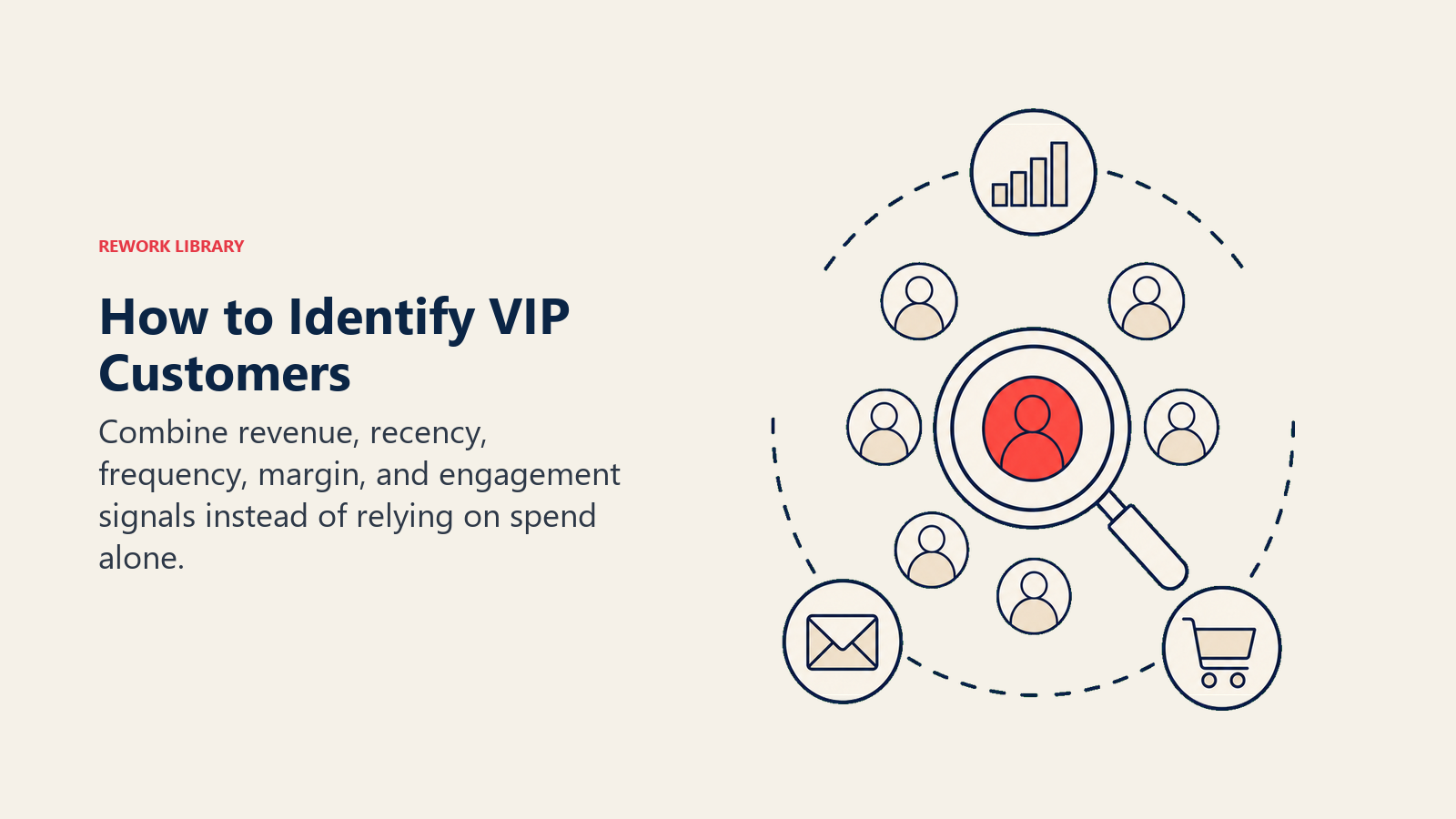
The best VIP candidates score high across all three dimensions. Someone who spends $10,000 once isn't as valuable as someone who spends $1,000 ten times over two years.
Lifetime value projection helps identify rising stars. A customer who's been buying for six months with steadily increasing order values might be worth more long-term than someone with one large historical order.
Use your customer data platform to calculate projected LTV based on:
- Average order value trends
- Purchase frequency acceleration
- Product category expansion (are they buying more types of products?)
- Engagement with marketing (email opens, site visits)
Behavioral signals can identify VIP potential early:
- Product review contributions
- Social media engagement and sharing
- High average time on site
- Browsing premium product categories
- Early adoption of new products
VIP Tier Structures
Your tier structure determines how customers progress through your VIP program and what they receive at each level. Single-tier programs work well for smaller businesses or niche markets:
- One VIP threshold (e.g. $2,000 annual spend)
- All VIPs receive the same benefits
- Simpler to manage and explain
- Lower operational complexity Multi-tier programs create aspiration and progression:
- Multiple levels with increasing benefits
- Customers work to reach higher tiers
- More opportunities for differentiation
- Higher perceived value Here's a typical three-tier structure:
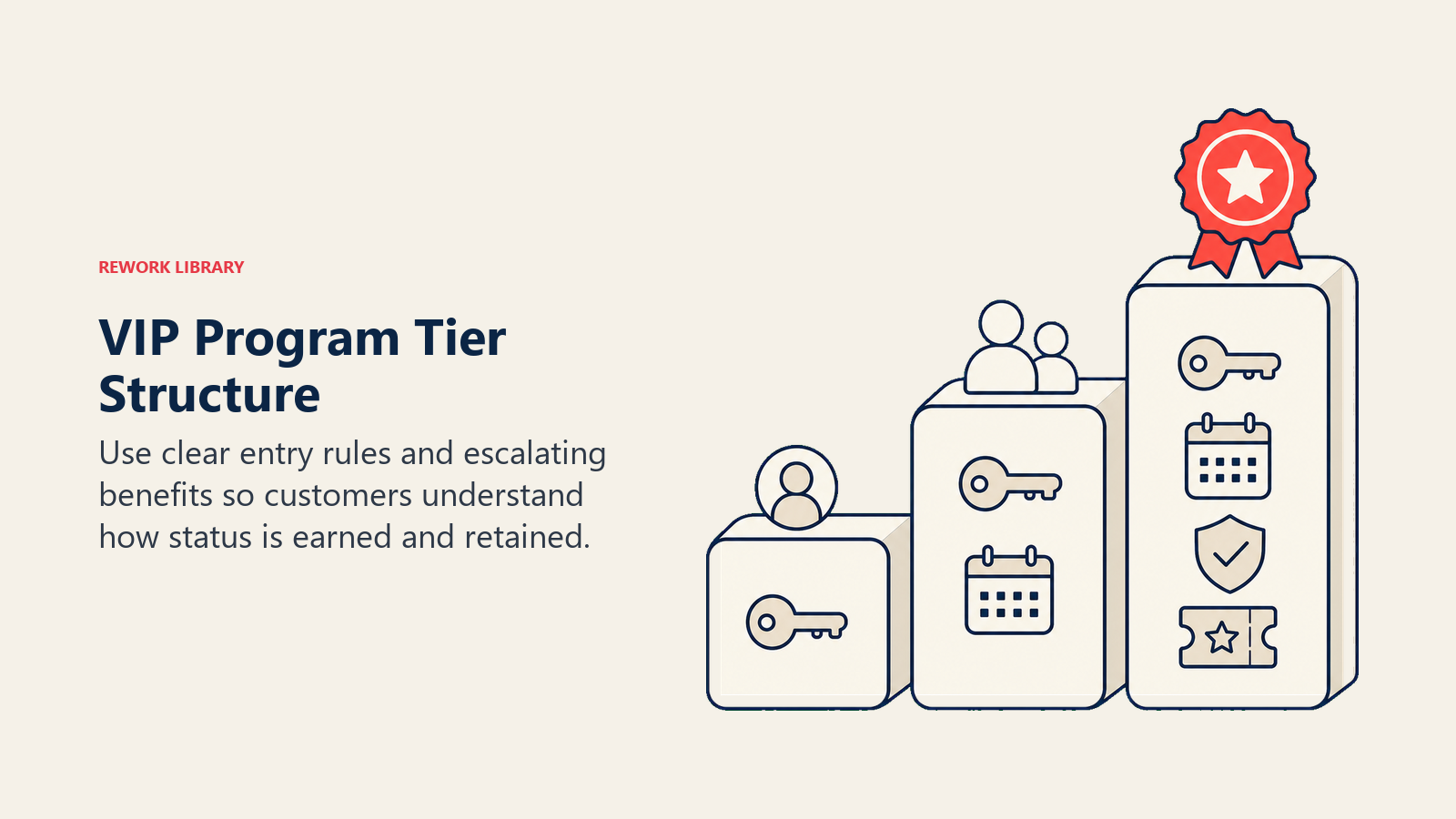
| Feature | Silver VIP | Gold VIP | Platinum VIP |
|---|---|---|---|
| Annual Spend | $2,000+ | $5,000+ | $10,000+ |
| Discount | 10% off | 15% off | 20% off |
| Free Shipping | Standard | Expedited | Next-day |
| Early Access | 24 hours | 48 hours | 72 hours |
| Exclusive Products | - | Yes | Yes + Pre-orders |
| Birthday Gift | $25 credit | $50 credit | $100 credit |
| Dedicated Support | - | Priority queue | Personal rep |
| Annual Gift | - | - | Luxury item |
| VIP Events | Virtual | Virtual + Regional | All + Private |
Progression paths should be clear and achievable. Show customers:
- Current tier status
- Progress toward next tier
- Benefits they'll unlock
- Time period for qualification (rolling 12 months, calendar year, etc.)
Demotion handling is sensitive but necessary. You can't sustain VIP benefits for customers who stop spending. Options include:
- Grace periods (maintain status for 3-6 months after dropping below threshold)
- Soft landing (gradual benefit reduction rather than immediate loss)
- Reactivation campaigns (targeted offers to help them maintain status)
- Transparent communication (explain the rolling qualification period upfront)
The key is setting expectations clearly from the start. Customers should understand that VIP status is earned continuously, not granted permanently.
Exclusive Benefits & Perks
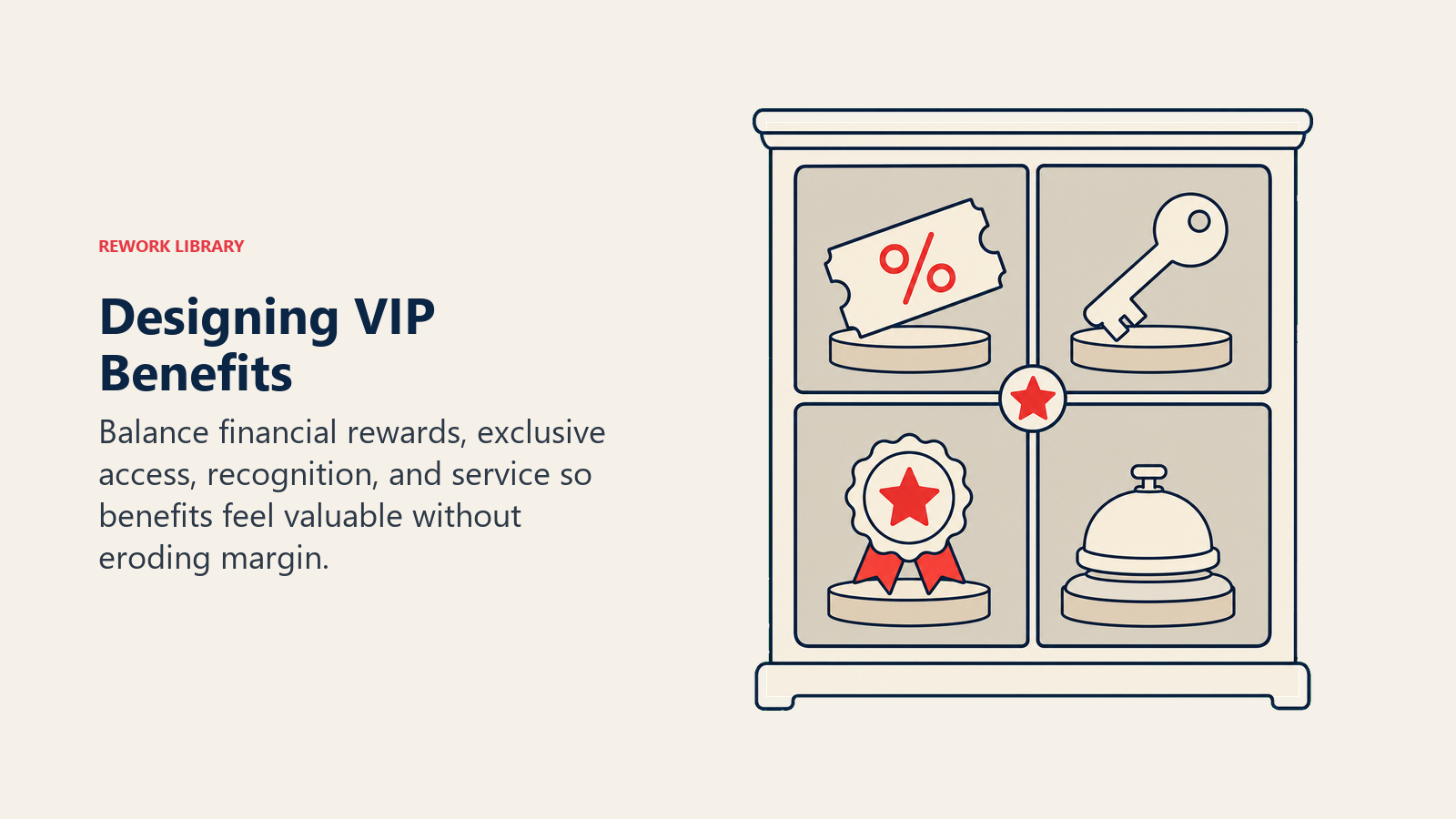
VIP benefits fall into three categories: financial rewards, experience benefits, and personalization perks. Financial rewards are table stakes:
- Percentage discounts: 10-20% across all purchases
- Dollar credits: Birthday gifts, anniversary bonuses, quarterly rewards
- Free shipping: Expedited or premium shipping at no cost
- Extended returns: 90 or 120-day return windows versus 30 days
- Price protection: If an item goes on sale, refund the difference But financial benefits alone won't differentiate your VIP program. Every brand offers discounts. The experience benefits create emotional connection. Experience benefits make customers feel special:
- Early access: Shop new collections 24-72 hours before public launch
- Exclusive products: Limited editions or colorways only for VIPs
- Personal shopping: Virtual or in-person styling consultations
- VIP events: Private shopping events, product launches, meet-and-greets
- Behind-the-scenes access: Product development insights, founder interactions
- Gift with purchase: Premium items not available to general customers
Personalization perks show you understand them:
- Curated recommendations: Hand-picked products based on their style
- Personalized packaging: Custom notes, premium packaging, monogramming
- Flexible purchasing: Pre-orders, backorder priority, saved payment methods
- Custom services: Alterations, customization, special requests
- Surprise and delight: Unexpected gifts based on their preferences
The best VIP programs layer these benefits strategically. Financial rewards drive immediate value, experience benefits create memorable moments, and personalization builds emotional connection.
Personalization at Scale
VIP programs require personalization, but you can't manually curate experiences for hundreds or thousands of top customers. You need systems that enable personalization at scale. Using customer data effectively: Start with purchase history. What categories do they buy? What price points? What brands? This tells you their style preferences, quality expectations, and product interests. Layer in behavioral data from your personalization engine:
- Browsing patterns (what they view but don't buy)
- Email engagement (which types of content they open)
- Time-of-day preferences (when they shop)
- Device preferences (mobile vs. desktop behavior) Behavioral segmentation creates personalization clusters:
- Trend Leaders: Early adopters who buy new releases immediately
- Sale Shoppers: High spenders who wait for promotions
- Brand Loyalists: Stick to specific brands within your catalog
- Category Specialists: Deep purchasing in one product category
- Generalists: Shop across multiple categories
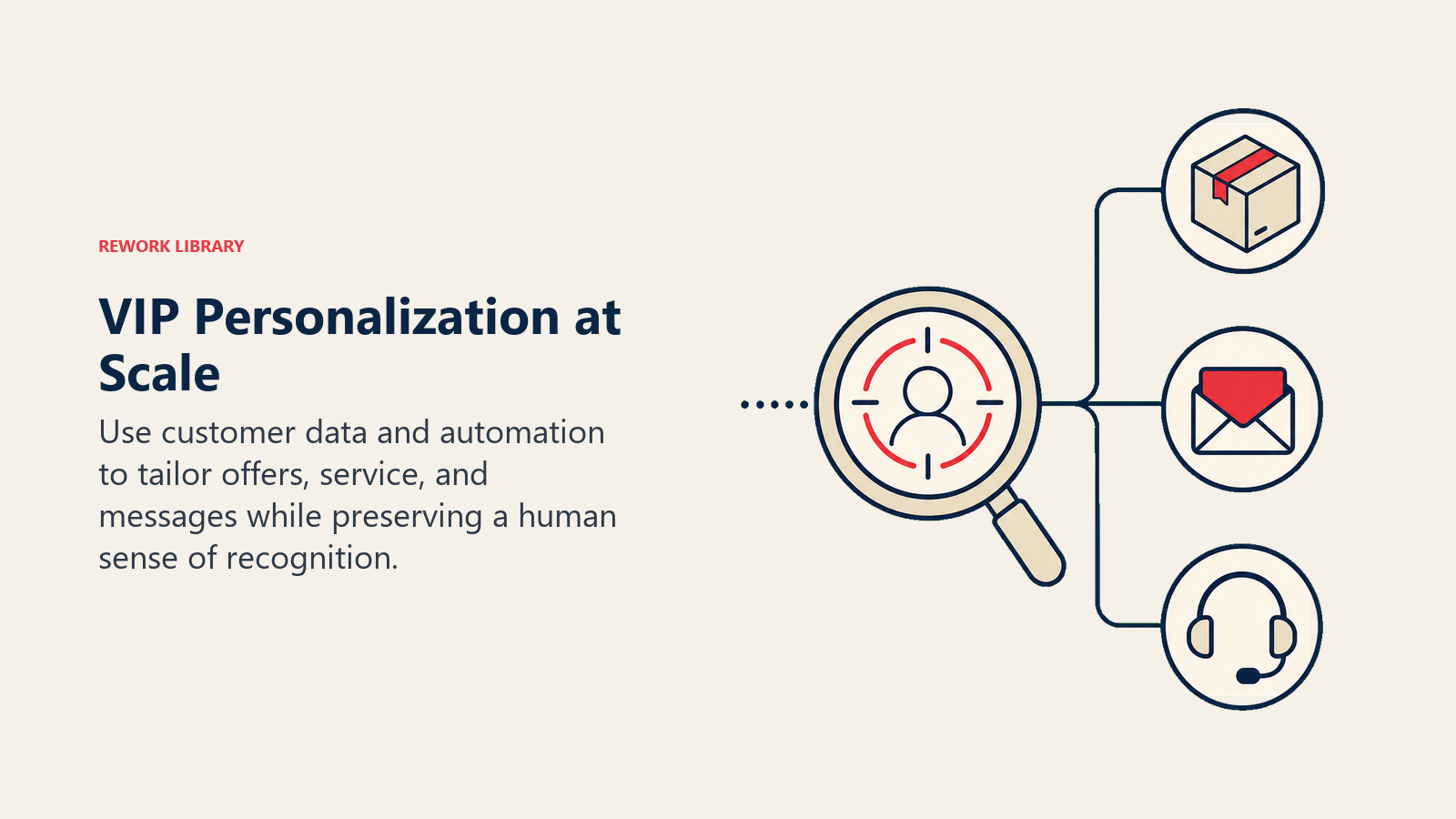
Build automated workflows in your marketing automation system that trigger personalized experiences:
For Trend Leaders:
- First-to-know emails about new arrivals
- Pre-order opportunities for upcoming products
- Sneak peeks at design processes
- Beta testing invitations
For Sale Shoppers:
- VIP-only sale previews
- Extra discount codes for already-reduced items
- Early access to clearance events
- Price drop alerts on browsed items
For Brand Loyalists:
- Curated emails featuring their favorite brands
- Alerts when those brands release new items
- Exclusive brand collaborations or limited editions
- Direct connections to brand representatives
The key is making each VIP feel like you understand their individual preferences, even when you're using automated segmentation.
VIP Recognition & Community
Exclusivity perception matters as much as actual benefits. VIPs need to feel like they're part of something special. Visual recognition signals:
- VIP badge or icon on their account
- Special packaging for shipments
- Exclusive VIP gift cards or payment cards
- Branded gifts (tote bags, water bottles with VIP logo)
- Personalized thank-you notes from founders or executives
VIP-only features create segregated experiences:
- Private shopping sections on your site
- VIP-only product collections
- Exclusive access to sales before they go public
- Hidden categories or products not visible to non-VIPs
Community building connects VIPs with each other:
- Private Facebook or Discord groups
- VIP member directories (opt-in)
- Exclusive events where VIPs can network
- User-generated content campaigns featuring VIPs
- VIP advisory boards for product development input
The goal is making VIP status feel like joining an exclusive club, not just getting discounts. When VIPs feel part of a community, they become brand advocates who recruit other high-value customers.
Priority Support & Service
Customer service quality often determines whether VIPs stay or leave. Your highest-value customers should never wait in standard support queues. Dedicated support channels:
- Separate VIP phone number or email
- Live chat priority routing
- Text message support for urgent issues
- Video call support for complex problems
Priority response times:
- VIP emails answered within 1-2 hours (vs. 24 hours for standard)
- Phone calls answered within 1 minute (vs. 5-10 minutes)
- Chat responses within 30 seconds
- After-hours support for top-tier VIPs
Concierge-level support: At the highest VIP tiers, consider dedicated account managers. One person who knows their history, preferences, and needs. They can:
- Proactively reach out with relevant new products
- Handle any issue end-to-end without transfers
- Coordinate special requests or customizations
- Serve as a single point of contact
Empowerment protocols: Train support teams to go above and beyond for VIPs:
- Higher refund/replacement authority without manager approval
- Ability to issue immediate credits or discounts
- Flexibility to bend policies (extended returns, exception handling)
- Budget for surprise-and-delight gestures
Document VIP interactions in your CRM so every team member can see the relationship history. Nothing frustrates VIP customers more than having to repeat their issue or history multiple times.
Data & Technology Implementation
VIP programs require robust technology infrastructure to identify customers, track status, and deliver benefits.
Customer Data Platform (CDP) identification: Your CDP should automatically:
- Calculate rolling 12-month spend
- Score customers on RFM dimensions
- Project lifetime value
- Flag customers approaching tier thresholds
- Alert when customers risk demotion
Automation workflows: Set up triggers for:
- Welcome email when customer reaches VIP status
- Tier upgrade celebrations with special offers
- Threshold proximity emails ("You're $200 away from Gold status!")
- Demotion warnings ("Make a purchase to maintain Platinum benefits")
- Quarterly VIP benefit reminders
Integration requirements: Your VIP program needs to connect with:
- E-commerce platform: Apply discounts, show VIP pricing
- Email marketing: Segment VIP lists for targeted campaigns
- Customer support: Flag VIP tickets for priority handling
- Inventory system: Reserve products for VIP early access
- Shipping provider: Route VIP orders to expedited fulfillment
Personalization technology: Use your product recommendations engine to:
- Show VIP-exclusive products prominently
- Prioritize recommendations based on VIP preferences
- Surface products similar to their past purchases
- Hide out-of-stock items (reserve available inventory for VIPs)
Program Economics
VIP programs cost money. You need to understand the economics to ensure profitability. Calculating direct costs:
- Discount margin reduction (15% off reduces margin by 15%)
- Free shipping costs (average $8-15 per order)
- Exclusive gifts (birthday credits, anniversary gifts)
- Premium packaging materials
- Dedicated support staffing Example calculation: Gold VIP with $5,000 annual spend:
- 15% discount: $750 margin reduction
- Free expedited shipping: $10 × 12 orders = $120
- Birthday gift: $50
- Support time: $25 (higher touch = more support hours)
- Total cost: $945 If your baseline margin is 40%, you're earning $2,000 on their $5,000 spend. After VIP costs of $945, you net $1,055, still a healthy 21% margin.
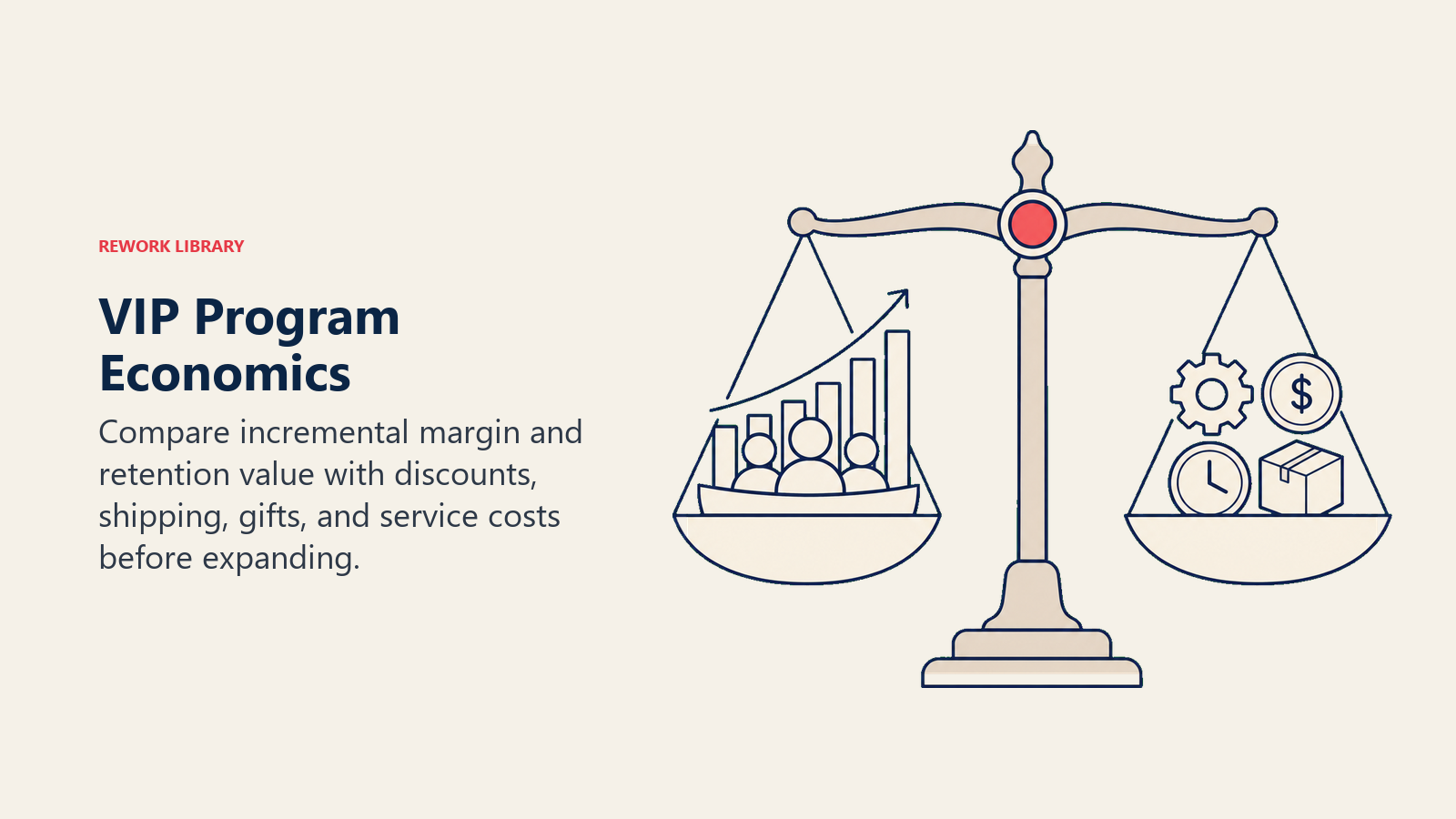
If your baseline margin is 40%, you're earning $2,000 on their $5,000 spend. After VIP costs of $945, you net $1,055, still a healthy 21% margin.
ROI analysis: The real ROI comes from retention and increased spending:
- Retention lift: VIPs have 30-40% higher retention than non-VIPs
- Spending increase: VIP status drives 20-30% higher annual spend
- Referral value: VIPs refer 2-3x more customers
If your VIP program increases retention by 35% and spending by 25%, that Gold VIP goes from $5,000 to $6,250 annual spend, with an 85% probability of buying again next year (vs. 50% for non-VIPs).
Break-even analysis: Calculate the incremental revenue needed to cover VIP costs. If it costs $945 to maintain a Gold VIP, and your margin is 40%, you need $2,363 in incremental revenue to break even.
For a customer already spending $5,000, that's a 47% increase, achievable through higher retention and increased purchase frequency.
Measurement & Optimization
Track specific metrics to understand VIP program performance and identify optimization opportunities. Core VIP metrics: Retention rate by tier:
- Compare VIP retention to non-VIP retention
- Track retention differences between tiers
- Monitor year-over-year retention trends
- Calculate retention lift from VIP program Target: VIP retention should be 30-50% higher than non-VIP retention.
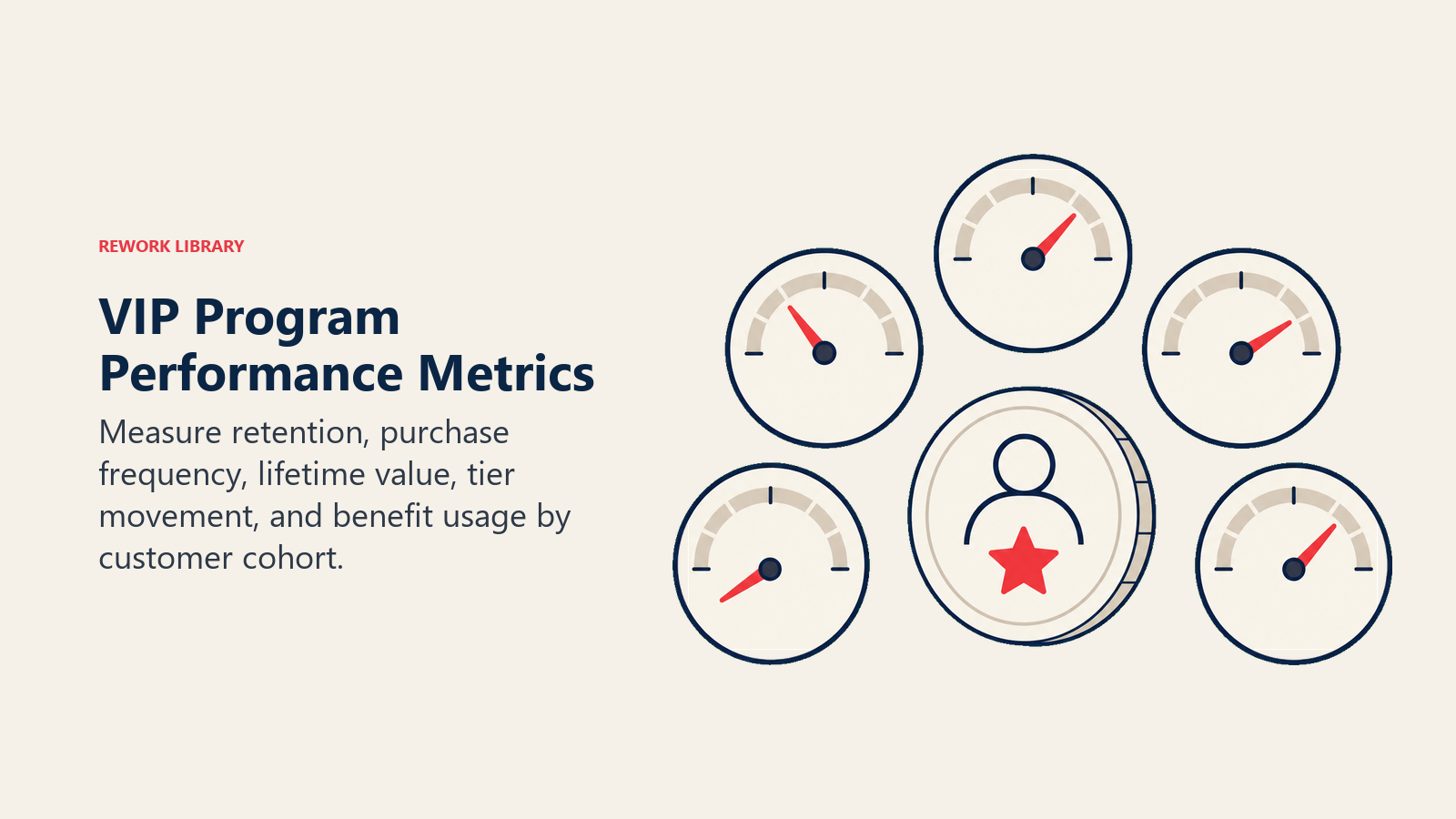
Repeat purchase rate:
- Average orders per year by tier
- Time between purchases by tier
- Purchase frequency acceleration over time
Target: VIPs should purchase 2-3x more frequently than average customers.
LTV growth:
- Actual LTV by tier vs. projected LTV
- Year-over-year LTV increases
- LTV for customers before and after VIP qualification
Target: 20-40% LTV increase after achieving VIP status.
Tier progression metrics:
- Percentage of customers moving up tiers
- Time to reach each tier
- Demotion rates by tier
- Reactivation rates after demotion
Program engagement:
- VIP benefit redemption rates
- Email open rates for VIP-specific campaigns
- Event attendance rates
- Support interaction frequency
Secondary metrics:
- Referral rates from VIPs vs. non-VIPs
- Net Promoter Score by tier
- Average order value trends
- Category expansion (how many different product types they buy)
Use these metrics to identify optimization opportunities. If Silver VIPs have high demotion rates, maybe the tier is too hard to maintain. If Platinum VIPs rarely use their dedicated support rep, maybe that benefit isn't valuable.
Common Pitfalls & Best Practices
Pitfall: Making VIP status too easy to achieve If 40% of customers are VIPs, it's not very exclusive. Keep thresholds high enough that VIP status feels earned. Aim for 10-20% of customers at any VIP tier.
Best practice: Set thresholds based on your specific economics. Calculate what spend level makes the program profitable, then add 20-30% to maintain exclusivity.
Pitfall: Insufficient differentiation between tiers If Gold and Platinum benefits are nearly identical, there's no motivation to reach the higher tier.
Best practice: Create meaningful gaps between tiers. Each tier should offer 2-3 benefits the tier below doesn't have. Make top-tier benefits genuinely exclusive.
Pitfall: Inconsistent benefit delivery Promising early access but then launching products to everyone simultaneously destroys trust.
Best practice: Build systems that enforce benefit delivery. If VIPs get 48-hour early access, set up automated email campaigns and site controls that prevent public launch until the window ends.
Pitfall: Poor communication about status changes Customers are blindsided when they lose VIP status without warning.
Best practice: Send proactive notifications:
- 60 days before potential demotion: "You're at risk of losing Gold status"
- 30 days before: "Spend $X to maintain Gold benefits"
- At demotion: "Your status has changed, but here's how to earn it back"
Pitfall: Generic personalization Sending the same "VIP exclusive" email to all 10,000 VIPs defeats the purpose.
Best practice: Segment VIP communications by:
- Tier level
- Product category preferences
- Behavioral patterns
- Engagement history
Use your email marketing platform to create dynamic content blocks that adapt to each VIP's profile.
Pitfall: Neglecting mid-tier VIPs Focusing all attention on top-tier VIPs while ignoring Silver and Gold members.
Best practice: Allocate benefits and attention proportionally across tiers. Entry-level VIPs should still feel valued. They're your future Platinum members.
Pitfall: No clear path to VIP status Customers don't know what they need to do to qualify.
Best practice: Make qualification transparent. Show progress bars, send milestone emails ("You're halfway to Silver status!"), and explain exactly how the program works.
Scaling VIP Programs
As your business grows, your VIP base will expand. You need systems that maintain personalized experiences while serving hundreds or thousands of top customers. Growing the VIP base while maintaining quality: Tiered attention allocation:
- Top 1% get white-glove, manual attention
- Top 5% get semi-automated personalization with human oversight
- Top 20% get fully automated but highly personalized experiences
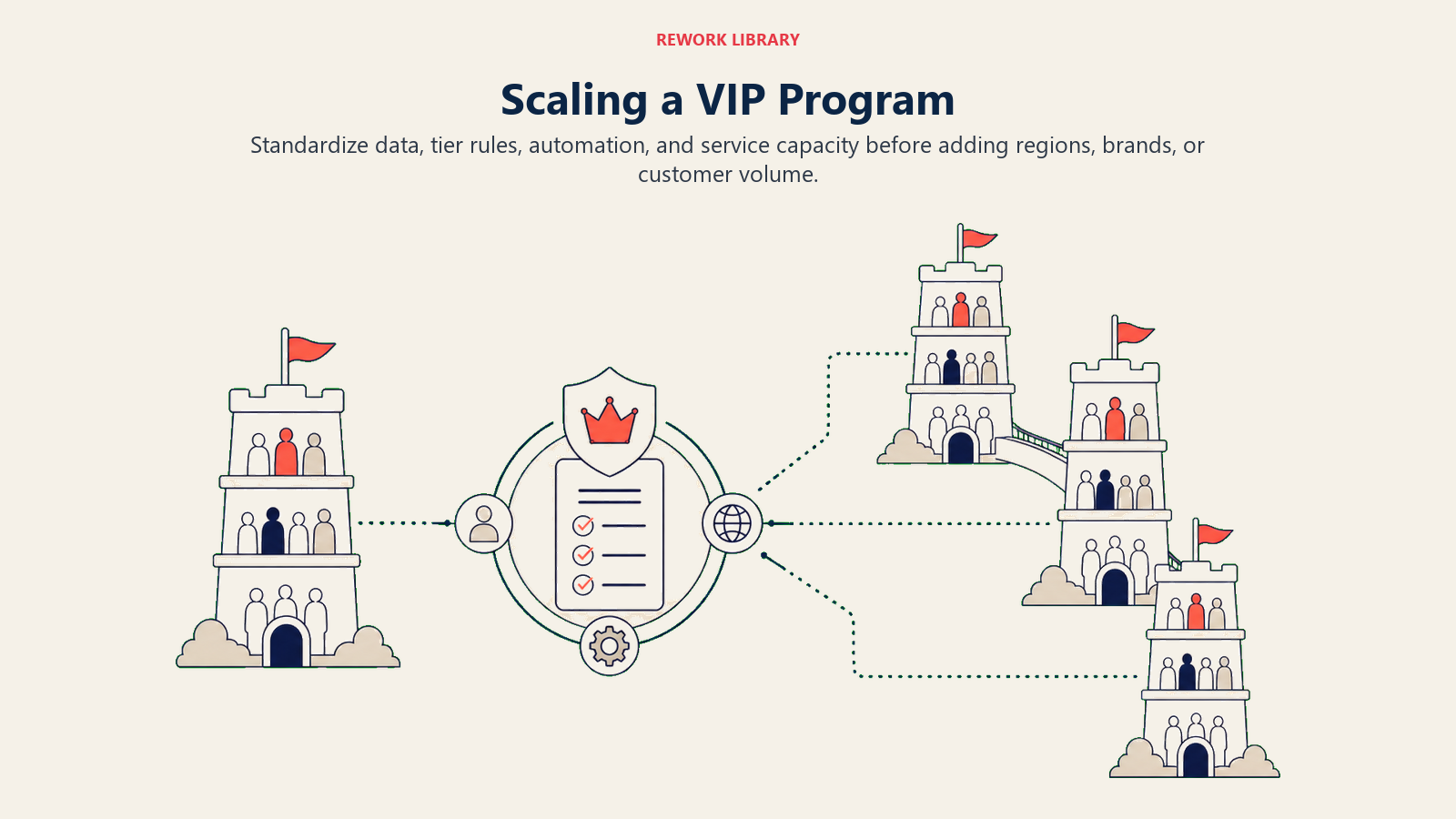
This lets you scale without losing the exclusivity that makes VIP programs valuable.
Automation with personalization: Use your marketing automation platform to create journeys that feel personal:
- Triggered emails based on browsing and purchase behavior
- Dynamic content that adapts to individual preferences
- Automated but contextually relevant product recommendations
- AI-powered personalization at scale
Community-powered experiences: As your VIP base grows, let VIPs add value for each other:
- VIP-only forums where members share tips
- User-generated content from VIP customers
- VIP-led product reviews and guides
- Regional VIP meetups organized by members
Smart segmentation: Break your VIP base into microsegments:
- By product category specialization
- By shopping behavior patterns
- By geographic region
- By lifecycle stage (new VIP vs. long-term VIP)
This lets you create relevant experiences without manual curation for each customer.
Technology investment: Scaling requires better tools:
- Advanced CDP with predictive analytics
- AI-powered recommendation engines
- Automated personalization platforms
- Customer success management software for top-tier VIPs
Building Your VIP Program
Start with a clear understanding of who your most valuable customers are and what would make them feel recognized.
Analyze your customer base to identify natural tier thresholds. Look at your revenue distribution. Where do you see clear breaks in the data? Those become your tier qualification levels.
Design benefits that are both economically sustainable and emotionally meaningful. Run the numbers to ensure profitability, then add experiential elements that create genuine exclusivity.
Build the technology infrastructure to identify VIPs, track their status, and deliver benefits automatically. Manual VIP programs don't scale.
Launch with clear communication about how the program works, what benefits each tier receives, and how customers can qualify. Transparency builds trust.
Then measure relentlessly. Track retention, spending, satisfaction, and program engagement. Optimize based on what your VIP customers actually value, not what you think they should value.
Your VIP program should make your best customers feel recognized, valued, and excited to maintain their status. When you get it right, they become your most powerful growth engine, spending more, staying longer, and bringing other high-value customers with them.
The goal isn't just retaining your top 20%. It's turning them into advocates who wouldn't consider shopping anywhere else.
Frequently Asked Questions about VIP Customer Programs
What is a VIP customer program?
A VIP customer program is a structured tier system that gives your highest-spending customers escalating rewards, exclusive access, and priority service. It identifies top buyers through revenue thresholds and RFM analysis, then rewards them with discounts, early access, dedicated support, and personalized perks to drive retention and higher lifetime value.
How do you identify VIP customers?
Use three signals together: revenue thresholds (annual spend tiers), RFM analysis (recency, frequency, monetary value), and projected lifetime value. A customer who spends consistently scores higher than one who made a single large purchase, so combine all three rather than ranking on total spend alone.
How many tiers should a VIP program have?
Most ecommerce brands use a three-tier structure (for example Silver, Gold, Platinum) with clear spend thresholds and 2 to 3 distinct benefits per level. Single-tier programs suit smaller catalogs, while multi-tier programs create aspiration and progression that pull customers toward higher spending.
What is the ROI of a VIP program?
Well-run VIP programs lift retention 30 to 50% and annual spend 20 to 30%, and VIPs refer 2 to 3 times more customers than average buyers. After accounting for discount margin, shipping, and gifts, a typical Gold-tier customer still nets a healthy margin because the incremental revenue from retention and frequency outweighs the program cost.
How do you keep a VIP program exclusive?
Set thresholds so only 10 to 20% of customers qualify at any tier, create meaningful benefit gaps between levels, and enforce a rolling 12-month qualification window with grace periods. If 40% of customers reach VIP status, it stops feeling earned and loses its motivational pull.

On this page
- Why Top Customers Deserve Special Treatment
- VIP Customer Identification
- VIP Tier Structures
- Exclusive Benefits & Perks
- Personalization at Scale
- VIP Recognition & Community
- Priority Support & Service
- Data & Technology Implementation
- Program Economics
- Measurement & Optimization
- Common Pitfalls & Best Practices
- Scaling VIP Programs
- Building Your VIP Program