Trust Signals & Social Proof: Building Buyer Confidence to Accelerate E-commerce Conversions
Turn this article into takeaways for your work.


Each assistant summarizes the article only for you and suggests best practices for your work.
The trust gap is one of e-commerce's biggest conversion killers. About 73% of online shoppers hesitate before buying because they're not sure they can trust the site. Yet most stores don't use the trust signals they have effectively. The numbers are clear: stores that systematically implement trust signals and social proof see conversion rate improvements of 20-35%, while others leave money on the table every day.
Here's the thing: trust signals exist everywhere. Security badges, customer reviews, money-back guarantees. But existence isn't the issue. Most stores treat trust signals like decorative elements instead of conversion drivers, placing them randomly without understanding what actually works or testing their effectiveness.
This creates an opportunity. While competitors scatter trust badges across their sites hoping something sticks, strategic stores build systematic frameworks that address specific purchase anxieties at the right moments in the customer journey.
Understanding Trust Signals and Social Proof as Conversion Mechanisms
Trust signals and social proof function as distinct but complementary psychological mechanisms that reduce perceived purchase risk and accelerate buying decisions.
Trust signals are credibility markers that demonstrate legitimacy, security, and reliability. They answer the fundamental question: "Is this store safe and legitimate?" Trust signals include security badges, payment logos, certifications, guarantees, and professional credentials. They establish baseline confidence that engaging with your store won't result in fraud, data theft, or buyer's remorse.
Social proof leverages consensus and authority psychology to demonstrate that others have successfully purchased and benefited from your products. It answers: "Have people like me had positive experiences here?" Social proof includes customer reviews, testimonials, purchase counts, real-time purchase notifications, and influencer endorsements. It transforms abstract product claims into validated reality through third-party verification.
Credibility markers represent the intersection, elements like awards, media mentions, years in business, and expert endorsements that simultaneously establish legitimacy and demonstrate social validation.
The psychological frameworks driving trust-based purchasing include:
- Authority bias: People defer to perceived experts and established credentials
- Social consensus: The tendency to follow what others are doing, especially in uncertain situations
- FOMO (Fear of Missing Out): Urgency created by popularity signals and scarcity indicators
- Risk aversion: The preference for certainty over uncertainty, driving demand for guarantees and verification
- Reciprocity principle: Trust signals create goodwill that influences purchase decisions
Trust signals don't work uniformly. They operate within a hierarchy based on credibility, relevance, and placement. A verified customer video testimonial carries more weight than a generic badge. A guarantee displayed prominently at checkout (where anxiety peaks) converts better than the same guarantee buried in footer text. Understanding this hierarchy and matching specific trust signals to customer journey stages is what determines effectiveness.
Why Trust Signals Matter for E-commerce
The business case for systematic trust signal implementation is measurable and substantial.
Direct conversion rate lift is the most immediate impact. Case studies show 20-35% improvement in conversion rates when you implement comprehensive trust signal frameworks instead of randomly placing badges. The mechanism is straightforward: reducing purchase anxiety lowers the psychological barrier to clicking "buy now." When customers feel confident in transaction security, product quality, and risk mitigation, they convert faster and more frequently.
Purchase anxiety reduction addresses the emotional side of online buying. Unlike physical retail where customers can touch products and talk to salespeople, e-commerce requires digital trust-building. Each trust signal removes a specific concern: security badges address payment safety, reviews validate product quality, guarantees eliminate risk, certifications confirm legitimacy. The cumulative effect transforms hesitant browsers into confident buyers.
Cart abandonment prevention through strategic credibility signaling tackles one of e-commerce's most expensive problems. The average 70% cart abandonment rate includes significant abandonment triggered by last-minute trust concerns. Placing the right trust signals at checkout, security badges near payment fields, prominent money-back guarantees, customer service contact information, prevents abandonment before it happens. This is particularly impactful because cart abandoners represent high-intent customers who've invested time in selection. Learn more about systematic cart abandonment recovery strategies.
Competitive differentiation in crowded markets is critical as more sellers offer similar products at comparable prices. Trust signals create separation beyond price and product features. Two stores selling identical products at identical prices will see dramatically different conversion rates based on perceived trustworthiness. The store with comprehensive, well-placed trust signals captures customers that competitors lose to purchase anxiety.
Customer retention receives reinforcement through trust that extends beyond the initial purchase. Trust signals that deliver on their promises, guarantees that get honored, reviews that accurately represent products, shipping timelines that match commitments, build confidence that drives repeat purchases. First-time buyers who experience validated trustworthiness become loyal customers with higher lifetime value.
The meta-benefit underlying all these impacts: trust signals create a compounding advantage. Each positive customer experience validates the trust signals for future customers through reviews and testimonials. This creates a virtuous cycle where trust begets more trust, accelerating growth over time.
Security and Payment Trust Signals
Security concerns represent the foundational trust barrier in e-commerce. Before customers consider product quality or return policies, they need confidence that their payment information and personal data won't be compromised.
SSL certificates and security badges provide visible evidence of transaction security. The padlock icon in browser address bars signals encrypted connections, but most customers don't understand technical security details. This creates opportunity for recognized security badges, Norton Secured, McAfee Secure, Verisign, that translate technical security into consumer-recognized trust symbols.
Placement matters. Security badges should appear on product pages (establishing early trust), cart pages (reinforcing security as intent increases), and checkout pages (addressing maximum anxiety). The checkout placement is particularly critical. Position security badges directly adjacent to payment form fields where customers actively enter sensitive information.
PCI DSS compliance messaging addresses the technical standard for payment card data security. While most customers don't know what PCI DSS means, the message "PCI DSS Certified" or "Payment Card Industry Compliant" communicates serious security investment. This works best when combined with brief explanatory text: "Your payment information is encrypted and secured according to banking industry standards."
Secure payment logos and partner badging leverage recognition and authority from established payment providers. Displaying logos for Visa, Mastercard, American Express, PayPal, Apple Pay, and Google Pay serves multiple purposes: it confirms accepted payment methods, implies vetting by major financial institutions, and provides familiar symbols that reduce uncertainty.
Strategic implementation displays these logos near payment method selection during checkout. Many stores bury payment logos in footer text where they're invisible at the critical decision moment. Move them to checkout page headers or directly above payment fields where customers actively evaluate transaction security.
Data protection guarantees and privacy policies address growing consumer awareness of data privacy. Generic privacy policy links carry minimal impact. More effective approaches include prominent badges stating "Your Data is Never Sold" or "GDPR Compliant, Your Privacy Protected." These direct statements address specific concerns without requiring customers to read lengthy legal text.
Trust seal placement and design optimization requires systematic testing rather than assumption. Common mistakes include using too many security badges (creating clutter that dilutes impact), placing badges where customers don't look during purchase decisions, and using outdated or unrecognized badge designs.
Testing framework: Start with 2-3 recognized security badges placed at checkout. A/B test placement variations (header vs. adjacent to payment fields vs. both). Measure impact on checkout completion rates and cart abandonment. Iterate based on data rather than aesthetic preference.
Guarantees and Risk Reversal Strategies
Risk reversal transforms the purchase decision from "What if this doesn't work out?" to "I have nothing to lose by trying this."
Money-back guarantees come in various durations, each signaling different levels of confidence. A 30-day guarantee has become standard, offering minimal differentiation. 60-day and 90-day guarantees demonstrate above-average confidence. Lifetime guarantees signal extraordinary product quality certainty.
The strategic question isn't just duration, it's messaging and visibility. "30-Day Money-Back Guarantee" states a policy. "Try it Risk-Free for 30 Days, Love it or Return it for a Full Refund" emphasizes customer benefit and removes perceived risk. The difference in conversion impact is measurable.
Guarantee visibility requires prominence at points of purchase consideration. Product pages should feature guarantee messaging in the buying decision area, near price and "add to cart" buttons. Checkout pages need guarantee reminders when customers are making final commitment decisions. Post-purchase communications should reinforce guarantees to reduce buyer's remorse and support long-term satisfaction.
Satisfaction guarantee messaging extends beyond money-back policies to encompass the entire customer experience. "100% Satisfaction Guaranteed" or "We Stand Behind Every Purchase" broadens the promise beyond simple refunds to include customer service commitment, product quality assurance, and resolution of any concerns.
This type of guarantee addresses customers who worry less about getting money back and more about whether problems will get resolved if something goes wrong. It's particularly effective for higher-priced items where customer service quality matters as much as product quality.
Return policy transparency and ease of communication matters as much as the policy itself. A generous return policy buried in fine print converts poorly. A clearly stated, easy-to-understand return policy displayed prominently converts significantly better.
Best practices include creating dedicated return policy pages with clear, scannable formatting. Use bullet points, bold text for key terms, and plain language instead of legal jargon. Answer common questions directly: "How do I return an item?" "When will I get my refund?" "Who pays return shipping?"
Then link to this page prominently from product pages, checkout, and post-purchase communications. Make the link text clear: "Hassle-Free Returns" or "Easy Return Policy" works better than just "Returns."
Product warranty displays and coverage clarity address durability and longevity concerns, particularly for electronics, appliances, and higher-priced goods. Generic warranty statements carry minimal impact. Specific warranty details build confidence: "2-Year Manufacturer Warranty Covering All Parts and Labor" outperforms "Warranty Included."
For products with extended warranty options, present these clearly without creating pressure. Offer information about what's covered, claim processes, and actual warranty provider (manufacturer vs. third-party). Transparency builds trust even for customers who don't purchase extended coverage.
Risk mitigation language and guarantee positioning requires understanding specific purchase anxieties for your products and directly addressing them. Athletic apparel might emphasize "If sizing doesn't fit perfectly, exchanges are free and fast." Electronics could highlight "Dead on arrival? We'll ship a replacement before you return the defective unit." Subscription products might state "Cancel anytime, no questions asked, we'll even remind you before renewal."
This targeted risk reversal addresses specific hesitations rather than generic concerns, making guarantees more credible and conversion-effective.
Third-Party Certifications and Credentials
Third-party certifications provide independent validation that your business meets specific standards, offering credibility that self-generated trust signals cannot match.

Industry certifications vary by sector but carry significant weight in relevant categories. B-Corp certification signals commitment to social and environmental responsibility, resonating with values-driven consumers. Fair Trade certification validates ethical sourcing practices. Organic certifications (USDA Organic, EU Organic) confirm production standards. ISO certifications demonstrate quality management systems.
The key to effective certification display: relevance and recognition. Only feature certifications that matter to your target customers. A B-Corp badge resonates with sustainability-focused buyers but means nothing to bargain hunters. Fair Trade certification drives purchase decisions for ethical consumers but creates confusion for customers unfamiliar with the concept.
Implementation strategy: Research which certifications your competitors display and which ones your target customers value. Survey customers or run A/B tests to determine which certifications influence purchase decisions for your specific audience.
Award recognition and accolades leverage authority and third-party validation. "Best Online Retailer 2026" from a recognized industry publication carries more weight than a generic "Award-Winning Store" claim without specifics.
Display awards prominently, but include context. Rather than just showing a badge, add brief text: "Named Best Beauty Retailer by Allure Magazine 2026." This provides specific authority and recency. Update awards annually and remove outdated recognitions that signal you haven't achieved anything recently.
Media mentions and press coverage display creates credibility through association with recognized publications. "As Featured In" sections showing logos from major publications (Forbes, Wall Street Journal, TechCrunch, Vogue) communicate legitimacy and newsworthiness.
Strategic implementation: Don't just show logos, link to actual articles or create a dedicated press page with quotes and article summaries. This transforms vague "featured in" claims into verified reality customers can investigate. It also extends the value of press coverage beyond the initial article publication.
Compliance certifications address legal and regulatory standards, particularly important for regulated categories like supplements, children's products, and electronics. FDA registration, CPSIA compliance for children's items, FCC certification for electronics, these demonstrate that you meet legal requirements and take compliance seriously.
This category of certification primarily prevents negative trust impact rather than creating positive trust signals. Customers in regulated categories expect compliance and penalize stores that don't clearly demonstrate it. Display relevant compliance certifications but don't overemphasize them unless they represent competitive advantages.
Badge placement and credibility hierarchy requires understanding that not all trust signals carry equal weight. Video testimonials from real customers outweigh generic security badges. Industry-specific certifications from recognized organizations outperform vague "trusted seller" claims.
Create a hierarchy based on credibility strength, then allocate visual prominence accordingly. Place highest-impact trust signals in prime positions (product pages, checkout, homepage hero sections). Lower-impact signals can appear in footer areas or dedicated trust pages.
Test regularly. The hierarchy you assume based on logic may differ from the hierarchy customers actually use when making purchase decisions. A/B testing reveals which trust signals drive measurable conversion improvements versus which ones are ignored.
Customer Testimonials and Case Studies
Customer testimonials transform marketing claims into validated reality through peer verification, making them among the most powerful trust signals available.

Video testimonial integration represents the highest-trust-impact format. Video overcomes the credibility challenge of written testimonials, which customers sometimes suspect are fabricated or cherry-picked. Seeing and hearing real customers discuss their experiences creates authenticity that text cannot match.
Implementation best practices: Feature short video testimonials (30-90 seconds) on product pages, collection pages, and homepage. Position them near purchase decision points. Include customer names and locations (with permission) to enhance authenticity. Show diverse customers to enable identification across your audience.
Technical considerations: Host videos on fast-loading platforms, provide transcripts for accessibility and SEO, and ensure mobile optimization since most customers will view testimonials on phones.
Text testimonial curation and authenticity requires balance between selecting impactful statements and maintaining credibility through transparency. The most effective testimonials include specific details and outcomes rather than generic praise.
"This product is amazing!" carries minimal credibility. "I was skeptical about switching from my usual brand, but after three weeks of use I noticed my skin was noticeably clearer and more hydrated. Worth every penny." provides specific experience that prospective customers can relate to.
Curation strategy: Collect testimonials systematically through post-purchase follow-up. Ask specific questions that elicit detailed responses: "What problem were you trying to solve?" "What specific results did you see?" "What surprised you about the product?" These prompts generate testimonials with concrete details rather than vague praise.
Before/after case study development works exceptionally well for products with visual results, beauty products, fitness equipment, home improvement items, organization solutions. The visual transformation provides undeniable proof that the product delivers results.
Format case studies as stories with three components: starting situation (problem/challenge), implementation (how the customer used your product), and outcome (specific results achieved). Include photos, metrics, timelines, and customer quotes. This narrative structure creates engagement while demonstrating value.
Distribution: Create dedicated case study pages, feature rotating case studies on product pages, include them in email nurture sequences, and share them across social channels. Case studies work harder than almost any other content format, maximize their reach.
Customer success metric highlight quantifies impact through aggregated data: "Join 50,000+ satisfied customers," "4.8/5 stars from 12,000+ reviews," "94% of customers would recommend us to a friend." These statistics provide social proof at scale.
Display these prominently in homepage hero sections, product page headers, and checkout pages. Update them regularly to maintain accuracy and freshness. Include source attribution when possible ("Based on independently verified reviews") to enhance credibility.
Testimonial display across product and category pages requires strategic placement rather than random scattering. Product pages should feature product-specific testimonials near the buying decision area (above or adjacent to add-to-cart buttons). Category pages can showcase collection-wide customer satisfaction.
Avoid testimonial overload that creates clutter and dilutes impact. Three to five well-selected testimonials strategically placed outperform dozens scattered throughout the page. Quality and placement trump quantity.
Social Proof Mechanisms
Social proof extends beyond testimonials to encompass real-time signals that demonstrate ongoing purchase activity and customer engagement.
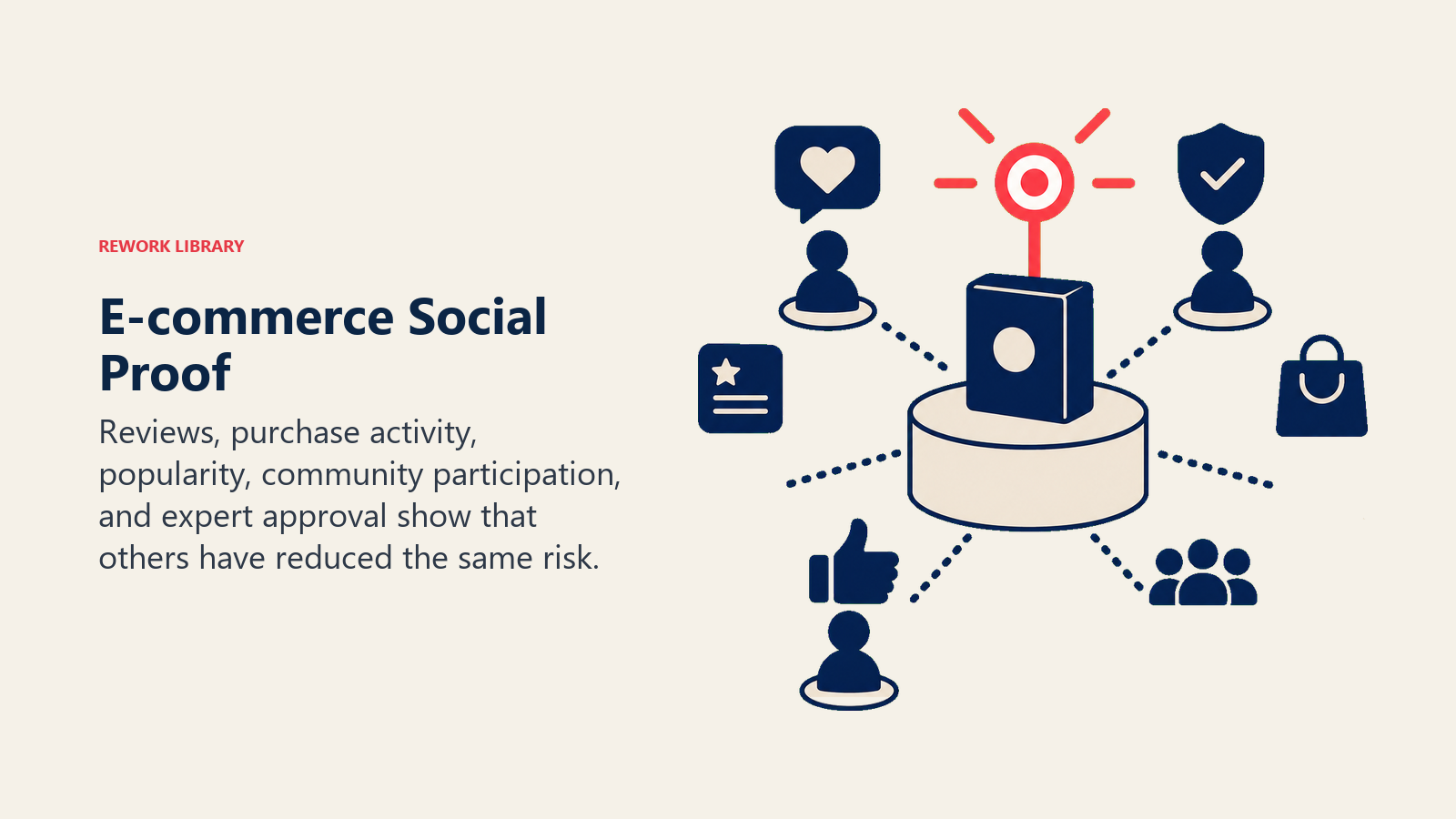
Customer count and popularity messaging leverages consensus psychology through statements like "Join 100,000+ happy customers" or "Trusted by over 50,000 businesses." These signals communicate that many others have successfully purchased and presumably had positive experiences.
Placement strategy: Feature customer count prominently on homepage hero sections, product pages (particularly for bestsellers), and checkout pages. Update these numbers regularly to maintain accuracy and demonstrate growth.
Specificity enhances credibility. "Join 100,000+ customers" is less credible than "Join 127,453 satisfied customers." The specific number suggests actual counting rather than round-number estimation.
Sales velocity signals create urgency and validate popularity through messages like "1,000+ sold this month," "Selling fast, 347 purchased in the last 24 hours," or "Low stock, only 12 remaining." These signals communicate that other customers are actively buying right now.
Implementation considerations: Only use velocity signals for products with genuine sales volume. Inflated or fabricated claims damage trust when customers return for repeat purchases and see the same "only 5 remaining" message they saw months earlier.
Dynamic displays that show actual recent purchase counts carry more credibility than static messages. Tools that track and display real-time purchase data create authentic urgency without requiring manual updates or risk of outdated information.
Real-time purchase notification displays show popup notifications of recent purchases: "Sarah from Chicago just purchased [product name]" or "3 people bought this in the last hour." These notifications provide live social proof that purchasing is happening actively.
Best practices: Display notifications subtly in corner positions that don't obstruct main content. Include first name and location (city or state) but protect privacy by avoiding full names or specific addresses. Show notifications for actual recent purchases rather than fabricated activity.
Frequency matters, too many notifications become annoying and damage user experience. Test notification frequency and timing to find the balance that creates social proof without disrupting shopping experience.
Customer photo testimonials and unboxing content showcase real customers with your products, providing visual social proof that extends beyond review text. User-generated photos demonstrate how products look in real life, how they're used, and how they integrate into customer environments. This customer-generated content creates authenticity that professional photography cannot replicate.
Encourage customer photo sharing through post-purchase emails requesting reviews with photos, creating hashtag campaigns for social sharing, and offering incentives (discounts, feature opportunities) for customers who submit photos.
Display these prominently in product image galleries, in dedicated UGC sections on product pages, and across social channels. Real customer photos often outperform professional photography for conversion because they're more relatable and authentic.
Live chat and customer service indicators demonstrate that help is available, reducing purchase anxiety about what happens if problems arise. "Live chat available now" or "Customer service team responds within 2 hours" signals commitment to customer support.
Display availability clearly across the site, particularly on product pages and checkout where purchase questions commonly arise. If you offer 24/7 support, emphasize this competitive advantage. If you have limited hours, state them clearly to set accurate expectations.
Reviews and Ratings Infrastructure
Product reviews represent one of the most influential trust signals in e-commerce, with research showing that 93% of consumers read reviews before making purchase decisions.
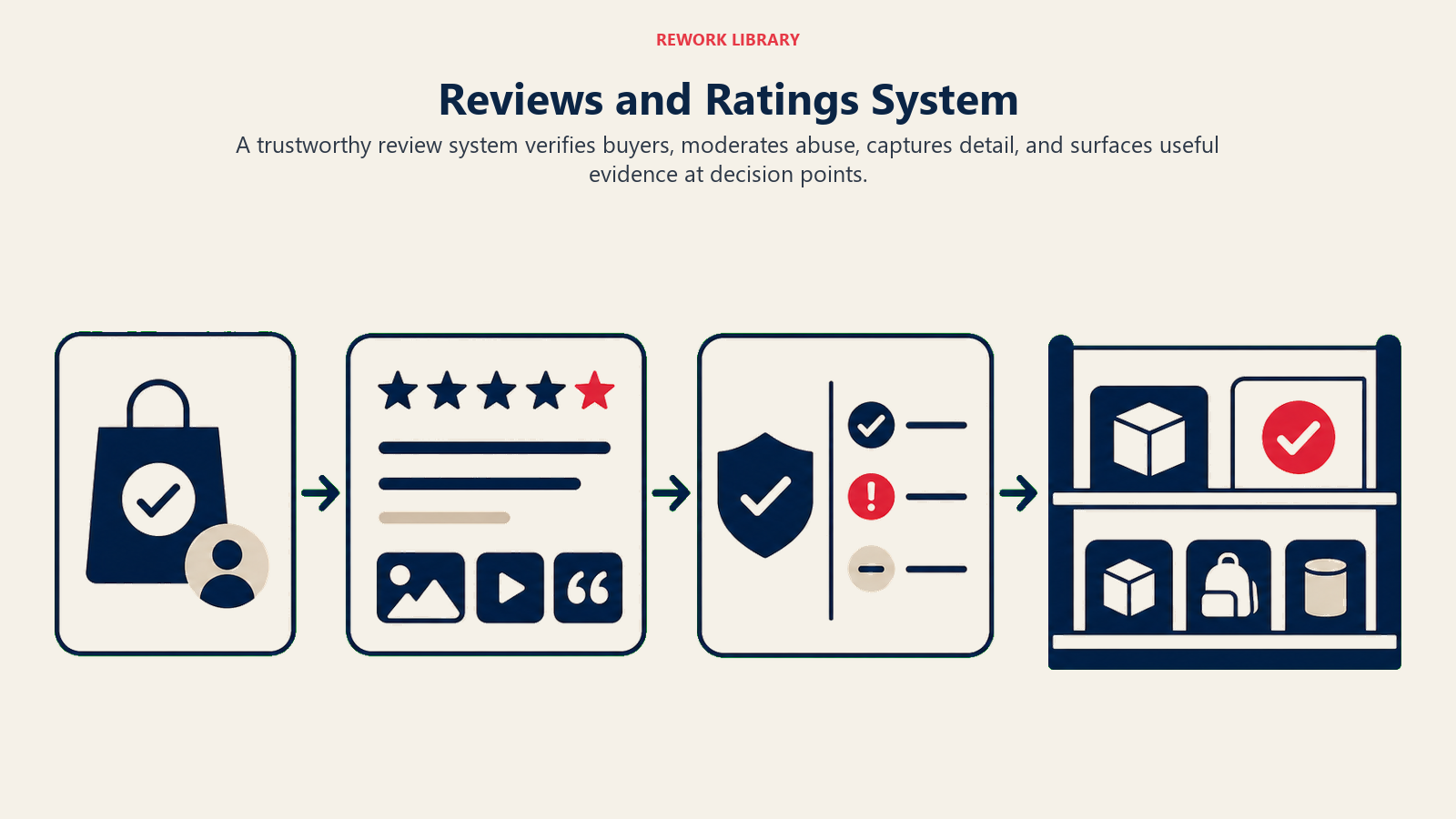
Star rating displays on product pages provide instant visual assessment of product quality. Display star ratings prominently in product cards on collection pages and at the top of individual product pages. This allows customers to quickly identify highly-rated products without reading detailed reviews.
Implementation details: Use standard 5-star rating systems that customers recognize universally. Display average ratings prominently with clear visual indication (filled vs. unfilled stars). Show rating counts alongside stars (4.7 stars from 234 reviews) to provide context for the average.
Review count transparency and aggregation matters as much as average ratings. A 5.0-star rating from 3 reviews carries less weight than a 4.6-star rating from 500 reviews. Display review counts prominently to provide context for ratings.
For stores with multiple variants or product lines, aggregate reviews strategically. Show variant-specific reviews when differences matter (taste reviews for different flavors) but combine reviews when they don't (color variants of identical products).
Review excerpt highlighting key benefits helps customers quickly identify whether reviews address their specific concerns. Rather than forcing customers to read through all reviews, excerpt and highlight themes: "Customers love the fast shipping (mentioned in 47% of reviews)" or "Highly rated for durability (4.8/5 average)."
This analysis helps customers quickly assess whether others with similar needs had positive experiences. It also demonstrates that you pay attention to customer feedback and understand what matters most.
Verified purchase badges for review authenticity address skepticism about fake reviews. "Verified Purchase" or "Confirmed Buyer" badges next to reviews indicate that the reviewer actually bought the product from your store, significantly increasing credibility.
Most review platforms (Yotpo, Trustpilot, Judge.me) include verified purchase verification. Enable this feature and display badges prominently. Consider going further by noting how reviews are verified: "Verified Purchase, confirmed customer who bought this product."
Review distribution visualization and trust shows the full picture beyond just average ratings. Display review distribution (how many 5-star, 4-star, 3-star, etc. reviews) to provide transparency. This distribution tells more accurate stories than averages alone.
A product with mostly 5-star reviews and a few 1-star reviews (creating a 4.6 average) represents very different quality than a product with all 4-star reviews (same 4.6 average but different pattern). Distribution displays let customers make informed judgments.
Some negative reviews actually increase trust by demonstrating authenticity. A 4.7-star average with a few negative reviews often converts better than a perfect 5.0 that seems too good to be true. The key is responding to negative reviews professionally and using them to demonstrate customer service commitment.
Brand Authority and Founder Trust
Personal connection and company transparency create trust that transactional elements alone cannot achieve.
Founder and CEO profiles humanize your brand by introducing the people behind the business. Create dedicated "About" or "Our Story" pages featuring founder profiles with photos, backgrounds, motivations, and company vision.
Effective founder stories answer: Why did you start this company? What problem are you trying to solve? What's your background and expertise? What do you care about beyond profit? These narratives create emotional connection and demonstrate authenticity.
Link to founder profiles from multiple locations: main navigation, homepage, product pages (for founder-driven brands), and checkout trust sections. Make it easy for curious customers to learn about the people they're buying from.
Team member credentials and experience display showcases expertise, particularly important for specialized or technical products. If you're selling supplements, feature your team nutritionist's credentials. For technical products, highlight engineering expertise. For fashion, showcase design backgrounds.
This works best when expertise directly relates to product quality or customer service. Generic team bios don't build trust. Specific credentials that explain why customers should trust your product selection or advice do.
Years in business and company history leverage temporal authority, the longer you've been operating successfully, the more legitimate you appear. "Serving customers since 2010" communicates experience and staying power in a way that new stores can't match.
For established businesses, feature this prominently. For newer businesses, emphasize other trust signals (founder expertise, rapid growth, customer satisfaction rates) rather than highlighting short operational history.
Company mission and values communication resonates particularly with values-driven consumers who want purchases aligned with their beliefs. Clear statements about sustainability, ethical sourcing, social responsibility, or community impact create connection beyond transactional relationships. This forms a crucial part of your overall brand building and positioning strategy.
Authenticity is critical. Generic corporate social responsibility statements feel hollow. Specific initiatives with measurable outcomes build credibility: "We've donated 10% of profits to environmental causes since our founding, contributing $150,000 to reforestation projects in 2026."
Industry expert positioning and thought leadership establishes authority through content, speaking engagements, media appearances, and industry recognition. If your founder or team members speak at industry conferences, publish thought leadership content, or appear as experts in media, showcase this prominently.
Create dedicated press or media pages featuring appearances, published articles, podcast interviews, and conference presentations. This positions your company as an authority source rather than just another retailer.
Trust Signal Measurement and Optimization
Trust signals that don't get measured don't get optimized. Systematic testing separates effective trust signals from security theater.
A/B testing different trust signal combinations reveals which signals actually drive conversion versus which ones customers ignore. Test variables include: badge types (security badges vs. guarantees vs. certifications), placement locations (header vs. near add-to-cart vs. checkout), messaging variations, and visual design approaches.
Testing framework: Start with high-traffic pages (homepage, bestselling products, checkout). Test one variable at a time to isolate impact. Run tests to statistical significance (typically requiring thousands of sessions). Measure conversion rate impact, average order value changes, and cart abandonment rates.
Trust signal placement and visual hierarchy testing determines optimal positioning. Common placement locations to test: product page hero section, adjacent to add-to-cart button, in product description area, at checkout, in header/footer. Also test whether trust signals work better grouped together or distributed throughout pages.
Heat mapping tools reveal where customers actually look during purchase decisions. Place trust signals in high-attention zones rather than assuming customers see everything on the page.
Conversion impact attribution from specific signals quantifies which trust elements drive the most value. Use attribution modeling to understand whether customers who interact with trust signals (clicking for more information, viewing detailed guarantees, watching testimonials) convert at higher rates than those who don't.
This data informs investment decisions. If video testimonials drive 15% higher conversion rates while generic security badges show no measurable impact, prioritize testimonial creation over badge collection.
Customer trust perception surveys and feedback provide qualitative insights that quantitative data misses. Post-purchase surveys asking "What factors made you feel confident in your purchase decision?" reveal which trust signals actually influenced behavior.
Exit surveys for abandoned cart customers asking "What prevented you from completing your purchase?" identify trust gaps that need addressing. This feedback often reveals concerns you didn't know existed.
Trust score development and competitive benchmarking creates frameworks for ongoing measurement. Develop internal trust scores based on metrics like: percentage of products with reviews, average review count, review star average, presence of key trust signals, guarantee strength, certification breadth.
Track these scores over time to measure trust infrastructure improvement. Benchmark against competitors to identify trust gaps and opportunities. If competitors have substantially higher review counts or stronger guarantees, these represent competitive disadvantages requiring attention.
Trust Signal Maturity Stages
Trust signal sophistication evolves through predictable stages as e-commerce operations mature.
Stage 1: Basic compliance focuses on foundational trust signals required for legitimacy. Stage 1 stores display SSL certificates, basic security badges, return policies in legal text, and generic "customer satisfaction" claims. Trust signals exist but lack strategic placement or optimization. This stage prevents major trust deficits but provides no competitive advantage.
Stage 2: Strategic implementation introduces intentional trust signal placement based on customer journey mapping. Stores in this stage have money-back guarantees prominently displayed, security badges at checkout, customer review systems implemented, and testimonials featured on key pages. Trust signals become visible decision factors rather than buried compliance elements.
Stage 3: Integrated trust ecosystem creates comprehensive trust frameworks across all customer touchpoints. Advanced stores feature video testimonials, detailed case studies, real-time social proof displays, extensive certification portfolios, and dynamic trust signals that adapt to customer behavior. Trust building happens proactively throughout the journey rather than reactively at points of friction.
Stage 4: Predictive trust personalization leverages data and AI to optimize trust signals for individual customers. The most sophisticated operations personalize which trust signals display based on customer characteristics: new vs. returning visitors see different signals, high-anxiety customers receive additional guarantees, customers from certain geographic regions see location-specific social proof. This stage requires advanced analytics, testing infrastructure, and personalization platforms.
Most e-commerce stores operate in Stage 1 or early Stage 2, creating opportunity for stores that advance to Stage 3. The competitive advantage from trust signals increases as fewer competitors operate at higher sophistication levels.
Building Your Trust Signal Strategy
Trust signals and social proof represent one of the highest-ROI investments in e-commerce optimization. Unlike paid acquisition that requires ongoing spending, trust infrastructure built today continues driving conversions indefinitely.
Start with audit: Catalog every trust signal currently on your site. Map them to customer journey stages. Identify gaps where customers experience purchase anxiety without corresponding trust signals to address concerns.
Prioritize high-impact implementations: security badges at checkout, prominent money-back guarantees on product pages, review system implementation, basic testimonial collection. These foundational elements deliver immediate conversion improvements.
Then advance to sophisticated elements: video testimonial creation, case study development, real-time social proof systems, third-party certification pursuit, comprehensive guarantee programs.
Throughout implementation, measure everything. Track conversion rates before and after trust signal additions. A/B test placement and messaging variations. Survey customers about what influenced their purchase decisions. Use data to iterate toward increasingly effective trust signal frameworks.
The stores that win on trust don't just display more badges than competitors. They strategically address specific purchase anxieties with credible, well-placed signals that reduce friction and accelerate buying decisions. This systematic approach transforms trust signals from decorative elements into powerful conversion drivers that compound over time.
Learn More
Enhance your e-commerce strategy with these related resources:
- Customer Reviews & User-Generated Content - Build a comprehensive review strategy that amplifies social proof
- Customer Retention Strategies - Turn first-time buyers into loyal customers through trust reinforcement
- Influencer Marketing - Leverage third-party authority to build credibility at scale

On this page
- Understanding Trust Signals and Social Proof as Conversion Mechanisms
- Why Trust Signals Matter for E-commerce
- Security and Payment Trust Signals
- Guarantees and Risk Reversal Strategies
- Third-Party Certifications and Credentials
- Customer Testimonials and Case Studies
- Social Proof Mechanisms
- Reviews and Ratings Infrastructure
- Brand Authority and Founder Trust
- Trust Signal Measurement and Optimization
- Trust Signal Maturity Stages
- Building Your Trust Signal Strategy
- Learn More