Subscription Churn Management: Reducing Cancellations and Maximizing Lifetime Value

Turn this article into takeaways for your work.


Each assistant summarizes the article only for you and suggests best practices for your work.
Subscription churn management is the discipline of identifying, analyzing, and reducing the rate at which subscribers cancel, so you protect recurring revenue and grow customer lifetime value. For ecommerce growth, it's the highest-leverage lever you have: retaining existing subscribers is far cheaper than replacing them, and small drops in churn compound into large revenue gains over time.
Here's the truth about subscription commerce: acquiring new subscribers is expensive, but losing them costs even more. Every cancellation represents months or years of potential revenue walking out the door. Churn isn't just a metric to track. It's the biggest threat to your subscription business.
The math is rough. If you're churning 10% of subscribers monthly, you're losing half your customer base every seven months. Even 5% monthly churn means you need to replace 60% of your subscribers annually just to maintain revenue. That's not growth. That's running on a treadmill.
The good news? Churn is manageable. With the right frameworks, early warning systems, and retention tactics, you can dramatically reduce cancellations and maximize Customer Lifetime Value (LTV). This guide will show you how to build a comprehensive churn management system that turns subscription revenue into a predictable, growing asset.
Understanding Churn Metrics: Beyond the Basic Percentage
Most subscription businesses make a critical mistake: they track one churn number and call it a day. But churn is multidimensional, and you need multiple metrics to understand what's really happening.
Gross Churn Rate is your starting point, the percentage of subscribers who cancel in a given period:
Gross Churn Rate = (Subscribers Lost / Total Subscribers at Start) × 100
If you start the month with 1,000 subscribers and lose 50, your gross churn rate is 5%. Simple, but incomplete.
Net Churn Rate factors in expansion revenue from upgrades and upsells:
Net Churn Rate = ((MRR Lost - MRR Expansion) / Total MRR at Start) × 100
This is where things get interesting. You might have 5% gross churn but negative net churn if your expansion revenue exceeds cancellations. A coffee subscription losing 50 subscribers at $30/month ($1,500 MRR) but upgrading 40 subscribers from $30 to $50 (+$800 MRR) has a gross churn of 5% but net churn of only 3.5%.
Cohort Churn Rate tracks specific groups over time:
Month 1 Cohort Churn = Subscribers from Cohort Who Canceled / Original Cohort Size
This reveals whether January subscribers behave differently than July subscribers, critical for understanding if your Subscription Onboarding improvements are working.
Track all three. Gross churn shows your retention baseline, net churn reveals your revenue reality, and cohort churn exposes trends masked by aggregate data. These metrics should be part of your comprehensive E-commerce Metrics & KPIs dashboard for ongoing monitoring.
The Churn Analysis Framework: When and Why Customers Leave
You can't fix churn if you don't understand it. A systematic churn analysis framework identifies patterns that lead to actionable retention strategies. Timing Analysis reveals when customers are most vulnerable. Plot cancellations against subscription age:

- First-month churn (0-30 days): Usually indicates poor product-market fit, unmet expectations, or onboarding failures
- Second-third month churn (31-90 days): Often reflects initial enthusiasm wearing off or usage barriers
- Anniversary churn (12, 24 months): Natural evaluation points where customers reassess value
- Post-price increase churn: Immediate response to pricing changes
A beauty box seeing 40% of cancellations in month two has an engagement problem, not a product problem. A meal kit with spikes at 6 and 12 months has a fatigue issue that requires variety or customization improvements.
Root Cause Analysis connects cancellations to specific triggers. Segment churned subscribers by:
- Product satisfaction: Quality complaints, variety issues, sizing problems
- Financial constraints: Price too high, budget cuts, competing priorities
- Circumstantial changes: Moving, dietary changes, life events
- Competitive switches: Found better alternative, features elsewhere
- Technical issues: Delivery problems, billing errors, platform friction
The distribution matters. If 60% of churned customers cite "too expensive," you have a pricing or value communication problem. If 60% cite "lack of variety," you need product expansion or better Subscription Model Design with customization.
Cohort Analysis compares retention across customer segments:
Cohort           Month 1    Month 3    Month 6    Month 12
Jan 2024         95%        78%        62%        48%
Apr 2024         96%        82%        68%        54%
Jul 2024         97%        85%        72%        -
If newer cohorts retain better, your improvements are working. If retention is declining across all cohorts, you have a systemic problem requiring fundamental changes.
Run this analysis quarterly. Churn patterns shift with seasons, competition, and product changes. What worked six months ago might be obsolete today.
Early Warning Systems: Catching At-Risk Subscribers Before They Cancel
The best churn management is prevention. By the time someone clicks "Cancel," they've often mentally checked out weeks earlier. Early warning systems identify at-risk subscribers when you still have time to intervene. Engagement Signals predict future churn:
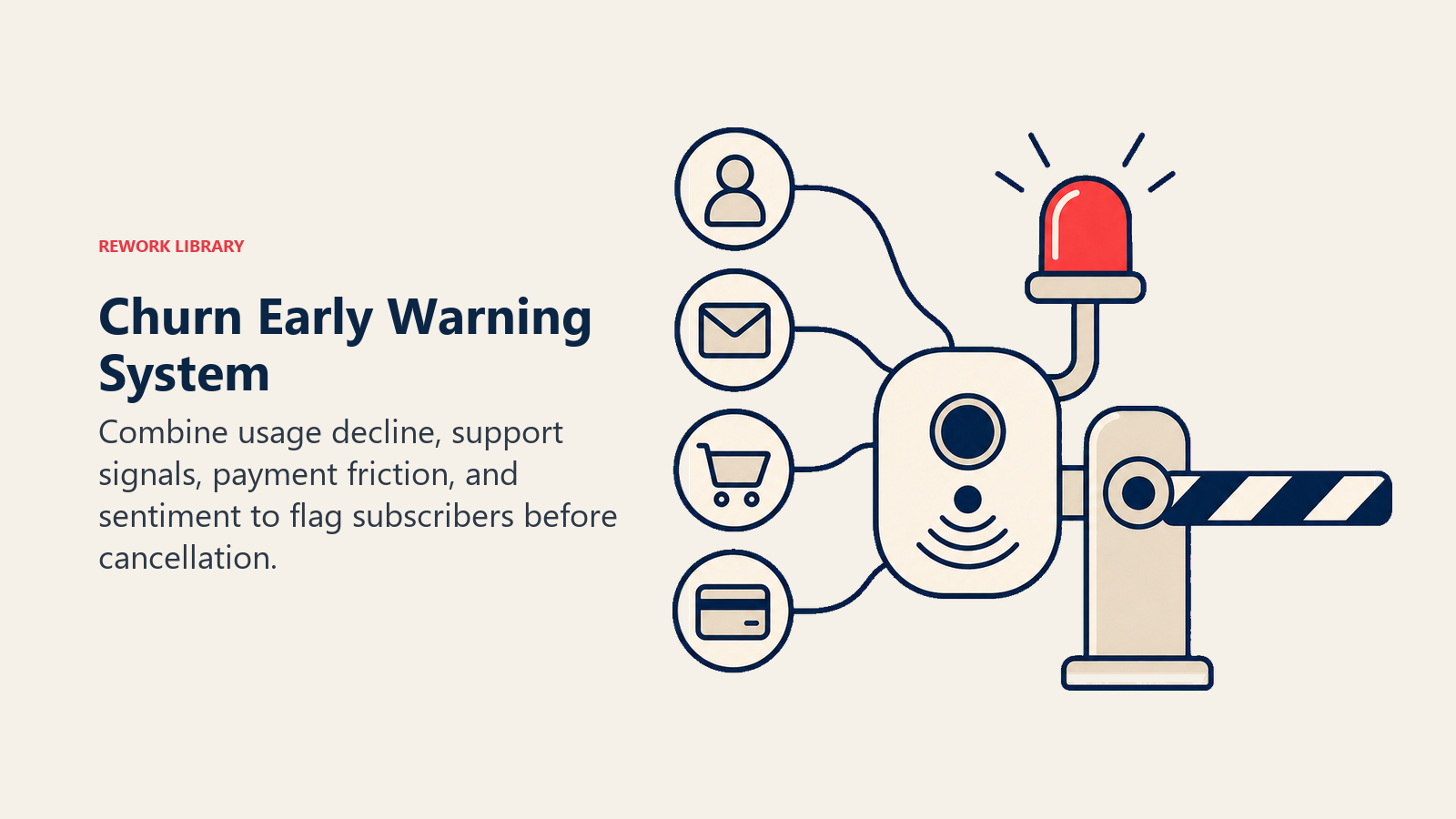
- Login frequency drops: Moving from weekly to monthly site visits
- Email engagement declines: Open rates falling below 20%, no clicks
- Support ticket patterns: Multiple complaints in short timeframe
- Referral activity stops: Previously active advocates go silent
- Social media disengagement: Unfollowing brand accounts
A supplement subscription tracking these signals might flag customers who haven't logged in for 30 days, haven't clicked an email in 45 days, or submitted two support tickets in one month. Each signal gets weighted based on historical correlation with churn. Effective customer segmentation helps identify which behavioral patterns matter most for different subscriber groups.
Usage Drop Indicators vary by subscription type:
- Consumables: Extending delivery frequency (monthly to every 6 weeks)
- Software: Feature usage declining by 50%+ month-over-month
- Content: Streaming time dropping, unread content accumulating
- Physical products: Returns increasing, feedback scores dropping
A pet food subscription should worry when a customer moves from 4-week to 6-week delivery, then 8-week. That's not just schedule flexibility, it's a warning sign they're buying elsewhere or reducing usage.
Health Scoring combines multiple signals into one metric:
Health Score = (Engagement × 40%) + (Usage × 30%) + (Satisfaction × 20%) + (Financial × 10%)
Subscribers scoring below 50 trigger automated interventions. Below 30? Escalate to your retention team for personal outreach. The specific weights depend on your business, but the framework applies universally.
Build automated systems that flag at-risk subscribers daily. A meal kit service might send a "We noticed you skipped three weeks, here's $20 off your next box" email automatically when health scores drop. The key is intervening before the cancellation decision crystallizes.
Cancellation Flow Optimization: Making It Hard (The Right Way)
Should you make cancellation easy or difficult? It's the wrong question. The right approach is making cancellation intentional, ensuring customers make informed decisions while respecting those who genuinely need to leave. Easy Cancellation Flow (one-click):
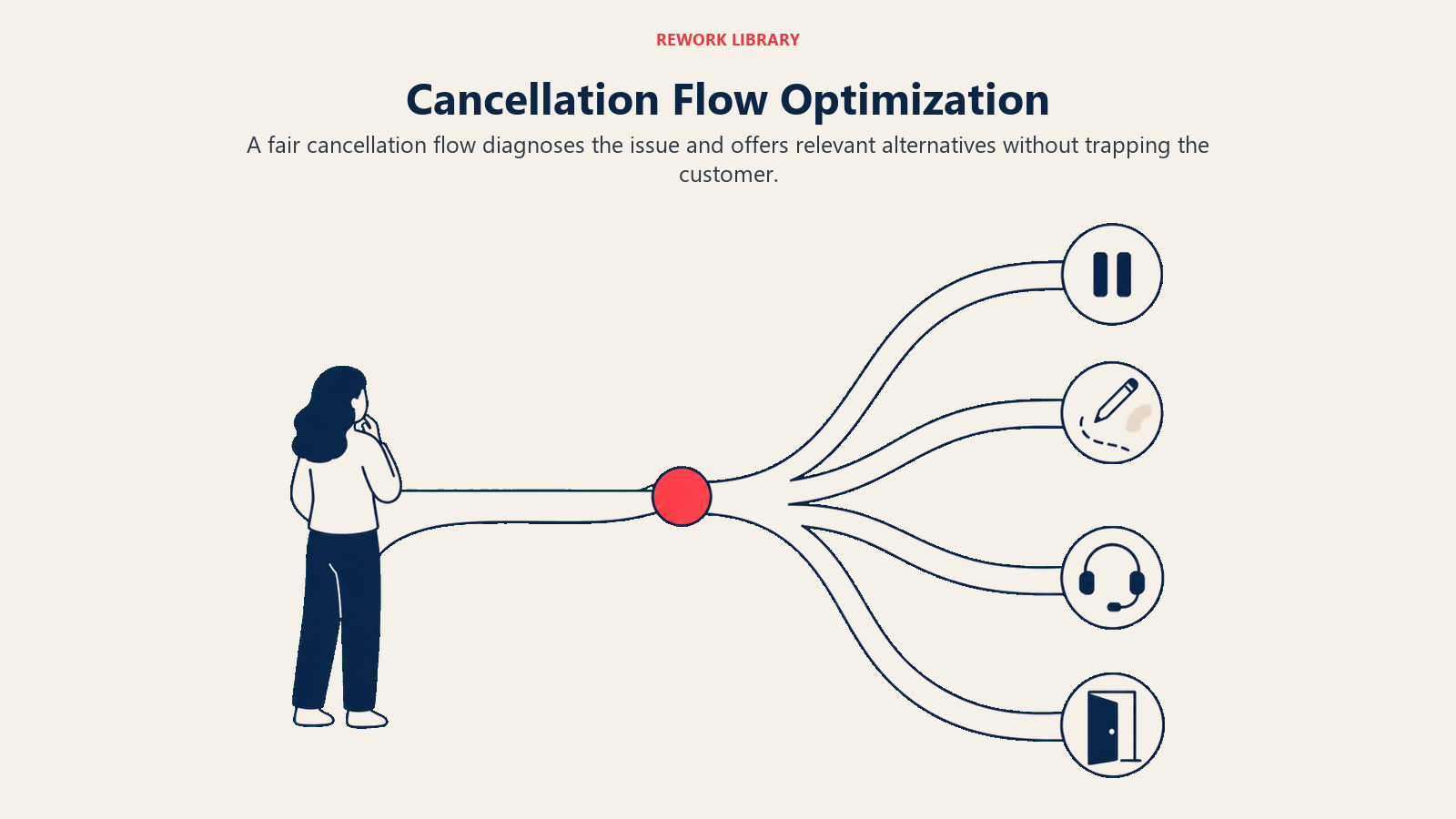
Account → Subscriptions → Cancel → Confirm → Done
Pros: Respectful, reduces frustration, maintains brand goodwill Cons: No opportunity to save relationship, no feedback, higher churn
Optimized Cancellation Flow (informed):
1. Cancel button → Why are you canceling? (required)
2. Show relevant save offer based on reason
3. Alternative options (pause, skip, change frequency)
4. Final confirmation with summary
5. Post-cancellation survey
This isn't dark patterns, it's respectful intervention. Someone canceling due to "too expensive" sees a discount offer. "Not using enough" triggers a pause option. "Moving" gets a location update prompt. "Product issues" escalates to support.
Exit Survey Design should be brief but revealing:
Primary reason (required, single choice):
- Price too high
- Don't need it anymore
- Found better alternative
- Product quality issues
- Delivery/logistics problems
- Too complicated to manage
- Just trying it out
Secondary feedback (optional, open text): "Anything else you'd like to share?"
The key is making the primary reason required with clear options. Open-ended questions alone get low response rates and vague feedback. Integrating this data into your customer feedback loop ensures insights drive product and experience improvements.
Save Offers should be relevant and limited:
- Price objections: 20-30% discount for 3 months
- Frequency issues: Switch to quarterly or pause 2 months
- Product concerns: Free upgrade to premium tier or product swap
- Competitive: Highlight unique features, loyalty rewards
A vitamin subscription losing someone to a competitor might offer: "Stay with us, here's 25% off for 3 months plus free shipping. We'll also add our new immune support blend to your next order at no cost."
Test save offers carefully. Too aggressive (50% off permanently) trains customers to threaten cancellation for discounts. Too weak (5% off one order) won't move the needle. The sweet spot is 20-30% for 2-3 months, meaningful but temporary.
Track save rates by reason. If "too expensive" has a 40% save rate but "found better alternative" only 10%, you know price discounts work but competitive positioning needs improvement.
Retention Tactics: Proactive Strategies to Reduce Churn
Waiting for cancellation attempts is reactive. Effective retention is proactive, building value, maintaining engagement, and addressing issues before they become cancellation triggers.
Value Reinforcement reminds subscribers why they joined:
- Monthly recap emails: "This month you saved $47 vs retail prices"
- Usage tracking: "You've enjoyed 24 meals, that's 8 hours not cooking"
- Milestone celebrations: "Happy 6-month anniversary! You've received 180 servings"
- ROI calculators: "Your subscription costs $50/month vs $85 buying individually"
A coffee subscription might send: "Your Subscription Stats: 12 bags delivered, 180 cups brewed, $156 saved vs coffee shops, 3 new origins discovered." This isn't just feel-good content, it's quantified value that justifies the recurring charge.
Engagement Programs keep subscribers actively involved:
- Loyalty rewards: Points for every delivery, redeemable for upgrades
- Exclusive access: Early product launches, limited editions, subscriber-only items
- Community building: Private Facebook groups, forums, member events
- Content creation: Recipe collections, tips, behind-the-scenes stories
The goal is creating switching costs beyond the product itself. A skincare subscription with an active community, points program, and personalized routines has higher retention than one that just ships products monthly.
Product Variety & Customization combat fatigue:
- Rotation schedules: Automatic variety in product selection
- Build-a-box options: Let subscribers customize each shipment
- Surprise elements: Mystery items, bonus products, limited editions
- Seasonal adaptations: Summer vs winter product mixes
A snack box rotating flavors monthly while letting subscribers exclude allergens and choose sweet vs savory ratios maintains novelty without requiring constant decisions.
Communication Cadence should inform without overwhelming:
- Pre-shipment notices: "Your box ships tomorrow, customize by midnight"
- Delivery updates: Tracking information, expected arrival
- Educational content: How-to guides, tips, inspiration
- Feedback requests: "Rate this month's selections"
The right frequency is typically 2-4 emails per month: one pre-shipment customization reminder, one shipping confirmation, one value-add content piece, and occasional special announcements. More than weekly risks unsubscribes. A well-planned email marketing for e-commerce strategy balances retention touchpoints with subscriber preferences.
Track engagement metrics rigorously. If open rates drop below 20% or click rates below 2%, your content isn't resonating. Test different subject lines, send times, and content types until you find what maintains engagement. Consider adding an SMS marketing strategy for time-sensitive retention messages like reactivation offers or shipping updates.
Pause & Skip Features: The Alternative to Permanent Churn
One of the most effective churn reduction tactics is simple: don't make cancellation the only option when customers need flexibility. Subscription Pause & Skip features dramatically reduce permanent churn by accommodating temporary needs. Pause Functionality lets subscribers suspend deliveries:
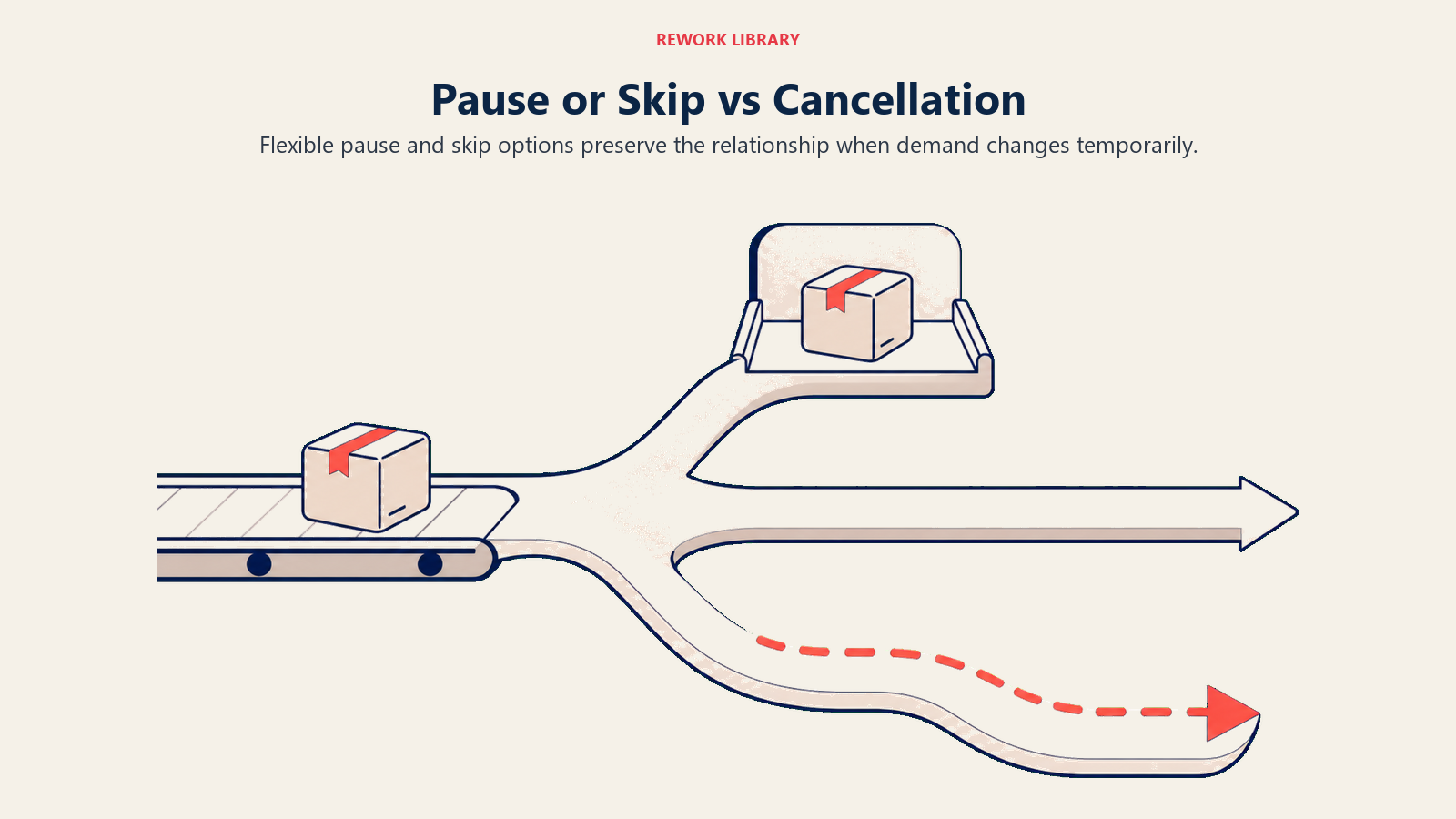
- Standard pause: 1-3 months, no action required
- Extended pause: 4-6 months, requires reactivation
- Indefinite pause: Remains paused until customer resumes
A meal kit service might see someone request cancellation due to "traveling for work." Instead of losing them permanently, offer: "Pause your subscription for up to 3 months, no charges, no deliveries. Resume anytime with one click."
Skip Features provide delivery-level flexibility:
- One-time skip: Skip next delivery, resume automatically
- Recurring skip: Every other delivery, every third delivery
- Seasonal skip: Pause summers, resume fall
Pet owners might skip deliveries when visiting family or traveling. Coffee drinkers might skip when they've accumulated surplus. The alternative is cancellation followed by eventual reacquisition, far more expensive.
Implementation Strategy:
Make pause/skip options prominent in cancellation flows:
"Before you cancel, consider these options:
○ Pause 1 month (resume March 15)
○ Pause 3 months (resume May 15)
○ Skip next 2 deliveries
○ Change to every 6 weeks
□ Cancel subscription"
The psychology matters. Pause feels temporary and reversible. Cancel feels permanent and final. Even if some "paused" subscribers never return, many will, and you've maintained the relationship.
Reactivation Flows bring back paused subscribers:
- Week before auto-resume: "Your subscription resumes next week, customize your next box"
- Extended pause reminder: "You've been paused 2 months, ready to resume?"
- Seasonal trigger: "Summer's over, restart your subscription with fall flavors"
A supplement subscription might email paused customers: "It's been 8 weeks, time to restock? Resume with 15% off your first order back."
Track pause-to-reactivation rates. If 60% of paused subscribers return, that's 60% who would have been permanent churn. If only 20% return, pause might be delaying inevitable cancellation, but it's still worth the attempt.
Win-Back Campaigns: Re-Engaging Churned Subscribers
Even with perfect retention efforts, some customers will cancel. Win-back campaigns turn churned subscribers into revenue recovery opportunities. These campaigns are a critical component of comprehensive customer retention strategies that address the full subscriber lifecycle. Post-Cancellation Timing matters:
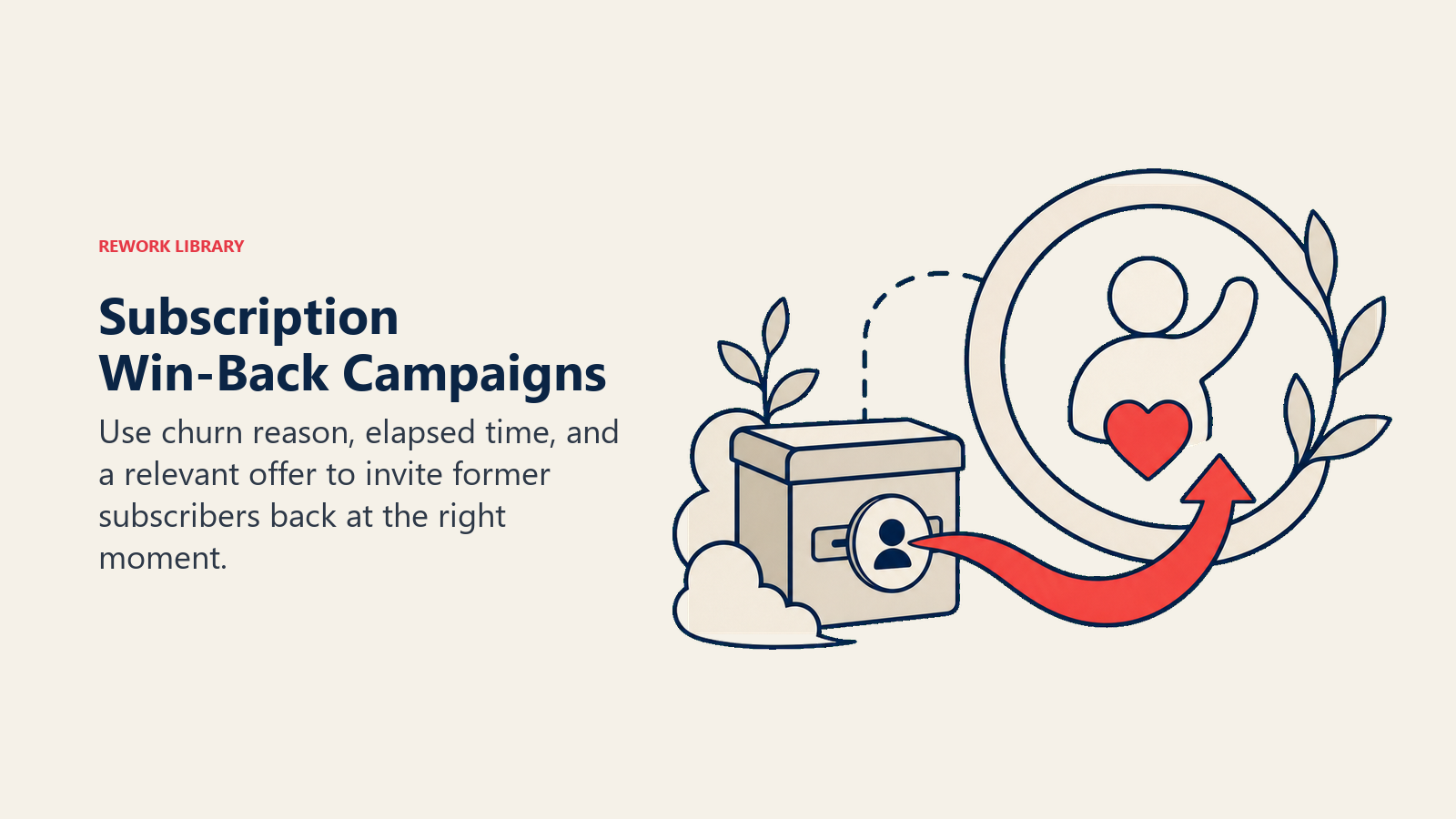
- Immediate (0-7 days): "We're sorry to see you go, was it something we can fix?"
- Short-term (30-60 days): "We've missed you, here's what's new"
- Long-term (90-180 days): "It's been a while, ready to give us another try?"
Different timing targets different motivations. Immediate emails catch regret and impulse cancellations. Short-term targets circumstantial cancellations now resolved. Long-term targets customers who've forgotten why they left.
Win-Back Offer Structure:
Strong opener: "Come back to [Brand], we want to make it right"
Personalized acknowledgment: "We noticed you canceled due to [specific reason]"
Relevant offer: "Here's [discount/upgrade/flexibility] to address your concerns"
What's changed: "Since you left, we've [new products/features/options]"
Clear CTA: "Reactivate with one click, no commitment beyond first month"
A coffee subscription might send churned customers: "We've expanded to 12 new origins, added a 'try 3 different beans' option, and improved our roasting process. Come back for $15 off your first month, cancel anytime if we haven't won you back."
Segmented Campaigns based on churn reason:
- Price-sensitive: Heavy discount (40-50% first month)
- Product quality: Quality improvements, guarantee
- Lack of variety: New product announcements, customization options
- Competitive: Unique differentiators, loyalty rewards
- Circumstantial: Generic welcome back, standard offer
Don't send the same email to everyone. Someone who left for a competitor needs different messaging than someone who left due to budget constraints.
Multi-Touch Sequences:
Email 1 (Week 1): Exit feedback survey Email 2 (Week 4): "We've missed you" with 25% offer Email 3 (Week 8): "Here's what's new" product announcements Email 4 (Week 12): "Last chance" aggressive offer (50% off)
Then quarterly check-ins for another year before moving to annual outreach.
Track win-back rates and Customer Lifetime Value (LTV) of reactivated subscribers. If win-back customers have 60% the LTV of never-churned customers, factor that into your win-back offer economics. Spending $30 to reacquire someone worth $180 is profitable.
For comprehensive strategies, see Win-Back Campaigns.
Cohort Tracking: Measuring Retention Over Time
Aggregate churn rates mask critical patterns. Cohort tracking reveals whether your retention improvements are actually working and which customer segments have the best long-term potential. Cohort Definition groups subscribers by acquisition date:
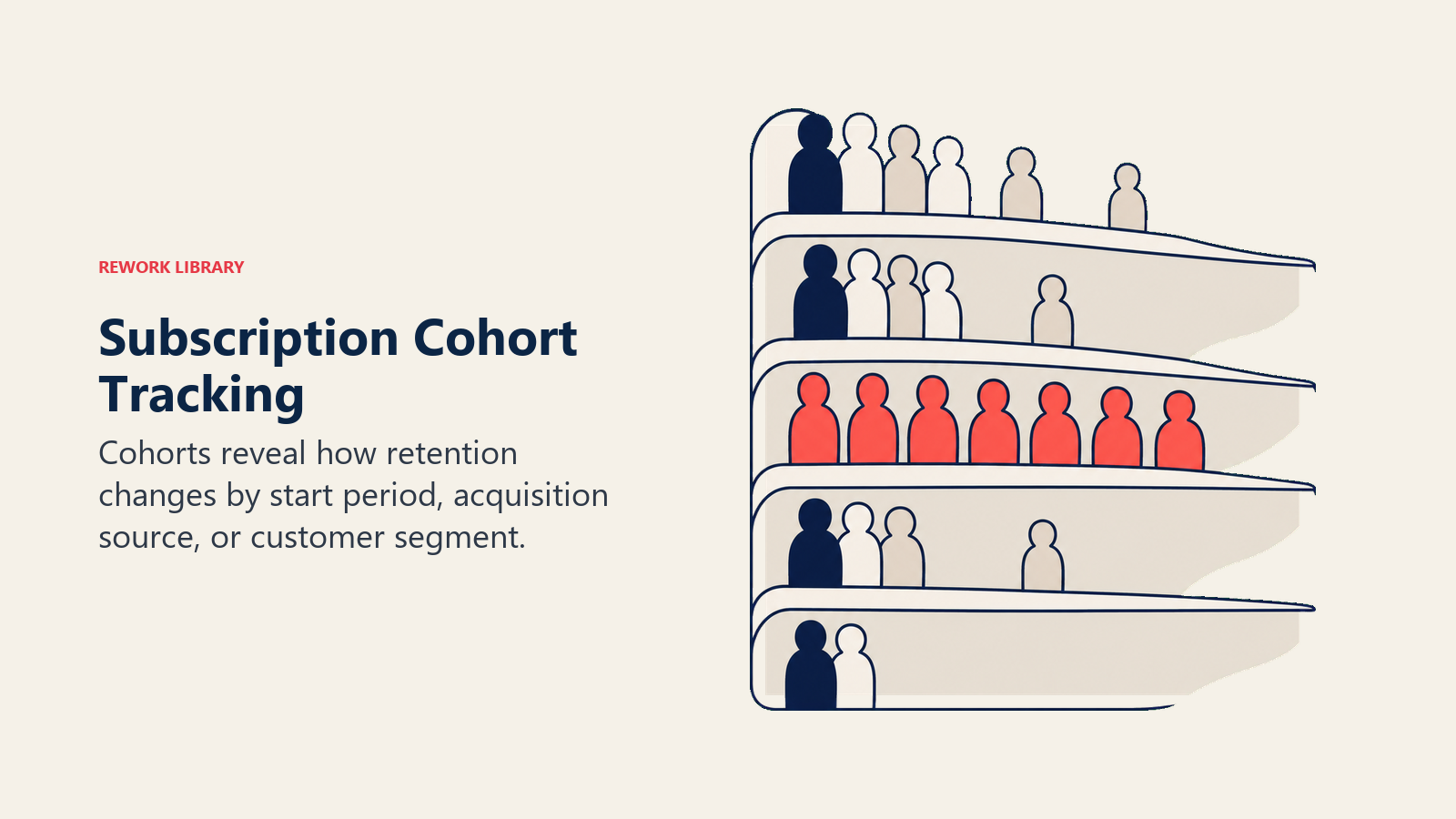
Cohort           Size    Month 1    Month 3    Month 6    Month 12
Jan 2024         500     475        390        310        240
Feb 2024         520     499        421        346        -
Mar 2024         550     539        467        -          -
This shows whether newer cohorts (benefiting from your improvements) retain better than older cohorts. If March retains at 98% month one vs January's 95%, your Subscription Onboarding changes are working.
Retention Curves visualize subscriber lifespan:
100% |█████▓▓▓▓▒▒▒▒░░░░
 80% |     ███▓▓▒▒▒░░░
 60% |         ███▓▒░░
 40% |             ███
 20% |
     └─────────────────
      1  3  6  9  12 months
The curve shape reveals business health. A steep initial drop followed by flattening (healthy) vs continuous linear decline (problematic) tells different stories. You want to see flattening after month 3-4, indicating subscribers who make it past initial evaluation period become stable.
Segment Comparisons identify high-value acquisition channels:
Channel          6-Month Retention    12-Month LTV
Paid Search      68%                  $180
Social Ads       62%                  $156
Email List       79%                  $228
Referrals        84%                  $264
This data transforms acquisition strategy. Even if referrals cost $50 each vs $25 for social ads, their superior retention and LTV make them the better investment.
Declining Pattern Analysis identifies when fatigue sets in:
If retention drops sharply between months 6-8, you need a mid-term engagement initiative. If it drops at month 12, anniversary campaigns become critical. If decline is steady from month 1, you have a fundamental product-market fit issue.
Build cohort reports automatically. Most subscription platforms (Recharge, Recurly, Chargebee) include cohort analysis. If not, export data monthly and build Excel dashboards tracking retention by acquisition month, channel, product tier, and key segments.
Customer Segmentation for Targeted Retention
Not all subscribers are equal. High-value customers justify aggressive retention investment while low-margin subscribers might not be worth expensive save offers. Segmentation ensures you're allocating retention resources efficiently.
Value-Based Segments:
- Whales (top 10%): High LTV, multiple subscriptions, frequent upgrades
- Core (middle 60%): Standard plans, occasional upgrades, stable usage
- Budget (bottom 30%): Minimal plans, discount-seeking, price-sensitive
A whale canceling due to product quality issues might justify a phone call from your founder, a free year of premium tier, and priority access to new products. A budget subscriber leaving for price reasons gets a standard 25% discount email.
Engagement-Based Segments:
- Advocates: High engagement, referrals, social sharing, reviews
- Passive satisfied: Low engagement but consistent usage, no complaints
- At-risk: Declining engagement, support issues, usage dropping
Advocates leaving are devastating, they're not just revenue but marketing engines. They warrant personal outreach, community perks, and aggressive retention. Passive satisfied customers get automated retention flows.
Behavioral Segments:
- Power users: High frequency, multiple products, advanced features
- Casual users: Low frequency, basic plans, minimal engagement
- Seasonal: Usage spikes certain months, pauses others
Power users need retention focused on continued innovation and advanced features. Casual users need simplification and value communication. Seasonal users need flexible Subscription Pause & Skip options.
Retention Tactics by Segment:
Whales get:
- Personal account management
- Early access to everything
- Unlimited flexibility (pause, skip, change)
- Generous loyalty rewards
- Direct feedback channels to product team
Core customers get:
- Standard automation flows
- Loyalty program access
- Moderate save offers (20-30% discounts)
- Regular engagement content
Budget customers get:
- Minimal intervention
- Price-focused retention (if any)
- Evaluation of profitability (should you even retain them?)
This sounds harsh, but resources are finite. Spending $100 in effort to save a subscriber worth $60 LTV is poor economics. Better to let them churn and focus retention budget on higher-value segments. Understanding unit economics for e-commerce helps determine which retention investments generate positive ROI.
Benchmarking: What's Good Churn?
Context matters. A 5% monthly churn rate might be excellent for budget snack boxes but disastrous for premium skincare. Understanding industry benchmarks helps set realistic goals.
General Subscription Benchmarks (monthly churn):
- Excellent: <3% monthly (>97% retention)
- Good: 3-5% monthly (95-97% retention)
- Average: 5-7% monthly (93-95% retention)
- Concerning: 7-10% monthly (90-93% retention)
- Unsustainable: >10% monthly (<90% retention)
These translate to annual retention:
- 3% monthly = 70% annual retention
- 5% monthly = 54% annual retention
- 10% monthly = 28% annual retention
Category-Specific Benchmarks:
- Food/meal kits: 8-12% monthly (high usage, fatigue risk)
- Beauty/cosmetics: 5-8% monthly (moderate usage)
- Supplements: 6-9% monthly (results-dependent)
- Pet products: 4-6% monthly (recurring need)
- Coffee/beverages: 5-7% monthly (habitual consumption)
- Software: 3-5% monthly (switching costs)
A meal kit at 9% monthly churn is performing well. A pet food subscription at 9% monthly has serious problems.
Churn Rate Goals should be realistic:
Year 1: Establish baseline, aim for category average Year 2: Reduce churn 15-25% from baseline Year 3: Reach top quartile for category Year 4+: Maintain top quartile, focus on margin improvement
If you start at 8% monthly churn, don't expect to hit 3% in six months. Aim for 6-7% by end of year one, 5-6% by year two. Sustainable improvement is gradual.
Revenue Churn vs Subscriber Churn:
You might have 5% subscriber churn but only 3% MRR Growth for Subscriptions churn if higher-value customers retain better. Or 5% subscriber churn but 8% MRR churn if your whales are leaving. Track both, losing 100 $20 subscribers hurts less than losing 20 $100 subscribers.
Pricing & Packaging Strategy for Retention
Sometimes churn isn't about engagement or product quality, it's about fit. Flexible pricing and packaging reduce churn by accommodating different usage patterns and budgets.
Tier Flexibility prevents all-or-nothing cancellations:
Premium ($50/month): 4 products, premium brands, customization
Standard ($30/month): 2 products, core brands, limited customization
Lite ($15/month): 1 product, basic brands, no customization
Someone considering cancellation due to price can downgrade to Lite instead of leaving entirely. A $15/month subscriber is better than $0 from a churned customer.
Upgrade/Downgrade Flows should be frictionless:
Cancellation flow: "Before you cancel, would a lower-priced plan work?" → Show tier comparison → One-click downgrade → Confirm change
Mid-cycle changes: Prorate differences, immediate access to new tier features No penalties: Make movement between tiers easy and transparent
A solid payment processing strategy ensures smooth handling of prorations, refunds, and tier transitions without billing errors that trigger cancellations.
A coffee subscription losing someone to "too expensive" offers: "Switch to our Lite plan, $15/month for 8oz bag instead of 16oz. You can always upgrade later."
Annual vs Monthly impacts churn differently:
Monthly: Higher churn but less upfront commitment Annual: Lower churn but requires conversion confidence
Consider hybrid: Month-to-month initially, incentivize annual after 3-4 months: "You've been with us 4 months, switch to annual and save 20% plus lock in your current price."
Commitment Tiers:
- No commitment: Cancel anytime, full price
- 3-month minimum: 10% discount, early cancel fee
- Annual prepay: 25% discount, no refunds after 30 days
Different customers have different risk tolerances. Offering multiple commitment options captures broader audience while naturally segmenting based on retention confidence.
Strategic Pricing Changes:
If raising prices, grandfather existing customers for 6-12 months. The goodwill and reduced churn spike is worth the delayed revenue. Then offer grandfathered customers incentive to switch to new pricing with added value: "New price is $35, but you're locked at $30. Upgrade to premium tier for $40 (new customers pay $50) and get 3 bonus products."
Track tier distribution and movement. If 80% choose cheapest tier, you're priced wrong or value communication is failing. If 90% choose annual, you might be overweighting annual discounts vs monthly pricing.
Long-term Sustainability: Reducing Inherent Churn
All the retention tactics in the world can't fix a fundamentally broken product-market fit. Long-term churn reduction requires addressing root causes, not just treating symptoms.
Product-Market Fit Evaluation:
Ask honestly: Is there inherent churn in your model?
- Meal kits: Yes, cooking fatigue is real
- Razors: No, ongoing need doesn't decline
- Diet programs: Yes, goal-based, temporary by nature
- Coffee: No, habitual consumption persists
If your subscription solves a temporary problem or creates its own fatigue, no amount of optimization will achieve 3% monthly churn. Instead, embrace reality and build for it:
Goal-based subscriptions: Plan for graduation, create alumni programs, design natural endpoints Fatigue-prone categories: Maximize variety, enable pauses, create seasonal models Competitive categories: Build switching costs through community and personalization
Fundamental changes to your subscription model design may be necessary if churn patterns reveal structural problems rather than execution issues.
Continuous Product Improvement:
Churn feedback reveals product gaps:
- 40% cite "not enough variety" → Expand SKU options
- 30% cite "quality inconsistent" → Improve QC processes
- 25% cite "too complicated" → Simplify customization
This isn't retention strategy, it's product strategy informed by churn analysis. The best retention tactic is building something people don't want to cancel.
Lifecycle Adaptation:
Month 1-3: Onboarding focus, expectation setting, quick wins Month 4-6: Engagement building, community integration, habit formation Month 7-12: Value reinforcement, loyalty rewards, exclusive access Month 13+: VIP treatment, co-creation opportunities, advocacy programs
Different stages need different interventions. A month-two subscriber needs usage education. A year-two subscriber needs to feel valued and special.
Organizational Alignment:
Churn isn't just the retention team's problem:
- Product: Build features that increase switching costs
- Marketing: Acquire customers who fit profile, set accurate expectations
- Support: Resolve issues before they become cancellation triggers
- Operations: Deliver reliably, minimize friction
- Finance: Price appropriately, avoid surprise billing
If marketing promises 10 products but subscriptions only include 5, churn is inevitable. If support takes 3 days to respond, at-risk customers become churned customers. Retention is a company-wide responsibility.
Putting It All Together: Your Churn Management System
Here's your implementation roadmap:
Month 1: Measurement Foundation
- Track gross, net, and cohort churn rates
- Implement exit surveys with required reason selection
- Build basic cohort retention dashboards
- Calculate current benchmarks and set goals
Month 2: Early Warning System
- Define engagement and usage indicators
- Build health scoring model
- Create automated at-risk flags
- Test intervention triggers
Month 3: Cancellation Flow Optimization
- Redesign cancellation flow with alternatives
- Implement pause and skip features
- Build reason-specific save offers
- Launch A/B tests on flow variations
Month 4-6: Proactive Retention
- Deploy value reinforcement campaigns
- Launch engagement programs (loyalty, community)
- Build product variety and customization
- Implement win-back email sequences
Month 7-12: Refinement & Scaling
- Analyze cohort performance trends
- Segment retention strategies by value
- Optimize pricing and packaging options
- Build organizational churn awareness
This isn't a set-it-and-forget-it system. Review churn metrics weekly, analyze cohorts monthly, and revise strategies quarterly. Churn management is continuous optimization, not a one-time project.
The Retention Mindset
The best subscription businesses focus on retention before acquisition. They know that growing MRR with 10% monthly churn is like filling a leaky bucket. You can pour faster, but you'll never get ahead.
Keep the customers you have before spending more to acquire new ones. Analyze why people leave, build systems to catch at-risk subscribers early, make cancellation informed but not manipulative, and create a product so valuable that canceling feels like a loss.
Your churn rate is the ultimate product scorecard. Every percentage point of improvement flows directly to MRR Growth for Subscriptions and long-term business value. Start with measurement, build early warning systems, optimize your cancellation flow, and keep refining.
The subscription businesses that win aren't those that acquire the most customers, they're the ones that keep them longest. Master churn management, and you'll build a subscription engine that compounds value month after month, year after year.
Subscription Churn Management FAQ
What is a good monthly churn rate for a subscription business?
Below 3% monthly churn is excellent, 3-5% is good, and 5-7% is average for most ecommerce subscriptions. Benchmarks vary by category: meal kits often run 8-12% monthly while pet products and software sit lower at 3-6%. Compare against your specific category, not a single universal number.
How do you calculate subscription churn rate?
Gross churn rate is subscribers lost in a period divided by total subscribers at the start, times 100. Net churn rate subtracts expansion revenue from upgrades, so a business with strong upsells can show lower net churn than gross churn, and sometimes negative net churn.
What is the difference between gross churn and net churn?
Gross churn measures only customers or revenue lost. Net churn factors in expansion revenue from upgrades and upsells. Track both: gross churn shows your retention baseline, while net churn reveals whether expansion is offsetting cancellations.
How can ecommerce brands reduce subscription churn?
Build early warning systems with health scores, offer pause and skip instead of cancel-only flows, run reason-specific save offers, reinforce value with recap emails, and launch segmented win-back campaigns. The biggest gains come from preventing churn before the cancel click, not recovering after it.
Learn More
Deepen your subscription commerce expertise with these related resources:
- Subscription Model Design - Build subscription frameworks that minimize inherent churn from the start
- Customer Lifetime Value - Calculate and optimize the long-term value of retained subscribers
- Customer Retention Strategies - Comprehensive tactics for keeping customers engaged beyond subscriptions
- Customer Feedback Loop - Systematically capture and act on subscriber feedback to reduce churn

On this page
- Understanding Churn Metrics: Beyond the Basic Percentage
- The Churn Analysis Framework: When and Why Customers Leave
- Early Warning Systems: Catching At-Risk Subscribers Before They Cancel
- Cancellation Flow Optimization: Making It Hard (The Right Way)
- Retention Tactics: Proactive Strategies to Reduce Churn
- Pause & Skip Features: The Alternative to Permanent Churn
- Win-Back Campaigns: Re-Engaging Churned Subscribers
- Cohort Tracking: Measuring Retention Over Time
- Customer Segmentation for Targeted Retention
- Benchmarking: What's Good Churn?
- Pricing & Packaging Strategy for Retention
- Long-term Sustainability: Reducing Inherent Churn
- Putting It All Together: Your Churn Management System
- The Retention Mindset
- Learn More