Pricing Strategy for E-commerce: Models, Psychology, and Competitive Tactics
Turn this article into takeaways for your work.


Each assistant summarizes the article only for you and suggests best practices for your work.
Pricing strategy is the most powerful profit lever for e-commerce growth: a 3% price increase can match the profit impact of a 10% lift in traffic, yet most stores leave 20-40% of margin on the table by setting prices once and competing only on being cheapest. The strongest approach is a hybrid, using cost-plus as a floor, value-based pricing as the target, competitive analysis as a reality check, and continuous testing to optimize over time.
Your pricing strategy is the most powerful profit lever in your e-commerce business. Two small 3% price increases deliver the same profit impact as a 10% increase in traffic. Most brands obsess over acquisition while leaving 20-40% margin improvement sitting right there through better pricing.
The difference between a $47 product and a $54 product isn't customer perception. It's $70,000 in additional profit on 10,000 units sold. Yet most e-commerce operators set prices once and never revisit them, or worse, compete purely on being the cheapest option.
This guide covers the pricing models that work in e-commerce, the psychological tactics that influence purchase decisions, and the competitive strategies that protect margins while keeping your market position. You'll learn how to set initial prices, test adjustments, segment pricing across customer groups, and avoid the common mistakes that erode profitability. Understanding how pricing impacts customer lifetime value is essential for long-term profitability.
Pricing Models Overview
E-commerce pricing isn't one-size-fits-all. The right model depends on your product category, competitive position, brand perception, and business goals. Here are the six core models: Cost-Plus Pricing: Calculate total costs and add a fixed margin percentage. Simple to implement, easy to justify, but it ignores customer value perception and competitive dynamics.
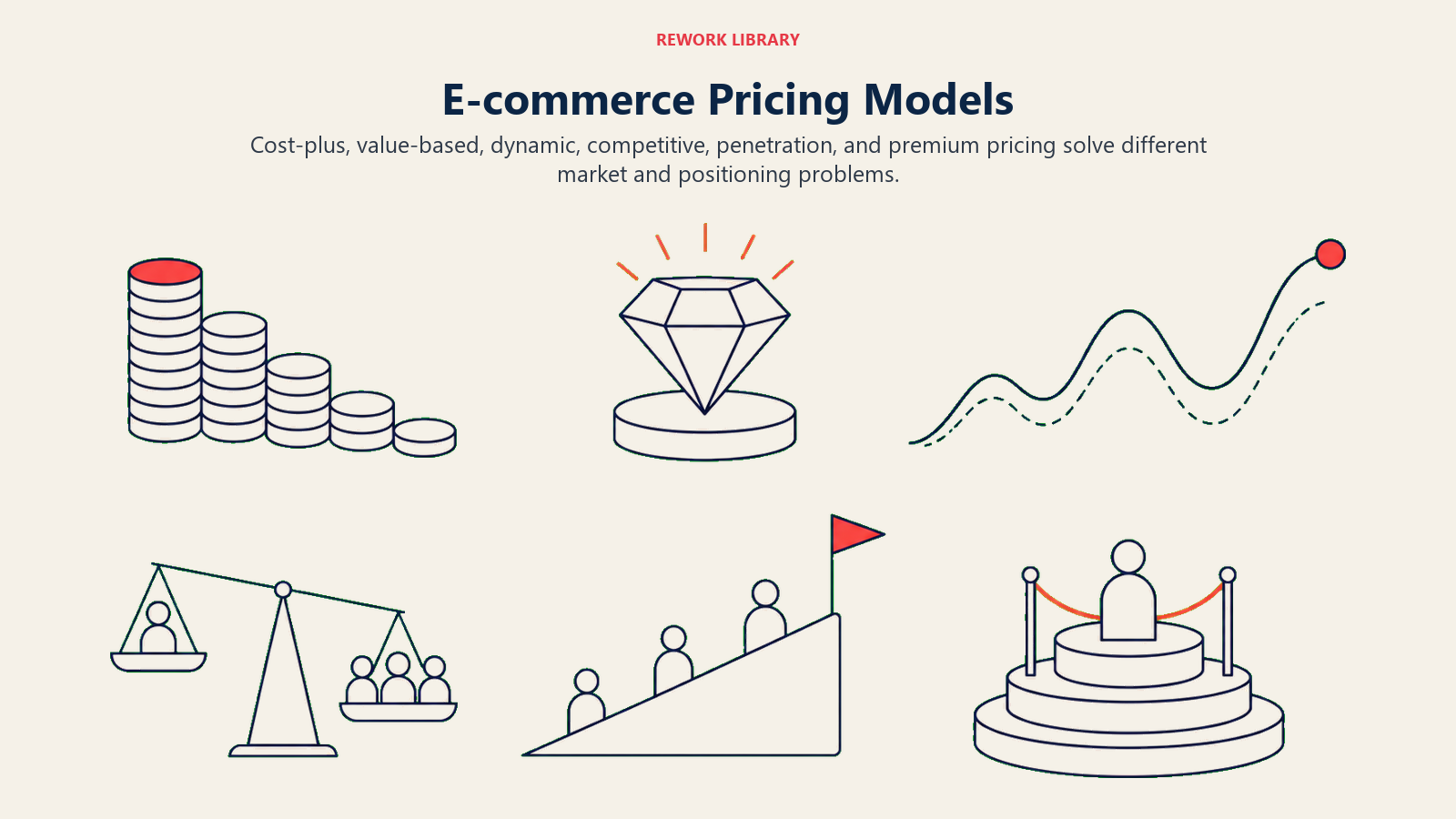
Value-Based Pricing: Set prices based on the perceived value customers receive rather than your costs. Requires deep customer understanding but captures maximum profit when done right.
Dynamic Pricing: Adjust prices in real-time based on demand, inventory levels, competitor pricing, or customer segments. Common in travel and hospitality, increasingly viable in e-commerce with automation tools.
Competitive Pricing: Price at, above, or below competitors based on your positioning strategy. Works when products are commoditized but creates margin pressure without differentiation.
Penetration Pricing: Launch at low prices to gain market share quickly, then increase once established. Works for new entrants but it's tough to raise prices later without customer backlash.
Price Skimming: Launch at premium prices to early adopters, then gradually decrease to reach wider markets. Works for innovative products with strong differentiation and limited competition.
Most successful e-commerce brands use a hybrid approach: cost-plus as a floor, value-based as the target, competitive analysis as a reality check, and dynamic adjustments to optimize over time.
Use this table to match a model to your situation before you commit:
| Model | Use it when | Watch out for |
|---|---|---|
| Cost-Plus | You need a fast, defensible floor | Ignores what customers will actually pay |
| Value-Based | Your product solves a high-stakes problem | Requires real willingness-to-pay research |
| Dynamic | Demand or inventory swings often | Frequent changes erode customer trust |
| Competitive | Products are commoditized | Drags you toward margin-killing price wars |
| Penetration | You're a new entrant chasing share | Raising prices later triggers backlash |
| Price Skimming | You have a differentiated, novel product | Invites competitors once margins are visible |
Cost-Based Pricing: Building Your Foundation
Every pricing strategy starts with knowing your costs. Cost-based pricing isn't sophisticated, but it sets the minimum viable price that keeps your business solvent.
Calculate Total Unit Costs:
- Cost of Goods Sold (COGS): Raw materials, manufacturing, packaging, inbound shipping
- Fulfillment Costs: Warehousing, pick-pack, outbound shipping, returns processing
- Transaction Fees: Payment processing (2.9% + $0.30 typical), platform fees, affiliate commissions
- Marketing Attribution: Customer acquisition cost divided by average order frequency
- Overhead Allocation: Portion of rent, software, salaries, utilities per unit sold
If your product costs $15 to manufacture, $3 to ship, $1.50 in transaction fees, $8 in attributed marketing, and $2.50 in overhead allocation, your total cost is $30 per unit.
Apply Margin Targets: Industry benchmarks vary, but healthy e-commerce margins typically range from 25-60% depending on category:
- Commodity products: 25-35% margin
- Differentiated products: 35-50% margin
- Premium/luxury products: 50-70% margin
Using a 40% margin target on $30 cost: Price = $30 / (1 - 0.40) = $50
This gives you a starting point, not the final price. Cost-plus ensures you don't lose money, but it doesn't capture the value you deliver or what customers will actually pay.
Link this to your broader unit economics to understand how pricing impacts overall profitability, not just gross margin.
Value-Based Pricing: Capturing What Customers Will Pay
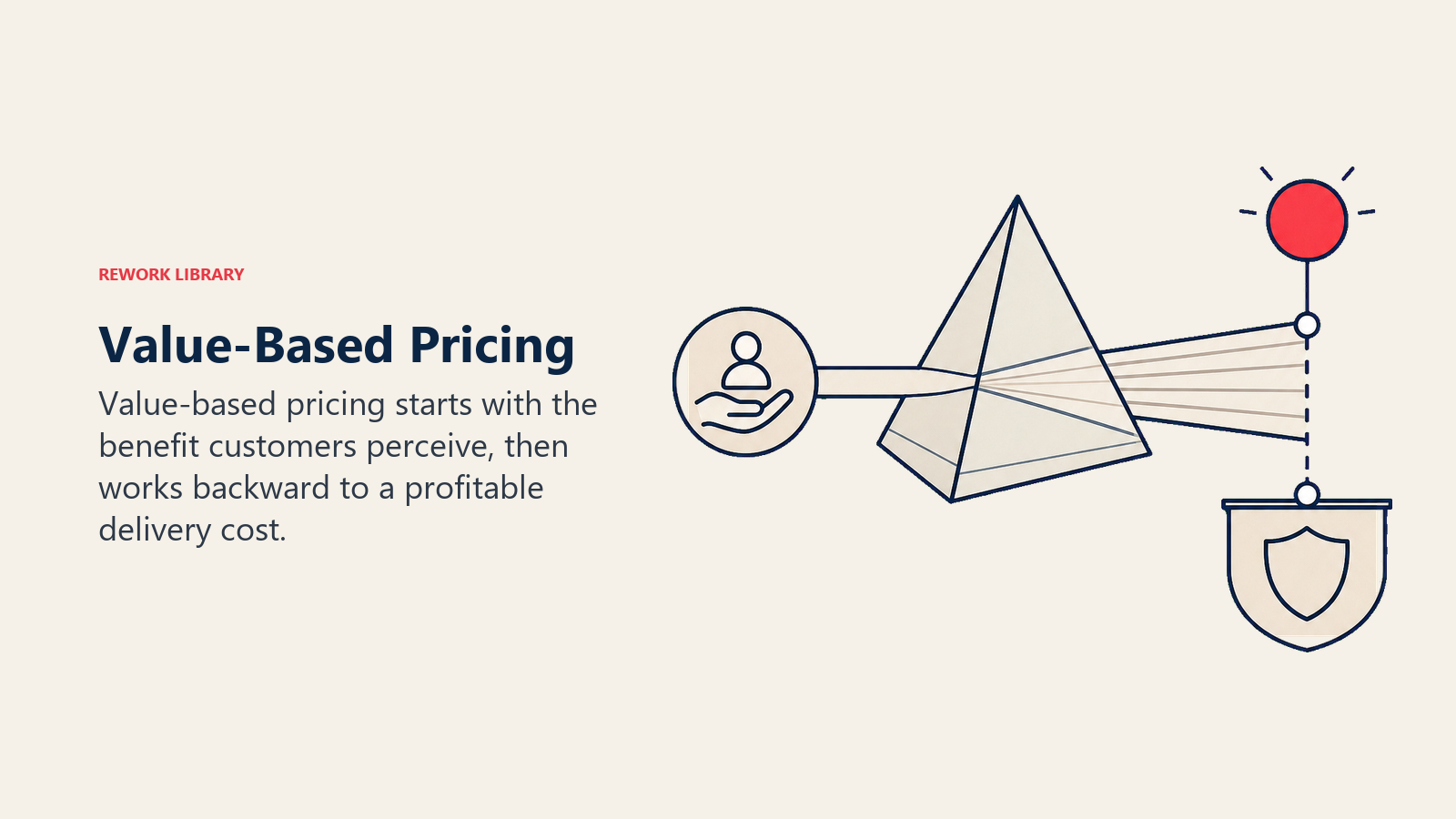
Value-based pricing flips the equation: instead of cost + margin = price, you start with customer value and work backward to costs. The price is determined by the perceived benefit delivered, not the expense of delivering it.
A $5 blue light blocking lens costs the same to manufacture as a $5 clear lens, but customers pay $30 more for the blue light version because they value eye strain reduction and better sleep. The cost didn't change, the perceived value did.
A $5 blue light blocking lens costs the same to manufacture as a $5 clear lens, but customers pay $30 more for the blue light version because they value eye strain reduction and better sleep. The cost didn't change, the perceived value did. Quantify Customer Value:
- Functional value: What problem does your product solve? What's the cost of not solving it?
- Time savings: How many hours does your product save? What's that time worth?
- Alternative solutions: What do customers currently pay for inferior alternatives?
- Emotional value: How much do customers value convenience, status, peace of mind?
A productivity app that saves 10 hours per month has a functional value of $500/month if the user's time is worth $50/hour. Pricing it at $29/month captures a fraction of the value while feeling like a bargain.
Willingness-to-Pay Research: Ask prospective customers directly using techniques like:
Van Westendorp Price Sensitivity Meter: Four questions that identify acceptable price ranges
- "At what price would this be too expensive to consider?"
- "At what price would this be expensive but worth considering?"
- "At what price would this be a bargain?"
- "At what price would this be too cheap to trust quality?"
Conjoint Analysis: Present product bundles with different features at different prices, analyze trade-offs
A/B Price Testing: Show different prices to different customer segments, measure conversion and revenue
The intersection of "too cheap" and "too expensive" gives you the optimal price range where most customers find value acceptable.
Combine value-based pricing with strategic AOV optimization to increase transaction value beyond single-item purchases.
Psychological Pricing Tactics
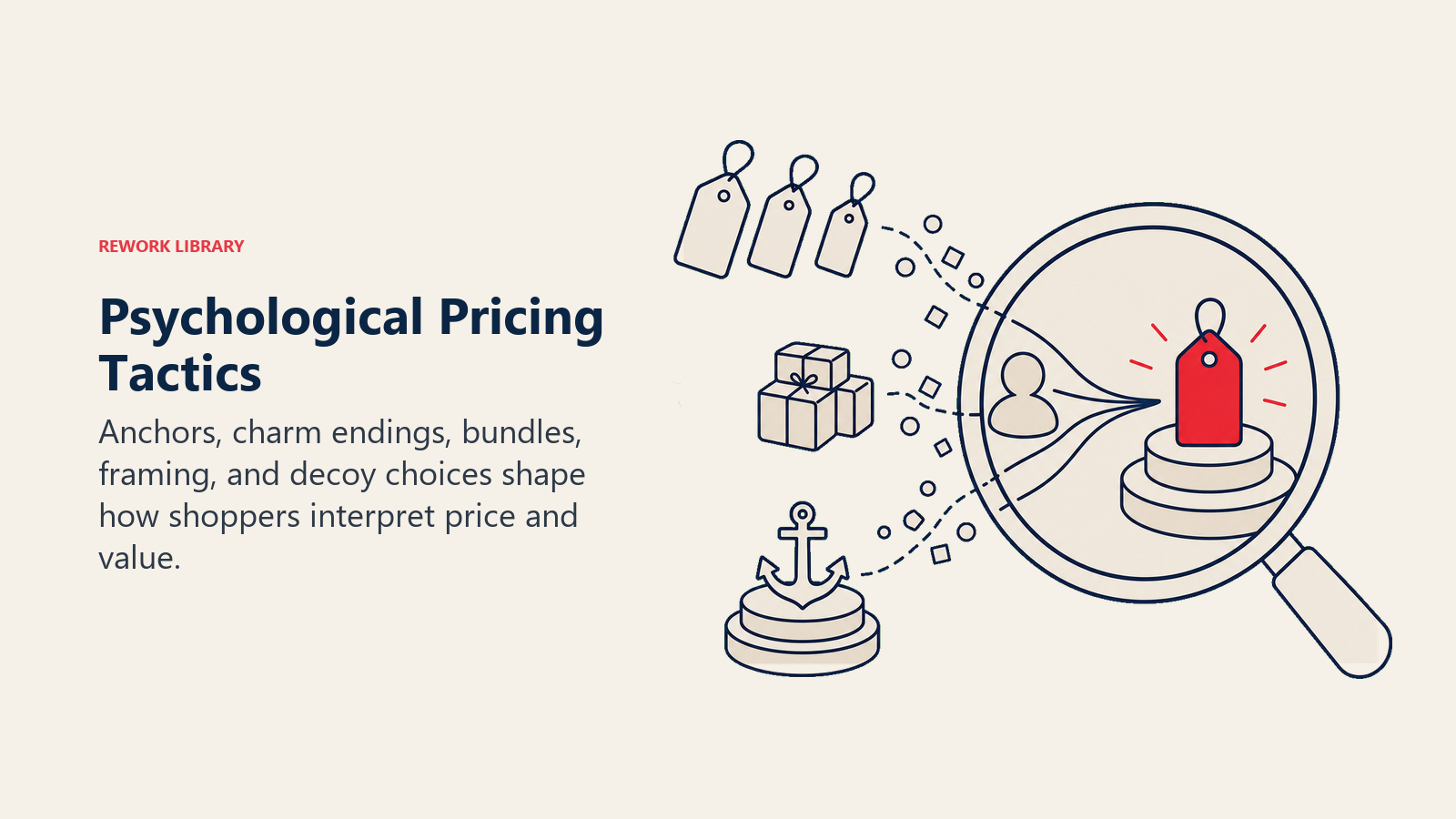
Pricing is emotional, not purely rational. Small presentation changes influence purchase decisions without changing actual value. Use these tactics deliberately: Charm Pricing ($9.99 vs $10.00): Prices ending in 9, 99, or 95 convert 8-12% better than round numbers in testing. The left-digit effect makes $19.99 feel significantly cheaper than $20.00 even though the difference is one cent.
Use charm pricing for:
- Price-sensitive products
- Impulse purchases
- Promotional items
Avoid charm pricing for:
- Luxury products (undermines premium positioning)
- B2B products (appears unsophisticated)
- Services where round numbers signal professionalism
Anchor Pricing: The first price customers see becomes the reference point for all subsequent prices. Display a higher original price next to your sale price to make the discount feel more significant.
Original: $149 → Sale: $99 feels like a better deal than just showing $99 alone.
Use anchoring through:
- Compare-at pricing (show MSRP vs your price)
- Multi-tier pricing (expensive option makes mid-tier look reasonable)
- Before/after pricing on sales
Decoy Pricing: Introduce a third option specifically to make another option more attractive. The decoy isn't meant to sell, it's meant to shift perception.
- Small: $5
- Medium: $7
- Large: $7.50
The large appears to be incredible value compared to the medium, steering customers toward the high-margin large option. Without the decoy, customers might default to the small.
Price Framing: How you present price affects perception:
- "$1 per day" feels smaller than "$365 per year"
- "Save $50" feels better than "5% off" even when identical
- "Only $2 more for premium" emphasizes small incremental cost
- "$149 one-time" vs "$12.99/month for 12 months" changes payment psychology
Bundling Psychology: Customers perceive bundled pricing as better value even when the discount is minimal. A $100 bundle containing three $40 items (total $120 value) feels like a deal even though you're only saving $20.
Bundle strategically using effective bundling strategies to increase average order value while maintaining healthy margins.
Competitive Pricing Analysis
You need to know competitor pricing, but you don't need to match it. Competitive analysis informs your positioning strategy, it doesn't dictate your prices.
Competitor Monitoring Framework:
Identify 5-10 direct competitors selling similar products to similar customers. Track:
- Base prices across product lines
- Promotional frequency and depth (20% off vs 50% off)
- Shipping costs and thresholds
- Bundle offers and package deals
- Seasonal pricing patterns
Use tools like:
- Price monitoring software: Prisync, Competera, Wiser (automate tracking)
- Manual spot checks: Weekly spreadsheet updates for key SKUs
- Customer perspective: Sign up for competitor emails, browse as a customer would
Implement systematic competitor analysis and monitoring processes to track pricing trends and market positioning over time.
Positioning Strategies:
Premium Positioning (+10-30% above competitors): Justify higher prices through:
- Superior quality or materials
- Better customer service and guarantees
- Exclusive features or benefits
- Brand prestige and social proof
- Enhanced shopping experience
Example: Warby Parker charges more than Zenni Optical but less than traditional optical shops (premium positioning within the online category).
Match Positioning (within 5% of competitors): Appropriate when:
- Products are largely commoditized
- Differentiation is subtle
- Market share is the priority
- Customer switching costs are low
Compete on service, speed, selection, or experience rather than price.
Value Positioning (-10-20% below competitors): Win on price while maintaining margins through:
- Lower overhead costs
- Direct-to-consumer model eliminating middlemen
- Operational efficiency and automation
- Higher volume compensating for lower margins
The Race-to-Bottom Trap: Competing purely on price creates a destructive cycle where everyone loses margin, quality suffers, and the only winner is Amazon. Avoid this by:
- Establishing minimum advertised pricing (MAP) if you control distribution
- Focusing on customer lifetime value, not just acquisition
- Building brand equity that commands premium positioning
- Creating differentiation that justifies your price point
If your only competitive advantage is being cheapest, you don't have a sustainable business, you have a margin compression problem waiting to happen.
Dynamic Pricing Fundamentals
Dynamic pricing adjusts prices based on real-time market conditions, inventory levels, customer behavior, or competitive activity. Done well, it maximizes revenue without alienating customers. Done poorly, it creates trust issues and negative brand perception. When to Use Dynamic Pricing:
- High inventory turnover: Fashion, electronics, seasonal goods where freshness matters
- Perishable inventory: Limited shelf life or time-bound products
- Demand fluctuations: Significant variation in demand by time, season, or event
- Competitive markets: Where price is a primary purchase driver and competitors adjust frequently
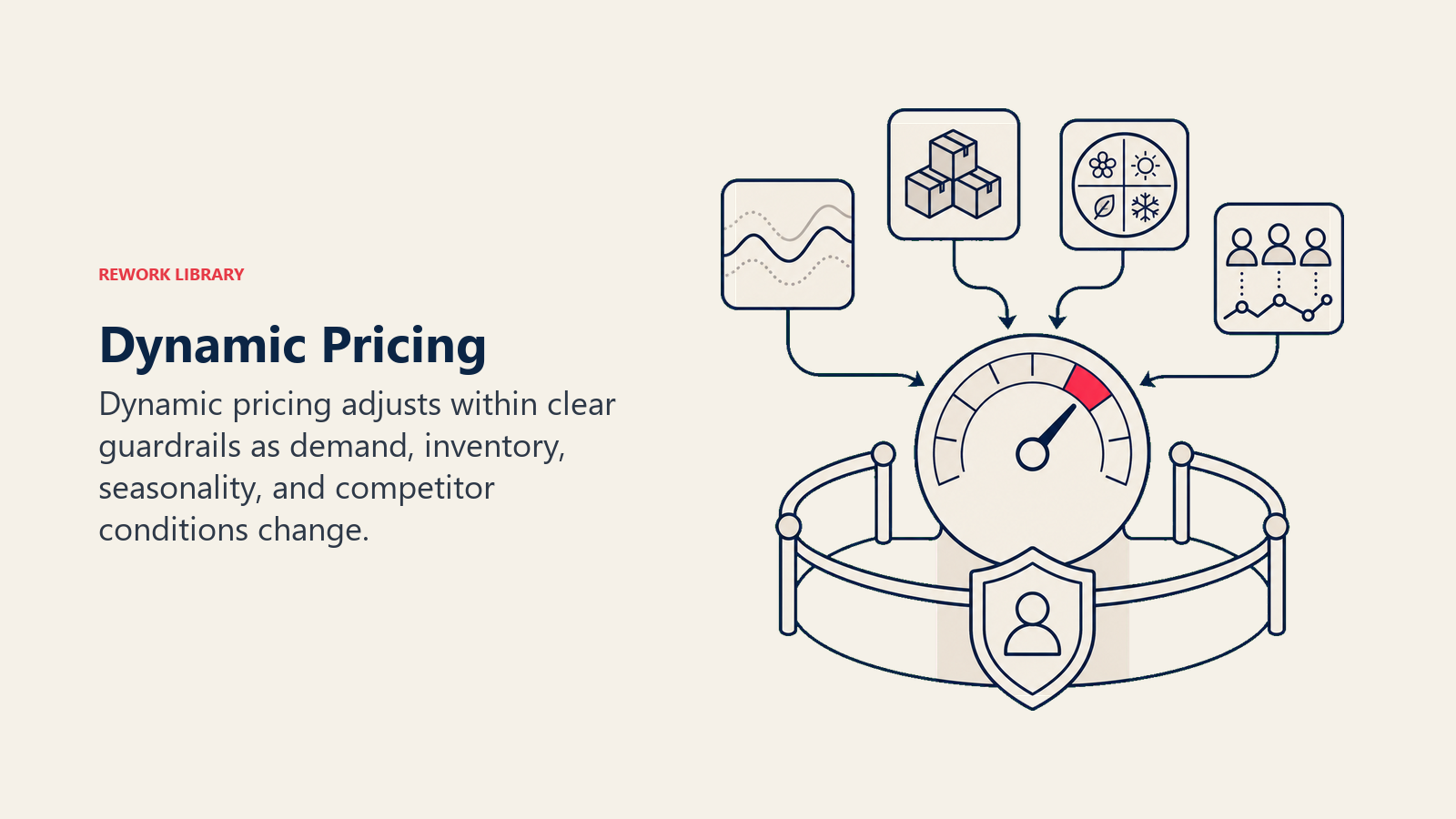
Dynamic Pricing Variables:
Demand-Based Adjustments: Increase prices when demand exceeds supply, decrease when inventory is slow-moving. Surge pricing works for events, holidays, or trending products where scarcity is real.
Example: Portable generators during hurricane season, outdoor furniture in spring, winter coats in October.
Inventory-Level Triggers: Clear aging inventory with progressive discounts:
- First 30 days: Full price
- 31-60 days: 10% off
- 61-90 days: 25% off
- 90+ days: 40% off or bundle deals
Prevents dead stock while maximizing revenue on fresh inventory.
Customer Segment Pricing: Show different prices to different customer types based on customer segmentation analysis:
- First-time visitors: Discounted entry offer
- Returning customers: Loyalty pricing
- Cart abandoners: Retargeting discount
- High-value customers: Early access or VIP pricing
Competitor-Triggered Adjustments: Automatically adjust when competitors change prices beyond certain thresholds. Set rules like "stay within 5% of lowest competitor on commodity items" or "maintain 10% premium on differentiated products."
Implementation Best Practices:
- Set floors: Never drop below cost + minimum margin
- Cap frequency: Don't change prices multiple times per day (creates customer distrust)
- Segment carefully: Don't show different prices to the same customer within hours
- Test gradually: Start with 10-20% of catalog, expand as you refine
Learn more about advanced techniques in dynamic pricing strategies for e-commerce.
Price Testing & Experimentation
Assumptions about optimal pricing are usually wrong. The only way to know what customers will actually pay is to test systematically. A/B Price Testing Framework:
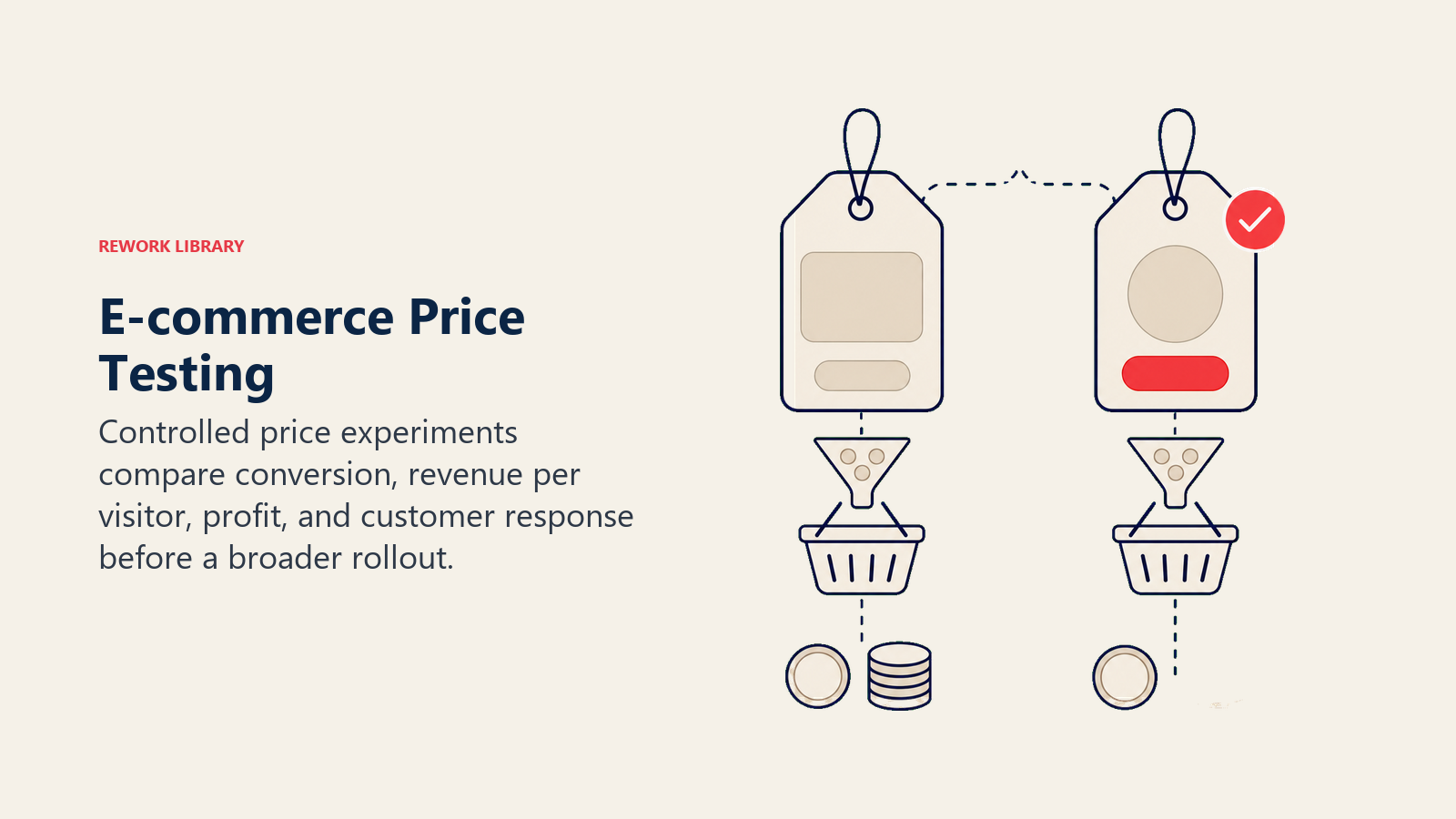
1. Single-SKU Testing: Split traffic 50/50 between two price points for the same product. Track:
- Conversion rate at each price
- Revenue per visitor (conversion × price)
- Profit margin impact
- Cart abandonment changes
Run for minimum 2 weeks or 1,000 visitors per variant to reach statistical significance.
Example test:
- Control: $49 → 4.2% conversion → $2.06 revenue per visitor
- Variant: $59 → 3.5% conversion → $2.07 revenue per visitor
The $59 price generates more revenue despite lower conversion, and higher margins make it the clear winner.
2. Price Tiering Tests: Test different good/better/best configurations:
- Test A: $29 / $49 / $79
- Test B: $39 / $59 / $89
- Test C: $34 / $54 / $84
Measure which configuration drives highest average order value and conversion rate.
3. Discount Depth Testing: Test promotional intensity:
- Control: 15% off
- Variant A: 20% off
- Variant B: 25% off
Measure incremental revenue against margin erosion. Often 15-20% discounts generate 80% of the response of 25-30% discounts while preserving significantly more margin.
Price Elasticity Measurement:
Price elasticity = (% change in quantity demanded) / (% change in price)
If raising price 10% reduces quantity sold by 8%, elasticity = -0.8 (inelastic). You should raise prices because revenue increases despite lower volume.
If raising price 10% reduces quantity sold by 15%, elasticity = -1.5 (elastic). Lowering prices increases total revenue.
Most e-commerce products are more inelastic than operators assume. Customers care more about value and convenience than 5-10% price differences.
Willingness-to-Pay Studies:
Survey customers or prospects: "If this product were priced at $X, would you: Definitely buy / Probably buy / Might buy / Probably not buy / Definitely not buy"
Test multiple price points ($39, $49, $59, $69). The price where 50%+ say "definitely" or "probably buy" is your target.
Combine price testing with broader A/B testing frameworks and conversion rate optimization initiatives for compound improvements.
Tiered Pricing Strategy
Tiered pricing offers multiple versions at different price points, capturing customers with varying budgets and needs. The goal is maximizing both market coverage and profit margins. Good/Better/Best Framework:
Good (Entry Tier):
- Priced to be accessible: Appeals to budget-conscious customers
- Basic features: Core functionality without extras
- Lower margin: 25-35% typically
- High volume: Often 40-50% of total sales
- Strategic purpose: Market share, customer acquisition, upsell pipeline
Better (Mid Tier):
- Sweet spot pricing: Where most customers gravitate
- Enhanced features: Meaningful upgrades over basic
- Healthy margin: 40-50% typically
- Moderate volume: 30-40% of total sales
- Strategic purpose: Profit maximization, satisfies most needs
Best (Premium Tier):
- Premium pricing: 2-3x the entry tier
- Complete features: Everything included, no compromises
- Highest margin: 50-70% typically
- Low volume: 10-20% of total sales
- Strategic purpose: Margin expansion, brand positioning, makes mid-tier look reasonable
Example: SaaS Product Tiers:
- Starter: $29/month → Basic features, 100 users, email support
- Professional: $79/month → Advanced features, 500 users, chat support, integrations
- Enterprise: $199/month → All features, unlimited users, phone support, dedicated manager
Most customers choose Professional (mid-tier), which has the best margins. Starter captures price-sensitive customers who might become Professional later. Enterprise generates highest per-customer profit and anchors Professional as "reasonable."
Physical Product Example: Headphones:
- Basic: $79 → Bluetooth, 20-hour battery, basic sound quality
- Premium: $149 → Bluetooth, 40-hour battery, active noise canceling, superior sound
- Pro: $299 → Bluetooth, 60-hour battery, adaptive noise canceling, audiophile sound, premium materials
The $149 tier sells 60% of volume at 45% margins. The $79 tier captures budget customers at 30% margins. The $299 tier represents 12% of volume but 55% margins, plus it makes the $149 option appear to be great value.
Pricing Gaps: Space tiers to create meaningful differentiation:
- Too close (20-30% difference): Customers always choose cheaper option
- Optimal (50-100% difference): Each tier feels justified
- Too wide (200%+ difference): Mid-tier loses anchor effect
Segmented Pricing
Different customers have different willingness to pay. Segmented pricing captures this variation by charging different prices to different groups, legally and ethically.
Geographic Pricing: Adjust prices by region based on:
- Local purchasing power and economic conditions
- Competitive landscape in each market
- Shipping costs and logistics
- Currency fluctuations
A $49 product in the US might be £39 in the UK, €45 in Germany, and $39 CAD in Canada, not direct currency conversions but optimized for each market.
Channel-Based Pricing: Different prices across sales channels:
- Direct website: Full price, best margins
- Amazon/Marketplaces: 15% lower to account for platform fees
- Wholesale/Retail partners: 40-50% discount to allow retail markup
- Subscription boxes: Special bundle pricing
Protect margins on owned channels, be competitive on marketplaces, provide sustainable margins to retail partners.
Customer Segment Pricing:
First-Time Customer Pricing: Offer 10-20% discount to reduce acquisition friction, then full price for repeat purchases. Customer acquisition cost justifies the initial discount if lifetime value is strong.
Loyalty Pricing: Reward repeat customers with:
- VIP pricing tiers (spend $500+ annually, get 15% off everything)
- Early access to sales
- Exclusive products or bundles
- Free shipping thresholds
B2B vs B2C Pricing: Business customers buying in volume get negotiated pricing:
- Volume discounts (10+ units: 15% off, 50+ units: 25% off)
- Annual contracts with fixed pricing
- Net-30 payment terms vs immediate payment
- Dedicated account management at higher tiers
Student/Military/Teacher Discounts: 10-15% ongoing discounts to specific groups using verification services like SheerID. Builds brand loyalty early with customers who may have higher future earning potential.
Legal Considerations: Price discrimination is legal when based on:
- Geographic location
- Customer type (B2B vs B2C)
- Volume purchased
- Timing of purchase
Avoid discrimination based on protected characteristics (race, gender, religion, etc.). Be transparent about why prices differ when asked.
Common Pricing Mistakes
Mistake 1: Underpricing to Win Market Share
New brands often underprice thinking it's the path to growth. You attract price-sensitive customers who churn the moment a cheaper option appears. You train customers to expect low prices. You lack margin to invest in product improvement or marketing.
Better: Price for your target customer from day one. If you're premium, price premium and build brand to justify it. Compete on value, not price.
Mistake 2: Ignoring Total Costs
Pricing at 2x COGS sounds healthy until you add fulfillment ($4), transaction fees ($2), returns (15% of revenue), marketing attribution ($12), and overhead. Suddenly your 50% gross margin is 12% net margin, and you're barely profitable.
Calculate fully-loaded costs including all variable and allocated fixed costs. Price to achieve target net margins, not just gross margins. Review unit economics regularly to ensure pricing supports profitability.
Mistake 3: Set-It-and-Forget-It Pricing
You set prices at launch and never revisit them. Costs increase, competitors adjust, customer perception evolves, and your margins erode year after year.
Review pricing quarterly. Test 3-5% increases on portions of your catalog. Adjust based on cost changes, competitive moves, and demand patterns.
Mistake 4: Competing Only on Price
If price is your only competitive advantage, you'll lose to whoever is willing to accept the lowest margins, usually Amazon or venture-backed competitors burning cash.
Build differentiation: Better product, superior service, unique positioning, community, brand values. Price competitively within your segment, but don't make price the only reason to buy.
Mistake 5: Inconsistent Pricing
Charging different prices across channels confuses customers and erodes trust. Showing one price in ads and different prices on the site creates cart abandonment.
Maintain consistent pricing across owned channels. If marketplace pricing differs, explain why (platform fees passed through). Honor advertised prices or clearly label them as limited-time offers.
Mistake 6: Poor Discount Communication
Running constant "sales" trains customers to wait for discounts. Advertising "70% off" looks desperate and makes customers question original pricing validity.
Use strategic discount strategy approaches: planned seasonal sales, email-list exclusives, cart abandonment offers. Maintain regular pricing integrity so discounts feel special, not expected.
Mistake 7: Not Testing
Assuming you know the right price without testing leaves money on the table. Most brands can increase prices 5-15% with minimal impact on conversion.
Test systematically: new products, slow sellers, high performers. Measure revenue impact, not just conversion changes. Small increases compound to significant profit gains.
Implementation Best Practices
Pricing Tools and Software:
Basic Tools (Free - $50/month):
- Spreadsheet modeling: Calculate costs, margins, price scenarios
- Google Analytics: Track revenue, conversion by price point
- Competitor tracking: Manual monitoring or basic tools like Visualping
Mid-Tier Tools ($100-$500/month):
- Price optimization: Prisync, Wiser, Intelligence Node (competitive monitoring)
- A/B testing: Optimizely, VWO, Google Optimize (price testing)
- Analytics: Heap, Mixpanel (behavioral analysis by price)
Enterprise Tools ($500+/month):
- Dynamic pricing engines: Competera, Pricefx, PROS (automated optimization)
- Revenue management: Revionics, Vendavo (sophisticated modeling)
- Machine learning: Custom models predicting elasticity and optimal prices
Start simple: spreadsheet modeling and manual testing. Graduate to tools as volume and complexity justify investment.
Monitoring and Optimization:
Track weekly using e-commerce metrics and KPIs:
- Average selling price by SKU
- Gross margin by product and category
- Conversion rate changes after price adjustments
- Revenue per visitor trends
- Competitive price gaps
Track monthly:
- Price elasticity by category
- Discount impact on margins
- Customer acquisition cost vs lifetime value by entry price
- Channel profitability including pricing differences
Adjust quarterly:
- Cost-based price reviews (if costs changed)
- Competitive positioning assessments
- Strategic price tests on 10-20% of catalog
- Tier structure optimization
Communicating Price Changes:
Price Increases:
- Give notice: Email current customers 30 days before increase
- Explain why: Cost increases, value improvements, market conditions
- Grandfather existing customers: Honor old pricing for 3-6 months for loyal customers
- Emphasize value: Remind what they're getting, not just what they're paying
Example: "Starting March 1st, our pricing will increase from $49 to $54 to reflect improvements we've made to [specific features]. Current subscribers will maintain $49/month pricing through May 31st."
Price Decreases:
- Less common but happens: Economies of scale, competitive pressure, strategic positioning
- Don't apologize: Frame as passing savings to customers
- Limited time: "Permanently lowering prices" sounds desperate; "New competitive pricing" sounds strategic
Promotional Pricing:
- Clear start and end dates
- Specific reason: Holiday, product launch, flash sale
- Scarcity or urgency: "48-hour sale" or "Limited to first 100 customers"
- Return to regular pricing: Don't extend perpetually or you train discount expectations
Align promotional pricing with your broader seasonal and promotional strategy to maximize impact while protecting brand integrity.
Starting Price Strategy for New Products:
Launch at your target price, not a discounted "introductory offer." Raising prices later creates customer resentment. Launching high lets you discount strategically while maintaining long-term margin integrity.
Test higher than you think. Most founders underprice new products. Launch at your best estimate, then test 10-15% higher on a segment. You'll be surprised how often the higher price converts similarly with better margins.
Pricing is never perfect on day one. Plan to iterate based on market feedback, competitive response, and actual customer behavior. Build in flexibility to adjust within the first 90 days as you gather data.
Your pricing strategy determines your profit margins more than any other lever in your business. Cost-plus establishes your floor, value-based pricing sets your target, competitive analysis provides reality checks, and systematic testing optimizes over time. Use psychological tactics deliberately, segment pricing to capture different customer groups, and avoid the race-to-bottom trap of competing only on price. Test continuously, monitor competitors without obsessing over them, and adjust quarterly based on costs, market conditions, and performance data. The brands that win are those that price for value, not just cost recovery.
Frequently Asked Questions about E-commerce Pricing Strategy
Which pricing strategy is best for e-commerce growth?
There's no single best model. The brands that grow fastest run a hybrid: cost-plus sets the floor that keeps you solvent, value-based pricing sets the target that captures what customers will pay, competitive analysis provides a reality check, and continuous testing optimizes from there. Competing only on price is the one approach to avoid, because it compresses margin without building any durable advantage.
How much can better pricing improve profit?
A 3% price increase often delivers the same profit impact as a 10% increase in traffic, and most stores can raise prices 5-15% with minimal effect on conversion. Because price flows straight to the bottom line, even small, tested increases compound into 20-40% margin improvement over time.
Does charm pricing (ending in .99) actually work?
In testing, prices ending in 9, 99, or 95 convert 8-12% better than round numbers for price-sensitive and impulse purchases, thanks to the left-digit effect that makes $19.99 read as meaningfully cheaper than $20. Avoid it for luxury and B2B products, where round numbers signal quality and professionalism.
How do I test whether a price change helps?
Run an A/B price test: split traffic 50/50 between two price points on the same product for at least two weeks or 1,000 visitors per variant, then compare revenue per visitor (conversion times price), not just conversion rate. A higher price with slightly lower conversion frequently wins on both revenue and margin.
When should I use dynamic pricing?
Dynamic pricing fits high-turnover, perishable, or demand-volatile categories like fashion, electronics, and seasonal goods. Set price floors so you never drop below cost plus minimum margin, cap how often prices change to avoid eroding trust, and never show the same shopper different prices within hours.
Related Resources
Deepen your pricing and e-commerce strategy expertise with these related guides:
- Unit Economics for E-commerce - Master the financial fundamentals that determine whether your pricing strategy generates sustainable profits
- Dynamic Pricing - Implement advanced real-time pricing adjustments based on market conditions and customer behavior
- AOV Optimization Strategy - Increase average order value through strategic pricing, bundling, and cross-selling techniques
- A/B Testing Framework - Build a systematic approach to testing price points and optimizing for revenue and conversion

On this page
- Pricing Models Overview
- Cost-Based Pricing: Building Your Foundation
- Value-Based Pricing: Capturing What Customers Will Pay
- Psychological Pricing Tactics
- Competitive Pricing Analysis
- Dynamic Pricing Fundamentals
- Price Testing & Experimentation
- Tiered Pricing Strategy
- Segmented Pricing
- Common Pricing Mistakes
- Implementation Best Practices
- Related Resources