Free Shipping Thresholds: Strategic AOV Lever for E-commerce Profitability
Turn this article into takeaways for your work.


Each assistant summarizes the article only for you and suggests best practices for your work.
Here's the free shipping paradox: 90% of online shoppers say free shipping is the top incentive to shop more online, yet most e-commerce businesses are losing money on every "free" shipment they fulfill. The difference between companies that use free shipping as a profit engine versus those who bleed margin comes down to one number, your threshold.
Set it too low, and you're subsidizing small orders that destroy your unit economics. Set it too high, and you're pushing customers to competitors who offer more attractive terms. The sweet spot exists, but finding it requires more than copying what your competitors do or picking a round number that "feels right."
This guide walks through the strategic framework for setting, testing, and optimizing free shipping thresholds that drive measurable AOV growth while protecting profitability.
The Psychology of Free Shipping Thresholds
Free shipping isn't rational - it's psychological. Customers will add a $12 item they don't need to qualify for free shipping on a $50 order, even though paying $6.99 for shipping would be cheaper. Understanding this irrational behavior is the foundation of threshold strategy. The Magnet Effect
Research from MIT found that the word "free" activates the same neural pathways as receiving a reward. When customers see they're $8 away from free shipping, their brain processes this as "you're $8 away from winning." This creates three behavioral responses:
- Cart Padding: 58% of shoppers add items to reach the threshold
- Purchase Acceleration: 48% of shoppers who planned to "think about it" convert immediately
- Reduced Price Sensitivity: Customers focus on reaching the threshold, not on whether they're paying full price
The magnet effect is strongest when the gap is between $5-$25. Below $5, the effort doesn't feel worth it. Above $25, it feels unattainable for many shoppers.
Perceived Value vs. Actual Cost
Here's where psychology gets expensive if you don't manage it right. Customers perceive free shipping as having $10-$15 of value, even when your actual shipping cost is $6-$8. This perception gap is your opportunity. If you structure your threshold correctly, customers will add $20 in products to save $8 in shipping they perceive as worth $15.
The key is making the math feel like a win. A customer who adds a $15 item to reach a $75 threshold feels smart. A customer who adds a $40 item to reach a $100 threshold feels manipulated. The difference is whether the incremental purchase feels proportional to the "savings."
Threshold Calculation Framework
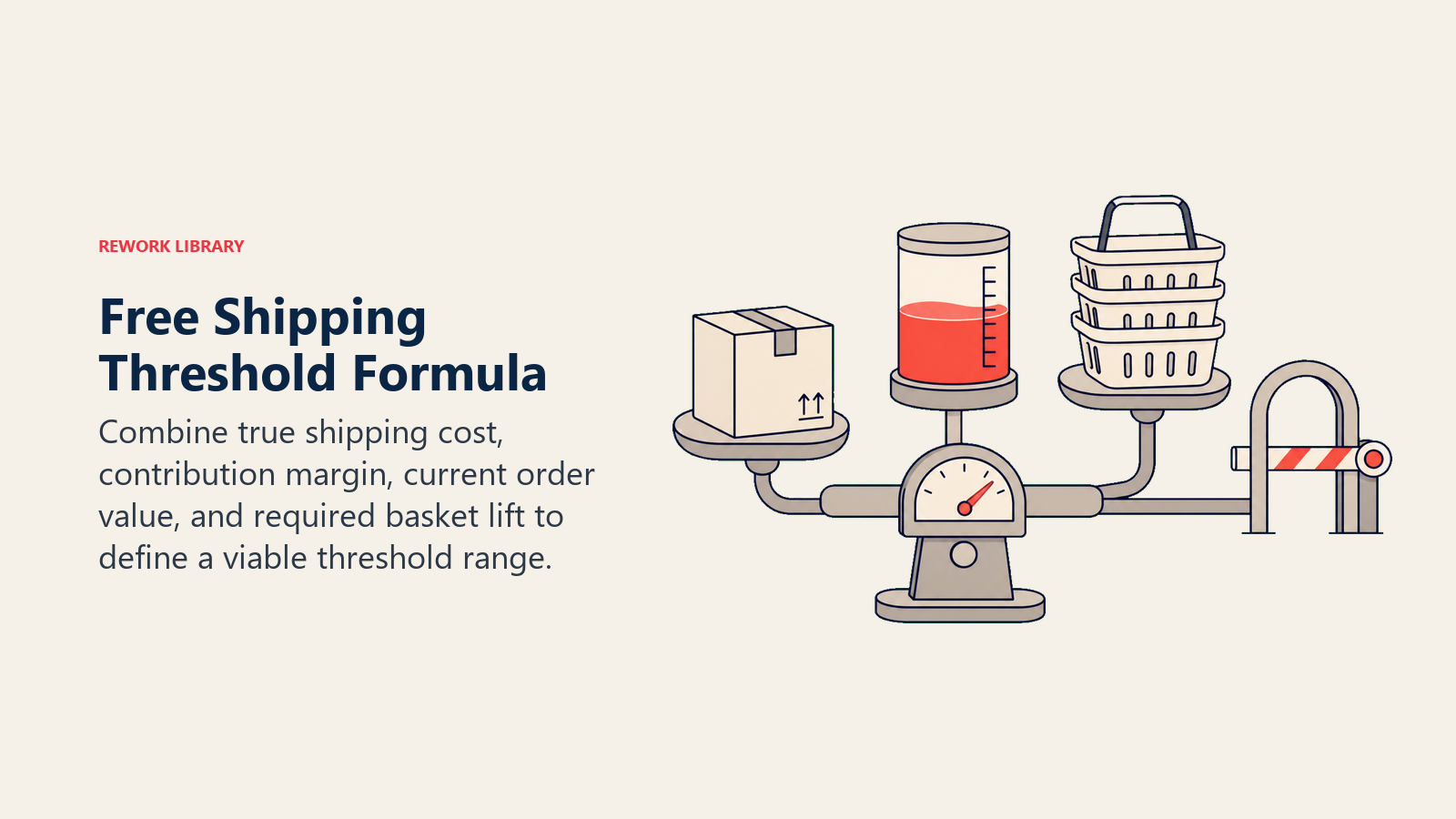
Before you can optimize for psychology, you need to understand your economics. Here's the framework for calculating what your threshold should be based on actual costs and margin structure. True Shipping Cost Analysis Your shipping cost isn't just what you pay the carrier. It includes:
- Carrier Base Rate: The invoice from USPS, UPS, FedEx, or regional carriers
- Packaging Materials: Boxes, padding, tape, labels (typically $0.50-$2.50 per order)
- Labor Cost: Time spent picking, packing, printing labels (typically $2-$5 per order)
- Overhead Allocation: Warehouse space, shipping software, equipment depreciation
- Damage/Loss Rate: Historical percentage of lost or damaged shipments requiring replacement
For most e-commerce businesses, true all-in shipping cost runs 20-40% higher than the carrier rate alone. A $6 USPS Priority Mail label actually costs you $7.50-$8.50 when fully loaded.
Margin Threshold Calculation
Your free shipping threshold should be set where the gross margin on the incremental products covers your all-in shipping cost. Here's the formula:
Minimum Threshold = All-In Shipping Cost ÷ Gross Margin %
If your all-in shipping cost is $8 and your gross margin is 40%, your absolute minimum threshold is $20. Below this, you're losing money on every order. In practice, you want a buffer, so the practical minimum is closer to $30-$35.
Logistics Overhead Considerations
Your shipping cost structure changes at different volume tiers and order values:
- Small/Light Orders ($0-$30): Often ship in padded mailers, lower cost
- Medium Orders ($30-$75): Ship in small boxes, moderate cost
- Large Orders ($75+): May require larger boxes, sometimes multiple packages
This creates a non-linear cost structure. A $35 order might cost $6 to ship, while a $90 order might cost $9. Your threshold should account for these step-changes in cost.
Setting Your Threshold: Data-Driven Approach
Theory is useful, but your actual threshold should be grounded in your specific business data. Here's how to calculate your optimal starting point. Baseline Metrics You Need Before setting a threshold, pull these numbers from your analytics:
- Current AOV: Your baseline before implementing a threshold
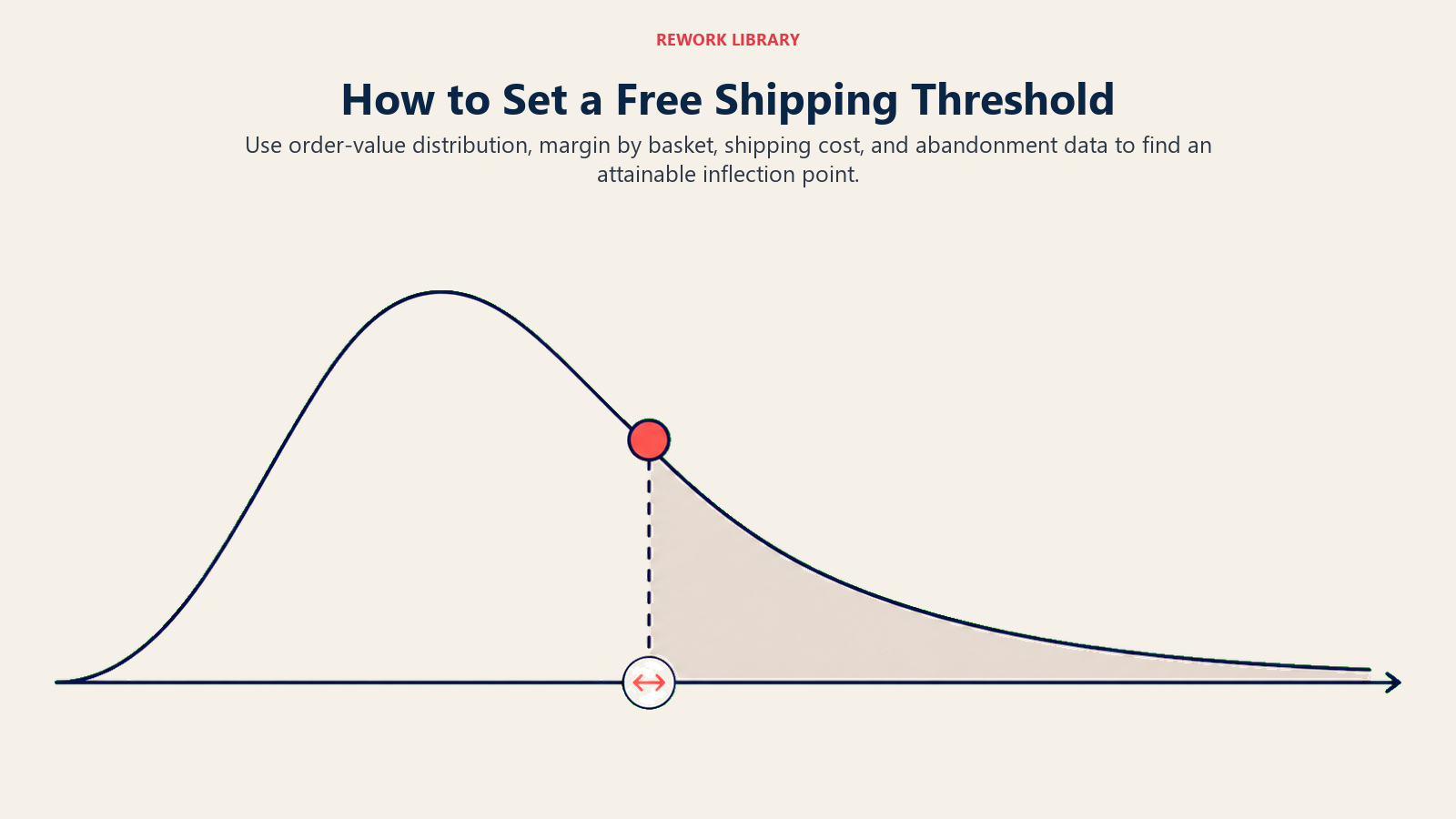
- AOV Distribution: How many orders fall into $10 buckets ($0-$10, $10-$20, etc.)
- Gross Margin by Order Size: Margin often varies based on what products are in the cart
- Shipping Cost by Order Size: Actual shipping cost distribution
- Cart Abandonment Rate: Baseline before threshold implementation
Most e-commerce platforms can export this data. You're looking for the inflection points, where do most orders cluster, and where is the biggest gap between order value and your cost coverage threshold?
Benchmark Data by Industry
While your data should drive decisions, industry benchmarks provide helpful context:
| Industry Category | Typical Threshold | Avg. Order Lift |
|---|---|---|
| Fashion/Apparel | $50-$75 | 15-25% |
| Beauty/Cosmetics | $35-$50 | 20-30% |
| Home Goods | $75-$100 | 10-18% |
| Electronics | $50-$100 | 8-15% |
| Specialty Food | $40-$60 | 18-28% |
These ranges reflect both cost structures (heavier items = higher thresholds) and typical purchase behavior (beauty buyers often add small items easily, electronics buyers don't).
The 30-40-50 Testing Framework
If you're implementing a threshold for the first time or optimizing an existing one, use this three-tier testing approach:
- Conservative Tier (30% above current AOV): Safe starting point, high likelihood of profit improvement
- Target Tier (40% above current AOV): Balance between aggressive AOV growth and conversion risk
- Aggressive Tier (50% above current AOV): Maximum revenue potential, some conversion risk
Test all three simultaneously across different customer segments or time periods. Track not just AOV, but total revenue and margin. Sometimes a lower threshold with better conversion generates more total profit.
Impact on Average Order Value
Free shipping thresholds are one of the highest-leverage AOV optimization tactics available. Here's what you can realistically expect and how to measure it. Conversion Impact Analysis Introducing a free shipping threshold creates two opposing forces:
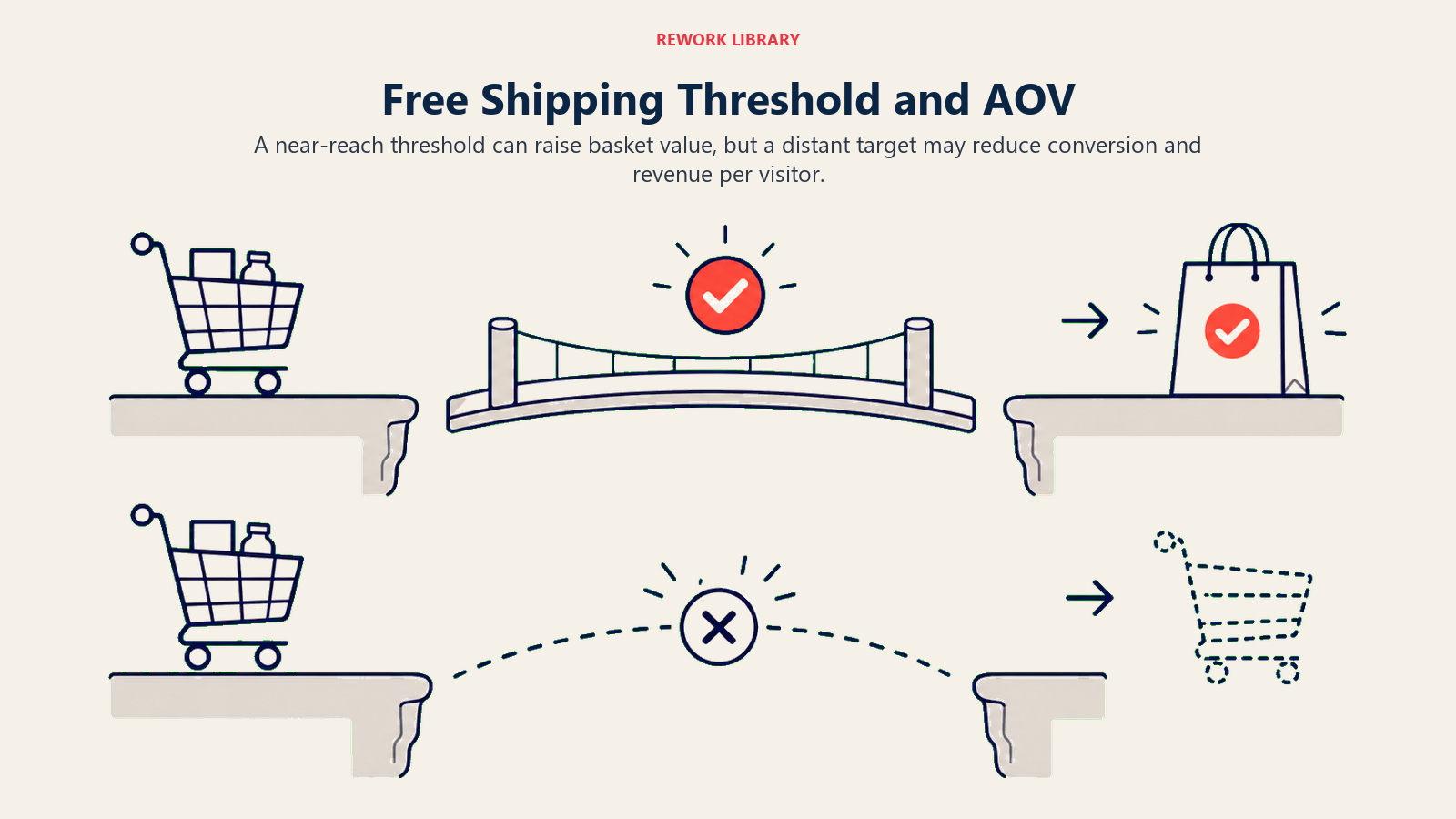
- Conversion Rate Decrease: Some customers abandon because they can't or won't reach the threshold
- Order Value Increase: Customers who do convert have significantly higher cart values
The net impact depends on your starting AOV relative to the threshold. If your current AOV is $45 and you set a $50 threshold, you'll see minimal conversion drop (customers only need to add $5). If you set a $100 threshold, expect 10-20% conversion decrease.
The math works when the AOV increase more than offsets the conversion decrease:
Revenue Impact = (New AOV × New Conversion Rate) - (Old AOV × Old Conversion Rate)
Best-in-class implementations see 15-30% AOV increases with only 5-10% conversion decreases, resulting in 5-15% net revenue growth.
Incremental Revenue Attribution
Not all AOV increase is "free money." You need to understand what's driving the growth:
- Natural Purchase Intent: Customers who were already planning to buy more
- Threshold-Driven Addition: Customers who added products specifically to reach free shipping
- Trading Up: Customers who bought a larger size or premium version instead of adding items
Track this by analyzing which products see the biggest volume increase after implementing a threshold. Products priced between (Threshold - Current AOV) and (Threshold - Current AOV + $15) will see the biggest lift. These are your "threshold fillers."
Margin Impact & Profitability Analysis
AOV growth means nothing if it destroys your unit economics. Here's how to ensure your threshold strategy improves profitability, not just top-line revenue. Unit Economics Before and After Calculate your contribution margin per order before and after threshold implementation:
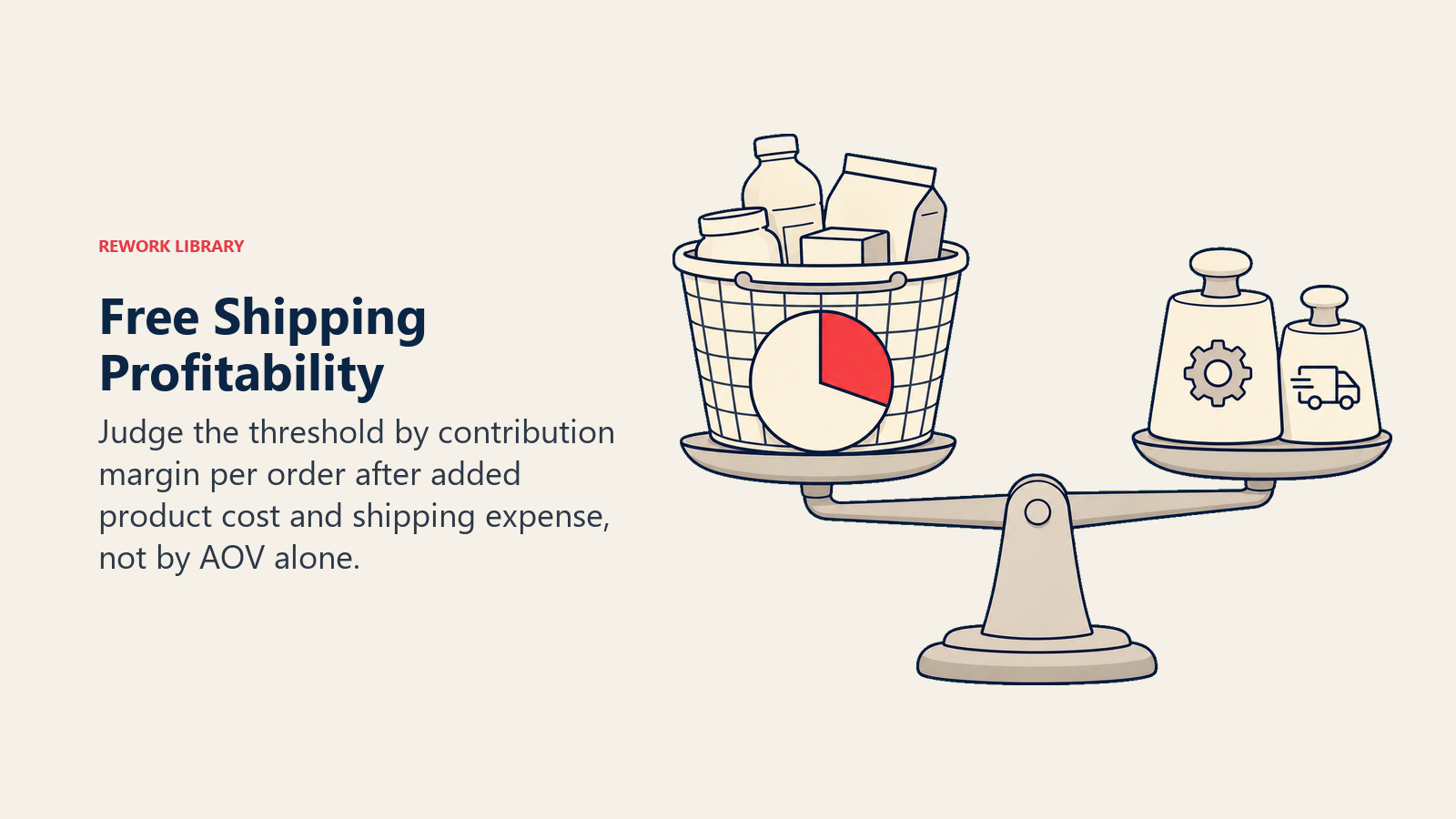
Before Threshold:
- Average Order Value: $45
- COGS (at 60% margin): $27
- Shipping Cost (customer pays): $0
- Shipping Cost (you pay): $7
- Contribution Margin: $45 - $27 - $7 = $11
After $65 Threshold:
- Average Order Value: $68
- COGS (at 60% margin): $40.80
- Shipping Cost (customer pays): $0
- Shipping Cost (you pay): $8.50
- Contribution Margin: $68 - $40.80 - $8.50 = $18.70
In this example, contribution margin per order increased 70% while absorbing shipping costs. This is the ideal outcome: higher revenue and higher profit per transaction.
CAC Leverage & Customer Lifetime Value
Free shipping thresholds create compounding value through improved customer lifetime value. When first-order AOV increases by 30%, you see several downstream effects:
- Faster CAC Payback: Higher first-order margin covers acquisition cost sooner
- Reduced Payback Period: Break-even happens on first order instead of second or third
- Improved LTV: Customers who spend more on first purchase have 25-40% higher lifetime value
This makes your entire acquisition strategy more efficient. Channels that were marginally profitable at $45 AOV become highly profitable at $68 AOV, allowing you to scale spend.
Strategic Messaging & Customer Communication
How you communicate your threshold is as important as the number itself. Poor messaging creates frustration; great messaging creates urgency and excitement. Progress Indicators That Convert
The most effective threshold messaging shows three elements:
- Current Gap: "Add $12 more for free shipping"
- Visual Progress Bar: 78% of the way to free shipping
- Threshold Value: Clear statement of the qualifying amount
Place this messaging in three locations:
- Product Pages: Shows the benefit before they add to cart
- Cart Drawer/Mini-Cart: Reinforces as they're shopping
- Cart Page: Final reminder before checkout
Testing from Baymard Institute shows that dynamic progress indicators increase threshold conversion by 15-25% compared to static messaging.
Suggested Products for Threshold Completion
When customers are close but not quite at the threshold, show them relevant products to bridge the gap. The best implementations:
- Price-Filter Automatically: Only show items that fit within the remaining gap
- Relevance Match: Complementary to what's already in cart
- Sort by Margin: Prioritize products that improve your blended margin
Example: Cart is at $58, threshold is $75. Show items priced $17-$25 that complement their current cart contents. Avoid showing $5 items (too small to meaningfully help) or $40 items (feels like too much to add).
Threshold Strategy Variations
One-size-fits-all thresholds leave money on the table. Advanced strategies segment by customer type, geography, and timing. Geographic & Shipping Zone Variations
Your shipping costs vary dramatically by distance and region. A package to a nearby customer might cost $5, while the same package across the country costs $12. Consider zone-based thresholds:
- Zone 1-2 (Local): $50 threshold
- Zone 3-5 (Regional): $60 threshold
- Zone 6-8 (Far): $75 threshold
This ensures you're not over-subsidizing expensive shipments while staying competitive in your core markets. However, ensure this doesn't violate any regional fairness regulations in your jurisdiction.
Customer Tier Segmentation
Loyalty programs create opportunities for tiered thresholds:
- New Customers: $65 threshold (standard)
- Returning Customers: $55 threshold (10% loyalty discount equivalent)
- VIP Members: $45 threshold (premium benefit)
This approach rewards loyalty while maintaining margin on new customer acquisition. It also creates a tangible incentive to join your loyalty program beyond points or discounts.
Time-Based & Promotional Thresholds
Temporarily lowering your threshold during key periods can drive volume:
- Holiday Shopping: Lower from $65 to $50 during November-December
- Flash Sales: 48-hour threshold drop to create urgency
- Category Promotions: Lower threshold for specific product categories
Track incremental volume vs. margin impact carefully. A temporary threshold reduction during peak season (when you have better shipping rates due to volume) can be highly profitable.
Competitive Benchmarking & Market Position
Your threshold doesn't exist in isolation. It's part of your competitive positioning in shipping strategy and pricing.
Competitor Analysis Framework
Research your top 5-10 direct competitors and document:
- Free shipping threshold (if any)
- Flat-rate shipping options
- Expedited shipping costs
- Promotional free shipping frequency
Look for gaps. If everyone in your category clusters around $50, there may be an opportunity at $40 (more competitive) or $75 (if you can justify premium positioning).
Market Positioning Through Shipping
Your threshold communicates brand positioning:
- Budget/Value Positioning: Lower threshold ($35-$45), demonstrates accessibility
- Mid-Market Positioning: Standard threshold ($50-$65), competitive with category norms
- Premium Positioning: Higher threshold ($75-$100), shipping cost integrated into premium pricing
Ensure your threshold aligns with your overall brand promise. A luxury brand with a $35 threshold creates cognitive dissonance. It signals desperation rather than exclusivity.
Integration with Pricing & Promotion Strategy
Free shipping thresholds don't operate in isolation. They interact with your broader pricing and promotion strategy, including product bundling approaches.
Threshold vs. Flat-Rate Shipping
Many businesses offer both options:
- Standard Shipping: Free over $65
- Flat Rate Shipping: $5.99 for orders under $65
This gives customers choice while protecting your margin. About 30-40% of sub-threshold customers will pay the flat rate rather than abandon, generating partial shipping cost recovery.
Interaction with Discount Codes
Decide whether free shipping thresholds calculate on:
- Pre-Discount Amount: $100 order with 20% off code = $80, doesn't qualify for $85 threshold
- Post-Discount Amount: Same order qualifies because pre-discount value was $100
Pre-discount calculation protects margin but can frustrate customers. Post-discount is more customer-friendly but can be abused with aggressive coupon stacking. Most businesses use post-discount calculation but limit stackability.
Bundle Strategy Integration
Create pre-configured bundles priced just at or above your threshold. This serves customers who want free shipping but don't want to build their own cart:
- "Starter Kit": $75 (at threshold)
- "Complete Set": $95 (above threshold)
- "Ultimate Bundle": $125 (well above threshold)
Bundles often have better margins than individual items, so they're profitable even with absorbed shipping costs.
Common Threshold Mistakes & Pitfalls
Even sophisticated e-commerce operators make these errors when implementing free shipping thresholds. Setting Thresholds Based on Competitors Only
Your competitor's economics aren't your economics. They might:
- Have better shipping rates due to higher volume
- Have higher margins that allow more aggressive thresholds
- Be venture-funded and optimizing for growth over profit
- Have a different product mix that ships more cheaply
Use competitive data as one input, but your threshold should be based primarily on your own unit economics.
Ignoring Mobile vs. Desktop Behavior
Mobile shoppers have 20-30% lower AOV than desktop shoppers. If you set a threshold based on overall AOV, you may find that mobile shoppers rarely reach it. Consider:
- Responsive messaging that's more prominent on mobile
- Suggested products optimized for mobile browsing
- Potentially lower threshold for mobile (test carefully)
Not Testing International Thresholds
If you ship internationally, your shipping costs are 2-5x higher than domestic. A $65 threshold that works domestically might require a $100+ threshold internationally to maintain margin.
Create separate thresholds by country or region, and communicate them clearly based on detected or selected location.
Threshold Too Close to Current AOV
If your current AOV is $62 and you set a $65 threshold, you won't see meaningful behavioral change. Thresholds need to create enough gap to drive incremental purchases. Aim for at least 20-30% above current AOV to see real impact.
Optimization & Testing Roadmap
Free shipping thresholds aren't set-and-forget. Markets evolve, costs change, and customer behavior shifts. Here's your ongoing optimization framework. Month 1-2: Baseline Testing
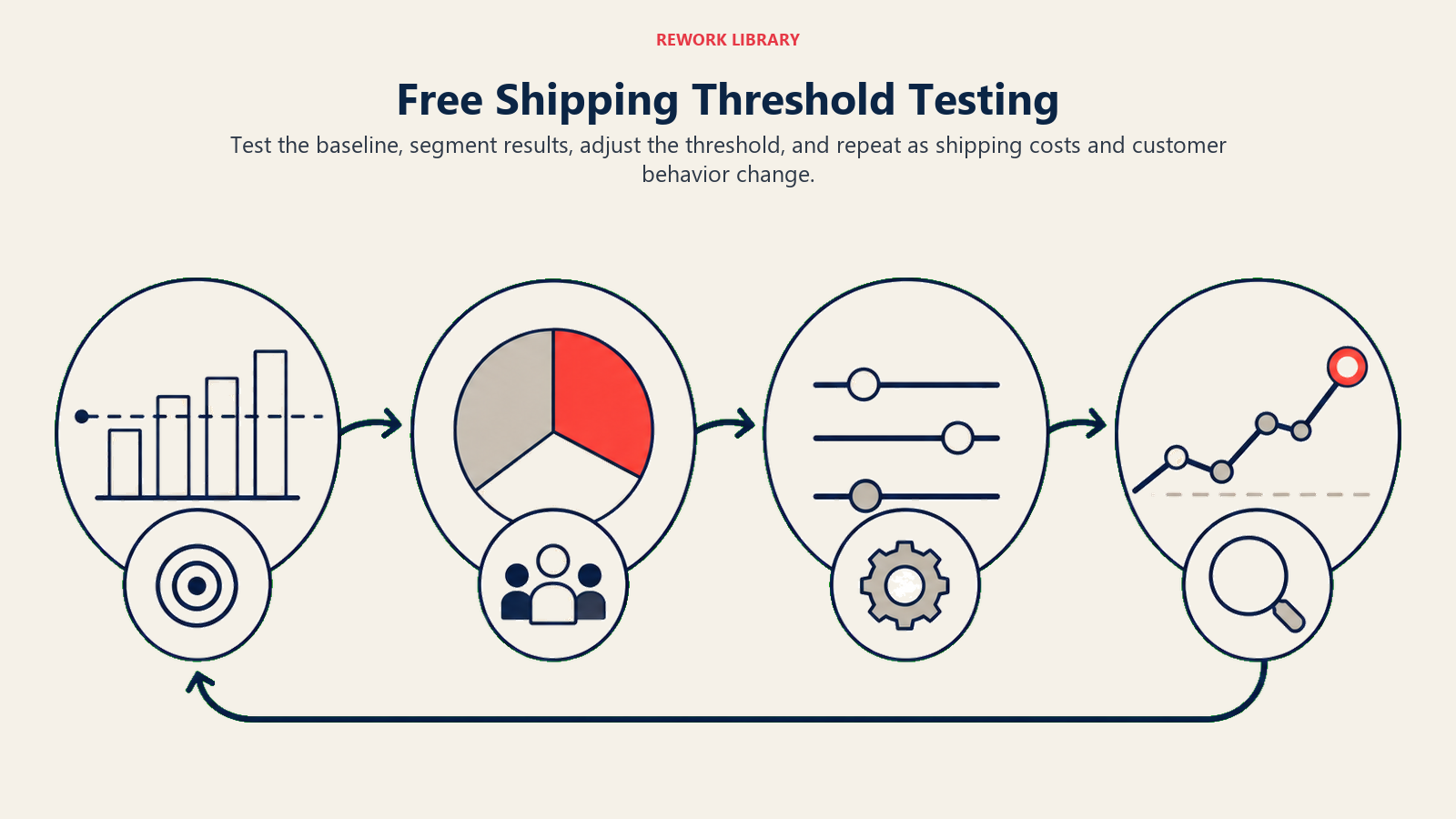
Implement your initial threshold and measure:
- AOV change (target: +15-25%)
- Conversion rate change (acceptable: -5-10%)
- Revenue per visitor (must be positive)
- Contribution margin per order (must be positive)
- Cart abandonment rate (watch for major spikes)
Use this period to validate that your threshold is in the viable range. If contribution margin is negative, your threshold is too low. If conversion drops more than 15%, it's too high.
Month 3-6: Segmentation Testing
Test variations by:
- Customer type (new vs. returning)
- Traffic source (paid vs. organic)
- Product category (if you have distinct categories)
- Geographic region
You may discover that one threshold doesn't optimize all segments. Create segmentation rules based on what drives the best blended results.
Month 6-12: Continuous Optimization
Establish a quarterly review cycle:
- Q1: Review Holiday season data, adjust for Q1 typically lower spending
- Q2: Test more aggressive thresholds as shipping costs normalize
- Q3: Prepare holiday threshold strategy
- Q4: Execute holiday threshold (often temporarily reduced)
Track your threshold performance as part of your broader e-commerce metrics and KPIs dashboard. Changes in product mix, shipping costs, or competitive landscape may warrant threshold adjustments.
Integration with Checkout Optimization
Your threshold strategy should integrate with your checkout flow optimization efforts. Test showing threshold progress at different checkout stages:
- After cart review (before address entry)
- After address entry (can show accurate shipping if threshold not met)
- At payment step (final reminder)
Conclusion: Making Free Shipping Profitable
Free shipping isn't actually free - someone always pays. The question is whether you're paying for incremental profit or subsidizing unprofitable transactions.
A strategically set threshold transforms free shipping from a margin-eroding necessity into a high-leverage AOV growth tool. The key is finding the balance point where:
- Customers perceive value: The threshold feels attainable and the savings feel real
- You protect margin: Incremental purchases more than cover shipping cost absorption
- Conversion stays healthy: The threshold doesn't create barriers to purchase
Start with your unit economics, validate against customer behavior data, test systematically, and optimize continuously. Done well, free shipping thresholds can increase AOV by 20-40% while improving overall profitability - making "free" the most profitable word in your e-commerce vocabulary.
The stores winning with free shipping thresholds aren't offering the lowest barriers to entry. They're offering the smartest balance between customer psychology and business economics. That's the difference between free shipping as a cost center and free shipping as a profit center.

Sales Operations Practice Lead
On this page
- The Psychology of Free Shipping Thresholds
- Threshold Calculation Framework
- Setting Your Threshold: Data-Driven Approach
- Impact on Average Order Value
- Margin Impact & Profitability Analysis
- Strategic Messaging & Customer Communication
- Threshold Strategy Variations
- Competitive Benchmarking & Market Position
- Integration with Pricing & Promotion Strategy
- Common Threshold Mistakes & Pitfalls
- Optimization & Testing Roadmap
- Conclusion: Making Free Shipping Profitable