Flash Sales & Limited Offers: Mastering Urgency-Driven Revenue Tactics
Turn this article into takeaways for your work.


Each assistant summarizes the article only for you and suggests best practices for your work.
A flash sale is a short, deep discount that runs for a fixed window, usually a few hours to a couple of days, to compress buying decisions and spike revenue. Done well, it clears inventory and acquires customers from buyers who already wanted your products. Done badly, it trains shoppers to never pay full price. The difference is execution: tight duration, real scarcity, capped discounts, and a planned calendar.
Flash sales generate 3-5x normal conversion rates, but they also train customers to wait for discounts. The best flash sale strategies compress decision-making windows to accelerate purchases from buyers who were already considering your products. Not create a discount-dependent customer base that kills your margins.
The difference between effective flash sales and destructive ones comes down to execution. Run them too frequently, and you condition customers to never pay full price. Run them poorly, and you create infrastructure failures, customer frustration, and inventory chaos. Run them strategically, and you clear inventory, acquire new customers, and create revenue spikes without eroding brand value.
This guide covers how to build flash sales that drive revenue growth while preserving customer lifetime value and margin sustainability.
The Psychology Behind Urgency Marketing
Flash sales work because they compress the consideration phase. Three psychological mechanisms drive their effectiveness:
Scarcity triggers loss aversion. When inventory is limited, customers fear missing out more than they value the discount itself. A product with "3 left in stock" converts 40% higher than the same product with unlimited inventory, even at identical prices.
Time constraints force decisions. Most purchase journeys include a research phase, comparison shopping, and deliberation. A 4-hour flash sale eliminates these steps. Customers either buy now or lose the opportunity. This works best for products customers already know they want. Flash sales accelerate existing intent rather than create it.
Social proof amplifies urgency. Showing "127 people viewing this item" or "sold 43 in the last hour" creates competitive urgency. When other buyers are actively purchasing, fence-sitters convert faster. This only works with real data. Fake countdown timers and invented scarcity destroy trust.
The critical distinction is authentic versus manufactured urgency. Authentic urgency comes from genuine constraints: limited inventory, seasonal availability, exclusive partnerships. Manufactured urgency uses fake timers, invented scarcity, and perpetual "limited time" offers that never end. Customers recognize the difference, and manufactured urgency erodes brand credibility.
Flash Sale Architecture: Duration and Structure
Flash sale duration determines which customer segments you'll capture and how much infrastructure stress you'll create.
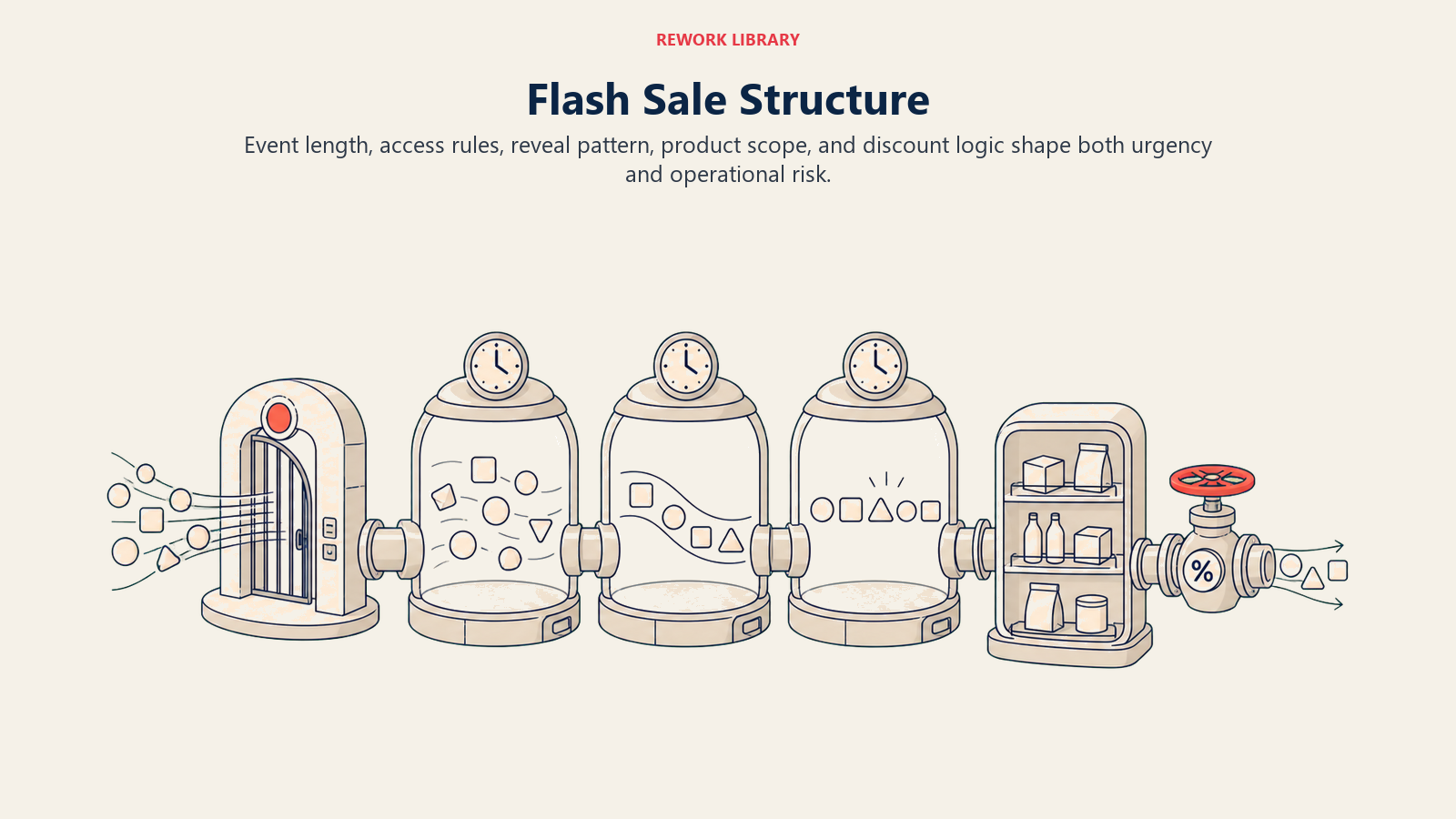
3-6 hour flash sales create maximum urgency but require customers to be available during the window. These work best for engaged audiences with push notification or SMS alerts. Conversion rates peak in the first hour, then decline steadily. These ultra-short windows work for clearing specific inventory or testing new products.
24-hour flash sales balance urgency with accessibility. Most customers check email or browse your site within 24 hours, giving you broader reach. The urgency curve is flatter, so conversions stay relatively steady throughout the day with spikes at lunch and evening hours. This duration works for broader audience targeting.
Weekend flash events (48-72 hours) sacrifice some urgency for reach. These function more like traditional promotions but maintain time-bound elements. They work well for major shopping periods or when targeting customers who primarily shop on weekends.
Duration should match your inventory goals. If you need to move 200 units of a specific SKU, a 6-hour flash sale with higher discounts will clear it faster. If you're testing demand for a new product line, a 48-hour event gives you better data on sustained interest.
Consider stacking multiple short flash sales rather than one long event. A "Flash Sale Friday" series with 4-hour windows creates anticipation and repeat engagement. Customers learn to expect the events and plan their shopping accordingly.
Inventory Management for Flash Events
Flash sales fail when you oversell and can't fulfill orders or undersell and miss revenue potential. Effective inventory management starts before the sale begins.
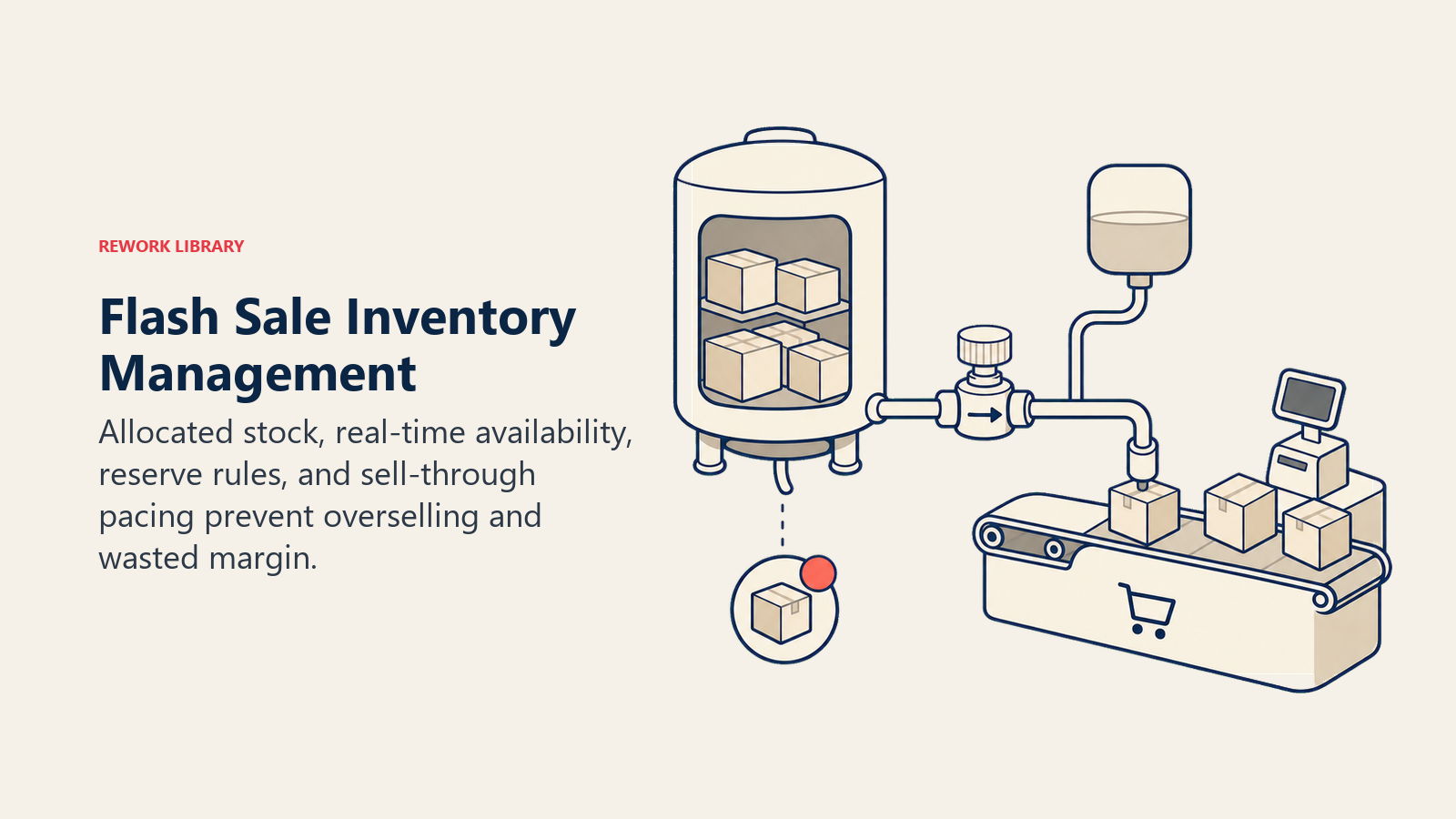
Pre-event allocation determines success. Calculate your available inventory minus safety stock for regular sales. If you have 500 units and want to maintain 100 for normal operations, allocate 400 to the flash sale. Set a hard cap in your system to prevent overselling. Nothing damages customer relationships faster than canceled orders after payment processing.
Real-time stock visibility prevents the midnight apology email. Your e-commerce platform should update inventory counts in real-time as orders process. When inventory hits 10% of flash sale allocation, trigger low-stock messaging ("Only 40 left!"). When you hit zero, immediately end the sale and update all promotion channels.
Stock allocation strategies vary by product type:
- High-margin, popular items: Allocate 60-80% to flash sales, maintain reserve for full-price customers
- Slow-moving inventory: Allocate 100%, goal is clearance
- New product launches: Allocate 40-50%, create scarcity to build demand
- Seasonal products: Allocate based on remaining season length
For products with variants (sizes, colors), manage allocation at the SKU level. Selling out of size Large while still promoting "Available Now" creates frustration. Show variant-level availability and auto-remove sold-out options from selection menus.
Flash sale inventory should come from existing stock, not special purchases. Buying inventory specifically for flash sales creates downside risk if the event underperforms. The exception is closeout purchases or special manufacturer deals where the economics work even at flash sale prices.
Timing & Seasonality: When Flash Sales Work Best
Flash sale timing affects both participation rates and conversion performance.
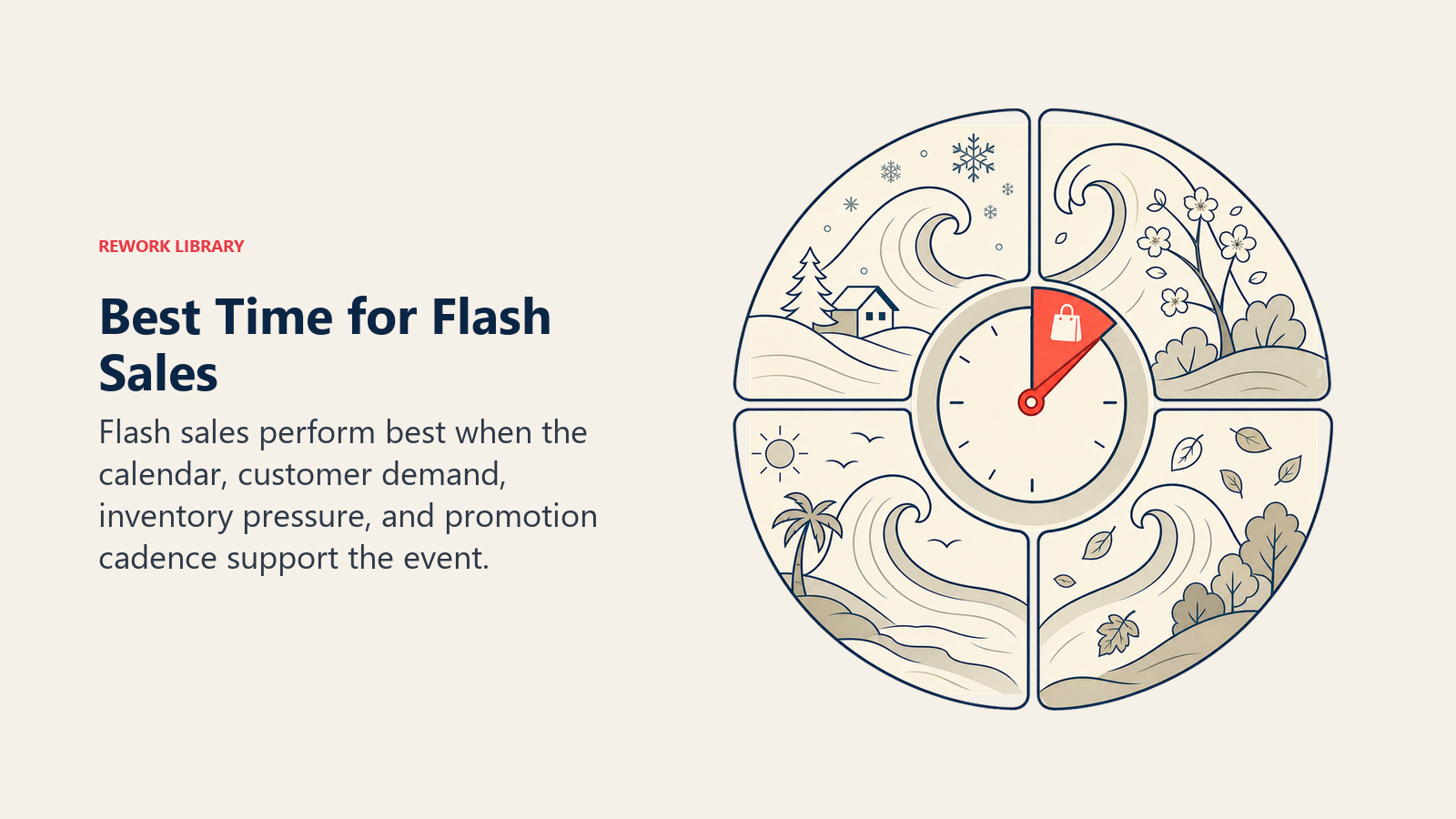
Day of week patterns are consistent across industries. Tuesday through Thursday flash sales generate 25-30% higher email open rates than Monday or Friday events. Weekend flash sales work for consumer products but underperform for B2B or business-related purchases. The exception is fashion and home goods, where weekend browsing is peak shopping time.
Time of day matters more than most brands realize. Flash sales starting at 10 AM or 2 PM (local time) capture lunch break browsing. Evening sales (6-8 PM start times) work for products requiring household decisions. Avoid early morning starts unless you're targeting East Coast markets, since a 6 AM Pacific start means West Coast customers miss the peak urgency window.
Seasonal factors amplify or suppress effectiveness. Flash sales during November-December compete with Black Friday conditioning, where customers expect deep discounts and become less responsive to smaller offers. January-February flash sales perform exceptionally well as customers have gift cards and year-end bonuses. Spring cleaning season (March-April) works for home goods and organization products.
Frequency creates expectations. Weekly flash sales train customers to wait for discounts. Monthly events maintain urgency without conditioning discount dependency. The right frequency depends on your margin structure and customer acquisition strategy. If you're using flash sales primarily for new customer acquisition, monthly events work well. If you're clearing seasonal inventory, quarterly events aligned with season changes are sufficient. For more on timing your promotions effectively, see our seasonal promotional strategy guide.
Test your timing systematically. Run the same flash sale offer on different days and times, measure both open rates and conversion rates. Your email open rate tells you when customers are checking messages. Your conversion rate tells you when they're ready to buy. These don't always align.
Promotion Mechanics That Amplify Urgency
The way you structure flash sale access affects both participation and perceived value.
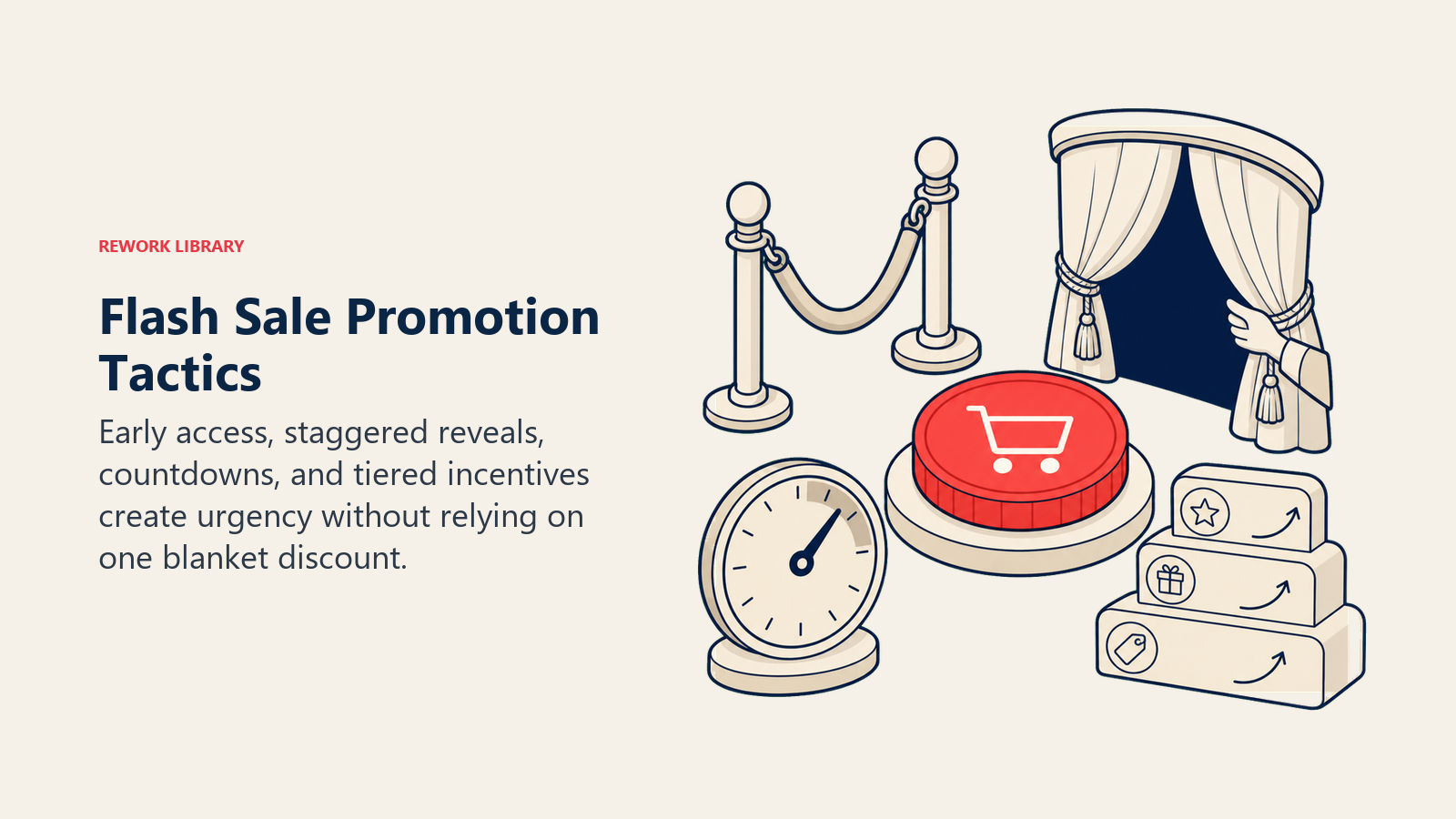
Exclusive early access rewards existing customers while driving list growth. Give email subscribers or loyalty program members 2-4 hours of exclusive access before opening to the public. This creates VIP status perception and incentivizes list signup. Sephora's Rouge program uses 24-hour early access to sale events, generating 40% of sale revenue from 15% of customers.
Staggered reveals maintain engagement throughout longer flash events. Instead of discounting everything at once, reveal new deals every 2-3 hours. Customers check back repeatedly to see new offers, increasing session frequency and cross-sell opportunities. Amazon Prime Day uses this effectively with Lightning Deals appearing throughout the event.
Progressive discounts reward fast action. Start at 20% off for the first hour, drop to 15% for hours 2-3, then 10% for the remainder. This frontloads urgency and captures the most motivated buyers at the deepest discount, while still converting price-sensitive customers later at better margins.
Countdown timers work when they're real. Display hours and minutes remaining for the entire event. Add item-level timers for products with limited inventory ("This deal ends in 2:47 or when sold out"). Never use fake countdown timers that reset when customers reload the page, since this is detectable and destroys credibility.
Bundle strategies increase average order value during flash events. Offer "Flash Sale + Free Gift" on orders over $X, or "Buy 2, Get 40% Off" instead of straight percentage discounts. Bundles increase basket size and make the economics more sustainable. Check out our Pricing Strategy for E-commerce guide for bundle pricing tactics.
Minimum order thresholds help margin preservation. A 25% off flash sale with a $75 minimum order maintains revenue per transaction while still creating urgency. Customers add additional items to hit the threshold, improving your unit economics.
Traffic Management & Conversion Optimization
Flash sales concentrate your normal traffic into compressed windows, stressing your technical infrastructure and checkout flow.
Infrastructure preparation prevents disaster. Load test your site at 5-10x normal peak traffic before running flash sales. The last thing you want is a crashed site during your highest-converting window. Cloud hosting with auto-scaling handles flash sale traffic better than fixed-capacity servers. CDN configuration becomes critical when you're serving product images and checkout pages to 10x normal concurrent users. Our site speed and performance guide covers infrastructure optimization in detail.
Checkout optimization determines realized revenue. Simplify your checkout to the absolute minimum required fields. Guest checkout should be prominent, because creating account friction during a flash sale kills conversions. One-click payment options (Apple Pay, Google Pay, Shop Pay) reduce checkout time from 3-4 minutes to under 30 seconds. During high-urgency windows, every additional click costs conversions.
Cart abandonment recovery requires flash-sale-specific messaging. Standard abandoned cart emails talking about "still interested?" don't work when the flash sale ended. Instead, segment flash sale abandoners separately and follow up with "Sorry you missed it, here's 10% off at regular price" or "The flash sale ended, but we saved one in your size." Learn more in our Cart Abandonment Recovery guide.
Mobile optimization is non-negotiable. 60-70% of flash sale traffic comes from mobile devices, often driven by push notifications or SMS alerts. Your mobile checkout flow should be tested at length. Autofill forms, large touch targets, and simplified navigation prevent mobile abandonment.
Queue systems manage demand for truly high-volume events. When traffic exceeds capacity, place customers in a queue with estimated wait times rather than crashing the site. This preserves the customer experience and converts more buyers than site downtime.
Promotion Channels: Driving Flash Sale Traffic
Flash sale success depends on reaching customers in the narrow time window.
Email segmentation determines response rates. Segment your list by engagement level and purchase history. Send flash sale alerts to your most engaged customers first, since they convert at 3-4x the rate of less engaged segments. For broader reach, send to your full list, but with subject lines that work for different engagement levels. "VIP Early Access" for top customers, "Flash Sale Now Live" for everyone else. Learn more about effective customer segmentation strategies.
Email timing should align with flash sale start times. Send the alert 15-30 minutes before the sale begins to build anticipation, not after it's already started. Include countdown timers in email creative that update automatically. Tools like Litmus or Email on Acid provide dynamic countdown functionality.
SMS urgency messaging converts higher than email for flash sales. Open rates hit 90-95% within 3 minutes of delivery, and SMS subscribers are your most engaged customers. Keep messages short and action-focused: "⚡️ Flash Sale: 30% off running shoes. 4 hours only. Shop now: [link]". SMS works best for your highest-value segments, since sending flash sale texts to your entire list creates unsubscribe risk.
Push notifications capture mobile customers immediately. Browser push for web visitors, app push for mobile app users. These have similar open rates to SMS but without carrier fees. Use push notifications for flash sale start alerts, low-stock warnings, and final-hour reminders. For more on messaging strategy, see our Email Marketing for E-commerce and SMS Marketing Strategy guides.
Social media creates FOMO but rarely drives immediate conversions. Instagram Stories with countdown stickers build awareness. Facebook posts reach older demographics. But social traffic converts at 40-60% of email or SMS traffic because social browsers aren't in buying mode. Use social for awareness and list building ("Sign up for flash sale alerts"), not primary conversion.
Retargeting ads capture previous visitors during flash sales. If someone browsed your site in the past 30 days, show them flash sale ads when the event goes live. These audiences convert 5-7x higher than cold traffic because they're already familiar with your products.
Analytics & Measurement: Beyond Surface Revenue
Flash sales generate obvious revenue spikes, but the real metrics determine profitability and sustainability.
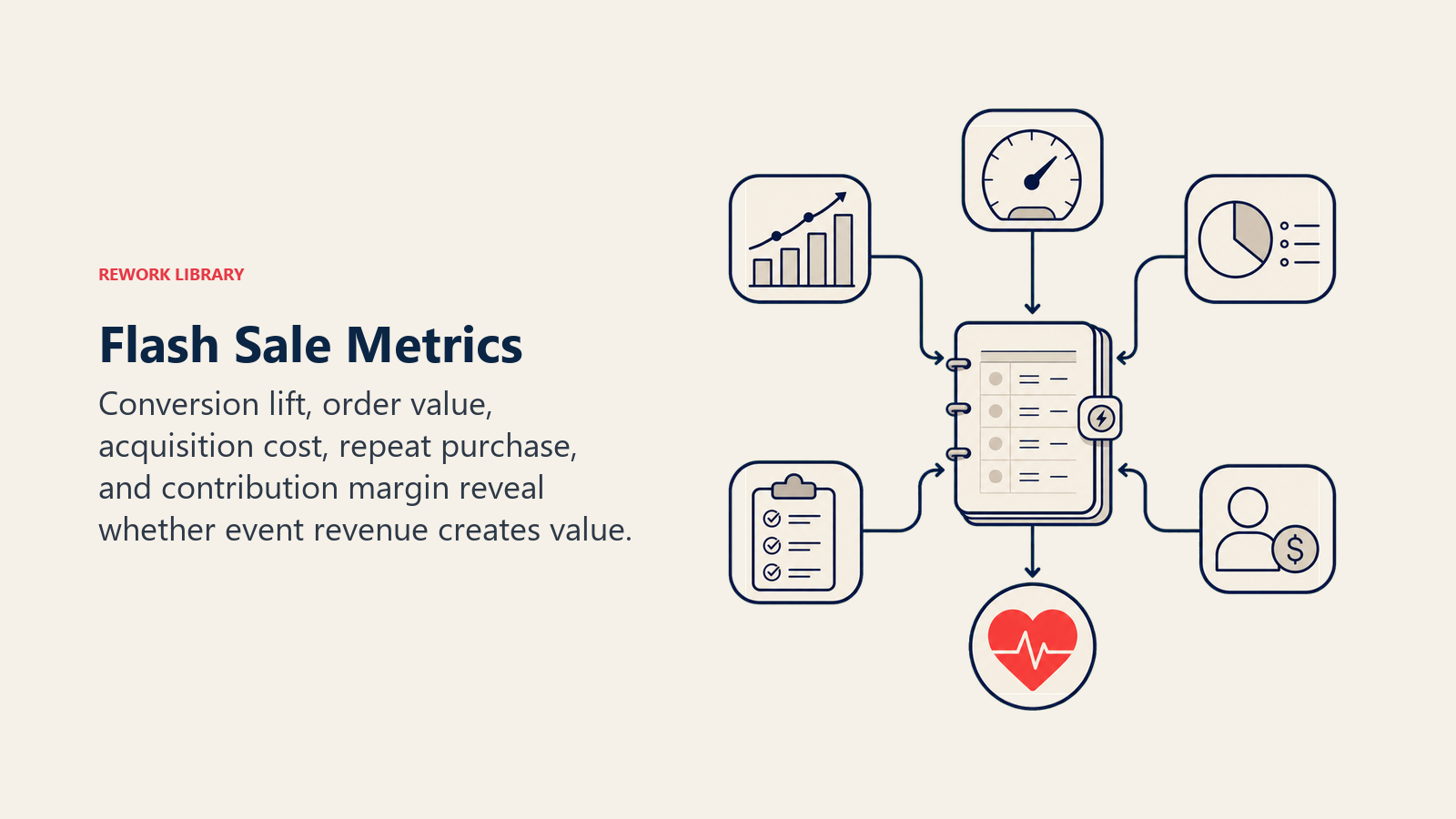
Conversion rate lift shows flash sale effectiveness. Compare flash sale conversion rates to your normal rates by traffic source. Email flash sale traffic should convert at 8-12% vs. 2-3% for normal email traffic. If your lift is under 2x, your discount isn't creating sufficient urgency or your promotion mechanics need adjustment.
Average order value typically drops during flash sales. Discounts reduce transaction value, and urgency often prevents cross-sell browsing. Track AOV separately for flash sales vs. normal sales. If flash sale AOV is under 60% of normal AOV, you're likely attracting cherry-pickers who only buy discounted items. Bundle requirements and minimum order thresholds help preserve AOV.
Customer acquisition cost during flash events determines new customer economics. Calculate CAC by dividing promotional spend (email, SMS, ads) by new customers acquired. Flash sales often generate $15-25 CAC compared to $40-60 for normal acquisition. But track whether these customers return, because if flash sale customers have 50% lower repeat purchase rates, the apparent CAC advantage disappears.
Repeat purchase behavior reveals flash sale quality. Segment customers by acquisition source and track their second purchase timing and frequency. Customers acquired through flash sales should return within 90 days at rates above 25-30%. If repeat rates are under 15%, you're acquiring one-time bargain hunters, not building customer lifetime value.
Margin per transaction matters more than gross revenue. A flash sale generating $50K in revenue at 25% off yields $37.5K in margin (assuming 50% base margins). The same promotional spend driving $35K in full-price sales yields $35K in margin. Track margin dollars, not revenue dollars. For a comprehensive view of performance tracking, explore our e-commerce metrics and KPIs guide.
Track inventory turn velocity for products included in flash sales. If flash sale items sell out in 4 hours but would have sold in 2 weeks at full price, you've accelerated cash flow but reduced profit. This makes sense for seasonal inventory or products approaching obsolescence, but not for evergreen bestsellers.
Margin & Profitability: Sustainable Discount Depths
Flash sale discounts should be carefully calculated based on margin structure and strategic goals.
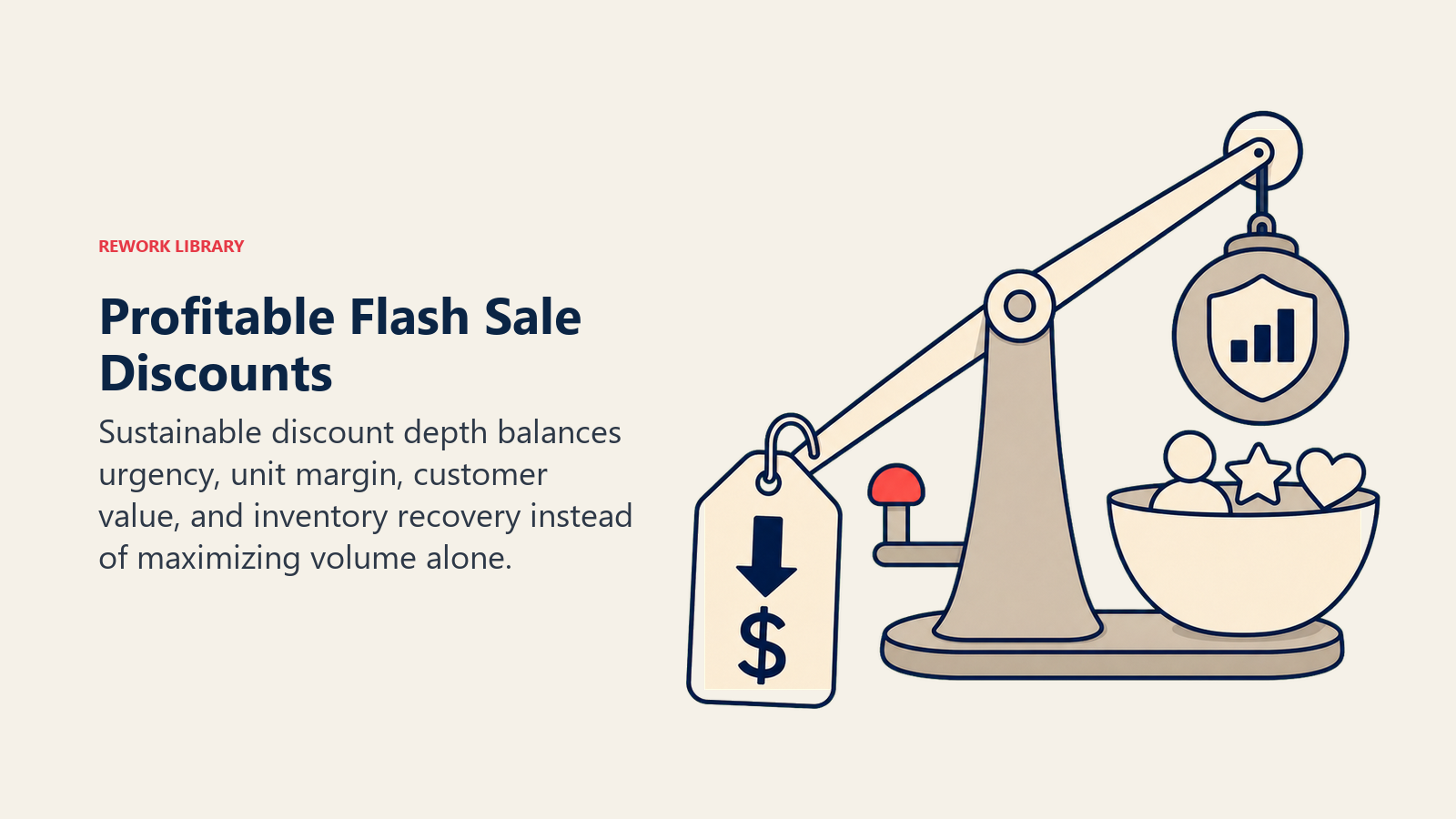
Discount depths of 20-35% create urgency without destroying margins. Deeper discounts (40-50%+) work for closeout inventory but train customers to expect massive markdowns. Calculate your minimum viable discount by testing response rates. Sometimes 25% off generates 90% of the conversions you'd get at 40% off, and the extra margin is pure profit. Our pricing strategy and optimization guide covers discount psychology in depth.
Loss leader strategy uses deep discounts on specific items to drive traffic and cross-sell. Discount a popular, recognizable product at 40-50% off to generate clicks, then recommend full-price complementary products. This works when your site navigation and product recommendations are strong. Athletic wear brands often discount popular shoe styles while maintaining full price on apparel.
Tiered discounting preserves margins on bestsellers. Offer 20% off most items, 30% off moderate sellers, and 40% off slow-moving inventory. This concentrates your discount spend where it creates the most value (moving stale inventory) rather than discounting products that would sell anyway.
Customer lifetime value math determines acceptable acquisition discounts. If your average customer generates $500 in margin over their lifetime, a flash sale that acquires customers at $50 CAC (including discount costs) generates 10x return. Even deep discounts make sense when they're acquiring high-value customers. But this only works if flash sale customers exhibit normal repeat purchase behavior, so track this carefully. Learn more about calculating and optimizing customer lifetime value.
Consider your Discount Strategy in context of flash sales. If you're already running frequent promotions, flash sales add incremental discount conditioning. If you rarely discount, flash sales create contrast and attention.
Flash sale frequency affects sustainable discount depth. Monthly flash sales at 25% off maintain urgency without conditioning. Weekly sales at the same depth train customers to never pay full price. Either reduce frequency or reduce discount depth as you scale flash sale programs.
Customer Experience Risks & Mitigation
Flash sales create potential friction points that damage relationships if not managed carefully.
Stock-out frustration happens when customers complete checkout only to find items unavailable. Prevent this with real-time inventory checks before payment processing. If an item sells out after adding to cart, notify immediately with alternative suggestions. Never process payment for unavailable items, since refund friction creates lasting negative impressions.
Expectation management starts before the sale. Be explicit about inventory limits, duration, and rules. "Limited to stock on hand" and "Maximum 2 per customer" prevent surprise disappointment. Clear communication reduces customer service volume and maintains trust.
Waitlists capture demand for sold-out items. When flash sale items sell out, offer a waitlist for "back in stock at regular price" alerts. This converts disappointed customers into future revenue. Some brands offer waitlist members first access to the next flash sale, creating VIP perception.
Rain checks work for stockouts on advertised items. If you promoted a specific product that sold out quickly, offer customers who tried to buy a rain check at the flash sale price when it restocks. This preserves the relationship and demonstrates customer-first values.
Speed vs. accuracy in fulfillment creates tension. Flash sales generate order surges that stress warehouse operations. Plan for overtime or temporary staff to maintain normal fulfillment timelines. Delayed shipping after a flash sale creates negative experiences that offset the positive purchase experience.
Price matching policies need flash sale rules. Will you price match your own flash sale for customers who bought at full price yesterday? Most brands don't, but clear policies prevent customer service chaos. "Flash sales are limited-time promotional pricing and are not eligible for price matching" sets expectations.
Advanced Tactics for Sophisticated Flash Sale Programs
Once basic flash sale mechanics work reliably, advanced tactics improve performance and reduce discount dependency.
Personalized flash offers use browsing and purchase history to target relevant discounts. If a customer viewed running shoes three times but didn't buy, trigger a personalized 24-hour flash sale on running shoes via email or push notification. These individual urgency events convert at 15-20% compared to 8-12% for general flash sales because the offer matches demonstrated intent.
Progressive discounts reward fast action while capturing price-sensitive customers. Start at 30% off for hour one, 25% off for hours 2-3, 20% off for hours 4-6. This captures your most eager customers at deeper discounts while still converting fence-sitters at better margins. The discount progression itself creates urgency, so customers accelerate decisions to capture the deeper discount.
Tiered events by customer segment maintain margin structure. VIP customers get 25% off during exclusive access windows. General customers get 20% off when the sale opens publicly. New visitors get 15% off with email signup. This rewards loyalty while still capturing new customers at different price points.
Loyalty program integration makes flash sales strategic rather than purely tactical. Offer double or triple points during flash sale purchases, or give loyalty members an extra hour of access. This shifts flash sales from margin-negative discount events to loyalty-building engagement opportunities. The discount is partially offset by increased lifetime value from loyalty program members.
Flash sales for new product launches create buzz without conditioning discount expectations. Launch a new product at full price, then run a 24-hour flash sale at 15% off for email subscribers one week later. This rewards your engaged audience while maintaining the product's full-price positioning.
Mystery flash sales build list engagement. Email subscribers get "Mystery Flash Sale, opens in 24 hours" teasers without knowing which products will be discounted. This creates anticipation and drives higher open rates for the actual sale announcement. The unknown element adds excitement beyond the discount itself.
Abandoned cart flash sales convert fence-sitters. If someone abandons a cart, trigger a personalized 4-hour flash sale via email: "The items in your cart are now 20% off for the next 4 hours." This combines urgency with relevance, converting abandoned carts at 8-12% vs. 2-3% for standard abandoned cart emails.
Inventory-triggered automatic flash sales optimize clearance. When inventory aging reaches defined thresholds (90 days for fashion, 6 months for home goods), automatically trigger flash sales for those specific SKUs. This maintains inventory freshness without manual promotion planning. For more on inventory strategy, see our Inventory Management guide.
Building a Sustainable Flash Sale Calendar
Flash sales work best as part of a planned promotional calendar, not random revenue panic buttons.
Map your flash sales around natural shopping behavior and inventory needs. Post-holiday sales clear gift inventory. End-of-season sales prepare for new arrivals. New customer acquisition flash sales run during high-traffic periods when CAC is lower.
Monthly flash sale series create anticipation without conditioning. "First Friday Flash Sale" or "Monthly VIP Event" establishes rhythm. Customers know to expect the event and plan accordingly, but the monthly frequency maintains urgency.
Test systematically. Run similar flash sales with one variable changed (duration, discount depth, day of week) and measure response. Build a playbook of what works for your audience and product mix.
Balance flash sales with full-price positioning. If 15% of your revenue comes from flash sales and 85% from regular pricing, you're using urgency strategically. If 40%+ comes from flash sales, you've trained customers to wait for discounts. The right balance depends on your margin structure and customer lifetime value economics.
Flash sales should accelerate purchases customers were already considering, not create discount dependency. When executed strategically, they clear inventory, acquire new customers, and generate revenue spikes while preserving brand value and customer relationships.

On this page
- The Psychology Behind Urgency Marketing
- Flash Sale Architecture: Duration and Structure
- Inventory Management for Flash Events
- Timing & Seasonality: When Flash Sales Work Best
- Promotion Mechanics That Amplify Urgency
- Traffic Management & Conversion Optimization
- Promotion Channels: Driving Flash Sale Traffic
- Analytics & Measurement: Beyond Surface Revenue
- Margin & Profitability: Sustainable Discount Depths
- Customer Experience Risks & Mitigation
- Advanced Tactics for Sophisticated Flash Sale Programs
- Building a Sustainable Flash Sale Calendar