First-Time Customer Offers: Balancing Acquisition Economics with Long-Term Value
Turn this article into takeaways for your work.


Each assistant summarizes the article only for you and suggests best practices for your work.
A first-time customer offer is an incentive (a discount, free shipping, gift, or bundle) given to new buyers to convert their first purchase. Done well, it lowers effective acquisition cost and attracts customers who repurchase profitably. Done poorly, it trains shoppers to wait for codes and erodes margin and brand value.
First-time customer offers sit at the intersection of acquisition efficiency and brand positioning. Too generous, and you train customers to wait for discounts while destroying margins. Too conservative, and you leave conversion lift on the table while competitors capture your traffic. The right approach requires understanding the full economic equation: not just immediate conversion rate, but customer quality, payback period, and long-term retention patterns.
Most brands treat first-time offers reactively, copying competitor pop-ups or applying blanket discounts because "everyone does it." The result? Commoditized positioning and customer bases trained to hunt for codes before purchasing. Strategic first-time offers work differently. They're calibrated to acquisition economics, segmented by traffic quality, tested rigorously, and designed to attract customers who convert profitably over time.
Economics Framework: When Offers Make Financial Sense
Start with the math. A first-time offer only makes sense when it improves your customer acquisition economics, measured across the full customer lifecycle rather than the first transaction alone. The basic equation: Your customer acquisition cost (CAC) plus any discount cost must be lower than your customer lifetime value (LTV), with an acceptable payback period. If your blended CAC is $40 and you offer a 20% discount on a $60 average order, you've invested $52 to acquire a customer. That customer needs to generate at least $52 in gross profit (not revenue) to break even, preferably within 60-90 days.
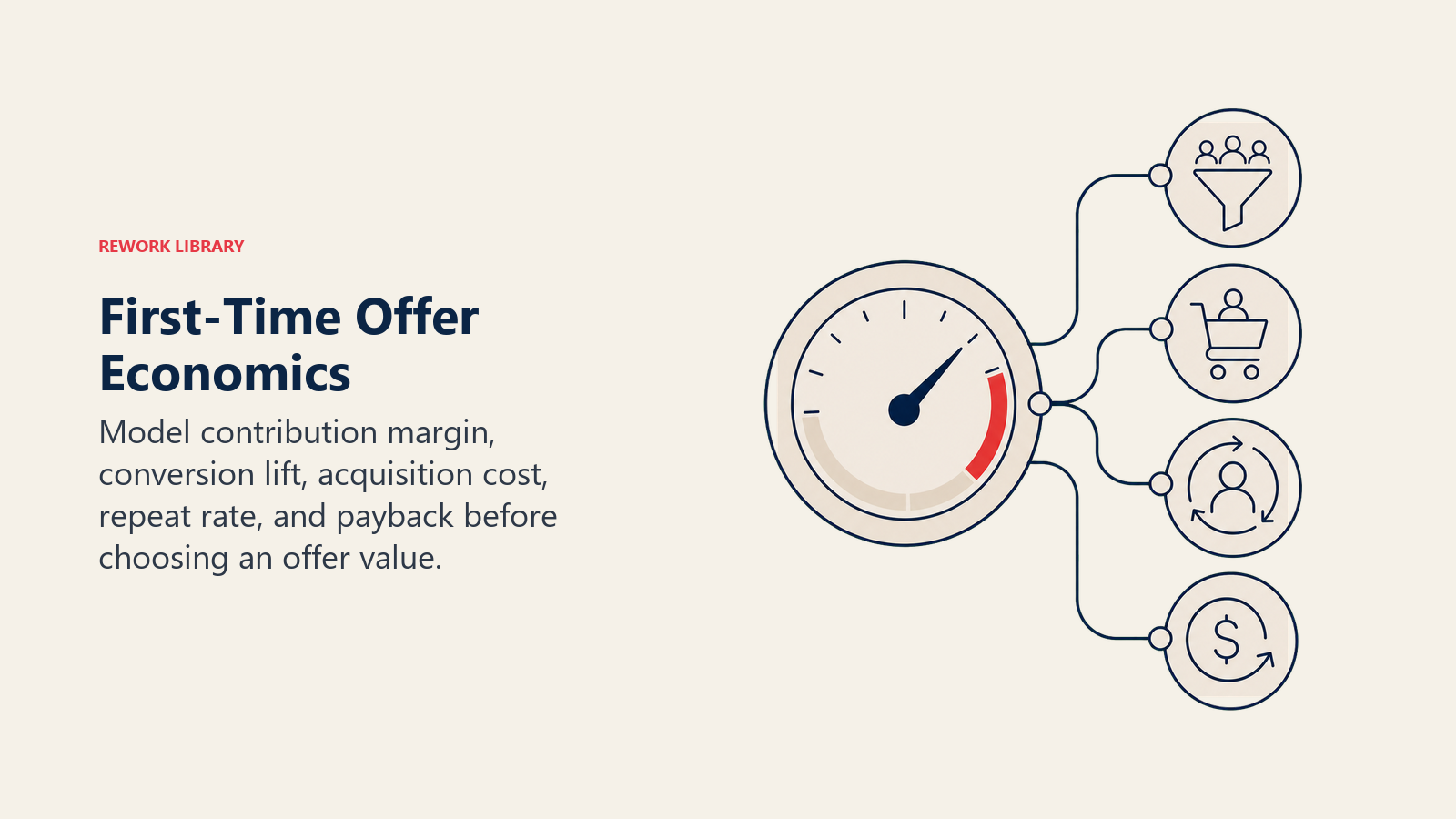
Most brands lose money on first purchases after accounting for fulfillment, returns, and support costs. Your first-time offer needs to either improve conversion enough to lower effective CAC, or attract higher-quality customers with better retention rates. If neither happens, you're just accepting lower margins without economic benefit.
Break-even analysis example: Let's say you're driving traffic from Facebook ads at $2.50 per click with a 2% conversion rate, resulting in a $125 CAC. Your average order value is $75 with 40% gross margins ($30 gross profit). Without a first-time offer, you lose $95 on the first purchase and need repeat orders to become profitable.
Now add a 15% first-time discount. If this increases conversion from 2% to 2.8%, your CAC drops to $89. The discount costs $11.25 per order, reducing gross profit to $18.75. Your net investment per customer falls from $95 to $70.25, a significant improvement. But only if the incremental customers convert at similar rates to your baseline customers.
This is where most brands get the math wrong. They calculate lift based on aggregate conversion improvement without measuring cohort performance. That 0.8% conversion lift might come entirely from bargain hunters who never repurchase, making your economics worse despite better top-line metrics. You need to understand Unit Economics for E-commerce to make this assessment accurately.
Payback periods matter equally. If your business operates on thin cash flow, a first-time offer that extends payback from 60 to 120 days might create cash constraints even if the lifetime economics improve. Calculate payback at both the gross profit and contribution margin level to understand your true cash position.
Types of First-Time Customer Offers
Different offer structures attract different customer segments and create different economic profiles. Percentage discounts (10%, 15%, 20% off) are the most common but also the most commoditizing. They work best for higher AOV products where the dollar savings feel substantial. A 15% discount on a $200 order ($30 off) feels more valuable than 15% on a $40 order ($6 off). But here's the downside: percentage discounts train customers to calculate value in discount terms rather than product value terms.
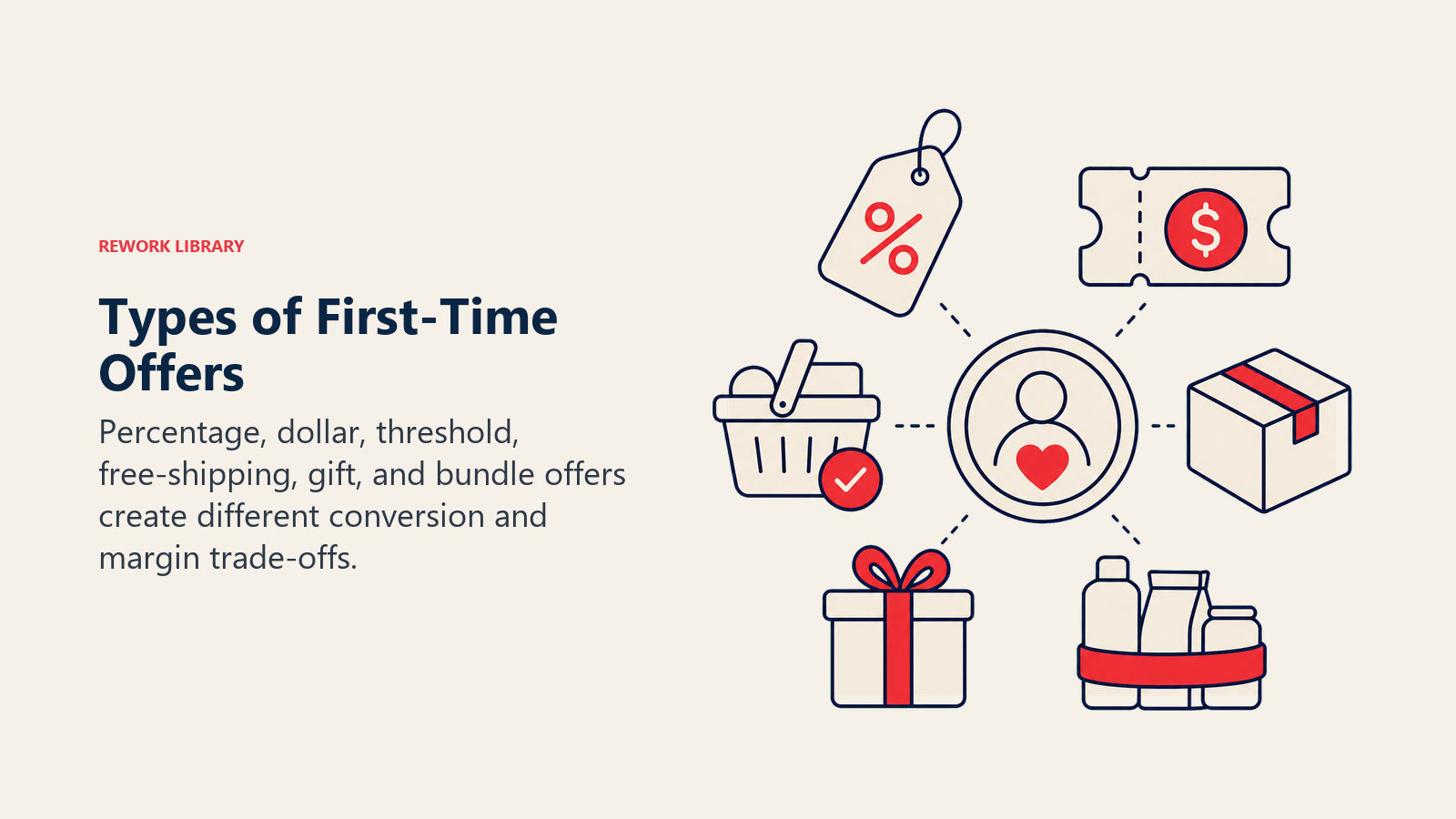
Dollar-value discounts ($10 off $50, $25 off $100) create clear thresholds that encourage higher cart values. They work particularly well for driving customers toward specific AOV targets. A $15 off $75 offer effectively pushes customers from $60 carts to $75 carts, improving your economics while still providing perceived value. The mechanics align incentives better than pure percentage discounts.
Free shipping thresholds convert exceptionally well for products where shipping costs are a known purchase barrier. For brands with $8-12 shipping charges, offering free shipping on orders over $50-75 creates clear value while encouraging larger carts. The cost is predictable and often lower than percentage discounts on the same order value. See AOV Optimization Strategy for detailed threshold mechanics.
Free gift with purchase works when you have high-perceived-value items with low actual costs, such as samples, accessories, or overstock items. A deluxe sample set that costs you $4 but has a perceived value of $25 creates strong conversion lift without the margin hit of a dollar discount. The gift also introduces customers to additional products, potentially driving future purchases.
Bundle offers (buy 2 get 15% off, buy 3 get 1 free) optimize for both AOV and inventory management. They work particularly well for consumables, where buying multiple units is logical, or for gift-giving scenarios. Bundles often attract higher-quality customers who plan to use products rather than one-time buyers chasing deals.
Flash or time-limited offers create urgency without training customers to expect permanent discounts. A 4-hour window or "first 100 customers" mechanic converts fence-sitters while maintaining full-price positioning for other segments. The urgency must be real. Fake countdown timers destroy trust faster than they create conversions.
Value-add offers (free extended warranty, exclusive access, expedited shipping) provide benefits without directly discounting products. These work best for premium brands where maintaining price integrity matters more than maximizing conversion rate. A free 2-year warranty might cost you $8 in expected claims but provide $40 of perceived value without cheapening your brand.
The right offer type depends on your product characteristics, margin structure, and brand positioning. Premium brands should favor value-add offers and modest shipping discounts over aggressive percentage discounts. Volume-oriented businesses can use steeper discounts if their LTV-to-CAC ratios support it.
Pop-up and Conversion Mechanics
How you present first-time offers matters as much as the offer itself. Poor mechanics destroy conversion lift even with attractive economics. Email capture vs immediate discount: The classic trade-off. Email-gated offers (enter your email to get 10% off) build your list but create friction that reduces immediate conversion. Immediate discounts (applied automatically to first-time visitors) maximize conversion lift but provide no contact information for follow-up.
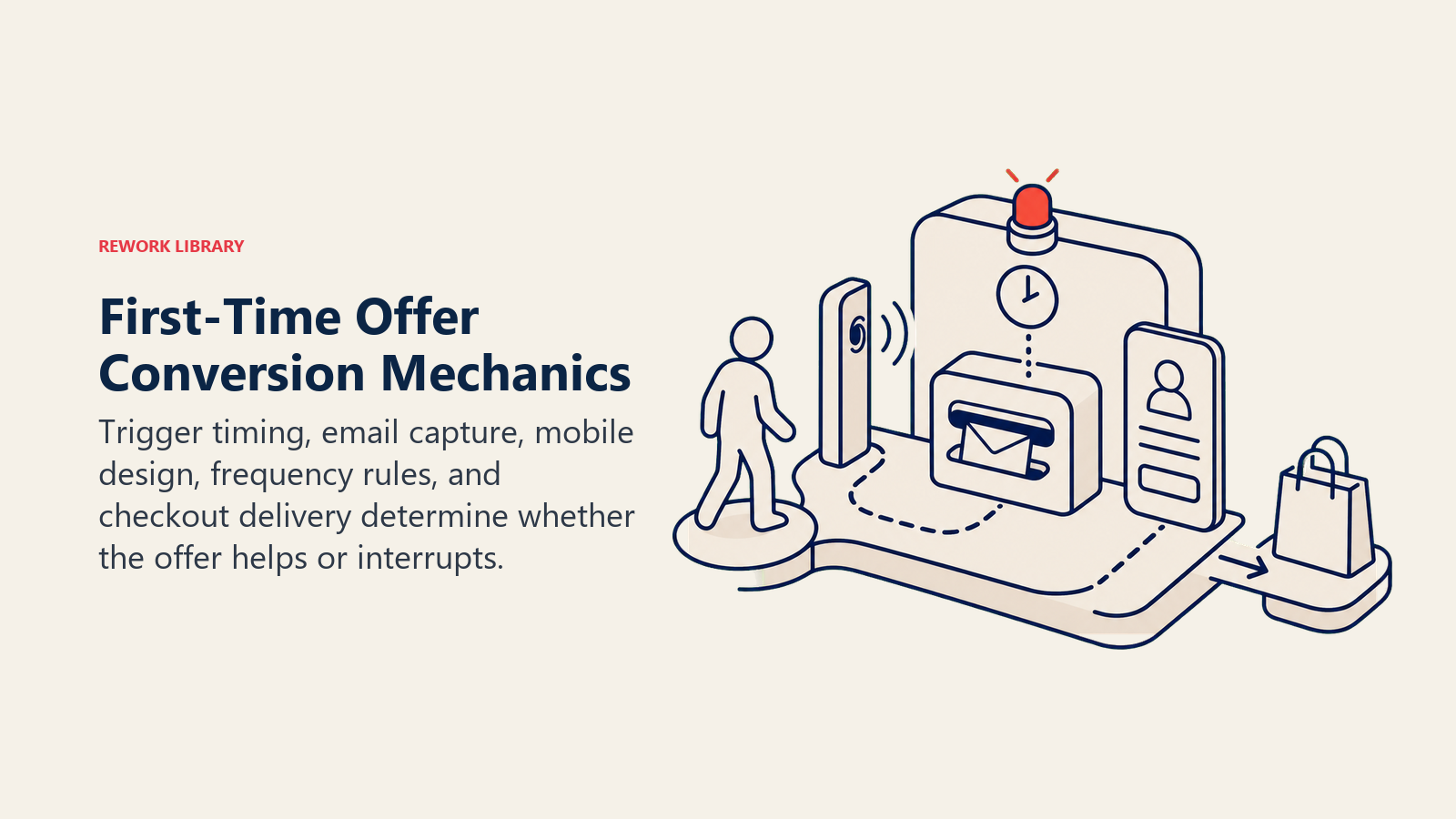
The hybrid approach works best for most brands: use email capture as the primary mechanic, but allow guest checkout with the discount applied. You capture emails from the majority of converters while not blocking the minority who refuse to provide email addresses. The key is making the email field feel like value exchange rather than data extraction.
Exit-intent triggers catch visitors about to leave, making the offer feel like a retention tool rather than a desperate discount. Exit-intent pop-ups typically convert 2-4% of abandoning visitors, not spectacular, but meaningful volume for high-traffic sites. The timing creates a psychological anchor: you're "saving" the visit rather than buying it.
The downside of pure exit-intent? You miss visitors who intended to purchase anyway. A better approach combines exit-intent with time-on-site triggers (show after 60 seconds) and scroll-depth triggers (show after scrolling 50% down a product page). This captures intent signals while maintaining the urgency of exit-intent for abandoning visitors.
On-page presentation matters enormously. Full-screen overlays create maximum visibility but also maximum annoyance. Slide-in corner pop-ups are less intrusive but easier to miss. Top or bottom bars integrate into the page design without blocking content but lack visual impact.
Test presentation style by visitor segment. New visitors from paid ads might need aggressive pop-ups to justify your ad spend. Organic visitors from content might respond better to subtle top bars that respect their browsing experience. Traffic from email campaigns (where users already know your brand) might need no pop-up at all, just apply the offer automatically.
Mobile implementation requires separate consideration. Full-screen pop-ups on mobile create worse user experience than on desktop, but mobile traffic often represents 60-70% of total visitors. Mobile-optimized offers use slide-up bottom sheets that feel more native to mobile interactions, or top bars with persistent visibility as users scroll.
The technical implementation matters: ensure offers load fast, don't create layout shifts that frustrate users, and respect user dismissals (don't show the same pop-up five times in one session). Use session cookies to track offer views and conversions, preventing repeated displays to the same visitor.
Segmentation and Personalization Strategies
Not all first-time visitors deserve the same offer. Segmentation improves both conversion economics and customer quality. Traffic source targeting is the most important dimension to segment on. Visitors from paid search (actively looking for your product) convert at higher rates than display ad traffic (passive browsing). You might offer 10% to high-intent paid search traffic but 20% to cold display traffic to equalize conversion rates.
The math: if paid search converts at 4% with no offer and display converts at 1% with no offer, you need different inducements to reach profitable CAC levels. A modest 10% offer might push paid search to 5.5% conversion (37% lift) while a 20% offer pushes display to 2% (100% lift). Your effective CAC from display traffic improves more dramatically, justifying the steeper discount.
Track performance by UTM parameters or traffic source tags. Most e-commerce platforms allow showing different offers based on referring URL parameters. Google Ads traffic gets one offer, Facebook traffic gets another, organic traffic gets a third. This optimization often improves blended CAC by 15-25% compared to one-size-fits-all offers.
Device-specific offers address different conversion barriers. Mobile visitors often abandon at higher rates due to form friction and slower browsing experiences. A mobile-specific free shipping offer (lower friction than percentage discounts requiring price calculation) might convert better than the desktop percentage discount offer.
Desktop visitors tend to research more thoroughly, suggesting they're deeper in the purchase funnel. A value-add offer (free gift, extended return window) might convert these visitors without the margin hit of a direct discount.
Geographic targeting allows adjusting offers based on shipping costs, competitive intensity, or purchasing power. International customers facing high shipping costs might get free shipping offers. Customers in highly competitive markets might get steeper discounts than those in markets where you have less competition.
New customer identification requires technical implementation, usually IP tracking, cookie tracking, or email lookups against your customer database. The investment pays off by preventing repeat customers from accessing new-customer discounts, which both preserves margins and maintains offer exclusivity.
A/B Testing and Optimization Framework
Most brands test first-time offers poorly, if they test at all. Rigorous testing uncovers 20-40% improvements in offer economics.
Testing offer value levels: Start with the discount percentage or dollar amount. Test 10% vs 15% vs 20% discounts in rotation, measuring both conversion rate and downstream metrics. Many brands find 15% offers convert nearly as well as 20% offers while preserving significantly better margins.
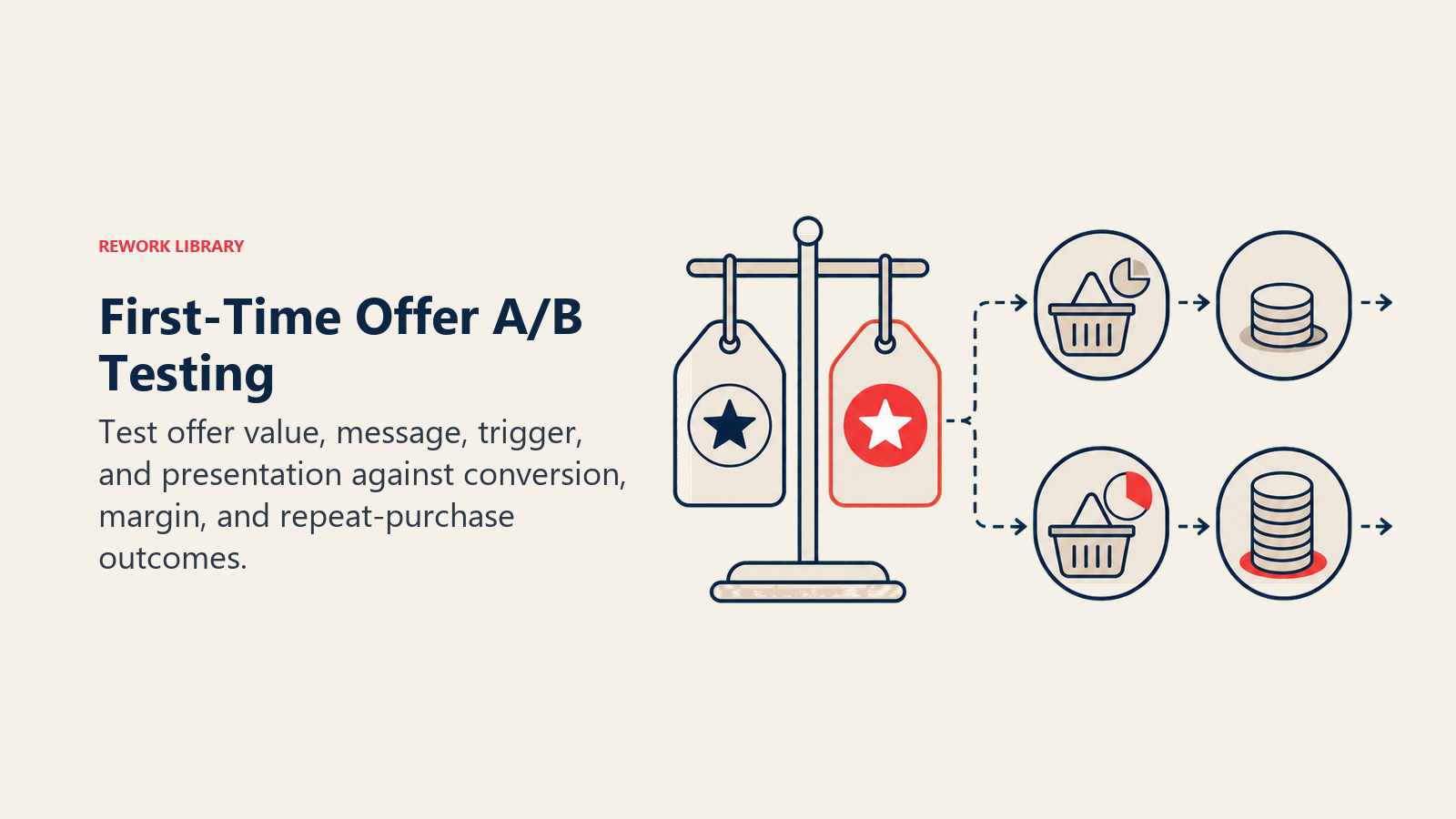
The sample size requirements are substantial. You need at least 100 conversions per variant to reach statistical significance on conversion rate, and ideally 500+ to detect meaningful differences in repeat purchase rates. This means smaller stores need weeks or months to properly test offer levels.
Messaging tests often matter more than offer value. "Get 15% off your first order" converts differently than "Welcome! Here's 15% off to get started" or "New customer exclusive: 15% off your first purchase." The framing creates different psychological anchors.
Test benefit-focused copy against urgency-focused copy. "Free shipping on orders over $50" emphasizes the benefit. "Order now for free shipping, today only!" adds urgency. Neither is universally better; it depends on your product, audience, and brand voice.
Pop-up timing tests examine when to show offers. Immediate display (on page load) maximizes visibility but might annoy visitors before they've evaluated products. Delayed display (after 30-60 seconds) respects browsing time but risks missing quick bounces. Exit-intent only catches abandoners but feels less pushy.
Run multi-variant tests comparing immediate, 30-second delay, 60-second delay, and exit-intent only. Measure both conversion rate and bounce rate. Immediate pop-ups might improve conversion by 8% while increasing bounce rate by 5%, creating a net negative effect.
CTA design tests examine button copy, color, size, and placement. "Claim My Discount" often outperforms "Submit" or "Get Offer" by creating ownership language. Contrasting button colors improve click-through by 15-30% compared to low-contrast designs.
The most important test: conversion rate vs AOV trade-offs. Steeper discounts increase conversion rates but decrease average order values (customers don't need to add items to hit thresholds) and attract lower-quality customers. Your goal is optimizing for customer acquisition cost and lifetime value, not maximizing conversion rate in isolation.
Calculate the effectiveness metric: (Conversion rate × AOV × Gross margin) / (1 + Discount percentage). This gives you gross profit per visitor, the actual metric you're optimizing for. A 4% conversion rate at $80 AOV with 15% discount and 40% margins generates more profit per visitor than a 5% conversion rate at $65 AOV with 20% discount, even though the latter has a "better" conversion rate.
Fraud Prevention and Abuse Detection
First-time offers attract abuse. Without proper controls, you'll subsidize serial discount hunters and lose money on fraudulent orders. Coupon stacking prevention blocks customers from combining first-time offers with other promotions. Most e-commerce platforms allow setting exclusivity rules at the discount code level. Your first-time offer should exclude stacking with sale prices, loyalty discounts, and other promotional codes unless you've explicitly calculated the combined economics.
Bot detection prevents automated systems from generating hundreds of fake accounts to harvest discount codes. Implement CAPTCHA on email signup forms, rate-limit sign-ups from individual IP addresses (max 3-5 per day), and flag accounts created with temporary email services (mailinator, 10minutemail, etc.).
Watch for patterns: multiple accounts created within minutes from the same IP, accounts using similar email patterns (user1@domain, user2@domain), or accounts with minimal interaction before checkout. These patterns indicate abuse rather than genuine customers.
Email validation ensures you're collecting real, working email addresses in exchange for discounts. Use real-time email verification APIs that check for valid domains, catch typos, and flag disposable email addresses. The cost (typically $0.002-0.005 per verification) is minimal compared to the wasted discounts and poor list quality from fake emails.
Velocity checks flag unusual purchase patterns. A new customer making three orders in 24 hours might be exploiting your system. Similarly, customers creating multiple accounts with slight email variations (john.smith@gmail.com, johnsmith@gmail.com, john.smith1@gmail.com) are likely abusing first-time offers.
Set business rules: flag any customer who creates more than two accounts from the same IP in 30 days, or makes more than two orders to the same shipping address using different email addresses. These rules catch most abuse while minimizing false positives.
Chargeback monitoring identifies fraud that passes initial checks. New customers acquired through discount offers have higher chargeback rates than organic customers. Track chargeback rates by acquisition source and offer type. If your 25% off offer generates 3× higher chargebacks than your 10% offer, you're attracting fraudsters or extremely price-sensitive customers with high return rates.
The preventive measures create friction, which reduces conversion rates. The goal is implementing just enough security to minimize abuse without destroying legitimate conversion. Start light, then add controls as you identify specific abuse patterns.
Integration with Customer Journey
The first-time offer is your entry point, not your entire strategy. Integration with the post-purchase journey determines whether you acquire valuable customers or one-time bargain hunters.
Post-purchase experience for first-time customers should acknowledge their status while starting the relationship-building process. Send a welcome email series that educates about product usage, shares your brand story, and provides helpful resources, not just promotional messages.
The welcome series conversion rate (typically 15-25% of recipients make second purchases within 30 days) often determines whether your first-time offer paid off. A well-designed series focuses on value delivery first, selling second. The best practice for Email Marketing for E-commerce suggests a 3-5 email sequence over 14-21 days.
Loyalty enrollment should happen immediately for first-time customers. Offer enrollment at checkout ("Join our loyalty program and earn points on this order!") or in the post-purchase confirmation. Getting customers into loyalty programs early increases retention by 25-40% compared to customers who never enroll.
The enrollment messaging matters. Don't just push loyalty as another thing to sign up for. Demonstrate the immediate value. "You earned 75 points on this order, worth $7.50 toward your next purchase" creates tangible value that encourages return visits.
Retention measurement requires tracking first-time customer cohorts over 90-180 days. Calculate repeat purchase rates at 30, 60, and 90 days for customers acquired through different offers. A 20% discount might generate 3× more first purchases than a 10% discount, but if those customers repurchase at half the rate, the economics favor the modest discount.
Build cohort reports comparing: acquisition cost, first order value, repeat purchase rate, second order value, and cumulative LTV at 90 and 180 days. These metrics reveal which offers attract customers worth keeping versus which offers attract deal-seekers who never return.
For brands with longer purchase cycles, retention measurement might require 6-12 months. Furniture or appliance brands can't judge customer quality after 60 days, since their customers might not need another purchase for years. In these cases, focus on engagement metrics (email opens, site visits, review submissions) as leading indicators of long-term value. More on this in Repeat Purchase Strategy.
Channel-Specific Strategies
First-time offers work differently across acquisition channels. Channel alignment improves conversion economics and reduces customer confusion.
Paid ad alignment ensures your ad messaging matches your offer presentation. If your Facebook ad promises "15% off your first order," your landing page must deliver that exact offer immediately. Mismatches between ad promise and on-site experience kill conversion rates.
Many brands run channel-specific offers: 15% off for Google Ads traffic (high intent, converts well with modest offers), 20% off for Facebook cold traffic (low intent, needs stronger inducement), 10% off for retargeting traffic (already familiar with brand, needs small push). Use UTM parameters to trigger appropriate offers automatically.
The technical implementation: create landing pages for each major channel, with offer details embedded in the page rather than just in pop-ups. This ensures visitors see the offer even if they have pop-up blockers or dismiss the modal too quickly.
Email deployment of first-time offers requires list hygiene. Don't send "new customer" offers to your existing subscriber list, or you'll either cannibalize full-price sales or frustrate customers who feel excluded. Segment your email sends to exclude existing customers, or use graduated offers (10% for new customers, 15% for existing VIPs).
For email capture offers (give us your email, get 10% off), the follow-up sequence matters enormously. Send the discount code immediately, then follow up within 4-24 hours for non-converters. The follow-up email should address objections ("Still deciding? Here's what customers love about us...") while reinforcing the limited-time nature of the offer.
SMS marketing for first-time offers converts exceptionally well but requires careful permission management. SMS offers typically generate 15-25% conversion rates versus 3-8% for email offers, but you need explicit opt-in for SMS communications.
The winning approach: offer the discount upon SMS opt-in ("Text JOIN to 12345 and get 15% off today!"), deliver the code immediately via text, then follow up 24-48 hours later for non-converters. Keep messages brief and value-focused. SMS is an intimate channel that punishes verbose messaging.
Social media considerations focus on platform-specific behavior. Instagram users respond to visual value demonstrations (show the product, then reveal the offer). TikTok users want entertainment first, selling second (create valuable content, then mention the offer). LinkedIn users (for B2B brands) prefer professional value-add offers over percentage discounts.
Don't run identical offers across all channels unless your testing data shows they perform equally well. Channel-specific optimization typically improves blended conversion rates by 20-30% compared to one-size-fits-all approaches.
Measurement and Success Metrics
You can't optimize what you don't measure. Comprehensive tracking separates profitable first-time offers from expensive conversion theater. Acceptance rates measure how many visitors who see your offer actually use it. Low acceptance rates (under 5-10%) suggest your offer isn't compelling or your presentation needs improvement. High acceptance rates (over 40-50%) might indicate you're offering more than necessary to drive conversion.
Track acceptance rate by traffic source, device, and new vs returning visitor status. This segmentation reveals which audiences find your offer compelling and which remain unconvinced.
AOV impact measures whether your offer encourages larger or smaller carts. Percentage discounts often decrease AOV (customers feel they're saving enough without adding extra items). Threshold offers ($20 off $100) increase AOV by encouraging customers to reach the threshold. Free gift offers sometimes increase AOV if customers add items to qualify for the gift.
Calculate AOV separately for customers who use the first-time offer versus those who purchase without it. If the offer decreases AOV by 20%, you need significantly higher conversion lift to justify the combined margin impact.
CAC calculation for first-time offers requires including the discount cost in your acquisition cost. If you spent $50 on ads to acquire a customer who used a 20% discount on a $60 order, your true CAC is $62 ($50 ad cost + $12 discount), not $50.
Many brands make this mistake, calculating CAC from ad spend alone while ignoring discount costs. This creates a false picture of profitability and leads to over-investment in acquisition channels.
Payback period measures how long until a customer becomes profitable. Calculate time to profitability at the gross profit level: (Total acquisition cost + discount cost) / Average gross profit per order = Number of orders to break even.
If your all-in CAC is $70 and your average gross profit per order is $35, you need two orders to break even. Measure actual time between first and second purchase for customers acquired through different offers. Offers that attract customers with longer payback periods strain your cash flow and increase risk.
LTV-to-CAC ratio provides the ultimate measure of offer effectiveness. Calculate 180-day LTV (or 12-month for longer purchase cycles) for customers acquired through different offer types, then divide by the all-in CAC for each offer.
Your target LTV-to-CAC ratio depends on your margin structure and growth stage. Established brands should target 3:1 or higher. Growth-stage brands might accept 2:1 if the customer quality justifies it. Ratios below 2:1 indicate you're overpaying for customers who won't generate sufficient return.
Cohort analysis tracks customer behavior over time by acquisition month and offer type. Build cohort reports showing: month of acquisition, offer used, first order value, 30-day repeat rate, 60-day repeat rate, 90-day repeat rate, and cumulative LTV at each interval.
This analysis reveals seasonal patterns (customers acquired in November during holiday shopping behave differently than June customers), offer effectiveness over time (has your 15% offer generated worse customers in 2026 than 2024?), and quality variations by traffic source.
The measurement infrastructure requires proper tracking implementation. Use UTM parameters to track traffic sources, implement offer code tracking in your analytics, and ensure your e-commerce platform passes offer usage data to your analytics tool. Without clean data, optimization becomes guesswork. Learn more about tracking in Conversion Rate Optimization.
Offer Lifecycle and Seasonal Adjustments
First-time offers aren't set-and-forget. Strategic adjustments based on seasonality, competitive dynamics, and business goals maximize long-term effectiveness.
Peak vs off-season often requires different offer strategies. During peak seasons (Q4 holidays, industry-specific peaks), traffic converts at higher baseline rates and competition for customer attention intensifies. You might need stronger offers during peak periods just to maintain share of attention, even though conversion rates are higher.
Conversely, off-season periods generate lower-intent traffic that converts poorly. Steeper off-season offers might improve conversion economics by keeping acquisition costs acceptable during slow periods. The math: if your Q4 CAC is $45 with a 10% offer but Q2 CAC would be $90 with the same offer, a 20% Q2 offer that brings CAC down to $60 improves your economics despite the steeper discount.
Holiday alignment means adjusting offers around major shopping events. Black Friday/Cyber Monday traffic expects steep discounts, and a modest 10% offer looks weak when competitors offer 30% off. You might run 25% first-time offers during BFCM despite normally offering 15%, accepting lower margins to capture the seasonal traffic spike.
The key is returning to normal offers quickly after holiday periods. Don't train customers to expect Black Friday pricing year-round. Use clear messaging that frames holiday offers as special events, not new baseline discounts.
Refresh cycles prevent offer fatigue and maintain perceived value. Running the same 15% offer for years trains customers to ignore it. Quarterly or semi-annual refreshes keep offers feeling current. The refresh might be messaging changes ("Spring Welcome Offer: 15% off"), value shifts (15% off vs $20 off $75), or format changes (discount vs free gift).
Test refreshes rather than changing blindly. Your "stale" 15% offer might still outperform a fresh 10% offer if customers respond to value over novelty.
Sunset strategies phase out offers that stopped working or no longer align with brand positioning. Many premium brands start with aggressive discounts during launch, then gradually reduce offer generosity as brand equity builds. The transition requires careful testing to avoid conversion rate cliffs.
A gradual sunset works better than abrupt changes: 20% off → 15% off → 10% off → free shipping → value-add only. Monitor conversion rates and CAC at each step, rolling back if the economics deteriorate too severely.
The opposite approach, ramping up offers over time, usually indicates deeper business problems. If you need increasingly aggressive offers to maintain conversion rates, you likely have product-market fit issues, increasing competition, or deteriorating brand perception that discounts won't fix long-term.
Common Pitfalls and Risk Management
Most first-time offer failures follow predictable patterns. Avoid these mistakes to protect both short-term economics and long-term brand value. Unsustainable discounts that destroy margins without compensating LTV happen when brands focus on conversion rate without calculating full economics. A 30% first-time discount might triple your conversion rate, but if it attracts customers who never repurchase, you've tripled your losses per customer rather than tripling your profits.
Run the math before launching offers: calculate break-even scenarios, model required retention rates, and set clear success metrics beyond conversion rate. If the numbers don't work even with optimistic assumptions, don't launch the offer.
Low-quality customers disproportionately attracted by steep discounts create long-term problems beyond poor repeat rates. These customers generate higher return rates (they're buying because it's cheap, not because they need the product), more support tickets (they expect perfection at discount prices), and worse reviews (discount hunters are harsher critics).
Track quality metrics by offer type: return rate, support contact rate, review scores, and fraud/chargeback rates. If your 25% offer generates customers with 2× the return rate of your 10% offer customers, the economics are worse than gross margin alone suggests.
Cannibalizing full-price sales happens when existing customers access new-customer offers or when "would-have-purchased-anyway" visitors use discounts they didn't need. The cannibalization cost is difficult to measure directly but often represents 10-30% of offer volume.
Minimize cannibalization through proper visitor identification (don't show offers to existing customers), exit-intent timing (only offer to visitors showing leave signals), and value-add offers instead of discounts for high-intent traffic sources.
Poor targeting wastes margin by offering discounts to visitors who would convert without inducement. Your high-intent paid search traffic (people searching for "buy [your product]") doesn't need 20% off, since they're already in buying mode. Offering them discounts just reduces your margins without improving conversion meaningfully.
Segment offers by intent signals. High-intent traffic gets minimal or value-add offers. Low-intent traffic gets stronger inducements. The targeting reduces average discount percentage while maintaining or improving overall conversion rates.
Training customers to wait for discounts destroys pricing power long-term. If customers know they can get 15% off by entering an email, they'll never purchase at full price. You've converted your brand into a discount brand, making it nearly impossible to raise prices or reduce promotional intensity later.
Protect against this by making offers genuinely exclusive (truly one-time, verified new customers only), using varied offer types rather than always discounting, and maintaining strong full-price value propositions. Your product quality, service, and brand experience need to justify full pricing for customers who don't receive offers.
Ignoring lifetime cohort performance means optimizing for acquisition metrics while ignoring whether you're acquiring valuable customers. The 20% offer that doubles your conversion rate might generate customers with half the LTV of your 10% offer customers, making it economically worse despite better top-line numbers.
Build reporting that tracks offer performance through complete customer lifecycles, at minimum 90 days, ideally 180+ days. Make offer decisions based on LTV and CAC ratios, not conversion rates in isolation. Understanding Customer Lifetime Value in depth helps avoid this trap.
Over-complicating offer mechanics confuses customers and reduces conversion despite attractive economics. Offers like "Buy 3, get 15% off the second item and 30% off the third" or "Spend $100, get $20 off, plus free shipping, plus a free gift if you sign up for our loyalty program" create cognitive overload that kills conversion.
Keep offers simple: one clear benefit, easy to understand math, obvious action required. "15% off your first order" converts better than complex tiered offers, even if the complex offer provides better value at certain cart sizes.
Neglecting mobile experience leaves conversion lift on the table. If 65% of your traffic is mobile but your pop-up doesn't work well on phones, you're only optimizing for 35% of visitors. Mobile-specific testing and implementation are non-negotiable for first-time offers.
Test your offers on actual mobile devices, not just responsive previews. Check load times, touch target sizes, form field usability, and dismiss mechanics. Mobile visitors are more impatient, and poor experience kills conversion faster on mobile than desktop.
Frequently Asked Questions About First-Time Customer Offers
What is a good first-time customer discount?
For most ecommerce brands, 10% to 15% off is the sweet spot. It lifts conversion without gutting margin, and testing often shows 15% converts nearly as well as 20% while protecting profit. Higher AOV products can use dollar-value or free-shipping offers that feel substantial without a steep percentage cut.
Do first-time offers hurt profit margins?
They only help if they improve acquisition economics. Add the discount cost to your CAC, then compare it to lifetime value with an acceptable payback period. If the offer lowers effective CAC or attracts customers who repurchase, it pays off. If it only attracts one-time bargain hunters, it deepens losses.
What types of first-time offers convert best?
Percentage discounts are most common but most commoditizing. Dollar-value thresholds and free-shipping offers encourage larger carts. Free gift with purchase and bundles attract higher-quality buyers. Premium brands often favor value-add offers like extended warranties that protect price integrity.
How do I stop people abusing first-time offers?
Combine coupon-stacking rules, bot detection with CAPTCHA, IP rate limits, real-time email validation, and velocity checks on duplicate accounts or addresses. Start light and add controls as you spot specific abuse patterns, so security does not crush legitimate conversion.
How do I measure if a first-time offer is working?
Look past first-purchase conversion to cohort performance. Track acceptance rate, AOV impact, all-in CAC including discount cost, payback period, and the 90 to 180 day LTV-to-CAC ratio. Aim for a 3:1 ratio for established brands and at least 2:1 for growth-stage brands.
First-time customer offers work when they're built on solid economics, tested rigorously, segmented appropriately, and integrated into your full customer journey. They fail when brands copy competitors, chase conversion rates without considering customer quality, or neglect the measurement required for continuous optimization.
Start with your unit economics. Calculate acceptable CAC levels based on LTV and margins. Design offers that improve acquisition economics, not just conversion rates. Test systematically. Measure cohort performance over full customer lifecycles. Adjust based on data rather than assumptions.
The brands winning with first-time offers treat them as strategic acquisition tools calibrated to specific business objectives, not as generic conversion tactics everyone must use. Your offer strategy should reflect your economics, your brand positioning, your customer quality requirements, and your growth stage, not what your competitors are doing or what e-commerce "best practices" suggest.
If your economics support first-time offers, implement them with the sophistication they deserve. If they don't, invest in higher-leverage growth strategies like Retargeting & Remarketing or Cart Abandonment Recovery that improve conversion without commoditizing your brand through discounting.

On this page
- Economics Framework: When Offers Make Financial Sense
- Types of First-Time Customer Offers
- Pop-up and Conversion Mechanics
- Segmentation and Personalization Strategies
- A/B Testing and Optimization Framework
- Fraud Prevention and Abuse Detection
- Integration with Customer Journey
- Channel-Specific Strategies
- Measurement and Success Metrics
- Offer Lifecycle and Seasonal Adjustments
- Common Pitfalls and Risk Management