SMS Marketing Strategy: Building High-Converting Customer Relationships Through Text Messaging
Turn this article into takeaways for your work.


Each assistant summarizes the article only for you and suggests best practices for your work.
Your customer just checked out and left your store. Within three minutes, their phone buzzes with a text: "Thanks for your order, Sarah! Your #2847 is being packed now. Track it here: [link]." They tap immediately. That's the power of SMS marketing, a direct line to your customers that gets opened 98% of the time, compared to email's 20-30%.
SMS isn't just about high open rates. It's about building immediate, personal relationships that drive real revenue. Brands using strategic SMS programs see conversion rates of 25-35%, order values 15-20% higher than email campaigns, and most importantly, customer retention strategies that climb by 30-40%.
The key word here is "strategic." SMS isn't email with a character limit. It's a completely different channel that needs its own approach, its own rules, and its own rhythm. Send too many messages and you'll see unsubscribes spike. Send the wrong message at the wrong time and you'll damage trust. But get it right, and SMS becomes your highest-performing revenue channel.
Here's how to build an SMS marketing strategy that turns text messages into customer relationships and those relationships into sustainable growth.
Why SMS Outperforms Email (And When It Doesn't)
Let's start with the numbers. SMS messages get opened within three minutes on average. Email? Three hours if you're lucky. Often longer. SMS click-through rates hover around 15-25%. Email CTR typically sits at 2-5%. SMS drives conversion rates of 25-35% for promotional campaigns. Email conversion rates range from 2-5%. But here's what those numbers don't tell you: SMS and email aren't competitors. They're complementary channels that work best together.
Use SMS when you need:
- Immediate action (flash sales, limited inventory alerts)
- High-priority information (shipping updates, delivery notifications)
- Time-sensitive offers (cart abandonment within 1-2 hours)
- Personal, conversational touchpoints (birthday messages, thank you notes)
- Quick responses (feedback requests, customer service follow-ups)
Use email when you need:
- Detailed content (buying guides, product comparisons)
- Visual storytelling (collection launches, brand narratives)
- Complex offers (multi-product sales, tiered discounts)
- Long-form engagement (newsletters, educational content)
- Information customers want to reference later
The brands seeing the best results use both: SMS for the tap-and-act moments, email for the browse-and-consider moments. They're not cannibalizing each other, they're amplifying each other.
Compliance First: The Legal Framework That Protects Your Business
Before you send a single text message, understand this: SMS marketing is heavily regulated, and violations carry serious penalties. The Telephone Consumer Protection Act (TCPA) in the US allows for damages of $500-1,500 per unsolicited text message. Send 1,000 texts without proper consent? That's potentially $1.5 million in liability. The non-negotiable compliance requirements:
- Explicit consent: You must have written consent before sending marketing texts. Checking a box that says "I want to receive promotional texts from [Brand]" works. Pre-checked boxes don't. Implied consent from an email signup doesn't count.
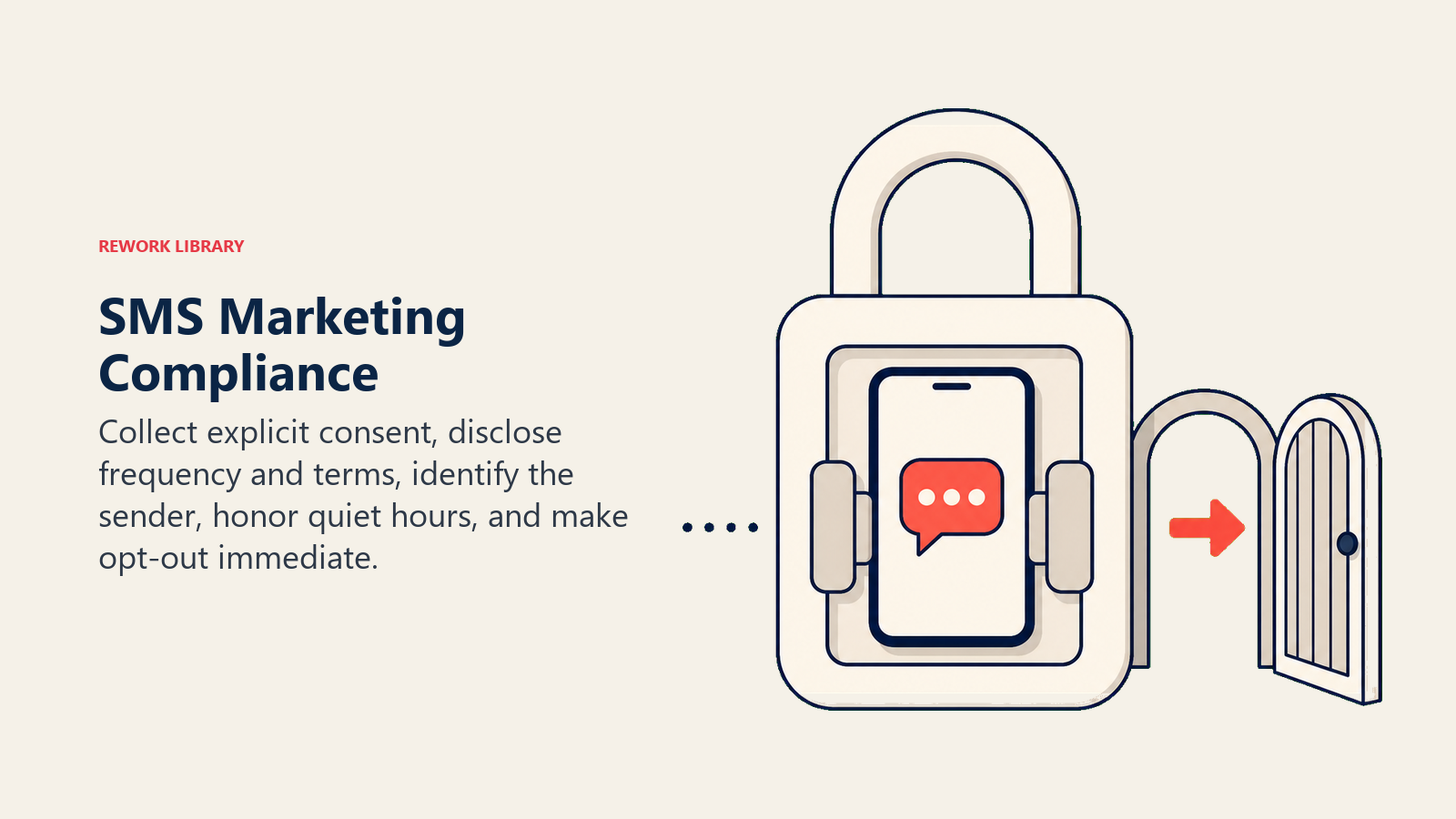
Clear opt-in language: Your signup form must clearly state what customers are signing up for, how often they'll receive messages, that message/data rates may apply, and how to opt out.
Easy opt-out: Every message must include opt-out instructions (typically "Reply STOP to unsubscribe"). You must process opt-outs immediately, within seconds, not hours.
Proper identification: Every message must identify your business clearly. "Hi from Sarah at Acme Co" works. "Great deals today!" doesn't.
Time restrictions: Don't send texts before 8am or after 9pm in the recipient's local time zone. Period.
Compliance checklist for every SMS program:
- Written consent obtained with clear, affirmative action
- Terms and conditions displayed at point of signup
- Privacy policy includes SMS marketing disclosures
- Double opt-in process implemented (recommended, not always required)
- Automated opt-out processing configured
- Time zone restrictions programmed into sending system
- Regular compliance audits scheduled (quarterly minimum)
- Consent records stored securely with timestamps
- Customer service team trained on SMS compliance
- Legal review completed for all automated message flows
For international businesses, add GDPR (EU), CASL (Canada), and local regulations to your compliance checklist. When in doubt, over-communicate what customers are signing up for and make opting out even easier than opting in.
Building Your SMS List: Quality Over Quantity
A small, engaged SMS list outperforms a large, purchased list every time. Your goal isn't 100,000 subscribers. It's 10,000 subscribers who want to hear from you, respond to your messages, and buy from your store. Point-of-sale capture is your highest-converting list-building method. When customers are checking out, they're already in buying mode. Add a checkbox to your checkout flow: "Text me when my order ships + get 15% off my next purchase." Conversion rates on checkout SMS signups typically hit 25-40%. Website popup signups work when the value is clear. "Get 10% off right now via text" converts better than "Join our SMS list." Use exit-intent popups, or trigger them after 30-60 seconds of browsing. Test different incentives: immediate discounts, early access to sales, exclusive product drops.
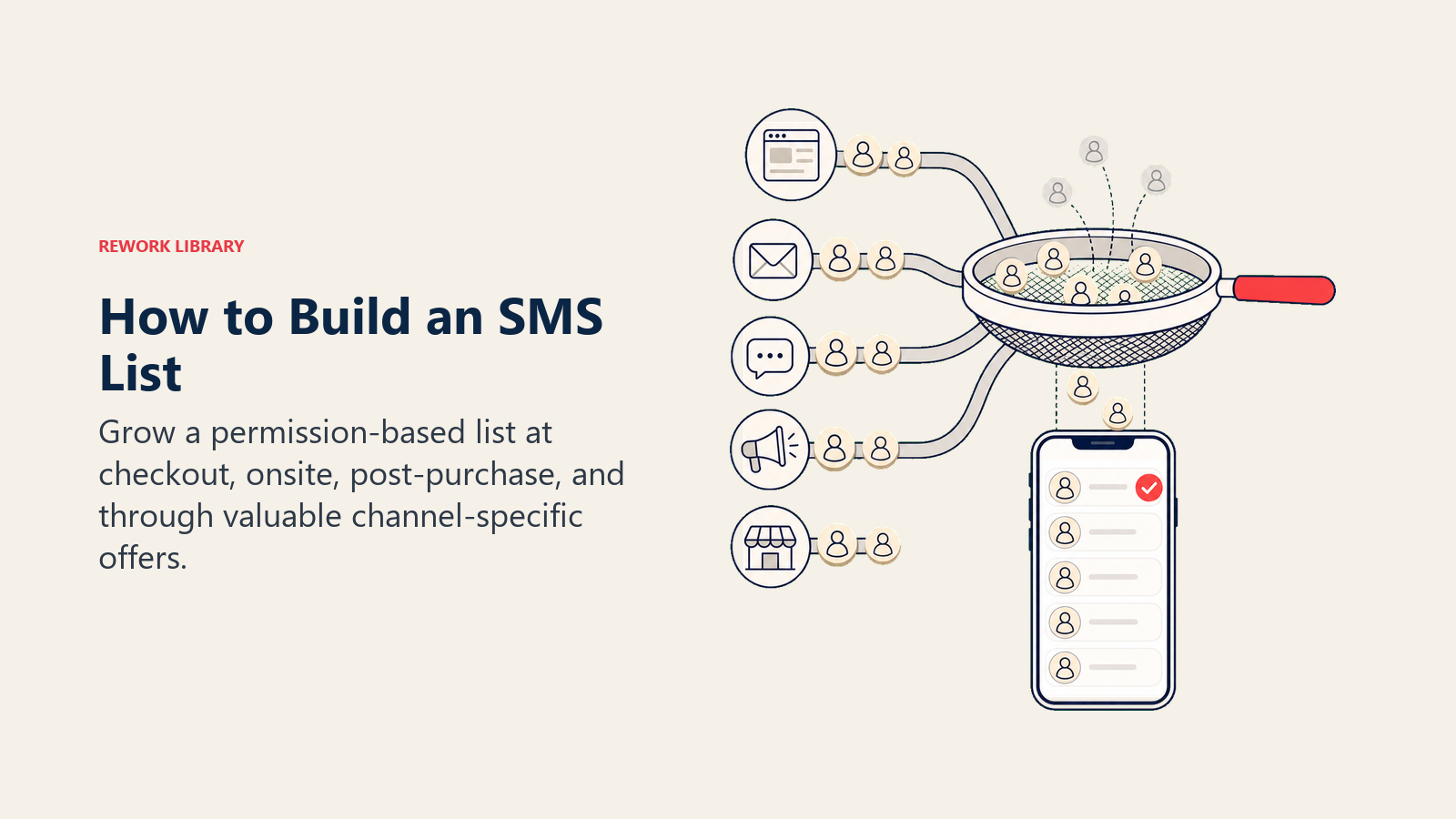
Email-to-SMS conversion leverages your existing audience. Send an email campaign specifically about your SMS program: "Want these deals faster? Get them via text." Include a simple signup link that pre-fills their information. You'll typically convert 5-15% of your email list.
Post-purchase invitation captures customers when satisfaction is highest. Include SMS signup in your order confirmation page and thank you emails: "Love your purchase? Get styling tips and exclusive offers via text." No additional discount needed, the product experience is the incentive.
In-store signups (for retail locations) use QR codes at checkout, on receipts, or on signage. Make the value proposition visible: "Scan for VIP text alerts, first access to new arrivals + member-only sales."
The incentive matters, but here's what matters more: setting accurate expectations. If you promise "exclusive deals," send exclusive deals, not daily inventory updates. If you say "occasional texts," don't send three per week. Mismatched expectations drive unsubscribes faster than anything else.
Choosing Your SMS Marketing Platform
Your SMS platform is infrastructure, not just a tool. It needs to handle compliance automatically, integrate with your e-commerce stack, and scale as your list grows. Essential platform capabilities:
- E-commerce integration: Native connections to Shopify, WooCommerce, BigCommerce, or your platform
- Segmentation engine: Filter by purchase history, browsing behavior, engagement, demographics
- Automation builder: Visual workflow editor for triggered campaigns and customer journeys (see marketing automation)
- Compliance management: Automatic opt-out processing, time zone detection, consent tracking
- Two-way messaging: Customer replies route to support team or trigger automated responses
- Analytics dashboard: Real-time metrics on delivery, engagement, revenue attribution
- Template library: Pre-built flows for common use cases (cart abandonment, welcome series, etc.)
- A/B testing: Test message content, timing, segmentation strategies
- Customer data sync: Real-time updates from your e-commerce platform
Leading platforms to evaluate:
- Postscript: Built specifically for e-commerce, strong Shopify integration, advanced segmentation
- Attentive: Enterprise-grade features, excellent compliance tools, higher price point
- Klaviyo SMS: Unified email + SMS platform, shared customer profiles, strong for smaller lists
- SMSBump: Shopify-focused, competitive pricing, good automation capabilities
- Emotive: Conversational SMS with human-in-the-loop responses, premium positioning
Don't choose based on features alone. Check deliverability rates (should be 95%+), message speed (under 30 seconds), and customer support quality. SMS problems need immediate fixes, you can't afford platform downtime during a flash sale.
SMS Automation Flows That Drive Revenue
The real power of SMS isn't in broadcast campaigns. It's in automated flows that respond to customer behavior in real time. Set these up once and they'll generate revenue 24/7. Welcome series (starts when someone subscribes):
- Message 1 (immediate): "Welcome! Here's your 15% off code: WELCOME15. Shop now: [link]"
- Message 2 (day 2): "Still browsing? Our best sellers: [link]. Questions? Just reply."
- Message 3 (day 5): "Your welcome code expires tomorrow! Don't miss out: [link]" Transactional messages (triggered by orders):
- Order confirmation: "Order #2847 confirmed! We're packing it now. Track here: [link]"
- Shipping update: "Your order shipped! Arriving Tuesday. Track: [link]"
- Delivery confirmation: "Your order arrived! How did we do? Reply with feedback."
- Delivery delay: "Heads up, your delivery moved to Wednesday due to weather. Track: [link]"
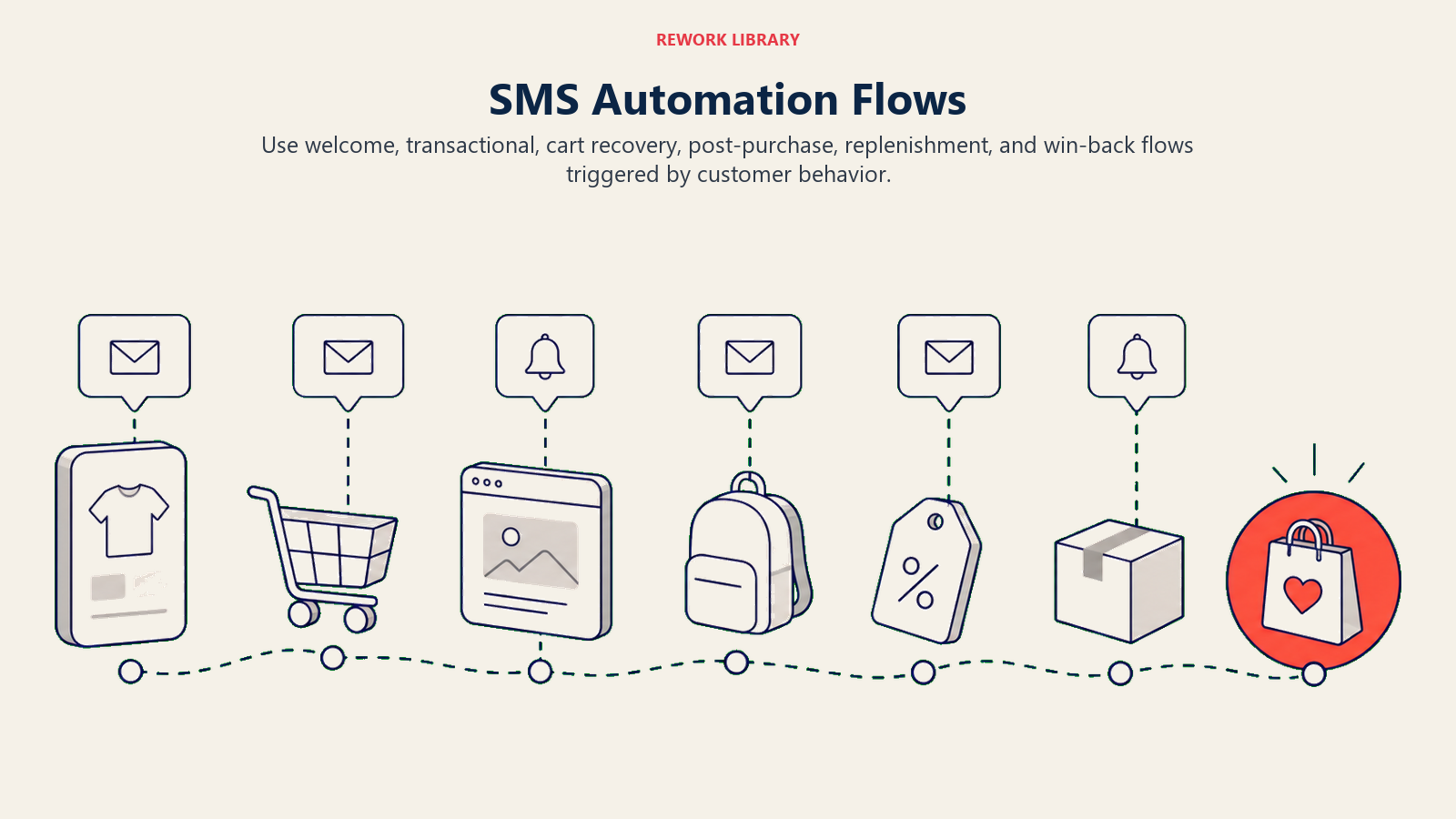
Browse abandonment (triggered 1-2 hours after browsing):
- "Still thinking about [product name]? Here's 10% off to help you decide: [code]"
- Include product image (MMS) if your platform supports it
- Add urgency: "Only 3 left in stock" or "Sale ends tonight"
Cart abandonment (triggered 1-4 hours after cart abandonment):
- Message 1 (1 hour): "You left something behind! Complete your order: [link]"
- Message 2 (24 hours): "Still want this? Here's 10% off your cart: [code]"
- Message 3 (3 days): "Last chance! Your cart expires tomorrow: [link]"
These flows typically recover 10-15% of abandoned carts through SMS alone, higher than email recovery rates. The key is timing: send too quickly and customers feel harassed; wait too long and they've already purchased elsewhere or lost interest.
For more on cart recovery strategies, see our guide on Cart Abandonment Recovery.
Post-purchase flows create repeat customers:
- Request review (7 days after delivery): "How's your [product]? Share your thoughts: [link]"
- Cross-sell (14 days): "Love your [product]? Try [complementary product]: [link]"
- Replenishment (based on product lifecycle): "Running low on [consumable]? Reorder: [link]"
Learn more about maximizing post-purchase engagement in our Post-Purchase Email Sequences guide.
Win-back campaigns re-engage inactive customers:
- 30 days inactive: "We miss you! Here's 20% off your next order: [code]"
- 60 days inactive: "Come back! New arrivals you'll love: [link]"
- 90 days inactive: "Last chance, 25% off everything: [code]"
For comprehensive win-back strategies, check out Win-Back Campaigns.
Message Timing, Frequency & Segmentation
Getting the timing right is the difference between high engagement and mass unsubscribes. Here's what works: Best sending times:
- Tuesday-Thursday, 10am-1pm (highest engagement)
- Saturday mornings for retail/fashion (weekend shopping mode)
- Monday 6-8pm for meal kits/grocery (meal planning time)
- Avoid early mornings (before 10am) and late evenings (after 8pm) Frequency guidelines:
- Promotional messages: 2-4 per month maximum
- Transactional messages: as many as needed (customers want these)
- VIP segments: up to 6 per month (they've opted into more)
- New subscribers: front-load value in first 7 days, then scale back
Track your unsubscribe rate religiously. If it climbs above 1% per campaign, you're sending too many messages or the wrong messages. Cut frequency by 30-50% and monitor for two weeks.
Behavioral segmentation strategies:
Purchase-based segments:
- First-time buyers: welcome series, second purchase incentive
- Repeat customers: loyalty rewards, early access
- High-value customers: VIP treatment, exclusive products (learn about customer lifetime value)
- One-time buyers (60+ days ago): win-back offers
Engagement-based segments:
- Active browsers: product recommendations, limited-time offers
- Cart abandoners: recovery messages with escalating urgency
- Review writers: thank you messages, community recognition
- Non-openers: test different message styles or reduce frequency
Product-based segments:
- Category buyers: new arrivals in their preferred category
- Seasonal buyers: reminders when their season approaches
- Bundle buyers: cross-sell complementary products
- Subscription buyers: renewal reminders, upgrade offers
For advanced approaches to customer segmentation, tailor your messaging based on behavior, purchase patterns, and engagement levels.
SMS Content Strategy: What to Say in 160 Characters
SMS forces clarity. You don't have space for fluffy copy or lengthy explanations. Every character counts. Promotional message framework:
- Hook (create urgency or curiosity): "24hr flash sale" or "New drop alert"
- Offer (clear, specific value): "40% off dresses" not "big savings"
- Call to action: "Shop now" with link
- Expiration (creates urgency): "Ends tonight"
Example promotional messages:
"Flash sale! 40% off all dresses today only. Shop now: [link] Reply STOP to opt out"
"Just dropped: Summer collection. Shop first before it sells out: [link]"
"Your birthday gift: 25% off anything! Use code BDAY25. Valid 7 days: [link]"
Transactional message framework:
- Status update (what happened): "Your order shipped"
- Relevant details (tracking, timing): "Arriving Tuesday"
- Action link: "Track here: [link]"
- Optional: Next step or support offer
Personalization elements that boost engagement:
- First name: "Hey Sarah" vs "Hey there"
- Past purchases: "Love your [product name]?" creates relevance
- Location: "Store near you in Brooklyn just restocked"
- Preferences: "New arrivals in your favorite category"
Message types to include in your strategy:
- Product launches: "Just dropped: [Product]. Limited quantity. Shop: [link]"
- Flash sales: "Next 4 hours only, 30% off everything. Code: FLASH30 [link]"
- Restocks: "Back in stock: [Product] you wanted. Grab it: [link]"
- Exclusive offers: "VIP only: Early access to Black Friday. Shop: [link]"
- Loyalty rewards: "You earned 500 points! That's $10 off. Use it: [link]"
Avoid industry jargon, excessive emojis (one per message maximum), and ALL CAPS (looks spammy). Write like you're texting a friend who happens to love good deals.
SMS for Repeat Purchases & Customer Loyalty
SMS's real revenue potential isn't in acquisition, it's in retention. Customers who engage with your SMS program purchase 3-5x more frequently than non-subscribers. Loyalty program integration:
- Points balance notifications: "Sarah, you have 850 points ($17 off). Shop: [link]"
- Tier promotions: "You're 150 points from Gold status! Shop to unlock: [link]"
- Points expiration warnings: "200 points expire Friday. Use them: [link]"
- Reward redemption confirmations: "Your $10 reward applied to order #2847!"
Discover how to build effective loyalty programs that keep customers engaged and coming back.
Exclusive SMS-only offers create perceived value:
- "SMS subscribers only: 30% off our new collection. Code: TXTONLY30"
- "You're in! Early access to Black Friday starts now: [link]"
- "Secret sale: 40% off clearance. Not advertised anywhere else: [link]"
Referral campaigns turn customers into advocates:
- "Love us? Share this with friends: [link]. You both get $10 off!"
- "Your friend used your code! Here's $10 off: [link]"
- "3 friends joined with your link, here's $30 in rewards!"
For building a comprehensive repeat purchase engine, read our guide on Repeat Purchase Strategy.
Birthday and anniversary campaigns:
- "Happy birthday, Sarah! Here's 25% off anything: BDAY25. Treat yourself!"
- "It's been 1 year since your first order! Thanks for being with us. Here's 20% off: [link]"
Feedback loop messages show you're listening:
- Post-purchase (7 days): "Quick question: How's your [product]? Reply 1-5 stars."
- After review: "Thanks for your review! Here's $5 off your next order: [code]"
- After complaint resolution: "Did we fix the issue? Let us know: [link]"
Learn more about building effective feedback systems in Customer Feedback Loop.
Performance Metrics & Analytics
You can't optimize what you don't measure. Track these metrics weekly: Delivery metrics:
- Delivery rate: 95%+ is healthy (lower indicates phone number quality issues)
- Bounce rate: under 2% (higher suggests old/invalid numbers) Engagement metrics:
- Click-through rate: 15-25% is good, 30%+ is excellent
- Conversion rate: 25-35% for promotional messages
- Reply rate: 5-10% for conversational messages
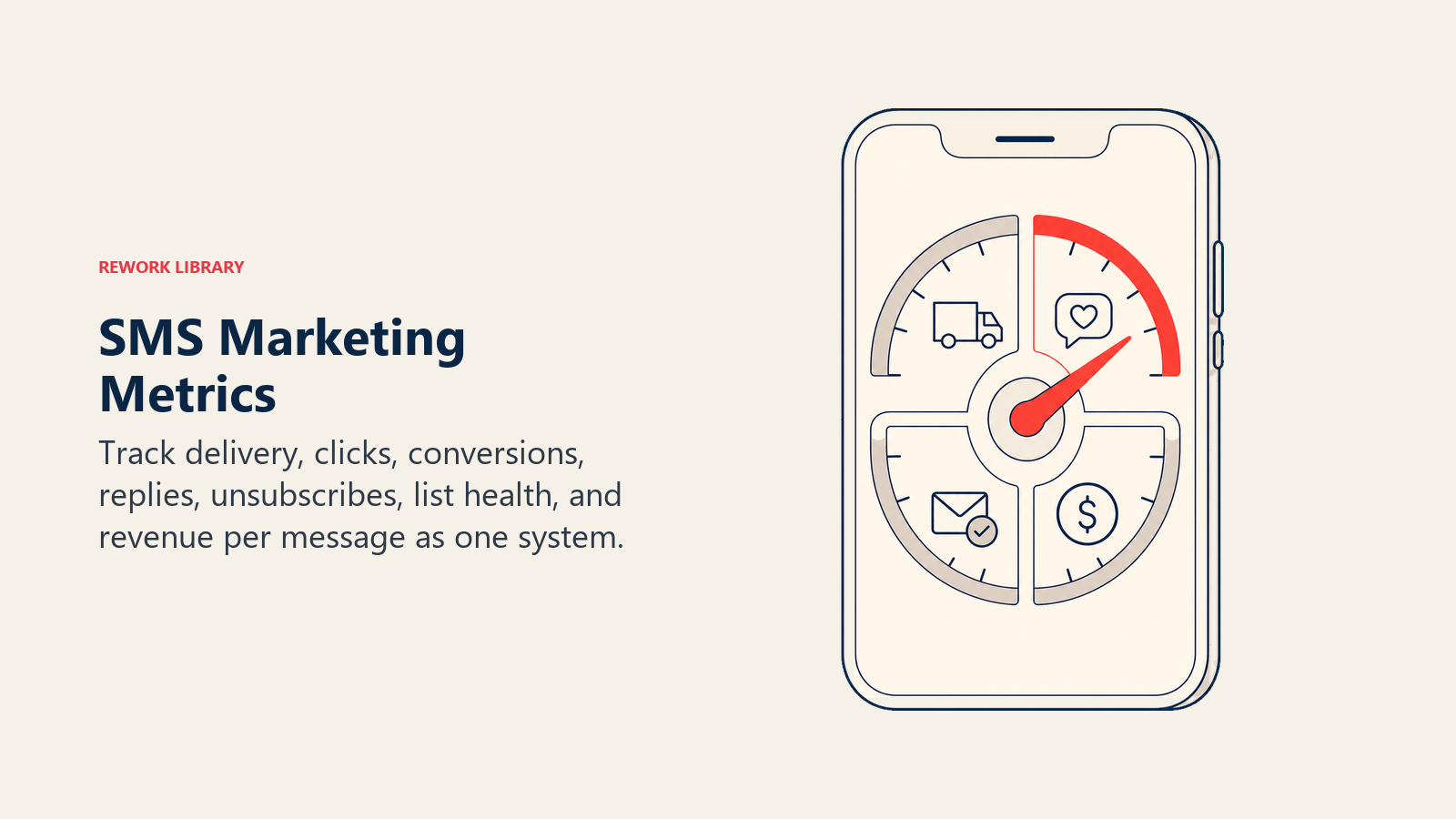
List health metrics:
- Unsubscribe rate: under 1% per campaign (higher = frequency or relevance problem)
- Growth rate: should exceed unsubscribe rate consistently
- Active engagement rate: 60%+ of list clicking within 90 days
Revenue metrics:
- Revenue per message: benchmark against email (should be 2-5x higher)
- Revenue per subscriber: track monthly, should increase over time
- SMS-attributed revenue: percentage of total revenue driven by SMS
Track these alongside other e-commerce metrics and KPIs to understand your full marketing performance.
Flow performance:
- Welcome series conversion rate: 20-30% of subscribers making first purchase
- Cart abandonment recovery rate: 10-15% of abandoned carts recovered
- Win-back reactivation rate: 5-10% of inactive customers purchasing
Attribution challenges and solutions:
SMS attribution is tricky. Customers often see multiple touchpoints before purchasing. Use:
- Unique discount codes per campaign (tracks direct attribution)
- UTM parameters in all links (tracks assisted conversions)
- Multi-touch attribution model (gives partial credit to SMS in customer journey)
- Platform-specific tracking pixels (most SMS platforms offer these)
Compare your SMS metrics to email benchmarks regularly. SMS should outperform email on engagement and conversion, but email should reach more people. If SMS isn't outperforming email by 2-3x on engagement, revisit your message content and segmentation. Learn more about email marketing for e-commerce to coordinate your multi-channel approach.
Integration with Email & Multi-Channel Strategy
SMS and email aren't separate channels, they're two parts of one customer communication strategy. The brands seeing the best results coordinate messages across both channels. Coordinated campaign example (product launch):
- Day 1: Email with full product details, images, story (education)
- Day 2: SMS with direct link and limited-time offer (action)
- Day 4: Email to non-openers with social proof (nurture)
- Day 5: SMS to cart abandoners from SMS campaign (recovery) Channel preference management:
- Let customers choose: "Want these updates via text instead? Click here"
- Segment by engagement: SMS for high-engagers, email for browsers
- Respect quiet periods: if customer unsubscribes from SMS, don't immediately push email
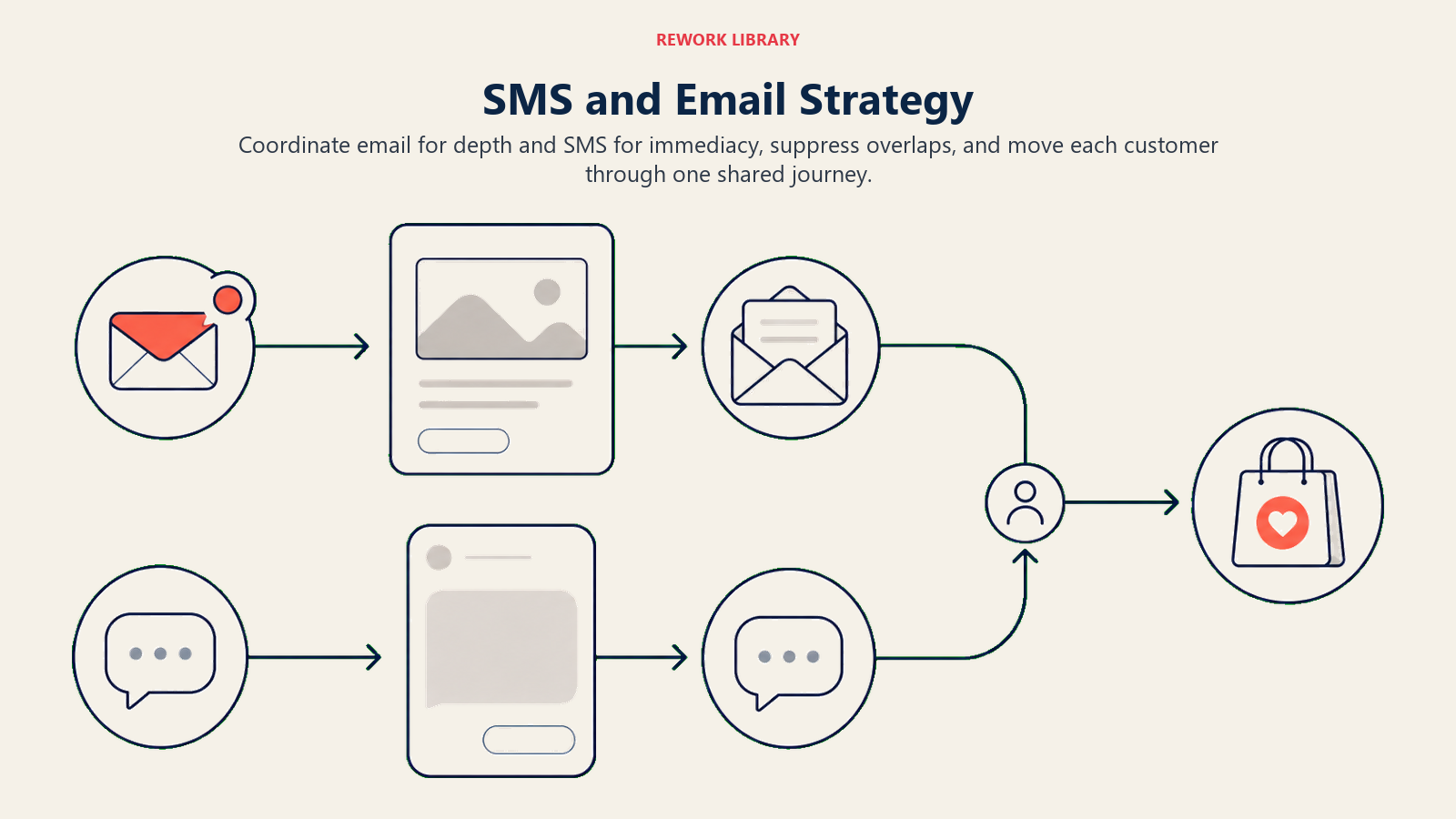
Cross-channel remarketing:
- Email subscriber doesn't open: send SMS 48 hours later
- SMS subscriber doesn't click: send email with more details
- Cart abandonment: SMS within 1 hour, email within 24 hours (see cart abandonment recovery)
- Win-back: SMS for high-value customers, email for others
Unified customer profiles make this possible. Your SMS platform should sync with your email platform and e-commerce system in real time. When a customer purchases via SMS, that data updates their email profile immediately. When they unsubscribe from email, your SMS segmentation reflects it.
Message timing coordination:
- Don't send SMS and email within 2 hours of each other (feels overwhelming)
- Stagger promotional campaigns: SMS Tuesday, email Thursday
- Exception: transactional messages (order confirmation via both is fine)
A/B testing across channels:
- Test same offer, different channels: which drives more revenue?
- Test channel sequence: SMS-then-email vs email-then-SMS
- Test exclusivity: SMS-only offers vs multi-channel offers (learn about conversion rate optimization)
The goal isn't choosing between SMS and email. It's using each channel's strengths: SMS for urgency and action, email for education and consideration.
Advanced SMS Tactics for Sophisticated Marketers
Once your foundation is solid, these advanced tactics unlock additional revenue. Keyword campaigns let customers text to engage:
- "Text RESTOCK to 12345 to get alerts when [product] is back"
- "Text DEALS to 12345 for exclusive flash sales"
- "Text VIP to 12345 to join our insider program"
Promote keywords on social media, in email signatures, on packaging, and in store signage.
Geo-triggered messages use location data:
- "You're near our SoHo store! Stop by for 20% off today: [address]"
- "Local delivery available in your area! Order by 2pm for same-day: [link]" (enhance with mobile commerce optimization)
- "Shipping sale: Free shipping to [city] this weekend only: [link]"
MMS (multimedia messages) add visual impact:
- Product images in browse abandonment messages (25% higher CTR)
- GIFs showing products in use (stronger engagement than static images)
- Before/after images for beauty, fitness, home products
Note: MMS costs more per message and has lower deliverability. Test ROI carefully.
Two-way conversational SMS creates personal connections:
- Customer replies with questions → routes to support team
- Customer replies with feedback → triggers thank you + coupon
- Customer replies "YES" to question → enrolls in VIP program
Surveys via SMS get response rates of 30-40%:
- "On a scale of 1-10, how likely are you to recommend us? Reply with your number"
- "What's your favorite product category? Reply: 1) Dresses 2) Tops 3) Bottoms"
- "What would you like to see more of? Just reply with your idea"
SMS for community building:
- Text-to-join for exclusive groups: "Text INSIDER to join our product testing team"
- Early access for engaged subscribers: "You've been with us 6 months, here's early access"
- Sneak peeks and behind-the-scenes: "Want to see what's launching next week? [link]"
Predictive send-time optimization uses AI to determine the best time to text each individual customer based on their historical engagement patterns. Most advanced SMS platforms offer this feature.
Building Your SMS Strategy: 90-Day Implementation Plan
Use this roadmap as a sequencing guide: establish compliance and infrastructure first, then optimize performance, then expand into more advanced SMS programs. Month 1: Foundation
- Week 1: Choose SMS platform, configure compliance settings
- Week 2: Set up basic automations (welcome, transactional)
- Week 3: Create signup forms, launch list building
- Week 4: Send first broadcast campaign, monitor metrics
Month 2: Optimization
- Week 5: Add cart abandonment and browse abandonment flows
- Week 6: Segment list, create targeted campaigns
- Week 7: Integrate with email platform, coordinate messaging
- Week 8: Launch loyalty/VIP program SMS component
Month 3: Expansion
- Week 9: Add post-purchase flows and win-back series
- Week 10: Test MMS, keyword campaigns, or geo-targeting
- Week 11: Optimize underperforming flows based on data
- Week 12: Document playbook, plan next quarter strategy
Your SMS strategy isn't a set-it-and-forget-it channel. It's a living system that requires regular optimization, fresh content, and close attention to customer preferences. But get it right, and SMS becomes your highest-performing revenue channel, one that drives immediate sales, builds lasting relationships, and keeps customers coming back.
Start with compliance, build with automation, optimize with data, and always remember: you're not sending messages to a list. You're having conversations with real people who invited you into their most personal space, their text messages. Respect that privilege, deliver real value, and watch the revenue follow.
Related Resources
Enhance your SMS marketing strategy with these complementary guides:
- Post-Purchase Email Sequences - Coordinate SMS with email for maximum post-purchase engagement
- Customer Retention Strategies - Build comprehensive retention programs beyond SMS
- Marketing Automation - Integrate SMS into your broader automation strategy
- Loyalty Programs - Create loyalty systems that work seamlessly with SMS campaigns

On this page
- Why SMS Outperforms Email (And When It Doesn't)
- Compliance First: The Legal Framework That Protects Your Business
- Building Your SMS List: Quality Over Quantity
- Choosing Your SMS Marketing Platform
- SMS Automation Flows That Drive Revenue
- Message Timing, Frequency & Segmentation
- SMS Content Strategy: What to Say in 160 Characters
- SMS for Repeat Purchases & Customer Loyalty
- Performance Metrics & Analytics
- Integration with Email & Multi-Channel Strategy
- Advanced SMS Tactics for Sophisticated Marketers
- Building Your SMS Strategy: 90-Day Implementation Plan
- Related Resources