Shopify vs Marketplace: Building Your Optimal Sales Channel Strategy
 The Shopify versus marketplace debate isn't really a debate at all. It's a strategic decision that shapes your e-commerce business economics, customer relationships, and growth trajectory. Most founders approach this as an either/or question. The reality is more nuanced, and getting the strategy wrong can cost you millions in lost revenue or wasted marketing spend.
Turn this article into takeaways for your work.


Each assistant summarizes the article only for you and suggests best practices for your work.
Here's what actually matters when making channel decisions for your business.
The Channel Decision Framework
Before diving into tactics, understand what you're really choosing between. This isn't about which platform has better features or lower fees. You're choosing between two different business models with different economics, risks, and strategic implications. Owned channels (Shopify, custom builds) give you control. You own the customer relationship, set your own rules, and keep your margins. But you're responsible for driving all your own traffic, and customer acquisition costs are on you.
Marketplace channels (Amazon, eBay, Etsy, Walmart) give you access. You tap into existing traffic, benefit from platform trust, and scale faster. But you pay for that access through fees, lose control over the customer relationship, and compete in a race-to-the-bottom pricing environment.
Neither is inherently better. What matters is which aligns with your current stage, product category, competitive position, and resource constraints.
The companies that win use both strategically. They understand the economics of each channel, know when to prioritize which, and build systems that allow channels to complement rather than cannibalize each other.
Owned Channel Economics: The Shopify Model
When you sell through your own Shopify store, you're building a direct-to-consumer (DTC) brand. The economics look fundamentally different from marketplace selling. Revenue per order is higher. You keep 100% of the sale price minus payment processing fees (roughly 2.9% + $0.30 per transaction). On a $50 product, you keep $48.55. No marketplace commission eating into your margins.
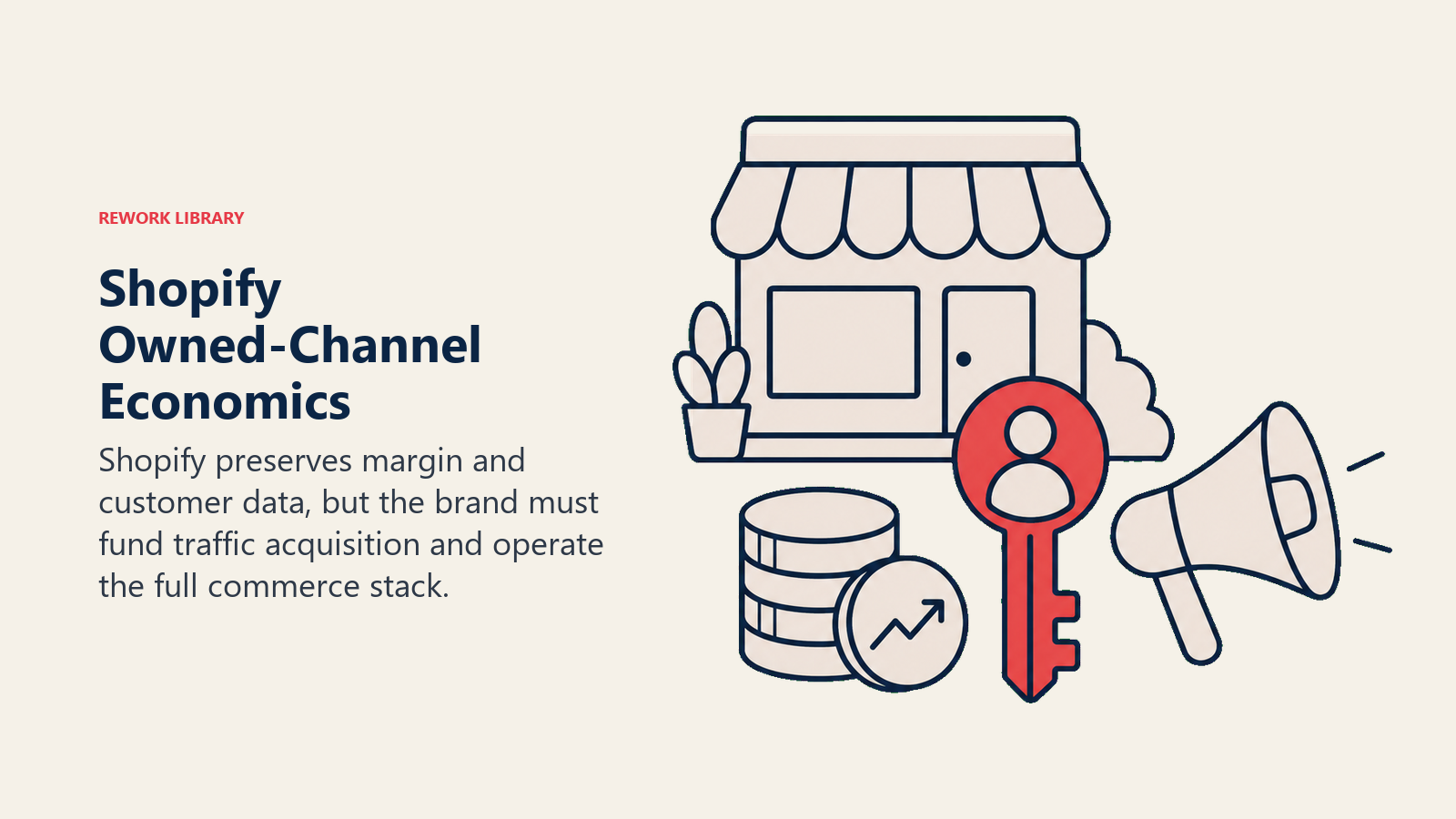
Customer acquisition cost is your biggest investment. You need to drive traffic through paid ads, SEO, content marketing, social media, or influencer partnerships. Depending on your product category, CAC might range from $10 to $200+ per customer. This is where most DTC brands struggle, they underestimate how expensive it is to build awareness and drive traffic to a site nobody knows about.
Customer lifetime value is where you win. When you own the customer relationship, you can market to them again at virtually zero cost. If that $50 first purchase turns into five purchases over two years, your LTV is $250, and suddenly that $80 CAC looks reasonable. This is why Customer Lifetime Value (LTV) analysis is critical for owned channels.
Data is your strategic asset. You capture email addresses, purchase history, browsing behavior, and demographics. This data allows you to build better products, personalize marketing, and create customer segments that improve conversion rates over time.
Brand control is absolute. You control the messaging, the experience, the product presentation, and the customer service. You can build brand equity that commands premium pricing and creates defensibility against competitors.
The math works when you can acquire customers profitably and retain them. It breaks when CAC is too high or repeat purchase rates are too low. This is why Unit Economics for E-commerce needs to be your north star.
Marketplace Economics: The Amazon Reality
Selling on Amazon or other marketplaces operates on completely different economics. The tradeoffs are immediate and significant. Revenue per order is lower. Amazon takes 15% as a referral fee (varies by category, can be 6-45%). If you use FBA (Fulfillment by Amazon), add another 20-35% in fulfillment fees depending on product size and weight. On that same $50 product, you might net $30-35 after fees. See Amazon FBA Strategy for detailed fee structures.
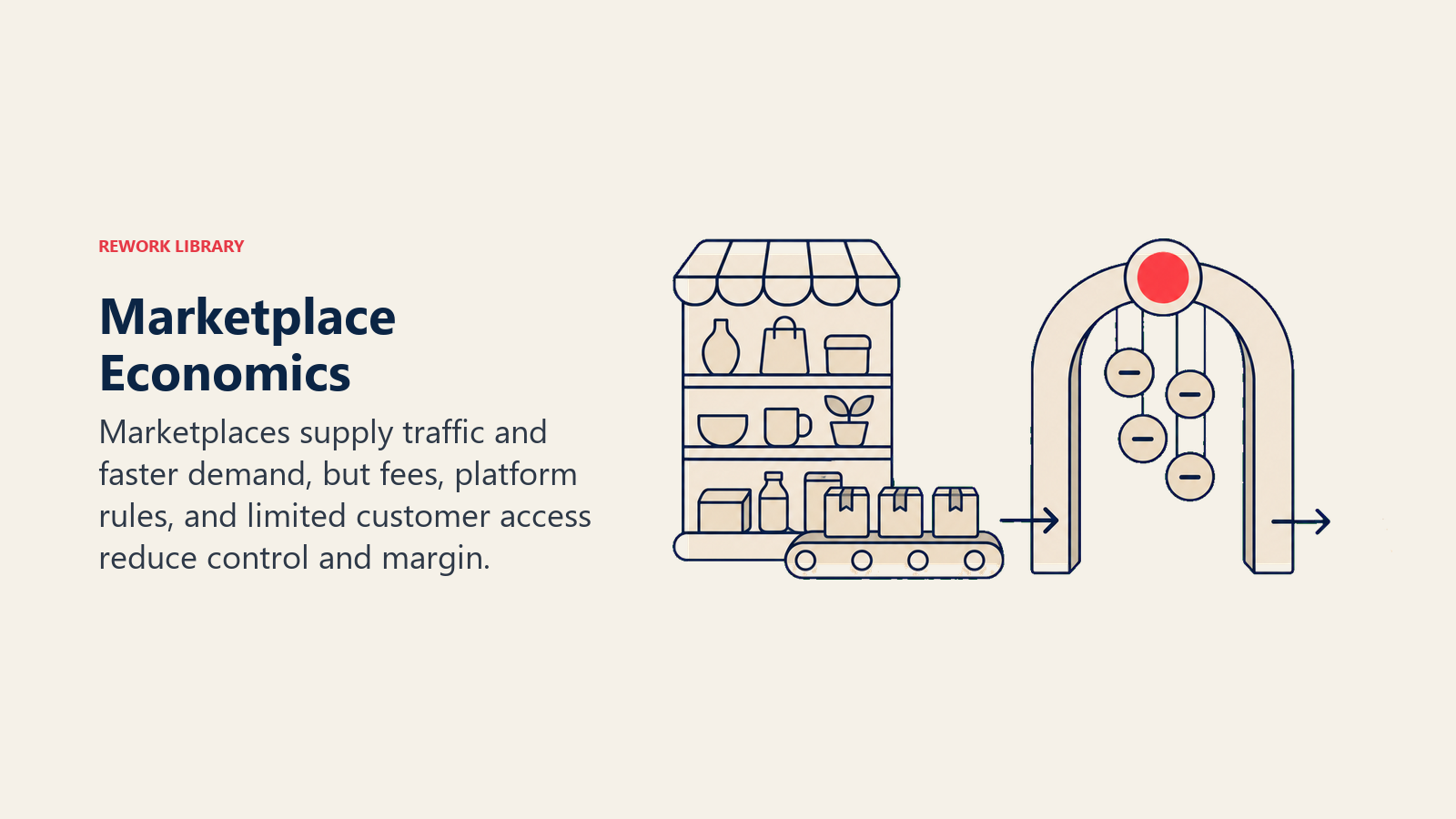
Customer acquisition cost is near zero. Amazon brings the traffic. Customers searching for products in your category see your listing. You don't pay for that visibility unless you run Amazon PPC ads (which you should, but those costs are typically much lower than Facebook or Google ads for cold traffic).
Speed to revenue is faster. You can launch a product and make your first sale within days. No need to build an audience, create brand awareness, or establish trust. Amazon's brand provides that credibility.
Volume potential is massive. Amazon processes billions of searches monthly. If you rank well for the right keywords, you can scale to six or seven figures monthly without ever driving external traffic.
Customer relationship is Amazon's, not yours. You don't get customer email addresses. You can't remarket to them. They're Amazon's customers, not yours. This fundamentally limits your LTV and makes you dependent on the platform for all future sales.
Competition is brutal. Everyone sees the same sales data through tools like Jungle Scout and Helium 10. Successful products get copied quickly. Price becomes the primary differentiator unless you have strong branding or unique product features.
Platform dependency creates risk. Algorithm changes can crater your sales overnight. Account suspensions can destroy your business. You're building on rented land, and the landlord makes all the rules.
The math works when you have products that can compete on Amazon's terms, good margins even after fees, differentiation beyond just price, and volume potential that justifies the channel investment.
The Trade-Off Matrix
Here's how the key variables stack up across channels: | Factor | Shopify (Owned) | Amazon (Marketplace) | |--------|----------------|---------------------| | Margin per sale | High (keep 97%+) | Low (keep 50-70%) | | Customer acquisition cost | High ($20-200+) | Low ($0-15) | | Speed to first sale | Slow (weeks to months) | Fast (days) | | Customer data access | Full access | No access | | Brand control | Complete control | Limited control | | Pricing flexibility | Full flexibility | Must be competitive | | Customer LTV potential | High (direct remarket) | Low (one-time sale) | | Scale ceiling | Limited by CAC economics | Limited by category size | | Platform risk | Low (you own platform) | High (algorithm, suspension) | | Setup complexity | Medium-High | Low-Medium | | Ongoing operational load | High (all functions) | Low-Medium (FBA handles fulfillment) | | Best for | Brand building, high LTV | Volume, commodity products |
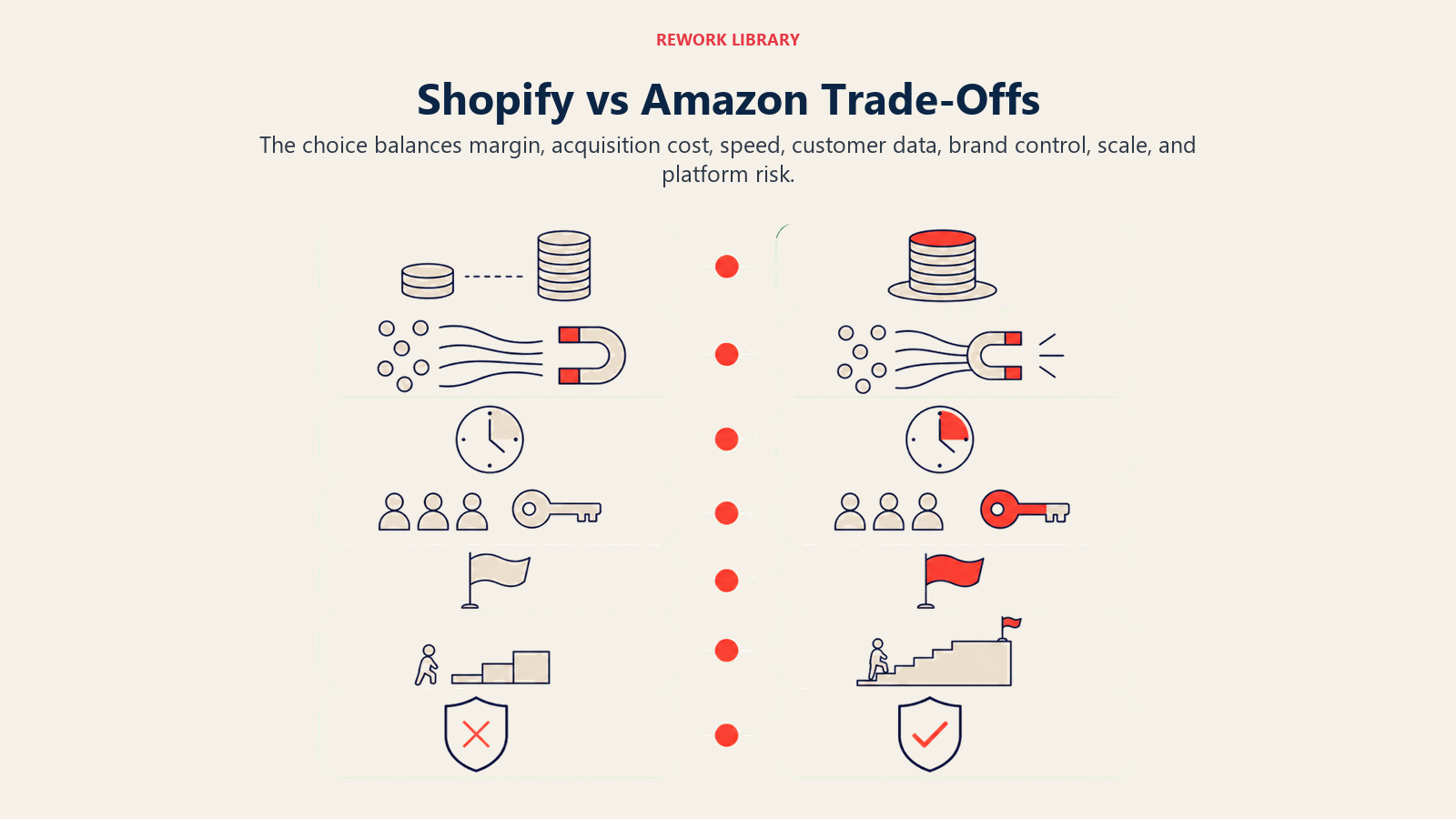
This matrix shows why the right answer is almost never "pick one." Different products, different stages, different economics call for different strategies.
Amazon-Specific Dynamics
Amazon deserves special attention because it dominates marketplace e-commerce in the US. Understanding Amazon's unique dynamics is critical to making smart channel decisions.
The algorithm rewards momentum. Amazon's A9 algorithm prioritizes products with high conversion rates, good reviews, and strong sales velocity. When you launch, you need to generate sales quickly to signal relevance. This creates a chicken-and-egg problem, you need sales to rank, but you need ranking to get sales.
FBA is a competitive advantage. Products fulfilled by Amazon get Prime badge eligibility, which dramatically increases conversion rates. FBA also improves your ranking in search results. The fulfillment fees are high, but the conversion lift often justifies the cost. See Fulfillment Strategy for when FBA makes sense.
Reviews are currency. Products with 100+ reviews and 4.5+ star ratings convert 3-5x better than products with few reviews. Getting those first 50 reviews is often the biggest hurdle. This is where strategic launch tactics (friends and family, early reviewer programs, inserts asking for reviews) become critical.
PPC is table stakes. Organic ranking is nearly impossible without running Amazon PPC campaigns. You'll typically spend 10-20% of revenue on PPC during launch, settling to 5-15% once established. Budget for this as part of your cost structure.
Category dynamics vary wildly. In some categories (phone cases, supplements), competition is so intense that only the top 3-5 listings make money. In others (specialized tools, niche hobby products), you can profitably rank on page 2-3. Research your specific category before committing.
Hybrid Strategy Best Practices
The most successful e-commerce businesses use both owned and marketplace channels strategically. Here's how to make them complement rather than compete. Use Amazon for product validation. Launch new products on Amazon first. The low CAC and fast feedback let you test product-market fit quickly. If a product works on Amazon, you know there's demand. Then invest in building the owned channel for products with proven traction.
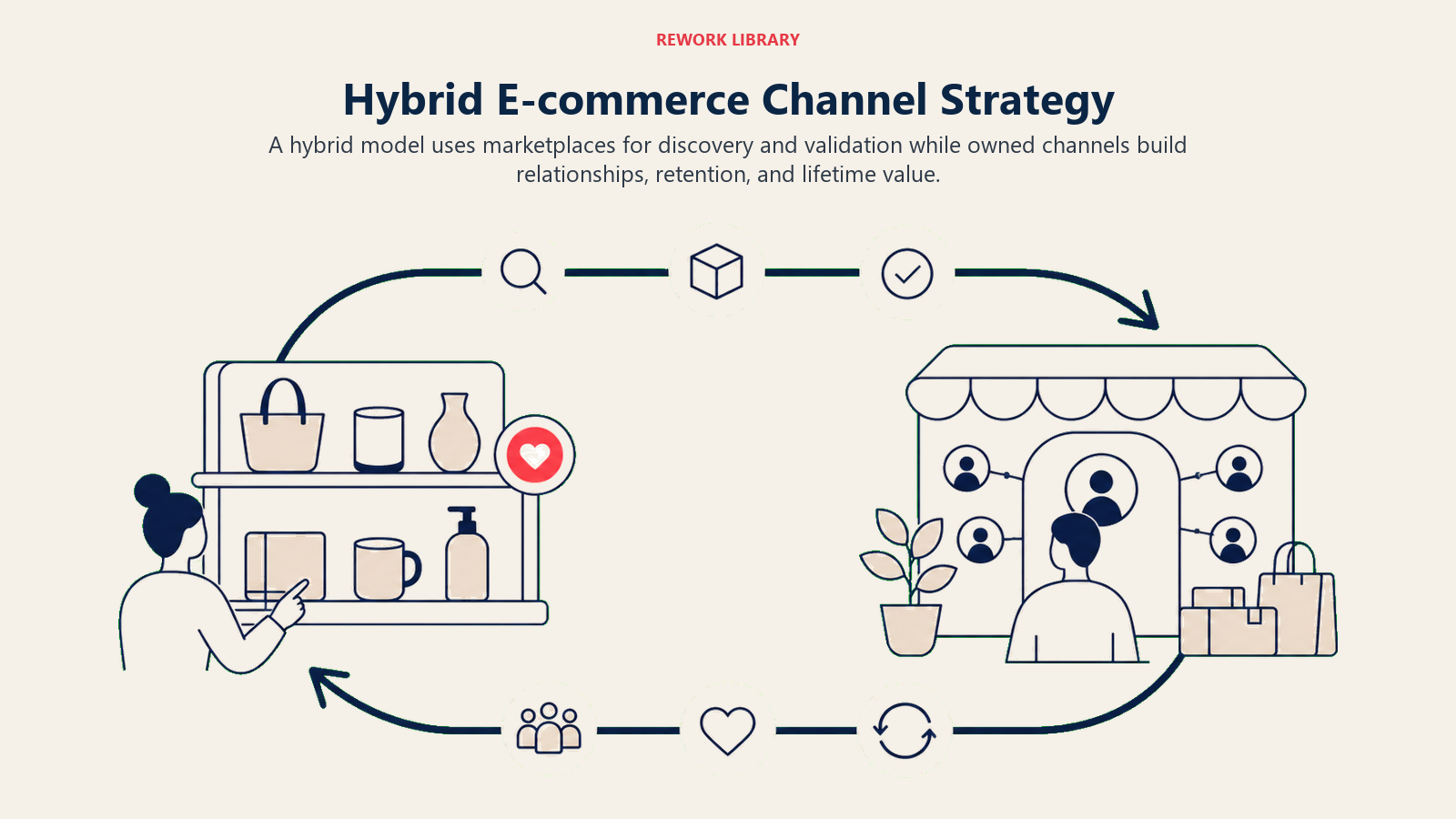
Use Shopify for customer acquisition and retention. Drive social media, content marketing, and influencer traffic to your Shopify store. These customers are yours, remarket to them, build email lists, and maximize LTV. Amazon should be incremental volume, not your primary customer source.
Price strategically across channels. Your Shopify store can have slightly higher prices than Amazon because you're offering a different value proposition (better customer service, exclusive bundles, subscription options). A 10-15% price premium is usually acceptable if you're delivering additional value.
Create channel-specific SKUs when possible. Bundle products differently, offer exclusive colors or sizes on your owned channel, or create subscription-only offerings. This reduces direct price comparison and gives customers reasons to buy from you directly.
Use Amazon traffic to build your email list. Include product inserts with QR codes leading to exclusive content, extended warranties, or bonus materials (only available via email signup). You're converting Amazon's customers into your customers. Stay within Amazon's terms of service, don't include promotional materials or direct competitive offers.
Sync inventory but manage stock strategically. Use inventory management systems (like Sellbrite, ChannelAdvisor, or custom Shopify integrations) to prevent overselling. But consider holding back 20-30% of inventory for your owned channel during peak seasons or for high-LTV customers.
Leverage marketplace sales data for Shopify optimization. Amazon shows you what keywords convert, what products customers buy together, and what price points work. Use this data to optimize your Shopify SEO, product bundles, and Pricing Strategy for E-commerce.
The key is avoiding cannibalization. Each channel should attract customers you wouldn't have reached otherwise, or serve them at different points in their buying journey.
Brand Control and Customer Relationships
This is where the strategic difference becomes most stark. On Shopify, you're building a brand. On Amazon, you're building a product listing.
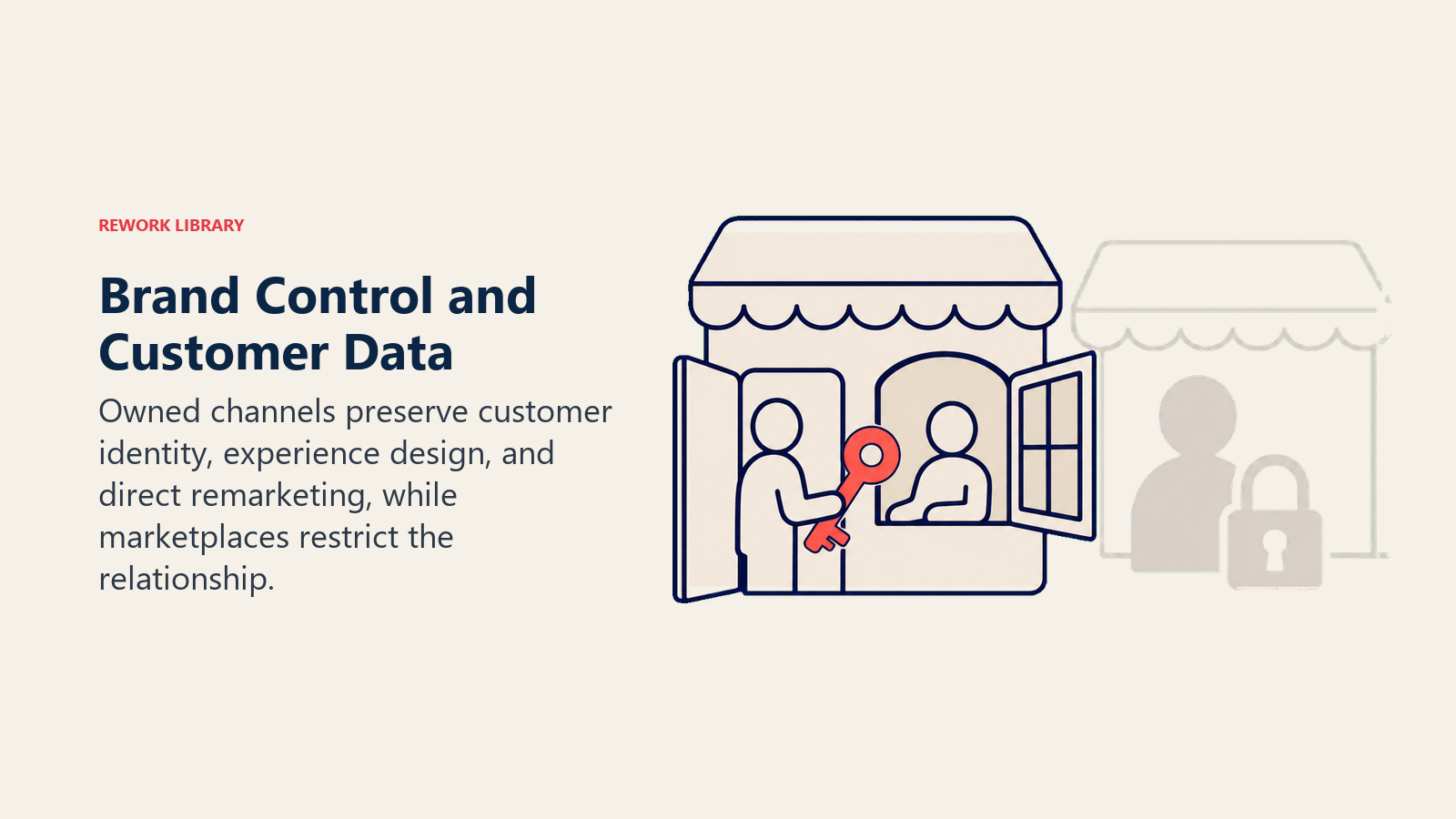
Email list ownership changes everything. A 50,000-person email list might generate $50,000-100,000 in revenue per month through regular campaigns, product launches, and seasonal promotions, at near-zero acquisition cost. On Amazon, you make each sale from scratch.
Brand positioning commands premium pricing. On Shopify, you can build a brand story that justifies higher prices. You're selling the experience, the values, the community, not just the product. On Amazon, unless you have truly differentiated products, you're competing primarily on price and reviews.
Customer service builds loyalty. On your owned channel, exceptional customer service turns buyers into advocates. They leave reviews, refer friends, and become repeat customers. On Amazon, customer service prevents negative reviews and account suspensions, but rarely builds long-term loyalty.
Data enables personalization. Knowing what customers bought previously allows you to recommend relevant products, send targeted campaigns, and create segments with different messaging. Amazon gives you none of this capability.
Brand equity creates defensibility. A strong DTC brand can survive marketplace competition, price wars, and copycat products. Your brand becomes the moat. On Amazon alone, you're always vulnerable to the next competitor with lower prices or better PPC strategy.
If your product category supports brand building (beauty, fitness, lifestyle products), the owned channel is where you create long-term value. If you're selling commodity or utilitarian products (phone chargers, batteries, basic household items), brand matters less and marketplace efficiency matters more.
Operational Considerations
The day-to-day reality of managing channels affects your resource allocation and organizational structure.
Inventory synchronization is critical. Selling out on one channel while sitting on stock in another warehouse is a fast way to destroy profitability. You need systems (manual or automated) that keep inventory counts accurate across all channels. See Multi-Channel Marketplace Strategy for implementation details.
Fulfillment strategy varies by channel. FBA makes sense for Amazon, the conversion lift justifies the cost. For Shopify, you might use 3PL fulfillment, self-fulfill from your own warehouse, or use Shopify Fulfillment Network. Each has different cost structures and operational requirements.
Pricing updates require discipline. When you run a promotion on Shopify, do you match it on Amazon? When a competitor undercuts you on Amazon, do you drop Shopify prices? You need clear rules about pricing consistency and variation across channels.
Customer service volume scales with channels. Each additional channel adds customer service load. Amazon customers email with questions. Shopify customers use your contact form. Walmart customers call your support line. Budget for customer service resources as you add channels.
Content creation multiplies with channels. Amazon listings need different optimization than Shopify product pages. You'll need channel-specific images, copy, and keyword optimization. This isn't just duplicate work, it's strategic customization for each platform's algorithm and user behavior.
Platform compliance is non-negotiable. Amazon has strict rules about inserts, customer contact, and listing claims. Violate them and you risk suspension. Shopify has fewer restrictions, but you need to comply with payment processor rules, data privacy regulations, and advertising platform policies.
The operational complexity of multi-channel selling is real. Many businesses underestimate it and end up with inventory nightmares, customer service disasters, or compliance issues. Start with one channel, get operations smooth, then expand.
Growth Stage Implications
Your business stage should heavily influence channel priority. What works at $0 revenue is different from what works at $10M revenue. Stage 1: Product Validation ($0-100K revenue) Priority: Amazon or marketplace. Get product in front of customers fast with minimal acquisition cost. Prove people will buy before investing in brand building. Use marketplace sales data to validate product-market fit.
Stage 2: Early Traction ($100K-500K revenue) Priority: Add owned channel, but keep marketplace as volume driver. Start building email list, test marketing channels, and establish brand positioning. Marketplace revenue funds owned channel customer acquisition.
Stage 3: Channel Diversification ($500K-2M revenue) Priority: Invest heavily in owned channel growth. Build content marketing, social presence, and brand awareness. Use marketplace channels for volume and product launches, but focus on making owned channel economics work.
Stage 4: Brand Maturity ($2M+ revenue) Priority: Owned channel becomes primary growth driver. Marketplace is stable revenue stream but not strategic focus. You've built brand equity, customer loyalty, and repeatable acquisition channels. Consider launching additional product lines DTC-first.
Stage 5: Omnichannel Dominance ($10M+ revenue) Priority: Add wholesale, retail partnerships, and additional marketplace channels. You have brand recognition and operational sophistication to manage complexity. Each channel serves strategic purpose without cannibalization.
This progression isn't rigid, but it reflects the typical evolution of successful e-commerce brands. Start where acquisition is cheapest, build toward where margins are highest.
Profitability Analysis: Running the Numbers
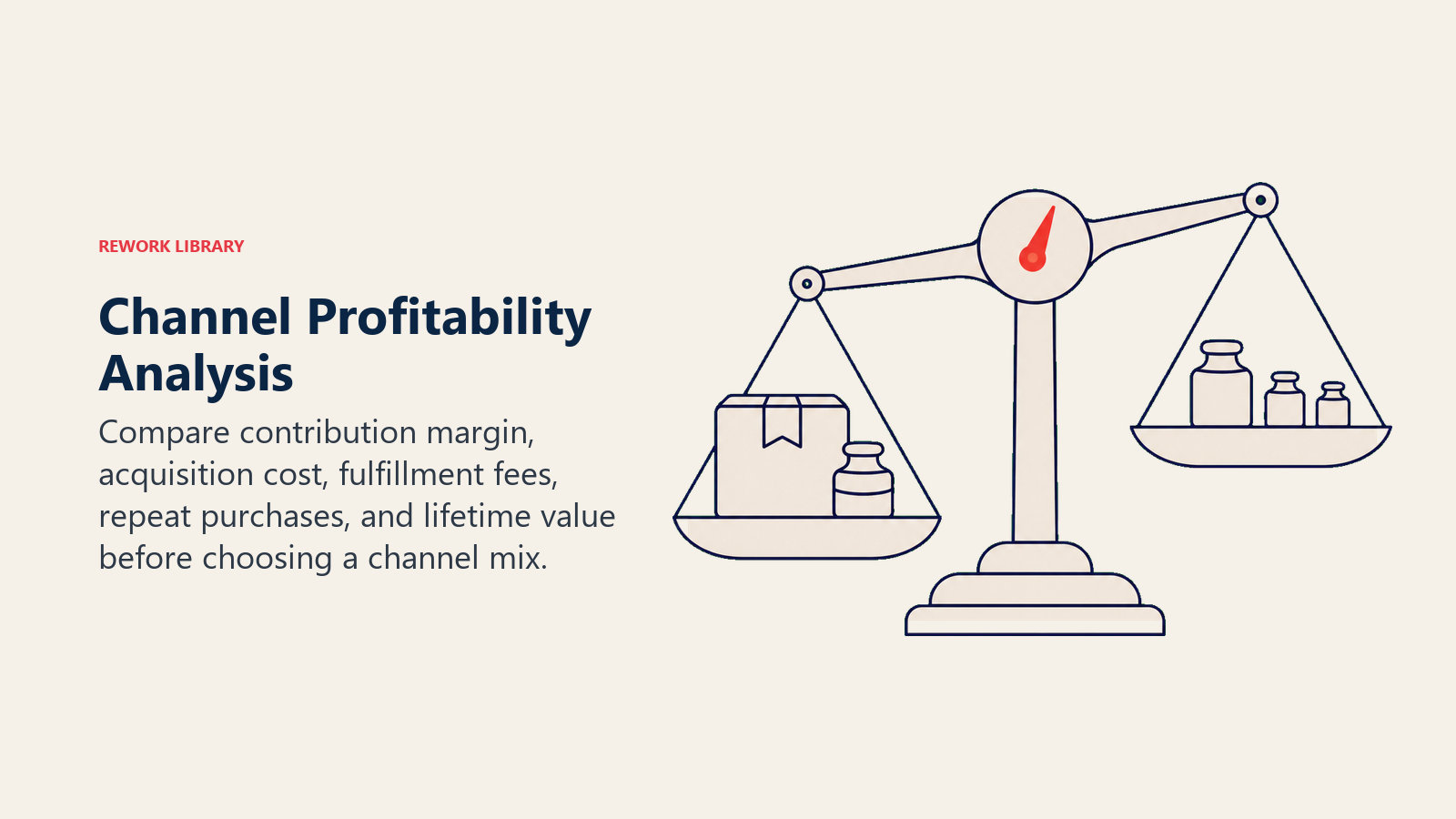
Let's make this concrete with actual numbers for a typical $50 product:
Shopify Economics:
- Sale price: $50.00
- Payment processing: -$1.75 (3.5%)
- Shopify fees: -$0.50 (1%)
- Shipping (customer pays): $0
- Net revenue: $47.75
- COGS: -$15.00
- Fulfillment cost: -$5.00
- Customer acquisition cost: -$40.00 (first purchase)
- First purchase profit: -$12.25 (loss)
- Repeat purchase profit (no CAC): $27.75
- Breakeven at: 1.4 purchases
- LTV at 4 purchases: $161.00
- Total profit over lifetime: $71.00
Amazon Economics:
- Sale price: $50.00
- Amazon referral fee: -$7.50 (15%)
- FBA fulfillment: -$8.00 (varies by size)
- Storage fees: -$0.50 (monthly)
- PPC cost: -$5.00 (10% of sale)
- Net revenue: $29.00
- COGS: -$15.00
- Profit per sale: $14.00
- LTV: $14.00 (customer is Amazon's)
- Customer acquisition cost: $0 (organic) to $5 (PPC)
The Analysis: On Amazon, you make $14 per sale, every sale, with minimal acquisition cost. On Shopify, you lose money on the first sale but make $27.75 on every repeat purchase.
If your repeat purchase rate is 50% or higher, Shopify wins on total profit per customer. If it's below 30%, Amazon's simplicity and guaranteed profit per sale makes more sense.
This is why replenishable products (skincare, supplements, consumables) work beautifully on owned channels, while one-time purchases (phone cases, electronics accessories) often perform better on marketplaces.
Run this analysis for your specific product category, margins, and customer behavior. The answer will be different for every business.
Risk Management: Platform Dependency
Building your entire business on Amazon is risky. Building it entirely on Shopify is also risky, just in different ways. Diversification matters. Amazon risks:
- Algorithm changes tank your ranking overnight
- Account suspension destroys your revenue stream
- Competitors copy your best products
- Category-wide margin compression
- Platform fee increases eat your profitability
Shopify risks:
- Facebook/Google ad costs increase, destroying CAC economics
- iOS privacy changes reduce attribution and targeting
- Brand doesn't resonate, CAC stays too high to profitably scale
- Competitive landscape shifts, making differentiation harder
- Economic downturn reduces discretionary spending
Mitigation strategies:
- Maintain presence on both owned and marketplace channels
- Build email list as channel-independent asset
- Diversify across multiple marketplaces (Amazon, Walmart, eBay, Etsy)
- Invest in SEO and organic traffic sources
- Create genuine product differentiation (patents, exclusive partnerships, brand loyalty)
- Maintain healthy cash reserves to weather temporary downturns
- Build direct relationships with customers (community, subscriptions, content)
The businesses that survive long-term don't depend on any single channel, platform, or traffic source. They build resilient multi-channel strategies with owned audiences.
Decision Framework: Which Channel When
Here's a practical framework for making the Shopify versus marketplace decision: Choose marketplace-first if:
- You have limited capital for customer acquisition
- Your product is undifferentiated or commodity-like
- You need cash flow quickly
- Your product has low repeat purchase rates
- You're testing product-market fit
- Your competitive advantage is sourcing or pricing, not branding
- You lack marketing expertise or resources
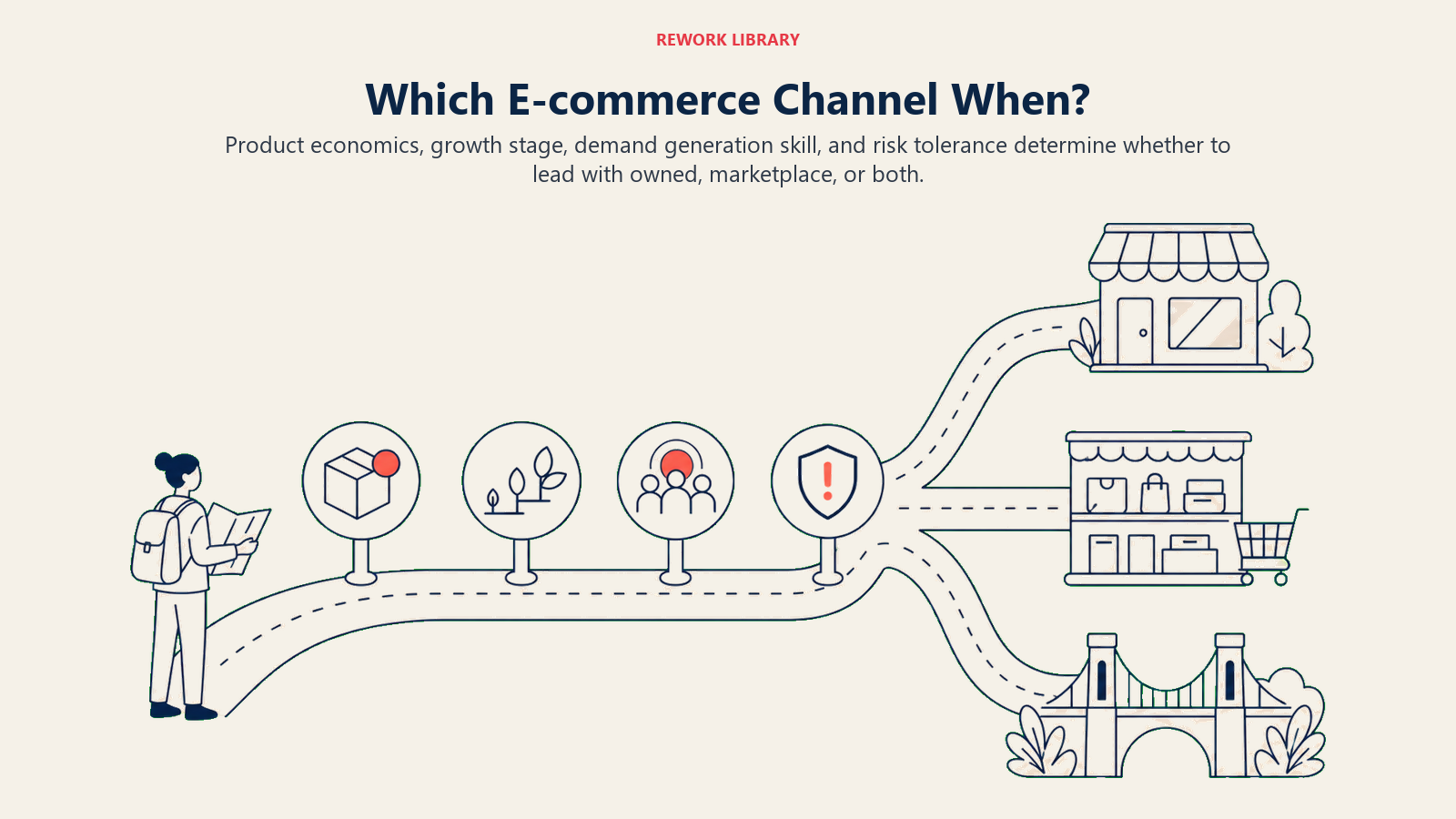
Choose owned channel-first if:
- You have capital for customer acquisition investment
- Your product supports premium pricing and brand building
- You have high repeat purchase potential
- You can create compelling content and brand story
- You have marketing skills and resources
- Customer relationships and data are strategically important
- You're building for long-term brand value
Use hybrid strategy if:
- You're past product validation stage
- You have resources to manage channel complexity
- Your product works in both contexts
- You want to maximize total addressable market
- You're optimizing for both volume and margin
- You can prevent channel conflict through SKU strategy
For most businesses, the answer is "start with marketplaces for validation and volume, build owned channel for margin and relationships, then optimize the mix based on profitability by channel."
The Bottom Line
The Shopify versus marketplace question isn't about which platform is better, it's about which business model aligns with your product, stage, resources, and strategic goals.
Marketplaces give you access to customers, fast validation, and volume at the cost of margin and customer relationships. Owned channels give you margin, control, and customer lifetime value at the cost of higher acquisition costs and slower scaling.
The most successful e-commerce businesses use both strategically. They understand the economics of each channel, know when to prioritize which, and build systems that allow channels to complement rather than cannibalize each other.
Start where customer acquisition is cheapest for your product category. Build toward where customer lifetime value is highest. And always, always make decisions based on actual unit economics rather than platform features or fees alone.
Your channel strategy should evolve as your business grows, your brand strengthens, and your understanding of customer behavior deepens. The companies that win aren't necessarily the ones that picked the "right" channel, they're the ones that continuously optimize their channel mix based on changing economics and strategic priorities.
For platform-specific optimization strategies, see Shopify Optimization and E-commerce Platform Selection for comprehensive guides on maximizing performance within each channel.

Sales Operations Practice Lead
On this page
- The Channel Decision Framework
- Owned Channel Economics: The Shopify Model
- Marketplace Economics: The Amazon Reality
- The Trade-Off Matrix
- Amazon-Specific Dynamics
- Hybrid Strategy Best Practices
- Brand Control and Customer Relationships
- Operational Considerations
- Growth Stage Implications
- Profitability Analysis: Running the Numbers
- Risk Management: Platform Dependency
- Decision Framework: Which Channel When
- The Bottom Line