Gift Card Strategy: Boost Revenue, Customer Acquisition, and Lifetime Value
Turn this article into takeaways for your work.


Each assistant summarizes the article only for you and suggests best practices for your work.
Gift cards are an underused e-commerce growth lever because they drive three things at once: upfront cash flow, new-customer acquisition cheaper than paid ads, and bigger orders when recipients overspend their balance. Roughly 60 to 75 percent of cards are bought as gifts, each a pre-qualified introduction to a new buyer, and breakage on unredeemed balances can add 5 to 15 percent of program revenue at zero cost. Run it year-round, not just in December.
Most e-commerce brands treat gift cards as a holiday convenience feature. That's leaving money on the table. A well-executed gift card program delivers upfront cash flow, acquires new customers at lower cost than paid advertising, and increases average order values when recipients redeem. The breakage alone (unredeemed balances that eventually become revenue) can add 5-15% to your gift card program profitability.
The mechanics are straightforward. Customers buy gift cards, you receive cash immediately, and redemption happens weeks or months later. During that window, you've improved working capital, acquired potential new customers through gifting, and created future purchase opportunities. Recipients typically spend 20-40% more than the card value, expanding transaction size without discounting your core products.
This guide covers the full gift card lifecycle: business model fundamentals, breakage maximization within legal boundaries, promotion strategies beyond December, redemption optimization, operational setup, accounting compliance, acquisition economics, and advanced integration with your loyalty programs and overall pricing strategy for e-commerce.
Gift Card Business Model Fundamentals
Gift cards generate revenue through three distinct mechanisms: initial sale proceeds, overspend during redemption, and breakage from unredeemed balances. Understanding each component helps you optimize program performance.
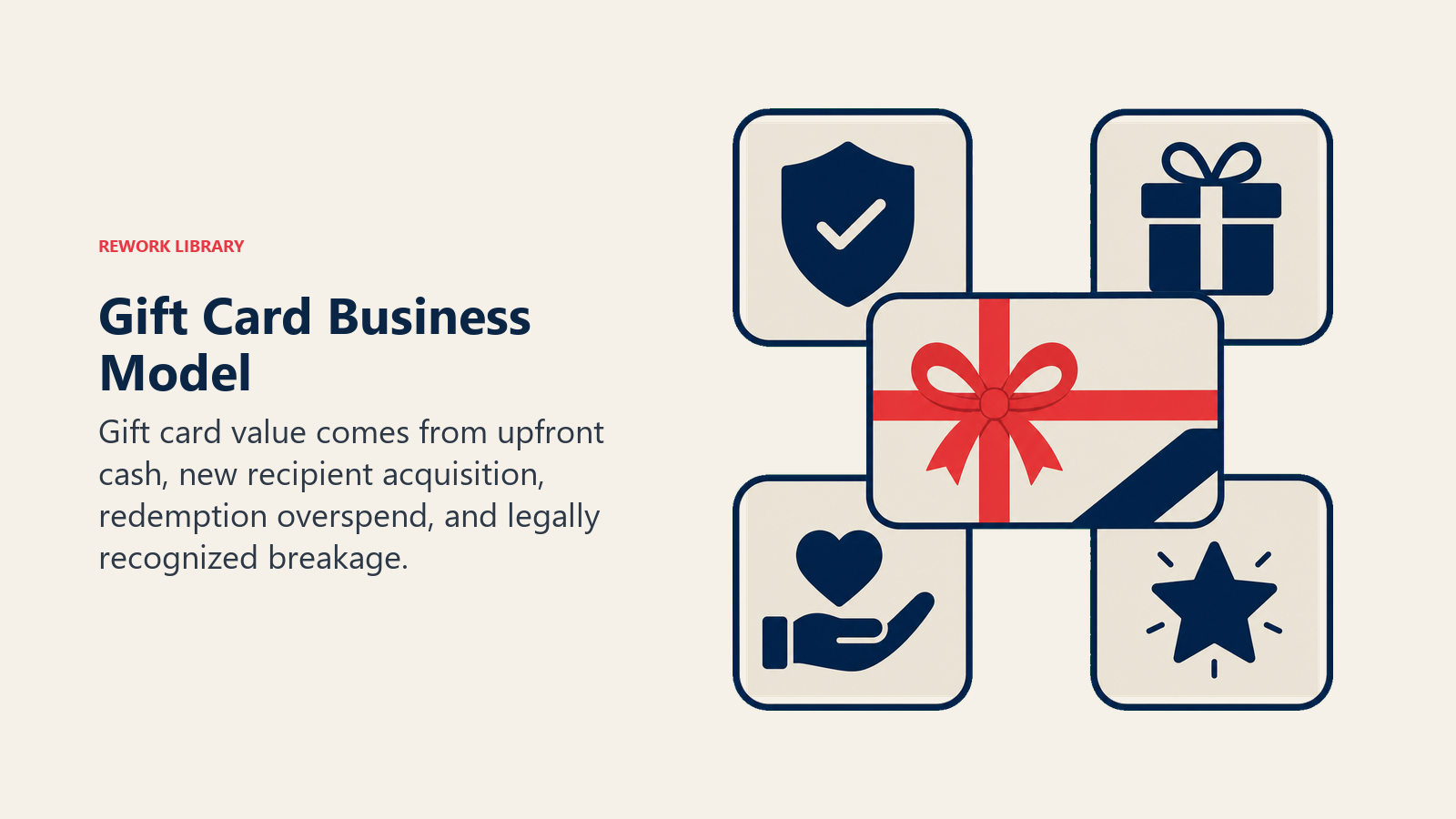
Revenue timing and cash flow benefits: When someone purchases a $100 gift card, you receive $100 in cash immediately. Sure, it's deferred revenue from an accounting perspective, but the cash is in your bank account. For seasonal businesses, gift card sales in November and December provide working capital during peak inventory purchasing months. Redemption typically occurs 30-90 days after purchase, creating a natural cash flow buffer.
Customer acquisition mechanism: Approximately 60-75% of gift cards are purchased for someone else. Each gifted card represents a potential new customer acquisition. The gift giver has pre-qualified the recipient, they believe your brand aligns with the recipient's preferences. This warm introduction converts at 2-3x the rate of cold traffic from paid advertising. Track redemption by new versus existing customers to measure acquisition impact.
Lifetime value expansion: Gift card recipients who become customers show higher customer lifetime value (LTV) than average. They were introduced through trusted recommendation, spent time browsing your catalog during redemption, and often overspent their balance (creating immediate profit). Track the 12-month value of gift card redeemers versus other acquisition channels. Many brands find gift card acquisitions rank second only to referrals in long-term value.
Margin dynamics: Unlike traditional discount strategy approaches that reduce margin, gift cards preserve full-price economics. The $100 gift card costs you nothing at point of sale, it's a liability, not a cost of goods sold. When redeemed, the customer typically purchases $130-140 in merchandise, paying the additional $30-40 at full price. Your effective margin on that incremental $30-40 is higher than typical transactions because you're not discounting to acquire the customer.
The mathematical advantage becomes clear with volume. A brand selling $500,000 in gift cards annually with 10% breakage generates $50,000 in eventual revenue at zero acquisition cost. Add average 30% overspend during redemption ($150,000 additional revenue) and you've created $200,000 in incremental revenue from the program.
Breakage Analysis and Optimization
Breakage refers to the percentage of gift card value that goes unredeemed. This eventually converts to revenue after the legal dormancy period. Understanding breakage patterns helps you forecast revenue and optimize program design.
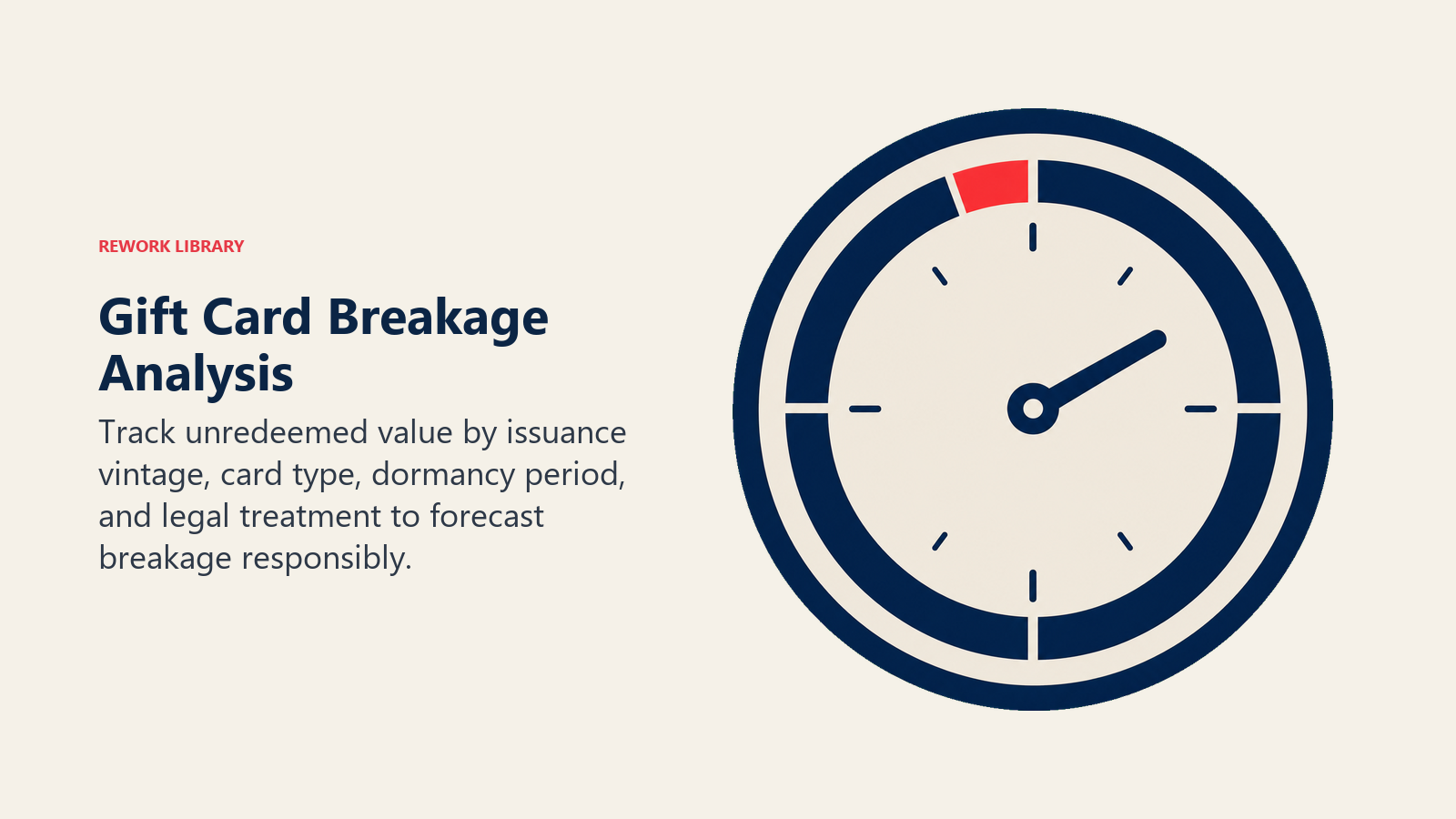
Industry benchmarks: Retail gift card breakage typically ranges from 8-15% depending on category and card type. Digital cards show lower breakage (6-10%) because they're harder to physically lose. Physical cards have higher breakage (12-18%) due to being misplaced, forgotten, or thrown away with small remaining balances. Restaurant gift cards see highest breakage (15-20%), while specialty retail falls in the middle (10-14%).
Breakage calculation framework: Calculate breakage monthly by vintage (month of issuance). Track cards issued in January 2024, measure redemption percentages at 30, 60, 90, 180, and 365 days. After 24 months, remaining unredeemed balance is likely breakage. Formula: Breakage % = (Issued Value - Redeemed Value - Active Balance) / Issued Value. Monitor this by vintage to identify trends.
Legal maximization strategies: Several tactics increase breakage while staying compliant. First, avoid sending redemption reminders. Companies that email balance reminders see breakage drop to 3-5%. Second, make balance checking slightly inconvenient (require card number plus PIN rather than just number). Third, set redemption minimums at $10-25 so small balances become difficult to use. Fourth, accept partial redemptions but don't issue new cards for remaining balances under $5.
Regulatory compliance requirements: Laws vary by state and country. In the US, the CARD Act of 2009 prohibits expiration dates within 5 years and restricts inactivity fees. Many states require escheatment reporting, turning over unredeemed balances to the state after 3-5 years. California requires cards never expire. Check regulations in your primary markets. Consult a CPA familiar with ASC 606 and state escheatment laws before launching.
Ethical considerations: While maximizing breakage increases revenue, creating intentionally frustrating redemption experiences damages brand perception. Balance financial optimization with customer experience. Make redemption reasonably easy, provide clear balance information when requested, and ensure checkout systems handle gift cards smoothly. The goal is natural breakage from lost cards and forgotten balances, not deliberately prevented redemptions.
Track these metrics: redemption rate by vintage, average time to first use, average time to full redemption, percentage of cards with balances under $5, and percentage of cards inactive for 12+ months. These indicators forecast breakage and highlight operational issues before they impact customer satisfaction.
Gift Card Promotion Strategy
Gift cards shouldn't be passive catalog items. Strategic promotion drives volume beyond holiday seasons and integrates with broader customer acquisition efforts.
Seasonal versus year-round promotion: December represents 40-60% of annual gift card sales for most brands. That concentration is natural, but year-round promotion captures additional opportunities. Promote gift cards during: graduation season (May-June), back-to-school (August-September), weddings (peak May-October), birthdays (year-round with personalization), and corporate appreciation (January and year-end). Create seasonal creative rather than generic "buy gift cards" messaging.
Acquisition campaign pairing: Pair gift cards with new customer acquisition campaigns. Run Facebook/Instagram ads offering "Give $100, Get $20" where purchasers receive a $20 card for themselves when buying $100+ for someone else. This reduces effective customer acquisition cost while generating cash flow. The self-use card often goes unredeemed (breakage) or drives first purchase (conversion). Track blended CAC including both the incentive cost and the revenue from the gifted card redemption.
Bundling mechanics: Bundle gift cards with popular products during peak seasons. "Buy this skincare set, add a $25 gift card for just $20" works because it's positioned as a discount (the customer "saves" $5) while you've sold a $20 gift card that may break or drive overspend. The bundled card often gets gifted to someone else, creating new customer acquisition. Test bundles at 10-20% discount to face value.
Corporate and B2B programs: Corporate gift card programs generate bulk revenue with different economics than consumer sales. Offer 5-10% volume discounts for orders of 50+ cards, provide custom designs with company branding, and sell through corporate gifting platforms like Snappy or Alyce. Corporate cards show higher redemption rates (92-97%) because they're often incentives rather than gifts, but average order value during redemption is similar to consumer cards.
Consider promotional calendar alignment with your overall holiday & seasonal promotions strategy. If you typically discount 20% in November, gift cards become relatively more attractive because they don't expire and maintain full value. Promote "skip the sale, give a gift card" positioning when you'd normally discount.
Structure bonuses carefully. "Buy $100, get $120 value" effectively discounts 20% and trains customers to wait for bonuses. Better approach: "Buy $100 in gift cards, receive $20 toward your next purchase" which drives purchaser retention separately from recipient acquisition. The bonus goes to a different customer segment with different tracking.
Redemption Optimization
The redemption experience determines whether gift card recipients become repeat customers. Optimize for conversion, average order value, and future purchase likelihood.
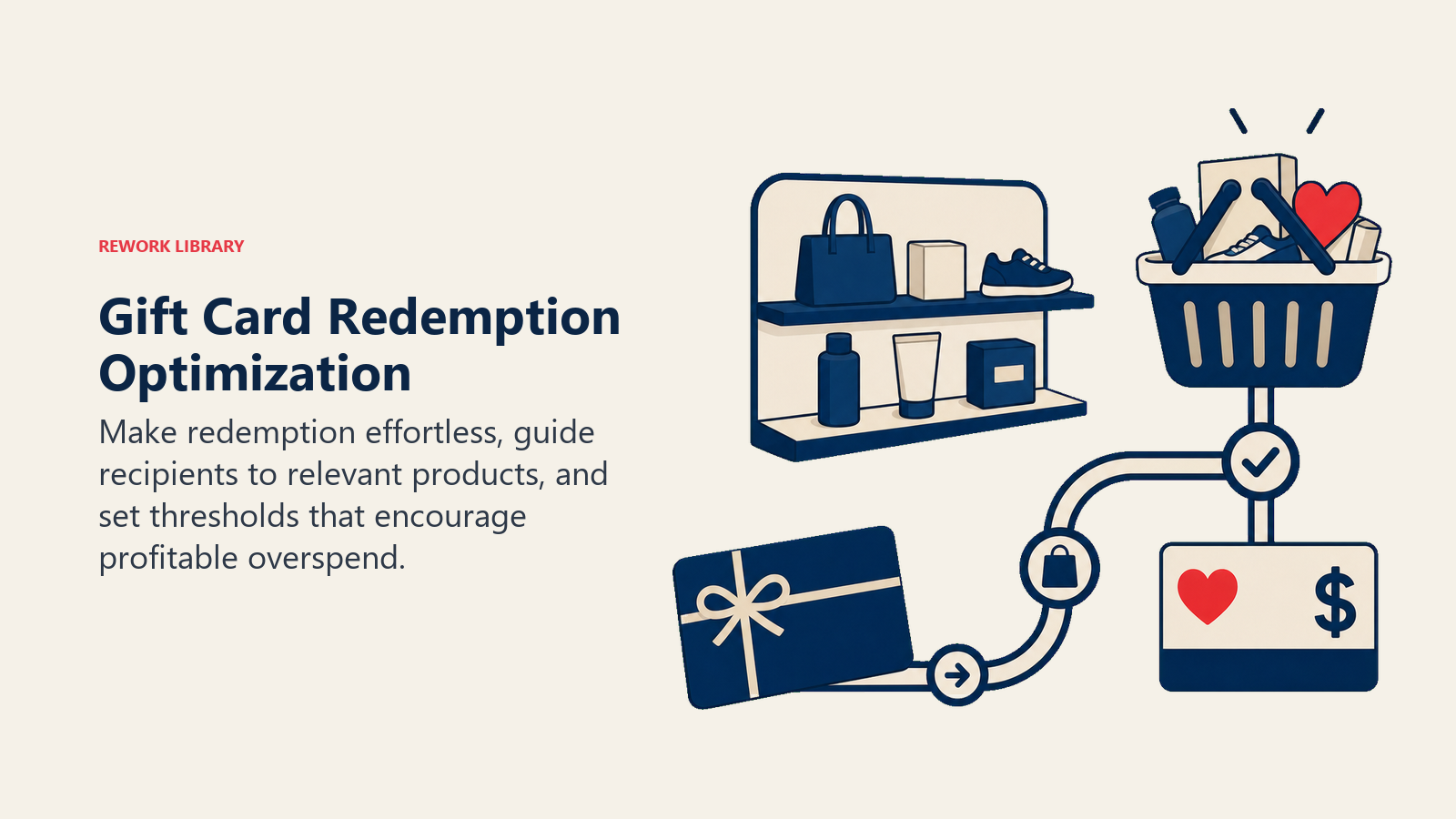
Post-redemption purchase strategies: 65-80% of gift card recipients spend more than the card value during redemption. Maximize this overspend by: featuring bestsellers prominently when they enter with a gift card, offering free shipping at thresholds slightly above card value ($100 card gets free shipping at $125+), and bundling related items at checkout. Track average order value for gift card transactions separately, this is a key program metric.
Average order value maximization: Use several tactics. First, set free shipping thresholds $20-30 above common gift card denominations. A $50 card with $75 free shipping threshold drives $25+ overspend at high conversion rates. Second, show "people who redeemed gift cards also bought" recommendations. Third, offer gift card-exclusive bundles that require adding $15-25 to complete the bundle. Fourth, highlight gift card balance during checkout to remove friction, show "$50 gift card applied, you owe $23.50."
Preventing redemption bottlenecks: Technical issues during redemption destroy conversion. Common problems: gift cards not applying to sale items (fix: allow gift cards on everything), balance checking requiring account creation (fix: allow guest balance checks), cards not working on mobile (fix: test mobile redemption flows monthly), and unclear remaining balance after partial use (fix: send email receipts showing new balance). Mystery shop your redemption process quarterly.
Low-balance management: Cards with $2-8 remaining create customer frustration and program inefficiency. Solutions include: allowing balances under $10 to be used as discount codes without shipping requirements (they buy something else and apply the $4 balance), accepting gift cards as partial payment for subscriptions or memberships, or offering "donate your balance" options to charity. Track percentage of issued value sitting in sub-$10 balances, above 3% indicates a problem.
Create redemption urgency without expiration dates by sending 60-day, 90-day, and 6-month emails highlighting "your gift card is waiting" with product recommendations. These emails drive redemption before cards are forgotten, reducing breakage but increasing customer acquisition from gifted cards. Balance breakage optimization against acquisition goals based on your business model.
Operational Excellence
Platform selection and system integration determine program scalability and customer experience quality.
Platform and technology selection: Most e-commerce platforms include basic gift card functionality. Shopify, BigCommerce, and WooCommerce offer native solutions suitable for straightforward programs. Advanced needs, bulk sales, corporate programs, multi-brand cards, or detailed analytics, require specialized providers like Giftbit, Yiftee, or Square Gift Cards. Evaluate based on: transaction fees (typically $0.10-0.50 per transaction), revenue share (0-3%), fraud protection, reporting capabilities, and API flexibility.
POS and inventory integration: Gift cards must work seamlessly across all sales channels. If you have retail locations, ensure cards purchased online work in-store and vice versa. Test these flows: online purchase / in-store redemption, in-store purchase / online redemption, partial redemption across channels (use $30 of $50 card in-store, $20 online), and balance checking across touchpoints. Inventory systems should treat gift cards as distinct SKUs with unlimited inventory to prevent "out of stock" scenarios.
Physical versus digital cards: Digital cards cost $0.02-0.10 per issuance versus $0.50-2.00 for physical cards including materials, printing, and shipping. Digital cards are instant (better for last-minute gifters) and show lower breakage. Physical cards feel more gift-like, command higher average denominations ($75 vs $50 average), and work better for corporate programs. Offer both. Data shows digital cards are 70% self-purchase for later gifting, while physical cards are 85% direct gifts.
Custom design and personalization: Custom designs increase perceived value and brand recognition. Minimum investment: professional design ($500-2000) and initial print run (500-1000 cards at $1-2 each). Seasonal designs drive urgency, "holiday edition" cards create collection appeal. Personalization (recipient name on digital card) increases redemption rates 15-20% because it's clearly a gift, not a forgotten purchase. Test personalization with email delivery that includes giver's message.
Fraud prevention: Gift card fraud takes several forms. Card testing involves criminals checking stolen card numbers against your system. Prevent by rate-limiting balance checks (3 per IP per hour). Fraudulent purchases use stolen credit cards to buy gift cards quickly converted to cash. Mitigate by flagging large gift card purchases ($500+) from new customers, blocking gift card purchases from high-risk countries, and manually reviewing orders with mismatched billing/shipping for gift card-only carts. Set velocity limits: max 5 gift cards per customer per day.
Accounting and Compliance Considerations
Proper accounting treatment and regulatory compliance prevent future liabilities and ensure accurate financial reporting.
Revenue recognition under ASC 606: Gift card sales are not revenue at point of sale, they're liabilities. You've received cash but haven't fulfilled your performance obligation (delivering goods). Record gift card sales as "deferred revenue" or "gift card liability" on your balance sheet. Recognize revenue when: the card is redeemed, the card is legally considered broken (after escheatment period), or you can reliably estimate breakage. This is complex; consult a CPA familiar with ASC 606.
Breakage revenue recognition: You can recognize breakage proportionally as cards are redeemed if you have sufficient historical data to estimate breakage patterns. Example: Historical data shows 12% average breakage. As cards from a vintage redeem, you recognize 12% of redeemed value as breakage revenue in addition to the redeemed amount. This accelerates revenue recognition but requires documentation of historical breakage rates by vintage. Conservative approach: wait until escheatment period expires to recognize breakage.
Tax implications: Sales tax treatment varies by jurisdiction. In most US states, gift card sales are not taxable events, tax is collected when the card is redeemed and goods are purchased. Some states require collecting tax at purchase if the card is for a specific item rather than open-loop. Document your policy and ensure tax is calculated correctly at redemption. If you operate in multiple states, this complexity increases significantly.
Unredeemed balance liabilities: Unredeemed balances sit on your balance sheet as liabilities until they break or are redeemed. This affects your debt-to-equity ratio and balance sheet strength. Brands with large seasonal gift card programs can show $500K-2M in gift card liabilities in January that slowly decrease throughout the year. Factor this into cash flow projections and banking relationships, these liabilities represent inventory you'll need to fulfill.
Escheatment requirements: Many states require turning over unredeemed gift card balances to the state after a dormancy period (typically 3-5 years). This is called escheatment or unclaimed property. You file annual reports listing unredeemed cards and remit the balances to the state. The original recipient can still claim the value from the state. Track cards by vintage and purchaser state to determine escheatment obligations. Services like Sovos or Compliance Resources help manage multi-state escheatment.
Record retention: Maintain detailed gift card records for 7+ years including: issuance date, amount, purchaser information, redemption history, remaining balance, and state of purchase. You'll need this for escheatment reporting, audits, and customer service. Most platforms maintain these records automatically, but verify data can be exported and stored long-term.
Marketing Gift Cards Effectively
Strategic marketing positions gift cards beyond "we offer these" to drive consistent volume and integrate with acquisition strategy.
Packaging as gifts versus self-purchase: Market to two distinct audiences. Gift purchasers care about presentation, convenience, and delivery timing. Self-purchasers (buying for later personal use) care about flexibility, not expiring, and strategic budgeting. Create separate landing pages and creative. Gift-focused messaging: "The perfect gift for [persona], delivered instantly." Self-purchase messaging: "Lock in your purchase power, never expires, works on everything."
Influencer and affiliate partnerships: Gift cards work exceptionally well for influencer partnerships. Structure: influencer promotes your brand with "I'm giving away 5 $100 gift cards" contest. You provide the cards, influencer drives engagement and awareness, winners become potential customers through redemption. Track redemption rates and post-redemption purchases by influencer source. Cost per acquisition typically runs 40-60% lower than traditional influencer product seeding.
Affiliate programs can promote gift cards with competitive commissions (8-12%) because the lifetime value math works. The affiliate earns commission on the gift card sale, you receive cash immediately, and redemption drives future revenue. Set commission on initial sale only, not on redemption, to keep economics manageable.
Email and SMS campaigns: Integrate gift cards into lifecycle campaigns. Email sequences that work: abandoned cart recovery offering "buy it as a gift card instead" (recovers 5-8% of carts that wouldn't convert otherwise), win-back campaigns offering "here's $20 to redeem your $100 gift card" (reactivates dormant recipients), and birthday campaigns suggesting "send a gift card to celebrate." SMS works for time-sensitive promotions: "Last day for guaranteed holiday delivery, gift cards deliver instantly."
Upselling at point of sale: Checkout upsells drive incremental gift card revenue. Display: "Add a $25 gift card for $22.50" or "Buy a gift card with your order, perfect for upcoming birthdays." Conversion rates are typically 2-4% of checkout traffic, generating significant incremental revenue at scale. Test placement, discount levels, and messaging quarterly.
Include gift cards in your customer data platform segmentation. Identify customers who've purchased gifts (based on different shipping address) and market gift cards to this high-propensity segment during peak gifting seasons. Track purchase frequency, customers who buy gift cards often do so repeatedly if you remind them.
Customer Acquisition Economics
Gift cards represent a unique acquisition channel with different economics than paid advertising or organic search.
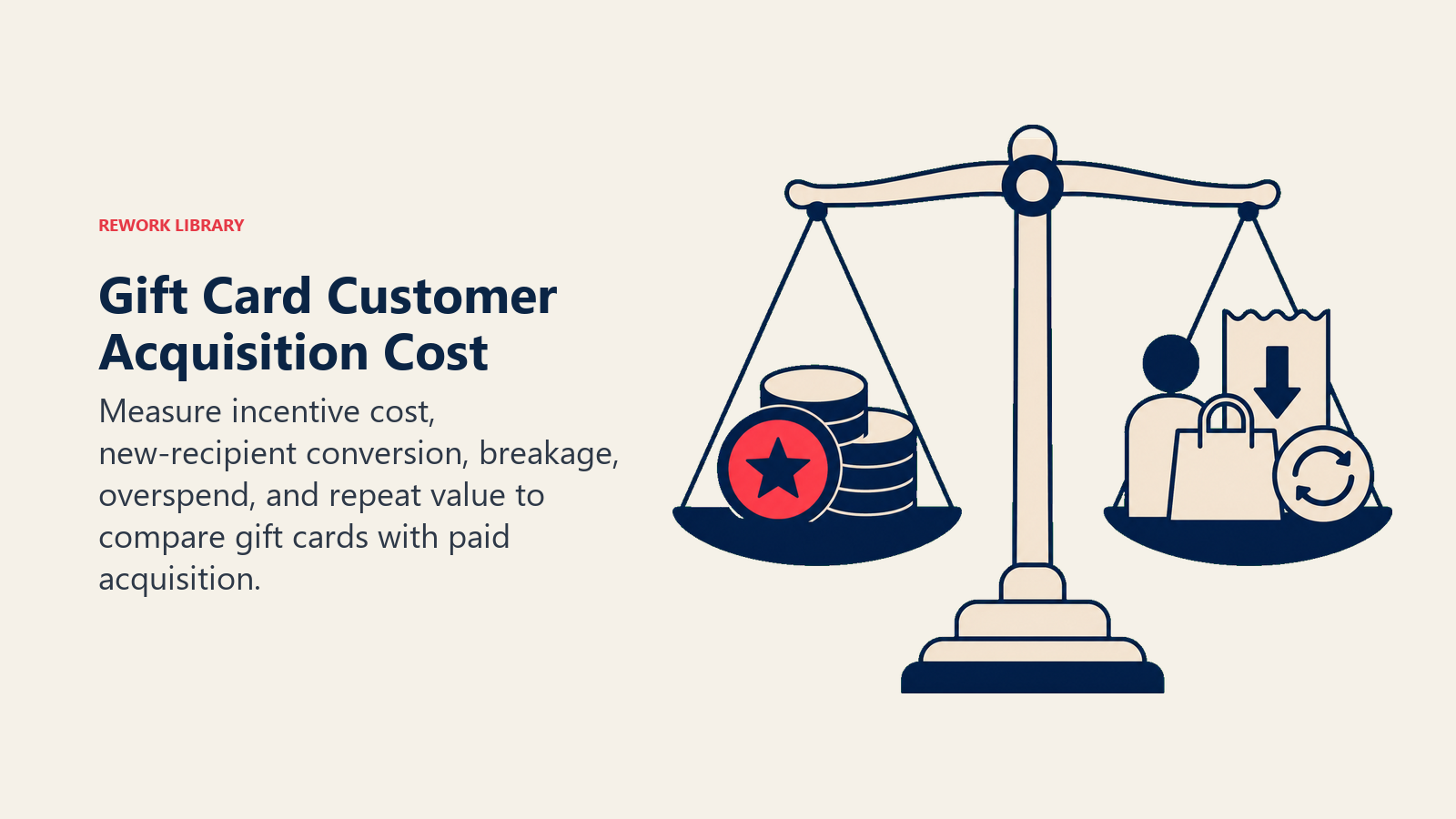
Cost per acquisition via referrals: Calculate true CAC by including the incentive cost and excluding revenue from the gifted card. Example: You run a "buy $100 gift card, get $20 for yourself" promotion. Customer pays $100, receives $120 in total value ($100 gifted, $20 self-use). Your cost is the $20 incentive. If 60% of gifted cards are redeemed by new customers, your CAC is $20 / 0.60 = $33.33 per acquired customer. Compare this to $45-80 CAC from Facebook ads for similar quality customers.
Factor in breakage and overspend to calculate net CAC. If 10% of the $20 self-use cards break and redeemers spend average $35 above card value at 40% gross margin, the economics improve further: $33.33 CAC - ($2 breakage + $14 margin from overspend) = $17.33 net CAC. These calculations require tracking redemption and purchase behavior by promotion source.
Conversion rates from redemption: Not all gift card recipients redeem, and not all redeemers become repeat customers. Benchmark redemption rates: 85-92% within 12 months for digital cards, 75-85% for physical cards. Of redeemers, 25-35% make a second purchase within 6 months. Track this funnel: cards issued → cards redeemed → new customers acquired → repeat purchase rate. Your gift card program is effectively acquiring customers at the repeat purchase stage.
Retention patterns: Gift card-acquired customers show different retention curves than other channels. They typically have lower initial repeat purchase rates (month 1-3) because they didn't self-select your brand, someone else chose it for them. However, those who do repeat purchase show higher long-term retention because the gift was well-matched to their preferences. Track 12-month retention cohorts by acquisition channel to understand true value.
Lifetime value comparison: Compare LTV of gift card-acquired customers to other channels over 24 months. Most brands find gift card customers rank 3rd-5th in LTV behind organic search and referrals, but ahead of paid social and display advertising. The key advantage is acquisition cost, even if LTV is similar to paid social customers, the 40-60% lower CAC makes gift cards more profitable from an ROI perspective.
Calculate LTV:CAC ratio specifically for gift card programs. Ratios above 3:1 indicate excellent performance. Factors improving the ratio: lower incentive costs (reduce the "buy $100 get $20" bonus to $15), higher redemption rates among new customers (better targeting of gift purchasers), and improved post-redemption conversion (better redemption experience and follow-up marketing).
Common Mistakes and Pitfalls
Avoid these frequent errors that undermine program performance and customer satisfaction.
Poor redemption experience: Making redemption difficult or confusing destroys the acquisition value. Common issues: requiring account creation before redemption (friction point that loses 15-20% of redeemers), unclear error messages when cards don't work ("invalid card number" vs "card already redeemed, contact support"), complicated balance checking (requiring both card number and PIN when just number would suffice), and cards not working on mobile browsers. Test redemption flows quarterly from a customer perspective.
Inadequate promotion: Treating gift cards as a passive catalog item leaves revenue on the table. Symptoms: gift card sales concentrated in December only (indicating zero year-round promotion), gift cards buried in footer navigation rather than featured in main menu, no gift card mentions in email marketing or social media, and no dedicated landing pages optimized for search terms like "gift cards for [your category]." Allocate 5-10% of marketing budget to gift card promotion beyond November-December.
Ignoring accounting complexity: Recording gift card sales as immediate revenue creates major problems. Your revenue is overstated, liabilities are understated, and you'll face questions during audits or due diligence. Set up proper accounting treatment from day one, it's exponentially harder to correct 2-3 years of transactions retroactively. If you've already launched without proper setup, engage a CPA to restate financials before year-end close.
Failing to track breakage: Operating gift cards without tracking redemption rates, breakage percentages, and vintage performance means you can't forecast revenue or optimize the program. Minimum tracking: monthly report showing cards issued by vintage, redemption percentages at 30/60/90/180/365 days, estimated breakage by vintage, and revenue recognized from breakage. This data informs inventory planning, cash flow forecasting, and promotional strategy.
Restrictive terms that hurt experience: Overly restrictive terms damage customer perception and redemption rates. Examples: cards that don't work on sale items (why would you restrict this?), minimum purchase requirements above card value ($50 card requires $75 purchase), cards that can't be combined with other payment methods, and expiration dates shorter than legal minimums. Unless legally required, make cards as flexible as possible. The overspend and acquisition value depends on easy, friction-free redemption.
Ignoring fraud patterns: Gift card fraud scales quickly once criminals identify vulnerabilities. Warning signs: unusual spikes in gift card purchases, orders for maximum denomination from new customers, multiple gift card purchases from same IP or similar email patterns, and balance checking attempts in rapid succession. Implement basic fraud prevention from day one rather than waiting until you've lost $20-50K to organized fraud rings.
Metrics and Analytics
Track these KPIs to manage program performance and identify optimization opportunities.
Sales tracking: Monitor gift card revenue daily during peak seasons, weekly during standard periods. Track: total gift card sales, average gift card value, sales by denomination ($25, $50, $100+), digital versus physical card split, and promotional versus full-price sales. Compare year-over-year performance to identify trends. December comparisons should account for calendar shifts (number of weekend shopping days before Christmas varies annually).
Redemption rate and velocity: Calculate redemption rate by vintage monthly. Cards issued in January should show 25-35% redeemed within 30 days, 45-60% within 90 days, and 75-85% within 12 months. Velocity (time to first redemption) averages 45-75 days but varies by season, holiday cards redeem faster than birthday cards. Track velocity because it impacts cash flow and inventory planning.
Time to redemption analysis: Break down redemption timing: 0-30 days (35-45% typically), 31-90 days (25-30%), 91-180 days (15-20%), 181-365 days (10-15%), and 365+ days (5-10% eventual breakage). This distribution helps forecast when deferred revenue becomes recognized revenue and when to expect redemption-driven traffic spikes.
Customer acquisition cost attribution: Calculate CAC from gift card programs by tracking: promotion costs (bonuses, discounts, advertising), number of cards gifted to others (versus self-purchased), redemption rate among new customers, and fully-loaded cost divided by new customers acquired. Track separately from other acquisition channels in your analytics platform. Most brands find gift card CAC runs 35-55% of paid social CAC for comparable customer quality.
Average order value during redemption: Track AOV separately for gift card redemption transactions. Benchmark: 125-140% of card face value (someone with a $100 card spends $125-140 total). Monitor trends monthly. Declining AOV indicates redemption experience issues, insufficient upselling, or changing customer demographics. Rising AOV suggests effective bundling and recommendation strategies.
Breakage forecasting: Project breakage monthly using historical vintage data. If cards issued 24+ months ago show 12% unredeemed, and you've issued $1M in cards over past 24 months, you're carrying roughly $120K in eventual breakage revenue. Update forecasts quarterly as redemption patterns evolve. Conservative businesses wait to recognize breakage until legal escheatment periods; aggressive businesses recognize proportionally during redemption.
Program profitability: Calculate total gift card program profit including: gross card sales, minus promotions and discounts, plus overspend revenue at blended margin, plus estimated breakage revenue, minus platform fees and operational costs. This gives true program profitability. Many programs show 20-35% profit margin (profit as percentage of card sales), significantly higher than typical e-commerce transaction margins of 10-20%.
Advanced Strategies
Once basic gift card operations run smoothly, test these advanced tactics to maximize program value.
Tiered incentive structures: Instead of flat "buy $100 get $20" offers, create tiers that encourage larger purchases: buy $50 get $5 (10% bonus), buy $100 get $15 (15% bonus), buy $200 get $40 (20% bonus). This structure increases average gift card purchase size while offering better value to customers buying larger amounts. Test tier breakpoints quarterly based on average purchase values in your catalog.
Loyalty program integration: Integrate gift cards with loyalty programs to create compound value. Award points for gift card purchases (purchases and recipients both earn), allow points redemption toward gift card purchases (reduces cash CAC), and offer bonus points when gift cards are redeemed. This integration increases engagement in both programs and improves customer lifetime value metrics.
Subscription gift cards: Create subscription-specific gift cards: "3 months of our monthly subscription box" or "$150 toward annual membership." These convert gift recipients into subscription customers with much higher lifetime value than one-time purchasers. Track conversion rates from subscription gift cards to ongoing subscribers, typically 35-50% continue subscriptions beyond the gifted period. Price subscription gift cards at slight discount to drive adoption.
Secondary market considerations: Gift card marketplaces like Raise, CardCash, and Gift Card Granny create a secondary market where recipients can sell unwanted cards at 70-90% of face value. This impacts your brand in two ways: it's free market research (if your cards sell at 90% of value, recipients want to use them; if they're at 70%, you may have brand perception issues), and it creates another acquisition channel (someone who buys your card secondhand is acquired at zero cost to you). Monitor secondary market pricing quarterly.
Corporate customization programs: Build high-value B2B revenue by offering fully customized corporate gift card programs. Services include: custom card designs with company branding, dedicated redemption landing pages, bulk pricing (5-10% discounts on $10K+ orders), and detailed redemption reporting for corporate customers tracking employee engagement. Corporate programs typically generate $50-500K in annual revenue with 95%+ redemption rates.
Analytics-driven promotion timing: Use historical data to identify optimal promotion timing beyond December. Analyze gift card sales by week for 2-3 years to find secondary peaks (Mother's Day, graduation, back-to-school). Promote 2-3 weeks before these peaks to capture early planners. Track sales lift from targeted promotion versus baseline to calculate promotional ROI.
Integration with first-time customer offers: Combine gift cards with first-time customer offers to maximize new customer conversion. When a gift card recipient redeems, offer "spend your gift card plus $25 more and get free shipping + 10% off your overspend." This stacks incentives specifically for valuable new customers acquired through gifting. Test offer structures and track incremental AOV and repeat purchase rates.
Gift card programs represent one of e-commerce's highest ROI investments when executed strategically. The combination of upfront cash flow, low-cost customer acquisition, average order value expansion during redemption, and breakage revenue creates multiple value drivers from a single program. Start with solid operational foundations, reliable platform, proper accounting treatment, and smooth redemption experience, then layer in sophisticated promotion strategies, acquisition tracking, and loyalty integration.
The brands that succeed treat gift cards as a year-round growth channel integrated with overall AOV optimization strategy and acquisition planning, not a December-only convenience feature. Track the full funnel from purchase through redemption to repeat customer conversion, optimize based on data, and reinvest savings from reduced acquisition costs into program promotion and customer experience improvements.
Frequently Asked Questions
How do gift cards drive e-commerce growth?
Gift cards create three growth effects at once. You collect cash the moment a card is sold (improving working capital), you acquire new customers because 60 to 75 percent of cards are bought as pre-qualified gifts, and you lift average order value because recipients typically spend 20 to 40 percent above the card balance at full price.
What is gift card breakage and how much revenue does it add?
Breakage is the share of card value that never gets redeemed and eventually converts to revenue after the legal dormancy period. Retail breakage usually runs 8 to 15 percent, lower for digital cards (6 to 10 percent) and higher for physical cards (12 to 18 percent). Recognize it only with documented historical data and within state escheatment rules.
How are gift cards accounted for under ASC 606?
A gift card sale is a liability, not revenue, at point of sale. You record it as deferred revenue or a gift card liability and recognize revenue when the card is redeemed, when it is legally considered broken, or proportionally if you can reliably estimate breakage. Many states also require escheatment of unredeemed balances after 3 to 5 years.
Is selling gift cards cheaper than paid advertising for customer acquisition?
Usually, yes. A "buy $100, get $20" promotion can yield a blended cost per acquisition around $33, versus $45 to $80 from paid social for comparable customers, and breakage plus overspend push the net cost lower still. The catch is a smooth redemption experience, since friction at checkout destroys the acquisition value.

On this page
- Gift Card Business Model Fundamentals
- Breakage Analysis and Optimization
- Gift Card Promotion Strategy
- Redemption Optimization
- Operational Excellence
- Accounting and Compliance Considerations
- Marketing Gift Cards Effectively
- Customer Acquisition Economics
- Common Mistakes and Pitfalls
- Metrics and Analytics
- Advanced Strategies
- Frequently Asked Questions