Email Marketing for E-commerce: Strategic Automation, Segmentation, and Revenue Attribution
Turn this article into takeaways for your work.


Each assistant summarizes the article only for you and suggests best practices for your work.
Email marketing consistently delivers the highest ROI of any marketing channel: between $36 and $40 for every dollar spent. Yet most e-commerce brands barely scratch the surface of what's possible.
The difference between a basic promotional email program and a sophisticated revenue engine comes down to three things: strategic segmentation, intelligent automation, and precise attribution. Get these right, and email becomes your most predictable, scalable growth channel.
What Is Email Marketing for E-commerce?
Email marketing is the practice of using email to communicate with customers and prospects throughout their entire lifecycle, from first website visit to loyal repeat customer. For e-commerce, it's not just a communication channel; it's a revenue-generating system that touches every stage of the customer journey.
Your email list is a strategic asset. Unlike social media followers or paid traffic, you own the relationship. You control the message, the timing, and the frequency. This makes email uniquely powerful for building long-term customer value.
The most effective e-commerce email programs operate on three levels:
Automated behavioral emails that respond to customer actions in real-time (abandoned carts, browse behavior, purchase triggers)
Strategic campaigns that drive specific business objectives (product launches, seasonal promotions, educational content)
Retention sequences that systematically increase Customer Lifetime Value through replenishment reminders, cross-sells, and win-back campaigns
Done right, email marketing accounts for 25-30% of total e-commerce revenue while requiring minimal ongoing ad spend.
Why Email Marketing Matters for E-commerce Growth
The numbers tell a compelling story. According to industry benchmarks, email drives 47% of e-commerce revenue for brands with mature programs. That's more than paid search, social media, and display advertising combined.
But the real power of email isn't just revenue. It's profitability. While customer acquisition costs continue to rise across paid channels, email operates on different economics. Once someone's on your list, the marginal cost of reaching them is essentially zero.
This creates a compounding advantage. Every new subscriber increases your potential revenue without proportionally increasing your costs. As your list grows and your segmentation gets more sophisticated, the gap between email's performance and other channels widens.
Email also serves as the connective tissue between other marketing channels. It rescues revenue from abandoned carts discovered through Retargeting & Remarketing. It amplifies the impact of improved conversion rate optimization. It extends the reach of your SMS marketing strategy.
Perhaps most importantly, email gives you direct access to your customers without platform dependencies. Algorithm changes, rising ad costs, and platform policy shifts don't affect your ability to reach your audience.
Email List Building and Growth Strategy
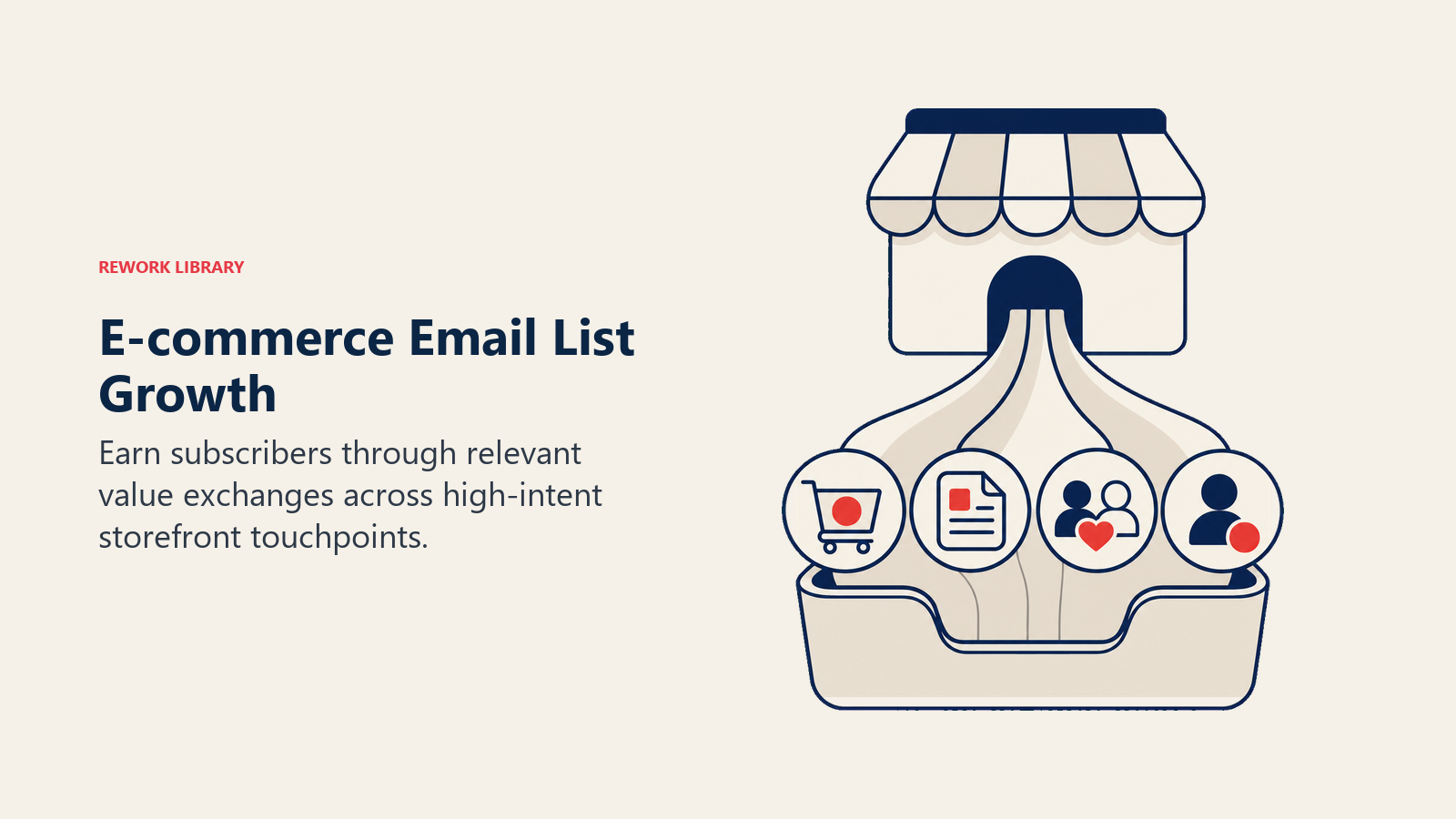
Your email list is only as valuable as the quality of subscribers on it. A small list of engaged, high-intent subscribers will always outperform a large list of disengaged contacts.
Lead Magnet Strategy
The most effective lead magnets solve an immediate problem or satisfy a specific desire for your target customer. Generic "10% off your first order" offers work, but they attract price-sensitive shoppers who may never become repeat customers.
Instead, create segmented lead magnets that attract your ideal customers:
Product education guides that help customers make better buying decisions (sizing guides, style guides, ingredient glossaries)
Early access programs that give subscribers first access to new products, limited editions, or exclusive colorways
Value-added tools like calculators, quiz results, or personalized recommendations that require an email to access
Content series that deliver educational value over multiple emails (skincare routines, style challenges, recipe series)
The key is matching the lead magnet to both your product and your customer's stage of awareness. Someone just discovering your category needs different information than someone actively comparing products.
List Building Channels
Diversify your list building across multiple channels to reduce dependency on any single source:
On-site popups remain effective when properly timed (exit-intent, scroll depth, time on site) and targeted (returning visitors, specific product categories)
Landing pages designed specifically for list building, often promoted through content marketing or paid traffic
Checkout opt-ins that capture purchasers who didn't previously subscribe (with clear value proposition for joining)
Post-purchase flows that invite customers to subscribe for replenishment reminders, care guides, or complementary product suggestions
Social media bio links that lead to list-building landing pages rather than directly to your homepage
Referral incentives where existing subscribers earn rewards for bringing in new subscribers
The goal is to capture emails from people who are genuinely interested in hearing from you, not just collecting addresses. A smaller list of engaged subscribers will always generate more revenue than a large list of uninterested contacts.
Email Segmentation Strategy
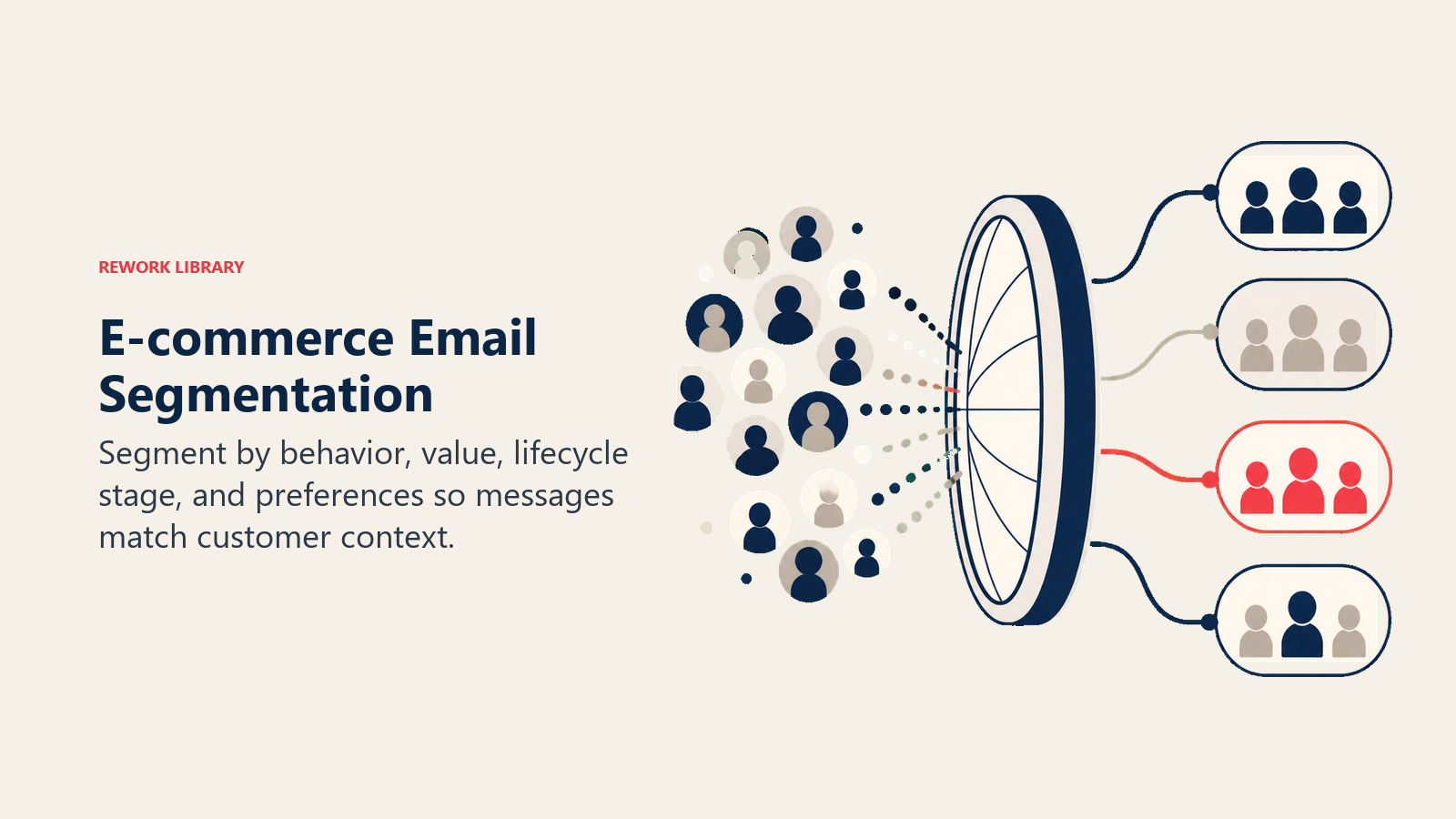
Customer segmentation is where good email programs become great ones. Sending the same message to everyone on your list leaves massive revenue on the table.
Behavioral Segmentation
Behavioral segments are based on what customers do (or don't do): Browse behavior: What products or categories they view, how frequently they visit, which pages they spend time on Purchase history: What they buy, how often, how much they spend, which categories they prefer
Engagement patterns: Open rates, click rates, time since last engagement, preferred content types
Abandonment behavior: Cart abandonment, browse abandonment, checkout abandonment at specific steps
Use these behavioral signals to send highly relevant messages. Someone who browses running shoes three times in a week should receive different content than someone who last visited your site six months ago.
RFM Analysis
RFM (Recency, Frequency, Monetary) segmentation divides your list based on three variables:
Recency: How recently they purchased Frequency: How often they purchase Monetary: How much they spend
This creates segments like:
Champions (high recency, high frequency, high spend): Your best customers who deserve VIP treatment, early access, and exclusive offers
Loyal customers (high frequency, medium-high spend): Regular buyers who should receive replenishment reminders and cross-sell recommendations
At-risk (previously high value, declining recency): Former good customers who need win-back campaigns
New customers (high recency, low frequency): Recent first-time buyers who need nurturing to become repeat customers
Different segments need different messaging, offers, and frequency. Your champions can handle higher email volume. Your at-risk segment needs compelling win-back offers, not generic promotions.
Lifecycle Stage Segmentation
Map your email strategy to specific lifecycle stages:
| Lifecycle Stage | Primary Goal | Key Email Types |
|---|---|---|
| Prospect | Convert to first purchase | Lead nurture, social proof, Discount Strategy for first order |
| First-time buyer | Drive second purchase | Welcome series, product education, cross-sell recommendations |
| Repeat customer | Increase frequency and AOV | Replenishment reminders, loyalty rewards, new product launches |
| VIP customer | Maintain relationship and prevent churn | Exclusive access, personal outreach, surprise rewards |
| Lapsed customer | Reactivation | Win-back campaigns, feedback requests, compelling comeback offers |
Each stage requires different messaging, frequency, and offers. Treating a VIP customer like a prospect is just as problematic as treating a prospect like they're already a loyal customer.
Automation Workflows and Sequences
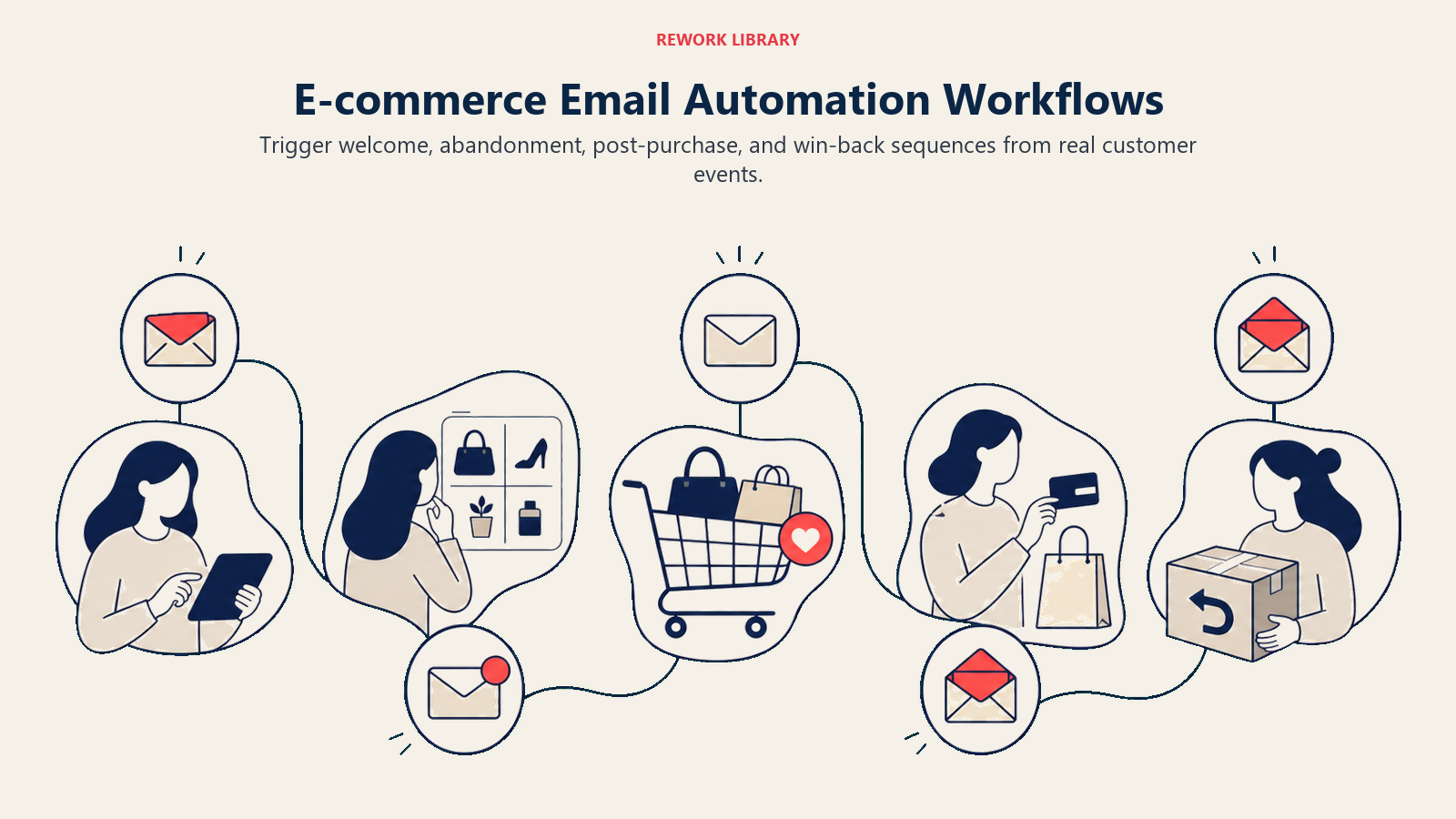
Marketing automation workflows generate revenue 24/7 without manual effort. They respond to customer behavior in real-time with precisely targeted messages.
Welcome Series (Days 1-14)
Your welcome series has one job: convert new subscribers into first-time buyers. A strong welcome series generates 30-50% of a subscriber's lifetime value. Email 1 (Immediate): Deliver the promised lead magnet, set expectations for email frequency, introduce your brand story Email 2 (Day 2): Showcase best-sellers or most popular products, include social proof and customer reviews
Email 3 (Day 4): Address common objections (shipping, returns, quality guarantees), share unique value proposition
Email 4 (Day 7): Limited-time welcome offer (if not offered in Email 1), create urgency with countdown timer
Email 5 (Day 10): Case study or customer story, demonstrate transformation or results
Email 6 (Day 14): Last-chance message for welcome offer, clear call-to-action
Branch based on behavior: If they purchase after Email 2, move them into your post-purchase email sequence. If they add to cart but don't purchase, trigger your cart abandonment recovery sequence.
Cart Abandonment Sequence
Cart abandonment emails recover 10-30% of abandoned carts when properly executed:
Email 1 (1 hour): Simple reminder with cart contents, no discount, emphasis on items being saved
Email 2 (24 hours): Address objections (free shipping threshold, return policy, customer reviews), still no discount
Email 3 (48 hours): Final reminder with social proof, optional small incentive (5-10%) for high-value carts only
The key is not immediately offering a discount. Most people abandon carts for reasons other than price, they got distracted, wanted to comparison shop, or needed to check with someone. Offering a discount too quickly trains customers to abandon carts to get deals.
Browse Abandonment
Browse abandonment captures people who view products but never add them to cart:
Email 1 (4-6 hours): Showcase the products they viewed with key features, customer reviews, and similar items
Email 2 (24 hours): Educational content about the product category, buying guide, or how-to use
This sequence captures earlier-stage interest and can drive 2-5% conversion rates on its own.
Post-Purchase Sequence
The post-purchase window is critical for driving repeat purchases:
Email 1 (Immediately): Order confirmation with clear delivery expectations and tracking information
Email 2 (Upon delivery): Delivery confirmation, product care instructions, how to get help if needed
Email 3 (3-7 days post-delivery): Request review, share tips for getting the most from their purchase
Email 4 (14-30 days): Cross-sell complementary products based on what they purchased
Email 5 (Before expected replenishment): Replenishment reminder for consumable products
Each email builds the relationship while creating additional revenue opportunities.
Win-Back Sequence
For customers who haven't purchased in 90-180 days (adjust based on your purchase cycle):
Email 1: "We miss you" message with highlight of what's new since they last purchased
Email 2: Customer feedback request, ask why they haven't been back
Email 3: Compelling offer (15-25% off) with urgency component
Email 4: Final email before removing from active list, strongest offer
Win-back campaigns can reactivate 5-10% of lapsed customers at a fraction of the cost of acquiring new ones. These sequences are a critical component of effective customer retention strategies.
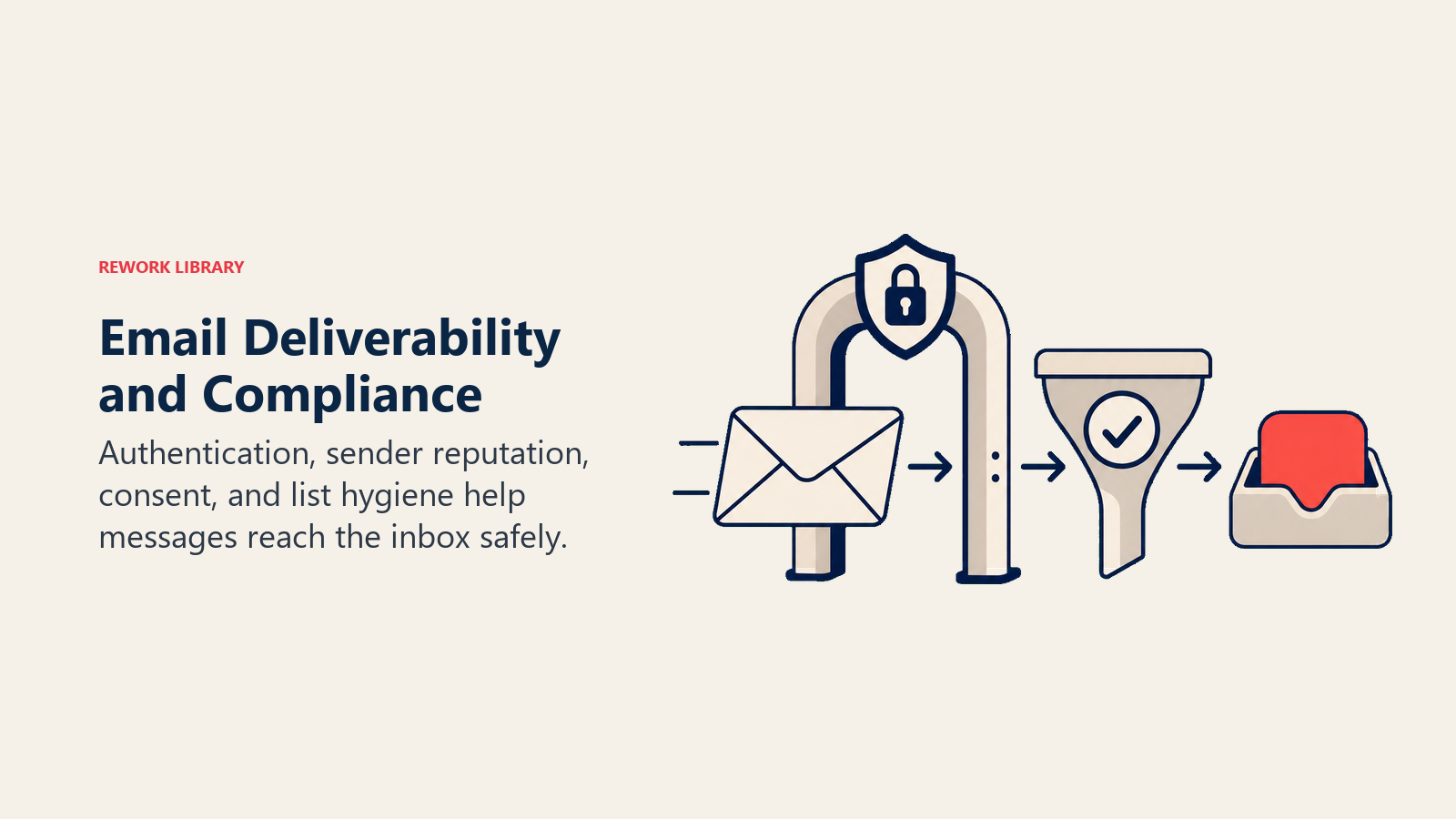
Email Deliverability and Compliance
None of your sophisticated segmentation or automation matters if your emails don't reach the inbox.
Sender Reputation
Email service providers (Gmail, Yahoo, Outlook) assign reputation scores based on:
Engagement rates: Opens, clicks, replies, and forwards signal that recipients want your emails
Spam complaints: High complaint rates tank your reputation quickly (keep under 0.1%)
Bounce rates: Hard bounces indicate poor list quality (keep under 2%)
Spam trap hits: Sending to dormant or recycled email addresses signals you're not managing your list
Protect your reputation by maintaining list hygiene, respecting unsubscribes immediately, and sending only to engaged segments.
Authentication and Technical Setup
Proper technical setup is non-negotiable:
SPF records: Specify which servers can send email on behalf of your domain
DKIM signatures: Cryptographic signatures that verify emails haven't been tampered with
DMARC policies: Tell receiving servers what to do with emails that fail authentication
Custom sending domain: Use your own domain rather than a shared ESP domain
Most ESPs can help with setup, but many brands skip these steps and wonder why their deliverability suffers.
List Hygiene and Compliance
Remove hard bounces immediately: These damage your reputation with every send
Suppress unsubscribes: Make it easy to unsubscribe and honor requests instantly
Re-engagement campaigns: Before removing inactive subscribers, attempt to re-engage with targeted campaigns
Clear consent: Maintain records of how and when people joined your list (GDPR requirement)
Preference centers: Let subscribers control frequency and content types rather than unsubscribing entirely
Clean lists perform better than large lists. Remove unengaged subscribers who haven't opened in 6-12 months, they're hurting more than helping.
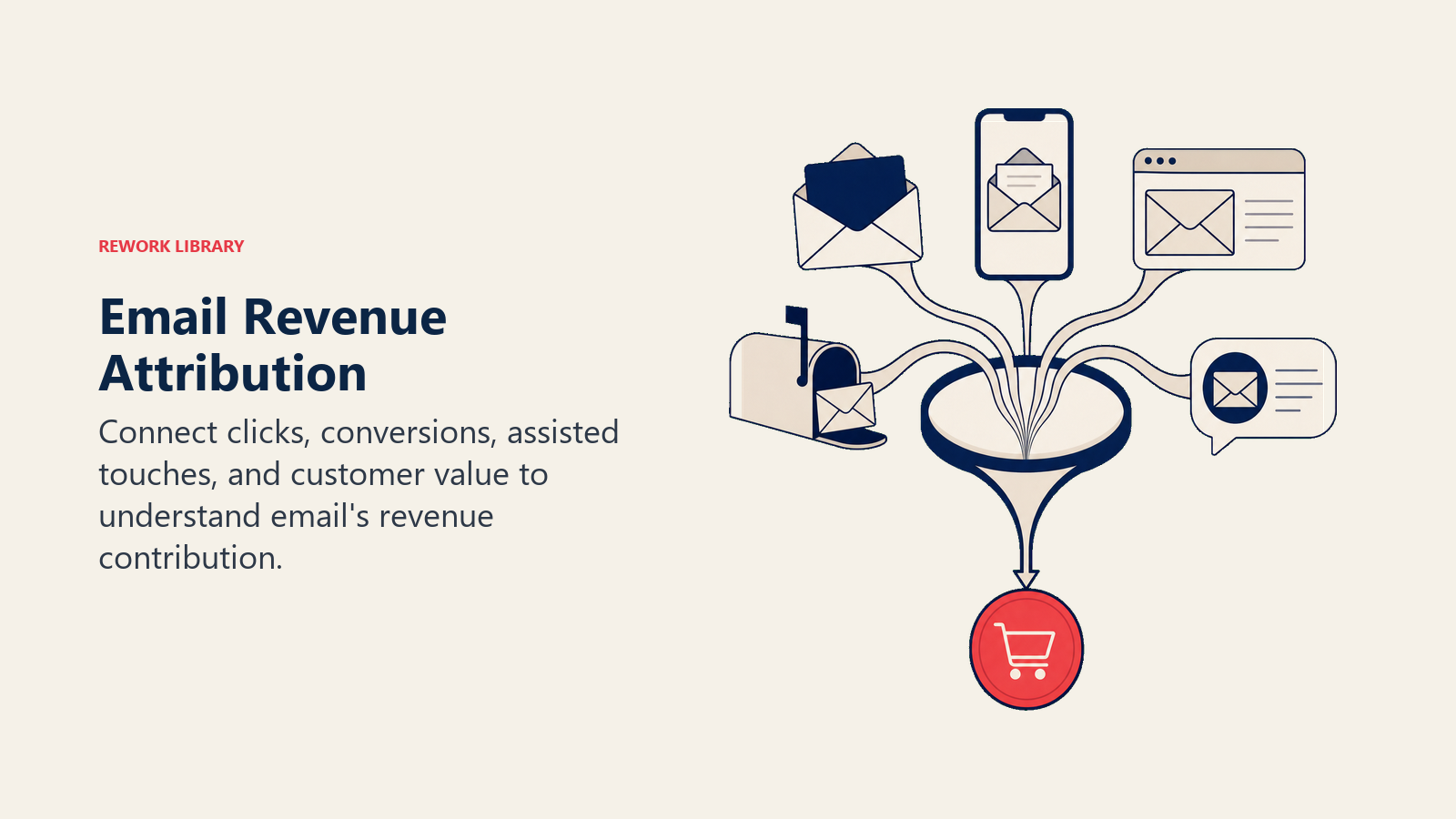
Revenue Attribution and Measurement
What you measure determines what you optimize. Track the right metrics to understand email's true impact.
Direct Revenue Tracking
The most straightforward metrics are directly trackable:
Revenue per email sent: Total revenue divided by emails sent (benchmark: $0.10-0.50 for broadcasts, $1-5 for automated flows)
Revenue per subscriber: Total email revenue divided by list size (benchmark: $5-15 per subscriber annually)
Conversion rate by segment: Purchase rate for different audience segments (reveals which segments need different treatment)
Average order value by email type: AOV from different campaigns and automation (indicates which emails drive higher-value purchases)
These direct metrics tell you which emails are working and which need optimization.
Multi-Touch Attribution
Email often assists conversions that other channels get credit for. Someone might:
- Open your email about a product
- Click through to your site
- Browse and leave
- Return later via Google search
- Purchase
Simple last-click attribution gives all credit to the Google search, but the email was crucial in the customer journey.
Track assisted conversions in Google Analytics and your ESP to understand email's full impact. Many brands find that email influences 50-70% more revenue than it's directly credited with.
Key Performance Metrics
Monitor these Ecommerce Metrics & KPIs to assess email program health:
List growth rate: Net new subscribers as percentage of total list (benchmark: 2-4% monthly)
Open rate: Percentage who open your emails (benchmark: 15-25% for broadcasts, 40-60% for transactional)
Click rate: Percentage who click links (benchmark: 2-5% for broadcasts, 10-20% for transactional)
Unsubscribe rate: Percentage who opt out (keep under 0.3% per send)
Revenue attribution: Percentage of total revenue driven by email (benchmark: 20-30% for mature programs)
Track trends over time rather than obsessing over individual campaign performance. A declining open rate across all campaigns signals a deliverability or content issue.
Email Content Strategy
Great content gets opened, clicked, and converts. Poor content gets ignored or deleted.
Subject Lines and Preview Text
Your subject line and preview text work together to earn the open:
Subject line best practices:
- Keep it under 50 characters (mobile optimization)
- Create curiosity without being clickbait
- Use personalization when it adds value (not just "Hey [First Name]")
- Test emojis (they work for some brands, not others)
- Avoid spam trigger words (free, urgent, act now)
Preview text strategy:
- Extends your subject line, doesn't repeat it
- Adds context or creates additional curiosity
- Optimized separately for mobile (shorter) and desktop (longer)
Test variations consistently. Small improvements in open rates compound into significant revenue gains.
Mobile-First Design
Over 60% of emails are opened on mobile devices. Design for mobile first:
Single-column layouts that stack naturally on small screens
Large, tappable buttons (minimum 44x44 pixels)
Scannable content with clear hierarchy, short paragraphs, and plenty of white space
Fast-loading images optimized for mobile connections
Brief, compelling copy that doesn't require extensive scrolling
Test every email on actual devices before sending. What looks great on desktop often breaks on mobile.
Personalization and Dynamic Content
Basic personalization (first names) is table stakes. Advanced personalization drives real lift:
Product recommendations based on browse and purchase history
Category-specific content based on interests and past behavior
Location-based messaging for local inventory, weather-triggered products, or regional events
Lifecycle stage messaging that changes based on customer tenure and value
A/B test winners dynamically shown to increase performance
The best personalization feels natural, not creepy. Use what you know to be more relevant, not to show off that you're tracking behavior.
Frequency, Timing, and Engagement Management
How often you send matters as much as what you send.
Optimal Frequency
There's no universal right answer, but general guidelines:
Welcome series: Daily or every other day (when engagement is highest)
Regular newsletters: 2-3x per week for engaged subscribers
Promotional campaigns: 3-5x per week during peak seasons, 1-2x per week otherwise
VIP segments: Can handle higher frequency (5-7x per week), especially members of loyalty programs
Re-engagement attempts: Reduce frequency before removing entirely
Monitor engagement metrics by send frequency. If open rates drop as you increase frequency, you're over-mailing. If they stay high, you have room to send more.
Send Time Optimization
Test different send times to find what works for your audience:
B2C e-commerce: Often peaks 8-10am, 12-2pm, and 7-9pm local time
Weekend sends: Work well for some categories (home decor, fashion), poorly for others (B2B products)
Day of week: Tuesday, Wednesday, Thursday often outperform Monday and Friday
Use your ESP's send time optimization if available, it sends to each subscriber at their historically best time.
Preference Centers
Instead of losing subscribers to unsubscribes, offer control:
Frequency preferences: Daily digest, weekly roundup, or just important updates
Content preferences: Product categories, content types, or promotional vs. educational
Channel preferences: Email only, email + SMS, or just SMS
Preference centers reduce unsubscribes by 20-40% while increasing engagement from those who remain.
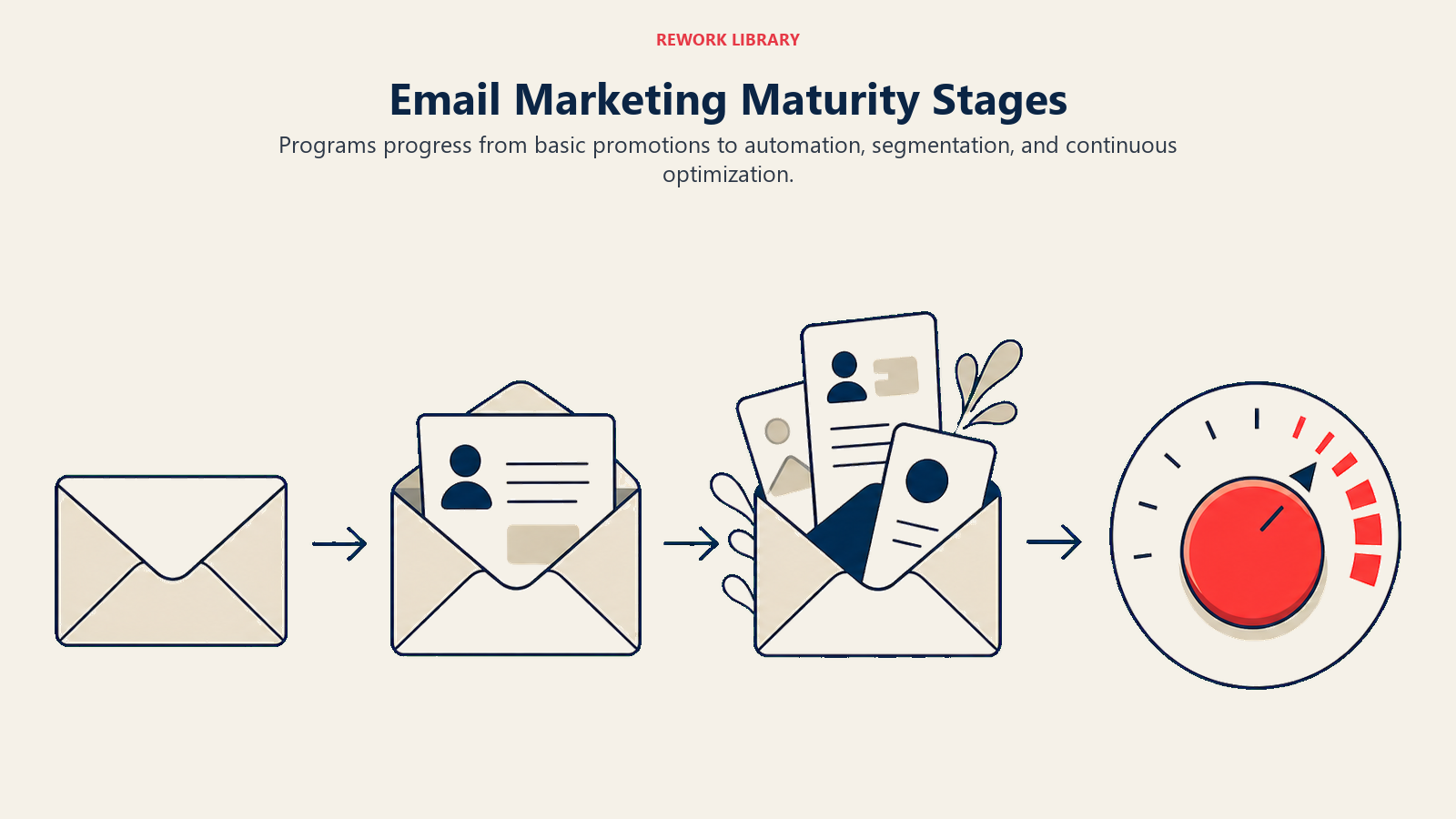
Email Marketing Maturity Stages
Most e-commerce brands evolve through predictable stages:
Stage 1: Basic Promotional (Months 1-6)
- Single welcome email
- Weekly promotional broadcasts
- Basic cart abandonment (single email)
- No segmentation beyond purchasers vs. non-purchasers
Focus: Build list, establish consistent send cadence, achieve basic deliverability
Stage 2: Essential Automation (Months 6-12)
- Multi-email welcome series
- 2-3 email cart abandonment sequence
- Post-purchase sequence
- Basic behavioral segmentation (engaged vs. unengaged)
- Regular A/B testing of subject lines
Focus: Implement core automation, begin segmentation, improve conversion rates
Stage 3: Strategic Segmentation (Year 2)
- RFM segmentation with tailored messaging
- Browse abandonment sequences
- Category-specific campaigns
- Win-back automation
- Lifecycle stage mapping
- Dynamic content and personalization
Focus: Sophisticate segmentation, optimize flows, increase relevance
Stage 4: Advanced Optimization (Year 3+)
- Predictive segmentation using machine learning
- Cross-channel orchestration (email + SMS + push)
- Advanced attribution modeling
- Sunset policies for inactive subscribers
- Extensive A/B testing across segments
- Real-time behavioral triggers
Focus: Maximize efficiency, predict behavior, orchestrate across channels
Most brands get stuck at Stage 2, sending the same emails to everyone. Moving to Stage 3 typically increases email revenue by 40-70%.
Technology Stack and Tool Selection
Your email service provider (ESP) is a critical infrastructure decision.
ESP Selection Criteria
Automation capabilities: Can it handle complex, branching workflows based on behavior?
Segmentation flexibility: How easily can you create and test new segments?
Integration ecosystem: Does it connect cleanly with your e-commerce platform, CRM, and analytics tools?
Deliverability reputation: What's their average inbox placement rate?
Analytics and reporting: Can you track revenue, attribution, and segment performance?
Scalability and pricing: How does pricing scale as your list grows?
Popular options for e-commerce include Klaviyo (best for advanced segmentation), Omnisend (good balance of features and price), Mailchimp (entry-level), and Attentive (if combining with SMS).
Essential Integrations
Your ESP should connect with:
E-commerce platform (Shopify, WooCommerce, BigCommerce): Sync customer data, purchase history, and product catalogs
Analytics tools (Google Analytics, Mixpanel): Track attribution and user journeys
Customer data platform: Unify data from all channels for better segmentation
SMS platform: Coordinate cross-channel campaigns
Review platforms: Trigger review requests post-purchase
Loyalty programs: Sync points, tiers, and rewards to create unified customer lifetime value strategies
Tight integrations enable sophisticated automation and personalization that standalone systems can't achieve.
From Promotional Tool to Revenue Engine
Email marketing isn't just another channel. It's the foundation of profitable e-commerce growth. While paid advertising attracts attention and organic channels build brand awareness, email converts attention into revenue and one-time buyers into lifetime customers.
The brands winning with email aren't sending more emails. They're sending smarter emails. They segment ruthlessly. They automate strategically. They measure precisely. And they treat their email list as the strategic asset it is.
Start with the fundamentals: build a quality list, implement core automation, and maintain strong deliverability. Then layer in segmentation, testing, and optimization. Each improvement compounds over time. Consider integrating SMS marketing for time-sensitive campaigns to complement your email efforts.
Your email program should generate 25-30% of your revenue within 18-24 months. If it's not, you're leaving money on the table.
The highest-ROI marketing channel is already at your fingertips. It's time to use it.
Related Resources
- Cart Abandonment Recovery - Rescue lost revenue with strategic abandonment sequences
- Post-Purchase Email Sequences - Turn one-time buyers into repeat customers
- Customer Segmentation - Build targeted email campaigns that convert
- Marketing Automation - Create scalable automated workflows
- Customer Lifetime Value - Maximize value through retention marketing
- Customer Retention Strategies - Keep customers coming back
- Product Recommendations & Personalization - Deliver relevant content to each subscriber
- Loyalty Programs - Integrate rewards with email marketing
- SMS Marketing Strategy - Complement email with SMS for key moments
- Ecommerce Metrics & KPIs - Track the metrics that matter for email performance
- Traffic Acquisition Strategy - Build your email list with strategic traffic sources

On this page
- What Is Email Marketing for E-commerce?
- Why Email Marketing Matters for E-commerce Growth
- Email List Building and Growth Strategy
- Lead Magnet Strategy
- List Building Channels
- Email Segmentation Strategy
- Behavioral Segmentation
- RFM Analysis
- Lifecycle Stage Segmentation
- Automation Workflows and Sequences
- Welcome Series (Days 1-14)
- Cart Abandonment Sequence
- Browse Abandonment
- Post-Purchase Sequence
- Win-Back Sequence
- Email Deliverability and Compliance
- Sender Reputation
- Authentication and Technical Setup
- List Hygiene and Compliance
- Revenue Attribution and Measurement
- Direct Revenue Tracking
- Multi-Touch Attribution
- Key Performance Metrics
- Email Content Strategy
- Subject Lines and Preview Text
- Mobile-First Design
- Personalization and Dynamic Content
- Frequency, Timing, and Engagement Management
- Optimal Frequency
- Send Time Optimization
- Preference Centers
- Email Marketing Maturity Stages
- Stage 1: Basic Promotional (Months 1-6)
- Stage 2: Essential Automation (Months 6-12)
- Stage 3: Strategic Segmentation (Year 2)
- Stage 4: Advanced Optimization (Year 3+)
- Technology Stack and Tool Selection
- ESP Selection Criteria
- Essential Integrations
- From Promotional Tool to Revenue Engine
- Related Resources