Customer Reviews & User-Generated Content: Leveraging Social Proof to Drive E-commerce Conversions
 Customer reviews and user-generated content are one of the highest-ROI levers in e-commerce growth: product pages with reviews convert 15 to 30 percent better than those without, and 79 percent of shoppers say UGC shapes what they buy. The brands that win treat reviews as a systematic program, not something that happens on its own.
Turn this article into takeaways for your work.


Each assistant summarizes the article only for you and suggests best practices for your work.
You've spent thousands perfecting your product pages. Professional photography. Compelling copy. Every detail optimized. But your conversion rate is stuck at 2%.
Then you add customer reviews and photos to your product pages. Within a month, conversion rate jumps to 3.2%. That's a 60% increase in sales from the same traffic.
That's the power of customer reviews and user-generated content (UGC). When shoppers see real people using and loving your products, trust barriers dissolve. The purchase decision becomes easier.
But here's what most e-commerce brands get wrong: they treat reviews and UGC as something that happens organically, hoping customers leave feedback on their own. The brands that actually generate meaningful review volume understand something different. This isn't passive - it requires systematic programs, clear processes, and ongoing effort.
Here's how to build review and UGC programs that drive conversions, build trust, and create marketing assets you can use everywhere.
Why Customer Reviews and UGC Matter: The Trust Gap
Online shopping has a fundamental trust problem. You can't touch the product. Can't try it on. Can't see it in person. All you have are the brand's marketing claims and a few photos. Reviews and UGC solve this trust gap. They're third-party validation that your product actually delivers on its promises. As powerful forms of trust signals and social proof, they turn skeptical visitors into confident buyers.
The data backs this up:
- 88% of consumers trust online reviews as much as personal recommendations
- Product pages with reviews see 15-30% higher conversion rates than those without
- 79% of consumers say user-generated content impacts their purchasing decisions
- Products with 50+ reviews convert 4.6x better than products with no reviews
When integrated with your broader conversion rate optimization strategy, reviews and UGC become your most powerful tools for turning browsers into buyers.
Understanding Reviews and UGC: Different Types of Social Proof
Before building programs, understand what you're collecting. Customer reviews are structured feedback including star ratings, written text, and sometimes photos or videos. They appear on product pages, in search results, and across your marketing. Reviews work because they're comparable and tied directly to products.
User-generated content is visual content created by customers - photos, videos, unboxing content, styling examples. UGC works because it's authentic. No professional styling or unrealistic scenarios. Just real people using real products in their real lives. While product photography and video are essential for showcasing products, UGC provides the authentic perspective that builds trust.
Testimonials are curated customer quotes highlighting specific benefits or outcomes. They work best on homepages, landing pages, and in sales materials where you need focused social proof.
Each type serves different purposes, but all build the trust needed to convert hesitant shoppers into buyers.
The Review Generation Framework: Getting Customers to Leave Feedback
Here's the problem: only 5-10% of customers leave reviews naturally. Most satisfied customers simply don't think to write reviews unless you ask. Building a review generation system means systematically requesting feedback from every customer at the right time, through the right channel, with the right incentive.
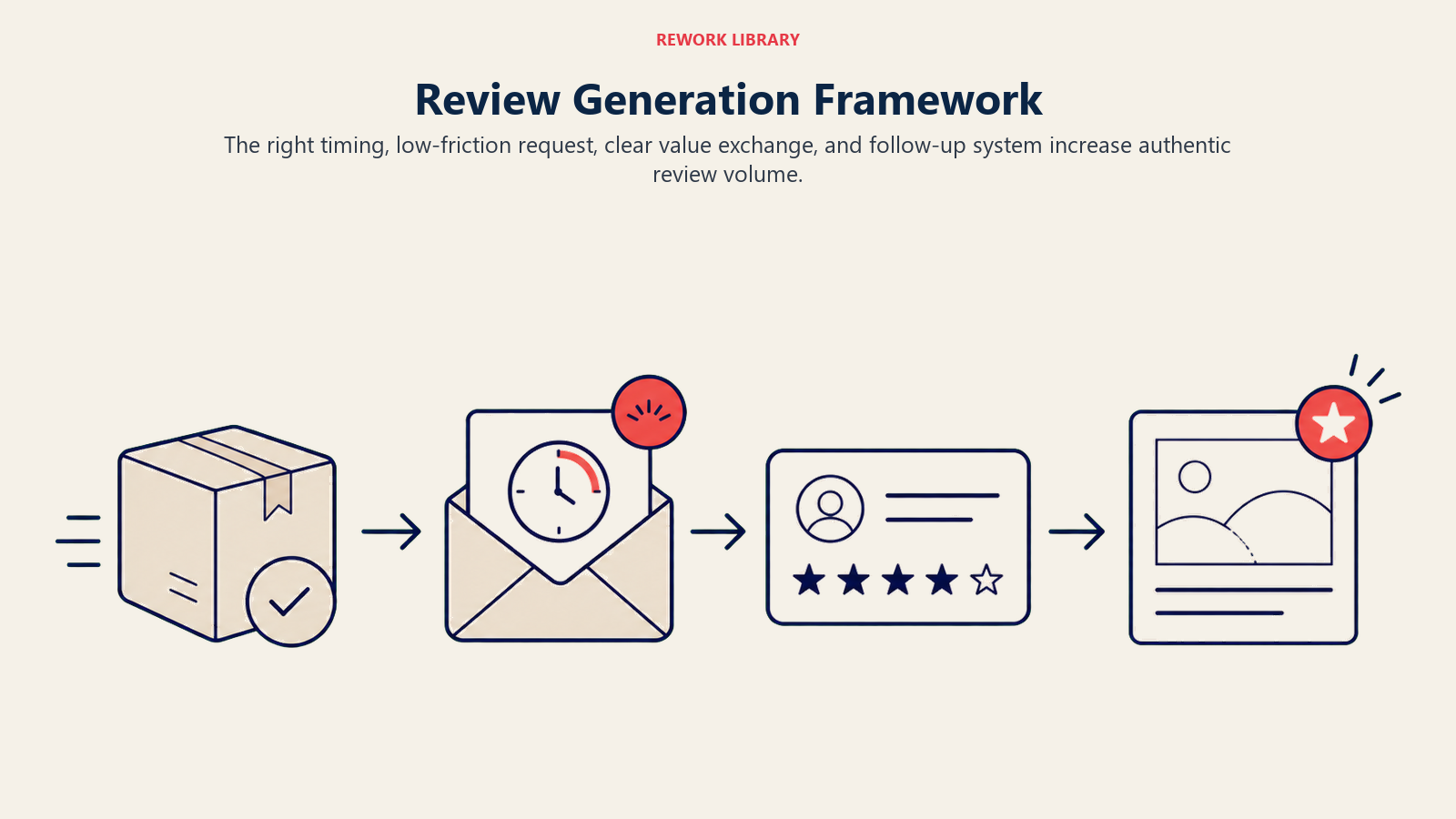
Timing strategy: when to ask for reviews
Asking too early means customers haven't used the product yet. Too late and they've forgotten about the purchase.
Optimal timing by product type:
- Fashion and accessories: 14-21 days (enough time to wear, still excited)
- Beauty and skincare: 21-30 days (can see results, multiple uses)
- Electronics: 7-14 days (setup complete, features tested)
- Home goods: 14-21 days (integrated into home, regular use)
- Food and consumables: 7-10 days (product consumed, can assess quality)
Don't just send one request. Use a multi-touch sequence: first request at optimal timing, second follow-up 7-10 days later for non-responders.
Channel selection: where to request reviews
Different customers respond to different channels. Use multiple touchpoints for maximum response rates.
Email requests remain the workhorse of review generation. They allow for personalized messaging, product images, and detailed explanations. Send personalized emails referencing the specific product purchased with a large, clear CTA button linking directly to the review form. For more on email sequencing strategy, see post-purchase email sequences.
SMS requests work well for younger demographics with very high open rates (98%). Keep messages short and friendly: "Hey [Name]! How's your [Product]? Leave a quick review: [link]"
Packaging inserts catch customers during unboxing at peak excitement. Include a simple card with QR code linking to your review form.
Incentive strategies that stay compliant
Should you offer incentives? Yes - but carefully, to stay compliant with FTC regulations.
Acceptable approaches:
- Reward for any review (not just positive ones): 10% off next purchase
- Entry into monthly giveaway for reviewers
- Loyalty points for submitting feedback
- Charitable donations for each review
The key: reward the act of reviewing, not the rating given. Never offer incentives specifically for positive reviews - that violates FTC guidelines and destroys trust.
Friction reduction: making review submission effortless
The easier reviewing is, the more reviews you get.
Simplify your review form:
- Start with just star rating (easiest commitment)
- Make written review optional
- Allow anonymous reviews
- Pre-fill customer name and product details
- Enable one-click submission from email
Each additional field or step dramatically reduces completion rates. Start with the minimum and use progressive enhancement - customers who want to elaborate can add details after submitting their rating.
Review Platform Selection: Choosing the Right Infrastructure
You need somewhere to collect, display, and manage reviews. The platform you choose affects everything from collection rates to SEO value.
Popular platforms compared
Judge.me - Best for Shopify stores on tight budgets. Free to $15/month with strong Shopify integration, photo/video reviews, and Google Shopping integration.
Yotpo - Best for growing brands. Free tier available, paid plans $19-$500+/month. Robust automation, UGC galleries, SMS requests, and loyalty integration.
Trustpilot - Best for external credibility. $199-$1,000+/month. Independent trusted brand with strong SEO domain authority and industry credibility.
Stamped.io - Best for features and flexibility. Free to $89+/month with comprehensive features, Instagram integration, and custom workflows.
Choose based on your platform, budget, and specific feature requirements. Most offer free trials - test before committing. Many platforms also integrate with Google Shopping Ads, automatically syncing review data to improve ad performance.
Integration and SEO optimization
Reviews only help if customers can see them and search engines can index them.
On-site integration points:
- Product pages: Star rating summary above fold, detailed reviews below description
- Category pages: Aggregate ratings on product cards
- Homepage: Featured positive reviews, recent review stream
SEO optimization:
- Implement schema.org structured data markup
- Include review data in product structured data
- Make reviews crawlable (not JavaScript-only)
- Submit review feeds to Google Merchant Center
Reviews with proper structured data appear as rich snippets in Google search results - showing star ratings directly in search listings. This massively improves click-through rates. For more on technical implementation, see analytics and tracking setup. Review-rich snippets also enhance your broader e-commerce SEO strategy by increasing organic visibility and click-through rates.
Managing Negative Reviews: Turning Problems into Opportunities
Negative reviews will happen. How you handle them matters more than the reviews themselves.
Response protocols that work

Not every review needs a response, but negative ones absolutely do.
Response timeline standards:
- Critical issues (safety, major defects): Within 24 hours
- Negative reviews (1-2 stars): Within 48 hours
- Neutral reviews (3 stars): Within 72 hours
Effective response framework:
- Acknowledge and empathize: "I'm really sorry you had this experience with [Product]."
- Take responsibility: "We should have caught this issue before it reached you."
- Offer resolution: "I'd love to send you a replacement and a full refund."
- Show improvement: "We've made changes to prevent this in the future."
Never argue with customers publicly. Even if they're wrong, you can clarify politely while validating their frustration. A good response to a negative review can turn a detractor into an advocate.
Mining reviews for product insights
Reviews are product feedback goldmines. They tell you exactly what's working and what's not.
Track common complaints by category:
- Product quality issues
- Sizing or fit problems
- Functionality expectations
- Shipping concerns
- Value for money
If 20% of reviews mention sizing runs small, that's actionable product feedback. Share insights with product, marketing, and operations teams. Reviews are direct voice-of-customer data. Building a systematic customer feedback loop ensures these insights drive continuous product improvement.
User-Generated Content Strategy: Getting Customers to Share
Reviews are structured feedback. UGC is creative content. You need both.
Hashtag campaigns that work

Branded hashtags turn customer social posts into discoverable content you can curate and use.
Creating effective branded hashtags:
- Make it memorable and simple
- Relevant to brand or product
- Unique (not already widely used)
Examples: #MyMorningRitual (coffee brand), #PackedWithPeak (outdoor gear)
Promote your hashtag:
- Feature on product packaging and receipts
- Include in email marketing and social bios
- Run monthly contests for best post
- Feature customer posts on your channels. Consider partnering with creators through influencer marketing to amplify your hashtag's reach
Content rights and legal usage
You can't just use any customer photo you find online. You need permission.
Getting proper permissions:
- Include usage rights language in submission forms
- Request explicit permission when you find great content
- Use UGC platforms that automate permission requests
- Always credit and tag original creators
What you need permission for:
- Random social media posts (even with your hashtag)
- Customer photos not submitted directly
- Content reshared by others
Proper rights management protects you legally and respects your customers.
Displaying UGC Across Your E-commerce Ecosystem
Collecting UGC is step one. Strategic display is where conversion impact happens.
Product page integration
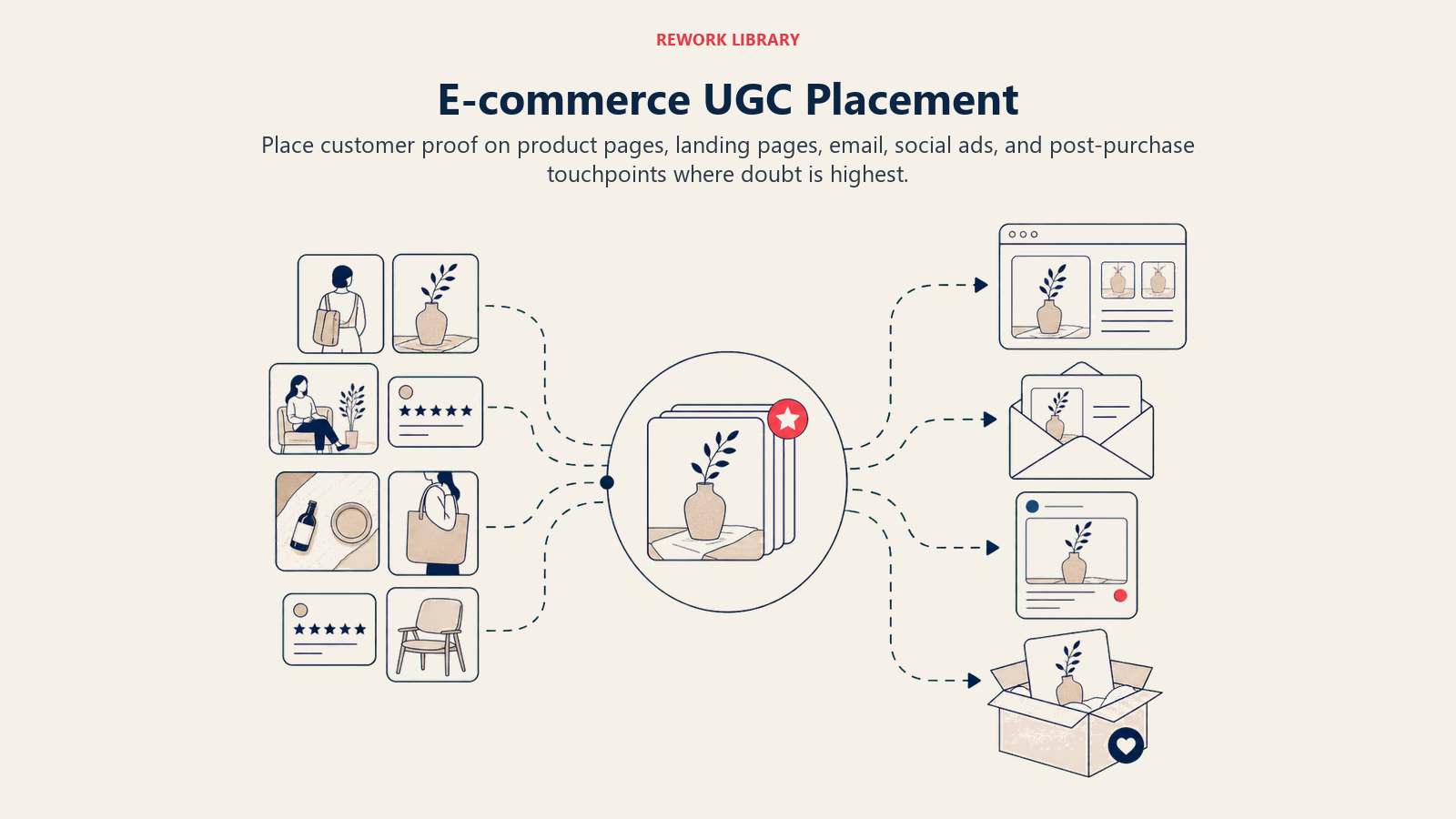
Product pages are your highest-intent traffic. UGC here drives maximum conversion impact.
Optimal placement:
- Above fold: Star rating summary, review count, recent customer photo preview
- Mid-page: Customer photo gallery after product description
- Below fold: Detailed review feed with filters and sorting
For complete product page optimization strategies, see product page optimization.
Multi-channel UGC usage
UGC works everywhere, not just on your website.
Social media: Repost customer content, create customer spotlight series, share review quotes as graphics.
Email marketing: Include customer photos in promotional emails, add review quotes to product recommendations, feature customer stories. Integrating reviews into your email marketing for e-commerce campaigns significantly increases engagement and conversion rates.
Paid advertising: Use customer photos instead of professional shots, include review quotes in ad copy, show star ratings in creative. Ads featuring reviews typically see 20-40% higher click-through rates. For more on social advertising, see Facebook & Instagram Ads.
Review Analytics: Measuring Impact and Optimizing Performance
Track review program performance to understand what's working.
Key metrics to monitor
Collection metrics:
- Review submission rate (% who submit after request)
- Reviews collected per month
- Review/order ratio
Quality metrics:
- Average star rating
- Reviews with photos (%)
- Word count average
Business impact metrics:
- Conversion rate by review count
- Return rate correlation with reviews
- Revenue attributed to reviews
Most brands see conversion rate lift of 15-30% once products reach 20-50 reviews. Products with 100+ reviews often convert 2-3x better than products with no reviews.
A/B testing and optimization
Test review display variations:
- Products with reviews visible vs hidden
- Review placement on page
- Filter and sort options
- Photo gallery layouts
Use data to continuously improve review collection and display strategies.
Legal and Compliance: Staying on the Right Side of Regulations
Review programs must comply with FTC regulations and platform policies.
FTC guidelines essentials
What's allowed:
- Offering incentives for honest reviews of any rating
- Providing free products for review (with disclosure)
- Running contests for reviewers
What's not allowed:
- Paying for positive reviews only
- Suppressing negative reviews
- Posting fake reviews
- Failing to disclose material connections
If you provide incentives, reviews must disclose this. Most platforms add "Incentivized review" badges automatically.
Review authenticity verification
Maintain authenticity through:
- Verified purchase badges
- Email verification for reviewers
- Manual moderation of suspicious reviews
- Pattern detection for fraud
Fake reviews damage trust and violate laws. Most review platforms include fraud detection, but maintain your own quality standards.
Building Your Review and UGC Program: 90-Day Action Plan
Ready to build a systematic program? Here's your roadmap.
Month 1: Foundation
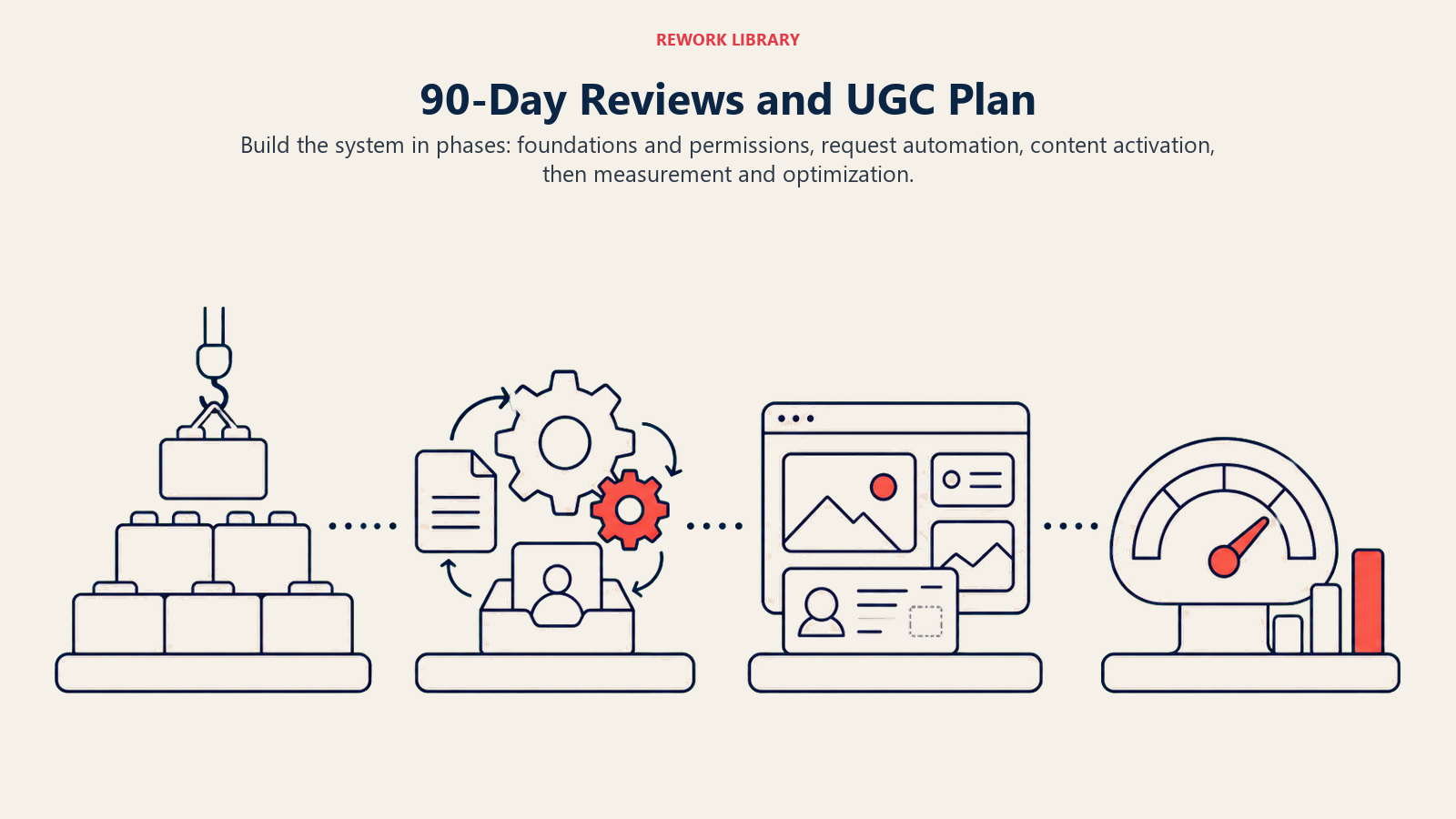
Week 1: Research and select review platform, integrate with e-commerce platform, configure review display.
Week 2: Create review request email templates, set up automated campaigns, design submission form.
Week 3: Create response templates, define timeline standards, assign monitoring responsibilities.
Week 4: Audit current review status, document baseline conversion rates, launch automated requests.
Month 2: Optimization
Week 5: Test incentive offers, add SMS requests, A/B test timing, optimize forms for mobile.
Week 6: Add reviews to category pages, implement structured data for SEO, add highlights to homepage.
Week 7: Create branded hashtag, design packaging inserts, launch social campaign, set up photo submission.
Week 8: Analyze month 1 performance, identify high/low performers, adjust messaging, document wins.
Month 3: Amplification
Week 9: Extract testimonials for website, create email templates with reviews, design social posts with quotes.
Week 10: Add customer photo galleries, create Instagram highlights, feature customer stories in email.
Week 11: Add review filtering/sorting, implement Q&A functionality, test video reviews.
Week 12: Calculate conversion impact, review sentiment analysis, identify top performers, plan next quarter.
Goals: 25%+ review submission rate, reviews integrated across channels, measurable conversion lift, systematic UGC collection.
Moving Forward: Reviews as Conversion Infrastructure
Customer reviews and UGC aren't nice-to-haves. They're essential conversion infrastructure for modern e-commerce.
You can perfect your product photography and write compelling descriptions, but if visitors don't trust you, none of it matters. Reviews and UGC build that trust.
Start simple:
- Choose a review platform and set up automated collection
- Get your first 100 reviews through systematic requests
- Display reviews prominently on product pages
- Respond to every negative review within 48 hours
- Launch a basic UGC hashtag campaign
Then optimize based on data. Test incentives and timing. Add photo and video reviews. Integrate reviews across marketing channels. Use sentiment analysis for product improvements.
Reviews and UGC compound over time. Every review makes the next sale easier. Every customer photo adds social proof. Every piece of feedback improves your products.
Six months from now, reviews could be your highest-ROI marketing channel. Not because you're spending more, but because you're systematically capturing and leveraging customer validation at scale.
The brands winning with reviews aren't lucky. They're systematic. They ask every customer. They make submission easy. They display reviews everywhere. They use feedback to improve.
Your customers already have opinions about your products. The question is whether you're capturing and amplifying those opinions to help future customers make purchase decisions.
Start building that system today.
Frequently Asked Questions
How much do customer reviews actually lift e-commerce conversion? Product pages with reviews typically convert 15 to 30 percent better than pages without them, and products with 50 or more reviews convert about 4.6x better than products with none. The lift compounds: every review you collect makes the next sale a little easier, which is why reviews behave more like infrastructure than a one-time campaign.
What percentage of customers leave a review on their own? Only about 5 to 10 percent of customers leave a review without being asked. That's why a review generation system matters. Brands that request feedback systematically, at the right moment and through the right channel, routinely push submission rates above 25 percent.
When is the best time to ask for a review? It depends on the product. Fashion and home goods convert best at 14 to 21 days after delivery, beauty at 21 to 30 days, and electronics at 7 to 14 days once setup is done. The goal is to ask after the customer has experienced real value but before the purchase fades from memory, then follow up once for non-responders.
Can I offer an incentive for reviews without breaking FTC rules? Yes, as long as you reward the act of reviewing, not the rating. Offering a discount, loyalty points, or a giveaway entry for an honest review of any star rating is compliant. Paying only for positive reviews, or suppressing negative ones, violates FTC guidelines and damages trust.
What's the difference between reviews and UGC? Reviews are structured feedback tied to a product, usually a star rating plus text and sometimes photos. UGC is creative visual content customers make on their own, such as photos, unboxing clips, and styling examples. Reviews build comparable, product-level trust; UGC adds authentic real-world proof. A strong trust signals and social proof program uses both.
How do reviews help SEO and search click-through? When you mark up reviews with structured data, Google can show star ratings as rich snippets in search results, which lifts organic click-through rates. That visibility strengthens your broader e-commerce SEO strategy and feeds your overall conversion rate optimization work.
Learn More
Deepen your understanding of reviews, UGC, and related conversion optimization strategies:
Conversion Optimization
- Conversion Rate Optimization (CRO) - Systematic approach to improving conversion
- Product Page Optimization - Optimize product pages for maximum sales
- Trust Signals & Social Proof - Build credibility that converts
Content & Marketing
- Product Photography & Video - Create visual content that sells
- Email Marketing for E-commerce - Leverage email for retention and sales
- Post-Purchase Email Sequences - Nurture customers after purchase
- Influencer Marketing - Build partnerships with content creators
Analytics & Measurement
- Analytics & Tracking Setup - Measure what matters for growth

On this page
- Why Customer Reviews and UGC Matter: The Trust Gap
- Understanding Reviews and UGC: Different Types of Social Proof
- The Review Generation Framework: Getting Customers to Leave Feedback
- Timing strategy: when to ask for reviews
- Channel selection: where to request reviews
- Incentive strategies that stay compliant
- Friction reduction: making review submission effortless
- Review Platform Selection: Choosing the Right Infrastructure
- Popular platforms compared
- Integration and SEO optimization
- Managing Negative Reviews: Turning Problems into Opportunities
- Response protocols that work
- Mining reviews for product insights
- User-Generated Content Strategy: Getting Customers to Share
- Hashtag campaigns that work
- Content rights and legal usage
- Displaying UGC Across Your E-commerce Ecosystem
- Product page integration
- Multi-channel UGC usage
- Review Analytics: Measuring Impact and Optimizing Performance
- Key metrics to monitor
- A/B testing and optimization
- Legal and Compliance: Staying on the Right Side of Regulations
- FTC guidelines essentials
- Review authenticity verification
- Building Your Review and UGC Program: 90-Day Action Plan
- Month 1: Foundation
- Month 2: Optimization
- Month 3: Amplification
- Moving Forward: Reviews as Conversion Infrastructure
- Frequently Asked Questions
- Learn More
- Conversion Optimization
- Content & Marketing
- Analytics & Measurement